
Judges 6:15

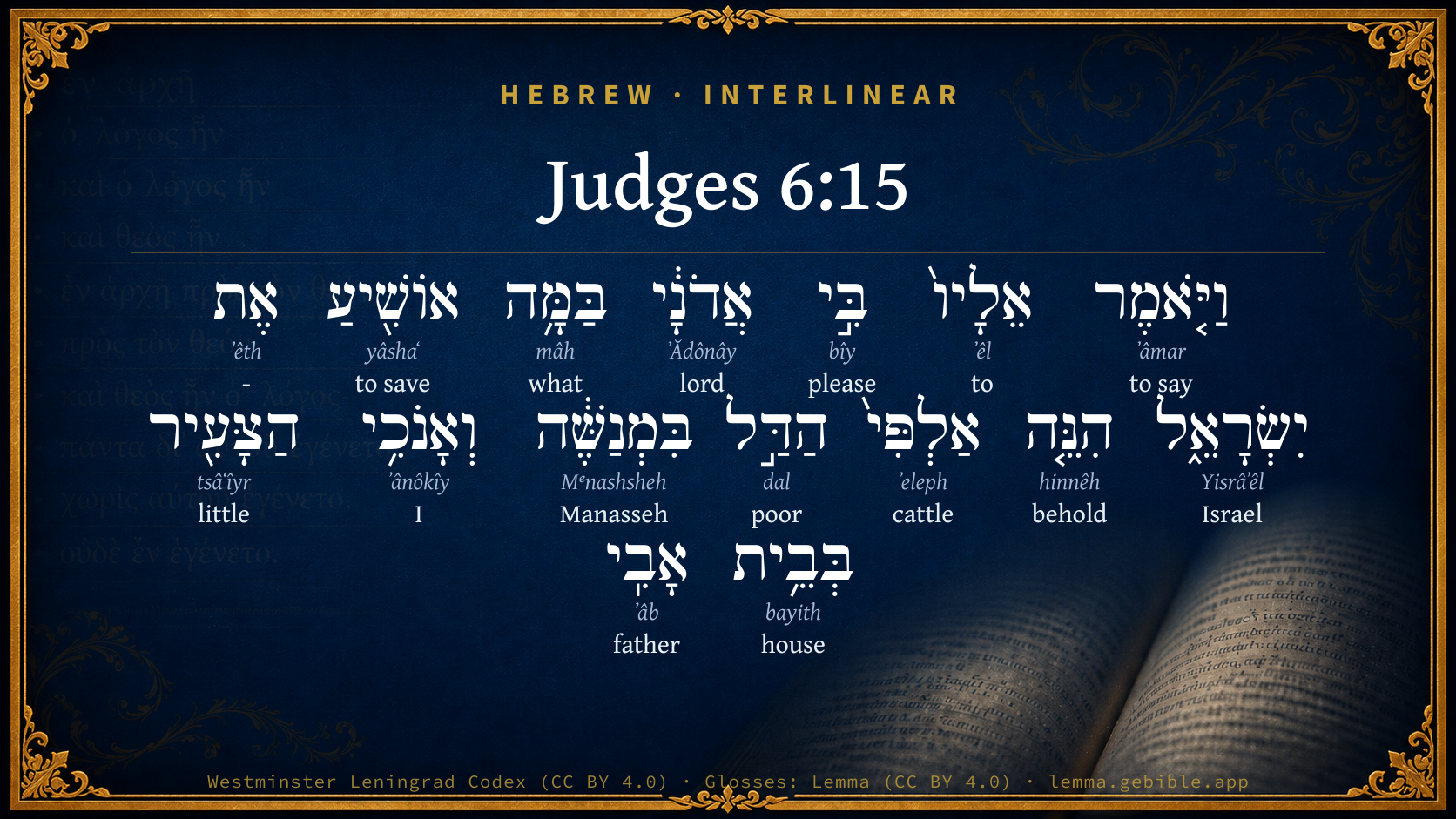
Hebrew (Westminster Leningrad Codex) Judges 6:15 appears in the Hebrew Old Testament. The text above is from the Westminster Leningrad Codex. Each word links to its Strong’s number, a concise gloss, and parsing drawn from the Open Scriptures Hebrew Bible morphology. Click any word for its full Brown-Driver-Briggs (BDB) entry.
Download image
Cite this verse

Judges 6:15 (World English Bible). Public Domain. Lemma interlinear Bible study tool, https://lemma.gebible.app/v/judges/6/15.

Show BibTeX & RIS
BibTeX
RIS
English Translation
He said to him, Oh, Lord, with which shall I save Israel? behold, my family is the poorest in Manasseh, and I am the least in my father's house.
World English Bible · Public Domain
Download a study sheet

One document with this verse’s original text, its word-by-word gloss line, the meaning frame, cross-references with their text, attributed commentary, and full source and license credits — printable, and it pastes into notes with its structure intact.

This verse Autodidact and up

Study sheet (.html) Plain text (.txt)

A passage Seminary Student

Up to 50 verses in one chapter. A passage sheet keeps up to 6 commentary sources and 12 cross-references per verse, in the order this page ranks them, and says so on the sheet whenever that leaves anything out. Ask for a single verse and you get the Autodidact verse sheet above.

Everything on this page stays free to read, with no account — the sheet is a download of what is already on screen, not access to it.

Want to remove ads? Support Godless Engineer
Compare translations 3

The same verse in 3 English versions, stacked beneath the original-language interlinear above. Click any original word for its lexicon entry.

Each is an independent rendering of the whole verse — the interlinear is not word-aligned to these translations.

Highlighted words mark where these versions differ — a whole-verse word diff, not a word-by-word alignment.

  • World English Bible Public Domain
    He said to him, Oh, Lord, with which shall I save Israel? behold, my family is the poorest in Manasseh, and I am the least in my father's house.
  • King James Version Public Domain
    And he said unto him, Oh my Lord, wherewith shall I save Israel? behold, my family is poor in Manasseh, and I am the least in my father's house.
  • unfoldingWord Literal Text CC BY-SA 4.0
    And he said to him, “Excuse me, my lord, by what shall I save Israel? Behold, my thousand the weak in Manasseh, and I the young in the house of my father.”

unfoldingWord Literal Text — © unfoldingWord, licensed CC BY-SA 4.0. Word-aligned USFM3 via Door43 (git.door43.org/unfoldingWord/en_ult).

Versions to compare (up to 4)

3 of 4 selected

Show all 18 translations

Every available English version of this verse, each an independent rendering of the whole verse.

  • World English Bible Public Domain
    He said to him, Oh, Lord, with which shall I save Israel? behold, my family is the poorest in Manasseh, and I am the least in my father's house.
  • Berean Standard Bible Public Domain
    “Please, my Lord,” Gideon replied, “how can I save Israel? Indeed, my clan is the weakest in Manasseh, and I am the youngest in my father’s house.”
  • Majority Standard Bible Public Domain
    “Please, my Lord,” Gideon replied, “how can I save Israel? Indeed, my clan is the weakest in Manasseh, and I am the youngest in my father’s house.”
  • King James Version Public Domain
    And he said unto him, Oh my Lord, wherewith shall I save Israel? behold, my family is poor in Manasseh, and I am the least in my father's house.
  • American Standard Version (1901) Public Domain
    And he said unto him, Oh, Lord, wherewith shall I save Israel? behold, my family is the poorest in Manasseh, and I am the least in my father's house.
  • Revised Version (1885) Public Domain
    And he said unto him, Oh Lord, wherewith shall I save Israel? behold, my family is the poorest in Manasseh, and I am the least in my father’s house.
  • Geneva Bible (1599) Public Domain
    And he answered him, Ah my Lord, whereby shall I saue Israel? beholde, my father is poore in Manasseh, and I am the least in my fathers house.
  • Douay-Rheims (1899) Public Domain
    And the Lord looked upon him, and said: Go in this thy strength, and then shalt deliver Israel out of the hand of Madian: know that I have sent thee.
  • Young's Literal Translation Public Domain
    And he saith unto him, `O, my lord, wherewith do I save Israel? lo, my chief `is' weak in Manasseh, and I the least in the house of my father.'
  • Literal Standard Version CC BY-SA 4.0
    And he says to Him, “O my Lord, with what do I save Israel? Behold, my chief [is] weak in Manasseh, and I [am] the least in the house of my father.”
  • Unlocked Literal Bible CC BY-SA 4.0
    Gideon said to him, “Please, Lord, how can I deliver Israel? See, my family is the weakest in Manasseh, and I am the least important in my father's house.”
  • unfoldingWord Literal Text CC BY-SA 4.0
    And he said to him, “Excuse me, my lord, by what shall I save Israel? Behold, my thousand the weak in Manasseh, and I the young in the house of my father.”
  • Darby Bible Public Domain
    And he said to him, "Pray, Lord, how can I deliver Israel? Behold, my clan is the weakest in Manas'seh, and I am the least in my family."
  • World Messianic Bible Public Domain
    He said to him, “O Lord, how shall I save Israel? Behold, my family is the poorest in Manasseh, and I am the least in my father’s house.”
  • Webster's Bible Public Domain
    And he said to him, O my Lord, by what means shall I save Israel? behold, my family is poor in Manasseh, and I am the least in my father's house.
  • Free Bible Version CC BY-SA 4.0
    “Excuse me, my lord, but how can I save Israel?” Gideon replied. “My family is the least important of the tribe of Manasseh, and I am the least important person of that family!”
  • Bible in Basic English Public Domain
    And he said to him, O Lord, how may I be the saviour of Israel? See, my family is the poorest in Manasseh, and I am the least in my father's house.
  • JPS Tanakh (1917) Public Domain
    And he said unto him: 'Oh, my lord, wherewith shall I save Israel? behold, my family is the poorest in Manasseh, and I am the least in my father's house.'

Literal Standard Version (2020), Covenant Press — licensed CC BY-SA 4.0. Text via the HelloAO Bible API (eBible.org). Unlocked Literal Bible (unfoldingWord) — licensed CC BY-SA 4.0. Text via the HelloAO Bible API (eBible.org). unfoldingWord Literal Text — © unfoldingWord, licensed CC BY-SA 4.0. Word-aligned USFM3 via Door43 (git.door43.org/unfoldingWord/en_ult). Free Bible Version, Dr. Jonathan Gallagher — licensed CC BY-SA 4.0. Text via the HelloAO Bible API (eBible.org).

Word by word

More ways to search: Search by grammar → Find every occurrence → Compare this word →

Practice this passage: Drill this verse → Learn its vocabulary →

אַלְפִּי֙
ʼeleph
H504
“cattle · my”
Noun, Common, Masculine, Singular, Construct + Suffix, Personal, 1st Person, Common, Singular
Part of Speech
Noun
Type
Common
Gender
Masculine
Number
Singular
State
Construct
Full BDB Definition

Origin: from H502

TWOT: 108a

cattle, oxen - in farming - as a possession
  1. וַיֹּ֤אמֶר ʼâmar H559 “and · to say” Conjunction + Verb, Qal, Sequential Imperfect, 3rd Person, Masculine, Singular
  2. אֵלָיו֙ ʼêl H413 “to · him” Preposition + Suffix, Personal, 3rd Person, Masculine, Singular
  3. בִּ֣י bîy H994 “please” Particle, Exhortation
  4. אֲדֹנָ֔י ʼĂdônây H136 “Lord · my” Noun, Common, Masculine, Plural, Construct + Suffix, Personal, 1st Person, Common, Singular
  5. בַּמָּ֥ה mâh H4100 “in/at · what” Preposition + Particle, Interrogative
  6. אוֹשִׁ֖יעַ yâshaʻ H3467 “to save” Verb, Hiphil, Imperfect, 1st Person, Common, Singular
  7. אֶת ʼêth H853 “-” Particle, Direct Object
  8. יִשְׂרָאֵ֑ל Yisrâʼêl H3478 “Israel” Noun, Proper
  9. הִנֵּ֤ה hinnêh H2009 “behold” Particle, Demonstrative
  10. הַדַּ֣ל dal H1800 “the · poor” Particle, Definite Article + Adjective, Adjective, Masculine, Singular, Absolute
  11. בִּמְנַשֶּׁ֔ה Mᵉnashsheh H4519 “in/at · Manasseh” Preposition + Noun, Proper
  12. וְאָנֹכִ֥י ʼânôkîy H595 “and · I” Conjunction + Pronoun, Personal, 1st Person, Common, Singular
  13. הַצָּעִ֖יר tsâʻîyr H6810 “the · little” Particle, Definite Article + Adjective, Adjective, Masculine, Singular, Absolute
  14. בְּבֵ֥ית bayith H1004 “in/at · house of” Preposition + Noun, Common, Masculine, Singular, Construct
  15. אָבִֽי ʼâb H1 “father · my” Noun, Common, Masculine, Singular, Construct + Suffix, Personal, 1st Person, Common, Singular

About this verse

These counts appear in no published source. They are computed here, from the morphology-tagged text and Lemma’s own curated glosses. What Lemma adds →

16
words
16
distinct lemmas
Historical
section

Notable vocabulary

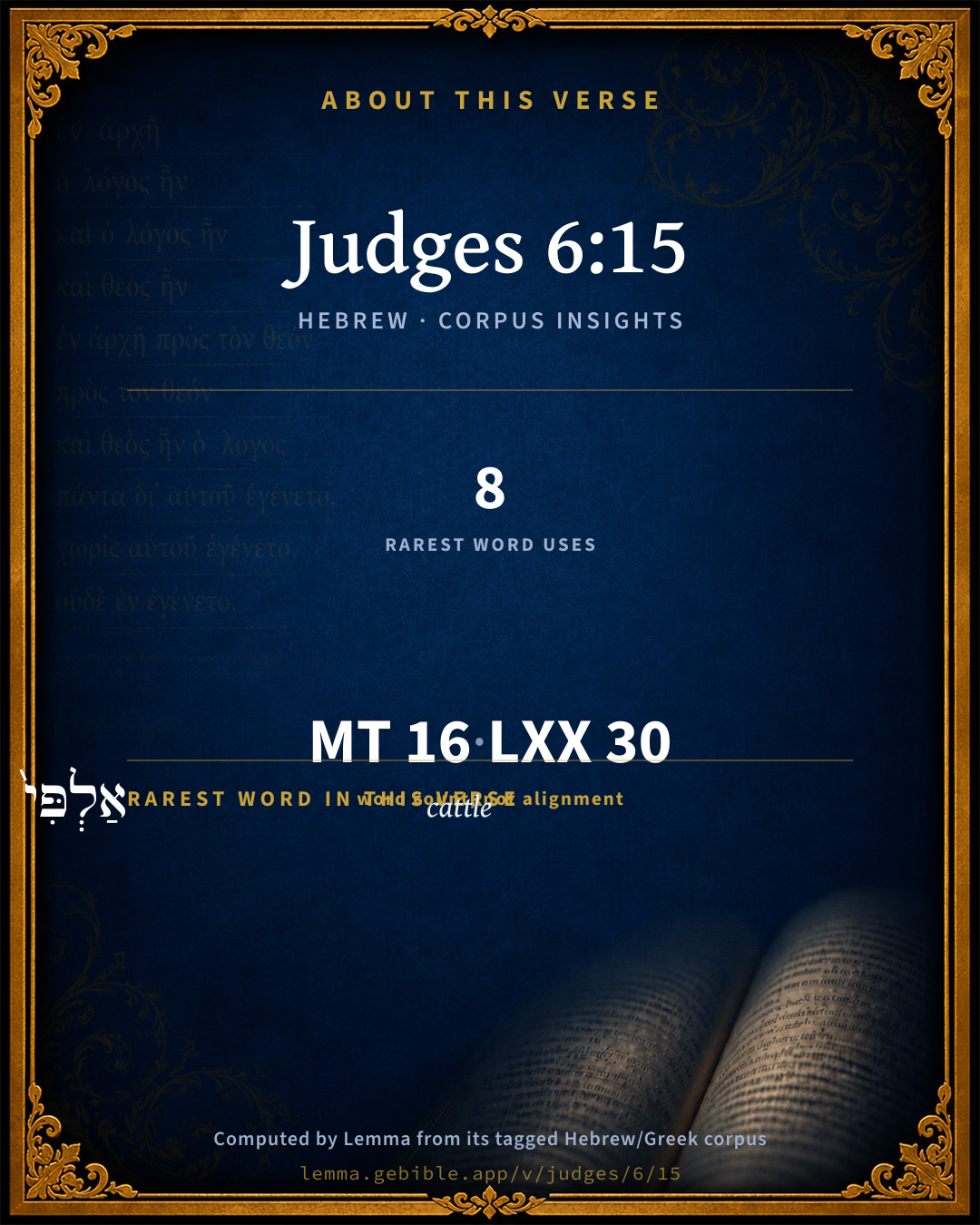
The rarest word here is אַלְפִּי֙ cattle H504 — appearing just 8 times in the whole Hebrew Bible.

Shared distinctive vocabulary

אַלְפִּי֙ cattle H504 occurs in 8 verses of the Hebrew Bible. Also found in:

Grammatical profile

  • 2 verbs
  • 6 nouns
  • 2 adjectives
  • 1 pronoun
  • 1 preposition
  • 4 particles

Verb forms

  • וַיֹּ֤אמֶר Qal · Sequential Imperfect
  • אוֹשִׁ֖יעַ Hiphil · Imperfect

Hebrew & Septuagint length

In English translation the verse runs 29 words from the Hebrew and 32 from the Septuagint (LXX English) — closely comparable.

A rough comparison of the two English renderings, which tokenize alike — not a word-level alignment.

Word counts can differ between the Hebrew and the Greek without any difference in meaning — e.g. the Hebrew direct-object marker אֵת has no separate Greek word, and Greek often adds the article ὁ.

In the original languages it is 16 Hebrew tokens and 30 Greek tokens — but the two are counted differently (Hebrew bundles its prefixes and suffixes into one token; the Greek is in lemma form), so that isn’t a like-for-like length.

Cross-references

12

Topical passages linked to Judges 6:15 in the Treasury of Scripture Knowledge — connected by theme and wording, ordered by reader-vote popularity; previews shown in the World English Bible.

  • Exodus 3:11 Moses said to God, "Who am I, that I should go to Pharaoh, and that I should bring forth the children of Israel out of Egypt?"
  • 1 Samuel 9:21 Saul answered, Am I not a Benjamite, of the smallest of the tribes of Israel? and my family the least of all the families of the tribe of Benjamin? why then speak you to me after this manner?
  • Exodus 4:10 Moses said to Yahweh, "Oh, Lord, I am not eloquent, neither before now, nor since you have spoken to your servant; for I am slow of speech, and of a slow tongue."
  • Jeremiah 1:6 Then said I, Ah, Lord Yahweh! behold, I don't know how to speak; for I am a child.
  • Ephesians 3:8 To me, the very least of all saints, was this grace given, to preach to the Gentiles the unsearchable riches of Christ,
  • 1 Samuel 18:23 Saul's servants spoke those words in the ears of David. David said, Seems it to you a light thing to be the king's son-in-law, seeing that I am a poor man, and lightly esteemed?
  • Jeremiah 50:45 Therefore hear the counsel of Yahweh, that he has taken against Babylon; and his purposes, that he has purposed against the land of the Chaldeans: Surely they shall drag them away, [even] the little ones of the flock; surely he shall make their habitation desolate over them.
  • Micah 5:2 But you, Bethlehem Ephrathah, Being small among the clans of Judah, Out of you one will come forth to me that is to be ruler in Israel; Whose goings forth are from of old, from everlasting.
  • Luke 1:34 Mary said to the angel, "How can this be, seeing I am a virgin?"
  • 1 Corinthians 15:9 For I am the least of the apostles, who is not worthy to be called an apostle, because I persecuted the assembly of God.
  • Genesis 32:10 I am not worthy of the least of all the loving kindnesses, and of all the truth, which you have shown to your servant; for with just my staff I passed over this Jordan; and now I have become two companies.
  • Exodus 18:21–25 Moreover you shall provide out of all the people able men, such as fear God: men of truth, hating unjust gain; and place such over them, to be rulers of thousands, rulers of hundreds, rulers of fifties, and rulers of tens.

Cross-references courtesy of OpenBible.info (CC BY 4.0).

Hebrew and Greek witnesses Masoretic Hebrew ↔ Greek Septuagint

The same verse in the two great witnesses to the Old Testament, shown verse-for-verse.

These are two independent witnesses, not word-aligned to each other, and the Septuagint is shown in lemma (dictionary) form.

Hebrew Judges 6:15 Masoretic · Westminster Leningrad Codex

וַיֹּ֤אמֶר אֵלָיו֙ בִּ֣י אֲדֹנָ֔י בַּמָּ֥ה אוֹשִׁ֖יעַ אֶת יִשְׂרָאֵ֑ל הִנֵּ֤ה אַלְפִּי֙ הַדַּ֣ל בִּמְנַשֶּׁ֔ה וְאָנֹכִ֥י הַצָּעִ֖יר בְּבֵ֥ית אָבִֽי

He said to him, Oh, Lord, with which shall I save Israel? behold, my family is the poorest in Manasseh, and I am the least in my father's house.

World English Bible · Public Domain

Greek LXX Judges 6:15 Septuagint · lemma form

καί εἶπον πρός αὐτός γεδεων ἐν ἐγώ κύριος ἐγώ ἐν τίς σώζω ὁ ἰσραήλ ἰδού ὁ χιλιάς ἐγώ ἀσθενέω ἐν μανασσή καί ἐγώ εἰμί ὁ μικρός ἐν οἶκος πατήρ ἐγώ

And Gedeon said to him, Be gracious with me, my Lord: whereby shall I save Israel? behold, my thousand is weakened in Manasse, and I am the least in my father's house.

LXX2012 (modern English Septuagint) · Public Domain

On this verse, Haydock's Catholic Bible Commentary discusses the Septuagint’s reading. Read the note in Commentary ↓

Hebrew: Westminster Leningrad Codex (CC BY 4.0). Greek: Septuagint (public domain); English from LXX2012 (modern English Septuagint) (Public Domain). How the Septuagint differs from the Hebrew →

Targum (Aramaic paraphrase)

1

The Targum is the ancient Jewish Aramaic paraphrase of the Hebrew Scriptures — an interpretive translation, not the Hebrew text itself. Onkelos (literal) and Pseudo-Jonathan (expansive) render the Torah, and Jonathan the Prophets. Coverage is partial: where no permissively-licensed English translation exists for a verse, only the Aramaic is shown. This is verse-level text, not a word-by-word alignment to the Hebrew.

  1. Targum Jonathan Prophets (Joshua–Malachi)
    וַאֲמַר לֵיהּ בְּבָעוּ יְיָ בְּמָא אֶפְרוֹק יַת יִשְׂרָאֵל הֲלָא הָא זַרְעִיתִי זְעִירָא בְּשֵׁבֶט מְנַשֶׁה וַאֲנָא חֲלַשׁ בְּבֵית אַבָּא:

    (no public-domain English translation for this verse)

    Targum Jonathan — Aramaic: “Mikraot Gedolot” (public domain). English: “Sefaria Community Translation” (CC0 1.0 (public-domain dedication)); “London "Chaldee Paraphrase," 1871” (public domain). Text via Sefaria.

Commentary

Notes on Judges 6:15 from classic Christian and Jewish commentators (each source and its license shown beneath its notes). The classic Christian expositions comment on the surrounding passage and are grouped to its opening verse, so a note may address several verses; the Jewish commentaries on the Tanakh (Rashi and others) are per-verse, so they appear only where the commentator wrote on this verse.

Lemma curates 59 commentaries, every one of them public domain or Creative Commons licensed, each selected and text-cleaned for this edition rather than reprinted as found. About our sources →

Trapp's Complete Commentary

John Trapp

Jdg 6:15 And he said unto him, Oh my Lord, wherewith shall I save Israel? behold, my family [is] poor in Manasseh, and I [am] the least in my father’s house.

Ver. 15. Wherewith shall I save Israel?] Since I want both men and money, - the sinews of war, and authority to order an army. Here Gideon was faithful in weakness, though but weak in faith, and is therefore reckoned among those renowned worthies in Heb 11:32.

Behold, my family is poor.] He was well descended, but had mean thoughts of himself. True worth is modest, Some render it, My chiliad. Moses had distributed the people into thousands, {Exo 18:25} as Alfred did the English into shires, hundreds, and tenths, or tithings, whereof the aucientest were called the tithing men.

John Trapp, A Commentary or Exposition upon All the Books of the Old and New Testament (1647–1656) — public domain. Text from a community e-Sword module.

Joseph Benson's Commentary

Jdg 6:15. Behold, my family — Hebrew, my thousand. For the tribes were distributed into several thousands, whereof each thousand had its peculiar governor; is poor — Weak and contemptible. I am the least in my father’s house — Either for age or qualifications for such a work. It is no proof that a person is unfit for an important work, because he thinks himself so. Before honour is humility. Indeed God delights to advance the humble, and often chooses to do great things by those that are little, especially that are so in their own eyes. “He chooseth the weak things of the world to confound the wise, and things that are despised, and things that are not, to bring to naught the things that are; that no flesh may glory in his presence.”

Joseph Benson's Commentary on the Old and New Testaments (1811–1818) — public domain. Text from a community e-Sword module.

The Expositor's Bible

GIDEON, ICONOCLAST AND REFORMER

Jdg_6:15-32

"The Lord is with thee, thou mighty man of valour":-so has the prophetic salutation come to the young man at the threshing floor of Ophrah. It is a personal greeting and call "with thee"-just what a man needs in the circumstances of Gideon. There is a nation to be saved, and a human leader must act for Jehovah. Is Gideon fit for so great a task? A wise humility, a natural fear have held him under the yoke of daily toil until this hour. Now the needed signs are given; his heart leaps up in the pulses of a longing which God approves and blesses. The criticism of kinsfolk, the suspicious carping of neighbours, the easily affronted pride of greater families no longer crush patriotic desire and overbear yearning faith. The Lord is with thee, Gideon, youngest son of Joash, the toiler in obscure fields. Go in this thy might; be strong in Jehovah.

But the assurance must widen if it is to satisfy. With me-that is a great thing for Gideon; that gives him free air to breathe and strength to use the sword. But can it be true? Can God be with one only in the land? He seems to have forsaken Israel and sold His people to the oppressor. Unless He returns to all in forgiveness and grace nothing can be done; a renewal of the nation is the first thing, and this Gideon desires. Comfort for himself, freedom from Midianite vexation for himself and his fathers house would be no satisfaction if, all around, he saw Israel still crushed under heathen hordes. To have a hand in delivering his people from danger and sorrow is Gideons craving. The assurance given to himself personally is welcome because in it there is a sound as of the beginning of Israels redemption. Yet "if the LORD be with us, why then is all this befallen us?" God cannot be with the tribes, for they are harassed and spoiled by enemies, they lie prone before the altars of Baal.

There is here an example of largeness in heart and mind which we ought not to miss, especially because it sets before us a principle often unrecognised. It is clear enough that Gideon could not enjoy freedom unless his country was free, for no man can be safe in an enslaved land; but many fail to see that spiritual redemption, in like manner, cannot be enjoyed by one unless others are moving towards the light. Truly salvation is personal at first and personal at last; but it is never an individual affair only. Each for himself must hear and answer the divine call to repentance; each as a moral unit must enter the strait gate, press along the marrow way of life, agonise and overcome. But the redemption of one soul is part of a vast redeeming purpose, and the fibres of each life are interwoven with those of other lives far and wide. Spiritual brotherhood is a fact but faintly typified by the brotherhood of the Hebrews, and the struggling soul today, like Gideons long ago, must know God as the Saviour of all men before a personal hope can be enjoyed worth the having. As Gideon showed himself to have the Lord with him by a question charged not with individual anxiety but with keen interest in the nation, so a man now is seen to have the Spirit of God as he exhibits a passion for the regeneration of the world. Salvation is enlargement of soul, devotion to God and to man for the sake of God. If anyone thinks he is saved while he bears no burdens for others, makes no steady effort to liberate souls from the tyranny of the false and the vile, he is in fatal error. The salvation of Christ plants always in men and women His mind, His law of life, Who is the Brother and Friend of all.

And the church of Christ must be filled with His Spirit, animated by His law of life, or be unworthy the name. It exists to unite men in the quest and realisation of highest thought and purest activity. The church truly exists for all men, not simply for those who appear to compose it. Salvation and peace are with the church as with the individual believer, but only as her heart is generous, her spirit simple and unselfish. Doubtful and distressed as Gideon was the church of Christ should never be, for to her has been whispered the secret that the Abiezrite had not read, how the Lord is in the oppression and pain of the people, in the sorrow and the cloud. Nor is a church to suppose that salvation can be hers while she thinks of any outside with the least touch of Pharisaism, denying their share in Christ. Better no visible church than one claiming exclusive possession of truth and grace; better no church at all than one using the name of Christ for privilege and excommunication, restricting the fellowship of life to its own enclosure.

But with utmost generosity and humaneness goes the clear perception that Gods service is the sternest of campaigns, beginning with resolute protest and decisive deed, and Gideon must rouse himself to strike for Israels liberty first against the idol worship of his own village. There stands the altar of Baal, the symbol of Israels infidelity; there beside it the abominable Asherah, the sign of Israels degradation. Already he has thought of demolishing these, but has never summoned courage, never seen that the result would justify him. For such a deed there is a time, and before the time comes the bravest man can only reap discomfiture. Now, with the warrant in his soul, the duty on his conscience, Gideon can make assault on a hateful superstition.

The idolatrous altar and false worship of ones own clan, of ones own family-these need courage to overturn and, more than courage, a ripeness of time and a Divine call. A man must be sure of himself and his motives, for one thing, before he takes upon him to be the corrector of errors that have seemed truth to his fathers and are maintained by his friends. Suppose people are actually worshipping a false god, a world power which has long held rule among them. If one would act the part of iconoclast the question is, By what right? Is he himself clear of illusion and idolatry? Has he a better system to put in place of the old? He may be acting in mere bravado and self-display, flourishing opinions which have less sincerity than those which he assails. There were men in Israel who had no commission and could have claimed no right to throw down Baals altar, and taking upon them such a deed would have had short shrift at the hands of the people of Ophrah. And so there are plenty among us who if they set up to be judges of their fellow men and of beliefs which they call false, even when these are false, deserve simply to be put down with a strong hand. There are voices, professing to be those of zealous reformers, whose every word and tone are insults. The men need to go and learn the first lessons of truth, modesty, and earnestness. And this principle applies all round-to many who assail modern errors as well as to many who assail established beliefs. On the one hand, are men anxious to uphold the true faith? It is well. But anxiety and the best of motives do not qualify them to attack science, to denounce all rationalism as godless. We want defenders of the faith who have a Divine calling to the task in the way of long study and a heavenly fairness of mind, so that they shall not offend and hurt religion more by their ignorant vehemence than they help it by their zeal. On the other hand, by what authority do they speak who sneer at the ignorance of faith and would fain demolish the altars of the world? It is no slight equipment that is needed. Fluent sarcasm, confident worldliness, even a large acquaintance with the dogmas of science will not suffice. A man needs to prove himself a wise and humane thinker, he needs to know by experience and deep sympathy those perpetual wants of our race which Christ knew and met to the uttermost. Some facile admiration of Jesus of Nazareth does not give the right to free criticism of His life and words, or of the faith based upon them. And if the plea is a rare respect for truth, an unusual fidelity to fact, humanity will still ask of its would be liberator on what fields he has won his rank or what yoke he has borne. Successful men especially will find it difficult to convince the world that they have a right to strike at the throne of Him who stood alone before the Roman Pilate and died on the Cross.

Gideon was not unfit to render high service. He was a young man tried in humble duty and disciplined in common tasks, shrewd but not arrogant, a person of clear mind and a patriot. The people of the farm and a good many in Ophrah had learned to trust him and were prepared to follow when he struck out a new path. He had Gods call and also his own past to help him. Hence when Gideon began his undertaking, although to attempt it in broad day would have been rash and he must act under cover of darkness, he soon found ten men to give their aid. No doubt he could in a manner command them, for they were his servants. Still a business of the kind he proposed was likely to rouse their superstitious fears, and he had to conquer these. It was also sure to involve the men in some risk, and he must have been able to give them confidence in the issue. This he did, however, and they went forth. Very quietly the altar of Baal was demolished and the great wooden mast, hateful symbol of Astarte, was cut down and split in pieces. Such was the first act in the revolution.

We observe, however, that Gideon does not leave Ophrah without an altar and a sacrifice. Destroy one system without laying the foundation of another that shall more than equal it in essential truth and practical power, and what sort of deliverance have you effected? Men will rightly execrate you. It is no reformation that leaves the heart colder, the life barer and darker than before; and those who move in the night against superstition must be able to speak in the day of a Living God who will vindicate His servants. It has been said over and over again and must yet be repeated, to overturn merely is no service. They that break down need some vision at least of a building up, and it is the new edifice that is the chief thing. The world of thought today is infested with critics and destroyers and may well be tired of them. It is too much in need of constructors to have any thanks to spare for new Voltaires and Humes. Let us admit that demolition is the necessity of some hours. We look back on the ruins of Bastilles and temples that served the uses of tyranny, and even in the domain of faith there have been fortresses to throw down and ramparts that made evil separations among men. But destruction is not progress; and if the end of modern thought is to be agnosticism, the denial of all faith and all ideals, then we are simply on the way to something not a whit better than primeval ignorance.

The morning sun showed the gap upon the hill where the symbols had stood of Baal and Astarte, and soon like an angry swarm of bees the people were buzzing round the scattered stones of the old altar and the rough new pile with its smoking sacrifice. Where was he who ventured to rebuke the city? Very indignant, very pious are these false Israelites. They turn on Joash with the fierce demand, "Bring out thy son that he may die." But the father too has come to a decision. We get a hint of the same nature as Gideons, slow, but firm when once roused; and if anything would rouse a man it would be this brutal passion, this sudden outbreak of cruelty nursed by heathen custom, his own conscience meanwhile testifying that Gideon was right. Tush! says Joash, will you plead for Baal? Will you save him? Is it necessary for you to defend one whom you have worshipped as Lord of heaven? Let him ply his lightnings if he has any. I am tired of this Baal who has no principles and is good only for feast days. He that pleads for Baal, let him be the man to die. Unexpected apology, serious too and unanswerable. Conscience that seemed dead is suddenly awakened and carries all before it. There is a quick conversion of the whole town because one man has acted decisively and another speaks strong words which cannot be gainsaid. To be sure Joash uses a threat-hints something of taking a very short method with those who still protest for Baal; and that helps conversion. But it is force against force, and men cannot object who have themselves talked of killing. By a rapid popular impulse Gideon is justified, and with the new name Jerubbaal he is acknowledged as a leader in Manasseh.

False religion is not always so easily exposed and upset. Truth may be so mixed with the error of a system that the moral sense is confused and faith clings to the follies and lies conjoined with the truth. And when we look at Judaism in contact with Christianity, at Romanism in contact with the Protestant spirit, we see how difficult it may be to liberate faith. The Apostle Paul, wielding the weapon of a singular and keen eloquence, cannot overcome the Pharisaism of his countrymen. At Antioch, at Iconium he does his utmost with scant success. The Protestant reformation did not so swiftly and thoroughly establish itself in every European country as in Scotland. Where there is no pressure of outward circumstances forcing new religious ideas upon men there must be all the more a spirit of independent thought if any salutary change is to be made in creed and worship. Either there must be men of Berea who search the Scriptures daily, men of Zurich and Berne with the energy of free citizens, or reformation must wait on some political emergency. And in effect conscience rarely has free play, since men are seldom manly, but more or less like sheep. Hence the value, as things go in this world, of leaders like Joash, princes like Luthers Elector, who give the necessary push to the undecided and check forward opponents by a significant warning. It is not the ideal way of reforming the world, but it has often answered well enough within limits. There are also cases in which the threats of the enemy have done good service, as when the appearance of the Spanish Armada on the English coast did more to confirm the Protestantism of the country than many years of peaceful argument. In truth, were there not occasionally something like master strokes in Providence the progress of humanity would be almost imperceptible. Men and nations are urged on although they have no great desire to advance; they are committed to a voyage and cannot return; they are caught in currents and must go where the currents bear them. Certainly in such cases there is not the ardour, and men cannot reap the reward belonging to the thinkers and brave servants of the truth. Practically, whether Protestants or Romanists, they are spiritually inert. Still it is well for them, well for the world, that a strong hand should urge them forward, since otherwise they would not move at all. Of many in all churches it must be said they are not victors in a fight of faith, they do not work out their own salvation. Yet they are guided, warned, persuaded into a certain habit of piety and understanding of truth, and their children have a new platform, somewhat higher than their fathers, on which to begin life.

At Ophrah of the Abiezrites, though we cannot say much for the nature of the faith in God which has replaced idolatry, still the way is prepared for further and decisive action. Men do not cease from worshipping Baal and become true servants of the Most Holy in a single day; that requires time. There, are better possibilities, but Gideon cannot teach the way of Jehovah, nor is he in the mood for religious inquiry. The conversion of Abiezer is quite of the same sort as in early Christian times was effected when a king went over to the new faith and ordered his subjects to be baptised. Not even Gideon knows the value of the faith to which the people have returned, in the strength of which they are to fight. They will be bold now, for even a little trust in God goes a long way in sustaining courage. They will face the enemy now to whom they have long submitted. But of the purity and righteousness into which the faith of Jehovah should lead them they have no vision.

Now with this in view many will think it strange to hear of the conversion of Abiezer. It is a great error however to despise the day of small things. God gives it and we ought to understand its use. Conversion cannot possibly mean the same in every period of the worlds history; it cannot even mean the same in any two cases. To recognise this would be to clear the ground of much that hinders the teaching and the success of the gospel. Where there has been long familiarity with the New Testament, the facts of Christianity and the high spiritual ideas it presents, conversion, properly speaking, does not take place till the message of Christ to the soul stirs it to its depths, moves alike the reason and the will, and creates fervent discipleship. But the history of Israel and of humanity moves forward continuously in successive discoveries or revelations of the highest, culminating in the Christian salvation. To view Gideon as a religious reformer of the same kind as Isaiah is quite a mistake. He had scarcely an idea in common with the great prophet of a later day. But the liberty he desired for his people and the association of liberty with the worship of Jehovah made his revolution a step in the march of Israels redemption. Those who joined him with any clear purpose and sympathy were therefore converted men in a true if very limited sense. There must be first the blade and then the ear before there can be the full corn. We reckon Gideon a hero of faith, and his hope was truly in the same God Whom we worship-the God and Father of our Lord Jesus Christ. Yet his faith could not be on a level with ours, his knowledge being far less. The angel who speaks to him, the altar he builds, the Spirit of the Lord that comes upon him, his daring iconoclasm, the new purpose and power of the man are in a range quite above material life-and that is enough.

There are some circles in which honesty and truth speaking are evidence of a work of grace. To become honest and to speak truth in the fear of God is to be converted, in a sense, where things are at that pass. There are people who are so cold that among them enthusiasm for anything good may be called superhuman. Nobody has it. If it appears it must come from above. But these steps of progress, though we may describe them as supernatural, are elementary. Men have to be converted again and again, ever making one gain a step to another. The great advance comes when the soul believes enthusiastically in Christ, pledging itself to Him in full sight of the cross. This and nothing less is the conversion we need. To love freedom, righteousness, charity only prepares for the supreme love of God in Christ, in which life springs to its highest power and joy.

Now are we to suppose that Gideon alone of all the men of Israel had the needful spirit and faith to lead the revolution? Was there no one but the son of Joash? We do not find him fully equipped, nor as the years go by does he prove altogether worthy to be chief of the tribes of God. Were there not in many Hebrew towns souls perhaps more ardent, more spiritual than his, needing only the prophetic call, the touch of the Unseen Hand to make them aware of power and opportunity? The leadership of such a one as Moses is complete and unquestionable. He is the man of the age; knowledge, circumstances, genius fit him for the place he has to occupy. We cannot imagine a second Moses in the same period. But in Israel as well as among other peoples it is often a very imperfect hero who is found and followed. The work is done, but not so well done as we might think possible. Revolutions which begin full of promise lose their spirit because the leader reveals his weakness or even folly. We feel sure that there are many who have the power to lead in thought where the world has not dreamt of climbing, to make a clear road where as yet there is no path; and yet to them comes no messenger, the daily task goes on and it is not supposed that a leader, a prophet is passed by. Are there no better men that Ehud, Gideon, Jephthah must stand in the front?

One answer certainly is that the nation at the stage it has reached cannot as a whole esteem a better man, cannot understand finer ideas. A hundred men of more spiritual faith were possibly brooding over Israels state, ready to act as fearlessly as Gideon and to a higher issue. But it could only have been after a cleansing of the nations life, a suppression of Baal worship much more rigorous than could at that time be effected. And in every national crisis the thought of which the people generally are capable determines who must lead and what kind of work shall be done. The reformer before his time either remains unknown or ends in eclipse; either he gains no power or it passes rapidly from him because it has no support in popular intelligence or faith.

It may seem well nigh impossible in our day for any man to fail of the work he can do; if he has the will we think he can make the way. The inward call is the necessity, and when that is heard and the man shapes a task for himself the day to begin will come. Is that certain? Perhaps there are many now who find circumstance a web from which they cannot break away without arrogance and unfaithfulness. They could speak, they could do if God called them; but does He call them? On every side ring the fluent praises of the idols men love to worship. One must indeed be deft in speech and many other arts who would hope to turn the crowd from its folly, for it will only listen to what seizes the ear, and the obscure thinker has not the secret of pleasing. While those who see no visions lead their thousands to a trivial victory, many an uncalled Gideon toils on in the threshing floor. The duties of a low and narrow lot may hold a man; the babble all around of popular voices may be so loud that nothing can make way against them. A certain slowness of the humble and patient spirit may keep one silent who with little encouragement could speak words of quickening truth. But the day of utterance never comes.

To these waiting in the market place it is comparatively a small thing that the world will not hire them. But does the church not want them? Where God is named and professedly honoured, can it be that the smooth message is preferred because it is smooth? Can it be that in the church men shrink from instead of seeking the highest, most real and vital word that can be said to them? This is what oppresses, for it seems to imply that God has no use in His vineyard for a man when He lets him wait long unregarded; it seems to mean that there is no end for the wistful hope and the words that burn unspoken in the breast. The unrecognised thinker has indeed to trust God largely. He has often to be content with the assurance that what he would say but cannot as yet shall be said in good time, that what he would do but may not shall be done by a stronger hand. And further, he may cherish a faith for himself. No life can remain forever unfruitful, or fruitful only in its lower capacities. Purposes broken off here shall find fulfilment. Where the highways of being reach beyond the visible horizon leaders will be needed for the yet advancing host, and the time of every soul shall come to do the utmost that is in it. The day of perfect service for many of Gods chosen ones will begin where beyond these shadows there is light and space. Were it not so, some of the best lives would disappear in the darkest cloud.

William Robertson Nicoll, ed., The Expositor's Bible (London: Hodder & Stoughton, 1887–1910) — public domain. 65 of 66 books (1 Corinthians is not separately keyed, as that volume carries no machine-parseable verse references); section-level commentary keyed to the opening verse. Introductory and overview sections not keyed to a specific passage are excluded.

Geneva Bible (1599)

Geneva Bible translators

Or, family.

Geneva Bible (1599) marginal notes — public domain. Text via Bolls.life.

Adam Clarke's Commentary

Verse 15. Wherewith shall I save Israel?] I have neither men nor money.

Behold, my family is poor in Manasseh] הנה אלפי הדל, Behold, my thousand is impoverished. Tribes were anciently divided into tens, and fifties, and hundreds, and thousands; the thousands therefore marked grand divisions, and consequently numerous families; Gideon here intimates that the families of which he made a part were very much diminished. But if we take אלפי alpey for the contracted form of the plural, which is frequently in Hebrew nouns joined with a verb in the singular, then the translation will be, "The thousands in Manasseh are thinned;" i.e., this tribe is greatly reduced, and can do little against their enemies.

Adam Clarke's Commentary on the Bible (1810–1826) — public domain. Text from a community e-Sword/MySword module.

Ellicott's Commentary for English Readers

(15) Oh my Lord.—Here our version deliberately adopts the reading adonî, as in Jdg_6:13, and the reason for this reading is that Gideon does not appear to have fully recognised the angel till his disappearance (Jdg_6:22). The reading of the Hebrew MSS., however, is Adonai, “Lord;” and if it be correct, we must suppose that Gideon addresses God as recognising that the message came from Him.

Wherewith shall I save Israel?—We repeatedly find this preliminary diffidence of humility in those whom God selects for His service. (Comp. Exo_4:1-13; 1Sa_9:21; Isa_6:5; Jer_1:6-7, &c.)

My family.—Literally, my thousand (Exo_18:21; 1Sa_10:19).

Poor.—Rather, the meanest, as is shown by the article “my thousand is the mean one,” just as David is called “the little one” of his brethren (1Sa_18:14). What had caused this depression of the house of Abiezer we do not know, but it may have been due in part to the overweening pride of Ephraim.

I am the least in my father’s house.—He was also the last of his father’s house. All his brethren had been slain.

A Bible Commentary for English Readers, edited by Charles John Ellicott (1878–1897) — public domain. Text from a community e-Sword module.

The Cambridge Bible for Schools and Colleges

gen. ed. J. J. S. Perowne

15. Oh Lord] Read with a slight change, Oh my lord as in Jdg_6:13.

my family … the least] Saul used the same plea, 1Sa_9:21. ‘Family’ is lit. ‘thousand,’ a division of the tribe which corresponds to a ‘clan’ (mishpâḥâh); the ‘clan’ or ‘thousand’ consisted of several ‘fathers’ houses,’ the ‘house’ of a number of individuals; see 1Sa_10:19-21.

The Cambridge Bible for Schools and Colleges (gen. ed. J. J. S. Perowne; Cambridge University Press, 1878–1918) — public domain. Text from a community e-Sword module.

John Gill's Exposition

And the Lord said unto him, surely I will be with thee,.... The Targum is,"my Word shall be thy help,''which was sufficient to answer all objections taken from his meanness, unworthiness, and weakness:

and thou shalt smite the Midianites as one man; all together, and as easily as if thou hadst but one man to deal with, and the destruction be so entire and general that none shall be left.

John Gill's Exposition of the Whole Bible (1746–1763) — public domain (CC PDM 1.0). Text via the HelloAO Bible API.

Albert Barnes' Notes on the Bible

Gideon now perceived that the Lord was speaking to him by His angel. He saw, however, no qualifications in himself, or in his family or tribe, for the office of saviour to his people. He therefore desires some assurance that the message he had just received was indeed from God, and not a mere dream or delusion. He asks as a sign Jdg 6:18 that his mysterious visitor should tarry under the oak until he should return to Him with his gifts and offerings.

Albert Barnes' Notes on the Bible (1834–1885) — public domain. Text from a community e-Sword/MySword module.

Haydock's Catholic Bible Commentary

The meanest in Manasses, &c. Mark how the Lord chooses the humble (who are mean and little in their own eyes) for the greatest enterprises. (Challoner) --- Hebrew and Septuagint literally, "My millenary is poor, or lowly," &c. This term means a great family, from which many others spring, or a city inhabited by such. Bethlehem was of this description in Juda, Micheas v. 2. Ephra and the family of Abiezer were not the first in Manasses. Grotius observes, that Gedeon and Cincinnatus were called to the highest offices, when they least expected it.

George Leo Haydock (1774–1849), Haydock's Catholic Family Bible and Commentary, 1859 edition — public domain. Excludes Psalms (Douay-Rheims chapter numbering differs from Protestant) and Deuterocanonical books (Catholic canon only).

Matthew Poole's English Annotations

My family, Heb. my thousand; for the tribes were distributed into several thousands, whereof each thousand had his peculiar governor.

Poor, i.e. weak and contemptible.

I am the least either for age, or for wisdom, and fitness for so great a work.

Matthew Poole's English Annotations on the Holy Bible (1683–1685) — public domain. Text from a community e-Sword/MySword module.

Whedon's Commentary on the Bible

Daniel D. Whedon

15. My family is poor in Manasseh. — Literally, my thousand. For convenience in government Israel was divided into thousands, hundreds, fifties, and tens. Exo_18:21; Exo_18:25. A thousand in this technical sense might become greater or smaller in the course of time. Its numbers, like those of a regiment of an army, might become much diminished, and yet the old title of thousand remain. That thousand in Manasseh to which Gideon belonged had become feeble, though its exact numerical strength might not have been known.

Daniel D. Whedon (gen. ed.), Commentary on the Old and New Testaments (1874–1909) — public domain. Text from a community e-Sword module.

The Pulpit Commentary

Wherewith shall I save Israel? etc. Compare the unwillingness of Moses, (Exo_3:11 Exo_4:10, Exo_4:13) of Saul, (1Sa_10:21, 1Sa_10:22) of Jeremiah, (Jer_1:6) of Amos, (Amo_7:14, Amo_7:15) and of St. Peter. (Luk_5:8) Also in ecclesiastical history that of Ambrose, Gregory the Great, and others. The least fit are usually the most forward, the most fit the most backward, to undertake great offices. (Jud 9:8-15) True humility is the usual companion of true greatness. (2Co_2:16 2Co_3:5)

The Pulpit Commentary (1880–1919), ed. H.D.M. Spence-Jones & Joseph S. Exell — public domain. Text from a community e-Sword module.

John Wesley's Explanatory Notes

My family - Hebrew. my thousand: for the tribes were distributed into several thousands, whereof each thousand had his peculiar governor. Is poor - That is, weak and contemptible. The least - Either for age, or fitness for so great a work.

John Wesley, Explanatory Notes Upon the Whole Bible (1754–1765) — public domain. Text via the GEBible commentary corpus.

Rashi

Rabbi Shlomo Yitzchaki (Rashi)

Behold, my unit [lit. thousand]. The thousand member unit of which I am a constituent, under the command of its captain, is the most inadequate unit among all the units in Menasheh.

Rashi on the Tanakh — English translations: “The Judaica Press complete Tanach with Rashi, translated by A. J. Rosenberg” (CC BY 4.0); “Pentateuch with Rashi's commentary by M. Rosenbaum and A.M. Silbermann, 1929-1934” (public domain); “The Metsudah Tanach series, Lakewood, N.J” (CC BY 4.0); and “The Book of Joshua, Metsudah Publications, 1997” (CC BY 4.0). Text via Sefaria.

Lesson kit

Teaching starters — assembled from the data on this page, not authored interpretation. Every prompt links to the verse data it draws on. Edit before teaching.

Judges, in the Historical, opens this verse with 16 words (16 distinct Hebrew lemmas). Its most distinctive word is ʼeleph (“cattle”). A historical commentator’s framing appears above. Read the whole chapter for the surrounding context.

Discussion questions

  1. How does “cattle” (ʼeleph) shape what this verse is saying?
  2. Deuteronomy 7:13 shares the word «cattle» with this verse. How do the two illuminate each other?
  3. The translations on this page render this verse differently — a whole-verse word diff, not a word-by-word alignment. What might account for the different wordings?
  4. The verb «וַיֹּ֤אמֶר» is Qal Sequential Imperfect. How does its form color the action?
  5. Reading how Trapp's Complete Commentary and Joseph Benson's Commentary read this verse, where do the two commentators agree and where do they part?

Things to notice

Reading settings

Reading text

Shown beneath each verse's original-language words.

Old Testament
Old Testament edition

Read the OT as the Masoretic Hebrew (MT) or the Greek Septuagint (LXX).

English shown for the Greek Septuagint (in the Hebrew ↔ Greek comparison).

Comparing translations? Open the Compare panel on any verse page to stack up to four side by side.