Isaiah 22:12

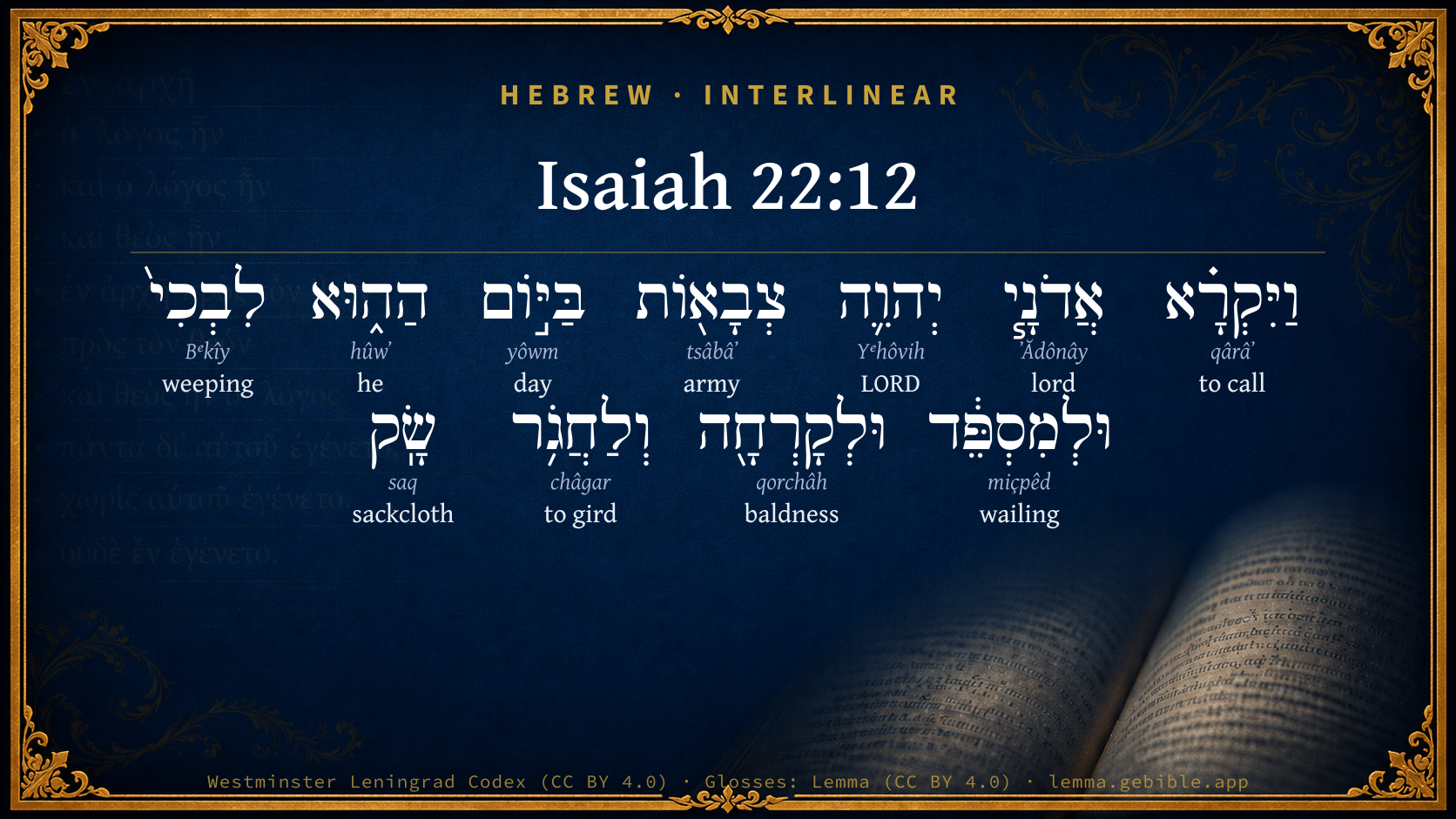
Hebrew (Westminster Leningrad Codex) Isaiah 22:12 appears in the Hebrew Old Testament. The text above is from the Westminster Leningrad Codex. Each word links to its Strong’s number, a concise gloss, and parsing drawn from the Open Scriptures Hebrew Bible morphology. Click any word for its full Brown-Driver-Briggs (BDB) entry.
Download image
Cite this verse

Isaiah 22:12 (World English Bible). Public Domain. Lemma interlinear Bible study tool, https://lemma.gebible.app/v/isaiah/22/12.

Show BibTeX & RIS
BibTeX
RIS
English Translation
In that day did the Lord, Yahweh of Hosts, call to weeping, and to mourning, and to baldness, and to girding with sackcloth:
World English Bible · Public Domain
Download a study sheet

One document with this verse’s original text, its word-by-word gloss line, the meaning frame, cross-references with their text, attributed commentary, and full source and license credits — printable, and it pastes into notes with its structure intact.

This verse Autodidact and up

Study sheet (.html) Plain text (.txt)

A passage Seminary Student

Up to 50 verses in one chapter. A passage sheet keeps up to 6 commentary sources and 12 cross-references per verse, in the order this page ranks them, and says so on the sheet whenever that leaves anything out. Ask for a single verse and you get the Autodidact verse sheet above.

Everything on this page stays free to read, with no account — the sheet is a download of what is already on screen, not access to it.

Want to remove ads? Support Godless Engineer
Compare translations 3

The same verse in 3 English versions, stacked beneath the original-language interlinear above. Click any original word for its lexicon entry.

Each is an independent rendering of the whole verse — the interlinear is not word-aligned to these translations.

Highlighted words mark where these versions differ — a whole-verse word diff, not a word-by-word alignment.

  • World English Bible Public Domain
    In that day did the Lord, Yahweh of Hosts, call to weeping, and to mourning, and to baldness, and to girding with sackcloth:
  • King James Version Public Domain
    And in that day did the Lord GOD of hosts call to weeping, and to mourning, and to baldness, and to girding with sackcloth:
  • unfoldingWord Literal Text CC BY-SA 4.0
    And the Lord, Yahweh of Armies, called on that day for weeping and for mourning, and for baldness and for girding of sackcloth,

unfoldingWord Literal Text — © unfoldingWord, licensed CC BY-SA 4.0. Word-aligned USFM3 via Door43 (git.door43.org/unfoldingWord/en_ult).

Versions to compare (up to 4)

3 of 4 selected

Show all 18 translations

Every available English version of this verse, each an independent rendering of the whole verse.

  • World English Bible Public Domain
    In that day did the Lord, Yahweh of Hosts, call to weeping, and to mourning, and to baldness, and to girding with sackcloth:
  • Berean Standard Bible Public Domain
    On that day the Lord GOD of Hosts called for weeping and wailing, for shaven heads and the wearing of sackcloth.
  • Majority Standard Bible Public Domain
    On that day the Lord GOD of Hosts called for weeping and wailing, for shaven heads and the wearing of sackcloth.
  • King James Version Public Domain
    And in that day did the Lord GOD of hosts call to weeping, and to mourning, and to baldness, and to girding with sackcloth:
  • American Standard Version (1901) Public Domain
    And in that day did the Lord, Jehovah of hosts, call to weeping, and to mourning, and to baldness, and to girding with sackcloth:
  • Revised Version (1885) Public Domain
    And in that day did the Lord, the LORD of hosts, call to weeping, and to mourning, and to baldness, and to girding with sackcloth:
  • Geneva Bible (1599) Public Domain
    And in that day did the Lord God of hosts call vnto weeping and mourning, and to baldnes and girding with sackecloth.
  • Douay-Rheims (1899) Public Domain
    And the Lord, the God of hosts, in that day shall call to weeping, and to mourning, to baldness, and to girding with sackcloth:
  • Young's Literal Translation Public Domain
    And call doth the Lord, Jehovah of Hosts, In that day, to weeping and to lamentation, And to baldness and to girding on of sackcloth,
  • Literal Standard Version CC BY-SA 4.0
    And the Lord calls, YHWH of Hosts, || In that day, to weeping and to lamentation, || And to baldness and to girding on of sackcloth,
  • Unlocked Literal Bible CC BY-SA 4.0
    The Lord Yahweh of hosts called on that day for weeping, for mourning, for shaved heads, and the wearing of sackcloth.
  • unfoldingWord Literal Text CC BY-SA 4.0
    And the Lord, Yahweh of Armies, called on that day for weeping and for mourning, and for baldness and for girding of sackcloth,
  • Darby Bible Public Domain
    And in that day did the Lord Jehovah of hosts call to weeping, and to mourning, and to baldness, and to girding with sackcloth;
  • World Messianic Bible Public Domain
    In that day, the Lord, GOD of Hosts, called to weeping, to mourning, to baldness, and to dressing in sackcloth;
  • Webster's Bible Public Domain
    And in that day did the Lord GOD of hosts call to weeping, and to mourning, and to baldness, and to girding with sackcloth:
  • Free Bible Version CC BY-SA 4.0
    At that time the Lord, the Lord Almighty, was calling you to weep and mourn, to shave your heads and wear sackcloth.
  • Bible in Basic English Public Domain
    And in that day the Lord, the Lord of armies, was looking for weeping, and cries of sorrow, cutting off of the hair, and putting on the clothing of grief:
  • JPS Tanakh (1917) Public Domain
    And in that day did the Lord, the GOD of hosts, call to weeping, and to lamentation, and to baldness, and to girding with sackcloth;

Literal Standard Version (2020), Covenant Press — licensed CC BY-SA 4.0. Text via the HelloAO Bible API (eBible.org). Unlocked Literal Bible (unfoldingWord) — licensed CC BY-SA 4.0. Text via the HelloAO Bible API (eBible.org). unfoldingWord Literal Text — © unfoldingWord, licensed CC BY-SA 4.0. Word-aligned USFM3 via Door43 (git.door43.org/unfoldingWord/en_ult). Free Bible Version, Dr. Jonathan Gallagher — licensed CC BY-SA 4.0. Text via the HelloAO Bible API (eBible.org).

Word by word

More ways to search: Search by grammar → Find every occurrence → Compare this word →

Practice this passage: Drill this verse → Learn its vocabulary →

וּלְקָרְחָ֖ה
qorchâh
H7144
“and · to/for · baldness”
Conjunction + Preposition + Noun, Common, Feminine, Singular, Absolute
Part of Speech
Conjunction + Preposition + Noun
Type
Common
Gender
Feminine
Number
Singular
State
Absolute
Full BDB Definition

Origin: from H7139

TWOT: 2069b

baldness, bald
  1. וַיִּקְרָ֗א qârâʼ H7121 “and · to call” Conjunction + Verb, Qal, Sequential Imperfect, 3rd Person, Masculine, Singular
  2. אֲדֹנָ֧י ʼĂdônây H136 “Lord · my” Noun, Common, Masculine, Plural, Construct + Suffix, Personal, 1st Person, Common, Singular
  3. יְהוִ֛ה Yᵉhôvih H3069 “LORD” Noun, Proper
  4. צְבָא֖וֹת tsâbâʼ H6635 “armies” Noun, Common, Both, Plural, Absolute
  5. בַּיּ֣וֹם yôwm H3117 “in/at the · day” Preposition, Determined + Noun, Common, Masculine, Singular, Absolute
  6. הַה֑וּא hûwʼ H1931 “the · he” Particle, Definite Article + Pronoun, Personal, 3rd Person, Masculine, Singular
  7. לִבְכִי֙ Bᵉkîy H1065 “to/for · weeping” Preposition + Noun, Common, Masculine, Singular, Absolute
  8. וּלְמִסְפֵּ֔ד miçpêd H4553 “and · to/for · wailing” Conjunction + Preposition + Noun, Common, Masculine, Singular, Absolute
  9. וְלַחֲגֹ֥ר châgar H2296 “and · to gird” Conjunction + Preposition + Verb, Qal, Infinitive Construct
  10. שָֽׂק saq H8242 “sackcloth” Noun, Common, Masculine, Singular, Absolute

About this verse

These counts appear in no published source. They are computed here, from the morphology-tagged text and Lemma’s own curated glosses. What Lemma adds →

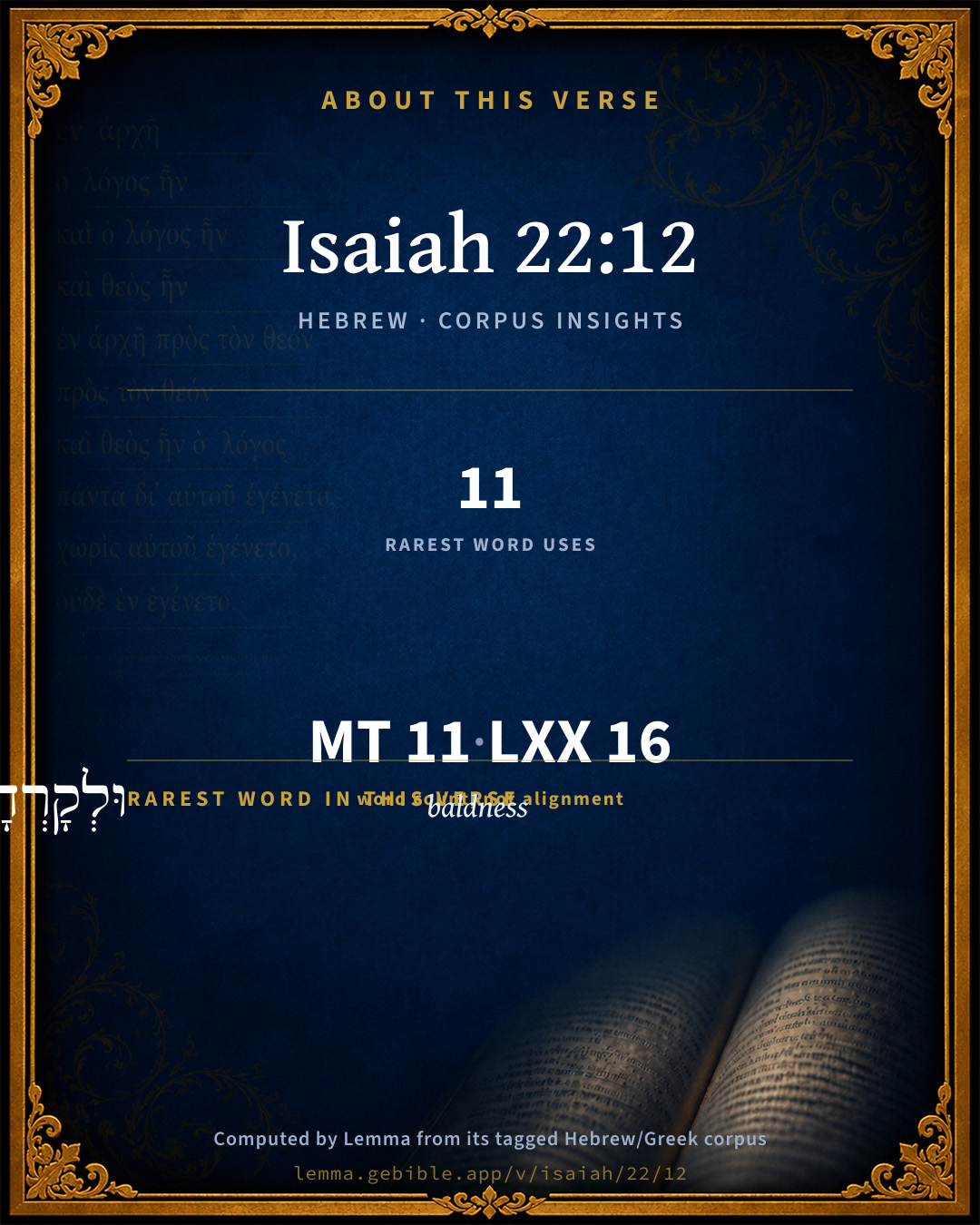
11
words
11
distinct lemmas
Prophets
section

Notable vocabulary

The rarest word here is וּלְקָרְחָ֖ה baldness H7144 — appearing just 11 times in the whole Hebrew Bible.

Shared distinctive vocabulary

וּלְקָרְחָ֖ה baldness H7144 occurs in 11 verses of the Hebrew Bible. Also found in:

Grammatical profile

  • 2 verbs
  • 8 nouns
  • 1 pronoun

Verb forms

  • וַיִּקְרָ֗א Qal · Sequential Imperfect
  • וְלַחֲגֹ֥ר Qal · Infinitive Construct

Hebrew & Septuagint length

In English translation the verse runs 23 words from the Hebrew and 22 from the Septuagint (LXX English) — closely comparable.

A rough comparison of the two English renderings, which tokenize alike — not a word-level alignment.

Word counts can differ between the Hebrew and the Greek without any difference in meaning — e.g. the Hebrew direct-object marker אֵת has no separate Greek word, and Greek often adds the article ὁ.

In the original languages it is 11 Hebrew tokens and 16 Greek tokens — but the two are counted differently (Hebrew bundles its prefixes and suffixes into one token; the Greek is in lemma form), so that isn’t a like-for-like length.

Cross-references

15

Topical passages linked to Isaiah 22:12 in the Treasury of Scripture Knowledge — connected by theme and wording, ordered by reader-vote popularity; previews shown in the World English Bible.

  • Joel 1:13 Put on sackcloth and mourn, you priests! Wail, you ministers of the altar. Come, lie all night in sackcloth, you ministers of my God, For the meal offering and the drink offering are withheld from your God's house.
  • Joel 2:17 Let the priests, the ministers of Yahweh, weep between the porch and the altar, And let them say, "Spare your people, Yahweh, And don't give your heritage to reproach, That the nations should rule over them. Why should they say among the peoples, 'Where is their God?'"
  • Micah 1:16 Shave your heads, And cut off your hair for the children of your delight. Enlarge your baldness like the vulture; For they have gone into captivity from you!
  • Job 1:20 Then Job arose, and tore his robe, and shaved his head, and fell down on the ground, and worshiped.
  • Ecclesiastes 3:4 A time to weep, And a time to laugh; A time to mourn, And a time to dance;
  • Amos 8:10 I will turn your feasts into mourning, And all your songs into lamentation; And I will make you wear sackcloth on all your bodies, And baldness on every head. I will make it like the mourning for an only son, And the end of it like a bitter day.
  • James 5:1 Come now, you rich, weep and howl for your miseries that are coming on you.
  • 2 Chronicles 35:25 Jeremiah lamented for Josiah: and all the singing men and singing women spoke of Josiah in their lamentations to this day; and they made them an ordinance in Israel: and, behold, they are written in the lamentations.
  • Ezra 9:3 When I heard this thing, I tore my garment and my robe, and plucked off the hair of my head and of my beard, and sat down confounded.
  • Nehemiah 8:9–12 Nehemiah, who was the governor, and Ezra the priest the scribe, and the Levites who taught the people, said to all the people, This day is holy to Yahweh your God; don't mourn, nor weep. For all the people wept, when they heard the words of the law.
  • Nehemiah 9:9 You saw the affliction of our fathers in Egypt, and heard their cry by the Red Sea,
  • Ecclesiastes 3:11 He has made everything beautiful in its time. He has also set eternity in their hearts, yet so that man can't find out the work that God has done from the beginning even to the end.
  • Isaiah 15:2 They are gone up to Bayith, and to Dibon, to the high places, to weep: Moab wails over Nebo, and over Medeba; on all their heads is baldness, every beard is cut off.
  • Jonah 3:6 The news reached the king of Nineveh, and he arose from his throne, and took off his royal robe, covered himself with sackcloth, and sat in ashes.
  • James 4:8–10 Draw near to God, and he will draw near to you. Cleanse your hands, you sinners; and purify your hearts, you double-minded.

Cross-references courtesy of OpenBible.info (CC BY 4.0).

Hebrew and Greek witnesses Masoretic Hebrew ↔ Greek Septuagint

The same verse in the two great witnesses to the Old Testament, shown verse-for-verse.

These are two independent witnesses, not word-aligned to each other, and the Septuagint is shown in lemma (dictionary) form.

Hebrew Isaiah 22:12 Masoretic · Westminster Leningrad Codex

וַיִּקְרָ֗א אֲדֹנָ֧י יְהוִ֛ה צְבָא֖וֹת בַּיּ֣וֹם הַה֑וּא לִבְכִי֙ וּלְמִסְפֵּ֔ד וּלְקָרְחָ֖ה וְלַחֲגֹ֥ר שָֽׂק

In that day did the Lord, Yahweh of Hosts, call to weeping, and to mourning, and to baldness, and to girding with sackcloth:

World English Bible · Public Domain

Greek LXX Isaiah 22:12 Septuagint · lemma form

καί καλέω κύριος σαβαωθ ἐν ὁ ἡμέρα ἐκεῖνος κλαυθμός καί κοπετός καί ξύρησις καί ζώσις σάκκος

And the Lord, the Lord of hosts, called in that day for weeping, and lamentation, and baldness, and for girding with sackcloth:

LXX2012 (modern English Septuagint) · Public Domain

Hebrew: Westminster Leningrad Codex (CC BY 4.0). Greek: Septuagint (public domain); English from LXX2012 (modern English Septuagint) (Public Domain). How the Septuagint differs from the Hebrew →

Targum (Aramaic paraphrase)

1

The Targum is the ancient Jewish Aramaic paraphrase of the Hebrew Scriptures — an interpretive translation, not the Hebrew text itself. Onkelos (literal) and Pseudo-Jonathan (expansive) render the Torah, and Jonathan the Prophets. Coverage is partial: where no permissively-licensed English translation exists for a verse, only the Aramaic is shown. This is verse-level text, not a word-by-word alignment to the Hebrew.

  1. Targum Jonathan Prophets (Joshua–Malachi)
    וְאַכְלֵי נְבִיָא דַייָ אֱלֹהִי צְבָאוֹת בְּיוֹמָא הַהוּא לְמִבְכֵּי וּלְמִסְפֵּד וּלְגִזוּז רֵישׁ וּלְמֵיסַר סַקִין:

    And the prophet of the Lord, the God, the God of hosts, called in that day to weeping, and to mourning, and to baldness, and to girding with sackcloth:

    Targum Jonathan — Aramaic: “Mikraot Gedolot” (public domain). English: “Sefaria Community Translation” (CC0 1.0 (public-domain dedication)); “London "Chaldee Paraphrase," 1871” (public domain). Text via Sefaria.

Commentary

Notes on Isaiah 22:12 from classic Christian and Jewish commentators (each source and its license shown beneath its notes). The classic Christian expositions comment on the surrounding passage and are grouped to its opening verse, so a note may address several verses; the Jewish commentaries on the Tanakh (Rashi and others) are per-verse, so they appear only where the commentator wrote on this verse.

Lemma curates 59 commentaries, every one of them public domain or Creative Commons licensed, each selected and text-cleaned for this edition rather than reprinted as found. About our sources →

Trapp's Complete Commentary

John Trapp

Isa 22:12 And in that day did the Lord GOD of hosts call to weeping, and to mourning, and to baldness, and to girding with sackcloth:

Ver. 12. And in that day did the Lord God of hosts call to weeping.] Ponit arma quibus civitates ab hostibus defenduntur, nempe arma poenitentiae. These are the best defensive weapons, which therefore God of his goodness calleth people to, or ere he punisheth them. He calleth them, I say, by his word and by his works, both ordinary and extraordinary, that his justice may be magnified, and every foul mouth stopped.

To weeping and mourning.] The walls of Zion cannot but stand firm if well tempered with the tears of true penitents.

And to baldness.] Forbidden in other cases, {Lev 19:27-28; Lev 21:5 Deu 14:1 Mic 1:16} called for in the practice of holy repentance, which hath nothing to do with despair. See Ezr 9:3.

John Trapp, A Commentary or Exposition upon All the Books of the Old and New Testament (1647–1656) — public domain. Text from a community e-Sword module.

The Biblical Illustrator

Joseph S. Exell

Isa_22:12-14

And in that day did the Lord God of hosts call to weeping . . . And behold joy and gladness

A call to repentance

I.

THE CALL TO REPENTANCE (Isa_22:12).

1. The day here referred to was a season of abounding iniquity. A day of sore trouble (Isa_22:4-5).

II. THE RECEPTION IT MET WITH. (Isa_22:13). There is no room to suppose that they had given no attention to the message delivered by the prophet. It would rather appear that they had attended to it with accuracy, nay, studied its meaning on purpose to counteract it; for a contrast so minutely exact, a scheme of contradiction so completely adjusted, could hardly have been stumbled upon by mere accident. And indeed the latter part of the verse puts this beyond all doubt, Let us eat and drink, said they, for tomorrow we shall die. We are not to imagine that these words were spoken seriously, by one of those presumptuous and boasting rebels. The most daring amongst them must have been conscious that the aspect of the king of terrors, at their most sumptuous entertainments, would leave them no appetite either for flesh or wine. They meant it as a scoff, a witty saying, for turning rote ridicule the warning they had received, but which they did not believe. It is common enough to condemn the same faults in others which we easily forgive, nay, cherish in ourselves.

III. THE ALARMING DENUNCIATION OF WRATH against those perverse and obstinate transgressors (Isa_22:14).

IV. IMPROVEMENT. What concern have we in these things? (1Co_10:11). God is always the same. And therefore, in His past acts of government, as they are explained by His Word, we behold a plan of righteous administration, from whence we may learn, with some degree of certainty, what kind of treatment, in similar circumstances, we ourselves have reason to expect. (H. Blair, D. D.)

Gods call to repentance

The awful state of Jerusalem forces this truth upon our minds--that no privileges, civil or religious, can give immunity to a depraved and guilty people, from the threatened judgments of an angry God. In how many instances do the circumstances and the conduct of the ancient Jews strikingly resemble ours!

I. THE DUTY TO WHICH GOD CALLS US. We are called to weeping and to mourning, and to baldness, and to girding with sackcloth--these expressions being indicative of the ancient forms of mourning. We are called by our calamities to it; we are called by our God.

II. THE CONDUCT WHICH IS DISPLAYED. And behold joy and gladness, slaying oxen and killing sheep, eating flesh and drinking wine: let us eat and drink, for tomorrow we die--a sensualist notion, which may be taken here either as the language of despair--Since we must die tomorrow, let us eat and drink today; or, in the way of sneering--They say we shall die; let us eat and drink then, and enjoy as much as we can of the good things of this life.

III. THE THREATENING WHICH IS DENOUNCED (Isa_22:14). Gods threatenings are not idle declamations. (G. B. Macdonald.)

Judahs great folly

They were entering on the terrible issues of the struggle with Assyria with as light a heart as the Parisians did on the Franco-German war. They were spending, as it were, the night before the battle in the revelry of drunken mirth, as the Saxons spent the night before the battle of Hastings. (E. H. Plumptre, D. D.)

The Biblical Illustrator, edited by Joseph S. Exell (c. 1880s–1900s) — public domain. Text from a community e-Sword module.

Joseph Benson's Commentary

Isa 22:12-14. And in that day did, or will, the Lord call, &c. — Another fault, which the prophet imputes to the carnal Jews, is impenitence, or carnal security. He foretels that God would call them to weeping and mourning, and other instances and evidences of humiliation and godly sorrow; but that, instead thereof, he should find them given up to joy and gladness, slaying oxen, &c., that is, to levity and luxury, mirth and feasting: saying, Let us eat and drink, for to-morrow we die — The prophet tells us, that we shall certainly and suddenly be destroyed; it concerns us, therefore, to make our best of the present time, and to be merry while we have opportunity: a most perverse and desperate conclusion, proceeding from obstinate profaneness and contempt of God’s judgments. It was revealed in mine ears — God himself hath said to me; Surely this iniquity shall not be purged till you die — This, your hardening your hearts, under and against God’s judgments, and defeating and rendering ineffectual the means provided for bringing you to repentance, shall never be forgiven you, but you shall feel the effects of such conduct, and of God’s displeasure against you for it, as long as you live.

Joseph Benson's Commentary on the Old and New Testaments (1811–1818) — public domain. Text from a community e-Sword module.

Tyndale Open Study Notes

Tyndale Open Resources

22:12-14 Judah’s feasting and disobedience resulted in a prophecy of judgment.

Tyndale Open Study Notes — © Tyndale Open Resources, licensed CC BY-SA 4.0. Text via the HelloAO Bible API.

Jamieson, Fausset & Brown

Robert Jamieson, A. R. Fausset & David Brown

did the Lord God call--Usually the priests gave the summons to national mourning (Joe 1:14); now JEHOVAH Himself shall give it; the "call" shall consist in the presence of a terrible foe. Translate, "shall call."

baldness--emblem of grief (Job 1:20; Mic 1:16).

Jamieson, Fausset & Brown — Commentary Critical and Explanatory on the Whole Bible (1871) — public domain (CC PDM 1.0). Text via the HelloAO Bible API.

Ellicott's Commentary for English Readers

(12) To weeping, and to mourning, and to baldness . . .—National danger, Isaiah adds, should call to a national repentance in its outward manifestations, like the fast described in Joel 2 “Baldness,’ produced by the tearing of the hair in extreme grief, took its place naturally, with weeping and sackcloth, in those manifestations.

A Bible Commentary for English Readers, edited by Charles John Ellicott (1878–1897) — public domain. Text from a community e-Sword module.

The Cambridge Bible for Schools and Colleges

gen. ed. J. J. S. Perowne

12. in that day did the Lord … call] not only by the silent march of events, but also by the voice of His prophet: see ch. Isa_32:11. The call was to seriousness and humiliation, expressed by the customary signs of mourning. (Cf. Joe_2:12; Amo_8:10; Isa_3:24; Isa_20:2, &c.)

12–14. The ignoring of Jehovah’s presence in this crisis is an unpardonable sin.

The Cambridge Bible for Schools and Colleges (gen. ed. J. J. S. Perowne; Cambridge University Press, 1878–1918) — public domain. Text from a community e-Sword module.

John Gill's Exposition

And in that day did the Lord God of hosts,.... When it was a day of trouble, of treading down, and of perplexity; when Jerusalem was besieged by the Assyrian army; and when the people were so much concerned, and so careful for their defence and preservation; then did the Lord

call to weeping and to mourning; to confess and mourn over their sins, the cause of these calamities; to lament their unhappy case; to humble themselves under the mighty hand of God, and, by prayer and supplication, with tears to implore his help and assistance, and grant them deliverance; this the Lord called them unto by the voice of his Providence, by the afflictive dispensations of it, and also by his prophets, whom he sent unto them, particularly the Prophet Isaiah; so the Targum,

"and the prophet of the Lord God of hosts called in that day,'' &c.:

and to baldness, and to girding with sackcloth; which were external signs and tokens of inward sorrow and repentance; the former of which was done by shaving the head, or plucking off the hair, and was forbidden on private occasions, yet might be allowed in a public case; see Mic 1:16.

John Gill's Exposition of the Whole Bible (1746–1763) — public domain (CC PDM 1.0). Text via the HelloAO Bible API.

Albert Barnes' Notes on the Bible

And in that day - In the invasion of Sennacherib. It might be rendered, ‘And the Lord, Yahweh of hosts, on such a day calls to weeping;’ intimating that in such a time it was a general truth that God required those who were thus afflicted to weep, and fast, and pray.

Call to weeping - That is, by his providence; or, it was “proper” that at such a time they should weep. Affliction, oppression, and calamity are indications from God “always” that we ought to be humbled, and to prostrate ourselves before Him.

And to baldness - To plucking off the hair, or shaving the head - one of the emblems of grief among the ancients Job 1:20; Mic 1:16.

And to girding with sackcloth - (see the note at Isa 3:24).

Albert Barnes' Notes on the Bible (1834–1885) — public domain. Text from a community e-Sword/MySword module.

Matthew Poole's English Annotations

Call; invite and oblige them by the course of his providence, and require this by the precepts requiring these things in such times and conditions.

To baldness; to make themselves bald, by plucking or shaving off the hair of their heads, as was usual in great sorrows, as Ezr 9:3; Job 1:20; Mic 1:16, although it was forbidden in case of the death of relations, for a special reason; of which see on Lev 19:27,28; 21:5.

Matthew Poole's English Annotations on the Holy Bible (1683–1685) — public domain. Text from a community e-Sword/MySword module.

Whedon's Commentary on the Bible

Daniel D. Whedon

12-14. And now God calls to repentance, to weeping… to mourning… to baldness, etc. — Signs, all of them, of bitter repentance. But the people have gone too far into error of life to obey. The prophecy seems to touch on the last days of the kingdom; for though repentance is commanded, no promise, no consolation is offered, and the people seem incredulous; certainly they show no desire to obey, for the prophet sees them either confident still of security, or else thinking their situation a lost one, and so they rollic in heathenish revelry, and say, “Let us eat and drink, for to-morrow we die.” This piece of prophecy seems thus far really generic, embracing points applicable to all the sieges the Jews endured. Yet the 14th verse can scarcely apply to any other than the last one suffered by that people as a kingdom.

Daniel D. Whedon (gen. ed.), Commentary on the Old and New Testaments (1874–1909) — public domain. Text from a community e-Sword module.

The Pulpit Commentary

In that day. The day alluded to in ver. 7, when the choice valleys in the neighborhood of Jerusalem were first seen to be full of a hostile soldiery, and the Assyrian horsemen were observed drawing themselves up opposite the gates. Such a sight constituted an earnest call upon the people for immediate repentance. Baldness. (comp. Mic_1:16 Amo_8:10) It has been said that "baldness" was forbidden by the Law (Cheyne); but this is not so, absolutely. Baldness was wholly forbidden to the priests; (Lev_21:5; comp. Eze_44:20) and certain peculiar modes of shaving the hair, the beard, and the eyebrows, practiced by idolatrous nations, were prohibited to all the people. (Lev_19:27 Deu_14:2) But such shaving of the head as was practiced by Job (Job_1:20) and other pious men, was not forbidden to laymen, any more than the wearing of sackcloth. It was regarded as a natural mode of exhibiting grief.

God"s call to penitence.

"In that day did the Lord God of hosts call to weeping, and to mourning, and to baldness, and to girding with sackcloth." These are the Eastern signs and expressions of penitence and humiliation; as may be illustrated in the case of Nineveh, which repented at the preaching of Jonah. (Jon_3:5-9) God calls on the people to "lament their sins, by which they had brought these judgments upon their land, and to dispose themselves to a reformation of theft lives by a holy seriousness, and a tenderness of heart under the Word of God." God is ever, and has ever been, in various ways, calling men to repentance, because men are sinful, and constantly grieving him and ruining themselves by their willfulness.

I GOD"S CALLS TO PENITENCE BY HIS PROPHETS. From Enoch, (Jud_1:15) and Noah, to Isaiah, Jeremiah, Jonah, etc. It is the burden of prophecy. Their voice is ever crying, "Put away the evil of your doings.

II GOD"S CALLS TO PENITENCE BY THE SILENT MARCH OF EVENTS. See the plea of Joel on foretelling invasions. (Joe_2:12-14) "Coming events cast their shadows before," and those shadows ought to prove calls of God to thought and moral preparation.

III GOD"S CALLS TO PENITENCE BY THE REVEALED WORD. "When God threatens us with his judgments he expects and requires that we humble ourselves under his mighty hand, that we tremble when the lion roars, and in a day of adversity consider" (Matthew Henry).

IV GOD"S CALLS TO PENITENCE BY JOHN BAPTIST. A most remarkable person, as standing on the dividing line between the new and old dispensations. He carries forward into the new God"s great demand in the old, "Repent." And he shows that moral preparation by repentance is the threshold of the new kingdom of forgiveness, acceptance, and grace.

V GOD"S CALLS TO PENITENCE BY THE LORD JESUS AND HIS APOSTLES. They still demand repentance. Our Lord sends his apostles out with this message, and the apostles in the Pentecostal time, and in their letters, plead, saying, "Repent, and be baptized, every one of you.

VI GOD"S CALLS TO PENITENCE IN MODERN PREACHING. In this, more than in any other aspect of revealed truth, modern preaching fails. The ministers of the present day have no oppressive burden from the Lord, almost making them run away like Jonah a burden of demanding repentance of sin. R.T.

The Pulpit Commentary (1880–1919), ed. H.D.M. Spence-Jones & Joseph S. Exell — public domain. Text from a community e-Sword module.

John Wesley's Explanatory Notes

Call - By his providence, and by his precepts requiring these things in such times. Baldness - By plucking or shaving off the hair of their heads, as was usual in great sorrows.

John Wesley, Explanatory Notes Upon the Whole Bible (1754–1765) — public domain. Text via the GEBible commentary corpus.

Keil & Delitzsch

C. F. Keil & F. Delitzsch

And so far as it had proceeded already, it was a call from Jehovah to repentance. "The Lord, Jehovah of hosts, calls in that day to weeping, and to mourning, and to the pulling out of hair, and to girding with sackcloth; and behold joy and gladness, slaughtering of oxen and killing of sheep, eating of flesh and drinking of wine, eating and drinking, for 'tomorrow we die.' And Jehovah of hosts hath revealed in mine ears, Surely this iniquity shall not be expiated for you until ye die, saith the Lord, Jehovah of hosts." The first condition of repentance is a feeling of pain produced by the punishments of God. But upon Jerusalem they produce the opposite effect. The more threatening the future, the more insensibly and madly do they give themselves up to the rude, sensual enjoyment of the present. Shâthoth is interchanged with shâthō (which is only another form of שׁתה, as in Isa 6:9; Isa 30:19), to ring with shâchōt (compare Hos 10:4). There are other passages in which we meet with unusual forms introduced for the sake of the play upon the words (vid., Isa 4:6; Isa 8:6; Isa 16:9, and compare Eze 43:11, and the keri of Sa2 3:25). The words of the rioters themselves, whose conduct is sketched by the inf. abs., which are all governed by hinnēh, are simply "for tomorrow we shall die." This does not imply that they feel any pleasure in the thought of death, but indicates a love of life which scoffs at death. Then the unalterable will of the all-commanding God is audibly and distinctly revealed to the prophet. Such scoffing as this, which defies the chastisements of God, will not be expiated in any other way than by the death of the scoffer (cuppar, from câphar, tegere, means to be covered over, i.e., expiated). This is done in the case of sin either by the justice of God, as in the present instance, or by the mercy of God (Isa 6:7), or by both justice and mercy combined (as in Isa 27:9). In all three cases the expiation is demanded by the divine holiness, which requires a covering between itself and sin, by which sin becomes as though it were not. In this instance the expunging act consists in punishment. The sin of Jerusalem is expiated by the giving up of the sinners themselves to death. The verb temūthūn (ye shall die) is written absolutely, and therefore is all the more dreadful. The Targum renders it "till ye die the second (eternal) death" (mōthâh thinyânâh). So far as they prophecy threatened the destruction of Jerusalem by Assyria, it was never actually fulfilled; but the very opposite occurred. Asshur itself met with destruction in front of Jerusalem. But this was by no means opposed to the prophecy; and it was with this conviction that Isaiah, nevertheless, included the prophecy in the collection which he made at a time when the non-fulfilment was perfectly apparent. It stands here in a double capacity. In the first place, it is a memorial of the mercy of God, which withdraws, or at all events modifies, the threatened judgment as soon as repentance intervenes. The falling away from Assyria did take place; but on the part of Hezekiah and many others, who had taken to heart the prophet's announcement, it did so simply as an affair that was surrendered into the hands of the God of Israel, through distrust of either their own strength or Egyptian assistance. Hezekiah carried out the measures of defence described by the prophet; but he did this for the good of Jerusalem, and with totally different feelings from those which the prophet had condemned. These measures of defence probably included the reservoir between the two walls, which the chronicler does not mention till the close of the history of his reign, inasmuch as he follows the thread of the book of Kings, to which his book stands, as it were, in the relation of a commentary, like the midrash, from which extracts are made. The king regulated his actions carefully by the prophecy, inasmuch as after the threats had produced repentance, Isa 22:8-11 still remained as good and wise counsels. In the second place, the oracle stands here as the proclamation of a judgment deferred but not repealed. Even if the danger of destruction which threatened Jerusalem on the part of Assyria had been mercifully caused to pass away, the threatening word of Jehovah had not fallen to the ground. The counsel of God contained in the word of prophecy still remained; and as it was the counsel of the Omniscient, the time would surely come when it would pass out of the sphere of ideality into that of actual fact. It remained hovering over Jerusalem like an eagle, and Jerusalem would eventually become its carrion. We have only to compare the temūthūn of this passage with the ἀποθανείσθε of Joh 8:21, to see when the eventual fulfilment took place. Thus the "massa of the valley of vision" became a memorial of mercy to Israel when it looked back to its past history: but when it looked into the future, it was still a mirror of wrath.

Keil & Delitzsch — Biblical Commentary on the Old Testament (1861–1891) — public domain (CC PDM 1.0). Text via the HelloAO Bible API. (Old Testament only.)

J. A. Alexander on Isaiah

Joseph Addison Alexander

“And the Lord Jehovah of Hosts called in that day to weeping and to mourning and to baldness and to girding sackcloth.” The meaning is not that He called or summoned grief to come, but that He called on men to mourn, not only by His providence, but by His word through the prophets. By baldness we may either understand the tearing of the hair, or the shaving of the head, or both, as customary signs of grief. The last phrase, rendered in the English Bible girding with sackcloth, does not mean girding up the other garments with a sackcloth girdle, but girding the body with a sackcloth dress, or girding on (i.e., wearing sackcloth). The providential call to mourning here referred to must be the siege before described.

Joseph Addison Alexander, The Prophecies of Isaiah (1846–1847; New York: Scribner, 1870–1878) — public domain. Text from a community e-Sword module.

unfoldingWord translationNotes

Door43 World Missions Community

Yahweh of hosts

See how you translated this in Isaiah 1:9.

for shaved heads

This was a sign of mourning and repenting. (See: Symbolic Action)

let us eat and drink, for tomorrow we will die

Here "eat and drink" represents having a party and over indulging in food and wine. AT: "we may as well have fun now by eating and drinking all we want, for we will die soon" (See: Metonymy)

This was revealed in my ears by Yahweh of hosts

Here "ears" represents Isaiah as a whole. This can be stated in active form. AT: "Yahweh of hosts revealed this to me" (See: Synecdoche and Active or Passive)

Surely this iniquity will not be forgiven you, even when you die

This can be stated in active form. AT: "Surely I will not forgive you for these sinful things you have done, even when you die" (See: Active or Passive)

even when you die

Possible meanings are 1) Yahweh will never forgive them, even after they die or 2) Yahweh will not forgive them until they die.

translationWords

lord

Yahweh of hosts

mourn

sackcloth

cow

slaughter

ewe

wine

reveal

iniquity

forgive

unfoldingWord translationNotes — © Distant Shores Media and the Door43 World Missions Community, licensed CC BY-SA 4.0. Source: git.door43.org/Door43/en_tn.

Ibn Ezra

Rabbi Abraham ibn Ezra

And in that day did the Lord, God of Hosts, call, etc. That is, God decreed. More correctly, however, this phrase may be referred to the words of the prophet.

Ibn Ezra on the Tanakh — English translations: “Sefaria Community Translation” (CC0 1.0 (public-domain dedication)); “Yalkut, Sifsei Chachomim Chumash, Metsudah Publications, 2009” (CC BY 4.0); and “Commentary of Ibn Ezra on Isaiah - trans. by M. Friedlander, 1873” (public domain). Text via Sefaria.

Lesson kit

Teaching starters — assembled from the data on this page, not authored interpretation. Every prompt links to the verse data it draws on. Edit before teaching.

Isaiah, in the Prophets, opens this verse with 11 words (11 distinct Hebrew lemmas). Its most distinctive word is qorchâh (“baldness”). A historical commentator’s framing appears above. Read the whole chapter for the surrounding context.

Discussion questions

  1. The word qorchâh carries the sense “baldness.” How does it shape the verse?
  2. Leviticus 21:5 shares the word «baldness» with this verse. How do the two illuminate each other?
  3. These translations render this verse differently. What is at stake in choosing one wording over another?
  4. The verb «וַיִּקְרָ֗א» is Qal Sequential Imperfect. How does its form color the action?
  5. Reading how Trapp's Complete Commentary and The Biblical Illustrator read this verse, where do the two commentators agree and where do they part?

Things to notice

Reading settings

Reading text

Shown beneath each verse's original-language words.

Old Testament
Old Testament edition

Read the OT as the Masoretic Hebrew (MT) or the Greek Septuagint (LXX).

English shown for the Greek Septuagint (in the Hebrew ↔ Greek comparison).

Comparing translations? Open the Compare panel on any verse page to stack up to four side by side.