
Psalms 69:6

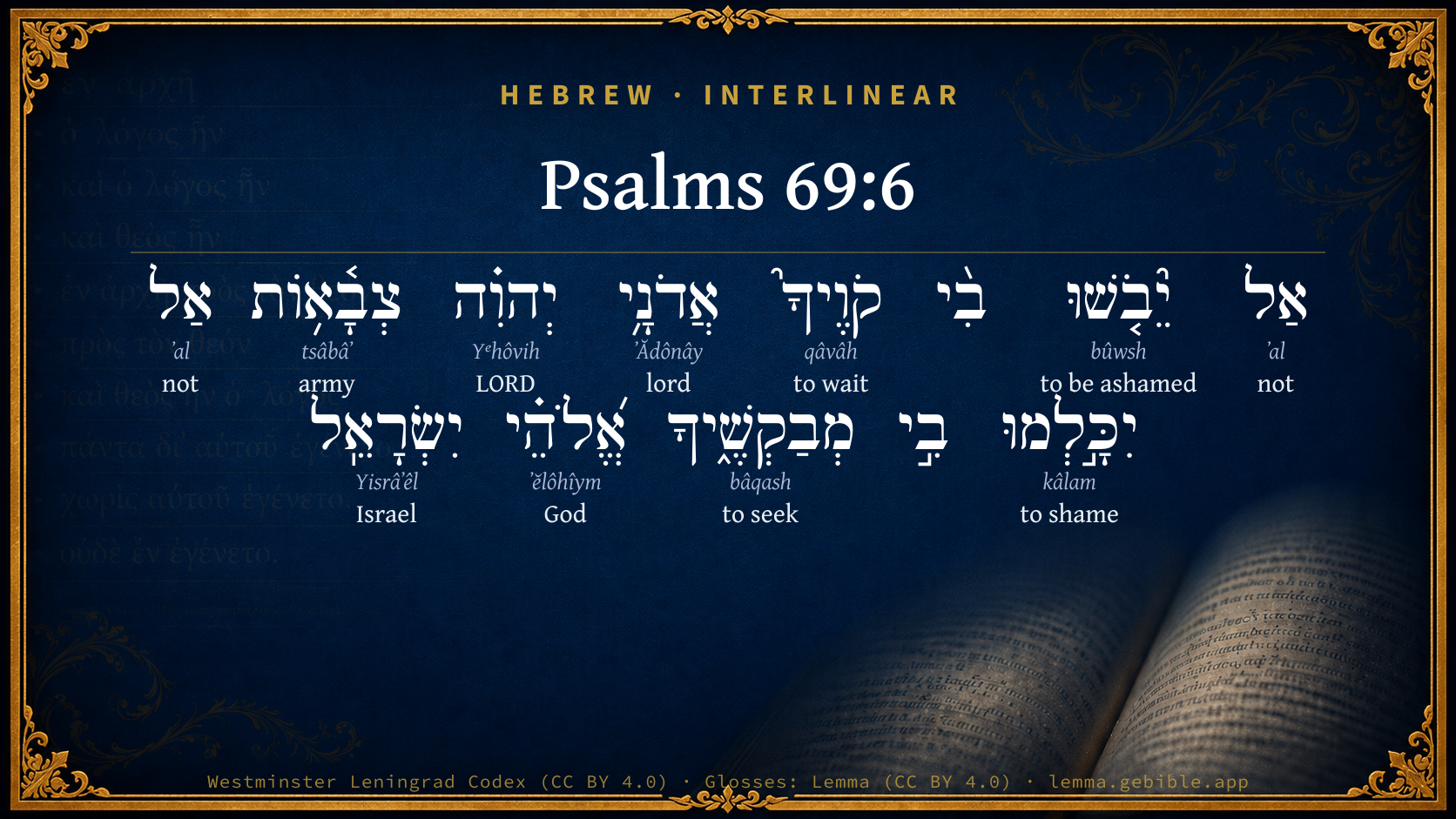
Hebrew (Westminster Leningrad Codex) Psalms 69:6 appears in the Hebrew Old Testament. The text above is from the Westminster Leningrad Codex. Each word links to its Strong’s number, a concise gloss, and parsing drawn from the Open Scriptures Hebrew Bible morphology. Click any word for its full Brown-Driver-Briggs (BDB) entry.
Download image
Cite this verse

Psalms 69:6 (World English Bible). Public Domain. Lemma interlinear Bible study tool, https://lemma.gebible.app/v/psalms/69/6.

Show BibTeX & RIS
BibTeX
RIS
English Translation
Don't let those who wait for you be shamed through me, Lord Yahweh of Hosts. Don't let those who seek you be brought to dishonor through me, God of Israel.
World English Bible · Public Domain
Download a study sheet

One document with this verse’s original text, its word-by-word gloss line, the meaning frame, cross-references with their text, attributed commentary, and full source and license credits — printable, and it pastes into notes with its structure intact.

This verse Autodidact and up

Study sheet (.html) Plain text (.txt)

A passage Seminary Student

Up to 50 verses in one chapter. A passage sheet keeps up to 6 commentary sources and 12 cross-references per verse, in the order this page ranks them, and says so on the sheet whenever that leaves anything out. Ask for a single verse and you get the Autodidact verse sheet above.

Everything on this page stays free to read, with no account — the sheet is a download of what is already on screen, not access to it.

Want to remove ads? Support Godless Engineer
Compare translations 3

The same verse in 3 English versions, stacked beneath the original-language interlinear above. Click any original word for its lexicon entry.

Each is an independent rendering of the whole verse — the interlinear is not word-aligned to these translations.

Highlighted words mark where these versions differ — a whole-verse word diff, not a word-by-word alignment.

  • World English Bible Public Domain
    Don't let those who wait for you be shamed through me, Lord Yahweh of Hosts. Don't let those who seek you be brought to dishonor through me, God of Israel.
  • King James Version Public Domain
    Let not them that wait on thee, O Lord GOD of hosts, be ashamed for my sake: let not those that seek thee be confounded for my sake, O God of Israel.
  • unfoldingWord Literal Text CC BY-SA 4.0
    May the ones waiting for you not have shame because of me, Lord Yahweh of Armies. May the ones seeking you not be humiliated because of me, God of Israel.

unfoldingWord Literal Text — © unfoldingWord, licensed CC BY-SA 4.0. Word-aligned USFM3 via Door43 (git.door43.org/unfoldingWord/en_ult).

Versions to compare (up to 4)

3 of 4 selected

Show all 18 translations

Every available English version of this verse, each an independent rendering of the whole verse.

  • World English Bible Public Domain
    Don't let those who wait for you be shamed through me, Lord Yahweh of Hosts. Don't let those who seek you be brought to dishonor through me, God of Israel.
  • Berean Standard Bible Public Domain
    May those who hope in You not be ashamed through me, O Lord GOD of Hosts; may those who seek You not be dishonored through me, O God of Israel.
  • Majority Standard Bible Public Domain
    May those who hope in You not be ashamed through me, O Lord GOD of Hosts; may those who seek You not be dishonored through me, O God of Israel.
  • King James Version Public Domain
    Let not them that wait on thee, O Lord GOD of hosts, be ashamed for my sake: let not those that seek thee be confounded for my sake, O God of Israel.
  • American Standard Version (1901) Public Domain
    Let not them that wait for thee be put to shame through me, O Lord Jehovah of hosts: Let not those that seek thee be brought to dishonor through me, O God of Israel.
  • Revised Version (1885) Public Domain
    Let not them that wait on thee be ashamed through me, O Lord GOD of hosts: let not those that seek thee be brought to dishonour through me, O God of Israel.
  • Geneva Bible (1599) Public Domain
    Let not them that trust in thee, O Lord God of hostes, be ashamed for me: let not those that seeke thee, be confounded through mee, O God of Israel.
  • Douay-Rheims (1899) Public Domain
    O God, thou knowest my foolishness; and my offences are not hidden from thee:
  • Young's Literal Translation Public Domain
    Let not those waiting on Thee be ashamed because of me, O Lord, Jehovah of Hosts, Let not those seeking Thee Blush because of me, O God of Israel.
  • Literal Standard Version CC BY-SA 4.0
    Do not let those waiting on You be ashamed because of me, || O Lord, YHWH of Hosts, || Do not let those seeking You || Blush because of me, || O God of Israel.
  • Unlocked Literal Bible CC BY-SA 4.0
    Let not those who hope in you be put to shame because of me, Lord Yahweh of hosts; let not those who seek you be brought to dishonor because of me, God of Israel.
  • unfoldingWord Literal Text CC BY-SA 4.0
    May the ones waiting for you not have shame because of me, Lord Yahweh of Armies. May the ones seeking you not be humiliated because of me, God of Israel.
  • Darby Bible Public Domain
    Let not them that wait on thee, Lord, Jehovah of hosts, be ashamed through me; let not those that seek thee be confounded through me, O God of Israel.
  • World Messianic Bible Public Domain
    Don’t let those who wait for you be shamed through me, Lord GOD of Hosts. Don’t let those who seek you be brought to dishonor through me, God of Israel.
  • Webster's Bible Public Domain
    \\69:5\\O God, thou knowest my foolishness; and my sins are not hid from thee.
  • Free Bible Version CC BY-SA 4.0
    Don't let those who trust you be ashamed because of me, Lord God Almighty. Don't let those who follow you be disgraced because of me, God of Israel.
  • Bible in Basic English Public Domain
    Let not those who have hope in you be put to shame because of me, O Lord God of armies: let not those who are waiting for you be made low because of me, O God of Israel.
  • JPS Tanakh (1917) Public Domain
    (69-7) Let not them that wait for Thee be ashamed through me, O Lord GOD of hosts; let not those that seek Thee be brought to confusion through me, O God of Israel.

Literal Standard Version (2020), Covenant Press — licensed CC BY-SA 4.0. Text via the HelloAO Bible API (eBible.org). Unlocked Literal Bible (unfoldingWord) — licensed CC BY-SA 4.0. Text via the HelloAO Bible API (eBible.org). unfoldingWord Literal Text — © unfoldingWord, licensed CC BY-SA 4.0. Word-aligned USFM3 via Door43 (git.door43.org/unfoldingWord/en_ult). Free Bible Version, Dr. Jonathan Gallagher — licensed CC BY-SA 4.0. Text via the HelloAO Bible API (eBible.org).

Word by word

More ways to search: Search by grammar → Find every occurrence → Compare this word →

Practice this passage: Drill this verse → Learn its vocabulary →

יִכָּ֣לְמוּ
kâlam
H3637
“to shame”
Verb, Niphal, Jussive, 3rd Person, Masculine, Plural
Part of Speech
Verb
Stem
Niphal
Form
Jussive
Person
3rd Person
Gender
Masculine
Number
Plural
Full BDB Definition

Origin: a primitive root

TWOT: 987

to insult, shame, humiliate, blush, be ashamed, be put to shame, be reproached, be put to confusion, be humiliated - (Niphal) - to be humiliated, be ashamed - to be put to shame, be dishonoured, be confounded - (Hiphil) - to put to shame, insult, humiliate, cause shame to - to exhibit shame - (Hophal) - to be insulted, be humiliated - to be put to shame, be dishonoured, be confounded
  1. אַל ʼal H408 “not” Particle, Negative
  2. יֵ֘בֹ֤שׁוּ bûwsh H954 “to be ashamed” Verb, Qal, Jussive, 3rd Person, Masculine, Plural
  3. קֹוֶיךָ֮ qâvâh H6960 “waiting · you” Verb, Qal, Participle Active, Masculine, Plural, Construct + Suffix, Personal, 2nd Person, Masculine, Singular
  4. אֲדֹנָ֥י ʼĂdônây H136 “Lord · my” Noun, Common, Masculine, Plural, Construct + Suffix, Personal, 1st Person, Common, Singular
  5. יְהוִ֗ה Yᵉhôvih H3069 “LORD” Noun, Proper
  6. צְבָ֫א֥וֹת tsâbâʼ H6635 “armies” Noun, Common, Both, Plural, Absolute
  7. אַל ʼal H408 “not” Particle, Negative
  8. מְבַקְשֶׁ֑יךָ bâqash H1245 “seeking · you” Verb, Piel, Participle Active, Masculine, Plural, Construct + Suffix, Personal, 2nd Person, Masculine, Singular
  9. אֱ֝לֹהֵ֗י ʼĕlôhîym H430 “God(s) of” Noun, Common, Masculine, Plural, Construct
  10. יִשְׂרָאֵֽל Yisrâʼêl H3478 “Israel” Noun, Proper

About this verse

These counts appear in no published source. They are computed here, from the morphology-tagged text and Lemma’s own curated glosses. What Lemma adds →

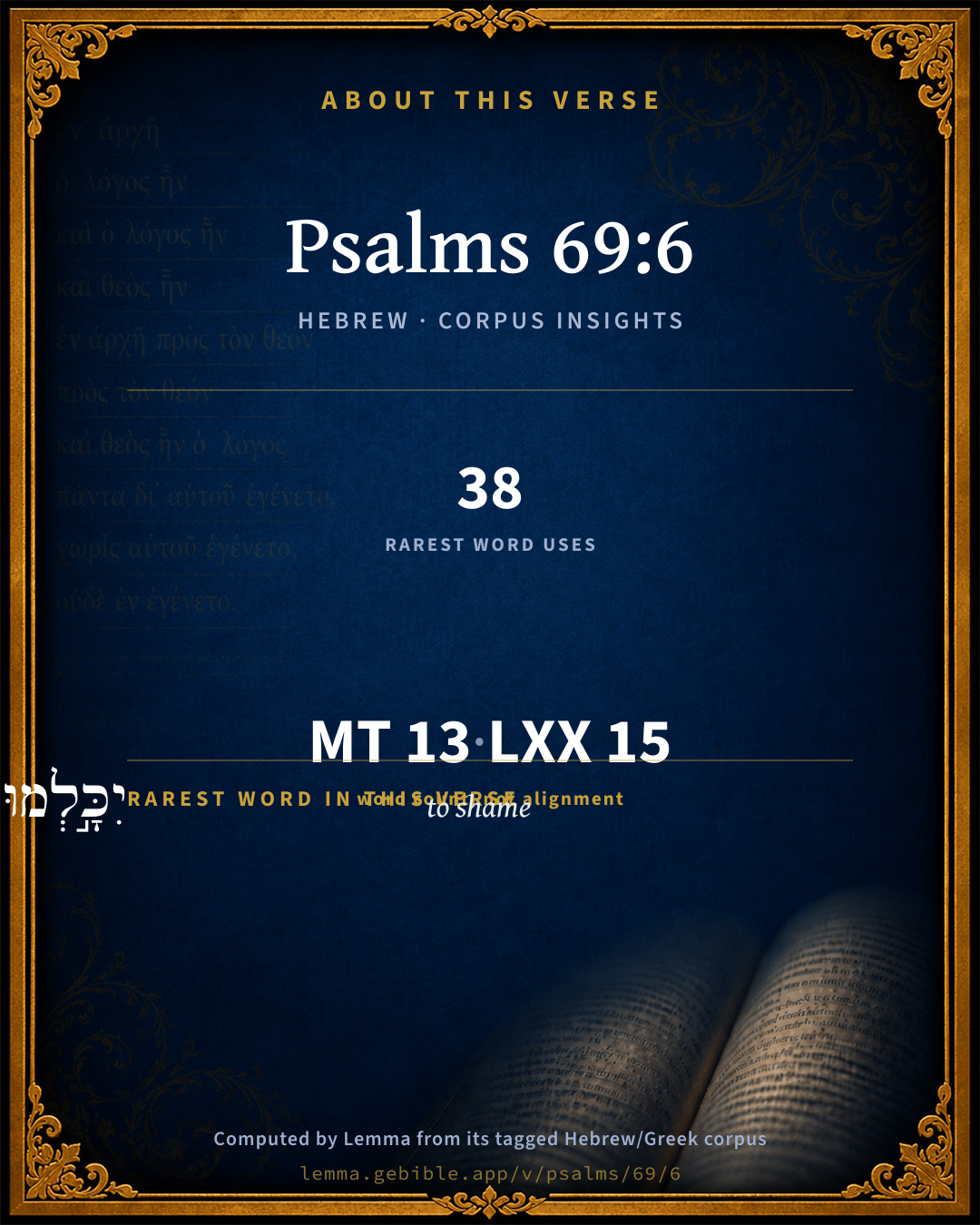
13
words
10
distinct lemmas
Wisdom
section

Shared distinctive vocabulary

יִכָּ֣לְמוּ to shame H3637 occurs in 38 verses of the Hebrew Bible. Also found in:

Grammatical profile

  • 4 verbs
  • 5 nouns
  • 2 prepositions
  • 2 particles

Verb forms

  • יֵ֘בֹ֤שׁוּ Qal · Jussive
  • קֹוֶיךָ֮ Qal · Participle Active
  • יִכָּ֣לְמוּ Niphal · Jussive
  • מְבַקְשֶׁ֑יךָ Piel · Participle Active

Repetition

A word recurs within this verse — often emphatic in Hebrew:

  • אַל not H408 ×2

Hebrew & Septuagint length

In English translation the verse runs 30 words from the Hebrew and 31 from the Septuagint (LXX English) — closely comparable.

A rough comparison of the two English renderings, which tokenize alike — not a word-level alignment.

Word counts can differ between the Hebrew and the Greek without any difference in meaning — e.g. the Hebrew direct-object marker אֵת has no separate Greek word, and Greek often adds the article ὁ.

In the original languages it is 13 Hebrew tokens and 15 Greek tokens — but the two are counted differently (Hebrew bundles its prefixes and suffixes into one token; the Greek is in lemma form), so that isn’t a like-for-like length.

Cross-references

10

Topical passages linked to Psalms 69:6 in the Treasury of Scripture Knowledge — connected by theme and wording, ordered by reader-vote popularity; previews shown in the World English Bible.

  • Psalms 25:3 Yes, no one who waits for you shall be shamed. They shall be shamed who deal treacherously without cause.
  • Psalms 35:26 Let them be disappointed and confounded together who rejoice at my calamity. Let them be clothed with shame and dishonor who magnify themselves against me.
  • Luke 24:19–21 He said to them, "What things?" They said to him, "The things concerning Jesus, the Nazarene, who was a prophet mighty in deed and word before God and all the people;
  • Psalms 72:18 Praise be to Yahweh God, the God of Israel, Who alone does marvelous deeds.
  • Isaiah 49:23 Kings shall be your nursing fathers, and their queens your nursing mothers: they shall bow down to you with their faces to the earth, and lick the dust of your feet; and you shall know that I am Yahweh; and those who wait for me shall not be disappointed.
  • Psalms 7:7 Let the congregation of the peoples surround you. Rule over them on high.
  • 2 Samuel 23:3 The God of Israel said, The Rock of Israel spoke to me: One who rules over men righteously, Who rules in the fear of God,
  • Acts 13:23 From this man's seed, God has brought salvation to Israel according to his promise,
  • Acts 4:7 When they had stood them in the middle of them, they inquired, "By what power, or in what name, have you done this?"
  • Acts 13:17 The God of this people chose our fathers, and exalted the people when they stayed as aliens in the land of Egypt, and with an uplifted arm, he led them out of it.

Cross-references courtesy of OpenBible.info (CC BY 4.0).

Hebrew and Greek witnesses Masoretic Hebrew ↔ Greek Septuagint

The same verse in the two great witnesses to the Old Testament, shown verse-for-verse.

You’re reading Greek Psalm 68 (Hebrew Psalm 69). The Septuagint counts the superscription, so verse numbers can differ from the Hebrew — chapter-level alignment, not verse-by-verse. Numbering follows Rahlfs.

These are two independent witnesses, not word-aligned to each other, and the Septuagint is shown in lemma (dictionary) form.

Hebrew Psalms 69:6 Masoretic · Westminster Leningrad Codex

אַל יֵ֘בֹ֤שׁוּ בִ֨י קֹוֶיךָ֮ אֲדֹנָ֥י יְהוִ֗ה צְבָ֫א֥וֹת אַל יִכָּ֣לְמוּ בִ֣י מְבַקְשֶׁ֑יךָ אֱ֝לֹהֵ֗י יִשְׂרָאֵֽל

Don't let those who wait for you be shamed through me, Lord Yahweh of Hosts. Don't let those who seek you be brought to dishonor through me, God of Israel.

World English Bible · Public Domain

Greek LXX Greek Psalm 68:6 Septuagint · lemma form

ὁ θεός σύ γιγνώσκω ὁ ἀφροσύνη ἐγώ καί ὁ πλημμέλεια ἐγώ ἀπό σύ οὐ κρύπτω

Let not them that wait on you, O Lord of hosts, be ashamed on my account: let not them that seek you, be ashamed on my account, O God of Israel.

LXX2012 (modern English Septuagint) · Public Domain

Hebrew: Westminster Leningrad Codex (CC BY 4.0). Greek: Septuagint (public domain); English from LXX2012 (modern English Septuagint) (Public Domain). How the Septuagint differs from the Hebrew →

Commentary

Notes on Psalms 69:6 from classic Christian and Jewish commentators (each source and its license shown beneath its notes). The classic Christian expositions comment on the surrounding passage and are grouped to its opening verse, so a note may address several verses; the Jewish commentaries on the Tanakh (Rashi and others) are per-verse, so they appear only where the commentator wrote on this verse.

Lemma curates 59 commentaries, every one of them public domain or Creative Commons licensed, each selected and text-cleaned for this edition rather than reprinted as found. About our sources →

Trapp's Complete Commentary

John Trapp

Psa 69:6 Let not them that wait on thee, O Lord GOD of hosts, be ashamed for my sake: let not those that seek thee be confounded for my sake, O God of Israel.

Ver. 6. Let not them … be ashamed for my sake] Give me not up to passions of dishonour, to opprobrious practices, whereby religion might be reproached, or good people reviled and abused, much less staggered and set at a stand by my sufferings.

John Trapp, A Commentary or Exposition upon All the Books of the Old and New Testament (1647–1656) — public domain. Text from a community e-Sword module.

The Biblical Illustrator

Joseph S. Exell

Psa_69:6

Let not them that wait on Thee, O Lord, be ashamed for my sake.

Esprit de corps

This poet is afraid that if he misbehaves himself people will exalt themselves against God, and say with mocking laughter, These are Thy saints! Even whilst he is sinking he would wish to do it with some grace. Extinction itself may be crowned with a species of honour. Death need not be humiliation. There are men who have so died as to have lived a thousand lives in their last combat. Have we lost esprit de corps? Do you not remember that we are involved in the way in which you bear your troubles? If you do not play the man now the enemy will laugh at the whole Church; he will gladly take you up as a specimen of Gods sustaining grace, and say, This is the man who prayed: how chopfallen now I see how that once proud chin hangs on the collapsing breast: this is prayer! If I do not bear myself heroically in the storm, the enemy will have a right to laugh at this pulpit, and to put his foot of contempt upon this whole ministry. If I play the atheist in the darkness, then may men justly meek what I endeavour to say in the light. The mockery will be directed against God, not against men. Moses felt this; he said, If they go back, they will say Thou thyself wert not able to take us forward; and if saints do not play the hero in the time of real combat and desperate difficulty, when everything is going down, when business is dull, when enemies are strong, when health is quaking, people will blame not them only but God, and say, This is the doing of the Lord; why, what advantage is it that we pray to Him? or what profit have we in waiting upon God? the saint and the dog die in the same agony. Thus we recover ourselves, under the blessing of God, by thinking of others. (J. Parker, D. D.)

The Biblical Illustrator, edited by Joseph S. Exell (c. 1880s–1900s) — public domain. Text from a community e-Sword module.

Joseph Benson's Commentary

Psa 69:6. Let not them that wait on thee — The truly pious, who believe thy promises, and look to thee for the fulfilment of them; who are conscious of their own weakness, and of the insufficiency of all human aid, and therefore apply to thee, and trust in thee for the help they want; be ashamed — That is, frustrated of their just and reasonable expectations, which would make them ashamed of their past confidence in thee, and either to look up to thee in future, or to look upon their enemies with assurance, when they shall reproach them for their trust in thee; for my sake — Because of my sad disappointments. For, if they see me forsaken, they will be discouraged by this example; or, let them not hang down their heads for shame to see me, who am thy worshipper, deserted of thee. He was afraid, if God did not appear for him, it would be a discouragement to other pious people, and give their enemies cause to triumph over them; and it was his earnest desire, whatever became of himself, that all the true people of God might retain their confidence and hope in God, and their boldness in his cause, and neither be discouraged in themselves, nor exposed to contempt from others.

Joseph Benson's Commentary on the Old and New Testaments (1811–1818) — public domain. Text from a community e-Sword module.

J. A. Alexander on Psalms

Joseph Addison Alexander

7. (Psa 69:6). Let not them be ashamed in me that wait for thee, Lord, Jehovah, of Hosts; let not them be disgraced in me that seek thee, God of Israel! He prays that the principle laid down in Psa 25:3 may not be falsified. In me, not merely by me, or because of me, but in me, as the representative of the whole class. Ashamed, disappointed and defeated in their hopes. Wait for thee, for thine appearance and the fulfilment of thy promises. Seek thee, i.e. seek to know thee, and enjoy thy favour.

Joseph Addison Alexander, The Psalms Translated and Explained (1850) — public domain. Text from a community e-Sword module.

Geneva Bible (1599)

Geneva Bible translators

Let not mine evil entreaty of the enemies be an occasion, that the faithful fall from thee.

Geneva Bible (1599) marginal notes — public domain. Text via Bolls.life.

Jamieson, Fausset & Brown

Robert Jamieson, A. R. Fausset & David Brown

for my sake--literally, "in me," in my confusion and shame.

Jamieson, Fausset & Brown — Commentary Critical and Explanatory on the Whole Bible (1871) — public domain (CC PDM 1.0). Text via the HelloAO Bible API.

Adam Clarke's Commentary

Verse 6. Be ashamed for my sake] The sins of the Jews were a great stumbling-block in the way of the conversion of the Gentiles. They had been the peculiar people of the Lord. "How," say the Gentiles, "can a pure and holy Being love such people?" They were now punished for their crimes. "How," say the Gentiles, "can God deal so hardly with those whom he professes to love?" The pious among the captives felt keenly, because this reproach seemed to fall upon their gracious and merciful God.

Adam Clarke's Commentary on the Bible (1810–1826) — public domain. Text from a community e-Sword/MySword module.

John Calvin's Commentaries

6 O Jehovah, Lord of Hosts! let not them that wait for thee be ashamed in me. David declares that he is set forth as an example from which all the people of God may derive matter either of hope or despair. Although he was held in detestation and execrated by the great body of the people, there yet remained a few who were ready to bear just and impartial testimony to his innocence; knowing as they did that he was unrighteously afflicted by his persecutors, that he constantly reposed on the grace and goodness of God, and that no temptations could discourage or prevent him from continuing steadfast in the practice of true godliness. But when they observed the distresses and calamities to which he was notwithstanding subjected, the only conclusion to which they were able to arrive was, that all the pains and labor which he had taken in devoutly serving God were entirely thrown away. As all the instances in which God extends his succor to his servants are so many seals, by which he confirms and gives us assurance of his goodness and grace towards us, the faithful must have been exceedingly discouraged had David been forsaken in the extremity of his distress. The danger of their being thus discouraged he now lays before God; not that God has ever need of being put in mind of any thing, but because he allows us to deal familiarly with him at the throne of grace. The word wait is properly to be understood of hope, and the expression to seek God, of prayer. The connecting of the two together teaches us the profitable lesson, that faith is not all inactive principle, since it is the means of stirring us up to seek God.

John Calvin's Commentaries (1540-1563) — public domain. Text from the Calvin Translation Society English edition (1840s-50s) via the Christian Classics Ethereal Library (ccel.org). Calvin's coverage is partial (roughly two-thirds of the Bible); uncommented books and verses are honest gaps, never fabricated. The 19th-century editor's footnotes and remarks are omitted so the notes are faithfully Calvin's own voice.

Ellicott's Commentary for English Readers

(6) Let not them.—We again meet the feeling so common in the Psalms (see especially Psa_44:17-22), that the sufferings of any member of Israel must bring dishonour on the name of Jehovah and on His religion. Here, however, it seems to touch a higher chord of feeling and to approach the true Churchmanship—the esprit de corps of the Kingdom of Heaven—which attaches a greater heinousness to the sin because it may harm the brethren. Not only would Jehovah be dishonoured in the sight of the heathen if He seemed to be disregarding His part of the covenant, but for an Israelite to have violated his part brought shame on all Israel.

A Bible Commentary for English Readers, edited by Charles John Ellicott (1878–1897) — public domain. Text from a community e-Sword module.

The Cambridge Bible for Schools and Colleges

gen. ed. J. J. S. Perowne

6. Let not those that wait on thee be ashamed through me,

O Lord, Jehovah of hosts:

Let not those that seek thee be brought to dishonour through me, O God of Israel.

Cp. Psa_25:3; Psa_38:15-16. The divine titles are significant. They appeal to God’s sovereignty and to His relation to His people. Surely, since He has the power to prevent it, He cannot leave the true Israel to be the scorn of its foes, as will happen through me, or, in my case, if I am left to perish unregarded.

The Cambridge Bible for Schools and Colleges (gen. ed. J. J. S. Perowne; Cambridge University Press, 1878–1918) — public domain. Text from a community e-Sword module.

John Gill's Exposition

Let not them that wait on thee, O Lord God of hosts, be ashamed for my sake,.... Of their expectation of redemption and salvation by the Messiah, they have been waiting upon the Lord for; when they shall see him in suffering circumstances, and even dead and laid in the grave, without any hope of his rising again; which was the case of the two disciples travelling to Emmaus, Luk 24:19; whose trust in him, and expectation of him, as the Redeemer of Israel, were almost gone. The people of God, and believers in Christ, are described by such that "wait on the Lord"; for the coming of Christ, and salvation by him; who would be in danger of being put to shame and in confusion, when they should see him under the power of death and the grave; wherefore in this petition Christ addresses his divine Father as "the Lord God of hosts", of armies above and below, as God omnipotent; partly to encourage their trust and confidence in him, and partly to encourage his own faith as man, that this petition would be answered;

let not those that seek thee: in the word and ordinances, by prayer and supplication, with all their hearts, in Christ, in whom the Lord is only to be found, and for life and happiness:

be confounded for my sake; that is, through his sufferings and death, as before:

O God of Israel; the covenant God of the spiritual Israel, whom he has chosen, the Messiah redeems, and the Spirit makes Israelites indeed.

John Gill's Exposition of the Whole Bible (1746–1763) — public domain (CC PDM 1.0). Text via the HelloAO Bible API.

Albert Barnes' Notes on the Bible

Let not them that wait on thee - Those who worship thee; those who are thy true friends. True piety is often, in the Scriptures, represented as waiting on the Lord. See Psa 25:3, Psa 25:5; Psa 37:9; Isa 40:31.

Be ashamed for my sake - On account of me; or, in consequence of what I do. Let me not be suffered to do anything that would make them ashamed of me, or ashamed to have it known that I belong to their number. I know that I am a sinner; I know that judgments come justly on me; I know that if left to myself I shall fall into sin, and shall dishonor religion; and I pray, therefore, that I may be kept from acting out the depravity of my heart, and bringing dishonor on the cause that I profess to love. No one who knows the evil of his own heart can fail to see the propriety of this prayer; no one who remembers how often people high in the church, and zealous in their professed piety, fall into sin, and disgrace their profession, can help feeling that what has happened to others “may” happen to him also, and that he has need of special prayer, and special grace, that he may go down into the grave at last without having brought dishonor upon religion.

Let not those that seek thee - Another phrase to denote people of true piety - as those who are “seeking” after God; that is, who are desirous of understanding his character, and obtaining his favor.

Be confounded for my sake - Let them not feel “disgraced” in me; let them not feel it a dishonor to have it said that I am one of their number, or that I profess to be united to them.

Albert Barnes' Notes on the Bible (1834–1885) — public domain. Text from a community e-Sword/MySword module.

Matthew Poole's English Annotations

Them that wait on thee, i.e. thy godly people, who rely upon thy promises which thou hast made to all thine in general, and to me in a special manner, wherein they also are concerned.

Ashamed, i.e. frustrated of their just hopes; which will make them ashamed, either to look upon God, or to look upon their enemies, when they shall reproach them for their confidence in God.

For my sake; either,

1. For the sake of my sins last mentioned; let not all good men suffer for my sins. Or,

2. Because of my sad disappointments. For if they see me rejected and forsaken of God, whom they have esteemed a great example of faith, and prayer, and all virtue and piety, they will be exceedingly discouraged by this example; which will tend much to thy dishonour and disservice.

Matthew Poole's English Annotations on the Holy Bible (1683–1685) — public domain. Text from a community e-Sword/MySword module.

The Treasury of David

Charles H. Spurgeon

Ver. 6. Let not them that wait on thee, O Lord God of hosts, be ashamed for my sake. If he were deserted, others who were walking in the same path of faith would be discouraged and disappointed. Unbelievers are ready enough to catch at anything which may turn humble faith into ridicule, therefore, O God of all the armies of Israel, let not my case cause the enemy to blaspheme--such is the spirit of this verse. Our blessed Lord ever had a tender concern for his people, and would not have his own oppression of spirit become a source of discouragement to them.

Let not those that seek thee be confounded for my sake, O God of Israel. He appealed to the Lord of hosts by his power to help him, and now to the God of Israel by his covenant faithfulness to come to the rescue. If the captain of the host fail, how will it fare with the rank and file? If David flee, what will his followers do? If the king of believers shall find his faith unrewarded, how will the feeble ones hold on their way? Our Lord's behaviour during his sharpest agonies is no cause of shame to us; he wept, for he was man, but he murmured not, for he was sinless man; he cried, "My Father, if it be possible, let this cup pass from me; "for he was human, but he added, "Nevertheless, not as I will, but as thou wilt, "for his humanity was without taint of rebellion. In the depths of tribulation no repining word escaped him, for there was no repining in his heart. The Lord of martyrs witnessed a good confession. He was strengthened in the hour of peril, and came off more than a conqueror, as we also shall do, if we hold fast our confidence even to the end.

Ver. 6. Let not them that wait on thee, O Lord God of hosts, be ashamed for my sake, etc. This says, that unless the carriage and deportment of the godly man redounds to the comfort of all the rest of the godly, it in some way tends to the discredit of the godly. Since this is the case, when they slip aside, or carry not aright; since they are all in hazard of doing so, it should be matter of affecting and afflicting exercise, lest they do so. Fellow professors are ashamed of the person that walketh not aright; they are ashamed that ever they should have been in company or fellowship with him; they are ashamed that ever such a person should have owned such a cause, and that ever such a thing should have befallen a professor of such a cause; and, besides, they are weakened by him in their hopes of persevering for themselves. Again, they are in hazard of being a discredit to all the godly, because, say they, it seems the Lord has granted no peremptory promise, as to the manner of their final perseverance; and corruption enough remains in them still, to overturn all their stock of grace, if they get not present renewed influences. William Guthrie. 1620-1655.

Ver. 6. Ashamed for my sake. I pray that they may not be confounded by external enemies with their boundless insults and reproaches, because they seem to be the worshippers of a God crucified and dead, and are themselves like dead men, and lie rotting before his sepulchre, as if their good name were gone. Rather let my enemies who do not wish me to live be terror stricken at my angelic countenance, and fall like the dead. Gerhohus.

Ver. 6. For my sake. yb: more exactly, in me. In these words the voice of the Sponsor of his people's peace is clearly audible. The prayer of the Sufferer has its answer in the declarative testimony which now forms the basis of the gospel: "He that believeth on him shall not be confounded." 1Pe 2:6. Arthur Pridham.

Ver. 6. Because I, for their sakes, do at thy command bear that shame which they should else have done, Lord, take it off from them, because thou hast laid it upon me; so it expressly follows, Ps 69:7: Because for thy sake I have borne reproach; shame hath covered my face. Thomas Goodwin.

None.

Psalms 69:7*

Charles H. Spurgeon's The Treasury of David (1869–1885) — public domain. Psalms only. Text from a community e-Sword/MySword module.

Whedon's Commentary on the Bible

Daniel D. Whedon

6. Ashamed for my sake—Literally, ashamed in me. The form of speech is exactly similar to “offended in me.” Mat_11:6. The meaning is, Let not them that wait on thee be turned out of the way on account of my sufferings and apparent abandonment. The humility, poverty, and persecutions of Jesus were the occasion of turning many aside. See Mat_13:21; Mat_13:57; Mat_26:31; Mat_26:33

Daniel D. Whedon (gen. ed.), Commentary on the Old and New Testaments (1874–1909) — public domain. Text from a community e-Sword module.

The Pulpit Commentary

Let not them that wait on thee (or, hope in thee), O Lord God of hosts, be ashamed for my sake; or, through me (Revised Version); on my account (Kay) as they would be if I, although thy faithful worshipper, were delivered into my enemies" hands. Let not those that seek thee be confounded for my sake, O God of Israel. One of the many places where the second clause is a simple echo of the first.

The Pulpit Commentary (1880–1919), ed. H.D.M. Spence-Jones & Joseph S. Exell — public domain. Text from a community e-Sword module.

John Wesley's Explanatory Notes

For my sake - Because of my sad disappointments. For if they see me forsaken, they will be discouraged by this example.

John Wesley, Explanatory Notes Upon the Whole Bible (1754–1765) — public domain. Text via the GEBible commentary corpus.

Lesson kit

Teaching starters — assembled from the data on this page, not authored interpretation. Every prompt links to the verse data it draws on. Edit before teaching.

Psalms, in the Wisdom, opens this verse with 13 words (10 distinct Hebrew lemmas). Its most distinctive word is kâlam (“to shame”). A historical commentator’s framing appears above. Read the whole chapter for the surrounding context.

Discussion questions

  1. What does “to shame” (kâlam) contribute to the verse as a whole?
  2. How does Numbers 12:14, which shares the word «to shame», read alongside this verse?
  3. What does the repetition of “not” (2× in this one verse) do in this verse?
  4. These translations render this verse differently. What is at stake in choosing one wording over another?
  5. «יֵ֘בֹ֤שׁוּ» is a Qal Jussive verb. How does that grammatical form shape the action described?
  6. Compare how Trapp's Complete Commentary and The Biblical Illustrator read this verse. Where do they agree or differ?

Things to notice

Reading settings

Reading text

Shown beneath each verse's original-language words.

Old Testament
Old Testament edition

Read the OT as the Masoretic Hebrew (MT) or the Greek Septuagint (LXX).

English shown for the Greek Septuagint (in the Hebrew ↔ Greek comparison).

Comparing translations? Open the Compare panel on any verse page to stack up to four side by side.