
Jeremiah 1:6

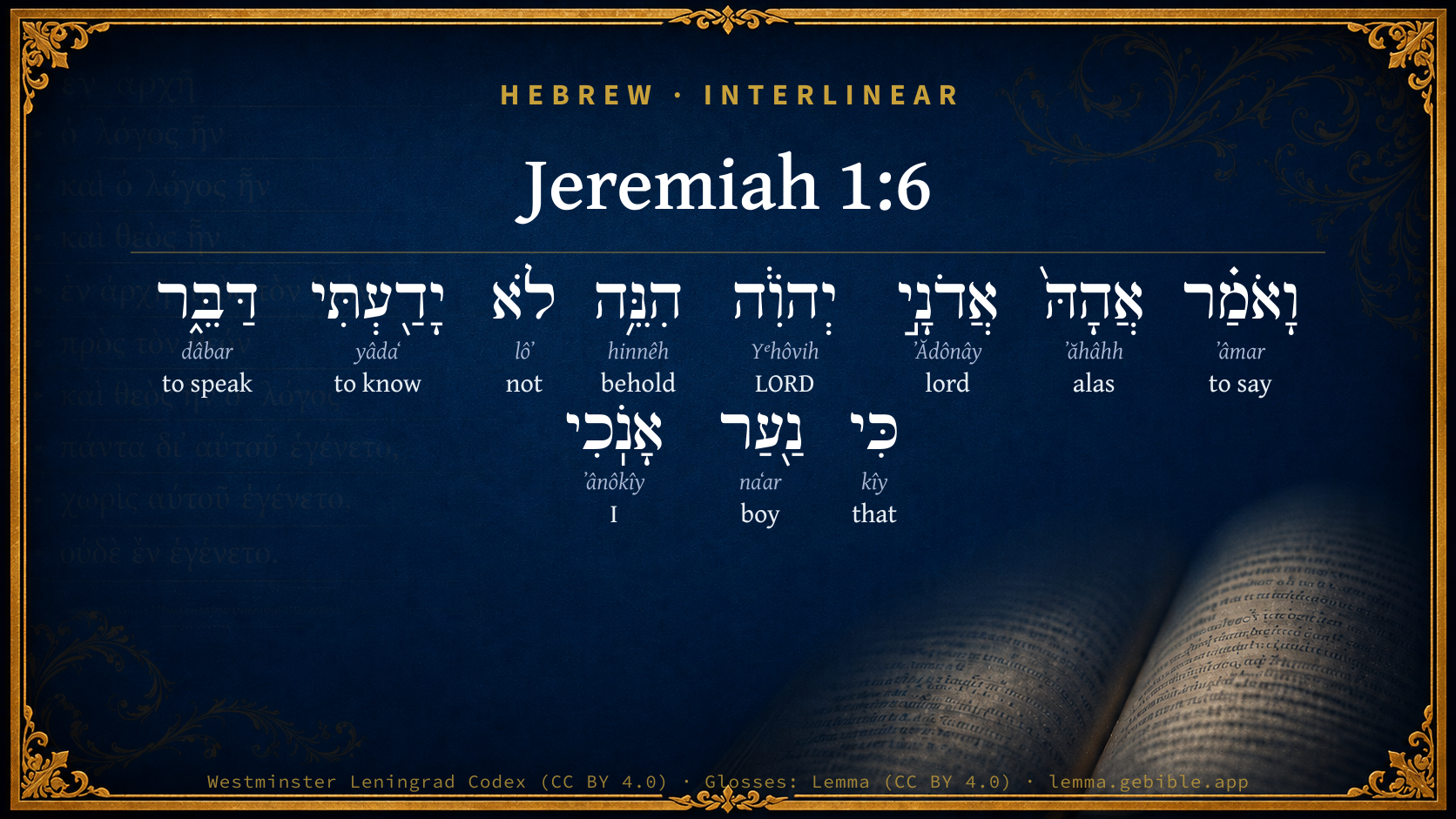
Hebrew (Westminster Leningrad Codex) Jeremiah 1:6 appears in the Hebrew Old Testament. The text above is from the Westminster Leningrad Codex. Each word links to its Strong’s number, a concise gloss, and parsing drawn from the Open Scriptures Hebrew Bible morphology. Click any word for its full Brown-Driver-Briggs (BDB) entry.
Download image
Cite this verse

Jeremiah 1:6 (World English Bible). Public Domain. Lemma interlinear Bible study tool, https://lemma.gebible.app/v/jeremiah/1/6.

Show BibTeX & RIS
BibTeX
RIS
English Translation
Then said I, Ah, Lord Yahweh! behold, I don't know how to speak; for I am a child.
World English Bible · Public Domain
Download a study sheet

One document with this verse’s original text, its word-by-word gloss line, the meaning frame, cross-references with their text, attributed commentary, and full source and license credits — printable, and it pastes into notes with its structure intact.

This verse Autodidact and up

Study sheet (.html) Plain text (.txt)

A passage Seminary Student

Up to 50 verses in one chapter. A passage sheet keeps up to 6 commentary sources and 12 cross-references per verse, in the order this page ranks them, and says so on the sheet whenever that leaves anything out. Ask for a single verse and you get the Autodidact verse sheet above.

Everything on this page stays free to read, with no account — the sheet is a download of what is already on screen, not access to it.

Want to remove ads? Support Godless Engineer
Compare translations 3

The same verse in 3 English versions, stacked beneath the original-language interlinear above. Click any original word for its lexicon entry.

Each is an independent rendering of the whole verse — the interlinear is not word-aligned to these translations.

Highlighted words mark where these versions differ — a whole-verse word diff, not a word-by-word alignment.

  • World English Bible Public Domain
    Then said I, Ah, Lord Yahweh! behold, I don't know how to speak; for I am a child.
  • King James Version Public Domain
    Then said I, Ah, Lord GOD! behold, I cannot speak: for I am a child.
  • unfoldingWord Literal Text CC BY-SA 4.0
    Then said, “Alas, Lord Yahweh! Behold, I do not know to speak, for I a youth.”

unfoldingWord Literal Text — © unfoldingWord, licensed CC BY-SA 4.0. Word-aligned USFM3 via Door43 (git.door43.org/unfoldingWord/en_ult).

Versions to compare (up to 4)

3 of 4 selected

Show all 18 translations

Every available English version of this verse, each an independent rendering of the whole verse.

  • World English Bible Public Domain
    Then said I, Ah, Lord Yahweh! behold, I don't know how to speak; for I am a child.
  • Berean Standard Bible Public Domain
    “Ah, Lord GOD,” I said, “I surely do not know how to speak, for I am only a child!”
  • Majority Standard Bible Public Domain
    “Ah, Lord GOD,” I said, “I surely do not know how to speak, for I am only a child!”
  • King James Version Public Domain
    Then said I, Ah, Lord GOD! behold, I cannot speak: for I am a child.
  • American Standard Version (1901) Public Domain
    Then said I, Ah, Lord Jehovah! behold, I know not how to speak; for I am a child.
  • Revised Version (1885) Public Domain
    Then said I, Ah, Lord GOD! behold, I cannot speak: for I am a child.
  • Geneva Bible (1599) Public Domain
    Then said I, Oh, Lord God, behold, I can not speake, for I am a childe.
  • Douay-Rheims (1899) Public Domain
    And I said: Ah, ah, ah, Lord God: behold, I cannot speak, for I am a child.
  • Young's Literal Translation Public Domain
    And I say, `Ah, Lord Jehovah! lo, I have not known -- to speak, for I `am' a youth.'
  • Literal Standard Version CC BY-SA 4.0
    And I say, “Aah! Lord YHWH! Behold, I have not known—to speak, for I [am] a youth.”
  • Unlocked Literal Bible CC BY-SA 4.0
    “Ah, Lord Yahweh!” I said, “I do not know how to speak, for I am too young.”
  • unfoldingWord Literal Text CC BY-SA 4.0
    Then said, “Alas, Lord Yahweh! Behold, I do not know to speak, for I a youth.”
  • Darby Bible Public Domain
    And I said, Alas, Lord Jehovah! behold, I cannot speak; for I am a child.
  • World Messianic Bible Public Domain
    Then I said, “Ah, Lord GOD! Behold, I don’t know how to speak; for I am a child.”
  • Webster's Bible Public Domain
    Then said I, Ah, Lord GOD! behold, I cannot speak: for I am a child.
  • Free Bible Version CC BY-SA 4.0
    “Oh no, Lord God!” I replied. “I really don't know how to speak in public because I'm still too young!”
  • Bible in Basic English Public Domain
    Then said I, O Lord God! see, I have no power of words, for I am a child.
  • JPS Tanakh (1917) Public Domain
    Then said I: 'Ah, Lord GOD! behold, I cannot speak; for I am a child.'

Literal Standard Version (2020), Covenant Press — licensed CC BY-SA 4.0. Text via the HelloAO Bible API (eBible.org). Unlocked Literal Bible (unfoldingWord) — licensed CC BY-SA 4.0. Text via the HelloAO Bible API (eBible.org). unfoldingWord Literal Text — © unfoldingWord, licensed CC BY-SA 4.0. Word-aligned USFM3 via Door43 (git.door43.org/unfoldingWord/en_ult). Free Bible Version, Dr. Jonathan Gallagher — licensed CC BY-SA 4.0. Text via the HelloAO Bible API (eBible.org).

Word by word

More ways to search: Search by grammar → Find every occurrence → Compare this word →

Practice this passage: Drill this verse → Learn its vocabulary →

About this verse

These counts appear in no published source. They are computed here, from the morphology-tagged text and Lemma’s own curated glosses. What Lemma adds →

11
words
11
distinct lemmas
Prophets
section

Notable vocabulary

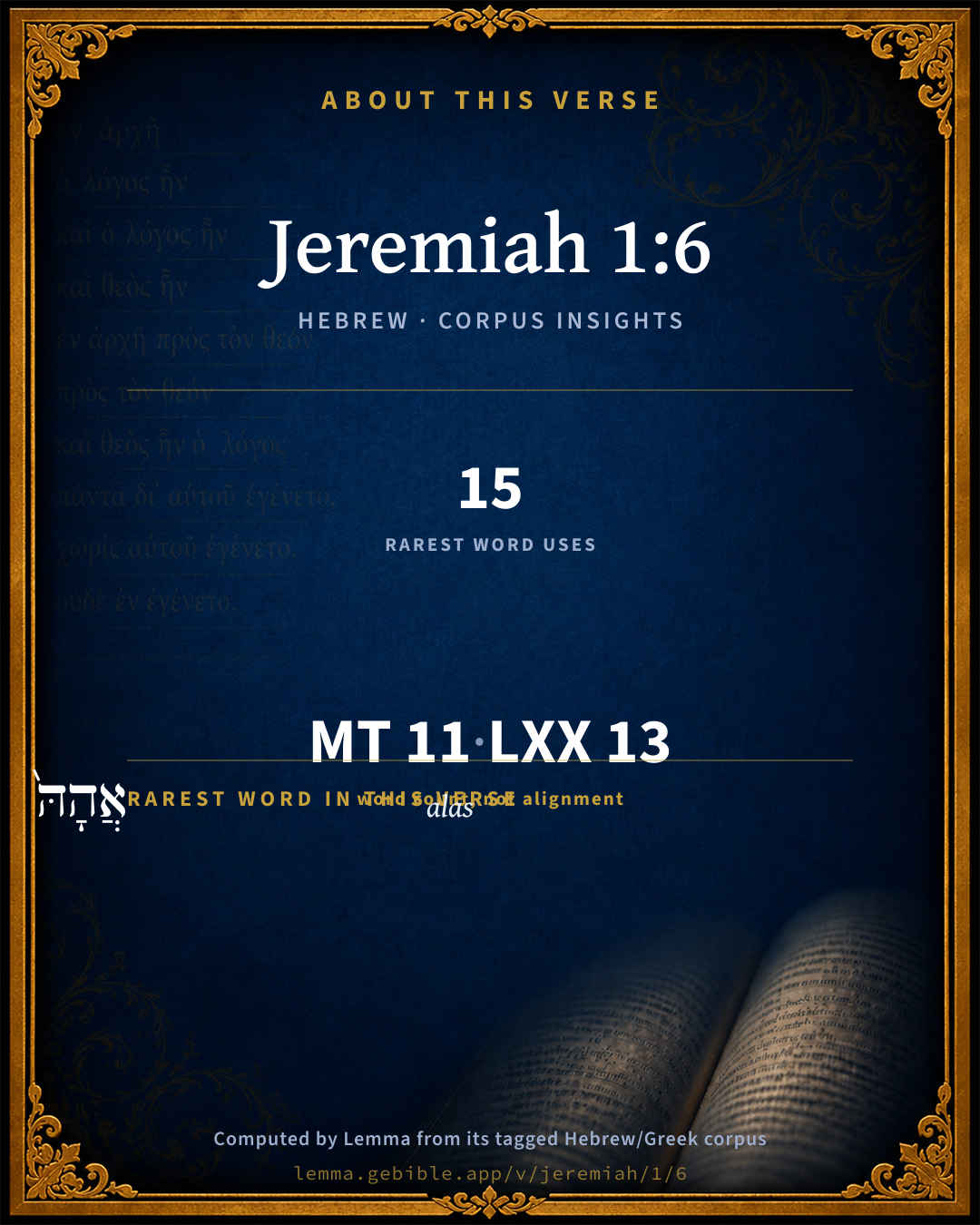
The rarest word here is אֲהָהּ֙ alas H162 — appearing just 15 times in the whole Hebrew Bible.

Shared distinctive vocabulary

אֲהָהּ֙ alas H162 occurs in 15 verses of the Hebrew Bible. Also found in:

Grammatical profile

  • 3 verbs
  • 3 nouns
  • 1 pronoun
  • 1 conjunction
  • 3 particles

Verb forms

  • וָאֹמַ֗ר Qal · Sequential Imperfect
  • יָדַ֖עְתִּי Qal · Perfect
  • דַּבֵּ֑ר Piel · Infinitive Construct

Hebrew & Septuagint length

In the original languages it is 11 Hebrew tokens and 13 Greek tokens — but the two are counted differently (Hebrew bundles its prefixes and suffixes into one token; the Greek is in lemma form), so that isn’t a like-for-like length.

Cross-references

9

Topical passages linked to Jeremiah 1:6 in the Treasury of Scripture Knowledge — connected by theme and wording, ordered by reader-vote popularity; previews shown in the World English Bible.

  • Exodus 4:10–16 Moses said to Yahweh, "Oh, Lord, I am not eloquent, neither before now, nor since you have spoken to your servant; for I am slow of speech, and of a slow tongue."
  • Exodus 6:12 Moses spoke before Yahweh, saying, "Behold, the children of Israel haven't listened to me. How then shall Pharaoh listen to me, who am of uncircumcised lips?"
  • 1 Kings 3:7–9 Now, Yahweh my God, you have made your servant king instead of David my father: and I am but a little child; I don't know how to go out or come in.
  • Jeremiah 32:17 Ah Lord Yahweh! behold, you have made the heavens and the earth by your great power and by your outstretched arm; there is nothing too hard for you,
  • Exodus 4:1 Moses answered, "But, behold, they will not believe me, nor listen to my voice; for they will say, 'Yahweh has not appeared to you.'"
  • Exodus 6:30 Moses said before Yahweh, "Behold, I am of uncircumcised lips, and how shall Pharaoh listen to me?"
  • Jeremiah 14:13 Then said I, Ah, Lord Yahweh! behold, the prophets tell them, You shall not see the sword, neither shall you have famine; but I will give you assured peace in this place.
  • Jeremiah 4:10 Then said I, Ah, Lord Yahweh! surely you have greatly deceived this people and Jerusalem, saying, You shall have peace; whereas the sword reaches to the life.
  • Isaiah 6:5 Then I said, "Woe is me! For I am undone, because I am a man of unclean lips, and I dwell in the midst of a people of unclean lips: for my eyes have seen the King, Yahweh of Hosts!"

Cross-references courtesy of OpenBible.info (CC BY 4.0).

Hebrew and Greek witnesses Masoretic Hebrew ↔ Greek Septuagint

The same verse in the two great witnesses to the Old Testament, shown verse-for-verse.

These are two independent witnesses, not word-aligned to each other, and the Septuagint is shown in lemma (dictionary) form.

Hebrew Jeremiah 1:6 Masoretic · Westminster Leningrad Codex

וָאֹמַ֗ר אֲהָהּ֙ אֲדֹנָ֣י יְהֹוִ֔ה הִנֵּ֥ה לֹא יָדַ֖עְתִּי דַּבֵּ֑ר כִּי נַ֖עַר אָנֹֽכִי

Then said I, Ah, Lord Yahweh! behold, I don't know how to speak; for I am a child.

World English Bible · Public Domain

Greek LXX Structure differs

In the Septuagint, Jeremiah is about an eighth shorter than the Hebrew and arranges its material differently — the Oracles Against the Nations (Hebrew chapters 46–51) appear in the middle of the Greek book, after 25:13. Because the chapter and verse boundaries do not line up, a verse-for-verse comparison with the Hebrew is not shown.

A verse-for-verse comparison isn’t shown here because the chapters and verses don’t line up. Switch to the LXX edition with the MT / LXX toggle above to read the Greek directly.

On this verse, John Gill's Exposition discusses the Septuagint’s reading. Read the note in Commentary ↓

Hebrew: Westminster Leningrad Codex (CC BY 4.0). Greek: Septuagint (public domain); English from a public-domain English Septuagint. How the Septuagint differs from the Hebrew →

Targum (Aramaic paraphrase)

1

The Targum is the ancient Jewish Aramaic paraphrase of the Hebrew Scriptures — an interpretive translation, not the Hebrew text itself. Onkelos (literal) and Pseudo-Jonathan (expansive) render the Torah, and Jonathan the Prophets. Coverage is partial: where no permissively-licensed English translation exists for a verse, only the Aramaic is shown. This is verse-level text, not a word-by-word alignment to the Hebrew.

  1. Targum Jonathan Prophets (Joshua–Malachi)
    וַאֲמָרֵית קַבֵּיל בָּעוּתִי יְיָ אֱלֹהִים הָא לֵית אֲנָא יָדַע לְאִתְנַבָּאָה אֲרֵי רָבֵי אֲנָא וּמִשֵׁירוּתִי עָקָא וְגָלוּ אֲנָא מִתְנַבֵּי עַל עַמָא הָדֵין:

    (no public-domain English translation for this verse)

    Targum Jonathan — Aramaic: “Mikraot Gedolot” (public domain). English: “Sefaria Community Translation” (CC0 1.0 (public-domain dedication)); “London "Chaldee Paraphrase," 1871” (public domain). Text via Sefaria.

Commentary

Notes on Jeremiah 1:6 from classic Christian and Jewish commentators (each source and its license shown beneath its notes). The classic Christian expositions comment on the surrounding passage and are grouped to its opening verse, so a note may address several verses; the Jewish commentaries on the Tanakh (Rashi and others) are per-verse, so they appear only where the commentator wrote on this verse.

Lemma curates 59 commentaries, every one of them public domain or Creative Commons licensed, each selected and text-cleaned for this edition rather than reprinted as found. About our sources →

Trapp's Complete Commentary

John Trapp

Jer 1:6 Then said I, Ah, Lord GOD! behold, I cannot speak: for I [am] a child.

Ver. 6. Then said I, Ah, Lord God!] Verbum angustiae. The old Latin hath it A, A, A, whereby is noted, say some, a threefold defect - scil., of age, of knowledge, and of eloquence; but that is more subtle than solid. True worth is ever modest; and the more fit any man is for whatsoever vocation, the less he thinketh hinlself; forwardness argueth insufficiency.

Behold, I cannot speak.] Heb., I know not to speak, i.e., aright, and as I ought. Tanto negotio tam instructum oratorem me non agnosco. Jeremiah was an excellent speaker, as well appeareth by these ensuing homilies of his, which show that he was suaviter gravis, et graviter suavis (as one saith of Basil), a grave and sweet preacher, one that could deliver his mind fitly, and dared to do it freely. Hence some of the Jews judged our Saviour to have been Jeremiah propter dicendi agendique gravitatem et parrhesian, for his gravity and freedom of speech. Nevertheless Jeremiah, in his own opinion, "cannot speak"; that is, was no way fit to speak. So Moses is at it with his "Who am I?," {Exo 3:11} whereas none in all Egypt was comparably fit for such an embassy. It was a usual saying of Luther, Etsi iam senex, et in concionando exercitus sum, &c. Although I am now an old man, and an experienced preacher, yet I tremble as oft as I go up into the pulpit.

For I am a child.] Epiphanius saith that Jeremiah was not even over fourteen or fifteen when he began to prophesy. Samuel also, and Daniel, began very young. So did Timothy, Origen, Cornelius Mus, a famous preacher, say his fellow Jesuites, at eleven years of age. Archbishop Ussher was converted at ten years old, preached early, and so continued to do for sixty years, or nearly so. {a} Mr Beza was likewise converted at sixteen years old (for the which, as for a special mercy, he giveth God thanks in his last will and testament), and lived a preacher in Geneva to a very great age.

{a} His Life and Death, by Dr Bern.

John Trapp, A Commentary or Exposition upon All the Books of the Old and New Testament (1647–1656) — public domain. Text from a community e-Sword module.

Joseph Benson's Commentary

Jer 1:6. Then said I, Ah, Lord God, &c. — He modestly excuses himself from a consideration of the weight of the work, and the tenderness of his age, as in the next expression. Behold, I cannot speak; for I am a child — We cannot infer from this, that Jeremiah was within the years of what is properly called childhood. For he might call himself a child by way of extenuating his abilities; as Solomon calls himself a little child, 1Ki 1:7, although at that time he was married, and must have been at least twenty years of age. And the word child, or youth, is elsewhere used of those who were arrived at the first years of manhood.

Joseph Benson's Commentary on the Old and New Testaments (1811–1818) — public domain. Text from a community e-Sword module.

Tyndale Open Study Notes

Tyndale Open Resources

1:6 Jeremiah was young (probably a teenager).

Tyndale Open Study Notes — © Tyndale Open Resources, licensed CC BY-SA 4.0. Text via the HelloAO Bible API.

Geneva Bible (1599)

Geneva Bible translators

Considering the great judgments of God, which according to his threatening should come upon the world, he was moved with a certain compassion on the one side to pity them that should thus perish, and on the other side by the infirmity of man’s nature, knowing how hard a thing it was to enterprise such a charge, as Isa. 6:11; Exod. 3:21 and 4:1.

Geneva Bible (1599) marginal notes — public domain. Text via Bolls.life.

Jamieson, Fausset & Brown

Robert Jamieson, A. R. Fausset & David Brown

From the long duration of his office (Jer 1:2-3; Jer 40:1, &c.; Jer 43:8, &c.), it is supposed that he was at the time of his call under twenty-five years of age.

child--the same word is translated, "young man" (Sa2 18:5). The reluctance often shown by inspired ministers of God (Exo 4:10; Exo 6:12, Exo 6:30; Jon 1:3) to accept the call, shows that they did not assume the office under the impulse of self-deceiving fanaticism, as false prophets often did.

Jamieson, Fausset & Brown — Commentary Critical and Explanatory on the Whole Bible (1871) — public domain (CC PDM 1.0). Text via the HelloAO Bible API.

Adam Clarke's Commentary

Verse 6. I cannot speak] Being very young, and wholly inexperienced, I am utterly incapable of conceiving aright, or of clothing these Divine subjects in suitable language. Those who are really called of God to the sacred ministry are such as have been brought to a deep acquaintance with themselves, feel their own ignorance, and know their own weakness. They know also the awful responsibility that attaches to the work; and nothing but the authority of God can induce such to undertake it. They whom God never called run, because of worldly honour and emolument: the others hear the call with fear and trembling, and can go only in the strength of Jehovah.

"How ready is the man to go,

Whom God hath never sent!

How timorous, diffident, and slow,

God's chosen instrument!"

Adam Clarke's Commentary on the Bible (1810–1826) — public domain. Text from a community e-Sword/MySword module.

John Calvin's Commentaries

After having spoken of his call, the Prophet adds, that he at first refused his office, and he states this for two reasons; first, that he might clear himself from every suspicion of rashness, for we know how much ambition prevails among men, according to what James intimates, that many wish to be teachers, (James 3:1) and there is hardly one who is not anxious to be listened to. Since, then, most men too readily assume the office of teaching, and many boldly intrude into it, Jeremiah, in order to avoid the very suspicion of rashness, informs us that he was constrained to take the office. Secondly, he says that he refused the office, that he might gain more esteem, and render his disciples more attentive. But why did he refuse to obey God, when called to the prophetic function? Because its difficulty frightened him: and yet this very reason ought to rouse readers to a greater attention, as it no doubt awakened hearers when Jeremiah spoke to them.

If any one asks, whether Jeremiah acted rightly in refusing what God enjoined? the answer is, that God pardoned his servant, for it was not his design to reject his call, or to exempt himself from obedience, or to shake off the yoke, because he regarded his own leisure, or his own fame, or any similar considerations: Jeremiah looked on nothing of this kind; but when he thought of himself, he felt, that he was wholly unequal to undertake an office so arduous. Hence the excuse that is added is that of modesty. We then see that God forgave his timidity, for it proceeded, as we have just said, from a right feeling; and we know that from good principles vices often arise. But it was yet a laudable thing in Jeremiah, that he thought himself not sufficiently qualified to undertake the prophetic office, and that he wished to be excused, and that another should be chosen endued with more courage and with better qualifications. I shall proceed with what remains tomorrow.

John Calvin's Commentaries (1540-1563) — public domain. Text from the Calvin Translation Society English edition (1840s-50s) via the Christian Classics Ethereal Library (ccel.org). Calvin's coverage is partial (roughly two-thirds of the Bible); uncommented books and verses are honest gaps, never fabricated. The 19th-century editor's footnotes and remarks are omitted so the notes are faithfully Calvin's own voice.

Ellicott's Commentary for English Readers

(6) Ah, Lord God!—Better, Alas, O Lord Jehovah! as answering to the Hebrew Adonai Jehovah.

I cannot speak.—In the same sense as the “I am not eloquent” of Moses (Exo_4:10), literally, “a man of words,” i.e., have no gifts of utterance.

I am a child.—Later Jewish writers fix the age of fourteen as that up to which the term rendered “child” might be used. With Jeremiah it was probably more indefinite, and in the intense consciousness of his own weakness he would naturally use a word below the actual standard of his age; and there is accordingly nothing against assuming any age within the third hebdomad of life. In Gen_34:19 it is used of a young man old enough for marriage. The words are memorable as striking a note common to the lives of many prophets; common, also, we may add, to most men as they feel themselves called to any great work. So Moses draws back: “I am slow of speech, and of a slow tongue” (Exo_4:10). So Isaiah cries, “Woe is me! for . . . I am a man of unclean lips” (Isa_6:5); and Peter, “Depart from me; for I am a sinful man, O Lord” (Luk_5:8). Something of the same shrinking is implied in St. Paul’s command to Timothy (1Ti_4:12). In tracing the whole course of Jeremiah’s work, we must never forget the divine constraint by which he entered on them. A necessity was laid upon him, as afterwards on St. Paul (1Co_9:16).

A Bible Commentary for English Readers, edited by Charles John Ellicott (1878–1897) — public domain. Text from a community e-Sword module.

The Cambridge Bible for Schools and Colleges

gen. ed. J. J. S. Perowne

6. Jeremiah shews that the prophetic office was not one of his own seeking.

Ah] Rather, Alas! The word in the Hebrew expresses not so much an entreaty that things should be arranged otherwise, as a lament that they are as they are; cp. Jos_7:7; 2Ki_3:10. Jeremiah’s position is thus different from that of Moses (Exo_4:10). The latter pleaded inability, “Oh Lord, I am not eloquent,” while the former acquiesces in the appointment, now announced to have been made so long before, deploring only youth and inexperience (cp. Isa_6:5; Eze_3:15 ff.), and replies to the Almighty in the same spirit as Solomon at the beginning of his reign (1Ki_3:7).

Lord God] lit. Lord Yahweh (Jehovah). When the Hebrew word Adônai (Lord), which was ordinarily used in reading as a substitute for Yahweh, immediately (as here) precedes that word, the latter was read as God (Elôhîm), and in such cases is printed in E.VV. in capitals.

I cannot speak] meaning, I have not the powers necessary to win a hearing. For the prophet of those days eloquence, natural or acquired, was as necessary as it is for one who would be a popular preacher or prominent statesman now.

I am a child] meaning, a very young man. The length of Jeremiah’s ministry shews that he was very youthful at its commencement. So Isaiah must have been still a young man when he began to prophesy.

The Cambridge Bible for Schools and Colleges (gen. ed. J. J. S. Perowne; Cambridge University Press, 1878–1918) — public domain. Text from a community e-Sword module.

John Gill's Exposition

Then said I, Ah, Lord God!.... The word "Ah", or "Ahah", is used in distress and grief, as Kimchi observes; and is expressive of mourning and complaint, as Jarchi notes; and shows that the prophet was troubled and uneasy at his call, and would gladly have been excused on the following account:

behold, I cannot speak; or, "I know not how to speak" (r); properly and pertinently, politely and eloquently, especially before great personages, kings and princes, and the citizens of Jerusalem, being brought up in a rustic manner in the country. A like excuse Moses made, Exo 4:10. The Targum is, "I know not to prophesy: for I am a child"; meaning either in knowledge and understanding, or in years; not a mere child, but a "junior", as the Septuagint version renders the word; or a "young man", as the Arabic version; so Samuel and Zechariah were young men, when they first ministered in their office, Sa1 3:1. Abarbinel supposes that Jeremiah was now twelve or fifteen years of age; but it should seem rather that he was more, perhaps twenty years of age; since he seems to have prophesied to the men of Anathoth before he was sent to Jerusalem, Jer 11:21.

(r) "uescio loqui", V. L. Munster, Vatablus, Junius & Tremellius; "non novi loqui", Pagninus, Montanus.

John Gill's Exposition of the Whole Bible (1746–1763) — public domain (CC PDM 1.0). Text via the HelloAO Bible API.

Albert Barnes' Notes on the Bible

There is no resistance on Jeremiah’s part, but he shrinks back alarmed.

I cannot speak - i. e., “I cannot prophesy,” I have not those powers of oratory necessary for success. The prophets of Israel were the national preachers in religious matters, and their orators in political.

I am a child - This implies nothing very definite about Jeremiah’s age. Still the long duration of his prophetic mission makes it probable that he was very young when called to the office, as also were Isaiah, Hosea, Zechariah, and others.

Albert Barnes' Notes on the Bible (1834–1885) — public domain. Text from a community e-Sword/MySword module.

Haydock's Catholic Bible Commentary

Ah. Hebrew ahah. Septuagint, "thou Being." Protestants, "Then said I: Ah, Lord God." (Haydock) --- He does not imitate a child. He might be above 30 years old, though some say (Calmet) only 14, (Tirinus) or less; yet he finds himself devoid of eloquence, like Moses, Exodus xiv. 10. (Calmet)

George Leo Haydock (1774–1849), Haydock's Catholic Family Bible and Commentary, 1859 edition — public domain. Excludes Psalms (Douay-Rheims chapter numbering differs from Protestant) and Deuterocanonical books (Catholic canon only).

Matthew Poole's English Annotations

Ah! an introductory interjection, making way for his excuse in a way of grief and complaint, endeavouring with all reverence to clear himself of undertaking such a work rashly, it being properly the sigh of one that hath too great a weight upon his shoulders.

I cannot speak; not dumb, as Zacharias, Luk 1:20,22, nor stammering, as Moses, Exo 4:10,14; but not with that becoming gravity and commanding majesty as is suitable to a prophet; he modestly excuseth himself, from a consideration of the weight of the work, and the tenderness of his age, as in the next expression.

I am a child; either,

1. In years, and so not ripe or apt for the declaring of great things, and that to princes and nobles. Or,

2. In experience, being altogether unskilful in such affairs, not having been used to prophesy, and therefore in neither respect likely to be much regarded.

Matthew Poole's English Annotations on the Holy Bible (1683–1685) — public domain. Text from a community e-Sword/MySword module.

Whedon's Commentary on the Bible

Daniel D. Whedon

6. I am a child — Moses said, (Exo_4:10, margin,) “I am not a man of words;” but Jeremiah, overwhelmed with the greatness of his work, cries out, “I am a child!” The original word, na’ar, (נער,) has more scope of meaning than our word “child,” being in one instance, in plain historical prose, applied to Isaac when he was twenty-eight years old; and yet there is reason to think that Jeremiah was called to the prophetical office at an unusually early age. But these words especially reflect his sense of the greatness of the work before a prophet of God at that time; and so, by implication, the unspirituality and corruption of the time. He was young in the presence of hoary abuses. He was weak to cope with giant evils.

Daniel D. Whedon (gen. ed.), Commentary on the Old and New Testaments (1874–1909) — public domain. Text from a community e-Sword module.

The Pulpit Commentary

Ah, Lord God! rather, Alas, O Lord Jehovah! It is a cry of alarm and pain, and recurs in Jer_4:10 Jer_14:13 Jer_32:17. I am a child. I am too young to support such an office. The word rendered "child" is used elsewhere of youths nearly grown up. (comp. Gen_34:19 Gen_41:12 1Ki_3:7)

Vers. 6-9. Diffidence overcome.

I DIFFIDENCE IS A DIFFICULTY TO BE OVERCOME.

1. Jeremiah shrank from his mission, not through the cowardice that fears danger, nor through the indolence that dislikes effort, nor through the selfishness that declines responsibility, but through the diffidence of youth, sensitiveness, and humility.

(1) Youth is naturally diffident. The world is all unknown; powers are not yet proved by experience.

(2) Sensitiveness inclines to diffidence. There is a confidence which depends simply on denseness and callousness. Acute feeling is a great hindrance to bold action. Jeremiah felt the miseries of his nation deeply, and it was peculiarly difficult for such a man to assume the position of a stern censor.

(3) Humility leads to diffidence. If we think little of ourselves we are not likely to be forward in accepting posts of responsibility.

2. Now, this diffidence is an evil thing. It may not be sinful in its origin, but perfectly innocent, and even a mark of amiable characteristics. But it is injurious in its effects, and becomes positively guilty if indulged in when God has provided us means for overcoming it. The most gifted are often the most diffident. Hence if they yielded to their reluctance to fulfill their vocation, the greatest and best work of the world would be left undone. There is also a danger lest diffidence should become an excuse for indolence, selfishness, and cowardice. If unrestrained it will lead to these vices. People are often greatly to blame for shrinking from posts of responsibility, although they may even imagine they are earning the honors of modesty and humility.

II GOD PROVIDES MEANS FOR OVERCOMING DIFFIDENCE. God never calls a man to any work without securing to him the means for performing it. Thus having called Jeremiah to his service, God sends help for overcoming the young man"s diffidence.

1. The consciousness of a Divine mission. "Thou shalt go to all that I shall send thee." It is well to feel that we are not doing our own work but God"s. If we fail, what does that matter to us so long as we are doing his will? The thought of duty is itself an inspiration. We are not simply to attempt what we imagine to be a good thing; we are called for a purpose, sent on a mission, and the thought that we are about our Father"s business should allay the hesitation of natural diffidence. The ambassador is armed with the authority of his master and backed by his master"s power. The prophet is sent by God with God"s authority. All who are working God"s will are similarly supported by God"s authority.

2. The realization of the presence of God. "I am with thee." We may be diffident while we look to self; but when we look away to God we see the Source of strength and victory. Indeed, our very diffidence may be a means of securing our true strength by making us seek the help of God. Self-distrust may lead to trust in God. Thus when weak in ourselves we may become strong in him. (2Co_12:10) If we go in God"s strength we have no more occasion to fear, since success no longer depends on our ability but on his assistance.

3. The direct inspiration of the Spirit of God. "Behold I have put my words in thy mouth." God is not only present by our side to assist and deliver us, but he is within the soul, infusing light and power. The prophet fears he cannot speak the needed words. The words he is to speak are not his own but God"s. He is the messenger, God is the real speaker. If then he can but discern the voice of God within him, and interpret this to the people, all diffidence arising from his own incompetence should vanish. Every work which is done for God can only proceed from God, and when it does thus come from God we need not fear its failure. God can accomplish his own will in us as well as by his immediate actions in the world.

The Pulpit Commentary (1880–1919), ed. H.D.M. Spence-Jones & Joseph S. Exell — public domain. Text from a community e-Sword module.

Keil & Delitzsch

C. F. Keil & F. Delitzsch

The divine call throws Jeremiah into terror. Knowing well his too great weakness for such an office, he exclaims: Ah, Lord Jahveh! I know not how to speak; for I am נער, i.e., young and inexperienced; cf. Kg1 3:7. This excuse shows that לא יד means something else than לא אישׁ דברים, by which Moses sought to repel God's summons. Moses was not ready of speech, he lacked the gift of utterance; Jeremiah, on the other hand, only thinks himself not yet equal to the task by reason of his youth and want of experience.

Keil & Delitzsch — Biblical Commentary on the Old Testament (1861–1891) — public domain (CC PDM 1.0). Text via the HelloAO Bible API. (Old Testament only.)

Rashi

Rabbi Shlomo Yitzchaki (Rashi)

Alas This is an expression of wailing (konpljjnt in O.F.).

for I am a youth I am not worthy to reprove them. Moses reproved them shortly before his death, when he was already esteemed in their eyes through the many miracles that he had performed for them. He had taken them out of Egypt, split the Reed Sea for them, brought down the manna, caused the quails to fly, given them the Torah, brought up the well. I come to reprove them at the beginning of my mission.

Rashi on the Tanakh — English translations: “The Judaica Press complete Tanach with Rashi, translated by A. J. Rosenberg” (CC BY 4.0); “Pentateuch with Rashi's commentary by M. Rosenbaum and A.M. Silbermann, 1929-1934” (public domain); “The Metsudah Tanach series, Lakewood, N.J” (CC BY 4.0); and “The Book of Joshua, Metsudah Publications, 1997” (CC BY 4.0). Text via Sefaria.

Lesson kit

Teaching starters — assembled from the data on this page, not authored interpretation. Every prompt links to the verse data it draws on. Edit before teaching.

Jeremiah, in the Prophets, opens this verse with 11 words (11 distinct Hebrew lemmas). Its most distinctive word is ʼăhâhh (“alas”). A historical commentator’s framing appears above. Read the whole chapter for the surrounding context.

Discussion questions

  1. How does “alas” (ʼăhâhh) shape what this verse is saying?
  2. Joshua 7:7 shares the word «alas» with this verse. How do the two illuminate each other?
  3. The translations on this page render this verse differently — a whole-verse word diff, not a word-by-word alignment. What might account for the different wordings?
  4. The verb «וָאֹמַ֗ר» is Qal Sequential Imperfect. How does its form color the action?
  5. Reading how Trapp's Complete Commentary and Joseph Benson's Commentary read this verse, where do the two commentators agree and where do they part?

Things to notice

Reading settings

Reading text

Shown beneath each verse's original-language words.

Old Testament
Old Testament edition

Read the OT as the Masoretic Hebrew (MT) or the Greek Septuagint (LXX).

English shown for the Greek Septuagint (in the Hebrew ↔ Greek comparison).

Comparing translations? Open the Compare panel on any verse page to stack up to four side by side.