Psalms 77:2

Hebrew (Westminster Leningrad Codex) Psalms 77:2 appears in the Hebrew Old Testament. The text above is from the Westminster Leningrad Codex. Each word links to its Strong’s number, a concise gloss, and parsing drawn from the Open Scriptures Hebrew Bible morphology. Click any word for its full Brown-Driver-Briggs (BDB) entry.
Download image
Cite this verse

Psalms 77:2 (World English Bible). Public Domain. Lemma interlinear Bible study tool, https://lemma.gebible.app/v/psalms/77/2.

Show BibTeX & RIS
BibTeX
RIS
English Translation
In the day of my trouble I sought the Lord. My hand was stretched out in the night, and didn't get tired. My soul refused to be comforted.
World English Bible · Public Domain
Download a study sheet

One document with this verse’s original text, its word-by-word gloss line, the meaning frame, cross-references with their text, attributed commentary, and full source and license credits — printable, and it pastes into notes with its structure intact.

This verse Autodidact and up

Study sheet (.html) Plain text (.txt)

A passage Seminary Student

Up to 50 verses in one chapter. A passage sheet keeps up to 6 commentary sources and 12 cross-references per verse, in the order this page ranks them, and says so on the sheet whenever that leaves anything out. Ask for a single verse and you get the Autodidact verse sheet above.

Everything on this page stays free to read, with no account — the sheet is a download of what is already on screen, not access to it.

Want to remove ads? Support Godless Engineer
Compare translations 3

The same verse in 3 English versions, stacked beneath the original-language interlinear above. Click any original word for its lexicon entry.

Each is an independent rendering of the whole verse — the interlinear is not word-aligned to these translations.

Highlighted words mark where these versions differ — a whole-verse word diff, not a word-by-word alignment.

  • World English Bible Public Domain
    In the day of my trouble I sought the Lord. My hand was stretched out in the night, and didn't get tired. My soul refused to be comforted.
  • King James Version Public Domain
    In the day of my trouble I sought the Lord: my sore ran in the night, and ceased not: my soul refused to be comforted.
  • unfoldingWord Literal Text CC BY-SA 4.0
    In the day of my trouble I sought the Lord; my hand was stretched out at night, and it did not slacken. My soul refused to be comforted.

unfoldingWord Literal Text — © unfoldingWord, licensed CC BY-SA 4.0. Word-aligned USFM3 via Door43 (git.door43.org/unfoldingWord/en_ult).

Versions to compare (up to 4)

3 of 4 selected

Show all 18 translations

Every available English version of this verse, each an independent rendering of the whole verse.

  • World English Bible Public Domain
    In the day of my trouble I sought the Lord. My hand was stretched out in the night, and didn't get tired. My soul refused to be comforted.
  • Berean Standard Bible Public Domain
    In the day of trouble I sought the Lord; through the night my outstretched hands did not grow weary; my soul refused to be comforted.
  • Majority Standard Bible Public Domain
    In the day of trouble I sought the Lord; through the night my outstretched hands did not grow weary; my soul refused to be comforted.
  • King James Version Public Domain
    In the day of my trouble I sought the Lord: my sore ran in the night, and ceased not: my soul refused to be comforted.
  • American Standard Version (1901) Public Domain
    In the day of my trouble I sought the Lord: My hand was stretched out in the night, and slacked not; My soul refused to be comforted.
  • Revised Version (1885) Public Domain
    In the day of my trouble I sought the Lord: my hand was stretched out in the night, and slacked not; my soul refused to be comforted.
  • Geneva Bible (1599) Public Domain
    In the day of my trouble I sought ye Lord: my sore ranne and ceased not in the night: my soule refused comfort.
  • Douay-Rheims (1899) Public Domain
    I cried to the Lord with my voice; to God with my voice, and he gave ear to me.
  • Young's Literal Translation Public Domain
    In a day of my distress the Lord I sought, My hand by night hath been spread out, And it doth not cease, My soul hath refused to be comforted.
  • Literal Standard Version CC BY-SA 4.0
    I sought the Lord in a day of my distress, || My hand has been spread out by night, || And it does not cease, || My soul has refused to be comforted.
  • Unlocked Literal Bible CC BY-SA 4.0
    In the day of my trouble I sought the Lord; at night I stretched my hands out, and they would not become tired. My soul refused to be comforted.
  • unfoldingWord Literal Text CC BY-SA 4.0
    In the day of my trouble I sought the Lord; my hand was stretched out at night, and it did not slacken. My soul refused to be comforted.
  • Darby Bible Public Domain
    In the day of my trouble, I sought the Lord: my hand was stretched out in the night, and slacked not; my soul refused to be comforted.
  • World Messianic Bible Public Domain
    In the day of my trouble I sought the Lord. My hand was stretched out in the night, and didn’t get tired. My soul refused to be comforted.
  • Webster's Bible Public Domain
    \\77:1\\To the chief Musician, to Jeduthun, A Psalm of Asaph. I cried to God with my voice, even to God with my voice; and he gave ear to me.
  • Free Bible Version CC BY-SA 4.0
    When I was in trouble I prayed to the Lord. All night long I stretched out my hands to him in prayer but nothing brought me any comfort.
  • Bible in Basic English Public Domain
    In the day of my trouble, my heart was turned to the Lord: my hand was stretched out in the night without resting; my soul would not be comforted.
  • JPS Tanakh (1917) Public Domain
    (77-3) In the day of my trouble I seek the Lord; with my hand uplifted, mine eye streameth in the night without ceasing; my soul refuseth to be comforted.

Literal Standard Version (2020), Covenant Press — licensed CC BY-SA 4.0. Text via the HelloAO Bible API (eBible.org). Unlocked Literal Bible (unfoldingWord) — licensed CC BY-SA 4.0. Text via the HelloAO Bible API (eBible.org). unfoldingWord Literal Text — © unfoldingWord, licensed CC BY-SA 4.0. Word-aligned USFM3 via Door43 (git.door43.org/unfoldingWord/en_ult). Free Bible Version, Dr. Jonathan Gallagher — licensed CC BY-SA 4.0. Text via the HelloAO Bible API (eBible.org).

Word by word

More ways to search: Search by grammar → Find every occurrence → Compare this word →

Practice this passage: Drill this verse → Learn its vocabulary →

תָפ֑וּג
pûwg
H6313
“to faint”
Verb, Qal, Imperfect, 3rd Person, Feminine, Singular
Part of Speech
Verb
Stem
Qal
Form
Imperfect
Person
3rd Person
Gender
Feminine
Number
Singular
Full BDB Definition

Origin: a primitive root

TWOT: 1740

to grow numb, be feeble, be benumbed - (Qal) to be feeble - (Niphal) to be benumbed
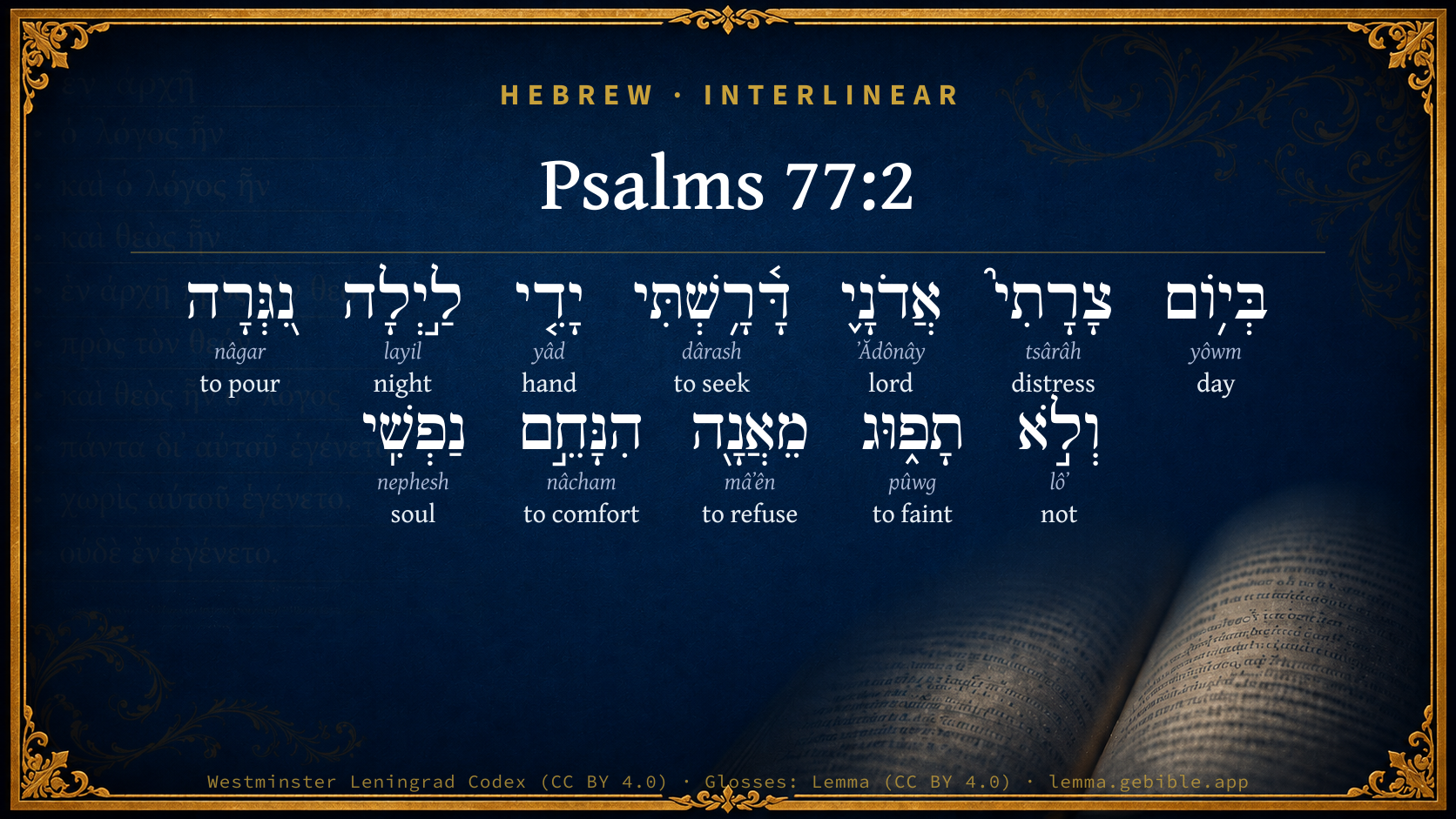
  1. בְּי֥וֹם yôwm H3117 “in/at · day of” Preposition + Noun, Common, Masculine, Singular, Construct
  2. צָרָתִי֮ tsârâh H6869 “distress · my” Noun, Common, Feminine, Singular, Construct + Suffix, Personal, 1st Person, Common, Singular
  3. אֲדֹנָ֪י ʼĂdônây H136 “Lord · my” Noun, Common, Masculine, Plural, Construct + Suffix, Personal, 1st Person, Common, Singular
  4. דָּ֫רָ֥שְׁתִּי dârash H1875 “to seek” Verb, Qal, Perfect, 1st Person, Common, Singular
  5. יָדִ֤י yâd H3027 “hand · my” Noun, Common, Both, Singular, Construct + Suffix, Personal, 1st Person, Common, Singular
  6. לַ֣יְלָה layil H3915 “night” Noun, Common, Masculine, Singular, Absolute
  7. נִ֭גְּרָה nâgar H5064 “to pour” Verb, Niphal, Perfect, 3rd Person, Feminine, Singular
  8. וְלֹ֣א lôʼ H3808 “and · not” Conjunction + Particle, Negative
  9. מֵאֲנָ֖ה mâʼên H3985 “to refuse” Verb, Piel, Perfect, 3rd Person, Feminine, Singular
  10. הִנָּחֵ֣ם nâcham H5162 “to comfort” Verb, Niphal, Infinitive Construct
  11. נַפְשִֽׁי nephesh H5315 “soul · my” Noun, Common, Both, Singular, Construct + Suffix, Personal, 1st Person, Common, Singular

About this verse

These counts appear in no published source. They are computed here, from the morphology-tagged text and Lemma’s own curated glosses. What Lemma adds →

12
words
12
distinct lemmas
Wisdom
section

Notable vocabulary

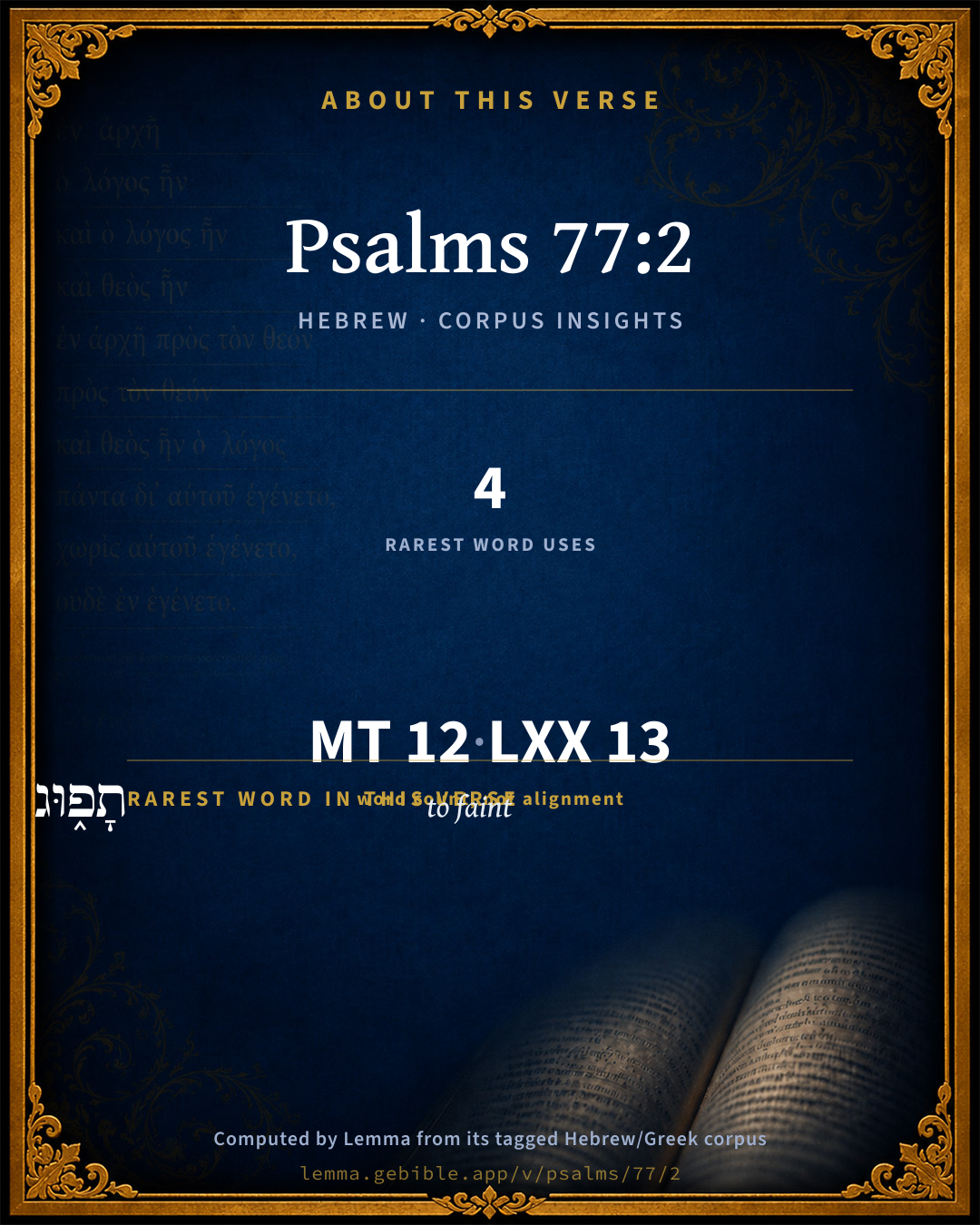
The rarest word here is תָפ֑וּג to faint H6313 — appearing just 4 times in the whole Hebrew Bible.

Shared distinctive vocabulary

תָפ֑וּג to faint H6313 occurs in 4 verses of the Hebrew Bible. Also found in:

Grammatical profile

  • 5 verbs
  • 6 nouns
  • 1 particle

Verb forms

  • דָּ֫רָ֥שְׁתִּי Qal · Perfect
  • נִ֭גְּרָה Niphal · Perfect
  • תָפ֑וּג Qal · Imperfect
  • מֵאֲנָ֖ה Piel · Perfect
  • הִנָּחֵ֣ם Niphal · Infinitive Construct

Hebrew & Septuagint length

In English translation the verse runs 28 words from the Hebrew and 30 from the Septuagint (LXX English) — closely comparable.

A rough comparison of the two English renderings, which tokenize alike — not a word-level alignment.

Word counts can differ between the Hebrew and the Greek without any difference in meaning — e.g. the Hebrew direct-object marker אֵת has no separate Greek word, and Greek often adds the article ὁ.

In the original languages it is 12 Hebrew tokens and 13 Greek tokens — but the two are counted differently (Hebrew bundles its prefixes and suffixes into one token; the Greek is in lemma form), so that isn’t a like-for-like length.

Cross-references

28

Topical passages linked to Psalms 77:2 in the Treasury of Scripture Knowledge — connected by theme and wording, ordered by reader-vote popularity; previews shown in the World English Bible.

  • Psalms 50:15 Call on me in the day of trouble. I will deliver you, and you will honor me."
  • Genesis 37:35 All his sons and all his daughters rose up to comfort him; but he refused to be comforted. He said, "For I will go down to Sheol to my son mourning." His father wept for him.
  • Isaiah 26:9 With my soul have I desired you in the night; yes, with my spirit within me will I seek you earnestly: for when your judgments are in the earth, the inhabitants of the world learn righteousness.
  • Isaiah 26:16 Yahweh, in trouble have they visited you; they poured out a prayer [when] your chastening was on them.
  • Hebrews 5:7 He, in the days of his flesh, having offered up prayers and petitions with strong crying and tears to him who was able to save him from death, and having been heard for his godly fear,
  • Esther 4:1–4 Now when Mordecai knew all that was done, Mordecai tore his clothes, and put on sackcloth with ashes, and went out into the midst of the city, and cried with a loud and a bitter cry;
  • Jonah 2:1–2 Then Jonah prayed to Yahweh, his God, out of the fish's belly.
  • Psalms 102:1–2 Hear my prayer, Yahweh! Let my cry come to you.
  • Jeremiah 31:15 Thus says Yahweh: A voice is heard in Ramah, lamentation, and bitter weeping, Rachel weeping for her children; she refuses to be comforted for her children, because they are no more.
  • Hosea 5:13 When Ephraim saw his sickness, And Judah his wound, Then Ephraim went to Assyria, And sent to king Jareb: But he is not able to heal you, Neither will he cure you of your wound.
  • Genesis 32:7–12 Then Jacob was greatly afraid and was distressed: and he divided the people who were with him, and the flocks, and the herds, and the camels, into two companies;
  • Genesis 32:28 He said, "Your name will no longer be called 'Jacob,' but, 'Israel,' for you have fought with God and with men, and have prevailed."
  • 2 Kings 19:3–4 They said to him, Thus says Hezekiah, This day is a day of trouble, and of rebuke, and of rejection; for the children are come to the birth, and there is not strength to bring forth.
  • 2 Kings 19:15–20 Hezekiah prayed before Yahweh, and said, Yahweh, the God of Israel, who sit [above] the cherubim, you are the God, even you alone, of all the kingdoms of the earth; you have made heaven and earth.
  • 2 Chronicles 6:28 If there be in the land famine, if there be pestilence, if there be blasting or mildew, locust or caterpillar; if their enemies besiege them in the land of their cities; whatever plague or whatever sickness there be;
  • Job 11:13 "If you set your heart aright, Stretch out your hands toward him.
  • Psalms 6:2–3 Have mercy on me, Yahweh, for I am faint. Yahweh, heal me, for my bones are troubled.
  • Psalms 18:6 In my distress I called on Yahweh, And cried to my God. He heard my voice out of his temple, My cry before him came into his ears.
  • Psalms 38:3–8 There is no soundness in my flesh because of your indignation, Neither is there any health in my bones because of my sin.
  • Psalms 63:6 When I remember you on my bed, And think about you in the night watches.
  • Psalms 86:7 In the day of my trouble I will call on you, For you will answer me.
  • Psalms 88:1–3 Yahweh, the God of my salvation, I have cried day and night before you.
  • Psalms 130:1–2 Out of the depths I have cried to you, Yahweh.
  • Proverbs 18:14 A man's spirit will sustain him in sickness, But a crushed spirit, who can bear?
  • Isaiah 1:5–6 Why should you be beaten more, That you revolt more and more? The whole head is sick, And the whole heart faint.
  • Hosea 6:1 "Come, and let us return to Yahweh; For he has torn us to pieces, And he will heal us; He has injured us, And he will bind up our wounds.
  • John 11:31 Then the Jews who were with her in the house, and were consoling her, when they saw Mary, that she rose up quickly and went out, followed her, saying, "She is going to the tomb to weep there."
  • 2 Corinthians 12:7–8 By reason of the exceeding greatness of the revelations, that I should not be exalted excessively, there was given to me a thorn in the flesh, a messenger of Satan to buffet me, that I should not be exalted excessively.

Cross-references courtesy of OpenBible.info (CC BY 4.0).

Hebrew and Greek witnesses Masoretic Hebrew ↔ Greek Septuagint

The same verse in the two great witnesses to the Old Testament, shown verse-for-verse.

You’re reading Greek Psalm 76 (Hebrew Psalm 77). The Septuagint counts the superscription, so verse numbers can differ from the Hebrew — chapter-level alignment, not verse-by-verse. Numbering follows Rahlfs.

These are two independent witnesses, not word-aligned to each other, and the Septuagint is shown in lemma (dictionary) form.

Hebrew Psalms 77:2 Masoretic · Westminster Leningrad Codex

בְּי֥וֹם צָרָתִי֮ אֲדֹנָ֪י דָּ֫רָ֥שְׁתִּי יָדִ֤י לַ֣יְלָה נִ֭גְּרָה וְלֹ֣א תָפ֑וּג מֵאֲנָ֖ה הִנָּחֵ֣ם נַפְשִֽׁי

In the day of my trouble I sought the Lord. My hand was stretched out in the night, and didn't get tired. My soul refused to be comforted.

World English Bible · Public Domain

Greek LXX Greek Psalm 76:2 Septuagint · lemma form

φωνή ἐγώ πρός κύριος κράζω φωνή ἐγώ πρός ὁ θεός καί προςἔχω ἐγώ

In the day of my affliction I earnestly sought the Lord; even with my hands by night before him, and I was not deceived; my soul refused to be comforted.

LXX2012 (modern English Septuagint) · Public Domain

On this verse, Ellicott's Commentary for English Readers discusses the Septuagint’s reading. Read the note in Commentary ↓

Hebrew: Westminster Leningrad Codex (CC BY 4.0). Greek: Septuagint (public domain); English from LXX2012 (modern English Septuagint) (Public Domain). How the Septuagint differs from the Hebrew →

Commentary

Notes on Psalms 77:2 from classic Christian and Jewish commentators (each source and its license shown beneath its notes). The classic Christian expositions comment on the surrounding passage and are grouped to its opening verse, so a note may address several verses; the Jewish commentaries on the Tanakh (Rashi and others) are per-verse, so they appear only where the commentator wrote on this verse.

Lemma curates 59 commentaries, every one of them public domain or Creative Commons licensed, each selected and text-cleaned for this edition rather than reprinted as found. About our sources →

Trapp's Complete Commentary

John Trapp

Psa 77:2 In the day of my trouble I sought the Lord: my sore ran in the night, and ceased not: my soul refused to be comforted.

Ver. 2. In the day of my trouble] The time of affliction is the time of supplication, Psa 50:15.

My sore ran in the night] Heb. My hand was poured out; that is, stretched out in prayer; or wet with continual weeping. Non fuit remissa, nec retracta in lectum.

And ceased not] Or, was not tired; in allusion, belike, to Moses’s hands held up against Amalek; though

My soul refused to be comforted] I prayed on, though I had little heart to do it (as Daniel afterwards did the king’s work, though he were sick), or though with much infirmity, while I rather wrangled with God, by cavilling objections, than wrestled with him, as I ought to have done; by important prayer.

John Trapp, A Commentary or Exposition upon All the Books of the Old and New Testament (1647–1656) — public domain. Text from a community e-Sword module.

The Biblical Illustrator

Joseph S. Exell

Psa_77:2

My soul refused to be comforted.

Refusing to be comforted

I. When a mans soul refuses to be comforted, possibly he may be right. He may have a great spiritual sorrow, and some one, who does not at all understand his grief, may proffer to him a consolation which is far too slight. Not knowing how deep the wound is, this foolish physician may think that it can be healed with any common ointments. So, too, it is equally right to refuse to be comforted, when the comfort is untrue. When a man is under a sense of sin, I have known his friends say to him, You should not fret; you have not been so very bad. You have been, indeed, a very good sort of fellow. You have not committed any very terrible sin; God help the world if you are a great sinner! I do not know what will become of the rest Of us. Another says, You have only to pray, and go to a place of worship; perhaps be a little more regular in your attention to religion, and it will all come right again; you are not so bad as you think you are. Such talk as that is a lie, and the man whom God has really awakened to feel his state by nature will refuse to be comforted by such falsehoods as those. We have known others who have tried to comfort poor, mourning, repentant sinners in an unhallowed way. They have said, You want to raise your spirits, I can recommend you some fine old wine; it will do you a world of good. Another will say, You should really mix a little more in society, and shake yourself up; you should get with some gay, lively people, they would soon take this melancholy out of you. I am sure that a person who is really troubled in spirit will increase his sorrow if he attempts to cure it in that way. It is only putting more fuel on the flame. In danger every moment of death, and certain that, if death came, I should be lost, can I enjoy mirth? It cannot be! Refuse every comfort short of being born again, and made a new creature in Jesus.

II. But now, I want to show when this refusal is wrong. Probably he is wrong who says, My soul refused to be comforted. It is quite wrong if it be a temporal matter that causes your sorrow. Refuse not to be comforted, I pray you; you are only driving the dagger deeper into your wounds. Instead of doing that, think of the mercies that you still have, think of how God can bless your troubles. But now I will suppose that yours is a spiritual trouble. Do not refuse to be comforted, for if you do, you will be spiritually a suicide. The man who will not eat, and so dies of starvation, is as much a suicide as he that puts the pistol to his head, and blows out his brains.

III. But now, haply you will have to repent of refusing to be comforted. Possibly you will have to repent it in a very terrible way. Suppose, now, that you should refuse to be comforted, and so should wilfully go into a yet darker and deeper dungeon of despair. Suppose that your Christian friends should grow weary of you. Where would you be then? And suppose that, because you shut your eyes to the light, God should take it away? I do hope that many here present, who have refused to be comforted, will yet regret it when they shall be enjoying the fulness of comfort. What a fool am I, thus to lie in a stinking dungeon, when I may as well walk at liberty I I have a key in my bosom, called Promise, that will, I am persuaded, open any lock in Doubting Castle. So he pulled it out of his bosom, put it in the lock, opened the door of the dungeon, and they soon passed out. Now, finally, when you and I get to heaven, we shall regret that we ever refused to be comforted. (C. H. Spurgeon.)

A sermon for the most miserable of men

My main bent, this morning, is to deal with mourners who are seeking Christ, but up till now have sought Him in vain.

I. Concerning so deplorable a state of heart, alas I still so common, we will remark in the first place that it is very wonderful. It is a most surprising thing that there should be in this world persons who have the richest consolation near to hand, and persistently refuse to partake of it. Doth the ox refuse its fodder? Will the lion turn from his meat? Or the eagle loathe its nest? The refusal of consolation is the more singular because the most admirable comfort is within reach. Sin can be forgiven; sin has been forgiven; Christ has made an atonement for it. It is said that some years ago, a vessel sailing on the northern coast of the South American continent, was observed to make signals of distress. When hailed by another vessel, they reported themselves as Dying for water! Dip it up, then, was the response, you are in the mouth of the Amazon river. There was fresh water all around them, they had nothing to do but to dip it up, and yet they were dying of thirst, because they thought themselves to be surrounded by the salt sea. How often are men ignorant of their mercies! How sad that they should perish for lack of knowledge! But suppose after the sailors had received the joyful information, they had still refused to draw up the water which was in boundless plenty all around them, would it not have been a marvel?

II. Secondly, this wonderful madness has a method in it, and may be variously accounted for. In many, their refusal to be comforted arises from bodily and mental disease. It is in vain to ply with scriptural arguments those who are in more urgent need of healing medicine, or generous diet, or a change of air. In some the monstrous refusal is suggested by a proud dislike to the plan of salvation. They would be comforted, aye, that they would, but may they not do something to earn eternal life? May they not at least contribute a feeling or emotion? May they not prepare themselves for Christ? In others it is not pride, but an unholy resolve to retain some favourite sin. In some cases we have found out that the sorrowing person indulged still in a secret vice, or kept the society of the ungodly. I fear, in a great many, there is another reason for this refusing to be comforted, namely, a dishonouring unbelief in the love, and goodness, and truthfulness of God. They do not believe God to be gracious; they think Him so stern that a sinner had need plead full many a day before the stern heart of God will be touched. Oh, but you do not know my God! What is He? He is love. Some, however, have refused comfort so long, that they have grown into the habit of despair. Beware of nursing despondency. Does it creep upon you to-day through unbelief? Oh, shake it off if possible!

III. This remarkable piece of folly assumes divers forms. One is a persistent misrepresentation of the Gospel, as though it claimed some hard thing of us. Another shape of this malady is this: many continually and persistently underestimate the power of the precious blood of Jesus. There are some who will then say, But I have sinned such and such a sin. What, and cannot the blood of Jesus wash that away? All manner of sin and blasphemy shall be forgiven unto men.

IV. This refusal to be comforted involves much of wrong. When you hear the Gospel and refuse to be comforted by it, there is a wrong done to the minister of God. He sympathizes with you, he desires to comfort you, and it troubles him when he puts before you the cup of salvation, and you refuse to take it. But worse than that, you wrong Gods Gospel. You put it away as though it were a thing of nought. You wrong this precious Bible. It is full of consoling promises, and you read it, and you seem to say, It is all chaff. Oh, but the Bible does not deserve to have such a slur cast upon it. You do wrong to the dear friends who try to comfort you. Above all, you do wrong to your God, to Jesus, and to His Holy Spirit. The crucifixion of Christ is repeated by your rejection of Christ.

V. Such a refusal should not be persisted in. (C. H. Spurgeon.)

The Biblical Illustrator, edited by Joseph S. Exell (c. 1880s–1900s) — public domain. Text from a community e-Sword module.

Joseph Benson's Commentary

Psa 77:2. In the day of my trouble I sought the Lord — Being afflicted, he prayed, Jas 5:13, and being in an agony he prayed the more fervently: he cried unto God. He did not apply to the diversion of business, or of any recreation, that he might by that means shake off his trouble; but he had recourse to God in prayer, and sought his favour and grace. In this he is an example for our imitation. When under any trouble, and especially trouble of mind for sin, we must apply to God and spread our case before him. We must not endeavour to get rid of our trouble some other way, but must entreat him to remove it by lifting up the light of his countenance upon us. This, and only this, will give us peace of mind, and put joy and gladness into our hearts. My sore ran — Hebrew, ידי נגרה, jadi niggerah, my hand flowed, or poured forth, that is, was spread abroad, or stretched out to God in prayer and ceased not. — So Hammond, Patrick, Waterland, and Houbigant. In the night — Which to others was a time of rest and refreshment, but to me of sorrow and distress. My soul refused to be comforted — Without a gracious answer from God, and an assurance that he had not cast me off, but was again reconciled to me, Psa 77:7-9. Till I should obtain this, I rejected all those consolations which either my friends or my own mind suggested.

Joseph Benson's Commentary on the Old and New Testaments (1811–1818) — public domain. Text from a community e-Sword module.

J. A. Alexander on Psalms

Joseph Addison Alexander

3. (Psa 77:2). In the day of my distress the Lord I sought; my hand by night was spread, and grew not numb ; my soul refused to be comforted. Day is here put for time, but not without allusion to the mention of the night in the clause following, so as to express the idea that he prayed day and night. The verb translated spread means strictly spilt, poured out, scattered, but seems to be here poetically applied to the spreading of the hands as a customary gesture of entreaty. See above, on Psa 44:20. The common ver sion, my sore ran, has no foundation in etymology or usage. For the meaning of the next verb, see above, on Psa 38:8. Its form is future, but the copulative particle, though separated from it by the negative, may be considered as exerting a conversive force.

Joseph Addison Alexander, The Psalms Translated and Explained (1850) — public domain. Text from a community e-Sword module.

Geneva Bible (1599)

Geneva Bible translators

Or, mine hand was stretched out.

Geneva Bible (1599) marginal notes — public domain. Text via Bolls.life.

Adam Clarke's Commentary

Verse 2. My sore ran in the night, and ceased not] This is a most unaccountable translation; the literal meaning of ידי נגרה yadi niggerah, which we translate my sore ran, is, my hand was stretched out, i.e., in prayer. He continued during the whole night with his voice and hands lifted up to God, and ceased not, even in the midst of great discouragements.

Adam Clarke's Commentary on the Bible (1810–1826) — public domain. Text from a community e-Sword/MySword module.

John Calvin's Commentaries

2. I sought the Lord in the day of my trouble. In this verse he expresses more distinctly the grievous and hard oppression to which the Church was at that time subjected. There is, however, some ambiguity in the words. The Hebrew word יד, yad, which I have translated hand, is sometimes taken metaphorically for a wound; and, therefore, many interpreters elicit this sense, My wound ran in the night, and ceased not, that is to say, My wound was not so purified from ulcerous matter as that the running from it was made to stop. But; I rather take the word in its ordinary signification, which is hand, because the verb נגרה, niggera, which he uses, signifies not only to run as a sore does, but also to be stretched forth or extended. Now, when he affirms that he sought the Lord in the day of his trouble, and that his hands were stretched out to him in the night season, this denotes that prayer was his continual exercise, — that his heart was so earnestly and unweariedly engaged in that exercise, that he could not desist from it. In the concluding sentence of the verse the adversative particle although is to be supplied; and thus the meaning will be, that although the prophet found no solace and no alleviation of the bitterness of his grief, he still continued to stretch forth his hands to God. In this manner it becomes us to wrestle against despair, in order that our sorrow, although it may seem to be incurable, may not shut our mouths, and keep us from pouring out our prayers before God.

John Calvin's Commentaries (1540-1563) — public domain. Text from the Calvin Translation Society English edition (1840s-50s) via the Christian Classics Ethereal Library (ccel.org). Calvin's coverage is partial (roughly two-thirds of the Bible); uncommented books and verses are honest gaps, never fabricated. The 19th-century editor's footnotes and remarks are omitted so the notes are faithfully Calvin's own voice.

Ellicott's Commentary for English Readers

(2) My sore ran . . .—The text of this verse is evidently faulty. As it stands it is unintelligible. My hand was poured out and grew not dull (like a corpse).

The LXX. and Vulg. have, “with my hands against Him, and I was not deceived,” pointing to a different reading. Symmachus has, however, “my hand was stretched out,” which may be a possible meaning of the Hebrew, though a comparison with Lam_3:49 (comp. Lam_2:18) suggests that eye was written instead of hand. The Authorised Version’s sore comes from the Rabbins, who thought of the hand beating the breast, and rendered, “my blows were poured out.” Though the probable text may be beyond recovery, the feeling of the verse is quite palpable. It expresses the anguish of the poet’s soul—

“His vows in the night, so fierce and unavailing,

Stings of his shame and passion of his tears.”

A Bible Commentary for English Readers, edited by Charles John Ellicott (1878–1897) — public domain. Text from a community e-Sword module.

The Cambridge Bible for Schools and Colleges

gen. ed. J. J. S. Perowne

2. (Thus) in the day of my distress I sought the Lord:

My hand was stretched out in the night, and slacked not;

My soul refused to be comforted.

The Cambridge Bible for Schools and Colleges (gen. ed. J. J. S. Perowne; Cambridge University Press, 1878–1918) — public domain. Text from a community e-Sword module.

John Gill's Exposition

In the day of my trouble I sought the Lord,.... Not the creature, for help, and creature amusements to drive away trouble, but the Lord, in private, by prayer and supplication; a time of trouble is a time for prayer, Jam 5:13, all men have their trouble, but the people of God more especially; and there are some particular times in which they have more than usual, and then it may be said to be "a day of trouble" with them; which sometimes arises from themselves, the strength of their corruptions, the weakness of their graces, their backwardness to duties, or poor performance of them; sometimes from others, from the profaneness or persecutions of the men of the world, from the heretical notions or wicked lives of professors; sometimes from the temptations of Satan, and at other times from the Lord himself more immediately, by his withdrawing his presence from them, or by laying his afflicting hand upon them; but, let the trouble come from what quarter it may, it is always right to seek the Lord. Some think reference is had to the time of trouble mentioned in Dan 12:1,

my sore ran in the night; my "stroke", or "wound" (i); so Kimchi interprets it; the wound that was made in his soul, and the pain and anguish, grief and trouble, which flowed from it; see Jer 6:7 though the word may be literally rendered "my hand" (k); and the sense is, either that his hand flowed or was wet with wiping his eyes, or with the tears that flowed from his eyes, which ran down to his fingers' ends; so the Targum,

"in the night my eye dropped with tears;''

or rather that his hand was stretched out, as waters, that are poured out and run, are spread, that is, in prayer; the stretching out of the hand being a prayer gesture:

and ceased not; was not remiss and feeble, or was not let down, as Moses's, Exo 17:11, it denotes the constancy of prayer, and his continuance in it; he prayed without ceasing:

my soul refused to be comforted: such was the greatness of his distress, like that of Jacob's and Rachel's, Gen 37:35, it is right to refuse comfort and peace, which men speak to themselves upon the false foundation of their own merit and works; or any but what comes from the God of all comfort, and through Christ, in whom is all solid consolation, and by his Spirit, who is the Comforter; but it is wrong to refuse any that comes from hence, and by means of the promises, the word and ordinances and ministries of the Gospel, or Christian friends; this shows the strength of unbelief.

(i) "plaga mea", Pagninus, Muis. (k) "Manus mea", Montanus, Piscator, Gejerus, &c.

John Gill's Exposition of the Whole Bible (1746–1763) — public domain (CC PDM 1.0). Text via the HelloAO Bible API.

Albert Barnes' Notes on the Bible

In the day of my trouble I sought the Lord - Compare the notes at Psa 50:15. This trouble may have been either mental or bodily; that is, it may have arisen from some form of disease, or it may have been that which sprang from difficulties in regard to the divine character, government, and dealings. That it “assumed” the latter form, even if it had its beginning in the former, is apparent from the following verses. Whether it was connected with any form of bodily disease must be determined by the proper interpretation of the next clause in this verse.

My sore ran in the night - Margin, “My hand.” It is evident that our translators sup. posed that there was some bodily disease - some running sore - which was the cause of his trouble. Hence, they so rendered the Hebrew word. But it is now generally agreed that this is without authority. The Hebrew word is “hand” - יד yâd - a word which is never used in the sense of sore or wound. The Septuagint renders it, “my hands are before him.” The Vulgate renders it in the same manner. Luther, “My hand is stretched out at night.” DeWette, “My hand is stretched out at night unwearied.” The word which is rendered in our version “ran” - נגר nâgar - means to “flow;” and, in Niphil, to be poured out, and then, “to be stretched out;” which is evidently its meaning here. The idea is, that his hand was stretched out in earnest supplication, and that this continued in the night when these troubles came most upon him. See Psa 77:4, Psa 77:6. In his painful meditations in the night. watches - in thinking on God and his ways, as he lay upon his bed, he stretched out his hand in fervent prayer to God.

And ceased not - The word used here - פוג pûg - means properly to be cold; then, to be torpid, sluggish, slack. Here it means that the hand did not become weary; it did not fall from exhaustion; or, in other words, that he did not give over praying through weariness or exhaustion.

My soul refused to be comforted - I resisted all the suggestions that came to my own mind, that might have comforted me. My heart was so melancholy and downcast; my spirits were so crushed; my mind was so dark; I had become so morbid, that I loved to cherish these thoughts. I chose to dwell on them. They had obtained possession of me, and I could not let them go. There was nothing that my own mind could suggest, there was nothing that occurred to me, that would relieve the difficulty or restore peace to my soul. These sad and gloomy thoughts filled all my soul, and left no room for thoughts of consolation and peace. A truly pious man may, therefore, get into a state of mind - a sad, dispirited, melancholy, morbid state - in which nothing that can be said to him, nothing that will occur to himself, will give him comfort and peace. Compare Jer 31:15.

Albert Barnes' Notes on the Bible (1834–1885) — public domain. Text from a community e-Sword/MySword module.

Matthew Poole's English Annotations

My sore ran: the hand in the Hebrew tongue, and Scripture use, is oft put for a blow or stroke given by the hand. Heb. My hand, or hands, (the singular number being frequently put for the plural,)

flowed or poured forth, i.e. spread abroad to God in prayer. This phrase he useth rather than were stretched out, which is frequent in like cases, to imply that his case was low and almost desperate, his spirits and strength quite gone, so that he was not able to stretch them out, as he had done.

In the night; which to others was a time of rest and quietness, but to me of torment.

My soul refused to be comforted; I rejected all those consolations which either my friends or my own mind suggested to me.

Matthew Poole's English Annotations on the Holy Bible (1683–1685) — public domain. Text from a community e-Sword/MySword module.

The Treasury of David

Charles H. Spurgeon

Ver. 2. In the day of my trouble I sought the Lord. All day long his distress drove him to his God, so that when night came he continued still in the same search. God had hidden his face from his servant, therefore the first care of the troubled saint was to seek his Lord again. This was going to the root of the matter and removing the main impediment first. Diseases and tribulations are easily enough endured when God is found of us, but without him they crush us to the earth.

My sore ran in the night, and ceased not. As by day so by night his trouble was on him and his prayer continued. Some of us know what it is, both physically and spiritually, to be compelled to use these words: no respite has been afforded us by the silence of the night, our bed has been a rack to us, our body has been in torment, and our spirit in anguish. It appears that this sentence is wrongly translated, and should be, "my hand was stretched out all night, "this shows that his prayer ceased not, but with uplifted hand he continued to seek succour of his God.

My soul refused to be comforted. He refused some comforts as too weak for his case, others as untrue, others as unhallowed; but chiefly because of distraction, he declined even those grounds of consolation which ought to have been effectual with him. As a sick man turns away even from the most nourishing food, so did he. It is impossible to comfort those who refuse to be comforted. You may bring them to the waters of the promise, but who shall make them drink if they will not do so? Many a daughter of despondency has pushed aside the cup of gladness, and many a son of sorrow has hugged his chains. There are times when we are suspicious of good news, and are not to be persuaded into peace, though the happy truth should be as plain before us as the King's highway.

Whole Psalm. See Psalms on "Ps 77:1" for further information.

Ver. 2. In the day of my trouble I sought the Lord. Days of trouble must be days of prayer; in days of inward trouble, especially when God seems to have withdrawn from us, we must seek him, and seek till we find him. In the day of his trouble he did not seek for the diversions of business or recreation, to shake off his trouble that way, but he sought God, and his favour and grace. Those that are under trouble of mind, must not think to drink it away, or laugh it away, but pray it away. Matthew Henry.

Ver. 2. My sore ran in the night. Hebrew: My hand was poured out; that is, stretched out in prayer; or wet with continual weeping. Non fuit remissa, nec retracta in lectum. John Trapp.

Ver. 2. My sore ran in the night, and ceased not, etc. There is no healing of this wound, no easing of this sore, no cleansing of the conscience, no quieting of a man's spirit: till God whom the soul seeketh show himself as the Physician, the evil continueth still and groweth. David Dickson.

Ver. 2. My soul refused to be comforted. God has provided suitable and sufficient comfort for his people. He sends them comforters just as their circumstances require. But they at times refuse to hear the voice of the charmer. The Lord has perhaps taken away an idol--or he withholds his sensible presence, that they may learn to live by faith--or he has blighted their worldly prospects --or he has written vanity and emptiness upon all their gourds, cisterns, and delights. They give way to passion, as did Jonah--or they sink into sullen gloom--or allow unhumbled pride to rule the spirit--or yield to extreme sorrow, as Rachel did--or fall under the power of temptation--or imbibe the notion that they have no right to comfort. This is wrong, all wrong, decidedly wrong. Look at what is left you, at what the gospel presents to you, at what heaven will be to you. But the psalmist was recovered from this state. He was convinced that it was wrong. He was sorry for his sin. He was reformed in his spirit and conduct. He wrote this Psalm to instruct, caution, and warn us. Observe, they who are entitled to all comfort, often through their own folly, enjoy the least. The Lord's people are often their own tormentors, they put away the cup of comfort from them, and say they are unworthy of it

O Thou source of every blessing,

Chase my sorrows, cheer my heart,

Till in heaven, thy smiles possessing,

Life, and joy, and peace impart. James Smith.

Ver. 2. My soul refused to be comforted. Poor I, that am but of yesterday, have known some that have been so deeply plunged in the gulf of despair, that they would throw all the spiritual cordials that have been tendered to them against the walls. They were strong in reasoning against their own souls, and resolved against everything that might be a comfort and support unto them. They have been much set against all ordinances and religious services; they have cast off holy duties themselves, and peremptorily refused to join with others in them; yea, they have, out of a sense of sin and wrath, which hath laid hard upon them, refused the necessary comforts of this life, even to the overthrow of natural life, and yet out of this horrible pit, this hell upon earth, hath God delivered their souls, and given them such manifestations of his grace and favour, that they would not exchange them for a thousand worlds. O despairing souls, you see that others, whose conditions have been as bad if not worse than yours, have obtained mercy. God hath turned their hell into a heaven; he hath remembered them in their low estate; he hath pacified their raging consciences, and quieted their distracted souls; he hath wiped all tears from their eyes; and he hath been a well spring of life unto their hearts. Therefore be not discouraged, O despairing souls, but look up to the mercyseat. Thomas Brooks.

Ver. 2. See "Spurgeon's Sermons, "No. 853. "A Sermon for the Most Miserable of Men."

Ver. 2.

I. Special prayer: In the days, etc.

II. Persevering prayer: hands lifted up to God by night

as well as by day.

III. Agonizing prayer: my soul refused to be

comforted, until the answer came. "Being in an

agony, he prayed, "etc.

Ver. 2. (last clause). When this is wise, and when it is censurable.

Psalms 77:3*

Charles H. Spurgeon's The Treasury of David (1869–1885) — public domain. Psalms only. Text from a community e-Sword/MySword module.

Whedon's Commentary on the Bible

Daniel D. Whedon

2. In the day of my trouble I sought the Lord—Not only the depth of the psalmist’s sufferings is here indicated, such as God only could relieve, but his true piety. His troubles brought him nearer to God. Psa_50:15.

My sore ran in the night—Hebrew, My hand was stretched out all night; that is, in the posture of earnest supplication. Psa_44:20; Psa_88:9.

Ceased not—Rested not. Compare the painfulness of the attitude with Exo_17:11-12

Daniel D. Whedon (gen. ed.), Commentary on the Old and New Testaments (1874–1909) — public domain. Text from a community e-Sword module.

The Pulpit Commentary

In the day of my trouble I sought the Lord. (comp. Gen_35:3 Hab_3:16) My sore ran in the night; rather, my band was stretched out in the night (Cook, Cheyne, Revised Version); comp. Psa_28:2. And ceased not. He continued in prayer all through the night. My soul refused to be comforted. (comp. Gen_37:35 Jer_31:15) He was like Jacob when he lost Joseph, or like Rachel weeping for her children.

The mission of mental depressions.

"My hand in the night season was stretched out, and ceased not." The figure is of the hand stretched out in prayer till it was unnerved by weariness, and yet refused to rest. The cause of lying awake at night is usually mental anxiety and distress; burdens on the mind rather than pains in the body. We begin to think worryfully, and so banish sleep. The text, therefore, presents a season of mental depression; and the occasion of it is found in the anxious condition of the nation. Illust. by the times of Hezekiah. Times of mental depression are not necessarily wrong. They are the natural response of the mind to physical conditions and outward circumstances. They mean "sensitiveness," "quickness to respond;" and these differ in different individuals. Some are easily made despondent; they can always see, or think they see, black clouds gathering in the sky. Some are unduly hopeful, and fail to respond when circumstances do call for anxiety. We make the mistake of failing to recognize Divine working through the anxieties of the mind, as well as through the pains of the body, and the distress of the circumstances. We deceive ourselves by thinking these mental trials are in no sense sent; we make them ourselves, and so we fail to associate God with them, and lose what would be our best comfort and relief. The truth is, that God is even more freely working through our mental depressions, because they are immaterial they belong to the innermost of us, to the sphere in which God"s grace is most unhindered.

I MENTAL DEPRESSIONS KEEP US CONVINCED OF THE SPIRITUAL. Suppose we took all things easily; never troubled over them; never brooded; how easily the "material" would gain the mastery! We know there is another world than the world of sense; there is a world of thought and feeling. How intense and real this world is we are made to know when depression prevents sleep, and even breaks down health. And so we come to apprehend the reality of the "spiritual.

II MENTAL DEPRESSIONS CONVINCE OF THE SERIOUSNESS OF OUR MORAL CONFLICT. Conceive that the struggle for character only concerned circumstances and relations, and then what an unimportant struggle it would seem to be! "But we wrestle, not with flesh and blood only, but with the rulers of spiritual darkness." Add mental conflict, and virtue becomes a sublime achievement, a transcendent victory, won at an awful cost.

III MENTAL DEPRESSIONS MAY BE OVERRULED SO AS TO GIVE NOBLER VIEWS OF GOD. Illustrate by the psalm (vers. 10-20). The law of rebound applies. Compare such a case as that of the poet Cowper, whose songs of trust were the cries of one who was often in despair. The question is Do we yield to mental depressions, or do we resist them, and so let God work his work of grace through them? R.T.

The Pulpit Commentary (1880–1919), ed. H.D.M. Spence-Jones & Joseph S. Exell — public domain. Text from a community e-Sword module.

John Wesley's Explanatory Notes

Night - Which to others was a time of rest and quietness.

John Wesley, Explanatory Notes Upon the Whole Bible (1754–1765) — public domain. Text via the GEBible commentary corpus.

unfoldingWord translationNotes

Door43 World Missions Community

I stretched my hands out

"I prayed with my arms extended"

My soul refused to be comforted

The "soul" represents the person. This can be stated in active form. AT: "I would not allow anyone to try to comfort me" (See: Synecdoche and Active or Passive)

I thought of God as I groaned; I thought about him as I grew faint

These two phrases share similar meanings and are combined for emphasis. (See: Parallelism)

as I grew faint

"as my spirit grew faint" or "as my spirit was overwhelmed"

Selah

This may be a musical term that tells people how to sing or play their instruments here. Some translations write the Hebrew word, and some translations do not include it. See how you translated this in Psalms 3:2. (See: Copy or Borrow Words)

translationWords

trouble

lord

comfort

God

selah

unfoldingWord translationNotes — © Distant Shores Media and the Door43 World Missions Community, licensed CC BY-SA 4.0. Source: git.door43.org/Door43/en_tn.

Lesson kit

Teaching starters — assembled from the data on this page, not authored interpretation. Every prompt links to the verse data it draws on. Edit before teaching.

Psalms, in the Wisdom, opens this verse with 12 words (12 distinct Hebrew lemmas). Its most distinctive word is pûwg (“to faint”). A historical commentator’s framing appears above. Read the whole chapter for the surrounding context.

Discussion questions

  1. How does “to faint” (pûwg) shape what this verse is saying?
  2. Genesis 45:26 shares the word «to faint» with this verse. How do the two illuminate each other?
  3. The translations on this page render this verse differently — a whole-verse word diff, not a word-by-word alignment. What might account for the different wordings?
  4. The verb «דָּ֫רָ֥שְׁתִּי» is Qal Perfect. How does its form color the action?
  5. Reading how Trapp's Complete Commentary and The Biblical Illustrator read this verse, where do the two commentators agree and where do they part?

Things to notice

Reading settings

Reading text

Shown beneath each verse's original-language words.

Old Testament
Old Testament edition

Read the OT as the Masoretic Hebrew (MT) or the Greek Septuagint (LXX).

English shown for the Greek Septuagint (in the Hebrew ↔ Greek comparison).

Comparing translations? Open the Compare panel on any verse page to stack up to four side by side.