Genesis 18:27

Hebrew (Westminster Leningrad Codex) Genesis 18:27 appears in the Hebrew Old Testament. The text above is from the Westminster Leningrad Codex. Each word links to its Strong’s number, a concise gloss, and parsing drawn from the Open Scriptures Hebrew Bible morphology. Click any word for its full Brown-Driver-Briggs (BDB) entry.
Download image
Cite this verse

Genesis 18:27 (World English Bible). Public Domain. Lemma interlinear Bible study tool, https://lemma.gebible.app/v/genesis/18/27.

Show BibTeX & RIS
BibTeX
RIS
English Translation
Abraham answered, "See now, I have taken it on myself to speak to the Lord, who am but dust and ashes.
World English Bible · Public Domain
Highlights
  • 3 first appearances in the Hebrew Bible
Full analysis ↓
Download a study sheet

One document with this verse’s original text, its word-by-word gloss line, the meaning frame, cross-references with their text, attributed commentary, and full source and license credits — printable, and it pastes into notes with its structure intact.

This verse Autodidact and up

Study sheet (.html) Plain text (.txt)

A passage Seminary Student

Up to 50 verses in one chapter. A passage sheet keeps up to 6 commentary sources and 12 cross-references per verse, in the order this page ranks them, and says so on the sheet whenever that leaves anything out. Ask for a single verse and you get the Autodidact verse sheet above.

Everything on this page stays free to read, with no account — the sheet is a download of what is already on screen, not access to it.

Want to remove ads? Support Godless Engineer
Compare translations 3

The same verse in 3 English versions, stacked beneath the original-language interlinear above. Click any original word for its lexicon entry.

Each is an independent rendering of the whole verse — the interlinear is not word-aligned to these translations.

Highlighted words mark where these versions differ — a whole-verse word diff, not a word-by-word alignment.

  • World English Bible Public Domain
    Abraham answered, "See now, I have taken it on myself to speak to the Lord, who am but dust and ashes.
  • King James Version Public Domain
    And Abraham answered and said, Behold now, I have taken upon me to speak unto the LORD, which am but dust and ashes:
  • unfoldingWord Literal Text CC BY-SA 4.0
    Then Abraham spoke up and said, “Behold, please, I have taken it upon myself to speak to my Lord, although I dust and ashes.

unfoldingWord Literal Text — © unfoldingWord, licensed CC BY-SA 4.0. Word-aligned USFM3 via Door43 (git.door43.org/unfoldingWord/en_ult).

Versions to compare (up to 4)

3 of 4 selected

Show all 18 translations

Every available English version of this verse, each an independent rendering of the whole verse.

  • World English Bible Public Domain
    Abraham answered, "See now, I have taken it on myself to speak to the Lord, who am but dust and ashes.
  • Berean Standard Bible Public Domain
    Then Abraham answered, “Now that I have ventured to speak to the Lord—though I am but dust and ashes—
  • Majority Standard Bible Public Domain
    Then Abraham answered, “Now that I have ventured to speak to the Lord—though I am but dust and ashes—
  • King James Version Public Domain
    And Abraham answered and said, Behold now, I have taken upon me to speak unto the LORD, which am but dust and ashes:
  • American Standard Version (1901) Public Domain
    And Abraham answered and said, Behold now, I have taken upon me to speak unto the Lord, who am but dust and ashes:
  • Revised Version (1885) Public Domain
    And Abraham answered and said, Behold now, I have taken upon me to speak unto the Lord, which am but dust and ashes:
  • Geneva Bible (1599) Public Domain
    Then Abraham answered and said, Behold nowe, I haue begun to speake vnto my Lord, and I am but dust and ashes.
  • Douay-Rheims (1899) Public Domain
    And the Lord said to him: If I And in Sodom fifty just within the city, I will spare the whole place for their sake.
  • Young's Literal Translation Public Domain
    And Abraham answereth and saith, `Lo, I pray thee, I have willed to speak unto the Lord, and I -- dust and ashes;
  • Literal Standard Version CC BY-SA 4.0
    And Abraham answers and says, “Now behold, I have willed to speak to the Lord, and I [am] dust and ashes;
  • Unlocked Literal Bible CC BY-SA 4.0
    Abraham answered and said, “Look, I have undertaken to speak to my Lord, even though I am only dust and ashes!
  • unfoldingWord Literal Text CC BY-SA 4.0
    Then Abraham spoke up and said, “Behold, please, I have taken it upon myself to speak to my Lord, although I dust and ashes.
  • Darby Bible Public Domain
    And Abraham answered and said, Behold now, I have ventured to speak unto the Lord; I, who am dust and ashes.
  • World Messianic Bible Public Domain
    Abraham answered, “See now, I have taken it on myself to speak to the Lord, although I am dust and ashes.
  • Webster's Bible Public Domain
    And Abraham answered and said, Behold now, I, who am dust and ashes, have taken upon me to speak to the Lord.
  • Free Bible Version CC BY-SA 4.0
    “Since I've started, let me go on speaking to my Lord, even though I'm nothing but dust and ashes,” Abraham continued.
  • Bible in Basic English Public Domain
    And Abraham answering said, Truly, I who am only dust, have undertaken to put my thoughts before the Lord:
  • JPS Tanakh (1917) Public Domain
    And Abraham answered and said: 'Behold now, I have taken upon me to speak unto the Lord, who am but dust and ashes.

Literal Standard Version (2020), Covenant Press — licensed CC BY-SA 4.0. Text via the HelloAO Bible API (eBible.org). Unlocked Literal Bible (unfoldingWord) — licensed CC BY-SA 4.0. Text via the HelloAO Bible API (eBible.org). unfoldingWord Literal Text — © unfoldingWord, licensed CC BY-SA 4.0. Word-aligned USFM3 via Door43 (git.door43.org/unfoldingWord/en_ult). Free Bible Version, Dr. Jonathan Gallagher — licensed CC BY-SA 4.0. Text via the HelloAO Bible API (eBible.org).

Word by word

More ways to search: Search by grammar → Find every occurrence → Compare this word →

Practice this passage: Drill this verse → Learn its vocabulary →

הוֹאַ֨לְתִּי֙
yâʼal
H2974
“to be willing”
Verb, Hiphil, Perfect, 1st Person, Common, Singular
Part of Speech
Verb
Stem
Hiphil
Form
Perfect
Person
1st Person
Gender
Common
Number
Singular
Full BDB Definition

Origin: a primitive root [probably rather the same as H2973 through the idea of mental weakness]

TWOT: 831

to begin, make a beginning, show willingness, undertake to do, be pleased, be determined - (Hiphil) - to agree to, show willingness, acquiesce, accept an invitation, be willing - to undertake - to resolve, be pleased, be determined
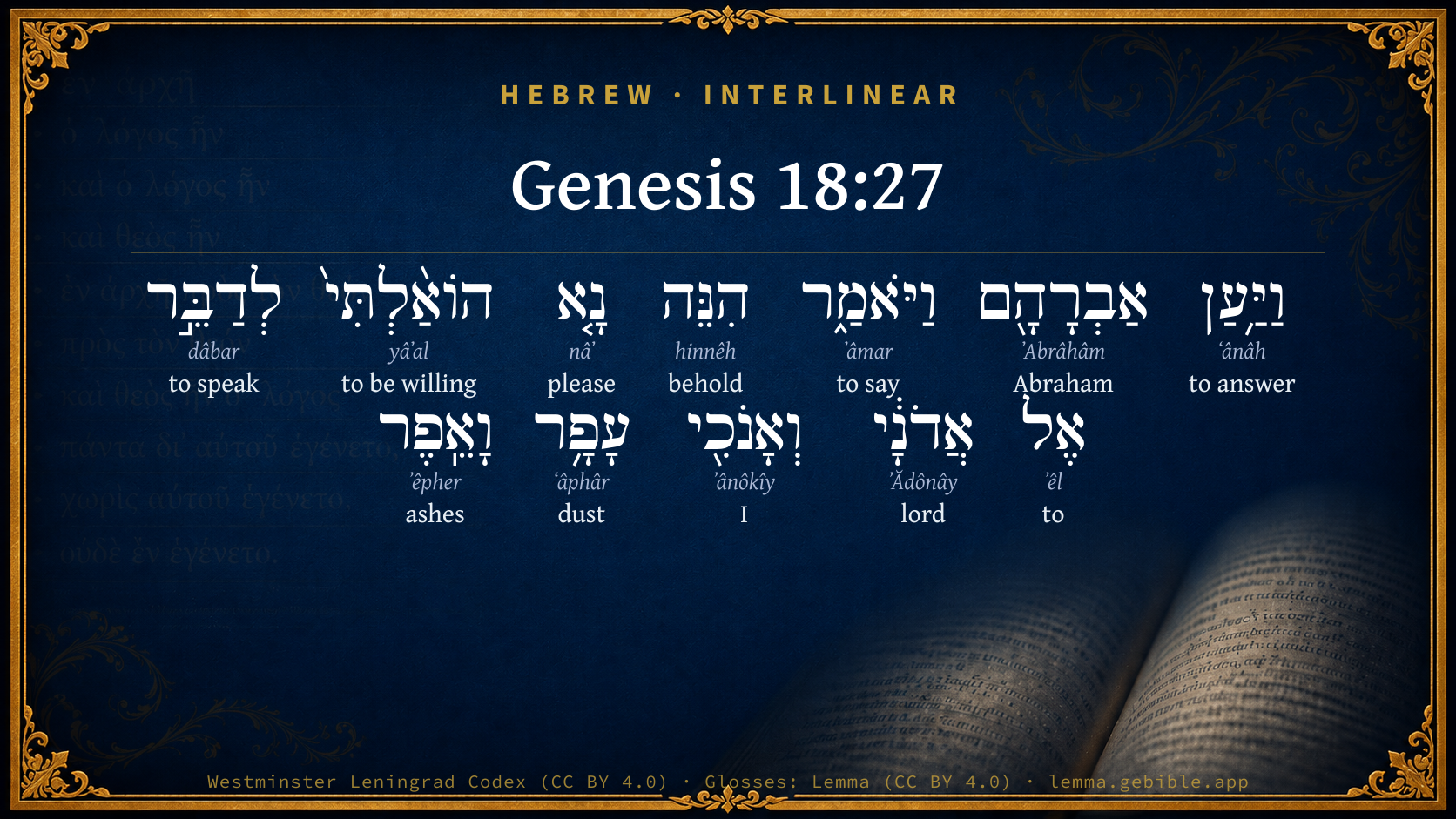
  1. וַיַּ֥עַן ʻânâh H6030 “and · to answer” Conjunction + Verb, Qal, Sequential Imperfect, 3rd Person, Masculine, Singular
  2. אַבְרָהָ֖ם ʼAbrâhâm H85 “Abraham” Noun, Proper
  3. וַיֹּאמַ֑ר ʼâmar H559 “and · to say” Conjunction + Verb, Qal, Sequential Imperfect, 3rd Person, Masculine, Singular
  4. הִנֵּה hinnêh H2009 “behold” Particle, Demonstrative
  5. נָ֤א nâʼ H4994 “please” Particle, Exhortation
  6. לְדַבֵּ֣ר dâbar H1696 “to speak” Preposition + Verb, Piel, Infinitive Construct
  7. אֶל ʼêl H413 “to” Preposition
  8. אֲדֹנָ֔י ʼĂdônây H136 “Lord · my” Noun, Common, Masculine, Plural, Construct + Suffix, Personal, 1st Person, Common, Singular
  9. וְאָנֹכִ֖י ʼânôkîy H595 “and · I” Conjunction + Pronoun, Personal, 1st Person, Common, Singular
  10. עָפָ֥ר ʻâphâr H6083 “dust” Noun, Common, Masculine, Singular, Absolute
  11. וָאֵֽפֶר ʼêpher H665 “and · ashes” Conjunction + Noun, Common, Masculine, Singular, Absolute

About this verse

These counts appear in no published source. They are computed here, from the morphology-tagged text and Lemma’s own curated glosses. What Lemma adds →

12
words
12
distinct lemmas
Pentateuch
section

Notable vocabulary

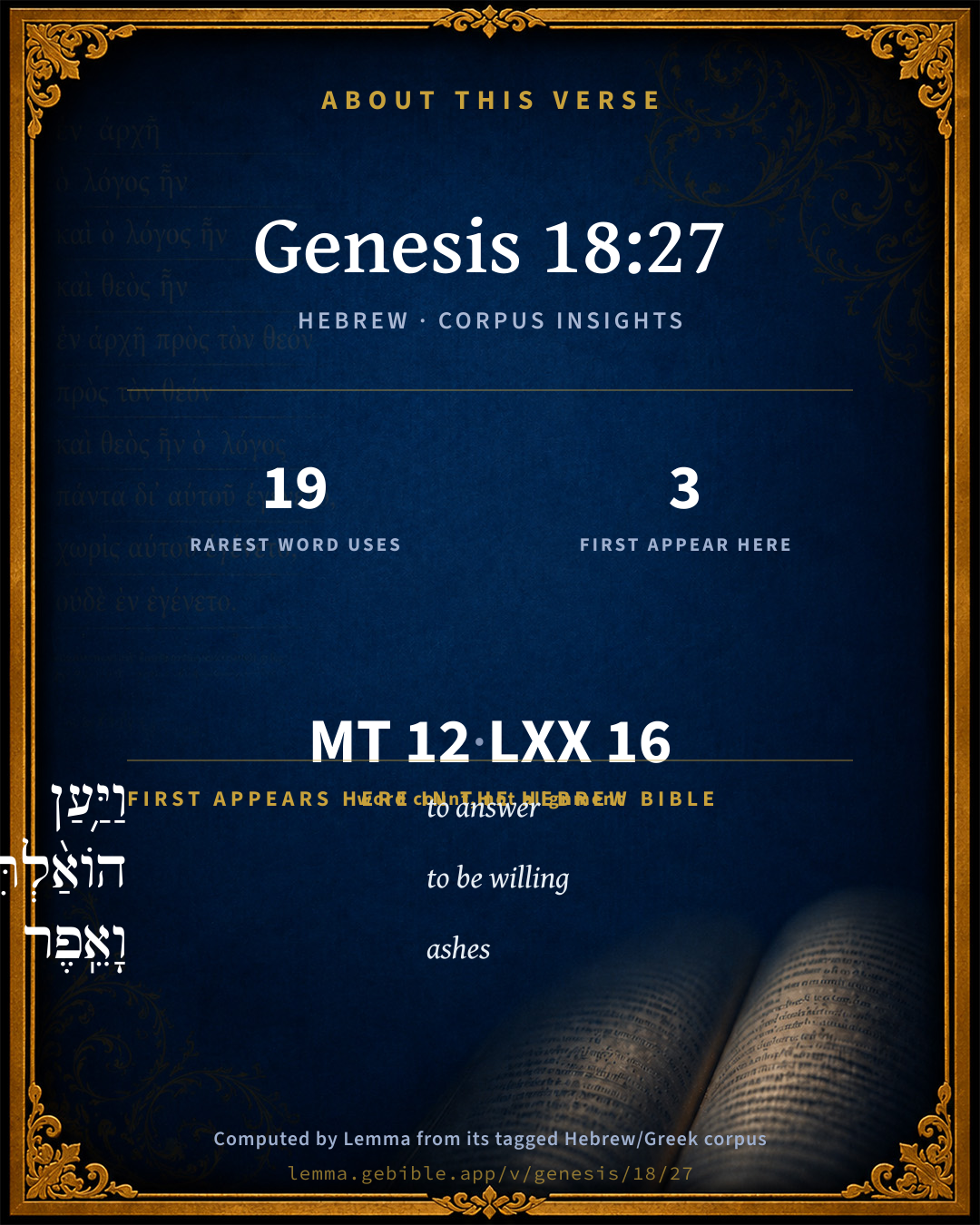
The rarest word here is הוֹאַ֨לְתִּי֙ to be willing H2974 — appearing just 19 times in the whole Hebrew Bible.

First appearance in Scripture

These words make their first canonical appearance in the Hebrew Bible here:

  • וַיַּ֥עַן to answer H6030
  • הוֹאַ֨לְתִּי֙ to be willing H2974
  • וָאֵֽפֶר ashes H665

Shared distinctive vocabulary

הוֹאַ֨לְתִּי֙ to be willing H2974 occurs in 19 verses of the Hebrew Bible. Also found in:

Grammatical profile

  • 4 verbs
  • 4 nouns
  • 1 pronoun
  • 1 preposition
  • 2 particles

Verb forms

  • וַיַּ֥עַן Qal · Sequential Imperfect
  • וַיֹּאמַ֑ר Qal · Sequential Imperfect
  • הוֹאַ֨לְתִּי֙ Hiphil · Perfect
  • לְדַבֵּ֣ר Piel · Infinitive Construct

Hebrew & Septuagint length

In English translation the verse runs 21 words from the Hebrew and 20 from the Septuagint (LXX English) — closely comparable.

A rough comparison of the two English renderings, which tokenize alike — not a word-level alignment.

Word counts can differ between the Hebrew and the Greek without any difference in meaning — e.g. the Hebrew direct-object marker אֵת has no separate Greek word, and Greek often adds the article ὁ.

In the original languages it is 12 Hebrew tokens and 16 Greek tokens — but the two are counted differently (Hebrew bundles its prefixes and suffixes into one token; the Greek is in lemma form), so that isn’t a like-for-like length.

Cross-references

16

Topical passages linked to Genesis 18:27 in the Treasury of Scripture Knowledge — connected by theme and wording, ordered by reader-vote popularity; previews shown in the World English Bible.

  • Isaiah 6:5 Then I said, "Woe is me! For I am undone, because I am a man of unclean lips, and I dwell in the midst of a people of unclean lips: for my eyes have seen the King, Yahweh of Hosts!"
  • Genesis 3:19 By the sweat of your face will you eat bread until you return to the ground, for out of it you were taken. For you are dust, and to dust you shall return."
  • Luke 5:8 But Simon Peter, when he saw it, fell down at Jesus' knees, saying, "Depart from me, for I am a sinful man, Lord."
  • Job 30:19 He has cast me into the mire. I have become like dust and ashes.
  • Isaiah 64:8 But now, Yahweh, you are our Father; we are the clay, and you our potter; and we all are the work of your hand.
  • 1 Corinthians 15:47–48 The first man is of the earth, made of dust. The second man is the Lord from heaven.
  • Genesis 2:7 Yahweh God formed man from the dust of the ground, and breathed into his nostrils the breath of life; and man became a living soul.
  • Genesis 18:30–32 He said, "Oh don't let the Lord be angry, and I will speak. What if there are thirty found there?" He said, "I will not do it, if I find thirty there."
  • Job 4:19 How much more, those who dwell in houses of clay, Whose foundation is in the dust, Who are crushed before the moth!
  • Psalms 8:4 What is man, that you think of him? The son of man, that you care for him?
  • Psalms 144:3 Yahweh, what is man, that you care for him? Or the son of man, that you think of him?
  • Ecclesiastes 12:7 And the dust returns to the earth as it was, And the spirit returns to God who gave it.
  • Luke 18:1 He also spoke a parable to them that they must always pray, and not give up,
  • Ezra 9:6 and I said, my God, I am ashamed and blush to lift up my face to you, my God; for our iniquities are increased over our head, and our guiltiness is grown up to the heavens.
  • Job 42:6–8 Therefore I abhor myself, And repent in dust and ashes."
  • 2 Corinthians 5:1–2 For we know that if the earthly house of our tent is dissolved, we have a building from God, a house not made with hands, eternal, in the heavens.

Cross-references courtesy of OpenBible.info (CC BY 4.0).

Hebrew and Greek witnesses Masoretic Hebrew ↔ Greek Septuagint

The same verse in the two great witnesses to the Old Testament, shown verse-for-verse.

These are two independent witnesses, not word-aligned to each other, and the Septuagint is shown in lemma (dictionary) form.

Hebrew Genesis 18:27 Masoretic · Westminster Leningrad Codex

וַיַּ֥עַן אַבְרָהָ֖ם וַיֹּאמַ֑ר הִנֵּה נָ֤א הוֹאַ֨לְתִּי֙ לְדַבֵּ֣ר אֶל אֲדֹנָ֔י וְאָנֹכִ֖י עָפָ֥ר וָאֵֽפֶר

Abraham answered, "See now, I have taken it on myself to speak to the Lord, who am but dust and ashes.

World English Bible · Public Domain

Greek LXX Genesis 18:27 Septuagint · lemma form

καί ἀποκρίνω αβρααμ εἶπον νῦν ἄρχω λαλέω πρός ὁ κύριος ἐγώ δέ εἰμί γῆ καί σποδός

And Abraam answered and said, Now I have begun to speak to my Lord, and I am earth and ashes.

LXX2012 (modern English Septuagint) · Public Domain

Hebrew: Westminster Leningrad Codex (CC BY 4.0). Greek: Septuagint (public domain); English from LXX2012 (modern English Septuagint) (Public Domain). How the Septuagint differs from the Hebrew →

Targum (Aramaic paraphrase)

2

The Targum is the ancient Jewish Aramaic paraphrase of the Hebrew Scriptures — an interpretive translation, not the Hebrew text itself. Onkelos (literal) and Pseudo-Jonathan (expansive) render the Torah, and Jonathan the Prophets. Coverage is partial: where no permissively-licensed English translation exists for a verse, only the Aramaic is shown. This is verse-level text, not a word-by-word alignment to the Hebrew.

  1. Targum Onkelos Torah (Genesis–Deuteronomy)
    וַאֲתֵב אַבְרָהָם וַאֲמַר הָא כְעַן שָׁרֵיתִי לְמַלָּלָא קֳדָם יְיָ וַאֲנָא עָפָר וּקְטָם

    (no public-domain English translation for this verse)

    Targum Onkelos — Aramaic: “Onkelos Genesis” (public domain); “Onkelos Exodus” (public domain); “Onkelos Leviticus” (public domain); “Onkelos Numbers” (public domain); “Onkelos Deuteronomy” (public domain). English: “Sefaria Community Translation” (CC0 1.0 (public-domain dedication)); “J.W. Etheridge. The Targums of Onkelos and Jonathan Ben Uzziel on the Pentateuch. London: Longmans, Green, 1862” (public domain). Text via Sefaria.

  2. Targum Pseudo-Jonathan Torah (Genesis–Deuteronomy)
    וְאָתֵיב אַבְרָהָם וַאֲמַר בְּבָעוּ בְּרַחֲמִין הָא כְּדוֹן שָׁרִיתִי לְמַלְלָא קֳדָם יְיָ וַאֲנָא מְתִיל לְעָפָר וּקְטָם

    And Abraham responded, and said, I pray for mercy. Behold, now, I have begun to speak before the Lord; I, who am as dust and ashes.

    Targum Pseudo-Jonathan — Aramaic: “Targum Jonathan on Genesis” (public domain); “Targum Jonathan on Exodus” (public domain); “Targum Jonathan on Leviticus” (public domain); “Targum Jonathan on Numbers” (public domain); “Targum Jonathan on Deuteronomy” (public domain). English: “The Targum of Jonathan ben Uzziel, trans. J. W. Etheridge, London, 1862” (public domain). Text via Sefaria.

Commentary

Notes on Genesis 18:27 from classic Christian and Jewish commentators (each source and its license shown beneath its notes). The classic Christian expositions comment on the surrounding passage and are grouped to its opening verse, so a note may address several verses; the Jewish commentaries on the Tanakh (Rashi and others) are per-verse, so they appear only where the commentator wrote on this verse.

Lemma curates 59 commentaries, every one of them public domain or Creative Commons licensed, each selected and text-cleaned for this edition rather than reprinted as found. About our sources →

Trapp's Complete Commentary

John Trapp

Gen 18:27 And Abraham answered and said, Behold now, I have taken upon me to speak unto the Lord, which [am but] dust and ashes:

Ver. 27. Which am but dust and ashes.] Gnaphar veephar , χονις et cinus ; none so humble as they that have nearest communion with God. The angels that stand before him, cover their faces with two wings as with a double scarf. {Isa 6:2}

John Trapp, A Commentary or Exposition upon All the Books of the Old and New Testament (1647–1656) — public domain. Text from a community e-Sword module.

The Biblical Illustrator

Joseph S. Exell

Gen_18:27

But dust and ashes

Abraham interceding

I.

THE TRUE POSTURE FOR A SINNER, AT THE THRONE OF GRACE. He must lie low, and aim high. You see this in the behaviour of Abraham on the present occasion. Though honoured by a fresh token of the Lords confidential friendship, he has--

1. Low thoughts of himself. He cannot forget who and what he is: I am but dust and ashes! The expression is singular. It alludes, I think, first to the meanness of his origin. What was Abraham--what are all men--but dust? But this expression of Abraham may allude, secondly, to the corruption of his nature. Dust is what God made it: but ashes have had a value, which is now departed from them. Thus man, however mean, was yet not offensive, till he corrupted his way before God.

2. High thoughts of God: high thoughts, first, of His equity; The Judge of all the earth, he is persuaded, must and will do right. Any other supposition, indeed, were an affront to the Lord. But, secondly, let Abraham teach you also to entertain equally high thoughts of His mercy. Be not backward to ask of God, what you are unable to claim.

II. THE GENEROUS CHARACTER OF TRUE GODLINESS. For whose welfare does Abraham make this urgent intercession? Two parties were included in it, neither of whom had very greatly deserved such kindness at his hands.

1. Lot his nephew, though not named, had (we may suppose) the foremost place in his good wishes. He was a pious person; and wilt Thou also destroy the righteous with the wicked?

2. The people of Sodom, on the other hand, are expressly named. Abraham knew that they were wicked, and sinners before the Lord exceedingly. Yet even for them he prays.

III. THE EFFICACY OF INTERCESSORY PRAYER is another lesson taught us by this narrative.

IV. A FAINT TYPE OF OUR GREAT INTERCESSOR, JESUS THE SON OF GOD.

1. Was Abrahams a generous interposition? That of Jesus is far more unmerited. He intercedes for enemies!

2. Did Abraham appear to have some weight, as the friend of God? Far more authoritative is the mediation of Jesus. He stands in His own name, and on His own merits; not as a servant, high in favour indeed at court--but as the Kings Son.

3. Did Abraham persevere, with an earnestness which, in his own eyes, seemed almost to border upon presumption? The event showed, notwithstanding, that he left off too soon. This will never be said of our Divine Intercessor. He will not fail nor be discouraged, till He have set judgment in the earth--till He have fully accomplished all His purposes of grace.

4. Once more: let Abraham intercede as he might, whether on this or on subsequent occasions, yet his good offices were sure to be terminated, sooner or later not being suffered to continue, by reason of death. After death--as the rich man in torments found--he neither can nor will interpose. But Jesus ever liveth to make intercession for us. (J. Jowett, M. A.)

How may we have suitable conceptions of God in duty?

That which we have more especially to take notice of is, with what apprehensions or conceptions of God Abraham did speak to God, did deport himself towards God, did manage this great undertaking with God: concerning which, four things present themselves for our observation:--

1. That those apprehensions or conceptions [which] Abraham had of God, did highly exalt and magnify the greatness and excellency of God in his heart: Behold, now I have taken upon me to speak unto the Lord; One who hath excellency, and sovereignty, and majesty, and dominion, and power, and glory.

2. That they were such conceptions of God as did humble, vilify, and abase Abraham in himself in comparison of God: I have taken upon me to speak unto the Lord, which am but dust and ashes; a sinful, weak, worthless, frail piece of vanity and mortality.

3. That they were such conceptions of God as did represent Him gracious, propitious, benevolent to the creature, notwithstanding the greatness and excellency of God, and the meanness and unworthiness of the creature: thus much seems to be comprehended in the note of admiration, behold! O what admirable condescension is this in the great God! O what wonderful mercy and grace is this, that such a poor vile creature should have liberty to speak to Him, to parley with Him!

4. That they were such apprehensions of God as did beget in Abraham a faith of acceptation with God in the performance of that duty, without which it had been dangerous presumption in him, who was but dust and ashes, to take upon him to speak unto the Lord.

DOCTRINE: THAT SUCH AS SPEAK TO GOD OR SPEAK OF GOD, SUCH AS DRAW NEAR TO GOD OR HAVE TO DO WITH GOD IN ANY PART OF DIVINE WORSHIP, MUST MANAGE ALL THEIR PERFORMANCES WITH RIGHT APPREHENSIONS AND DUE CONCEPTIONS OF GOD.

1. The first proposition is this: That we cannot have any true, right apprehensions or conceptions of God, except we have a true knowledge of Him. Such as have not known God, have slighted Him: Who is the Lord, saith Pharaoh, that I should obey His voice? I know not the Lord Exo_5:2). Such as know not God, nor desire to know Him, are so far from drawing near to God, that they drive Him as far from them as they can; they say unto the Almighty, Depart from us; for we desire not the knowledge of Thy ways (Job_21:14).

2. The second proposition is: That we cannot know anything savingly of God, further than He is pleased to manifest and make known Himself to us. No man can make known God but God Himself. Moses, who had seen as much of Gods glory as any man, when he desired a further manifestation of Gods glory, in a higher measure or degree than formerly he had seen, he goes to God Himself for it: I beseech Thee, show me Thy glory Exo_33:18).

3. The third proposition is: That the clearest manifestations of God to us, and such as can beget in us right apprehensions and due conceptions of Him, are made out to us in and by Jesus Christ. No man hath seen God at any time; the only-begotten Son, which is in the bosom of the Father, He hath declared Him (Joh_1:18). Therefore no man ever did or canapprehend anything of God truly, that is, upon a saving account, but in and by Jesus Christ. The Divine Essence or Godhead no man hath seen, nor can see in itself (1Ti_6:16). In the works of creation, God is a God above us; in His works of providence, a God without us; in the law, a God against us; in Himself, a God invisible to us. Only in Christ He is Emmanuel, God manifested in our flesh, God in us, God with us, God for us.

4. Hence follows the fourth proposition: That the manifestations of God to us in Christ are those which alone can beget those due apprehensions and right conceptions of God, with which we must draw near to Him, and perform all our worship to Him. As Abraham is held forth to us a pattern of faith; so he may be to us a pattern of worship, inasmuch as all true worship to God is performed by faith, by faith in Christ.

(1) Those apprehensions Abraham had of God did beget, as we have shown, high thoughts of God. With such apprehensions of God we must perform all our worship. See what high thoughts of God His people have always had in worshipping Him: Neh_9:5-6; 1Ti_1:17;

6:16.

(2) Abraham had such conceptions of God as humbled, emptied, and abased him in himself in comparison of God. And with such apprehensions of God must we perform all our worship to Him. We are exhorted to come and worship, and bow down, and kneel (Psa_95:6). In all worship we are to testify, as our absolute subjection to God, so our humblest submission to Him. Observe what self-abasing thoughts the apprehension of Gods goodness wrought in David when he went to worship before the Lord (2Sa_7:18-20).

(3) Abraham had such conceptions of God as did represent Him gracious, propitious, benevolous to the creature, a bountiful rewarder of him that serveth Him, notwithstanding the greatness of God, or the unworthiness of the creature. Such apprehensions we must have of God in all our approaches to Him, in all our performances of duty and worship.

(4) Abraham had such apprehensions of God as did beget a comfortable persuasion of faith for his acceptation with God in that his drawing near to Him. Now, such apprehensions of God as beget a faith of acceptation with God in our approaches to Him, can spring only from the manifestations of God to us in Christ. The use I shall make of this point is, to inform Christians how much it concerneth us to acquaint ourselves more intimately with God as He hath manifested Himself in Christ Jesus; in whom alone we can have right apprehensions and due conceptions of God; without which we cannot perform aright any kind of worship to God.

1. Without due apprehensions and conceptions of God, we cannot perform any part of that natural worship we owe to God. We cannot love Him, fear Him, trust in Him, pray unto Him, praise Him, &c.

2. Without the right apprehensions and due conceptions of God in Jesus Christ, we cannot perform aright any part of His instituted worship.

(1) For all the ordinances of Gods instituted worship (as the sacrifices and sacraments under the law, so the sacraments and other ordinances under the gospel) seem to have immediate relation to, and near dependence on, Christ. God manifested in the flesh.

(2) The Divine Essence or Godhead in Jesus Christ seems to be the proper object of all worship. This Divine Essence is wholly in Christ: In Him dwelleth all the fulness of the Godhead bodily (Col_2:9).

(3) The flesh or humanity of Christ is the medium or mean by which we have access to God in all our worship.

This is expressed: Having boldness to enter into the holiest, where the Divine glory appeared between the cherubims on the mercy-seat, by the blood of Jesus, by a new and living way, which He hath consecrated for us, through the veil, that is to say, His flesh (Heb_10:19-20). (T. Mallery, D. D.)

Dust and ashes

1. The first thing that occurs, is the lamentable folly of those who cry up the dignity of human nature: for neither revelation nor reason discovers any nature to us, but such as is mortal and sinful; and there is no dignity either in sin or mortality.

2. Secondly, the fearful effects of sin are displayed to us by this subject in a very particular manner. Why does the body, so wonderfully formed by the Divine wisdom, return again to its original dust, but because that which has taken root in it cannot otherwise be extracted? Why are we under condemnation, and liable to be reduced to ashes, but because sin has kindled the flames of the Divine wrath? How odious then must sin be in itself, and how contrary to the nature of God, if it compels His justice to destroy the work of His hands! Lastly, they who have ears to hear, will learn from this subject, not to set their affections upon a world, which is under sentence of condemnation, and whose end is to be burned. (W. Jones, M. A.)

Necessity of humility

The grandest edifices, the tallest towers, the loftiest spires, rest upon deep foundations. The very safety of eminent gifts and pre-eminent graces lies in their association with deep humility they were dangerous without it. Great men do need to be good men. Look at this mighty ship, a leviathan on the deep. With her towering masts, and carrying a cloud of canvas, how she steadies herself on the waves, and walks erect upon the rolling waters, like a thing of inherent, self-regulating life! When the corn is waving, and trees are bending, and foaming billows roll before the blast and break in thunders on the beach, why is she not flung on her beam ends, sent down foundering into the deep? Why, because unseen, beneath the surface, a vast well-ballasted hull gives her balance, and taking hold of the water, keeps her steady under a press of sail, and on the bosom of a swelling sea. Even so, to preserve the saint upright, erect, and safe from falling, God gives him balance and ballast, bestowing on the man to whom He has given lofty endowments, the grace of a proportionate humility.

Humility in prayer

Artabanus, one of the military officers of the Athenians, was applied to by a certain great man, who told him that he desired an audience of the king. He was answered that before it was granted, he must prostrate himself before him, for it was a custom of the country for the king to admit no one to his presence who would not worship him. That which was an arrogant assumption in an earthly king, is a proper condition of an approach to the King of kings. Humility is the foundation of an intercourse with Him. We must bow before His throne. No sinner who is too proud to yield obedience to this law need expect any favours from His hands.

The Biblical Illustrator, edited by Joseph S. Exell (c. 1880s–1900s) — public domain. Text from a community e-Sword module.

Joseph Benson's Commentary

Gen 18:27. Behold now, I have taken upon me to speak unto the Lord, who am but dust and ashes — He speaks as one amazed at his own boldness, and the liberty God graciously allowed him, considering God’s greatness, who is the Lord, and his own meanness, but dust and ashes. Whenever we draw near to God, it becomes us reverently to acknowledge the vast distance that there is between us and him. He is the Lord of glory, we are worms of the earth.

Joseph Benson's Commentary on the Old and New Testaments (1811–1818) — public domain. Text from a community e-Sword module.

Geneva Bible (1599)

Geneva Bible translators

Hereby we learn, that the nearer we approach unto God, the more doth our miserable estate appear, and the more are we humbled.

Geneva Bible (1599) marginal notes — public domain. Text via Bolls.life.

Adam Clarke's Commentary

Verse 27. Which am but dust and ashes] עפר ואפר aphar vaepher, words very similar in sound, as they refer to matters which so much resemble each other. Dust - the lightest particles of earth. Ashes - the residuum of consumed substances. By these expressions he shows how deeply his soul was humbled in the presence of God. He who has high thoughts of himself must have low thoughts of the dignity of the Divine nature, of the majesty of God, and the sinfulness of sin.

Adam Clarke's Commentary on the Bible (1810–1826) — public domain. Text from a community e-Sword/MySword module.

John Calvin's Commentaries

27. Which am but dust and ashes. Abraham speaks thus for the sake of obtaining pardon. For what is mortal man when compared with God? He therefore confesses that he is too bold, in thus familiarly interrogating God; yet he desires that this favor may be granted unto him, by the Divine indulgence. It is to be noted, that the nearer Abraham approaches to God, the more fully sensible does he become of the miserable and abject condition of men. For it is only the brightness of the glory of God which covers with shame and thoroughly humbles men, when stripped of their foolish and intoxicated self-confidence. Whosoever, therefore, seems to himself to be something, let him turn his eyes to God, and immediately he will acknowledge himself to be nothing. Abraham, indeed was not forgetful that he possessed a living soul; but he selects what was most contemptible, in order to empty himself of all dignity. It may seem, however, that Abraham does but sophistically trifle with God, when, diminishing gradually from the number first asked, he proceeds to his sixth interrogation. I answer, that this was rather to be considered as the language of a perturbed mind. At first he anxiously labors for the men of Sodom, wherefore he omits nothing which may serve to mitigate his solicitude. And as the Lord repeatedly answers him so mildly, we know that he had not been deemed importunate, nor troublesome. But if he was kindly heard, when pleading for the inhabitants of Sodom, even to his sixth petition; much more will the Lord hearken to the prayers which any one may pour out for the Church and household of faith. Moreover, the humanity of Abraham appears also in this, that although he knows Sodom to be filled with vilest corruptions, he cannot bring his mind to think that all are infected with the contagion of wickedness; but he rather inclines to the equitable supposition, that, in so great a multitude, some just persons may be concealed. For this is a horrible prodigy, that the filth of iniquity should so pervade the whole body, as to allow no member to remain pure. We are, however, taught by this example, how tyrannically Satan proceeds when once the dominion of sin is established. And certainly, seeing the propensity of men to sin, and the facility for sinning are so great, it is not surprising that one should be corrupted by another, till the contagion reached every individual. For nothing is more dangerous than to live where the public license of crime prevails; yea, there is no pestilence so destructive, as that corruption of morals, which is opposed neither by laws nor judgments, nor any other remedies. And although Moses, in the next chapter Genesis 18:1, explains the most filthy crime which reigned in Sodom, we must nevertheless remember what Ezekiel teaches (Ezekiel 16:48,49,) that the men of Sodom did not fall at once into such execrable wickedness; but that in the beginning, luxury from the fullness of bread prevailed, and that, afterwards, pride and cruelty followed. At length, when they were given up to a reprobate mind, they were also driven headlong into brutal lusts. Therefore if we dread this extreme of inordinate passion, let us cultivate temperance and frugality; and let us always fear, lest a superfluity of food should impel us to luxury; lest our minds should be infected with pride on account of our wealth, and lest delicacies should tempt us to give the reins to our lusts.

John Calvin's Commentaries (1540-1563) — public domain. Text from the Calvin Translation Society English edition (1840s-50s) via the Christian Classics Ethereal Library (ccel.org). Calvin's coverage is partial (roughly two-thirds of the Bible); uncommented books and verses are honest gaps, never fabricated. The 19th-century editor's footnotes and remarks are omitted so the notes are faithfully Calvin's own voice.

The Cambridge Bible for Schools and Colleges

gen. ed. J. J. S. Perowne

27. dust and ashes] Two alliterative words in the Heb. (âphar va-êpher) which defy reproduction in English: cf. Gen_1:2, Gen_4:14. For the dust of man’s frame, cf. Gen_2:7, Gen_3:19. See a similar use of the phrase in Job_30:19; Job_42:6.

The Cambridge Bible for Schools and Colleges (gen. ed. J. J. S. Perowne; Cambridge University Press, 1878–1918) — public domain. Text from a community e-Sword module.

John Gill's Exposition

And Abraham answered and said,.... In a very humble and modest manner, encouraged by the answer given him:

behold now, I have taken upon me to speak unto the Lord; suggesting that it was bold and daring in him, and was what he was unfit for and unworthy of; or, "I have begun to speak" (e); and since he had, he intimates, it would be a favour, and what he was undeserving of, might he be permitted to proceed; or, "I am desirous to speak" (f); it is a pleasure to me, as well as an honour done me, to be permitted to speak unto the Lord, though I deserve it not:

which am but dust and ashes; whose original was out of the dust, and to which he would return, and was now a frail, feeble, mortal creature, mean and despicable, unworthy to speak to God; the disproportion between the speaker and the person spoken to was infinite; wherefore the most profound humility and self-abasement are necessary in a creature's approach to the divine Being.

(e) "coepi, loquar", V. L. "loqui", Pagninus, Montanus; so Targum Jon. (f) "Gestio, volo, eupio", Vatablus; "cuperem alloqui", Junius & Tremellius; so Jarchi and Aben Ezra, and Ben Gersom.

John Gill's Exposition of the Whole Bible (1746–1763) — public domain (CC PDM 1.0). Text via the HelloAO Bible API.

Matthew Poole's English Annotations

In regard of the composition of my body, which was taken out of the dust, and shall return into it again. See Gen 3:19; Job 4:19; Ecc 12:7; 1Co 15:47,48.

Matthew Poole's English Annotations on the Holy Bible (1683–1685) — public domain. Text from a community e-Sword/MySword module.

The Pulpit Commentary

And Abraham answered and said (being emboldened by the success of his first petition), Behold now, I have taken upon me, literally, I have begun, though here perhaps used in a more emphatic sense: I have undertaken or ventured (vide Gesenius, p. 326)to speak unto the Lord Adonai (Gen_15:2) which am but dust and ashes. "Dust in his origin and ashes in his end" (Delitzsch; vide. (Gen_3:19)

The Pulpit Commentary (1880–1919), ed. H.D.M. Spence-Jones & Joseph S. Exell — public domain. Text from a community e-Sword module.

John Wesley's Explanatory Notes

Behold now, I have taken upon me to speak unto the Lord, who am but dust and ashes - He speaks as one amazed at his own boldness, and the liberty God graciously allowed him, considering God's greatness, he is the Lord; and his own meanness, but dust and ashes. Whenever we draw near to God, it becomes us reverently to acknowledge the vast distance that there is between us and Him. He is the Lord of glory, we are worms of the earth.

John Wesley, Explanatory Notes Upon the Whole Bible (1754–1765) — public domain. Text via the GEBible commentary corpus.

unfoldingWord translationNotes

Door43 World Missions Community

Look

The phrase "Look" here draws attention to the surprising information that follows.

I have undertaken to speak

"Pardon me for being so bold as to speak to you" or "Excuse me for daring to speak"

to my Lord

Abraham shows his respect to Yahweh by speaking to Yahweh as if he were speaking to someone else. AT: "to you, my Lord" (See: First, Second, or Third Person)

only dust and ashes

This metaphor describes Abraham as a human being, who will die and whose body will turn into to dust and ashes. AT: "only a mortal man" or "as unimportant as dust and ashes" (See: Metaphor)

five less than fifty righteous

"only forty-five righteous people"

for lack of five

"if there are five fewer righteous people"

I will not destroy it

"I will not destroy Sodom"

translationWords

Abraham

lord

righteous

unfoldingWord translationNotes — © Distant Shores Media and the Door43 World Missions Community, licensed CC BY-SA 4.0. Source: git.door43.org/Door43/en_tn.

Rashi

Rabbi Shlomo Yitzchaki (Rashi)

הואלתי means I am willing to speak, just as (Exodus 2:21) “And Moses was pleased (ויואל) [to dwell with the man]”.

ואנכי עפר ואפר I Am BUT DUST AND ASHES — I would long ago have been reduced to dust by the kings and to ashes by Nimrod had it not been that Thy mercies stood by me (Genesis Rabbah 49:11).

Rashi on the Tanakh — English translations: “The Judaica Press complete Tanach with Rashi, translated by A. J. Rosenberg” (CC BY 4.0); “Pentateuch with Rashi's commentary by M. Rosenbaum and A.M. Silbermann, 1929-1934” (public domain); “The Metsudah Tanach series, Lakewood, N.J” (CC BY 4.0); and “The Book of Joshua, Metsudah Publications, 1997” (CC BY 4.0). Text via Sefaria.

Sforno

Rabbi Ovadia Sforno

I have begun. To present my inquiry regarding Divine justice. I am but dust and ashes.

Therefore I was unable to comprehend Your answer

Sforno on the Tanakh — English translation: “Yalkut, Sifsei Chachomim Chumash, Metsudah Publications, 2009” (CC BY 4.0). Text via Sefaria.

Radak

Rabbi David Kimhi (Radak)

ויען..הואלתי, “I wanted to speak some more to G’d, אנכי עפר ואפר, even though compared to You I am only dust and ashes. I did not mean to protest Your justice, but I merely wish to understand it.

Radak on the Tanakh — English translations: “Sefaria Community Translation” (CC0 1.0 (public-domain dedication)); “Eliyahu Munk, HaChut Hameshulash” (CC BY 4.0); “Rabbi Mike Feuer, Jerusalem Anthology” (CC BY 4.0); and “R. David Kimhi on the first book of Psalms, Translated by R.G. Finch, London, 1919” (public domain). Text via Sefaria.

Lesson kit

Teaching starters — assembled from the data on this page, not authored interpretation. Every prompt links to the verse data it draws on. Edit before teaching.

Genesis, in the Pentateuch, opens this verse with 12 words (12 distinct Hebrew lemmas). Its most distinctive word is yâʼal (“to be willing”). A historical commentator’s framing appears above. Read the whole chapter for the surrounding context.

Discussion questions

  1. What does “to be willing” (yâʼal) contribute to the verse as a whole?
  2. 3 words here appear for the first time in Scripture. What is being introduced at this debut?
  3. Genesis 18:31 shares the word «to be willing» with this verse. How do the two illuminate each other?
  4. The translations on this page render this verse differently — a whole-verse word diff, not a word-by-word alignment. What might account for the different wordings?
  5. The verb «וַיַּ֥עַן» is Qal Sequential Imperfect. How does its form color the action?
  6. Reading how Trapp's Complete Commentary and The Biblical Illustrator read this verse, where do the two commentators agree and where do they part?

Things to notice

Reading settings

Reading text

Shown beneath each verse's original-language words.

Old Testament
Old Testament edition

Read the OT as the Masoretic Hebrew (MT) or the Greek Septuagint (LXX).

English shown for the Greek Septuagint (in the Hebrew ↔ Greek comparison).

Comparing translations? Open the Compare panel on any verse page to stack up to four side by side.