2 Samuel 7:28

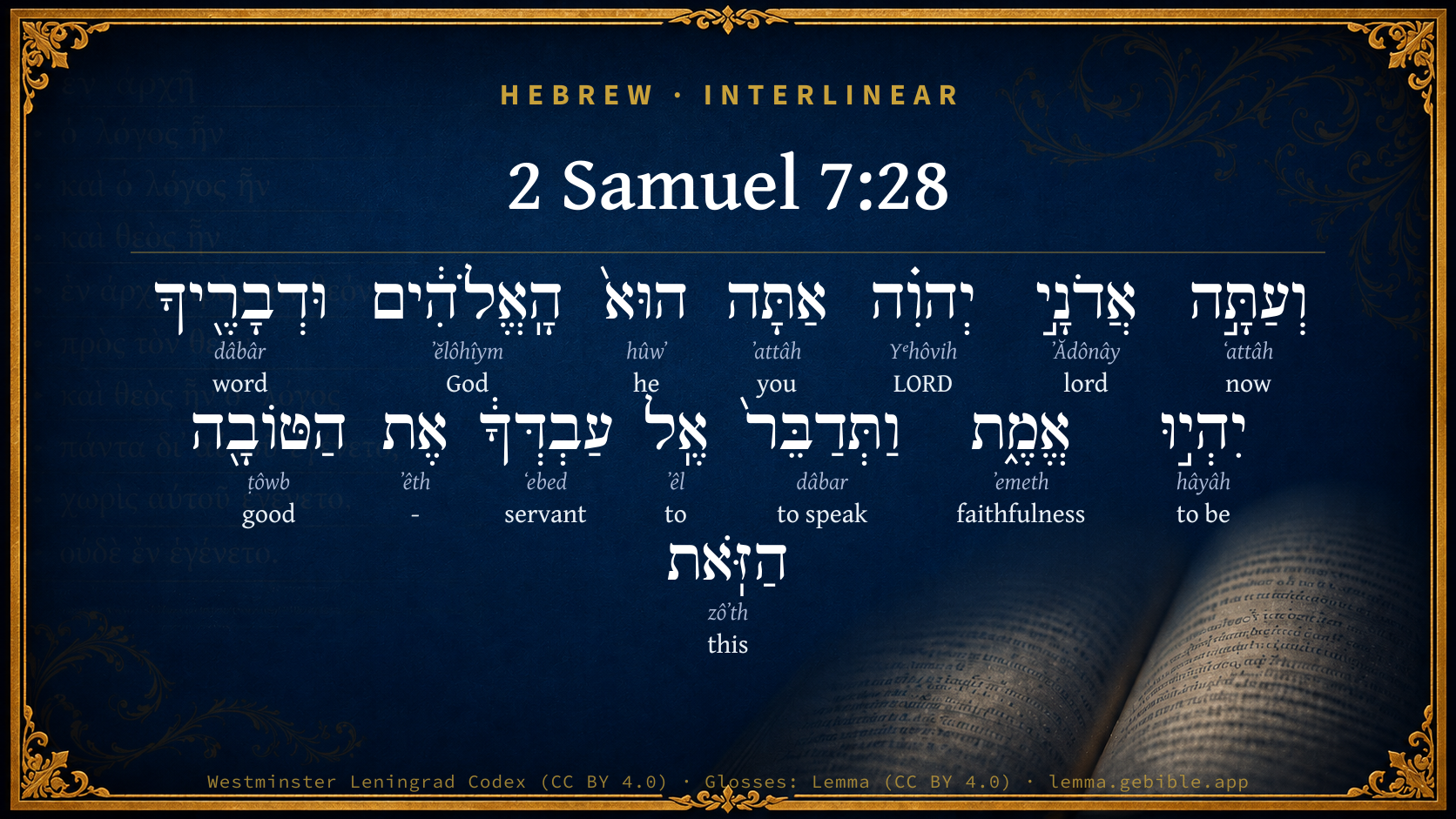
Hebrew (Westminster Leningrad Codex) 2 Samuel 7:28 appears in the Hebrew Old Testament. The text above is from the Westminster Leningrad Codex. Each word links to its Strong’s number, a concise gloss, and parsing drawn from the Open Scriptures Hebrew Bible morphology. Click any word for its full Brown-Driver-Briggs (BDB) entry.
Download image
Cite this verse

2 Samuel 7:28 (World English Bible). Public Domain. Lemma interlinear Bible study tool, https://lemma.gebible.app/v/2-samuel/7/28.

Show BibTeX & RIS
BibTeX
RIS
English Translation
Now, O Lord Yahweh, you are God, and your words are truth, and you have promised this good thing to your servant:
World English Bible · Public Domain
Download a study sheet

One document with this verse’s original text, its word-by-word gloss line, the meaning frame, cross-references with their text, attributed commentary, and full source and license credits — printable, and it pastes into notes with its structure intact.

This verse Autodidact and up

Study sheet (.html) Plain text (.txt)

A passage Seminary Student

Up to 50 verses in one chapter. A passage sheet keeps up to 6 commentary sources and 12 cross-references per verse, in the order this page ranks them, and says so on the sheet whenever that leaves anything out. Ask for a single verse and you get the Autodidact verse sheet above.

Everything on this page stays free to read, with no account — the sheet is a download of what is already on screen, not access to it.

Want to remove ads? Support Godless Engineer
Compare translations 3

The same verse in 3 English versions, stacked beneath the original-language interlinear above. Click any original word for its lexicon entry.

Each is an independent rendering of the whole verse — the interlinear is not word-aligned to these translations.

Highlighted words mark where these versions differ — a whole-verse word diff, not a word-by-word alignment.

  • World English Bible Public Domain
    Now, O Lord Yahweh, you are God, and your words are truth, and you have promised this good thing to your servant:
  • King James Version Public Domain
    And now, O Lord GOD, thou art that God, and thy words be true, and thou hast promised this goodness unto thy servant:
  • unfoldingWord Literal Text CC BY-SA 4.0
    And now, my Lord Yahweh, you he, God, so your words are true. And you have spoken concerning this good your servant.

unfoldingWord Literal Text — © unfoldingWord, licensed CC BY-SA 4.0. Word-aligned USFM3 via Door43 (git.door43.org/unfoldingWord/en_ult).

Versions to compare (up to 4)

3 of 4 selected

Show all 18 translations

Every available English version of this verse, each an independent rendering of the whole verse.

  • World English Bible Public Domain
    Now, O Lord Yahweh, you are God, and your words are truth, and you have promised this good thing to your servant:
  • Berean Standard Bible Public Domain
    And now, O Lord GOD, You are God! Your words are true, and You have promised this goodness to Your servant.
  • Majority Standard Bible Public Domain
    And now, O Lord GOD, You are God! Your words are true, and You have promised this goodness to Your servant.
  • King James Version Public Domain
    And now, O Lord GOD, thou art that God, and thy words be true, and thou hast promised this goodness unto thy servant:
  • American Standard Version (1901) Public Domain
    And now, O Lord Jehovah, thou art God, and thy words are truth, and thou hast promised this good thing unto thy servant:
  • Revised Version (1885) Public Domain
    And now, O Lord GOD, thou art God, and thy words are truth, and thou hast promised this good thing unto thy servant:
  • Geneva Bible (1599) Public Domain
    Therefore now, O Lord God, (for thou art God, and thy words be true, and thou hast tolde this goodnes vnto thy seruant)
  • Douay-Rheims (1899) Public Domain
    And now, O Lord God, thou art God, and thy words shall be true: for thou hast spoken to thy servant these good things.
  • Young's Literal Translation Public Domain
    And now, Lord Jehovah, Thou `art' God Himself, and Thy words are truth, and Thou speakest unto Thy servant this goodness,
  • Literal Standard Version CC BY-SA 4.0
    And now, Lord YHWH, You [are] God Himself, and Your words are truth, and You speak this goodness to Your servant,
  • Unlocked Literal Bible CC BY-SA 4.0
    Now, Lord Yahweh, you are God, and your words are trustworthy, and you have made this good promise to your servant.
  • unfoldingWord Literal Text CC BY-SA 4.0
    And now, my Lord Yahweh, you he, God, so your words are true. And you have spoken concerning this good your servant.
  • Darby Bible Public Domain
    And now, Lord Jehovah, thou art that God, and thy words are true, and thou hast promised this goodness unto thy servant;
  • World Messianic Bible Public Domain
    “Now, O Lord GOD, you are God, and your words are truth, and you have promised this good thing to your servant.
  • Webster's Bible Public Domain
    And now, O Lord GOD, thou art that God, and thy words are true, and thou hast promised this goodness to thy servant:
  • Free Bible Version CC BY-SA 4.0
    Lord Almighty, you are God! Your words are truth, and you are the one who has promised these good things to your servant.
  • Bible in Basic English Public Domain
    And now, O Lord God, you are God and your words are true and you have said you will give your servant this good thing;
  • JPS Tanakh (1917) Public Domain
    And now, O Lord GOD, Thou alone art God, and Thy words are truth, and Thou hast promised this good thing unto Thy servant;

Literal Standard Version (2020), Covenant Press — licensed CC BY-SA 4.0. Text via the HelloAO Bible API (eBible.org). Unlocked Literal Bible (unfoldingWord) — licensed CC BY-SA 4.0. Text via the HelloAO Bible API (eBible.org). unfoldingWord Literal Text — © unfoldingWord, licensed CC BY-SA 4.0. Word-aligned USFM3 via Door43 (git.door43.org/unfoldingWord/en_ult). Free Bible Version, Dr. Jonathan Gallagher — licensed CC BY-SA 4.0. Text via the HelloAO Bible API (eBible.org).

Word by word

More ways to search: Search by grammar → Find every occurrence → Compare this word →

Practice this passage: Drill this verse → Learn its vocabulary →

אֱמֶ֑ת
ʼemeth
H571
“faithfulness”
Noun, Common, Feminine, Singular, Absolute
Part of Speech
Noun
Type
Common
Gender
Feminine
Number
Singular
State
Absolute
Full BDB Definition

Origin: contracted from H539

TWOT: 116k

firmness, faithfulness, truth (noun feminine) - sureness, reliability - stability, continuance - faithfulness, reliableness - truth - as spoken - of testimony and judgment - of divine instruction - truth as a body of ethical or religious knowledge - true doctrine - in truth, truly (adverb)
  1. וְעַתָּ֣ה ʻattâh H6258 “and · now” Conjunction + Adverb
  2. אֲדֹנָ֣י ʼĂdônây H136 “Lord · my” Noun, Common, Masculine, Plural, Construct + Suffix, Personal, 1st Person, Common, Singular
  3. יְהוִ֗ה Yᵉhôvih H3069 “LORD” Noun, Proper
  4. אַתָּה ʼattâh H859 “you” Pronoun, Personal, 2nd Person, Masculine, Singular
  5. הוּא֙ hûwʼ H1931 “he” Pronoun, Personal, 3rd Person, Masculine, Singular
  6. הָֽאֱלֹהִ֔ים ʼĕlôhîym H430 “the · God(s)” Particle, Definite Article + Noun, Common, Masculine, Plural, Absolute
  7. וּדְבָרֶ֖יךָ dâbâr H1697 “and · words · your” Conjunction + Noun, Common, Masculine, Plural, Construct + Suffix, Personal, 2nd Person, Masculine, Singular
  8. יִהְי֣וּ hâyâh H1961 “to be” Verb, Qal, Imperfect, 3rd Person, Masculine, Plural
  9. וַתְּדַבֵּר֙ dâbar H1696 “and · to speak” Conjunction + Verb, Piel, Sequential Imperfect, 2nd Person, Masculine, Singular
  10. אֶֽל ʼêl H413 “to” Preposition
  11. עַבְדְּךָ֔ ʻebed H5650 “servant · your” Noun, Common, Masculine, Singular, Construct + Suffix, Personal, 2nd Person, Masculine, Singular
  12. אֶת ʼêth H853 “-” Particle, Direct Object
  13. הַטּוֹבָ֖ה ṭôwb H2896 “the · good” Particle, Definite Article + Adjective, Adjective, Feminine, Singular, Absolute
  14. הַזֹּֽאת zôʼth H2063 “the · this” Particle, Definite Article + Pronoun, Demonstrative, Feminine, Singular

About this verse

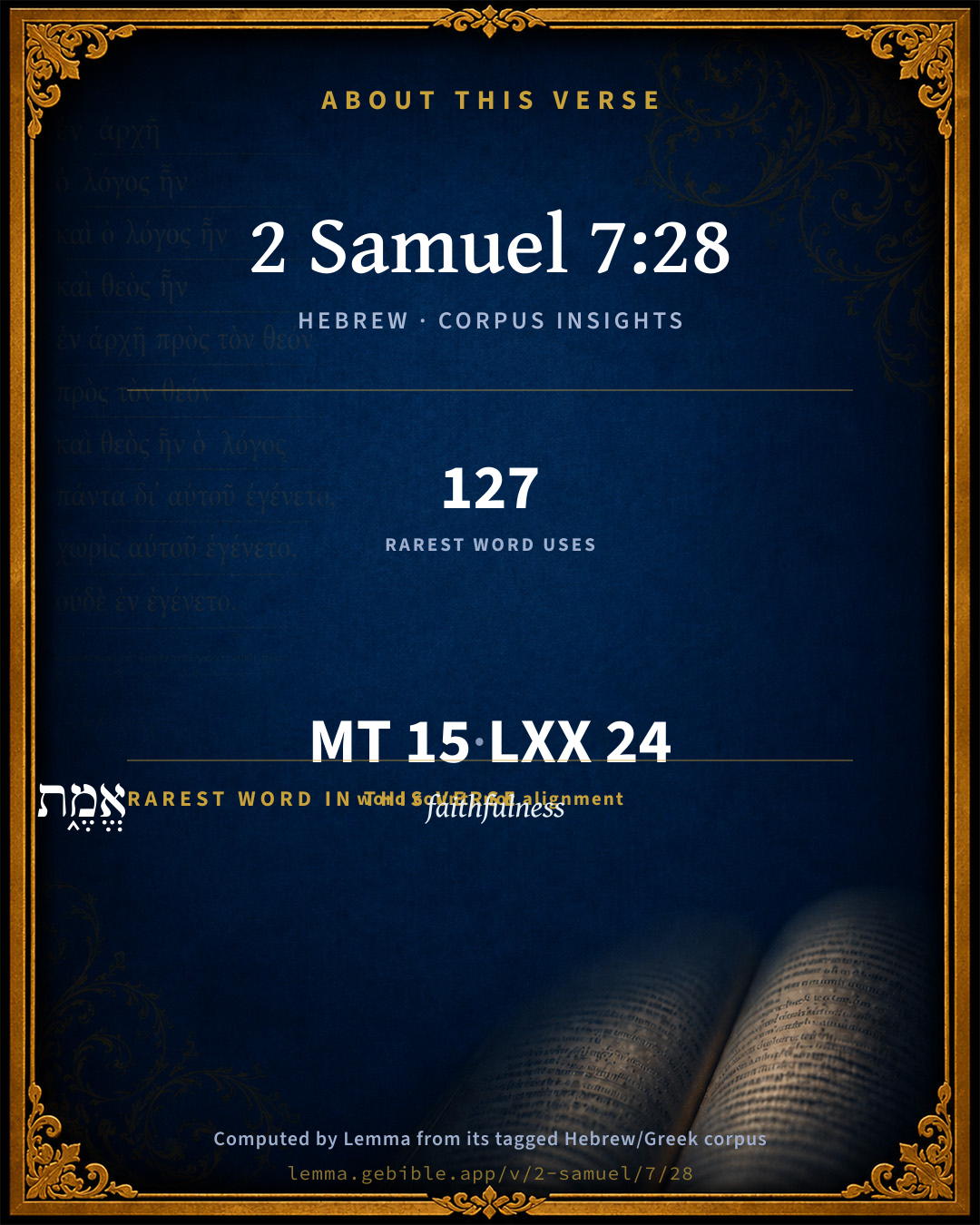
These counts appear in no published source. They are computed here, from the morphology-tagged text and Lemma’s own curated glosses. What Lemma adds →

15
words
15
distinct lemmas
Historical
section

Grammatical profile

  • 2 verbs
  • 6 nouns
  • 1 adjective
  • 3 pronouns
  • 1 preposition
  • 1 adverb
  • 1 particle

Verb forms

  • יִהְי֣וּ Qal · Imperfect
  • וַתְּדַבֵּר֙ Piel · Sequential Imperfect

Hebrew & Septuagint length

In English translation the verse runs 22 words from the Hebrew and 25 from the Septuagint (LXX English) — closely comparable.

A rough comparison of the two English renderings, which tokenize alike — not a word-level alignment.

Word counts can differ between the Hebrew and the Greek without any difference in meaning — e.g. the Hebrew direct-object marker אֵת has no separate Greek word, and Greek often adds the article ὁ.

In the original languages it is 15 Hebrew tokens and 24 Greek tokens — but the two are counted differently (Hebrew bundles its prefixes and suffixes into one token; the Greek is in lemma form), so that isn’t a like-for-like length.

Cross-references

4

Topical passages linked to 2 Samuel 7:28 in the Treasury of Scripture Knowledge — connected by theme and wording, ordered by reader-vote popularity; previews shown in the World English Bible.

  • John 17:17 Sanctify them in your truth. Your word is truth.
  • Exodus 34:6 Yahweh passed by before him, and proclaimed, "Yahweh! Yahweh, a merciful and gracious God, slow to anger, and abundant in loving kindness and truth,
  • Numbers 23:19 God is not a man, that he should lie, Neither the son of man, that he should repent: Has he said, and will he not do it? Or has he spoken, and will he not make it good?
  • Titus 1:2 in hope of eternal life, which God, who can't lie, promised before eternal times;

Cross-references courtesy of OpenBible.info (CC BY 4.0).

Hebrew and Greek witnesses Masoretic Hebrew ↔ Greek Septuagint

The same verse in the two great witnesses to the Old Testament, shown verse-for-verse.

These are two independent witnesses, not word-aligned to each other, and the Septuagint is shown in lemma (dictionary) form.

Hebrew 2 Samuel 7:28 Masoretic · Westminster Leningrad Codex

וְעַתָּ֣ה אֲדֹנָ֣י יְהוִ֗ה אַתָּה הוּא֙ הָֽאֱלֹהִ֔ים וּדְבָרֶ֖יךָ יִהְי֣וּ אֱמֶ֑ת וַתְּדַבֵּר֙ אֶֽל עַבְדְּךָ֔ אֶת הַטּוֹבָ֖ה הַזֹּֽאת

Now, O Lord Yahweh, you are God, and your words are truth, and you have promised this good thing to your servant:

World English Bible · Public Domain

Greek LXX 2 Samuel 7:28 Septuagint · lemma form

καί νῦν κύριος ἐγώ κύριος σύ εἰμί ὁ θεός καί ὁ λόγος σύ εἰμί ἀληθινός καί λαλέω ὑπέρ ὁ δοῦλος σύ ὁ ἀγαθός οὗτος

And now, O Lord my Lord, you are God; and your words will be true, and you have spoken these good things concerning your servant.

LXX2012 (modern English Septuagint) · Public Domain

Hebrew: Westminster Leningrad Codex (CC BY 4.0). Greek: Septuagint (public domain); English from LXX2012 (modern English Septuagint) (Public Domain). How the Septuagint differs from the Hebrew →

Targum (Aramaic paraphrase)

1

The Targum is the ancient Jewish Aramaic paraphrase of the Hebrew Scriptures — an interpretive translation, not the Hebrew text itself. Onkelos (literal) and Pseudo-Jonathan (expansive) render the Torah, and Jonathan the Prophets. Coverage is partial: where no permissively-licensed English translation exists for a verse, only the Aramaic is shown. This is verse-level text, not a word-by-word alignment to the Hebrew.

  1. Targum Jonathan Prophets (Joshua–Malachi)
    וּכְעַן יְיָ אֱלֹהִים אַתְּ הוּא יְיָ וּפִתְגָמָךְ אִינוּן קְשׁוֹט וּמַלֵלְתָּא עַל עַבְדָךְ יַת טַבְתָא הָדָא:

    (no public-domain English translation for this verse)

    Targum Jonathan — Aramaic: “Mikraot Gedolot” (public domain). English: “Sefaria Community Translation” (CC0 1.0 (public-domain dedication)); “London "Chaldee Paraphrase," 1871” (public domain). Text via Sefaria.

Commentary

Notes on 2 Samuel 7:28 from classic Christian and Jewish commentators (each source and its license shown beneath its notes). The classic Christian expositions comment on the surrounding passage and are grouped to its opening verse, so a note may address several verses; the Jewish commentaries on the Tanakh (Rashi and others) are per-verse, so they appear only where the commentator wrote on this verse.

Lemma curates 59 commentaries, every one of them public domain or Creative Commons licensed, each selected and text-cleaned for this edition rather than reprinted as found. About our sources →

Trapp's Complete Commentary

John Trapp

2Sa 7:28 And now, O Lord GOD, thou [art] that God, and thy words be true, and thou hast promised this goodness unto thy servant:

Ver. 28. Thou art that God … and thou hast promised.] David hath never done with this; but improves it, and works out the goodness of it, by actuating his faith upon the promise.

John Trapp, A Commentary or Exposition upon All the Books of the Old and New Testament (1647–1656) — public domain. Text from a community e-Sword module.

The Cambridge Bible for Schools and Colleges

gen. ed. J. J. S. Perowne

28. thou art that God] Better, thou art God, and thy words shall be truth. Truth is an essential attribute of God, and His promises must therefore prove true. Cp. Exo_34:6; Psa_19:9; Joh_17:17.

The Cambridge Bible for Schools and Colleges (gen. ed. J. J. S. Perowne; Cambridge University Press, 1878–1918) — public domain. Text from a community e-Sword module.

John Gill's Exposition

And now, O Lord God, thou art that God,.... Who is the Lord of hosts, and the God of Israel, that has promised and is able to perform, and is faithful to his promise:

and thy words be true; are truly, punctually, and faithfully performed, never fail:

and thou hast promised this goodness unto thy servant; concerning building and establishing his house. David repeats this promise as being greatly affected with it, and fully assured of the performance of it.

John Gill's Exposition of the Whole Bible (1746–1763) — public domain (CC PDM 1.0). Text via the HelloAO Bible API.

Matthew Poole's English Annotations

That God who hast declared thyself to be Israel’s God, and in particular my God.

Matthew Poole's English Annotations on the Holy Bible (1683–1685) — public domain. Text from a community e-Sword/MySword module.

The Pulpit Commentary

And now, O Lord God, thou art that God. The pronoun rendered "that" is really a personal pronoun used as the copula, which the Authorized Version inserts in italics. As this grammatical usage, which is common to all the Semitic languages, was not understood at the time when our version was made, we find all the parts of the verb "to be" constantly printed in italics, as though absent, while really they are expressed in the Oriental way. This has the advantage, however, of reminding the reader that wherever the verb "to be" is printed in Roman characters it has a much stronger meaning than the mere union of subject and predicate. Thus in Gen_1:2 the first "was," in Roman type, means "existed," or possibly "became;" the second "was," in italics, is simply the copula. Here the correct translation is, And now, O Lord Jehovah, thou art the God; i.e. the one real, true God.

Truth of God"s words.

art God, and thy words are truth" (Revised version). David may be thinking only of the promises of God, and expressing his own confidence in their fulfilment to himself and his family. But his assertion applies to all the words of God, declarations and threatenings as well as promises; and, as his language is general, his thought may be general also; and his faith in the truth of all the words of God might then be regarded as the ground of his faith in the promise made to himself. The words, "Thou art God," give the reason of his confidence in the Divine words. "Because thou art God, we know that "thy words are truth," and only truth.

I THE GROUNDS OF OUR ASSURANCE OF THE TRUTH OF GOD"S WORDS. "Thou art God.

1. His nature and character.

(1) His universal knowledge. He cannot, like men, be mistaken, and honestly assert that for truth which is untrue.

(2) His essential truthfulness. Because he is God we are intuitively sure of this. As he cannot be mistaken, so he "cannot lie

(3) His goodness. Which of itself would prevent him from misleading and deceiving his dependent creatures.

(4) His unbounded power. Men who are not untrue to their promises may be unable to fulfil them. Not so God.

(5) His unchangeableness. As well in faithfulness as in goodness and power. He can never become either unable or unwilling to fulfil his Word.

2. His doings. The actual fulfilment of his words.

(1) In the history of the world; especially the promises respecting the Christ, the blessings he would bestow, and the changes he would effect. The faithfulness of God to his Word, as shown in the previous history of Israel, would assure David of the fulfilment of the promises to himself.

(2) Within the range of our own observation and experience. The words of God as to the results of faith and unbelief, of holiness and sin, of prayerfulness and prayerlessness, are continually being accomplished. Our personal experience testifies to their truth, and we can witness their fulfilment in others.

II THE WORDS RESPECTING WHICH WE HAVE THIS ASSURANCE. All declarations that can be traced to God, whether ascertained by unaided reason (as we say, though the living God through the eternal Word is ever working in the human reason) or by the inspired Book. God speaks in nature as well as in the Bible. Scientific truth, and moral truth known by the conscience, are from him as well as religious. But as Christians we have to do with the words of God in Holy Scripture, and especially with the "truth which is in Jesus." As he declared in language almost identical with David"s, "Thy Word is truth", (Joh_17:17) so he said of himself, "I am the Truth". (Joh_14:6) And it is of unspeakable importance to be assured that he is and gives the revelation of God; that all that he is and says is the truth. And as he declares of the Old Testament that "the Scripture cannot be broken", (Joh_10:35) we have his warrant for full Confidence also in the more ancient revelation. God"s words as thus ascertained relate to:

1. Existences. God himself, his Son, his Spirit. Inhabitants of the invisible world angels, Satan, demons. Mankind the nature of man, purposes of his creation, the relations he sustains, his fallen condition, etc. For our knowledge of the invisible beings and things we depend on the Word of God, mainly the Scriptures; and the knowledge thus acquired is, we may be sure, truth.

2. Moral laws. Known partly by reason, partly by Scripture. However ascertained, we know them to be truth.

3. Spiritual truths and laws. The redeeming love and works of God and our Saviour; the way in which they become effectual for ourselves; the duties thence arising.

4. The results of our conduct in respect to these truths and laws. That is, the promises and the threatenings of God, as to both the present life and the eternal future.

Observe, that it is the words of God about these things which are the truth; not necessarily the assertions of men individuals or Churches respecting them. It is for human teachers, not to require of their brethren unquestioning faith in their statements, but to lead them up to where they may hear the utterances of God himself. And this is to be done, not merely by proving their assertions by the letter of Scripture, but by cherishing themselves, and fostering in others, the spirit which enables communion with "the Father of spirits". (Heb_12:9) If God"s words be truth:

1. We should seek full knowledge of them.

2. We should exercise undoubting faith in them.

(1) The faith which realizes the invisible and eternal; apprehends and feels them to be as God says.

(2) The faith which is full confidence in the Divine promises and threatenings, assurance that our own future and that of others will be according to them. We have such a faith only when our belief sways and rules our hearts and lives.

3. We should imitate God as to our truthfulness and the actual truth of our words. Being true and sincere in our character and utterances, and taking care that what we truly say shall be truth. G.W.

The Pulpit Commentary (1880–1919), ed. H.D.M. Spence-Jones & Joseph S. Exell — public domain. Text from a community e-Sword module.

John Wesley's Explanatory Notes

That God - That God who hast declared thyself to be Israel's God, and in particular my God.

John Wesley, Explanatory Notes Upon the Whole Bible (1754–1765) — public domain. Text via the GEBible commentary corpus.

Rashi

Rabbi Shlomo Yitzchaki (Rashi)

You are the Elokim. The ruler. The ability to fulfill [this promise] is in Your Hand.

Rashi on the Tanakh — English translations: “The Judaica Press complete Tanach with Rashi, translated by A. J. Rosenberg” (CC BY 4.0); “Pentateuch with Rashi's commentary by M. Rosenbaum and A.M. Silbermann, 1929-1934” (public domain); “The Metsudah Tanach series, Lakewood, N.J” (CC BY 4.0); and “The Book of Joshua, Metsudah Publications, 1997” (CC BY 4.0). Text via Sefaria.

Lesson kit

Teaching starters — assembled from the data on this page, not authored interpretation. Every prompt links to the verse data it draws on. Edit before teaching.

2 Samuel, in the Historical, opens this verse with 15 words (15 distinct Hebrew lemmas). Its most distinctive word is ʼemeth (“faithfulness”). A historical commentator’s framing appears above. Read the whole chapter for the surrounding context.

Discussion questions

  1. What does “faithfulness” (ʼemeth) contribute to the verse as a whole?
  2. John 17:17 shares this passage’s theme. How do the two illuminate each other?
  3. The translations on this page render this verse differently — a whole-verse word diff, not a word-by-word alignment. What might account for the different wordings?
  4. The verb «יִהְי֣וּ» is Qal Imperfect. How does its form color the action?
  5. Reading how Trapp's Complete Commentary and The Cambridge Bible for Schools and Colleges read this verse, where do the two commentators agree and where do they part?

Things to notice

Reading settings

Reading text

Shown beneath each verse's original-language words.

Old Testament
Old Testament edition

Read the OT as the Masoretic Hebrew (MT) or the Greek Septuagint (LXX).

English shown for the Greek Septuagint (in the Hebrew ↔ Greek comparison).

Comparing translations? Open the Compare panel on any verse page to stack up to four side by side.