
Psalms 59:11

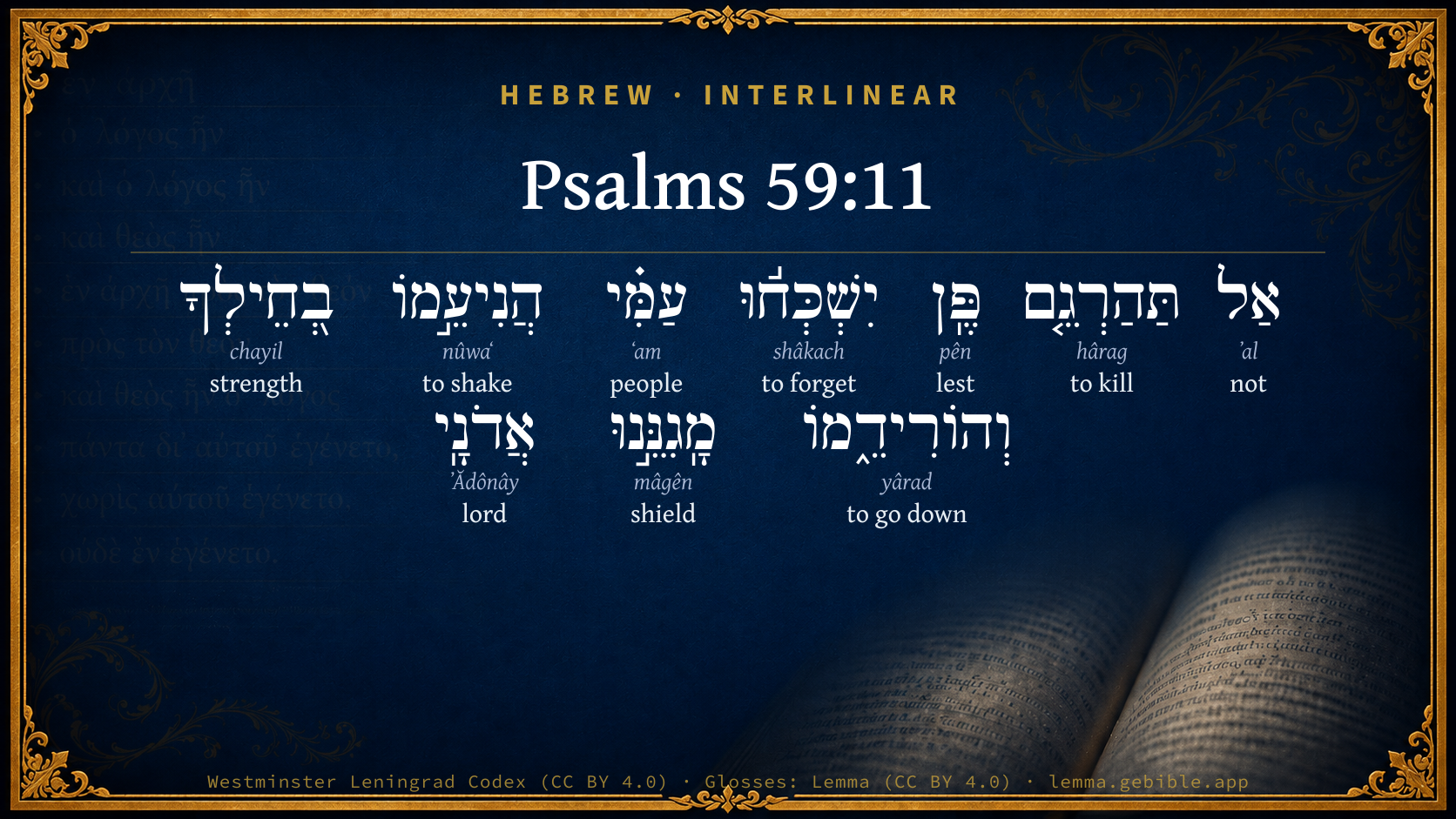
Hebrew (Westminster Leningrad Codex) Psalms 59:11 appears in the Hebrew Old Testament. The text above is from the Westminster Leningrad Codex. Each word links to its Strong’s number, a concise gloss, and parsing drawn from the Open Scriptures Hebrew Bible morphology. Click any word for its full Brown-Driver-Briggs (BDB) entry.
Download image
Cite this verse

Psalms 59:11 (World English Bible). Public Domain. Lemma interlinear Bible study tool, https://lemma.gebible.app/v/psalms/59/11.

Show BibTeX & RIS
BibTeX
RIS
English Translation
Don't kill them, or my people may forget. Scatter them by your power, and bring them down, Lord our shield.
World English Bible · Public Domain
Download a study sheet

One document with this verse’s original text, its word-by-word gloss line, the meaning frame, cross-references with their text, attributed commentary, and full source and license credits — printable, and it pastes into notes with its structure intact.

This verse Autodidact and up

Study sheet (.html) Plain text (.txt)

A passage Seminary Student

Up to 50 verses in one chapter. A passage sheet keeps up to 6 commentary sources and 12 cross-references per verse, in the order this page ranks them, and says so on the sheet whenever that leaves anything out. Ask for a single verse and you get the Autodidact verse sheet above.

Everything on this page stays free to read, with no account — the sheet is a download of what is already on screen, not access to it.

Want to remove ads? Support Godless Engineer
Compare translations 3

The same verse in 3 English versions, stacked beneath the original-language interlinear above. Click any original word for its lexicon entry.

Each is an independent rendering of the whole verse — the interlinear is not word-aligned to these translations.

Highlighted words mark where these versions differ — a whole-verse word diff, not a word-by-word alignment.

  • World English Bible Public Domain
    Don't kill them, or my people may forget. Scatter them by your power, and bring them down, Lord our shield.
  • King James Version Public Domain
    Slay them not, lest my people forget: scatter them by thy power; and bring them down, O Lord our shield.
  • unfoldingWord Literal Text CC BY-SA 4.0
    Do not slay them, lest my people forget. Scatter them by your power and bring them down, Lord, our shield.

unfoldingWord Literal Text — © unfoldingWord, licensed CC BY-SA 4.0. Word-aligned USFM3 via Door43 (git.door43.org/unfoldingWord/en_ult).

Versions to compare (up to 4)

3 of 4 selected

Show all 18 translations

Every available English version of this verse, each an independent rendering of the whole verse.

  • World English Bible Public Domain
    Don't kill them, or my people may forget. Scatter them by your power, and bring them down, Lord our shield.
  • Berean Standard Bible Public Domain
    Do not kill them, or my people will forget. Scatter them by Your power, and bring them down, O Lord, our shield.
  • Majority Standard Bible Public Domain
    Do not kill them, or my people will forget. Scatter them by Your power, and bring them down, O Lord, our shield.
  • King James Version Public Domain
    Slay them not, lest my people forget: scatter them by thy power; and bring them down, O Lord our shield.
  • American Standard Version (1901) Public Domain
    Slay them not, lest my people forget: Scatter them by thy power, and bring them down, O Lord our shield.
  • Revised Version (1885) Public Domain
    Slay them not, lest my people forget: scatter them by thy power, and bring them down, O Lord our shield.
  • Geneva Bible (1599) Public Domain
    Slay them not, least my people forget it: but scatter them abroad by thy power, and put them downe, O Lord our shield,
  • Douay-Rheims (1899) Public Domain
    my God, his mercy shall prevent me.
  • Young's Literal Translation Public Domain
    Slay them not, lest my people forget, Shake them by Thy strength, And bring them down, O Lord our shield.
  • Literal Standard Version CC BY-SA 4.0
    Do not slay them, lest my people forget, || Shake them by Your strength, || And bring them down, O Lord our shield.
  • Unlocked Literal Bible CC BY-SA 4.0
    Do not kill them, or my people will forget. Scatter them by your power and make them fall, Lord our shield.
  • unfoldingWord Literal Text CC BY-SA 4.0
    Do not slay them, lest my people forget. Scatter them by your power and bring them down, Lord, our shield.
  • Darby Bible Public Domain
    Slay them not, lest my people forget; by thy power make them wander, and bring them down, O Lord, our shield.
  • World Messianic Bible Public Domain
    Don’t kill them, or my people may forget. Scatter them by your power, and bring them down, Lord our shield.
  • Webster's Bible Public Domain
    \\59:10\\The God of my mercy will succor me: God will let me see my desire upon my enemies.
  • Free Bible Version CC BY-SA 4.0
    Don't kill them right away, otherwise my people will quickly forget what you have done. By your power make them stagger around and then fall down, Lord our protection.
  • Bible in Basic English Public Domain
    Put them not to death, for so my people will keep the memory of them: let them be sent in all directions by your power; make them low, O Lord our saviour.
  • JPS Tanakh (1917) Public Domain
    (59-12) Slay them not, lest my people forget, make them wander to and fro by Thy power, and bring them down, O Lord our shield.

Literal Standard Version (2020), Covenant Press — licensed CC BY-SA 4.0. Text via the HelloAO Bible API (eBible.org). Unlocked Literal Bible (unfoldingWord) — licensed CC BY-SA 4.0. Text via the HelloAO Bible API (eBible.org). unfoldingWord Literal Text — © unfoldingWord, licensed CC BY-SA 4.0. Word-aligned USFM3 via Door43 (git.door43.org/unfoldingWord/en_ult). Free Bible Version, Dr. Jonathan Gallagher — licensed CC BY-SA 4.0. Text via the HelloAO Bible API (eBible.org).

Word by word

More ways to search: Search by grammar → Find every occurrence → Compare this word →

Practice this passage: Drill this verse → Learn its vocabulary →

הֲנִיעֵ֣מוֹ
nûwaʻ
H5128
“shake · them”
Verb, Hiphil, Imperative, 2nd Person, Masculine, Singular + Suffix, Personal, 3rd Person, Masculine, Plural
Part of Speech
Verb
Stem
Hiphil
Form
Imperative
Person
2nd Person
Gender
Masculine
Number
Singular
Full BDB Definition

Origin: a primitive root

TWOT: 1328

to quiver, totter, shake, reel, stagger, wander, move, sift, make move, wave, waver, tremble - (Qal) - to wave, quiver, vibrate, swing, stagger, tremble, be unstable - to totter, go tottering - vagabond (participle) - (Niphal) to be tossed about or around - (Hiphil) - to toss about - to shake, cause to totter - to shake, disturb - to cause to wander
  1. אַל ʼal H408 “not” Particle, Negative
  2. תַּהַרְגֵ֤ם hârag H2026 “to kill · them” Verb, Qal, Jussive, 2nd Person, Masculine, Singular + Suffix, Personal, 3rd Person, Masculine, Plural
  3. פֶּֽן pên H6435 “lest” Conjunction
  4. יִשְׁכְּח֬וּ shâkach H7911 “to forget” Verb, Qal, Imperfect, 3rd Person, Masculine, Plural
  5. עַמִּ֗י ʻam H5971 “people · my” Noun, Common, Masculine, Singular, Construct + Suffix, Personal, 1st Person, Common, Singular
  6. בְ֭חֵילְךָ chayil H2428 “in/at · strength · your” Preposition + Noun, Common, Masculine, Singular, Construct + Suffix, Personal, 2nd Person, Masculine, Singular
  7. וְהוֹרִידֵ֑מוֹ yârad H3381 “and · go down · them” Conjunction + Verb, Hiphil, Imperative, 2nd Person, Masculine, Singular + Suffix, Personal, 3rd Person, Masculine, Plural
  8. מָֽגִנֵּ֣נוּ mâgên H4043 “shield · our” Noun, Common, Both, Singular, Construct + Suffix, Personal, 1st Person, Common, Plural
  9. אֲדֹנָֽי ʼĂdônây H136 “Lord · my” Noun, Common, Masculine, Plural, Construct + Suffix, Personal, 1st Person, Common, Singular

About this verse

These counts appear in no published source. They are computed here, from the morphology-tagged text and Lemma’s own curated glosses. What Lemma adds →

10
words
10
distinct lemmas
Wisdom
section

Shared distinctive vocabulary

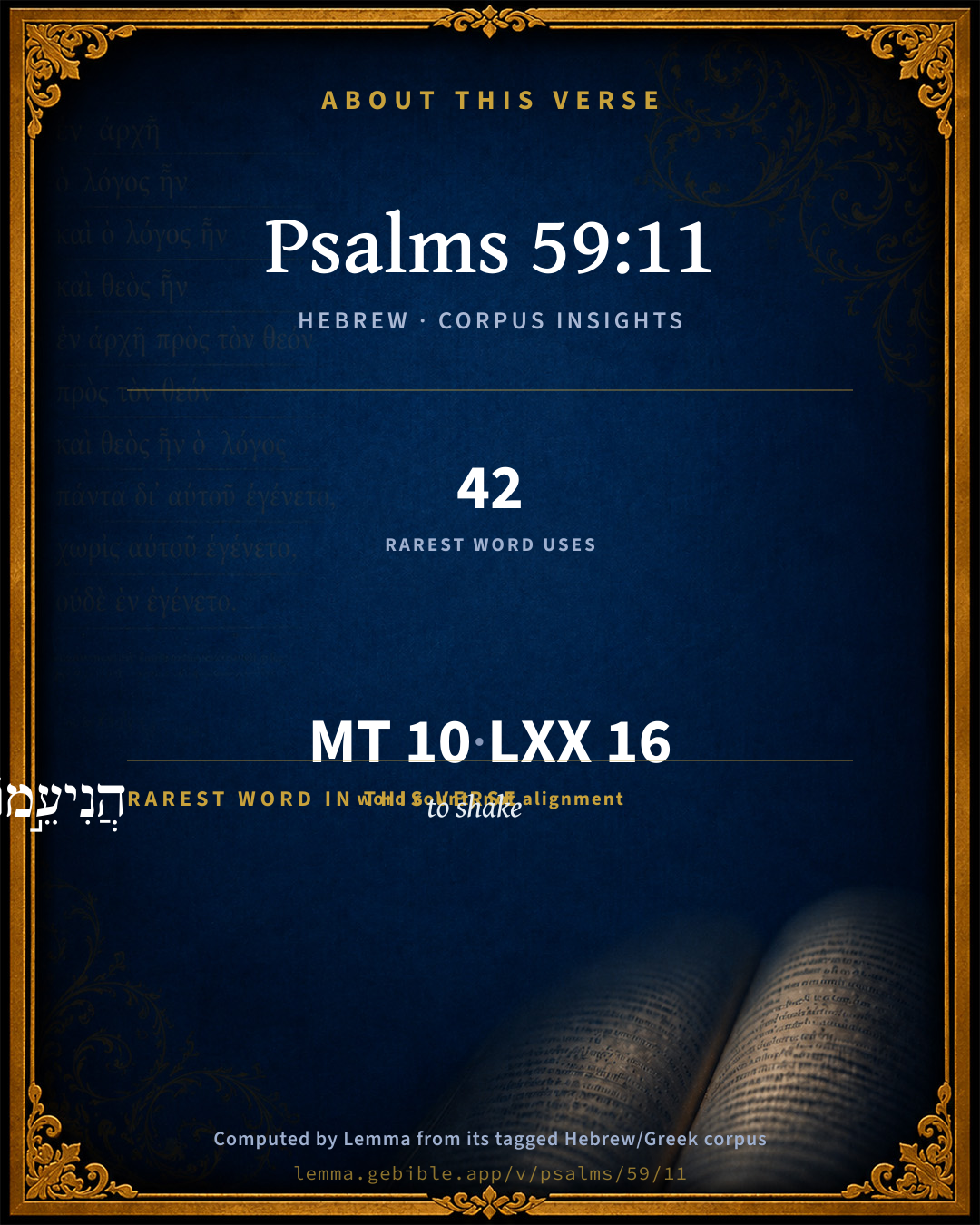
הֲנִיעֵ֣מוֹ to shake H5128 occurs in 36 verses of the Hebrew Bible. Also found in:

Grammatical profile

  • 4 verbs
  • 4 nouns
  • 1 conjunction
  • 1 particle

Verb forms

  • תַּהַרְגֵ֤ם Qal · Jussive
  • יִשְׁכְּח֬וּ Qal · Imperfect
  • הֲנִיעֵ֣מוֹ Hiphil · Imperative
  • וְהוֹרִידֵ֑מוֹ Hiphil · Imperative

Hebrew & Septuagint length

In English translation the verse runs 20 words from the Hebrew and 21 from the Septuagint (LXX English) — closely comparable.

A rough comparison of the two English renderings, which tokenize alike — not a word-level alignment.

Word counts can differ between the Hebrew and the Greek without any difference in meaning — e.g. the Hebrew direct-object marker אֵת has no separate Greek word, and Greek often adds the article ὁ.

In the original languages it is 10 Hebrew tokens and 16 Greek tokens — but the two are counted differently (Hebrew bundles its prefixes and suffixes into one token; the Greek is in lemma form), so that isn’t a like-for-like length.

Cross-references

20

Topical passages linked to Psalms 59:11 in the Treasury of Scripture Knowledge — connected by theme and wording, ordered by reader-vote popularity; previews shown in the World English Bible.

  • Psalms 3:3 But you, Yahweh, are a shield around me, My glory, and the one who lifts up my head.
  • Deuteronomy 4:27 Yahweh will scatter you among the peoples, and you shall be left few in number among the nations, where Yahweh shall lead you away.
  • Deuteronomy 28:64 Yahweh will scatter you among all peoples, from the one end of the earth even to the other end of the earth; and there you shall serve other gods, which you have not known, you nor your fathers, even wood and stone.
  • Luke 1:51–52 He has shown strength with his arm. He has scattered the proud in the imagination of their heart.
  • Revelation 9:6 In those days people will seek death, and will in no way find it. They will desire to die, and death will flee from them.
  • Genesis 4:12–15 From now on, when you till the ground, it won't yield its strength to you. You shall be a fugitive and a wanderer in the earth."
  • Leviticus 26:33 I will scatter you among the nations, and I will draw out the sword after you: and your land will be a desolation, and your cities shall be a waste.
  • Judges 1:6–7 But Adoni-bezek fled; and they pursued after him, and caught him, and cut off his thumbs and his great toes.
  • Job 40:12 Look on everyone who is proud, and humble him. Crush the wicked in their place.
  • Psalms 52:5 God will likewise destroy you forever. He will take you up, and pluck you out of your tent, And root you out of the land of the living. Selah.
  • Ezekiel 12:15–16 They shall know that I am Yahweh, when I shall disperse them among the nations, and scatter them through the countries.
  • Luke 21:21 Then let those who are in Judea flee to the mountains. Let those who are in the midst of her depart. Let those who are in the country not enter therein.
  • Deuteronomy 4:9 Only take heed to yourself, and keep your soul diligently, lest you forget the things which your eyes saw, and lest they depart from your heart all the days of your life; but make them known to your children and your children's children;
  • Deuteronomy 30:3–4 that then Yahweh your God will turn your captivity, and have compassion on you, and will return and gather you from all the peoples, where Yahweh your God has scattered you.
  • Psalms 44:11 You have made us like sheep for food, And have scattered us among the nations.
  • Psalms 84:9 Behold, God our shield, Look at the face of your anointed.
  • Psalms 84:11 For Yahweh God is a sun and a shield. Yahweh will give grace and glory. He withholds no good thing from those who walk blamelessly.
  • Psalms 106:27 That he would overthrow their seed among the nations, And scatter them in the lands.
  • Ezekiel 14:22–23 Yet, behold, therein shall be left a remnant that shall be carried forth, both sons and daughters: behold, they shall come forth to you, and you shall see their way and their doings; and you shall be comforted concerning the evil that I have brought on Jerusalem, even concerning all that I have brought on it.
  • Ecclesiastes 9:5 For the living know that they will die, but the dead don't know anything, neither do they have any more a reward; for the memory of them is forgotten.

Cross-references courtesy of OpenBible.info (CC BY 4.0).

Hebrew and Greek witnesses Masoretic Hebrew ↔ Greek Septuagint

The same verse in the two great witnesses to the Old Testament, shown verse-for-verse.

You’re reading Greek Psalm 58 (Hebrew Psalm 59). The Septuagint counts the superscription, so verse numbers can differ from the Hebrew — chapter-level alignment, not verse-by-verse. Numbering follows Rahlfs.

These are two independent witnesses, not word-aligned to each other, and the Septuagint is shown in lemma (dictionary) form.

Hebrew Psalms 59:11 Masoretic · Westminster Leningrad Codex

אַל תַּהַרְגֵ֤ם פֶּֽן יִשְׁכְּח֬וּ עַמִּ֗י הֲנִיעֵ֣מוֹ בְ֭חֵילְךָ וְהוֹרִידֵ֑מוֹ מָֽגִנֵּ֣נוּ אֲדֹנָֽי

Don't kill them, or my people may forget. Scatter them by your power, and bring them down, Lord our shield.

World English Bible · Public Domain

Greek LXX Greek Psalm 58:11 Septuagint · lemma form

ὁ θεός ἐγώ ὁ ἔλεος αὐτός προφθάνω ἐγώ ὁ θεός δεικνύω ἐγώ ἐν ὁ ἐχθρός ἐγώ

Slay them not, lest they forget your law; scatter them by your power; and bring them down, O Lord, my defender.

LXX2012 (modern English Septuagint) · Public Domain

Hebrew: Westminster Leningrad Codex (CC BY 4.0). Greek: Septuagint (public domain); English from LXX2012 (modern English Septuagint) (Public Domain). How the Septuagint differs from the Hebrew →

Commentary

Notes on Psalms 59:11 from classic Christian and Jewish commentators (each source and its license shown beneath its notes). The classic Christian expositions comment on the surrounding passage and are grouped to its opening verse, so a note may address several verses; the Jewish commentaries on the Tanakh (Rashi and others) are per-verse, so they appear only where the commentator wrote on this verse.

Lemma curates 59 commentaries, every one of them public domain or Creative Commons licensed, each selected and text-cleaned for this edition rather than reprinted as found. About our sources →

Trapp's Complete Commentary

John Trapp

Psa 59:11 Slay them not, lest my people forget: scatter them by thy power; and bring them down, O Lord our shield.

Ver. 11. Slay them not, lest my people forget] Marcet sine adversario virtus, the natural heat decayeth if it have not wherewith to wrestle. Carthage was not to be destroyed, that Rome might not want an adversary. The saints have the relics of corruption left in them for exercise of their graces. "Slay them not," saith David; and the Chaldee addeth, statim, forthwith, or outright, but by degrees rather; "lest my people," my followers and fellow soldiers, forget their skill in arms or thy judgments on the enemies.

Scatter them by thy power] That they may wander, as Cain did, and be restless. Or, shake them to and fro, as meal is shaken in a sieve; let them be dissipated, and by degrees wasted, that they may be as so many standing monuments of the divine justice, ut eo sint illustriora et testatiora tun iudicia, as the dejected people of the Jews are today.

John Trapp, A Commentary or Exposition upon All the Books of the Old and New Testament (1647–1656) — public domain. Text from a community e-Sword module.

Joseph Benson's Commentary

Psa 59:11. Slay them not — Hebrew, אל תהרגם, al tahargeem, Thou wilt not slay them, namely, suddenly, or at once; lest my people — My countrymen, those over whom thou hast appointed me to be governor in due time; forget — Their former danger, thy glorious mercy in delivering them, and their own duty to thee for it. Hereby it plainly appears that David, in his prayers against, and predictions concerning his enemies, was not moved by private malice or desire of revenge, but by the respect which he had to God’s honour, and the general good of his people. Scatter them by thy power — הניעמו, hanigneemo, Make them to wander. As they have wandered about the city and country to do me mischief, so let their punishment be agreeable to their sin; let them wander from place to place for meat, (as it is expressed Psa 59:15,) that they may carry the tokens of thy justice, and their own shame, to all places where they come. And bring them down — From that power and dignity in which thou hadst set them, which they so wickedly abused; and from the height of their carnal hopes of success against me.

Joseph Benson's Commentary on the Old and New Testaments (1811–1818) — public domain. Text from a community e-Sword module.

J. A. Alexander on Psalms

Joseph Addison Alexander

12. (Psa 59:11). Slay them not, lest my people forget; make them wander by thy power and bring them down, our shield, O Lord! The meaning of the first clause, as appears from the context, is, destroy them not utterly, or once for all. My people, i.e. Israel, the chosen race. Make them wander, like Cain and like Israel in the wilderness, to both which cases the same verb is applied, Gen 4:12, Num 32:13. These are tacitly referred to, as familiar examples of this kind of punishment, inflicted both on individuals and nations. Bring them down, cause them to descend, from their present high position, humble them, and make their humiliation an example and a warning to all others. This was signally fulfilled in the case of Saul and his household, as well as in that of the nations which resisted the divine will and oppressed the chosen people, to both which cases the expressions of this psalm are designedly appropriate. Our shield, our protector; not only mine but ours; not only David's but all Israel's. The figure of a shield is a favourite one with David. See above, on Psa 3:3; Psa 18:2; Psa 28:7. It is not only striking and expressive, but historically associated with the origin of the nation in the calling of Abraham and the patriarchal promises. See Gen 15:1.

Joseph Addison Alexander, The Psalms Translated and Explained (1850) — public domain. Text from a community e-Sword module.

Tyndale Open Study Notes

Tyndale Open Resources

59:11-13 The psalmist prays that the wicked will be forced to endure the same agonizing pain they have caused.

Tyndale Open Study Notes — © Tyndale Open Resources, licensed CC BY-SA 4.0. Text via the HelloAO Bible API.

Geneva Bible (1599)

Geneva Bible translators

Altogether, but by little and little, that the people seeing oftentimes thy judgments, may be mindful of thee.

Geneva Bible (1599) marginal notes — public domain. Text via Bolls.life.

Jamieson, Fausset & Brown

Robert Jamieson, A. R. Fausset & David Brown

Slay them not--at once (Jdg 2:21-23); but perpetuate their punishment (Gen 4:12; Num 32:13), by scattering or making them wander, and humble them.

Jamieson, Fausset & Brown — Commentary Critical and Explanatory on the Whole Bible (1871) — public domain (CC PDM 1.0). Text via the HelloAO Bible API.

Adam Clarke's Commentary

Verse 11. Slay them not, lest my people forget] I believe the Chaldee gives the true sense of this verse: "Do not slay them suddenly, lest my people should forget. Drive them from their habitations by thy power, and reduce them to poverty by the loss of their property." Preserve them long in a state of chastisement, that Israel may see thou hast undertaken for them: that thy hand is on the wicked for evil, and on them for good. The Canaanites were not suddenly destroyed; they were left to be pricks in the eyes and thorns in the sides of the Israelites. It is in a sense somewhat similar that the words are used here.

Adam Clarke's Commentary on the Bible (1810–1826) — public domain. Text from a community e-Sword/MySword module.

John Calvin's Commentaries

11 Slay them not, lest my people forget David very properly suggests this to his own mind, as a consideration which should produce patience. We are apt to think, when God has not annihilated our enemies at once, that they have escaped out of his hands altogether; and we look upon it as properly no punishment, that they should be gradually and slowly destroyed. Such being the extravagant desire which almost all, without exception, have, to see their enemies at once exterminated, David checks himself, and dwells upon the judgment of God to be seen in the lesser calamities which overtake the wicked. It is true, that were not our eyes blinded, we would behold a more evident display of divine retribution in cases where the destruction of the ungodly is sudden; but these are so apt to fade away from our remembrance, that he had good reason to express his desire that the spectacle might be one constantly renewed, and thus our knowledge of the judgments of God be more deeply graven upon our hearts. He arms and fortifies himself against impatience under delays in the execution of divine judgment, by the consideration that God has an express design in them, as, were the wicked exterminated in a moment, the remembrance of the event might speedily be effaced. There is an indirect censure conveyed to the people of Israel for failing to improve the more striking judgments of God. But the sin is one too prevalent in the world even at this day. Those judgments which are so evident that none can miss to observe them without shutting his eyes, we sinfully allow to pass into oblivion; so that we need to be brought daily into that theater where we are compelled to perceive the divine hand. This we must never forget when we see God subjecting his enemies to a gradual process of destruction, instead of launching his thunders instantly upon their head. He prays that God would make them to wander, as men under poverty and misery, who seek in every direction, but in vain, for a remedy to their misfortunes. The idea is still more forcibly described in the word which follows, make them descend, or, cast them down. He wished that they might be dragged from that position of honor which they had hitherto occupied, and thrown to the ground, so as to present, in their wretchedness and degradation, a constant illustration of the wrath of God. The word בחילך, becheylcha, which we have translated, in thy power, some render, with thy army, understanding the people of God. But it is more probable that David calls to his assistance the power of God for the destruction of his enemies, and this because they deemed themselves invincible through those worldly resources in which they trusted. As a further argument for obtaining his request, he intimates in the close of the verse that he was now pleading the cause of the whole Church, for he uses the plural number, O God our shield Having been chosen king by divine appointment, the safety of the Church stood connected with his person. The assault made upon him by his enemies was not an assault upon himself merely as a private individual, but upon the whole people, whose common welfare God had consulted in making choice of him. And this suggested another reason why he should patiently submit to see the judgments of God measured out in the manner which might best engage their minds in assiduous meditation.

John Calvin's Commentaries (1540-1563) — public domain. Text from the Calvin Translation Society English edition (1840s-50s) via the Christian Classics Ethereal Library (ccel.org). Calvin's coverage is partial (roughly two-thirds of the Bible); uncommented books and verses are honest gaps, never fabricated. The 19th-century editor's footnotes and remarks are omitted so the notes are faithfully Calvin's own voice.

Ellicott's Commentary for English Readers

(11) Slay them not, lest my people forget . . .—The Spartans refused to allow the destruction of a neighbouring city, which had often called forth their armies, saying, “Destroy not the whetstone of our young men.” Timon, in the play, is made to say—

“Live loath’d and long

You smiling smooth detested parasites,”

that the ruin of Athens might be complete, if deferred. National feeling, too, has often insisted on extreme modes of punishment, partly from vindictive feeling, partly for deterrent purposes. Witness the sequel to the Indian mutiny. But where is the parallel to the feeling that seems uppermost in the Psalmist’s mind, viz., a wish for protracted retribution on the nations for the moral benefit of Israel?

Scatter them.—Better, make them wander: a word applied to Cain and to the Israelite wanderings in the wilderness.

A Bible Commentary for English Readers, edited by Charles John Ellicott (1878–1897) — public domain. Text from a community e-Sword module.

The Cambridge Bible for Schools and Colleges

gen. ed. J. J. S. Perowne

11. Slay them not] Apparently inconsistent with Psa_59:13; but burning indignation does not study logical consistency. What he desires is that they may not be destroyed outright by some signal catastrophe, but visibly punished as a living example, until at last their own wickedness proves their destruction. Cp. Exo_9:15-16 (R.V.). Pharaoh might have been cut off at once, but was suffered to exist, till his obstinate resistance sealed his doom, and enhanced God’s sovereignty. The Fathers applied the words to the Jews in their dispersion, scattered but not consumed, an ever visible memorial of divine judgement.

scatter them by thy power] Rather, make them wander to and fro by thine army, as vagabonds and outcasts (Psa_109:10; Gen_4:12; Gen_4:14; Num_32:13). The word rendered by thy power in A.V. is never used of God’s might, but may mean (cp. Joe_2:25; Joe_3:11) the heavenly army which God has at His command. Cp. Psa_35:5-6.

bring them down] Cp. Psa_55:23; Psa_56:7.

our shield] The Psalmist speaks as the representative of the nation, or at least of a class. For the metaphor cp. Psa_3:3; Gen_15:1; Deu_33:29; Psa_18:2; &c.

The Cambridge Bible for Schools and Colleges (gen. ed. J. J. S. Perowne; Cambridge University Press, 1878–1918) — public domain. Text from a community e-Sword module.

John Gill's Exposition

Slay thou not,.... Though they deserved to be slain, and the Lord seemed as if he was about to slay them, who was able to do it; he seemed to be whetting his glittering sword, and his hand to take hold of vengeance ready to execute it; wherefore intercession is made to spare them, which agrees with Christ's petition on the cross, Luk 23:34. The Targum adds, "immediately": slay them not directly, and at once; give them space for repentance; and so the Jews had: for it was forty years after the death of Christ before their destruction was: or the meaning may be, slay them not utterly; destroy them not totally: and so it was; for though multitudes were slain during the siege of Jerusalem, and at the taking of it, yet they were not all slain: there were many carried captive, and sent into different parts of the world, whose posterity continue to this day. The reason of this petition is,

lest my people forget: the Syriac version renders it, "lest they should forget my people"; or my people should be forgotten. David's people, the Jews by birth and religion, though not as yet his subjects, unless in designation and appointment, and Christ's people according to the flesh: now if these had all been slain at once, they had been forgotten, like dead men out of mind: or Christ's special and peculiar people; his chosen, redeemed, and called ones, who truly believe in him, and are real Christians; and then the sense is, if full vengeance had been taken of the Jews at once, and they had been cut off root and branch, so that none of them remained, Christ's people would have forgot them, and the vengeance inflicted on them for their rejection of the Messiah; but now they are a continued and lasting instance of God's wrath and displeasure on that account, and they and their case cannot be forgotten. The Arabic version renders it, "lest my people forget the law"; its precepts and sanction, its rewards and punishments;

scatter them by thy power; or let them wander up and down like fugitives and vagabonds in the earth, as Cain did, and as the Jews now do, being dispersed in the several parts of the world; and which was done by the power of God, or through the kingdom of God coming with power upon that people, Mar 9:1; or "by thine army" (x); the Roman army, which was the Lord's, being permitted by him to come against them, and being made use of as an instrument to destroy and scatter them, Mat 22:7;

and bring them down; from their excellency, greatness, riches, and honour, into a low, base, mean, and poor estate and condition, in which the Jews now are;

O Lord, our shield; the protector and defender of his people, while he is the destroyer and scatterer of their enemies.

(x) "exercitu tuo", Michaelis, Vatablus.

John Gill's Exposition of the Whole Bible (1746–1763) — public domain (CC PDM 1.0). Text via the HelloAO Bible API.

Albert Barnes' Notes on the Bible

Slay them not, lest my people forget - The meaning of this seems to be, Do not destroy them at once, lest, being removed out of the way, the people should forget what was done, or should lose the impression which it is desirable should be produced by their punishment. Let them live, and let them wander about, as exiles under the divine displeasure, that they may be permanent and enduring proofs of the justice of God; of the evil of sin; of the danger of violating the divine law. So Cain wandered on the earth Gen 4:12-14, a living proof of that justice which avenges murder; and so the Jews still wander, a lasting illustration of the justice which followed their rejection of the Messiah. The prayer of the psalmist, therefore, is that the fullest expression might be given to the divine sense of the wrong which his enemies had done, that the salutary lesson might not be soon forgotten, but might be permanent and enduring.

Scatter them by thy, power - Break up their combinations, and let them go abroad as separate wanderers, proclaiming everywhere, by being thus vagabonds on the earth, the justice of God.

And bring them down - Humble them. Show them their weakness. Show them that they have not power to contend against God.

O Lord our shield - See Psa 5:12, note; Psa 33:20, note. The words “our” here, and “my” in the former part of the verse, are designed to show that the author of the psalm regarded God as “his” God, and the people of the land as “his,” in the sense that he was identified with them, and felt that his cause was really that of the people.

Albert Barnes' Notes on the Bible (1834–1885) — public domain. Text from a community e-Sword/MySword module.

Matthew Poole's English Annotations

Slay them not, to wit, suddenly, or at once.

My people; my countrymen; or those over whom thou hast appointed me to be governor in due time. Forget their former danger, and thy glorious mercy in delivering them, and their own duty to thee for it. Hereby it most plainly appears that David, in these and the like imprecations against his enemies, was not moved thereunto by his private malice, or desire of revenge, but by the respect which he had to God’s honour and the general good of his people.

Scatter them, Heb. make them to wander. As they wandered about the city and country to do me mischief, Psa 59:6, so let their punishment be agreeable to their sin; let them wander from place to place, to wit, for meat, as it is expressed, Psa 59:15, that they may carry the tokens of thy justice and their own shame to all places where they come.

Bring them down from that power and dignity in which thou hast set them, which they do so wickedly abuse; and from the height of their carnal hopes and confidences of success against me.

Matthew Poole's English Annotations on the Holy Bible (1683–1685) — public domain. Text from a community e-Sword/MySword module.

The Treasury of David

Charles H. Spurgeon

Ver. 11. Slay them not, lest my people forget. It argues great faith on David's part, that even while his house was surrounded by his enemies he is yet so fully sure of their overthrow, and so completely realises it in his own mind, that he puts in a detailed petition that they may not be too soon or too fully exterminated. God's victory over the craft and cruelty of the wicked is so easy and so glorious that it seems a pity to end the conflict too soon. To sweep away the plotters all at once were to end the great drama of retribution too abruptly. Nay, let the righteous be buffeted a little longer, and let the boasting oppressor puff and brag through his little hour, it will help to keep Israel in mind of the Lord's justice, and make the brave party who side with God's champion accustomed to divine interpositions. It were a pity for good men to be without detractors, seeing that virtue shines the brighter for the foil of slander. Enemies help to keep the Lord's servants awake. A lively, vexatious devil is less to be dreaded than a sleepy, forgetful spirit which is given to slumber.

Scatter them by thy power. Blow them to and fro, like chaff in the wind. Let the enemy live as a vagabond race. Make Cains of them. Let them be living monuments of divine power, advertisements of heaven's truth. To the fullest extent let divine justice be illustrated in them.

And bring them down. Like rotten fruit from a tree. From the seats of power which they disgrace, and the positions of influence which they pollute, let them be hurled into humiliation. This was a righteous wish, and if it be untempered by the gentleness of Jesus, we must remember that it is a soldier's prayer, and the wish of one who was smarting under injustice and malice of no ordinary kind.

O Lord, our shield. David felt himself to be the representative of the religious party in Israel, and therefore he says, our shield, speaking in the name of all those who make Jehovah their defence. We are in good company when we hide beneath the buckler of the Eternal; meanwhile he who is the shield of his people is the scatterer of their enemies.

Ver. 11. Slay them not, that they may be a whetstone to others' faith--as the Spartans (mentioned in Plutarch's Apothegms) refused to allow the destruction of a neighbouring city which had often called forth their armies, saying, "Destroy not the whetstone of our young men." Andrew A. Bonar.

Ver. 11. Slay them not: --

"Live loathed and long

You smiling, smooth, detested parasites." W. Shakespeare.

Ver. 11. The enemies must serve for monuments of the divine righteousness, not less in the abiding wretchedness of their race than by their own sudden destruction. Parallel to this verse, and to Ps 59:6, 14, is the curse which David utters upon Joab, in 2Sa 3:29: "Let there not fail from the house of Joab one that hath an issue, or that is a leper, or that leaneth on a staff, or that falleth on the sword, or that lacketh bread; "then the threatening of a man of God to Eli, in 1Sa 3:36, where, after announcing the violent death of the evildoers themselves, corresponding to 1Sa 3:13 here, it is said: "And it shall come to pass, that every one that is left in thine house shall come and crouch to him (the new high priest) for a piece of silver and a morsel of bread, and shall say, Put me, I pray thee, into one of the priests offices, that I may eat a piece of bread." Christian expositors have all along drawn attention to the fact, that the substance of our verse, as that also of verses, 6, 14, has gone into fulfilment on the Jews. "They have been scattered into all lands, and must go and stand before the eyes of all Christians, as a living witness that they have crucified the true Messiah and Saviour of the world. So that if you see a Jew, think on this word." (Arndt.) E. W. Hengstenberg.

Ver. 11. Slay them not; namely, suddenly. Scatter them. It should seem that he hath a relation to Cain's punishment, whom God would not have killed, but would have him to be a wanderer all the days of his life for a spectacle, and an example of his judgments. Ge 4:12. Others translate it, shake them namely, their degree of honour and glory. John Diodati, 1576-1649.

Ver. 11. The continuance of our enemies a salutary ordinance of God for the prevention of an evil to which we are very liable.

Psalms 59:12*

Charles H. Spurgeon's The Treasury of David (1869–1885) — public domain. Psalms only. Text from a community e-Sword/MySword module.

Whedon's Commentary on the Bible

Daniel D. Whedon

11. Slay them not—Probably an allusion to the punishment of Cain, and of the Israelites in the desert. Gen_4:12; Gen_4:14; Num_32:13. He would have their punishment exemplary, to deter others from sin.

Scatter them—Cause them to wander. The word means to stagger, reel, and is applied to an irregular, objectless moving from place to place as a wanderer. The participle is translated fugitive in Gen_4:12; Gen_4:14. This was David’s condition in his exile, 2Sa_15:20. It was considered more terrible than death. Psa_109:10

Daniel D. Whedon (gen. ed.), Commentary on the Old and New Testaments (1874–1909) — public domain. Text from a community e-Sword module.

The Pulpit Commentary

Slay them not, lest my people forget; i.e. my true peoplefaithful Israel. The psalmist"s "first thought is, that by lingering on in life for a while the wicked may be more edifying monuments of the Divine anger" (Cheyne). (For a parallel, see Exo_9:16) Scatter them by thy power; or, make them wanderers. (comp. Gen_4:12, Gen_4:14) It has been often noted that David"s curse seems to have passed on to the entire nation of the Jews. And bring them down, O Lord our Shield; i.e. "cast them down from their honourable positions bring them into misery and disgrace O Lord, who art our Defense and Shield". (comp. Psa_3:3 Psa_18:2 Psa_28:7)

The Pulpit Commentary (1880–1919), ed. H.D.M. Spence-Jones & Joseph S. Exell — public domain. Text from a community e-Sword module.

John Wesley's Explanatory Notes

My people - Over whom thou hast appointed me to be governor in due time. Forget - Their former danger, and thy glorious mercy in delivering them. Scatter - Let them wander from place to place, that they may carry the tokens of thy justice, and their own shame to all places.

John Wesley, Explanatory Notes Upon the Whole Bible (1754–1765) — public domain. Text via the GEBible commentary corpus.

Rashi

Rabbi Shlomo Yitzchaki (Rashi)

will precede He will give me His help before the hand of my enemy overwhelms me.

will allow me to see in those who watch me what I long to see.

Rashi on the Tanakh — English translations: “The Judaica Press complete Tanach with Rashi, translated by A. J. Rosenberg” (CC BY 4.0); “Pentateuch with Rashi's commentary by M. Rosenbaum and A.M. Silbermann, 1929-1934” (public domain); “The Metsudah Tanach series, Lakewood, N.J” (CC BY 4.0); and “The Book of Joshua, Metsudah Publications, 1997” (CC BY 4.0). Text via Sefaria.

Lesson kit

Teaching starters — assembled from the data on this page, not authored interpretation. Every prompt links to the verse data it draws on. Edit before teaching.

Psalms, in the Wisdom, opens this verse with 10 words (10 distinct Hebrew lemmas). Its most distinctive word is nûwaʻ (“to shake”). A historical commentator’s framing appears above. Read the whole chapter for the surrounding context.

Discussion questions

  1. The word nûwaʻ carries the sense “to shake.” How does it shape the verse?
  2. Genesis 4:12 shares the word «to shake» with this verse. How do the two illuminate each other?
  3. These translations render this verse differently; the difference is in the English rendering, not the original. What questions does that raise?
  4. The verb «תַּהַרְגֵ֤ם» is Qal Jussive. How does its form color the action?
  5. Reading how Trapp's Complete Commentary and Joseph Benson's Commentary read this verse, where do the two commentators agree and where do they part?

Things to notice

Reading settings

Reading text

Shown beneath each verse's original-language words.

Old Testament
Old Testament edition

Read the OT as the Masoretic Hebrew (MT) or the Greek Septuagint (LXX).

English shown for the Greek Septuagint (in the Hebrew ↔ Greek comparison).

Comparing translations? Open the Compare panel on any verse page to stack up to four side by side.