

Psalms 86:5

Hebrew (Westminster Leningrad Codex) Psalms 86:5 appears in the Hebrew Old Testament. The text above is from the Westminster Leningrad Codex. Each word links to its Strong’s number, a concise gloss, and parsing drawn from the Open Scriptures Hebrew Bible morphology. Click any word for its full Brown-Driver-Briggs (BDB) entry.
Download image
Cite this verse

Psalms 86:5 (World English Bible). Public Domain. Lemma interlinear Bible study tool, https://lemma.gebible.app/v/psalms/86/5.

Show BibTeX & RIS
BibTeX
RIS
English Translation
For you, Lord, are good, and ready to forgive; Abundant in loving kindness to all those who call on you.
World English Bible · Public Domain
Highlights
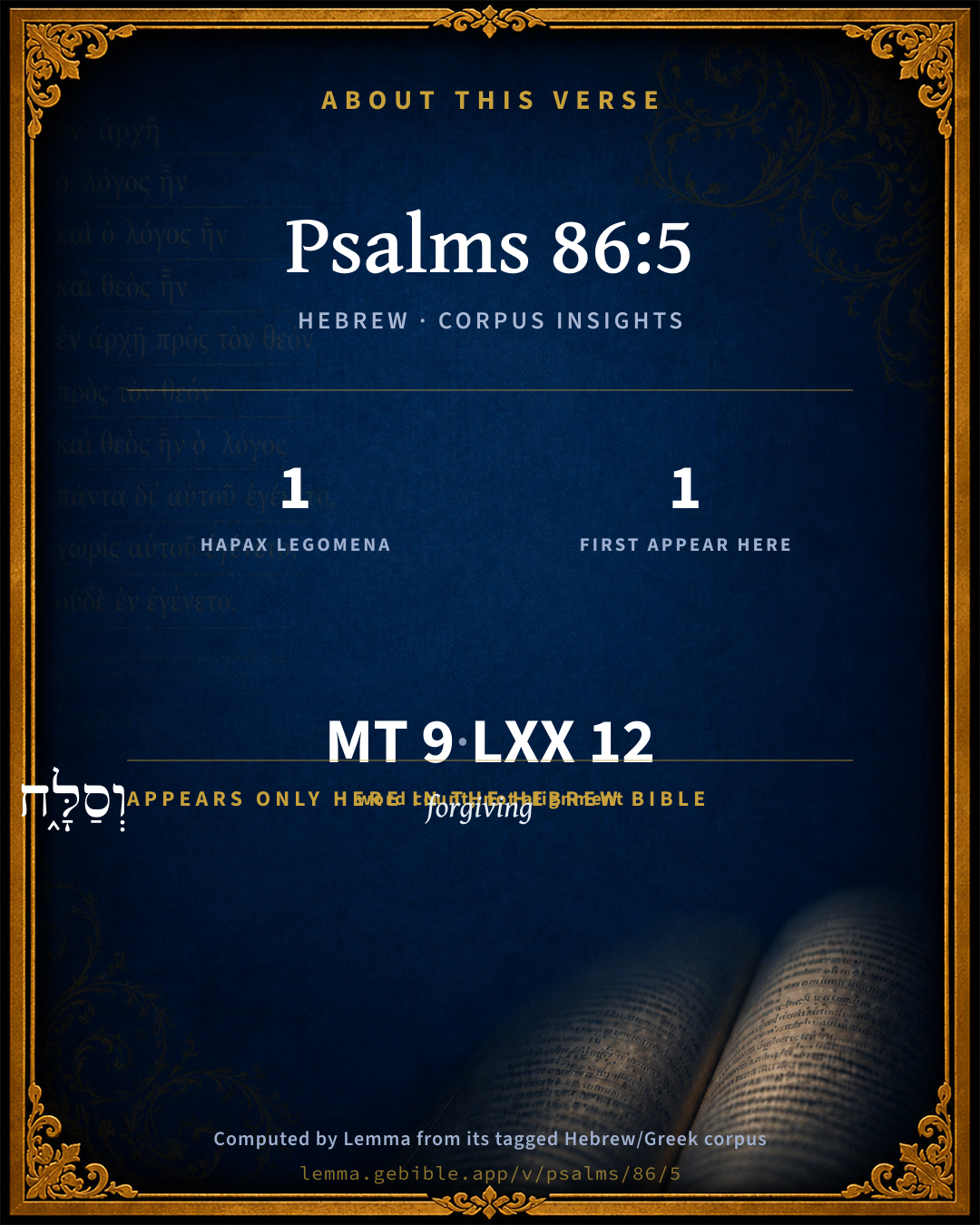
  • 1 hapax legomenon — only here in the Hebrew Bible
  • 1 first appearance in the Hebrew Bible
Full analysis ↓
Download a study sheet

One document with this verse’s original text, its word-by-word gloss line, the meaning frame, cross-references with their text, attributed commentary, and full source and license credits — printable, and it pastes into notes with its structure intact.

This verse Autodidact and up

Study sheet (.html) Plain text (.txt)

A passage Seminary Student

Up to 50 verses in one chapter. A passage sheet keeps up to 6 commentary sources and 12 cross-references per verse, in the order this page ranks them, and says so on the sheet whenever that leaves anything out. Ask for a single verse and you get the Autodidact verse sheet above.

Everything on this page stays free to read, with no account — the sheet is a download of what is already on screen, not access to it.

Want to remove ads? Support Godless Engineer
Compare translations 3

The same verse in 3 English versions, stacked beneath the original-language interlinear above. Click any original word for its lexicon entry.

Each is an independent rendering of the whole verse — the interlinear is not word-aligned to these translations.

Highlighted words mark where these versions differ — a whole-verse word diff, not a word-by-word alignment.

  • World English Bible Public Domain
    For you, Lord, are good, and ready to forgive; Abundant in loving kindness to all those who call on you.
  • King James Version Public Domain
    For thou, Lord, art good, and ready to forgive; and plenteous in mercy unto all them that call upon thee.
  • unfoldingWord Literal Text CC BY-SA 4.0
    For you, Lord, good and forgiving and plentiful of covenant faithfulness to all of the ones calling on you.

unfoldingWord Literal Text — © unfoldingWord, licensed CC BY-SA 4.0. Word-aligned USFM3 via Door43 (git.door43.org/unfoldingWord/en_ult).

Versions to compare (up to 4)

3 of 4 selected

Show all 18 translations

Every available English version of this verse, each an independent rendering of the whole verse.

  • World English Bible Public Domain
    For you, Lord, are good, and ready to forgive; Abundant in loving kindness to all those who call on you.
  • Berean Standard Bible Public Domain
    For You, O Lord, are kind and forgiving, rich in loving devotion to all who call on You.
  • Majority Standard Bible Public Domain
    For You, O Lord, are kind and forgiving, rich in loving devotion to all who call on You.
  • King James Version Public Domain
    For thou, Lord, art good, and ready to forgive; and plenteous in mercy unto all them that call upon thee.
  • American Standard Version (1901) Public Domain
    For thou, Lord, art good, and ready to forgive, And abundant in lovingkindness unto all them that call upon thee.
  • Revised Version (1885) Public Domain
    For thou, Lord, art good, and ready to forgive, and plenteous in mercy unto all them that call upon thee.
  • Geneva Bible (1599) Public Domain
    For thou, Lord, art good and mercifull, and of great kindenes vnto all them, that call vpon thee.
  • Douay-Rheims (1899) Public Domain
    For thou, O Lord, art sweet and mild: and plenteous in mercy to all that call upon thee.
  • Young's Literal Translation Public Domain
    For Thou, Lord, `art' good and forgiving. And abundant in kindness to all calling Thee.
  • Literal Standard Version CC BY-SA 4.0
    For You, Lord, [are] good and forgiving, || And abundant in kindness to all calling You.
  • Unlocked Literal Bible CC BY-SA 4.0
    You, Lord, are good, and ready to forgive, and you show great mercy to all those who cry out to you.
  • unfoldingWord Literal Text CC BY-SA 4.0
    For you, Lord, good and forgiving and plentiful of covenant faithfulness to all of the ones calling on you.
  • Darby Bible Public Domain
    For thou, Lord, art good, and ready to forgive, and art of great loving-kindness unto all that call upon thee.
  • World Messianic Bible Public Domain
    For you, Lord, are good, and ready to forgive, abundant in loving kindness to all those who call on you.
  • Webster's Bible Public Domain
    For thou, Lord, art good, and ready to forgive; and abundant in mercy to all them that call upon thee.
  • Free Bible Version CC BY-SA 4.0
    For you, Lord, are good; you are forgiving and full of trustworthy love for all who come to you.
  • Bible in Basic English Public Domain
    You are good, O Lord, and full of forgiveness; your mercy is great to all who make their cry to you.
  • JPS Tanakh (1917) Public Domain
    For Thou, Lord, art good, and ready to pardon, and plenteous in mercy unto all them that call upon Thee.

Literal Standard Version (2020), Covenant Press — licensed CC BY-SA 4.0. Text via the HelloAO Bible API (eBible.org). Unlocked Literal Bible (unfoldingWord) — licensed CC BY-SA 4.0. Text via the HelloAO Bible API (eBible.org). unfoldingWord Literal Text — © unfoldingWord, licensed CC BY-SA 4.0. Word-aligned USFM3 via Door43 (git.door43.org/unfoldingWord/en_ult). Free Bible Version, Dr. Jonathan Gallagher — licensed CC BY-SA 4.0. Text via the HelloAO Bible API (eBible.org).

Word by word

More ways to search: Search by grammar → Find every occurrence → Compare this word →

Practice this passage: Drill this verse → Learn its vocabulary →

וְסַלָּ֑ח
çallâch
H5546
“and · forgiving”
Conjunction + Adjective, Adjective, Masculine, Singular, Absolute
Part of Speech
Conjunction + Adjective
Type
Adjective
Gender
Masculine
Number
Singular
State
Absolute
Full BDB Definition

Origin: from H5545

TWOT: 1505a

ready to forgive, forgiving
  1. כִּֽי kîy H3588 “that” Conjunction
  2. אַתָּ֣ה ʼattâh H859 “you” Pronoun, Personal, 2nd Person, Masculine, Singular
  3. אֲ֭דֹנָי ʼĂdônây H136 “Lord · my” Noun, Common, Masculine, Plural, Construct + Suffix, Personal, 1st Person, Common, Singular
  4. ט֣וֹב ṭôwb H2896 “good” Adjective, Adjective, Masculine, Singular, Absolute
  5. וְרַב rab H7227 “and · many of” Conjunction + Adjective, Adjective, Masculine, Singular, Construct
  6. חֶ֝֗סֶד chêçêd H2617 “kindness” Noun, Common, Masculine, Singular, Absolute
  7. לְכָל kôl H3605 “to/for · all of” Preposition + Noun, Common, Masculine, Singular, Construct
  8. קֹרְאֶֽיךָ qârâʼ H7121 “calling · you” Verb, Qal, Participle Active, Masculine, Plural, Construct + Suffix, Personal, 2nd Person, Masculine, Singular

About this verse

These counts appear in no published source. They are computed here, from the morphology-tagged text and Lemma’s own curated glosses. What Lemma adds →

9
words
9
distinct lemmas
Wisdom
section

Notable vocabulary

1 hapax legomenon — a word that appears only here in the entire Hebrew Bible:

  • וְסַלָּ֑ח forgiving H5546

First appearance in Scripture

This word makes its first canonical appearance in the Hebrew Bible here:

  • וְסַלָּ֑ח forgiving H5546

Grammatical profile

  • 1 verb
  • 3 nouns
  • 3 adjectives
  • 1 pronoun
  • 1 conjunction

Verb forms

  • קֹרְאֶֽיךָ Qal · Participle Active

Hebrew & Septuagint length

In English translation the verse runs 20 words from the Hebrew and 18 from the Septuagint (LXX English) — closely comparable.

A rough comparison of the two English renderings, which tokenize alike — not a word-level alignment.

Word counts can differ between the Hebrew and the Greek without any difference in meaning — e.g. the Hebrew direct-object marker אֵת has no separate Greek word, and Greek often adds the article ὁ.

In the original languages it is 9 Hebrew tokens and 12 Greek tokens — but the two are counted differently (Hebrew bundles its prefixes and suffixes into one token; the Greek is in lemma form), so that isn’t a like-for-like length.

Cross-references

29

Topical passages linked to Psalms 86:5 in the Treasury of Scripture Knowledge — connected by theme and wording, ordered by reader-vote popularity; previews shown in the World English Bible.

  • Psalms 145:8–9 Yahweh is gracious, merciful, Slow to anger, and of great loving kindness.
  • Joel 2:13 Tear your heart, and not your garments, And turn to Yahweh, your God; For he is gracious and merciful, Slow to anger, and abundant in loving kindness, And relents from sending calamity.
  • Exodus 34:6 Yahweh passed by before him, and proclaimed, "Yahweh! Yahweh, a merciful and gracious God, slow to anger, and abundant in loving kindness and truth,
  • Nehemiah 9:17 and refused to obey, neither were mindful of your wonders that you did among them, but hardened their neck, and in their rebellion appointed a captain to return to their bondage. But you are a God ready to pardon, gracious and merciful, slow to anger, and abundant in loving kindness, and didn't forsake them.
  • Psalms 103:8 Yahweh is merciful and gracious, Slow to anger, and abundant in loving kindness.
  • Acts 2:21 It will be, that whoever will call on the name of the Lord will be saved.'
  • Psalms 25:8 Good and upright is Yahweh, Therefore he will instruct sinners in the way.
  • Psalms 145:18 Yahweh is near to all those who call on him, To all who call on him in truth.
  • 1 John 4:8–9 He who doesn't love doesn't know God, for God is love.
  • Psalms 86:15 But you, Lord, are a merciful and gracious God, Slow to anger, and abundant in loving kindness and truth.
  • Ezekiel 36:37 Thus says the Lord Yahweh: For this, moreover, will I be inquired of by the house of Israel, to do it for them: I will increase them with men like a flock.
  • Ephesians 1:6–8 to the praise of the glory of his grace, by which he freely bestowed favor on us in the Beloved,
  • Psalms 130:7 Israel, hope in Yahweh, For with Yahweh there is loving kindness. With him is abundant redemption.
  • Micah 7:18 Who is a God like you, who pardons iniquity, And passes over the disobedience of the remnant of his heritage? He doesn't retain his anger forever, Because he delights in loving kindness.
  • Romans 10:12–13 For there is no distinction between Jew and Greek; for the same Lord is Lord of all, and is rich to all who call on him.
  • Psalms 119:68 You are good, and do good. Teach me your statutes.
  • Jeremiah 33:3 Call to me, and I will answer you, and will show you great things, and difficult, which you don't know.
  • Ezekiel 36:33 Thus says the Lord Yahweh: In the day that I cleanse you from all your iniquities, I will cause the cities to be inhabited, and the waste places shall be built.
  • Daniel 9:9 To the Lord our God belong mercies and forgiveness; for we have rebelled against him;
  • Luke 11:9–10 "I tell you, keep asking, and it will be given you. Keep seeking, and you will find. Keep knocking, and it will be opened to you.
  • John 4:10 Jesus answered her, "If you knew the gift of God, and who it is who says to you, 'Give me a drink,' you would have asked him, and he would have given you living water."
  • Romans 5:20–21 The law came in besides, that the trespass might abound; but where sin abounded, grace did abound more exceedingly;
  • Psalms 36:7 How precious is your loving kindness, God! The children of men take refuge under the shadow of your wings.
  • Psalms 69:16 Answer me, Yahweh, for your loving kindness is good. According to the multitude of your tender mercies, turn to me.
  • Psalms 130:4 But there is forgiveness with you, Therefore you are feared.
  • Isaiah 55:7 let the wicked forsake his way, and the unrighteous man his thoughts; and let him return to Yahweh, and he will have mercy on him; and to our God, for he will abundantly pardon.
  • Jonah 4:2 He prayed to Yahweh, and said, "Please, Yahweh, wasn't this what I said when I was still in my own country? Therefore I hurried to flee to Tarshish, for I knew that you are a gracious God, and merciful, slow to anger, and abundant in loving kindness, and you repent of the evil.
  • Psalms 52:1 Why do you boast of mischief, mighty man? God's loving kindness endures continually.
  • Ephesians 2:4 But God, being rich in mercy, for his great love with which he loved us,

Cross-references courtesy of OpenBible.info (CC BY 4.0).

Hebrew and Greek witnesses Masoretic Hebrew ↔ Greek Septuagint

The same verse in the two great witnesses to the Old Testament, shown verse-for-verse.

You’re reading Greek Psalm 85 (Hebrew Psalm 86). The Septuagint counts the superscription, so verse numbers can differ from the Hebrew — chapter-level alignment, not verse-by-verse. Numbering follows Rahlfs.

These are two independent witnesses, not word-aligned to each other, and the Septuagint is shown in lemma (dictionary) form.

Hebrew Psalms 86:5 Masoretic · Westminster Leningrad Codex

כִּֽי אַתָּ֣ה אֲ֭דֹנָי ט֣וֹב וְסַלָּ֑ח וְרַב חֶ֝֗סֶד לְכָל קֹרְאֶֽיךָ

For you, Lord, are good, and ready to forgive; Abundant in loving kindness to all those who call on you.

World English Bible · Public Domain

Greek LXX Greek Psalm 85:5 Septuagint · lemma form

ὅτι σύ κύριος χρηστός καί ἐπιεικής καί πολυέλεος πᾶς ὁ ἐπικαλέω σύ

For you, O Lord, are kind, and gentle; and plenteous in mercy to all that call upon you.

LXX2012 (modern English Septuagint) · Public Domain

On this verse, Ellicott's Commentary for English Readers discusses the Septuagint’s reading. Read the note in Commentary ↓

Hebrew: Westminster Leningrad Codex (CC BY 4.0). Greek: Septuagint (public domain); English from LXX2012 (modern English Septuagint) (Public Domain). How the Septuagint differs from the Hebrew →

Commentary

Notes on Psalms 86:5 from classic Christian and Jewish commentators (each source and its license shown beneath its notes). The classic Christian expositions comment on the surrounding passage and are grouped to its opening verse, so a note may address several verses; the Jewish commentaries on the Tanakh (Rashi and others) are per-verse, so they appear only where the commentator wrote on this verse.

Lemma curates 59 commentaries, every one of them public domain or Creative Commons licensed, each selected and text-cleaned for this edition rather than reprinted as found. About our sources →

Trapp's Complete Commentary

John Trapp

Psa 86:5 For thou, Lord, [art] good, and ready to forgive; and plenteous in mercy unto all them that call upon thee.

Ver. 5. For thou, Lord, art good, &c.] Lord, I am hell, but thou art heaven, said that martyr; faith wrappeth herself up in the promise, and goeth boldly to God by prayer.

And plenteous in mercy] Both to forgive sin and to give good, Hos 14:2.

John Trapp, A Commentary or Exposition upon All the Books of the Old and New Testament (1647–1656) — public domain. Text from a community e-Sword module.

J. A. Alexander on Psalms

Joseph Addison Alexander

5. (Psa 86:5) For thou, Lord, art good and forgiving, and rich in mercy to all (those) invoking thee. God is not only the sovereign of his people, and as such bound by covenant to protect them, but benevolent or good in his own nature; and that not merely in the general, or in reference to all his creatures, but especially in reference to the undeserving and the ill-deserving; that is, to such of them as really desire his favour, and evince their willingness to have it by the act of asking for it. Rich (in) mercy, literally great (or much, abundant, plenteous, as to) mercy. This expression, and indeed the whole description, is borrowed from Exo 34:6.

Joseph Addison Alexander, The Psalms Translated and Explained (1850) — public domain. Text from a community e-Sword module.

Tyndale Open Study Notes

Tyndale Open Resources

86:5-7 The psalmist appeals to God to remain true to his character, which is the basis for hope.

86:5 The psalmist recounts the catalog of divine perfections (Exod 34:6-7), especially God’s willingness to forgive sin (see Pss 32:5; 85:2; 145:7-10).

Tyndale Open Study Notes — © Tyndale Open Resources, licensed CC BY-SA 4.0. Text via the HelloAO Bible API.

Geneva Bible (1599)

Geneva Bible translators

He doth confess that God is good to all, but only merciful to poor sinners.

Geneva Bible (1599) marginal notes — public domain. Text via Bolls.life.

Adam Clarke's Commentary

Verse 5. For thou, Lord, art good] I found my expectations of help on thy own goodness through which thou art always ready to forgive. And I found it also on thy well-known character, to which all thy followers bear testimony, viz., that "thou art plenteous in mercy unto all them that call upon thee."

Adam Clarke's Commentary on the Bible (1810–1826) — public domain. Text from a community e-Sword/MySword module.

John Calvin's Commentaries

5 For thou, O Lord! art good and propitious. We have here a confirmation of the whole preceding doctrine, derived from the nature of God. It would avail the afflicted nothing to have recourse to him, and to lift up their desires and prayers to heaven, were they not persuaded that he is a faithful rewarder of all who call upon him. The point upon which David now insists is, that God is bountiful and inclined to compassion, and that his mercy is so great, as to render it impossible for him to reject any who implore his aid. He calls God propitious, or ascribes to him the attribute of pardoning sin, which is a modification of his goodness. It were not enough for God to be good in general, did he not also extend to sinners his forgiving mercy, which is the meaning of the word סלה, salach. Farther, although David magnifies the plenteousness of God’s mercy, yet he immediately after represents this plenteousness as restricted to the faithful who call upon him, to teach us that those who, making no account of God, obstinately chafe upon the bit, deservedly perish in their calamities. At the same time, he uses the term all, that every man, without exception, from the greatest to the least, may be encouraged confidently to betake himself to the goodness and mercy of God.

John Calvin's Commentaries (1540-1563) — public domain. Text from the Calvin Translation Society English edition (1840s-50s) via the Christian Classics Ethereal Library (ccel.org). Calvin's coverage is partial (roughly two-thirds of the Bible); uncommented books and verses are honest gaps, never fabricated. The 19th-century editor's footnotes and remarks are omitted so the notes are faithfully Calvin's own voice.

Ellicott's Commentary for English Readers

(5) For thou.—Up to this time the psalmist has only put forward his needs in various aspects as a plea for God’s compassion. Now, not without art, he clenches his petition by an appeal to the nature itself of the Divine Being. The originals of the expressions in this verse will be found in Exo_20:6; Exo_34:6-9; Num_14:18-19.

Ready to forgive.—The Hebrew word occurs nowhere else in the form found here. Etymologically it means remitting. The LXX. have ἐπιεικὴς, a word for which perhaps our considerate is the nearest equivalent, implying that legal right is overlooked and suspended in consideration of human weakness. Wis_12:18 gives a good description of this Divine attribute.

A Bible Commentary for English Readers, edited by Charles John Ellicott (1878–1897) — public domain. Text from a community e-Sword module.

The Cambridge Bible for Schools and Colleges

gen. ed. J. J. S. Perowne

5. ready to forgive] The exact word is found only here, but for the thought see Psa_130:4; and for the whole verse cp. Exo_34:6 f.

The Cambridge Bible for Schools and Colleges (gen. ed. J. J. S. Perowne; Cambridge University Press, 1878–1918) — public domain. Text from a community e-Sword module.

John Gill's Exposition

For thou, Lord, art good,.... Essentially and independently good, from whom every good and perfect gift comes; good in himself, and good to others; good to all, in a providential way; and good to his own special people in a way of grace: this is asserted by Christ, Mat 19:17.

and ready to forgive; there is forgiveness with him, and it is to be had without difficulty; he has largely provided for it; he is forward unto it, he freely giving it; it is according to the riches of his grace; he does abundantly pardon; no sooner is it asked but it is had; this David knew by experience, Psa 32:5,

and plenteous in mercy unto all them that call upon thee; in truth, in sincerity, in a right way, through Christ, and faith in him; to such not only the Lord shows himself merciful, but is rich and abundant in mercy; he has a multitude of tender mercies, and abounds in his grace and goodness, and in the donation of it to his people; all which encourage their faith and hope in their petitions to him.

John Gill's Exposition of the Whole Bible (1746–1763) — public domain (CC PDM 1.0). Text via the HelloAO Bible API.

Albert Barnes' Notes on the Bible

For thou, Lord, art good ... - This is another reason why God should hear his prayer; and it is a reason which may be properly urged at all times, and by all classes of persons. It is founded on the benevolence of God; on the fullness of his mercy to all that invoke his name. We should call in vain on a God who was not merciful and ready to forgive; but in the divine character there is the most ample foundation for such an appeal. In his benevolence; in his readiness to forgive; in the plenitude of his mercy, God is all that a penitent sinner could wish him to be. For if such a sinner should endeavor to describe what he would desire to find in God as a ground of appeal in his prayers, he could not express his feelings in language more full and free than God has himself employed about his own readiness to pardon and save. The language of the Bible on this subject would express, better than any language which he could himself employ, what in those circumstances he would wish to find God to be.

Albert Barnes' Notes on the Bible (1834–1885) — public domain. Text from a community e-Sword/MySword module.

Matthew Poole's English Annotations

Herewith he relieveth himself under the sense of his guilt, whereby he had brought his present calamities upon himself.

Them that call upon thee, to wit, in truth, as it is explained Psa 145:18, or with an upright heart; for if a man regard iniquity in his heart, God will not hear him, Psa 66:18.

Matthew Poole's English Annotations on the Holy Bible (1683–1685) — public domain. Text from a community e-Sword/MySword module.

The Treasury of David

Charles H. Spurgeon

Ver. 5. For thou, Lord, art good, and ready to forgive. Good at giving and forgiving; supplying us with his good, and removing our evil. Here was the great reason why the Psalmist looked to the Lord alone for his joy, because every joy creating attribute is to be found in perfection in Jehovah alone. Some men who would be considered good are so self exultingly indignant at the injuries done them by others, that they cannot forgive; but we may rest assured that the better a being is, the more willing he is to forgive, and the best and highest of all is ever ready to blot out the transgressions of his creatures.

And plenteous in mercy unto all them that call upon thee. God does not dispense his mercy from a slender store which perchance may be so impoverished as to give out altogether, but out of a cornucopiae he pours forth the infinite riches of his mercy: his goodness flows forth in abounding streams towards those who pray and in adoring worship make mention of his name. David seems to have stood in the cleft of the rock with Moses, and to have heard the name of the Lord proclaimed even as the great lawgiver did, for in two places in this psalm he almost quotes verbatim the passage in Ex 34:6 "The Lord God, merciful and gracious, longsuffering, and abundant in goodness and truth."

Ver. 5. For thou, Lord, art good, and whither should beggars go but to the door of the good house keeper? Matthew Henry.

Ver. 5. Ready to forgive. The mercy of God is a ready mercy, and his pardons are ready for his people; his pardons and mercies are not to seek, he hath them at hand, he is good and ready to forgive. Whereas most men, though they will forgive, yet they are not ready to forgive, they are hardly brought to it, though they do it at last. But God is "ready to forgive"; he hath, as it were, pardons ready drawn (as a man who would be ready to do a business, he will have such writings as concern the passing of it ready); there is nothing to do but to put in the date and the name; yea indeed, the date and the name are put in from all eternity. Thus the Scripture speaks to show how forward God is to do good; he needs not set his heart to it; his heart is ever in the exactest fitness. Joseph Caryl.

Ver. 5. Plenteous in mercy. It is a thing marvellously satisfactory and pleasing to the heart of a man to be still taking from a great heap; and upon this ground are those proverbial sayings, There is no fishing like to a fishing in the sea; no service like the service of a king: because in one there is the greatest plenty and abundance of that kind of pleasure that fishers look after; and for them that serve, and must live by their service, there is none like that of princes, because they have abundance of reward and opportunity whereby to recompense the services of those that do wait and attend upon them...

And upon the same ground is it that the Scriptures, in several places, do not only assert and testify that God is merciful and gracious, but abundant in mercy and full of grace; and not simply that there is redemption in him, but plenteousness of redemption: Ps 103:8 130:7 Isa 55:7; "Let the wicked forsake his way", etc.; "Let him return unto the Lord and he will have mercy; and unto our God, for lie will abundantly pardon." The commodity which we stand in need of is mercy and the pardon of our sins, in case we have been unholy and ungodly creatures; this commodity is abundantly in God. There it is treasured up as waters are in the store house of the sea; there is no end of the treasures of his grace, mercy, pardon, and compassion. There is no man, being in want, but had ten times rather go to a rich man's door to be relieved, than to the door of a poor man, if he knoweth the rich man to be as liberal and bountifully disposed as the poor man can be. John Goodwin.

Ver. 5. Encouraging thoughts of God.

1. He has goodness in his essence.

2. He has forgiveness in readiness.

3. He has mercy in action, flowing forth from him plenteously.

4. His very discrimination is gracious"all them that call upon him."

Psalms 86:6*

Charles H. Spurgeon's The Treasury of David (1869–1885) — public domain. Psalms only. Text from a community e-Sword/MySword module.

Whedon's Commentary on the Bible

Daniel D. Whedon

5. Good, and ready to forgive—God’s goodness is an attribute of his nature; his forgiveness is a modification, or special exercise, of his goodness. The first is generic, the second specific.

Plenteous in mercy— His “mercy” is an emanation of his goodness, directed to man as a sinful and suffering being, through the abundant or manifold operation of which, forgiveness is bestowed.

Daniel D. Whedon (gen. ed.), Commentary on the Old and New Testaments (1874–1909) — public domain. Text from a community e-Sword module.

The Pulpit Commentary

For thou, Lord, art good, and ready to forgive. The word translated "ready to forgive," jls, occurs here only; but the context sufficiently fixes its meaning, which is well expressed by the epieikhv of the LXX As God was "good" and "forgiving," he would be likely to grant the petitions just addressed to him. And plenteous in mercy unto all them that call upon thee. (comp. Exo_34:6 Joe_2:13)

The Pulpit Commentary (1880–1919), ed. H.D.M. Spence-Jones & Joseph S. Exell — public domain. Text from a community e-Sword module.

unfoldingWord translationNotes

Door43 World Missions Community

In the day of my trouble

"During my times of difficulty"

I call on you

"I pray to you"

translationWords

lord

forgive

mercy

Yahweh

pray

day

trouble

call

unfoldingWord translationNotes — © Distant Shores Media and the Door43 World Missions Community, licensed CC BY-SA 4.0. Source: git.door43.org/Door43/en_tn.

Lesson kit

Teaching starters — assembled from the data on this page, not authored interpretation. Every prompt links to the verse data it draws on. Edit before teaching.

Psalms, in the Wisdom, opens this verse with 9 words (9 distinct Hebrew lemmas). Its most distinctive word is çallâch (“forgiving”). A historical commentator’s framing appears above. Read the whole chapter for the surrounding context.

Discussion questions

  1. How does “forgiving” (çallâch) shape what this verse is saying?
  2. 1 word here appears nowhere else in the Hebrew Bible. Why might the author reach for such rare wording?
  3. This is the first place “forgiving” appears in Scripture (first appears here). What does its debut here establish?
  4. How does Psalms 145:8–9, which shares this passage’s theme, read alongside this verse?
  5. These translations render this verse differently. What is at stake in choosing one wording over another?
  6. «קֹרְאֶֽיךָ» is a Qal Participle Active verb. How does that grammatical form shape the action described?
  7. Compare how Trapp's Complete Commentary and J. A. Alexander on Psalms read this verse. Where do they agree or differ?

Things to notice

Reading settings

Reading text

Shown beneath each verse's original-language words.

Old Testament
Old Testament edition

Read the OT as the Masoretic Hebrew (MT) or the Greek Septuagint (LXX).

English shown for the Greek Septuagint (in the Hebrew ↔ Greek comparison).

Comparing translations? Open the Compare panel on any verse page to stack up to four side by side.