Isaiah 30:20

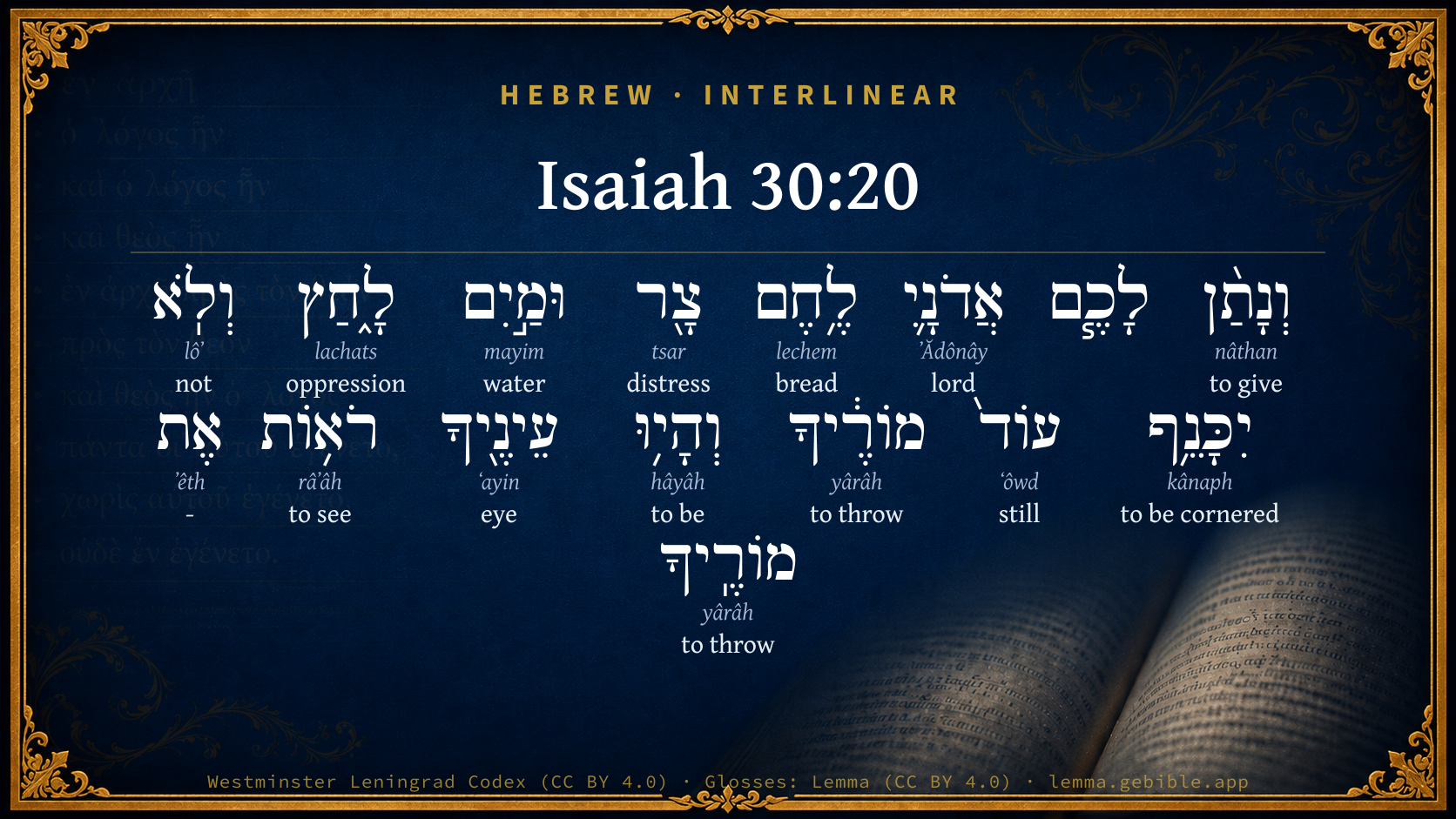
Hebrew (Westminster Leningrad Codex) Isaiah 30:20 appears in the Hebrew Old Testament. The text above is from the Westminster Leningrad Codex. Each word links to its Strong’s number, a concise gloss, and parsing drawn from the Open Scriptures Hebrew Bible morphology. Click any word for its full Brown-Driver-Briggs (BDB) entry.
Download image
Cite this verse

Isaiah 30:20 (World English Bible). Public Domain. Lemma interlinear Bible study tool, https://lemma.gebible.app/v/isaiah/30/20.

Show BibTeX & RIS
BibTeX
RIS
English Translation
Though the Lord give you the bread of adversity and the water of affliction, yet shall not your teachers be hidden anymore, but your eyes shall see your teachers;
World English Bible · Public Domain
Highlights Full analysis ↓
Download a study sheet

One document with this verse’s original text, its word-by-word gloss line, the meaning frame, cross-references with their text, attributed commentary, and full source and license credits — printable, and it pastes into notes with its structure intact.

This verse Autodidact and up

Study sheet (.html) Plain text (.txt)

A passage Seminary Student

Up to 50 verses in one chapter. A passage sheet keeps up to 6 commentary sources and 12 cross-references per verse, in the order this page ranks them, and says so on the sheet whenever that leaves anything out. Ask for a single verse and you get the Autodidact verse sheet above.

Everything on this page stays free to read, with no account — the sheet is a download of what is already on screen, not access to it.

Want to remove ads? Support Godless Engineer
Compare translations 3

The same verse in 3 English versions, stacked beneath the original-language interlinear above. Click any original word for its lexicon entry.

Each is an independent rendering of the whole verse — the interlinear is not word-aligned to these translations.

Highlighted words mark where these versions differ — a whole-verse word diff, not a word-by-word alignment.

  • World English Bible Public Domain
    Though the Lord give you the bread of adversity and the water of affliction, yet shall not your teachers be hidden anymore, but your eyes shall see your teachers;
  • King James Version Public Domain
    And though the Lord give you the bread of adversity, and the water of affliction, yet shall not thy teachers be removed into a corner any more, but thine eyes shall see thy teachers:
  • unfoldingWord Literal Text CC BY-SA 4.0
    And the Lord may give to you bread of trouble and water of affliction, yet your teachers will not hide himself anymore, but your eyes will be seeing your teachers.

unfoldingWord Literal Text — © unfoldingWord, licensed CC BY-SA 4.0. Word-aligned USFM3 via Door43 (git.door43.org/unfoldingWord/en_ult).

Versions to compare (up to 4)

3 of 4 selected

Show all 18 translations

Every available English version of this verse, each an independent rendering of the whole verse.

  • World English Bible Public Domain
    Though the Lord give you the bread of adversity and the water of affliction, yet shall not your teachers be hidden anymore, but your eyes shall see your teachers;
  • Berean Standard Bible Public Domain
    The Lord will give you the bread of adversity and the water of affliction, but your Teacher will no longer hide Himself—with your own eyes you will see Him.
  • Majority Standard Bible Public Domain
    The Lord will give you the bread of adversity and the water of affliction, but your Teacher will no longer hide Himself—with your own eyes you will see Him.
  • King James Version Public Domain
    And though the Lord give you the bread of adversity, and the water of affliction, yet shall not thy teachers be removed into a corner any more, but thine eyes shall see thy teachers:
  • American Standard Version (1901) Public Domain
    And though the Lord give you the bread of adversity and the water of affliction, yet shall not thy teachers be hidden anymore, but thine eyes shall see thy teachers;
  • Revised Version (1885) Public Domain
    And though the Lord give you the bread of adversity and the water of affliction, yet shall not thy teachers be hidden any more, but thine eyes shall see thy teachers:
  • Geneva Bible (1599) Public Domain
    And when the Lord hath giuen you the bread of aduersitie, and the water of affliction, thy raine shalbe no more kept backe, but thine eyes shall see thy raine.
  • Douay-Rheims (1899) Public Domain
    And the Lord will give you spare bread, and short water: and will not cause thy teacher to flee away from thee any more, and thy eyes shall see thy teacher.
  • Young's Literal Translation Public Domain
    And the Lord hath given to you bread of adversity, And water of oppression. And thy directors remove no more, And thine eyes have seen thy directors,
  • Literal Standard Version CC BY-SA 4.0
    And the Lord has given to you bread of adversity, || And water of oppression. And your teachers remove no longer, || And your eyes have seen your teachers,
  • Unlocked Literal Bible CC BY-SA 4.0
    Though Yahweh gives you the bread of adversity and the water of affliction, even so, your teacher will not hide himself anymore, but you will see your teacher with your own eyes.
  • unfoldingWord Literal Text CC BY-SA 4.0
    And the Lord may give to you bread of trouble and water of affliction, yet your teachers will not hide himself anymore, but your eyes will be seeing your teachers.
  • Darby Bible Public Domain
    And the Lord will give you the bread of adversity, and the water of oppression; yet thy teachers shall not be hidden any more, but thine eyes shall see thy teachers.
  • World Messianic Bible Public Domain
    Though the Lord may give you the bread of adversity and the water of affliction, yet your teachers won’t be hidden any more, but your eyes will see your teachers;
  • Webster's Bible Public Domain
    And though the Lord shall give you the bread of adversity, and the water of affliction, yet shall not thy teachers be removed into a corner any more, but thy eyes shall see thy teachers:
  • Free Bible Version CC BY-SA 4.0
    Even though the Lord will give you the bread of hardship to eat and the water of suffering to drink, your teacher will no longer hide himself from you—you will see him with your own eyes.
  • Bible in Basic English Public Domain
    And though the Lord will give you the bread of trouble and the water of grief, you will no longer put your teacher on one side, but you will see your teacher:
  • JPS Tanakh (1917) Public Domain
    And though the Lord give you sparing bread and scant water, yet shall not thy Teacher hide Himself any more, but thine eyes shall see thy Teacher;

Literal Standard Version (2020), Covenant Press — licensed CC BY-SA 4.0. Text via the HelloAO Bible API (eBible.org). Unlocked Literal Bible (unfoldingWord) — licensed CC BY-SA 4.0. Text via the HelloAO Bible API (eBible.org). unfoldingWord Literal Text — © unfoldingWord, licensed CC BY-SA 4.0. Word-aligned USFM3 via Door43 (git.door43.org/unfoldingWord/en_ult). Free Bible Version, Dr. Jonathan Gallagher — licensed CC BY-SA 4.0. Text via the HelloAO Bible API (eBible.org).

Word by word

More ways to search: Search by grammar → Find every occurrence → Compare this word →

Practice this passage: Drill this verse → Learn its vocabulary →

יִכָּנֵ֥ף
kânaph
H3670
“to be cornered”
Verb, Niphal, Imperfect, 3rd Person, Masculine, Singular
Part of Speech
Verb
Stem
Niphal
Form
Imperfect
Person
3rd Person
Gender
Masculine
Number
Singular
Full BDB Definition

Origin: a primitive root

TWOT: 1003

(Niphal) to be put or thrust in or into a corner, be hidden from view, be cornered, be thrust aside
  1. וְנָתַ֨ן nâthan H5414 “and · to give” Conjunction + Verb, Qal, Sequential Perfect, 3rd Person, Masculine, Singular
  2. אֲדֹנָ֛י ʼĂdônây H136 “Lord · my” Noun, Common, Masculine, Plural, Construct + Suffix, Personal, 1st Person, Common, Singular
  3. לֶ֥חֶם lechem H3899 “bread” Noun, Common, Both, Singular, Absolute
  4. צָ֖ר tsar H6862 “distress” Adjective, Adjective, Masculine, Singular, Absolute
  5. וּמַ֣יִם mayim H4325 “and · water(s)” Conjunction + Noun, Common, Masculine, Plural, Absolute
  6. לָ֑חַץ lachats H3906 “oppression” Noun, Common, Masculine, Singular, Absolute
  7. וְלֹֽא lôʼ H3808 “and · not” Conjunction + Particle, Negative
  8. עוֹד֙ ʻôwd H5750 “still” Adverb
  9. מוֹרֶ֔יךָ yârâh H3384 “archers · your” Noun, Common, Masculine, Plural, Construct + Suffix, Personal, 2nd Person, Masculine, Singular
  10. וְהָי֥וּ hâyâh H1961 “and · to be” Conjunction + Verb, Qal, Sequential Perfect, 3rd Person, Common, Plural
  11. עֵינֶ֖יךָ ʻayin H5869 “eyes · your” Noun, Common, Both, Dual, Construct + Suffix, Personal, 2nd Person, Masculine, Singular
  12. רֹא֥וֹת râʼâh H7200 “seeing” Verb, Qal, Participle Active, Feminine, Plural, Absolute
  13. אֶת ʼêth H853 “-” Particle, Direct Object
  14. מוֹרֶֽיךָ yârâh H3384 “archers · your” Noun, Common, Masculine, Plural, Construct + Suffix, Personal, 2nd Person, Masculine, Singular

About this verse

These counts appear in no published source. They are computed here, from the morphology-tagged text and Lemma’s own curated glosses. What Lemma adds →

16
words
14
distinct lemmas
Prophets
section

Notable vocabulary

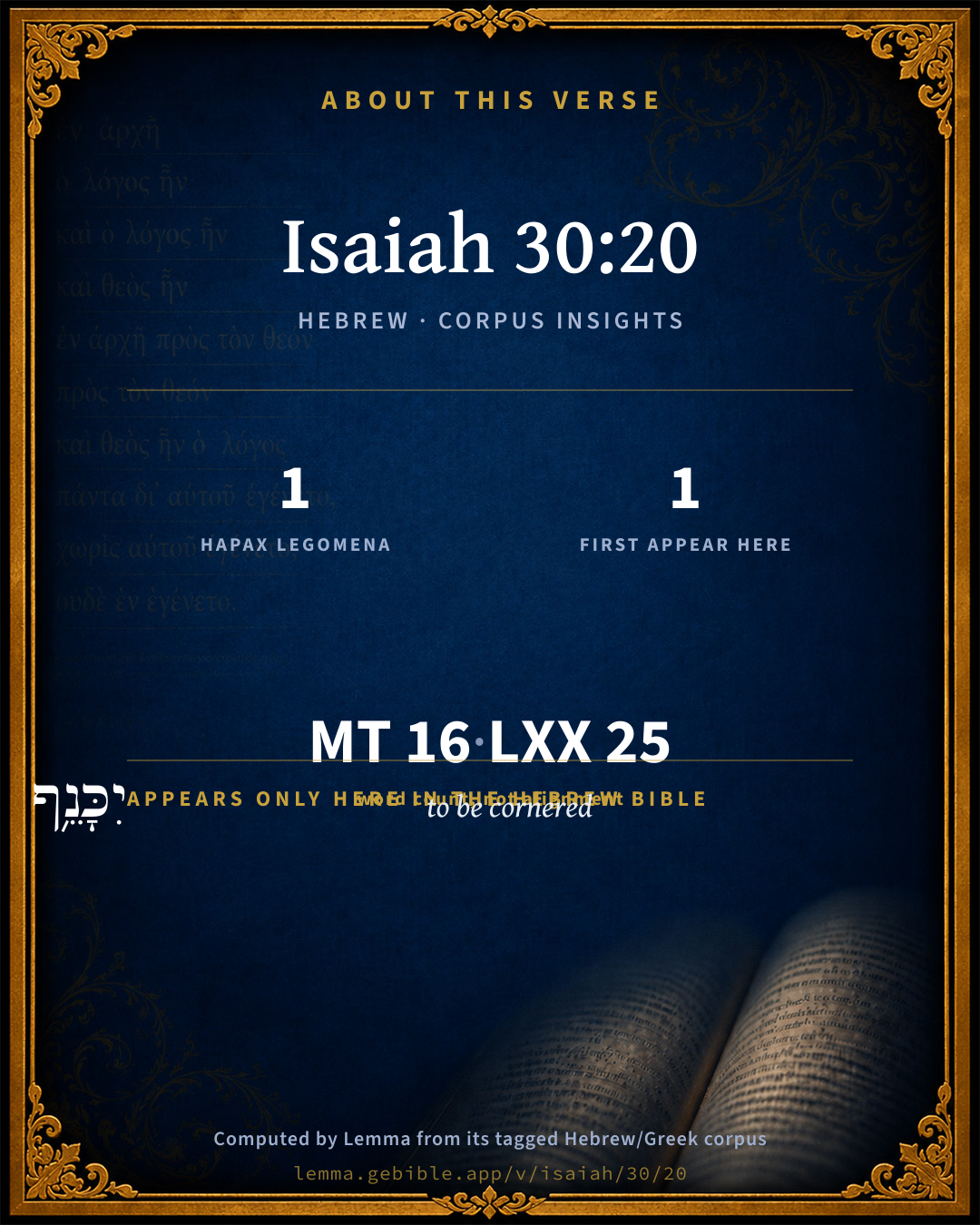
1 hapax legomenon — a word that appears only here in the entire Hebrew Bible:

  • יִכָּנֵ֥ף to be cornered H3670

First appearance in Scripture

This word makes its first canonical appearance in the Hebrew Bible here:

  • יִכָּנֵ֥ף to be cornered H3670

Shared distinctive vocabulary

לָ֑חַץ oppression H3906 occurs in 10 verses of the Hebrew Bible. Also found in:

Grammatical profile

  • 4 verbs
  • 7 nouns
  • 1 adjective
  • 1 preposition
  • 1 adverb
  • 2 particles

Verb forms

  • וְנָתַ֨ן Qal · Sequential Perfect
  • יִכָּנֵ֥ף Niphal · Imperfect
  • וְהָי֥וּ Qal · Sequential Perfect
  • רֹא֥וֹת Qal · Participle Active

Repetition

A word recurs within this verse — often emphatic in Hebrew:

  • מוֹרֶ֔יךָ to throw H3384 ×2

Hebrew & Septuagint length

In English translation the verse runs 29 words from the Hebrew and 41 from the Septuagint (LXX English) — the Septuagint runs noticeably longer here. See the side-by-side →

A rough comparison of the two English renderings, which tokenize alike — not a word-level alignment.

Word counts can differ between the Hebrew and the Greek without any difference in meaning — e.g. the Hebrew direct-object marker אֵת has no separate Greek word, and Greek often adds the article ὁ.

In the original languages it is 16 Hebrew tokens and 25 Greek tokens — but the two are counted differently (Hebrew bundles its prefixes and suffixes into one token; the Greek is in lemma form), so that isn’t a like-for-like length.

Cross-references

13

Topical passages linked to Isaiah 30:20 in the Treasury of Scripture Knowledge — connected by theme and wording, ordered by reader-vote popularity; previews shown in the World English Bible.

  • 1 Kings 22:27 and say, Thus says the king, Put this fellow in the prison, and feed him with bread of affliction and with water of affliction, until I come in peace.
  • Psalms 80:5 You have fed them with the bread of tears, And given them tears to drink in large measure.
  • Amos 8:11–12 Behold, the days come," says the Lord Yahweh, "That I will send a famine in the land, Not a famine of bread, Nor a thirst for water, But of hearing the words of Yahweh.
  • Psalms 127:2 It is vain for you to rise up early, To stay up late, Eating the bread of toil; For he gives sleep to his loved ones.
  • Acts 14:22 confirming the souls of the disciples, exhorting them to continue in the faith, and that through many afflictions we must enter into the Kingdom of God.
  • Psalms 74:9 We see no miraculous signs. There is no longer any prophet, Neither is there among us anyone who knows how long.
  • Deuteronomy 16:3 You shall eat no leavened bread with it; seven days shall you eat unleavened bread therewith, even the bread of affliction; for you came forth out of the land of Egypt in haste: that you may remember the day when you came forth out of the land of Egypt all the days of your life.
  • Psalms 30:5 For his anger is but for a moment; His favor is for a lifetime. Weeping may stay for the night, But joy comes in the morning.
  • Psalms 102:9 For I have eaten ashes like bread, And mixed my drink with tears,
  • Ezekiel 4:13–17 Yahweh said, Even thus shall the children of Israel eat their bread unclean, among the nations where I will drive them.
  • Ephesians 4:11 He gave some to be apostles; and some, prophets; and some, evangelists; and some, shepherds and teachers;
  • 2 Chronicles 18:26 and say, Thus says the king, Put this fellow in the prison, and feed him with bread of affliction and with water of affliction, until I return in peace.
  • Ezekiel 24:22–23 You shall do as I have done: you shall not cover your lips, nor eat the bread of men.

Cross-references courtesy of OpenBible.info (CC BY 4.0).

Hebrew and Greek witnesses Masoretic Hebrew ↔ Greek Septuagint

The same verse in the two great witnesses to the Old Testament, shown verse-for-verse.

Here the Septuagint runs noticeably longer than the Hebrew — LXX2012 (modern English Septuagint) 41 words vs World English Bible 29. A rough length comparison of the two English translations, not a word-level alignment — read both below.

These are two independent witnesses, not word-aligned to each other, and the Septuagint is shown in lemma (dictionary) form.

Hebrew Isaiah 30:20 Masoretic · Westminster Leningrad Codex

וְנָתַ֨ן לָכֶ֧ם אֲדֹנָ֛י לֶ֥חֶם צָ֖ר וּמַ֣יִם לָ֑חַץ וְלֹֽא יִכָּנֵ֥ף עוֹד֙ מוֹרֶ֔יךָ וְהָי֥וּ עֵינֶ֖יךָ רֹא֥וֹת אֶת מוֹרֶֽיךָ

Though the Lord give you the bread of adversity and the water of affliction, yet shall not your teachers be hidden anymore, but your eyes shall see your teachers;

World English Bible · Public Domain

Greek LXX Isaiah 30:20 Septuagint · lemma form

καί δίδωμι κύριος σύ ἄρτος θλῖψις καί ὕδωρ στενός καί οὐκέτι μή ἐγγίζω σύ ὁ πλανάω σύ ὅτι ὁ ὀφθαλμός σύ ὁράω ὁ πλανάω σύ

And though the Lord shall give you the bread of affliction and scant water, yet they that cause you to err shall no more at all draw near to you; for your eyes shall see those that cause you to err,

LXX2012 (modern English Septuagint) · Public Domain

On this verse, Albert Barnes' Notes on the Bible discusses the Septuagint’s reading. Read the note in Commentary ↓

Hebrew: Westminster Leningrad Codex (CC BY 4.0). Greek: Septuagint (public domain); English from LXX2012 (modern English Septuagint) (Public Domain). How the Septuagint differs from the Hebrew →

Targum (Aramaic paraphrase)

1

The Targum is the ancient Jewish Aramaic paraphrase of the Hebrew Scriptures — an interpretive translation, not the Hebrew text itself. Onkelos (literal) and Pseudo-Jonathan (expansive) render the Torah, and Jonathan the Prophets. Coverage is partial: where no permissively-licensed English translation exists for a verse, only the Aramaic is shown. This is verse-level text, not a word-by-word alignment to the Hebrew.

  1. Targum Jonathan Prophets (Joshua–Malachi)
    וִיהַב לְכוֹן יְיָ נִכְסֵי סַנְאָה וּבִזַת מְעִיקָא וְלָא יְסַלֵק עוֹד שְׁכִינְתֵּהּ מִבֵּית מַקְדְשָׁא וְיֶהְוְיָן עֵינָךְ חֶזְיָן יַת שְׁכִנְתִּי בְּבֵית מַקְדְשָׁא:

    And the Lord shall give unto you the treasures of the enemy, and the spoil of the oppressor, and He will no more take away His Shekinah from the house of the sanctuary, and thine eyes shall behold my Shekinah in the house of the sanctuary.

    Targum Jonathan — Aramaic: “Mikraot Gedolot” (public domain). English: “Sefaria Community Translation” (CC0 1.0 (public-domain dedication)); “London "Chaldee Paraphrase," 1871” (public domain). Text via Sefaria.

Commentary

Notes on Isaiah 30:20 from classic Christian and Jewish commentators (each source and its license shown beneath its notes). The classic Christian expositions comment on the surrounding passage and are grouped to its opening verse, so a note may address several verses; the Jewish commentaries on the Tanakh (Rashi and others) are per-verse, so they appear only where the commentator wrote on this verse.

Lemma curates 59 commentaries, every one of them public domain or Creative Commons licensed, each selected and text-cleaned for this edition rather than reprinted as found. About our sources →

Trapp's Complete Commentary

John Trapp

Isa 30:20 And [though] the Lord give you the bread of adversity, and the water of affliction, yet shall not thy teachers be removed into a corner any more, but thine eyes shall see thy teachers:

Ver. 20. And though the Lord give you the bread of adversity.] Though he hold you to hard meat, and give you but prisoner’s pittance, so much as will keep you alive only, and that you eat your meat with the peril of your lives; Emendicato pane hic vivamus, saith Luther; in our Father’s house is bread, God’s plenty.

Yet shall not thy teachers be removed into a corner.] Non alis se induent, they shall not take wing and fly from thee. The ministry is a sweet mercy, under what misery soever men do otherwise groan and labour. Corporeal wants are not much to be passed on, so the spiritual food be not wanting: a famine of the word is the greatest judgment. {Amo 8:11} When the gospel was first preached there was great scarcity of bodily food, {Rev 6:6 Act 11:28} but that was scarce felt by those holy souls who did eat their meat, such as it was, with gladness and singleness of heart, accounting that bread and cheese with the gospel was good cheer. {a}

Thine eyes shall see thy teachers.] A description of holy hearers; their eyes are intent on the preacher’s, their ears erect, their whole course conformed to the rule, quando lapsus tam in proclivi est {b} {Isa 30:21} their dearest sins abandoned. {Isa 30:22} Oh, for such hearers in these days!

“ Apparent rarl nantes in gurgite vasto. ”

{a} Greenham.

{b} Scultet.

John Trapp, A Commentary or Exposition upon All the Books of the Old and New Testament (1647–1656) — public domain. Text from a community e-Sword module.

The Biblical Illustrator

Joseph S. Exell

Isa_30:20

Thine eyes shall see thy teachers

Trouble making the heavenly Teacher real

The siege shall surely come, with its sorely concrete privations, but the Lord will be there, equally distinct . . . Real, concrete sorrows,--these are they that make the heavenly Teacher real! It is linguistically possible, and more in harmony with the rest of the passage, to turn teachers, as the E.. has it, into the singular, and to render it by revealer. The word is an active participle, moreh, from the same verb as the noun torah, which is constantly translated law in our version, but is, in the Prophets at least, more nearly equivalent to instruction, or to our modern term revelation (Isa_30:9). Looking thus to the One Revealer, and hearkening to the One Voice, the lying and rebellious children shall at last be restored to that capacity for truth and obedience, the loss of which has been their ruin. (Prof. G. A. Smith, D. D.)

Unseen teachers

There are troubled hours in life, in which we long to see our teachers; to know what certain things mean; and to have it explained why some special trials have been put upon us, and to what end events, now inexplicable, are tending. Devout men and women suspect, or feel sure, already; they think that the hand of the Lord is in all thin They rest assured that what seems wrong now will be made right by and by: that all is for the best; and, more than this, they are persuaded that some time or other, perhaps as death approaches, perhaps in the shadowy and thoughtful place of departed spirits, perhaps at the last great day of God, they shall see their teachers, and comprehend it all. (Morgan Dix.)

The blessing of Christian teachers

Though the Gospel first began to be preached by the Lord, yet, as it was expedient that He should go away, He has instituted, and in every age preserved an order of men, for guiding others in the way of faith, of holiness, and of peace.

I. A BRIEF SURVEY OF THE ADVANTAGES WHICH MEN DERIVE FROM THIS INSTITUTION.

1. Attend to the thousands who devote themselves to the service of the sanctuary, and whose characters are improved and ennobled by their previous studies. With what diligence and success, prompted by motives of piety and benevolence, do they search for the good way, that they may walk in it themselves, and teach and recommend it to others with advantage! Their gifts ripen and expand; their moral and religious excellences become distinguished. Giving themselves to the Word of God and to prayer, and, in subserviency to these, to inquiries after truth, to meditation, and to the perusal of useful human writings, their good resolutions strengthen; and their knowledge, wisdom, activity, and usefulness increase.

2. Public teachers often refine the taste, improve the genius, civilise the manners, and promote the literary pursuits of a nation.

3. Instructions from the pulpit greatly promote a virtuous behaviour.

4. Attend to the gentle, penetrating, beneficent effects of pastoral instruction, on the sorrowful, the disconsolate, the tempted, the doubting, the feeble-minded, the sick, and the dying.

5. Teachers are profitable as they spread and defend the doctrines of religion, and excite and cherish just sentiments of Divine things.

6. Pastoral instruction is a chief means which God hath appointed to rescue sinners from the ruins of their apostasy, and to interest them in His favour and friendship.

II. But, must it not be acknowledged that CONGREGATIONS SOMETIMES DERIVE LITTLE OR NO BENEFIT FROM SERMONS, and that to their teachers much of the blame belongs?

1. Bad men regard the effect of what they preach with cold indifference, except in so far as worldly honour or interest is advanced by their seeming success; and efforts naturally are feeble and ineffectual, where desire is languid.

2. Sometimes a clergymans behaviour is not visibly influenced by the doctrines and duties of religion. Men of small sagacity discern it, infer his craft and disingenuity, or conclude that they may imitate him without hazard.

3. The natural abilities, extent of knowledge, and persuasive talents, highly important in a teacher of religion, do not always accompany true piety. (J. Erskine, D. D.)

The Biblical Illustrator, edited by Joseph S. Exell (c. 1880s–1900s) — public domain. Text from a community e-Sword module.

Joseph Benson's Commentary

Isa 30:20-21. And though the Lord give you the bread of adversity — Although in that time and state of the church you will be subject to many outward straits and afflictions, which was the case with the Jews after their restoration from Babylon, and which was also the lot of the first converts to Christianity; yet shall not thy teachers be removed, &c. — As they have been in former times, both in Israel and Judah, when the godly prophets, and other instructers of the people, were but few, and when they were persecuted and banished by their wicked rulers. The Jews, after their return from Babylon, were blessed with many excellent instructers, as appears from the books of Ezra and Nehemiah, at the head of which we must place these two eminent servants of God. In the times of the New Testament, however, God provided still better for his church, sending his Son, the great teacher of his people, into the world; and pouring forth the gifts and graces of the Spirit in abundance, increasing the number of faithful ministers, and promising a continued succession of them to the end of the world. This is the second great benefit predicted by the prophet to follow these judgments. Thine eyes shall see thy teachers — They shall be present in your assemblies, instructing, exhorting, warning, and encouraging you from time to time. The original word, מורים, here used, means ordinary teachers, and not those of an extraordinary kind, such as the prophets or seers were. And thine ears shall hear a word, &c. — As often as need shall require, thou shalt hear the voice of God’s word and Spirit directing thee in thy course: behind thee — A metaphor, borrowed either from shepherds, who used to follow their sheep, and to recall them when they went out of the way; or from travellers, who, if they go out of the right way, are ofttimes admonished of their error, and recalled by some other passenger or person behind them.

Joseph Benson's Commentary on the Old and New Testaments (1811–1818) — public domain. Text from a community e-Sword module.

The Preacher's Complete Homiletical Commentary

Joseph S. Exell (gen. ed.)

THE BREAD OF ADVERSITY

Isa_30:20-21. And though the Lord give you the bread of adversity, &c. [1129]

[1129] The Authorised Version, upon which these outlines are founded, is supported by Mr. Cheyne, who translates: “And though the Lord give you bread in short measure and water in scant quantity,” &c. But Delitzsch, Kay, and Birks render the first clause: “And the Lord will give you bread in your adversity and water in your affliction.” Mr. Birks adds: “These words form part of a promise, not its limitation. The affliction has been fully denounced before. Here they are assured that, although besieged, they will not be given over to famine. The path of duty will be made plain by God’s prophets, and speedy deliverance be given.”

I. DIFFICULTIES SUPPOSED.

“The Bread of Adversity” was a proverbial expression among the Jews (1Ki_22:27; Psa_80:5). The Lord gives: He who gave the cup of salvation gives the cup of affliction. He who gives the bread of life gives also the bread of adversity (Heb_12:6.) Recollect that the Lord who gives you the bread of adversity gave His own Son no better fare, no richer diet.

II. CONSOLATIONS PROMISED.

“Yet shall not thy teachers be removed,” &c. He will compensate temporal troubles by spiritual blessings. Numbers have found that as tribulation abounded, consolation abounded by Christ (1Co_1:5). Such consolations are threefold.

1. A free access to God’s throne. “He will be very gracious to thee at the voice of thy cry.” Prayer relieves distress.

2. A faithful administration of God’s word and ordinances. Religious instruction shall be continued, “thy teachers shall not be removed.”

3. A gracious direction of God’s providence.

III. INSTRUCTIONS SUGGESTED.

1. Guard against whatever may endanger Christian privileges. Neglect of prayer; absence of love; seductions of the world.

3. Recollect what is needful to give this promise full effect—the influence of the Spirit. Pray for and expect a baptism of the Holy Ghost.

3. Commend to others the consolations you receive. Visit the sick; remember the widow and the fatherless. In comforting others, your own bread of adversity shall be made sweet.—Samuel Thodey.

I. A CALAMITY ANTICIPATED.

Affliction may be continuous and severe. Bread and water are the prominent things in the sustenance of life. Day by day received. Few, if any, are entirely exempt from affliction. Periods of difficulty and privation, when weeks and months of consuming anxiety are experienced. Losses which seriously incommode and cripple their business. Troubles in the family, sometimes from the conduct of those most loved. Bereavements which rend the heart. Sickness, accident, consuming disease, and excruciating pain wear life slowly away.

The godly are not exempted. The infected atmosphere may poison the saint as well as the sinner. If a good man falls over a precipice he will be killed. “The same hurricane may equally swamp the vessel which is filled with pirates and that which is filled by a band of devoted missionaries.” If a Christian neglect his business, or conduct it on unsound principles, he must expect insolvency. He may conduct it with perfect commercial wisdom and care, and yet be overtaken by disasters from causes beyond his control.

But it does not happen by chance. There is no such thing as fate. We recognise the hand of the Lord. “Though the Lord give you the bread of affliction and the water of adversity.” In this truth is help for believers perplexed by the mystery of sorrow. It throws their thoughts on God. And they have such confidence in Him that it is a resting-place. We do not know, we never can know, the evils He prevents. When He permits or sends trouble we may rest assured that there is a sufficient reason (Lam_3:33).

What are the reasons? [1132] We may mistake their application, but they are such as these:

1. It is sometimes punitive. God has established a connection between sin and suffering. The former always works towards the latter. The chain of connection may be so subtle, and may extend so far back, that we cannot follow it. Yet such a chain there is. When affliction comes, it is useful to trace the chain, and ascertain, if we can, wherefore the Lord is contending with us.

2. It is sometimes corrective. He deals with us as men deal with their children (Heb_12:5-11). It is not that he may vent His anger, but recall them to their better selves. He means it as the refiner means the fire into which he casts the gold (Psa_119:67).

3. It is sometimes auxiliary. The means to an end. The dark way into light. It is necessary to some advantage which could not be reached without it. Joseph’s slavery and imprisonment were the steps to his subsequent greatness. Jesus reached the crown by the cross. Perhaps you can illustrate from your own experience.

[1132] H. E. I., 56–115.

Meantime, here is

II. AN ANTIDOTE PROMISED.

Their teachers had been removed. The prophets were persecuted (Isa_30:9-10). Jeremiah, Zedekiah, under Jezebel’s persecution. Obadiah had hid a hundred in caves. Persecution usually fastens on the teachers as most prominent. Thus Apostles. Thus the Nonconforming clergy in England. Thus the missionaries were driven from Madagascar. But the promise here is that they shall regain their liberty. And this will be not only a relief to themselves, but an antidote to the people’s calamities. It will secure:

1. Instruction. “Thy teachers.” Truth is the basis of everything in experience or practice. It is their business carefully to unfold and apply the truth [1135]

2. Consolation. Christian ordinances are consolatory. There are truths that bear on troubles. The views of the Divine character and of the course of Providence exhibited in the Gospel sustain and comfort.

3. Direction. There is danger of turning to right or left. So many allurements, from ignorance, misguidance, temptation. By the ministry you hear the voice which points out the way, invites steadfastness, warns against divergence.

[1135] The Christian Church requires a teaching ministry. Not only must the Gospel be proclaimed to the world, the Church must be trained into knowledge, experience, holiness, activity. Individual study of Scripture is largely useful. But regularly recurring religious services, of which careful instruction is a part, are universally necessary. Godly men must be released from secular business, trained, set apart to the study and ministry of the word. The living voice of the preacher helps guides, confirms, and gives greater practical influence to the private reading of Christians. Even under the old dispensation, large use was made of this method. There were schools of the prophets. A few were so eminent that they have left their words behind them. But there were many whose names have not survived their time. Jesus trained His disciples for their future work. After His Ascension, He gave various gifts to men for the work of the ministry. He continues them. While one could wish that all the Lord’s people were prophets, and that He would put His Spirit upon them, so that they would work to the full extent of their ability for the world’s salvation, it remains true that the strength of the Church is in an able, well-instructed, godly, and earnest ministry.

Among the blessings here promised to the ancient Church is the restoration of its silenced teachers to their work after its period of discipline.—Rawlinson.

God provides guidance in the journey to the better land. Value the ministry of the word. Attend it. Follow its teaching.—J. Rawlinson.

THE GUIDING VOICE

Isa_30:21. And thou shalt hear a voice behind thee, &c.

This may be a promise to God’s people of the continuance of the services of the ministry, or of the additional blessings of spiritual suggestions to guide them in the path of duty.

I. It may be a continuation of the promise in the preceding verse: “Thy teachers shall not be removed into a corner any more, but thine eyes shall see thy teachers, and thine ears shall hear a word behind thee.” The Word of God proclaimed by faithful ministers follows men. Sometimes, as they listen to it, they reject it, but it pursues them, and gives them no rest until they obey it. When they are bent on a wrong course, it haunts them until they are recalled to duty. Or it stimulates them to the performance of duties they are neglecting or performing sluggishly. Thus understood, we may see that in this promise God compares Himself as it were to a shepherd, who puts his sheep before him; or to a schoolmaster who will have his scholars in sight, that so he may the better keep them in order.

Thus understood, we see our duty. It is to give reverent heed to the Word of God as proclaimed to us by His ministers. Food, however choice, is no blessing to us unless it be eaten and digested; and the Word of God is no blessing to us, except there be an ear to hearken to it, a spiritual taste to relish it, and a heart to close and comply with it. Well is it with those who imitate Lydia (Act_16:14). But neglect of God’s word shuts against us even the throne of grace (Pro_28:9). To those who disregard what they know to be the voice of God, there comes a time when they discover that the greatest of all calamities is to have their voice disregarded by Him (Pro_1:24-26).

II. But the promise may be that of an additional blessing, the inward motions and suggestions of the Holy Spirit. His voice may be called “a word behind us,” because—

1. Of its secresy (Job_4:12).

2. Because it follows us always, as constantly as our shadow. Parallels to this promise we find in 1Jn_2:20; 1Jn_2:27; Joh_14:26; Joh_16:13.

III. This voice His people hear when they are about to wander, or have wandered from the way of righteousness. From that way it is easy to de part; but God loves His people, and cannot abide to see them miscarry, and therefore He counsels them. “This is the way, walk ye in it,” is sometimes a word of correction and reformation, in case of error; sometimes a word of instruction and direction, in case of ignorance; sometimes a word of strengthening and confirmation, in case of unsettledness.

In all these respects God’s people hear the “word behind them,” sometimes giving them very gracious hints concerning the affairs of this present life, but more frequently concerning the spiritual life. Those who wait upon God shall not lack counsels concerning the manner in which they are to serve Him. He answers the prayers of His people (Psa_25:4-5; Psa_86:11; Psa_143:8).

What a great comfort and encouragement we have here! If we really desire to serve God amid all the labyrinths and uncertainties of this present life, we shall be safe, for He will guide us.

IV. But how may we know whether the word behind us is the voice of God, and not merely one of our own fancies, or a suggestion of Satan’s? There are several touchstones by which every “word” may and should be tested.

1. The word within is to be compared with the word without. Every suggestion is to be examined by the rule of Scripture. God never speaks in the conscience contrary to what He speaks there, for He is unchangeable and cannot contradict Himself (Isa_8:20).

2. God’s “words” are orderly and regular; they keep men within the compass of their callings, and the place in which God has set them. They incite us not to forsake our duty, but to be faithful in it.

3. They are ordinarily mild, gentle, seasonable; they are not ordinarily raptures, but such as leave a man in a right apprehension of what he does, and capable of reflection upon it.

4. They are discernible also from their effects, and the ends to which they tend. All the hints and motions of God’s Spirit tend to make us better, and to carry us nearer to Himself in one way or another. Honestly using these tests, we shall learn promptly and surely to discern the voice of God’s Spirit when He says to us, “This is the way, walk ye in it.”

V. From all this two duties plainly arise.

1. Thankfulness. A faithful monitor is a very great advantage; it is so betwixt man and man, and we should bless God that He condescends to be this to us.

2. Obedience. To His infallible, loving counsel we should give prompt heed, especially as He not only points out the way, but is always ready to help us to walk in it; and the way in which He would have us go is the only one that leads to true happiness and lasting peace. Disobedience exposes us to manifold dangers, such as

(1.) God’s future silence; when His counsels are repeatedly rejected, He will cease to speak. What a terrible calamity (1Sa_28:5).

(2.) Those who hearken not to the voice of God in them are often given up to Satan, and their own corruptions bear sway within them (Psa_81:11-12).—Thomas Horton, D.D.: 100 Select Sermons, pp. 298–304.

I. Our need of the guidance here promised. We are ignorant of the way to true happiness, and we have not always daylight. The path is narrow, and is sometimes very intricate. It lies through an enemy’s country. Many as wise as we have lost their way, and, after years of sorrow, have perished miserably. We need this guidance in youth, in manhood, in old age, even unto death (P. D. 952, 2388).

II. Some of the means by which God guides His people. The promise in our text suggests a traveller in doubt as to the course he should take, pausing perplexed at cross roads, and in danger of choosing a wrong one, when a friendly voice behind him is heard, saying, “This is the way, walk ye in it.” God thus speaks to His people.

1. By His providences. Afflictions are often monitions and instructions (H. E. I., 66–70).

2. By His Word. It clearly marks the path to heaven.

3. By our conscience (H. E. I., 1291, 1304, 1308–1312).

4. By His Spirit; by whom conscience is quickened, our understanding cleared of delusions, our attention fixed on the happy career of the righteous, and the disastrous end of the wicked.

III. What is needed to enable us to profit by this promise.

1. A prayerful spirit (Isa_30:19).

2. A studious eye that will look for the waymarks, especially for the footprints of Jesus.

3. A listening ear.

4. An obedient habit of mind (1Sa_15:22; P. D., 1656). Disregard of the Guiding Voice will involve us in present disaster and misery, and in eternal woe. Heedfulness of it will ensure for us present safety and peace, and eternal blessedness.—Samuel Thodey.

The Preacher's Complete Homiletical Commentary (gen. ed. Joseph S. Exell; Funk & Wagnalls, c. 1892) — public domain (pre-1929). A full-Bible homiletical/sermon-outline anthology covering 65 of 66 books (2 John is absent from the source module). Text from a community e-Sword module.

Tyndale Open Study Notes

Tyndale Open Resources

30:20 adversity for food and suffering for drink: A city under enemy siege for a long time would eventually be overcome by starvation and disease. God did not intend that this disaster should destroy the people of Jerusalem, rather that it would be a tool to teach them.

Tyndale Open Study Notes — © Tyndale Open Resources, licensed CC BY-SA 4.0. Text via the HelloAO Bible API.

Geneva Bible (1599)

Geneva Bible translators

Or, instructor.

Geneva Bible (1599) marginal notes — public domain. Text via Bolls.life.

Jamieson, Fausset & Brown

Robert Jamieson, A. R. Fausset & David Brown

Rather, "The Lord will give"; the "though" is not in the original.

bread of adversity--He will not deny you food enough to save you in your adversity (Kg1 22:27; Psa 127:2).

be removed--rather, "hide themselves"; they shall no more be forced to hide themselves from persecution, but shall be openly received with reverence [MAURER]. Contrast with this Psa 74:9; Amo 8:11.

Jamieson, Fausset & Brown — Commentary Critical and Explanatory on the Whole Bible (1871) — public domain (CC PDM 1.0). Text via the HelloAO Bible API.

Adam Clarke's Commentary

Verse 20. Though the Lord - "Though JEHOVAH"] For אדני Adonai, sixteen MSS. and three editions have יהוה Yehovah, many of De Rossi's have the same reading; all my own have יהוה Yehovah.

Adam Clarke's Commentary on the Bible (1810–1826) — public domain. Text from a community e-Sword/MySword module.

Ellicott's Commentary for English Readers

(20) The bread of adversity.—Better, bread in small quantity, and water in scant measure. The words seem to imply an allusion to the scant rations of a siege such as Jerusalem was to endure from the Assyrian armies. For this there should be the compensation that the true “teachers” of the people, Isaiah and his fellow-workers, should at least be recognised—no longer thrust into a corner, as they had been in the days of Ahaz. The clearer vision of the truth was to be the outcome of the sharp teaching of chastisement. A various reading gives “thy teacher,” i.e., Jehovah Himself; but the plural seems more in harmony with the context. In the mission of Isa_37:2 we have a virtual fulfilment of the prediction.

A Bible Commentary for English Readers, edited by Charles John Ellicott (1878–1897) — public domain. Text from a community e-Sword module.

The Cambridge Bible for Schools and Colleges

gen. ed. J. J. S. Perowne

20. the bread of adversity, and the water of affliction] (cf. 1Ki_22:27) the most meagre necessities of existence. The reference is to the period of distress (perhaps the siege) which precedes the great deliverance.

shall not thy teachers be removed into a corner] Rather: shall not thy Teacher (God) hide Himself; (nearly as R.V. marg.). The alternative rendering “teachers” is no doubt possible, but the verb is in the singular, and the conception of Jehovah as the personal teacher of His people, although surprising, gives the fullest meaning to the expressions of this verse and the next, and is not too exalted for a description of the Messianic age. If the other view be adopted, the reference must be to the prophets, who are now driven into concealment, but shall then freely appear in public. But such an anticipation has no parallel in Messianic prophecy, and certainly receives no light from the circumstances of Isaiah’s time.

20, 21. The restoration of religious privileges and instruction.

The Cambridge Bible for Schools and Colleges (gen. ed. J. J. S. Perowne; Cambridge University Press, 1878–1918) — public domain. Text from a community e-Sword module.

John Gill's Exposition

And though the Lord give you the bread of adversity, and the water of affliction,.... Either at this present time, when the city was besieged by Sennacherib; or when it should be besieged by the Chaldeans, when adversity was their bread, and affliction their water; or when they had only bread and water in their adversity and affliction; or a famine of bread and water, as is common in times of a siege. It may refer to the poor, and mean, and afflicted state of the people of God, in the first times of the Gospel especially:

yet shall not thy teachers be removed into a corner any more; or, "thy rain" (b), as some interpret it; one and the same word signifies both rain and a teacher, because doctrine from the mouth of a teacher drops like rain upon the tender herb, and as showers on the grass; and is to be understood, not merely in a literal sense, of rain, and fruitfulness by it, in opposition to penury and famine for want of it; but of rain of spiritual doctrine; and so the sense is much the same as if it was rendered teachers; that though the people of God should be attended with afflictions, yet they should have spiritual consolation; and though they might have a famine of bread and water, yet not of hearing the word of the Lord; their teachers should not be removed from them, as they had formerly been, perhaps in the time of Ahaz: or "take wing" (c), and fly away from them, as the word signifies, being scared by persecutors; so the prophets in the time of Ahab were forced to fly, and were hid by fifty in a cave. The word here used has in the Arabic language the signification of hiding, as Maimonides (d) from Aben Ganach has observed; and so may be read, "thy teachers shall not be hidden any more"; things being hidden under wings; see Psa 17:8,

but thine eyes shall see thy teachers; in their proper place, doing the work of their office: it denotes not a bare seeing them with their bodily eyes, but a seeing them with pleasure and delight, a wistfully looking at them, and a diligent and attentive observance of what they said. Some understand these teachers of Hezekiah and his princes, as Aben Ezra, Kimchi, and Abendana; others of the priests and prophets in his time, the principal of which was Isaiah; others of the prophets a little before, in, and after the Babylonish captivity; it may be applied to John the Baptist, Christ, and his apostles, and other Gospel ministers. Jarchi interprets it of God himself, who teaches to profit, and who would not hide his face from his people; the Targum, of the Shechinah not removing from the sanctuary, but being seen there; and being in the plural number, may denote all the three Persons.

(b) "pluvia tua", some in Munster, Calvin; so Ben Melech interprets it; and the same in the next clause. (c) "non avolabit", Piscator; "ad verb. alabitur", Forerius. (d) More Nevochim, par. 1. cap. 43. p. 61. So "operuit, sub alis tutatus est", Castel. col. 1760.

John Gill's Exposition of the Whole Bible (1746–1763) — public domain (CC PDM 1.0). Text via the HelloAO Bible API.

Albert Barnes' Notes on the Bible

And though the Lord give you the bread of adversity - The bread that is eaten in a time of calamity; that is, he would bring upon them sore distress and want.

The water of affliction - Margin, ‘Oppression.’ That is, water drank in times of affliction and oppression, or in the long and weary days of captivity.

Yet shall not thy teachers - Your public instructors and guides Psa 74:9; Isa 43:27; Dan 12:3; Amo 8:11-12. This refers to “all” those who would be the true guides and teachers of the people of God in subsequent times; and relates, therefore, not only to prophets and pious men whom God would raise up under their own dispensation, but also to all whom he would appoint to communicate his will. It is a promise that the church of God should never want a pious and devoted ministry qualified to make known his will and defend his truth.

Be removed into a corner - The word used here (יכנף yikânēp from כנף kânap) occurs nowhere else in the Scriptures. It is probably derived from כנף kânâp, “a wing;” and in the Syriac and Chaldee, it means to collect together. The Septuagint renders this, ‘And they who deceived thee shall no more come near unto thee.’ The Syriac, ‘And he (that is, the Lord) shall no more collect thy seducers.’ The Chaldee, ‘And he shall no more take away his own glory from the house of his sanctuary.’ Rosenmuller, in accordance with Schultens, renders it, ‘And thy teachers shall no more hide themselves,’ referring to the fact that the wing of a fowl furnishes a hiding-place or shelter. This would accord with the general idea that they should not be removed from public view. Lowth, singularly, and without authority from versions or manuscripts, renders it,

‘Yet the timely rain shall no more be restrained.’

The general idea is, evidently, that they should be no more taken away; and probably the specific idea is that proposed by Taylor (“Heb. Con.”), that thy teachers shall no more, as it were, be winged, or fly away; that is, be removed by flight, or as a flock of birds moving together rapidly on the wing.

Albert Barnes' Notes on the Bible (1834–1885) — public domain. Text from a community e-Sword/MySword module.

Haydock's Catholic Bible Commentary

Water. The land will be reduced to a miserable condition by the ravages of Sennacherib. (Haydock) --- The following was a sabbatical year, ver. 23., and chap. xxxvii. 30. --- Teacher. It seems that Isaias, &c., had been silent. He spoke after Ezechias had sent for him, and God promises that the people shall not be left without guides. (Calmet) --- Christ will not abandon his Church. (Menochius)

George Leo Haydock (1774–1849), Haydock's Catholic Family Bible and Commentary, 1859 edition — public domain. Excludes Psalms (Douay-Rheims chapter numbering differs from Protestant) and Deuterocanonical books (Catholic canon only).

Matthew Poole's English Annotations

And though the Lord give you the bread of adversity, and the water of affliction; and although in that time and state of the church you will be subject to many outward straits and afflictions. This phrase is borrowed from Deu 16:3; 1Ki 22:27. He seems to allude to the condition of besieged cities, and particularly of Jerusalem, as it was straitened and distressed by Sennacherib, and as it should be far more straitened by the Chaldeans; of which see 2Ki 25:3. Heb. And the Lord will give, &c. Or, the Lord indeed will give, &c. Yet shall not thy teachers be removed into a corner any more; as they have been in former times, both in Israel and Judah, when the godly prophets and ministers were but few, and when they were persecuted and banished by their wicked rulers. But in the New Testament God hath made better provision for his church, sending his Son, the great Teacher of the church, into the world, and pouring forth the gifts and graces of the Spirit in abundance, and increasing the number of able and faithful ministers, and promising a continued succession of them to the end of the world, Mat 28:19,20.

Thine eyes shall see thy teachers; thou shalt have their presence, and their instruction and assistance.

Matthew Poole's English Annotations on the Holy Bible (1683–1685) — public domain. Text from a community e-Sword/MySword module.

The Pulpit Commentary

And though the Lord give you the bread of adversity (so Mr. Cheyne). But most modern critics (Kay, Delitzsch, Vance Smith, etc.) regard the words as a promise of support through the siege, and omit the interpolated "though." Translate, And the Lord will give yon bread of adversity, and water of affliction; i.e. scant rations, but sufficient; and thy teachers shall not, etc. Be removed into a corner; i.e. "have to hide themselves from persecution." A persecution of Jehovah"s prophets had commenced in Judah during the reign of Joash, (2Ch_24:19-22) and had probably continued with more or less severity ever since.

Adversity as Divine bread.

"The bread of adversity, and the water of affliction." We can only think of God by the help of our associations with man. Therefore, in the revelation which he has given us in a book, God is spoken of as if he had the form of a man (anthropomorphism), and as if he had the feelings of a man (anthropopathism). We, indeed, know no other moral beings beside man, and probably our senses would allow of the apprehension of no other. We are not allowed to create material images representing God, but we are allowed to think of God through the figures of the human being. Answering to this is the truth that we can only know our soul through our body; we have to think of it as a kind of spiritual body. So it needs care, clothing, feed, etc., eves as the body. This is the line on which it can best be shown that adversity is Divine bread for the soul, which must be nourished by appropriate food. Working out this thought, two points may be more especially treated.

I BREAD IS THE STAPLE FOOD FOR THE BODY. It is in itself sufficient to sustain life; it contains all the necessary elements for the renewal of vitality. So is adversity the staple food for the soul; for it contains all the necessary elements for the renewal of character. Since we are sinners, wayward, and willful, the prosperities of life are but like luxuries; and adversity is our staple food, which nourishes humility, penitence, godly fear, and trust. The expression is used of King Manasseh, the willful, who, in prison, was fed with the bread and water of affliction, and thereby nourished unto penitence, forsaking of sin, and hearty return to the God of his fathers. If we pray, "Feed me with food convenient for me," we must clearly see that the answer may include "adversity and affliction.

II BREAD IS A GENERAL TERM EMBRACING ALL NECESSARY FOOD. And necessary food for the body includes some things that are unpleasant to the taste. Sometimes even medicine is bread the very best of bread for us under the circumstances. And so our soul-conditions and our soul-culture may make necessary things that are very trying to feeling. No affliction for the present seemeth joyous, but grievous; nevertheless, afterward it yieldeth the peaceable fruit of righteousness unto them who are exercised thereby. R.T.

The Pulpit Commentary (1880–1919), ed. H.D.M. Spence-Jones & Joseph S. Exell — public domain. Text from a community e-Sword module.

J. A. Alexander on Isaiah

Joseph Addison Alexander

“And the Lord will give you bread of affliction and water of oppression, and no more shall thy teachers hide themselves, and thine eyes shall see thy teachers.” God would afflict them outwardly, but would not deprive them of their spiritual privileges; or, there should be a famine of bread, but not of the word of the Lord (Amo 8:11). The word ‘teachers’ is probably a designation or description of the prophets, with particular reference, as some suppose, to their reappearance after a period of severe persecution or oppression. See Eze 33:22.

Joseph Addison Alexander, The Prophecies of Isaiah (1846–1847; New York: Scribner, 1870–1878) — public domain. Text from a community e-Sword module.

unfoldingWord translationNotes

Door43 World Missions Community

General Information:

Isaiah continues speaking to the people of Judah.

the bread of adversity and the water of affliction

Here "bread" and "water" make up the diet of a very poor person. The whole phrase represents the hard times and poverty of the people. (See: Metonymy)

your teacher

This refers to Yahweh.

you will see your teacher with your own eyes

Here "eyes" represents the whole person. AT: "you yourselves will see your teacher" (See: Synecdoche)

Your ears will hear

Here "ears" represents the whole person. AT: "You will hear" (See: Synecdoche)

a word behind you saying

"him speaking behind you saying"

This is the way, walk in it

How Yahweh wants his people to behave is spoken of as if it were a way or path. To obey Yahweh is spoken of as if it were a person walking on his path. (See: Metaphor)

when you turn to the right or when you turn to the left

Disobeying Yahweh is spoken of as if the person turned left or right off of Yahweh's path. (See: Metaphor)

translationWords

Yahweh

bread

teacher

walk

unfoldingWord translationNotes — © Distant Shores Media and the Door43 World Missions Community, licensed CC BY-SA 4.0. Source: git.door43.org/Door43/en_tn.

Rashi

Rabbi Shlomo Yitzchaki (Rashi)

scant bread and water of oppression You shall not run after pleasures as you do now, as it is said (Amos 6:6): “Who drink from basins of wine.” (Above 22:13) “And behold joy and happiness.”

shall no longer be concealed (לֹא יִכָּנֵף) shall not be covered from you with the skirt of His garments, i.e., He shall not hide His countenance from you.

your Teacher The Holy One, blessed be He, who teaches you for your profit.

Rashi on the Tanakh — English translations: “The Judaica Press complete Tanach with Rashi, translated by A. J. Rosenberg” (CC BY 4.0); “Pentateuch with Rashi's commentary by M. Rosenbaum and A.M. Silbermann, 1929-1934” (public domain); “The Metsudah Tanach series, Lakewood, N.J” (CC BY 4.0); and “The Book of Joshua, Metsudah Publications, 1997” (CC BY 4.0). Text via Sefaria.

Ibn Ezra

Rabbi Abraham ibn Ezra

לחם צר Scanty bread. They were afflicted with famine, as I said before (29:17). מים לחץ The water of affliction. מים is not in the construct state, but מֵי the waters of is to be supplied. מים מי לחץ ═ מים לחץ; comp. שרה האהלה אהל ═ האהלה שרה to the tent, namely to the tent of Sarah. (Gen. 24:67)

Ibn Ezra on the Tanakh — English translations: “Sefaria Community Translation” (CC0 1.0 (public-domain dedication)); “Yalkut, Sifsei Chachomim Chumash, Metsudah Publications, 2009” (CC BY 4.0); and “Commentary of Ibn Ezra on Isaiah - trans. by M. Friedlander, 1873” (public domain). Text via Sefaria.

Lesson kit

Teaching starters — assembled from the data on this page, not authored interpretation. Every prompt links to the verse data it draws on. Edit before teaching.

Isaiah, in the Prophets, opens this verse with 16 words (14 distinct Hebrew lemmas). Its most distinctive word is kânaph (“to be cornered”). The Greek Septuagint runs longer here. A historical commentator’s framing appears above. Read the whole chapter for the surrounding context.

Discussion questions

  1. What does “to be cornered” (kânaph) contribute to the verse as a whole?
  2. This verse holds 1 word here found nowhere else in the Hebrew Bible. What might the rare word draw attention to?
  3. The word “to be cornered” first appears here in Scripture. What is being introduced at this debut?
  4. Exodus 3:9 shares the word «oppression» with this verse. How do the two illuminate each other?
  5. “to throw” occurs 2× in this one verse. What is the effect of the repetition?
  6. Compared with the Hebrew, the Septuagint runs longer here. What questions does that raise?
  7. These translations render this verse differently; the difference is in the English rendering, not the original. What questions does that raise?
  8. The verb «וְנָתַ֨ן» is Qal Sequential Perfect. How does its form color the action?

Things to notice

  • 1 word in this verse appears nowhere else in the Hebrew Bible.
  • 1 word makes its first canonical appearance in Scripture here.
  • This verse counts 16 Hebrew ↔ 25 Greek words.
  • These translations choose different wording for 17 words in this verse.
  • “to throw” occurs 2× in this single verse.

Reading settings

Reading text

Shown beneath each verse's original-language words.

Old Testament
Old Testament edition

Read the OT as the Masoretic Hebrew (MT) or the Greek Septuagint (LXX).

English shown for the Greek Septuagint (in the Hebrew ↔ Greek comparison).

Comparing translations? Open the Compare panel on any verse page to stack up to four side by side.