

Psalms 130:2

Hebrew (Westminster Leningrad Codex) Psalms 130:2 appears in the Hebrew Old Testament. The text above is from the Westminster Leningrad Codex. Each word links to its Strong’s number, a concise gloss, and parsing drawn from the Open Scriptures Hebrew Bible morphology. Click any word for its full Brown-Driver-Briggs (BDB) entry.
Download image
Cite this verse

Psalms 130:2 (World English Bible). Public Domain. Lemma interlinear Bible study tool, https://lemma.gebible.app/v/psalms/130/2.

Show BibTeX & RIS
BibTeX
RIS
English Translation
Lord, hear my voice. Let your ears be attentive to the voice of my petitions.
World English Bible · Public Domain
Download a study sheet

One document with this verse’s original text, its word-by-word gloss line, the meaning frame, cross-references with their text, attributed commentary, and full source and license credits — printable, and it pastes into notes with its structure intact.

This verse Autodidact and up

Study sheet (.html) Plain text (.txt)

A passage Seminary Student

Up to 50 verses in one chapter. A passage sheet keeps up to 6 commentary sources and 12 cross-references per verse, in the order this page ranks them, and says so on the sheet whenever that leaves anything out. Ask for a single verse and you get the Autodidact verse sheet above.

Everything on this page stays free to read, with no account — the sheet is a download of what is already on screen, not access to it.

Want to remove ads? Support Godless Engineer
Compare translations 3

The same verse in 3 English versions, stacked beneath the original-language interlinear above. Click any original word for its lexicon entry.

Each is an independent rendering of the whole verse — the interlinear is not word-aligned to these translations.

Highlighted words mark where these versions differ — a whole-verse word diff, not a word-by-word alignment.

  • World English Bible Public Domain
    Lord, hear my voice. Let your ears be attentive to the voice of my petitions.
  • King James Version Public Domain
    Lord, hear my voice: let thine ears be attentive to the voice of my supplications.
  • unfoldingWord Literal Text CC BY-SA 4.0
    Lord, hear my voice; let your ears be attentive to the voice of my supplications.

unfoldingWord Literal Text — © unfoldingWord, licensed CC BY-SA 4.0. Word-aligned USFM3 via Door43 (git.door43.org/unfoldingWord/en_ult).

Versions to compare (up to 4)

3 of 4 selected

Show all 18 translations

Every available English version of this verse, each an independent rendering of the whole verse.

  • World English Bible Public Domain
    Lord, hear my voice. Let your ears be attentive to the voice of my petitions.
  • Berean Standard Bible Public Domain
    O Lord, hear my voice; let Your ears be attentive to my plea for mercy.
  • Majority Standard Bible Public Domain
    O Lord, hear my voice; let Your ears be attentive to my plea for mercy.
  • King James Version Public Domain
    Lord, hear my voice: let thine ears be attentive to the voice of my supplications.
  • American Standard Version (1901) Public Domain
    Lord, hear my voice: Let thine ears be attentive To the voice of my supplications.
  • Revised Version (1885) Public Domain
    Lord, hear my voice: let thine ears be attentive to the voice of my supplications.
  • Geneva Bible (1599) Public Domain
    Lord, heare my voyce: let thine eares attend to the voyce of my prayers.
  • Douay-Rheims (1899) Public Domain
    Often have they fought against me from my youth: but they could not prevail over me.
  • Young's Literal Translation Public Domain
    Lord, hearken to my voice, Thine ears are attentive to the voice of my supplications.
  • Literal Standard Version CC BY-SA 4.0
    Lord, listen to my voice, || Your ears are attentive to the voice of my supplications.
  • Unlocked Literal Bible CC BY-SA 4.0
    Lord, hear my voice; let your ears be attentive to my pleas for mercy.
  • unfoldingWord Literal Text CC BY-SA 4.0
    Lord, hear my voice; let your ears be attentive to the voice of my supplications.
  • Darby Bible Public Domain
    Lord, hear my voice; let thine ears be attentive to the voice of my supplication.
  • World Messianic Bible Public Domain
    Lord, hear my voice. Let your ears be attentive to the voice of my petitions.
  • Webster's Bible Public Domain
    Lord, hear my voice: let thy ears be attentive to the voice of my supplications.
  • Free Bible Version CC BY-SA 4.0
    Please listen to my cry, and pay attention to what I'm asking.
  • Bible in Basic English Public Domain
    Lord, let my voice come before you: let your ears be awake to the voice of my prayer.
  • JPS Tanakh (1917) Public Domain
    Lord, hearken unto my voice; let Thine ears be attentive to the voice of my supplications.

Literal Standard Version (2020), Covenant Press — licensed CC BY-SA 4.0. Text via the HelloAO Bible API (eBible.org). Unlocked Literal Bible (unfoldingWord) — licensed CC BY-SA 4.0. Text via the HelloAO Bible API (eBible.org). unfoldingWord Literal Text — © unfoldingWord, licensed CC BY-SA 4.0. Word-aligned USFM3 via Door43 (git.door43.org/unfoldingWord/en_ult). Free Bible Version, Dr. Jonathan Gallagher — licensed CC BY-SA 4.0. Text via the HelloAO Bible API (eBible.org).

Word by word

More ways to search: Search by grammar → Find every occurrence → Compare this word →

Practice this passage: Drill this verse → Learn its vocabulary →

קַשֻּׁב֑וֹת
qashshâb
H7183
“attentive”
Adjective, Adjective, Feminine, Plural, Absolute
Part of Speech
Adjective
Type
Adjective
Gender
Feminine
Number
Plural
State
Absolute
Full BDB Definition

Origin: from H7181

TWOT: 2084b , 2084c

attentive
  1. אֲדֹנָי֮ ʼĂdônây H136 “Lord · my” Noun, Common, Masculine, Plural, Construct + Suffix, Personal, 1st Person, Common, Singular
  2. שִׁמְעָ֪ה shâmaʻ H8085 “hear” Verb, Qal, Imperative, 2nd Person, Masculine, Singular + Suffix, h
  3. בְק֫וֹלִ֥י qôwl H6963 “in/at · voice · my” Preposition + Noun, Common, Masculine, Singular, Construct + Suffix, Personal, 1st Person, Common, Singular
  4. תִּהְיֶ֣ינָה hâyâh H1961 “to be” Verb, Qal, Imperfect, 3rd Person, Feminine, Plural
  5. אָ֭זְנֶיךָ ʼôzen H241 “ears · your” Noun, Common, Feminine, Dual, Construct + Suffix, Personal, 2nd Person, Masculine, Singular
  6. לְ֝ק֗וֹל qôwl H6963 “to/for · voice of” Preposition + Noun, Common, Masculine, Singular, Construct
  7. תַּחֲנוּנָֽי tachănûwn H8469 “supplications · my” Noun, Common, Masculine, Plural, Construct + Suffix, Personal, 1st Person, Common, Singular

About this verse

These counts appear in no published source. They are computed here, from the morphology-tagged text and Lemma’s own curated glosses. What Lemma adds →

8
words
7
distinct lemmas
Wisdom
section

Notable vocabulary

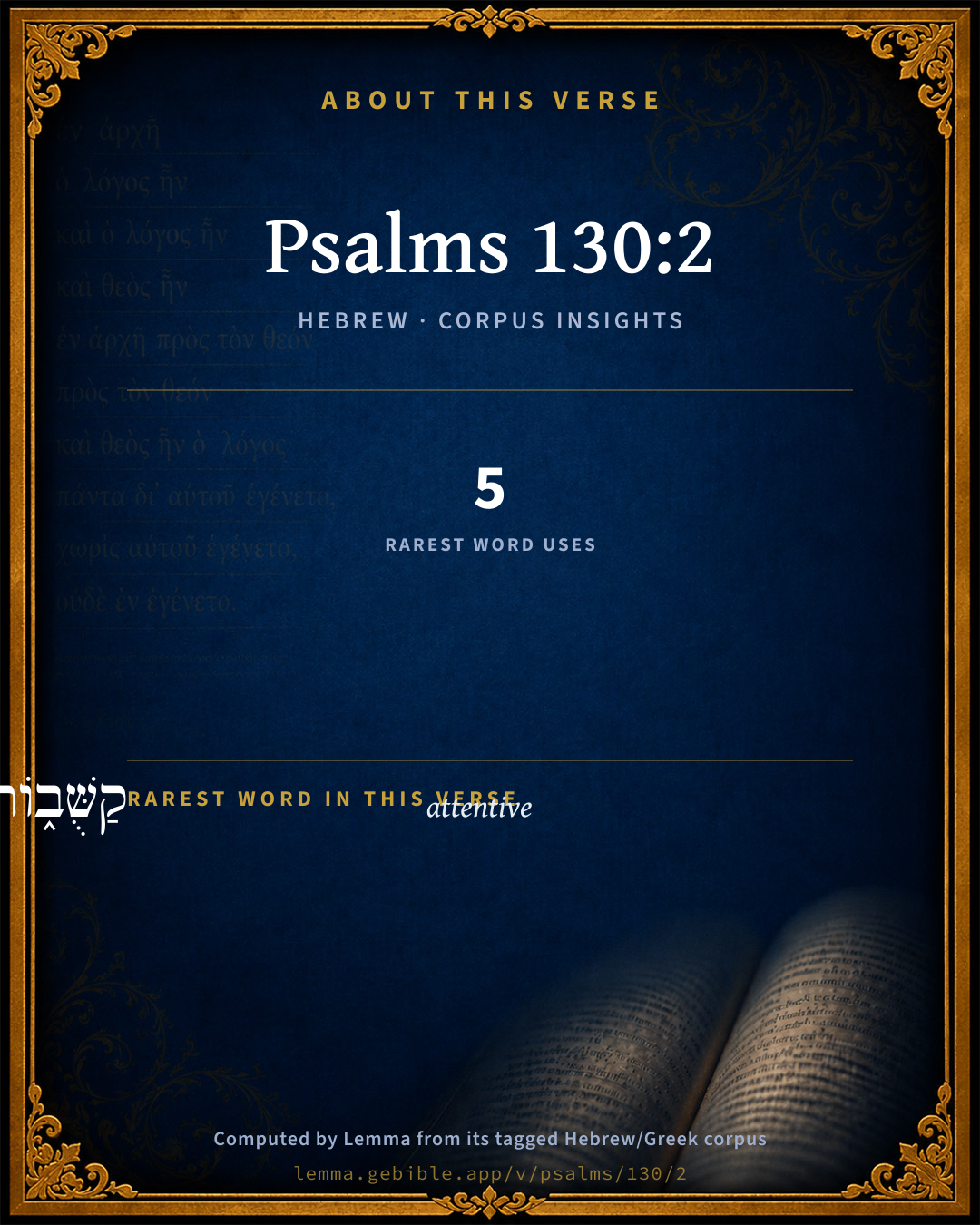
The rarest word here is קַשֻּׁב֑וֹת attentive H7183 — appearing just 5 times in the whole Hebrew Bible.

Shared distinctive vocabulary

קַשֻּׁב֑וֹת attentive H7183 occurs in 5 verses of the Hebrew Bible. Also found in:

Grammatical profile

  • 2 verbs
  • 5 nouns
  • 1 adjective

Verb forms

  • שִׁמְעָ֪ה Qal · Imperative
  • תִּהְיֶ֣ינָה Qal · Imperfect

Repetition

A word recurs within this verse — often emphatic in Hebrew:

  • בְק֫וֹלִ֥י voice H6963 ×2

Hebrew & Septuagint length

In English translation the verse runs 15 words from the Hebrew and 17 from the Septuagint (LXX English) — closely comparable.

A rough comparison of the two English renderings, which tokenize alike — not a word-level alignment.

Word counts can differ between the Hebrew and the Greek without any difference in meaning — e.g. the Hebrew direct-object marker אֵת has no separate Greek word, and Greek often adds the article ὁ.

Cross-references

12

Topical passages linked to Psalms 130:2 in the Treasury of Scripture Knowledge — connected by theme and wording, ordered by reader-vote popularity; previews shown in the World English Bible.

  • 2 Chronicles 6:40 Now, my God, let, I beg you, your eyes be open, and let your ears be attentive, to the prayer that is made in this place.
  • Psalms 61:1–2 Hear my cry, God. Listen to my prayer.
  • Nehemiah 1:11 Lord, I beg you, let now your ear be attentive to the prayer of your servant, and to the prayer of your servants, who delight to fear your name; and please prosper your servant this day, and grant him mercy in the sight of this man. Now I was cup bearer to the king.
  • Isaiah 37:17 Turn your ear, Yahweh, and hear; open your eyes, Yahweh, and behold; and hear all the words of Sennacherib, who has sent to defy the living God.
  • Nehemiah 1:6 Let your ear now be attentive, and your eyes open, that you may listen to the prayer of your servant, which I pray before you at this time, day and night, for the children of Israel your servants while I confess the sins of the children of Israel, which we have sinned against you. Yes, I and my father's house have sinned:
  • Psalms 55:1–2 Listen to my prayer, God. Don't hide yourself from my supplication.
  • Psalms 140:6 I said to Yahweh, "You are my God." Listen to the cry of my petitions, Yahweh.
  • Daniel 9:17–19 Now therefore, our God, listen to the prayer of your servant, and to his petitions, and cause your face to shine on your sanctuary that is desolate, for the Lord's sake.
  • Psalms 5:1–2 Give ear to my words, Yahweh. Consider my meditation.
  • Psalms 17:1 Hear, Yahweh, my righteous plea; Give ear to my prayer, that doesn't go out of deceitful lips.
  • Psalms 28:2 Hear the voice of my petitions, when I cry to you, When I lift up my hands toward your Most Holy Place.
  • Psalms 64:1 Hear my voice, God, in my complaint. Preserve my life from fear of the enemy.

Cross-references courtesy of OpenBible.info (CC BY 4.0).

Hebrew and Greek witnesses Masoretic Hebrew ↔ Greek Septuagint

The same verse in the two great witnesses to the Old Testament, shown verse-for-verse.

You’re reading Greek Psalm 129 (Hebrew Psalm 130). The Septuagint counts the superscription, so verse numbers can differ from the Hebrew — chapter-level alignment, not verse-by-verse. Numbering follows Rahlfs.

These are two independent witnesses, not word-aligned to each other, and the Septuagint is shown in lemma (dictionary) form.

Hebrew Psalms 130:2 Masoretic · Westminster Leningrad Codex

אֲדֹנָי֮ שִׁמְעָ֪ה בְק֫וֹלִ֥י תִּהְיֶ֣ינָה אָ֭זְנֶיךָ קַשֻּׁב֑וֹת לְ֝ק֗וֹל תַּחֲנוּנָֽי

Lord, hear my voice. Let your ears be attentive to the voice of my petitions.

World English Bible · Public Domain

Greek LXX Greek Psalm 129:2 Septuagint · lemma form

κύριος εἰςἀκούω ὁ φωνή ἐγώ γίγνομαι ὁ οὖς σύ προςἔχω εἰς ὁ φωνή ὁ δέησις ἐγώ

O Lord, listen to my voice; let your ears be attentive to the voice of my supplication.

LXX2012 (modern English Septuagint) · Public Domain

Hebrew: Westminster Leningrad Codex (CC BY 4.0). Greek: Septuagint (public domain); English from LXX2012 (modern English Septuagint) (Public Domain). How the Septuagint differs from the Hebrew →

Commentary

Notes on Psalms 130:2 from classic Christian and Jewish commentators (each source and its license shown beneath its notes). The classic Christian expositions comment on the surrounding passage and are grouped to its opening verse, so a note may address several verses; the Jewish commentaries on the Tanakh (Rashi and others) are per-verse, so they appear only where the commentator wrote on this verse.

Lemma curates 59 commentaries, every one of them public domain or Creative Commons licensed, each selected and text-cleaned for this edition rather than reprinted as found. About our sources →

Trapp's Complete Commentary

John Trapp

Psa 130:2 Lord, hear my voice: let thine ears be attentive to the voice of my supplications.

Ver. 2. Lord, hear my voice] Precum exauditio identidem est precanda, Audience must be begged again and again; and if he once prepare our heart it is sure that he will cause his ear to hear, Psa 10:17; as when we bid our children ask this or that of us, it is because we mean to give it them.

John Trapp, A Commentary or Exposition upon All the Books of the Old and New Testament (1647–1656) — public domain. Text from a community e-Sword module.

J. A. Alexander on Psalms

Joseph Addison Alexander

2. (Psa 130:2) Lord, hearken to my voice; let thine ears be attentive to the voice of my supplications. The first word in Hebrew is the one strictly meaning Lord, and shewing that the prayer is offered to a sovereign God. The common verb to hear is here construed with a preposition, thus resembling, in its syntax, our verbs hearken, listen. The adjective attentive is peculiar to the later Hebrew, though its verbal root is of frequent occurrence in the psalms. Supplications, prayers for grace or mercy. See above, on Psa 28:6; Psa 31:2.

Joseph Addison Alexander, The Psalms Translated and Explained (1850) — public domain. Text from a community e-Sword module.

Adam Clarke's Commentary

Verse 2. Lord, hear my voice] They could have no helper but God, and to him they earnestly seek for relief.

Adam Clarke's Commentary on the Bible (1810–1826) — public domain. Text from a community e-Sword/MySword module.

The Cambridge Bible for Schools and Colleges

gen. ed. J. J. S. Perowne

2. let thine ears be attentive] Cp. 2Ch_6:40; 2Ch_7:15; Neh_1:7; Neh_1:11. Penitent Israel can plead for the audience which sin made impossible (Isa_59:1-2).

the voice &c.] Cp. Psa_28:2.

The Cambridge Bible for Schools and Colleges (gen. ed. J. J. S. Perowne; Cambridge University Press, 1878–1918) — public domain. Text from a community e-Sword module.

John Gill's Exposition

If thou, Lord, shouldest mark iniquities,.... Or "observe" (f) them. Not but that God does observe the sins of men: he sees all the evil actions of bad men done in the dark, which cannot hide them from him; and all the iniquities of good men, so as to correct and chastise for them, but not with his eye of vindictive justice. Or "keep" (g) them; should he keep a watchful eye over them, make strict inspection into them, enter into a critical examination of them, and of all their aggravated circumstances; should he keep them in mind and memory, retain them in the book of his remembrance; should he lay them up, and keep them sealed among his stores, in order to be brought to light, and brought out as charges another day, and to the condemnation of men; should he set them before him in the light of his countenance, and not cast them behind his back and into the depths of the sea; should he visit for them in a way of wrath, or enter into judgment on account of them, with men in their own persons; demanding satisfaction for them at their own hands, without any regard to the sacrifice and satisfaction of his Son; all a man's righteousness, repentance, humiliation and tears, would stand him in no stead, would not answer for him, or atone for his sins; still his iniquities would remain marked before God; the consequence of which would be eternal damnation, Jer 2:22;

O Lord, who shall stand? Not one; since all are sinners. The Arabic version adds, "before thee"; in his presence; in the house and courts of God, there to minister before him; to pray and praise, to preach and hear: or at his bar hereafter, with any boldness and confidence; so as to litigate the point with him in his court of judicature, before angels and men, and so as to carry the cause; the wicked shall not stand in judgment, Psa 1:5. Or who can stand before his vindictive justice, or bear his wrath and vengeance? No one can. See Nah 1:6, Mal 3:2.

(f) "observaveris", V. L. Pagninus, Montanus, Musculus, Junius & Tremellius, Piscator, Michaelis. (g) "Serves", Cocceius; "servaveris", Muis.

John Gill's Exposition of the Whole Bible (1746–1763) — public domain (CC PDM 1.0). Text via the HelloAO Bible API.

Albert Barnes' Notes on the Bible

Lord, hear my voice - This is the prayer; this is what he cried. It is the language of earnest pleading.

Let thine ears be attentive to the voice of my supplications - Do not turn away from me; do not disregard my cry. See the notes at Psa 5:1.

Albert Barnes' Notes on the Bible (1834–1885) — public domain. Text from a community e-Sword/MySword module.

The Treasury of David

Charles H. Spurgeon

Ver. 2. Lord, hear my voice. It is all we ask; but nothing less will content us. If the Lord will but hear us we will leave it to his superior wisdom to decide whether he will answer us or no. It is better for our prayer to be heard than answered. If the Lord were to make an absolute promise to answer all our requests it might be rather a curse than a blessing, for it would be casting the responsibility of our lives upon ourselves, and we should be placed in a very anxious position: but now the Lord hears our desires, and that is enough; we only wish him to grant them if his infinite wisdom sees that it would be for our good and for his glory. Note that the Psalmist spoke audibly in prayer: this is not at all needful, but it is exceedingly helpful; for the use of the voice assists the thoughts. Still, there is a voice in silent supplication, a voice in our weeping, a voice in that sorrow which cannot find a tongue: that voice the Lord will hear if its cry is meant for his ear. Let thine ears be attentive to the voice of my supplication. The Psalmist's cry is a beggar's petition; he begs the great King and Lord to lend an ear to it. He has supplicated many times, but always with one voice, or for one purpose; and he begs to be noticed in the one matter which he has pressed with so much importunity. He would have the King hearken, consider, remember, and weigh his request. He is confused, and his prayer may therefore be broken, and difficult to understand; he begs therefore that his Lord will give the more earnest and compassionate heed to the voice of his many and painful pleadings. When we have already prayed over our troubles it is well to pray over our prayers. If we can find no more words, let us entreat the Lord to hear those petitions which we have already presented. If we have faithfully obeyed the precept by praying without ceasing, we may be confident that the Lord will faithfully fulfil the promise by helping us without fall. Though the Psalmist was under a painful sense of sin, and so was in the depth, his faith pleaded in the teeth of conscious unworthiness; for well he knew that the Lord's keeping his promise depends upon his own character and not upon that of his erring creatures.

Ver. 2. Lord, hear my voice, etc. Every prayer should have its reverent invocation, as every temple its porch. The two greatest prayers in the Old TestamentSolomon's prayer and Daniel's prayer both have it very emphatically. And it is a very distinct part of our own perfect model: "Our Father, which art in heaven, hallowed be thy name." On our part it is deferential, and puts the mind into its proper form; while it places the great God, whom it addresses, where he ought to be, in the awe of his glory; in the magnitude of his power; in the infinitude of his wisdom and love. Never think little of that part of your prayer: never omit, never hurry over the opening address. Do not go into his presence without a pause, or some devout ascription. Lord, hear my voice: let thine ears be attentive to the voice of my supplications. True, he is always listening and waiting for his children's "cry", far more prepared to answer, than we are to ask. And the very fact that we are praying is a proof of his attention, for who but he put it into our hearts to make that prayer? Nevertheless, it becomes us, and honours him, to establish, at the outset, the right relationship between a creature and his Creator; between a child and his Father: "Lord, hear my voice: let thine ears be attentive to the voice of my supplication." James Vaughan.

Ver. 2. Lord. Hebrew, Adonai. As Jehovah marks his unchangeable faithfulness to his promises of delivering his people, so Adonai his Lordship over all hindrances in the way of his delivering them. Andrew Robert Fausset, in "A Commentary, Critical, Experimental and Practical", 1866.

Ver. 2. Lord, hear my voice, etc. The expressions are metaphorical, and borrowed from the carriage of a parent to a child, and upon the matter his suit is this, Lord, notice me when I pray, as a parent will notice his distressed child's cry when he is like to ruin. Let thine ears be attentive to the voice of my supplications; that goes a little further; that as a parent knowing a child to be in hazard, he will listen and hearken attentively if he can hear him cry, and notice and ponder that cry, and what he cries for; so he pleaded with God, that he would be waiting on and attentive, to see and hear if a cry should come from him, and that he would affectionately ponder and notice it when he hears it. George Hutcheson, 1678.

Ver. 2. Attention from God to ushow to gain it.

1. Let us plead the name which commands attention.

2. Let us ourselves pay attention to God's word.

3. Let us give earnest attention to what we ask, and how we ask.

4. Let us attentively watch for a reply.

Ver. 2. Lord, hear my voice.

1. Though it be faint by reason of distancehear it.

2. Though it be broken because of my distresshear it.

3. Though it be unworthy on account of my iniquitieshear it. W. H. J. P.

Psalms 130:3*

Charles H. Spurgeon's The Treasury of David (1869–1885) — public domain. Psalms only. Text from a community e-Sword/MySword module.

Whedon's Commentary on the Bible

Daniel D. Whedon

2. Lord—Hebrew, Adonah. This divine name occurs three times in this psalm, and that of Jehovah five times. Delitzsch thinks this and Psalms 86, where Adonah is repeated seven times, are specimens of a third, or Adonajic style of psalms, added to the Jehovistic and Elohimic. The frequent occurrence of these awful names is evidence of intensity of desire and agony of spirit.

Attentive—Literally, With pointed ears— “strained attention.”—Delitzsch. The ears, and hence the mind, to be directed to this one point. The first two verses earnestly claim a hearing of the complaint.

Daniel D. Whedon (gen. ed.), Commentary on the Old and New Testaments (1874–1909) — public domain. Text from a community e-Sword module.

The Pulpit Commentary

Lord, hear my voice; i.e. "hear and grant my request;" or, as explained in the next clause, let thine ears be attentive to the voice of my supplications.

The Pulpit Commentary (1880–1919), ed. H.D.M. Spence-Jones & Joseph S. Exell — public domain. Text from a community e-Sword module.

Lesson kit

Teaching starters — assembled from the data on this page, not authored interpretation. Every prompt links to the verse data it draws on. Edit before teaching.

Psalms, in the Wisdom, opens this verse with 8 words (7 distinct Hebrew lemmas). Its most distinctive word is qashshâb (“attentive”). A historical commentator’s framing appears above. Read the whole chapter for the surrounding context.

Discussion questions

  1. The word qashshâb carries the sense “attentive.” How does it shape the verse?
  2. 2 Chronicles 6:40 shares the word «attentive» with this verse. How do the two illuminate each other?
  3. “voice” occurs 2× in this one verse. What is the effect of the repetition?
  4. These translations render this verse differently; the difference is in the English rendering, not the original. What questions does that raise?
  5. The verb «שִׁמְעָ֪ה» is Qal Imperative. How does its form color the action?
  6. Reading how Trapp's Complete Commentary and J. A. Alexander on Psalms read this verse, where do the two commentators agree and where do they part?

Things to notice

  • These translations choose different wording for 2 words in this verse.
  • “voice” occurs 2× in this single verse.
  • 7 distinct Hebrew lemmas span 8 words in this verse.

Reading settings

Reading text

Shown beneath each verse's original-language words.

Old Testament
Old Testament edition

Read the OT as the Masoretic Hebrew (MT) or the Greek Septuagint (LXX).

English shown for the Greek Septuagint (in the Hebrew ↔ Greek comparison).

Comparing translations? Open the Compare panel on any verse page to stack up to four side by side.