
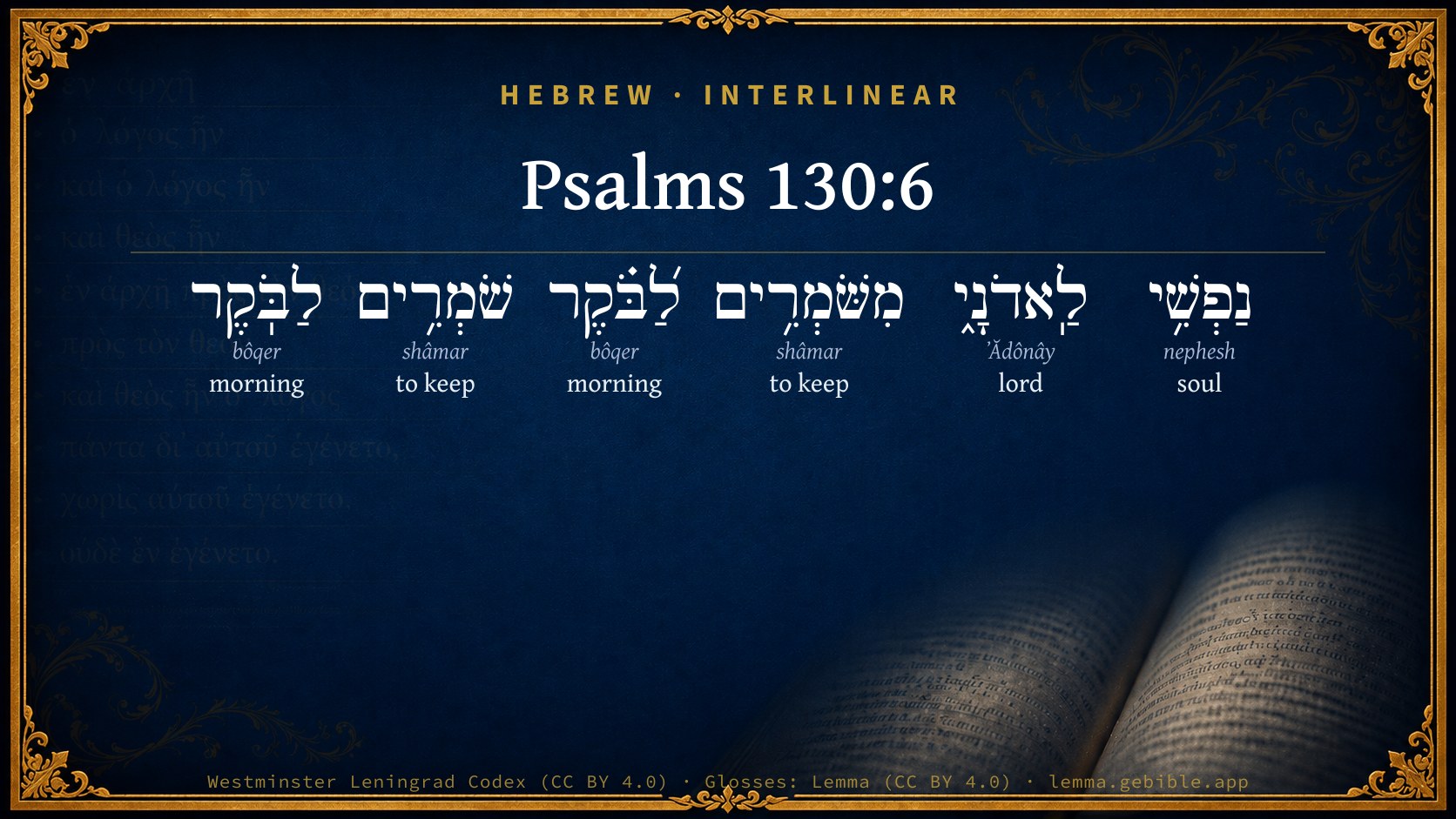
Psalms 130:6

Hebrew (Westminster Leningrad Codex) Psalms 130:6 appears in the Hebrew Old Testament. The text above is from the Westminster Leningrad Codex. Each word links to its Strong’s number, a concise gloss, and parsing drawn from the Open Scriptures Hebrew Bible morphology. Click any word for its full Brown-Driver-Briggs (BDB) entry.
Download image
Cite this verse

Psalms 130:6 (World English Bible). Public Domain. Lemma interlinear Bible study tool, https://lemma.gebible.app/v/psalms/130/6.

Show BibTeX & RIS
BibTeX
RIS
English Translation
My soul longs for the Lord more than watchmen long for the morning; More than watchmen for the morning.
World English Bible · Public Domain
Download a study sheet

One document with this verse’s original text, its word-by-word gloss line, the meaning frame, cross-references with their text, attributed commentary, and full source and license credits — printable, and it pastes into notes with its structure intact.

This verse Autodidact and up

Study sheet (.html) Plain text (.txt)

A passage Seminary Student

Up to 50 verses in one chapter. A passage sheet keeps up to 6 commentary sources and 12 cross-references per verse, in the order this page ranks them, and says so on the sheet whenever that leaves anything out. Ask for a single verse and you get the Autodidact verse sheet above.

Everything on this page stays free to read, with no account — the sheet is a download of what is already on screen, not access to it.

Want to remove ads? Support Godless Engineer
Compare translations 3

The same verse in 3 English versions, stacked beneath the original-language interlinear above. Click any original word for its lexicon entry.

Each is an independent rendering of the whole verse — the interlinear is not word-aligned to these translations.

Highlighted words mark where these versions differ — a whole-verse word diff, not a word-by-word alignment.

  • World English Bible Public Domain
    My soul longs for the Lord more than watchmen long for the morning; More than watchmen for the morning.
  • King James Version Public Domain
    My soul waiteth for the Lord more than they that watch for the morning: I say, more than they that watch for the morning.
  • unfoldingWord Literal Text CC BY-SA 4.0
    my soul for the Lord, more than watchmen for the morning, watchmen for the morning.

unfoldingWord Literal Text — © unfoldingWord, licensed CC BY-SA 4.0. Word-aligned USFM3 via Door43 (git.door43.org/unfoldingWord/en_ult).

Versions to compare (up to 4)

3 of 4 selected

Show all 18 translations

Every available English version of this verse, each an independent rendering of the whole verse.

  • World English Bible Public Domain
    My soul longs for the Lord more than watchmen long for the morning; More than watchmen for the morning.
  • Berean Standard Bible Public Domain
    My soul waits for the Lord more than watchmen wait for the morning—more than watchmen wait for the morning.
  • Majority Standard Bible Public Domain
    My soul waits for the Lord more than watchmen wait for the morning—more than watchmen wait for the morning.
  • King James Version Public Domain
    My soul waiteth for the Lord more than they that watch for the morning: I say, more than they that watch for the morning.
  • American Standard Version (1901) Public Domain
    My soul `waiteth' for the Lord More than watchmen `wait' for the morning; `Yea, more than' watchmen for the morning.
  • Revised Version (1885) Public Domain
    My soul looketh for the Lord, more than watchmen look for the morning; yea, more than watchmen for the morning.
  • Geneva Bible (1599) Public Domain
    My soule waiteth on the Lord more then the morning watch watcheth for the morning.
  • Douay-Rheims (1899) Public Domain
    Let them be as grass on the tops of houses: which withered before it be plucked up:
  • Young's Literal Translation Public Domain
    My soul `is' for the Lord, More than those watching for morning, Watching for morning!
  • Literal Standard Version CC BY-SA 4.0
    My soul [is] for the Lord, || More than those watching for morning, || Watching for morning!
  • Unlocked Literal Bible CC BY-SA 4.0
    My soul waits for the Lord more than watchmen wait for the morning.
  • unfoldingWord Literal Text CC BY-SA 4.0
    my soul for the Lord, more than watchmen for the morning, watchmen for the morning.
  • Darby Bible Public Domain
    My soul [waiteth] for the Lord more than the watchers [wait] for the morning, [more than] the watchers for the morning.
  • World Messianic Bible Public Domain
    My soul longs for the Lord more than watchmen long for the morning, more than watchmen for the morning.
  • Webster's Bible Public Domain
    My soul waiteth for the Lord more than they that watch for the morning: I say, more than they that watch for the morning.
  • Free Bible Version CC BY-SA 4.0
    I long for the Lord to come, more than watchmen longing for the dawn to come, more than watchmen longing for the dawn to come.
  • Bible in Basic English Public Domain
    My soul is watching for the Lord more than those who are watching for the morning; yes, more than the watchers for the morning.
  • JPS Tanakh (1917) Public Domain
    My soul waiteth for the Lord, more than watchmen for the morning; yea, more than watchmen for the morning.

Literal Standard Version (2020), Covenant Press — licensed CC BY-SA 4.0. Text via the HelloAO Bible API (eBible.org). Unlocked Literal Bible (unfoldingWord) — licensed CC BY-SA 4.0. Text via the HelloAO Bible API (eBible.org). unfoldingWord Literal Text — © unfoldingWord, licensed CC BY-SA 4.0. Word-aligned USFM3 via Door43 (git.door43.org/unfoldingWord/en_ult). Free Bible Version, Dr. Jonathan Gallagher — licensed CC BY-SA 4.0. Text via the HelloAO Bible API (eBible.org).

Word by word

More ways to search: Search by grammar → Find every occurrence → Compare this word →

Practice this passage: Drill this verse → Learn its vocabulary →

לַ֝בֹּ֗קֶר
bôqer
H1242
“to/for the · morning”
Preposition, Determined + Noun, Common, Masculine, Singular, Absolute
Part of Speech
Preposition + Noun
Type
Common
Gender
Masculine
Number
Singular
State
Absolute
Full BDB Definition

Origin: from H1239

TWOT: 274c

morning, break of day - morning - of end of night - of coming of daylight - of coming of sunrise - of beginning of day - of bright joy after night of distress (figuratively) - morrow, next day, next morning
  1. נַפְשִׁ֥י nephesh H5315 “soul · my” Noun, Common, Both, Singular, Construct + Suffix, Personal, 1st Person, Common, Singular
  2. לַֽאדֹנָ֑י ʼĂdônây H136 “to/for · Lord · my” Preposition + Noun, Common, Masculine, Plural, Construct + Suffix, Personal, 1st Person, Common, Singular
  3. מִשֹּׁמְרִ֥ים shâmar H8104 “from · keeping” Preposition + Verb, Qal, Participle Active, Masculine, Plural, Absolute
  4. שֹׁמְרִ֥ים shâmar H8104 “keeping” Verb, Qal, Participle Active, Masculine, Plural, Absolute
  5. לַבֹּֽקֶר bôqer H1242 “to/for the · morning” Preposition, Determined + Noun, Common, Masculine, Singular, Absolute

About this verse

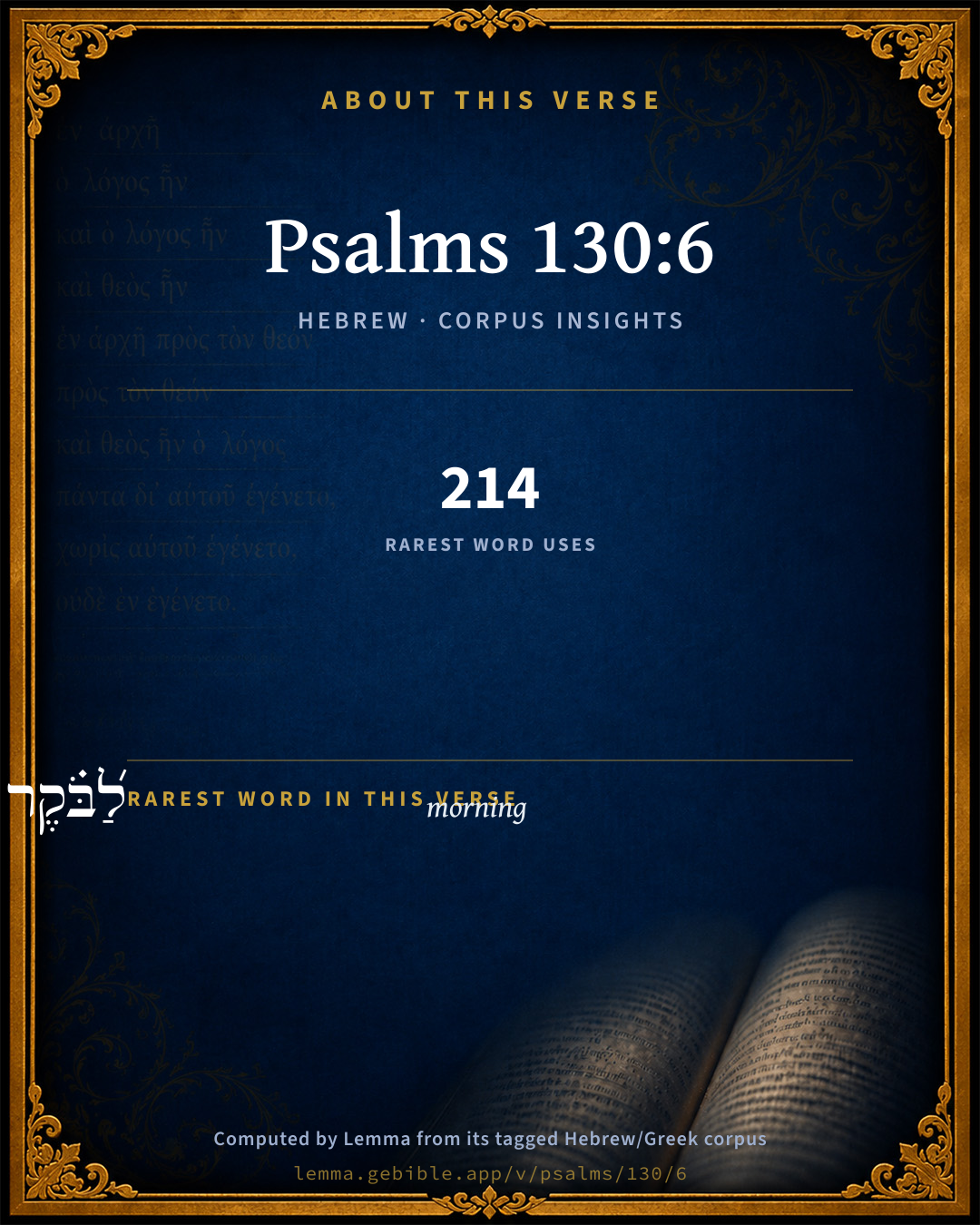
These counts appear in no published source. They are computed here, from the morphology-tagged text and Lemma’s own curated glosses. What Lemma adds →

6
words
4
distinct lemmas
Wisdom
section

Grammatical profile

  • 2 verbs
  • 4 nouns

Verb forms

  • מִשֹּׁמְרִ֥ים Qal · Participle Active
  • שֹׁמְרִ֥ים Qal · Participle Active

Repetition

Words recur within this verse — often emphatic in Hebrew:

  • מִשֹּׁמְרִ֥ים to keep H8104 ×2
  • לַ֝בֹּ֗קֶר morning H1242 ×2

Hebrew & Septuagint length

In English translation the verse runs 19 words from the Hebrew and 13 from the Septuagint (LXX English) — closely comparable.

A rough comparison of the two English renderings, which tokenize alike — not a word-level alignment.

Word counts can differ between the Hebrew and the Greek without any difference in meaning — e.g. the Hebrew direct-object marker אֵת has no separate Greek word, and Greek often adds the article ὁ.

Cross-references

5

Topical passages linked to Psalms 130:6 in the Treasury of Scripture Knowledge — connected by theme and wording, ordered by reader-vote popularity; previews shown in the World English Bible.

  • Psalms 63:6 When I remember you on my bed, And think about you in the night watches.
  • Psalms 119:147 I rise before dawn and cry for help. I put my hope in your words.
  • Psalms 134:1 Look! Praise Yahweh, all you servants of Yahweh, Who stand by night in Yahweh's house!
  • Isaiah 21:8 He cried as a lion: Lord, I stand continually on the watch-tower in the day-time, and am set in my ward whole nights;
  • Acts 27:29 Fearing that we would run aground on rocky ground, they let go four anchors from the stern, and wished for daylight.

Cross-references courtesy of OpenBible.info (CC BY 4.0).

Hebrew and Greek witnesses Masoretic Hebrew ↔ Greek Septuagint

The same verse in the two great witnesses to the Old Testament, shown verse-for-verse.

You’re reading Greek Psalm 129 (Hebrew Psalm 130). The Septuagint counts the superscription, so verse numbers can differ from the Hebrew — chapter-level alignment, not verse-by-verse. Numbering follows Rahlfs.

These are two independent witnesses, not word-aligned to each other, and the Septuagint is shown in lemma (dictionary) form.

Hebrew Psalms 130:6 Masoretic · Westminster Leningrad Codex

נַפְשִׁ֥י לַֽאדֹנָ֑י מִשֹּׁמְרִ֥ים לַ֝בֹּ֗קֶר שֹׁמְרִ֥ים לַבֹּֽקֶר

My soul longs for the Lord more than watchmen long for the morning; More than watchmen for the morning.

World English Bible · Public Domain

Greek LXX Greek Psalm 129:6 Septuagint · lemma form

ἐλπίζω ὁ ψυχή ἐγώ ἐπί ὁ κύριος ἀπό φυλακή πρωΐα μέχρι νύξ ἀπό φυλακή πρωΐα ἐλπίζω ἰσραήλ ἐπί ὁ κύριος

My soul has hoped in the Lord; from the morning watch till night.

LXX2012 (modern English Septuagint) · Public Domain

On this verse, Albert Barnes' Notes on the Bible discusses the Septuagint’s reading. Read the note in Commentary ↓

Hebrew: Westminster Leningrad Codex (CC BY 4.0). Greek: Septuagint (public domain); English from LXX2012 (modern English Septuagint) (Public Domain). How the Septuagint differs from the Hebrew →

Commentary

Notes on Psalms 130:6 from classic Christian and Jewish commentators (each source and its license shown beneath its notes). The classic Christian expositions comment on the surrounding passage and are grouped to its opening verse, so a note may address several verses; the Jewish commentaries on the Tanakh (Rashi and others) are per-verse, so they appear only where the commentator wrote on this verse.

Lemma curates 59 commentaries, every one of them public domain or Creative Commons licensed, each selected and text-cleaned for this edition rather than reprinted as found. About our sources →

Trapp's Complete Commentary

John Trapp

Psa 130:6 My soul [waiteth] for the Lord more than they that watch for the morning: [I say, more than] they that watch for the morning.

Ver. 6. My soul waiteth for the Lord] Or, watcheth for the Lord, Heb. my soul to the Lord, an ecliptical, concise speech, importing strong affection, as doth also the following reduplication, Prae custodibus ad mane, prae custodibus ad mane.

I say, more than they] Or, more than they that watch for the morning wait for the morning; wherein they may sleep, which by night they might not do.

John Trapp, A Commentary or Exposition upon All the Books of the Old and New Testament (1647–1656) — public domain. Text from a community e-Sword module.

The Biblical Illustrator

Joseph S. Exell

Psa_130:6

More than they that watch for the morning.

The Christian watchman

I. This world is a night, The morning presupposes the night, and this world most properly is compared to a long winters night which is very uncomfortable. The night also is cold, wanting the sun which warmeth the earth; so is the world a shadow of death, a dark dungeon.

II. Christians are watchmen. Every particular Christian ought to be a watchman; for he hath enemies both spiritual and corporal, continually assaulting him, to destroy both his soul and his body, for which cause our Saviour often exhorted his hearers to watch and pray, and by nature we fall asleep, as the apostles did in the garden, and Jonas in the ship. Therefore it is good we should be careful to watch over our ways. The watch looks to the enemy without, but we have more need to watch over our domestic and inward enemies, lest they surprise us, even our lusts and concupiscences, our pride, our avarice, our malice, all which are like to overthrow our soul. Let us, therefore, watch, lest we be surprised.

III. Comfort and light must come from above. The watchman waiteth for the day, and he is very glad when he seeth it break, for then he knoweth the sun is rising upon the earth, which will enlighten all the world. No comfort is to be found on earth for a Christian soul in this dark night; we must look to the day dawning, when Christ in that day of His glorious appearing shall come to deliver His Church from all miseries: which all Christians should earnestly attend, and fervently pray with the spouse, Come, Lord Jesus. The watchman looketh about to see the sun spread out his beams; he knoweth that light doth not come from below. We should turn our eyes from the world, because here is no comfort, and look unto Christ Jesus sitting at the right hand of the Father, from whom only we may expect a comfortable deliverance out of all our miseries.

IV. The light cometh in the morning. Before break of day is greatest darkness, and then the sun ariseth, and by his beams expelleth the same; the light cometh not till the morning. The apostles rowed all night, till they were become weary, and out of all hope, and then Christ came in the fourth watch and relieved them, being then in a most desperate ease. So the Lord, although he tarrieth to let us see our own weakness, yet no doubt He will come: He dealt thus with Jacob, he wrestled all night with him till the break of day, and then blessed him; David, after he was long pursued and persecuted by Saul, yet at last got rest and ease. The Jews were nearly destroyed by their enemies, but God raised up saviours to defend them. Despair not, then, and disquiet not yourselves; be not discouraged, howsoever ye see the Church, which is, as the disciples boat, tossed to and fro by the waves of persecuting tyrants. Look to heaven, for the day of her deliverance is at hand; yea, that everlasting deliverance, When the Sun of Righteousness shall arise and shine on her for ever. (A. Symson.)

The hope of the good in sorrow

I. The object of his hope in his sorrows I wait for the Lord. This implies two things--

1. A belief that the Lord would appear for him. He seemed as if He was hidden from him now. The clouds of his sorrow concealed Him, as the mists of the earth conceal the sun, but he knew that He would come, and he waited.

2. A belief that at His appearance he should have relief. He would not wait if he felt there would come no deliverance, still less if he felt that his sorrows would be aggravated by the event. God will come to deliver His people out of their sorrows. I know that my Redeemer liveth, etc.

II. The ground of his hope in his sorrow. In His Word do I hope.

1. His Word promises deliverance to the good in sorrow.

2. His Word is infallibly true. What He has promised must be fulfilled.

III. The earnestness of his hope in his sorrow. My soul waiteth for the Lord more, etc. This implies--

1. The intensity of his distress. His soul is in the midnight of sadness, and he looks with stronger solicitude for relief than they that watch for the morning. In a suffering world there are thousands every night who watch earnestly for the morning. The man tossed on the bed of agony watches for the morning; the prisoner in his cell watches for the morning; the mariner in the storm watches for the morning; the general who has to decide on the coming day the destiny of his campaign, watches for the morning. None, however, watch more anxiously for the morning than the soul in anguish watches for its God.

2. The certainty of his deliverance. The night always appears long to the sufferer; still the morning comes at last. The sun comes mounting the steeps of heaven, chasing the darkness away, brightening the landscape, and pouring gladness into the world. Even so deliverance will come to the good. (Homilist.)

Approach of dawn

Day will soon break to those who long for it in the gloom or shadows of night. Gods world never stands still. From the creation, when the evening and the morning were the first day, light has followed darkness, and dawn has come from dusk. This is a thought for every weary soul to whom it seems as if daylight would never come. If there is no dawn here, there is dawn not far ahead, and we shall see it before long.

Out of the darkness of night

The world rolls into light;

It is daybreak everywhere.

(Great Thoughts.)

Watching for the morning

In the year 1830, on the night preceding the 1st of August, the day the slaves in our West Indian colonies were to come into possession of the freedom promised them, many of them, we are told, never went to bed at all. Thousands and tens of thousands of them assembled in their places of worship, engaging in devotional duties, and singing praises to God, waiting for the first streak of the light of the morning of that day on which they were to be made free. Some of their number were sent to the hills, from which they might obtain the first view of the coming day, and by a signal intimate to their brethren down in the valley the dawn of the day that was to make them men, and no longer, as they had hitherto been, mere goods and chattels--men with souls that God had created to live for ever. How eagerly must these men have watched for the morning. (F. W. Aveling.)

The Biblical Illustrator, edited by Joseph S. Exell (c. 1880s–1900s) — public domain. Text from a community e-Sword module.

Joseph Benson's Commentary

Psa 130:6. My soul waiteth for the Lord — This verse in the original is remarkably concise, forcible, and elegant. It is literally, My soul for the Lord, (namely, waiteth,) more than watchers for the morning, than watchers for the morning. The psalmist is thought to intend those that kept the night-watches in the city, or the priests or Levites who watched in the temple; who, being wearied with hard service and want of rest, earnestly desired and eagerly expected the break of day, that they might be discharged from duty. Or, as Dr. Hammond and some others interpret the words, he means those priests, or their officers, “who were peculiarly appointed from a tower to expect the first appearance of the break of day.” The repetitions in this and the preceding verse beautifully and forcibly express that ardent desire with which true penitents expect and long for the salvation of God.

Joseph Benson's Commentary on the Old and New Testaments (1811–1818) — public domain. Text from a community e-Sword module.

J. A. Alexander on Psalms

Joseph Addison Alexander

6. (Psa 130:6) My soul (waits) for the Lord more than (those) watching for the morning—watching for the morning. There is something beautiful and touching in this simple repetition, though it is not easy to account for its effect, which is sensibly impaired by the attempt made in the English version to relieve the baldness of the iteration, I say more than they that watch for the morning. The comparison suggested is between the impatience of nocturnal watchers for the break of day and that of sufferers for relief, or of convicted sinners for forgiveness.

Joseph Addison Alexander, The Psalms Translated and Explained (1850) — public domain. Text from a community e-Sword module.

Adam Clarke's Commentary

Verse 6. More than they that watch for the morning.] I believe the original should be read differently from what it is here. The Chaldee has, "More than they who observe the morning watches, that they may offer the morning oblation." This gives a good sense, and is, perhaps, the true meaning. Most of the Versions have "From the morning to the night watches." Or the passage may be rendered, "My soul waiteth for the Lord from the morning watches to the morning watches." That is, "I wait both day and night."

Adam Clarke's Commentary on the Bible (1810–1826) — public domain. Text from a community e-Sword/MySword module.

John Calvin's Commentaries

6. My soul hath waited for the Lord before the watchers of the morning. In this verse he expresses both the ardor and the perseverance of his desire. In saying that he anticipated the watchmen, he shows by this similitude with what diligence and alacrity he breathed after God. And the repetition is a proof of his perseverance; for there is no doubt that thereby he intended to express an uninterrnitted continuance of the same course, and consequently perseverance. Both these qualities in his exercise, are worthy of attention; for it is too manifest how slow and cold we are in elevating our minds to God, and also how easily we are shaken and even fall at every little blast of wind. Farther, as the watches of the night were in ancient times usually divided into four parts, this passage may be explained as implying that as the watchmen of the night, who keep watch by turns, are careful in looking when the morning will dawn, so the Prophet looked to God with the greatest attention of mind. But the more natural sense seems to be, that as in the morning the warders of the gates are more wakeful than all other people, and are the earliest in rising, that they may appear at the posts assigned them, so the mind of the Prophet hastened with all speed to seek God. The repetition, as I have already observed, shows that he stood keeping his gaze perseveringly fixed upon its object. We must always beware of allowing our fervor to languish through the weariness of delay, should the Lord for any length of time keep us in suspense. Some, as Street, Mant, Dr. Adam Clarke, French and Skinner, and Phillips, suppose that the allusion in this verse is to the watchings which the Priests and Levites in their turns exercised during the night in the Temple, (see Psalm 34:1,) and especially to those officers of theirs who were appointed to watch for the first dawn of day, in order that the morning sacrifice might be offered. “In the Talmudical Tract Tamid it is related, ‘The prefect said to them, Go and see if the time of slaying; have arrived; if it had arrived, the watcher calls out, ברקאי, Coruscations.’ Agreeably to this explanation of the verse is the rendering of the Chaldee, which is as follows: “My soul waits for the Lord, more than the keepers of the morning vigils, which they observe for offering of the morning oblation.” — Phillips. “The custom alluded to by the Targumist,” [or Chaldee,] says Street, “is mentioned in Exodus 30:7. ‘And Aaron shall burn thereon sweet incense every morning: when he dresseth the lamps he shall burn incense upon it.’” “The similitude,” observes Mant, “is beautifully expressive of the eager impatience of the Psalmist; which is still further augmented by the repetition.”

John Calvin's Commentaries (1540-1563) — public domain. Text from the Calvin Translation Society English edition (1840s-50s) via the Christian Classics Ethereal Library (ccel.org). Calvin's coverage is partial (roughly two-thirds of the Bible); uncommented books and verses are honest gaps, never fabricated. The 19th-century editor's footnotes and remarks are omitted so the notes are faithfully Calvin's own voice.

Ellicott's Commentary for English Readers

(6) Watch for the morning.—Comp. Psa_123:2 for another figure of the same earnest upward gaze. In the “watcher for the dawn” there may be an allusion to the Levite-sentinel whose duty it was to signal the first ray of dawn, and the moment for commencing the sacred rites of the Temple (Psa_134:1), but the figure if general, as marking the impatience of a deeply agitated soul—a sufferer waiting for relief, a contrite sinner for forgiveness—is as striking as graceful. (See Deu_28:67.)

A Bible Commentary for English Readers, edited by Charles John Ellicott (1878–1897) — public domain. Text from a community e-Sword module.

The Cambridge Bible for Schools and Colleges

gen. ed. J. J. S. Perowne

6. My soul (looketh) for the Lord,

More than watchmen (look) for the morning,

(Yea, more than) watchmen for the morning (R.V.).

More anxiously than the watchman longs for the dawn which is to release him from his duty does the devout Israelite long for the end of the night of trouble and the dawn of a happier day. The repetition of watchmen for the morning gives a touch of pathetic earnestness. Most commentators suppose that military sentinels are meant by watchmen; but the Targum renders, “My soul waits for Jehovah, more than the keepers of the morning-watch which they keep in order to offer the morning sacrifice,” understanding the allusion to be to the custom that one of the Levites who kept the night watch in the Temple was appointed to watch for the moment of the dawn, at which the daily sacrifice was to be offered. This explanation adds point to the comparison, for the Levites were watching with eager expectation for a dawn which would bring not merely release from toil but positive blessing, in the renewed assurance of God’s covenant mercy.

The P.B.V. before the morning watch, I say, before the morning watch, is derived from Münster’s ante custodes matutinos, ante custodes, inquam, matutinos. Coverdale’s original rendering, frô the one morn-ynge to the other, was taken from the Zürich Version, “von einer morgenwacht zur anderen.”

The Cambridge Bible for Schools and Colleges (gen. ed. J. J. S. Perowne; Cambridge University Press, 1878–1918) — public domain. Text from a community e-Sword module.

John Gill's Exposition

Let Israel hope in the Lord,.... The psalmist having himself hope in the Lord and in his word, through a view of forgiveness with him, exhorts and encourages others to do so likewise, even every Israelite indeed; and such may comfortably hope in him for salvation, which was designed, contrived, promised, and now wrought out for sinners, the chief of sinners, and to be had freely; and the Gospel declaration is, that whosoever believes in Christ shall be saved; as well as for the remission of sin, which God has promised in covenant; proclaimed in Christ, whom he has sent to obtain it, and exalted to give it; and has declared in the Gospel that whoever believes in him shall have it; and also for eternal life and happiness, which is the gift of God through Christ; is in the hands of Christ, and of which the Spirit of God is the earnest and pledge. Arguments encouraging hope follow:

for with the Lord there is mercy; which is natural and essential to him; as displayed, is either general, and over all his works, and towards all his creatures; or special, only shown to whom he will: this flows through Christ, and is very large and abundant; and appears in various instances, in the covenant, in the mission of Christ, and redemption by him; in regeneration, the forgiveness of sins, and in salvation; as well as it is bestowed on innumerable objects: and this nerves much to encourage hope, since there is plenty of it, and God is plenteous in it; and it is kept for many, for thousands, and even the vilest of sinners, share in it; God has set up a throne of grace and mercy for men to apply to, and he delights in showing mercy, and in those that hope in it: or, there is "grace" (k) with him; an abundance of it in his heart; a fulness of it in his son; and large aboundings of it through Christ, in conversion, pardon, and other things;

and with him is plenteous redemption; the purpose of it was in him; the scheme of it was drawn by him; the covenant of it was made with Christ; the promise of it was published, and now the thing itself is done, and is with Christ the author of it: and this is "plenteous", if we consider the number of persons redeemed from among men, being such as no man can number; what of them is redeemed, even all of them, their souls and bodies; what they are redeemed from, from all sin, the law, its curse and condemnation, from death and hell, from Satan and all enemies; the several blessings included in it, or connected with it, pardon of sin, justification of persons, adoption, sanctification, and eternal life; the great price paid for it, the blood, the life of Christ, yea, himself: and the large display of love, grace, and mercy, wisdom, power, justice, and holiness, made in it. Kimchi interprets this of redemption from Egypt, Babylon, &c.

(k) "gratia", Cocceius, Michaelis.

John Gill's Exposition of the Whole Bible (1746–1763) — public domain (CC PDM 1.0). Text via the HelloAO Bible API.

Albert Barnes' Notes on the Bible

My soul waiteth for the Lord more than they that watch for the morning - More intently; more anxiously. The Septuagint and Latin Vulgate render this, “My soul hopeth in the Lord from the morning watch until night.” The idea is that of watchers - night guards - who look anxiously for the break of day that they may be relieved. It is not that of persons who simply look for the return of day, but of those who are on guard - or it may be who watch beside the sick or the dying - and who look out on the east to mark the first indications of returning light. To them the night seems long; they are weary, and want repose; all around is cheerless, gloomy, and still; and they long for the first signs that light will again visit the world. Thus in affliction - the long, dark, dreary, gloomy night of sorrow - the sufferer looks for the first indication, the first faint ray of comfort to the soul. Thus under deep conviction for sin, and deep apprehension of the wrath of God - that night, dark, dreary, gloomy, often long - the soul looks for some ray of comfort, some intimation that God will be merciful, and will speak peace and pardon.

I say, more than they that watch for the morning - Margin, which watch unto the morning. The translation in the text best expresses the sense. There is something exceedingly beautiful and touching in this language of repetition, though it is much enfeebled by the words which our translators have inserted, “I say, more than.” The Hebrew is, “more than they that watch for the morning - watch for the morning,” as if the mind dwelt upon the words as better expressing its own anxious state than any other words could do. Everyone who has been afflicted will feel the force of this; every one who has been under conviction of sin, and who has felt himself in danger of suffering the wrath of God, will remember how anxiously he longed for mercy, for light, for peace, for some indication, even the most faint, like the first ray which breaks in the east, that his soul would find mercy and peace.

Albert Barnes' Notes on the Bible (1834–1885) — public domain. Text from a community e-Sword/MySword module.

Matthew Poole's English Annotations

Whether soldiers that keep the night watches in an army or city, or the priests or Levites who did so in the temple; who being wearied with hard service and want of convenient rest, diligently look for and fervently desire the morning, when they may be discharged. Compare Psa 119:148.

Matthew Poole's English Annotations on the Holy Bible (1683–1685) — public domain. Text from a community e-Sword/MySword module.

The Treasury of David

Charles H. Spurgeon

Ver. 6. My soul waiteth for the Lord more than they that watch for the morning. Men who guard a city, and women who wait by the sick, long for daylight. Worshippers tarrying for the morning sacrifice, the kindling of the incense and the lighting of the lamps, mingle fervent prayers with their holy vigils, and pine for the hour when the lamb shall smoke upon the altar. David, however, waited more than these, waited longer, waited more longingly, waited more expectantly. He was not afraid of the great Adonai before whom none can stand in their own righteousness, for he had put on the righteousness of faith, and therefore longed for gracious audience with the Holy One. God was no more dreaded by him than light is dreaded by those engaged in a lawful calling. He pined and yearned after his God. I say, more than they that watch for the morning. The figure was not strong enough, though one can hardly think of anything more vigorous: he felt that his own eagerness was unique and unrivalled. Oh to be thus hungry and thirsty after God! Our version spoils the abruptness of the language; the original runs thus"My soul for the Lord more than those watching for the morningwatching for the morning." This is a fine poetical repeat. We long for the favour of the Lord more than weary sentinels long for the morning light which will release them from their tedious watch. Indeed this is true. He that has once rejoiced in communion with God is sore tried by the hidings of his face, and grows faint with strong desire for the Lord's appearing,

"When wilt thou come unto me, Lord?

Until thou dost appear,

I count each moment for a day,

Each minute for a year."

Ver. 6. My soul waiteth for the LORD. And now, my soul, what do I live for but only to wait upon God, and to wait for God? To wait upon him, to do him service, to wait for him, to be enabled to do him better service; to wait upon him, as being Lord of all; and to wait for him, as being the rewarder of all; to wait upon him whose service is better than any other command, and to wait for him whose expectation is better than any other possession. Let others, therefore, wait upon the world, wait for the world; I, O God, will wait upon thee, for thee, seeing I find more true contentment in this waiting than all the world can give me in enjoying; for how can I doubt of receiving reward by my waiting for thee when my waiting for thee is itself the reward of my waiting upon thee? And therefore my soul waiteth; for if my soul did not wait, what were my waiting worth no more than I were worth myself, if I had not a soul; but my soul puts a life into my waiting, and makes it become a living sacrifice. Alas, my frail body is very unfit to make a waiter: it rather needs to be waited upon itself: it must have so much resting, so often leave to be excused from waiting, that if God should have no other waiters than bodies, he would be left oftentimes to wait upon himself; but my soul is Divinoe particula auroe a portion of the Divine breath, endued with all qualities fit for a waiter; and hath it not received its abilities, O God, from thee?] And therefore my soul waiteth, and is so intent in the service that it waits "more than they that watch for the morning." Sir Richard Baker.

Ver. 6. Hammond thus renders the verse: "My soul hasteneth to the Lord from the guards in the morning, the guards in the morning."

Ver. 6. More than they that watch for the morning. Look, as the weary sentinel that is wet and stiff with cold and the dews of the night, or as the porters that watched in the Temple, the Levites, were waiting for the daylight, so "more than they that watch for the morning" was he waiting for some glimpse of God's favour. Though he do not presently ease us of our smart or gratify our desires, yet we are to wait upon God. In time we shall have a good answer. God's delays are not denials. Day will come at length, though the weary sentinel or watchman counts it long first; so God will come at length; he will not be at our beck. We have deserved nothing, but must wait for him in the diligent use of means; as Benhadad's servants watched for the word "brother", or anything of kindness to drop from the king of Israel. Thomas Manton.

Ver. 6. More than they that watch for the morning. How many in the hallowed precincts of the Temple turned with anxious eye to the east, for the first red streak over Moab's mountains that gave intimation of approaching day; yet it was not for deliverance they waited, but for the accustomed hour when the morning sacrifice could be offered, and the soul be relieved of its gratitude in the hymn of thanksgiving, and of the burden of its sorrows and sins by prayer, and could draw that strength from renewed intercourse with heaven, that would enable it in this world to breathe the spirit and engage in the beneficent and holy deeds of a better. Robert Nisbet.

Ver. 6. I say, more than they that watch for the morning, for must there not be a proportion between the cause and effect? If my cause of watching be more than theirs, should not my watching be more than theirs? They that watch for the morning have good cause, no doubt, to watch for it, that it may bring them the light of day; but have not I more cause to watch, who wait for the light that lighteth every one that comes into the world? They that watch for the morning wait but for the rising of the sun to free them from darkness, that hinders their sight; but I wait for the rising of the Sun of righteousness to dispel the horrors of darkness that affright my soul. They watch for the morning that they may have light to walk by; but I wait for the Dayspring from on High to give light to them that sit in darkness and in the shadow of death, and to guide our feet into the way of peace. But though there may be question made of the intentness of our watching, yet of the extensiveness there can be none, for they that watch for the morning watch at most but a piece of the night; but I have watched whole days and whole nights, and may I not then justly say, I wait more than they that watch for the morning? Sir Richard Baker.

Ver. 6. Holy men like Simeon, and devout priests like Zacharias, there were, amidst this seething people, who, brooding, longing, waiting, chanted to themselves day by day the words of the Psalmist, "My soul waiteth for the Lord more than they that watch for the morning." As lovers that watch for the appointed coming, and start at the quivering of a leaf, the flight of a bird, or the humming of a bee, and grow weary of the tense strain, so did the Jews watch for their Deliverer. It is one of the most piteous sights of history, especially when we reflect that he came, and they knew him not. Henry Ward Beechef, in his "Life of Jesus the Christ."

Ver. 6. Watch. We do injustice to that good and happy word, "watch", when we take it as watching against; against a danger; against a coming evil. It will bear that interpretation; but it is a far higher, and better, and more filial thing to watch for a coming good than to watch against an approaching evil.

So, "watching for", we send up our arrows of prayer, and then look trustingly to see where they are coming down again. So, "watching for", we listen, in silence, for the familiar voice we love. So, "watching for", we expect the Bridegroom!

Take care, that as one always standing on the eve, not of danger, but of happiness, your "watch" be the "watch" of love, and confidence, and cheerful hope. James Vaughan.

Ver. 6. In the year 1830, on the night preceding the first of August, the day the slaves in our West Indian Colonies were to come into possession of the freedom promised them, many of them, we are told, never went to bed at all. Thousands, and tens of thousands of them, assembled in their places of worship, engaging in devotional duties, and singing praises to God, waiting for the first streak of the light of the morning of that day on which they were to be made free. Some of their number were sent to the hills, from which they might obtain the first view of the coming day, and, by a signal, intimate to their brethren down in the valley the dawn of the day that was to make them men, and no longer, as they had hitherto been, mere goods and chattels, men with souls that God had created to live forever. How eagerly must these men have watched for the morning! T. W. Aveling, in "The Biblical Museum", 1872.

Ver. 6. More than they.

1. For the darker sorrow his absence causes.

2. For the richer splendour Iris coming must bring.

3. For the greater might of our indwelling love. W. B. H.

Ver. 6.

1. A long, dark night: The Lord absent.

2. An eager, hopeful watcher: Waiting the Lord's return.

3. A bright, blessed morning: The time of the Lord's appearing. W. H. J. P.

Psalms 130:7*

Charles H. Spurgeon's The Treasury of David (1869–1885) — public domain. Psalms only. Text from a community e-Sword/MySword module.

Whedon's Commentary on the Bible

Daniel D. Whedon

6. More than they that watch for the morning—It is not the common watch, that is here alluded to, but the Levitical watch in the temple, which were sent to discover and announce the first streaks of day, in order that the priests might know when to order the morning sacrifice. “Agreeably to this explanation is the Chaldee: ‘My soul waits for the Lord, more than the keepers of the morning vigils, which they observe for the offering of the morning oblation.’”—Phillips.

Daniel D. Whedon (gen. ed.), Commentary on the Old and New Testaments (1874–1909) — public domain. Text from a community e-Sword module.

The Pulpit Commentary

My soul waiteth for the Lord more than they that watch for the morning: I say, more than they that watch for the morning; i.e. more eagerly, more anxiously, than even the night watchman, tired with his long vigil. Again the repetition adds force.

The Pulpit Commentary (1880–1919), ed. H.D.M. Spence-Jones & Joseph S. Exell — public domain. Text from a community e-Sword module.

John Wesley's Explanatory Notes

They - Whether soldiers that keep the night-watches in an army, or the priests or Levites who did so in the temple.

John Wesley, Explanatory Notes Upon the Whole Bible (1754–1765) — public domain. Text via the GEBible commentary corpus.

Rashi

Rabbi Shlomo Yitzchaki (Rashi)

My soul is to the Lord among those who await the morning I am among those who look forward to the redemption.

those who await the morning They look forward and repeatedly look forward for one end after another end. (I found this.)

Rashi on the Tanakh — English translations: “The Judaica Press complete Tanach with Rashi, translated by A. J. Rosenberg” (CC BY 4.0); “Pentateuch with Rashi's commentary by M. Rosenbaum and A.M. Silbermann, 1929-1934” (public domain); “The Metsudah Tanach series, Lakewood, N.J” (CC BY 4.0); and “The Book of Joshua, Metsudah Publications, 1997” (CC BY 4.0). Text via Sefaria.

Lesson kit

Teaching starters — assembled from the data on this page, not authored interpretation. Every prompt links to the verse data it draws on. Edit before teaching.

Psalms, in the Wisdom, opens this verse with 6 words (4 distinct Hebrew lemmas). Its most distinctive word is bôqer (“morning”). A historical commentator’s framing appears above. Read the whole chapter for the surrounding context.

Discussion questions

  1. What does “morning” (bôqer) contribute to the verse as a whole?
  2. Psalms 63:6 shares this passage’s theme. How do the two illuminate each other?
  3. “to keep” occurs 2× in this one verse. What is the effect of the repetition?
  4. These translations render this verse differently; the difference is in the English rendering, not the original. What questions does that raise?
  5. The verb «מִשֹּׁמְרִ֥ים» is Qal Participle Active. How does its form color the action?
  6. Reading how Trapp's Complete Commentary and The Biblical Illustrator read this verse, where do the two commentators agree and where do they part?

Things to notice

  • These translations choose different wording for 7 words in this verse.
  • “to keep” occurs 2× in this single verse.
  • 4 distinct Hebrew lemmas span 6 words in this verse.

Reading settings

Reading text

Shown beneath each verse's original-language words.

Old Testament
Old Testament edition

Read the OT as the Masoretic Hebrew (MT) or the Greek Septuagint (LXX).

English shown for the Greek Septuagint (in the Hebrew ↔ Greek comparison).

Comparing translations? Open the Compare panel on any verse page to stack up to four side by side.