
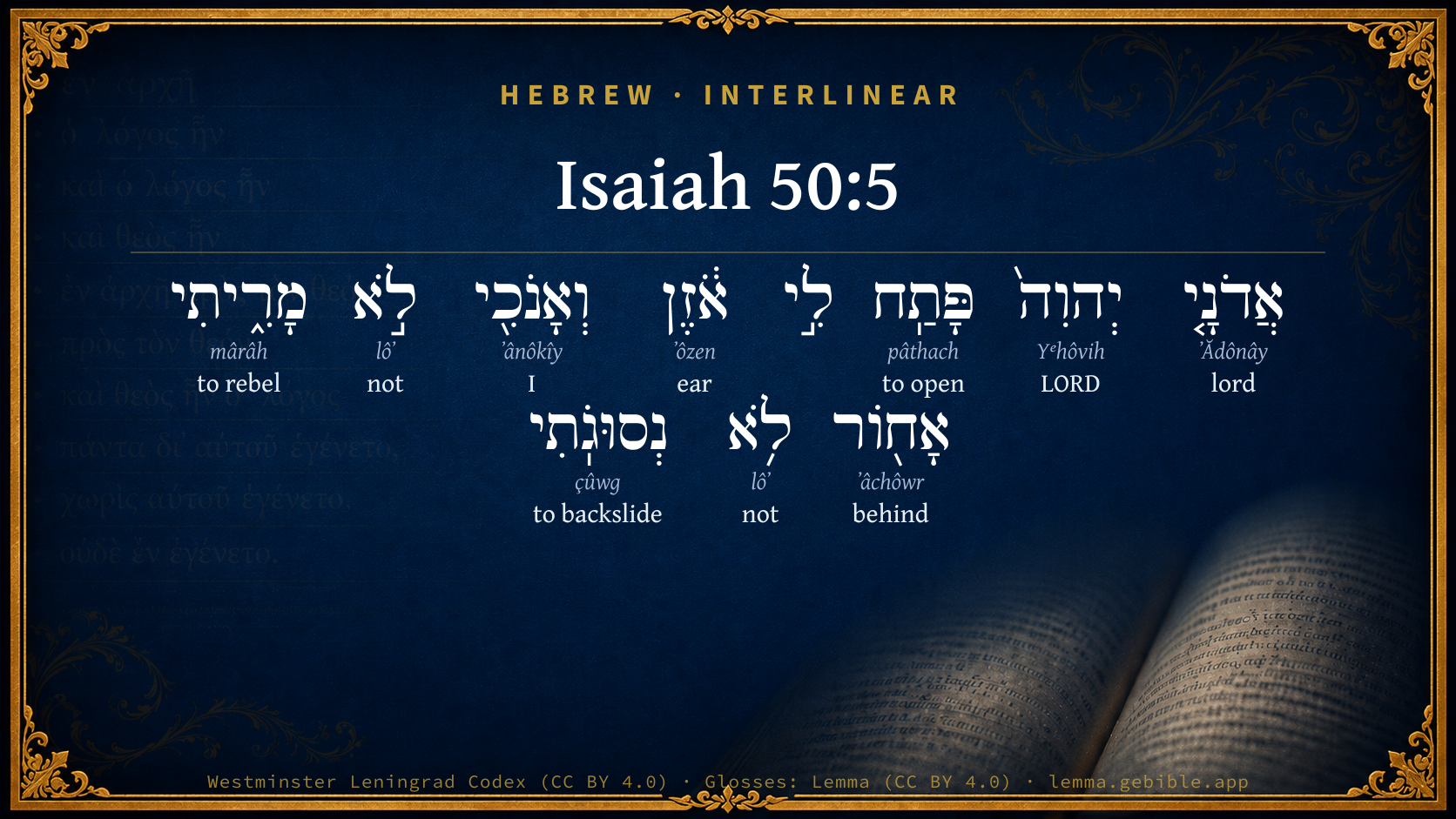
Isaiah 50:5

Hebrew (Westminster Leningrad Codex) Isaiah 50:5 appears in the Hebrew Old Testament. The text above is from the Westminster Leningrad Codex. Each word links to its Strong’s number, a concise gloss, and parsing drawn from the Open Scriptures Hebrew Bible morphology. Click any word for its full Brown-Driver-Briggs (BDB) entry.
Download image
Cite this verse

Isaiah 50:5 (World English Bible). Public Domain. Lemma interlinear Bible study tool, https://lemma.gebible.app/v/isaiah/50/5.

Show BibTeX & RIS
BibTeX
RIS
English Translation
The Lord Yahweh has opened my ear, and I was not rebellious, neither turned away backward.
World English Bible · Public Domain
Download a study sheet

One document with this verse’s original text, its word-by-word gloss line, the meaning frame, cross-references with their text, attributed commentary, and full source and license credits — printable, and it pastes into notes with its structure intact.

This verse Autodidact and up

Study sheet (.html) Plain text (.txt)

A passage Seminary Student

Up to 50 verses in one chapter. A passage sheet keeps up to 6 commentary sources and 12 cross-references per verse, in the order this page ranks them, and says so on the sheet whenever that leaves anything out. Ask for a single verse and you get the Autodidact verse sheet above.

Everything on this page stays free to read, with no account — the sheet is a download of what is already on screen, not access to it.

Want to remove ads? Support Godless Engineer
Compare translations 3

The same verse in 3 English versions, stacked beneath the original-language interlinear above. Click any original word for its lexicon entry.

Each is an independent rendering of the whole verse — the interlinear is not word-aligned to these translations.

Highlighted words mark where these versions differ — a whole-verse word diff, not a word-by-word alignment.

  • World English Bible Public Domain
    The Lord Yahweh has opened my ear, and I was not rebellious, neither turned away backward.
  • King James Version Public Domain
    The Lord GOD hath opened mine ear, and I was not rebellious, neither turned away back.
  • unfoldingWord Literal Text CC BY-SA 4.0
    The Lord Yahweh has opened for me an ear, and I, I did not rebel; I did not turn backward.

unfoldingWord Literal Text — © unfoldingWord, licensed CC BY-SA 4.0. Word-aligned USFM3 via Door43 (git.door43.org/unfoldingWord/en_ult).

Versions to compare (up to 4)

3 of 4 selected

Show all 18 translations

Every available English version of this verse, each an independent rendering of the whole verse.

  • World English Bible Public Domain
    The Lord Yahweh has opened my ear, and I was not rebellious, neither turned away backward.
  • Berean Standard Bible Public Domain
    The Lord GOD has opened My ears, and I have not been rebellious, nor have I turned back.
  • Majority Standard Bible Public Domain
    The Lord GOD has opened My ears, and I have not been rebellious, nor have I turned back.
  • King James Version Public Domain
    The Lord GOD hath opened mine ear, and I was not rebellious, neither turned away back.
  • American Standard Version (1901) Public Domain
    The Lord Jehovah hath opened mine ear, and I was not rebellious, neither turned away backward.
  • Revised Version (1885) Public Domain
    The Lord GOD hath opened mine ear, and I was not rebellious, neither turned away backward.
  • Geneva Bible (1599) Public Domain
    The Lord God hath opened mine eare and I was not rebellious, neither turned I backe.
  • Douay-Rheims (1899) Public Domain
    The Lord God hath opened my ear, and I do not resist: I have not gone back.
  • Young's Literal Translation Public Domain
    The Lord Jehovah opened for me the ear, And I rebelled not -- backward I moved not.
  • Literal Standard Version CC BY-SA 4.0
    Lord YHWH opened My ear, || And I did not rebel—I did not move backward.
  • Unlocked Literal Bible CC BY-SA 4.0
    The Lord Yahweh has opened my ear, and I was not rebellious, nor did I turn away backward.
  • unfoldingWord Literal Text CC BY-SA 4.0
    The Lord Yahweh has opened for me an ear, and I, I did not rebel; I did not turn backward.
  • Darby Bible Public Domain
    The Lord Jehovah hath opened mine ear, and I was not rebellious; I turned not away back.
  • World Messianic Bible Public Domain
    The Lord GOD has opened my ear. I was not rebellious. I have not turned back.
  • Webster's Bible Public Domain
    The Lord GOD opened my ear, and I was not rebellious, neither turned away back.
  • Free Bible Version CC BY-SA 4.0
    The Lord God has instructed me, and I haven't been rebellious and I haven't turned away.
  • Bible in Basic English Public Domain
    And I have not put myself against him, or let my heart be turned back from him.
  • JPS Tanakh (1917) Public Domain
    The Lord GOD hath opened mine ear, and I was not rebellious, neither turned away backward.

Literal Standard Version (2020), Covenant Press — licensed CC BY-SA 4.0. Text via the HelloAO Bible API (eBible.org). Unlocked Literal Bible (unfoldingWord) — licensed CC BY-SA 4.0. Text via the HelloAO Bible API (eBible.org). unfoldingWord Literal Text — © unfoldingWord, licensed CC BY-SA 4.0. Word-aligned USFM3 via Door43 (git.door43.org/unfoldingWord/en_ult). Free Bible Version, Dr. Jonathan Gallagher — licensed CC BY-SA 4.0. Text via the HelloAO Bible API (eBible.org).

Word by word

More ways to search: Search by grammar → Find every occurrence → Compare this word →

Practice this passage: Drill this verse → Learn its vocabulary →

נְסוּגֹֽתִי
çûwg
H5472
“to backslide”
Verb, Niphal, Perfect, 1st Person, Common, Singular
Part of Speech
Verb
Stem
Niphal
Form
Perfect
Person
1st Person
Gender
Common
Number
Singular
Full BDB Definition

Origin: a primitive root

TWOT: 1469

to move, go, turn back, move away, backslide - (Qal) to backslide, prove recreant to - (Niphal) - to turn oneself away, turn back - to be turned or driven back, be repulsed
  1. אֲדֹנָ֤י ʼĂdônây H136 “Lord · my” Noun, Common, Masculine, Plural, Construct + Suffix, Personal, 1st Person, Common, Singular
  2. יְהוִה֙ Yᵉhôvih H3069 “LORD” Noun, Proper
  3. פָּתַֽח pâthach H6605 “to open” Verb, Qal, Perfect, 3rd Person, Masculine, Singular
  4. אֹ֔זֶן ʼôzen H241 “ear” Noun, Common, Feminine, Singular, Absolute
  5. וְאָנֹכִ֖י ʼânôkîy H595 “and · I” Conjunction + Pronoun, Personal, 1st Person, Common, Singular
  6. לֹ֣א lôʼ H3808 “not” Particle, Negative
  7. מָרִ֑יתִי mârâh H4784 “to rebel” Verb, Qal, Perfect, 1st Person, Common, Singular
  8. אָח֖וֹר ʼâchôwr H268 “behind” Noun, Common, Masculine, Singular, Absolute
  9. לֹ֥א lôʼ H3808 “not” Particle, Negative

About this verse

These counts appear in no published source. They are computed here, from the morphology-tagged text and Lemma’s own curated glosses. What Lemma adds →

11
words
9
distinct lemmas
Prophets
section

Notable vocabulary

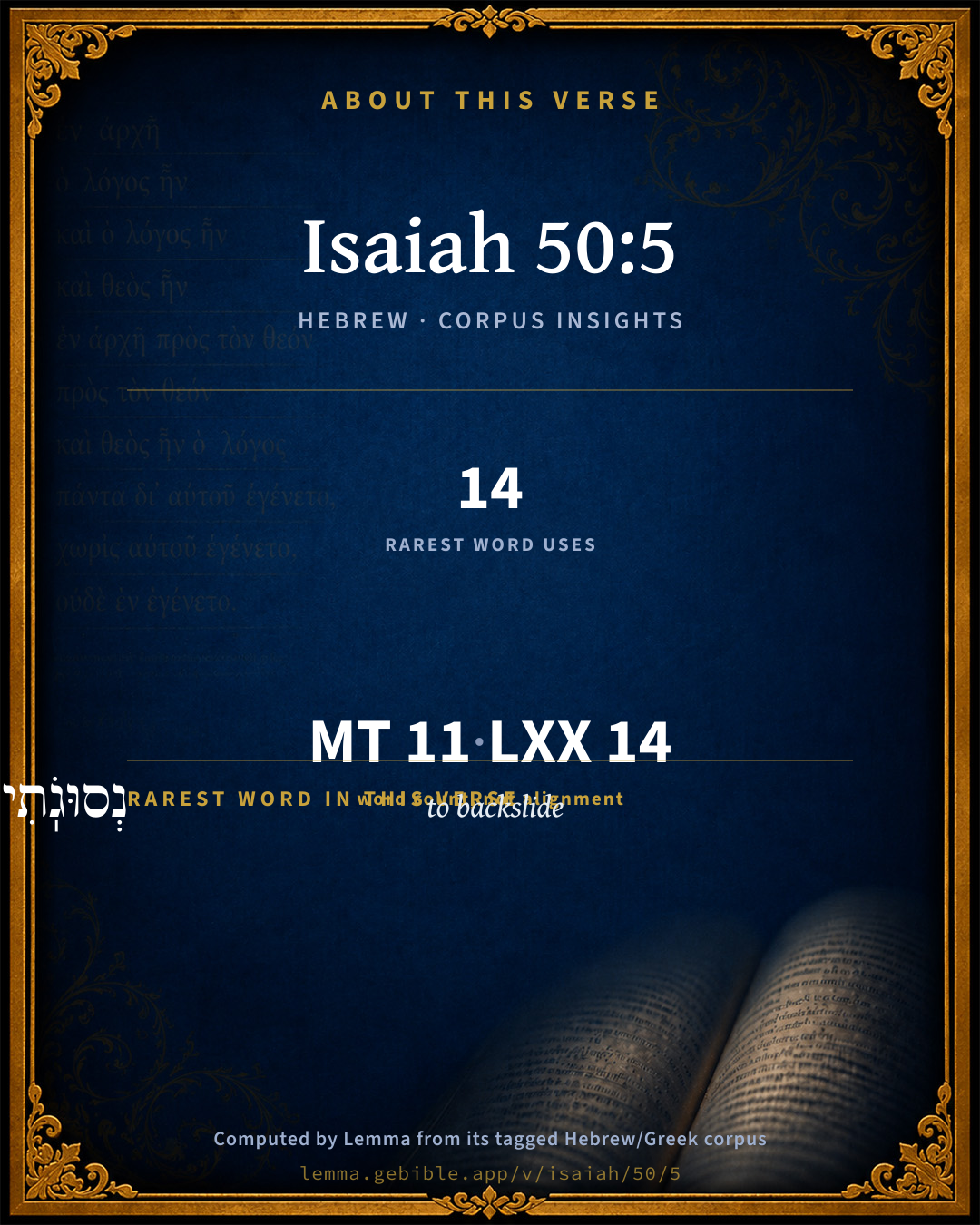
The rarest word here is נְסוּגֹֽתִי to backslide H5472 — appearing just 14 times in the whole Hebrew Bible.

Shared distinctive vocabulary

נְסוּגֹֽתִי to backslide H5472 occurs in 14 verses of the Hebrew Bible. Also found in:

Grammatical profile

  • 3 verbs
  • 4 nouns
  • 1 pronoun
  • 1 preposition
  • 2 particles

Verb forms

  • פָּתַֽח Qal · Perfect
  • מָרִ֑יתִי Qal · Perfect
  • נְסוּגֹֽתִי Niphal · Perfect

Repetition

A word recurs within this verse — often emphatic in Hebrew:

Hebrew & Septuagint length

In English translation the verse runs 16 words from the Hebrew and 19 from the Septuagint (LXX English) — closely comparable.

A rough comparison of the two English renderings, which tokenize alike — not a word-level alignment.

Word counts can differ between the Hebrew and the Greek without any difference in meaning — e.g. the Hebrew direct-object marker אֵת has no separate Greek word, and Greek often adds the article ὁ.

In the original languages it is 11 Hebrew tokens and 14 Greek tokens — but the two are counted differently (Hebrew bundles its prefixes and suffixes into one token; the Greek is in lemma form), so that isn’t a like-for-like length.

Cross-references

11

Topical passages linked to Isaiah 50:5 in the Treasury of Scripture Knowledge — connected by theme and wording, ordered by reader-vote popularity; previews shown in the World English Bible.

  • John 14:31 But that the world may know that I love the Father, and as the Father commanded me, even so I do. Arise, let us go from here.
  • Hebrews 5:8 though he was a Son, yet learned obedience by the things which he suffered.
  • Isaiah 35:5 Then the eyes of the blind shall be opened, and the ears of the deaf shall be unstopped.
  • Philippians 2:8 And being found in human form, he humbled himself, becoming obedient to death, yes, the death of the cross.
  • John 8:29 He who sent me is with me. The Father hasn't left me alone, for I always do the things that are pleasing to him."
  • Isaiah 48:8 Yes, you didn't hear; yes, you didn't know; yes, from of old your ear was not opened: for I knew that you did deal very treacherously, and was called a transgressor from the womb.
  • Matthew 26:39 He went forward a little, fell on his face, and prayed, saying, "My Father, if it is possible, let this cup pass away from me; nevertheless, not what I desire, but what you desire."
  • John 15:10 If you keep my commandments, you will remain in my love; even as I have kept my Father's commandments, and remain in his love.
  • Psalms 40:6–8 Sacrifice and offering you didn't desire. You have opened my ears: Burnt offering and sin offering you have not required.
  • Acts 26:19 "Therefore, King Agrippa, I was not disobedient to the heavenly vision,
  • Hebrews 10:5–9 Therefore when he comes into the world, he says, "Sacrifice and offering you didn't desire, But a body did you prepare for me;

Cross-references courtesy of OpenBible.info (CC BY 4.0).

Hebrew and Greek witnesses Masoretic Hebrew ↔ Greek Septuagint

The same verse in the two great witnesses to the Old Testament, shown verse-for-verse.

These are two independent witnesses, not word-aligned to each other, and the Septuagint is shown in lemma (dictionary) form.

Hebrew Isaiah 50:5 Masoretic · Westminster Leningrad Codex

אֲדֹנָ֤י יְהוִה֙ פָּתַֽח לִ֣י אֹ֔זֶן וְאָנֹכִ֖י לֹ֣א מָרִ֑יתִי אָח֖וֹר לֹ֥א נְסוּגֹֽתִי

The Lord Yahweh has opened my ear, and I was not rebellious, neither turned away backward.

World English Bible · Public Domain

Greek LXX Isaiah 50:5 Septuagint · lemma form

καί ὁ παιδεία κύριος ἀναοἴγω ἐγώ ὁ οὖς ἐγώ δέ οὐ ἀπειθέω οὐδέ ἀντιλέγω

and the instruction of the Lord, even the Lord, opens my ears, and I do not disobey, nor dispute.

LXX2012 (modern English Septuagint) · Public Domain

On this verse, Adam Clarke's Commentary discusses the Septuagint’s reading. Read the note in Commentary ↓

Hebrew: Westminster Leningrad Codex (CC BY 4.0). Greek: Septuagint (public domain); English from LXX2012 (modern English Septuagint) (Public Domain). How the Septuagint differs from the Hebrew →

Targum (Aramaic paraphrase)

1

The Targum is the ancient Jewish Aramaic paraphrase of the Hebrew Scriptures — an interpretive translation, not the Hebrew text itself. Onkelos (literal) and Pseudo-Jonathan (expansive) render the Torah, and Jonathan the Prophets. Coverage is partial: where no permissively-licensed English translation exists for a verse, only the Aramaic is shown. This is verse-level text, not a word-by-word alignment to the Hebrew.

  1. Targum Jonathan Prophets (Joshua–Malachi)
    יְיָ אֱלֹהִים שָׁלָחַנִי לְאִתְנַבָּאָה וַאֲנָא לָא סְרֵיבֵית לַאֲחוֹרָא לָא אִסְתַּחֲרֵית:

    The Lord God hath sent me to prophesy, and I did not refuse, neither turned away back.

    Targum Jonathan — Aramaic: “Mikraot Gedolot” (public domain). English: “Sefaria Community Translation” (CC0 1.0 (public-domain dedication)); “London "Chaldee Paraphrase," 1871” (public domain). Text via Sefaria.

Commentary

Notes on Isaiah 50:5 from classic Christian and Jewish commentators (each source and its license shown beneath its notes). The classic Christian expositions comment on the surrounding passage and are grouped to its opening verse, so a note may address several verses; the Jewish commentaries on the Tanakh (Rashi and others) are per-verse, so they appear only where the commentator wrote on this verse.

Lemma curates 59 commentaries, every one of them public domain or Creative Commons licensed, each selected and text-cleaned for this edition rather than reprinted as found. About our sources →

Trapp's Complete Commentary

John Trapp

Isa 50:5 The Lord GOD hath opened mine ear, and I was not rebellious, neither turned away back.

Ver. 5. The Lord God hath opened mine ear.] Removing all lets, and making the bore bigger, as it were, thereby speaking home to my heart, and making me morigerous and obedient, against all affronts and misusages. For here our Saviour setteth forth his active obedience, as in the next verse his passive.

John Trapp, A Commentary or Exposition upon All the Books of the Old and New Testament (1647–1656) — public domain. Text from a community e-Sword module.

Joseph Benson's Commentary

Isa 50:5-6. The Lord hath opened mine ear — Hath given me a power and will to hear and receive his commands. And I was not rebellious — I readily did and suffered what he required of me. Neither turned away back — From hearing or obeying his will, how difficult or dangerous soever the work might be to which he called me. He seems to allude to some of the former prophets, who had shrunk back, and for a time refused such work as God called them to, as Moses, Exo 3:11; Jonah, chap. 1:3, and others. I gave my back to the smiters — I patiently yielded up myself to the will of those who smote me: I was willing, not only to do, but to suffer the will of God, and the injuries of men: and my cheeks to them that plucked off the hair — Which was a contumely or punishment sometimes inflicted on malefactors, Neh 13:25. I hid not my face from shame — From any manner of reproachful usage, but did knowingly and willingly submit myself thereunto; and spitting — Spitting in a man’s face was used in token of contempt and detestation. All these things were literally fulfilled in Christ, as is expressly affirmed in the gospels; but we read of no such things concerning Isaiah, and therefore it is most safe and reasonable to understand this passage of Christ, and the rather, because it is not usual with the prophets to commend themselves so highly as the prophet here commends the person of whom he speaks.

Joseph Benson's Commentary on the Old and New Testaments (1811–1818) — public domain. Text from a community e-Sword module.

Keil & Delitzsch

C. F. Keil & F. Delitzsch

His calling is to save, not to destroy; and for this calling he has Jehovah as a teacher, and to Him he has submitted himself in docile susceptibility and immoveable obedience. Isa 50:5 "The Lord Jehovah hath opened mine ear; and I, I was not rebellious, and did not turn back." He put him into a position inwardly to discern His will, that he might become the mediator of divine revelation; and he did not set himself against this calling (mârâh, according to its radical meaning stringere, to make one's self rigid against any one, ἀντιτείνειν), and did not draw back from obeying the call, which, as he well knew, would not bring him earthly honour and gain, but rather shame and ill-treatment. Ever since he had taken the path of his calling, he had not drawn timidly back from the sufferings with which it was connected, but had rather cheerfully taken them upon him. V.6 "I offered my back to smiters, and my cheeks to them that pluck off the hair; I hid not my face from shame and spitting." He offered his back to such as smote it, his cheeks to such as plucked out the hair of his beard (mârat as in Neh 13:25). He did not hide his face, to cover it up from actual insults, or from being spit upon (on kelimmōth with rōq, smiting on the cheek, κολαφίζειν, strokes with rods, ῥαπίζειν, blows upon the head, τύπτειν εἰς τὴν κεφαλήν with ἐμπτύειν, compare Mat 26:67; Mat 27:30; Joh 18:22). The way of his calling leads through a shameful condition of humiliation. What was typified in Job (see Isa 30:10; Isa 17:6), and prefigured typically and prophetically in the Psalms of David (see Psa 22:7; Psa 69:8), finds in him its perfect antitypical fulfilment.

Keil & Delitzsch — Biblical Commentary on the Old Testament (1861–1891) — public domain (CC PDM 1.0). Text via the HelloAO Bible API. (Old Testament only.)

MacLaren's Expositions of Holy Scripture

Alexander MacLaren

Isaiah

THE SERVANT’S OBEDIENCE

Isa 50:5.

I. The secret of Christ’s life, filial obedience.

The fact is attested by Scripture. By His own words: ‘My meat is to do the will of My Father’; ‘For thus it becometh us to fulfil all righteousness’; ‘I came down from heaven not to do My own will.’ By His servant’s words: ‘Obedient unto death’; ‘Made under the law’; ‘He learned obedience by the things which He suffered.’ It is involved in the belief of His righteous manhood. It is essential to true manhood. The highest ideal for humanity is conscious dependence on God, and the very definition of righteousness is conscious conformity to the Will of God. If Christ had done the noblest acts and yet had not always had this sense of being a servant, He would not have been pure and holy.

It is not inconsistent with His true Divinity. We stand afar off, but we can see this much.

The completeness of that obedience. It was continuous and it was entire.

The living heart of it: ‘I delight to do Thy Will.’ The Father’s Will was not a force without, but Christ’s whole being was conformed to it, and it was shrined within His heart and had become His choice and delight.

The expressions of His obedience were His perfect fulfilment of the divine commands, and His perfect endurance of the divine appointments.

Thus God’s Will was the keynote, to which Christ’s will struck the full chord.

II. The yet deeper mysteries which that perfect obedience discloses.

1. A sinless human life must be more than human. The contrast with all which we have known-the impossibility of retaining belief in the perfect obedience of Jesus unless we have underlying it the belief in His divinity. ‘There is none good but one, that is God.’

2. The sinless human life suffers not for itself but for us. The combination of holiness and sorrow leads on to the mystery of atonement. The sinlessness is indispensable to the doctrine of His sacrificial death.

III. The glorious gifts which flow from that perfect obedience.

1. It gives us a living law to obey.

2. It gives us a transforming power to receive.

3. It gives us a perfect righteousness to trust to.

This perfect obedience may be ours. Being ours, our lives will be strong, free, peaceful.

That obedience becomes ours by faith, which leads to love, and love to the glad obedience of sons.

Alexander MacLaren, Expositions of Holy Scripture (1904–1910) — public domain. Text from a community e-Sword module.

Jamieson, Fausset & Brown

Robert Jamieson, A. R. Fausset & David Brown

opened . . . ear--(See on Isa 42:20; Isa 48:8); that is, hath made me obediently attentive (but MAURER, "hath informed me of my duty"), as a servant to his master (compare Psa 40:6-8, with Phi 2:7; Isa 42:1; Isa 49:3, Isa 49:6; Isa 52:13; Isa 53:11; Mat 20:28; Luk 22:27).

not rebellious--but, on the contrary, most willing to do the Father's will in proclaiming and procuring salvation for man, at the cost of His own sufferings (Heb 10:5-10).

Jamieson, Fausset & Brown — Commentary Critical and Explanatory on the Whole Bible (1871) — public domain (CC PDM 1.0). Text via the HelloAO Bible API.

Adam Clarke's Commentary

Verse 5. Neither turned away back - "Neither did I withdraw myself backward"] Eleven MSS. and the oldest edition prefix the conjunction ו vau; and so also the Septuagint and Syriac.

Adam Clarke's Commentary on the Bible (1810–1826) — public domain. Text from a community e-Sword/MySword module.

Ellicott's Commentary for English Readers

(5, 6) The Lord God.—Jehovah Adonai, as before. The Servant continues his soliloquy. What has come to him in the morning communings with God is, as in the next verse, that he too is to bear reproach and shame, as other disciples had done before him. The writer of Psa_22:7, the much-enduring Job (Job_30:10), the prophet Jeremiah (Jer_20:7), were but foreshadowings of the sufferings that should fall on him. And all this the true Servant-Scholar accepts willingly. because it is his Father’s will. Here again we cannot fail to trace the influence of Isaiah’s words in all our Lord’s utterances as to His passion. (Comp. Mat_16:21; Mar_10:34; Luk_18:32.)

A Bible Commentary for English Readers, edited by Charles John Ellicott (1878–1897) — public domain. Text from a community e-Sword module.

The Cambridge Bible for Schools and Colleges

gen. ed. J. J. S. Perowne

5. hath opened mine ear] The phrase used of the imparting of a prophetic communication in 1Sa_9:15 (cf. Psa_40:6, different verbs).

and I was not rebellious &c.] a circumstantial clause (“I being not rebellious” &c.). Comp. Jon_1:3 and Jer_20:9. The character and history of Jeremiah seem to have contributed many traits to the portrait of the “Servant of Jehovah.”

The Cambridge Bible for Schools and Colleges (gen. ed. J. J. S. Perowne; Cambridge University Press, 1878–1918) — public domain. Text from a community e-Sword module.

John Gill's Exposition

The Lord God hath opened mine ear,.... To hear most freely, and receive most fully, what is said by him, and to observe and do it: the allusion seems to be to the servant that had his ears bored, being willing to serve his master for ever, Exo 21:5 which phrase of boring or opening the ear is used of Christ, Psa 40:6. It is expressive of his voluntary obedience, as Mediator, to his divine Father, engaging in, and performing with the greatest readiness and cheerfulness, the great work of man's redemption and salvation.

And I was not rebellious; not to his earthly parents, to whom he was subject; nor to civil magistrates, to whom he paid tribute; nor to God, he always did the things that pleased him: he was obedient to the precepts of the moral law, and to the penalty of it, death itself, and readily submitted to the will of God in suffering for his people; which obedience of his was entirely free and voluntary, full, complete, and perfect, done in the room and stead of his people; is the measure of their righteousness, and by which they become righteous; is well pleasing to God, and infinitely preferable to the obedience of men and angels:

neither turned away back; he did not decline the work proposed to him, but readily engaged in it; he never stopped in it, or desisted from it, until he had finished it; he did not hesitate about it, as Moses and Jeremy; or flee from it, as Jonah.

John Gill's Exposition of the Whole Bible (1746–1763) — public domain (CC PDM 1.0). Text via the HelloAO Bible API.

Albert Barnes' Notes on the Bible

The Lord God hath opened mine ear - This is another expression denoting that he was attentive to the import of the divine commission (see Psa 40:6).

And I was not rebellious - I willingly undertook the task of communicating the divine will to mankind. The statement here is in accordance with all that is said of the Messiah, that he was willing to come and do the will of God, and that whatever trials the work involved he was prepared to meet them (see Psa 40:6-8; compare Heb 10:4-10).

Albert Barnes' Notes on the Bible (1834–1885) — public domain. Text from a community e-Sword/MySword module.

Matthew Poole's English Annotations

Hath opened mine ear; hath revealed unto me; or rather, hath given me a power and will to hear and receive his commands, as this phrase is used, Psa 40:6; Isa 35:5, and elsewhere.

I was not rebellious; I readily did and suffered what he required of me.

Neither turned away back: the same thing repeated in other words. I did not turn away mine ear from hearing any of God’s commands, nor my feet from gong where God sent me, how difficult or dangerous soever my employment was. He seems to allude to the former prophets, who had, divers of them, shrunk back, and for a time refused such work as God called them to, as Moses, Exo 3:11,13; Jon 1:8, and others.

Matthew Poole's English Annotations on the Holy Bible (1683–1685) — public domain. Text from a community e-Sword/MySword module.

The Pulpit Commentary

The Lord hath opened mine ear. Some understand this of the boring of the ear for perpetual service; (Psa_40:6 Exo_21:6) but it is perhaps better to regard it as intended to mark a contrast between the true Servant and the professed servants, or children of Israel. They "did not hear; their ear was not opened; they were treacherous and rebellious from the womb". (Isa_48:8) His ear was opened to receive God"s word perpetually; he was not rebellious, did not turn away back. Even when most tried, his final word was, "Not my will, but thine, be done". (Luk_22:42)

Vers. 5-10. Signs of faithful service.

Whether this is intended to point to the Person and work of the Messiah, or to that of some living prophet, it treats of the faithful servant of God; it is applicable to any one among us "that feareth the Lord, that obeyeth the voice of his servant" (ver. 10). We find here marks of fidelity in holy service.

I COMING INTO THE SHADOW OF PERSECUTION. In doing this the faithful one:

1. Follows in the train of the noblest men of ancient time. (Mat_5:12)

2. Treads in the footsteps of the Divine Master. (Mat_16:24, 25 10:22-25)

3. Takes the necessary consequence of his faithfulness. For the man who fearlessly speaks the truth, and unwaveringly follows the example of Christ, must come into conflict with the error and the evil which is in the world. He must

(1) teach that against which the pride of human intellect will rebel; (Mar_10:15 1Co_1:23 1Co_2:14 1Co_3:18)

(2) say and do things which reflect upon the habits of men;

(3) take up positions which militate against the temporal interests of men. (Act_19:25) It is still true, though the provocation and the resentment take different forms in our time, that "all that will live godly in Christ Jesus shall suffer persecution". (2Ti_3:12)

II RESOLUTELY PERSISTING IN THE PATH OF FAITHFULNESS. Not "turning away back; setting our face like a flint immovably determined to go on in the direction in which truth is pointing, to which God is calling. "None of these things neither bonds nor afflictions move me," is the language of Christian fidelity. (see Act_20:24 Php_1:20)

III FINDING REFUGE IN GOD. "The Lord God will help me; and I know that I shall not be ashamed" (ver. 7); "He is near that justifieth me" (ver. 8). Let him that obeyeth and walketh in darkness trust in the Name of the Lord, and stay upon his God upon his near presence, upon his parental pity, upon his upholding grace, upon his overruling, victorious power, which will make truth and righteousness to triumph in the end. C.

The Pulpit Commentary (1880–1919), ed. H.D.M. Spence-Jones & Joseph S. Exell — public domain. Text from a community e-Sword module.

J. A. Alexander on Isaiah

Joseph Addison Alexander

“The Lord Jehovah opened for me the ear, and I resisted not.” The common version, “I was not rebellious,” seems to convert the description of an act into that of a habit. “I did not draw back,” or refuse the office, on account of the hardships by which I foresaw that it would be accompanied. There may be an allusion to the conduct of Moses (Isa 4:1-3) in declining the dangerous but honorable work to which the Lord had called Him. (Compare Jer 1:6; Jer 17:16).

Joseph Addison Alexander, The Prophecies of Isaiah (1846–1847; New York: Scribner, 1870–1878) — public domain. Text from a community e-Sword module.

unfoldingWord translationNotes

Door43 World Missions Community

General Information:

The servant of Yahweh continues speaking.

The Lord Yahweh has opened my ear

Yahweh enabling his servant to hear and understand is spoken of as if Yahweh opened his ear. AT: "The Lord Yahweh has enabled me to hear and understand him" (See: Metaphor)

I was not rebellious, nor did I turn away backward

These two phrases mean basically the same thing. Disobeying what Yahweh said is spoken of as if it were turning one's back toward him. This can be stated in positive terms. AT: "I obeyed what he said" (See: Parallelism and Metaphor)

I gave my back to those who beat me, and my cheeks to those who plucked out my beard

Allowing people to beat him and pluck out his beard is spoken of as if it were giving his back and cheeks to them. AT: "I allowed people to beat me on my back and to pluck out my beard from my cheeks" (See: Metaphor)

I did not hide my face from acts of shame and spitting

Hiding one's face means to protect oneself. AT: "I did not defend myself when they mocked me and spat on me" (See: Synecdoche)

translationWords

Lord Yahweh

rebel

shame

unfoldingWord translationNotes — © Distant Shores Media and the Door43 World Missions Community, licensed CC BY-SA 4.0. Source: git.door43.org/Door43/en_tn.

Rashi

Rabbi Shlomo Yitzchaki (Rashi)

opened my ear and let me hear (supra 6:8), “Whom shall I send?” I sent Amos, and they called him ‘pesilus.’ I sent Micah, etc., as is stated in Pesikta of ‘Nachamu nachamu.’

and I did not rebel going on His mission, neither did I turn away backwards, but I said, “Here I am; send me” (ibid.).

Rashi on the Tanakh — English translations: “The Judaica Press complete Tanach with Rashi, translated by A. J. Rosenberg” (CC BY 4.0); “Pentateuch with Rashi's commentary by M. Rosenbaum and A.M. Silbermann, 1929-1934” (public domain); “The Metsudah Tanach series, Lakewood, N.J” (CC BY 4.0); and “The Book of Joshua, Metsudah Publications, 1997” (CC BY 4.0). Text via Sefaria.

Ibn Ezra

Rabbi Abraham ibn Ezra

The Lord God hath opened mine ear, etc. Since the Lord hath opened mine ear, and revealed His plan to me, I have not objected to be His messenger.

Ibn Ezra on the Tanakh — English translations: “Sefaria Community Translation” (CC0 1.0 (public-domain dedication)); “Yalkut, Sifsei Chachomim Chumash, Metsudah Publications, 2009” (CC BY 4.0); and “Commentary of Ibn Ezra on Isaiah - trans. by M. Friedlander, 1873” (public domain). Text via Sefaria.

Lesson kit

Teaching starters — assembled from the data on this page, not authored interpretation. Every prompt links to the verse data it draws on. Edit before teaching.

Isaiah, in the Prophets, opens this verse with 11 words (9 distinct Hebrew lemmas). Its most distinctive word is çûwg (“to backslide”). A historical commentator’s framing appears above. Read the whole chapter for the surrounding context.

Discussion questions

  1. What does “to backslide” (çûwg) contribute to the verse as a whole?
  2. How does Psalms 35:4, which shares the word «to backslide», read alongside this verse?
  3. What does the repetition of “not” (2× in this one verse) do in this verse?
  4. These translations render this verse differently; the difference is in the English rendering, not the original. What questions does that raise?
  5. «פָּתַֽח» is a Qal Perfect verb. How does that grammatical form shape the action described?
  6. Compare how Trapp's Complete Commentary and Joseph Benson's Commentary read this verse. Where do they agree or differ?

Things to notice

Reading settings

Reading text

Shown beneath each verse's original-language words.

Old Testament
Old Testament edition

Read the OT as the Masoretic Hebrew (MT) or the Greek Septuagint (LXX).

English shown for the Greek Septuagint (in the Hebrew ↔ Greek comparison).

Comparing translations? Open the Compare panel on any verse page to stack up to four side by side.