Isaiah 56:8

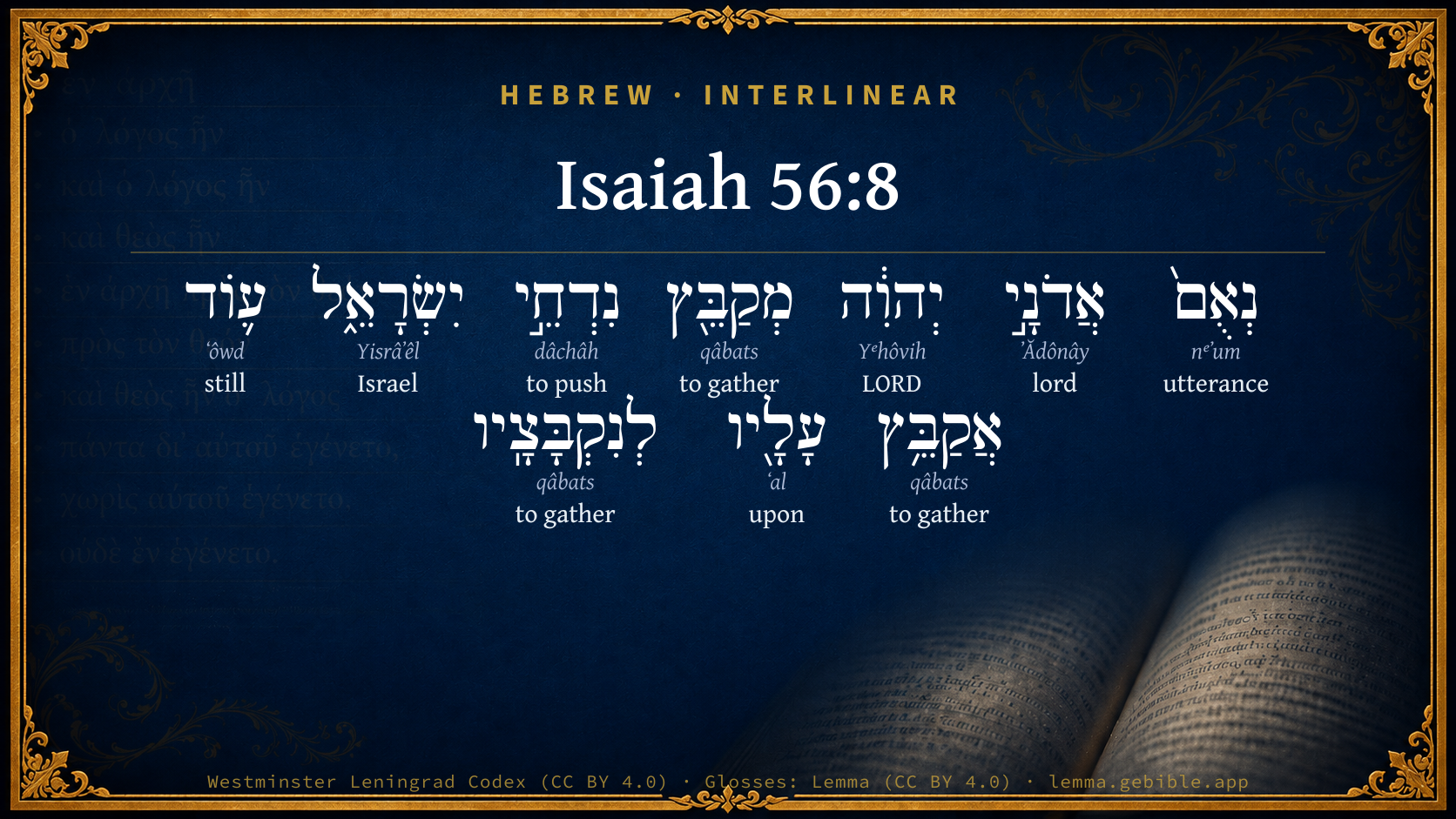
Hebrew (Westminster Leningrad Codex) Isaiah 56:8 appears in the Hebrew Old Testament. The text above is from the Westminster Leningrad Codex. Each word links to its Strong’s number, a concise gloss, and parsing drawn from the Open Scriptures Hebrew Bible morphology. Click any word for its full Brown-Driver-Briggs (BDB) entry.
Download image
Cite this verse

Isaiah 56:8 (World English Bible). Public Domain. Lemma interlinear Bible study tool, https://lemma.gebible.app/v/isaiah/56/8.

Show BibTeX & RIS
BibTeX
RIS
English Translation
The Lord Yahweh, who gathers the outcasts of Israel, says, Yet will I gather [others] to him, besides his own who are gathered.
World English Bible · Public Domain
Download a study sheet

One document with this verse’s original text, its word-by-word gloss line, the meaning frame, cross-references with their text, attributed commentary, and full source and license credits — printable, and it pastes into notes with its structure intact.

This verse Autodidact and up

Study sheet (.html) Plain text (.txt)

A passage Seminary Student

Up to 50 verses in one chapter. A passage sheet keeps up to 6 commentary sources and 12 cross-references per verse, in the order this page ranks them, and says so on the sheet whenever that leaves anything out. Ask for a single verse and you get the Autodidact verse sheet above.

Everything on this page stays free to read, with no account — the sheet is a download of what is already on screen, not access to it.

Want to remove ads? Support Godless Engineer
Compare translations 3

The same verse in 3 English versions, stacked beneath the original-language interlinear above. Click any original word for its lexicon entry.

Each is an independent rendering of the whole verse — the interlinear is not word-aligned to these translations.

Highlighted words mark where these versions differ — a whole-verse word diff, not a word-by-word alignment.

  • World English Bible Public Domain
    The Lord Yahweh, who gathers the outcasts of Israel, says, Yet will I gather [others] to him, besides his own who are gathered.
  • King James Version Public Domain
    The Lord GOD, which gathereth the outcasts of Israel saith, Yet will I gather others to him, beside those that are gathered unto him.
  • unfoldingWord Literal Text CC BY-SA 4.0
    —the declaration of Lord Yahweh, the one gathering the outcasts of Israel— “yet I will gather to him, to his gathered ones.” q1

unfoldingWord Literal Text — © unfoldingWord, licensed CC BY-SA 4.0. Word-aligned USFM3 via Door43 (git.door43.org/unfoldingWord/en_ult).

Versions to compare (up to 4)

3 of 4 selected

Show all 18 translations

Every available English version of this verse, each an independent rendering of the whole verse.

  • World English Bible Public Domain
    The Lord Yahweh, who gathers the outcasts of Israel, says, Yet will I gather [others] to him, besides his own who are gathered.
  • Berean Standard Bible Public Domain
    Thus declares the Lord GOD, who gathers the dispersed of Israel: “I will gather to them still others besides those already gathered.”
  • Majority Standard Bible Public Domain
    Thus declares the Lord GOD, who gathers the dispersed of Israel: “I will gather to them still others besides those already gathered.”
  • King James Version Public Domain
    The Lord GOD, which gathereth the outcasts of Israel saith, Yet will I gather others to him, beside those that are gathered unto him.
  • American Standard Version (1901) Public Domain
    The Lord Jehovah, who gathereth the outcasts of Israel, saith, Yet will I gather `others' to him, besides his own that are gathered.
  • Revised Version (1885) Public Domain
    The Lord GOD which gathereth the outcasts of Israel saith, Yet will I gather others to him, beside his own that are gathered.
  • Geneva Bible (1599) Public Domain
    The Lord God sayth, which gathereth the scattered of Israel, Yet wil I gather to them those that are to be gathered to them.
  • Douay-Rheims (1899) Public Domain
    The Lord God, who gathereth the scattered of Israel, saith: I will still gather unto him his congregation.
  • Young's Literal Translation Public Domain
    An affirmation of the Lord Jehovah, Who is gathering the outcasts of Israel: `Again I gather to him -- to his gathered ones.'
  • Literal Standard Version CC BY-SA 4.0
    A declaration of Lord YHWH, || Who is gathering the outcasts of Israel: “Again I gather to him—to his gathered ones.”
  • Unlocked Literal Bible CC BY-SA 4.0
    this is the declaration of the Lord Yahweh, who gathers the outcasts of Israel— I will still gather others in addition to them.”
  • unfoldingWord Literal Text CC BY-SA 4.0
    —the declaration of Lord Yahweh, the one gathering the outcasts of Israel— “yet I will gather to him, to his gathered ones.” q1
  • Darby Bible Public Domain
    The Lord Jehovah, who gathereth the outcasts of Israel, saith: Yet will I gather [others] to him, with those of his that are gathered.
  • World Messianic Bible Public Domain
    The Lord GOD, who gathers the outcasts of Israel, says, “I will yet gather others to him, in addition to his own who are gathered.”
  • Webster's Bible Public Domain
    The Lord GOD who gathereth the outcasts of Israel, Yet will I gather others to him, besides those that are gathered to him.
  • Free Bible Version CC BY-SA 4.0
    This is what the Lord God says, who brought back the scattered people of Israel: I will bring back still others to join you.
  • Bible in Basic English Public Domain
    The Lord God, who gets together the wandering ones of Israel, says, I will get together others in addition to those of Israel who have come back.
  • JPS Tanakh (1917) Public Domain
    Saith the Lord GOD who gathereth the dispersed of Israel: Yet I will gather others to him, beside those of him that are gathered.

Literal Standard Version (2020), Covenant Press — licensed CC BY-SA 4.0. Text via the HelloAO Bible API (eBible.org). Unlocked Literal Bible (unfoldingWord) — licensed CC BY-SA 4.0. Text via the HelloAO Bible API (eBible.org). unfoldingWord Literal Text — © unfoldingWord, licensed CC BY-SA 4.0. Word-aligned USFM3 via Door43 (git.door43.org/unfoldingWord/en_ult). Free Bible Version, Dr. Jonathan Gallagher — licensed CC BY-SA 4.0. Text via the HelloAO Bible API (eBible.org).

Word by word

More ways to search: Search by grammar → Find every occurrence → Compare this word →

Practice this passage: Drill this verse → Learn its vocabulary →

נִדְחֵ֣י
dâchâh
H1760
“pushing”
Verb, Niphal, Participle Active, Masculine, Plural, Construct
Part of Speech
Verb
Stem
Niphal
Form
Participle Active
Gender
Masculine
Number
Plural
State
Construct
Full BDB Definition

Origin: a primitive root

TWOT: 420

to push, thrust, chase, overflow, totter, sore, drive away or out, be outcast, be cast down - (Qal) to push, push violently - (Niphal) to be thrust down, be cast down - (Pual) to be thrust down
  1. נְאֻם֙ nᵉʼum H5002 “utterance of” Noun, Common, Masculine, Singular, Construct
  2. אֲדֹנָ֣י ʼĂdônây H136 “Lord · my” Noun, Common, Masculine, Plural, Construct + Suffix, Personal, 1st Person, Common, Singular
  3. יְהוִ֔ה Yᵉhôvih H3069 “LORD” Noun, Proper
  4. מְקַבֵּ֖ץ qâbats H6908 “gathering” Verb, Piel, Participle Active, Masculine, Singular, Absolute
  5. יִשְׂרָאֵ֑ל Yisrâʼêl H3478 “Israel” Noun, Proper
  6. ע֛וֹד ʻôwd H5750 “still” Adverb
  7. אֲקַבֵּ֥ץ qâbats H6908 “to gather” Verb, Piel, Imperfect, 1st Person, Common, Singular
  8. עָלָ֖יו ʻal H5921 “upon · him” Preposition + Suffix, Personal, 3rd Person, Masculine, Singular
  9. לְנִקְבָּצָֽיו qâbats H6908 “to/for · gathering · him” Preposition + Verb, Niphal, Participle Active, Masculine, Plural, Construct + Suffix, Personal, 3rd Person, Masculine, Singular

About this verse

These counts appear in no published source. They are computed here, from the morphology-tagged text and Lemma’s own curated glosses. What Lemma adds →

10
words
8
distinct lemmas
Prophets
section

Notable vocabulary

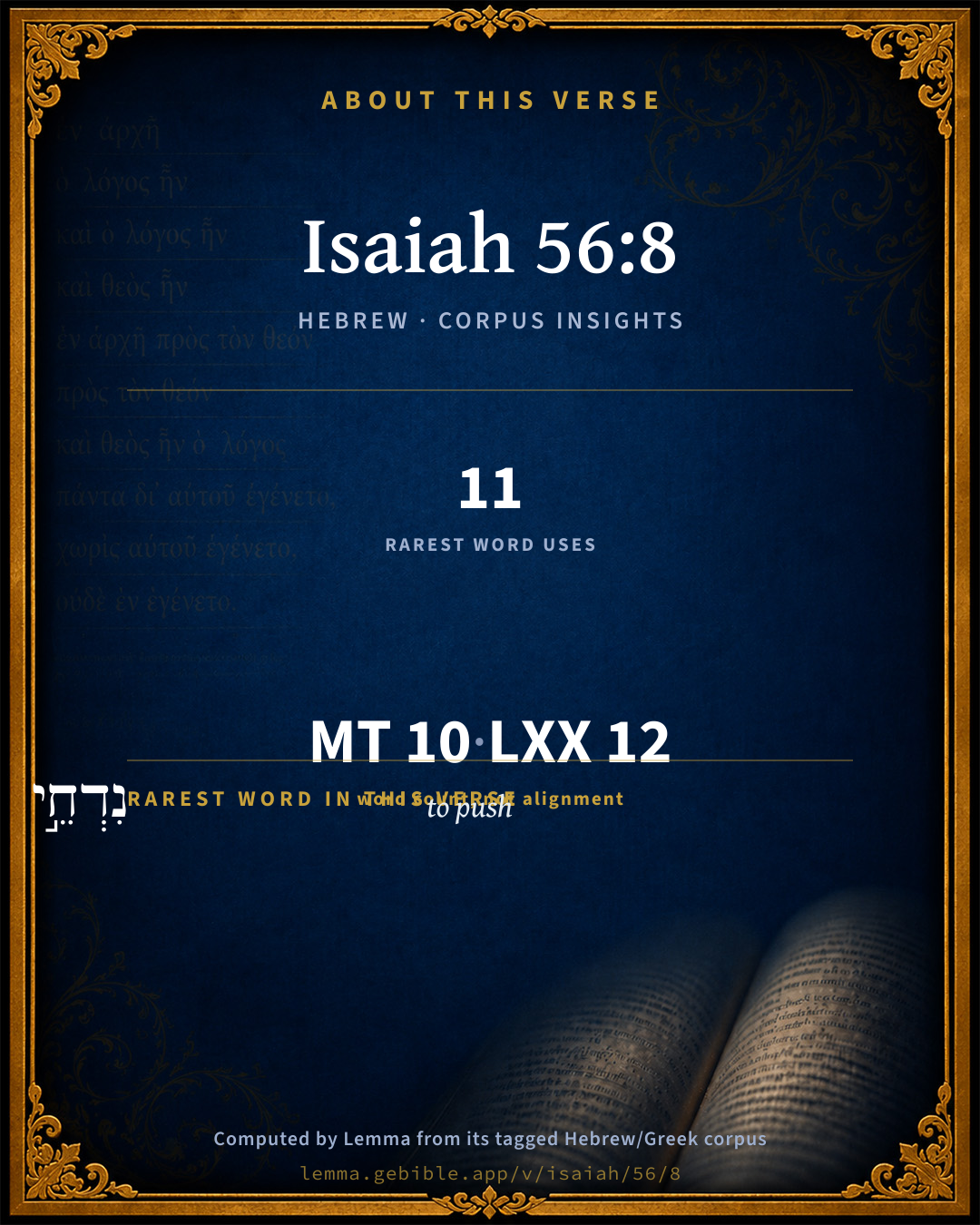
The rarest word here is נִדְחֵ֣י to push H1760 — appearing just 11 times in the whole Hebrew Bible.

Shared distinctive vocabulary

נִדְחֵ֣י to push H1760 occurs in 10 verses of the Hebrew Bible. Also found in:

Grammatical profile

  • 4 verbs
  • 4 nouns
  • 1 preposition
  • 1 adverb

Verb forms

  • מְקַבֵּ֖ץ Piel · Participle Active
  • נִדְחֵ֣י Niphal · Participle Active
  • אֲקַבֵּ֥ץ Piel · Imperfect
  • לְנִקְבָּצָֽיו Niphal · Participle Active

Repetition

A word recurs within this verse — often emphatic in Hebrew:

  • מְקַבֵּ֖ץ to gather H6908 ×3

Hebrew & Septuagint length

In English translation the verse runs 23 words from the Hebrew and 17 from the Septuagint (LXX English) — closely comparable.

A rough comparison of the two English renderings, which tokenize alike — not a word-level alignment.

Word counts can differ between the Hebrew and the Greek without any difference in meaning — e.g. the Hebrew direct-object marker אֵת has no separate Greek word, and Greek often adds the article ὁ.

In the original languages it is 10 Hebrew tokens and 12 Greek tokens — but the two are counted differently (Hebrew bundles its prefixes and suffixes into one token; the Greek is in lemma form), so that isn’t a like-for-like length.

Cross-references

22

Topical passages linked to Isaiah 56:8 in the Treasury of Scripture Knowledge — connected by theme and wording, ordered by reader-vote popularity; previews shown in the World English Bible.

  • John 10:16 I have other sheep, which are not of this fold. I must bring them also, and they will hear my voice. They will become one flock with one shepherd.
  • Isaiah 54:7 For a small moment have I forsaken you; but with great mercies will I gather you.
  • Isaiah 60:3–11 Nations shall come to your light, and kings to the brightness of your rising.
  • Genesis 49:10 The scepter will not depart from Judah, Nor the ruler's staff from between his feet, Until he comes to whom it belongs. To him will the obedience of the peoples be.
  • Isaiah 66:18–21 For I [know] their works and their thoughts: [the time] comes, that I will gather all nations and languages; and they shall come, and shall see my glory.
  • Jeremiah 30:17 For I will restore health to you, and I will heal you of your wounds, says Yahweh; because they have called you an outcast, [saying], It is Zion, whom no man seeks after.
  • Jeremiah 31:10 Hear the word of Yahweh, you nations, and declare it in the isles afar off; and say, He who scattered Israel will gather him, and keep him, as shepherd does his flock.
  • Zechariah 10:8–10 I will signal for them, and gather them; For I have redeemed them; And they will increase as they have increased.
  • Ephesians 1:10 to an administration of the fullness of the times, to sum up all things in Christ, the things in the heavens, and the things on the earth, in him;
  • Ephesians 2:14–16 For he is our peace, who made both one, and broke down the middle wall of partition,
  • Psalms 106:47 Save us, Yahweh, our God, Gather us from among the nations, To give thanks to your holy name, To triumph in your praise!
  • Psalms 147:2 Yahweh builds up Jerusalem. He gathers together the outcasts of Israel.
  • Isaiah 11:11–12 It shall happen in that day, that the Lord will set his hand again the second time to recover the remnant of his people, who shall remain, from Assyria, and from Egypt, and from Pathros, and from Cush, and from Elam, and from Shinar, and from Hamath, and from the islands of the sea.
  • Isaiah 27:12–13 It shall happen in that day, that Yahweh will beat off [his fruit] from the flood of the River to the brook of Egypt; and you shall be gathered one by one, you children of Israel.
  • Isaiah 43:6 I will tell the north, Give up; and to the south, Don't keep back; bring my sons from far, and my daughters from the end of the earth;
  • Isaiah 49:12 Behold, these shall come from far; and, behold, these from the north and from the west; and these from the land of Sinim.
  • Isaiah 49:22 Thus says the Lord Yahweh, Behold, I will lift up my hand to the nations, and set up my ensign to the peoples; and they shall bring your sons in their bosom, and your daughters shall be carried on their shoulders.
  • Hosea 1:11 The children of Judah and the children of Israel will be gathered together, and they will appoint themselves one head, and will go up from the land; for great will be the day of Jezreel.
  • Micah 4:6 "In that day," says Yahweh, "I will assemble that which is lame, And I will gather that which is driven away, And that which I have afflicted;
  • John 11:52 and not for the nation only, but that he might also gather together into one the children of God who are scattered abroad.
  • Psalms 107:2–3 Let the redeemed by Yahweh say so, Whom he has redeemed from the hand of the adversary,
  • Zephaniah 3:18–20 Those who are sad for the appointed feasts, I will remove from you. They are a burden and a reproach to you.

Cross-references courtesy of OpenBible.info (CC BY 4.0).

Hebrew and Greek witnesses Masoretic Hebrew ↔ Greek Septuagint

The same verse in the two great witnesses to the Old Testament, shown verse-for-verse.

These are two independent witnesses, not word-aligned to each other, and the Septuagint is shown in lemma (dictionary) form.

Hebrew Isaiah 56:8 Masoretic · Westminster Leningrad Codex

נְאֻם֙ אֲדֹנָ֣י יְהוִ֔ה מְקַבֵּ֖ץ נִדְחֵ֣י יִשְׂרָאֵ֑ל ע֛וֹד אֲקַבֵּ֥ץ עָלָ֖יו לְנִקְבָּצָֽיו

The Lord Yahweh, who gathers the outcasts of Israel, says, Yet will I gather [others] to him, besides his own who are gathered.

World English Bible · Public Domain

Greek LXX Isaiah 56:8 Septuagint · lemma form

εἶπον κύριος ὁ συνἄγω ὁ διασπείρω ἰσραήλ ὅτι συνἄγω ἐπί αὐτός συναγωγή

says the Lord that gathers the dispersed of Israel; for I will gather to him a congregation.

LXX2012 (modern English Septuagint) · Public Domain

On this verse, John Gill's Exposition discusses the Septuagint’s reading. Read the note in Commentary ↓

Hebrew: Westminster Leningrad Codex (CC BY 4.0). Greek: Septuagint (public domain); English from LXX2012 (modern English Septuagint) (Public Domain). How the Septuagint differs from the Hebrew →

Targum (Aramaic paraphrase)

1

The Targum is the ancient Jewish Aramaic paraphrase of the Hebrew Scriptures — an interpretive translation, not the Hebrew text itself. Onkelos (literal) and Pseudo-Jonathan (expansive) render the Torah, and Jonathan the Prophets. Coverage is partial: where no permissively-licensed English translation exists for a verse, only the Aramaic is shown. This is verse-level text, not a word-by-word alignment to the Hebrew.

  1. Targum Jonathan Prophets (Joshua–Malachi)
    אֲמַר יְיָ אֱלֹהִים דַעֲתִיד לְכַנָשָׁא מְבַדְרֵי יִשְׂרָאֵל עוֹד אֲקָרֵב גַלְוַתְהוֹן לְכַנָשָׁא יַתְהוֹן:

    The Lord God, who will gather together the scattered ones of Israel, saith, I will again gather their captivity, by collecting them together.

    Targum Jonathan — Aramaic: “Mikraot Gedolot” (public domain). English: “Sefaria Community Translation” (CC0 1.0 (public-domain dedication)); “London "Chaldee Paraphrase," 1871” (public domain). Text via Sefaria.

Commentary

Notes on Isaiah 56:8 from classic Christian and Jewish commentators (each source and its license shown beneath its notes). The classic Christian expositions comment on the surrounding passage and are grouped to its opening verse, so a note may address several verses; the Jewish commentaries on the Tanakh (Rashi and others) are per-verse, so they appear only where the commentator wrote on this verse.

Lemma curates 59 commentaries, every one of them public domain or Creative Commons licensed, each selected and text-cleaned for this edition rather than reprinted as found. About our sources →

Trapp's Complete Commentary

John Trapp

Isa 56:8 The Lord GOD which gathereth the outcasts of Israel saith, Yet will I gather [others] to him, beside those that are gathered unto him.

Ver. 8. Which gathereth the outcasts of Israel.] According to that ancient promise of his. {Deu 30:4} None of his shall be lost for looking after; he will "fetch back his banished," as that witty woman said. {2Sa 14:14}

Yet will I gather others to him.] Strangers, eunuchs, all mine "other sheep that are not yet of this fold," {Joh 10:16} together with all my stragglers; those that are relapsed will I recover.

John Trapp, A Commentary or Exposition upon All the Books of the Old and New Testament (1647–1656) — public domain. Text from a community e-Sword module.

The Biblical Illustrator

Joseph S. Exell

Isa_56:8

The Lord God which gathereth the outcasts of Israel saith

An important Divine declaration

Declaration of the Lord, Jehovah: gathering the outcasts of Israel, I roll further gather beyond it to Its gathered ones.

That Isa_56:8 declares something of importance, and, because it might possibly seem strange, something to be solemnly confirmed, is shown by the expression, which is in itself solemn, and is here placed at the head of the declaration. So far is it from being the case that Gentiles who love Jehovah will be excluded from the congregation, that it is rather the design of Jehovah to gather some from among the Gentiles and add them to the gathered diaspora of Israel. The double name of God likewise, points to something important. (F. Delitzsch, D. D.)

Others to be gathered

Gods work now is that of gathering. There was a time when it was scattering. Man built the tower of Babel, which was intended to be the centre of unity, the armoury of power, and the seat of dominion, whence some mighty Nimrod might sway his sceptre over all the human race: but the Lord would not have it so. Infinite wisdom baffled finite ambition. Now the Lord is gathering together in one the children of God which are scattered abroad. Jesus hath made both Jew and Gentile one, breaking down every wall of partition. This ingathering process is going on every day by the testimony of the Word, and it is to be continued until the end of time.

I. THE INSTANCES MENTIONED: instances of gathering by the hand of the Lord, who is described as The Lord God which gathereth the outcasts of Israel. Outcasts have been gathered, and this is the token that others shall be gathered. I suppose Isaiah first alludes to the banished who had been carried away captive to Babylon and to all parts of the East, but who were at different times restored to their land. But I prefer to use the text in reference to our Divine Lord, seeing that to Him shall the gathering of the people be.

1. When He was here below He gathered the outcasts of Israel by His ministry.

2. He gathered them by forgiving their sins. This brought them nearer still, and held them there.

3. Our Lord gathered many by graciously helping them. He met with some whose great trial was sore affliction, temptation and sorrow. Magdalene is a chief instance.

4. He gathered them, also, so as to enrol them under HIS banner. It was a marvellous moment for Levi, when he sat at the receipt of custom, when

Jesus called him. You will, perhaps, think that my Masters gathering power lay in His being here Himself. It is true there was a matchless charm about Him, and yet to let us know that we must know Him no longer after the flesh, there was not even in the charms of Christs most blessed Person enough of power to prevent the people crying, Crucify Him, crucify Him. His power is spiritual, the power of His own Spirit, and therefore it is exercised now though His bodily presence is removed.

II. THE. PROMISE UTTERED. The Lord God which gathereth the outcasts of Israel saith, etc.

1. This promise is very wide. It means in the first place that the Gentiles should be brought to know the Lord. It was a bright day when first of all the centurion of Caesarea sent men to Joppa, and received a visit from Peter, and was baptized of him. Fair also was the day when the Ethiopian eunuch was baptized of Philip. How strange it must have seemed at first to the apostles, who were all Jews, and very strongly Jewish too, especially Peter, to see the Gentiles gathered. One marvels that Paul was not more narrow in heart, considering his birth and education, but he had vanquished his old notions, and gloried in being the apostle of the Gentiles. It is delightful to think of men of divers colours coming to Christ, and in the best possible manner proving the unity of our race. What would the twelve have thought if they could have foreseen that the Gospel which they preached would bind in one brotherhood all races of men?

2. The promise is continuous. Yet will I gather others. That was true when Isaiah stated it; it would have been true if Peter had quoted it on the morning of Pentecost. It was quite true when Carsy acted upon it, and started on what men thought his mad enterprise, to go as a consecrated cobbler to convert the learned Brahmins of India. It is quite as true now. If the promise had been written this morning and the ink were not yet dry it would be no more true than it is now:--Yet will I gather others to Him.

3. The promise is most graciously encouraging, because it evidently applies very pointedly to outcasts. Has there strayed into this house of prayer an outcast from society? Hearken thou to this word. But if not an outcast from society, it may be you are an outcast in your own esteem.

4. The promise is absolute. This is the kind of language which only an omnipotent being can use as to mens minds.

III. THE FACTS WHICH SUSTAIN OUR FAITH IN THIS PROMISE.

1. The perpetuity of the Gospel. Still is the good news preached among you.

2. The blood of atonement has not lost its power.

3. The Spirit of God is with us still.

4. The glory and majesty of the Gospel, or rather the greatness of the glory of God in the Gospel, demands that many more should be gathered than have as yet been enfolded in the Church.

5. There must be many more souls to be ingathered because of the longings of the saints. They are not satisfied unless they see conversions. The Church needs more conversions. We never prosper as a Church unless we have a fresh stream of young blood running into us.

IV. THE CONDUCT CONSISTENT WITH THIS PROMISE.

1. To believe it, and then to pray about 2:2. If you pray, you must work, for prayer without endeavour is hypocrisy.

3. Expect to see others gathered.

4. Those who have not yet been gathered should be encouraged to hope. (C. H.Spurgeon.)

The Biblical Illustrator, edited by Joseph S. Exell (c. 1880s–1900s) — public domain. Text from a community e-Sword module.

Joseph Benson's Commentary

Isa 56:8. The Lord which gathereth the outcasts — Who will gather to himself, and bring into their own land, those poor Israelites which are or shall be cast out of it, and dispersed in divers parts of the world; saith, Yet will I gather others to him — As there are some few Gentiles whom I have made proselytes and added to the Jewish Church, so I will make another and far more comprehensive gathering of the Gentiles, whom I will bring into the same church with the Jews, making both Jews and Gentiles one flock under one shepherd.

Joseph Benson's Commentary on the Old and New Testaments (1811–1818) — public domain. Text from a community e-Sword module.

The Preacher's Complete Homiletical Commentary

Joseph S. Exell (gen. ed.)

OTHERS TO BE GATHERED

Isa_56:8. The Lord God which gathereth the outcasts of Israel, &c.

God’s work is now that of gathering, &c.

I. ENCOURAGEMENT TO THOSE WHO SEEK THE LORD. Note well the instances mentioned: instances of gathering by the hand of the Lord. Outcasts have been gathered, and this is the token that others shall be gathered.

1. I suppose Isaiah alludes to the banished who had been carried away captive to Babylon and to all parts of the East, but who were at different times restored to their land. God, who brought His people out of Babylon, can bring men out of sin; He who loosed captives from bondage, can liberate spirits from despair, &c.

2. But I prefer to use the text in reference to our Divine Lord and Master, seeing that to Him shall the gathering of the people be. When He was here below He gathered the outcasts of Israel.

(1.) By His ministry (Luk_15:1-2, &c.).

(2.) By forgiving their sins. This brought them nearer still and held them there.

(3.) By graciously helping them. Magdalene, Thomas. Since He gathered to Himself a woman out of whom He cast seven devils, and a man from whom a whole legion were made to flee, why should He not deliver those of you who are under bondage now?

(4.) So as to enrol them under His banner. Levi, when he sat at the receipt of custom. Three thousand souls on the day of Pentecost.

II. THE PROMISE UTTERED.

1. It is very wide. The Gentiles should be called to know the Lord.

2. It is continuous. It was true when Isaiah stated it; it would have been true if Peter had quoted it on the morning of Pentecost. It was quite true when Carey acted upon it, and started on what men thought his mad enterprise, to go as a consecrated cobbler to convert the learned Brahmins of India, and to lay the foundation of Messiah’s kingdom there. It is quite as true now.

3. It is most graciously encouraging. It evidently applies very pointedly to outcasts. If not an outcast from society, it may be you are an outcast in your own esteem. How sweetly encouraging this should be to all of you that are sick of yourselves, and sick of your sins! There is no hope elsewhere, but there is hope in Jesus, for He is mighty to deliver, &c. Trust in Him.

4. The promise is absolute. He speaks as a king. This is the kind of language which only an Omnipotent being can use.

III. THE FACTS WHICH SUSTAIN OUR FAITH IN THIS PROMISE. We believe it, whether or no; fact or no fact, to back it up, God’s Word is sure; but still this will help some who have but slender confidence.

1. The perpetuity of the Gospel.

2. The blood of atonement has not lost its power.

3. The Spirit of God is with us still.

4. The glory and majesty of the Gospel, or rather the greatness of the glory of God in the Gospel.

5. The longings of the saints.

IV. THE CONDUCT CONSISTENT WITH THIS PROMISE.

1. Let us view this question with reference to God’s people. Believe it, and then pray about it. If you pray, you must work, for prayer without endeavour is hypocrisy; expect to see others gathered. Look out for them, and be continually saying, “Where are these others?”

2. Those who have not yet been gathered. They should be encouraged to hope. What God has done for others He can do for you.—C. H. Spurgeon: Metropolitan Tabernacle Pulpit, No. 1437.

The Preacher's Complete Homiletical Commentary (gen. ed. Joseph S. Exell; Funk & Wagnalls, c. 1892) — public domain (pre-1929). A full-Bible homiletical/sermon-outline anthology covering 65 of 66 books (2 John is absent from the source module). Text from a community e-Sword module.

Tyndale Open Study Notes

Tyndale Open Resources

56:8 The outcasts of Israel were those dispersed among the nations as the result of the Exile (see also 11:12). • The others would be eunuchs and Gentiles (56:3-7; see also 57:19; John 10:16).

Tyndale Open Study Notes — © Tyndale Open Resources, licensed CC BY-SA 4.0. Text via the HelloAO Bible API.

Jamieson, Fausset & Brown

Robert Jamieson, A. R. Fausset & David Brown

Jehovah will not only restore the scattered outcasts of Israel (Isa 11:12; Psa 147:2) to their own land, but "will gather others ('strangers') to him (Israel), besides those gathered" (Margin, "to his gathered"; that is, in addition to the Israelites collected from their dispersion), (Joh 10:16; Eph 1:10; Eph 2:19).

Jamieson, Fausset & Brown — Commentary Critical and Explanatory on the Whole Bible (1871) — public domain (CC PDM 1.0). Text via the HelloAO Bible API.

Ellicott's Commentary for English Readers

(8) The Lord God . . . saith.—The phrase is the normal one for introducing an oracle of special importance. This, so to speak, was to be one of the “faithful sayings” of Isaiah. We can hardly fail to find in Joh_10:16 a deliberate reproduction of Isaiah’s thought. The first clause refers clearly to the gathering of the heathen as following on that of the “outcasts” of Israel.

A Bible Commentary for English Readers, edited by Charles John Ellicott (1878–1897) — public domain. Text from a community e-Sword module.

The Cambridge Bible for Schools and Colleges

gen. ed. J. J. S. Perowne

8. The Lord God … saith] Saith the Lord Jehovah &c. The formula usually follows the sentence to which it refers; here it introduces it, as ch. Isa_1:24; Zec_12:1; Psa_110:1.

which gathereth the dispersed of Israel] Cf. ch. Isa_11:12; Psa_147:2.

Yet will I gather others &c.] Lit. “I will yet further gather to him, to his gathered ones.” “His gathered ones” is the antithesis to the “dispersed” above. The language certainly suggests (though it may not absolutely prove) that a partial gathering has taken place: the promise is that yet more shall be gathered, and, amongst these, men from “all peoples.”

The Cambridge Bible for Schools and Colleges (gen. ed. J. J. S. Perowne; Cambridge University Press, 1878–1918) — public domain. Text from a community e-Sword module.

John Gill's Exposition

The Lord God, which gathereth the outcasts of Israel, saith,.... Not the outcasts of literal Israel, the captives in Babylon, and elsewhere; but of spiritual Israel, and who are cast out, not by the Lord, but by the men of the world; who cast out their names as evil, who call them outcasts, and account them the offscouring of all things, Jer 30:17 or rather this character of them may represent what they appear to be in a state of nature, when they seem to be neglected, and not taken notice of by the Lord, as if they were not his people, or beloved by him; and are like the infant cast out into the open field to the loathing of its person; and yet such as these the Lord looks upon, takes notice of, and gathers in by an effectual calling. The Targum renders it, "the scattered of Israel"; and so the Septuagint, Vulgate Latin, Syriac, and Arabic versions; who, while unregenerate, are in a state of distance and alienation from God; are without God and Christ, and destitute of the Spirit; aliens from the people of God; wandering out of the way of God; are like lost sheep, scattered abroad by the fall of Adam, and their own actual transgressions: now the Lord God is the gatherer of these; which agrees with Christ, as the surety that engaged to look them up, and bring them in; and as he is a shepherd that gathers the lambs in his arms; and as he is the Saviour that came to seek and save that which was lost; and who, in consequence of having redeemed his people, gathers them by his Spirit and grace, through the ministry of the word; see Joh 10:16, it may be here meant of God the Father, whose purpose, plan, and contrivance, it was to gather together all his elect in one, even in Christ; and whose promise it is, that to him should the gathering of the people be; and who set him up as an ensign for that purpose, Eph 1:10 he now says:

yet will I gather others to him besides those that are gathered unto him; that is, to Israel; either to Christ, to whom these outcasts and scattered ones belong, who is sometimes called Israel, Isa 49:3, or to the church of God, whither they are brought when gathered, as in Isa 56:5, this is done in the effectual calling, when God's elect are called and gathered out of the world, among whom they have been, and are brought to Christ as their Saviour; as the Lord their righteousness; as the Mediator of the new covenant; and to his blood for pardon, justification, and salvation; and as the ark where they only can find rest for their souls; and as their King, to whom they become subject; and so they are gathered into the church as to a fold and good pasture. Now great numbers of these, both among the Jews and Gentiles, were gathered in at the first preaching of the Gospel, in the first times of the Gospel dispensation; and it is here promised that others besides them should be gathered in, even all that remain of the election of grace uncalled; the rest of those that the Father has given to Christ; the residue of those he has redeemed by his blood; such of the children of God as are yet scattered abroad, even all the remainder of the Lord's people, whether Jews or Gentiles; which will be fulfilled in the latter day, when the forces and fulness of the Gentiles shall be brought in, and the nation of the Jews converted at once. The words may be rendered, "yet will I gather unto him his that are to be gathered" (s); the other sheep uncalled; as many as are ordained unto eternal life; not one shall be lost or left behind. Kimchi mentions it as an exposition of his father's,

"after I have gathered the outcasts of Israel; yet will I gather, against them that are gathered, others against his gathered ones, and they are Gog and Magog;''

to which sense, he says, the following verse inclines: but much better is the sense of Aben Ezra,

"yet, will I gather proselytes to the gathered of Israel;''

for his "gathered ones", he says, refers to Israel. But it is best of all to interpret it of the nations gathered and added to the Christian churches in the times of Constantine, who before had been treated as outcasts, and persecuted for their profession of Christ; and of the conversion of various other people, as the Goths, Vandals, &c. in later ages. So Vitringa.

(s) "adhuc congregabo, super eum congregatos ejus", Pagninus, Montanus; "congregandos ejus", Forerius, Grotius.

John Gill's Exposition of the Whole Bible (1746–1763) — public domain (CC PDM 1.0). Text via the HelloAO Bible API.

Albert Barnes' Notes on the Bible

The Lord God - This verse is a continuation of the promise made in the previous verses, that those of other nations would be united to the ancient people of God. The sense is, that Yahweh would not only gather back to their country those who were scattered abroad in other lands, but would also call to the same privileges multitudes of those who were now aliens and strangers.

Which gathereth the outcasts of Israel - Who will collect again and restore to their own country those of the Jews who were scattered abroad - the exiles who were in distant lands.

Yet will I gather others to him - To Israel; that is, to the Jews (see Joh 10:16).

Besides those - Margin, ‘To his gathered.’ To those who are collected from their exile and restored to their own country, I will add many others of other nations. This completes the promise referred to in this and the previous chapters. The next verse introduces a new subject, and here a division should have been made in the chapters. The great truth is here fully expressed, that under the Messiah the pagan world would be admitted to the privileges of the people of God. The formidable and long-existing barriers between the nations would be broken down. No one nation would be permitted to come before God claiming any special privileges; none should regard themselves as in any sense inferior to any other portion of the world on account of their birth, their rank, their privileges by nature. Under this economy we are permitted to live - happy now in the assurance that though we were once regarded as strangers and foreigners, yet we are ‘now fellow-citizens with the saints and of the household of God’ Eph 2:19.

The whole world lies on a level before God in regard to its origin - for God ‘has made of one blood all the nations of mankind to dwell on the face of all the earth’ Act 18:26. The whole race is on a level in regard to moral character - for all have sinned, and come short of the glory of God. And the whole race is on a level in regard to redemption - for the same Saviour died for all; the same heaven is offered to all; and the same eternal and most blessed God is ready to admit all to his favor, and to confer on all everlasting life. What thanks do ‘we owe to the God of grace for the blessings of the eternal gospel; and how anxious should we be that the offers of salvation should in fact be made known to all people! The wide world may be saved, and there is not one of the human race so degraded in rank, or color, or ignorance, that he may not be admitted to the same heaven with Abraham and the prophets, and whose prayers and praises would not be as acceptable to God as those of the most magnificent monarch who ever wore a crown.

Albert Barnes' Notes on the Bible (1834–1885) — public domain. Text from a community e-Sword/MySword module.

Matthew Poole's English Annotations

Which gathereth the outcasts of Israel; which will gather to himself, and bring into their own land, those poor Israelites which are, or shall be, cast out of their own land, and from God’s presence, and dispersed in divers parts of the world.

Yet will I gather others to him, beside those that are gathered unto him; as there are some few Gentiles whom I have made proselytes, and added to the Jewish church, so I shall make another and a far more comprehensive gathering of the Gentiles, whom I shall bring into the same church with the Jews, making both Jews and Gentiles one fold under one Shepherd, as it is promised, Joh 10:16.

Matthew Poole's English Annotations on the Holy Bible (1683–1685) — public domain. Text from a community e-Sword/MySword module.

Whedon's Commentary on the Bible

Daniel D. Whedon

8. Outcasts — Equality thus declared, alike to Gentile and Jew, is no afterthought; not a new purpose sprung up from new exigencies in the course of history. It is found in the terms of the original covenant — “all the nations… shall be blessed in him.” Gen_18:18-19. Pursuant to this covenant Christ also said, (Joh_10:16,) “Other sheep I have,” referring to the original purpose that salvation shall be provided for all.

Daniel D. Whedon (gen. ed.), Commentary on the Old and New Testaments (1874–1909) — public domain. Text from a community e-Sword module.

The Pulpit Commentary

The Lord God; rather, the Lord Jehovah Adonai Jehovah. An unusual phrase. Which gathereth together the outcasts of Israel; i.e. the Lord who has pledged himself to bring back Israel from captivity, and to gather together Israel"s outcasts from all regions. (Isa_11:11 Isa_27:12, 13 43:5, 6, etc.) This same Lord now promises something further: "He will gather others also to Israel, besides his own gathered ones." Introduced with such emphasis and formality, this was probably, when delivered, a new revelation. In the present arrangement of the prophecies, however, it announces no novelty. The addition of Gentile members to the Israelite community has been declared frequently. (see Isa_44:5 Isa_55:5, etc.)

The Pulpit Commentary (1880–1919), ed. H.D.M. Spence-Jones & Joseph S. Exell — public domain. Text from a community e-Sword module.

John Wesley's Explanatory Notes

The Lord - Who will gather to himself, and bring into their own land, those that are cast out of their own land. Yet - I will make a far more comprehensive gathering of the Gentiles.

John Wesley, Explanatory Notes Upon the Whole Bible (1754–1765) — public domain. Text via the GEBible commentary corpus.

Keil & Delitzsch

C. F. Keil & F. Delitzsch

The expression "saying of the Lord" (Ne'um Jehovah), which is so solemn an expression in itself, and which stands here at the head of the following declaration, is a proof that it contains not only something great, but something which needs a solemn confirmation because of its strangeness. Not only is there no ground for supposing that Gentiles who love Jehovah will be excluded from the congregation; but it is really Jehovah's intention to gather some out of the heathen, and add them to the assembled diaspora of Israel. "Word of the Lord, Jehovah: gathering the outcasts of Israel, I will also gather beyond itself to its gathered ones." We only find ה נאם at the commencement of the sentence, in this passage and Zac 12:1. The double name of God, Adonai Jehovah, also indicates something great. עליו (to it) refers to Israel, and לנקבּציו is an explanatory permutative, equivalent to על־נקבציו; or else על denotes the fact that the gathering will exceed the limits of Israel (cf., Gen 48:22), and ל the addition that will be made to the gathered ones of Israel. The meaning in either case remains the same. Jehovah here declares what Jesus says in Joh 10:16 : "Other sheep I have which are not of this fold: them also I must bring, and they shall hear my voice; and there shall be one fold and one Shepherd:" "Jehovah one, and His name one," as it is expressed in Zac 14:9. Such as the views and hopes that have grown up out of the chastisement inflicted by their captivity. God has made it a preparatory school for New Testament times. It has been made subservient to the bursting of the fetters of the law, the liberation of the spirit of the law, and the establishment of friendship between Israel and the Gentile world as called to one common salvation.

Keil & Delitzsch — Biblical Commentary on the Old Testament (1861–1891) — public domain (CC PDM 1.0). Text via the HelloAO Bible API. (Old Testament only.)

J. A. Alexander on Isaiah

Joseph Addison Alexander

“Thus saith the Lord Jehovah, the gatherer of the outcasts of Israel, Still (more) will I gather upon him (in addition) to his gathered.” This may either mean, I will go on to gather still more of his outcasts, or, besides his outcasts I will gather others. There is less difference between the two interpretations than at first sight there might seem to be. In either case the words are applicable to the calling of the Gentiles. On the second supposition, which is commonly adopted, even by the Jewish writers, this is the direct and proper meaning of the words. But even on the other, they amount to the same thing, if we only give to Israel its true sense, as denoting not the Jewish nation as such, but the chosen people or the church of God, to which the elect heathen as really belong as the elect Jews, and are therefore just as much entitled to be called outcasts of Israel. It is true that our Savior uses a similar expression (lost sheep of the House of Israel) in a restricted application to the Israelites properly so called; but it is in a connection which brings the Jews and Gentiles into evident antithesis, and therefore leaves no doubt as to the sense in which the name Israel is to be understood.

Joseph Addison Alexander, The Prophecies of Isaiah (1846–1847; New York: Scribner, 1870–1878) — public domain. Text from a community e-Sword module.

unfoldingWord translationNotes

Door43 World Missions Community

this is the declaration of the Lord Yahweh, who gathers the outcasts of Israel

Yahweh speaks of himself by name to express the certainty of what he is declaring. AT: "this is what the Lord Yahweh, who gathers the outcasts of Israel, has declared" or "this is what I, Yahweh, who gather the outcasts of Israel, have declared" (See: First, Second, or Third Person)

translationWords

declare

Lord Yahweh

Israel

unfoldingWord translationNotes — © Distant Shores Media and the Door43 World Missions Community, licensed CC BY-SA 4.0. Source: git.door43.org/Door43/en_tn.

Rashi

Rabbi Shlomo Yitzchaki (Rashi)

I will yet gather of the heathens ([Mss. and K’li Paz:] of the nations) who will convert and join them.

(together with his gathered ones In addition to the gathered ones of Israel.)

Rashi on the Tanakh — English translations: “The Judaica Press complete Tanach with Rashi, translated by A. J. Rosenberg” (CC BY 4.0); “Pentateuch with Rashi's commentary by M. Rosenbaum and A.M. Silbermann, 1929-1934” (public domain); “The Metsudah Tanach series, Lakewood, N.J” (CC BY 4.0); and “The Book of Joshua, Metsudah Publications, 1997” (CC BY 4.0). Text via Sefaria.

Ibn Ezra

Rabbi Abraham ibn Ezra

The outcasts of Israel, that came from Babylon, Elam, and Assyria.

Beside those that are gathered unto him, that is, besides the proselytes. The meaning of the whole phrase is, Yet will I gather others to him, besides those that have already joined Israel. The suffix in לנקבציו, that are gathered unto him, refers to Israel.

Ibn Ezra on the Tanakh — English translations: “Sefaria Community Translation” (CC0 1.0 (public-domain dedication)); “Yalkut, Sifsei Chachomim Chumash, Metsudah Publications, 2009” (CC BY 4.0); and “Commentary of Ibn Ezra on Isaiah - trans. by M. Friedlander, 1873” (public domain). Text via Sefaria.

Lesson kit

Teaching starters — assembled from the data on this page, not authored interpretation. Every prompt links to the verse data it draws on. Edit before teaching.

Isaiah, in the Prophets, opens this verse with 10 words (8 distinct Hebrew lemmas). Its most distinctive word is dâchâh (“to push”). A historical commentator’s framing appears above. Read the whole chapter for the surrounding context.

Discussion questions

  1. How does “to push” (dâchâh) shape what this verse is saying?
  2. Psalms 35:5 shares the word «to push» with this verse. How do the two illuminate each other?
  3. “to gather” occurs 3× in this one verse. What is the effect of the repetition?
  4. These translations render this verse differently. What is at stake in choosing one wording over another?
  5. The verb «מְקַבֵּ֖ץ» is Piel Participle Active. How does its form color the action?
  6. Reading how Trapp's Complete Commentary and The Biblical Illustrator read this verse, where do the two commentators agree and where do they part?

Things to notice

Reading settings

Reading text

Shown beneath each verse's original-language words.

Old Testament
Old Testament edition

Read the OT as the Masoretic Hebrew (MT) or the Greek Septuagint (LXX).

English shown for the Greek Septuagint (in the Hebrew ↔ Greek comparison).

Comparing translations? Open the Compare panel on any verse page to stack up to four side by side.