
Psalms 130:3

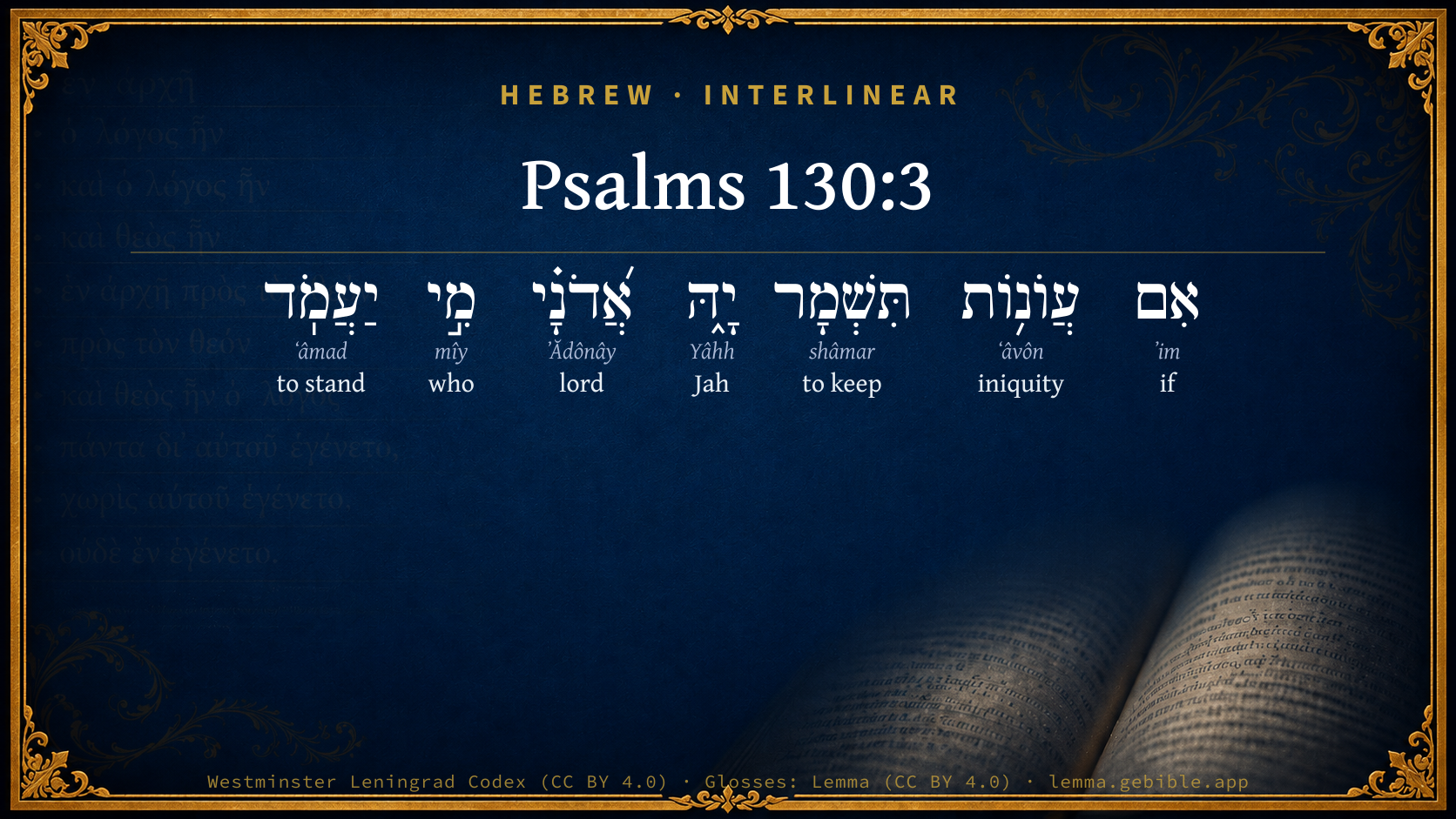
Hebrew (Westminster Leningrad Codex) Psalms 130:3 appears in the Hebrew Old Testament. The text above is from the Westminster Leningrad Codex. Each word links to its Strong’s number, a concise gloss, and parsing drawn from the Open Scriptures Hebrew Bible morphology. Click any word for its full Brown-Driver-Briggs (BDB) entry.
Download image
Cite this verse

Psalms 130:3 (World English Bible). Public Domain. Lemma interlinear Bible study tool, https://lemma.gebible.app/v/psalms/130/3.

Show BibTeX & RIS
BibTeX
RIS
English Translation
If you, Yah, kept a record of sins, Lord, who could stand?
World English Bible · Public Domain
Download a study sheet

One document with this verse’s original text, its word-by-word gloss line, the meaning frame, cross-references with their text, attributed commentary, and full source and license credits — printable, and it pastes into notes with its structure intact.

This verse Autodidact and up

Study sheet (.html) Plain text (.txt)

A passage Seminary Student

Up to 50 verses in one chapter. A passage sheet keeps up to 6 commentary sources and 12 cross-references per verse, in the order this page ranks them, and says so on the sheet whenever that leaves anything out. Ask for a single verse and you get the Autodidact verse sheet above.

Everything on this page stays free to read, with no account — the sheet is a download of what is already on screen, not access to it.

Want to remove ads? Support Godless Engineer
Compare translations 3

The same verse in 3 English versions, stacked beneath the original-language interlinear above. Click any original word for its lexicon entry.

Each is an independent rendering of the whole verse — the interlinear is not word-aligned to these translations.

Highlighted words mark where these versions differ — a whole-verse word diff, not a word-by-word alignment.

  • World English Bible Public Domain
    If you, Yah, kept a record of sins, Lord, who could stand?
  • King James Version Public Domain
    If thou, LORD, shouldest mark iniquities, O Lord, who shall stand?
  • unfoldingWord Literal Text CC BY-SA 4.0
    If you, Yah, would mark sins, Lord, who could stand?

unfoldingWord Literal Text — © unfoldingWord, licensed CC BY-SA 4.0. Word-aligned USFM3 via Door43 (git.door43.org/unfoldingWord/en_ult).

Versions to compare (up to 4)

3 of 4 selected

Show all 18 translations

Every available English version of this verse, each an independent rendering of the whole verse.

  • World English Bible Public Domain
    If you, Yah, kept a record of sins, Lord, who could stand?
  • Berean Standard Bible Public Domain
    If You, O LORD, kept track of iniquities, then who, O Lord, could stand?
  • Majority Standard Bible Public Domain
    If You, O LORD, kept track of iniquities, then who, O Lord, could stand?
  • King James Version Public Domain
    If thou, LORD, shouldest mark iniquities, O Lord, who shall stand?
  • American Standard Version (1901) Public Domain
    If thou, Jehovah, shouldest mark iniquities, O Lord, who could stand?
  • Revised Version (1885) Public Domain
    If thou, LORD, shouldest mark iniquities, O Lord, who shall stand?
  • Geneva Bible (1599) Public Domain
    If thou, O Lord, straightly markest iniquities, O Lord, who shall stand?
  • Douay-Rheims (1899) Public Domain
    The wicked have wrought upon my back: they have lengthened their iniquity.
  • Young's Literal Translation Public Domain
    If iniquities Thou dost observe, O Lord, who doth stand?
  • Literal Standard Version CC BY-SA 4.0
    If You observe iniquities, Lord YAH, who stands?
  • Unlocked Literal Bible CC BY-SA 4.0
    If you, Yahweh, would mark iniquities, Lord, who could stand?
  • unfoldingWord Literal Text CC BY-SA 4.0
    If you, Yah, would mark sins, Lord, who could stand?
  • Darby Bible Public Domain
    If thou, Jah, shouldest mark iniquities, Lord, who shall stand?
  • World Messianic Bible Public Domain
    If you, LORD, kept a record of sins, Lord, who could stand?
  • Webster's Bible Public Domain
    If thou, LORD, shouldest mark iniquities, O Lord, who shall stand?
  • Free Bible Version CC BY-SA 4.0
    Lord, if you kept a list of sins, who could escape being condemned?
  • Bible in Basic English Public Domain
    O Jah, if you took note of every sin, who would go free?
  • JPS Tanakh (1917) Public Domain
    If Thou, LORD, shouldest mark iniquities, O Lord, who could stand?

Literal Standard Version (2020), Covenant Press — licensed CC BY-SA 4.0. Text via the HelloAO Bible API (eBible.org). Unlocked Literal Bible (unfoldingWord) — licensed CC BY-SA 4.0. Text via the HelloAO Bible API (eBible.org). unfoldingWord Literal Text — © unfoldingWord, licensed CC BY-SA 4.0. Word-aligned USFM3 via Door43 (git.door43.org/unfoldingWord/en_ult). Free Bible Version, Dr. Jonathan Gallagher — licensed CC BY-SA 4.0. Text via the HelloAO Bible API (eBible.org).

Word by word

More ways to search: Search by grammar → Find every occurrence → Compare this word →

Practice this passage: Drill this verse → Learn its vocabulary →

About this verse

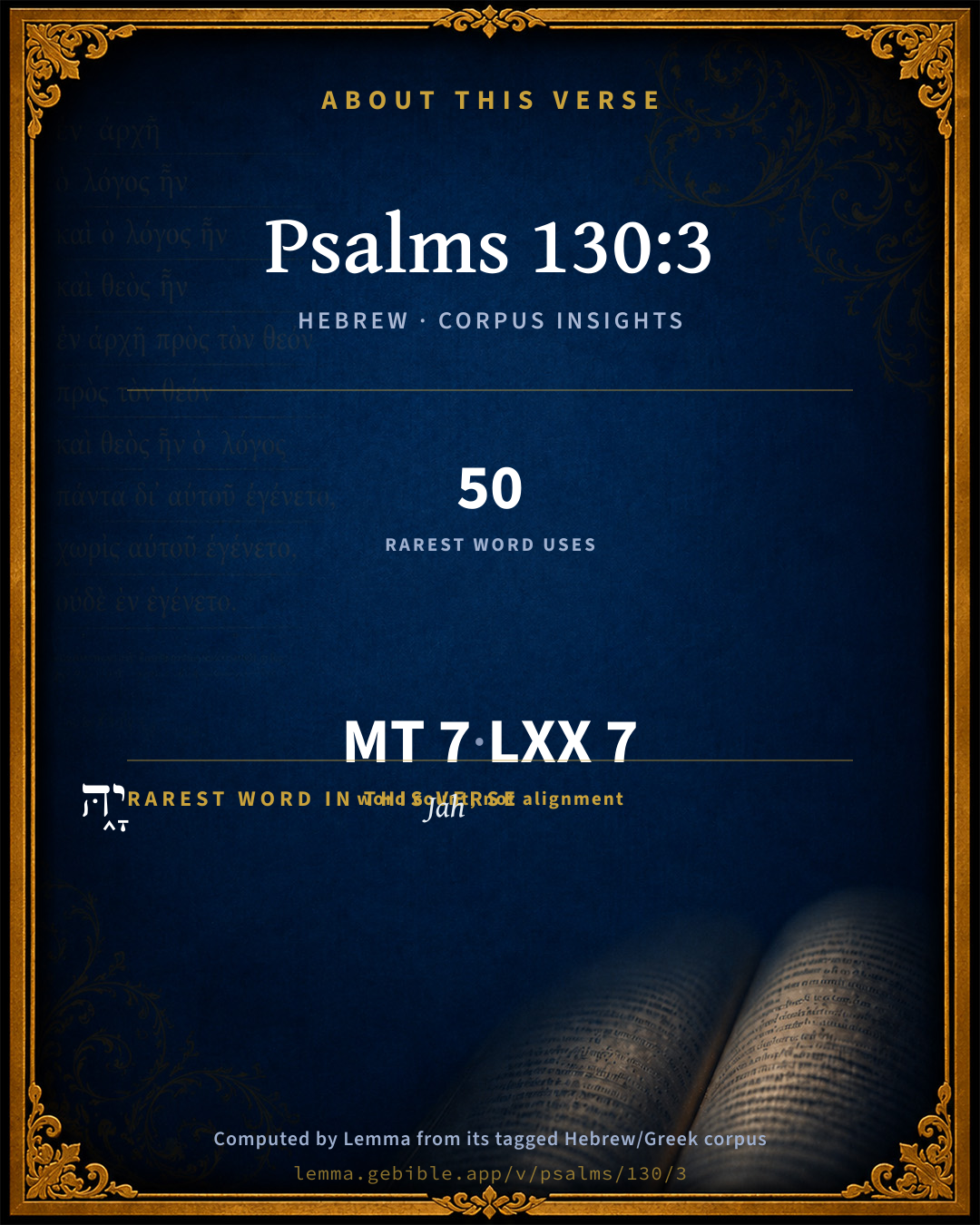
These counts appear in no published source. They are computed here, from the morphology-tagged text and Lemma’s own curated glosses. What Lemma adds →

7
words
7
distinct lemmas
Wisdom
section

Shared distinctive vocabulary

יָ֑הּ Jah H3050 occurs in 46 verses of the Hebrew Bible. Also found in:

Grammatical profile

  • 2 verbs
  • 3 nouns
  • 1 conjunction
  • 1 particle

Verb forms

  • תִּשְׁמָר Qal · Imperfect
  • יַעֲמֹֽד Qal · Imperfect

Hebrew & Septuagint length

In English translation the verse runs 12 words from the Hebrew and 12 from the Septuagint (LXX English) — the same length.

A rough comparison of the two English renderings, which tokenize alike — not a word-level alignment.

Word counts can differ between the Hebrew and the Greek without any difference in meaning — e.g. the Hebrew direct-object marker אֵת has no separate Greek word, and Greek often adds the article ὁ.

In the original languages it is 7 Hebrew tokens and 7 Greek tokens — but the two are counted differently (Hebrew bundles its prefixes and suffixes into one token; the Greek is in lemma form), so that isn’t a like-for-like length.

Cross-references

12

Topical passages linked to Psalms 130:3 in the Treasury of Scripture Knowledge — connected by theme and wording, ordered by reader-vote popularity; previews shown in the World English Bible.

  • Psalms 143:2 Don't enter into judgment with your servant, For in your sight no man living is righteous.
  • Psalms 76:7 You, even you, are to be feared. Who can stand in your sight when you are angry?
  • Romans 3:20–24 Because by the works of the law, no flesh will be justified in his sight. For through the law comes the knowledge of sin.
  • John 8:7–9 But when they continued asking him, he looked up and said to them, "He who is without sin among you, let him throw the first stone at her."
  • Job 10:14 If I sin, then you mark me. You will not acquit me from my iniquity.
  • Nahum 1:6 Who can stand before his indignation? Who can endure the fierceness of his anger? His wrath is poured out like fire, and the rocks are broken apart by him.
  • Revelation 6:17 for the great day of his wrath has come; and who is able to stand?"
  • Job 15:14 What is man, that he should be clean? He who is born of a woman, that he should be righteous?
  • Malachi 3:2 "But who can endure the day of his coming? And who will stand when he appears? For he is like a refiner's fire, and like launderer's soap;
  • Job 9:20 Though I am righteous, my own mouth shall condemn me. Though I am blameless, it shall prove me perverse.
  • Isaiah 53:6 All we like sheep have gone astray; everyone has turned to his own way; and Yahweh has laid on him the iniquity of us all.
  • Job 9:2–3 "Truly I know that it is so, But how can man be just with God?

Cross-references courtesy of OpenBible.info (CC BY 4.0).

Hebrew and Greek witnesses Masoretic Hebrew ↔ Greek Septuagint

The same verse in the two great witnesses to the Old Testament, shown verse-for-verse.

You’re reading Greek Psalm 129 (Hebrew Psalm 130). The Septuagint counts the superscription, so verse numbers can differ from the Hebrew — chapter-level alignment, not verse-by-verse. Numbering follows Rahlfs.

These are two independent witnesses, not word-aligned to each other, and the Septuagint is shown in lemma (dictionary) form.

Hebrew Psalms 130:3 Masoretic · Westminster Leningrad Codex

אִם עֲוֺנ֥וֹת תִּשְׁמָר יָ֑הּ אֲ֝דֹנָ֗י מִ֣י יַעֲמֹֽד

If you, Yah, kept a record of sins, Lord, who could stand?

World English Bible · Public Domain

Greek LXX Greek Psalm 129:3 Septuagint · lemma form

ἐάν ἀνομία παρατηρέω κύριος κύριος τίς ὑποἵστημι

If you, O Lord, should mark iniquities, O Lord, who shall stand?

LXX2012 (modern English Septuagint) · Public Domain

On this verse, John Gill's Exposition discusses the Septuagint’s reading. Read the note in Commentary ↓

Hebrew: Westminster Leningrad Codex (CC BY 4.0). Greek: Septuagint (public domain); English from LXX2012 (modern English Septuagint) (Public Domain). How the Septuagint differs from the Hebrew →

Commentary

Notes on Psalms 130:3 from classic Christian and Jewish commentators (each source and its license shown beneath its notes). The classic Christian expositions comment on the surrounding passage and are grouped to its opening verse, so a note may address several verses; the Jewish commentaries on the Tanakh (Rashi and others) are per-verse, so they appear only where the commentator wrote on this verse.

Lemma curates 59 commentaries, every one of them public domain or Creative Commons licensed, each selected and text-cleaned for this edition rather than reprinted as found. About our sources →

Trapp's Complete Commentary

John Trapp

Psa 130:3 If thou, LORD, shouldest mark iniquities, O Lord, who shall stand?

Ver. 3. If thou, Lord, shouldest mark iniquities] This and the next verse contains, saith one, the sum of all the Scriptures. Twice he here nameth the Lord, as desirous to take hold of him with both his hands. Extremity of justice he deprecateth; he would not be dealt with in rigour and rage. Extrema, fateor; commeritus sum, Deus; Quid enim aliud dixero? It is confessed I have deserved the extremity of thy fury; but yet let me talk with thee, {as Jer 12:1} or reason the case.

O Lord, who shall stand?] Stand in judgment, as Psa 1:5, and not fall under the weight of thy just wrath, which burneth as low as hell itself? How can any one escape the damnation of hell, which is the just hire of the least sin, Rom 6:23; and the best man’s life is fuller of sins than the firmament is of stars, or the furnace of sparks? Hence that of an ancient, Vae hominum vitae, quantumvis laudabili, si, remota misericordia, iudicetur, Woe to the best man alive should he be strictly dealt with! surely if his faults were but written in his forehead it would make him pull his hat over his eyes.

John Trapp, A Commentary or Exposition upon All the Books of the Old and New Testament (1647–1656) — public domain. Text from a community e-Sword module.

The Biblical Illustrator

Joseph S. Exell

Psa_130:3-4

If Thou, Lord, shouldst mark iniquities, O Lord, who shall stand?

A psalmists question and answer

I want to cheer some of you who at present hardly dare to pray. Yet you are the very people who may pray; you who think that the Lord will never hear you are the people whom lie is certain to hear and answer. When you are cleaned right out, when even the last rusty counterfeit farthing has been emptied out of your pocket, and you stand before your God as a wretched, starving, and bankrupt beggar, your abject poverty and dire need will commend you to His mercy and love.

I. First, we have a confession,--a confession which it will be well for every one of us to make (verse 3).

1. The psalmist may have felt that, if a human witness had been appointed to mark his sin, he might have been able to stand; but he says, If Thou, Lord, shouldest mark iniquities, who shall stand? You have sometimes had a white pocket handkerchief, and you have admired its whiteness; but when the snow has fallen, and you have laid your handkerchief upon the newly-fallen snow, it has looked quite yellow instead of white; and so is it with the holiest life when it is placed by the side of the life of Christ, or looked at in the light of the perfect law of God; then we see how stained and defiled it really is. So, Lord, we might stand up before our fellow-men, and plead Not guilty, when they belie and slander us, as they do; but, before Thy holy presence, if Thou, Lord, shouldest mark iniquities, O Lord, who shall stand?

2. The psalmist also speaks of a special form of guilt. He does not say, If Thou shouldest mark open and overt transgression,--the breaking out of bounds, and going astray in the paths of evil; but he says, If Thou shouldest mark iniquities. Pull that word to pieces, and it becomes in-equities--whatever is not right in the sight of God. If He were to mark those in-equities, who could stand before Him? Not one of us could do so.

3. Notice, next, how the psalmist inquires, Who shall stand? If there were any way of getting into heaven by a back door, or of hiding our sins from Gods eye, we might have some ground of hope; but there will come a day when we shall stand before God like prisoners at the bar. David, who probably wrote this psalm, had known many good men in his time, and he was accustomed to associate with the excellent of the earth; yet he says, O Lord, who shall stand? And I may repeat his question now, since God has marked our iniquities, Who among us can stand in His sight upon the footing of our own good works? Echo answers, Who?

II. The psalmists confidence (verse 4).

1. We know that there is forgiveness with God, because we have been informed by revelation concerning the character of God; and we find one prominent feature in the character of God is that lie delighteth in mercy.

2. Moreover, this impression, conveyed to us by the general tenor of the Scriptures, is deepened by the direct teaching of the Gospel. Why did Jesus come into the world to be a Saviour if God does not delight to save the lost? Why did He offer an atonement if it were not that sin might be put away by that atonement?

3. Further, we are assured that God will forgive sin because we have so many definite promises to that effect. This blessed Book is as full of promises and proclamations of mercy as an egg is full of meat. It abounds in messages of love and grace; it tells us that God willeth not the death of the sinner, that He delighteth not in judgment, for that is His left-handed work, but that His compassion freely moves towards the blackest and vilest of sinners when they repent, and return unto Him.

III. The consequence of forgiveness. There is forgiveness with Thee, that Thou mayest be feared. Thus, you see, the doctrine of free forgiveness actually produces in mans mind a fear of God. You might have thought the psalmist would have said, There is no forgiveness with Thee, that Thou mayest be feared; but it is not so.

1. The opposite of our text is very manifest. When there is no forgiveness, or when a man thinks there is none, what is the consequence? He is driven to despair, and despair often leads to desperate living. If there is no hope of forgiveness, then there is no proper fear of God.

2. Many are abiding in a state of carelessness, because they really do not know whether there is any pardon to be had. When a man is in doubt as to whether he can be forgiven, he says, I am afraid it would be a very long process, and I do not know whether I should get it even then. Perhaps, however, there is no pardon to be had, so I might become a religious man, and yet miss the forgiveness of sins. That is the thought of many, and therefore they become torpid and lethargic, careless and indifferent; but when the Holy Spirit teaches a man that there is forgiveness to be had, he would leap out of his very body rather than miss it.

3. How encouraging, too, is the belief that there is pardon to be had! But, more, how sanctifying is the actual reception of it! Walk carefully, prayerfully, humbly before God and men, putting your trust, not in yourselves, but in Christ alone, and you shall then find, in your experience, the best exposition of the text, There is forgiveness with Thee, that Thou mayest be feared; for you will prove, by your own fear of God, which is continually before your own eyes, that His free, rich, sovereign grace, manifested in your pardon, did not produce in you indulgence in sin, but gave you the sweet liberty of walking in holiness, and in the fear of the Lord. (C. H. Spurgeon.)

The sinner without excuse before God

I. Explain the meaning of the assertion. If Thou, Lord, shouldst execute the decrees of justice, and punish everything that is done amiss, the holiest man on earth would not be able to abide the trial; how much less would such a sinner as I be able to stand?

II. Confirm this truth from scripture and experience.

1. It is the constant doctrine of the Holy Scriptures; it is the uniform language of humility and penitence there (Psa_143:2; Job_9:2-4; Job_40:4-5; Job_42:5-6; Psa_19:12; Lam_3:22-23).

2. I shall propose three general subjects of examination.

(1) Hew many duties have you omitted which you must be sensible you ought to have performed?

(2) How often have you been guilty of express transgressions of the law of God?

(3) How many blemishes and imperfections cleave to those very duties which you endeavour to perform in obedience to his will?

III. Practical application.

1. How great is the deceitfulness of sin! How astonishing the blindness of sinners!

2. If the holiest cannot stand before God, if no flesh living can be justified in His sight, how fearful must be the state of those who are lying under the guilt of atrocious, aggravated, and repeated crimes!

3. If any Christian desires to keep his ten-science tender and faithful, to have a deep, growing and humbling sense of his own sinfulness; if he would bar the gate against the entrance of pride, or banish it after it has obtained admission; if he desires to walk humbly and watchfully, let him live as in the presence of God, let him often sift himself at His awful tribunal. (J. Witherspoon, D. D.)

The Biblical Illustrator, edited by Joseph S. Exell (c. 1880s–1900s) — public domain. Text from a community e-Sword module.

Joseph Benson's Commentary

Psa 130:3-4. If thou, Lord, shouldest mark iniquities — Observe them accurately, and punish them severely, as they deserve; O Lord, who shall stand? — In thy presence, or at thy tribunal. No man could acquit himself, or escape the sentence of condemnation, because all men are sinners. To stand is a judicial phrase, and imports a man being absolved or justified upon a fair trial. But there is forgiveness with thee — Thou art able and ready to forgive repenting sinners; that thou mayest be feared — Not with a slavish, but a filial fear and reverence, This mercy of thine is the foundation of all religion, without which men would desperately proceed in their impious courses, without any thought of repentance.

Joseph Benson's Commentary on the Old and New Testaments (1811–1818) — public domain. Text from a community e-Sword module.

J. A. Alexander on Psalms

Joseph Addison Alexander

3. (Psa 130:3) If iniquities thou mark, 0 Jah--0 Lord, who shall stand? This interrogation clearly implies consciousness of guilt, and is therefore an indirect confession of it. To mark is to note, take notice of, observe. The Hebrew verb is used in precisely the same manner, Job 10:14; Job 14:16. To stand is to stand one's ground, maintain one's innocence, and perhaps in this case, to endure one's sentence. See above, on Psa 1:6, and compare Nah 1:6, Mal 3:2. The question is equivalent to a strong negation, or an affirmation that none can stand.

Joseph Addison Alexander, The Psalms Translated and Explained (1850) — public domain. Text from a community e-Sword module.

Tyndale Open Study Notes

Tyndale Open Resources

130:3 The psalmist knows that his sins make him guilty and deserving of God’s judgment.

Tyndale Open Study Notes — © Tyndale Open Resources, licensed CC BY-SA 4.0. Text via the HelloAO Bible API.

Geneva Bible (1599)

Geneva Bible translators

He declareth that we cannot be just before God but by forgiveness of sins.

Geneva Bible (1599) marginal notes — public domain. Text via Bolls.life.

Adam Clarke's Commentary

Verse 3. If thou - shouldest mark iniquities] If thou shouldst set down every deviation in thought, word, and deed from thy holy law; and if thou shouldst call us into judgment for all our infidelities, both of heart and life; O Lord, who could stand? Who could stand such a trial, and who could stand acquitted in the judgment? This is a most solemn saying; and if we had not the doctrine that is in the next verse, who could be saved?

Adam Clarke's Commentary on the Bible (1810–1826) — public domain. Text from a community e-Sword/MySword module.

John Calvin's Commentaries

3. If thou, O God! shoudst mark iniquities The allusion is to judicial proceedings. It is as if the Psalmist had said, If thou wert, like an earthly judge, to note down every minute circumstance of guilt, who would be able to stand such a trial, or leave thy court unconvicted, or uncondemned? The verb, “שמר, denotes not only to mark, or observe, but to observe diligently, so as to retain a perpetual memory of what is done amiss — a rigid and judicial observation of faults: see Job 10:14; Job 14:16, 17 ” — Phillips.

“Et demeure confus.” — Fr.

John Calvin's Commentaries (1540-1563) — public domain. Text from the Calvin Translation Society English edition (1840s-50s) via the Christian Classics Ethereal Library (ccel.org). Calvin's coverage is partial (roughly two-thirds of the Bible); uncommented books and verses are honest gaps, never fabricated. The 19th-century editor's footnotes and remarks are omitted so the notes are faithfully Calvin's own voice.

Ellicott's Commentary for English Readers

(3) If thou.—The word rendered “mark” is “watch” in Psa_130:6. If “Jah” were to watch for men’s lapses, as one watches for the dawn, nothing but signal punishment could follow. So Job (Job_10:14; Job_14:16) actually believed God did watch; while the prophets Jeremiah (Jer_3:5) and Amos (Amo_1:11) use the word of the strict care taken that the consequences should follow the sin. It is a fact worthy of attention, that misfortune provokes at this crisis, in this people so profoundly religious, not murmurings against the Divine dealings, but a sense of deep contrition.

A Bible Commentary for English Readers, edited by Charles John Ellicott (1878–1897) — public domain. Text from a community e-Sword module.

The Cambridge Bible for Schools and Colleges

gen. ed. J. J. S. Perowne

3. If thou, Jah, shouldest mark iniquities] Shouldest observe them and keep them in remembrance, instead of blotting them out of Thy record. Cp. Psa_79:8. The same word is used of God’s ‘observing’ the sinner (Job_10:14; cp. Job_14:16-17), and of ‘keeping’ anger (Jer_3:5; cp. Psa_103:9). The P.B.V., “If thou, Lord, wilt be extreme to mark what is done amiss,” is one of Coverdale’s boldly beautiful paraphrases.

Lord] Adônai, as in Psa_130:2, implies that the servant is addressing his Master.

who would stand] Before Thee in judgement. No one could maintain his innocence: all must inevitably be condemned as guilty at the bar of Divine justice. Cp. Psa_1:5; Psa_76:7; Psa_143:2; Ezr_9:15. This verse is virtually a confession of sin and a plea for pardon.

The Cambridge Bible for Schools and Colleges (gen. ed. J. J. S. Perowne; Cambridge University Press, 1878–1918) — public domain. Text from a community e-Sword module.

John Gill's Exposition

But there is forgiveness with thee,.... And with God only; not with angels, nor any of the sons of men; and which flows from his grace and mercy, through the blood of his Son. It appears to be with him by his promise of it in covenant; by appointing his Son to shed his blood for it, and exalting him as a Saviour to give it; by proclaiming it in the Gospel; and by the numerous instances of it, both under the Old and under the New Testament. Or, there is "a propitiation with thee"; as the Septuagint and Vulgate Latin versions render it: God had found out Christ to be the propitiatory sacrifice for sin, and the ransom of his people; and set him forth in his purposes and decrees for that end; and which was made known by the sacrifices of the law, typical of it; and in the fulness of time he sent him to be the propitiation for it, and he is become so; and has made reconciliation for sin, and reconciled his people to God by the sufferings of death; and reconciled all the divine perfections of justice and holiness, grace and mercy, together, in the salvation of men; and is now an advocate the Father for them, pleading the propitiatory sacrifice of himself before him;

that thou mayest be feared; were it not for pardon, and the hope of it, men would be desperate; and, having no hope, would resolve upon taking their swing of sin, and be entirely negligent of the worship and service of God: was there no forgiveness of sin, there would be no more fear of God among men than there is among devils, for whom there is no forgiveness; there might be dread and trembling, as among them, but no godly fear: yea, if God was strictly to mark iniquity, and not pardon it, there would be none to fear him, all must be condemned and cut off by him; but, in order to secure and preserve his fear among men, he has taken the step he has to pardon sin through the propitiatory sacrifice of his Son; and a discovery, and an application of his grace, teaches men to fear to offend him; influences them to serve him acceptably with reverence and godly fear, and engages them to fear him and his goodness, and him for his goodness's sake, Tit 2:11, Hos 3:5.

John Gill's Exposition of the Whole Bible (1746–1763) — public domain (CC PDM 1.0). Text via the HelloAO Bible API.

Albert Barnes' Notes on the Bible

If thou, Lord, shouldest mark iniquities - If thou shouldst observe, note, attend to, regard all the evil that I have done. The Hebrew word means properly to keep, to watch, to guard. The word, as used here, refers to that kind of vigilance or watchfulness which one is expected to manifest who is on guard; who keeps watch in a city or camp by night. The idea is, If God should thus look with a scrutinizing eye; if he should try to see all that he could see; if he should suffer nothing to escape his observation; if he should deal with us exactly as we are; if he should overlook nothing, forgive nothing, we could have no hope.

Who shall stand? - Who shall stand upright? Who could stand before thee? Who could hope to be acquitted? This implies

(1) that the petitioner was conscious of guilt, or knew that he was a sinner;

(2) that he felt there was a depth of depravity in his heart which God could see, but which he did not - as every man must be certain that there is in his own soul;

(3) that God had the power of bringing that to light if he chose to do it, so that the guilty man would be entirely overwhelmed;

(4) that he who urged the prayer rested his only hope on the fact that God would not mark iniquity; would not develop what was in him; would not judge him by what he saw in his heart; but would deal with him otherwise, and show him mercy and compassion.

Every man must feel that if God should “mark iniquity” as it is - if he should judge us as we are - we could have no hope. It is only on the ground that we may be forgiven, that we eau hope to come before him.

Albert Barnes' Notes on the Bible (1834–1885) — public domain. Text from a community e-Sword/MySword module.

Matthew Poole's English Annotations

Mark iniquities; observe them accurately, and punish them severely, as they deserve. Who shall stand in thy presence, or at thy tribunal? No man can acquit himself, or escape the sentence of condemnation, because all men are sinners, Ecc 7:20; Jam 3:2. To stand is a judicial phrase, and notes a man’s being absolved or justified, upon an equal trial, as Psa 1:5; Rom 14:4, where it is opposed to falling.

Matthew Poole's English Annotations on the Holy Bible (1683–1685) — public domain. Text from a community e-Sword/MySword module.

The Treasury of David

Charles H. Spurgeon

Ver. 3. If thou, LORD, shouldest mark iniquities, O Lord, who shall stand. If JAH, the all seeing, should in strict justice call every man to account for every want of conformity to righteousness, where would any one of us be? Truly, he does record all our transgressions; but as yet he does not act upon the record, but lays it aside till another day. If men were to be judged upon no system but that of works, who among us could answer for himself at the Lord's bar, and hope to stand clear and accepted? This verse shows that the Psalmist was Under a sense of sin, and felt it imperative upon him not only to cry as a suppliant but to confess as a sinner. Here he owns that he cannot stand before the great King in his own righteousness, and he is so struck with a sense of the holiness of God, and the rectitude of the law that he is convinced that no man of mortal race can answer for himself before a Judge so perfect, concerning a law so divine. Well does he cry, "O Lord, who shall stand?" None can do so: there is none that doeth good; no, not one. Iniquities are matters which are not according to equity: what a multitude we have of these! Jehovah, who sees all, and is also our Adonai, or Lord, will assuredly bring us into judgment concerning those thoughts, and words, and works which are not in exact conformity to his law. Were it not for the Lord Jesus, could we hope to stand? Dare we meet him in the dread day of account on the footing of law and equity? What a mercy it is that we need not do so, for the next verse sets forth another way of acceptance to which we flee.

Ver. 3. If thou, LORD, shouldest mark iniquities, etc. But doth not the Lord mark iniquity? Doth not he take notice of every sin acted by any of the children of men, especially by his own children? Why, then, doth the Psalmist put it upon an if? "If thou, LORD, shouldest mark iniquity." 'Tis true, the Lord marks all iniquity to know it, but he doth not mark any iniquity in his children to condemn them for it: so the meaning of the Psalm is, that if the Lord should mark sin with a strict and severe eye, as a judge, to charge it upon the person sinning, no man could bear it.

The word rendered to mark notes, first, to watch, or to observe with strictest diligence, and is therefore in the noun rendered a watch tower, upon which a man is placed to take observation of all things that are done, and of all persons that pass by, or approach and come near. A watchman placed upon a high tower is bound industriously and critically to observe all passengers and passages, all that his eye can reach. So saith the text, If thou shouldest mark as a watchman, and eye with rigour everything that passeth from us, "who shall stand?" that is, make good his cause in the day of his judgment and trial before thee.

Secondly, the word signifieth to keep in mind, to lay up, to have, as it were, a store and stock, a memorial or record, of such and such things by us. In that sense it is said (Ge 37:11), "Joseph's brethren envied him; but his father observed the saying": he marked what Joseph spake about his dreams, he laid it up, and did not let it pass away as a dream, or as a vision of the night. Thus, by "If the Lord should mark iniquity", we understandif he should treasure up our sins in his memory, and keep them by him, "who were able to stand when accounted with?" The Lord, in a way of grace, seeth as if he saw, not, and winks at us oftentimes when we do amiss. Joseph Caryl.

Ver. 3. Let thine ears be attentive to the voice of my supplication, but let not thine eyes be intentive to the stains of my sin; for If thou, LORD, shouldest mark iniquities, O Lord, who shall stand? or who shall be able to abide it? Did not the angels fall when thou markest their follies? Can flesh, which is but dust, be clean before thee, when the stars, which are of a far purer substance, are not? Can anything be clean in thy sight which is not as clean as thy sight? and can any cleanness be equal to thine! Alas! O Lord, we are neither angels nor stars, and how then can we stand when those fell? how can we be clean when these be impure? If thou shouldest mark what is done amiss, there would be marking work enough for thee as long as the world lasts; for what action of man is free from stain of sin, or from defect of righteousness? Therefore, mark not anything in me, O God, that I have done, but mark that only in me which thou hast done thyself. Mark in me thine own image; and then thou mayest look upon me, and yet say still, as once thou saidst, Et erant omnia valde bona "And all things were very good". Sir Richard Baker.

Ver. 3 (whole verse). We are introduced at once into all the solemnities of a criminal court. The judge is seated on the bench: the culprit is standing at the bar, charged with a capital offence, the witnesses are giving their evidence against him. The judge is listening attentively to everything which is said; and in order to assist his memory, he takes notes of the more important parts. If the Lord were to try us after this fashion, what would be the result? Suppose him seated on his throne of inflexible righteousness, taking notes, with a pen in his hand, of the transgressions which are proven against us. Nothing is omitted. Every sin is marked down with its peculiar aggravations. There is no possibility of escape from the deserved condemnation. The evidence against us is clear, and copious, and overwhelming. A thousandth part of it is sufficient to determine our doom. The Judge has no alternative but to pronounce the awful sentence. We must die a felon's death. If thou, LORD, shouldest mark iniquities, O Lord, who shall stand? M. M'Michael.

Ver. 3. If thou, LORD, shouldest mark. If thou shouldest inquire and scrutinize, and then shouldest retain and impute: (for the Hebrew word imports both:) if thou shouldest inquire, thou wouldst find something of iniquity in the most righteous of mankind; and when thou hast found it, if thou shouldest retain it, and call him to an account for it, he could by no means free himself of the charge, or expiate the crime. Inquiring, thou wouldst easily find iniquity; but the sinner by the most diligent inquiry will not be able to discover a ransom, and therefore will be unable to stand, will have no place on which to rest his foot, but will fall by the irresistible judgments of thy law, and the sentence of thy justice. Robert Leighton.

Ver. 3. If thou, LORD. He here fixes on another name of God, which is Jah: a name, though from the same root as the former, yet seldom used but to intimate and express the terrible majesty of God. "He rideth on the heavens, and is extolled by his name Jail": Ps 68:4. He is to deal now with God about the guilt of sin: and God is represented to the soul as great and terrible, that he may know what to expect and look for, if the matter must be tried out according to the demerit of sin. John Owen.

Ver. 3. If thou, LORD...O Lord. Mark here that in this third verse he two times nameth God by the Lord (as he doth also in the ninth verse), showing to us hereby his earnest desire to take hold of God with both his hands. He nameth him not only Adonai, but also Jah (which two signify his nature and power); all the qualities of God must be conjoined and concur together for us: although he be Adonai, yet if he be not also Jah we are undone. Archibald Symson.

Ver. 3. LORD...Lord. If God should show himself as JAH, no creature would be able to stand before him, who is Adonai, and can therefore carry out his judicial will or purpose. Franz Delitzsch.

Ver. 3. Iniquities. The literal meaning of the word "iniquity" is "a thing which is not equal", or "not fair." Whatever breaks a command of God is "not equal." It does not match with what man is, nor with what God is. It does not keep the high level of the law. It is altogether out of proportion to all that God has done. It destroys the harmony of creation. It does not rise even to the height of conscience. Still more, it mars and makes a flaw in the divine government. Therefore sin is an unequal thing, fitting nothing, disarranging everything. And it is not fair. It is not fair to that God upon whose empire it is a trespass. It is not fair to your fellow creatures, to whom it may be a very great injury. It is not fair to yourself, for your happiness lies in obedience. Therefore we call sin "iniquity." Or, as the Prayer Book Version expresses the same idea, "a thing amiss", missing its proper mark. "If thou shouldest be extreme to mark what is done amiss." James Vaughan.

Ver. 3. O Lord, who shall stand? As soon as God manifests signs of anger, even those who appear to bc the most holy adopt this language. If God should determine to deal with them according to justice, and call them to his tribunal, not one would be able to stand; but would be compelled to fly for refuge to the mercy of God. See the confessions of Moses, Job, David, Nehemiah, Isaiah, Daniel, Paul, and others of the apostles. Hear Christ teaching his disciples to cry to the Father who is in heaven, "Forgive us our trespasses!" If before God the Patriarchs, Prophets, and Apostles, although possessing unusual holiness, nevertheless fell down, and as suppliants prayed for forgiveness, what shall be done with those who add sin to sin? D. H. Mollerus.

Ver. 3-4. These two verses contain the sum of all the Scriptures. In the third is the form of repentance, and in the fourth the mercies of the Lord. These are the two mountains, Gerizim and Ebal, mentioned in De 27:12-13. These are the pillars in Solomon's temple (1Ki 7:21), called Jachin and Boaz. We must, with Paul, persuade ourselves that we are come from Mount Sinai to Mount Zion, where mercy is, although some sour grapes must be eaten by the way. Jeremy tasted in his vision first a bitter fig out of one basket, then a sweet fig out of the other. In the days of Moses the waters were first bitter, then sweetened by the sweet wood. And Elisha cast in salt into the pottage of the sons of the prophets, then it became wholesome. Archibald Symson.

Ver. 3-4. As I was thus in musing and in my studies, considering how to love the LORD, and to express my love to him, that saying came in upon me: If thou, LORD, shouldest mark iniquities, O Lord, who shall stand? But there is forgiveness with thee, that thou mayest be feared. These were good words to me, especially the latter part thereof; to wit, that there is forgiveness with thee that thou mayest be feared; that is, as then I understood it, that he might be loved and had in reverence; for it was thus made out to me, that the great God did set so high an esteem upon the love of his poor creatures, that rather than he would go without their love he would pardon their transgressions. John Bunyan.

Ver. 3.

1. The supposition: "If thou, Lord, shouldest mark iniquities"

a) It is scriptural.

b) It is reasonable. If God is not indifferent towards men, he must observe their sins. If he is holy, he must manifest indignation against sin. If he is the Creator of conscience, he must certainly uphold its verdict against sin. If he is not wholly on the side of sin, how can he fail to avenge the mischiefs and miseries sin has caused?

2. The question it suggests: "Who shall stand?" A question,

a) Not difficult to answer.

b) Of solemn import to all.

c) Which ought to be seriously pondered without delay.

3. The possibility it hints at. "If thou, Lord." The "if" hints at the possibility that God may not mark sin. The possibility,

a) Is reasonable, providing it can be without damage to God's righteousness; for the Creator and Preserver of men cannot delight in condemning and punishing.

b) Is a God honouring reality, through the blood of Christ, Ro 3:21-26.

c) Becomes a glorious certainty in the experience of penitent and believing souls. J. F.

Ver. 3-4.

1. The Confession. He could not stand.

2. The Confidence. "There is forgiveness."

3. The Consequence. "That thou mayest be feared."

Ver. 3-4.

1. The fearful supposition.

2. The solemn interrogation.

3. The Divine consolation. W. J.

Psalms 130:4*

Charles H. Spurgeon's The Treasury of David (1869–1885) — public domain. Psalms only. Text from a community e-Sword/MySword module.

Whedon's Commentary on the Bible

Daniel D. Whedon

3. Mark iniquities—Literally, Keep iniquities, or, watch iniquities closely; that is, remember them accurately in order to bring them to punishment. The same idea is conveyed in Deu_32:34; Job_14:17; Hos_13:12. In such a strict course of justice who could stand! But opposite to this preserving, or “sealing up,” the record of our sins for judgment, stands the merciful non-imputation, or forgiveness, of sin through faith in the atonement, as in Psa_32:2; Rom_4:7-8.On this mercy alone, without human merit, depends the hope of every man.

Daniel D. Whedon (gen. ed.), Commentary on the Old and New Testaments (1874–1909) — public domain. Text from a community e-Sword module.

The Pulpit Commentary

If thou, Lord, shouldest mark iniquities. The Prayer-book paraphrase gives the true sense, "If thou, Lord, shouldest be extreme to mark what is done miss." If thou didst not "hide our transgressions" and "cover up" half our sins then, O Lord, who shall stand? (comp. Psa_76:7, "Who may stand in thy sight when once thou art angry?

The fears of conscience.

In pleading for her father"s life before the first Napoleon, a poor girl said, "Sire, I do not ask for justice; I implore pardon." The inward sense of our sin will never permit us to make a claim for anything before God. His love of forgiving, and triumph over all hindrances in the way of forgiving, are our only pleas, and our only grounds of hope. The searching character of the Divine inspection is indicated in Ps 139, and in Heb_4:12, Heb_4:13. Conscience freely admits that the Divine examination of the life cannot be endured. "If thou, Lord, shouldest mark iniquities, O Lord, who shall stand?" There need be no difficulty in understanding what conscience is. Some, indeed, regard it as a separate and independent power, which acts in a man as a sort of sentinel, giving notice of the approach or presence of evil. But it is altogether simpler to regard it as the ordinary faculty of judgment exercised by a man concerning the quality of his own actions. That self-judgment inevitably brings a man into fears.

I CONSCIENCE TESTIFIES BOTH THE GOOD AND THE BAD. This is often missed from view. Usually conscience is thought of as concerned only with the evil; and so its power and witness are only dreaded. Conscience ought to be the cheer of life. A man knows when he has done right. Appraising his life, he can sometimes approve. "Conscience makes cowards of us all;" but it is equally true that "Conscience can make brave men of us all.

II CONSCIENCE TESTIFIES TO THE BAD IN THE GOOD. And that is the real ground of our fear. Self-esteem may see only good; conscience never does. It finds the sinister mark everywhere, and always has to qualify its approval and praise. "Nevertheless, I have somewhat against thee." A "bar sinister" on every escutcheon.

III CONSCIENCE TESTIFIES TO THE GOOD IN THE BAD. And this keeps fear from becoming hopeless and despairing. The irretrievably bad is a conception that can only be associated with devils, not with man. And it is not a genuine conscience that judges in a blind, sectarian way, and makes a man accuse himself as hopelessly bad.

IV CONSCIENCE PUTS BOTH BAD AND GOOD OUT OF THE SELF-LIGHT INTO THE DIVINE LIGHT. According to the sense a man has of God will be his conscience-judgment of his own conduct. Right sense of God will make conscience-estimates induce fear. The conscience of good will bring a reverent and humble fear; the conscience of evil will bring a humiliating and anxious fear. The self-estimate of iniquities is painful enough, but what shall we say of the Divine estimate of those same iniquities? R.T.

The Pulpit Commentary (1880–1919), ed. H.D.M. Spence-Jones & Joseph S. Exell — public domain. Text from a community e-Sword module.

John Wesley's Explanatory Notes

Mark - Observe them accurately and punish them as they deserve. Stand - At thy tribunal.

John Wesley, Explanatory Notes Upon the Whole Bible (1754–1765) — public domain. Text via the GEBible commentary corpus.

unfoldingWord translationNotes

Door43 World Missions Community

who could stand?

The speaker uses this question to express the futility of thinking that anyone could stand in this situation. This rhetorical question can be translated as a statement. AT: "no one could stand." (See: Rhetorical Question)

who could stand

"Stand" often represents escaping or surviving when someone attacks. In this case, it would be to escape from being being punished. AT: "no one could escape from your punishment" or "no one could survive your punishment" (See: Metonymy)

translationWords

iniquity

forgive

revere

unfoldingWord translationNotes — © Distant Shores Media and the Door43 World Missions Community, licensed CC BY-SA 4.0. Source: git.door43.org/Door43/en_tn.

Lesson kit

Teaching starters — assembled from the data on this page, not authored interpretation. Every prompt links to the verse data it draws on. Edit before teaching.

Psalms, in the Wisdom, opens this verse with 7 words (7 distinct Hebrew lemmas). Its most distinctive word is Yâhh (“Jah”). A historical commentator’s framing appears above. Read the whole chapter for the surrounding context.

Discussion questions

  1. The word Yâhh carries the sense “Jah.” How does it shape the verse?
  2. How does Exodus 15:2, which shares the word «Jah», read alongside this verse?
  3. These translations render this verse differently. What is at stake in choosing one wording over another?
  4. «תִּשְׁמָר» is a Qal Imperfect verb. How does that grammatical form shape the action described?
  5. Compare how Trapp's Complete Commentary and The Biblical Illustrator read this verse. Where do they agree or differ?

Things to notice

Reading settings

Reading text

Shown beneath each verse's original-language words.

Old Testament
Old Testament edition

Read the OT as the Masoretic Hebrew (MT) or the Greek Septuagint (LXX).

English shown for the Greek Septuagint (in the Hebrew ↔ Greek comparison).

Comparing translations? Open the Compare panel on any verse page to stack up to four side by side.