
Isaiah 7:20

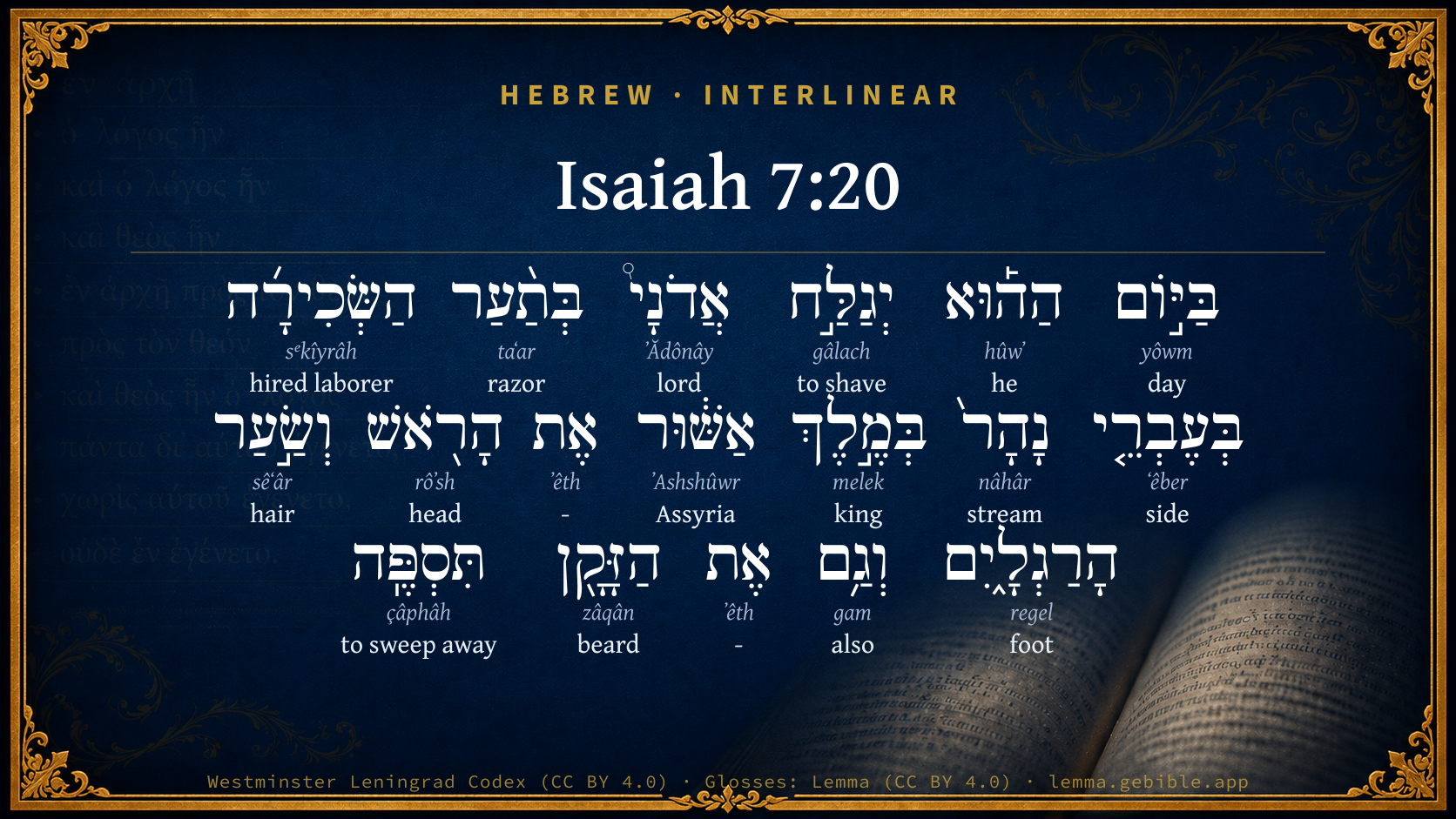
Hebrew (Westminster Leningrad Codex) Isaiah 7:20 appears in the Hebrew Old Testament. The text above is from the Westminster Leningrad Codex. Each word links to its Strong’s number, a concise gloss, and parsing drawn from the Open Scriptures Hebrew Bible morphology. Click any word for its full Brown-Driver-Briggs (BDB) entry.
Download image
Cite this verse

Isaiah 7:20 (World English Bible). Public Domain. Lemma interlinear Bible study tool, https://lemma.gebible.app/v/isaiah/7/20.

Show BibTeX & RIS
BibTeX
RIS
English Translation
In that day the Lord will shave with a razor that is hired in the parts beyond the River, even with the king of Assyria, the head and the hair of the feet; and it shall also consume the beard.
World English Bible · Public Domain
Highlights
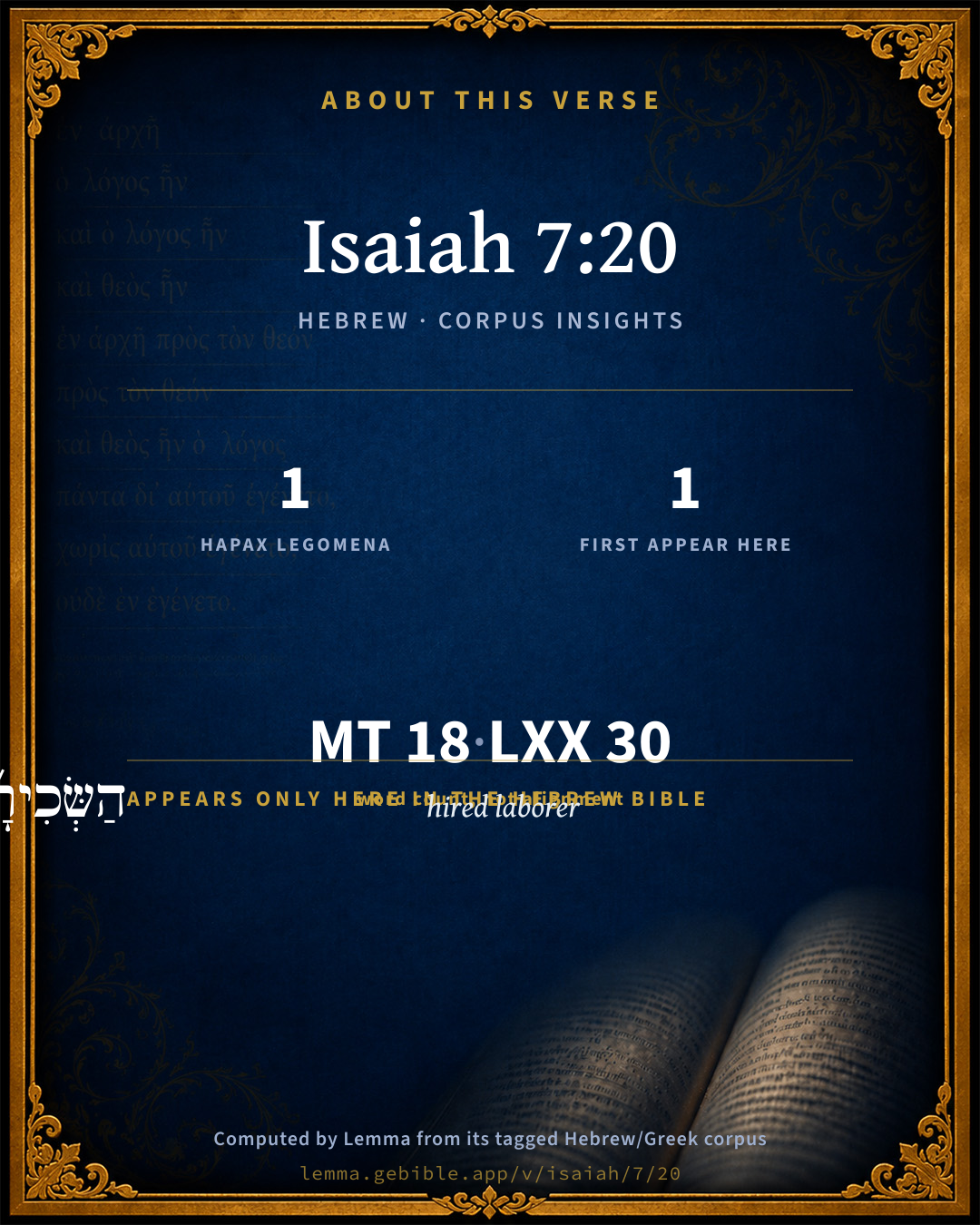
  • 1 hapax legomenon — only here in the Hebrew Bible
  • 1 first appearance in the Hebrew Bible
Full analysis ↓
Download a study sheet

One document with this verse’s original text, its word-by-word gloss line, the meaning frame, cross-references with their text, attributed commentary, and full source and license credits — printable, and it pastes into notes with its structure intact.

This verse Autodidact and up

Study sheet (.html) Plain text (.txt)

A passage Seminary Student

Up to 50 verses in one chapter. A passage sheet keeps up to 6 commentary sources and 12 cross-references per verse, in the order this page ranks them, and says so on the sheet whenever that leaves anything out. Ask for a single verse and you get the Autodidact verse sheet above.

Everything on this page stays free to read, with no account — the sheet is a download of what is already on screen, not access to it.

Want to remove ads? Support Godless Engineer
Compare translations 3

The same verse in 3 English versions, stacked beneath the original-language interlinear above. Click any original word for its lexicon entry.

Each is an independent rendering of the whole verse — the interlinear is not word-aligned to these translations.

Highlighted words mark where these versions differ — a whole-verse word diff, not a word-by-word alignment.

  • World English Bible Public Domain
    In that day the Lord will shave with a razor that is hired in the parts beyond the River, even with the king of Assyria, the head and the hair of the feet; and it shall also consume the beard.
  • King James Version Public Domain
    In the same day shall the Lord shave with a razor that is hired, namely, by them beyond the river, by the king of Assyria, the head, and the hair of the feet: and it shall also consume the beard.
  • unfoldingWord Literal Text CC BY-SA 4.0
    In that day the Lord will shave with a razor hired from beyond the River, with the king of Assyria, the head and the hair of the feet, and it will also take away the beard.

unfoldingWord Literal Text — © unfoldingWord, licensed CC BY-SA 4.0. Word-aligned USFM3 via Door43 (git.door43.org/unfoldingWord/en_ult).

Versions to compare (up to 4)

3 of 4 selected

Show all 18 translations

Every available English version of this verse, each an independent rendering of the whole verse.

  • World English Bible Public Domain
    In that day the Lord will shave with a razor that is hired in the parts beyond the River, even with the king of Assyria, the head and the hair of the feet; and it shall also consume the beard.
  • Berean Standard Bible Public Domain
    On that day the Lord will use a razor hired from beyond the Euphrates—the king of Assyria—to shave your head and the hair of your legs, and to remove your beard as well.
  • Majority Standard Bible Public Domain
    On that day the Lord will use a razor hired from beyond the Euphrates—the king of Assyria—to shave your head and the hair of your legs, and to remove your beard as well.
  • King James Version Public Domain
    In the same day shall the Lord shave with a razor that is hired, namely, by them beyond the river, by the king of Assyria, the head, and the hair of the feet: and it shall also consume the beard.
  • American Standard Version (1901) Public Domain
    In that day will the Lord shave with a razor that is hired in the parts beyond the River, `even' with the king of Assyria, the head and the hair of the feet; and it shall also consume the beard.
  • Revised Version (1885) Public Domain
    In that day shall the Lord shave with a razor that is hired, which is in the parts beyond the River, even with the king of Assyria, the head and the hair of the feet: and it shall also consume the beard.
  • Geneva Bible (1599) Public Domain
    In that day shall the Lord shaue with a rasor that is hired, euen by them beyond the Riuer, by the King of Asshur, the head and the heare of the feete, and it shall consume the beard.
  • Douay-Rheims (1899) Public Domain
    In that day the Lord shall shave with a razor that is hired by them that are beyond the river, by the king of the Assyrians, the head and the hairs of the feet, and the whole beard.
  • Young's Literal Translation Public Domain
    In that day doth the Lord shave, By a razor that is hired beyond the river, By the king of Asshur, The head, and the hair of the feet, Yea, also the beard it consumeth.
  • Literal Standard Version CC BY-SA 4.0
    In that day the Lord shaves, || By a razor that is hired beyond the river, || By the king of Asshur, || The head, and the hair of the feet, || Indeed, it also consumes the beard.
  • Unlocked Literal Bible CC BY-SA 4.0
    At that time the Lord will shave with a razor that was hired beyond the Euphrates River—the king of Assyria— the head and the hair of the legs; it will also sweep away the beard.
  • unfoldingWord Literal Text CC BY-SA 4.0
    In that day the Lord will shave with a razor hired from beyond the River, with the king of Assyria, the head and the hair of the feet, and it will also take away the beard.
  • Darby Bible Public Domain
    In that day will the Lord, with a razor which is hired beyond the river, with the king of Assyria, shave the head and the hair of the feet, yea, the beard also will it take away.
  • World Messianic Bible Public Domain
    In that day the Lord will shave with a razor that is hired in the parts beyond the River, even with the king of Assyria, the head and the hair of the feet; and it shall also consume the beard.
  • Webster's Bible Public Domain
    In the same day will the Lord shave with a razor that is hired, namely, by them beyond the river, by the king of Assyria, the head, and the hair of the feet: and it shall also consume the beard.
  • Free Bible Version CC BY-SA 4.0
    At that time the Lord will use a razor hired from beyond the Euphrates River, the king of Assyria, to shave you from head to toe, including your beards.
  • Bible in Basic English Public Domain
    In that day will the Lord take away the hair of the head and of the feet, as well as the hair of the face, with a blade got for a price from the other side of the River; even with the king of Assyria.
  • JPS Tanakh (1917) Public Domain
    In that day shall the Lord shave with a razor that is hired in the parts beyond the River, even with the king of Assyria, the head and the hair of the feet; and it shall also sweep away the beard.

Literal Standard Version (2020), Covenant Press — licensed CC BY-SA 4.0. Text via the HelloAO Bible API (eBible.org). Unlocked Literal Bible (unfoldingWord) — licensed CC BY-SA 4.0. Text via the HelloAO Bible API (eBible.org). unfoldingWord Literal Text — © unfoldingWord, licensed CC BY-SA 4.0. Word-aligned USFM3 via Door43 (git.door43.org/unfoldingWord/en_ult). Free Bible Version, Dr. Jonathan Gallagher — licensed CC BY-SA 4.0. Text via the HelloAO Bible API (eBible.org).

Word by word

More ways to search: Search by grammar → Find every occurrence → Compare this word →

Practice this passage: Drill this verse → Learn its vocabulary →

הַשְּׂכִירָ֜ה
sᵉkîyrâh
H7917
“the · hired laborer”
Particle, Definite Article + Adjective, Adjective, Feminine, Singular, Absolute
Part of Speech
Particle + Adjective
Type
Adjective
Gender
Feminine
Number
Singular
State
Absolute
Full BDB Definition

Origin: fem. of H7916

TWOT: 2264 . 1c

hired - hired (of animal) - hireling, hired labourer (substantive) - mercenary
  1. בַּיּ֣וֹם yôwm H3117 “in/at the · day” Preposition, Determined + Noun, Common, Masculine, Singular, Absolute
  2. הַה֡וּא hûwʼ H1931 “the · he” Particle, Definite Article + Pronoun, Personal, 3rd Person, Masculine, Singular
  3. יְגַלַּ֣ח gâlach H1548 “to shave” Verb, Piel, Imperfect, 3rd Person, Masculine, Singular
  4. אֲדֹנָי֩ ʼĂdônây H136 “Lord · my” Noun, Common, Masculine, Plural, Construct + Suffix, Personal, 1st Person, Common, Singular
  5. בְּתַ֨עַר taʻar H8593 “in/at · razor” Preposition + Noun, Common, Both, Singular, Absolute
  6. בְּעֶבְרֵ֤י ʻêber H5676 “in/at · sides of” Preposition + Noun, Common, Masculine, Plural, Construct
  7. נָהָר֙ nâhâr H5104 “stream” Noun, Common, Masculine, Singular, Absolute
  8. בְּמֶ֣לֶךְ melek H4428 “in/at · king of” Preposition + Noun, Common, Masculine, Singular, Construct
  9. אַשּׁ֔וּר ʼAshshûwr H804 “Assyria” Noun, Proper
  10. אֶת ʼêth H853 “-” Particle, Direct Object
  11. הָרֹ֖אשׁ rôʼsh H7218 “the · head” Particle, Definite Article + Noun, Common, Masculine, Singular, Absolute
  12. וְשַׂ֣עַר sêʻâr H8181 “and · hair of” Conjunction + Noun, Common, Masculine, Singular, Construct
  13. הָרַגְלָ֑יִם regel H7272 “the · feet” Particle, Definite Article + Noun, Common, Feminine, Dual, Absolute
  14. וְגַ֥ם gam H1571 “and · also” Conjunction + Particle, Accusative
  15. אֶת ʼêth H853 “-” Particle, Direct Object
  16. הַזָּקָ֖ן zâqân H2206 “the · beard” Particle, Definite Article + Noun, Common, Both, Singular, Absolute
  17. תִּסְפֶּֽה çâphâh H5595 “to sweep away” Verb, Qal, Imperfect, 3rd Person, Feminine, Singular

About this verse

These counts appear in no published source. They are computed here, from the morphology-tagged text and Lemma’s own curated glosses. What Lemma adds →

18
words
17
distinct lemmas
Prophets
section

Notable vocabulary

1 hapax legomenon — a word that appears only here in the entire Hebrew Bible:

  • הַשְּׂכִירָ֜ה hired laborer H7917

First appearance in Scripture

This word makes its first canonical appearance in the Hebrew Bible here:

  • הַשְּׂכִירָ֜ה hired laborer H7917

Shared distinctive vocabulary

בְּתַ֨עַר razor H8593 occurs in 13 verses of the Hebrew Bible. Also found in:

Grammatical profile

  • 2 verbs
  • 11 nouns
  • 1 adjective
  • 1 pronoun
  • 3 particles

Verb forms

  • יְגַלַּ֣ח Piel · Imperfect
  • תִּסְפֶּֽה Qal · Imperfect

Hebrew & Septuagint length

In English translation the verse runs 40 words from the Hebrew and 32 from the Septuagint (LXX English) — closely comparable.

A rough comparison of the two English renderings, which tokenize alike — not a word-level alignment.

Word counts can differ between the Hebrew and the Greek without any difference in meaning — e.g. the Hebrew direct-object marker אֵת has no separate Greek word, and Greek often adds the article ὁ.

In the original languages it is 18 Hebrew tokens and 30 Greek tokens — but the two are counted differently (Hebrew bundles its prefixes and suffixes into one token; the Greek is in lemma form), so that isn’t a like-for-like length.

Cross-references

14

Topical passages linked to Isaiah 7:20 in the Treasury of Scripture Knowledge — connected by theme and wording, ordered by reader-vote popularity; previews shown in the World English Bible.

  • Isaiah 8:7 now therefore, behold, the Lord brings up on them the waters of the River, strong and many, [even] the king of Assyria and all his glory: and it shall come up over all its channels, and go over all its banks;
  • Isaiah 10:15 Shall the axe boast itself against him who hews therewith? Shall the saw magnify itself against him who wields it? as if a rod should wield those who lift it up, [or] as if a staff should lift up [him who is] not wood.
  • Ezekiel 5:1–4 You, son of man, take a sharp sword; [as] a barber's razor shall you take it to you, and shall cause it to pass on your head and on your beard: then take balances to weigh, and divide the hair.
  • Ezekiel 29:18 Son of man, Nebuchadrezzar king of Babylon caused his army to serve a great service against Tyre: every head was made bald, and every shoulder was worn; yet had he no wages, nor his army, from Tyre, for the service that he had served against it.
  • 2 Kings 16:7–8 So Ahaz sent messengers to Tiglath Pileser king of Assyria, saying, I am your servant and your son: come up, and save me out of the hand of the king of Syria, and out of the hand of the king of Israel, who rise up against me.
  • 2 Kings 18:13–16 Now in the fourteenth year of king Hezekiah did Sennacherib king of Assyria come up against all the fortified cities of Judah, and took them.
  • 2 Chronicles 28:20–21 Tilgath Pilneser king of Assyria came to him, and distressed him, but didn't strengthen him.
  • Isaiah 1:5 Why should you be beaten more, That you revolt more and more? The whole head is sick, And the whole heart faint.
  • Isaiah 9:14–17 Therefore Yahweh will cut off from Israel head and tail, palm-branch and rush, in one day.
  • Isaiah 10:5–6 Ho Assyrian, the rod of my anger, the staff in whose hand is my indignation!
  • Isaiah 11:15 Yahweh will utterly destroy the tongue of the Egyptian sea; and with his scorching wind will he wave his hand over the River, and will strike it into seven streams, and cause men to march over in sandals.
  • Isaiah 24:1–2 Behold, Yahweh makes the earth empty, and makes it waste, and turns it upside down, and scatters abroad the inhabitants of it.
  • Jeremiah 27:6–7 Now have I given all these lands into the hand of Nebuchadnezzar the king of Babylon, my servant; and the animals of the field also have I given him to serve him.
  • Ezekiel 29:20 I have given him the land of Egypt as his recompense for which he served, because they worked for me, says the Lord Yahweh.

Cross-references courtesy of OpenBible.info (CC BY 4.0).

Hebrew and Greek witnesses Masoretic Hebrew ↔ Greek Septuagint

The same verse in the two great witnesses to the Old Testament, shown verse-for-verse.

These are two independent witnesses, not word-aligned to each other, and the Septuagint is shown in lemma (dictionary) form.

Hebrew Isaiah 7:20 Masoretic · Westminster Leningrad Codex

בַּיּ֣וֹם הַה֡וּא יְגַלַּ֣ח אֲדֹנָי֩ בְּתַ֨עַר הַשְּׂכִירָ֜ה בְּעֶבְרֵ֤י נָהָר֙ בְּמֶ֣לֶךְ אַשּׁ֔וּר אֶת הָרֹ֖אשׁ וְשַׂ֣עַר הָרַגְלָ֑יִם וְגַ֥ם אֶת הַזָּקָ֖ן תִּסְפֶּֽה

In that day the Lord will shave with a razor that is hired in the parts beyond the River, even with the king of Assyria, the head and the hair of the feet; and it shall also consume the beard.

World English Bible · Public Domain

Greek LXX Isaiah 7:20 Septuagint · lemma form

ἐν ὁ ἡμέρα ἐκεῖνος ξυράω κύριος ὁ ξυρόν ὁ μέγας καί μεθύω ὅς εἰμί πέραν ὁ ποταμός βασιλεύς ἀσσύριος ὁ κεφαλή καί ὁ θρίξ ὁ πούς καί ὁ πώγων ἀποαἱρέω

In that day the Lord shall shave with the hired razor of the king of Assyria beyond the river the head, and the hairs of the feet, and will remove the beard.

LXX2012 (modern English Septuagint) · Public Domain

On this verse, Adam Clarke's Commentary discusses the Septuagint’s reading. Read the note in Commentary ↓

Hebrew: Westminster Leningrad Codex (CC BY 4.0). Greek: Septuagint (public domain); English from LXX2012 (modern English Septuagint) (Public Domain). How the Septuagint differs from the Hebrew →

Targum (Aramaic paraphrase)

1

The Targum is the ancient Jewish Aramaic paraphrase of the Hebrew Scriptures — an interpretive translation, not the Hebrew text itself. Onkelos (literal) and Pseudo-Jonathan (expansive) render the Torah, and Jonathan the Prophets. Coverage is partial: where no permissively-licensed English translation exists for a verse, only the Aramaic is shown. This is verse-level text, not a word-by-word alignment to the Hebrew.

  1. Targum Jonathan Prophets (Joshua–Malachi)
    בְּעִדָנָא הַהִיא יִקְטוֹל יְיָ בְּהוֹן כְּמָא דְמִתְקְטֵיל בְּחַרְבָּא חֲרִיפָא בְּסִבְכַיָא וּבְמִגְרַיָא בְּעֶבְרֵי נַהֲרָא בְּמַלְכָּא דְאַתּוּר וְיַת מַלְכָּא וְיַת מַשִׁרְיָתֵיהּ וְאַף יַת שִׁלְטוֹנֵי כַּחֲדָא יְשֵׁיצֵי:

    In that time the Lord shall slay them as one is slain by a sharp sword, by clubs, and by saws, by those beyond the river, and by the king of Assyria; the king and his army, and even also his rulers, together shall he destroy.

    Targum Jonathan — Aramaic: “Mikraot Gedolot” (public domain). English: “Sefaria Community Translation” (CC0 1.0 (public-domain dedication)); “London "Chaldee Paraphrase," 1871” (public domain). Text via Sefaria.

Commentary

Notes on Isaiah 7:20 from classic Christian and Jewish commentators (each source and its license shown beneath its notes). The classic Christian expositions comment on the surrounding passage and are grouped to its opening verse, so a note may address several verses; the Jewish commentaries on the Tanakh (Rashi and others) are per-verse, so they appear only where the commentator wrote on this verse.

Lemma curates 59 commentaries, every one of them public domain or Creative Commons licensed, each selected and text-cleaned for this edition rather than reprinted as found. About our sources →

Trapp's Complete Commentary

John Trapp

Isa 7:20 In the same day shall the Lord shave with a razor that is hired, [namely], by them beyond the river, by the king of Assyria, the head, and the hair of the feet: and it shall also consume the beard.

Ver. 20. In the same day shall the Lord shave.] Not shear, but shave, with a razor, to set forth the calamity of war, which wasteth and taketh away all, and maketh clean work, as we use to say: Nihil in toto regno intactum reliquit, sed omnia a summo ad imum expilavit Assyrius. The Assyrian is here called God’s razor, because his instrument, to shave as he pleaseth, though haply by exceeding his commission {as Zec 1:15} he might prove a "deceitful razor," {as Psa 52:2} that, instead of shaving the hair, lanceth the flesh.

That is hired.] Whether by Ahaz himself, but for a better purpose, {2Ki 16:7-8} not to harm, but to help, though it happened otherwise; or by God, who paid the Assyrian for his hire the lands of Israel and of Syria. See the like Eze 29:18-19. Barbers use not their razors but for reward.

Beyond the river.] Euphrates, that ran between Syria and Assyria, but could not keep off the Assyrian destroyer.

The head, and the hair of the feet.] Elsewhere called "head and tail"; that is, high and low, prince and peasant.

And it shall also consume the beard.] (1.) The priests, {Psa 133:2} as some sense it; or (2.) As others, all the comeliness and virility of the Jewish nation.

John Trapp, A Commentary or Exposition upon All the Books of the Old and New Testament (1647–1656) — public domain. Text from a community e-Sword module.

The Biblical Illustrator

Joseph S. Exell

Isa_7:20

In the same day shall the Lord shave with a razor that is hired

The hired razor

There is involved the bitterest sarcasm for Ahaz; the cheap knife which he had hired for the deliverance of Judah is hired by the Lord in order to shave Judah wholly and most shamefully.

(F. Delitzsch.)

Shaving the beard

The most shameful of all. The beard is the sign of manly vigour, manliness, and manly dignity. (F. Delitzsch.)

The Lords razor

The Bible is the boldest book ever written. There are no similitudes in Ossian or the Iliad or the Odyssey so daring. Its imagery sometimes seems on the verge of the reckless, but only seems so. The fact is that God would startle and arouse men and nations. A tame and limping similitude would fail to accomplish the object. While there are times when He employs in the Bible the gentle dew and the morning cloud and the dove and the daybreak in the presentation of truth, we often find the iron chariot, the lightning, the earth quake, the sword and, in my text, the razor. This keen-bladed instrument has advanced in usefulness with the ages. In Bible times and lands the beard remained uncut save in the seasons of mourning and humiliation, but the razor was always a suggestive symbol. David says of Doeg, his antagonist: Thy tongue is a sharp razor working deceitfully that is, it pretends to clear the face, but is really used for deadly precision.

I. If Gods judgments are razors, WE HAD BETTER BE CAREFUL HOW WE USE THEM ON OTHER PEOPLE. In careful sheath the domestic weapons are put away, where no one by accident may touch them, and where the hands of children may not touch them. Such instruments must be carefully handled or not handled at all. But how recklessly some people wield the judgments of God. If a man meet with business misfortune, how many there are ready to cry out, This is a judgment of God upon him because he was unscrupulous, or arrogant, or over reaching, or miserly. How I do dislike the behaviour of those persons who, when people are unfortunate, say: I told you so--getting punished--served him right! With air sometimes supercilious and sometimes Pharisaical, and always blasphemous, they take the razor of Divine judgment and sharpen it on their own hard hearts, and then go to work on men sprawled out at full length under disaster, cutting mercilessly. They begin by soft expressions of sympathy and pity and half praise, and lather the victim all over before they put on the sharp edge.

II. Again, when I read in my text that the Lord shaves, with the hired razor of Assyria, the land of Judea, I bethink myself of THE PRECISION OF GODS PROVIDENCE. A razor swung the tenth part of an inch out of the right line means either failure or laceration, but Gods dealings never slip, and they do not miss, by the thousandth part of an inch, the right direction.

III. Further, my text tells us that GOD SOMETIMES SHAVES NATIONS. In the same day shall the Lord shave with the razor that is hired. With one sharp sweep He went across Judah, and down went its pride and its power. Assyria was the hired razor against Judah, and Cyrus the hired razor against Babylon, and the Huns the hired razor against the Goths, and there are now many razors that the Lord could hire if, because of our national sins, He should undertake to shave us.

IV. But notice that God is so kind and loving, that WHEN IT IS NECESSARY FOR HIM TO CUT, HE HAS TO GO TO OTHERS FOR THE SHARP-EDGED WEAPON. In the same day shall the Lord shave with a razor that is hired. God is love. God is pity. God is help. God is shelter. God is rescue. There are no sharp edges about Him, no thrusting points, no instruments of laceration. If you want balm for wounds, He has that. If you want salve for Divine eyesight, He has that. But if there is sharp and cutting work to do, which requires a razor, that He hires. God has nothing about Him that hurts, save when dire necessity demands, and then He has to go to someone else to get the instrument. (T. De W. Talmage, D. D.)

Allies and razors

You thought you were buying an ally when you were only hiring a razor by which you were to be rendered naked and made contemptible. (J. Parker, D. D.)

.

The Biblical Illustrator, edited by Joseph S. Exell (c. 1880s–1900s) — public domain. Text from a community e-Sword module.

Joseph Benson's Commentary

Isa 7:20. The Lord shall shave — Shall utterly spoil, as shaving takes away the hair; with a razor that is hired — Hired by Ahaz; for he purchased the aid of the Assyrians with large sums of silver and gold, 2Ki 16:7-8. And so the prophet signifies the just judgment of God, in scourging them with a rod of their own making. By them beyond the river — Euphrates, called the river, by way of eminence, beyond which Assyria lay. By the king of Assyria — By the successive kings of the Assyrian empire, Sennacherib, Esar-haddon, and especially by Nebuchadnezzar, who, having subdued the Assyrian monarchy, from thenceforth was king of Assyria as well as of Chaldea. The head and the hair of the feet, &c. — This highly parabolical mode of expression is used to denote “the utter devastation of the country from one end to the other, and the plundering of the people from the highest to the lowest. The hairs of the head are those of the highest order in the state; those of the feet, or lower parts, are the common people: the beard is the king, the high-priest, the very supreme in dignity and majesty: for the eastern people have always held the beard in the highest veneration, and have been extremely jealous of its honour.”

Joseph Benson's Commentary on the Old and New Testaments (1811–1818) — public domain. Text from a community e-Sword module.

Tyndale Open Study Notes

Tyndale Open Resources

7:20 shave off everything: your land, your crops, and your people: In the ancient Near East, forced shaving was an act of disgrace (see 2 Sam 10:4-5). Here it was a metaphor for the despoiling of the country.

Tyndale Open Study Notes — © Tyndale Open Resources, licensed CC BY-SA 4.0. Text via the HelloAO Bible API.

Geneva Bible (1599)

Geneva Bible translators

That is, that which is from the belly downward: meaning, that he would destroy both great and small.

Geneva Bible (1599) marginal notes — public domain. Text via Bolls.life.

Jamieson, Fausset & Brown

Robert Jamieson, A. R. Fausset & David Brown

razor--The Assyrians are to be God's instrument of devastating Judea, just as a razor sweeps away all hair before it (Isa 10:5; Eze 29:19-20).

hired--alluding to Ahaz' hiring (Kg2 16:7-8) Tiglath-pileser against Syria and Israel; namely,

by them beyond the river--namely, the Euphrates; the eastern boundary of Jewish geographical knowledge (Psa 72:8); the river which Abram crossed; the Nile also may be included (Isa 7:18) [G. V. SMITH]. GESENIUS translates, "With a razor hired in the parts beyond the river."

head . . . feet--the whole body, including the most honored parts. To cut the "beard" is the greatest indignity to an Easterner (Isa 50:6; Sa2 10:4-5; Eze 5:1).

Jamieson, Fausset & Brown — Commentary Critical and Explanatory on the Whole Bible (1871) — public domain (CC PDM 1.0). Text via the HelloAO Bible API.

Adam Clarke's Commentary

Verse 20. The river] That is, the Euphrates: הנהר hanahar. So read the Septuagint and two MSS.

Shall the Lord shave with a razor that is hired - "JEHOVAH shall shave by the hired razor"] To shave with the hired razor the head, the feet, and the beard, is an expression highly parabolical, to denote the utter devastation of the country from one end to the other; and the plundering of the people, from the highest to the lowest, by the Assyrians, whom God employed as his instrument to punish the Jews. Ahaz himself, in the first place, hired the king of Assyria to come to help him against the Syrians, by a present made to him of all the treasures of the temple, as well as his own. And God himself considered the great nations, whom he thus employed as his mercenaries; and paid them their wages. Thus he paid Nebuchadnezzar for his services against Tyre, by the conquest of Egypt, Eze 29:18-20. The hairs of the head are those of the highest order in the state; those of the feet, or the lower parts, are the common people; the beard is the king, the high priest, the very supreme in dignity and majesty. The Eastern people have always held the beard in the highest veneration, and have been extremely jealous of its honour. To pluck a man's beard is an instance of the greatest indignity that can be offered. See Isa 50:6. The king of the Ammonites, to show the utmost contempt of David, "cut off half the beards of his servants, and the men were greatly ashamed; and David bade them tarry at Jericho till their beards were grown," 2Sa 10:4; 2Sa 10:6. Niebuhr, Arabie, p. 275, gives a modern instance of the very same kind of insult. "The Turks," says Thevenot, "greatly esteem a man who has a fine beard; it is a very great affront to take a man by his beard, unless it be to kiss it; they swear by the beard." Voyages, i., p. 57. D'Arvieux gives a remarkable instance of an Arab, who, having received a wound in his jaw, chose to hazard his life, rather than suffer his surgeon to take off his beard. Memoires, tom. iii., p. 214. See also Niebuhr, Arabie, p. 61.

The remaining verses of this chapter, Isa 7:21-25, contain an elegant and very expressive description of a country depopulated, and left to run wild, from its adjuncts and circumstances: the vineyards and cornfields, before well cultivated, now overrun with briers and thorns; much grass, so that the few cattle that are left, a young cow and two sheep, have their full range, and abundant pasture, so as to yield milk in plenty to the scanty family of the owner; the thinly scattered people living, not on corn, wine, and oil, the produce of cultivation; but on milk and honey, the gifts of nature; and the whole land given up to the wild beasts, so that the miserable inhabitants are forced to go out armed with bows and arrows, either to defend themselves against the wild beasts, or to supply themselves with necessary food by hunting.

A VERY judicious friend has sent me the following observations on the preceding prophecy, which I think worthy of being laid before the reader; though they are in some respects different from my own view of the subject.

"To establish the primary and literal meaning of a passage of Scripture is evidently laying the true foundation for any subsequent views or improvements from it.

"The kingdom of Judah, under the government of Ahaz, was reduced very low. Pekah, king of Israel, had slain in Judea one hundred and twenty thousand in one day; and carried away captive two hundred thousand, including women and children, with much spoil. To add to this distress, Rezin, king of Syria, being confederate with Pekah, had taken Elath, a fortified city of Judah, and carried the inhabitants to Damascus. I think it may also be gathered from the sixth verse of Isa 8:6, that the kings of Syria and Israel had a considerable party in the land of Judea, who, regardless of the Divine appointment and promises, were disposed to favour the elevation of Tabeal, a stranger, to the throne of David.

"In this critical conjuncture of affairs, Isaiah was sent with a message of mercy, and a promise of deliverance, to Ahaz. He was commanded to take with him Shearjashub, his son whose name contained a promise respecting the captives lately made by Pekah, whose return from Samaria, effected by the expostulation of the prophet Oded and the concurrence of the princes of Ephraim, was now promised as a pledge of the Divine interposition offered to Ahaz in favour of the house of David. And as a farther token of this preservation, notwithstanding the incredulity of Ahaz, Isaiah was directed to predict the birth of another son which should be born to him within the space of a year, and to be named Immanuel, signifying thereby the protection of God to the land of Judah and family of David at this present conjuncture, with reference to the promise of the Messiah who was to spring from that family, and be born in that land. Compare Isa 8:8. Hence Isaiah testifies, Isa 8:18: 'Behold, I and the children whom the Lord hath given me are for signs and for types in Israel.' Compare Zec 3:8: 'Thy companions are men of sign and type:' see Dr. Lowth on this verse. The message of Divine displeasure against Israel is in like manner expressed by the names the prophet Hosea was directed to give his children; see Hos. i. and ii. Hos 1:4; Hos 1:6; Hos 1:9;

"Concerning this child, who was to be named Immanuel, the prophet was commissioned to declare, that notwithstanding the present scarcity prevailing in the land from its being harassed by war, yet within the space of time wherein this child should be of age to discern good and evil, both these hostile kings, viz., of Israel and Syria, should be cut off; and the country enjoy such plenty, that butter and honey, food accounted of peculiar delicacy, should be a common repast. See Harmer's Observations, p. 299.

"To this it may be objected that Isaiah's son was not named Immanuel, but Maher-shalal-hash-baz; the signification of which bore a threatening aspect, instead of a consolatory one. To this I think a satisfactory answer may be given. Ahaz, by his unbelief and disregard of the message of mercy sent to him from God, (for instead of depending upon it he sent and made a treaty with the king of Assyria,) drew upon himself the Divine displeasure, which was expressed by the change of the child's name, and the declaration that though Damascus and Samaria should, according to the former prediction, fall before the king of Assyria, yet that this very power, i.e., Assyria, in whom Ahaz trusted for deliverance, (see 2Kg 16:7, c.,) should afterwards come against Judah, and 'fill the breadth of the land,' which was accomplished in the following reign, when Jerusalem was so endangered as to be delivered only by miracle. The sixth and seventh verses of Isa 8:6-7 indicate, I think, as I before observed, that the kings of Syria and Israel had many adherents in Judah, who are said to refuse the peaceful waters of Shiloah or Siloam, him that is to be sent, who ought to have been their confidence, typified by the fountain at the foot of Mount Zion, whose stream watered the city of Jerusalem and therefore, since the splendour of victory, rather than the blessings of peace, was the object of their admiration, compared to a swelling river which overflowed its banks, God threatens to chastise them by the victorious armies of Ashur. The prophet at the same time addresses words of consolation to such of the people who yet feared and trusted in Jehovah, whom he instructs and comforts with the assurance (Isa 8:10) that they shall prove the fulfilment of the promise contained in the name Immanuel.

"But it may still be objected, that according to this interpretation of the fourteenth verse of Isa 7:14 nothing miraculous occurs, which is readily admitted; but the objection rests upon the supposition that something miraculous was intended; whereas the word אות oth, 'sign,' does by no means generally imply a miracle, but most commonly an emblematic representation, (see Eze 4:3-12; Eze 11:1-25; Eze 20:20; Zec 6:14,) either by actions or names, of some future event either promised or threatened. Ex 3:12; 1Sa 2:34; 2Kg 19:29; Jer 44:29-30, are all examples of a future event given as a sign or token of something else which is also future. The birth of Isaiah's son was indeed typical of him whose name he was, at first, appointed to bear, viz., Immanuel, even as Oshea the son of Nun had his name changed to Jehoshua, the same with Jesus, of whom he was an eminent type. Hence the prophet, in the ninth chapter, breaks forth into a strain of exultation: 'To us a child is born;' after which follow denunciations against Rezin and the kingdom of Israel, which are succeeded by declarations, that when Assyria had completed the appointed chastisement upon Judah and Jerusalem, that empire should be destroyed. The whole of the tenth chapter is a very remarkable prophecy, and was probably delivered about the time of Sennacherib's invasion.

"But still it will be urged, that St. Matthew, when relating the miraculous conception of our Lord, says, 'Now all this was done that it might be fulfilled which was spoken of the Lord by the prophet,' c. To this it may readily be answered, that what was spoken by the prophet was indeed now fulfilled in a higher, more important, and also in a more literal sense, than the primary fulfilment could afford, which derived all its value from its connection with this event, to which it ultimately referred.

"In like manner the prophecy of Isaiah, contained in the second chapter, received a complete fulfilment in our Saviour's honouring Capernaum with his residence, and preaching throughout Galilee though there appears reason to interpret the passage as having a primary respect to the reformation wrought by Hezekiah and which, at the eve of the dissolution of the kingdom of Israel by the captivity of the ten tribes, extended to the tribes of Asher and Zebulun, and many of the inhabitants of Ephraim and Manasseh, who were hereby stirred up to destroy idolatry in their country. See 2Ch 31:1. And without doubt the great deliverance wrought afterwards for Judah by the miraculous destruction of Sennacherib's army, and the recovery of Hezekiah in so critical a conjuncture from a sickness which had been declared to be unto death, contributed not a little to revive the fear of God in that part of Israel which, through their defection from the house of David, had grievously departed from the temple and worship of the true God; and as Galilee lay contiguous to countries inhabited by Gentiles, they had probably sunk deeper into idolatry than the southern part of Israel.

"In several passages of St. Matthew's Gospel, our translation conveys the idea of things being done in order to fulfil certain prophecies; but I apprehend that if the words ινα και οπως were rendered as simply denoting the event, so that and thus was fulfilled, the sense would be much clearer. For it is obvious that our Lord did not speak in parables or ride into Jerusalem previously to his last passover, simply for the purpose of fulfilling the predictions recorded, but also from other motives; and in Mt 2:15; Mt 2:19-23 the evangelist only remarks that the circumstance of our Lord's return from Egypt corresponded with the prophet Hosea's relation of that part of the history of the Israelites. So in the twenty-third verse Joseph dwelt at Nazareth because he was directed so to do by God himself; and the sacred historian, having respect to the effect afterwards produced, (see Joh 7:41-42; Joh 7:52,) remarks that this abode in Nazareth was a means of fulfilling those predictions of the prophets which indicate the contempt and neglect with which by many the Messiah should be treated. Galilee was considered by the inhabitants of Judea as a degraded place, chiefly from its vicinity to the Gentiles; and Nazareth seems to have been proverbially contemptible; and from the account given of the spirit and conduct of the inhabitants by the evangelists, not without reason." - E. M. B.

To my correspondent, as well as to many learned men, there appears some difficulty in the text; but I really think this is quite done away by that mode of interpretation which I have already adopted; and as far as the miraculous conception is concerned, the whole is set in the clearest and strongest light, and the objections and cavils of the Jeers entirely destroyed.

Adam Clarke's Commentary on the Bible (1810–1826) — public domain. Text from a community e-Sword/MySword module.

Ellicott's Commentary for English Readers

(20) Shall the Lord shave with a razor that is hired.—Better, “with the razor.” The words find a parallel in the “made him naked” of 2Ch_28:19. The term “hired” applies to the tribute which Ahaz was about to pay to Tilgath-pilneser. He thought that he was securing an ally: he was but hiring a razor (there is, perhaps, the implied thought that the razor is in other hands than his) that should sweep away all the signs of strength, and leave him an open shame and scorn to all who looked on him. (2Sa_10:4). From head to foot, not sparing even the beard, to maltreat which was the last extreme of Oriental outrage, he and his kingdom should be laid bare and naked to his enemies. Possibly there may be an allusive reference (Kay) to Lev_14:9. The nation, leprous in its guilt (Isa_1:6), needs the treatment which was prescribed for the leper.

(21:22) A man shall nourish a young cow, and two sheep . . .—Better, two ewes. Not only should cultivation cease, but the flocks and herds that had before been counted by hundreds or thousands should be counted now by units, two ewes and a heifer for a man’s whole stock, and yet (we note the prophet’s irony once more in the use of the word “abundance”) even that should be enough for a population reduced in proportion. There should be “milk and honey” for the scattered remnant. They should have that, and nothing but that, to eat, ad nauseam usque. The words are grouped together with a grim irony as reminding men of the proverbial words of praise which spoke of Canaan as “a land of milk and honey” (Exo_3:17).

A Bible Commentary for English Readers, edited by Charles John Ellicott (1878–1897) — public domain. Text from a community e-Sword module.

The Cambridge Bible for Schools and Colleges

gen. ed. J. J. S. Perowne

20. A new figure for the degradation and impoverishment of Judah at the hands of Assyria. In the same day] In that day.

with a rasor … river] Better: with the razor hired beyond the river (Euphrates). There may possibly be here an allusion to the “hiring” of Assyria by Ahaz (2Ki_16:7 f.); if so the prophecy is almost certainly later than Isa_7:1-17.

the king of Assyria] see on Isa_7:17.

and it shall also consume the beard] and even the beard (the symbol of manly dignity) it shall take away.

The Cambridge Bible for Schools and Colleges (gen. ed. J. J. S. Perowne; Cambridge University Press, 1878–1918) — public domain. Text from a community e-Sword module.

John Gill's Exposition

In the same day shall the Lord shave with a razor that is hired,.... Meaning the Assyrian monarch, whom he would use as an instrument in his hand to spoil and cut off the people of the Jews; who is compared to a "razor" for sharpness; and for the thorough work, and utter ruin and destruction, he should be the means of; and called a "hired" one, either in reference to the present Ahaz sent to the king of Assyria, by which he prevailed upon him to come and help him against the kings of Syria and Israel, Kg2 16:7 or to a reward given by the Lord to Nebuchadnezzar for the service in which he employed him, see Eze 29:18,

namely, by them beyond the river; not Nile, but Euphrates; even the Assyrians, Chaldeans, and Babylonians, who lived on the other side that river; which, with what follows, explains the simile of the razor:

by the king of Assyria; who ruled over those beyond the river:

the head, and the hair of the feet; and it shall also consume the beard; signifying that as a razor cuts off the hair entirely where it is applied, and leaves nothing behind, whether of the head, beard, or feet, or privy parts, which are meant by the latter; so the king of Assyria should carry all clean off captive out of the land of Judea; king, princes, nobles, and common people; those of the highest, and of the middling, and of the lowest class. The Targum is,

"in that time the Lord shall slay them as one is slain by a sharp sword, by clubs, and by saws, by those beyond the river, and by the king of Assyria; the king, and his army, and even his rulers, together shall he destroy.''

So Jarchi explains it. Several of the Jewish writers, as Aben Ezra, Abarbinel, and Kimchi (k), explain this of the Angel of the Lord destroying Sennacherib's army, when before Jerusalem, in Hezekiah's time; so the latter interprets it: "the head"; the heads of his armies: "the hair of the feet"; the multitude of the people: "the beard"; the king, who died, not in the camp, but was killed by his sons in his own land; but this is not a prophecy of the destruction of the Assyrian army, but of the Jewish people by it; and the whole denotes the mean and low condition, the state of slavery and bondage, the Jews should be brought into; of which the shaving of the hair is the symbol; it was usual to shave the head and hair of such as were taken captive, as a sign of reproach and servitude; see Sa2 10:4 (l).

(k) Vid. T. Bab. Sanhedrin, fol. 95. 2. and 96. 1. (l) Vid. Lydium de re militari, l. 6. c. 6. p. 238, 239. & Noldium, No. 937.

John Gill's Exposition of the Whole Bible (1746–1763) — public domain (CC PDM 1.0). Text via the HelloAO Bible API.

Albert Barnes' Notes on the Bible

In the same day ... - The idea in this verse is the same as in the preceding, though presented in a different form. The meaning is, that “God” would bring upon them this punishment, but that he would make use of the Assyrian as an “instrument” by which to do it.

Shave - The act of shaving off the hair denotes punishment or disgrace; compare 2Sa 10:4 : ‘Hanun took David’s servants, and shaved off one half of their beards;’ 1Ch 19:4.

With a razor - Using them as an instrument. God here claims the power of directing them, and regards them as employed by him; see Isa 10:5-7.

That is hired - This is an allusion to the custom of hiring soldiers, or employing mercenary armies. Thus Great Britain employed mercenary troops, or hired of the Germans bodies of Hessians to carry on the war in America. The meaning here is, that God would employ the Assyrians as his instruments, to effect his purposes, as though they were hired and paid by the plunder and spoil of the nation.

By them beyond the river - The river Euphrates. The Euphrates is usually meant in the Scriptures where ‘the river’ is mentioned without specifying the name; Psa 72:8; Psa 80:2. This was the river which Abraham had passed; and this, perhaps, was, for a long time, the eastern boundary of their geographical knowledge; see the note at Isa 11:15.

The head - The hair of the head.

The hair of the feet - Or the other parts of the body; of the lower parts of the body.

Shall consume the beard - Shall cut off the beard. This was esteemed particularly disgraceful among the Jews. It is, at this day, among all Eastern nations. The beard is regarded as a distinguished ornament; among the Mahometans, it is sworn by, and no higher insult can be offered than to treat the beard with indignity; compare the note at Isa 50:6. The meaning is here, that God would employ the Assyrian as his instrument to lay waste the land.

Albert Barnes' Notes on the Bible (1834–1885) — public domain. Text from a community e-Sword/MySword module.

Haydock's Catholic Bible Commentary

Razor. Or cut off with scissors all the hair, as was done with lepers, (Leviticus xiv. 9.) and Levites, Numbers viii. 7. The country shall be pillaged, and all shall be in mourning. (Calmet) --- The men shall be despised as no better than women and cowards. (St. Jerome) (Theodoret) --- Hired. With large sums. (Calmet)

George Leo Haydock (1774–1849), Haydock's Catholic Family Bible and Commentary, 1859 edition — public domain. Excludes Psalms (Douay-Rheims chapter numbering differs from Protestant) and Deuterocanonical books (Catholic canon only).

Matthew Poole's English Annotations

Shave with a razor, i.e. utterly spoil and destroy, as shaving takes away all the hair, and leaves not any thing of it visible, as there is when the hair is only cut or polled. Hired; either,

1. By Ahaz, who did hire them, 2Ki 16:7,8. And so the prophet notes the just judgment of God, in scourging them with a rod of their own making; and by this threatening he endeavours to prevent that wicked design which then was on foot, of hiring Assyrian succours. Or,

2. By God, who did stir them up, and send them upon his errand against Judah, as he threatens, Isa 10:6, and paid them liberally for that service, as he did Nebuchadnezzar, of which see Jer 25:9; 27:6,7; Da 2:37,38.

The river Euphrates, called the river, by way of eminency, Psa 72:8; Jer 2:18, beyond which Assyria lay.

By the king of Assyria; by the successive kings of the Assyrian empire, Sennacherib, 2Ki 18:13, &c., Esarhaddon, 2Ch 33:11, and especially by Nebuchadnezzar, who having subdued the Assyrian monarchy, from thenceforth was king of Assyria as well as of Chaldea. And the prophet rather mentions Assyria than Chaldea or Babylon, partly because the Assyrian began and continued to execute this judgment, although the Babylonian completed it; and partly to inform them that they laid the foundation of their own ruin, by opening the door to the Assyrian, who afterwards entered at his pleasure, and left it open for Nebuchadnezzar.

The hair of the feet; of the lower or secret parts, which come under that name, Eze 16:7,25, and elsewhere, as it hath been noted again and again; and which the Jewish writers affirm to have been shaved in the purification of lepers and Levites, Lev 14:8,9; Num 8:7.

The beard, which they highly esteemed, as a great ornament. By these metaphorical expressions he signifies the total destruction of their state, from head to foot, from the highest to the lowest.

Matthew Poole's English Annotations on the Holy Bible (1683–1685) — public domain. Text from a community e-Sword/MySword module.

Whedon's Commentary on the Bible

Daniel D. Whedon

20. Razor — The Assyrians are intended; the hired “razor” of Ahaz. Not so much the products of Palestine are said to be touched, for there locusts would be apt to be the figure employed. The “razor” cuts down princes, and clips the beard, or exacts a heavy, disgraceful tribute.

Beyond the river — The Euphrates. More is said in Scripture of indignities from those “beyond the river” than from those along the Nile. Orientals feel disgraced to the last degree when the beard is touched, pulled, or cut.

Daniel D. Whedon (gen. ed.), Commentary on the Old and New Testaments (1874–1909) — public domain. Text from a community e-Sword module.

The Pulpit Commentary

Shall the Lord shave with a razor that is hired; rather, with the hired razor; i.e. the razor that Ahaz will have hired. (2Ki_16:8) The metaphor well expresses the stripping of the land bare by plunder and exaction. (comp. Eze_5:1, Eze_5:12, and 2Ch_28:19-21) God would use Tiglath-Pileser as his instrument to distress Ahaz. By them beyond the river; or, in the parts beyond the river. (comp. 1Ch_19:16) "The river" is undoubtedly the Euphrates, and they who dwell beyond it the Assyrians. By the King of Assyria. Once more a gloss is suspected, as in ver. 17. The meaning would certainly be sufficiently plain without the clause. The head... the hair of the feet... the beard. These three represent all the hair on any part of the body. Judah is to be completely stripped.

The Pulpit Commentary (1880–1919), ed. H.D.M. Spence-Jones & Joseph S. Exell — public domain. Text from a community e-Sword module.

John Wesley's Explanatory Notes

Shave - Utterly spoil, as shaving takes away the hair. Hired - By Ahaz, who did hire them, 2 Kings xvi, 7, 8. And so the prophet notes the just judgment of God, in scourging them with a rod of their own making. By - By the successive kings of the Assyrian empire, Sennacherib, Esarhaddon, and especially by Nebuchadnezzar. The head - By these metaphorical expressions he signifies the total destruction of their state, from head to foot, from the highest to the lowest.

John Wesley, Explanatory Notes Upon the Whole Bible (1754–1765) — public domain. Text via the GEBible commentary corpus.

Keil & Delitzsch

C. F. Keil & F. Delitzsch

"In that day will the Lord shave with a razor, the thing for hire on the shore of the river, with the king of Assyria, the head and the hair of the feet; and even the beard it will take away." Knobel takes the hair to be a figurative representation of the produce of the land; but the only thing which at all favours the idea that the flora is ever regarded by biblical writers as the hairy covering of the soil, is the use of the term nâzir as the name of an uncultivated vine left to itself (Lev 25:5). The nation of Judah is regarded here, as in Isa 1:6, as a man stript naked, and not only with all the hair of his head and feet shaved off (raglaim, a euphemism), but what was regarded as the most shameful of all, with the hair of his beard shaved off as well. To this end the Almighty would make use of a razor, which is more distinctly defined as hired on the shore of the Euphrates (Conductitia in litoribus Euphratis: nâhâr stands here for hannâhâr), and still more precisely as the king of Asshur (the latter is again pronounced a gloss by Knobel and others). "The thing for hire:" hassecı̄râh might be an abstract term (hiring, Conductio), but it may also be the feminine of sâcı̄r, which indicates an emphatic advance from the indefinite to the more definite; in the sense of "with a razor, namely, that which was standing ready to be hired in the lands on both sides of the Euphrates, the king of Assyria." In hassecı̄râh (the thing for hire) there was involved the bitterest sarcasm for Ahaz. The sharp knife, which it had hired for the deliverance of Judah, was hired by the Lord, to shave Judah most thoroughly, and in the most disgraceful manner. Thus shaved, Judah would be a depopulated and desert land, in which men would no longer live by growing corn and vines, or by trade and commerce, but by grazing alone.

Keil & Delitzsch — Biblical Commentary on the Old Testament (1861–1891) — public domain (CC PDM 1.0). Text via the HelloAO Bible API. (Old Testament only.)

J. A. Alexander on Isaiah

Joseph Addison Alexander

Had the Prophet, as Hendewerk’s commentary suggests, represented the invaders as locusts, he would probably have gone on to describe them as devouring the land; but having chosen bees and flies as the emblem, he proceeds to express the idea of their spoliations by a different figure, that of a body closely shorn or shaven by a razor under the control of God and in his service. “In that day (the same day mentioned in v. 19) will the Lord shave, with a razor hired in the parts beyond the river (Euphrates), (that is to say) with the king of Assyria, the head and the hair of the feet (i.e., of both extremities, or of the whole body), and also the beard will it (the razor) take away.” As Ahaz had profaned and robbed God’s house to hire a foreign razor, with which Israel and Syria might be shaven, so God would make use of that self-same razor to shave Judah, (i.e., to remove its population, or its wealth, or both). The separate mention of the beard may have reference to the oriental fondness for it and associations of dishonor with the loss of it.

Isa 7:21

In consequence of these spoliations, the condition of the country will be wholly changed. The population left shall not be agricultural but pastoral. Instead of living on the fruits of the soil, they shall subsist upon spontaneous products, such as milk and honey, which shall be abundant only because the people will be few and the uncultivated grounds extensive. “And it shall be in that day (that) a man shall save (or keep) alive a young cow and two sheep; and it shall be (that) from the abundance of the making (yielding or production) of milk, he shall eat butter (or curds or cheese or cream); for butter and honey shall every one eat that is left in the midst of (or within) the land.”

The word translated save alive is used to denote the preservation of one’s life in danger (Psa 30:4), so that unless we depart from its proper meaning here, it must denote not merely the keeping or raising of the cow and sheep, but their being saved from a greater number, and preserved with difficulty, not for want of pasture, which was more than ever plentiful, but from the presence of invaders and enemies. Thus understood, the word throws light upon the state of the country, as described in the context.

Joseph Addison Alexander, The Prophecies of Isaiah (1846–1847; New York: Scribner, 1870–1878) — public domain. Text from a community e-Sword module.

unfoldingWord translationNotes

Door43 World Missions Community

General Information:

Isaiah continues to describe the time when the army of Assyria will attack Israel.

the Lord will shave with a razor that was hired beyond the Euphrates River—the king of Assyria

The word "razor" is a metaphor for the king of Assyria and his army, and Yahweh speaks of the king as if the king were a man who would do Yahweh's work and then receive money from Yahweh. AT: "the Lord will call the king of Assyria from beyond the Euphrates River to work for him to shave you" (See: Metaphor)

that was hired

This can be stated in active form. AT: "that he bought" (See: Active or Passive)

the head ... the hair of the legs ... also ... the beard

It was bad to have someone shave the top of the head; it was worse to have someone shave "the hair of the legs"; it was worst of all to have someone shave the beard.

the head ... the hair of the legs ... the beard

Isaiah does not say whose head, hair, and beard the Lord is going to shave, but Ahaz and the reader would understand that this is a man; the man is a metaphor for the people living in the land of Judah. (See: Metaphor)

the head

Here "the head" represents the hair that grows on it. AT: "the hair on the head" (See: Metonymy)

the hair of the legs

Possible meanings are 1) this is a polite way to speak of the hair on the lower body or 2) this speaks of the hair on the legs. (See: Euphemism)

it will also sweep

"the razor will also sweep." If your language requires a person to be the subject of "will ... sweep," you can say, "the Lord will also sweep."

because of the abundance of milk which they shall give

The abstract noun "abundance" can be translated as a clause. AT: "because they will give so much milk" (See: Abstract Nouns)

translationWords

Euphrates River

king

Assyria

cow

ewe

honey

unfoldingWord translationNotes — © Distant Shores Media and the Door43 World Missions Community, licensed CC BY-SA 4.0. Source: git.door43.org/Door43/en_tn.

Rashi

Rabbi Shlomo Yitzchaki (Rashi)

the Lord shall shave with the great razor Heb. (שְּׂכִירָה), comp. (Jer. 46:21) “Also its officers (שְׂכִירֶיהָ) in its midst,” which Jonathan renders: its great ones.

on the other side of the river Of those who dwell on the other side of the river, and of which of those dwellers? The king of Assyria, the head He will shave and the hair of the legs. Since it is in the construct state, it is voweled with a ‘pattach,’ (שַׂעַר) instead of (שֵׂעָר).

shall be entirely removed Will be destroyed. The shaving is the slaying, and the razor is the sword.

the head This symbolizes the king.

the legs [This symbolizes] his camps [from Jonathan].

the beard [This symbolizes] the governors [from Jonathan]. But our Rabbis said that this literally refers to shaving, and the removal of the beard is by singeing it with fire. “The beard” refers to the beard of Sennacherib, as is found in the Aggadah of the chapter entitled, ‘Chelek.’

Rashi on the Tanakh — English translations: “The Judaica Press complete Tanach with Rashi, translated by A. J. Rosenberg” (CC BY 4.0); “Pentateuch with Rashi's commentary by M. Rosenbaum and A.M. Silbermann, 1929-1934” (public domain); “The Metsudah Tanach series, Lakewood, N.J” (CC BY 4.0); and “The Book of Joshua, Metsudah Publications, 1997” (CC BY 4.0). Text via Sefaria.

Ibn Ezra

Rabbi Abraham ibn Ezra

Shall the Lord shave with a razor that is hired. This refers to the angel of the Lord coming forth and destroying the camp of Assyria (37:36). Some take השכירה in the meaning of great; comp. שכיריה (Jer. 46:21) her great ones. I think that שכירה is a noun like אכילה the eating (1 Kings 19:8), derived from שכר hire, which the owner of the razor receives; for this instrument, the hired razor, is very sharp; it is his profession. The head, the hair of the feet, the beard. Every mighty one, all princes and noblemen; it is said so distinctly (9:14)

Ibn Ezra on the Tanakh — English translations: “Sefaria Community Translation” (CC0 1.0 (public-domain dedication)); “Yalkut, Sifsei Chachomim Chumash, Metsudah Publications, 2009” (CC BY 4.0); and “Commentary of Ibn Ezra on Isaiah - trans. by M. Friedlander, 1873” (public domain). Text via Sefaria.

Lesson kit

Teaching starters — assembled from the data on this page, not authored interpretation. Every prompt links to the verse data it draws on. Edit before teaching.

Isaiah, in the Prophets, opens this verse with 18 words (17 distinct Hebrew lemmas). Its most distinctive word is sᵉkîyrâh (“hired laborer”). A historical commentator’s framing appears above. Read the whole chapter for the surrounding context.

Discussion questions

  1. What does “hired laborer” (sᵉkîyrâh) contribute to the verse as a whole?
  2. This verse holds 1 word here found nowhere else in the Hebrew Bible. What might the rare word draw attention to?
  3. The word “hired laborer” first appears here in Scripture. What is being introduced at this debut?
  4. Numbers 6:5 shares the word «razor» with this verse. How do the two illuminate each other?
  5. The translations on this page render this verse differently — a whole-verse word diff, not a word-by-word alignment. What might account for the different wordings?
  6. The verb «יְגַלַּ֣ח» is Piel Imperfect. How does its form color the action?
  7. Reading how Trapp's Complete Commentary and The Biblical Illustrator read this verse, where do the two commentators agree and where do they part?

Things to notice

Reading settings

Reading text

Shown beneath each verse's original-language words.

Old Testament
Old Testament edition

Read the OT as the Masoretic Hebrew (MT) or the Greek Septuagint (LXX).

English shown for the Greek Septuagint (in the Hebrew ↔ Greek comparison).

Comparing translations? Open the Compare panel on any verse page to stack up to four side by side.