

Exodus 4:13

Hebrew (Westminster Leningrad Codex) Exodus 4:13 appears in the Hebrew Old Testament. The text above is from the Westminster Leningrad Codex. Each word links to its Strong’s number, a concise gloss, and parsing drawn from the Open Scriptures Hebrew Bible morphology. Click any word for its full Brown-Driver-Briggs (BDB) entry.
Download image
Cite this verse

Exodus 4:13 (World English Bible). Public Domain. Lemma interlinear Bible study tool, https://lemma.gebible.app/v/exodus/4/13.

Show BibTeX & RIS
BibTeX
RIS
English Translation
He said, "Oh, Lord, please send someone else."
World English Bible · Public Domain
Download a study sheet

One document with this verse’s original text, its word-by-word gloss line, the meaning frame, cross-references with their text, attributed commentary, and full source and license credits — printable, and it pastes into notes with its structure intact.

This verse Autodidact and up

Study sheet (.html) Plain text (.txt)

A passage Seminary Student

Up to 50 verses in one chapter. A passage sheet keeps up to 6 commentary sources and 12 cross-references per verse, in the order this page ranks them, and says so on the sheet whenever that leaves anything out. Ask for a single verse and you get the Autodidact verse sheet above.

Everything on this page stays free to read, with no account — the sheet is a download of what is already on screen, not access to it.

Want to remove ads? Support Godless Engineer
Compare translations 3

The same verse in 3 English versions, stacked beneath the original-language interlinear above. Click any original word for its lexicon entry.

Each is an independent rendering of the whole verse — the interlinear is not word-aligned to these translations.

Highlighted words mark where these versions differ — a whole-verse word diff, not a word-by-word alignment.

  • World English Bible Public Domain
    He said, "Oh, Lord, please send someone else."
  • King James Version Public Domain
    And he said, O my LORD, send, I pray thee, by the hand of him whom thou wilt send.
  • unfoldingWord Literal Text CC BY-SA 4.0
    And he said, “Oh my Lord, please send by a hand you send.”

unfoldingWord Literal Text — © unfoldingWord, licensed CC BY-SA 4.0. Word-aligned USFM3 via Door43 (git.door43.org/unfoldingWord/en_ult).

Versions to compare (up to 4)

3 of 4 selected

Show all 18 translations

Every available English version of this verse, each an independent rendering of the whole verse.

  • World English Bible Public Domain
    He said, "Oh, Lord, please send someone else."
  • Berean Standard Bible Public Domain
    But Moses replied, “Please, Lord, send someone else.”
  • Majority Standard Bible Public Domain
    But Moses replied, “Please, Lord, send someone else.”
  • King James Version Public Domain
    And he said, O my LORD, send, I pray thee, by the hand of him whom thou wilt send.
  • American Standard Version (1901) Public Domain
    And he said, Oh, Lord, send, I pray thee, by the hand of him whom thou wilt send.
  • Revised Version (1885) Public Domain
    And he said, Oh Lord, send, I pray thee, by the hand of him whom thou wilt send.
  • Geneva Bible (1599) Public Domain
    But he saide, Oh my Lord, sende, I pray thee, by the hande of him, whome thou shouldest sende.
  • Douay-Rheims (1899) Public Domain
    But he said: I beseech thee, Lord send whom thou wilt send.
  • Young's Literal Translation Public Domain
    and he saith, `O, my Lord, send, I pray thee, by the hand Thou dost send.'
  • Literal Standard Version CC BY-SA 4.0
    and he says, “O my Lord, please send by the hand [of another that] You send.”
  • Unlocked Literal Bible CC BY-SA 4.0
    But Moses said, “Lord, please send anyone else, anyone whom you wish to send.”
  • unfoldingWord Literal Text CC BY-SA 4.0
    And he said, “Oh my Lord, please send by a hand you send.”
  • Darby Bible Public Domain
    And he said, Ah Lord! send, I pray thee, by the hand [of him whom] thou wilt send.
  • World Messianic Bible Public Domain
    Moses said, “Oh, Lord, please send someone else.”
  • Webster's Bible Public Domain
    And he said, O my Lord, send, I pray thee, by the hand of him whom thou wilt send.
  • Free Bible Version CC BY-SA 4.0
    “Please, Lord, send someone else!” Moses responded.
  • Bible in Basic English Public Domain
    And he said, O Lord, send, if you will, by the hand of anyone whom it seems good to you to send.
  • JPS Tanakh (1917) Public Domain
    And he said: 'Oh Lord, send, I pray Thee, by the hand of him whom Thou wilt send.'

Literal Standard Version (2020), Covenant Press — licensed CC BY-SA 4.0. Text via the HelloAO Bible API (eBible.org). Unlocked Literal Bible (unfoldingWord) — licensed CC BY-SA 4.0. Text via the HelloAO Bible API (eBible.org). unfoldingWord Literal Text — © unfoldingWord, licensed CC BY-SA 4.0. Word-aligned USFM3 via Door43 (git.door43.org/unfoldingWord/en_ult). Free Bible Version, Dr. Jonathan Gallagher — licensed CC BY-SA 4.0. Text via the HelloAO Bible API (eBible.org).

Word by word

More ways to search: Search by grammar → Find every occurrence → Compare this word →

Practice this passage: Drill this verse → Learn its vocabulary →

About this verse

These counts appear in no published source. They are computed here, from the morphology-tagged text and Lemma’s own curated glosses. What Lemma adds →

7
words
6
distinct lemmas
Pentateuch
section

Notable vocabulary

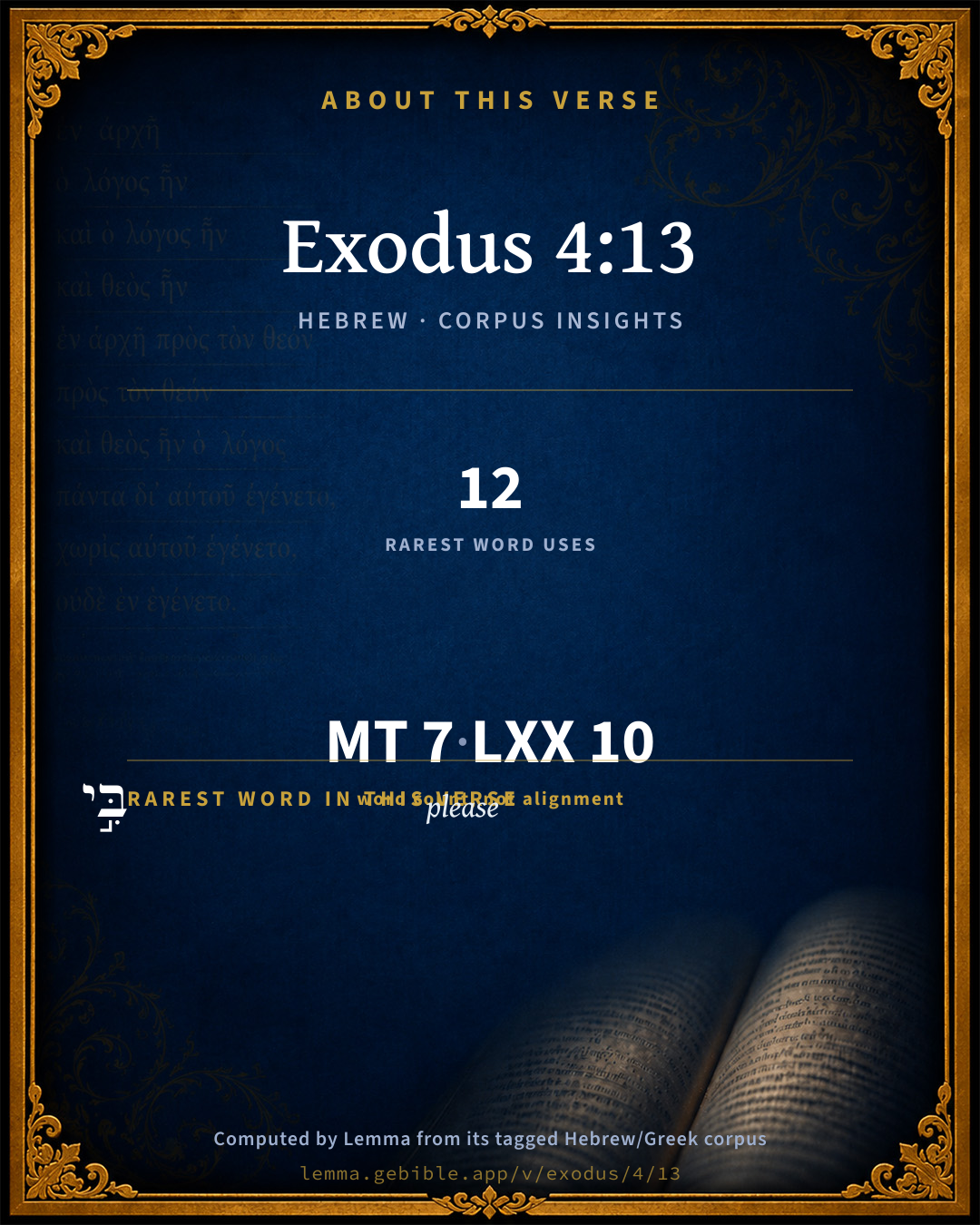
The rarest word here is בִּ֣י please H994 — appearing just 12 times in the whole Hebrew Bible.

Shared distinctive vocabulary

בִּ֣י please H994 occurs in 12 verses of the Hebrew Bible. Also found in:

Grammatical profile

  • 3 verbs
  • 2 nouns
  • 2 particles

Verb forms

  • וַיֹּ֖אמֶר Qal · Sequential Imperfect
  • שְֽׁלַֽח Qal · Imperative
  • תִּשְׁלָֽח Qal · Imperfect

Repetition

A word recurs within this verse — often emphatic in Hebrew:

  • שְֽׁלַֽח to send H7971 ×2

Hebrew & Septuagint length

In English translation the verse runs 8 words from the Hebrew and 15 from the Septuagint (LXX English) — the Septuagint runs noticeably longer here. See the side-by-side →

A rough comparison of the two English renderings, which tokenize alike — not a word-level alignment.

Word counts can differ between the Hebrew and the Greek without any difference in meaning — e.g. the Hebrew direct-object marker אֵת has no separate Greek word, and Greek often adds the article ὁ.

In the original languages it is 7 Hebrew tokens and 10 Greek tokens — but the two are counted differently (Hebrew bundles its prefixes and suffixes into one token; the Greek is in lemma form), so that isn’t a like-for-like length.

Cross-references

13

Topical passages linked to Exodus 4:13 in the Treasury of Scripture Knowledge — connected by theme and wording, ordered by reader-vote popularity; previews shown in the World English Bible.

  • Exodus 4:1 Moses answered, "But, behold, they will not believe me, nor listen to my voice; for they will say, 'Yahweh has not appeared to you.'"
  • Jonah 1:3 But Jonah rose up to flee to Tarshish from the presence of Yahweh. He went down to Joppa, and found a ship going to Tarshish; so he paid its fare, and went down into it, to go with them to Tarshish from the presence of Yahweh.
  • Genesis 48:16 the angel who has redeemed me from all evil, bless the lads, and let my name be named on them, and the name of my fathers Abraham and Isaac. Let them grow into a multitude in the midst of the earth."
  • Exodus 23:20 "Behold, I send an angel before you, to keep you by the way, and to bring you into the place which I have prepared.
  • Judges 2:1 The angel of Yahweh came up from Gilgal to Bochim. He said, I made you to go up out of Egypt, and have brought you to the land which I swore to your fathers; and I said, I will never break my covenant with you:
  • Jeremiah 1:6 Then said I, Ah, Lord Yahweh! behold, I don't know how to speak; for I am a child.
  • Jeremiah 20:9 If I say, I will not make mention of him, nor speak any more in his name, then there is in my heart as it were a burning fire shut up in my bones, and I am weary with forbearing, and I can't [contain].
  • Ezekiel 3:14–15 So the Spirit lifted me up, and took me away; and I went in bitterness, in the heat of my spirit; and the hand of Yahweh was strong on me.
  • Jonah 1:6 So the shipmaster came to him, and said to him, "What do you mean, sleeper? Arise, call on your gods! Maybe the gods will notice us, so that we won't perish."
  • Matthew 13:41 The Son of Man will send out his angels, and they will gather out of his Kingdom all things that cause stumbling, and those who do iniquity,
  • John 6:29 Jesus answered them, "This is the work of God, that you believe in him whom he has sent."
  • Genesis 24:7 Yahweh, the God of heaven, who took me from my father's house, and from the land of my birth, who spoke to me, and who swore to me, saying, 'I will give this land to your seed.' He will send his angel before you, and you shall take a wife for my son from there.
  • 1 Kings 19:4 But he himself went a day's journey into the wilderness, and came and sat down under a juniper tree: and he requested for himself that he might die, and said, It is enough; now, O Yahweh, take away my life; for I am not better than my fathers.

Cross-references courtesy of OpenBible.info (CC BY 4.0).

Hebrew and Greek witnesses Masoretic Hebrew ↔ Greek Septuagint

The same verse in the two great witnesses to the Old Testament, shown verse-for-verse.

Here the Septuagint runs noticeably longer than the Hebrew — LXX2012 (modern English Septuagint) 15 words vs World English Bible 8. A rough length comparison of the two English translations, not a word-level alignment — read both below.

These are two independent witnesses, not word-aligned to each other, and the Septuagint is shown in lemma (dictionary) form.

Hebrew Exodus 4:13 Masoretic · Westminster Leningrad Codex

וַיֹּ֖אמֶר בִּ֣י אֲדֹנָ֑י שְֽׁלַֽח נָ֖א בְּיַד תִּשְׁלָֽח

He said, "Oh, Lord, please send someone else."

World English Bible · Public Domain

Greek LXX Exodus 4:13 Septuagint · lemma form

καί εἶπον μωυσῆς δέομαι κύριος προςχειρίζω δύναμαι ἄλλος ὅς ἀποστέλλω

And Moses said, I pray you, Lord, appoint another able person whom you shall send.

LXX2012 (modern English Septuagint) · Public Domain

On this verse, Adam Clarke's Commentary discusses the Septuagint’s reading. Read the note in Commentary ↓

Hebrew: Westminster Leningrad Codex (CC BY 4.0). Greek: Septuagint (public domain); English from LXX2012 (modern English Septuagint) (Public Domain). How the Septuagint differs from the Hebrew →

Targum (Aramaic paraphrase)

2

The Targum is the ancient Jewish Aramaic paraphrase of the Hebrew Scriptures — an interpretive translation, not the Hebrew text itself. Onkelos (literal) and Pseudo-Jonathan (expansive) render the Torah, and Jonathan the Prophets. Coverage is partial: where no permissively-licensed English translation exists for a verse, only the Aramaic is shown. This is verse-level text, not a word-by-word alignment to the Hebrew.

  1. Targum Onkelos Torah (Genesis–Deuteronomy)
    וַאֲמַר בְּבָעוּ יְיָ שְׁלַח כְּעַן בְּיַד מָן דְכָשַׁר דְתִשְׁלַח:

    (no public-domain English translation for this verse)

    Targum Onkelos — Aramaic: “Onkelos Genesis” (public domain); “Onkelos Exodus” (public domain); “Onkelos Leviticus” (public domain); “Onkelos Numbers” (public domain); “Onkelos Deuteronomy” (public domain). English: “Sefaria Community Translation” (CC0 1.0 (public-domain dedication)); “J.W. Etheridge. The Targums of Onkelos and Jonathan Ben Uzziel on the Pentateuch. London: Longmans, Green, 1862” (public domain). Text via Sefaria.

  2. Targum Pseudo-Jonathan Torah (Genesis–Deuteronomy)
    וַאֲמַר בְּבָעוּ בְּרַחֲמִין מִן קֳדָמָךְ יְיָ שְׁלַח כְּדוֹן שְׁלִיחוּתָךְ בְּיַד פִּנְחָס דְחָמֵי לְמִשְׁתַּלְחָא בְּסוֹף יוֹמַיָא

    And he said, I pray for mercy before the Lord. Send now Thy sending by the hand of Phinehas, by whom it is to be sent at the end of the days.

    Targum Pseudo-Jonathan — Aramaic: “Targum Jonathan on Genesis” (public domain); “Targum Jonathan on Exodus” (public domain); “Targum Jonathan on Leviticus” (public domain); “Targum Jonathan on Numbers” (public domain); “Targum Jonathan on Deuteronomy” (public domain). English: “The Targum of Jonathan ben Uzziel, trans. J. W. Etheridge, London, 1862” (public domain). Text via Sefaria.

Commentary

Notes on Exodus 4:13 from classic Christian and Jewish commentators (each source and its license shown beneath its notes). The classic Christian expositions comment on the surrounding passage and are grouped to its opening verse, so a note may address several verses; the Jewish commentaries on the Tanakh (Rashi and others) are per-verse, so they appear only where the commentator wrote on this verse.

Lemma curates 59 commentaries, every one of them public domain or Creative Commons licensed, each selected and text-cleaned for this edition rather than reprinted as found. About our sources →

Trapp's Complete Commentary

John Trapp

Exo 4:13 And he said, O my Lord, send, I pray thee, by the hand [of him whom] thou wilt send.

Ver. 13. By the hand of him whom thou wilt.] Or, shouldst send: by that excellent speaker the Messiah, cuius dicere est facere. Thus when God had answered all Moses’s objections, he frowardly denies to go notwithstanding, and bids him send by his son, as one that was better fitted for the service. That which made Moses so unwilling, was, whatever he pretended, the fear of his life: which rub when God had once removed, he went on his journey. {Exo 4:19-20}

John Trapp, A Commentary or Exposition upon All the Books of the Old and New Testament (1647–1656) — public domain. Text from a community e-Sword module.

The Biblical Illustrator

Joseph S. Exell

Exo_4:13

Send, I pray Thee, by the hand of him whom Thou wilt send.

An evasion of spiritual work

I. Moses recognized the necessity that the work should be accomplished.

II. He manifested a disposition to shrink from achieving the work himself.

III. He expressed a desire that some other person should be called to, and entrusted with, the work.

IV. He was in danger of losing the honour of the work to which he was called. (J. S. Exell, M. A.)

The joy of being used by God

I have a letter from a dear Christian lady in this city who refused to speak to an inquirer when I asked her to, on the ground that she could not talk to an inquirer. The next day she was deeply humiliated to think that she had refused to speak to an anxious soul; and the question even of her own acceptance with God came up for discussion in her own mind. Can I be a child of God, if I am not willing to speak to an anxious soul about Jesus? She was led by this to cast herself down in consecration to God to be used of Him in any way, and especially in speaking to the anxious. Here is an extract from a letter just received. I am constrained to tell you that He allowed me on Sunday Night, for the first time, the intense joy of helping to lead a dear soul to Himself. Oh, the rest, and joy, and peace to my own heart, is more than tongue can tell! To think that after being His child for seventeen years, and being cold and useless all that wasted time, He should then be so loving and gracious as to use me, such a worthless cumberer. Oh, it is wonderful! Praise His dear name. Dear friend, would you not like to have a similar experience? (G. F. Pentecost, D. D.)

The inventiveness of reluctance

Man excusing himself from duty is a familiar picture. It is not a picture indeed; it is a personal experience. How inventive we are in finding excuses for not doing the will of God! How falsely modest we can become! depreciating ourselves, and putting ourselves before God in a light in which we could never consent to be put before society by the criticism of others. Is not this a revelation of the human heart to itself? We only want to walk in paths that are made beautiful with flowers, and to wander by streams that lull us by their own tranquillity. Nerve, and pluck, and force we seem to have lost. In place of the inventiveness of love we have the inventiveness of reluctance or distaste. It should be our supreme delight to find reasons for co-operating with God, and to fortify ourselves by such interpretations of circumstances as will plainly show us that we are in the right battle, fighting on the right side, and wielding the right weapon. The possibility of self-deception is one of the most solemn of all subjects. I cannot question the sincerity of Moses in enumerating and massing all the difficulties of his side of the case. He meant every word that he said. It is not enough to be sincere; we must have intelligence and conscience enlightened and enlarged. Mistakes are made about this matter of sincerity; the thing forgotten being that sincerity is nothing in itself, everything depending upon the motive by which it is actuated and the object towards which it is directed. The Church is to-day afflicted with the spirit of self-excusing:--it cannot give, because of the depression of the times; it cannot go upon its mighty errands, because of its dainty delicateness; it cannot engage in active beneficence, because its charity should begin at home; it cannot enter into ardent controversy, because it prefers the comfort of inaction. Churches should not tell lies to themselves. The first great thing to be done is for a man to be faithful to his own heart, to look himself boldly in the face, and speak the clear truth emphatically to his own consciousness. (J. Parker, D. D.)

The Biblical Illustrator, edited by Joseph S. Exell (c. 1880s–1900s) — public domain. Text from a community e-Sword module.

Joseph Benson's Commentary

Exo 4:13-14. Send by whom thou wilt send — By any but me. The anger of the Lord was kindled — Even self-diffidence, when it grows into an extreme, when it either hinders us from duty, or clogs us in duty, is very displeasing to him. I know that he can speak well — Moses excelled in wisdom and conduct, Aaron in eloquence. Such is the wise order of Providence. As in the human body each member has its different use and function, and all ministering to the good of the whole; so in the mystical body of Christ, God has dispensed different gifts to different members, and very seldom, if ever, gives all accomplishments to one; but to preserve a mutual dependance and relation, he distributes some to one and some to others, Rom 12:4.

Joseph Benson's Commentary on the Old and New Testaments (1811–1818) — public domain. Text from a community e-Sword module.

Tyndale Open Study Notes

Tyndale Open Resources

4:13 Having run out of protests, Moses simply asked to be excused.

Tyndale Open Study Notes — © Tyndale Open Resources, licensed CC BY-SA 4.0. Text via the HelloAO Bible API.

Geneva Bible (1599)

Geneva Bible translators

That is, the Messiah: or some other, that is more meet than I.

Or, ministry.

Geneva Bible (1599) marginal notes — public domain. Text via Bolls.life.

Adam Clarke's Commentary

Verse 13. Send - by the hand of him whom thou wilt send.] Many commentators, both ancient and modern, have thought that Moses prays here for the immediate mission of the Messiah; as if he had said: "Lord, thou hast purposed to send this glorious person at some time or other, I beseech thee send him now, for who can be sufficient to deliver and rule this people but himself alone?" The Hebrew שלח נא ביד תשלח shelach na beyad tishlach literally translated is, Send now (or, I beseech thee) by the hand thou wilt send; which seems to intimate, Send a person more fit for the work than I am. So the Septuagint: Προχειρισαι δυναμενον αλλον, ὁν αποστελεις· Elect another powerful person, whom thou wilt send. It is right to find out the Messiah wherever he is mentioned in the Old Testament; but to press scriptures into this service which have not an obvious tendency that way, is both improper and dangerous. I am firmly of opinion that Moses had no reference to the Messiah when he spoke these words.

Adam Clarke's Commentary on the Bible (1810–1826) — public domain. Text from a community e-Sword/MySword module.

Ellicott's Commentary for English Readers

(13) Send, I pray thee, by the hand of him whom thou wilt send.—Rather, pray send by whom thou wilt. A curt, impatient, and scarcely reverent speech. Moses means that he will undertake the task if God insists; but that God would do far better to send another. Hence the “anger of the Lord” against him (Exo_4:14), which led to Aaron’s association with him as joint leader of the people.

A Bible Commentary for English Readers, edited by Charles John Ellicott (1878–1897) — public domain. Text from a community e-Sword module.

The Cambridge Bible for Schools and Colleges

gen. ed. J. J. S. Perowne

13. Send, I pray thee, him whom thou wilt send, whoever it may be (for the idiom, see on Exo_33:19). Moses assents, but unwillingly and ambiguously (cf. W. R. Smith [p. 40 n.], p. 163).

The Cambridge Bible for Schools and Colleges (gen. ed. J. J. S. Perowne; Cambridge University Press, 1878–1918) — public domain. Text from a community e-Sword module.

John Gill's Exposition

And he said, O my Lord,.... Acknowledging his dominion, his sovereignty, his power to do the above things: or "on me, O Lord" (u), be the blame for making such objections; or on me let this work be devolved, since it is thy pleasure:

send, I pray thee, by the hand of him whom thou wilt send. Many of the ancient Christian fathers understand it of the Messiah that was to be sent, and as if Moses thought this was a fit time for the sending of him: and so Cocceius is of opinion, that nothing better can be understood, than that Moses desired that God would rather send him, whom Israel expected to be sent, even the Angel that should go before them; of whose mission see Exo 23:20, but no particular person is intended, unless himself; and the common interpretation is, that God would send a more fit and proper person than he was; and that he would rather send anyone but him, and entreats to be excused; but I see not why this may not be understood of Moses assenting to his mission, and acquiescing in the will of God; as if he should say, since it must be so, the will of the Lord be done, let him send by whom he will, and since it is his pleasure to send by me, I submit; what may seem to contradict this is, the Lord's anger and resentment expressed in the following words; but that might be notwithstanding, since Moses had been so backward and reluctant, and made so many objections before he consented.

(u) "in me", Oleaster.

John Gill's Exposition of the Whole Bible (1746–1763) — public domain (CC PDM 1.0). Text via the HelloAO Bible API.

Albert Barnes' Notes on the Bible

And he said - The reluctance of Moses is in accordance with the inner law of man’s spiritual development, and specially with his own character; but, under the circumstances, it indicated a weakness of faith.

Albert Barnes' Notes on the Bible (1834–1885) — public domain. Text from a community e-Sword/MySword module.

Haydock's Catholic Bible Commentary

Send. Many of the fathers think Moses here prays for the coming of the Messias, who was to be the deliverer of his people; (St. Justin, &c.) or he begs at least that one more proper than himself may be selected; in which some discover marks of pusillanimity, others of great and laudable modesty; so that the anger of God here only means an earnest expression of his will , that Moses should make no further demur. Lyranus supposes that Aaron was the person pointed at by Moses; and God grants his request. (Calmet)

George Leo Haydock (1774–1849), Haydock's Catholic Family Bible and Commentary, 1859 edition — public domain. Excludes Psalms (Douay-Rheims chapter numbering differs from Protestant) and Deuterocanonical books (Catholic canon only).

Matthew Poole's English Annotations

By one who is fitter for the work than I am. Heb. Send by the hand of him whom

thou wilt send, i.e. should send; for the future tense oft signifies what one should do. See Gen 20:9; 34:7; Mal 1:6; 2:7. Thou usest according to thy wisdom to choose fit instruments, and to use none but whom thou dost either find or make fit for their employment, which I am not. Others, Send by the hand of Messias, whom thou wilt certainly send, and canst not send at a fitter time, nor for better work. Moses and the prophets knew that Christ would come, but the particular time of his coming was unknown to them. See 1Pe 1:11.

Matthew Poole's English Annotations on the Holy Bible (1683–1685) — public domain. Text from a community e-Sword/MySword module.

Whedon's Commentary on the Bible

Daniel D. Whedon

13. Send, I pray thee, by the hand (of whomsoever else) thou wilt send — All his objections had been removed, yet still he hesitated and shrank. The unreasonableness of unbelief is here most naturally depicted, but with what unworldly fidelity! What an infallible touch of genuineness, when we consider the laws of man’s spiritual development, and note the progress of the faith of Moses! Yet what later scribe of the followers of the great lawgiver would ever, by the invention of such an incident, have blurred the glory of that venerated name? Only Moses himself — and only the inspired Moses — could ever have detailed this humiliating weakness. This is not the style of unrenewed and uninspired man.

Daniel D. Whedon (gen. ed.), Commentary on the Old and New Testaments (1874–1909) — public domain. Text from a community e-Sword module.

The Pulpit Commentary

Vers. 13, 14. The sin of self-distrust, and its punishment.

Undoubtedly the general inclination of men is towards self-assertion and self-sufficiency, so that diffidence and distrust of self are commonly regarded as excellences. But there is a diffidence which is wrongful, a self-distrust which Scripture condemns. St. Paul calls it "a voluntary humility" (ejqelotapeinofrosunh) a humblemindedness, that is, which has its root in the will; a man not choosing to think that he is fit for high things, and determining to keep down his aims, aspirations, hopes, endeavours. The same apostle exhorts his converts "not to think of themselves more highly than they ought to think", (Rom_12:3) but at the same time, by implication, "not to think too humbly, for he tells them to think soberly, according as God has dealt to every one the measure of faith." We ought to take true views of ourselves, of our capacities, powers, faculties, even of the graces to which by God"s mercy we have been able to attain; and not to deny them or depreciate them. If we do so we keep ourselves back from high things, and this is how God punishes us. Moses lost the gift of eloquence, which God would supernaturally have bestowed upon him (ver. 12), and lost one-half of his leadership (vers. 14-16), by his persistent diffidence and distrust. We prevent ourselves from attaining heights to which we might have attained, we keep ourselves down in this world and make our position low in the next, by similar folly. The youth who bore the banner with the word "excelsior" upon it, was wiser than most of us. If we would rise high we must aim high; if we would aim high we must not be too diffident of ourselves.

A servant"s difficulties.

Observe

I WHAT THEY WERE. Moses" difficulties resolved themselves into three.

1. The power of Pharaoh. "Who am I that I should go to Pharaoh?". (Exo_3:10) We may be staggered by the thought of the powers that are arrayed against us.

1. The anticipated unbelief of the people (ver. 1). The preacher has to encounter hard and unbelieving hearts, and this may enfeeble and dishearten him.

2. His lack of gifts (ver. 10). Humble natures are easily discouraged by the sense of their own short-comings by the consciousness of ignorance, defective education, lack of gifts of speech, etc.

II HOW THEY WERE MET.

1. God armed Moses with powers that made him more than a match for themighty king of Egypt.

2. He gave him the means of overcoming the unbelief of the people.

3. He promised to endow him with power of speech; and, when that wasrejected, supplied his defect by giving him a coadjutor.

From which learn:

1. That while it is right to state our difficulties to God to pour out allour hearts before him it is wrong to make them an excuse for shrinking from duty.

2. That God, if relied on, will give us all sufficiency. J.O.

Vers. 13-16. Moses, taking a step too far, is suddenly arrested.

In ver. 13 we must evidently look at the spirit of the words, rather than the words themselves. There is nothing wrong in the words. Uttered in a different tone and in different circumstances they might have drawn forth the approval of God rather than his anger. They might be used as expressing the most devout submissiveness, the consciousness of one who, though he is treading forth into darkness and danger, is sure that he is filled with the fulness of God. But not so had Moses yet learned to speak. God has tried to call him away from the turmoil of his doubts, from his hasty conjectures and crude anticipations; but instead of obeying, instead of acquainting himself with God, and thereby being at peace, he flies in his face with this half-despairing half-defiant cry. It is the crisis of the struggle, and it is very instructive to notice how firmly and yet gently God deals with his servant. Observe, then, how we have here a due mingling of righteous anger and compassionate aid.

I GOD"S MANIFESTED ANGER WITH MOSES. The expression is a strong and suggestive one. Not simply that God was angry, but that his anger was kindled. We may take it as meaning that there was some anger already, growing indeed hotter and hotter, but only now under this great provocation breaking into flame. The anger of God must inevitably rise at every contact with human ignorance and stubbornness, though it may be so veiled beneath love, pity, and patience as to be concealed from the man whose conduct excites it. And note in particular that there is no inconsistency in attributing to God anger with Moses. Moses himself was to be excused, as having only recently become acquainted with God; but he could not escape his share of the due effects arising out of the alienation of the entire human race from God. Besides, God"s anger must be looked upon as one of his instruments in bringing us effectually to compliance with his will. God"s anger is really part of the goodness which leads us to repentance; and if gentler methods fall, then the time will come at last when that anger must be decidedly manifested, even for our good. Moses could not but admit that so far he had been dealt with very gently indeed. God, quickly and. tenderly responsive, had met every hint of difficulty with a strong encouragement. But all the encouragements had made no real difference in Moses" mood of mind. He turns upon God in the querulous unappreciative strain indicated in ver. 13. Thus he unconsciously signifies that the time has come for God to change the method of his action. Moses, like a persistently heedless scholar, must be made to feel that his master cannot be trifled with. God speaks, not that we may discuss and parley with him, but that we may obey. Let Moses now understand that the time has come for him at once to go forth.

II THE ANGER IS MINGLED WITH A GRACIOUS PROMISE OF APPROPRIATE AID. God"s anger with his own chosen ones is but a sudden darkness to make the following light more useful and esteemed. God, who has just shown his power to Moses in the burning bush and the following signs, now shows power in a way even more attractive. He is one who can at the same moment warn and comfort, not only smiting that he may heal, but able to blend smiting and healing together. Even though Moses has provoked his indignation, he does not leave him with a bare promise that somehow or other his defect of utterance will be supplied. God sweeps away this latest difficulty as completely as he had done the previous ones. And note moreover that he disposed of it in his own unexpected way. It was better to leave Moses as he was, and make Aaron his spokesman, than to enrich him in his own person with all gifts of utterance and leave him alone. By linking the two men together, God was constantly teaching them the need of mutual subordination. If they would only be companions in humility they should also be companions in prosperity and in gladness of heart. Sad and disastrous would be the day when Moses should be disposed to say to Aaron, "I have no need of thee," or Aaron to Moses, "I have no need of thee." Aaron had what Moses lacked. Moses had the matter of a Divine and gladsome message, but he felt utterly at a loss how he was to get it properly laid before all whom it concerned. Aaron, on the other hand, had voice and faculty of speech, but behind that voice there had hitherto been nothing of commandment, direction, and encouragement. Aaron, says the Lord, was a man who could speak well; that is, as we may take it, a man able to speak distinctly and impressively one who could deliver any message entrusted to him in a way which would not obscure the message, nor draw ridicule on the utterer of it. Moses and Aaron went together like the musician and the instrument on which he plays. Thus we see the way in which God binds us together by our very deficiencies. He constitutes us so that we are always more or less dependent on our fellow-men, and sometimes the dependence is very marked indeed. It is well for us in the midway and strength of life to consider that there may be but a step between us and the need of the tenderest sympathy. When we are most independent there are possibilities lying before us yes, there are even certainties which should moderate our pride and self-sufficiency. Manly independence is one of the greatest blessings; egotistic isolation one of the greatest curses. They that are strong should bear the infirmities of the weak; there are none of us so strong but that in some emergency of life we may accept the relief; there are none of us so weak but that we may do something to provide the relief, in a world which is so full of temptations to discord and rivalry it is a great comfort to remember that God is constantly working to counteract them. He guides human affairs, even as he guides the planets themselves; the centripetal force is greater than the centrifugal. If every one of us were free to work out the desires of our selfish hearts, anarchy would come with fearful rapidity. Y.

The Pulpit Commentary (1880–1919), ed. H.D.M. Spence-Jones & Joseph S. Exell — public domain. Text from a community e-Sword module.

John Wesley's Explanatory Notes

Send by whom thou wilt send - By any but me.

John Wesley, Explanatory Notes Upon the Whole Bible (1754–1765) — public domain. Text via the GEBible commentary corpus.

Rashi

Rabbi Shlomo Yitzchaki (Rashi)

ביד תשלח signifies by the hand of him whom Thou art accustomed to send; viz., Aaron (Exodus Rabbah 3:16). Another explanation is: by the hand of some other person whom Thou wilt be pleased to send — for in the end “I” shall not bring them into the land of Palestine nor shall “I” become their deliverer in the future — and You have many messengers! (Pirkei DeRabbi Eliezer 40)

Rashi on the Tanakh — English translations: “The Judaica Press complete Tanach with Rashi, translated by A. J. Rosenberg” (CC BY 4.0); “Pentateuch with Rashi's commentary by M. Rosenbaum and A.M. Silbermann, 1929-1934” (public domain); “The Metsudah Tanach series, Lakewood, N.J” (CC BY 4.0); and “The Book of Joshua, Metsudah Publications, 1997” (CC BY 4.0). Text via Sefaria.

Ramban (Nachmanides)

Rabbi Moshe ben Nachman (Ramban / Nachmanides)

SEND, I PRAY THEE, BY THE HAND OF HIM WHOM THOU WILT SEND. “This means by the hand of him whom You are accustomed to send, and that is Aaron. Another explanation is: by the hand of some other person whom Thou wilt be pleased to send, for in the end I will not bring them into the Land, nor am I destined to be their deliverer in the future. Thou hast many messengers.” Thus the language of Rashi. And Onkelos said: “by the hand of him who is fit to be sent.” This means: “Send by the hand of him who speaks eloquently, who will be fit and proper for an honorable mission such as this. Do not send by the hand of one who is slow of speech and of a slow tongue and be with his mouth when he speaks before Pharaoh, since it is not a matter of respect and honor that Your messenger be one of uncircumcised lips, and none of the people will heed him when he speaks before the king, since this will appear to them as a defect.”The correct interpretation appears to me to be that Moses said, “Send, I pray Thee, by the hand of anyone whom Thou wilt send, for there is not a person in the world who is not more fit for the mission than I.” The reason for all this obduracy of Moses was his great meekness, above all the men that were upon the face of the earth, as he could not see himself assuming importance and speaking to the king and [taking] glory in saying, “The Eternal sent me,” nor [to speak] to Israel to bring them out from Egypt and be king over them.

Ramban (Nachmanides) on the Tanakh — English translation: “Commentary on the Torah by Ramban (Nachmanides). Translated and annotated by Charles B. Chavel. New York, Shilo Pub. House, 1971-1976” (CC BY 4.0). Text via Sefaria.

Sforno

Rabbi Ovadia Sforno

Please send the one You usually send. Through one who is better prepared to accomplish Your mission. Not a man such as myself, who will need Your constant support and guidance, so that [in reality] You will be the one who speaks.

Sforno on the Tanakh — English translation: “Yalkut, Sifsei Chachomim Chumash, Metsudah Publications, 2009” (CC BY 4.0). Text via Sefaria.

Lesson kit

Teaching starters — assembled from the data on this page, not authored interpretation. Every prompt links to the verse data it draws on. Edit before teaching.

Exodus, in the Pentateuch, opens this verse with 7 words (6 distinct Hebrew lemmas). Its most distinctive word is bîy (“please”). The Greek Septuagint runs longer here. A historical commentator’s framing appears above. Read the whole chapter for the surrounding context.

Discussion questions

  1. What does “please” (bîy) contribute to the verse as a whole?
  2. Genesis 43:20 shares the word «please» with this verse. How do the two illuminate each other?
  3. “to send” occurs 2× in this one verse. What is the effect of the repetition?
  4. Compared with the Hebrew, the Septuagint runs longer here. What questions does that raise?
  5. These translations render this verse differently. What is at stake in choosing one wording over another?
  6. The verb «וַיֹּ֖אמֶר» is Qal Sequential Imperfect. How does its form color the action?
  7. Reading how Trapp's Complete Commentary and The Biblical Illustrator read this verse, where do the two commentators agree and where do they part?

Things to notice

Reading settings

Reading text

Shown beneath each verse's original-language words.

Old Testament
Old Testament edition

Read the OT as the Masoretic Hebrew (MT) or the Greek Septuagint (LXX).

English shown for the Greek Septuagint (in the Hebrew ↔ Greek comparison).

Comparing translations? Open the Compare panel on any verse page to stack up to four side by side.