Exodus 21:5

Hebrew (Westminster Leningrad Codex) Exodus 21:5 appears in the Hebrew Old Testament. The text above is from the Westminster Leningrad Codex. Each word links to its Strong’s number, a concise gloss, and parsing drawn from the Open Scriptures Hebrew Bible morphology. Click any word for its full Brown-Driver-Briggs (BDB) entry.
Download image
Cite this verse

Exodus 21:5 (World English Bible). Public Domain. Lemma interlinear Bible study tool, https://lemma.gebible.app/v/exodus/21/5.

Show BibTeX & RIS
BibTeX
RIS
English Translation
But if the servant shall plainly say, 'I love my master, my wife, and my children. I will not go out free;'
World English Bible · Public Domain
Download a study sheet

One document with this verse’s original text, its word-by-word gloss line, the meaning frame, cross-references with their text, attributed commentary, and full source and license credits — printable, and it pastes into notes with its structure intact.

This verse Autodidact and up

Study sheet (.html) Plain text (.txt)

A passage Seminary Student

Up to 50 verses in one chapter. A passage sheet keeps up to 6 commentary sources and 12 cross-references per verse, in the order this page ranks them, and says so on the sheet whenever that leaves anything out. Ask for a single verse and you get the Autodidact verse sheet above.

Everything on this page stays free to read, with no account — the sheet is a download of what is already on screen, not access to it.

Want to remove ads? Support Godless Engineer
Compare translations 3

The same verse in 3 English versions, stacked beneath the original-language interlinear above. Click any original word for its lexicon entry.

Each is an independent rendering of the whole verse — the interlinear is not word-aligned to these translations.

Highlighted words mark where these versions differ — a whole-verse word diff, not a word-by-word alignment.

  • World English Bible Public Domain
    But if the servant shall plainly say, 'I love my master, my wife, and my children. I will not go out free;'
  • King James Version Public Domain
    And if the servant shall plainly say, I love my master, my wife, and my children; I will not go out free:
  • unfoldingWord Literal Text CC BY-SA 4.0
    But if the servant plainly says, “I love my master, my wife, and my children; I shall not go out free,”

unfoldingWord Literal Text — © unfoldingWord, licensed CC BY-SA 4.0. Word-aligned USFM3 via Door43 (git.door43.org/unfoldingWord/en_ult).

Versions to compare (up to 4)

3 of 4 selected

Show all 18 translations

Every available English version of this verse, each an independent rendering of the whole verse.

  • World English Bible Public Domain
    But if the servant shall plainly say, 'I love my master, my wife, and my children. I will not go out free;'
  • Berean Standard Bible Public Domain
    But if the servant declares, ‘I love my master and my wife and children; I do not want to go free,’
  • Majority Standard Bible Public Domain
    But if the servant declares, ‘I love my master and my wife and children; I do not want to go free,’
  • King James Version Public Domain
    And if the servant shall plainly say, I love my master, my wife, and my children; I will not go out free:
  • American Standard Version (1901) Public Domain
    But if the servant shall plainly say, I love my master, my wife, and my children; I will not go out free:
  • Revised Version (1885) Public Domain
    But if the servant shall plainly say, I love my master, my wife, and my children; I will not go out free:
  • Geneva Bible (1599) Public Domain
    But if the seruant saye thus, I loue my master, my wife and my children, I will not goe out free,
  • Douay-Rheims (1899) Public Domain
    And if the servant shall say: I love my master and my wife and children, I will not go out free:
  • Young's Literal Translation Public Domain
    `And if the servant really say: I have loved my lord, my wife, and my sons -- I do not go out free;
  • Literal Standard Version CC BY-SA 4.0
    And if the servant really says: I have loved my lord, my wife, and my sons—I do not go out free,
  • Unlocked Literal Bible CC BY-SA 4.0
    But if the servant plainly says, “I love my master, my wife, and my children; I will not go out free,”
  • unfoldingWord Literal Text CC BY-SA 4.0
    But if the servant plainly says, “I love my master, my wife, and my children; I shall not go out free,”
  • Darby Bible Public Domain
    But if the bondman shall say distinctly, I love my master, my wife, and my children, I will not go free;
  • World Messianic Bible Public Domain
    But if the servant shall plainly say, ‘I love my master, my wife, and my children. I will not go out free;’
  • Webster's Bible Public Domain
    And if the servant shall plainly say, I love my master, my wife, and my children; I will not depart free:
  • Free Bible Version CC BY-SA 4.0
    However, if the slave formally states, ‘I love my master and my wife and children; I do not want to be freed,’
  • Bible in Basic English Public Domain
    But if the servant says clearly, My master and my wife and children are dear to me; I have no desire to be free:
  • JPS Tanakh (1917) Public Domain
    But if the servant shall plainly say: I love my master, my wife, and my children; I will not go out free;

Literal Standard Version (2020), Covenant Press — licensed CC BY-SA 4.0. Text via the HelloAO Bible API (eBible.org). Unlocked Literal Bible (unfoldingWord) — licensed CC BY-SA 4.0. Text via the HelloAO Bible API (eBible.org). unfoldingWord Literal Text — © unfoldingWord, licensed CC BY-SA 4.0. Word-aligned USFM3 via Door43 (git.door43.org/unfoldingWord/en_ult). Free Bible Version, Dr. Jonathan Gallagher — licensed CC BY-SA 4.0. Text via the HelloAO Bible API (eBible.org).

Word by word

More ways to search: Search by grammar → Find every occurrence → Compare this word →

Practice this passage: Drill this verse → Learn its vocabulary →

חָפְשִֽׁי
chophshîy
H2670
“free”
Adjective, Adjective, Masculine, Singular, Absolute
Part of Speech
Adjective
Type
Adjective
Gender
Masculine
Number
Singular
State
Absolute
Full BDB Definition

Origin: from H2666

TWOT: 717c

free - free (from slavery) - free (from taxes or obligations)
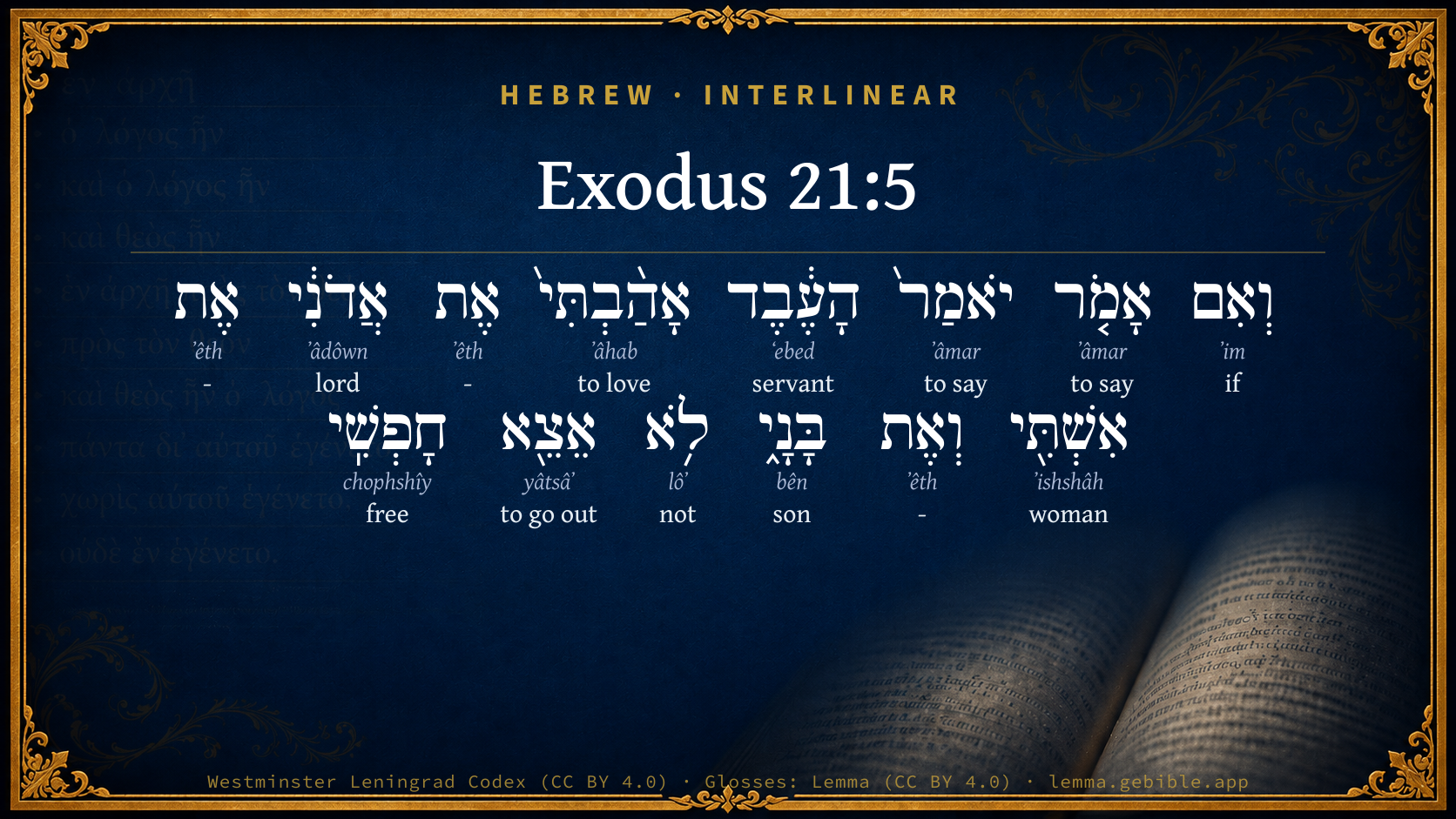
  1. וְאִם ʼim H518 “and · if” Conjunction + Conjunction
  2. אָמֹ֤ר ʼâmar H559 “to say” Verb, Qal, Infinitive Absolute
  3. יֹאמַר֙ ʼâmar H559 “to say” Verb, Qal, Imperfect, 3rd Person, Masculine, Singular
  4. הָעֶ֔בֶד ʻebed H5650 “the · servant” Particle, Definite Article + Noun, Common, Masculine, Singular, Absolute
  5. אָהַ֨בְתִּי֙ ʼâhab H157 “to love” Verb, Qal, Perfect, 1st Person, Common, Singular
  6. אֶת ʼêth H853 “-” Particle, Direct Object
  7. אֲדֹנִ֔י ʼâdôwn H113 “lord · my” Noun, Common, Masculine, Singular, Construct + Suffix, Personal, 1st Person, Common, Singular
  8. אֶת ʼêth H853 “-” Particle, Direct Object
  9. אִשְׁתִּ֖י ʼishshâh H802 “woman · my” Noun, Common, Feminine, Singular, Construct + Suffix, Personal, 1st Person, Common, Singular
  10. וְאֶת ʼêth H853 “and · -” Conjunction + Particle, Direct Object
  11. בָּנָ֑י bên H1121 “sons · my” Noun, Common, Masculine, Plural, Construct + Suffix, Personal, 1st Person, Common, Singular
  12. לֹ֥א lôʼ H3808 “not” Particle, Negative
  13. אֵצֵ֖א yâtsâʼ H3318 “to go out” Verb, Qal, Imperfect, 1st Person, Common, Singular

About this verse

These counts appear in no published source. They are computed here, from the morphology-tagged text and Lemma’s own curated glosses. What Lemma adds →

14
words
11
distinct lemmas
Pentateuch
section

Notable vocabulary

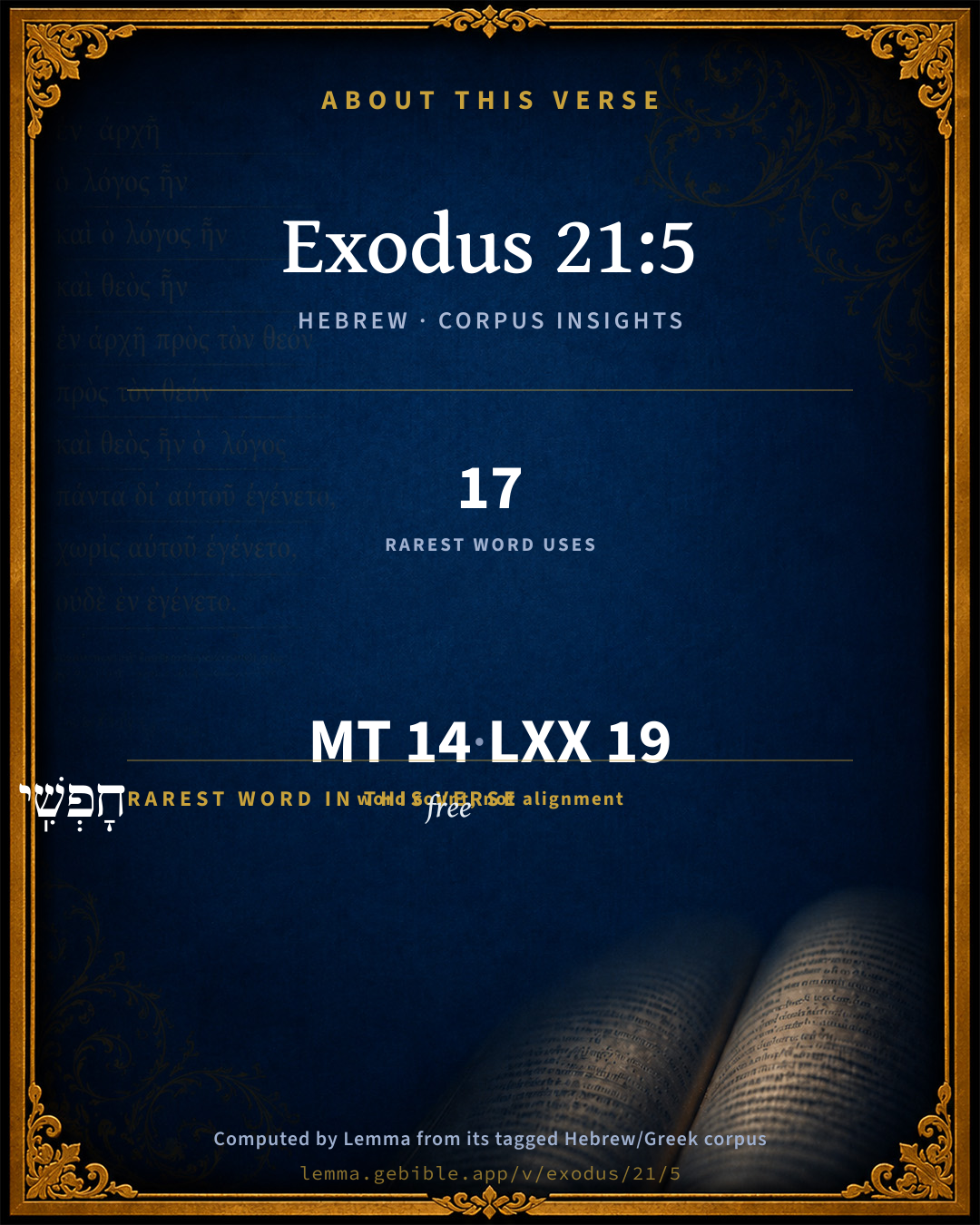
The rarest word here is חָפְשִֽׁי free H2670 — appearing just 17 times in the whole Hebrew Bible.

Shared distinctive vocabulary

חָפְשִֽׁי free H2670 occurs in 17 verses of the Hebrew Bible. Also found in:

Grammatical profile

  • 4 verbs
  • 4 nouns
  • 1 adjective
  • 1 conjunction
  • 4 particles

Verb forms

  • אָמֹ֤ר Qal · Infinitive Absolute
  • יֹאמַר֙ Qal · Imperfect
  • אָהַ֨בְתִּי֙ Qal · Perfect
  • אֵצֵ֖א Qal · Imperfect

Repetition

A word recurs within this verse — often emphatic in Hebrew:

  • אָמֹ֤ר to say H559 ×2

Hebrew & Septuagint length

In English translation the verse runs 22 words from the Hebrew and 22 from the Septuagint (LXX English) — the same length.

A rough comparison of the two English renderings, which tokenize alike — not a word-level alignment.

Word counts can differ between the Hebrew and the Greek without any difference in meaning — e.g. the Hebrew direct-object marker אֵת has no separate Greek word, and Greek often adds the article ὁ.

In the original languages it is 14 Hebrew tokens and 19 Greek tokens — but the two are counted differently (Hebrew bundles its prefixes and suffixes into one token; the Greek is in lemma form), so that isn’t a like-for-like length.

Cross-references

3

Topical passages linked to Exodus 21:5 in the Treasury of Scripture Knowledge — connected by theme and wording, ordered by reader-vote popularity; previews shown in the World English Bible.

  • Deuteronomy 15:16–17 It shall be, if he tell you, I will not go out from you; because he loves you and your house, because he is well with you;
  • 2 Corinthians 5:14–15 For the love of Christ constrains us; because we judge thus, that one died for all, therefore all died.
  • Isaiah 26:13 Yahweh our God, other lords besides you have had dominion over us; but by you only will we make mention of your name.

Cross-references courtesy of OpenBible.info (CC BY 4.0).

Hebrew and Greek witnesses Masoretic Hebrew ↔ Greek Septuagint

The same verse in the two great witnesses to the Old Testament, shown verse-for-verse.

These are two independent witnesses, not word-aligned to each other, and the Septuagint is shown in lemma (dictionary) form.

Hebrew Exodus 21:5 Masoretic · Westminster Leningrad Codex

וְאִם אָמֹ֤ר יֹאמַר֙ הָעֶ֔בֶד אָהַ֨בְתִּי֙ אֶת אֲדֹנִ֔י אֶת אִשְׁתִּ֖י וְאֶת בָּנָ֑י לֹ֥א אֵצֵ֖א חָפְשִֽׁי

But if the servant shall plainly say, 'I love my master, my wife, and my children. I will not go out free;'

World English Bible · Public Domain

Greek LXX Exodus 21:5 Septuagint · lemma form

ἐάν δέ ἀποκρίνω εἶπον ὁ παῖς ἀγαπέω ὁ κύριος ἐγώ καί ὁ γυνή καί ὁ παιδίον οὐ ἀποτρέχω ἐλεύθερος

And if the servant should answer and say, I love my master and wife and children, I will not go away free;

LXX2012 (modern English Septuagint) · Public Domain

Hebrew: Westminster Leningrad Codex (CC BY 4.0). Greek: Septuagint (public domain); English from LXX2012 (modern English Septuagint) (Public Domain). How the Septuagint differs from the Hebrew →

Targum (Aramaic paraphrase)

2

The Targum is the ancient Jewish Aramaic paraphrase of the Hebrew Scriptures — an interpretive translation, not the Hebrew text itself. Onkelos (literal) and Pseudo-Jonathan (expansive) render the Torah, and Jonathan the Prophets. Coverage is partial: where no permissively-licensed English translation exists for a verse, only the Aramaic is shown. This is verse-level text, not a word-by-word alignment to the Hebrew.

  1. Targum Onkelos Torah (Genesis–Deuteronomy)
    וְאִם מֵימַר יֵימַר עַבְדָא רָחֵימְנָא יָת רִבּוֹנִי יָת אִתְּתִי וְיָת בְּנָי לָא אֶפּוֹק לְבַר חוֹרִין:

    (no public-domain English translation for this verse)

    Targum Onkelos — Aramaic: “Onkelos Genesis” (public domain); “Onkelos Exodus” (public domain); “Onkelos Leviticus” (public domain); “Onkelos Numbers” (public domain); “Onkelos Deuteronomy” (public domain). English: “Sefaria Community Translation” (CC0 1.0 (public-domain dedication)); “J.W. Etheridge. The Targums of Onkelos and Jonathan Ben Uzziel on the Pentateuch. London: Longmans, Green, 1862” (public domain). Text via Sefaria.

  2. Targum Pseudo-Jonathan Torah (Genesis–Deuteronomy)
    וְאִין יַתְנֵי וְיֵימַר עַבְדָא רְחֵימְנָא יַת רִבּוֹנִי יַת אִנְתְּתִי וְיַת בְּנַי לָא אֵיפּוֹק לְבַר חוֹרִין

    But if the servant shall affirm and say, I love my master, my wife, and my children, (and) I will not go out free,

    Targum Pseudo-Jonathan — Aramaic: “Targum Jonathan on Genesis” (public domain); “Targum Jonathan on Exodus” (public domain); “Targum Jonathan on Leviticus” (public domain); “Targum Jonathan on Numbers” (public domain); “Targum Jonathan on Deuteronomy” (public domain). English: “The Targum of Jonathan ben Uzziel, trans. J. W. Etheridge, London, 1862” (public domain). Text via Sefaria.

Commentary

Notes on Exodus 21:5 from classic Christian and Jewish commentators (each source and its license shown beneath its notes). The classic Christian expositions comment on the surrounding passage and are grouped to its opening verse, so a note may address several verses; the Jewish commentaries on the Tanakh (Rashi and others) are per-verse, so they appear only where the commentator wrote on this verse.

Lemma curates 59 commentaries, every one of them public domain or Creative Commons licensed, each selected and text-cleaned for this edition rather than reprinted as found. About our sources →

Ellicott's Commentary for English Readers

(5) And if.—Better, But if.

I love my master.—Under every system of slavery affection grows up between the slaves and a master who is indulgent to them. At Rome it was common for slaves to endure the severest torture rather than betray or accuse their owners. If a man has no rights, he is thankful for small mercies, and responds with warm feeling to those who treat him kindly. As the Hebrew form of slavery was of a mild type, masters being admonished to treat their slaves “not as bondservants, but as hired servants” (Lev_25:39-40), and, again, “not to rule over them with rigour” (Lev_25:46), there would naturally be frequent cases where the slave would not wish to “go out.” He might actually “love his master;” or he might value the security from want which attaches to the slave condition; or he might be unwilling to break up the family which, by his master’s favour, he had been allowed to create. For such cases some provision was necessary. It was made by the law here formulated (Exo_21:5-6), which allowed the Hebrew slave, if he liked, to forfeit all claim to freedom, and take upon him permanently the condition of a bondman.

A Bible Commentary for English Readers, edited by Charles John Ellicott (1878–1897) — public domain. Text from a community e-Sword module.

Trapp's Complete Commentary

John Trapp

Exo 21:5 And if the servant shall plainly say, I love my master, my wife, and my children; I will not go out free:

Ver. 5. I love my master.] A little better than he in Plautus, that said, Ego non servio libenter; herus meus me non habet libenter, tamen utitur me ut lippis oculis.

John Trapp, A Commentary or Exposition upon All the Books of the Old and New Testament (1647–1656) — public domain. Text from a community e-Sword module.

The Cambridge Bible for Schools and Colleges

gen. ed. J. J. S. Perowne

5. plainly say] ‘Plainly’ should be omitted. It is an attempt to represent in English the idiomatic use of the Hebrew inf. abs., which emphasizes the verb to which it is attached, and is often used in the expression of a condition (G.-K. § 113o). ‘Plainly,’ however, does not give the correct emphasis.

I love my master] A slave was no doubt often well treated, and would then naturally ‘prefer slavery with comfort to freedom with destitution’ (EB. iv. 4656).

my wife, and my children] The case is supposed to be the one provided for in v. 4, in which the slave’s wife and children would not accompany him into freedom.

5, 6. The fourth case. A slave, if he was happy with his master might, if he desired to do so, remain in his master’s service for life.

The Cambridge Bible for Schools and Colleges (gen. ed. J. J. S. Perowne; Cambridge University Press, 1878–1918) — public domain. Text from a community e-Sword module.

John Gill's Exposition

And if the servant shall plainly say,.... Or, "in saying shall say" (i) shall express himself in plain and full terms, and repeat his words, and abide by them, signifying it as his last will and determined resolution:

I love my master, my wife, and my children, and I will not go out free; but continue in his servitude, having a great affection for his master, and that he might enjoy his wife and children he dearly loved; and being animated with such a principle, his servitude was a pleasure to him: and when our obedience to God springs from love to him, and to his cause and interest, which should be as dear to us as our families, it is then acceptable to God and delightful to ourselves; in Deu 15:16,

it is, because he loveth thee, and thine house, because he is well with thee; hence the Jewish writers say (k), understanding by "house" a family, if a servant has a wife and children and his master not, his ear is not to be bored; and if his master has a wife and children and he has not, his ear is not to be bored; if he loves his master and his master do not love him, or his master loves him and he do not love his master, or if he is sick, &c. his ear is not to be bored.

(i) (k) T. Bab. Kiddushin, fol. 22. 1. Maimon. in Misn. Kiddushin, c. 1. sect. 2.

John Gill's Exposition of the Whole Bible (1746–1763) — public domain (CC PDM 1.0). Text via the HelloAO Bible API.

The Pulpit Commentary

Vers. 5, 6. I love my master, etc. Affection might grow up between the slave and the master, if he were well treated. The Hebrew form of slavery was altogether of a mild kind. Masters are admonished to treat their slaves "not as bond-servants, but as hired servants or sojourners," and again "not to rule over them with rigour". (Lev_25:39, Lev_25:40, Lev_25:43) Even among the heathen, slaves often bore a true affection to their masters. Or, the slave might be so attached to his wife and children as to be unwilling to separate from them, and might prefer slavery with the solace of their society to freedom without it. For such cases the provision was made, which is contained in ver. 6. On the slave declaring to his master his unwillingness to go free, the master might take him before the judges, or magistrates (literally "gods") as witnesses, and perhaps registrars of the man"s declaration, and might then reconduct him to his house, and by a significant ceremony mark him as his slave "for ever." The ceremony consisted in boring through one of his ears with an awl, and driving the awl into the door or doorpost of the house, thereby attaching him physically to the dwelling of which he became thenceforth a permanent inmate. Almost all commentators assert that some such custom was common in the East in connection with slavery, and refer to Xen. Aaab. 3:1, Plant. Poenul. 5:2, 21; Juv. Sat. 1:104; Plutarch. Vit. Cic. etc. But these passages merely show that the Orientals generally not slaves in particular had their ears bored for the purpose of wearing earrings, and indicate no usage at all comparable to the Hebrew practice. The Hebrew custom probably a very ancient one seems to have had two objects

1. The declaring by a significant act, that the man belonged to the house; and

2. The permanent marking of him as a slave, dis-entitled to the rights offreemen, he shall serve him for ever. Josephus (Ant. Jud: 4:8, and the Jewish commentators generally maintain that the law of the jubilee release overruled this enactment; but this must be regarded as very doubtful.

HOMILIES BY G. A. GOODHART Vers. 5, 6. Mine ears hast thou opened.

Slavery not usually considered a desirable condition. The Israelites as apeople were just casting the slough of it, and God helps them in their social ordinances by emphasising the value of freedom. None the less, even here, a higher state than mere freedom is suggested; voluntary servitude may be preferred to liberty, and is very near akin to sonship. Consider:

I THE PREFERENCE. Naturally, to a slave freedom is an object. Slavery was a misfortune or a punishment resulting from debt or misconduct. (cf. Lev_25:39; Exo_22:3) Thus viewed God only permitted it to continue at most for six years. Every Hebrew had been redeemed by him; and therefore permanent slavery to man would have been an infringement of his rights of ownership. Temporary serfdom under the conditions which he imposed secured his rights and the privileges of those whom he had redeemed cf. the right of a tenant to sublet a house by arrangement with the actual owner. The relation between a serf and his employer was thus carefully defined and limited; in so far as they were linked together by a purely external bond, that bond ceased to exist at the close of six years" servitude. During six years, however, a firmer bond might have been formed and strengthened. Possession of the slave"s body does not carry with it the possession of his affections; they cannot be bought and sold, but they may be won. If the owner during six years could find bands to bind the heart; (Hos_11:4) in such case, the serf desiring it, a permanent relation might be established. It is not the abnegation of freedom, it is the exercise of freedom to choose for oneself; if a man was so bound to his employer that he preferred continuing in his service, God was willing to endorse such a preference with his consent. Nowadays, the relation of servant and employer is still more temporary than of old. At the same time, now as ever, love can prevail to win the affections and so weave by means of them a permanent and enduring bond. Love transmutes the conditions of servitude. It changes them into something which is preferable to freedom. The cords of a man bind more firmly than any other cords; but they do not confine or fetter.

II THE SIGN OF THE PREFERENCE. The servant who wished to remain a servant was to be brought before the judges (Elohim), the representatives of God. As God"s ministers they were empowered to permit the satisfaction of his desire. The ear pierced against the door post was the outward sign of this sacrament of servitude. Henceforth the man by his own desire was permanently united to the family of his employer. The pierced ear testified to the pierced heart. The sign of slavery was the badge of love.

III SERVANTS OF GOD. The relation of the slave to his employer is analogous to the relation between the natural man and God. All men are his servants debtors who cannot pay their debts. The relation however may be of a temporary character; God seeks to make it permanent by winning our hearts and our affections. Work for him in this world we must, willingly or unwillingly. He would have us willing servants; compulsory service has no moral value. "The ears opened", (Psa_40:6) in token of the heart won, are of more value than sacrifice and offering. Are we such willing servants?. (Isa_1:5) He is willing to "open our ears," to take us as his own for ever, but we must also ourselves be willing: hath opened mine ears and I was not rebellious." Slavery is a state of imperfection; but so also is the miscalled liberty of independence; the only perfect state for man is that "service which is perfect freedom. G.

The Pulpit Commentary (1880–1919), ed. H.D.M. Spence-Jones & Joseph S. Exell — public domain. Text from a community e-Sword module.

unfoldingWord translationNotes

Door43 World Missions Community

plainly says

"clearly says"

I will not go out free

"I do not want my master to set me free"

bore his ear through

"put a hole in his ear"

awl

a pointed tool used to make a hole

for life

"until the end of his life" or "until he dies"

translationWords

God

doorpost

unfoldingWord translationNotes — © Distant Shores Media and the Door43 World Missions Community, licensed CC BY-SA 4.0. Source: git.door43.org/Door43/en_tn.

Rashi

Rabbi Shlomo Yitzchaki (Rashi)

את אשתי MY WIFE — the Canaanitish handmaid mentioned above.

Rashi on the Tanakh — English translations: “The Judaica Press complete Tanach with Rashi, translated by A. J. Rosenberg” (CC BY 4.0); “Pentateuch with Rashi's commentary by M. Rosenbaum and A.M. Silbermann, 1929-1934” (public domain); “The Metsudah Tanach series, Lakewood, N.J” (CC BY 4.0); and “The Book of Joshua, Metsudah Publications, 1997” (CC BY 4.0). Text via Sefaria.

Lesson kit

Teaching starters — assembled from the data on this page, not authored interpretation. Every prompt links to the verse data it draws on. Edit before teaching.

Exodus, in the Pentateuch, opens this verse with 14 words (11 distinct Hebrew lemmas). Its most distinctive word is chophshîy (“free”). A historical commentator’s framing appears above. Read the whole chapter for the surrounding context.

Discussion questions

  1. What does “free” (chophshîy) contribute to the verse as a whole?
  2. Exodus 21:2 shares the word «free» with this verse. How do the two illuminate each other?
  3. “to say” occurs 2× in this one verse. What is the effect of the repetition?
  4. These translations render this verse differently; the difference is in the English rendering, not the original. What questions does that raise?
  5. The verb «אָמֹ֤ר» is Qal Infinitive Absolute. How does its form color the action?
  6. Reading how Ellicott's Commentary for English Readers and Trapp's Complete Commentary read this verse, where do the two commentators agree and where do they part?

Things to notice

Reading settings

Reading text

Shown beneath each verse's original-language words.

Old Testament
Old Testament edition

Read the OT as the Masoretic Hebrew (MT) or the Greek Septuagint (LXX).

English shown for the Greek Septuagint (in the Hebrew ↔ Greek comparison).

Comparing translations? Open the Compare panel on any verse page to stack up to four side by side.