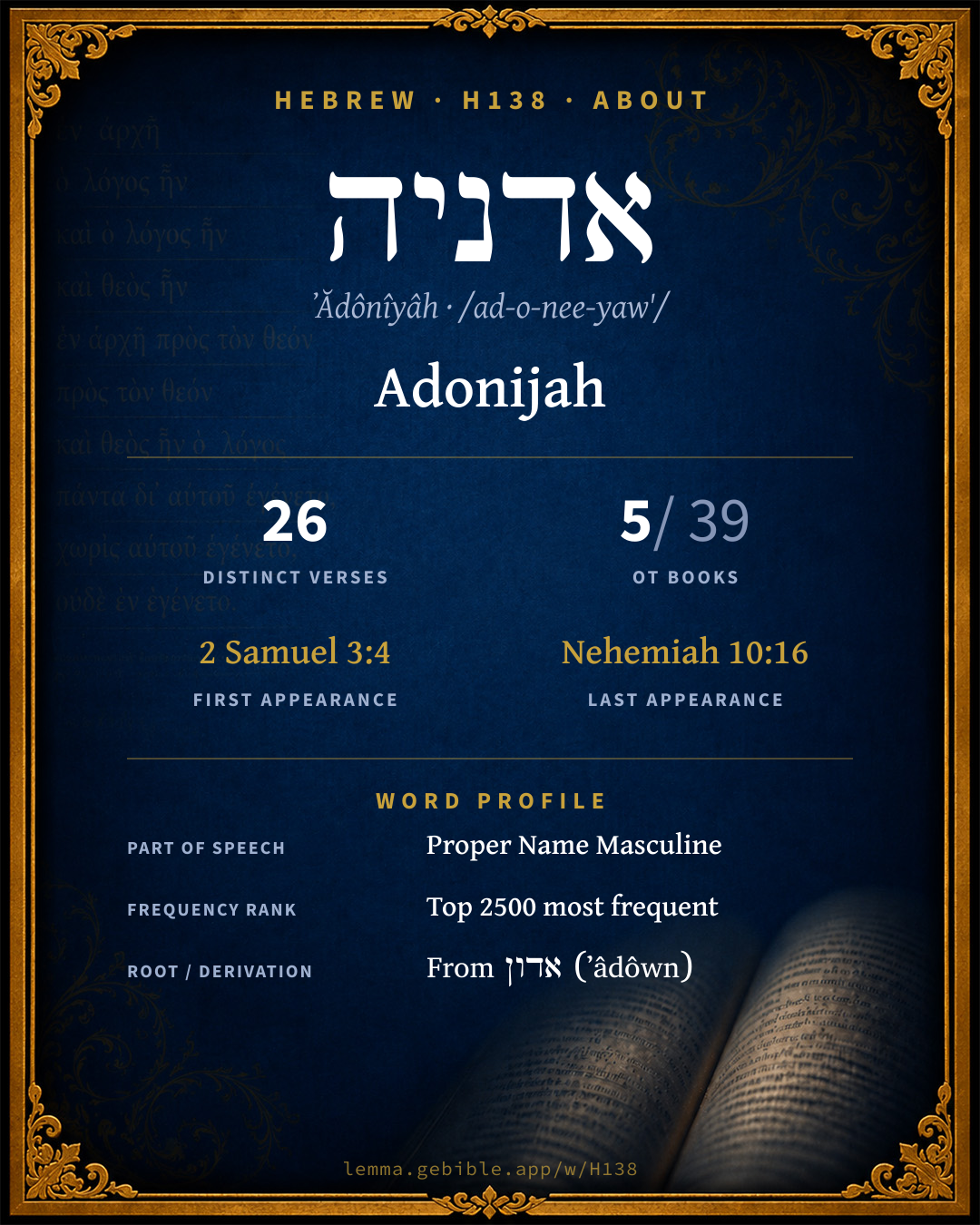
אֲדֹנִיָּ֫הוּ
Adonijah
BDB lists 4 entries for ‘Adonijah’ fuller range ↓
Full lexicon entry — Brown-Driver-Briggs (BDB)
From Brown-Driver-Briggs (BDB)
Where this word appears
Grammar key — what these labels mean
Part of speech
- Noun
- A naming word — a person, place, thing, or idea.
Noun type
- Proper
- A name of a specific person, place, or people (e.g. Abraham, Zion, Israel).
Every verse where H138 appears — 26 distinct verses across 5 books. Click any verse to open its interlinear word-by-word view. Verse text shown in the World English Bible for context — . Each verse’s Hebrew form is shown with its reference; the English is not keyword-highlighted, since the data carries no word-level English alignment. Use “Compare translations” on any verse to read it across multiple English versions. This concordance covers the Hebrew Bible; Septuagint (Greek Old Testament) occurrences are not indexed here.
2 Samuel 1 verse
1 Kings 22 verses
- 1 Kings 1:5 וַ/אֲדֹנִיָּ֧ה conj + n Proper Then Adonijah the son of Haggith exalted himself, saying, I will be king: and he prepared him chariots and horsemen, and fifty men to run before him.
- 1 Kings 1:7 אֲדֹנִיָּֽה n Proper He conferred with Joab the son of Zeruiah, and with Abiathar the priest: and they following Adonijah helped him.
- 1 Kings 1:8 אֲדֹנִיָּֽהוּ n Proper But Zadok the priest, and Benaiah the son of Jehoiada, and Nathan the prophet, and Shimei, and Rei, and the mighty men who belonged to David, were not with Adonijah.
- 1 Kings 1:9 אֲדֹנִיָּ֗הוּ n Proper Adonijah killed sheep and oxen and fatlings by the stone of Zoheleth, which is beside En Rogel; and he called all his brothers, the king's sons, and all the men of Judah, the king's servants:
- 1 Kings 1:11 אֲדֹנִיָּ֣הוּ n Proper Then Nathan spoke to Bathsheba the mother of Solomon, saying, Haven't you heard that Adonijah the son of Haggith reigns, and David our lord doesn't know it?
- 1 Kings 1:13 אֲדֹנִיָֽהוּ n Proper Go and get you in to king David, and tell him, Didn't you, my lord, king, swear to your handmaid, saying, Assuredly Solomon your son shall reign after me, and he shall sit on my throne? why then does Adonijah reign?
- 1 Kings 1:18 אֲדֹנִיָּ֖ה n Proper Now, behold, Adonijah reigns; and you, my lord the king, don't know it:
- 1 Kings 1:24 אֲדֹנִיָּ֖הוּ n Proper Nathan said, My lord, king, have you said, Adonijah shall reign after me, and he shall sit on my throne?
- 1 Kings 1:25 אֲדֹנִיָּֽהוּ n Proper For he is gone down this day, and has slain oxen and fatlings and sheep in abundance, and has called all the king's sons, and the captains of the host, and Abiathar the priest; and, behold, they are eating and drinking before him, and say, [Long] live king Adonijah.
- 1 Kings 1:41 אֲדֹנִיָּ֗הוּ n Proper Adonijah and all the guests who were with him heard it as they had made an end of eating. When Joab heard the sound of the trumpet, he said, Why is this noise of the city being in an uproar?
- 1 Kings 1:42 אֲדֹנִיָּ֨הוּ֙ n Proper While he yet spoke, behold, Jonathan the son of Abiathar the priest came: and Adonijah said, Come in; for you are a worthy man, and bring good news.
- 1 Kings 1:43 לַ/אֲדֹנִיָּ֑הוּ prep + n Proper Jonathan answered Adonijah, Most assuredly our lord king David has made Solomon king:
- 1 Kings 1:49 לַ/אֲדֹנִיָּ֑הוּ prep + n Proper All the guests of Adonijah were afraid, and rose up, and went every man his way.
- 1 Kings 1:50 וַ/אֲדֹ֣נִיָּ֔הוּ conj + n Proper Adonijah feared because of Solomon; and he arose, and went, and caught hold on the horns of the altar.
- 1 Kings 1:51 אֲדֹ֣נִיָּ֔הוּ n Proper It was told Solomon, saying, Behold, Adonijah fears king Solomon; for, behold, he has laid hold on the horns of the altar, saying, Let king Solomon swear to me first that he will not kill his servant with the sword.
- 1 Kings 2:13 אֲדֹנִיָּ֣הוּ n Proper Then Adonijah the son of Haggith came to Bathsheba the mother of Solomon. She said, Come you peaceably? He said, Peaceably.
- 1 Kings 2:19 אֲדֹנִיָּ֑הוּ n Proper Bathsheba therefore went to king Solomon, to speak to him for Adonijah. The king rose up to meet her, and bowed himself to her, and sat down on his throne, and caused a throne to be set for the king's mother; and she sat on his right hand.
- 1 Kings 2:21 לַ/אֲדֹנִיָּ֥הוּ prep + n Proper She said, Let Abishag the Shunammite be given to Adonijah your brother as wife.
- 1 Kings 2:22 לַ/אֲדֹ֣נִיָּ֔הוּ prep + n Proper King Solomon answered his mother, Why do you ask Abishag the Shunammite for Adonijah? ask for him the kingdom also; for he is my elder brother; even for him, and for Abiathar the priest, and for Joab the son of Zeruiah.
- 1 Kings 2:23 אֲדֹ֣נִיָּ֔הוּ n Proper Then king Solomon swore by Yahweh, saying, God do so to me, and more also, if Adonijah has not spoken this word against his own life.
- 1 Kings 2:24 אֲדֹנִיָּֽהוּ n Proper Now therefore as Yahweh lives, who has established me, and set me on the throne of David my father, and who has made me a house, as he promised, surely Adonijah shall be put to death this day.
- 1 Kings 2:28 אֲדֹנִיָּ֔ה n Proper The news came to Joab; for Joab had turned after Adonijah, though he didn't turn after Absalom. Joab fled to the Tent of Yahweh, and caught hold on the horns of the altar.
1 Chronicles 1 verse
2 Chronicles 1 verse
Nehemiah 1 verse
About this entry
At a glance — auto-summarized from this page’s data, not written by a person. Every figure links to its source below. This summary describes the numbers; it doesn’t interpret them.
“Adonijah” is the headline sense of the Hebrew name אדניה (ʼĂdônîyâh). It clusters heavily in 1 Kings, which alone accounts for 85% of its uses. With 26 verses in 5 books, it is a moderately common word in the Hebrew Bible. First canonically at 2 Samuel 3:4, it enters the text early. See 26-verse concordance and the renderings breakdown below.
Gloss history
Strong's 1890 vs modern scholarship
About this word
Strong's H138 catalogs a Hebrew word from the Hebrew Old Testament.
These counts are not copied from any lexicon or concordance. They are computed here, from the morphology-tagged Hebrew Old Testament. What Lemma adds →
- 26
- distinct verses
- The word appears in 26 distinct verses.
- 5 / 39
- OT books
- The word appears in 5 of 39 Old Testament books.
- #1,251
- by frequency
- Top 2500 most frequent Hebrew words (rank 1,251 of 8,640 Hebrew words by occurrence).
View all 26 occurrences in the concordance →
Most concentrated in
- 1 Kings 22 verses 85%
- 2 Samuel 1 verse 4%
- 1 Chronicles 1 verse 4%
By section of the Old Testament
By traditional corpus
Conventional, traditional groupings — biblical authorship is debated, so this is a traditional corpus grouping, not an authorship claim. Each share is this word’s portion of its verses in that division of the Hebrew canon. Each figure is a share of the word’s 26 distinct verses.
- Prophets (Nevi'im) 23 verses · 88%
- Writings (Ketuvim) 3 verses · 12%
How translations render this word
Counts come from each version’s own published word-to-Strong’s tagging or interlinear alignment — an approximate guide to how each version renders this word, not a word-level alignment the data otherwise carries. Because each total is that version’s own tagged count, the per-version totals vary from one another and need not match the appearance or distinct-verse counts above. These counts may also differ from a printed concordance because Lemma counts each distinctly tagged rendering and does not collapse phrase taggings into a single head-word total. This is a fixed set of word-tagged versions (KJV, ASV, BSB, ULT) and does not change with the reading translation you choose elsewhere. Each version’s license is shown beside its name below (and on Sources).
- King James Version: Adonijah 21×
- American Standard Version: Adonijah 20×
- Berean Standard Bible: Adonijah 20×
- unfoldingWord Literal Text: Adonijah 23×
King James Version Public Domain
Renders H138 across 26 tagged occurrences — most commonly:
Plus 5 renderings that appear only once — usually multi-word phrases or single function words the recovered tagging swept in, not distinct renderings.
American Standard Version Public Domain
Renders H138 across 26 tagged occurrences — most commonly:
Plus 6 renderings that appear only once — usually multi-word phrases or single function words the recovered tagging swept in, not distinct renderings.
Berean Standard Bible Public Domain
Renders H138 across 24 tagged occurrences — most commonly:
Plus 4 renderings that appear only once — usually multi-word phrases or single function words the recovered tagging swept in, not distinct renderings. Not rendered by a distinct English word in 2 further occurrences.
unfoldingWord Literal Text CC BY-SA 4.0
Renders H138 across 26 tagged occurrences — most commonly:
Plus 3 renderings that appear only once — usually multi-word phrases or single function words the recovered tagging swept in, not distinct renderings.
Senses in the full BDB
What do BDB’s symbols mean?
BDB uses these scholarly abbreviations:
| Symbol | Meaning |
|---|---|
| 𝔊 | the Septuagint (the ancient Greek translation, LXX) |
| 𝔙 | the Vulgate (the Latin translation) |
| 𝔖 | the Syriac version (the Peshitta) |
| 𝔗 | the Targum (the Aramaic translation) |
| ψ | the Psalms |
| √ | root (the underlying root or stem) |
| ‖ | parallel passage (a synonymous or contrasted parallel) |
| † | the dagger: every passage where the word occurs is cited |
The 3 senses and sub-senses the full Brown-Driver-Briggs lexicon distinguishes for this word, in lexicon order (not ranked by frequency), with BDB’s own verbatim wording and sub-sense lettering. Shown in Hebrew script with BDB’s own scholarly abbreviations. The condensed entry is in the Lexicon Entry tab. See also the Forms in the corpus table below.
- 1. fourth son of David 1 K 1:8 + 11 times, 2:13 + 5 times (= אֲדֹנִיָּה 2 S 3:4 1 K 1:5, 7, 18; 2:28 1 Ch 3:2). e.g. 1 Kings 1:8
- 2. a Levite †2 Ch 17:8. e.g. 2 Chronicles 17:8
- 3. a chief of the people †Ne 10:17 (= אֲדֹנִיקָם 7:18 Ezr 2:13 cf. 8:13). e.g. Nehemiah 10:17
Senses from the full Brown-Driver-Briggs lexicon (Brown, Driver, Briggs; Oxford 1906 — public domain), digitized via Sefaria, supplemented by the OpenScriptures HebrewLexicon (CC BY 4.0). Full attribution on Sources.
Word origin
(אֲדֹנִיָּה) n.pr.m. (my Lord is Yahweh, cf. Ph. אדנאשמן, אדנבעל, אדנשמש etc., in Assyrian Adunibaʾal SchrKB II, 172)
— Brown-Driver-Briggs (Oxford 1906, public domain), digitized via Sefaria, supplemented by the OpenScriptures HebrewLexicon (CC BY 4.0). See Sources.
Derived from אדון (ʼâdôwn) (H113) — lord.
Forms in the corpus
The 19 distinct written forms H138 takes in the Hebrew Bible, most frequent first — each parse links to that state’s occurrences in the concordance. Hebrew forms include their vowel points and cantillation, so a single lemma takes many written forms.
| Form | Parsing | Example | Uses |
|---|---|---|---|
| אֲדֹנִיָּֽהוּ | Noun, Proper | 1 Kings 1:8 | 3 |
| אֲדֹ֣נִיָּ֔הוּ | Noun, Proper | 1 Kings 1:51 | 2 |
| אֲדֹנִיָּ֗הוּ | Noun, Proper | 1 Kings 1:9 | 2 |
| אֲדֹנִיָּ֣הוּ | Noun, Proper | 1 Kings 1:11 | 2 |
| אֲדֹנִיָּ֥ה | Noun, Proper | 1 Chronicles 3:2 | 2 |
| לַ/אֲדֹנִיָּ֑הוּ | Noun, Proper | 1 Kings 1:43 | 2 |
| אֲדֹנִיָֽהוּ | Noun, Proper | 1 Kings 1:13 | 1 |
| אֲדֹנִיָּ֑הוּ | Noun, Proper | 1 Kings 2:19 | 1 |
| אֲדֹנִיָּ֔ה | Noun, Proper | 1 Kings 2:28 | 1 |
| אֲדֹנִיָּ֖ה | Noun, Proper | 1 Kings 1:18 | 1 |
| אֲדֹנִיָּ֖הוּ | Noun, Proper | 1 Kings 1:24 | 1 |
| אֲדֹנִיָּ֣ה | Noun, Proper | 2 Samuel 3:4 | 1 |
| אֲדֹנִיָּ֨הוּ֙ | Noun, Proper | 1 Kings 1:42 | 1 |
| אֲדֹנִיָּֽה | Noun, Proper | 1 Kings 1:7 | 1 |
| וַ/אֲדֹ֣נִיָּ֔הוּ | Noun, Proper | 1 Kings 1:50 | 1 |
| וַ/אֲדֹ֨נִיָּ֧הוּ | Noun, Proper | 2 Chronicles 17:8 | 1 |
| וַ/אֲדֹנִיָּ֧ה | Noun, Proper | 1 Kings 1:5 | 1 |
| לַ/אֲדֹ֣נִיָּ֔הוּ | Noun, Proper | 1 Kings 2:22 | 1 |
| לַ/אֲדֹנִיָּ֥הוּ | Noun, Proper | 1 Kings 2:21 | 1 |
Same root — word family
Other BDB entries built from the same root as H138, grouped by Strong’s listed origin. These share a root / origin per the lexicon — not necessarily a shared meaning. Each links to that word’s own entry.
Derives from
Shares the same root
Proper names from this root
People and places named from this root — a name, not an additional meaning of the word.
- אדון ʼAddôwn H114 Addon
- אדניבזק ʼĂdônîy-Bezeq H137 Adoni-Bezek
- אדניצדק ʼĂdônîy-Tsedeq H139 Adoni-zedek
- אדניקם ʼĂdônîyqâm H140 Adonikam
- אדנירם ʼĂdônîyrâm H141 Adoniram
Compare all same-root words → Showing 4 of 10 — not the complete family. 5 of the same-root words are proper names (people or places). They share a root, not necessarily a meaning.
Bible dictionary
Public-domain dictionary articles matched to this entry by name (Adonijah). A biblical name can be shared by more than one person or place, so an article may treat several.
Easton's Bible Dictionary · M. G. Easton, 1897
My Lord is Jehovah. (1.) The fourth son of David (2 Sam. 3:4). After the death of his elder brothers, Amnon and Absalom, he became heir-apparent to the throne. But Solomon, a younger brother, was preferred to him. Adonijah, however, when his father was dying, caused himself to be proclaimed king. But Nathan and Bathsheba induced David to give orders that Solomon should at once be proclaimed and admitted to the throne. Adonijah fled and took refuge at the altar, and received pardon for his conduct from Solomon on the condition that he showed himself "a worthy man" (1 Kings 1:5-53). He afterwards made a second attempt to gain the throne, but was seized and put to death (1 Kings 2:13-25).
(2.) A Levite sent with the princes to teach the book of the law to the inhabitants of Judah (2 Chr. 17:8).
(3.) One of the "chiefs of the people" after the Captivity (Neh. 10:16).
Smith's Bible Dictionary · William Smith, 1863
(my Lord is Jehovah).
+ The fourth son of David by Haggith, born at Hebron while his father was king of Judah. (2 Samuel 3:4) (B.C. about 1050.) After the death of his three brothers, Amnon, Chileab and Absalom, he became eldest son; and when his father's strength was visibly declining, put forward his pretensions to the crown. Adonijah's cause was espoused by Abiathar and by Joab the famous commander of David's army. [Joab] His name and influence secured a large number of followers among the captains of the royal army belonging to the tribe of Judah, comp. (1 Kings 1:5) and these, together with all the princes except Solomon, were entertained by Adonijah at the great sacrificial feast held "by the stone Zoheleth, which is by En-rogel." [EN-ROGEL] Apprised of these proceedings, David immediately caused Solomon to be proclaimed king, (1 Kings 1:33,34) at Gihon. [Gihon] This decisive measure struck terror into the opposite party, and Adonijah fled to the sanctuary, but was pardoned by Solomon on condition that he should "show himself a worthy man." (1 Kings 1:52) The death of David quickly followed on these events; and Adonijah begged Bath-sheba to procure Solomon's consent to his marriage with Abishag, who had been the wife of David in his old age. (1 Kings 1:3) This was regarded as equivalent to a fresh attempt on the throne [Absalom; Abner]; and therefore Solomon ordered him to be put to death by Benaiah. (1 Kings 2:25) + A Levite in the reign of Jehoshaphat. (2 Chronicles 17:8) + The same as Adonikam. (Nehemiah 10:16) [Adonikam, Or Adonikam]
Hitchcock's Bible Names Dictionary · Roswell D. Hitchcock, 1869
the Lord is my master
Classic public-domain reference works; full attribution on Sources.
Septuagint verse parallels
This word appears in 25 verses that also exist in the Greek Old Testament (Septuagint), out of the 26 Hebrew verses it occurs in. You can read those verses in Greek by switching the Old Testament edition to the Septuagint.
Read these verses in the Septuagint
This is a verse-level parallel only — the same verses exist in both the Hebrew and Greek Old Testaments. No word-level Hebrew↔Greek correspondence is claimed: the data carries no such alignment, so no Greek word is shown as this Hebrew word’s translation. Coverage is not total — the Septuagint omits the deuterocanon and renumbers the Psalms, so some Hebrew verses have no direct Greek parallel.