
Ezekiel 3:27

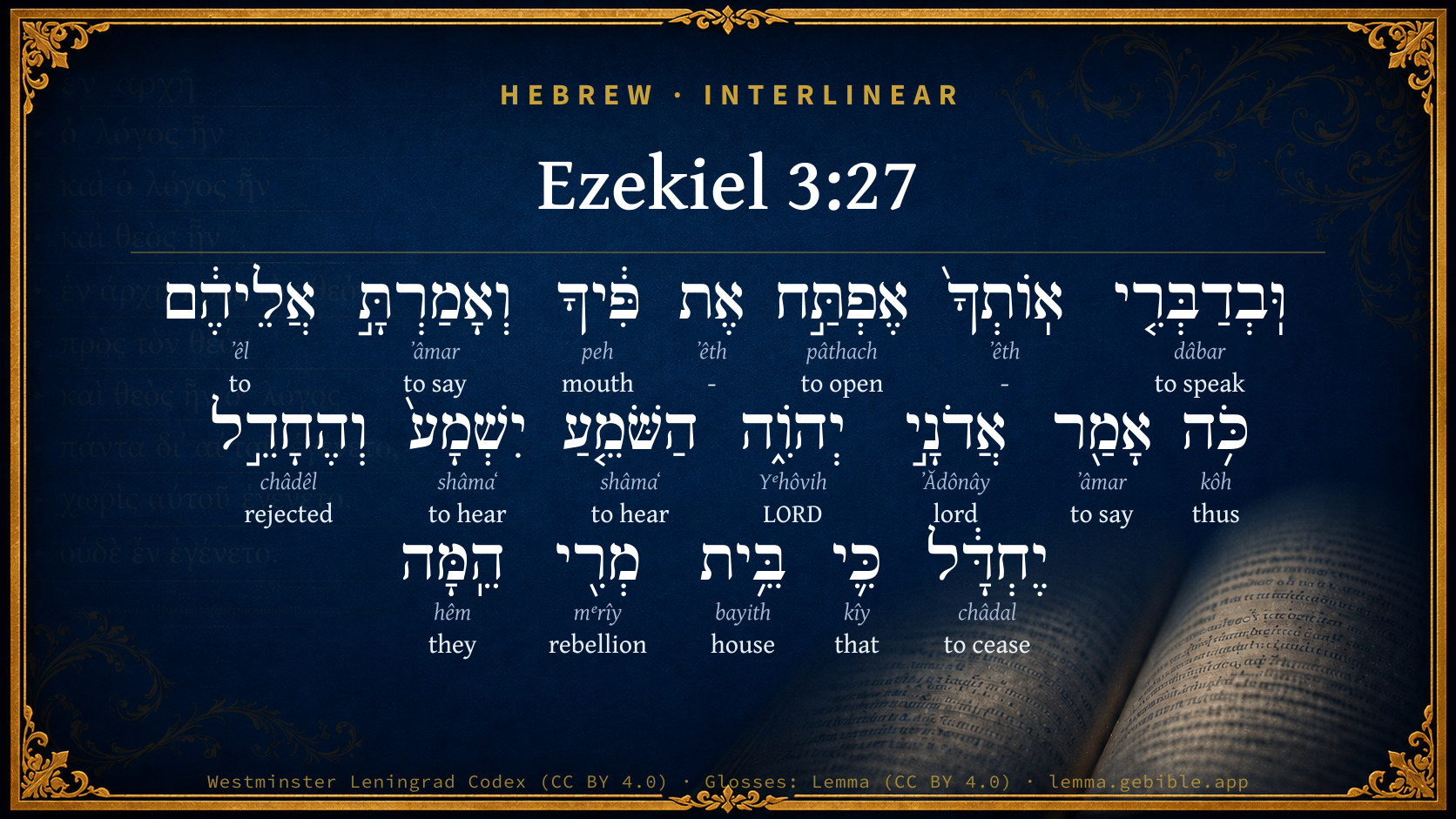
Hebrew (Westminster Leningrad Codex) Ezekiel 3:27 appears in the Hebrew Old Testament. The text above is from the Westminster Leningrad Codex. Each word links to its Strong’s number, a concise gloss, and parsing drawn from the Open Scriptures Hebrew Bible morphology. Click any word for its full Brown-Driver-Briggs (BDB) entry.
Download image
Cite this verse

Ezekiel 3:27 (World English Bible). Public Domain. Lemma interlinear Bible study tool, https://lemma.gebible.app/v/ezekiel/3/27.

Show BibTeX & RIS
BibTeX
RIS
English Translation
But when I speak with you, I will open your mouth, and you shall tell them, Thus says the Lord Yahweh: He who hears, let him hear; and he who forbears, let him forbear: for they are a rebellious house.
World English Bible · Public Domain
Download a study sheet

One document with this verse’s original text, its word-by-word gloss line, the meaning frame, cross-references with their text, attributed commentary, and full source and license credits — printable, and it pastes into notes with its structure intact.

This verse Autodidact and up

Study sheet (.html) Plain text (.txt)

A passage Seminary Student

Up to 50 verses in one chapter. A passage sheet keeps up to 6 commentary sources and 12 cross-references per verse, in the order this page ranks them, and says so on the sheet whenever that leaves anything out. Ask for a single verse and you get the Autodidact verse sheet above.

Everything on this page stays free to read, with no account — the sheet is a download of what is already on screen, not access to it.

Want to remove ads? Support Godless Engineer
Compare translations 3

The same verse in 3 English versions, stacked beneath the original-language interlinear above. Click any original word for its lexicon entry.

Each is an independent rendering of the whole verse — the interlinear is not word-aligned to these translations.

Highlighted words mark where these versions differ — a whole-verse word diff, not a word-by-word alignment.

  • World English Bible Public Domain
    But when I speak with you, I will open your mouth, and you shall tell them, Thus says the Lord Yahweh: He who hears, let him hear; and he who forbears, let him forbear: for they are a rebellious house.
  • King James Version Public Domain
    But when I speak with thee, I will open thy mouth, and thou shalt say unto them, Thus saith the Lord GOD; He that heareth, let him hear; and he that forbeareth, let him forbear: for they are a rebellious house.
  • unfoldingWord Literal Text CC BY-SA 4.0
    But when I speak with you, I will open your mouth so you will say to them, ‘This is what the Lord Yahweh says.’ The one who will hear will hear; the one who will not listen will not listen, for they are a rebellious house!”

unfoldingWord Literal Text — © unfoldingWord, licensed CC BY-SA 4.0. Word-aligned USFM3 via Door43 (git.door43.org/unfoldingWord/en_ult).

Versions to compare (up to 4)

3 of 4 selected

Show all 18 translations

Every available English version of this verse, each an independent rendering of the whole verse.

  • World English Bible Public Domain
    But when I speak with you, I will open your mouth, and you shall tell them, Thus says the Lord Yahweh: He who hears, let him hear; and he who forbears, let him forbear: for they are a rebellious house.
  • Berean Standard Bible Public Domain
    But when I speak with you, I will open your mouth, and you are to tell them, ‘This is what the Lord GOD says.’ Whoever listens, let him listen; and whoever refuses, let him refuse, for they are a rebellious house.
  • Majority Standard Bible Public Domain
    But when I speak with you, I will open your mouth, and you are to tell them, ‘This is what the Lord GOD says.’ Whoever listens, let him listen; and whoever refuses, let him refuse, for they are a rebellious house.
  • King James Version Public Domain
    But when I speak with thee, I will open thy mouth, and thou shalt say unto them, Thus saith the Lord GOD; He that heareth, let him hear; and he that forbeareth, let him forbear: for they are a rebellious house.
  • American Standard Version (1901) Public Domain
    But when I speak with thee, I will open thy mouth, and thou shalt say unto them, Thus saith the Lord Jehovah: He that heareth, let him hear; and he that forbeareth, let him forbear: for they are a rebellious house.
  • Revised Version (1885) Public Domain
    But when I speak with thee, I will open thy mouth, and thou shalt say unto them, Thus saith the Lord GOD: He that heareth, let him hear; and he that forbeareth, let him forbear: for they are a rebellious house.
  • Geneva Bible (1599) Public Domain
    But when I shall haue spoken vnto thee, I will open thy mouth, and thou shalt say vnto them, Thus saith the Lord God, He that heareth, let him heare, and he that leaueth off, let him leaue: for they are a rebellious house.
  • Douay-Rheims (1899) Public Domain
    But when I shall speak to thee, I will open thy mouth, and thou shalt say to them: Thus saith the Lord God: He that heareth, let him hear: and he that forbeareth, let him forbear: for they are a provoking house.
  • Young's Literal Translation Public Domain
    And in My speaking with thee, I do open thy mouth, and thou hast said unto them: Thus said the Lord Jehovah; the hearer doth hear, and the forbearer doth forbear; for a rebellious house `are' they.
  • Literal Standard Version CC BY-SA 4.0
    And in My speaking with you, I open your mouth, and you have said to them: Thus said Lord YHWH; the hearer hears, and the refrainer refrains; for they [are] a house of rebellion.”
  • Unlocked Literal Bible CC BY-SA 4.0
    But when I speak with you, I will open your mouth so you will say to them, 'This is what the Lord Yahweh says.' The one who will hear will hear; the one who will not listen will not listen, for they are a rebellious house!”
  • unfoldingWord Literal Text CC BY-SA 4.0
    But when I speak with you, I will open your mouth so you will say to them, ‘This is what the Lord Yahweh says.’ The one who will hear will hear; the one who will not listen will not listen, for they are a rebellious house!”
  • Darby Bible Public Domain
    And when I speak with thee, I will open thy mouth, and thou shalt say unto them, Thus saith the Lord Jehovah: He that heareth, let him hear; and he that forbeareth, let him forbear: for they are a rebellious house.
  • World Messianic Bible Public Domain
    But when I speak with you, I will open your mouth, and you shall tell them, ‘This is what the Lord GOD says.’ He who hears, let him hear; and he who refuses, let him refuse; for they are a rebellious house.”
  • Webster's Bible Public Domain
    But when I speak with thee, I will open thy mouth, and thou shalt say to them, Thus saith the Lord GOD; He that heareth, let him hear; and he that forbeareth, let him forbear: for they are a rebellious house.
  • Free Bible Version CC BY-SA 4.0
    However, when I talk with you, I will open your mouth so you can tell them that this is what the Lord God says. Those who want to listen will listen, and those who want to refuse will refuse, for they are a rebellious people.”
  • Bible in Basic English Public Domain
    But when I have talk with you I will make your mouth open, and you are to say to them, This is what the Lord has said: Let the hearer give ear; and as for him who will not, let him keep his ears shut: for they are an uncontrolled people.
  • JPS Tanakh (1917) Public Domain
    But when I speak with thee, I will open thy mouth, and thou shalt say unto them: Thus saith the Lord GOD; he that heareth, let him hear, and he that forbeareth, let him forbear; for they are a rebellious house.

Literal Standard Version (2020), Covenant Press — licensed CC BY-SA 4.0. Text via the HelloAO Bible API (eBible.org). Unlocked Literal Bible (unfoldingWord) — licensed CC BY-SA 4.0. Text via the HelloAO Bible API (eBible.org). unfoldingWord Literal Text — © unfoldingWord, licensed CC BY-SA 4.0. Word-aligned USFM3 via Door43 (git.door43.org/unfoldingWord/en_ult). Free Bible Version, Dr. Jonathan Gallagher — licensed CC BY-SA 4.0. Text via the HelloAO Bible API (eBible.org).

Word by word

More ways to search: Search by grammar → Find every occurrence → Compare this word →

Practice this passage: Drill this verse → Learn its vocabulary →

וְהֶחָדֵ֣ל
châdêl
H2310
“and · the · rejected”
Conjunction + Particle, Definite Article + Adjective, Adjective, Masculine, Singular, Absolute
Part of Speech
Conjunction + Particle + Adjective
Type
Adjective
Gender
Masculine
Number
Singular
State
Absolute
Full BDB Definition

Origin: from H2308

TWOT: 609b

rejected, forbearing, transient, fleeting, lacking
  1. וּֽבְדַבְּרִ֤י dâbar H1696 “and · in/at · to speak · me” Conjunction + Preposition + Verb, Piel, Infinitive Construct + Suffix, Personal, 1st Person, Common, Singular
  2. אֽוֹתְךָ֙ ʼêth H853 “- · you” Particle, Direct Object + Suffix, Personal, 2nd Person, Masculine, Singular
  3. אֶפְתַּ֣ח pâthach H6605 “to open” Verb, Qal, Imperfect, 1st Person, Common, Singular
  4. אֶת ʼêth H853 “-” Particle, Direct Object
  5. פִּ֔יךָ peh H6310 “mouth · your” Noun, Common, Masculine, Singular, Construct + Suffix, Personal, 2nd Person, Masculine, Singular
  6. וְאָמַרְתָּ֣ ʼâmar H559 “and · to say” Conjunction + Verb, Qal, Sequential Perfect, 2nd Person, Masculine, Singular
  7. אֲלֵיהֶ֔ם ʼêl H413 “to · them” Preposition + Suffix, Personal, 3rd Person, Masculine, Plural
  8. כֹּ֥ה kôh H3541 “thus” Adverb
  9. אָמַ֖ר ʼâmar H559 “to say” Verb, Qal, Perfect, 3rd Person, Masculine, Singular
  10. אֲדֹנָ֣י ʼĂdônây H136 “Lord · my” Noun, Common, Masculine, Plural, Construct + Suffix, Personal, 1st Person, Common, Singular
  11. יְהֹוִ֑ה Yᵉhôvih H3069 “LORD” Noun, Proper
  12. הַשֹּׁמֵ֤עַ shâmaʻ H8085 “the · hearing” Particle, Definite Article + Verb, Qal, Participle Active, Masculine, Singular, Absolute
  13. יִשְׁמָע֙ shâmaʻ H8085 “to hear” Verb, Qal, Imperfect, 3rd Person, Masculine, Singular
  14. יֶחְדָּ֔ל châdal H2308 “to cease” Verb, Qal, Imperfect, 3rd Person, Masculine, Singular
  15. כִּ֛י kîy H3588 “that” Conjunction
  16. בֵּ֥ית bayith H1004 “house of” Noun, Common, Masculine, Singular, Construct
  17. מְרִ֖י mᵉrîy H4805 “rebellion” Noun, Common, Masculine, Singular, Absolute
  18. הֵֽמָּה hêm H1992 “they” Pronoun, Personal, 3rd Person, Masculine, Plural

About this verse

These counts appear in no published source. They are computed here, from the morphology-tagged text and Lemma’s own curated glosses. What Lemma adds →

19
words
16
distinct lemmas
Prophets
section

Notable vocabulary

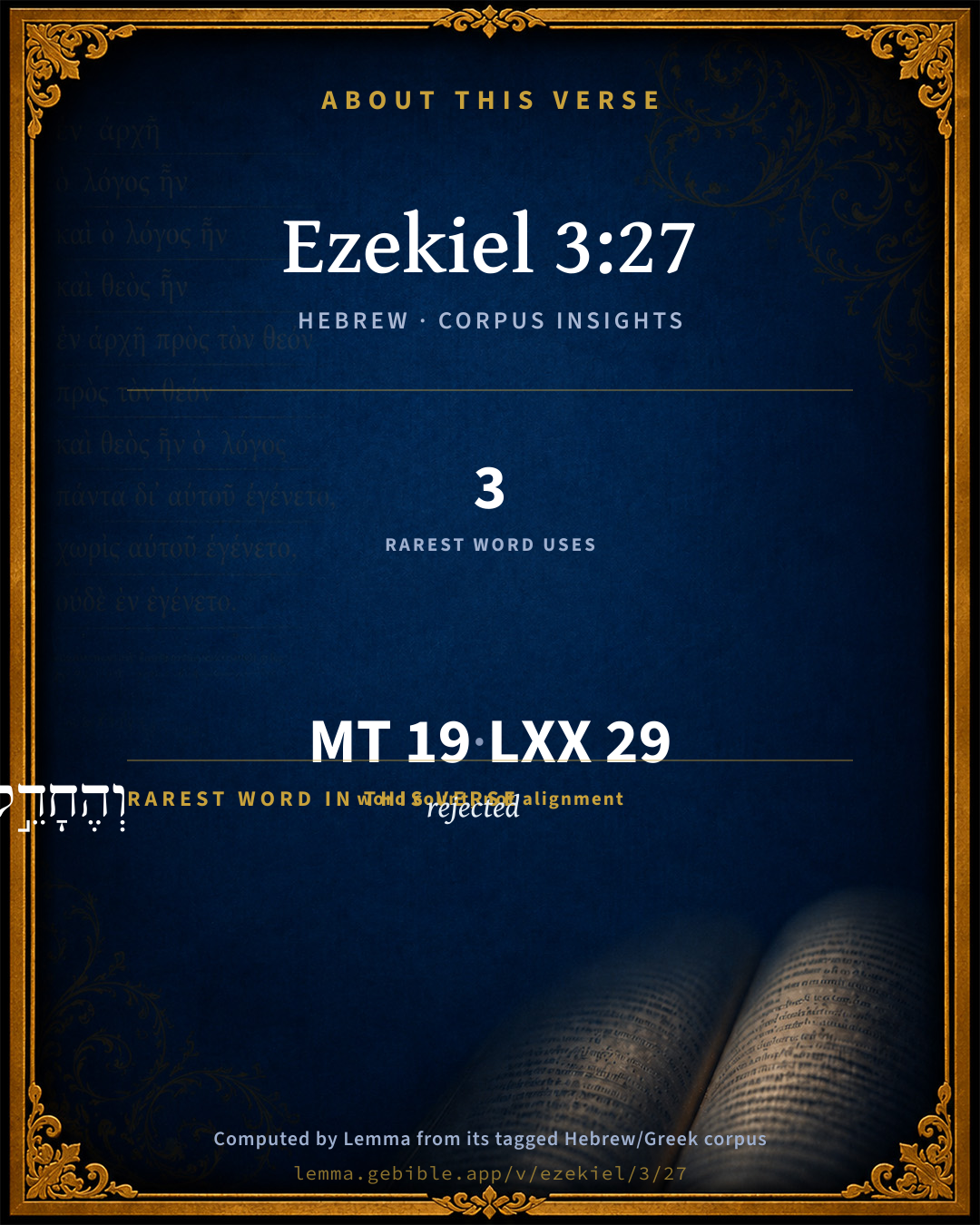
The rarest word here is וְהֶחָדֵ֣ל rejected H2310 — appearing just 3 times in the whole Hebrew Bible.

Shared distinctive vocabulary

וְהֶחָדֵ֣ל rejected H2310 occurs in 3 verses of the Hebrew Bible. Also found in:

Grammatical profile

  • 7 verbs
  • 5 nouns
  • 1 adjective
  • 1 pronoun
  • 1 preposition
  • 1 conjunction
  • 1 adverb
  • 2 particles

Verb forms

  • וּֽבְדַבְּרִ֤י Piel · Infinitive Construct
  • אֶפְתַּ֣ח Qal · Imperfect
  • וְאָמַרְתָּ֣ Qal · Sequential Perfect
  • אָמַ֖ר Qal · Perfect
  • הַשֹּׁמֵ֤עַ Qal · Participle Active
  • יִשְׁמָע֙ Qal · Imperfect
  • יֶחְדָּ֔ל Qal · Imperfect

Repetition

Words recur within this verse — often emphatic in Hebrew:

  • וְאָמַרְתָּ֣ to say H559 ×2
  • הַשֹּׁמֵ֤עַ to hear H8085 ×2

Hebrew & Septuagint length

In English translation the verse runs 40 words from the Hebrew and 42 from the Septuagint (LXX English) — closely comparable.

A rough comparison of the two English renderings, which tokenize alike — not a word-level alignment.

Word counts can differ between the Hebrew and the Greek without any difference in meaning — e.g. the Hebrew direct-object marker אֵת has no separate Greek word, and Greek often adds the article ὁ.

In the original languages it is 19 Hebrew tokens and 29 Greek tokens — but the two are counted differently (Hebrew bundles its prefixes and suffixes into one token; the Greek is in lemma form), so that isn’t a like-for-like length.

Cross-references

16

Topical passages linked to Ezekiel 3:27 in the Treasury of Scripture Knowledge — connected by theme and wording, ordered by reader-vote popularity; previews shown in the World English Bible.

  • Ezekiel 12:2–3 Son of man, you dwell in the midst of the rebellious house, who have eyes to see, and don't see, who have ears to hear, and don't hear; for they are a rebellious house.
  • Ezekiel 24:27 In that day shall your mouth be opened to him who is escaped, and you shall speak, and be no more mute: so shall you be a sign to them; and they shall know that I am Yahweh.
  • Ezekiel 3:11 Go, get you to them of the captivity, to the children of your people, and speak to them, and tell them, Thus says the Lord Yahweh; whether they will hear, or whether they will forbear.
  • Ezekiel 29:21 In that day will I cause a horn to bud forth to the house of Israel, and I will give you the opening of the mouth in the midst of them; and they shall know that I am Yahweh.
  • Exodus 4:11–12 Yahweh said to him, "Who made man's mouth? Or who makes one mute, or deaf, or seeing, or blind? Isn't it I, Yahweh?
  • Ezekiel 2:5 They, whether they will hear, or whether they will forbear, (for they are a rebellious house), yet shall know that there has been a prophet among them.
  • Ezekiel 3:9 As an adamant harder than flint have I made your forehead: don't be afraid of them, neither be dismayed at their looks, though they are a rebellious house.
  • Ezekiel 3:26 and I will make your tongue cleave to the roof of your mouth, that you shall be mute, and shall not be to them a reprover; for they are a rebellious house.
  • Ezekiel 11:25 Then I spoke to them of the captivity all the things that Yahweh had shown me.
  • Ezekiel 33:22 Now the hand of Yahweh had been on me in the evening, before he who was escaped came; and he had opened my mouth, until he came to me in the morning; and my mouth was opened, and I was no more mute.
  • Ezekiel 33:32 Behold, you are to them as a very lovely song of one who has a pleasant voice, and can play well on an instrument; for they hear your words, but they don't do them.
  • Matthew 11:15 He who has ears to hear, let him hear.
  • Luke 21:15 for I will give you a mouth and wisdom which all your adversaries will not be able to withstand or to contradict.
  • Ephesians 6:19 on my behalf, that utterance may be given to me in opening my mouth, to make known with boldness the mystery of the Gospel,
  • Revelation 22:10–11 He said to me, "Don't seal up the words of the prophecy of this book, for the time is at hand.
  • Matthew 13:9 He who has ears to hear, let him hear."

Cross-references courtesy of OpenBible.info (CC BY 4.0).

Hebrew and Greek witnesses Masoretic Hebrew ↔ Greek Septuagint

The same verse in the two great witnesses to the Old Testament, shown verse-for-verse.

These are two independent witnesses, not word-aligned to each other, and the Septuagint is shown in lemma (dictionary) form.

Hebrew Ezekiel 3:27 Masoretic · Westminster Leningrad Codex

וּֽבְדַבְּרִ֤י אֽוֹתְךָ֙ אֶפְתַּ֣ח אֶת פִּ֔יךָ וְאָמַרְתָּ֣ אֲלֵיהֶ֔ם כֹּ֥ה אָמַ֖ר אֲדֹנָ֣י יְהֹוִ֑ה הַשֹּׁמֵ֤עַ יִשְׁמָע֙ וְהֶחָדֵ֣ל יֶחְדָּ֔ל כִּ֛י בֵּ֥ית מְרִ֖י הֵֽמָּה

But when I speak with you, I will open your mouth, and you shall tell them, Thus says the Lord Yahweh: He who hears, let him hear; and he who forbears, let him forbear: for they are a rebellious house.

World English Bible · Public Domain

Greek LXX Ezekiel 3:27 Septuagint · lemma form

καί ἐν ὁ λαλέω ἐγώ πρός σύ ἀναοἴγω ὁ στόμα σύ καί εἶπον πρός αὐτός ὅδε λέγω κύριος ὁ ἀκούω ἀκούω καί ὁ ἀπειθέω ἀπειθέω διότι οἶκος παραπικραίνω εἰμί

But when I speak to you, I will open your mouth, and you shall say to them, Thus says the Lord, He that hears, let him hear; and he that is disobedient, let him be disobedient: because it is a provoking house.

LXX2012 (modern English Septuagint) · Public Domain

On this verse, Haydock's Catholic Bible Commentary discusses the Septuagint’s reading. Read the note in Commentary ↓

Hebrew: Westminster Leningrad Codex (CC BY 4.0). Greek: Septuagint (public domain); English from LXX2012 (modern English Septuagint) (Public Domain). How the Septuagint differs from the Hebrew →

Targum (Aramaic paraphrase)

1

The Targum is the ancient Jewish Aramaic paraphrase of the Hebrew Scriptures — an interpretive translation, not the Hebrew text itself. Onkelos (literal) and Pseudo-Jonathan (expansive) render the Torah, and Jonathan the Prophets. Coverage is partial: where no permissively-licensed English translation exists for a verse, only the Aramaic is shown. This is verse-level text, not a word-by-word alignment to the Hebrew.

  1. Targum Jonathan Prophets (Joshua–Malachi)
    וּבְמַלְלוּתִי עִמָךְ אַרְכִין יַת נַפְשָׁךְ וְתֵימַר לְהוֹן כִּדְנַן אֲמַר יְיָ אֱלֹהִים דִמְקַבֵּיל יְקַבֵּיל אוּלְפַן וְדִי יִתְמְנַע יִתְמְנַע מִלְמֶחֱטֵי אֲרֵי עַם סַרְבָן אִינוּן:

    (no public-domain English translation for this verse)

    Targum Jonathan — Aramaic: “Mikraot Gedolot” (public domain). English: “Sefaria Community Translation” (CC0 1.0 (public-domain dedication)); “London "Chaldee Paraphrase," 1871” (public domain). Text via Sefaria.

Commentary

Notes on Ezekiel 3:27 from classic Christian and Jewish commentators (each source and its license shown beneath its notes). The classic Christian expositions comment on the surrounding passage and are grouped to its opening verse, so a note may address several verses; the Jewish commentaries on the Tanakh (Rashi and others) are per-verse, so they appear only where the commentator wrote on this verse.

Lemma curates 59 commentaries, every one of them public domain or Creative Commons licensed, each selected and text-cleaned for this edition rather than reprinted as found. About our sources →

Trapp's Complete Commentary

John Trapp

Eze 3:27 But when I speak with thee, I will open thy mouth, and thou shalt say unto them, Thus saith the Lord GOD; He that heareth, let him hear; and he that forbeareth, let him forbear: for they [are] a rebellious house.

Ver. 27. But when I speak with thee.] As speak I will with thee again, by prophetic revelation, ere long be.

He that heareth, let him hear.] See Eze 2:5; whether more or fewer hearken to thee, be not troubled, I shall have my purpose howsoever.

John Trapp, A Commentary or Exposition upon All the Books of the Old and New Testament (1647–1656) — public domain. Text from a community e-Sword module.

Jamieson, Fausset & Brown

Robert Jamieson, A. R. Fausset & David Brown

when I speak . . . I will open thy mouth--opposed to the silence imposed on the prophet, to punish the people (Eze 3:26). After the interval of silence has awakened their attention to the cause of it, namely, their sins, they may then hearken to the prophecies which they would not do before.

He that heareth, let him hear . . . forbear--that is, thou hast done thy part, whether they hear or forbear. He who shall forbear to hear, it shall be at his own peril; he who hears, it shall be to his own eternal good (compare Rev 22:11).

Next: Ezekiel Chapter 4

Jamieson, Fausset & Brown — Commentary Critical and Explanatory on the Whole Bible (1871) — public domain (CC PDM 1.0). Text via the HelloAO Bible API.

Adam Clarke's Commentary

Verse 27. I will open thy mouth] When it is necessary to address them again, thou shalt sum up what thou hast said in this one speech: Thus saith the Lord, "He that heareth, let him hear; and he that forbeareth, let him forbear." Let him who feels obedience to the voice of God his interest, be steadfast. Let him who disregards the Divine monition go in his own way, and abide the consequences.

Adam Clarke's Commentary on the Bible (1810–1826) — public domain. Text from a community e-Sword/MySword module.

John Calvin's Commentaries

After a silence, God shows by what commands he wishes to instruct his servant, namely, by such as would exasperate the people, as we have formerly seen. His embassy therefore was hateful, since the Prophet begins with this insult — “If ye wish to hear, hear; but if not, I am not concerned.” Those who are sent as ambassadors are usually ordered to try whether they can conciliate, by courteous and friendly discourse, those with whom they have to deal. But God here follows a method completely the contrary. For what is the meaning of these words, He who hears, let him hear: he who desists, let him, desist? namely, that the Israelites may understand that the Prophet was sent to them, not because there was any hope of their becoming wise again, since they had borne witness by experiments sufficiently numerous that they were altogether desperate: but the Lord sends the Prophet, that he may strike and wound them further, and at length inflict a deadly blow. Now, therefore, we see that confirmed which the Prophet previously brought forward, that the office of teaching was enjoined upon him, not because his labor would be useful and fruitful with reference to the common people, but that he might inflame the Israelites to madness, if they were unwilling to grow wise again, that he might break them if they would not bend, and if they rejected him, that he should accuse them before God, who would be their judge, and in the meanwhile the course of Prophetic teaching would be free, however pertinaciously they might resist it. Now we understand the intention of the Prophet. Hence also we collect what I have lately touched upon: that God deals with the reprobate in various ways. Sometimes he makes it doubtful whether they be curable, and destines Prophets for them, who should exhort them to repentance. But when he sees them in their ingratitude burying all the light, then he deprives them of all doctrine; afterwards it shines forth again: at length other and denser darkness succeeds: therefore let us hasten, as long as the doctrine of salvation shines upon us, lest God darken all our minds and senses, and deprive us of that singular benefit, when the image of his paternal favor is engraven on us, as we have said. Let us go on —

John Calvin's Commentaries (1540-1563) — public domain. Text from the Calvin Translation Society English edition (1840s-50s) via the Christian Classics Ethereal Library (ccel.org). Calvin's coverage is partial (roughly two-thirds of the Bible); uncommented books and verses are honest gaps, never fabricated. The 19th-century editor's footnotes and remarks are omitted so the notes are faithfully Calvin's own voice.

Ellicott's Commentary for English Readers

(27) When I speak with thee, I will open thy mouth.—To this Ezekiel evidently refers in Eze_24:27; Eze_33:22, when, after the destruction of Jerusalem, his mouth should no longer be shut. But until then, although he should be greatly restrained in his ordinary utterances by the opposition of the people, yet there would be times when God would give him a message with such power that he would be constrained to declare it, whether the people would hear or whether they would forbear. Such messages are those contained in this book, which at this point begin to be recorded. By all this the difficulties and trials under which the prophet must exercise his office are clearly and strongly set before him. (See Excursus I., “On the Figurative and Symbolical Language of Ezekiel.”)

A Bible Commentary for English Readers, edited by Charles John Ellicott (1878–1897) — public domain. Text from a community e-Sword module.

The Cambridge Bible for Schools and Colleges

gen. ed. J. J. S. Perowne

27. Eventually the prophet’s mouth will be opened, his word will be confirmed, and he will no more have to speak to incredulous ears. (Comp. ch. Eze_29:21). During the existence of the kingdom all the prophets from Amos downward had stood in opposition to the mass of the people. Their teaching whether on religion or on policy ran counter to the inclinations of the multitude. The fall of the state, however, which they had so unanimously predicted gave them consideration in the eyes of the people, and led even the unthinking masses to feel that they were true interpreters of the mind of God and of his government. Passages like ch. Eze_33:10, “Our transgressions and our sins are upon us, and we pine away in them; how then should we live?” shew the change taking place in the people’s thoughts, and how they were coming round to take that view of their history which this prophet, as well as his predecessors, had so persistently inculcated. It is not easy to form any clear conception of the prophet’s ministry during the years preceding the fall of the state, but such passages as the above suggest the kind of thoughts which he expresses under the symbols of “dumbness” and “opening of the mouth.” It is unnecessary to say that the “binding” of the prophet here (Eze_3:25), which continues till the fall of Jerusalem, is quite different from the binding in ch. Eze_4:8, which lasts only for a period of days, and is a symbol of Israel bearing its iniquity in exile.

The Cambridge Bible for Schools and Colleges (gen. ed. J. J. S. Perowne; Cambridge University Press, 1878–1918) — public domain. Text from a community e-Sword module.

John Gill's Exposition

But when I speak with thee,.... Either when I have made an end of speaking to thee, when I have told thee all my mind, and have given thee all the instructions and prophecies thou art to deliver out; or when I shall speak to thee again, and give thee orders to speak:

I will open thy mouth; loose thy tongue, cause thee to break silence, and thou shall speak freely and fully all that I command thee; fulness of matter, and freedom of speech, are both from the Lord; liberty and opportunity of speaking are at his pleasure; and when he speaks his servants must prophesy, Amo 3:8;

and thou shalt say unto them, thus saith the Lord God; so and so, whatsoever he is pleased to order to be spoken; not that the following words are what were to be said to the people; but they are said to the prophet for his own use, that he might not be uneasy at the unfruitfulness and failure of his ministry:

he that heareth, let him hear; if any will hearken to what is sent to them, as few of them will, it is very well:

and he that forbeareth, let him forbear; or, "he that ceaseth, let him cease" (y); he that ceaseth from hearing, let him do so, do not mind it, or be discouraged at it:

for they are a rebellious house; See Gill on Eze 2:5. The Targum is,

"he that receiveth, let him receive instruction; and he that ceaseth, let him cease from sinning, for it is a rebellious people.''

(y) "et qui cessat cesset", Pagninus, Tigurine version, Starckius; "qui desistere volet desistat", Piscator; "qui desistit audire, desistet". So some in Vatablus.

Next: Ezekiel Chapter 4

John Gill's Exposition of the Whole Bible (1746–1763) — public domain (CC PDM 1.0). Text via the HelloAO Bible API.

Albert Barnes' Notes on the Bible

He that heareth ... - The judicial blindness of which Ezekiel speaks had already fallen upon the great body of the nation (Eze 14:4. Compare Rev 2:7; Rev 22:11).

Albert Barnes' Notes on the Bible (1834–1885) — public domain. Text from a community e-Sword/MySword module.

Haydock's Catholic Bible Commentary

Forbeareth. Septuagint, "disbelieveth, let him disbelieve." So we read, He that is unjust, let him be unjust still; (Apocalypse xxii. 11.) which denotes the most desperate condition. (Haydock) --- Aquila (2 edition) has, "he who abandons, shall be abandoned." (St. Jerome) --- The man who makes good use of grace shall receive more; but he who despises the offers of God, shall be justly deprived of them in his greatest need. (Calmet)

George Leo Haydock (1774–1849), Haydock's Catholic Family Bible and Commentary, 1859 edition — public domain. Excludes Psalms (Douay-Rheims chapter numbering differs from Protestant) and Deuterocanonical books (Catholic canon only).

Matthew Poole's English Annotations

When I speak with thee; whenever I shall reveal any thing to thee; or, when I shall have discovered all to thee which thy people should be informed in; then I will open thy lips, and loose they tongue, and give thee power to speak.

Thou shalt say unto them; in point of duty thou must tell them what I speak, and tell them as from me, who am eternal and sovereign Lord of heaven and earth: and in this style the Lord speaks above eighty times in this prophecy.

Let him hear; it is his duty and safety, and I propose it to his consideration, let him think what he hath to do herein.

Let him forbear; it is at his own peril, thou hast warned him, and now trouble not thyself, neither be grieved much at it. They, a rebellious house, act like themselves in sinning, and thou hast acted like thyself, a faithful admonisher; I will act like myself in punishing and giving them up into the hands of cruel, ravenous, and devouring enemies, who shall destroy them.

Matthew Poole's English Annotations on the Holy Bible (1683–1685) — public domain. Text from a community e-Sword/MySword module.

Whedon's Commentary on the Bible

Daniel D. Whedon

27. Ezekiel will some day be able to speak, but when he does he will not speak of his own power; he will not speak his own words. (Compare Mat_11:15; Mat_13:9.)

He that forbeareth, etc. — The Septuagint translates, He that is disobedient, let him be disobedient. (Compare Rev_22:2.)

Daniel D. Whedon (gen. ed.), Commentary on the Old and New Testaments (1874–1909) — public domain. Text from a community e-Sword module.

The Pulpit Commentary

When I speak with thee, etc. This then, as ever, was the condition of the prophet"s work. He was to speak out of his own heart. When the "time to speak" came words would be given him. (Mat_10:19) And those he would then speak would be as the echo of those in ver. 11. In our Lord"s words (Mat_11:15 Mat_13:9) we have, it may be, a deliberate reproduction of Ezekiel"s formula. The LXX, in this instance, it may be noted, translates the second clause by "He who is disobedient (ajpeiqwn), let him disobedient," which in its turn finds an echo in Rev_22:11.

Liberty of hearing.

Jeremy Taylor wrote on "Liberty of Prophesying," when that right had been interfered with unjustly. In more lawless times liberty of hearing has also been put under restraint. Where it is unhampered it brings its own responsibility. Now we all have liberty of hearing. The use and abuse of this liberty call for some consideration.

I THE USE OF THE LIBERTY OF HEARING.

1. All men are free to hear Gods Word. This is not a message for the priests; it is given to the people. It is not sent to the few elite; it belongs to the multitude. There is no esoteric doctrine in the Christian revelation.

2. All men can understand the Divine Word. Little children can grasp its most precious truths. Simple folk can receive what is vital and most valuable. The path is such that a wayfaring man, though a fool, may not err therein if he follows it with a true heart.

3. All men have a right to receive Gods Word. It is our duty to circulate the Bible throughout the world. If God has given utterances that are intended for all peoples and nations and languages and tongues, it is the duty of those to whom these oracles of God have been committed to see that everything is done to put them within the reach of those who have not yet received them.

4. All men to whom the Word of God has come are under a solemn obligation to give heed to it. Liberty does not exonerate from duty; on the contrary, it is the essential condition of the performance of any duty as such. If God speaks, we can refuse to hearken, but we ought to listen; and only by thus listening can the Word of God be of any profit to us.

II THE ABUSE OF THE LIBERTY OF HEARING. It is possible to forbear, if the hearing is within our own power. God forces no one to hear his Word. nor does he force any one to enter his kingdom. The good Shepherd seeks the wandering sheep, but when he finds it he does not drive it before him; he calls it to him, and even then, if the foolish creature is so madly inclined, it can turn a deaf ear to his merciful voice.

1. It would be useless to compel a hearing. God does not desire unwilling service. The revelation that is not welcome can bring little good. God blesses us through our own acquiescence; in the rebelious heart the blessing would be soured into a curse.

2. To be understood, the Word of God must be received sympathetically. This is not a statement of external facts so much as a light to shine into the heart. If, therefore, the language of it were dinned into our ears, syllable by syllable, the spirit, the truth itself, would still remain outside. We should hear the sounds, not the message they contained.

3. To refuse to hear the Word of God is to incur a grave responsibility. As a word of command it requires obedience. To decline to receive the message is to rebel and disobey. As a word of grace this Divine utterance offers a boon. To refuse it is to insult the gracious Speaker. It is also to run the risk of severe judgment when we fail for lack of that which would have saved us if we had given attention to it. They who act thus are without excuse. It will be "more tolerable for Tyre and Sidon" in the day of judgment than for such.

The Pulpit Commentary (1880–1919), ed. H.D.M. Spence-Jones & Joseph S. Exell — public domain. Text from a community e-Sword module.

John Wesley's Explanatory Notes

But - When ever I shall reveal any thing to thee. Open - I will give thee power to speak. Let - 'Tis his duty and safety. Forbear - 'Tis at his own peril.

John Wesley, Explanatory Notes Upon the Whole Bible (1754–1765) — public domain. Text via the GEBible commentary corpus.

Rashi

Rabbi Shlomo Yitzchaki (Rashi)

And when I speak with you When I shall wish to speak with you, I shall send you to them.

and you shall say to them, “So said the Lord God” all the words of My message.

He who listens will listen This is not part of the mission. Rather, the holy spirit told the prophet, “You tell them My message, and as for them, he who listens will listen, and he who forbears will forbear, for I know that not all of them will listen, for they are a rebellious house.”

Rashi on the Tanakh — English translations: “The Judaica Press complete Tanach with Rashi, translated by A. J. Rosenberg” (CC BY 4.0); “Pentateuch with Rashi's commentary by M. Rosenbaum and A.M. Silbermann, 1929-1934” (public domain); “The Metsudah Tanach series, Lakewood, N.J” (CC BY 4.0); and “The Book of Joshua, Metsudah Publications, 1997” (CC BY 4.0). Text via Sefaria.

Lesson kit

Teaching starters — assembled from the data on this page, not authored interpretation. Every prompt links to the verse data it draws on. Edit before teaching.

Ezekiel, in the Prophets, opens this verse with 19 words (16 distinct Hebrew lemmas). Its most distinctive word is châdêl (“rejected”). A historical commentator’s framing appears above. Read the whole chapter for the surrounding context.

Discussion questions

  1. What does “rejected” (châdêl) contribute to the verse as a whole?
  2. How does Psalms 39:4, which shares the word «rejected», read alongside this verse?
  3. What does the repetition of “to say” (2× in this one verse) do in this verse?
  4. The translations on this page render this verse differently — a whole-verse word diff, not a word-by-word alignment. What might account for the different wordings?
  5. «וּֽבְדַבְּרִ֤י» is a Piel Infinitive Construct verb. How does that grammatical form shape the action described?
  6. Compare how Trapp's Complete Commentary and Jamieson, Fausset & Brown read this verse. Where do they agree or differ?

Things to notice

Reading settings

Reading text

Shown beneath each verse's original-language words.

Old Testament
Old Testament edition

Read the OT as the Masoretic Hebrew (MT) or the Greek Septuagint (LXX).

English shown for the Greek Septuagint (in the Hebrew ↔ Greek comparison).

Comparing translations? Open the Compare panel on any verse page to stack up to four side by side.