
Ezekiel 4:14

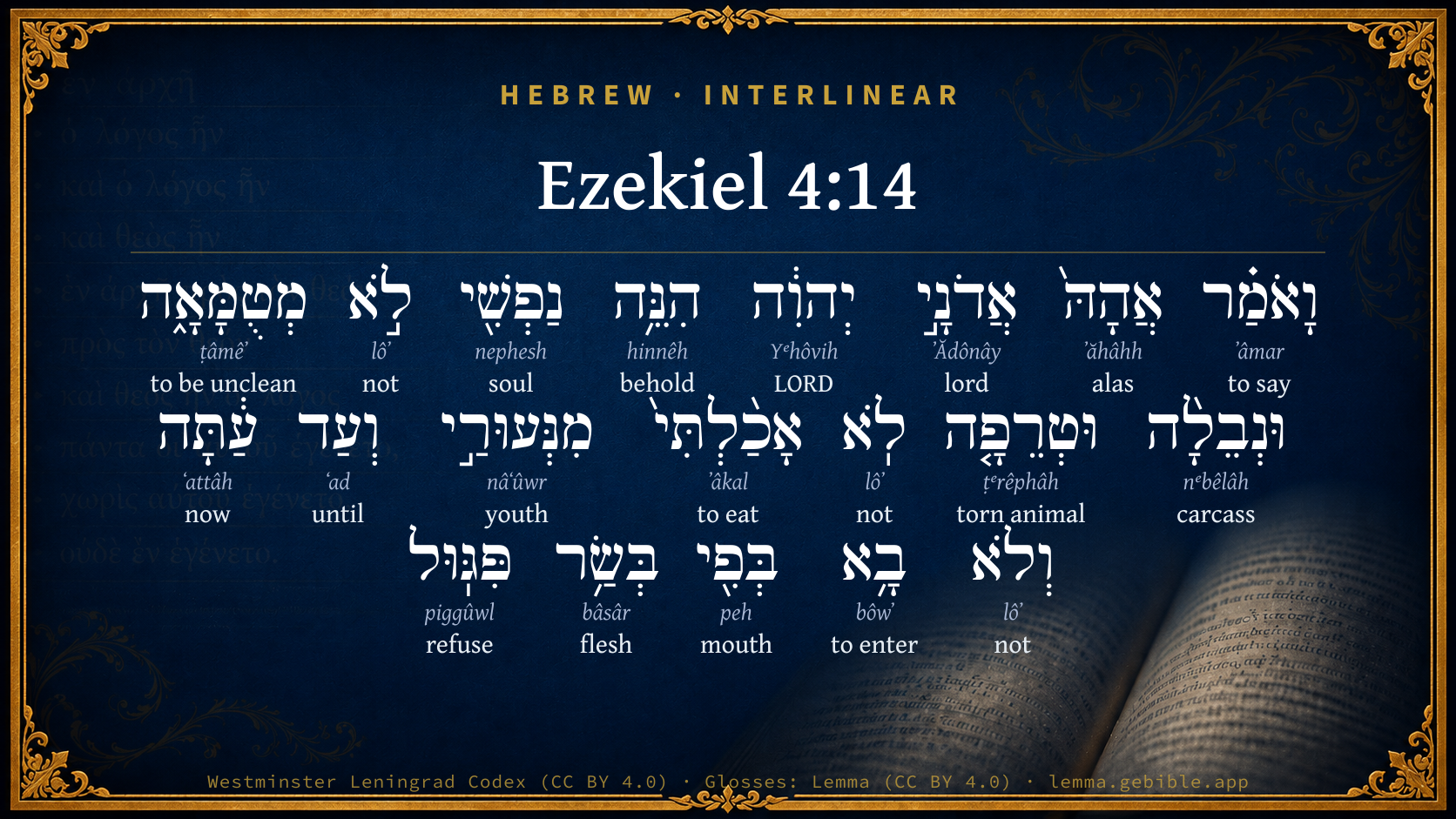
Hebrew (Westminster Leningrad Codex) Ezekiel 4:14 appears in the Hebrew Old Testament. The text above is from the Westminster Leningrad Codex. Each word links to its Strong’s number, a concise gloss, and parsing drawn from the Open Scriptures Hebrew Bible morphology. Click any word for its full Brown-Driver-Briggs (BDB) entry.
Download image
Cite this verse

Ezekiel 4:14 (World English Bible). Public Domain. Lemma interlinear Bible study tool, https://lemma.gebible.app/v/ezekiel/4/14.

Show BibTeX & RIS
BibTeX
RIS
English Translation
Then said I, Ah Lord Yahweh! behold, my soul has not been polluted; for from my youth up even until now have I not eaten of that which dies of itself, or is torn of animals; neither came there abominable flesh into my mouth.
World English Bible · Public Domain
Download a study sheet

One document with this verse’s original text, its word-by-word gloss line, the meaning frame, cross-references with their text, attributed commentary, and full source and license credits — printable, and it pastes into notes with its structure intact.

This verse Autodidact and up

Study sheet (.html) Plain text (.txt)

A passage Seminary Student

Up to 50 verses in one chapter. A passage sheet keeps up to 6 commentary sources and 12 cross-references per verse, in the order this page ranks them, and says so on the sheet whenever that leaves anything out. Ask for a single verse and you get the Autodidact verse sheet above.

Everything on this page stays free to read, with no account — the sheet is a download of what is already on screen, not access to it.

Want to remove ads? Support Godless Engineer
Compare translations 3

The same verse in 3 English versions, stacked beneath the original-language interlinear above. Click any original word for its lexicon entry.

Each is an independent rendering of the whole verse — the interlinear is not word-aligned to these translations.

Highlighted words mark where these versions differ — a whole-verse word diff, not a word-by-word alignment.

  • World English Bible Public Domain
    Then said I, Ah Lord Yahweh! behold, my soul has not been polluted; for from my youth up even until now have I not eaten of that which dies of itself, or is torn of animals; neither came there abominable flesh into my mouth.
  • King James Version Public Domain
    Then said I, Ah Lord GOD! behold, my soul hath not been polluted: for from my youth up even till now have I not eaten of that which dieth of itself, or is torn in pieces; neither came there abominable flesh into my mouth.
  • unfoldingWord Literal Text CC BY-SA 4.0
    But I said, “Alas, Lord Yahweh! I have never been unclean! I have never eaten either anything that died or anything killed by animals, from my youth until now, and foul meat has never entered my mouth!”

unfoldingWord Literal Text — © unfoldingWord, licensed CC BY-SA 4.0. Word-aligned USFM3 via Door43 (git.door43.org/unfoldingWord/en_ult).

Versions to compare (up to 4)

3 of 4 selected

Show all 18 translations

Every available English version of this verse, each an independent rendering of the whole verse.

  • World English Bible Public Domain
    Then said I, Ah Lord Yahweh! behold, my soul has not been polluted; for from my youth up even until now have I not eaten of that which dies of itself, or is torn of animals; neither came there abominable flesh into my mouth.
  • Berean Standard Bible Public Domain
    “Ah, Lord GOD,” I said, “I have never defiled myself. From my youth until now I have not eaten anything found dead or mauled by wild beasts. No unclean meat has ever entered my mouth.”
  • Majority Standard Bible Public Domain
    “Ah, Lord GOD,” I said, “I have never defiled myself. From my youth until now I have not eaten anything found dead or mauled by wild beasts. No unclean meat has ever entered my mouth.”
  • King James Version Public Domain
    Then said I, Ah Lord GOD! behold, my soul hath not been polluted: for from my youth up even till now have I not eaten of that which dieth of itself, or is torn in pieces; neither came there abominable flesh into my mouth.
  • American Standard Version (1901) Public Domain
    Then said I, Ah Lord Jehovah! behold, my soul hath not been polluted; for from my youth up even till now have I not eaten of that which dieth of itself, or is torn of beasts; neither came there abominable flesh into my mouth.
  • Revised Version (1885) Public Domain
    Then said I, Ah Lord GOD! behold, my soul hath not been polluted: for from my youth up even till now have I not eaten of that which dieth of itself, or is torn of beasts; neither came there abominable flesh into my mouth;
  • Geneva Bible (1599) Public Domain
    Then said I, Ah, Lord God, beholde, my soule hath not bene polluted: for from my youth vp, euen vnto this houre, I haue not eaten of a thing dead, or torne in pieces, neither came there any vncleane flesh in my mouth.
  • Douay-Rheims (1899) Public Domain
    And I said: Ah, ah, ah, O Lord God, behold my soul hath not been defiled, and from my infancy even till now, I have not eaten any thing that died of itself, or was torn by beasts, and no unclean flesh hath entered into my mouth.
  • Young's Literal Translation Public Domain
    And I say, `Ah, Lord Jehovah, lo, my soul is not defiled, and carcase, and torn thing, I have not eaten from my youth, even till now; nor come into my mouth hath abominable flesh.'
  • Literal Standard Version CC BY-SA 4.0
    And I say, “Aah! Lord YHWH, behold, my soul is not defiled, and carcass, and torn thing, I have not eaten from my youth, even until now; nor has abominable flesh come into my mouth.”
  • Unlocked Literal Bible CC BY-SA 4.0
    But I said, “Alas, Lord Yahweh! I have never been unclean! I have never eaten either anything that died or anything killed by animals, from my youth until now, and foul meat has never entered my mouth!”
  • unfoldingWord Literal Text CC BY-SA 4.0
    But I said, “Alas, Lord Yahweh! I have never been unclean! I have never eaten either anything that died or anything killed by animals, from my youth until now, and foul meat has never entered my mouth!”
  • Darby Bible Public Domain
    Then said I, Ah, Lord Jehovah! behold, my soul hath not been defiled, and from my youth up even until now have I not eaten of that which dieth of itself, or of that which is torn; neither came there abominable flesh into my mouth.
  • World Messianic Bible Public Domain
    Then I said, “Ah Lord GOD! Behold, my soul has not been polluted; for from my youth up even until now I have not eaten of that which dies of itself, or is torn of animals. No abominable meat has come into my mouth!”
  • Webster's Bible Public Domain
    Then said I, Ah Lord GOD! behold, my soul hath not been polluted: for from my youth even till now have I not eaten of that which dieth of itself, or is torn in pieces; neither hath abominable flesh come into my mouth.
  • Free Bible Version CC BY-SA 4.0
    “Please no, Lord God!” I answered. “I have never made myself unclean. I haven't eaten anything found dead or killed by wild animals from the time I was young until now. I've never put unclean meat in my mouth.”
  • Bible in Basic English Public Domain
    Then I said, Ah, Lord! see, my soul has never been unclean, and I have never taken as my food anything which has come to a natural death or has been broken by beasts, from the time when I was young even till now; no disgusting flesh has ever come into my mouth.
  • JPS Tanakh (1917) Public Domain
    Then said I: 'Ah Lord GOD! behold, my soul hath not been polluted; for from my youth up even till now have I not eaten of that which dieth of itself, or is torn of beasts; neither came there abhorred flesh into my mouth.'

Literal Standard Version (2020), Covenant Press — licensed CC BY-SA 4.0. Text via the HelloAO Bible API (eBible.org). Unlocked Literal Bible (unfoldingWord) — licensed CC BY-SA 4.0. Text via the HelloAO Bible API (eBible.org). unfoldingWord Literal Text — © unfoldingWord, licensed CC BY-SA 4.0. Word-aligned USFM3 via Door43 (git.door43.org/unfoldingWord/en_ult). Free Bible Version, Dr. Jonathan Gallagher — licensed CC BY-SA 4.0. Text via the HelloAO Bible API (eBible.org).

Word by word

More ways to search: Search by grammar → Find every occurrence → Compare this word →

Practice this passage: Drill this verse → Learn its vocabulary →

פִּגּֽוּל
piggûwl
H6292
“refuse”
Noun, Common, Masculine, Singular, Absolute
Part of Speech
Noun
Type
Common
Gender
Masculine
Number
Singular
State
Absolute
Full BDB Definition

Origin: from an unused root meaning to stink

TWOT: 1730a

foul thing, refuse - unclean sacrificial flesh (only use)
  1. וָאֹמַ֗ר ʼâmar H559 “and · to say” Conjunction + Verb, Qal, Sequential Imperfect, 1st Person, Common, Singular
  2. אֲהָהּ֙ ʼăhâhh H162 “alas” Particle, Interjection
  3. אֲדֹנָ֣י ʼĂdônây H136 “Lord · my” Noun, Common, Masculine, Plural, Construct + Suffix, Personal, 1st Person, Common, Singular
  4. יְהוִ֔ה Yᵉhôvih H3069 “LORD” Noun, Proper
  5. הִנֵּ֥ה hinnêh H2009 “behold” Particle, Demonstrative
  6. נַפְשִׁ֖י nephesh H5315 “soul · my” Noun, Common, Both, Singular, Construct + Suffix, Personal, 1st Person, Common, Singular
  7. לֹ֣א lôʼ H3808 “not” Particle, Negative
  8. מְטֻמָּאָ֑ה ṭâmêʼ H2930 “unclean” Verb, Pual, Participle Passive, Feminine, Singular, Absolute
  9. וּנְבֵלָ֨ה nᵉbêlâh H5038 “and · carcass” Conjunction + Noun, Common, Feminine, Singular, Absolute
  10. וּטְרֵפָ֤ה ṭᵉrêphâh H2966 “and · torn animal” Conjunction + Noun, Common, Feminine, Singular, Absolute
  11. לֹֽא lôʼ H3808 “not” Particle, Negative
  12. אָכַ֨לְתִּי֙ ʼâkal H398 “to eat” Verb, Qal, Perfect, 1st Person, Common, Singular
  13. מִנְּעוּרַ֣י nâʻûwr H5271 “from · youth · my” Preposition + Noun, Common, Both, Plural, Construct + Suffix, Personal, 1st Person, Common, Singular
  14. וְעַד ʻad H5704 “and · until” Conjunction + Preposition
  15. עַ֔תָּה ʻattâh H6258 “now” Adverb
  16. וְלֹא lôʼ H3808 “and · not” Conjunction + Particle, Negative
  17. בָ֥א bôwʼ H935 “to enter” Verb, Qal, Perfect, 3rd Person, Masculine, Singular
  18. בְּפִ֖י peh H6310 “in/at · mouth · my” Preposition + Noun, Common, Masculine, Singular, Construct + Suffix, Personal, 1st Person, Common, Singular
  19. בְּשַׂ֥ר bâsâr H1320 “flesh of” Noun, Common, Masculine, Singular, Construct

About this verse

These counts appear in no published source. They are computed here, from the morphology-tagged text and Lemma’s own curated glosses. What Lemma adds →

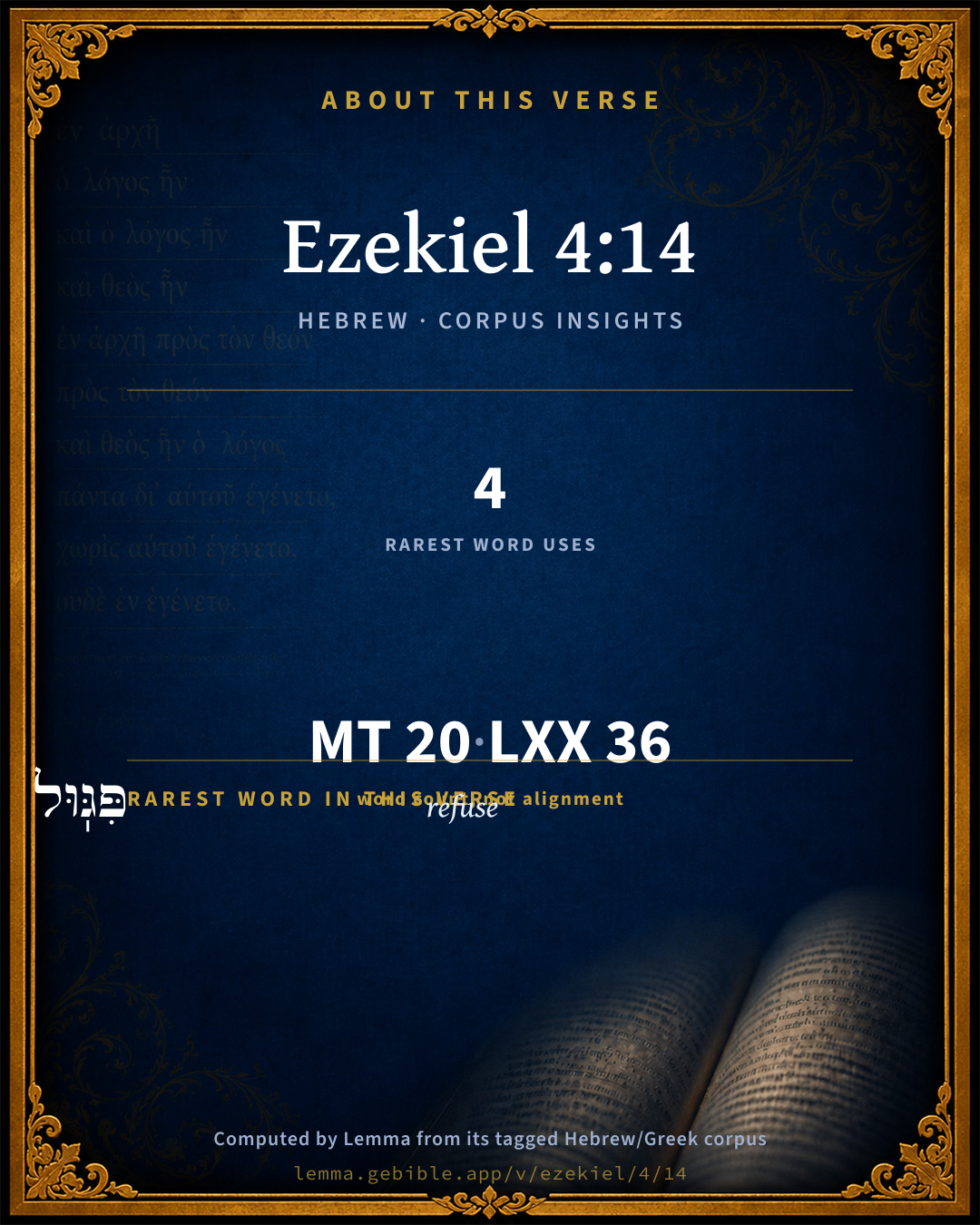
20
words
18
distinct lemmas
Prophets
section

Notable vocabulary

The rarest word here is פִּגּֽוּל refuse H6292 — appearing just 4 times in the whole Hebrew Bible.

Shared distinctive vocabulary

פִּגּֽוּל refuse H6292 occurs in 4 verses of the Hebrew Bible. Also found in:

Grammatical profile

  • 4 verbs
  • 9 nouns
  • 1 preposition
  • 1 adverb
  • 5 particles

Verb forms

  • וָאֹמַ֗ר Qal · Sequential Imperfect
  • מְטֻמָּאָ֑ה Pual · Participle Passive
  • אָכַ֨לְתִּי֙ Qal · Perfect
  • בָ֥א Qal · Perfect

Repetition

A word recurs within this verse — often emphatic in Hebrew:

Hebrew & Septuagint length

In English translation the verse runs 44 words from the Hebrew and 46 from the Septuagint (LXX English) — closely comparable.

A rough comparison of the two English renderings, which tokenize alike — not a word-level alignment.

Word counts can differ between the Hebrew and the Greek without any difference in meaning — e.g. the Hebrew direct-object marker אֵת has no separate Greek word, and Greek often adds the article ὁ.

In the original languages it is 20 Hebrew tokens and 36 Greek tokens — but the two are counted differently (Hebrew bundles its prefixes and suffixes into one token; the Greek is in lemma form), so that isn’t a like-for-like length.

Cross-references

12

Topical passages linked to Ezekiel 4:14 in the Treasury of Scripture Knowledge — connected by theme and wording, ordered by reader-vote popularity; previews shown in the World English Bible.

  • Acts 10:14 But Peter said, "Not so, Lord; for I have never eaten anything that is common or unclean."
  • Deuteronomy 14:3 You shall not eat any abominable thing.
  • Ezekiel 9:8 It happened, while they were smiting, and I was left, that I fell on my face, and cried, and said, Ah Lord Yahweh! will you destroy all the residue of Israel in your pouring out of your wrath on Jerusalem?
  • Ezekiel 20:49 Then said I, Ah Lord Yahweh! they say of me, Isn't he a speaker of parables?
  • Exodus 22:31 "You shall be holy men to me, therefore you shall not eat any flesh that is torn by animals in the field. You shall cast it to the dogs.
  • Leviticus 17:15 "'Every person that eats what dies of itself, or that which is torn by animals, whether he is native-born or a foreigner, he shall wash his clothes, and bathe himself in water, and be unclean until the evening: then he shall be clean.
  • Isaiah 65:4 who sit among the graves, and lodge in the secret places; who eat pig's flesh, and broth of abominable things is in their vessels;
  • Jeremiah 1:6 Then said I, Ah, Lord Yahweh! behold, I don't know how to speak; for I am a child.
  • Leviticus 11:39–40 "'If any animal, of which you may eat, dies; he who touches its carcass shall be unclean until the evening.
  • Leviticus 19:7 If it is eaten at all on the third day, it is an abomination. It will not be accepted;
  • Isaiah 66:17 Those who sanctify themselves and purify themselves [to go] to the gardens, behind one in the midst, eating pig's flesh, and the abomination, and the mouse, they shall come to an end together, says Yahweh.
  • Ezekiel 44:31 The priests shall not eat of anything that dies of itself, or is torn, whether it be bird or animal.

Cross-references courtesy of OpenBible.info (CC BY 4.0).

Hebrew and Greek witnesses Masoretic Hebrew ↔ Greek Septuagint

The same verse in the two great witnesses to the Old Testament, shown verse-for-verse.

These are two independent witnesses, not word-aligned to each other, and the Septuagint is shown in lemma (dictionary) form.

Hebrew Ezekiel 4:14 Masoretic · Westminster Leningrad Codex

וָאֹמַ֗ר אֲהָהּ֙ אֲדֹנָ֣י יְהוִ֔ה הִנֵּ֥ה נַפְשִׁ֖י לֹ֣א מְטֻמָּאָ֑ה וּנְבֵלָ֨ה וּטְרֵפָ֤ה לֹֽא אָכַ֨לְתִּי֙ מִנְּעוּרַ֣י וְעַד עַ֔תָּה וְלֹא בָ֥א בְּפִ֖י בְּשַׂ֥ר פִּגּֽוּל

Then said I, Ah Lord Yahweh! behold, my soul has not been polluted; for from my youth up even until now have I not eaten of that which dies of itself, or is torn of animals; neither came there abominable flesh into my mouth.

World English Bible · Public Domain

Greek LXX Ezekiel 4:14 Septuagint · lemma form

καί εἶπον μηδαμῶς κύριος θεός ὁ ἰσραήλ ἰδού ὁ ψυχή ἐγώ οὐ μιαίνω ἐν ἀκαθαρσία καί θνησιμαῖος καί θηριάλωτος οὐ βιβρώσκω ἀπό γένεσις ἐγώ ἕως ὁ νῦν οὐδέ εἰςἔρχομαι εἰς ὁ στόμα ἐγώ πᾶς κρέας ἕωλος

Then I said, Not so, Lord God of Israel: surely my soul has not been defiled with uncleanness; nor have I eaten, that which died of itself or was torn of beasts from my birth until now; neither has any corrupt flesh entered into my mouth.

LXX2012 (modern English Septuagint) · Public Domain

On this verse, Haydock's Catholic Bible Commentary discusses the Septuagint’s reading. Read the note in Commentary ↓

Hebrew: Westminster Leningrad Codex (CC BY 4.0). Greek: Septuagint (public domain); English from LXX2012 (modern English Septuagint) (Public Domain). How the Septuagint differs from the Hebrew →

Targum (Aramaic paraphrase)

1

The Targum is the ancient Jewish Aramaic paraphrase of the Hebrew Scriptures — an interpretive translation, not the Hebrew text itself. Onkelos (literal) and Pseudo-Jonathan (expansive) render the Torah, and Jonathan the Prophets. Coverage is partial: where no permissively-licensed English translation exists for a verse, only the Aramaic is shown. This is verse-level text, not a word-by-word alignment to the Hebrew.

  1. Targum Jonathan Prophets (Joshua–Malachi)
    וַאֲמָרֵית קַבֵּיל בָּעוּתִי יְיָ אֱלֹהִים הָא נַפְשִׁי לָא מְסָאֲבָא וּנְבֵילָא וּתְבִירָא לָא אֲכָלֵית מִזְעוּרֵי וְעַד כְּעַן וְלָא אֲכָלֵית בְּסַר מְרָחָק:

    (no public-domain English translation for this verse)

    Targum Jonathan — Aramaic: “Mikraot Gedolot” (public domain). English: “Sefaria Community Translation” (CC0 1.0 (public-domain dedication)); “London "Chaldee Paraphrase," 1871” (public domain). Text via Sefaria.

Commentary

Notes on Ezekiel 4:14 from classic Christian and Jewish commentators (each source and its license shown beneath its notes). The classic Christian expositions comment on the surrounding passage and are grouped to its opening verse, so a note may address several verses; the Jewish commentaries on the Tanakh (Rashi and others) are per-verse, so they appear only where the commentator wrote on this verse.

Lemma curates 59 commentaries, every one of them public domain or Creative Commons licensed, each selected and text-cleaned for this edition rather than reprinted as found. About our sources →

Trapp's Complete Commentary

John Trapp

Eze 4:14 Then said I, Ah Lord GOD! behold, my soul hath not been polluted: for from my youth up even till now have I not eaten of that which dieth of itself, or is torn in pieces; neither came there abominable flesh into my mouth.

Ver. 14. Ah Lord God! behold, my soul hath not been polluted.] Neither had it been here by eating suchlike bread, because God bade him do it, and his command legitimateth anything. But a good soul feareth and deprecateth all kind of pollution: "Keep thyself pure"; {1Ti 5:22} "Abstain from all appearance of evil." {1Th 5:22} The prophet in this prayer of his is very pathetic, Ah Domine Iehovi: not Iehova, but Iehovi. See the similar passage in Gen 15:2; Gen 15:8 Deu 3:24; Deu 9:26.

For from my youth up.] Let us be as careful of spiritual uncleanness; sin is the devil’s excrement, the corruption of a dead soul. {a} Constantinus Copronymus is reported to have delighted in stench and filth. The panther preferreth man’s dung before any meat; so do many feed greedily on sin’s murdering morsels.

{a} Polan.

John Trapp, A Commentary or Exposition upon All the Books of the Old and New Testament (1647–1656) — public domain. Text from a community e-Sword module.

Joseph Benson's Commentary

Eze 4:14-15. Then said I, Ah, Lord God, &c. — He deprecates this, and entreats it may not be enjoined him. Behold, my soul hath not been polluted — I have always carefully observed the distinction between meats clean and unclean: I beseech thee, command me not now to eat any thing so contrary to my former practice. Neither came their abominable flesh into my mouth — The Hebrew word, פגול, abominable, is used of such meats as were forbidden by the law, as the learned reader may see, Lev 7:18; Lev 19:7; Isa 65:4. Then he said, Lo, I have given thee cow’s dung, &c. — This indicated, that even the pious would suffer greatly during the siege of Jerusalem; and that all the circumstances of things would admit of, would be a very small distinction between them and the wicked; for Ezekiel, God’s prophet, could only obtain the exchange of a somewhat less offensive kind of fuel for one extremely offensive.

Joseph Benson's Commentary on the Old and New Testaments (1811–1818) — public domain. Text from a community e-Sword module.

Whedon's Commentary on the Bible

Daniel D. Whedon

14, 15. Ezekiel, a priest, was well acquainted with the Levitical legislation (Lev_17:15; Lev_22:8), and had been an ardent keeper of the law (Lev_7:18; Lev_7:24; Lev_11:39-40; Lev_19:7). When he heard this commandment to defile himself he burst out with a pathetic appeal for mercy, and because his conscience would have been defiled by eating (Eze_4:14), the Lord heard him and changed the most objectionable requirement.

Abominable flesh — This may mean spoiled flesh (Lev_19:7), or other unclean meats (Deu_14:3-21), or possibly flesh offered to idols (Acts 15; 1 Corinthians 7).

Daniel D. Whedon (gen. ed.), Commentary on the Old and New Testaments (1874–1909) — public domain. Text from a community e-Sword module.

Tyndale Open Study Notes

Tyndale Open Resources

4:14-15 The prophet protested that he had never eaten anything unclean. The Lord relented, allowing Ezekiel to cook his food over cow dung and to follow the law regarding disposal of human excrement (see Deut 23:12-14).

Tyndale Open Study Notes — © Tyndale Open Resources, licensed CC BY-SA 4.0. Text via the HelloAO Bible API.

Geneva Bible (1599)

Geneva Bible translators

Much less such vile corruption.

Geneva Bible (1599) marginal notes — public domain. Text via Bolls.life.

Jamieson, Fausset & Brown

Robert Jamieson, A. R. Fausset & David Brown

Ezekiel, as a priest, had been accustomed to the strictest abstinence from everything legally impure. Peter felt the same scruple at a similar command (Act 10:14; compare Isa 65:4). Positive precepts, being dependent on a particular command can be set aside at the will of the divine ruler; but moral precepts are everlasting in their obligation because God cannot be inconsistent with His unchanging moral nature.

abominable flesh--literally, "flesh that stank from putridity." Flesh of animals three days killed was prohibited (Lev 7:17-18; Lev 19:6-7).

Jamieson, Fausset & Brown — Commentary Critical and Explanatory on the Whole Bible (1871) — public domain (CC PDM 1.0). Text via the HelloAO Bible API.

Adam Clarke's Commentary

Verse 14. My soul hath not been polluted] There is a remarkable similarity between this expostulation of the prophet and that of St. Peter, Ac 10:14.

Adam Clarke's Commentary on the Bible (1810–1826) — public domain. Text from a community e-Sword/MySword module.

John Calvin's Commentaries

The Prophet here inserts the answer which he received to his request that God would relax his severe command: for it was abominable to eat flesh cooked with human dung, not only on account of the stench, but because religion forbade it: though the Prophet did not regard the taste of his palate, but objects that it was not lawful for him, and relates how anxiously he had abstained during his whole life from all polluted food. For if he had formerly dared to feed promiscuously on all sorts of food, he could not pray against it as he now does, that he should not be compelled to eat polluted bread: but he shows here that he had abstained throughout his whole life from all polluted food. My soul, says he, never was polluted: for soul is often put for the belly: then never have I tasted of a carcass, or of what has been torn in pieces By the figure a part put for the whole, he intends all unclean meats, which were unlawful food, according to the commandments of the law. (Leviticus 9.) For because a carcass is mixed with blood, God forbade them to touch the flesh of an animal which died by itself, because it had not been strangled, then if a wild beast should tear a sheep or an ox, that cruelty ought to be detestable to men. Since, therefore, both a carcass and torn and lacerated flesh are unclean food, the Prophet here says, that from his childhood even to that time he had kept the commands of God with his utmost endeavors: hence he obtains, as I have said, some mitigation. Yet he is compelled to eat his flesh cooked with the dung of oxen. This was done by vision, as I said yesterday: but meanwhile God did not change what he had determined concerning the people: viz. that they should eat their bread polluted among the Gentiles. For a cake cooked in the dung of oxen was unclean according to the Law. Hence God shows his own decree was fixed that the Israelites should be mingled among the Gentiles, so that they should contract pollution from their filth. It follows —

John Calvin's Commentaries (1540-1563) — public domain. Text from the Calvin Translation Society English edition (1840s-50s) via the Christian Classics Ethereal Library (ccel.org). Calvin's coverage is partial (roughly two-thirds of the Bible); uncommented books and verses are honest gaps, never fabricated. The 19th-century editor's footnotes and remarks are omitted so the notes are faithfully Calvin's own voice.

The Cambridge Bible for Schools and Colleges

gen. ed. J. J. S. Perowne

14. abominable flesh] This word “abomination” is applied to the sacrificial flesh kept over till the third day (Lev_7:18; Lev_19:7), and in Isa_65:4 broth of “abominations” is coupled with swine’s flesh. The meaning seems to be “carrion.” The word occurs only these four times.

The Cambridge Bible for Schools and Colleges (gen. ed. J. J. S. Perowne; Cambridge University Press, 1878–1918) — public domain. Text from a community e-Sword module.

John Gill's Exposition

Then said I, ah, Lord God!.... The interjection "ah" is expressive of sighing and groaning, as Jarchi; or of deprecation, as the Targum, which paraphrases it,

""and I said", receive my prayer, O Lord God:''

behold, my soul hath not been polluted; not meaning that his soul had not been polluted with sin, or with an evil thought, as Kimchi interprets it; but by his soul he means the inward part of his body, his stomach and belly; which had not been defiled by taking in meats which were unclean by the law, as follows:

for from my youth up, even till now, have I not eaten of that which dieth of itself, or is torn in pieces; these were forbidden to be eaten by the law; and such that did were defiled, and obliged to bathing in water, Lev 17:15; and from those the priests more especially were careful to abstain, as Kimchi observes; and such an one was the prophet; see Act 10:14;

neither came there abominable flesh into my mouth; corrupt or, putrefied, or whatsoever was unclean by law, as swine's flesh, or any other. The argument is, that since he had never eaten of anything forbidden by the law of God, he could by no means think of eating that which was abhorrent to nature; as bread baked with men's dung was.

John Gill's Exposition of the Whole Bible (1746–1763) — public domain (CC PDM 1.0). Text via the HelloAO Bible API.

Albert Barnes' Notes on the Bible

Abominable flesh - Flesh that had become corrupt and foul by overkeeping. Compare Lev 19:7.

Albert Barnes' Notes on the Bible (1834–1885) — public domain. Text from a community e-Sword/MySword module.

Haydock's Catholic Bible Commentary

Ah. He makes the same exclamation as Jeremias, i. 6. Hebrew aha. Theodotion, "Oh!" Septuagint and Symmachus, "by no means." (Haydock) --- God forbid. Excrements make a person legally unclean, Deuteronomy xxiii. 12. (Calmet)

George Leo Haydock (1774–1849), Haydock's Catholic Family Bible and Commentary, 1859 edition — public domain. Excludes Psalms (Douay-Rheims chapter numbering differs from Protestant) and Deuterocanonical books (Catholic canon only).

Matthew Poole's English Annotations

Ah Lord God he deprecateth this, and entreats it may not be enjoined him. He proposeth his legal purity, as one argument; in obedience to ceremonial precepts, he had kept himself clean, and now prays that he may not have his obedience tried by enjoining to eat what is abominable.

From my youth up; he took early care of this, and had persevered to this age; therefore prays mitigation, and some change in his diet or dressing of it.

That which dieth of itself; forbidden as polluted, Exo 22:31; Lev 17:15; Eze 44:31.

Torn in pieces; forbidden by the law also, as Exo 22:31.

Matthew Poole's English Annotations on the Holy Bible (1683–1685) — public domain. Text from a community e-Sword/MySword module.

The Pulpit Commentary

Then said I, Ah, Lord God! etc. The formula is, curiously enough, equally characteristic of Ezekiel (Eze_9:8 Eze_11:13 Eze_20:49) and of his teacher and contemporary. (Jer_1:6 Jer_4:10 Jer_14:13 Jer_32:17) The Vulgate represents it by A, a, a. His plea, which reminds us at once of Dan_1:8 and Act_10:14, is that he has kept himself free from all ceremonial pollution connected with food. And is he, a priest too, to do this? That be far from him! Anything but that! The kinds of defilement of which he speaks are noted in Exo_22:31; Lev_7:24 Lev_11:39, 40 17:15. The "abominable things" may refer either to the unclean meats catalogued in Deu_14:3-21 (as e.g. in Isa_65:4) or as in the controversy of the apostolic age (Ac 15; 1Co_8:1; Rev_2:20) to eating any flesh that had been offered in sacrifice to idols. The prophet"s passionate appeal is characteristic of the extent to which his character had been influenced by the newly discovered Law of the Lord, (2Ki 22 2Ch 34) i.e. probably by the Book of Deuteronomy.

The Pulpit Commentary (1880–1919), ed. H.D.M. Spence-Jones & Joseph S. Exell — public domain. Text from a community e-Sword module.

unfoldingWord translationNotes

Door43 World Missions Community

Alas, Lord Yahweh

"Lord Yahweh, it would be wrong for me to do that." Ezekiel is very troubled by what the Lord has told him to do.

Lord Yahweh

See how you translated this in Ezekiel 2:4. Here Ezekiel is speaking to the Lord.

foul meat has never entered my mouth

"I have never eaten foul meat"

foul meat

"disgusting, unclean meat." This refers to meat that is unclean because it has come from an animal that has died of sickness or old age or was killed by another animal. The word "foul" shows his disgust over meat like this.

Look

"Listen" or "Pay attention to the important thing I will tell you now"

I have given you

"I will allow you to use"

cow manure

solid waste from cows. Your language may have a polite way of expressing this.

human dung

solid waste from humans. Your language may have a polite way of expressing this. See how you translated this in Ezekiel 4:12.

translationWords

Lord Yahweh

clean

unfoldingWord translationNotes — © Distant Shores Media and the Door43 World Missions Community, licensed CC BY-SA 4.0. Source: git.door43.org/Door43/en_tn.

Rashi

Rabbi Shlomo Yitzchaki (Rashi)

O An expression of sighing.

my soul has not been defiled I did not entertain erotic thoughts by day, bringing myself to nocturnal pollution.

neither have I eaten from an animal that died by itself and was torn The flesh of a dying animal, which resembles an animal that died by itself and an animal that was torn by beasts.

loathsome meat An animal [of debatable status] upon which a rabbi ruled [permissively]. This cannot mean an animal that actually died by itself or that was torn [by beasts, injuring it so that it could not live for a year], because if so, what was the greatness of Ezekiel?

Rashi on the Tanakh — English translations: “The Judaica Press complete Tanach with Rashi, translated by A. J. Rosenberg” (CC BY 4.0); “Pentateuch with Rashi's commentary by M. Rosenbaum and A.M. Silbermann, 1929-1934” (public domain); “The Metsudah Tanach series, Lakewood, N.J” (CC BY 4.0); and “The Book of Joshua, Metsudah Publications, 1997” (CC BY 4.0). Text via Sefaria.

Lesson kit

Teaching starters — assembled from the data on this page, not authored interpretation. Every prompt links to the verse data it draws on. Edit before teaching.

Ezekiel, in the Prophets, opens this verse with 20 words (18 distinct Hebrew lemmas). Its most distinctive word is piggûwl (“refuse”). A historical commentator’s framing appears above. Read the whole chapter for the surrounding context.

Discussion questions

  1. How does “refuse” (piggûwl) shape what this verse is saying?
  2. Leviticus 7:18 shares the word «refuse» with this verse. How do the two illuminate each other?
  3. “not” occurs 3× in this one verse. What is the effect of the repetition?
  4. The translations on this page render this verse differently — a whole-verse word diff, not a word-by-word alignment. What might account for the different wordings?
  5. The verb «וָאֹמַ֗ר» is Qal Sequential Imperfect. How does its form color the action?
  6. Reading how Trapp's Complete Commentary and Joseph Benson's Commentary read this verse, where do the two commentators agree and where do they part?

Things to notice

Reading settings

Reading text

Shown beneath each verse's original-language words.

Old Testament
Old Testament edition

Read the OT as the Masoretic Hebrew (MT) or the Greek Septuagint (LXX).

English shown for the Greek Septuagint (in the Hebrew ↔ Greek comparison).

Comparing translations? Open the Compare panel on any verse page to stack up to four side by side.