
2 Samuel 7:20

Hebrew (Westminster Leningrad Codex) 2 Samuel 7:20 appears in the Hebrew Old Testament. The text above is from the Westminster Leningrad Codex. Each word links to its Strong’s number, a concise gloss, and parsing drawn from the Open Scriptures Hebrew Bible morphology. Click any word for its full Brown-Driver-Briggs (BDB) entry.
Download image
Cite this verse

2 Samuel 7:20 (World English Bible). Public Domain. Lemma interlinear Bible study tool, https://lemma.gebible.app/v/2-samuel/7/20.

Show BibTeX & RIS
BibTeX
RIS
English Translation
What can David say more to you? for you know your servant, Lord Yahweh.
World English Bible · Public Domain
Download a study sheet

One document with this verse’s original text, its word-by-word gloss line, the meaning frame, cross-references with their text, attributed commentary, and full source and license credits — printable, and it pastes into notes with its structure intact.

This verse Autodidact and up

Study sheet (.html) Plain text (.txt)

A passage Seminary Student

Up to 50 verses in one chapter. A passage sheet keeps up to 6 commentary sources and 12 cross-references per verse, in the order this page ranks them, and says so on the sheet whenever that leaves anything out. Ask for a single verse and you get the Autodidact verse sheet above.

Everything on this page stays free to read, with no account — the sheet is a download of what is already on screen, not access to it.

Want to remove ads? Support Godless Engineer
Compare translations 3

The same verse in 3 English versions, stacked beneath the original-language interlinear above. Click any original word for its lexicon entry.

Each is an independent rendering of the whole verse — the interlinear is not word-aligned to these translations.

Highlighted words mark where these versions differ — a whole-verse word diff, not a word-by-word alignment.

  • World English Bible Public Domain
    What can David say more to you? for you know your servant, Lord Yahweh.
  • King James Version Public Domain
    And what can David say more unto thee? for thou, Lord GOD, knowest thy servant.
  • unfoldingWord Literal Text CC BY-SA 4.0
    And what more shall David add to say to you? But you, you know your servant, my Lord Yahweh.

unfoldingWord Literal Text — © unfoldingWord, licensed CC BY-SA 4.0. Word-aligned USFM3 via Door43 (git.door43.org/unfoldingWord/en_ult).

Versions to compare (up to 4)

3 of 4 selected

Show all 18 translations

Every available English version of this verse, each an independent rendering of the whole verse.

  • World English Bible Public Domain
    What can David say more to you? for you know your servant, Lord Yahweh.
  • Berean Standard Bible Public Domain
    What more can David say to You? For You know Your servant, O Lord GOD.
  • Majority Standard Bible Public Domain
    What more can David say to You? For You know Your servant, O Lord GOD.
  • King James Version Public Domain
    And what can David say more unto thee? for thou, Lord GOD, knowest thy servant.
  • American Standard Version (1901) Public Domain
    And what can David say more unto thee? for thou knowest thy servant, O Lord Jehovah.
  • Revised Version (1885) Public Domain
    And what can David say more unto thee? for thou knowest thy servant, O Lord GOD.
  • Geneva Bible (1599) Public Domain
    And what can Dauid say more vnto thee? for thou, Lord God, knowest thy seruant.
  • Douay-Rheims (1899) Public Domain
    And what can David say more unto thee? for thou knowest thy servant, O Lord God:
  • Young's Literal Translation Public Domain
    And what doth David add more to speak unto Thee? and Thou, Thou hast known Thy servant, Lord Jehovah.
  • Literal Standard Version CC BY-SA 4.0
    And what does David add more to speak to You? And You, You have known Your servant, Lord YHWH.
  • Unlocked Literal Bible CC BY-SA 4.0
    What more can I, David, say to you? You have known your servant, Lord Yahweh.
  • unfoldingWord Literal Text CC BY-SA 4.0
    And what more shall David add to say to you? But you, you know your servant, my Lord Yahweh.
  • Darby Bible Public Domain
    And what can David say more to thee? for thou, Lord Jehovah, knowest thy servant.
  • World Messianic Bible Public Domain
    What more can David say to you? For you know your servant, Lord GOD.
  • Webster's Bible Public Domain
    And what can David say more to thee? for thou, Lord GOD, knowest thy servant.
  • Free Bible Version CC BY-SA 4.0
    What more can I, David, tell you? You know exactly what your servant is like, Lord God.
  • Bible in Basic English Public Domain
    What more may David say to you? for you have knowledge of your servant, O Lord God.
  • JPS Tanakh (1917) Public Domain
    And what can David say more unto Thee? for Thou knowest Thy servant, O Lord GOD.

Literal Standard Version (2020), Covenant Press — licensed CC BY-SA 4.0. Text via the HelloAO Bible API (eBible.org). Unlocked Literal Bible (unfoldingWord) — licensed CC BY-SA 4.0. Text via the HelloAO Bible API (eBible.org). unfoldingWord Literal Text — © unfoldingWord, licensed CC BY-SA 4.0. Word-aligned USFM3 via Door43 (git.door43.org/unfoldingWord/en_ult). Free Bible Version, Dr. Jonathan Gallagher — licensed CC BY-SA 4.0. Text via the HelloAO Bible API (eBible.org).

Word by word

More ways to search: Search by grammar → Find every occurrence → Compare this word →

Practice this passage: Drill this verse → Learn its vocabulary →

יּוֹסִ֥יף
yâçaph
H3254
“to add”
Verb, Hiphil, Imperfect, 3rd Person, Masculine, Singular
Part of Speech
Verb
Stem
Hiphil
Form
Imperfect
Person
3rd Person
Gender
Masculine
Number
Singular
Full BDB Definition

Origin: a primitive root

TWOT: 876

to add, increase, do again - (Qal) to add, increase, do again - (Niphal) - to join, join oneself to - to be joined, be added to - (Hiphil) - to cause to add, increase - to do more, do again
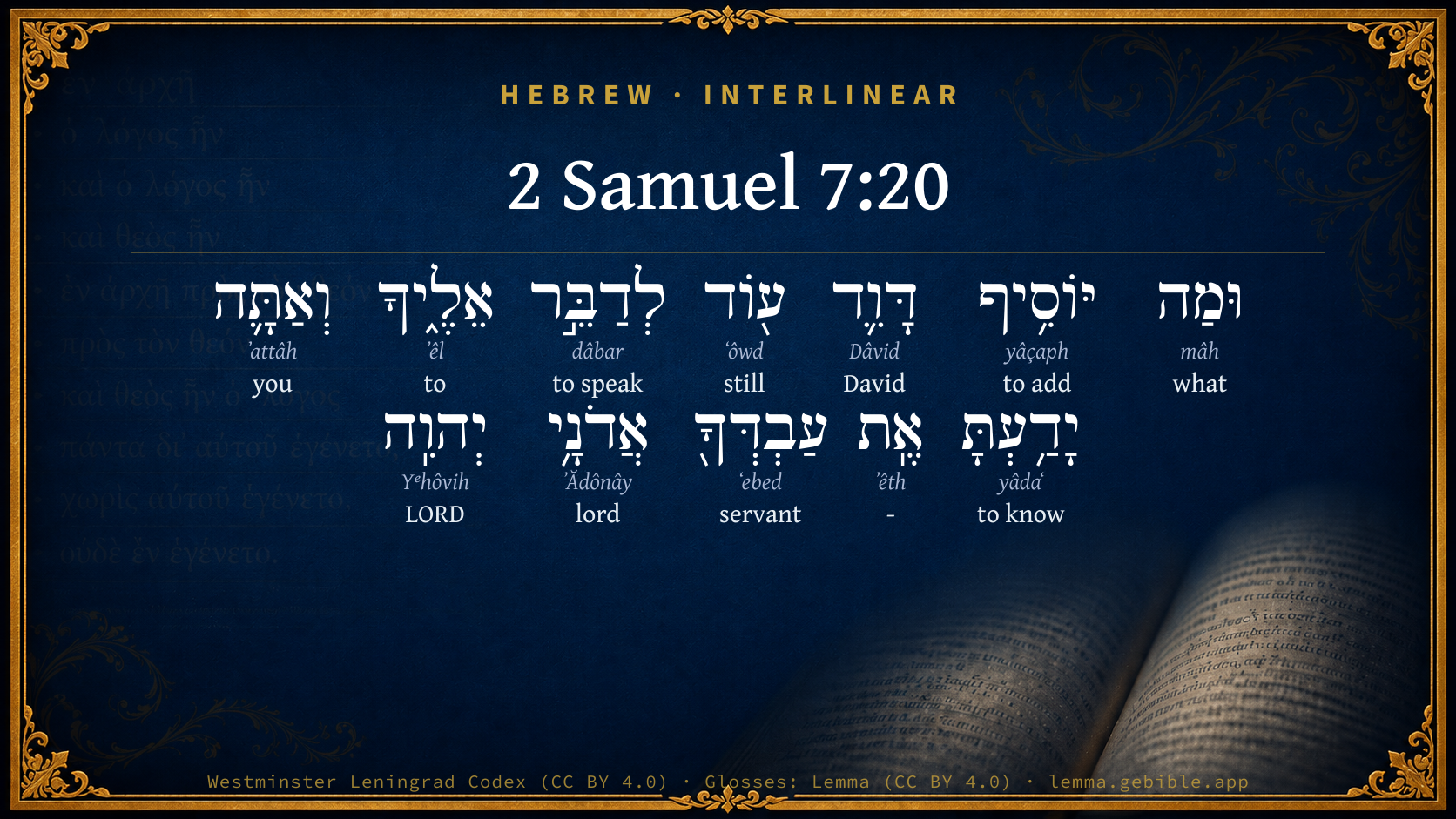
  1. וּמַה mâh H4100 “and · what” Conjunction + Particle, Interrogative
  2. דָּוִ֛ד Dâvid H1732 “David” Noun, Proper
  3. ע֖וֹד ʻôwd H5750 “still” Adverb
  4. לְדַבֵּ֣ר dâbar H1696 “to speak” Preposition + Verb, Piel, Infinitive Construct
  5. אֵלֶ֑יךָ ʼêl H413 “to · you” Preposition + Suffix, Personal, 2nd Person, Masculine, Singular
  6. וְאַתָּ֛ה ʼattâh H859 “and · you” Conjunction + Pronoun, Personal, 2nd Person, Masculine, Singular
  7. יָדַ֥עְתָּ yâdaʻ H3045 “to know” Verb, Qal, Perfect, 2nd Person, Masculine, Singular
  8. אֶֽת ʼêth H853 “-” Particle, Direct Object
  9. עַבְדְּךָ֖ ʻebed H5650 “servant · your” Noun, Common, Masculine, Singular, Construct + Suffix, Personal, 2nd Person, Masculine, Singular
  10. אֲדֹנָ֥י ʼĂdônây H136 “Lord · my” Noun, Common, Masculine, Plural, Construct + Suffix, Personal, 1st Person, Common, Singular
  11. יְהוִֽה Yᵉhôvih H3069 “LORD” Noun, Proper

About this verse

These counts appear in no published source. They are computed here, from the morphology-tagged text and Lemma’s own curated glosses. What Lemma adds →

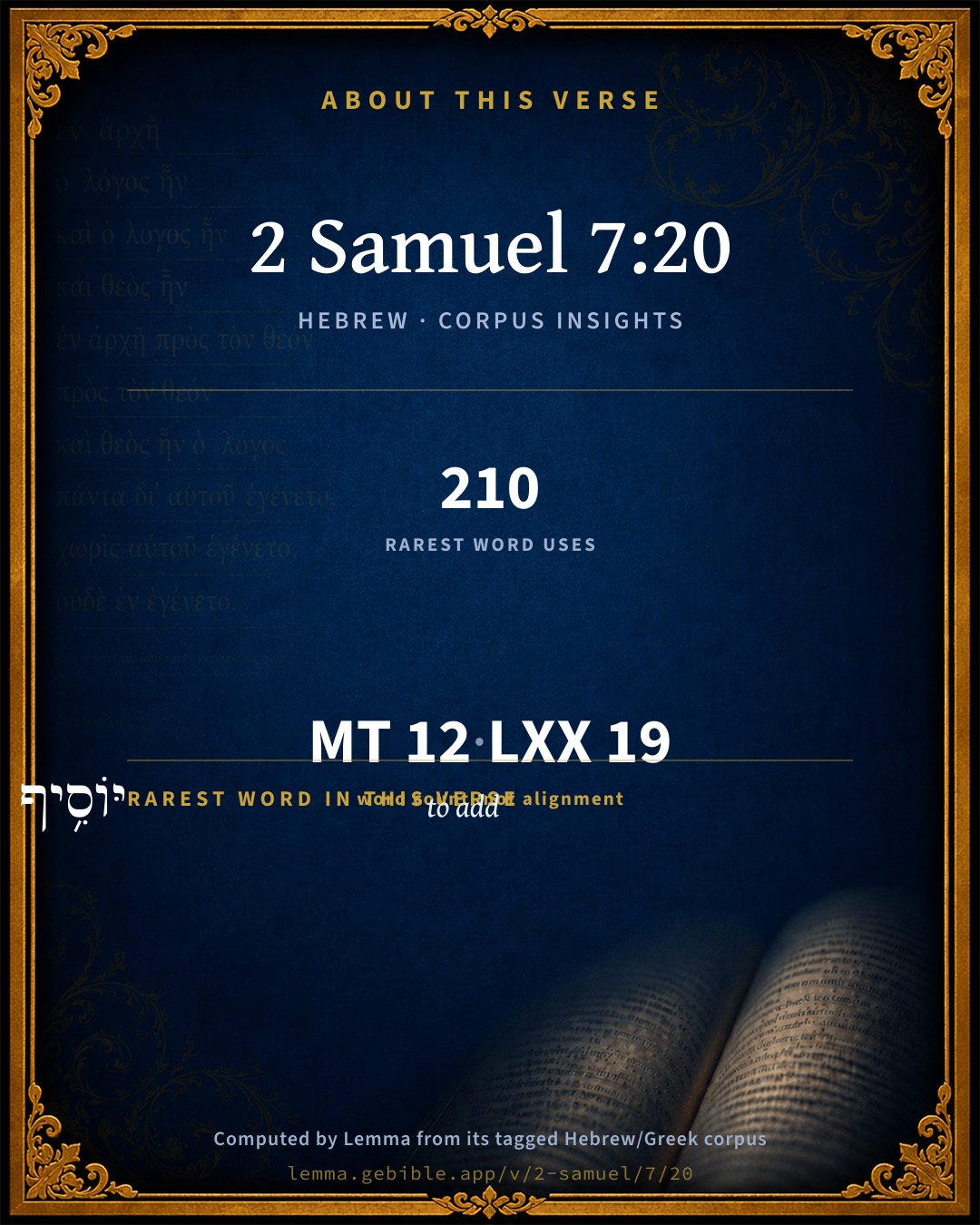
12
words
12
distinct lemmas
Historical
section

Grammatical profile

  • 3 verbs
  • 4 nouns
  • 1 pronoun
  • 1 preposition
  • 1 adverb
  • 2 particles

Verb forms

  • יּוֹסִ֥יף Hiphil · Imperfect
  • לְדַבֵּ֣ר Piel · Infinitive Construct
  • יָדַ֥עְתָּ Qal · Perfect

Hebrew & Septuagint length

In English translation the verse runs 14 words from the Hebrew and 18 from the Septuagint (LXX English) — closely comparable.

A rough comparison of the two English renderings, which tokenize alike — not a word-level alignment.

Word counts can differ between the Hebrew and the Greek without any difference in meaning — e.g. the Hebrew direct-object marker אֵת has no separate Greek word, and Greek often adds the article ὁ.

In the original languages it is 12 Hebrew tokens and 19 Greek tokens — but the two are counted differently (Hebrew bundles its prefixes and suffixes into one token; the Greek is in lemma form), so that isn’t a like-for-like length.

Cross-references

7

Topical passages linked to 2 Samuel 7:20 in the Treasury of Scripture Knowledge — connected by theme and wording, ordered by reader-vote popularity; previews shown in the World English Bible.

  • 1 Samuel 16:7 But Yahweh said to Samuel, "Don't look on his face, or on the height of his stature; because I have rejected him: for [Yahweh sees] not as man sees; for man looks at the outward appearance, but Yahweh looks at the heart."
  • John 21:17 He said to him the third time, "Simon, son of Jonah, do you have affection for me?" Peter was grieved because he asked him the third time, "Do you have affection for me?" He said to him, "Lord, you know everything. You know that I have affection for you." Jesus said to him, "Feed my sheep.
  • Psalms 139:1 Yahweh, you have searched me, And you know me.
  • Genesis 18:19 For I have known him, to the end that he may command his children and his household after him, that they may keep the way of Yahweh, to do righteousness and justice; to the end that Yahweh may bring on Abraham that which he has spoken of him."
  • John 2:25 and because he didn't need for anyone to testify concerning man; for he himself knew what was in man.
  • Hebrews 4:13 There is no creature that is hidden from his sight, but all things are naked and laid open before the eyes of him with whom we have to do.
  • Revelation 2:23 I will kill her children with Death, and all the assemblies will know that I am he who searches the minds and hearts. I will give to each one of you according to your deeds.

Cross-references courtesy of OpenBible.info (CC BY 4.0).

Hebrew and Greek witnesses Masoretic Hebrew ↔ Greek Septuagint

The same verse in the two great witnesses to the Old Testament, shown verse-for-verse.

These are two independent witnesses, not word-aligned to each other, and the Septuagint is shown in lemma (dictionary) form.

Hebrew 2 Samuel 7:20 Masoretic · Westminster Leningrad Codex

וּמַה יּוֹסִ֥יף דָּוִ֛ד ע֖וֹד לְדַבֵּ֣ר אֵלֶ֑יךָ וְאַתָּ֛ה יָדַ֥עְתָּ אֶֽת עַבְדְּךָ֖ אֲדֹנָ֥י יְהוִֽה

What can David say more to you? for you know your servant, Lord Yahweh.

World English Bible · Public Domain

Greek LXX 2 Samuel 7:20 Septuagint · lemma form

καί τίς προςτίθημι δαυίδ ἔτι ὁ λαλέω πρός σύ καί νῦν σύ οἶδα ὁ δοῦλος σύ κύριος ἐγώ κύριος

And what shall David yet say to you? and now you know your servant, O Lord, my Lord.

LXX2012 (modern English Septuagint) · Public Domain

Hebrew: Westminster Leningrad Codex (CC BY 4.0). Greek: Septuagint (public domain); English from LXX2012 (modern English Septuagint) (Public Domain). How the Septuagint differs from the Hebrew →

Targum (Aramaic paraphrase)

1

The Targum is the ancient Jewish Aramaic paraphrase of the Hebrew Scriptures — an interpretive translation, not the Hebrew text itself. Onkelos (literal) and Pseudo-Jonathan (expansive) render the Torah, and Jonathan the Prophets. Coverage is partial: where no permissively-licensed English translation exists for a verse, only the Aramaic is shown. This is verse-level text, not a word-by-word alignment to the Hebrew.

  1. Targum Jonathan Prophets (Joshua–Malachi)
    וּמַה יוֹסִיף דָוִד עוֹד לְמַלָלָא קֳדָמָךְ וְאַתְּ עֲבַדְתָּ בָּעוּת עַבְדָךְ יְיָ אֱלֹהִים:

    (no public-domain English translation for this verse)

    Targum Jonathan — Aramaic: “Mikraot Gedolot” (public domain). English: “Sefaria Community Translation” (CC0 1.0 (public-domain dedication)); “London "Chaldee Paraphrase," 1871” (public domain). Text via Sefaria.

Commentary

Notes on 2 Samuel 7:20 from classic Christian and Jewish commentators (each source and its license shown beneath its notes). The classic Christian expositions comment on the surrounding passage and are grouped to its opening verse, so a note may address several verses; the Jewish commentaries on the Tanakh (Rashi and others) are per-verse, so they appear only where the commentator wrote on this verse.

Lemma curates 59 commentaries, every one of them public domain or Creative Commons licensed, each selected and text-cleaned for this edition rather than reprinted as found. About our sources →

Trapp's Complete Commentary

John Trapp

2Sa 7:20 And what can David say more unto thee? for thou, Lord GOD, knowest thy servant.

Ver. 20. And what can David say more unto thee?] More I would say, but I want words, and am at a loss. But thou, Lord God, knowest thy servant - viz., that I could wish I had the "tongue of men and angels"; and that I could gladly grant thee better service than I am able to do thee.

John Trapp, A Commentary or Exposition upon All the Books of the Old and New Testament (1647–1656) — public domain. Text from a community e-Sword module.

Joseph Benson's Commentary

2Sa 7:20-21. What can David say — Either in a way of gratitude and praise — Words cannot express my obligations to thee, nor my sense of these obligations — or in a way of prayer: What can I ask of thee more than thou hast freely done? Thou knowest thy servant — Thou knowest my deep sense of thy favours, and my obligations to thee; and my condition and necessities, what I do or may need hereafter; and as thou knowest this, so I doubt not thou wilt supply me. Thy word’s sake — That thou mightest fulfil thy promises made to me, and thereby demonstrate thy faithfulness. According to thine own heart — Of thy own mere liberality and good pleasure, without any desert of mine. So far was David, though a very gracious man, from thinking his actions meritorious. To make thy servant know them — Thus David expresses the deep sense he had of the extraordinary kindness of God, not only in designing these great things for him and his posterity, but in condescending to make them known to him.

Joseph Benson's Commentary on the Old and New Testaments (1811–1818) — public domain. Text from a community e-Sword module.

Tyndale Open Study Notes

Tyndale Open Resources

7:20 You know what your servant is really like: God made his promises to David with full knowledge that David had both strengths and weaknesses.

Tyndale Open Study Notes — © Tyndale Open Resources, licensed CC BY-SA 4.0. Text via the HelloAO Bible API.

Jamieson, Fausset & Brown

Robert Jamieson, A. R. Fausset & David Brown

what can David say more unto thee?--that is, my obligations are greater than I can express.

Next: 2 Samuel Chapter 8

Jamieson, Fausset & Brown — Commentary Critical and Explanatory on the Whole Bible (1871) — public domain (CC PDM 1.0). Text via the HelloAO Bible API.

Adam Clarke's Commentary

Verse 20. What can David say more] How can I express my endless obligation to thee?

Adam Clarke's Commentary on the Bible (1810–1826) — public domain. Text from a community e-Sword/MySword module.

The Cambridge Bible for Schools and Colleges

gen. ed. J. J. S. Perowne

20. thou, Lord God, knowest thy servant] Words fail, and David appeals to God’s omniscience. Cp. Psa_17:3; Psa_139:1-4; Joh_21:17.

The Cambridge Bible for Schools and Colleges (gen. ed. J. J. S. Perowne; Cambridge University Press, 1878–1918) — public domain. Text from a community e-Sword module.

John Gill's Exposition

And what can David say more unto thee,.... In a way of self-abasement, or in thankfulness for such wonderful favours, or in prayer for more and other mercies; he wants words, as if he should say, to express his sense of his own nothingness and unworthiness, and to praise the Lord for all his benefits; and so large are the grants and promises made, that there is no room for him to ask for more:

for thou, Lord God, knowest thy servant; what a sense he has of his own meanness and vileness, what gratitude his heart is filled with, and what his wants and necessities are, which God only can supply, and does abundantly, even more than he is able to ask or think. The Targum is,"and thou hast performed the petition of thy servant, O Lord God.''

John Gill's Exposition of the Whole Bible (1746–1763) — public domain (CC PDM 1.0). Text via the HelloAO Bible API.

Haydock's Catholic Bible Commentary

Unto thee. To express his sentiments of gratitude. (Menochius) --- What more can he desire?

George Leo Haydock (1774–1849), Haydock's Catholic Family Bible and Commentary, 1859 edition — public domain. Excludes Psalms (Douay-Rheims chapter numbering differs from Protestant) and Deuterocanonical books (Catholic canon only).

Matthew Poole's English Annotations

What can David say more unto thee? either, first, In way of gratitude and praise to thee; words cannot express my obligations to thee, nor my sense of these obligations. Or rather, secondly, In way of prayer, as appears by the parallel place, 1Ch 17:18. What can I ask or desire of thee more than thou hast freely done?

Thou knowest thy servant; thou knowest, either, first, my deep sense of thy favours, and my obligations to thee; or rather, secondly, my condition and necessities, what I do or may need hereafter; and as thou knowest this, so I doubt not thou wilt be ready to supply me accordingly. Compare Mat 6:8,32.

Matthew Poole's English Annotations on the Holy Bible (1683–1685) — public domain. Text from a community e-Sword/MySword module.

The Pulpit Commentary

Thou, Lord. God, knowest thy servant. The Hebrew throughout has Lord Jehovah, except in vers. 22, 25, where it has "Jehovah God," the title of Deity used in Genesis 2. The repeated use Of this covenant and personal name of God is very emphatic; and the appeal to Jehovah"s knowledge of his heart reminds us of similar outpourings of David"s consciousness of his sincere devotion to his Maker, as for instance Psa_17:3.

Unutterable thoughts and feelings known to God.

God"s knowledge of the heart, which is a terror to evil men who think upon it, is often a joy to his servants. "Lord, thou knowest all things; thou knowest that I love thee". (Joh_21:17) So David, with his heart toofull for adequate utterance, finds satisfaction in the thought that God knew what his thoughts and feelings were.

I THE FELT INADEQUACY OF LANGUAGE TO EXPRESS THE DEEPEST THOUGHTS AND FEELINGS OF THE GODLY SOUL. In our ordinary condition we feel not this difficulty. Our expressions are more likely to go beyond our thoughts and feelings, especially when we use forms of devotion prepared by others. But when the soul is deeply stirred, as David"s at this time, we struggle in vain to express fully what is within. It is thus with

1. Our sense of the value of God"s gifts. Christ, God"s "unspeakable Gift". (2Co_9:15) Salvation. Everlasting life. Gifts of God associated with these which are from time to time bestowed special help in temptation, comfort in trouble, guidance in perplexities as to truth or duty, etc.

1. Our sense of the love which bestows them. We can only say, "How great is thy goodness!" "How excellent is thy loving kindness!" "God so loved the world;" "The love of Christ, which passeth knowledge" (Psa_31:19 Psa_36:7; Joh_3:16; Eph_3:19) Or, as David (ver. 22), "Thou art great, O Lord God; for there is none like unto thee.

2. The emotions excited by them. Our gratitude, affection, penitence, humility, confidence, joy ("unspeakable,", (1Pe_1:8) longing for fuller experience of them ("groanings which cannot be uttered,", (Rom_8:26) anticipations of their perfect enjoyment. (2Co_5:2-4) In our times of intense devotion we feel how utterly impossible it is fully to express what is in our hearts.

II THE SATISFACTION WHICH ARISES FROM GOD"S PERFECT KNOWLEDGE OF US. "What can David say more unto thee?" I cannot express what I feel; and I need not labour to do so, "For thou, Lord God, knowest thy servant." It is the same thought which St. Paul expresses, when, speaking of the unutterable groanings with which the Holy Spirit intercedes in the Christian soul, he says, "He that searcheth the heart knoweth what is the mind of the Spirit". (Rom_8:27) God knows much more about us than our words express; is not dependent for his knowledge of us on our own account of ourselves. As we cannot by any words conceal from him the evil which is in us, so our deficiencies of expression will not hinder his discernment of the good. Even earthly parents see the meaning which their children try to express in stammering words and broken sentences; how much more does the heavenly Father, who is not at all dependent for his knowledge of us on our words, see beyond the poor utterances of his children, into their hearts! This is

(1) a comfort under the consciousness of imperfect and unworthy utterance in our addresses to God; and

(2) a reason for not labouring too much to express ourselves fully and worthily.

(1) declining to speak to God at all, David did not actually sink into silence because he felt that he could not adequately express himself, and that God knew him (see what follows); or

(2) accustoming ourselves to careless expression before him.

Since

(1) the endeavour to speak aright aids right thought and feeling, these grow in the endeavour to utter them;

(2) in family and social worship our language aids or hinders others; and

(3) we should ever offer to God our best, poor as we may feel it to be. And we may indefinitely improve both in thought and expression by the careful employment of the helps presented in Holy Scripture and uninspired devotional books. Christian poets, too, may much assist us to find suitable, though it may be still inadequate, utterance for our deepest thoughts and emotions.

But it is not a reason for either Finally:

1. David"s emotions on this occasion are at once an example and a reproach to us. For the gifts and promises of God to us, if not greater than those to him, are greater than his understanding of them could be. They stand out to us in the light which streams from Jesus Christ, unfolding into all the precious revelations and assurances of the gospel, and all the happy experiences which the Holy Spirit produces. Yet how seldom are we so affected as to feel language too poor for the expression of the wonder, love, and gratitude which we feel!

2. How sad to be utterly insensible to the goodness of God and the greatness of his gifts to us! G.W.

The Pulpit Commentary (1880–1919), ed. H.D.M. Spence-Jones & Joseph S. Exell — public domain. Text from a community e-Sword module.

John Wesley's Explanatory Notes

David say - Either in a way of gratitude and praise, words cannot express my obligations to thee, nor my sense of these obligations: Or in a way of prayer. What can I ask of thee more than thou hast freely done? Thou knowest - Thou knowest my deep sense of thy favours, and my obligations to thee. And my condition and necessities, what I do or may need hereafter; and as thou knowest this, so I doubt not thou wilt supply me.

John Wesley, Explanatory Notes Upon the Whole Bible (1754–1765) — public domain. Text via the GEBible commentary corpus.

Rashi

Rabbi Shlomo Yitzchaki (Rashi)

What more can Dovid say to You. What more can I ask for?

You know Your servant. You have supplied me with all my needs as [it says] (Mishlei 12:10) "A righteous man knows his animal's being. "

Rashi on the Tanakh — English translations: “The Judaica Press complete Tanach with Rashi, translated by A. J. Rosenberg” (CC BY 4.0); “Pentateuch with Rashi's commentary by M. Rosenbaum and A.M. Silbermann, 1929-1934” (public domain); “The Metsudah Tanach series, Lakewood, N.J” (CC BY 4.0); and “The Book of Joshua, Metsudah Publications, 1997” (CC BY 4.0). Text via Sefaria.

Lesson kit

Teaching starters — assembled from the data on this page, not authored interpretation. Every prompt links to the verse data it draws on. Edit before teaching.

2 Samuel, in the Historical, opens this verse with 12 words (12 distinct Hebrew lemmas). Its most distinctive word is yâçaph (“to add”). A historical commentator’s framing appears above. Read the whole chapter for the surrounding context.

Discussion questions

  1. What does “to add” (yâçaph) contribute to the verse as a whole?
  2. 1 Samuel 16:7 shares this passage’s theme. How do the two illuminate each other?
  3. These translations render this verse differently; the difference is in the English rendering, not the original. What questions does that raise?
  4. The verb «יּוֹסִ֥יף» is Hiphil Imperfect. How does its form color the action?
  5. Reading how Trapp's Complete Commentary and Joseph Benson's Commentary read this verse, where do the two commentators agree and where do they part?

Things to notice

Reading settings

Reading text

Shown beneath each verse's original-language words.

Old Testament
Old Testament edition

Read the OT as the Masoretic Hebrew (MT) or the Greek Septuagint (LXX).

English shown for the Greek Septuagint (in the Hebrew ↔ Greek comparison).

Comparing translations? Open the Compare panel on any verse page to stack up to four side by side.