
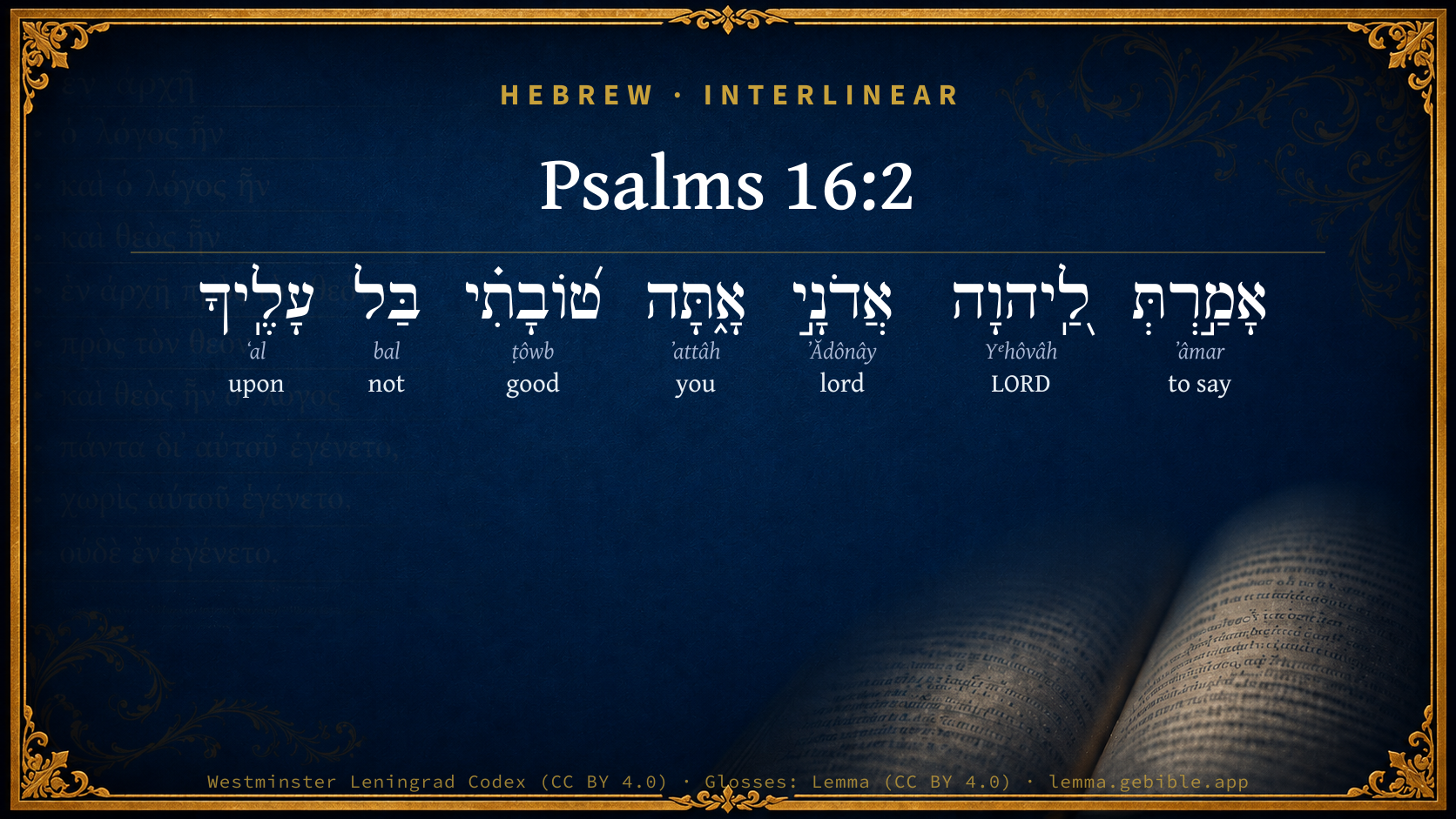
Psalms 16:2

Hebrew (Westminster Leningrad Codex) Psalms 16:2 appears in the Hebrew Old Testament. The text above is from the Westminster Leningrad Codex. Each word links to its Strong’s number, a concise gloss, and parsing drawn from the Open Scriptures Hebrew Bible morphology. Click any word for its full Brown-Driver-Briggs (BDB) entry.
Download image
Cite this verse

Psalms 16:2 (World English Bible). Public Domain. Lemma interlinear Bible study tool, https://lemma.gebible.app/v/psalms/16/2.

Show BibTeX & RIS
BibTeX
RIS
English Translation
My soul, you have said to Yahweh, "You are my Lord. Apart from you I have no good thing."
World English Bible · Public Domain
Download a study sheet

One document with this verse’s original text, its word-by-word gloss line, the meaning frame, cross-references with their text, attributed commentary, and full source and license credits — printable, and it pastes into notes with its structure intact.

This verse Autodidact and up

Study sheet (.html) Plain text (.txt)

A passage Seminary Student

Up to 50 verses in one chapter. A passage sheet keeps up to 6 commentary sources and 12 cross-references per verse, in the order this page ranks them, and says so on the sheet whenever that leaves anything out. Ask for a single verse and you get the Autodidact verse sheet above.

Everything on this page stays free to read, with no account — the sheet is a download of what is already on screen, not access to it.

Want to remove ads? Support Godless Engineer
Compare translations 3

The same verse in 3 English versions, stacked beneath the original-language interlinear above. Click any original word for its lexicon entry.

Each is an independent rendering of the whole verse — the interlinear is not word-aligned to these translations.

Highlighted words mark where these versions differ — a whole-verse word diff, not a word-by-word alignment.

  • World English Bible Public Domain
    My soul, you have said to Yahweh, "You are my Lord. Apart from you I have no good thing."
  • King James Version Public Domain
    O my soul, thou hast said unto the LORD, Thou art my Lord: my goodness extendeth not to thee;
  • unfoldingWord Literal Text CC BY-SA 4.0
    You said to Yahweh, “You are my Lord; my good is not beyond you.”

unfoldingWord Literal Text — © unfoldingWord, licensed CC BY-SA 4.0. Word-aligned USFM3 via Door43 (git.door43.org/unfoldingWord/en_ult).

Versions to compare (up to 4)

3 of 4 selected

Show all 18 translations

Every available English version of this verse, each an independent rendering of the whole verse.

  • World English Bible Public Domain
    My soul, you have said to Yahweh, "You are my Lord. Apart from you I have no good thing."
  • Berean Standard Bible Public Domain
    I said to the LORD, “You are my Lord; apart from You I have no good thing.”
  • Majority Standard Bible Public Domain
    I said to the LORD, “You are my Lord; apart from You I have no good thing.”
  • King James Version Public Domain
    O my soul, thou hast said unto the LORD, Thou art my Lord: my goodness extendeth not to thee;
  • American Standard Version (1901) Public Domain
    `O my soul', thou hast said unto Jehovah, Thou art my Lord: I have no good beyond thee.
  • Revised Version (1885) Public Domain
    I have said unto the LORD, Thou art my Lord: I have no good beyond thee.
  • Geneva Bible (1599) Public Domain
    O my soule, thou hast sayd vnto the Lord, Thou art my Lord: my weldoing extendeth not to thee,
  • Douay-Rheims (1899) Public Domain
    I have said to the Lord, thou art my God, for thou hast no need of my goods.
  • Young's Literal Translation Public Domain
    Thou hast said to Jehovah, `My Lord Thou `art';' My good `is' not for thine own sake;
  • Literal Standard Version CC BY-SA 4.0
    You have said to YHWH, “You [are] my Lord”; My goodness [is] not above You;
  • Unlocked Literal Bible CC BY-SA 4.0
    I say to Yahweh, “You are my Lord; my goodness is nothing apart from you.
  • unfoldingWord Literal Text CC BY-SA 4.0
    You said to Yahweh, “You are my Lord; my good is not beyond you.”
  • Darby Bible Public Domain
    Thou [my soul] hast said to Jehovah, Thou art the Lord: my goodness [extendeth] not to thee; --
  • World Messianic Bible Public Domain
    My soul, you have said to the LORD, “You are my Lord. Apart from you I have no good thing.”
  • Webster's Bible Public Domain
    O my soul, thou hast said to the LORD, Thou art my Lord: my goodness extendeth not to thee;
  • Free Bible Version CC BY-SA 4.0
    I tell the Lord, “Apart from you Lord, I don't have anything that's good.”
  • Bible in Basic English Public Domain
    O my soul, you have said to the Lord, You are my Lord: I have no good but you.
  • JPS Tanakh (1917) Public Domain
    I have said unto the LORD: 'Thou art my Lord; I have no good but in Thee';

Literal Standard Version (2020), Covenant Press — licensed CC BY-SA 4.0. Text via the HelloAO Bible API (eBible.org). Unlocked Literal Bible (unfoldingWord) — licensed CC BY-SA 4.0. Text via the HelloAO Bible API (eBible.org). unfoldingWord Literal Text — © unfoldingWord, licensed CC BY-SA 4.0. Word-aligned USFM3 via Door43 (git.door43.org/unfoldingWord/en_ult). Free Bible Version, Dr. Jonathan Gallagher — licensed CC BY-SA 4.0. Text via the HelloAO Bible API (eBible.org).

Word by word

More ways to search: Search by grammar → Find every occurrence → Compare this word →

Practice this passage: Drill this verse → Learn its vocabulary →

About this verse

These counts appear in no published source. They are computed here, from the morphology-tagged text and Lemma’s own curated glosses. What Lemma adds →

7
words
7
distinct lemmas
Wisdom
section

Grammatical profile

  • 1 verb
  • 2 nouns
  • 1 adjective
  • 1 pronoun
  • 1 preposition
  • 1 particle

Verb forms

  • אָמַ֣רְתְּ Qal · Perfect

Hebrew & Septuagint length

In English translation the verse runs 19 words from the Hebrew and 17 from the Septuagint (LXX English) — closely comparable.

A rough comparison of the two English renderings, which tokenize alike — not a word-level alignment.

Word counts can differ between the Hebrew and the Greek without any difference in meaning — e.g. the Hebrew direct-object marker אֵת has no separate Greek word, and Greek often adds the article ὁ.

Cross-references

15

Topical passages linked to Psalms 16:2 in the Treasury of Scripture Knowledge — connected by theme and wording, ordered by reader-vote popularity; previews shown in the World English Bible.

  • Psalms 73:25 Who do I have in heaven? There is no one on earth who I desire besides you.
  • Psalms 31:14 But I trust in you, Yahweh. I said, "You are my God."
  • Job 22:2–3 "Can a man be profitable to God? Surely he who is wise is profitable to himself.
  • Psalms 89:26 He will call to me, 'You are my Father, My God, and the rock of my salvation!'
  • Psalms 91:2 I will say of Yahweh, "He is my refuge and my fortress; My God, in whom I trust."
  • Psalms 8:1 Yahweh, our Lord, how majestic is your name in all the earth, Who has set your glory above the heavens!
  • Psalms 27:8 When you said, "Seek my face," My heart said to you, "I will seek your face, Yahweh."
  • John 20:28 Thomas answered him, "My Lord and my God!"
  • Isaiah 26:13 Yahweh our God, other lords besides you have had dominion over us; but by you only will we make mention of your name.
  • Zechariah 13:9 I will bring the third part into the fire, And will refine them as silver is refined, And will test them like gold is tested. They will call on my name, and I will hear them. I will say, 'It is my people;' And they will say, 'Yahweh is my God.'"
  • Romans 11:35 "Or who has first given to him, And it will be repaid to him again?"
  • Isaiah 44:5 One shall say, I am Yahweh's; and another shall call [himself] by the name of Jacob; and another shall subscribe with his hand to Yahweh, and surname [himself] by the name of Israel.
  • Luke 17:10 Even so you also, when you have done all the things that are commanded you, say, 'We are unworthy servants. We have done our duty.'"
  • Job 35:7–8 If you are righteous, what do you give him? Or what does he receive from your hand?
  • Psalms 50:9–10 I have no need for a bull from your stall, Nor male goats from your pens.

Cross-references courtesy of OpenBible.info (CC BY 4.0).

Hebrew and Greek witnesses Masoretic Hebrew ↔ Greek Septuagint

The same verse in the two great witnesses to the Old Testament, shown verse-for-verse.

You’re reading Greek Psalm 15 (Hebrew Psalm 16). The Septuagint counts the superscription, so verse numbers can differ from the Hebrew — chapter-level alignment, not verse-by-verse. Numbering follows Rahlfs.

These are two independent witnesses, not word-aligned to each other, and the Septuagint is shown in lemma (dictionary) form.

Hebrew Psalms 16:2 Masoretic · Westminster Leningrad Codex

אָמַ֣רְתְּ לַֽ֭יהוָה אֲדֹנָ֣י אָ֑תָּה ט֝וֹבָתִ֗י בַּל עָלֶֽיךָ

My soul, you have said to Yahweh, "You are my Lord. Apart from you I have no good thing."

World English Bible · Public Domain

Greek LXX Greek Psalm 15:2 Septuagint · lemma form

εἶπον ὁ κύριος κύριος ἐγώ εἰμί σύ ὅτι ὁ ἀγαθός ἐγώ οὐ χρεία ἔχω

I said to the Lord, You are my Lord; for you have no need of my goodness.

LXX2012 (modern English Septuagint) · Public Domain

On this verse, Trapp's Complete Commentary discusses the Septuagint’s reading. Read the note in Commentary ↓

Hebrew: Westminster Leningrad Codex (CC BY 4.0). Greek: Septuagint (public domain); English from LXX2012 (modern English Septuagint) (Public Domain). How the Septuagint differs from the Hebrew →

Commentary

Notes on Psalms 16:2 from classic Christian and Jewish commentators (each source and its license shown beneath its notes). The classic Christian expositions comment on the surrounding passage and are grouped to its opening verse, so a note may address several verses; the Jewish commentaries on the Tanakh (Rashi and others) are per-verse, so they appear only where the commentator wrote on this verse.

Lemma curates 59 commentaries, every one of them public domain or Creative Commons licensed, each selected and text-cleaned for this edition rather than reprinted as found. About our sources →

Ellicott's Commentary for English Readers

(2) Thou hast said.—The text of this passage is exceedingly corrupt. This appears (1) from the actual existence of various readings, (2) by the variations in the ancient versions, both from the Hebrew and each other. It will be best to take Psa_16:2-3 together first. The consensus of the ancient versions in favour of the first person, “I said,” instead of “thou hast said” (the italicised words O my soul, are a mere gloss from the Chaldee), gives for Psa_16:2 the plain and intelligible rendering

I said to Jehovah, Thou art my Lord,

I have no good besides thee.

Psa_16:3 also requires emendation, being quite unintelligible as it stands. The simplest device is to omit the conjunction and recognise one of those changes of person so agreeable to Hebrew, when the verse will run—

“And of the saints who are in the earth,

They are the excellent in whom is all my delight.”

The Authorised Version, in inserting “extendeth,” introduces the fine thought that

“Merit lives from man to man.

And not from man, O God, to Thee;”

but it could not have been the thought of the original, since “my good,” as Psa_16:5-6 show, equals “happiness,” not “conduct.”

A Bible Commentary for English Readers, edited by Charles John Ellicott (1878–1897) — public domain. Text from a community e-Sword module.

Trapp's Complete Commentary

John Trapp

Psa 16:2 [O my soul], thou hast said unto the LORD, Thou [art] my Lord: my goodness [extendeth] not to thee;

Ver. 2. O my soul, thou hast said unto the Lord] Or, I have said unto the Lord; and so I had rather read it, with Jerome and the Septuagint; because the letter Jod may be wanting in Amarti. See the like, Job 42:2 Eze 16:59. David was here extra se abreptus, carried beyond himself, and so might easily speak short, and say Amart for Amarti; like as Moses, in a passion, said to God, At for Atta, Num 11:15, as not able to speak out. Amor Dei est ecstaticus, &c.

Thou art my Lord] Heb. Thou my Lord, so the next words, My good not unto thee; all concise and abrupt, out of deepest affection; broken language from a broken spirit, spending and exhaling itself into God’s blessed bosom.

My goodness extendeth not to thee] But if it did I could with all my heart beteem it thee; even the very best of my best; but what can I give thee save only τα σο εκ των σων, since all is thine own? 1Ch 29:14; 1Ch 29:16 Psa 24:1; thou needest no sacrifices, Psa 50:8, neither art thou delighted therein, Psa 51:18 Isa 1:11. All that thou requirest is mercy, Hos 6:5 Mic 6:8 Mat 12:7. Therefore I will seek out those thy receivers, the saints, that are in the earth, &c. {See Trapp on "Job 35:6"} {See Trapp on "Job 35:7"} {See Trapp on "Job 35:8"}

John Trapp, A Commentary or Exposition upon All the Books of the Old and New Testament (1647–1656) — public domain. Text from a community e-Sword module.

The Biblical Illustrator

Joseph S. Exell

Psa_16:2

O my soul, thou hast said unto the Lord, Thou art my Lord.

Dedication to God

The Host High is a God of truth and faithfulness. The text alludes to Davids dedication of himself to God, and implies that he had done so deliberately and sincerely.

1. Apply the words for admonition. Remember that it were better not to vow than, after having vowed, not to pay. A dedication is one of the best preservatives against temptation and sin.

2. Apply for instruction. They teach us what David thought of God. They teach that his dedication was deliberate and sincere.

3. Apply for comfort and encouragement. If you have thus dedicated yourself, then to you the promises and consolations of the Gospel belong. Reflections by way of improvement--

(1) Abide in Christ.

(2) Do much for Him to whom you owe so much.

(3) Be assured that God will do much for you. (John Ramsay, M. A.)

The advantages of a Christian reviewing his dedication to God

I wish I could have heard what you said to yourselves when I read these words. I could guess the language of some of you. You thought, I never said anything to the Lord, except it was--Depart from me. Others of you, perhaps, said, I believe that I did once say so to the Lord, but it was so lung ago that I had forgotten it. It must have been when I was in trouble. But I cannot say it now. Others said, Yes, I have said that, and often, and I am glad to say it again. Good men are excellent company for themselves, for they can converse with their souls. David is doing so here. He is telling of his dedication to God, and reviewing what he then said. Now this is a good thing to do.

I. It is useful in the hour of temptation. It will not prevent, necessarily, the assaults of sin, nor our being overcome by them. The eleven disciples forsook Christ, though they had solemnly engaged not to do so. But it is a help against such temptations to be often reviewing our vows to God. It arms us against sin.

II. As a bond of diligence and consistency in duty. Many also would stand back from wilful sins and grosser vices, yet grow remiss in their duty and become less circumspect, Now against this it is well to preserve a remembrance of our covenant engagements.

III. To afford great relief in distress. The believer may be subject to great spiritual distress. The light of Gods countenance may be withheld, and grace be very feeble. Then such communion with our own souls and with the Lord, as is indicated here, does help us much. Tell Him how we desire to stand to our engagements, and to be His forever. So our hearts will brighten even in the midst of flowing tears.

IV. As a support and encouragement in the immediate prospect of death. Nothing, then, but what is real and substantial will serve. Death is rapidly approaching. So let it, cries the devoted servant of God; the sooner it comes the better. The God whom I have served is able to deliver me; and He will deliver me from thy sting, O death, and from all the power of the grave. Many years ago I said to the Lord, Thou art my Lord, and He honoured me with a place among His servants; and now I feel Thee, blessed Savour, to be the strength of my heart; and I depend upon Thee as my portion forever. Into Thine hand I commit my spirit; for Thou hast redeemed me, O Lord God of truth. Well, then, do you not think that happy is the people whose God is the Lord? But I want more than your approval. I want to know if you have said to the Lord, Thou art my Lord. Let me ask--

1. Have you ever felt the misery of being without God?

2. Have you ever given time for serious thought on this question? How solemn is your condition who live all your days in a hurry of business or thoughtless dissipation! But you who have taken the Lord to be your God, I would say to you: Cleave to God with purpose of heart. This is the bond of the servants of the Lord. I, such an one, whose name is hereunto subscribed, do hereby renounce all other masters which have had dominion over me, and bind myself to the Lord, to serve Him in holiness and righteousness all the days of my life: So help me God. And do much for Him. Also expect much from Him; you shall not be disappointed. And finally, you shall receive a crown of life. None ever served God for nought. (S. Lavington.)

A sacramental meditation

I. Before partaking. It was Davids wont, when in distress and ready to doubt whether he had really dedicated himself to God, to remind himself of the solemn transactions which had passed between him and God.

1. Let us consider the meaning and import of these words. He acknowledges Gods property in him, and claim upon him. And that he desires to be the Lords; that he prefers God to all else. He had chosen and acknowledged God as his God. And now, in distress, he repeats all this.

2. Let us remember what professions we have made. It is reasonable that we should; for we are in danger of forgetting. The world wears out the memory of them; and our afflictions tempt us to doubt that Jehovah is our Lord. Therefore it is good to renew our covenant. And it will help us to be more sensible of our duty, and will animate us under every suffering. And as we thus renew our vows we shall see such excellence in them as will engage us to fulfil them with diligence.

3. And there is no more fit time for this than at the Lords table. We commemorate the everlasting covenant. We profess our faith in Christs sacrifice. By His blood, which the wine represents, we are brought nigh to God and admitted into endearing relation to Him. Therefore let us, etc.

II. After partaking. Let us take review of what we have done, and each adopt the language of David, O my soul, etc. This means, I entirely approve, and give thanks for being inclined to say this. And acknowledge past unworthy behaviour. Failure in love to Him, and in faithfulness. But I desire that I may not again neglect my duty, that I may not yield to temptation, nor follow the world too eagerly, nor say to it what I had said to the Lord. Are we in affliction? That is a time to repeat the acknowledgment. Thou hast said to the Lord, Thou art my Lord: in Thee I have all things. Thou canst and wilt support and comfort me; make up my earthly losses, and teach me to glory in tribulation. Finally, do we feel the sentence of death in ourselves? There is no time more proper to repeat the acknowledgment, Thou hast said unto the Lord, Thou art my Lord; my God, whom I have sincerely loved and served; to whom I have often committed my soul through Christ; and I would do it again with gratitude, hope and joy, when flesh and heart are failing. Let us thus, in every circumstance of life and death, remember our covenant transactions. If you have sincerely said, and are saying to the Lord, Thou art my Lord, let this be your comfort, that He hath said, I will never leave thee nor forsake thee. (J. Orton.)

The Biblical Illustrator, edited by Joseph S. Exell (c. 1880s–1900s) — public domain. Text from a community e-Sword module.

The Treasury of David

Charles H. Spurgeon

Ver. 2-3. The possessing of the gold. The believer looking for justification to the righteousness of God alone, while maintaining personal holiness by companionship with the saints.

Ver. 2. O my soul, thou hast said unto the Lord, Thou art my Lord. In his inmost heart the Lord Jesus bowed himself to do service to his Heavenly Father, and before the throne of Jehovah his soul vowed allegiance to the Lord for our sakes. We are like him when our soul, truly and constantly in the presence of the heart searching God, declares her full consent to the rule and government of the Infinite Jehovah, saying, "Thou art my Lord." To avow this with the lip is little, but for the soul to say it, especially in times of trial, is a gracious evidence of spiritual health; to profess it before men is a small matter, but to declare it before Jehovah himself is of far more consequence. This sentence may also be viewed as the utterance of appropriating faith, laying hold upon the Lord by personal covenant and enjoyment; in this sense may it be our daily song in the house of our pilgrimage.

My goodness extendeth not to thee. The work of our Lord Jesus was not needful on account of any necessity in the Divine Being. Jehovah would have been inconceivably glorious had the human race perished, and had no atonement been offered. Although the life work and death agony of the Son did reflect unparalleled lustre upon every attribute of God, yet the Most Blessed and Infinitely Happy God stood in no need of the obedience and death of his Son; it was for our sakes that the work of redemption was undertaken, and not because of any lack or want on the part of the Most High. How modestly does the Saviour here estimate his own goodness! What overwhelming reasons have we for imitating his humility! "If thou be righteous, what givest thou him? or what receiveth he of thine hand?" (Job 35:7)

Ver. 2. O my soul, thou hast said unto the Lord, Thou art my Lord. I wish I could have heard what you said to yourself when these words were first mentioned. I believe I could guess the language of some of you. When you heard me repeat these words, "O my soul, thou hast said unto the Lord, Thou art my Lord, "you thought, "I have never said anything to the Lord, unless when I cried out, Depart from me, for I desire not the knowledge of thy ways." Has not something like this passed in your minds? I will try again. When I first mentioned the text, "Let me consider, "you secretly said, "I believe that I did once say to the Lord, Thou art my Lord; but it was so long ago, that I had almost forgotten it; but I suppose that it must have been at such a time when I was in trouble. I had met with disappointments in the world; and then, perhaps, I cried, Thou art my portion, O Lord. Or, perhaps, when I was under serious impressions, in the hurry of my spirits, I might look up to God and say, Thou art my Lord. But, whatever I could or did formerly say, I am certain that I cannot say it at present." Have none of you thought in this manner? I will hazard one conjecture more; and I doubt not but in this case I shall guess rightly. When I repeated these words, "O my soul, thou hast said unto the Lord, Thou art my Lord; ""So have I, "thought one; "So have I, " thought another; I have said it often, but I said it with peculiar solemnity and pleasure, when, in an act of humble devotion, I lately threw my ransomed, rescued, grateful soul at his feet and cried, "O Lord, truly I am thy servant; I am thy servant; thou hast loosed my bonds." The very recollection of it is pleasant; and I shall now have an opportunity of renewing my vows, and hope to recover something of the divine serenity and joy which I at that time experienced. Samuel Lavington's Sermons, 1810.

Ver. 2. Thou art my Lord. He acknowledgeth the Lord Jehovah; but he seeth him not as it were then afar off, but drawing near unto him, he sweetly embraces him; which thing is proper unto faith, and to that particular applying which we say to be in faith. Robert Rollock, 1600.

Ver. 2. My goodness extendeth not to thee. I think the words should be understood of what the Messiah was doing for men. My goodness, (Heb.) tobhathi, "my bounty" is not to thee. What I am doing can add nothing to thy divinity; thou art not providing this astonishing sacrifice because thou canst derive any excellence from it; but this bounty extends to the saints to all the spirits of just men made perfect, whose bodies are still in the earth; and to the excellent, (Heb.) addirey, "the noble or supereminent ones, "those who through faith and patience inherit the promises. The saints and illustrious ones not only taste of my goodness, but enjoy my salvation. Perhaps angels themselves may be intended; they are not uninterested in the incarnation, passion, death, and resurrection of our Lord. They desire to look into these things; and the victories of the cross in the conversion of sinners cause joy among the angels of God. Adam Clarke.

Ver. 2. My goodness extendeth not to thee; "My well doing extendeth not to thee." Oh, what shall I render unto thee, my God, for all thy benefits towards me? what shall I repay? Alas! I can do thee no good, for mine imperfect goodness cannot pleasure thee who art most perfect and goodness itself; my well doing can do thee no good, my wickedness can do thee no harm. I receive all good from thee, but no good can I return to thee; wherefore I acknowledge thee to be most rich, and myself to be most beggardly; so far off is it that thou standest in any need of me. Wherefore I will join myself to thy people, that whatsoever I have they may profit by it; and whatsoever they have I may profit by it, seeing the things that I have received must be put out to loan, to gain some comfort to others. Whatsoever others have, they have not for their own private use, but that by them, as by pipes and conduits, they liberally should be conveyed unto me also. Wherefore in this strain we are taught, that if we be the children of God, we must join ourselves in a holy league to his people, and by mutual participation of the gifts of God, we must testify each to other, that we be of the number and communion of saints; and this is an undoubted badge and cognizance of him that loveth God, if he also loveth them that are begotten of God. Wherefore, if we so profess ourselves to be of God and to worship him, then we must join ourselves to the church of God which with us doth worship God. And this must we do of necessity, for it is a branch of our belief that there is a communion of saints in the church; and if we believe that there is a God, we must also believe that there is a remnant of people, unto whom God revealeth himself, and communicates his mercies, in whom we must have all our delight, to whom we must communicate according to the measure of grace given unto every one of us. Richard Greenham.

Ver. 2. My goodness extendeth not to thee. Oh, how great is God's goodness to you! He calls upon others for the same things, and conscience stands as Pharaoh's taskmasters, requiring the tale of bricks but not allowing straw; it impels and presseth, but gives no enlargement of heart, and buffets and wounds them for neglect: as the hard creditor that, taking the poor debtor by the throat, saith, "Pay me that thou owest me, "but yields him no power to do it; thus God might deal with you also, for he oweth not assistance to us; but we owe obedience to him. Remember, we had power, and it is just to demand what we cannot do, because the weakness that is in us is of ourselves: we have impoverished ourselves. Therefore, when in much mercy he puts forth his hand into the work with thee, be very thankful. If the work be not done, he is no loser; if done, and well done, he is no gainer. Job 22:2 35: 6-8. But the gain is all to thee; all the good that comes by it is to thyself. Joseph Symonds, 1639.

Ver. 2. (last clause). It is a greater glory to us that we are allowed to serve God, than it is to him that we offer him that service. He is not rendered happy by us; but we are made happy by him. He can do without such earthly servants; but we cannot do without such a heavenly Master. William Secker.

Ver. 2. (last clause). There is nothing added to God; he is so perfect, that no sin can hurt him; and so righteous, that no righteousness can benefit him. O Lord, my righteousness extendeth not to thee! thou hast no need of my righteousness. Ac 17:24-25. God hath no need of anything. Richard Stock, 1641.

Ver. 2. As Christ is the head of man, so is God the head of Christ (1Co 11:3); and as man is subject unto Christ, so is Christ subject to God; not in regard of the divine nature, wherein there is an equality, and consequently no dominion or jurisdiction; nor only in his human nature, but in the economy of a Redeemer, considered as one designed, and consenting to be incarnate, and take our flesh; so that after this agreement, God had a sovereign right to dispose of him according to the articles consented to. In regard of his undertaking and the advantage he was to bring to the elect of God upon earth, he calls God by the solemn title of "his Lord." "O my soul, thou hast said unto the Lord, Thou art my Lord: my goodness extendeth not to thee; but to the saints that are in the earth." It seems to be the speech of Christ in heaven, mentioning the saints on earth as at a distance from him. I can add nothing to the glory of thy majesty, but the whole fruit of my mediation and suffering will redound to the saints on earth. Stephen Charnock.

Ver. 2-3. My goodness extendeth not to thee; but to the saints. God's goodness to us should make us merciful to others. It were strange indeed a soul should come out of his tender bosom with a hard uncharitable heart. Some children do not indeed take after their earthly parents, as Cicero's son, who had nothing of his father but his name; but God's children all partake of their heavenly Father's nature. Philosophy tells us, that there is no reaction from the earth to the heavens; they indeed shed their influences upon the lower world, which quicken and fructify it, but the earth returns none back to make the sun shine the better. David knew that his goodness extended not unto God, but this made him reach it forth to his brethren. Indeed, God hath left his poor saints to receive the rents we owe unto him for his mercies. An ingenuous guest, though his friend will take nothing for his entertainment, yet, to show his thankfulness, will give something to his servants. William Gurnall.

Ver. 2. Thou art my Lord. The soul's appropriation, allegiance, assurance, and avowal.

Ver. 2-3. The influence and sphere of goodness. No profit to God, or departed saints or sinners, but to living men. Need of promptness, etc.

Ver. 2-3. Evidences of true faith.

1. Allegiance to divine authority.

2. Rejection of self righteousness.

3. Doing good to the saints.

4. Appreciation of saintly excellence.

5. Delight in their society.

Psalms 16:3*

Ver. 2-3. My goodness extendeth not to thee; but to the saints. See Psalms on "Ps 16:2" for further information.

Ver. 2-3. Evidences of true faith.

1. Allegiance to divine authority.

2. Rejection of self righteousness.

3. Doing good to the saints.

4. Appreciation of saintly excellence.

5. Delight in their society.

Charles H. Spurgeon's The Treasury of David (1869–1885) — public domain. Psalms only. Text from a community e-Sword/MySword module.

Joseph Benson's Commentary

Psa 16:2-3. O my soul, thou hast said, &c. — The words, O my soul, not being in the original, Houbigant translates the clause, I have said unto the Lord — I have oftentimes avowed and professed it, and still persist so to do. Thou art my Lord — By creation, preservation, and on various other accounts: the king, to whom I am subject, the master whom I serve, the father whom I obey, the husband and portion whom I love, and to whom I cleave. My goodness extendeth not to thee — Whatever piety, or virtue, or goodness may be in me, or be done by me, it does not add any thing to thy felicity, for thou dost not need me nor my service, nor art capable of any advantage from it. Or, is not for thee, as the expression, בל עליךְ, bal gnaleka, is sometimes used; that is, for thy use or benefit. Or, is not upon thee, that is, it lays no obligation upon thee. All which interpretations come to the same thing, and signify that God is all-sufficient and infinitely happy, and the author of all the good that is in, or is done by, any of his creatures; and therefore that good cannot prevent or oblige God any further than he is graciously pleased to oblige himself. Thus he renounces all opinion of merit; and, though he urged his trust in God, as a motive to induce God to preserve him, Psa 16:1, yet he here declares he did not do it as supposing that God was indebted to him for it. The words, as applied to Christ, mean, that the services which he performed by his ministry, and the benefits which he procured by his sufferings, did not, properly speaking, make any addition of happiness and glory to God; because, being infinitely perfect in himself, his glory cannot be increased by any services which are paid him, nor be diminished by the crimes of his creatures. But to the saints — That is, the faithful, who are sanctified in Christ Jesus. See 1Co 1:2; John 17. As if he had said, I bear singular respect and love to all saints, for thy sake, whose friends and servants they are, and whose image they bear. This more properly agrees to David than to Christ, whose goodness was principally designed for, and imparted to, sinners, and who did not find men saints, but made them so; nor was it confined to them that lived with him upon the earth, but extended to all believers, of all ages, before and after him. And to the excellent — Hebrew ואדירי, veadiree, the magnificent, or mighty, or honourable, namely, the saints, as he now termed them, whom, because they were mean and despicable in the eyes of the world, he honours with their just titles, and by appropriating these titles to the people of God, he sufficiently intimates that all other men, how great soever, are truly ignoble before God, and vile persons, as he had termed them, Psa 15:4. In whom is all my delight — That is, whose company and conversation are pleasant and desirable to me. See Psa 119:63.

Joseph Benson's Commentary on the Old and New Testaments (1811–1818) — public domain. Text from a community e-Sword module.

J. A. Alexander on Psalms

Joseph Addison Alexander

2. (Psa 16:2) Thou hast said to Jehovah, The Lord (art) thou; my good (is) not besides thee (or beyond thee). The verb in the first clause has the form of a second person feminine, which some regard as an abbreviation of the first person. But this neither agrees so well with usage, nor affords so good a sense as the old construction, which supplies as the object of address the same that is expressed in Psa 42:6 (5), Ps. 42:12 (11), Psa 43:5, Jer 4:19, Lam 3:24-25. A similar ellipsis is assumed by some in 1Sa 24:11, and 2Sa 13:39. By this peculiar form of speech the Psalmist calls upon himself to remember his own solemn acknowledgment of Jehovah as THE LORD or Supreme God.—The obscure clause which follows has been very variously explained. Some understand by good moral goodness, merit, and explain the whole to mean, "My goodness is not such as to entitle me to thy regard." Most interpreters, however, give to good its usual sense of good fortune, happiness (see Psa 106:5, Job 9:25), and make the whole clause mean, "My happiness is not obligatory or incumbent on thee, thou art not bound to provide for it;" or "My happiness is not above thee; I have no higher happiness than thee." The true sense is probably afforded by a modification of this last" My happiness is not beside thee, independent of, or separable from thee," with allusion to the form of expression in the Hebrew of the first commandment (Exo 20:3). The verse, then, contains a twofold acknowledgment of God, as the universal sovereign, and as the only source of individual enjoyment. Compare Psa 73:25. That this recognition was not a mere momentary act, but a habitual affection of the mind, seems to be indicated by the Psalmist's appeal to his own soul as having made the acknowledgment already, hitherto or heretofore.

Joseph Addison Alexander, The Psalms Translated and Explained (1850) — public domain. Text from a community e-Sword module.

Tyndale Open Study Notes

Tyndale Open Resources

16:2 I said to the Lord: The various writers of the psalms pray, lament, and praise the Lord throughout the Psalter, and the Lord answers them (see 12:5-6).

Tyndale Open Study Notes — © Tyndale Open Resources, licensed CC BY-SA 4.0. Text via the HelloAO Bible API.

Geneva Bible (1599)

Geneva Bible translators

Though we can not enrich God, yet we must bestow God’s gifts to the use of his children.

Geneva Bible (1599) marginal notes — public domain. Text via Bolls.life.

Jamieson, Fausset & Brown

Robert Jamieson, A. R. Fausset & David Brown

my soul--must be supplied; expressed in similar cases (Psa 42:5, Psa 42:11).

my goodness . . . thee--This obscure passage is variously expounded. Either one of two expositions falls in with the context. "My goodness" or merit is not on account of Thee--that is, is not for Thy benefit. Then follows the contrast of Psa 16:3 (but is), in respect, or for the saints, &c.--that is, it enures to them. Or, my goodness--or happiness is not besides Thee--that is, without Thee I have no other source of happiness. Then, "to the saints," &c., means that the same privilege of deriving happiness from God only is theirs. The first is the most consonant with the Messianic character of the Psalm, though the latter is not inconsistent with it.

Jamieson, Fausset & Brown — Commentary Critical and Explanatory on the Whole Bible (1871) — public domain (CC PDM 1.0). Text via the HelloAO Bible API.

Adam Clarke's Commentary

Verse 2. Thou hast said unto the Lord, Thou art my Lord] Thou hast said ליהוה layhovah, to Jehovah, the supreme, self-existing, and eternal Being; Thou art my Lord, אדני אתה adonai attah, Thou art my prop, stay, or support. As the Messiah, or Son of God, Jesus derived his being and support from Jehovah; and the man Christ was supported by the eternal Divinity that dwelt within him, without which he could not have sustained the sufferings which he passed through, nor have made an atonement for the sin of the world; it is the suffering Messiah, or the Messiah in prospect of his sufferings, who here speaks.

My goodness extendeth not to thee] There are almost endless explanations of this clause; no man can read them without being confounded by them. The SEPTUAGINT read ὁτι των αγαθων μου ου χρειαν εχεις; Because thou dost not need my goods. The VULGATE follows the Septuagint. The CHALDEE: My good is given only by thyself. So the SYRIAC: My good is from thee. The ARABIC: Thou dost not need my good works. And in this sense, with shades of difference, it has been understood by most commentators and critics.

Bishop Horsley translates, Thou art my good - not besides thee. Dr. Kennicott, My goodness is not without thee.

I think the words should be understood of what the Messiah was doing for men. My goodness, טובתי tobathi, "my bounty," is not to thee. What I am doing can add nothing to thy divinity; thou art not providing this astonishing sacrifice because thou canst derive any excellence from it: but this bounty extends to the saints - to all the spirits of just men made perfect, whose bodies are still in the earth; and to the excellent, אדירי addirey, "the noble or supereminent ones," those who through faith and patience inherit the promises. The saints and illustrious ones not only taste of my goodness, but enjoy my salvation. Perhaps angels themselves may be intended; they are not uninterested in the incarnation, passion, death, and resurrection of our Lord. They desire to look into these things; and the victories of the cross in the conversion of sinners cause joy among the angels of God.

The קדושים kedoshim, "saints," or consecrated persons, may refer to the first planters of Christianity, evangelists, apostles, c., who were separated from all others, and consecrated to the great important work of preaching among the Gentiles the unsearchable riches of Christ. With these was all the desire, חפץ chephets, the good will and delight of Christ. In all their ministrations he was both with them and in them.

The passage, taken as referring to David, intimates that he abhorred the company of the profane and worthless, and delighted to associate with them that excelled in virtue.

On these two verses the translation and paraphrase of my old Psalter must not be forgotten: -

Ver. 1. Conserva me, Domine, c.

Trans. Kepe me Lord, for I hoped in the I said til Lord, my God thou ert for, of my gudes thu has na nede.

Par. - The voice of Crist in his manhede; prayand til the fader, and sayand: Lord, fader, kepe me imang peplis, for I hoped in the, noght in me. I said til the, my God, thu ert in that, that I am man; for thu has no nede of my godes; bot I haf of the, al that I haf; here is the wil pride of men confounded; that evenes that thai haf ought of tham self bot syn.

Ver. 2. Sanctis qui sunt in terra, c.

Trans. Til halowes the qwilk er his land, he selcouthed all my willes in tham.

Par. - Noght til wiked, bot til halows clene in saule, and depertid fra erdly bysynes, the qwilk er in his land: that es, that haf fested thair hope in the land of heven and rotyd in luf: the qwilk hope es als anker in stremys of this werld. He selcouthed al my willes, that of wonderful, he made my willes, of dying and rysing, sett and fulfilled in tham: that es, in thair profete, qware in that feled qwat it profeted tham my mekenes that wild dye, and my myght to rise.

Adam Clarke's Commentary on the Bible (1810–1826) — public domain. Text from a community e-Sword/MySword module.

John Calvin's Commentaries

2. Thou shalt say unto Jehovah. David begins by stating that he can bestow nothing upon God, not only because God stands in no need of any thing, but also because mortal man cannot merit the favor of God by any service which he can perform to him. At the same time, however, he takes courage, and, as God accepts our devotion, and the service which we yield to him, David protests that he will be one of his servants. To encourage himself the more effectually to this duty he speaks to his own soul; for the Hebrew word which is rendered Thou shalt say, is of the feminine gender, which can refer only to the soul. The word, נפשי, naphshi, is commonly supposed to be understood, Thou, my soul, shalt say, or hast said. But all the ancient versions, except the Chaldee, read in the first person, I have said, and this is the reading in many MSS. The words, however, “Thou, my soul, hast said,” are equivalent to “I have said.”

The Septuagint reads, Των ἀγαθων μου ου χρειαν ἐχεις Thou hast no need of my goodness, [or good things.] The reading in Tyndale Bible, “My goods are nothing unto thee.”

John Calvin's Commentaries (1540-1563) — public domain. Text from the Calvin Translation Society English edition (1840s-50s) via the Christian Classics Ethereal Library (ccel.org). Calvin's coverage is partial (roughly two-thirds of the Bible); uncommented books and verses are honest gaps, never fabricated. The 19th-century editor's footnotes and remarks are omitted so the notes are faithfully Calvin's own voice.

The Cambridge Bible for Schools and Colleges

gen. ed. J. J. S. Perowne

2. The Massoretic Text reads thou (fem.) hast said, assuming that the poet holds colloquy with himself, and addresses his soul, as in Psa_42:5; Lam_3:24 (a passage evidently based on this psalm). So the Targum. But an ellipse of O my soul cannot be grammatically justified; and R.V. is certainly right in reading I have said, with LXX, Vulg., Syr., Jer. Cp. Psa_31:14; Psa_91:2; Psa_140:6.

my Lord] The confession of Jehovah’s servant (cp. Psa_35:23), in contrast to the self-asserting independence of Psa_12:4. R.V. marg. the Lord is possible, but less satisfactory.

my goodness extendeth not to thee] Render with R.V., I have no good beyond thee. “Not merely is God the source of all his weal, but everything which he recognises as a true good, God actually contains within Himself” (Robertson Smith). Cp. Psa_73:25. The P.B.V. my goods are nothing unto thee (cp. Psa_50:9 ff.) follows LXX and Vulg., τῶν ἀγαθῶν μου οὐ χρείαν ἔχεις: bonorum meorum non eges.

The Cambridge Bible for Schools and Colleges (gen. ed. J. J. S. Perowne; Cambridge University Press, 1878–1918) — public domain. Text from a community e-Sword module.

John Gill's Exposition

O my soul, thou hast said unto the Lord,.... Some take these to be the words of David speaking to the church, who had owned the Lord to be her Lord, and had declared what follows; others think they are the words of God the Father to his Son, suggesting to him what he had said; but they are rather an apostrophe, or an address of Christ to his own soul; and the phrase, "O my soul", though not in the original text, is rightly supplied by our translators, and which is confirmed by the Targum, and by the Jewish commentators, Jarchi, Aben Ezra, and Kimchi;

thou art my Lord; Christ, as man, is a creature made by God; his human nature is the true tabernacle which God pitched and not man, and on this consideration he is his Lord, being his Creator; and as Mediator Christ is his servant, and was made under the law to him, obeyed him, and submitted to his will in all things; so that he not only in words said he was his Lord, but by deeds declared him to be so;

my goodness extendeth not to thee; such who suppose that David here speaks in his own person, or in the person of other believers, or that the church here speaks, differently interpret these words: some render them, "my goodness is not above thee" (l); it is far inferior to thine, it is not to be mentioned with it, it is nothing in comparison of it; all my goodness, happiness, and felicity lies, in thee, Psa 73:25; others, "I have no goodness without thee": the sense is the same as if it was "I have said", as read the Greek, Vulgate Latin, and Oriental versions, and so Apollinarius; I have none but what comes from thee; what I have is given me by thee, which is the sense of the Targum; see Jam 1:17; others, "my goodness is not upon thee" (m); does not lie upon thee, or thou art not obliged to bestow the blessings of goodness on me; they are not due to me, they spring from thy free grace and favour; to this sense incline Jarchi, Aben Ezra, and Kimchi; see Luk 17:10; others, "thou hast no need of my goodness"; nor wilt it profit thee, so R. Joseph Kimchi; see Job 22:2; or the words may be rendered, "O my goodness", or "thou art my good, nothing is above thee" (n); no goodness in any superior to God. But they are the words of Christ, and to be understood of his goodness; not of his essential goodness as God, nor of his providential goodness, the same with his Father's; but of his special goodness, and the effect of it to his church and people; and denotes his love, grace, and good will towards them, shown in his incarnation, sufferings, and death; and the blessings of goodness which come thereby; such as a justifying righteousness, forgiveness of sin, peace, and reconciliation, redemption, salvation, and eternal life. Now though God is glorified by Christ in his incarnation, sufferings, and death, and in the work of man's redemption, yet he stood in no need of the obedience and sufferings of his Son; he could have glorified his justice another way, as he did in not sparing the angels that sinned, in drowning the old world, and in burning Sodom and Gomorrah, and in other instances of his vengeance; though there is glory to God in the highest in the affair of salvation by Christ, yet the good will is to men; though the debt of obedience and sufferings was paid to the justice of God, whereby that is satisfied and glorified, yet the kindness in paying the debt was not to God but to men, described in Psa 16:8.

(l) "bonum meum non est supra te", Gejerus. (m) "Bonum meum non est super te", Montanus, Cocceius. (n) So Gussetius, p. 299.

John Gill's Exposition of the Whole Bible (1746–1763) — public domain (CC PDM 1.0). Text via the HelloAO Bible API.

Albert Barnes' Notes on the Bible

O my soul, thou hast said unto the Lord - The words “O my soul” are not in the original. A literal rendering of the passage would be, “Thou hast said unto the Lord,” etc., leaving something to be supplied. De Wette renders it: “To Yahweh I call; thou art my Lord.” Luther: “I have said to the Lord.” The Latin Vulgate: “Thou, my soul, hast said to the Lord.” The Septuagint: “I have said unto the Lord.” Dr. Horsley: “I have said unto Jehovah.” The speaker evidently is the psalmist; he is describing his feelings toward the Lord, and the idea is equivalent to the expression “I have said unto the Lord.” Some word must necessarily be understood, and our translators have probably expressed the true sense by inserting the words, “O my soul.” the state of mind indicated is that in which one is carefully looking at himself, his own perils, his own ground of hope, and when he finds in himself a ground of just confidence that he has put his trust in God, and in God alone. We have such a form of appeal in Psa 42:5, Psa 42:11; Psa 43:5, “Why art thou cast down, O my soul?”

Thou art my Lord - Thou hast a right to rule over me; or, I acknowledge thee as my Lord, my sovereign. The word here is not Yahweh, but Adonai - a word of more general signification than Yahweh. The sense is, I have acknowledged Yahweh to be my Lord and my God. I receive him and rest upon him as such.

My goodness extendeth not to thee - This passage has been very variously rendered. Prof. Alexander translates it: “My good (is) not besides thee (or, beyond thee);” meaning, as he supposes: “My happiness is not beside thee, independent of, or separable from thee?” So DeWette: “There is no success (or good fortune) to me out of thee.” Others render it: “My goodness is not such as to entitle me to thy regard.” And others, “My happiness is not obligatory or incumbent on thee; thou art not bound to provide for it.” The Latin Vulgate renders it: “My good is not given unless by thee.” Dr. Horsley: “Thou art my good - not besides thee.” I think the meaning is: “My good is nowhere except in thee; I have no source of good of any kind - happiness, hope, life, safety, salvation - but in thee. My good is not without thee.” This accords with the idea in the other member of the sentence, where he acknowledges Yahweh as his Lord; in other words, he found in Yahweh all that is implied in the idea of an object of worship - all that is properly expressed by the notion of a God. He renounced all other gods, and found his happiness - his all - in Yahweh.

Albert Barnes' Notes on the Bible (1834–1885) — public domain. Text from a community e-Sword/MySword module.

Matthew Poole's English Annotations

O my soul; which words are fitly understood; for it is manifest he speaks to one person of another. And it is usual with David to turn his speech to his soul, as Psa 42:6; 43:5.

Thou hast said; thou hast ofttimes avowed and professed it, and dost still persist to do so.

Thou art my Lord, by creation, and preservation, and otherwise; to whom I owe all service and obedience upon that account.

My goodness; whatsoever piety, or virtue, or good. ness is in me, or is done by me.

Extendeth not to thee, i.e. doth not add any thing to thy felicity; for thou dost not need me nor my service, nor art capable of any advantage from it. Or, is not for thee, as this word is used, Gen 16:5; 2Sa 1:26, i.e. for thy use or benefit. Or, is not upon thee, i.e. it lays no obligation upon thee, as this very word is taken, Jdg 19:20; Psa 56:12; Eze 45:17. All comes to the same thing. The sense is, God is all-sufficient and infinitely happy, and the author of all the good that is in or is done by any of his creatures; and therefore cannot prevent nor oblige God any further than he is graciously pleased to oblige himself. Thus he renounceth all opinion of merit; and though he urged his trust in God, as a motive to persuade God to preserve him, Psa 16:1, yet he here declares that he did not do it, as thinking that God was indebted to him for it.

Matthew Poole's English Annotations on the Holy Bible (1683–1685) — public domain. Text from a community e-Sword/MySword module.

Whedon's Commentary on the Bible

Daniel D. Whedon

2. O my soul—These words are not in the original, but אמרת, thou hast said, being in the second person feminine, supposes the soul addressed, which is not uncommon in David’s dramatic style. See Psa_42:5; Psa_42:11; Psa_43:5. Comp. Lam_3:24.

My goodness extendeth not to thee—Hebrew, my goodness [is] not above, עליךְ, or beyond thee. Goodness is not to be here taken in the sense of beneficence, but of happiness. Nothing stood above, or aside from, God as an object of desire or aim. God himself was the source and sum of all satisfaction, as in Psa_73:25. This is the soul’s response to Exo_20:3, “Thou shalt have no other gods before me.”

Daniel D. Whedon (gen. ed.), Commentary on the Old and New Testaments (1874–1909) — public domain. Text from a community e-Sword module.

The Pulpit Commentary

O my soul, thou hast said unto the Lord. The ordinary Hebrew text, Trma, "thou hast said," requires the insertion of "O my soul," or something similar. But if we read ytrma with a large number of manuscripts, with the LXX, the.Vulgate, the Syriac, and most other versions, no insertion will be necessary. The meaning will then be, I have said to Jehovah. Thou art my Lord; Hebrew, adonai Lord and Master." My goodness extendeth not to thee. This meaning cannot be elicited from the Hebrew words. Tobah is not "goodness," but "prosperity" or "happiness"; (comp. Psa_106:5) and aleyka is best explained as "beside thee," "beyond thee." The psalmist means to say that he has no happiness beside (or apart from) God. (So Ewald, Hengstenberg, Cheyne, the "Speaker"s Commentary," and the Revised Version)

The Pulpit Commentary (1880–1919), ed. H.D.M. Spence-Jones & Joseph S. Exell — public domain. Text from a community e-Sword module.

John Wesley's Explanatory Notes

To thee - Thou dost not need me or my service, nor art capable of any advantage from it.

John Wesley, Explanatory Notes Upon the Whole Bible (1754–1765) — public domain. Text via the GEBible commentary corpus.

Rashi

Rabbi Shlomo Yitzchaki (Rashi)

You should say to the Lord, “You are my Master, etc.” David addresses the Congregation of Israel. “It is your duty to say to the Lord, ‘You are the Master, and You have the upper hand in all that befalls me.’” Another explanation: You should say to the Lord, “You are my Master.” He [David] was saying this to his soul. Similarly, we find on this order (in II Sam. 13:39): “And David longed,” which means: And the soul of David longed. Here too, “You, my soul, have said to the Lord,” you my soul, should say to the Holy One, blessed be He. (The second interpretation appears in very few early editions.)

my good is not incumbent upon You. The benefits that You do for meit is not incumbent upon You to bestow [them] upon me, because You do not benefit me on account of my righteousness.

Rashi on the Tanakh — English translations: “The Judaica Press complete Tanach with Rashi, translated by A. J. Rosenberg” (CC BY 4.0); “Pentateuch with Rashi's commentary by M. Rosenbaum and A.M. Silbermann, 1929-1934” (public domain); “The Metsudah Tanach series, Lakewood, N.J” (CC BY 4.0); and “The Book of Joshua, Metsudah Publications, 1997” (CC BY 4.0). Text via Sefaria.

Radak

Rabbi David Kimhi (Radak)

Thou (fem.) hast said to the Lord, Thou art my Sovereign Lord: – He addresses his soul and says: Thou hast said and confessed to the Lord that He is thy God and Sovereign Lord; and such (address) is proper for thee; and thou shalt say unto Him likewise:

The good I do is not unto Thee: – They (Rashi and Rabbi Moses ha-Cohen ibn Giktilla) have interpreted (the clause): “The good which Thou doest to me it is not incumbent upon Thee to do, for I am not worthy of it, but it is entirely due to Thy loving-kindness.” And my revered father, of blessed memory, has interpreted: “The good I do is not done to Thee,” meaning that it does not reach Thee (personally), for one cannot dispose for, or help, or give to Thee; but it is

Radak on the Tanakh — English translations: “Sefaria Community Translation” (CC0 1.0 (public-domain dedication)); “Eliyahu Munk, HaChut Hameshulash” (CC BY 4.0); “Rabbi Mike Feuer, Jerusalem Anthology” (CC BY 4.0); and “R. David Kimhi on the first book of Psalms, Translated by R.G. Finch, London, 1919” (public domain). Text via Sefaria.

Lesson kit

Teaching starters — assembled from the data on this page, not authored interpretation. Every prompt links to the verse data it draws on. Edit before teaching.

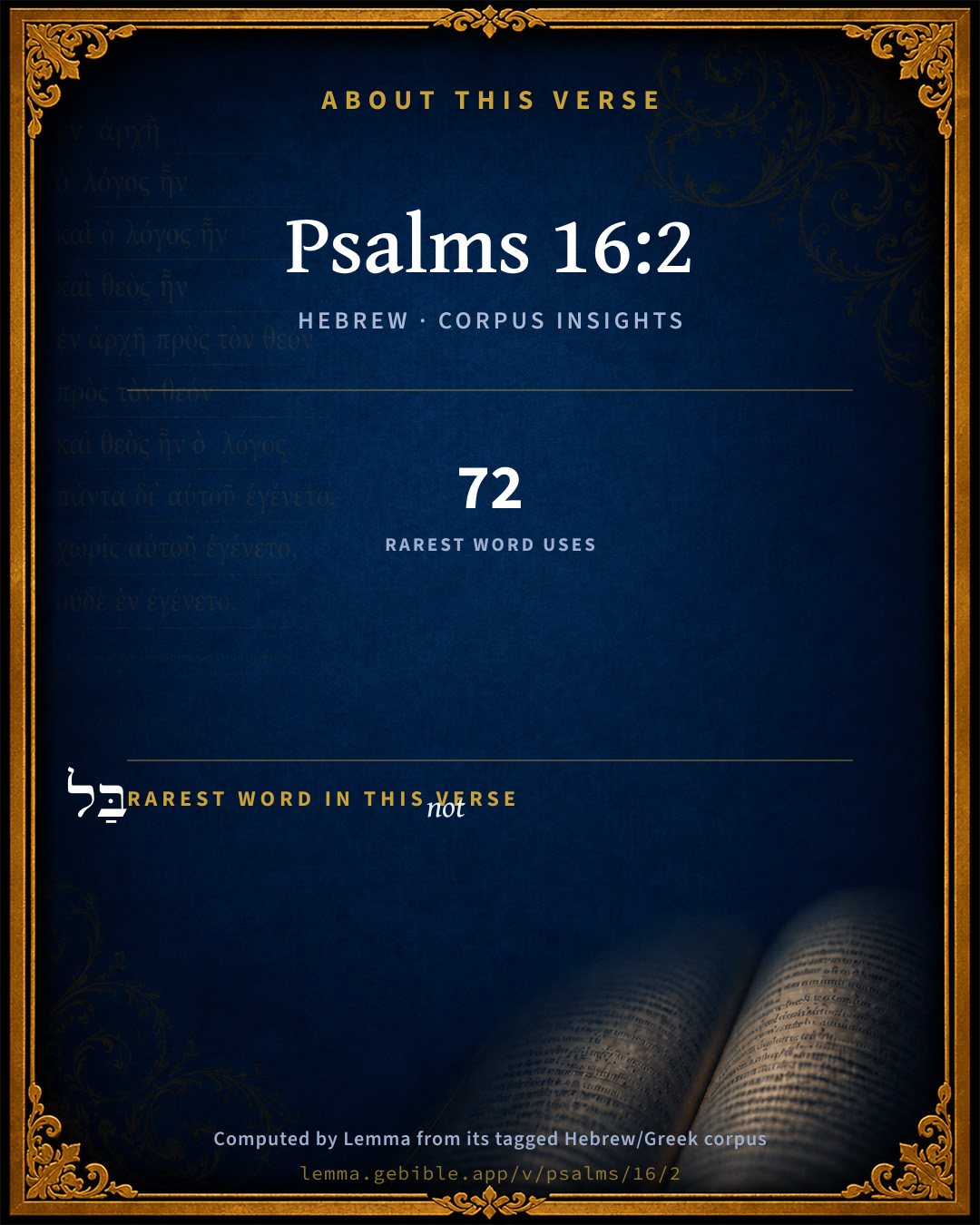
Psalms, in the Wisdom, opens this verse with 7 words (7 distinct Hebrew lemmas). Its most distinctive word is bal (“not”). A historical commentator’s framing appears above. Read the whole chapter for the surrounding context.

Discussion questions

  1. How does “not” (bal) shape what this verse is saying?
  2. How does Psalms 73:25, which shares this passage’s theme, read alongside this verse?
  3. The translations on this page render this verse differently — a whole-verse word diff, not a word-by-word alignment. What might account for the different wordings?
  4. «אָמַ֣רְתְּ» is a Qal Perfect verb. How does that grammatical form shape the action described?
  5. Compare how Ellicott's Commentary for English Readers and Trapp's Complete Commentary read this verse. Where do they agree or differ?

Things to notice

Reading settings

Reading text

Shown beneath each verse's original-language words.

Old Testament
Old Testament edition

Read the OT as the Masoretic Hebrew (MT) or the Greek Septuagint (LXX).

English shown for the Greek Septuagint (in the Hebrew ↔ Greek comparison).

Comparing translations? Open the Compare panel on any verse page to stack up to four side by side.