
Psalms 86:3

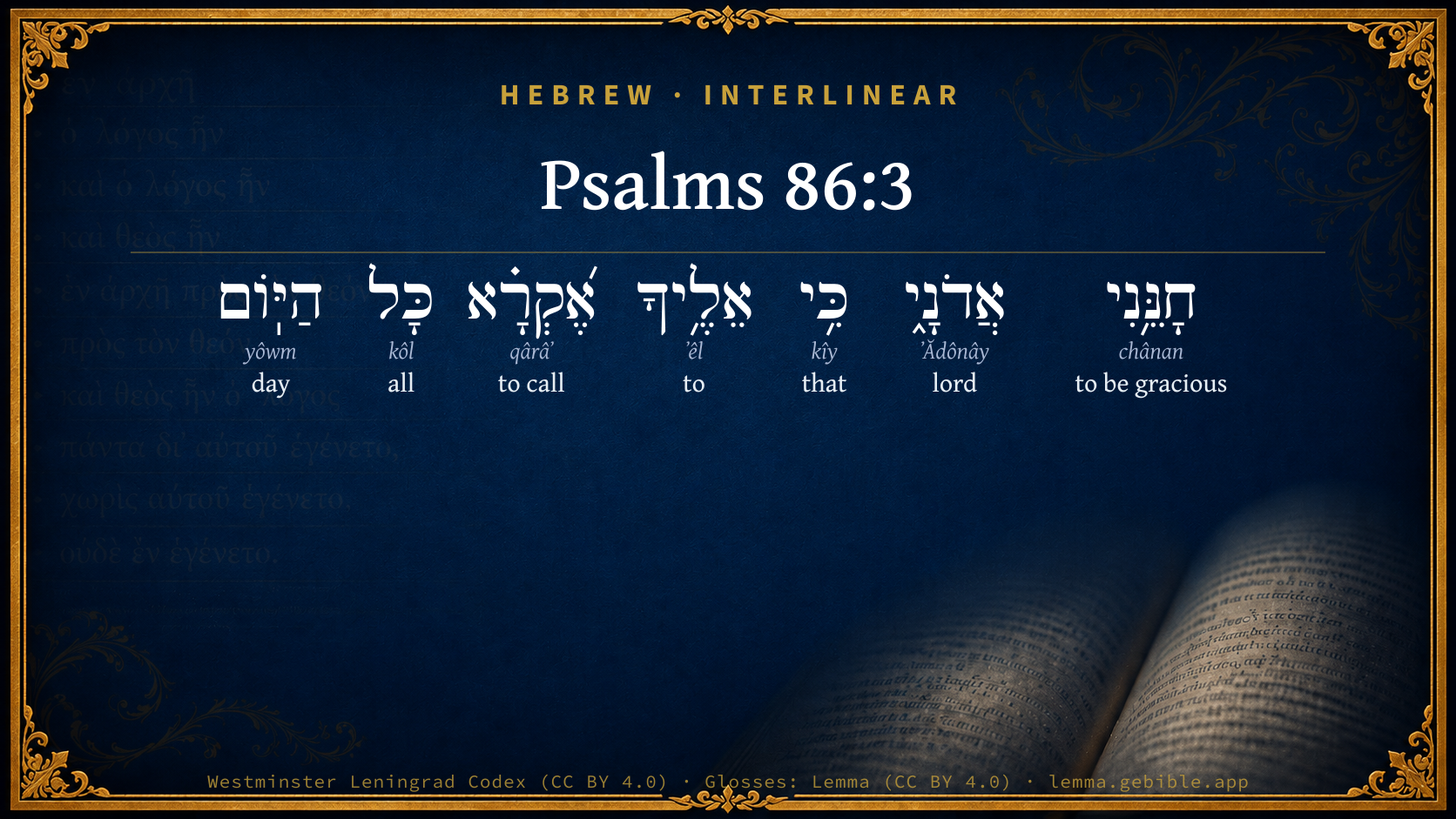
Hebrew (Westminster Leningrad Codex) Psalms 86:3 appears in the Hebrew Old Testament. The text above is from the Westminster Leningrad Codex. Each word links to its Strong’s number, a concise gloss, and parsing drawn from the Open Scriptures Hebrew Bible morphology. Click any word for its full Brown-Driver-Briggs (BDB) entry.
Download image
Cite this verse

Psalms 86:3 (World English Bible). Public Domain. Lemma interlinear Bible study tool, https://lemma.gebible.app/v/psalms/86/3.

Show BibTeX & RIS
BibTeX
RIS
English Translation
Be merciful to me, Lord, For I call to you all day long.
World English Bible · Public Domain
Download a study sheet

One document with this verse’s original text, its word-by-word gloss line, the meaning frame, cross-references with their text, attributed commentary, and full source and license credits — printable, and it pastes into notes with its structure intact.

This verse Autodidact and up

Study sheet (.html) Plain text (.txt)

A passage Seminary Student

Up to 50 verses in one chapter. A passage sheet keeps up to 6 commentary sources and 12 cross-references per verse, in the order this page ranks them, and says so on the sheet whenever that leaves anything out. Ask for a single verse and you get the Autodidact verse sheet above.

Everything on this page stays free to read, with no account — the sheet is a download of what is already on screen, not access to it.

Want to remove ads? Support Godless Engineer
Compare translations 3

The same verse in 3 English versions, stacked beneath the original-language interlinear above. Click any original word for its lexicon entry.

Each is an independent rendering of the whole verse — the interlinear is not word-aligned to these translations.

Highlighted words mark where these versions differ — a whole-verse word diff, not a word-by-word alignment.

  • World English Bible Public Domain
    Be merciful to me, Lord, For I call to you all day long.
  • King James Version Public Domain
    Be merciful unto me, O Lord: for I cry unto thee daily.
  • unfoldingWord Literal Text CC BY-SA 4.0
    Favor me, Lord, for to you I call all of the day.

unfoldingWord Literal Text — © unfoldingWord, licensed CC BY-SA 4.0. Word-aligned USFM3 via Door43 (git.door43.org/unfoldingWord/en_ult).

Versions to compare (up to 4)

3 of 4 selected

Show all 18 translations

Every available English version of this verse, each an independent rendering of the whole verse.

  • World English Bible Public Domain
    Be merciful to me, Lord, For I call to you all day long.
  • Berean Standard Bible Public Domain
    Be merciful to me, O Lord, for I call to You all day long.
  • Majority Standard Bible Public Domain
    Be merciful to me, O Lord, for I call to You all day long.
  • King James Version Public Domain
    Be merciful unto me, O Lord: for I cry unto thee daily.
  • American Standard Version (1901) Public Domain
    Be merciful unto me, O Lord; For unto thee do I cry all the day long.
  • Revised Version (1885) Public Domain
    Be merciful unto me, O Lord; for unto thee do I cry all the day long.
  • Geneva Bible (1599) Public Domain
    Be mercifull vnto me, O Lord: for I crie vpon thee continually.
  • Douay-Rheims (1899) Public Domain
    Have mercy on me, O Lord, for I have cried to thee all the day.
  • Young's Literal Translation Public Domain
    Favour me, O Lord, for to Thee I call all the day.
  • Literal Standard Version CC BY-SA 4.0
    Favor me, O Lord, for I call to You all the day.
  • Unlocked Literal Bible CC BY-SA 4.0
    Be merciful to me, Lord, for I cry out to you all day long.
  • unfoldingWord Literal Text CC BY-SA 4.0
    Favor me, Lord, for to you I call all of the day.
  • Darby Bible Public Domain
    Be gracious unto me, O Lord; for unto thee do I call all the day.
  • World Messianic Bible Public Domain
    Be merciful to me, Lord, for I call to you all day long.
  • Webster's Bible Public Domain
    Be merciful to me, O Lord: for I cry to thee daily.
  • Free Bible Version CC BY-SA 4.0
    Be kind to me, Lord, for I call out to you all day long.
  • Bible in Basic English Public Domain
    Have mercy on me, O Lord; for my cry goes up to you all the day.
  • JPS Tanakh (1917) Public Domain
    Be gracious unto me, O Lord; for unto Thee do I cry all the day.

Literal Standard Version (2020), Covenant Press — licensed CC BY-SA 4.0. Text via the HelloAO Bible API (eBible.org). Unlocked Literal Bible (unfoldingWord) — licensed CC BY-SA 4.0. Text via the HelloAO Bible API (eBible.org). unfoldingWord Literal Text — © unfoldingWord, licensed CC BY-SA 4.0. Word-aligned USFM3 via Door43 (git.door43.org/unfoldingWord/en_ult). Free Bible Version, Dr. Jonathan Gallagher — licensed CC BY-SA 4.0. Text via the HelloAO Bible API (eBible.org).

Word by word

More ways to search: Search by grammar → Find every occurrence → Compare this word →

Practice this passage: Drill this verse → Learn its vocabulary →

חָנֵּ֥נִי
chânan
H2603
“be gracious · me”
Verb, Qal, Imperative, 2nd Person, Masculine, Singular + Suffix, Personal, 1st Person, Common, Singular
Part of Speech
Verb
Stem
Qal
Form
Imperative
Person
2nd Person
Gender
Masculine
Number
Singular
Full BDB Definition

Origin: a primitive root [compare H2583 ]

TWOT: 694 , 695

to be gracious, show favour, pity - (Qal) to show favour, be gracious - (Niphal) to be pitied - (Piel) to make gracious, make favourable, be gracious - (Poel) to direct favour to, have mercy on - (Hophal) to be shown favour, be shown consideration - (Hithpael) to seek favour, implore favour - to be loathsome
  1. אֲדֹנָ֑י ʼĂdônây H136 “Lord · my” Noun, Common, Masculine, Plural, Construct + Suffix, Personal, 1st Person, Common, Singular
  2. כִּ֥י kîy H3588 “that” Conjunction
  3. אֵלֶ֥יךָ ʼêl H413 “to · you” Preposition + Suffix, Personal, 2nd Person, Masculine, Singular
  4. אֶ֝קְרָ֗א qârâʼ H7121 “to call” Verb, Qal, Imperfect, 1st Person, Common, Singular
  5. כָּל kôl H3605 “all of” Noun, Common, Masculine, Singular, Construct
  6. הַיּֽוֹם yôwm H3117 “the · day” Particle, Definite Article + Noun, Common, Masculine, Singular, Absolute

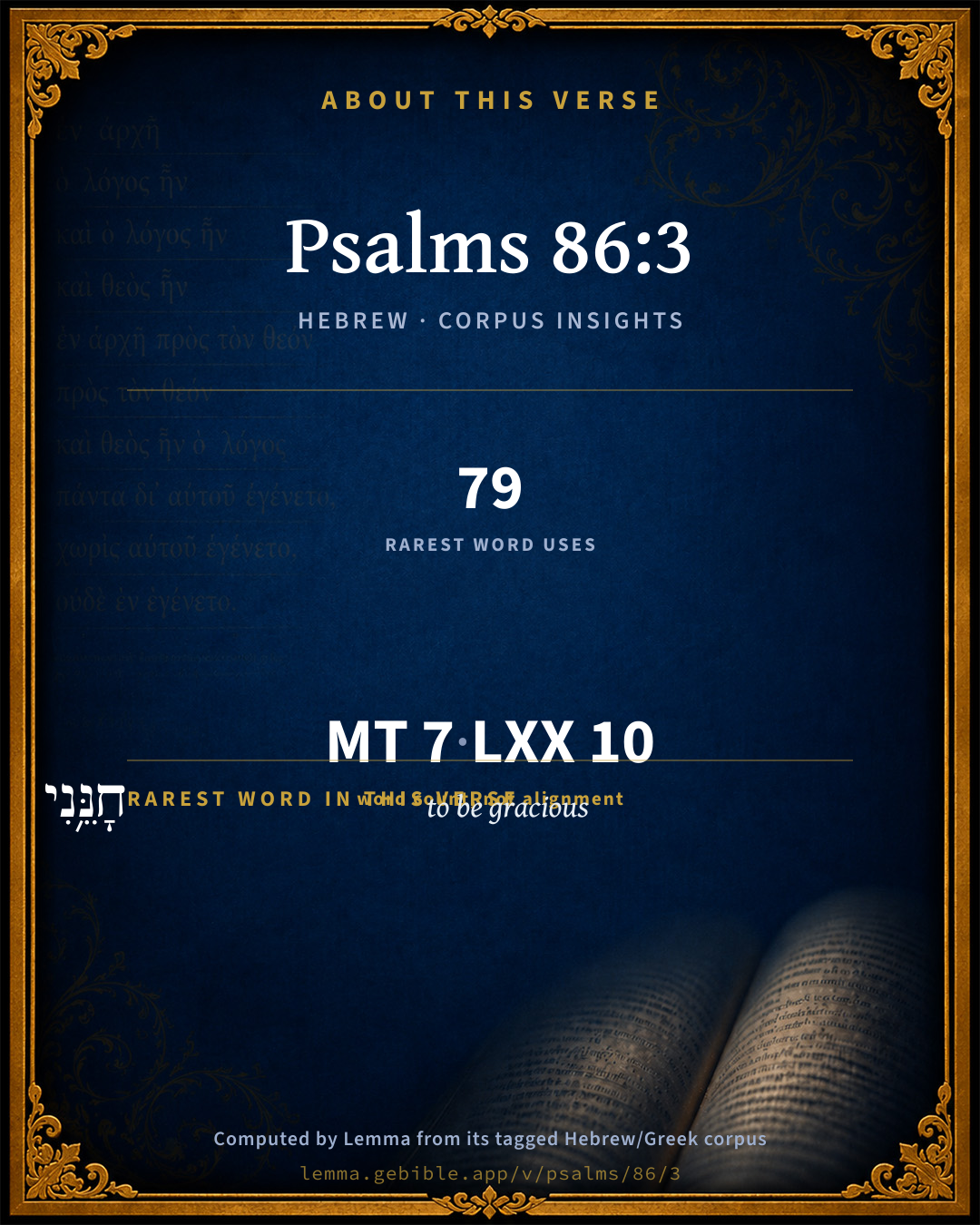
About this verse

These counts appear in no published source. They are computed here, from the morphology-tagged text and Lemma’s own curated glosses. What Lemma adds →

7
words
7
distinct lemmas
Wisdom
section

Grammatical profile

  • 2 verbs
  • 3 nouns
  • 1 preposition
  • 1 conjunction

Verb forms

  • חָנֵּ֥נִי Qal · Imperative
  • אֶ֝קְרָ֗א Qal · Imperfect

Hebrew & Septuagint length

In English translation the verse runs 13 words from the Hebrew and 13 from the Septuagint (LXX English) — the same length.

A rough comparison of the two English renderings, which tokenize alike — not a word-level alignment.

Word counts can differ between the Hebrew and the Greek without any difference in meaning — e.g. the Hebrew direct-object marker אֵת has no separate Greek word, and Greek often adds the article ὁ.

In the original languages it is 7 Hebrew tokens and 10 Greek tokens — but the two are counted differently (Hebrew bundles its prefixes and suffixes into one token; the Greek is in lemma form), so that isn’t a like-for-like length.

Cross-references

10

Topical passages linked to Psalms 86:3 in the Treasury of Scripture Knowledge — connected by theme and wording, ordered by reader-vote popularity; previews shown in the World English Bible.

  • Psalms 57:1 Be merciful to me, God, be merciful to me, For my soul takes refuge in you. Yes, in the shadow of your wings, I will take refuge, Until disaster has passed.
  • Psalms 88:9 My eyes are dim from grief. I have called on you daily, Yahweh. I have spread out my hands to you.
  • Ephesians 6:18 with all prayer and requests, praying at all times in the Spirit, and being watchful to this end in all perseverance and requests for all the saints:
  • Psalms 25:5 Guide me in your truth, and teach me, For you are the God of my salvation, I wait for you all day long.
  • Psalms 4:1 Answer me when I call, God of my righteousness. Give me relief from my distress. Have mercy on me, and hear my prayer.
  • Psalms 55:17 Evening, morning, and at noon, I will cry out in distress. He will hear my voice.
  • Psalms 56:1 Be merciful to me, God, for man wants to swallow me up. All day long, he attacks and oppresses me.
  • Luke 2:37 and she had been a widow for about eighty-four years), who didn't depart from the temple, worshipping with fastings and petitions night and day.
  • Luke 11:8–13 I tell you, although he will not rise and give it to him because he is his friend, yet because of his persistence, he will get up and give him as many as he needs.
  • Luke 18:7 Won't God avenge his chosen ones, who are crying out to him day and night, and yet he exercises patience with them?

Cross-references courtesy of OpenBible.info (CC BY 4.0).

Hebrew and Greek witnesses Masoretic Hebrew ↔ Greek Septuagint

The same verse in the two great witnesses to the Old Testament, shown verse-for-verse.

You’re reading Greek Psalm 85 (Hebrew Psalm 86). The Septuagint counts the superscription, so verse numbers can differ from the Hebrew — chapter-level alignment, not verse-by-verse. Numbering follows Rahlfs.

These are two independent witnesses, not word-aligned to each other, and the Septuagint is shown in lemma (dictionary) form.

Hebrew Psalms 86:3 Masoretic · Westminster Leningrad Codex

חָנֵּ֥נִי אֲדֹנָ֑י כִּ֥י אֵלֶ֥יךָ אֶ֝קְרָ֗א כָּל הַיּֽוֹם

Be merciful to me, Lord, For I call to you all day long.

World English Bible · Public Domain

Greek LXX Greek Psalm 85:3 Septuagint · lemma form

ἐλεέω ἐγώ κύριος ὅτι πρός σύ κράζω ὅλος ὁ ἡμέρα

Pity me, O Lord: for to you will I cry all the day.

LXX2012 (modern English Septuagint) · Public Domain

Hebrew: Westminster Leningrad Codex (CC BY 4.0). Greek: Septuagint (public domain); English from LXX2012 (modern English Septuagint) (Public Domain). How the Septuagint differs from the Hebrew →

Commentary

Notes on Psalms 86:3 from classic Christian and Jewish commentators (each source and its license shown beneath its notes). The classic Christian expositions comment on the surrounding passage and are grouped to its opening verse, so a note may address several verses; the Jewish commentaries on the Tanakh (Rashi and others) are per-verse, so they appear only where the commentator wrote on this verse.

Lemma curates 59 commentaries, every one of them public domain or Creative Commons licensed, each selected and text-cleaned for this edition rather than reprinted as found. About our sources →

Trapp's Complete Commentary

John Trapp

Psa 86:3 Be merciful unto me, O Lord: for I cry unto thee daily.

Ver. 3. Be merciful unto me] Lest any should, by the former words (I am holy), suspect him to be a merit monger, he beggeth mercy, with instancy and constancy of request.

John Trapp, A Commentary or Exposition upon All the Books of the Old and New Testament (1647–1656) — public domain. Text from a community e-Sword module.

J. A. Alexander on Psalms

Joseph Addison Alexander

3. (Psa 86:3) Be gracious unto me, 0 Lord, for unto thee will I cry all the day. The prayer is still substantially the same, but enforced by two additional reasons: one implied in the divine name used, to wit, that God is his sovereign, and as such bound to protect his subject; the other expressed, namely, that his subject never ceases to invoke his aid. The future meaning of the verb includes the present, but suggests the additional idea of determination to pursue the same, course till the blessing is obtained. Compare Gen 32:26, Luk 18:1. All the day is a common idiomatic phrase equivalent to all the time in English, and may therefore be considered as including, though it does not formally express, the idea of every day or daily. See above, on Psa 42:3; Psa 42:10.

Joseph Addison Alexander, The Psalms Translated and Explained (1850) — public domain. Text from a community e-Sword module.

Geneva Bible (1599)

Geneva Bible translators

Which was a sure token that he believed that God would deliver him.

Geneva Bible (1599) marginal notes — public domain. Text via Bolls.life.

Adam Clarke's Commentary

Verse 3. Be merciful unto me] I have no merit; I plead none, but trust in thee alone.

I cry unto thee daily.] My state deeply affects me; and I incessantly cry for thy salvation.

Adam Clarke's Commentary on the Bible (1810–1826) — public domain. Text from a community e-Sword/MySword module.

John Calvin's Commentaries

3 Have mercy upon me, O Jehovah! The Psalmist again betakes himself to the mercy of God. The word חנן, chanan, which I have rendered have mercy, is substantially the same as to gratify, to do a pleasure. It is as if he had said, I bring no merit of my own, but humbly pray for deliverance solely on the ground of thy mercy. When he speaks of crying daily, it is a proof of his hope and confidence, of which we have spoken a little before. By the word cry, as I have already had occasion frequently to remark, is denoted vehemence and earnestness of soul. The saints do not indeed always pray with a loud voice; but their secret sighs and groanings resound and echo upwards, and, ascending from their hearts, penetrate even into heaven. The inspired suppliant not only represents himself as crying, but as persevering in doing so, to teach us that he was not discouraged at the first or second encounter, but continued in prayer with untiring earnestness. In the following verse, he expresses more definitely the end for which he besought God to be merciful to him, which was, that his sorrow might be removed. In the second clause, he declares that there was no hypocrisy in his crying; for he lifted up his soul to God, which is the chief characteristic of right prayer.

John Calvin's Commentaries (1540-1563) — public domain. Text from the Calvin Translation Society English edition (1840s-50s) via the Christian Classics Ethereal Library (ccel.org). Calvin's coverage is partial (roughly two-thirds of the Bible); uncommented books and verses are honest gaps, never fabricated. The 19th-century editor's footnotes and remarks are omitted so the notes are faithfully Calvin's own voice.

The Cambridge Bible for Schools and Colleges

gen. ed. J. J. S. Perowne

3. Be gracious unto me, O Lord;

For unto thee do I cry all the day long.

See Psa_57:1-2, and elsewhere (Psa_3:4; Psa_4:1; &c.).

The Cambridge Bible for Schools and Colleges (gen. ed. J. J. S. Perowne; Cambridge University Press, 1878–1918) — public domain. Text from a community e-Sword module.

John Gill's Exposition

Be merciful unto me, O Lord,.... In my distressed and miserable condition, being an object of mercy, pity, and compassion; this petition is used by Christ in Psa 41:10.

for I cry unto thee daily; or "all the day"; every day, and several times in a day, Psa 55:17 constant and importunate prayer is the duty of saints, and available with God, Th1 5:17. Christ was much in the exercise of it, Luk 6:12.

John Gill's Exposition of the Whole Bible (1746–1763) — public domain (CC PDM 1.0). Text via the HelloAO Bible API.

Albert Barnes' Notes on the Bible

Be merciful unto me, O Lord - It was mercy after all that he relied on, and not justice. It was not because he had any claim on the ground that he was “holy,” but all that he had and hoped for was to be traced to the mercy of God.

For I cry unto thee daily - Margin, as in Hebrew, “All the day.” The meaning is, that he did this constantly, or without intermission.

Albert Barnes' Notes on the Bible (1834–1885) — public domain. Text from a community e-Sword/MySword module.

The Treasury of David

Charles H. Spurgeon

Ver. 3. Be merciful unto me, O Lord. The best of men need mercy, and appeal to mercy, yea to nothing else but mercy; they need it for themselves, and crave it eagerly of their God as a personal requisite.

For I cry unto thee daily. Is there not a promise that importunity shall prevail? May we not, then, plead our importunity as an argument with God? He who prays every day, and all the day, for so the word may mean, may rest assured that the Lord will hear him in the day of his need. If we cried sometimes to man, or other false confidences, we might expect to be referred to them in the hour of our calamity, but if in all former times we have looked to the Lord alone, we may be sure that he will not desert us now. See how David pleaded, first that he was poor and needy, next that he was the Lord's set apart one, then that he was God's servant and had learned to trust in the Lord, and lastly that he had been taught to pray daily; surely these are such holy pleadings as any tried believer may employ when wrestling with a prayer hearing God, and with such weapons the most trembling suppliant may hope to win the day.

Ver. 3. Be merciful unto me. Lest any should by the former words, ("I am holy", )suspect him to be a merit monger, he beggeth mercy with instancy and constancy of request. John Trapp.

Ver. 3. I cry unto thee daily. A great difference between saints and sinners in prayer is that sinners who pray at all, pray only when they are in trouble, whereas saints cry daily unto God. Compare Job 27:10. William S. Plumer.

Ver. 3. Importunity.

1. When she pleads"daily".

2. How she pleads"I cry".

3. To whom she pleads"unto thee".

4. For what she pleads"be merciful".

Ver. 3. I will cry daily for pardoning, sanctifying, assisting, preserving, providing and guiding mercy. William Jay.

Psalms 86:4*

Charles H. Spurgeon's The Treasury of David (1869–1885) — public domain. Psalms only. Text from a community e-Sword/MySword module.

The Pulpit Commentary

Be merciful unto me, O Lord; for I cry unto thee daily; rather, all day long (Revised Version).

The Pulpit Commentary (1880–1919), ed. H.D.M. Spence-Jones & Joseph S. Exell — public domain. Text from a community e-Sword module.

unfoldingWord translationNotes

Door43 World Missions Community

all day long

This is an exaggeration. David cries out continually, but not literally at all times from dawn to dusk. AT: "continually" (See: Hyperbole and Generalization)

Make your servant glad

David refers to himself as "your servant," that is, God's servant. AT: "Make me, your servant" or "Make me" (See: First, Second, or Third Person)

translationWords

mercy

lord

cry

servant

unfoldingWord translationNotes — © Distant Shores Media and the Door43 World Missions Community, licensed CC BY-SA 4.0. Source: git.door43.org/Door43/en_tn.

Rashi

Rabbi Shlomo Yitzchaki (Rashi)

all the days All the days of the exile, which is day for the wicked and night for the righteous. It is explained in this manner in Aggadath Tehillim (Mid. Ps. 86:2).

Rashi on the Tanakh — English translations: “The Judaica Press complete Tanach with Rashi, translated by A. J. Rosenberg” (CC BY 4.0); “Pentateuch with Rashi's commentary by M. Rosenbaum and A.M. Silbermann, 1929-1934” (public domain); “The Metsudah Tanach series, Lakewood, N.J” (CC BY 4.0); and “The Book of Joshua, Metsudah Publications, 1997” (CC BY 4.0). Text via Sefaria.

Lesson kit

Teaching starters — assembled from the data on this page, not authored interpretation. Every prompt links to the verse data it draws on. Edit before teaching.

Psalms, in the Wisdom, opens this verse with 7 words (7 distinct Hebrew lemmas). Its most distinctive word is chânan (“to be gracious”). A historical commentator’s framing appears above. Read the whole chapter for the surrounding context.

Discussion questions

  1. What does “to be gracious” (chânan) contribute to the verse as a whole?
  2. How does Psalms 57:1, which shares this passage’s theme, read alongside this verse?
  3. These translations render this verse differently. What is at stake in choosing one wording over another?
  4. «חָנֵּ֥נִי» is a Qal Imperative verb. How does that grammatical form shape the action described?
  5. Compare how Trapp's Complete Commentary and J. A. Alexander on Psalms read this verse. Where do they agree or differ?

Things to notice

Reading settings

Reading text

Shown beneath each verse's original-language words.

Old Testament
Old Testament edition

Read the OT as the Masoretic Hebrew (MT) or the Greek Septuagint (LXX).

English shown for the Greek Septuagint (in the Hebrew ↔ Greek comparison).

Comparing translations? Open the Compare panel on any verse page to stack up to four side by side.