Jeremiah 50:31

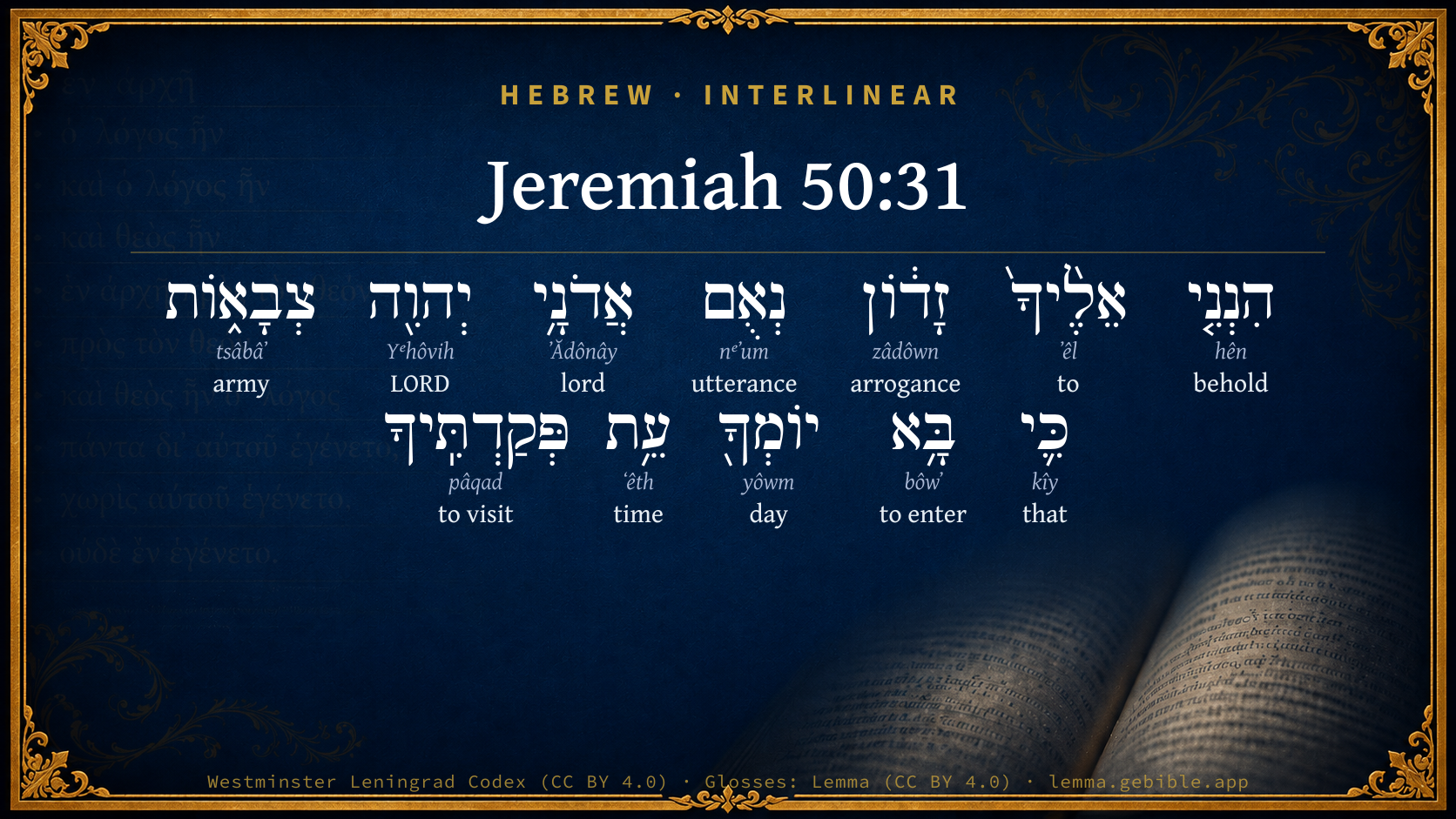
Hebrew (Westminster Leningrad Codex) Jeremiah 50:31 appears in the Hebrew Old Testament. The text above is from the Westminster Leningrad Codex. Each word links to its Strong’s number, a concise gloss, and parsing drawn from the Open Scriptures Hebrew Bible morphology. Click any word for its full Brown-Driver-Briggs (BDB) entry.
Download image
Cite this verse

Jeremiah 50:31 (World English Bible). Public Domain. Lemma interlinear Bible study tool, https://lemma.gebible.app/v/jeremiah/50/31.

Show BibTeX & RIS
BibTeX
RIS
English Translation
Behold, I am against you, you proud one, says the Lord, Yahweh of Hosts; for your day is come, the time that I will visit you.
World English Bible · Public Domain
Download a study sheet

One document with this verse’s original text, its word-by-word gloss line, the meaning frame, cross-references with their text, attributed commentary, and full source and license credits — printable, and it pastes into notes with its structure intact.

This verse Autodidact and up

Study sheet (.html) Plain text (.txt)

A passage Seminary Student

Up to 50 verses in one chapter. A passage sheet keeps up to 6 commentary sources and 12 cross-references per verse, in the order this page ranks them, and says so on the sheet whenever that leaves anything out. Ask for a single verse and you get the Autodidact verse sheet above.

Everything on this page stays free to read, with no account — the sheet is a download of what is already on screen, not access to it.

Want to remove ads? Support Godless Engineer
Compare translations 3

The same verse in 3 English versions, stacked beneath the original-language interlinear above. Click any original word for its lexicon entry.

Each is an independent rendering of the whole verse — the interlinear is not word-aligned to these translations.

Highlighted words mark where these versions differ — a whole-verse word diff, not a word-by-word alignment.

  • World English Bible Public Domain
    Behold, I am against you, you proud one, says the Lord, Yahweh of Hosts; for your day is come, the time that I will visit you.
  • King James Version Public Domain
    Behold, I am against thee, O thou most proud, saith the Lord GOD of hosts: for thy day is come, the time that I will visit thee.
  • unfoldingWord Literal Text CC BY-SA 4.0
    “See, I am against you, proud one—this is the declaration of the Lord Yahweh of hosts— for your day has come, proud one, the time when I will punish you.

unfoldingWord Literal Text — © unfoldingWord, licensed CC BY-SA 4.0. Word-aligned USFM3 via Door43 (git.door43.org/unfoldingWord/en_ult).

Versions to compare (up to 4)

3 of 4 selected

Show all 18 translations

Every available English version of this verse, each an independent rendering of the whole verse.

  • World English Bible Public Domain
    Behold, I am against you, you proud one, says the Lord, Yahweh of Hosts; for your day is come, the time that I will visit you.
  • Berean Standard Bible Public Domain
    “Behold, I am against you, O arrogant one,” declares the Lord GOD of Hosts, “for your day has come, the time when I will punish you.
  • Majority Standard Bible Public Domain
    “Behold, I am against you, O arrogant one,” declares the Lord GOD of Hosts, “for your day has come, the time when I will punish you.
  • King James Version Public Domain
    Behold, I am against thee, O thou most proud, saith the Lord GOD of hosts: for thy day is come, the time that I will visit thee.
  • American Standard Version (1901) Public Domain
    Behold, I am against thee, O thou proud one, saith the Lord, Jehovah of hosts; for thy day is come, the time that I will visit thee.
  • Revised Version (1885) Public Domain
    Behold, I am against thee, O thou proud one, saith the Lord, the LORD of hosts: for thy day is come, the time that I will visit thee.
  • Geneva Bible (1599) Public Domain
    Beholde, I come vnto thee, O proude man, saith the Lord God of hostes: for thy day is come, euen the time that I will visite thee.
  • Douay-Rheims (1899) Public Domain
    Behold I come against thee, O proud one, saith the Lord the God of hosts: for thy day is come, the time of thy visitation.
  • Young's Literal Translation Public Domain
    Lo, I `am' against thee, O pride, An affirmation of the Lord Jehovah of Hosts, For thy day hath come, the time of thy inspection.
  • Literal Standard Version CC BY-SA 4.0
    “Behold, I [am] against you, O pride,” || A declaration of Lord YHWH of Hosts, || “For your day has come, the time of your inspection.
  • Unlocked Literal Bible CC BY-SA 4.0
    “See, I am against you, proud one—this is the declaration of the Lord Yahweh of hosts— for your day has come, proud one, the time when I will punish you.
  • unfoldingWord Literal Text CC BY-SA 4.0
    “See, I am against you, proud one—this is the declaration of the Lord Yahweh of hosts— for your day has come, proud one, the time when I will punish you.
  • Darby Bible Public Domain
    Behold, I am against thee, proud one, saith the Lord Jehovah of hosts; for thy day is come, the time that I visit thee:
  • World Messianic Bible Public Domain
    “Behold, I am against you, you proud one,” says the Lord, GOD of Hosts; “for your day has come, the time that I will visit you.
  • Webster's Bible Public Domain
    Behold, I am against thee, O thou most proud, saith the Lord GOD of hosts: for thy day is come, the time that I will visit thee.
  • Free Bible Version CC BY-SA 4.0
    Watch out, because I'm against you, you arrogant people! declares the Lord God Almighty. Your time has come when I will punish you.
  • Bible in Basic English Public Domain
    See, I am against you, O pride, says the Lord, the Lord of armies, for your day has come, the time when I will send punishment on you.
  • JPS Tanakh (1917) Public Domain
    Behold, I am against thee, O thou most arrogant, saith the Lord GOD of hosts; for thy day is come, the time that I will punish thee.

Literal Standard Version (2020), Covenant Press — licensed CC BY-SA 4.0. Text via the HelloAO Bible API (eBible.org). Unlocked Literal Bible (unfoldingWord) — licensed CC BY-SA 4.0. Text via the HelloAO Bible API (eBible.org). unfoldingWord Literal Text — © unfoldingWord, licensed CC BY-SA 4.0. Word-aligned USFM3 via Door43 (git.door43.org/unfoldingWord/en_ult). Free Bible Version, Dr. Jonathan Gallagher — licensed CC BY-SA 4.0. Text via the HelloAO Bible API (eBible.org).

Word by word

More ways to search: Search by grammar → Find every occurrence → Compare this word →

Practice this passage: Drill this verse → Learn its vocabulary →

זָד֔וֹן
zâdôwn
H2087
“arrogance”
Noun, Common, Masculine, Singular, Absolute
Part of Speech
Noun
Type
Common
Gender
Masculine
Number
Singular
State
Absolute
Full BDB Definition

Origin: from H2102

TWOT: 547b

pride, insolence, presumptuousness, arrogance
  1. הִנְנִ֤י hên H2005 “behold · me” Particle, Demonstrative + Suffix, Personal, 1st Person, Common, Singular
  2. אֵלֶ֨יךָ֙ ʼêl H413 “to · you” Preposition + Suffix, Personal, 2nd Person, Masculine, Singular
  3. נְאֻם nᵉʼum H5002 “utterance of” Noun, Common, Masculine, Singular, Construct
  4. אֲדֹנָ֥י ʼĂdônây H136 “Lord · my” Noun, Common, Masculine, Plural, Construct + Suffix, Personal, 1st Person, Common, Singular
  5. יְהוִ֖ה Yᵉhôvih H3069 “LORD” Noun, Proper
  6. צְבָא֑וֹת tsâbâʼ H6635 “armies” Noun, Common, Both, Plural, Absolute
  7. כִּ֛י kîy H3588 “that” Conjunction
  8. בָּ֥א bôwʼ H935 “to enter” Verb, Qal, Perfect, 3rd Person, Masculine, Singular
  9. יוֹמְךָ֖ yôwm H3117 “day · your” Noun, Common, Masculine, Singular, Construct + Suffix, Personal, 2nd Person, Masculine, Singular
  10. עֵ֥ת ʻêth H6256 “time” Noun, Common, Both, Singular, Absolute
  11. פְּקַדְתִּֽיךָ pâqad H6485 “to visit · you” Verb, Qal, Perfect, 1st Person, Common, Singular + Suffix, Personal, 2nd Person, Masculine, Singular

About this verse

These counts appear in no published source. They are computed here, from the morphology-tagged text and Lemma’s own curated glosses. What Lemma adds →

12
words
12
distinct lemmas
Prophets
section

Notable vocabulary

The rarest word here is זָד֔וֹן arrogance H2087 — appearing just 11 times in the whole Hebrew Bible.

Shared distinctive vocabulary

זָד֔וֹן arrogance H2087 occurs in 11 verses of the Hebrew Bible. Also found in:

Grammatical profile

  • 2 verbs
  • 7 nouns
  • 1 preposition
  • 1 conjunction
  • 1 particle

Verb forms

  • בָּ֥א Qal · Perfect
  • פְּקַדְתִּֽיךָ Qal · Perfect

Cross-references

18

Topical passages linked to Jeremiah 50:31 in the Treasury of Scripture Knowledge — connected by theme and wording, ordered by reader-vote popularity; previews shown in the World English Bible.

  • Jeremiah 21:13 Behold, I am against you, O inhabitant of the valley, [and] of the rock of the plain, says Yahweh; you that say, Who shall come down against us? or who shall enter into our habitations?
  • Jeremiah 50:29 Call together the archers against Babylon, all those who bend the bow; encamp against her round about; let none of it escape: recompense her according to her work; according to all that she has done, do to her; for she has been proud against Yahweh, against the Holy One of Israel.
  • Ezekiel 39:1 You, son of man, prophesy against Gog, and say, Thus says the Lord Yahweh: Behold, I am against you, Gog, prince of Rosh, Meshech, and Tubal:
  • Nahum 2:13 "Behold, I am against you," says Yahweh of Hosts, "and I will burn her chariots in the smoke, and the sword will devour your young lions; and I will cut off your prey from the earth, and the voice of your messengers will no longer be heard."
  • Habakkuk 2:4–5 Behold, his soul is puffed up. It is not upright in him, but the righteous will live by his faith.
  • James 4:6 But he gives more grace. Therefore it says, "God resists the proud, but gives grace to the humble."
  • 1 Peter 5:5 Likewise, you younger ones, be subject to the elder. Yes, all of you gird yourselves with humility, to subject yourselves to one another; for "God resists the proud, but gives grace to the humble."
  • Job 40:11–12 Pour forth the fury of your anger. Look on everyone who is proud, and bring him low.
  • Jeremiah 48:29 We have heard of the pride of Moab, [that] he is very proud; his loftiness, and his pride, and his arrogance, and the haughtiness of his heart.
  • Jeremiah 49:16 As for your terror, the pride of your heart has deceived you, O you who dwell in the clefts of the rock, who hold the height of the hill: though you should make your nest as high as the eagle, I will bring you down from there, says Yahweh.
  • Jeremiah 50:32 The proud one shall stumble and fall, and none shall raise him up; and I will kindle a fire in his cities, and it shall devour all who are round about him.
  • Jeremiah 51:25 Behold, I am against you, destroying mountain, says Yahweh, which destroy all the earth; and I will stretch out my hand on you, and roll you down from the rocks, and will make you a burnt mountain.
  • Ezekiel 5:8 therefore thus says the Lord Yahweh: Behold, I, even I, am against you; and I will execute judgments in the midst of you in the sight of the nations.
  • Ezekiel 29:3 speak, and say, Thus says the Lord Yahweh: Behold, I am against you, Pharaoh king of Egypt, the great monster that lies in the midst of his rivers, that has said, My river is my own, and I have made it for myself.
  • Ezekiel 29:9–10 The land of Egypt shall be a desolation and a waste; and they shall know that I am Yahweh. Because he has said, The river is mine, and I have made it;
  • Ezekiel 38:3 and say, Thus says the Lord Yahweh: Behold, I am against you, Gog, prince of Rosh, Meshech, and Tubal:
  • Daniel 4:30–31 The king spoke and said, Is not this great Babylon, which I have built for the royal dwelling-place, by the might of my power and for the glory of my majesty?
  • Nahum 3:5 "Behold, I am against you," says Yahweh of Hosts, "and I will lift your skirts over your face. I will show the nations your nakedness, and the kingdoms your shame.

Cross-references courtesy of OpenBible.info (CC BY 4.0).

Hebrew and Greek witnesses Masoretic Hebrew ↔ Greek Septuagint

The same verse in the two great witnesses to the Old Testament, shown verse-for-verse.

These are two independent witnesses, not word-aligned to each other, and the Septuagint is shown in lemma (dictionary) form.

Hebrew Jeremiah 50:31 Masoretic · Westminster Leningrad Codex

הִנְנִ֤י אֵלֶ֨יךָ֙ זָד֔וֹן נְאֻם אֲדֹנָ֥י יְהוִ֖ה צְבָא֑וֹת כִּ֛י בָּ֥א יוֹמְךָ֖ עֵ֥ת פְּקַדְתִּֽיךָ

Behold, I am against you, you proud one, says the Lord, Yahweh of Hosts; for your day is come, the time that I will visit you.

World English Bible · Public Domain

Greek LXX Structure differs

In the Septuagint, Jeremiah is about an eighth shorter than the Hebrew and arranges its material differently — the Oracles Against the Nations (Hebrew chapters 46–51) appear in the middle of the Greek book, after 25:13. Because the chapter and verse boundaries do not line up, a verse-for-verse comparison with the Hebrew is not shown.

A verse-for-verse comparison isn’t shown here because the chapters and verses don’t line up. Switch to the LXX edition with the MT / LXX toggle above to read the Greek directly.

Hebrew: Westminster Leningrad Codex (CC BY 4.0). Greek: Septuagint (public domain); English from a public-domain English Septuagint. How the Septuagint differs from the Hebrew →

Targum (Aramaic paraphrase)

1

The Targum is the ancient Jewish Aramaic paraphrase of the Hebrew Scriptures — an interpretive translation, not the Hebrew text itself. Onkelos (literal) and Pseudo-Jonathan (expansive) render the Torah, and Jonathan the Prophets. Coverage is partial: where no permissively-licensed English translation exists for a verse, only the Aramaic is shown. This is verse-level text, not a word-by-word alignment to the Hebrew.

  1. Targum Jonathan Prophets (Joshua–Malachi)
    הָא אֲנָא שְׁלַח רוּגְזַי עֲלָךְ מַלְכָּא רַשִׁיעָא אֲמַר יְיָ אֱלֹהִים צְבָאוֹת אֲרֵי מָטָא יוֹם תְבִירָךְ עִדַן סְעוּרַן בִּישְׁתִּיךְ:

    (no public-domain English translation for this verse)

    Targum Jonathan — Aramaic: “Mikraot Gedolot” (public domain). English: “Sefaria Community Translation” (CC0 1.0 (public-domain dedication)); “London "Chaldee Paraphrase," 1871” (public domain). Text via Sefaria.

Commentary

Notes on Jeremiah 50:31 from classic Christian and Jewish commentators (each source and its license shown beneath its notes). The classic Christian expositions comment on the surrounding passage and are grouped to its opening verse, so a note may address several verses; the Jewish commentaries on the Tanakh (Rashi and others) are per-verse, so they appear only where the commentator wrote on this verse.

Lemma curates 59 commentaries, every one of them public domain or Creative Commons licensed, each selected and text-cleaned for this edition rather than reprinted as found. About our sources →

Trapp's Complete Commentary

John Trapp

Jer 50:31 Behold, I [am] against thee, [O thou] most proud, saith the Lord GOD of hosts: for thy day is come, the time [that] I will visit thee.

Ver. 31. Behold, I am against thee, O most proud.] Heb., O pride, in the abstract - i.e., O Belshazzar; as of a certain Pope was said,

“ Conditur hoc tumulo et scelus et vitium. ”

John Trapp, A Commentary or Exposition upon All the Books of the Old and New Testament (1647–1656) — public domain. Text from a community e-Sword module.

Tyndale Open Study Notes

Tyndale Open Resources

50:31-32 Because of the Lord’s decree, the arrogant Babylonian Empire would never rise again as a mighty power in the world.

Tyndale Open Study Notes — © Tyndale Open Resources, licensed CC BY-SA 4.0. Text via the HelloAO Bible API.

Jamieson, Fausset & Brown

Robert Jamieson, A. R. Fausset & David Brown

most proud--literally, "pride"; that is, man of pride; the king of Babylon.

visit--punish (Jer 50:27).

Jamieson, Fausset & Brown — Commentary Critical and Explanatory on the Whole Bible (1871) — public domain (CC PDM 1.0). Text via the HelloAO Bible API.

Adam Clarke's Commentary

Verse 31. O thou most proud] זדון zadon. PRIDE in the abstract; proudest of all people.

Adam Clarke's Commentary on the Bible (1810–1826) — public domain. Text from a community e-Sword/MySword module.

John Calvin's Commentaries

Jeremiah, in order more fully to confirm what he had said, again introduces God as the speaker. And we have stated how necessary this was, because he could have hardly gained credit otherwise to his prophecy; but when he introduced God, he removed every doubt. Behold, he says, I am against thee, O proud one He again calls the Babylonians proud, even because they had not been led to war by levity or folly, or vain ambition, but because they had assailed God and men without any reverence and without any regard to humanity.

He says that the time had come, because the faithful would have otherwise interrupted him and said, “How is this, that God so long delays?” That they might then sustain and cherish hope until the time which God had prescribed for his vengeance, he says, that the day had come, and the time of visitation Whenever this mode of speaking occurs, let us know that all the natural instincts of our flesh are checked; for there is no one of us who does not immediately jump to take vengeance when we see the faithful oppressed, when we see many unworthy things done to our brethren, when we see innocent blood shed, and the miserable cruelly treated by the ungodly. When, therefore, all these instances of barbarity happen, none of us can contain himself; hence God puts on us a bridle, and exhorts us to exercise patience, when he says, that the time of visitation is not yet completed.

As long then as God delays, let us know that the fit time is not yet come, because he has a fixed day of visitation, unknown to us. It follows, —

John Calvin's Commentaries (1540-1563) — public domain. Text from the Calvin Translation Society English edition (1840s-50s) via the Christian Classics Ethereal Library (ccel.org). Calvin's coverage is partial (roughly two-thirds of the Bible); uncommented books and verses are honest gaps, never fabricated. The 19th-century editor's footnotes and remarks are omitted so the notes are faithfully Calvin's own voice.

Ellicott's Commentary for English Readers

(31) O thou most proud.—Literally, O Pride, the prophet using the word (Zadon) as a proper name for Babylon, as he had before used Merathaim and Pekod (Jer_50:21). It is analogous in its meaning to the Rahab of Isa_51:9; Psa_87:4; Psa_89:10, as the name of Egypt. The word points, perhaps, to the self-exaltation of Nebuchadnezzar as embodying that of his people (Dan_4:30).

A Bible Commentary for English Readers, edited by Charles John Ellicott (1878–1897) — public domain. Text from a community e-Sword module.

The Cambridge Bible for Schools and Colleges

gen. ed. J. J. S. Perowne

31, 32. O thou proud one … the proud one] Heb. as mg. (O Pride and Pride respectively), applied as a proper name to Babylon. With these vv. cp. Jer_21:13 f.

The Cambridge Bible for Schools and Colleges (gen. ed. J. J. S. Perowne; Cambridge University Press, 1878–1918) — public domain. Text from a community e-Sword module.

John Gill's Exposition

Behold, I am against thee, O thou most proud, saith the Lord God of hosts,.... Or, O "pride", or O "man of pride" (i); intolerably proud, superlatively so, as the kings of Babylon were, as Nebuchadnezzar, and Belshazzar likewise, the present king; so the Targum interprets it of a king,

"behold, I send my fury against thee, O wicked king;''

and is applicable enough to the man of sin, that monster of pride, that exalts himself above all that is called God, or is worshipped, Th2 2:4; and therefore it is no wonder that the Lord is against him, who resists all that are proud; and woe to him and them that he is against:

for the day is come, the time that I will visit thee; in a way of vindictive wrath and justice, for pride and other this; see Jer 50:27.

(i) Heb. "superbia", Schmidt; vel "vir superbiae", Piscator; so Abarbinel.

John Gill's Exposition of the Whole Bible (1746–1763) — public domain (CC PDM 1.0). Text via the HelloAO Bible API.

Albert Barnes' Notes on the Bible

Babylon is here called Pride, just as in Jer 50:21 she was called Double-rebellion.

Albert Barnes' Notes on the Bible (1834–1885) — public domain. Text from a community e-Sword/MySword module.

Haydock's Catholic Bible Commentary

Proud. So the Chaldeans are often styled in the Psalms. (Calmet) --- The prophet addresses Nabuchodonosor, or rather Baltassar, (Menochius) under whom the city was taken, (Josephus, &c.) by Darius and Cyrus. He may be the Nabonides of Berosus, the question is so much perplexed. Yet "we are convinced that Darius reigned at Babylon before Cyrus, and took the city after the death of Baltassar." (Calmet) --- Most commentators are of a difficult opinion. (Haydock)

George Leo Haydock (1774–1849), Haydock's Catholic Family Bible and Commentary, 1859 edition — public domain. Excludes Psalms (Douay-Rheims chapter numbering differs from Protestant) and Deuterocanonical books (Catholic canon only).

Matthew Poole's English Annotations

Babylon is particularly branded for pride, which is the swelling of a man’s heart in a self-opinion, caused from something wherein he excelleth, or thinks that he excelleth, another, We have a large account of the pride of Babylon Isa 14:12-14, and particularly of one of their kings, Dan 5:20,21. The sinner exalteth himself against God, and either judgeth himself wiser or moro mighty than he.

Matthew Poole's English Annotations on the Holy Bible (1683–1685) — public domain. Text from a community e-Sword/MySword module.

The Pulpit Commentary

O thou most proud; rather, O Pride! Just as in ver. 21 Babylon is called Merathaim, and as Egypt is, in Hebrew poetry, called Rahab, i.e. "boisterousness" or "arrogance". (Isa_30:7 Isa_51:9 Psa_87:4 Psa_89:10)

The Pulpit Commentary (1880–1919), ed. H.D.M. Spence-Jones & Joseph S. Exell — public domain. Text from a community e-Sword module.

unfoldingWord translationNotes

Door43 World Missions Community

See, I am against you

Yahweh speaks this to the people of Babylon. This can be made clear. AT: "See, I am against you, people of Babylon" (See: Assumed Knowledge and Implicit Information)

See

This alerts the reader to pay special attention to what follows.

proud one

This is Yahweh's description of Babylon.

this is the declaration of the Lord Yahweh of hosts

Yahweh speaks of himself by name to express the certainty of what he is declaring. See how you translated this in Jeremiah 2:19. AT: "this is what the Lord Yahweh of hosts has declared" or "this is what I, the Lord Yahweh of hosts, have declared" (See: First, Second, or Third Person)

for your day has come ... the time when I will punish you

These two phrases mean the same thing. The second phrase defines the "day" that the first phrase mentions. AT: "for the day when I will punish you has come" (See: Doublet)

your day

"your time." This refers to the entire span of time during which the horrible judgment will come upon Babylon.

the proud ones will stumble and fall

Here "stumble and fall" are idioms that refer to defeat and death. AT: "I will cause enemies to defeat and kill the proud ones" (See: Idiom)

it will devour everything around him

Fire burning the cities of Babylon is spoken of as if the fire were an animal that ate them. (See: Metaphor)

around him

Here "him" refers to the "proud one" which describes Babylon.

translationWords

proud

lord

Yahweh of hosts

day

punish

raise

fire

devour

unfoldingWord translationNotes — © Distant Shores Media and the Door43 World Missions Community, licensed CC BY-SA 4.0. Source: git.door43.org/Door43/en_tn.

Lesson kit

Teaching starters — assembled from the data on this page, not authored interpretation. Every prompt links to the verse data it draws on. Edit before teaching.

Jeremiah, in the Prophets, opens this verse with 12 words (12 distinct Hebrew lemmas). Its most distinctive word is zâdôwn (“arrogance”). A historical commentator’s framing appears above. Read the whole chapter for the surrounding context.

Discussion questions

  1. How does “arrogance” (zâdôwn) shape what this verse is saying?
  2. Deuteronomy 17:12 shares the word «arrogance» with this verse. How do the two illuminate each other?
  3. These translations render this verse differently; the difference is in the English rendering, not the original. What questions does that raise?
  4. The verb «בָּ֥א» is Qal Perfect. How does its form color the action?
  5. Reading how Trapp's Complete Commentary and Tyndale Open Study Notes read this verse, where do the two commentators agree and where do they part?

Things to notice

Reading settings

Reading text

Shown beneath each verse's original-language words.

Old Testament
Old Testament edition

Read the OT as the Masoretic Hebrew (MT) or the Greek Septuagint (LXX).

English shown for the Greek Septuagint (in the Hebrew ↔ Greek comparison).

Comparing translations? Open the Compare panel on any verse page to stack up to four side by side.