
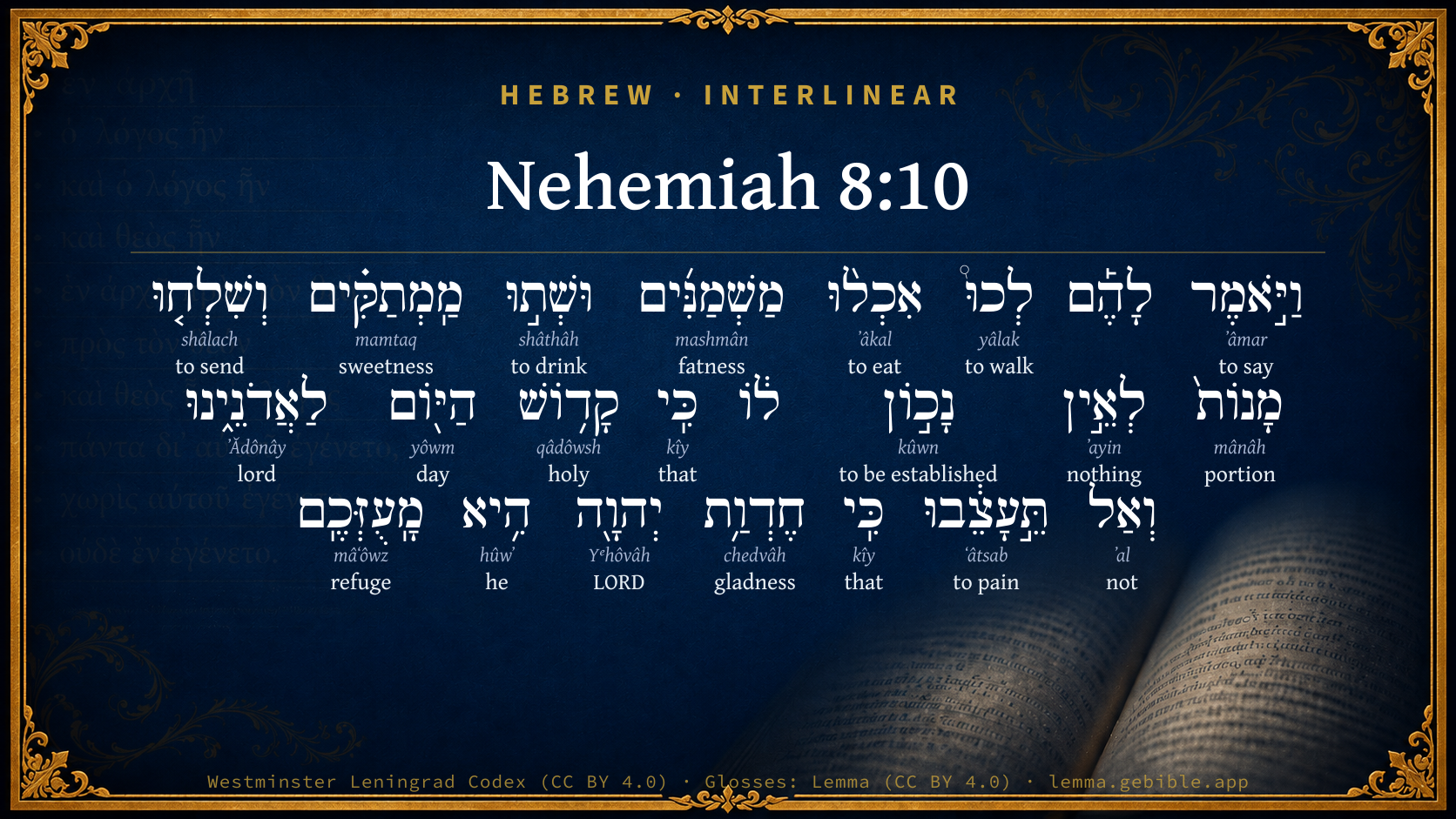
Nehemiah 8:10

Hebrew (Westminster Leningrad Codex) Nehemiah 8:10 appears in the Hebrew Old Testament. The text above is from the Westminster Leningrad Codex. Each word links to its Strong’s number, a concise gloss, and parsing drawn from the Open Scriptures Hebrew Bible morphology. Click any word for its full Brown-Driver-Briggs (BDB) entry.
Download image
Cite this verse

Nehemiah 8:10 (World English Bible). Public Domain. Lemma interlinear Bible study tool, https://lemma.gebible.app/v/nehemiah/8/10.

Show BibTeX & RIS
BibTeX
RIS
English Translation
Then he said to them, Go your way, eat the fat, and drink the sweet, and send portions to him for whom nothing is prepared; for this day is holy to our Lord: neither be you grieved; for the joy of Yahweh is your strength.
World English Bible · Public Domain
Highlights
  • 1 first appearance in the Hebrew Bible
Full analysis ↓
Download a study sheet

One document with this verse’s original text, its word-by-word gloss line, the meaning frame, cross-references with their text, attributed commentary, and full source and license credits — printable, and it pastes into notes with its structure intact.

This verse Autodidact and up

Study sheet (.html) Plain text (.txt)

A passage Seminary Student

Up to 50 verses in one chapter. A passage sheet keeps up to 6 commentary sources and 12 cross-references per verse, in the order this page ranks them, and says so on the sheet whenever that leaves anything out. Ask for a single verse and you get the Autodidact verse sheet above.

Everything on this page stays free to read, with no account — the sheet is a download of what is already on screen, not access to it.

Want to remove ads? Support Godless Engineer
Compare translations 3

The same verse in 3 English versions, stacked beneath the original-language interlinear above. Click any original word for its lexicon entry.

Each is an independent rendering of the whole verse — the interlinear is not word-aligned to these translations.

Highlighted words mark where these versions differ — a whole-verse word diff, not a word-by-word alignment.

  • World English Bible Public Domain
    Then he said to them, Go your way, eat the fat, and drink the sweet, and send portions to him for whom nothing is prepared; for this day is holy to our Lord: neither be you grieved; for the joy of Yahweh is your strength.
  • King James Version Public Domain
    Then he said unto them, Go your way, eat the fat, and drink the sweet, and send portions unto them for whom nothing is prepared: for this day is holy unto our LORD: neither be ye sorry; for the joy of the LORD is your strength.
  • unfoldingWord Literal Text CC BY-SA 4.0
    And he said to them, “Go, eat the fat and drink the sweet, and send portions to those for whom nothing is prepared, for today is holy, belonging to our Lord. And do not grieve, for, the joy of Yahweh, it is your strength.”

unfoldingWord Literal Text — © unfoldingWord, licensed CC BY-SA 4.0. Word-aligned USFM3 via Door43 (git.door43.org/unfoldingWord/en_ult).

Versions to compare (up to 4)

3 of 4 selected

Show all 18 translations

Every available English version of this verse, each an independent rendering of the whole verse.

  • World English Bible Public Domain
    Then he said to them, Go your way, eat the fat, and drink the sweet, and send portions to him for whom nothing is prepared; for this day is holy to our Lord: neither be you grieved; for the joy of Yahweh is your strength.
  • Berean Standard Bible Public Domain
    Then Nehemiah told them, “Go and eat what is rich, drink what is sweet, and send out portions to those who have nothing prepared, since today is holy to our Lord. Do not grieve, for the joy of the LORD is your strength.”
  • Majority Standard Bible Public Domain
    Then Nehemiah told them, “Go and eat what is rich, drink what is sweet, and send out portions to those who have nothing prepared, since today is holy to our Lord. Do not grieve, for the joy of the LORD is your strength.”
  • King James Version Public Domain
    Then he said unto them, Go your way, eat the fat, and drink the sweet, and send portions unto them for whom nothing is prepared: for this day is holy unto our LORD: neither be ye sorry; for the joy of the LORD is your strength.
  • American Standard Version (1901) Public Domain
    Then he said unto them, Go your way, eat the fat, and drink the sweet, and send portions unto him for whom nothing is prepared; for this day is holy unto our Lord: neither be ye grieved; for the joy of Jehovah is your strength.
  • Revised Version (1885) Public Domain
    Then he said unto them, Go your way, eat the fat, and drink the sweet, and send portions unto him for whom nothing is prepared: for this day is holy unto our Lord: neither be ye grieved; for the joy of the LORD is your strength.
  • Geneva Bible (1599) Public Domain
    He saide also vnto the, Go, and eate of the fat, and drinke the sweete, and send part vnto them, for whome none is prepared: for this day is holie vnto our Lord: be ye not sorie therefore: for the ioy of the Lord is your strength.
  • Douay-Rheims (1899) Public Domain
    And he said to them: Go, eat fat meats, and drink sweet wine, and send portions to them that have not prepared for themselves: because it is the holy day of the Lord, and be not sad: for the joy of the Lord is our strength.
  • Young's Literal Translation Public Domain
    And he saith to them, `Go, eat fat things, and drink sweet things, and sent portions to him for whom nothing is prepared, for to-day `is' holy to our Lord, and be not grieved, for the joy of Jehovah is your strength.'
  • Literal Standard Version CC BY-SA 4.0
    And he says to them, “Go, eat fat things, and drink sweet things, and send portions to him for whom nothing is prepared, for today [is] holy to our Lord, and do not be grieved, for the joy of YHWH is your strength.”
  • Unlocked Literal Bible CC BY-SA 4.0
    Then Nehemiah said to them, “Go your way, eat the fat and have something sweet to drink, and send some of it to one who has nothing prepared, for this day is holy to our Lord. Do not be grieved, for the joy of Yahweh is your strength.”
  • unfoldingWord Literal Text CC BY-SA 4.0
    And he said to them, “Go, eat the fat and drink the sweet, and send portions to those for whom nothing is prepared, for today is holy, belonging to our Lord. And do not grieve, for, the joy of Yahweh, it is your strength.”
  • Darby Bible Public Domain
    And he said to them, Go your way, eat the fat, and drink the sweet, and send portions to them for whom nothing is prepared; for the day is holy to our Lord; and be not grieved, for the joy of Jehovah is your strength.
  • World Messianic Bible Public Domain
    Then he said to them, “Go your way. Eat the fat, drink the sweet, and send portions to him for whom nothing is prepared, for today is holy to our Lord. Don’t be grieved, for the joy of the LORD is your strength.”
  • Webster's Bible Public Domain
    Then he said to them, Go your way, eat the fat, and drink the sweet, and send portions to them for whom nothing is prepared: for this day is holy to our Lord: neither be ye sad; for the joy of the LORD is your strength.
  • Free Bible Version CC BY-SA 4.0
    Nehemiah went on, “Go and enjoy some good food and sweet drinks, and share some with those who don't have anything ready, because today is a special, holy day to our Lord. Don't be sad, for your strength comes from the Lord who makes you happy.”
  • Bible in Basic English Public Domain
    Then he said to them, Go away now, and take the fat for your food and the sweet for your drink, and send some to him for whom nothing is made ready: for this day is holy to our Lord: and let there be no grief in your hearts; for the joy of the Lord is your strong place.
  • JPS Tanakh (1917) Public Domain
    Then he said unto them: 'Go your way, eat the fat, and drink the sweet, and send portions unto him for whom nothing is prepared; for this day is holy unto our Lord; neither be ye grieved; for the joy of the LORD is your strength.'

Literal Standard Version (2020), Covenant Press — licensed CC BY-SA 4.0. Text via the HelloAO Bible API (eBible.org). Unlocked Literal Bible (unfoldingWord) — licensed CC BY-SA 4.0. Text via the HelloAO Bible API (eBible.org). unfoldingWord Literal Text — © unfoldingWord, licensed CC BY-SA 4.0. Word-aligned USFM3 via Door43 (git.door43.org/unfoldingWord/en_ult). Free Bible Version, Dr. Jonathan Gallagher — licensed CC BY-SA 4.0. Text via the HelloAO Bible API (eBible.org).

Word by word

More ways to search: Search by grammar → Find every occurrence → Compare this word →

Practice this passage: Drill this verse → Learn its vocabulary →

מַֽמְתַקִּ֗ים
mamtaq
H4477
“sweet things”
Noun, Common, Masculine, Plural, Absolute
Part of Speech
Noun
Type
Common
Gender
Masculine
Number
Plural
State
Absolute
Full BDB Definition

Origin: from H4985

TWOT: 1268d

sweetness, sweet thing
  1. וַיֹּ֣אמֶר ʼâmar H559 “and · to say” Conjunction + Verb, Qal, Sequential Imperfect, 3rd Person, Masculine, Singular
  2. לְכוּ֩ yâlak H3212 “walk” Verb, Qal, Imperative, 2nd Person, Masculine, Plural
  3. אִכְל֨וּ ʼâkal H398 “eat” Verb, Qal, Imperative, 2nd Person, Masculine, Plural
  4. מַשְׁמַנִּ֜ים mashmân H4924 “fat pieces” Noun, Common, Masculine, Plural, Absolute
  5. וּשְׁת֣וּ shâthâh H8354 “and · drink” Conjunction + Verb, Qal, Imperative, 2nd Person, Masculine, Plural
  6. וְשִׁלְח֤וּ shâlach H7971 “and · send” Conjunction + Verb, Qal, Imperative, 2nd Person, Masculine, Plural
  7. מָנוֹת֙ mânâh H4490 “portions” Noun, Common, Feminine, Plural, Absolute
  8. לְאֵ֣ין ʼayin H369 “to/for · nothing” Preposition + Particle, Negative
  9. נָכ֣וֹן kûwn H3559 “being established” Verb, Niphal, Participle Active, Masculine, Singular, Absolute
  10. כִּֽי kîy H3588 “that” Conjunction
  11. קָד֥וֹשׁ qâdôwsh H6918 “holy” Adjective, Adjective, Masculine, Singular, Absolute
  12. הַיּ֖וֹם yôwm H3117 “the · day” Particle, Definite Article + Noun, Common, Masculine, Singular, Absolute
  13. לַאֲדֹנֵ֑ינוּ ʼĂdônây H136 “to/for · Lord · our” Preposition + Noun, Common, Masculine, Plural, Construct + Suffix, Personal, 1st Person, Common, Plural
  14. וְאַל ʼal H408 “and · not” Conjunction + Particle, Negative
  15. תֵּ֣עָצֵ֔בוּ ʻâtsab H6087 “to pain” Verb, Niphal, Jussive, 2nd Person, Masculine, Plural
  16. כִּֽי kîy H3588 “that” Conjunction
  17. חֶדְוַ֥ת chedvâh H2304 “gladness of” Noun, Common, Feminine, Singular, Construct
  18. יְהוָ֖ה Yᵉhôvâh H3068 “LORD” Noun, Proper
  19. הִ֥יא hûwʼ H1931 “he” Pronoun, Personal, 3rd Person, Feminine, Singular
  20. מָֽעֻזְּכֶֽם mâʻôwz H4581 “refuge · your” Noun, Common, Masculine, Singular, Construct + Suffix, Personal, 2nd Person, Masculine, Plural

About this verse

These counts appear in no published source. They are computed here, from the morphology-tagged text and Lemma’s own curated glosses. What Lemma adds →

23
words
20
distinct lemmas
Historical
section

Notable vocabulary

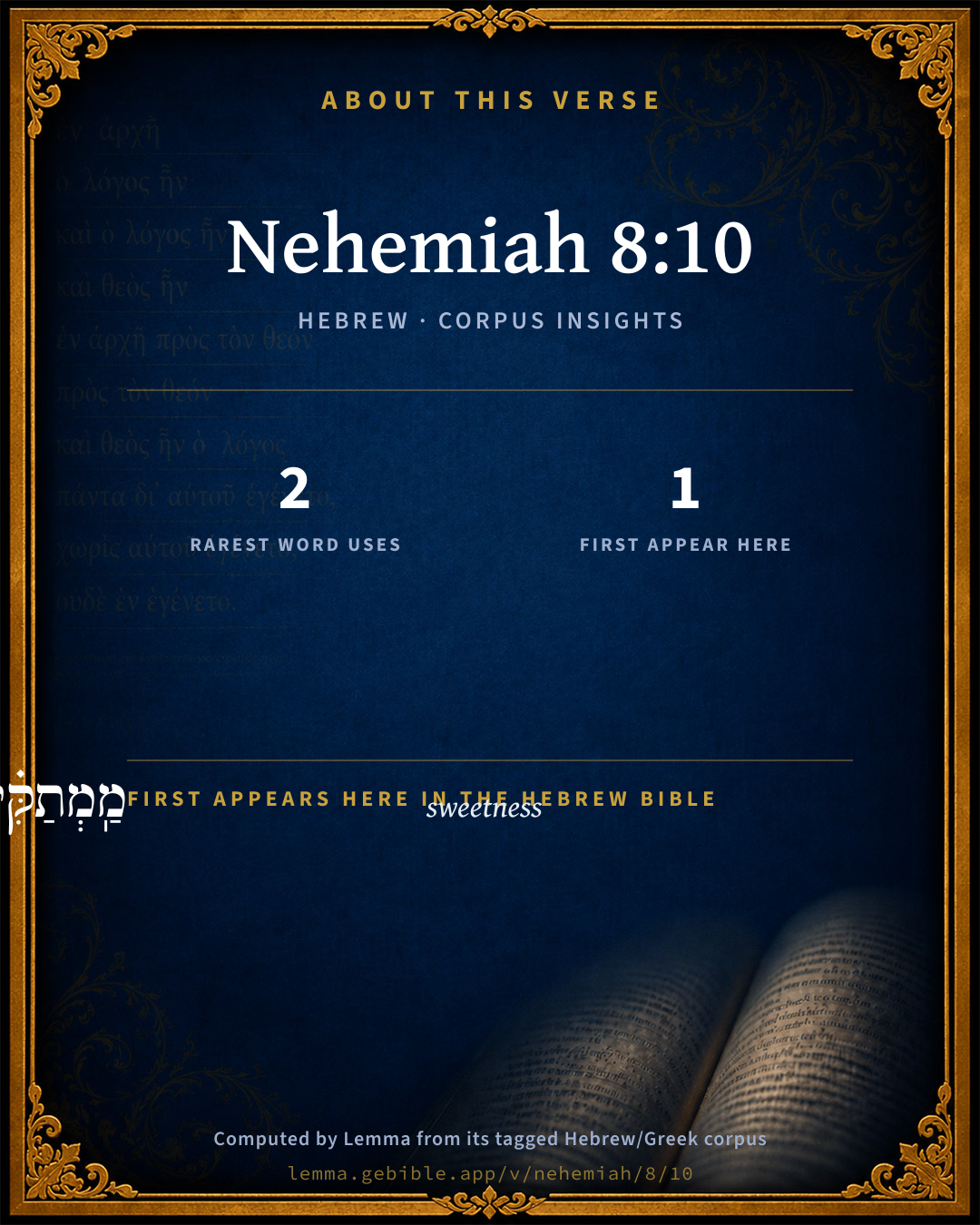
The rarest word here is מַֽמְתַקִּ֗ים sweetness H4477 — appearing just 2 times in the whole Hebrew Bible.

First appearance in Scripture

This word makes its first canonical appearance in the Hebrew Bible here:

  • מַֽמְתַקִּ֗ים sweetness H4477

Shared distinctive vocabulary

מַֽמְתַקִּ֗ים sweetness H4477 occurs in 2 verses of the Hebrew Bible. Also found in:

Grammatical profile

  • 7 verbs
  • 8 nouns
  • 1 adjective
  • 1 pronoun
  • 2 prepositions
  • 2 conjunctions
  • 2 particles

Verb forms

  • וַיֹּ֣אמֶר Qal · Sequential Imperfect
  • לְכוּ֩ Qal · Imperative
  • אִכְל֨וּ Qal · Imperative
  • וּשְׁת֣וּ Qal · Imperative
  • וְשִׁלְח֤וּ Qal · Imperative
  • נָכ֣וֹן Niphal · Participle Active
  • תֵּ֣עָצֵ֔בוּ Niphal · Jussive

Repetition

A word recurs within this verse — often emphatic in Hebrew:

  • כִּֽי that H3588 ×2

Cross-references

24

Topical passages linked to Nehemiah 8:10 in the Treasury of Scripture Knowledge — connected by theme and wording, ordered by reader-vote popularity; previews shown in the World English Bible.

  • Psalms 28:7–8 Yahweh is my strength and my shield. My heart has trusted in him, and I am helped. Therefore my heart greatly rejoices. With my song I will thank him.
  • Proverbs 17:22 A cheerful heart makes good medicine, But a crushed spirit dries up the bones.
  • 2 Corinthians 12:8–9 Concerning this thing, I begged the Lord three times that it might depart from me.
  • Ecclesiastes 9:7 Go your way--eat your bread with joy, and drink your wine with a merry heart; for God has already accepted your works.
  • Isaiah 12:1–3 In that day you will say, "I will give thanks to you, Yahweh; for though you were angry with me, your anger has turned away and you comfort me.
  • Isaiah 61:10 I will greatly rejoice in Yahweh, my soul shall be joyful in my God; for he has clothed me with the garments of salvation, he has covered me with the robe of righteousness, as a bridegroom decks himself with a garland, and as a bride adorns herself with her jewels.
  • Psalms 149:2 Let Israel rejoice in him who made them. Let the children of Zion be joyful in their King.
  • Esther 9:19 Therefore do the Jews of the villages, who dwell in the unwalled towns, make the fourteenth day of the month Adar [a day of] gladness and feasting, and a good day, and of sending portions one to another.
  • 2 Corinthians 8:2 how that in much proof of affliction the abundance of their joy and their deep poverty abounded to the riches of their liberality.
  • Esther 9:22 as the days in which the Jews had rest from their enemies, and the month which was turned to them from sorrow to gladness, and from mourning into a good day; that they should make them days of feasting and gladness, and of sending portions one to another, and gifts to the needy.
  • Ecclesiastes 2:24 There is nothing better for a man than that he should eat and drink, and make his soul enjoy good in his labor. This also I saw, that it is from the hand of God.
  • Ecclesiastes 3:13 Also that every man should eat and drink, and enjoy good in all his labor, is the gift of God.
  • Isaiah 35:1–4 The wilderness and the dry land shall be glad; and the desert shall rejoice, and blossom as the rose.
  • Philippians 3:4 though I myself might have confidence even in the flesh. If any other man thinks that he has confidence in the flesh, I yet more:
  • Job 31:16–18 "If I have withheld the poor from their desire, Or have caused the eyes of the widow to fail,
  • Ecclesiastes 5:18 Behold, that which I have seen to be good and proper is for one to eat and to drink, and to enjoy good in all his labor, in which he labors under the sun, all the days of his life which God has given him; for this is his portion.
  • Ecclesiastes 11:2 Give a portion to seven, yes, even to eight; For you don't know what evil will be on the earth.
  • Song of Solomon 5:1 I have come into my garden, my sister, my bride. I have gathered my myrrh with my spice; I have eaten my honeycomb with my honey; I have drunk my wine with my milk. Friends Eat, friends! Drink, yes, drink abundantly, beloved. Beloved
  • Isaiah 6:7–8 He touched my mouth with it, and said, "Behold, this has touched your lips; and your iniquity is taken away, and your sin forgiven."
  • Luke 11:41 But give for gifts to the needy those things which are within, and behold, all things will be clean to you.
  • 1 Timothy 6:17–18 Charge those who are rich in this present world that they not be haughty, nor have their hope set on the uncertainty of riches, but on the living God, who richly provides us with everything to enjoy;
  • Joel 2:23 "Be glad then, you children of Zion, And rejoice in Yahweh, your God; For he gives you the former rain in just measure, And he causes the rain to come down for you, The former rain and the latter rain, As before.
  • Deuteronomy 26:11–13 and you shall rejoice in all the good which Yahweh your God has given to you, and to your house, you, and the Levite, and the foreigner who is in the midst of you.
  • Revelation 11:10 Those who dwell on the earth rejoice over them, and they will be glad. They will give gifts to one another, because these two prophets tormented those who dwell on the earth.

Cross-references courtesy of OpenBible.info (CC BY 4.0).

Hebrew and Greek witnesses Masoretic Hebrew ↔ Greek Septuagint

The same verse in the two great witnesses to the Old Testament, shown verse-for-verse.

These are two independent witnesses, not word-aligned to each other, and the Septuagint is shown in lemma (dictionary) form.

Hebrew Nehemiah 8:10 Masoretic · Westminster Leningrad Codex

וַיֹּ֣אמֶר לָהֶ֡ם לְכוּ֩ אִכְל֨וּ מַשְׁמַנִּ֜ים וּשְׁת֣וּ מַֽמְתַקִּ֗ים וְשִׁלְח֤וּ מָנוֹת֙ לְאֵ֣ין נָכ֣וֹן ל֔וֹ כִּֽי קָד֥וֹשׁ הַיּ֖וֹם לַאֲדֹנֵ֑ינוּ וְאַל תֵּ֣עָצֵ֔בוּ כִּֽי חֶדְוַ֥ת יְהוָ֖ה הִ֥יא מָֽעֻזְּכֶֽם

Then he said to them, Go your way, eat the fat, and drink the sweet, and send portions to him for whom nothing is prepared; for this day is holy to our Lord: neither be you grieved; for the joy of Yahweh is your strength.

World English Bible · Public Domain

Greek LXX Structure differs

The Septuagint has no separate book of Nehemiah. Its Greek text is the second half of Esdras B (2 Esdras), chapters 11–23; Ezra is the first half (1–10).

A verse-for-verse comparison isn’t shown here because the chapters and verses don’t line up. Switch to the LXX edition with the MT / LXX toggle above to read the Greek directly.

On this verse, The Cambridge Bible for Schools and Colleges discusses the Septuagint’s reading. Read the note in Commentary ↓

Hebrew: Westminster Leningrad Codex (CC BY 4.0). Greek: Septuagint (public domain); English from a public-domain English Septuagint. How the Septuagint differs from the Hebrew →

Commentary

Notes on Nehemiah 8:10 from classic Christian and Jewish commentators (each source and its license shown beneath its notes). The classic Christian expositions comment on the surrounding passage and are grouped to its opening verse, so a note may address several verses; the Jewish commentaries on the Tanakh (Rashi and others) are per-verse, so they appear only where the commentator wrote on this verse.

Lemma curates 59 commentaries, every one of them public domain or Creative Commons licensed, each selected and text-cleaned for this edition rather than reprinted as found. About our sources →

Trapp's Complete Commentary

John Trapp

Neh 8:10 Then he said unto them, Go your way, eat the fat, and drink the sweet, and send portions unto them for whom nothing is prepared: for [this] day [is] holy unto our Lord: neither be ye sorry; for the joy of the LORD is your strength.

Ver. 10. Then he said unto them, Go your way] A friendly dismission. We must so reprove or admonish others, as that we ever preserve in them an opinion of our good will unto them; for this is that sugar that sweeteneth all such tartar pills.

Go your way, eat, &c.] One being asked whether a good man might not feed upon sweet and delicate meat; eat the fat, and drink the sweet, even the choicest wines and chiefest viands? answered, Yes; except God made bees only for fools. God freely permitteth to his best children the use of his best creatures, even to an honest affluence (on thanksgiving days), especially provided that they feed with fear, and keep within the bounds of sobriety.

And send portions to them for whom nothing is prepared] That is, to the poor, the fatherless, and the widows, Deu 16:14, who have not their set meals, nor certain dishes; but as hard fare for their holy day cheer, as Christ’s disciples had once for their Sabbath day’s dinner, Mat 12:1.

For this day is holy unto the Lord] A holy convocation, Lev 23:24, a day of blowing trumpets, a feast day: see Zec 8:19. {See Trapp on "Zec 8:19"} A more liberal use of the creature dilateth and exhilarateth the heart, and so disposeth it to thankfulness, Jas 5:13 Psa 92:2-3. Eat, that thy soul may bless me, Gen 27:19. The idolatrous Israelites sat down to eat and drink, and then rose up to play. God’s people should much more rejoice in the Lord, when refreshed by the creatures, speaking good of his name, and serving him with cheerfulness in the abundance of all things, Deu 28:47.

Neither be ye sorry] No, not for your sins now, lest it prove a sinful sorrow, see Neh 8:9.

For the joy of the Lord is your strength] Or, your fortification and place of defence against sin, and all the ill fruits of it. Laeti igitur sitis, sed non securi: gaudeatis in Domino, sed caveatis a recidivo Let us be joyful, but not untroubled, let us rejoice in God, but let us beware of backsliding. (Bernard). "A merry heart," grounded upon a good conscience, "doeth good like a medicine," Pro 17:22. It is as marrow to the bones; as oil to the wheels; as a bait by the way to a generous horse; as a back of steel to a bended bow, &c. Surely, as true gold strengtheneth the heart (that alchemy-gold doth not), so doth spiritual joy much more; making a man insuperable under sufferings, and unsatisfiable in performance of duties. It is such a precious commodity, as that no good can match it, no evil too powerful for it. It beareth all things, believeth all things, hopeth all things, endureth all things, as St Paul saith of charity, 1Co 13:7. And as a man that hath plenty of good blood and fresh spirits in his body, being well-lined within, as we say, can better endure heat and cold, &c., than another that hath not so; in like sort, he that hath his heart full of heaven, his conscience full of comfort, is in case to do and suffer much for and from God and men. The peace of his conscience will appear in his countenance, as Stephen’s did; and as the martyrs in Severus the emperor’s days, who, being released for a time, seemed to come, e myrotheca, non ergastulo, out of a perfumed palace, and not out of a stinking prison, looking more like angels of heaven than men on earth, as Eusebius relateth, Divinum nescio quid in vultibus ipsis praeferentes I do not know the god who wants to hide himself. (Euseb. lib. 5, cap. 12). The cross to such is anointed, as Bernard hath it; and by the joy of the Lord, that oil of gladness, it is made not only light, but sweet; not only tolerable, but desirable, and delectable.

John Trapp, A Commentary or Exposition upon All the Books of the Old and New Testament (1647–1656) — public domain. Text from a community e-Sword module.

Joseph Benson's Commentary

Neh 8:10. Eat the fat, and drink the sweet — Feast before the Lord, as the duty of the day requires you to do. Send portions, &c. — For the relief of your poor brethren, who otherwise must mourn while you rejoice. Concerning this duty and practice, see Deu 16:11; Deu 16:14; Est 9:10. For this day is holy — Being the first new moon in the year, and the feast of trumpets, (Lev 23:24,) and the beginning of this joyful month, in which so many days of thanksgiving are to be observed. For the joy of the Lord is your strength — That is, rejoicing in God, in the manner prescribed in his word, or serving him with cheerfulness and thankfulness, (which is always your duty, but now especially,) will give you that strength, both of body and mind, which you greatly need, that you may perform all the duties required of you, and oppose the designs of your enemies against you. But dejection of mind, and excessive grief, if you indulge it, will both offend God and damp your spirits, and will even weaken your very bodies, and make you unfit for God’s service, and an easy prey to your enemies.

Joseph Benson's Commentary on the Old and New Testaments (1811–1818) — public domain. Text from a community e-Sword module.

MacLaren's Expositions of Holy Scripture

Alexander MacLaren

Nehemiah

READING THE LAW WITH TEARS AND JOY

THE JOY OF THE LORD

Neh 8:10.

Judaism, in its formal and ceremonial aspect, was a religion of gladness. The feast was the great act of worship. It is not to be wondered at, that Christianity, the perfecting of that ancient system, has been less markedly felt to be a religion of joy; for it brings with it far deeper and more solemn views about man in his nature, condition, responsibilities, destinies, than ever prevailed before, under any system of worship. And yet all deep religion ought to be joyful, and all strong religion assuredly will be so.

Here, in the incident before us, there has come a time in Nehemiah’s great enterprise, when the law, long forgotten, long broken by the captives, is now to be established again as the rule of the newly-founded commonwealth. Naturally enough there comes a remembrance of many sins in the past history of the people; and tears not unnaturally mingle with the thankfulness that again they are a nation, having a divine worship and a divine law in their midst. The leader of them, knowing for one thing that if the spirits of his people once began to flag, they could not face nor conquer the difficulties of their position, said to them, ‘This day is holy unto the Lord: this feast that we are keeping is a day of devout worship; therefore mourn not, nor weep: go your way; eat the fat, and drink the sweet, and send portions unto them for whom nothing is prepared; neither be ye sorry, for the joy of the Lord is your strength.’ You will make nothing of it by indulgence in lamentation and in mourning. You will have no more power for obedience, you will not be fit for your work, if you fall into a desponding state. Be thankful and glad; and remember that the purest worship is the worship of God-fixed joy, ‘the joy of the Lord is your strength.’ And that is as true, brethren! with regard to us, as it ever was in these old times; and we, I think, need the lesson contained in this saying of Nehemiah’ s, because of some prevalent tendencies amongst us, no less than these Jews did. Take some simple thoughts suggested by this text which are both important in themselves and needful to be made emphatic because so often forgotten in the ordinary type of Christian character. They are these. Religious Joy is the natural result of faith. It is a Christian duty. It is an important element in Christian strength.

I. Joy in the Lord is the natural result of Christian Faith.

There is a natural adaptation or provision in the Gospel, both by what it brings to us and by what it takes away from us, to make a calm, and settled, and deep gladness, the prevalent temper of the Christian spirit. In what it gives us, I say, and in what it takes away from us. It gives us what we call well a sense of acceptance with God, it gives us God for the rest of our spirits, it gives us the communion with Him which in proportion as it is real, will be still, and in proportion as it is still, will be all bright and joyful. It takes away from us the fear that lies before us, the strifes that lie within us, the desperate conflict that is waged between a man’s conscience and his inclinations, between his will and his passions, which tears the heart asunder, and always makes sorrow and tumult wherever it comes. It takes away the sense of sin. It gives us, instead of the torpid conscience, or the angrily-stinging conscience-a conscience all calm from its accusations, with all the sting drawn out of it:-for quiet peace lies in the heart of the man that is trusting in the Lord. The Gospel works joy, because the soul is at rest in God; joy, because every function of the spiritual nature has found now its haven and its object; joy, because health has come, and the healthy working of the body or of the spirit is itself a gladness; joy, because the dim future is painted {where it is painted at all} with shapes of light and beauty, and because the very vagueness of these is an element in the greatness of its revelation. The joy that is in Christ is deep and abiding. Faith in Him naturally works gladness.

I do not forget that, on the other side, it is equally true that the Christian faith has as marked and almost as strong an adaptation to produce a solemn sorrow-solemn, manly, noble, and strong. ‘As sorrowful, yet always rejoicing,’ is the rule of the Christian life. If we think of what our faith does; of the light that it casts upon our condition, upon our nature, upon our responsibilities, upon our sins, and upon our destinies, we can easily see how, if gladness be one part of its operation, no less really and truly is sadness another. Brethren! all great thoughts have a solemn quiet in them, which not unfrequently merges into a still sorrow. There is nothing more contemptible in itself, and there is no more sure mark of a trivial nature and a trivial round of occupations, than unshaded gladness, that rests on no deep foundations of quiet, patient grief; grief, because I know what I am and what I ought to be; grief, because I have learnt the ‘exceeding sinfulness of sin’; grief, because, looking out upon the world, I see, as other men do not see, hell-fire burning at the back of the mirth and the laughter, and know what it is that men are hurrying to! Do you remember who it was that stood by the side of the one poor dumb man, whose tongue He was going to loose, and looking up to heaven, sighed before He could say, ‘Be opened’? Do you remember that of Him it is said, ‘God hath anointed Thee with the oil of gladness above Thy fellows’; and also, ‘a Man of sorrows, and acquainted with grief’? And do you not think that both these characteristics are to be repeated in the operations of His Gospel upon every heart that receives it? And if, by the hopes it breathes into us, by the fears that it takes away from us, by the union with God that it accomplishes for us, by the fellowship that it implants in us, it indeed anoints us all ‘with the oil of gladness’; yet, on the other hand, by the sense of mine own sin that it teaches me; by the conflict with weakness which it makes to be the law of my life; by the clear vision which it gives me of ‘the law of my members warring against the law of my mind, and bringing me into subjection’; by the intensity which it breathes into all my nature, and by the thoughts that it presents of what sin leads to, and what the world at present is, the Gospel, wheresoever it comes, will infuse a wise, valiant sadness as the very foundation of character. Yes, joy, but sorrow too! the joy of the Lord, but sorrow as we look on our own sin and the world’s woe! the head anointed with the oil of gladness, but also crowned with thorns!

These two are not contradictory. These two states of mind, both of them the natural operations of any deep faith, may co-exist and blend into one another, so as that the gladness is sobered, and chastened, and made manly and noble; and that the sorrow is like some thundercloud, all streaked with bars of sunshine, that pierce into its deepest depths. The joy lives in the midst of the sorrow; the sorrow springs from the same root as the gladness. The two do not clash against each other, or reduce the emotion to a neutral indifference, but they blend into one another; just as, in the Arctic regions, deep down beneath the cold snow, with its white desolation and its barren death, you will find the budding of the early spring flowers and the fresh green grass; just as some kinds of fire burn below the water; just as, in the midst of the barren and undrinkable sea, there may be welling up some little fountain of fresh water that comes from a deeper depth than the great ocean around it, and pours its sweet streams along the surface of the salt waste. Gladness, because I love, for love is gladness; gladness, because I trust, for trust is gladness; gladness, because I obey, for obedience is a meat that others know not of, and light comes when we do His will! But sorrow, because still I am wrestling with sin; sorrow, because still I have not perfect fellowship; sorrow, because mine eye, purified by my living with God, sees earth, and sin, and life, and death, and the generations of men, and the darkness beyond, in some measure as God sees them! And yet, the sorrow is surface, and the joy is central; the sorrow springs from circumstance, and the gladness from the essence of the thing;-and therefore the sorrow is transitory, and the gladness is perennial. For the Christian life is all like one of those sweet spring showers in early April, when the rain-drops weave for us a mist that hides the sunshine; and yet the hidden sun is in every sparkling drop, and they are all saturated and steeped in its light. ‘The joy of the Lord’ is the natural result and offspring of all Christian faith.

II. And now, secondly, the ‘joy of the Lord’ or rejoicing in God, is a matter of Christian duty.

It is a commandment here, and it is a command in the New Testament as well. ‘Neither be ye sorry, for the joy of the Lord is your strength.’ I need not quote to you the frequent repetitions of the same injunction which the Apostle Paul gives us, ‘Rejoice in the Lord always, and again I say, Rejoice’; ‘Rejoice evermore,’ and the like. The fact that this joy is enjoined us suggests to us a thought or two, worth looking at.

You may say with truth, ‘My emotions of joy and sorrow are not under my own control: I cannot help being glad and sad as circumstances dictate.’ But yet here it lies, a commandment. It is a duty, a thing that the Apostle enjoins; in which, of course, is implied, that somehow or other it is to a large extent within one’s own power, and that even the indulgence in this emotion, and the degree to which a Christian life shall be a cheerful life, is dependent in a large measure on our own volitions, and stands on the same footing as our obedience to God’s other commandments.

We can to a very great extent control even our own emotions; but then, besides, we can do more than that. It may be quite true, that you cannot help feeling sorrowful in the presence of sorrowful thoughts, and glad in the presence of thoughts that naturally kindle gladness. But I will tell you what you can do or refrain from doing-you can either go and stand in the light, or you can go and stand in the shadow. You can either fix your attention upon, and make the predominant subject of your religious contemplations, a truth which shall make you glad and strong, or a half-truth, which shall make you sorrowful, and therefore weak. Your meditations may either centre mainly upon your own selves, your faults and failings, and the like; or they may centre mainly upon God and His love, Christ and His grace, the Holy Spirit and His communion. You may either fill your soul with joyful thoughts, or though a true Christian, a real, devout, God-accepted believer, you may be so misapprehending the nature of the Gospel, and your relation to it, its promises and precepts, its duties and predictions, as that the prevalent tinge and cast of your religion shall be solemn and almost gloomy, and not lighted up and irradiated with the felt sense of God’s presence-with the strong, healthy consciousness that you are a forgiven and justified man, and that you are going to be a glorified one.

And thus far {and it is a long way} by the selection or the rejection of the appropriate and proper subjects which shall make the main portion of our religious contemplation, and shall be the food of our devout thoughts, we can determine the complexion of our religious life. Just as you inject colouring matter into the fibres of some anatomical preparation; so a Christian may, as it were, inject into all the veins of his religious character and life, either the bright tints of gladness or the dark ones of self-despondency; and the result will be according to the thing that he has put into them. If your thoughts are chiefly occupied with God, and what He has done and is for you, then you will have peaceful joy. If, on the other hand, they are bent ever on yourself and your own unbelief, then you will always be sad. You can make your choice.

Christian men, the joy of the Lord is a duty. It is so because, as we have seen, it is the natural effect of faith, because we can do much to regulate our emotions directly, and much more to determine them by determining what set of thoughts shall engage us. A wise and strong faith is our duty. To keep our emotional nature well under control of reason and will is our duty. To lose thoughts of ourselves in God’s truth about Himself is our duty. If we do these things, we cannot fail to have Christ’s joy remaining in us, and making ours full. If we have not that blessed possession abiding with us, which He lived and died to give us, there is something wrong in us somewhere.

It seems to me that this is a truth which we have great need, my friends, to lay to heart. It is of no great consequence that we should practically confute the impotent old sneer about religion as being a gloomy thing. One does not need to mind much what some people say on that matter. The world would call ‘the joy of the Lord’ gloom, just as much as it calls ‘godly sorrow’ gloom. But we are losing for ourselves a power and an energy of which we have no conception, unless we feel that joy is a duty, and unless we believe that not to be joyful in the Lord is, therefore, more than a misfortune, it is a fault.

I do not forget that the comparative absence of this happy, peaceful sense of acceptance, harmony, oneness with God, springs sometimes from temperament, and depends on our natural disposition. Of course the natural character determines to a large extent the perspective of our conceptions of Christian truth, and the colouring of our inner religious life. I do not mean to say, for a moment, that there is one uniform type to which all must be conformed, or they sin. There is indeed one type, the perfect manhood of Jesus, but it is all comprehensive, and each variety of our fragmentary manhood finds its own perfecting, and not its transmutation to another fashion of man, in being conformed to Him. Some of us are naturally fainthearted, timid, sceptical of any success, grave, melancholy, or hard to stir to any emotion. To such there will be an added difficulty in making quiet confident joy any very familiar guest in their home or in their place of prayer. But even such should remember that the ‘powers of the world to come,’ the energies of the Gospel, are given to us for the very express purpose of overcoming, as well as of hallowing, natural dispositions. If it be our duty to rejoice in the Lord, it is no sufficient excuse to urge for not responding to the reiterated call, ‘I myself am disposed to sadness.’

Whilst making all allowances for the diversities of character, which will always operate to diversify the cast of the inner life in each individual, we think that, in the great majority of instances, there are two things, both faults, which have a great deal more to do with the absence of joy from much Christian experience, than any unfortunate natural tendency to the dark side of things. The one is, an actual deficiency in the depth and reality of our faith; and the other is, a misapprehension of the position which we have a right to take and are bound to take.

There is an actual deficiency in our faith. Oh, brethren! it is not to be wondered at that Christians do not find that the Lord with them is the Lord their strength and joy, as well as the Lord ‘their righteousness’; when the amount of their fellowship with Him is so small, and the depth of it so shallow, as we usually find it. The first true vision that a sinful soul has of God, the imperfect beginnings of religion, usually are accompanied with intense self-abhorrence, and sorrowing tears of penitence. A further closer vision of the love of God in Jesus Christ brings with it ‘joy and peace in believing.’ But the prolongation of these throughout life requires the steadfast continuousness of gaze towards Him. It is only where there is much faith and consequent love that there is much joy. Let us search our own hearts. If there is but little heat around the bulb of the thermometer, no wonder that the mercury marks a low degree. If there is but small faith, there will not be much gladness. The road into Giant Despair’s castle is through doubt, which doubt comes from an absence, a sinful absence, in our own experience, of the felt presence of God, and the felt force of the verities of His Gospel.

But then, besides that, there is another fault: not a fault in the sense of crime or sin, but a fault {and a great one} in the sense of error and misapprehension. We as Christians do not take the position which we have a right to take and that we are bound to take. Men venture themselves upon God’s word as they do on doubtful ice, timidly putting a light foot out, to feel if it will bear them, and always having the tacit fear, ‘Now, it is going to crack!’ You must cast yourselves on God’s Gospel with all your weight, without any hanging back, without any doubt, without even the shadow of a suspicion that it will give-that the firm, pure floor will give, and let you through into the water! A Christian shrink from saying what the Apostle said, ‘I know in whom I have believed, and am persuaded that He is able to keep that which I have committed to Him until that day’! A Christian fancy that salvation is a future thing, and forget that it is a present thing! A Christian tremble to profess ‘assurance of hope,’ forgetting that there is no hope strong enough to bear the stress of a life’s sorrows, which is not a conviction certain as one’s own existence! Brethren! understand that the Gospel is a Gospel which brings a present salvation; and try to feel that it is not presumption, but simply acting out the very fundamental principle of it, when you are not afraid to say, ‘I know that my Redeemer is yonder, and I know that He loves me!’ Try to feel, I say, that by faith you have a right to take that position, ‘Now, we know that we are the sons of God’; that you have a right to claim for yourselves, and that you are falling beneath the loftiness of the gift that is given to you unless you do claim for yourselves, the place of sons, accepted, loved, sure to be glorified at God’s right hand. Am I teaching presumption? am I teaching carelessness, or a dispensing with self-examination? No, but I am saying this: If a man have once felt, and feel, in however small and feeble a degree, and depressed by whatsoever sense of daily transgressions, if he feel, faint like the first movement of an imprisoned bird in its egg, the feeble pulse of an almost imperceptible and fluttering faith beat-then that man has a right to say, ‘God is mine!’

As one of our great teachers, little remembered now said, ‘Let me take my personal salvation for granted’-and what? and ‘be idle?’ No; ‘and work from it.’ Ay, brethren! a Christian is not to be for ever asking himself, ‘Am I a Christian?’ He is not to be for ever looking into himself for marks and signs that he is. He is to look into himself to discover sins, that he may by God’s help cast them out, to discover sins that shall teach him to say with greater thankfulness, ‘What a redemption this is which I possess!’ but he is to base his convictions that he is God’s child upon something other than his own characteristics and the feebleness of his own strength. He is to have ‘joy in the Lord’ whatever may be his sorrow from outward things. And I believe that if Christian people would lay that thought to heart, they would understand better how the natural operation of the Gospel is to make them glad, and how rejoicing in the Lord is a Christian duty.

III. And now with regard to the other thought that still remains to be considered, namely, that rejoicing in the Lord is a source of strength,-I have already anticipated, fragmentarily, nearly all that I could have said here in a more systematic form. All gladness has something to do with our efficiency; for it is the prerogative of man that his force comes from his mind, and not from his body. That old song about a sad heart tiring in a mile, is as true in regard to the Gospel, and the works of Christian people, as in any other case. If we have hearts full of light, and souls at rest in Christ, and the wealth and blessedness of a tranquil gladness lying there, and filling our being; work will be easy, endurance will be easy, sorrow will be bearable, trials will not be so very hard, and above all temptations we shall be lifted, and set upon a rock. If the soul is full, and full of joy, what side of it will be exposed to the assault of any temptation? If the appeal be to fear, the gladness that is there is an answer. If the appeal be to passion, desire, wish for pleasure of any sort, there is no need for any more-the heart is full. And so the gladness which rests in Christ will be a gladness which will fit us for all service and for all endurance, which will be unbroken by any sorrow, and, like the magic shield of the old legends, invisible, impenetrable, in its crystalline purity will stand before the tempted heart, and will repel all the ‘fiery darts of the wicked.’

‘The joy of the Lord is your strength,’ my brother! Nothing else is. No vehement resolutions, no sense of his own sinfulness, nor even contrite remembrance of past failures, ever yet made a man strong. It made him weak that he might become strong, and when it had done that it had done its work. For strength there must be hope, for strength there must be joy. If the arm is to smite with vigour, it must smite at the bidding of a calm and light heart. Christian work is of such a sort as that the most dangerous opponent to it is simple despondency and simple sorrow. ‘The joy of the Lord is your strength.’

Well, then! there are two questions: How comes it that so much of the world’s joy is weakness? and how comes it that so much of the world’s notion of religion is gloom and sadness? Answer them for yourselves, and remember: you are weak unless you are glad; you are not glad and strong unless your faith and hope are fixed in Christ, and unless you are working from and not towards the sense of pardon, from and not towards the conviction of acceptance with God!

Alexander MacLaren, Expositions of Holy Scripture (1904–1910) — public domain. Text from a community e-Sword module.

Tyndale Open Study Notes

Tyndale Open Resources

8:10 Rich foods such as meat were eaten only on a special occasion. • Sweet drinks referred to unfermented juice, in contrast to the vinegar of the common laborer (see Ruth 2:14). • It is right to share with those who have need (see Deut 15:11; Job 29:16; Prov 31:20; Matt 6:2-3; Acts 4:34-35).

Tyndale Open Study Notes — © Tyndale Open Resources, licensed CC BY-SA 4.0. Text via the HelloAO Bible API.

Geneva Bible (1599)

Geneva Bible translators

Rejoice in the Lord, and he will give you strength.

That is, remember the poor.

Geneva Bible (1599) marginal notes — public domain. Text via Bolls.life.

Adam Clarke's Commentary

Verse 10. Eat the fat, and drink the sweet] Eat and drink the best that you have; and while ye are feeding yourselves in the fear of the Lord, remember those who cannot feast; and send portions to them, that the joy and the thanksgiving may be general. Let the poor have reason to rejoice as well as you.

For the joy of the Lord is your strength.] This is no gluttonous and drunken festival that enervates the body, and enfeebles the mind: from your religious feast your bodies will acquire strength and your minds power and fervour, so that you shall be able to DO HIS will, and to do it cheerfully. Religious joy, properly tempered with continual dependence on the help of God, meekness of mind, and self-diffidence, is a powerful means of strengthening the soul. In such a state every duty is practicable, and every duty delightful. In such a frame of mind no man an ever fell, and in such a state of mind the general health of the body is much improved; a cheerful heart is not only a continual feast, but also a continual medicine.

Adam Clarke's Commentary on the Bible (1810–1826) — public domain. Text from a community e-Sword/MySword module.

Ellicott's Commentary for English Readers

(10) For the joy of the Lord is your strength This beautiful sentence is, literally, delight in Jehovah is a strong refuge. It is capable of unlimited application in preaching and devotion.

A Bible Commentary for English Readers, edited by Charles John Ellicott (1878–1897) — public domain. Text from a community e-Sword module.

The Cambridge Bible for Schools and Colleges

gen. ed. J. J. S. Perowne

10. Then he said] Who issued the command, we are not told. Clearly either Nehemiah or Ezra. Some think Nehemiah because as governor he would be the person to issue authoritative directions. But more probably Ezra is intended; for (1) Ezra’s name is most conspicuous throughout this whole episode; cf. Neh_8:5-6; (2) the language used is that of the teacher of the Law rather than that of the practical governor.

eat the fat, and drink the sweet] A proverbial expression, meaning that the occasion was not one of fasting and grief. LXX. φάγετε λιπάσματα καὶ πίετε γλυκάσματα. Vulg. ‘comedite pinguia et bibite mulsum.’

send portions &c.] Doubtless with the thought of remembering the poor and needy more especially, as according to the law of Deu_16:14, where the Feast of Tabernacles is described, ‘And thou shalt rejoice in thy feast, thou, and thy son, and thy daughter, and thy manservant, and the Levite, and the stranger, and the fatherless and the widow that are within thy gates.’ But the allusion seems primarily to be to the custom of interchanging ‘portions’ on festal occasions, e.g. Est_9:19, ‘a day of gladness and feasting, and a good day, and of sending portions to one another,’ Est_9:22, ‘days of feasting and gladness, and of sending portions one to another and gifts to the poor.’ Nabal’s churlishness was the violation of an almost sacred rule, 1 Samuel 25, cf. R. Smith, Relig. of Semites. For this custom of open-handed distribution on the occasion of great sacrificial feasts, cf. 1Sa_9:13; 2Sa_6:19; Eze_39:17-20.

neither be ye sorry] R.V. grieved. LXX. μὴ διαπέσητε. Vulg. ‘no-lite contristari’. The R.V. gives the same rendering as in Neh_8:11.

for the joy of the Lord is your strength] R.V. marg. ‘Or, stronghold’. This joy of the Lord is not the joy of the Lord over Israel; but Israel’s joy in her Lord. Israel’s joy at her great festivals is based on her confidence that the Lord ever protects her. Gladness in Him is in proportion to the faith in the protection which He gives. The English version is that of the Vulgate, ‘gaudium etenim Domini est fortitudo nostra.’ The LXX. ὅτι ἐστὶ κύριος ἰσχὺς ἡμῶν omitted to render the somewhat unusual word for ‘joy,’ which elsewhere occurs in 1Ch_16:27, Ezr_6:16. The rendering ‘stronghold’ in the R.V. marg. gives the more common meaning, cf. Psa_37:39, ‘He is their stronghold in the time of trouble.’ He that rejoices in Jehovah has a strong fortress from which he can repel all adversaries.

The Cambridge Bible for Schools and Colleges (gen. ed. J. J. S. Perowne; Cambridge University Press, 1878–1918) — public domain. Text from a community e-Sword module.

John Gill's Exposition

Then he said unto them,.... Nehemiah the Tirshatha or governor:

go your way; to their own houses, and refresh themselves; it being noon, and they had stood many hours attentive to the reading and expounding of the law:

eat the fat, and drink the sweet: not a common meal, but a feast, consisting of the richest provisions, the best of food and liquors

and send portions unto them for whom nothing is prepared; for the poor, who had no food at home provided for them; the widow, fatherless, and stranger, who at festivals were to partake of the entertainment, Deu 16:11

for this day is holy unto our Lord: neither be you sorry; confirming what the Levites had said and exhorted to, Neh 8:9

for the joy of the Lord is your strength; to rejoice, as the Lord commanded them on such days as these, was a means both of increasing their bodily strength and their inward strength, and of fitting them the more to perform their duty to God and men with cheerfulness, which sorrow and heaviness made unfit for; and the joy which has the Lord for its object, and comes from him, is the cause of renewing spiritual strength, so as to run and not be weary, walk and not faint, in the ways of God.

John Gill's Exposition of the Whole Bible (1746–1763) — public domain (CC PDM 1.0). Text via the HelloAO Bible API.

Albert Barnes' Notes on the Bible

The “sending of portions” to the poor is not distinctly mentioned in any but the later historical Scriptures (compare the margin reference). The practice naturally grew out of this injunction of the Law Deu 16:11, Deu 16:14.

Albert Barnes' Notes on the Bible (1834–1885) — public domain. Text from a community e-Sword/MySword module.

Haydock's Catholic Bible Commentary

Wine. Hebrew and Septuagint, "things." Syriac and Arabic have simply, "drink." --- Portions. The Greeks styled them, Greek: merides; and the Latins, sportulæ. The custom prevailed not only among the Jews, (Esther ix. 19.) but also among Christians and pagans. Moses frequently exhorts the people to invite the poor; (Deuteronomy xvi. 14.) and St. Paul blames the rich Corinthians, for giving no part of their feast to them, 1 Corinthians xi. 21. --- Strength. By this holy joy, we shall be encouraged to perform all our duties. (Calmet) --- Septuagint, "Be not downcast, because he (the Lord) is our strength." (Haydock)

George Leo Haydock (1774–1849), Haydock's Catholic Family Bible and Commentary, 1859 edition — public domain. Excludes Psalms (Douay-Rheims chapter numbering differs from Protestant) and Deuterocanonical books (Catholic canon only).

Matthew Poole's English Annotations

Eat the fat, and drink the sweet; feast before the Lord, as the duty of the day obligeth you to do.

Send portions unto them for whom nothing is prepared; for the relief of your poor brethren, who else must mourn whilst you rejoice. See of this duty and practice Deu 16:11,14; Es 9:19.

This day is holy unto our Lord; being the feast of trumpets, Lev 23:24, and the beginning of this joyful month, wherein so many days of feasting and thanksgiving were to be observed.

The joy of the Lord is your strength, i.e. rejoicing in God in the manner prescribed in his word, or serving him with cheerfulness and thankfulness, which is your duty always, but now especially, will give you that strength both of mind and body which you greatly need, both to perform all the duties required of you, and to endure and oppose all the crafty counsels and malicious designs of your enemies against you; whereas this dejection of mind, and excessive grief, if you indulge it, will both offend God, and damp your spirits, and weaken your very bodies, and make you unfit for God’s service, or for your own necessary occasions, and so an easy prey to your enemies.

Matthew Poole's English Annotations on the Holy Bible (1683–1685) — public domain. Text from a community e-Sword/MySword module.

Whedon's Commentary on the Bible

Daniel D. Whedon

10. He said — That is, Nehemiah, the governor. He issued the order, being the public executive.

Eat the fat — Literally, fatnesses; that is, the fat pieces of flesh; the fat things.

Drink the sweet — Hebrew, sweetnesses; the sweet drinks, especially the new wine of that season.

Send portions — That the poor and destitute, for whom nothing is prepared, but what is freely given by those who have abundance, may rejoice and feast with the rest of the people. Comp. Est_9:19; Est_9:22; Deu_16:14.

The joy of the Lord is your strength — The joy of Jehovah is the delight and comfort which Jehovah imparts to his faithful servants; a consciousness of God’s favour, mercy, and long-suffering. The word rendered strength commonly means a fortress, a fortified citadel, or stronghold. They surely should not be sorry who abide in the joy of Jehovah as in a strong fortress.

Daniel D. Whedon (gen. ed.), Commentary on the Old and New Testaments (1874–1909) — public domain. Text from a community e-Sword module.

The Pulpit Commentary

Then he said. Either Ezra or Nehemiah, but probably the former, to whom it appertained to give religious directions. Eat the fat and drink the sweet. i.e. "Go and enjoy yourselves, eat and drink of the best let there be no fasting, nor even abstinence, on such a day as this." But at the same time send portions unto them for whom nothing is prepared. Make the poor partakers of your joy. "The stranger, the fatherless, and the widow" should have their part in the feast. (Deu_16:14) And for yourselves, remember that the joy of the Lord, i.e. religious joy, constitutes your strength.

A CHRISTMAS HOMILY. The joy of the Lord.

"Go your way, eat the fat ... for the joy of the Lord is your strength" stronghold. The common opinion that the Jewish religion was gloomy and austere is erroneous. Its ritual and ceremonial observances were indeed minute, and in some respects burdensome, but there was much that was joyous. The private observance of religion consisted a good deal in offering sacrifices of thanksgiving, of which the larger portion was eaten by the offerer and his friends in a social festal meal Deu_27:6, 7 expresses the spirit of the Mosaic law). The Sabbath day, as originally instituted, was far from being the gloomy season which some represent; and of the other seasons set apart for special religious observance, only one was a fast, all the rest were festivals for the commemoration of God"s goodness, and the offering of praise to him. The three occasions on which all the males were required to appear at the temple were all festivals, and how the festivals were to be kept our text shows. It relates to the feast of trumpets the new year"s festival as observed by the Jews after their re-settlement in Palestine. (for the law, see Lev_23:23) On this occasion the people were more disposed to mourn than rejoice, for the law had been read and expounded to them, and they were reminded by it of the nation"s sin and deserved punishment. But Nehemiah bids them not mourn, but rejoice, adding that the joy of the Lord would be as a stronghold to them. We may gather from his words hints on Christian joy and feasting.

I THE JOY WHICH GOD"S PEOPLE SHOULD INDULGE. "The joy of the Lord." Holy, pious joy. It is joy

1. In God his existence and perfections; his relation to believers; his works and government (in creation, providence, and grace); his special interpositions for Israel, for mankind, especially in and by the Lord Jesus; his word and the understanding of it (ver. 12); his operations in each heart and life.

2. From God. All joy which is his gift has his stamp of approval: innocent pleasures of sense, reason, social affection, as well as the higher spiritual joys. But these last are specially "the joy of the Lord," which is one of the fruits of the Spirit. (Gal_5:22)

3. With God, as he rejoices in his works, (Psa_104:31) in the repentance of sinners, (Lu 15) and in the character and welfare of his people. (Psa_147:11 Isa_62:5 Isa_65:19 Zep_3:17) We are capable of fellowship with him in his joy.

4. Directed to God. In gratitude and love, in praise and in cheerful service. Natural joys regulated by and culminating in religion, in thankfulness, etc., become thus "the joy of the Lord." Such joy, not sorrow, should be the predominant feeling of Christians, although sorrow has also its place. The consciousness of redemption, of pardon, peace with God, sonship, etc., should produce joy. Such joy, not sinful mirth, should Christians indulge.

II WHY SUCH JOY SHOULD BE CHERISHED. "The joy of the Lord is your strength. " Literally, your stronghold, fortress. For the Jews at this time, feeble as they were, the joy of the Lord would be safety against enemies. It would unite them, inspirit them, make them brave, stimulate them in God"s service, which was their safety, as it would secure his protection and blessing. And in all times religious, holy joy is a defence against evil. It imparts "strength" in another sense inward power to do and endure the will of God, and overcome temptation, and thus becomes a strong-hold

1. Against discouragement and despondency in trying times.

2. Against sin. Making God"s service a delight, it counterweighs the attractions of sinful pleasure. He who is happy in God is raised above them.

3. Against infidelity. For it gives an experimental proof of the reality and worth of religion which no mere argument can shake. And as it is with individuals, so with families, Churches, nations, the joy of the Lord is strength, gloomy religion weakness, sinful joy more so.

III WHEN IT SHOULD BE INDULGED. On days "holy to the Lord," which every day should be. Then on days specially set apart for religious services the Lord"s day, Easter, Christmas. Our special commemoration of God"s works should be with holy, not sinful, joy.

IV HOW IT SHOULD BE EXPRESSED.

1. It may be expressed by feasting. So here, and in Jewish religious observances generally. Two things secured by such association of religion and feasting. It makes religion social, cheerful, and attractive, and it elevates and sanctifies feasting itself, consecrating it to God, and preserving its purity by associating it with thoughts of him. We should deem it singular to hear the ministers of religion say, "Eat the fat and drink the sweet, for this day is holy to the Lord." Yet primitive Christianity had this element, in dropping which we have lost much good, if also much evil. At Christmas time we in a measure associate feasting with religion. Let us endeavour so to unite them that our joy may be "the joy of the Lord." Let us blend with our festivities gratitude for Christ and Christianity. Let us invite Jesus to our feasts, and enjoy ourselves as in his presence. It is easier to mix religion with feasting at this time, because of the occasion, and the family character of the feast, the children uniting.

2. It should always overflow in charity. "Send portions unto them for whom nothing is prepared". (see Deu_16:11, Deu_16:14) Special suitableness of this at Christmas time, not only on account of the time of year, when the poor have to bear peculiar hardships, but on account of the event celebrated. The incarnation sanctifies human nature, uniting it to the Divine; teaching us to reverence, respect, care for all; furnishing a new and sacred bond of unity and brotherhood. It sanctifies poverty, as Christ was born of a poor woman, in a very humble lodging. He chose to be a poor man, and esteems kindness to the poor as kindness to himself, and vice versa. It affords us all ground for utmost thankfulness, which we should express by charity. Even selfishness might prompt benevolence at this season, for it will give zest to our own feasting to be conscious that others are sharing it through our gifts. Even if we must curtail our own feast somewhat in order to give to others, we shall be thus repaid. Finally, all joy should, and may, be a joy of the Lord. That which cannot is unworthy a Christian, and will lead to ultimate sorrow.

The Pulpit Commentary (1880–1919), ed. H.D.M. Spence-Jones & Joseph S. Exell — public domain. Text from a community e-Sword module.

John Wesley's Explanatory Notes

Eat - Feast before the Lord. Send - For the relief of your poor brethren. Holy - Being the feast of trumpets, and the beginning of this joyful month, wherein so many days of thanksgiving were to be observed. Strength - Rejoicing in God in serving him with chearfulness, and thankfulness, which is your duty always, but now especially, will give you that strength both of mind and body, which you greatly need, both to perform all the duties required of you, and to oppose all the designs of your enemies.

John Wesley, Explanatory Notes Upon the Whole Bible (1754–1765) — public domain. Text via the GEBible commentary corpus.

Rashi

Rabbi Shlomo Yitzchaki (Rashi)

to whoever has nothing prepared to a poor man who has no food prepared for himself.

Rashi on the Tanakh — English translations: “The Judaica Press complete Tanach with Rashi, translated by A. J. Rosenberg” (CC BY 4.0); “Pentateuch with Rashi's commentary by M. Rosenbaum and A.M. Silbermann, 1929-1934” (public domain); “The Metsudah Tanach series, Lakewood, N.J” (CC BY 4.0); and “The Book of Joshua, Metsudah Publications, 1997” (CC BY 4.0). Text via Sefaria.

Lesson kit

Teaching starters — assembled from the data on this page, not authored interpretation. Every prompt links to the verse data it draws on. Edit before teaching.

Nehemiah, in the Historical, opens this verse with 23 words (20 distinct Hebrew lemmas). Its most distinctive word is mamtaq (“sweetness”). A historical commentator’s framing appears above. Read the whole chapter for the surrounding context.

Discussion questions

  1. What does “sweetness” (mamtaq) contribute to the verse as a whole?
  2. The word “sweetness” first appears here in Scripture. What is being introduced at this debut?
  3. Song of Solomon 5:16 shares the word «sweetness» with this verse. How do the two illuminate each other?
  4. “that” occurs 2× in this one verse. What is the effect of the repetition?
  5. These translations render this verse differently. What is at stake in choosing one wording over another?
  6. The verb «וַיֹּ֣אמֶר» is Qal Sequential Imperfect. How does its form color the action?
  7. Reading how Trapp's Complete Commentary and Joseph Benson's Commentary read this verse, where do the two commentators agree and where do they part?

Things to notice

  • 1 word makes its first canonical appearance in Scripture here.
  • These translations choose different wording for 12 words in this verse.
  • “that” occurs 2× in this single verse.
  • 20 distinct Hebrew lemmas span 23 words in this verse.

Reading settings

Reading text

Shown beneath each verse's original-language words.

Old Testament
Old Testament edition

Read the OT as the Masoretic Hebrew (MT) or the Greek Septuagint (LXX).

English shown for the Greek Septuagint (in the Hebrew ↔ Greek comparison).

Comparing translations? Open the Compare panel on any verse page to stack up to four side by side.