
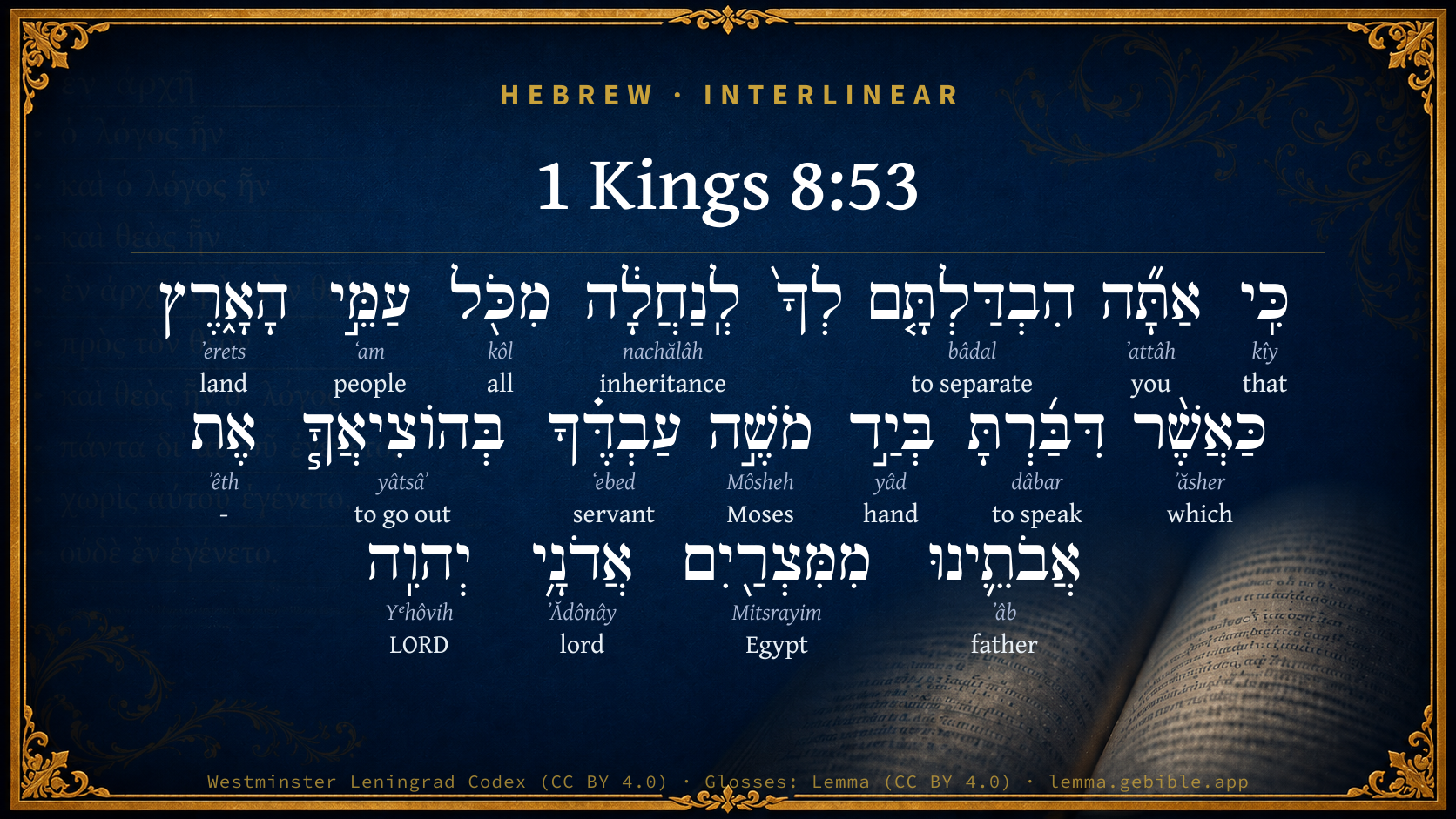
1 Kings 8:53

Hebrew (Westminster Leningrad Codex) 1 Kings 8:53 appears in the Hebrew Old Testament. The text above is from the Westminster Leningrad Codex. Each word links to its Strong’s number, a concise gloss, and parsing drawn from the Open Scriptures Hebrew Bible morphology. Click any word for its full Brown-Driver-Briggs (BDB) entry.
Download image
Cite this verse

1 Kings 8:53 (World English Bible). Public Domain. Lemma interlinear Bible study tool, https://lemma.gebible.app/v/1-kings/8/53.

Show BibTeX & RIS
BibTeX
RIS
English Translation
For you did separate them from among all the peoples of the earth, to be your inheritance, as you spoke by Moses your servant, when you brought our fathers out of Egypt, Lord Yahweh.
World English Bible · Public Domain
Download a study sheet

One document with this verse’s original text, its word-by-word gloss line, the meaning frame, cross-references with their text, attributed commentary, and full source and license credits — printable, and it pastes into notes with its structure intact.

This verse Autodidact and up

Study sheet (.html) Plain text (.txt)

A passage Seminary Student

Up to 50 verses in one chapter. A passage sheet keeps up to 6 commentary sources and 12 cross-references per verse, in the order this page ranks them, and says so on the sheet whenever that leaves anything out. Ask for a single verse and you get the Autodidact verse sheet above.

Everything on this page stays free to read, with no account — the sheet is a download of what is already on screen, not access to it.

Want to remove ads? Support Godless Engineer
Compare translations 3

The same verse in 3 English versions, stacked beneath the original-language interlinear above. Click any original word for its lexicon entry.

Each is an independent rendering of the whole verse — the interlinear is not word-aligned to these translations.

Highlighted words mark where these versions differ — a whole-verse word diff, not a word-by-word alignment.

  • World English Bible Public Domain
    For you did separate them from among all the peoples of the earth, to be your inheritance, as you spoke by Moses your servant, when you brought our fathers out of Egypt, Lord Yahweh.
  • King James Version Public Domain
    For thou didst separate them from among all the people of the earth, to be thine inheritance, as thou spakest by the hand of Moses thy servant, when thou broughtest our fathers out of Egypt, O LORD God.
  • unfoldingWord Literal Text CC BY-SA 4.0
    For you, you separated them for yourself as an inheritance from all of the peoples of the earth, just as you spoke by the hand of Moses your servant when you brought out our fathers from Egypt, my Lord Yahweh.”

unfoldingWord Literal Text — © unfoldingWord, licensed CC BY-SA 4.0. Word-aligned USFM3 via Door43 (git.door43.org/unfoldingWord/en_ult).

Versions to compare (up to 4)

3 of 4 selected

Show all 18 translations

Every available English version of this verse, each an independent rendering of the whole verse.

  • World English Bible Public Domain
    For you did separate them from among all the peoples of the earth, to be your inheritance, as you spoke by Moses your servant, when you brought our fathers out of Egypt, Lord Yahweh.
  • Berean Standard Bible Public Domain
    For You, O Lord GOD, as Your inheritance, have set them apart from all the peoples of the earth, as You spoke through Your servant Moses when You brought our fathers out of Egypt.”
  • Majority Standard Bible Public Domain
    For You, O Lord GOD, have set them apart from all the peoples of the earth as Your inheritance, as You spoke through Your servant Moses when You brought our fathers out of Egypt.”
  • King James Version Public Domain
    For thou didst separate them from among all the people of the earth, to be thine inheritance, as thou spakest by the hand of Moses thy servant, when thou broughtest our fathers out of Egypt, O LORD God.
  • American Standard Version (1901) Public Domain
    For thou didst separate them from among all the peoples of the earth, to be thine inheritance, as thou spakest by Moses thy servant, when thou broughtest our fathers out of Egypt, O Lord Jehovah.
  • Revised Version (1885) Public Domain
    For thou didst separate them from among all the peoples of the earth, to be thine inheritance, as thou spakest by the hand of Moses thy servant, when thou broughtest our fathers out of Egypt, O Lord GOD.
  • Geneva Bible (1599) Public Domain
    For thou diddest separate them to thee from among all people of the earth for an inheritance, as thou saidest by the hand of Moses thy seruant, when thou broughtest our fathers out of Egypt, O Lord God.
  • Douay-Rheims (1899) Public Domain
    For thou hast separated them to thyself for an inheritance from among all the people of the earth, as thou hast spoken by Moses thy servant, when thou broughtest our fathers out of Egypt, O Lord God.
  • Young's Literal Translation Public Domain
    for Thou hast separated them to Thyself for an inheritance, out of all the peoples of the earth, as Thou didst speak by the hand of Moses Thy servant, in Thy bringing out our fathers from Egypt, O Lord Jehovah.'
  • Literal Standard Version CC BY-SA 4.0
    for You have separated them to Yourself for an inheritance, out of all the peoples of the earth, as You spoke by the hand of Your servant Moses, in Your bringing out our fathers from Egypt, O Lord YHWH.”
  • Unlocked Literal Bible CC BY-SA 4.0
    For you separated them from among all the peoples of the earth to belong to you and receive your promises, just as you explained by Moses your servant, when you brought our fathers out of Egypt, Lord Yahweh.”
  • unfoldingWord Literal Text CC BY-SA 4.0
    For you, you separated them for yourself as an inheritance from all of the peoples of the earth, just as you spoke by the hand of Moses your servant when you brought out our fathers from Egypt, my Lord Yahweh.”
  • Darby Bible Public Domain
    For thou hast separated them from among all peoples of the earth, to be thine inheritance, as thou spokest through Moses thy servant, when thou broughtest our fathers out of Egypt, O Lord Jehovah.
  • World Messianic Bible Public Domain
    For you separated them from among all the peoples of the earth to be your inheritance, as you spoke by Moses your servant, when you brought our fathers out of Egypt, Lord GOD.”
  • Webster's Bible Public Domain
    For thou didst separate them from among all the people of the earth, to be thy inheritance, as thou didst speak by the hand of Moses thy servant, when thou broughtest our fathers out of Egypt, O Lord GOD.
  • Free Bible Version CC BY-SA 4.0
    For you set them apart from all the nations of the world as a people who belonged to you, just as you declared through your servant Moses when you led our fathers out of Egypt.”
  • Bible in Basic English Public Domain
    For you made them separate from all the peoples of the earth, to be your heritage, as you said by Moses your servant, when you took our fathers out of Egypt, O Lord God.
  • JPS Tanakh (1917) Public Domain
    For Thou didst set them apart from among all the peoples of the earth, to be Thine inheritance, as Thou didst speak by the hand of Moses Thy servant, when Thou broughtest our fathers out of Egypt, O Lord GOD.'

Literal Standard Version (2020), Covenant Press — licensed CC BY-SA 4.0. Text via the HelloAO Bible API (eBible.org). Unlocked Literal Bible (unfoldingWord) — licensed CC BY-SA 4.0. Text via the HelloAO Bible API (eBible.org). unfoldingWord Literal Text — © unfoldingWord, licensed CC BY-SA 4.0. Word-aligned USFM3 via Door43 (git.door43.org/unfoldingWord/en_ult). Free Bible Version, Dr. Jonathan Gallagher — licensed CC BY-SA 4.0. Text via the HelloAO Bible API (eBible.org).

Word by word

More ways to search: Search by grammar → Find every occurrence → Compare this word →

Practice this passage: Drill this verse → Learn its vocabulary →

הִבְדַּלְתָּ֤ם
bâdal
H914
“to separate · them”
Verb, Hiphil, Perfect, 2nd Person, Masculine, Singular + Suffix, Personal, 3rd Person, Masculine, Plural
Part of Speech
Verb
Stem
Hiphil
Form
Perfect
Person
2nd Person
Gender
Masculine
Number
Singular
Full BDB Definition

Origin: a primitive root

TWOT: 203

to divide, separate - (Hiphil) - to divide, separate, sever - to separate, set apart - to make a distinction, difference - to divide into parts - (Niphal) - to separate oneself from (reflexive of 1a2) - to withdraw from - to separate oneself unto - to be separated - to be excluded - to be set apart
  1. כִּֽי kîy H3588 “that” Conjunction
  2. אַתָּ֞ה ʼattâh H859 “you” Pronoun, Personal, 2nd Person, Masculine, Singular
  3. לְֽנַחֲלָ֔ה nachălâh H5159 “to/for · inheritance” Preposition + Noun, Common, Feminine, Singular, Absolute
  4. מִכֹּ֖ל kôl H3605 “from · all of” Preposition + Noun, Common, Masculine, Singular, Construct
  5. עַמֵּ֣י ʻam H5971 “peoples of” Noun, Common, Masculine, Plural, Construct
  6. הָאָ֑רֶץ ʼerets H776 “the · land” Particle, Definite Article + Noun, Common, Both, Singular, Absolute
  7. כַּאֲשֶׁ֨ר ʼăsher H834 “like/as · which” Preposition + Particle, Relative
  8. דִּבַּ֜רְתָּ dâbar H1696 “to speak” Verb, Piel, Perfect, 2nd Person, Masculine, Singular
  9. בְּיַ֣ד yâd H3027 “in/at · hand of” Preposition + Noun, Common, Both, Singular, Construct
  10. מֹשֶׁ֣ה Môsheh H4872 “Moses” Noun, Proper
  11. עַבְדֶּ֗ךָ ʻebed H5650 “servant · your” Noun, Common, Masculine, Singular, Construct + Suffix, Personal, 2nd Person, Masculine, Singular
  12. בְּהוֹצִיאֲךָ֧ yâtsâʼ H3318 “in/at · to go out · you” Preposition + Verb, Hiphil, Infinitive Construct + Suffix, Personal, 2nd Person, Masculine, Singular
  13. אֶת ʼêth H853 “-” Particle, Direct Object
  14. אֲבֹתֵ֛ינוּ ʼâb H1 “fathers · our” Noun, Common, Masculine, Plural, Construct + Suffix, Personal, 1st Person, Common, Plural
  15. מִמִּצְרַ֖יִם Mitsrayim H4714 “from · Egypt” Preposition + Noun, Proper
  16. אֲדֹנָ֥י ʼĂdônây H136 “Lord · my” Noun, Common, Masculine, Plural, Construct + Suffix, Personal, 1st Person, Common, Singular
  17. יְהוִֽה Yᵉhôvih H3069 “LORD” Noun, Proper

About this verse

These counts appear in no published source. They are computed here, from the morphology-tagged text and Lemma’s own curated glosses. What Lemma adds →

19
words
18
distinct lemmas
Historical
section

Shared distinctive vocabulary

הִבְדַּלְתָּ֤ם to separate H914 occurs in 40 verses of the Hebrew Bible. Also found in:

Grammatical profile

  • 3 verbs
  • 11 nouns
  • 1 pronoun
  • 1 preposition
  • 1 conjunction
  • 2 particles

Verb forms

  • הִבְדַּלְתָּ֤ם Hiphil · Perfect
  • דִּבַּ֜רְתָּ Piel · Perfect
  • בְּהוֹצִיאֲךָ֧ Hiphil · Infinitive Construct

Hebrew & Septuagint length

In English translation the verse runs 34 words from the Hebrew and 92 from the Septuagint (LXX English) — the Septuagint runs noticeably longer here. See the side-by-side →

A rough comparison of the two English renderings, which tokenize alike — not a word-level alignment.

Word counts can differ between the Hebrew and the Greek without any difference in meaning — e.g. the Hebrew direct-object marker אֵת has no separate Greek word, and Greek often adds the article ὁ.

Cross-references

15

Topical passages linked to 1 Kings 8:53 in the Treasury of Scripture Knowledge — connected by theme and wording, ordered by reader-vote popularity; previews shown in the World English Bible.

  • Exodus 19:5–6 Now therefore, if you will indeed obey my voice, and keep my covenant, then you shall be my own possession from among all peoples; for all the earth is mine;
  • Deuteronomy 14:2 For you are a holy people to Yahweh your God, and Yahweh has chosen you to be a people for his own possession, above all peoples who are on the face of the earth.
  • Deuteronomy 32:9 For Yahweh's portion is his people; Jacob is the lot of his inheritance.
  • Exodus 33:16 For how would people know that I have found favor in your sight, I and your people? Isn't it in that you go with us, so that we are separated, I and your people, from all the people who are on the surface of the earth?"
  • Numbers 23:9 For from the top of the rocks I see him, From the hills I see him: behold, it is a people that dwells alone, And shall not be reckoned among the nations.
  • Deuteronomy 4:34 Or has God tried to go and take him a nation from the midst of [another] nation, by trials, by signs, and by wonders, and by war, and by a mighty hand, and by an outstretched arm, and by great terrors, according to all that Yahweh your God did for you in Egypt before your eyes?
  • Deuteronomy 7:6–8 For you are a holy people to Yahweh your God: Yahweh your God has chosen you to be a people for his own possession, above all peoples who are on the face of the earth.
  • Deuteronomy 9:26–29 I prayed to Yahweh, and said, Lord Yahweh, don't destroy your people and your inheritance, that you have redeemed through your greatness, that you have brought forth out of Egypt with a mighty hand.
  • Deuteronomy 33:1–3 This is the blessing, with which Moses the man of God blessed the children of Israel before his death.
  • Deuteronomy 33:26–29 There is none like God, Jeshurun, Who rides on the heavens for your help, In his excellency on the skies.
  • Jeremiah 10:16 The portion of Jacob is not like these; for he is the former of all things; and Israel is the tribe of his inheritance: Yahweh of Hosts is his name.
  • 2 Corinthians 6:14–18 Don't be unequally yoked with unbelievers, for what fellowship have righteousness and iniquity? Or what communion has light with darkness?
  • Ephesians 1:18 having the eyes of your hearts enlightened, that you may know what is the hope of his calling, and what are the riches of the glory of his inheritance in the saints,
  • Titus 2:14 who gave himself for us, that he might redeem us from all iniquity, and purify for himself a people for his own possession, zealous for good works.
  • 1 Peter 2:9 But you are a chosen race, a royal priesthood, a holy nation, a people for God's own possession, that you may show forth the excellencies of him who called you out of darkness into his marvelous light:

Cross-references courtesy of OpenBible.info (CC BY 4.0).

Hebrew and Greek witnesses Masoretic Hebrew ↔ Greek Septuagint

The same verse in the two great witnesses to the Old Testament, shown verse-for-verse.

Here the Septuagint runs noticeably longer than the Hebrew — LXX2012 (modern English Septuagint) 92 words vs World English Bible 34. A rough length comparison of the two English translations, not a word-level alignment — read both below.

These are two independent witnesses, not word-aligned to each other, and the Septuagint is shown in lemma (dictionary) form.

Hebrew 1 Kings 8:53 Masoretic · Westminster Leningrad Codex

כִּֽי אַתָּ֞ה הִבְדַּלְתָּ֤ם לְךָ֙ לְֽנַחֲלָ֔ה מִכֹּ֖ל עַמֵּ֣י הָאָ֑רֶץ כַּאֲשֶׁ֨ר דִּבַּ֜רְתָּ בְּיַ֣ד מֹשֶׁ֣ה עַבְדֶּ֗ךָ בְּהוֹצִיאֲךָ֧ אֶת אֲבֹתֵ֛ינוּ מִמִּצְרַ֖יִם אֲדֹנָ֥י יְהוִֽה

For you did separate them from among all the peoples of the earth, to be your inheritance, as you spoke by Moses your servant, when you brought our fathers out of Egypt, Lord Yahweh.

World English Bible · Public Domain

Greek LXX 1 Kings 8:53 Septuagint · lemma form

ὅτι σύ διαστέλλω αὐτός σεαυτοῦ εἰς κληρονομία ἐκ πᾶς ὁ λαός ὁ γῆ καθώς λαλέω ἐν χείρ δοῦλος σύ μωυσῆς ἐν ὁ ἐκἄγω σύ ὁ πατήρ ἐγώ ἐκ γῆ αἴγυπτος κύριος κύριος τότε λαλέω σαλωμών ὑπέρ ὁ οἶκος ὡς συντελέω ὁ οἰκοδομέω αὐτός ἥλιος γνωρίζω ἐν οὐρανός κύριος εἶπον ὁ καταοἰκέω ἐν γνόφος οἰκοδομέω οἶκος ἐγώ οἶκος ἐκπρεπής σεαυτοῦ ὁ καταοἰκέω ἐπί καινότης οὐ ἰδού οὗτος γράφω ἐν βιβλίον ὁ ᾠδή

Because you have set them apart for an inheritance to yourself out of all the nations of the earth, as you spoke by the hand of your servant Moses, when you brought our fathers out of the land of Egypt, O Lord God.—Then spoke Solomon concerning the house, when he had finished building it—He manifested the sun in the heaven: the Lord said he would dwell in darkness: build you my house, a beautiful house for yourself to dwell in anew. Behold, is not this written in the book of the song?

LXX2012 (modern English Septuagint) · Public Domain

On this verse, The Cambridge Bible for Schools and Colleges discusses the Septuagint’s reading. Read the note in Commentary ↓

Hebrew: Westminster Leningrad Codex (CC BY 4.0). Greek: Septuagint (public domain); English from LXX2012 (modern English Septuagint) (Public Domain). How the Septuagint differs from the Hebrew →

Targum (Aramaic paraphrase)

1

The Targum is the ancient Jewish Aramaic paraphrase of the Hebrew Scriptures — an interpretive translation, not the Hebrew text itself. Onkelos (literal) and Pseudo-Jonathan (expansive) render the Torah, and Jonathan the Prophets. Coverage is partial: where no permissively-licensed English translation exists for a verse, only the Aramaic is shown. This is verse-level text, not a word-by-word alignment to the Hebrew.

  1. Targum Jonathan Prophets (Joshua–Malachi)
    אֲרֵי אַתְּ אַפְרֵשְׁתִּנוּן לָךְ לְאַחְסָנָא מִכֹּל עַמְמֵי אַרְעָא כְּמָא דְמַלֵילְתָּא בְּיַד מֹשֶׁה עַבְדָךְ בְּאַפָקוּתָךְ יַת אַבְהָתָנָא מִמִצְרַיִם יְיָ אֱלֹהִים:

    (no public-domain English translation for this verse)

    Targum Jonathan — Aramaic: “Mikraot Gedolot” (public domain). English: “Sefaria Community Translation” (CC0 1.0 (public-domain dedication)); “London "Chaldee Paraphrase," 1871” (public domain). Text via Sefaria.

Commentary

Notes on 1 Kings 8:53 from classic Christian and Jewish commentators (each source and its license shown beneath its notes). The classic Christian expositions comment on the surrounding passage and are grouped to its opening verse, so a note may address several verses; the Jewish commentaries on the Tanakh (Rashi and others) are per-verse, so they appear only where the commentator wrote on this verse.

Lemma curates 59 commentaries, every one of them public domain or Creative Commons licensed, each selected and text-cleaned for this edition rather than reprinted as found. About our sources →

The Cambridge Bible for Schools and Colleges

gen. ed. J. J. S. Perowne

53. As thou spakest by the hand of Moses] The reference is to Exo_19:5-6, where God promises that Israel shall be to Him ‘a peculiar treasure.’ ‘By the hand of’ is a not uncommon Hebrew phrase for ‘by’ (see below 1Ki_8:56), and it is so represented in A. V. Thus Isa_20:2, ‘the Lord spake by Isaiah,’ the original has ‘by the hand of.’ So in Mal_1:1 ‘by Malachi’ is ‘by the hand of Malachi.’ At this point there occurs in 2 Chron. (2Ch_6:40-42) a large addition thus: ‘Now, my God, let, I beseech thee, thine eyes be open, and let thine ears be attent unto the prayer that is made in this place. Now therefore arise, O Lord God, into thy resting place, thou and the ark of thy strength: let thy priests, O Lord God, be clothed with salvation, and let thy saints rejoice in goodness. O Lord God, turn not away the face of thine anointed: remember the mercies of David thy servant.’ These words may have belonged to the original document and be the groundwork of Psalms 132, or the Chronicler may have given a free variation and borrowed from the Psalm.

In the LXX. there is also an addition of a different kind after 1Ki_8:53. It purports to be something which was written ἐν βιβλίῳ τῆς ᾠδῆς, ‘in the book of song’ and is made up of allusions to 1Ki_8:12-13 of this chapter, and, as it stands, is not very intelligible. The translation would be ‘The sun he made known in heaven, the Lord hath said that he will dwell in darkness. Build my house, a comely house for thyself to dwell in. Behold, is it not written in the book of song?’ Prof. Robertson Smith has discussed this passage in the notes (pp. 403, 404) to his ‘Old Testament in the Jewish Church,’ and by certain, not very startling corrections, he gives a restored version thus:

Jehovah created the sun in the heavens,

But he hath determined to dwell in darkness.

Build my house, an house of habitation for me,

A place to dwell in eternally.

Behold is it not written in the book of Jashar?

The Cambridge Bible for Schools and Colleges (gen. ed. J. J. S. Perowne; Cambridge University Press, 1878–1918) — public domain. Text from a community e-Sword module.

Trapp's Complete Commentary

John Trapp

1Ki 8:53 For thou didst separate them from among all the people of the earth, [to be] thine inheritance, as thou spakest by the hand of Moses thy servant, when thou broughtest our fathers out of Egypt, O Lord GOD.

Ver. 53. As thou spakest by the hand of Moses,] q.d., Huius rei habeo authorem gravissimum et testimonium, I have very good authority for what I say.

John Trapp, A Commentary or Exposition upon All the Books of the Old and New Testament (1647–1656) — public domain. Text from a community e-Sword module.

The Biblical Illustrator

Joseph S. Exell

1Ki_8:53

For Thou didst separate them.

Solomons plea

I. The fact. Thou didst separate them from among all the people of the earth.

1. That separation commenced in the eternal purpose of God. Or ever the earth was He had set apart unto Himself a people whom He looked upon in the glass of His foreknowledge, and viewed with infinite affection.

2. This first act of separation was followed up by a distinct act of grace, in which the chosen were given over to the Lord Jesus Christ. Thine they were, says Jesus, and Thou gavest them Me.

3. So far the separation is hidden from us, but what is hidden in the purpose in due time develops itself in the event, for all the people of God are at the proper moment called out by effectual caning, and in this way they are separated from among the people of the world.

4. Believers become separate from the hour of their conversion by possessing a new nature.

5. The separateness of the believer tomes out in his life.

6. There shall be a final separation by and by when the wheat shall be gathered into the garner, and the tares cast into the oven, when the great Shepherd shall come and set His sheep on the right hand and the goats on the left. Oh, in that day of final separation, may we be found among those of whom He has said, They shall be Mine in the day when I make up My jewels.

II. The design. What has the Lord aimed at by separating His people from among men?

1. The text tens us: to be Thine inheritance. God has made choice of a people who are to be called the Lords portion, the lot of His inheritance, by which is meant that He would have a peculiar interest in them.

2. A man when he takes anything to be his inheritance expects to have it used for his own purposes.

3. A man will generally take up his abode in the spot which he has selected to be specially his own. For the Lord hath chosen Zion; He hath desired it for His habitation. This is My rest for ever; here will I dwell; for I have desired it.

4. In a mans inheritance He takes His delight. The Lord thy God in the midst of thee is mighty; He will save, He will rejoice over thee with joy; He will rest in His love, He will joy over thee with singing.

5. When a man takes a portion to be his inheritance he means never to give it up.

III. A Plea. If you have realised that you are separated to belong to the Lord, this is a plea; and the plea applies in prayer to all your trials. (C. H. Spurgeon.)

Detachment from the world through attachment to Christ

The first duty is to attach ourselves, detachment comes afterwards. The chrysalis covering in which the butterfly was imprisoned only breaks and falls away when the insects wings have grown--it is by opening that these burst their melancholy integuments. We only begin to detach ourselves from the world when we have learned to know something of a better. Till then we are capable of disappointment and weariness which are not detachment. (The Twofold Life.)

The Biblical Illustrator, edited by Joseph S. Exell (c. 1880s–1900s) — public domain. Text from a community e-Sword module.

Joseph Benson's Commentary

1Ki 8:53. For thou didst separate them to be thine inheritance — Thou hast begun a work of great and glorious mercy to them; do not give occasion to thine enemies to think thou wast unable to finish it; or that thou art inconstant in thy ways and purposes, or unkind to thy own children.

Joseph Benson's Commentary on the Old and New Testaments (1811–1818) — public domain. Text from a community e-Sword module.

John Gill's Exposition

And it was so, that, when Solomon had made an end of praying all this prayer and supplication unto the Lord,.... In which he was a type of Christ, praying and interceding for his people before the golden attar, Rev 8:3,

he arose from before the altar of the Lord; the altar of burnt offering, over against which he was:

from kneeling on his knees; upon the brasen scaffold; see Ch2 6:13, in which posture he was during this long prayer:

with his hands spread up to heaven; which gesture he had used in his prayer, and now continued in blessing the people.

John Gill's Exposition of the Whole Bible (1746–1763) — public domain (CC PDM 1.0). Text via the HelloAO Bible API.

Matthew Poole's English Annotations

Thou didst separate them to be thine inheritance; thou hast begun to build a work of great and glorious mercy to them; do not give occasion to thine enemies to think thou wast unable to finish it; or that thou art unstable in thy ways and counsels, or unkind to thine own children.

Matthew Poole's English Annotations on the Holy Bible (1683–1685) — public domain. Text from a community e-Sword/MySword module.

The Pulpit Commentary

For thou didst separate them from (Lev_20:24, 26 Exo_19:5, Exo_19:6) among all the people of the earth, to be thine inheritance same expression, Deu_4:20 Deu_9:26, Deu_9:29. This is no idle repetition of ver. 51. The idea of that verse is deliverance, of this election. (Cf. Num_16:9 Num_8:14) , as thou spakest by the hand see note on ch. 2:25 of Moses thy servant, (Exo_19:5, 6 Deu_9:26, 29 14:2) when thou broughtest our fathers out of Egypt, O Lord God.

In Chronicles (ch. 6:41, 42) the prayer ends somewhat differently. "Now therefore arise, O Lord God," etc. words which are found in substance Psa_132:8-10. These two verses look like an addition, and were probably inserted by the chronicler to form a connecting link with 1Ki_7:1-3 (Bahr). The LXX has an extremely curious addition, said to be taken from the "Book of the Song." Stanley sees in its very abruptness and obscurity an evidence of its genuineness ("Jewish Ch." 2:218).

The Pulpit Commentary (1880–1919), ed. H.D.M. Spence-Jones & Joseph S. Exell — public domain. Text from a community e-Sword module.

Lesson kit

Teaching starters — assembled from the data on this page, not authored interpretation. Every prompt links to the verse data it draws on. Edit before teaching.

1 Kings, in the Historical, opens this verse with 19 words (18 distinct Hebrew lemmas). Its most distinctive word is bâdal (“to separate”). The Greek Septuagint runs longer here. A historical commentator’s framing appears above. Read the whole chapter for the surrounding context.

Discussion questions

  1. What does “to separate” (bâdal) contribute to the verse as a whole?
  2. How does Genesis 1:4, which shares the word «to separate», read alongside this verse?
  3. The Septuagint runs longer here than the Hebrew. What might account for the difference?
  4. The translations on this page render this verse differently — a whole-verse word diff, not a word-by-word alignment. What might account for the different wordings?
  5. «הִבְדַּלְתָּ֤ם» is a Hiphil Perfect verb. How does that grammatical form shape the action described?
  6. Compare how The Cambridge Bible for Schools and Colleges and Trapp's Complete Commentary read this verse. Where do they agree or differ?

Things to notice

Reading settings

Reading text

Shown beneath each verse's original-language words.

Old Testament
Old Testament edition

Read the OT as the Masoretic Hebrew (MT) or the Greek Septuagint (LXX).

English shown for the Greek Septuagint (in the Hebrew ↔ Greek comparison).

Comparing translations? Open the Compare panel on any verse page to stack up to four side by side.