
Psalms 30:8

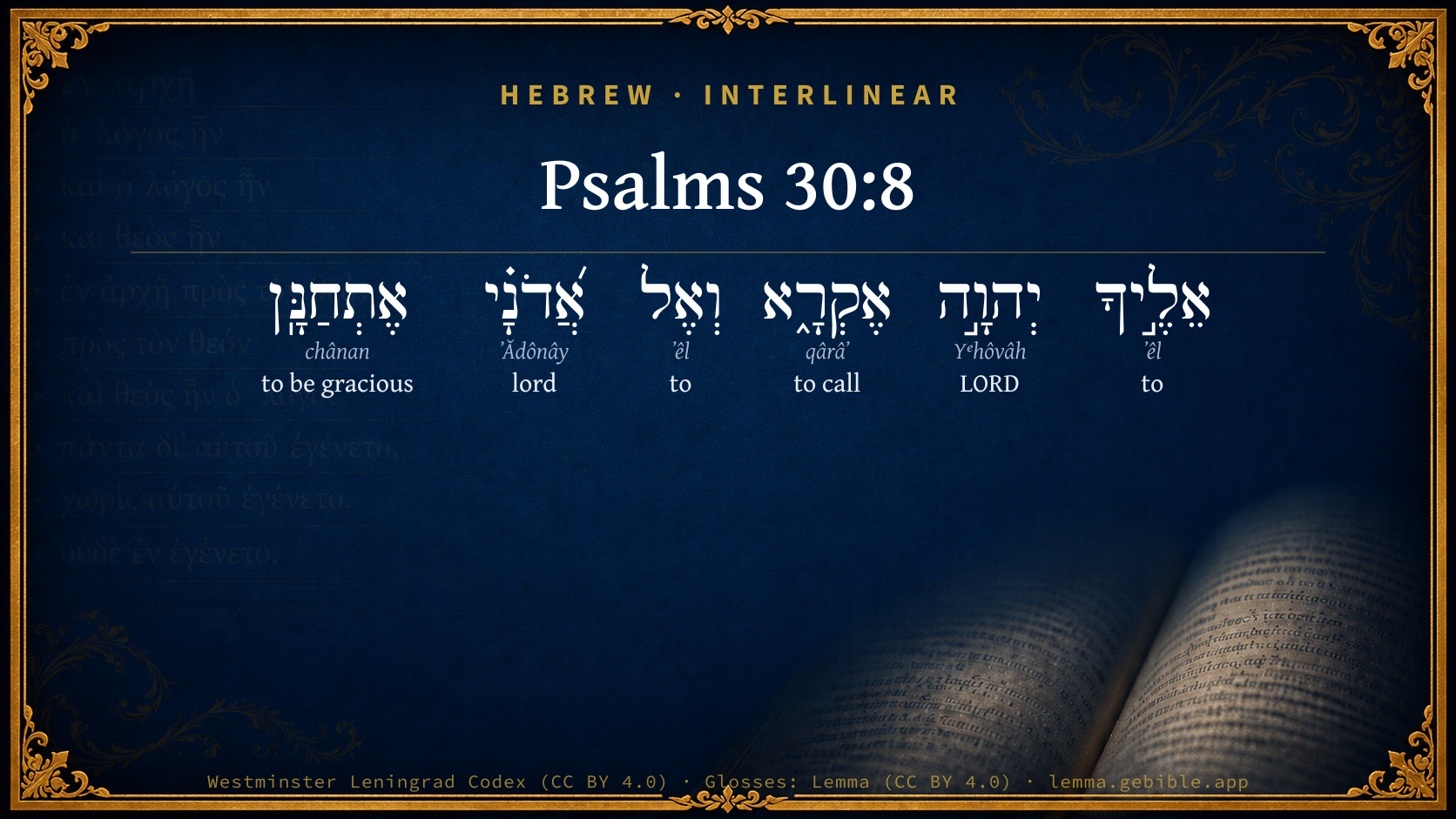
Hebrew (Westminster Leningrad Codex) Psalms 30:8 appears in the Hebrew Old Testament. The text above is from the Westminster Leningrad Codex. Each word links to its Strong’s number, a concise gloss, and parsing drawn from the Open Scriptures Hebrew Bible morphology. Click any word for its full Brown-Driver-Briggs (BDB) entry.
Download image
Cite this verse

Psalms 30:8 (World English Bible). Public Domain. Lemma interlinear Bible study tool, https://lemma.gebible.app/v/psalms/30/8.

Show BibTeX & RIS
BibTeX
RIS
English Translation
I cried to you, Yahweh. To Yahweh I made supplication:
World English Bible · Public Domain
Download a study sheet

One document with this verse’s original text, its word-by-word gloss line, the meaning frame, cross-references with their text, attributed commentary, and full source and license credits — printable, and it pastes into notes with its structure intact.

This verse Autodidact and up

Study sheet (.html) Plain text (.txt)

A passage Seminary Student

Up to 50 verses in one chapter. A passage sheet keeps up to 6 commentary sources and 12 cross-references per verse, in the order this page ranks them, and says so on the sheet whenever that leaves anything out. Ask for a single verse and you get the Autodidact verse sheet above.

Everything on this page stays free to read, with no account — the sheet is a download of what is already on screen, not access to it.

Want to remove ads? Support Godless Engineer
Compare translations 3

The same verse in 3 English versions, stacked beneath the original-language interlinear above. Click any original word for its lexicon entry.

Each is an independent rendering of the whole verse — the interlinear is not word-aligned to these translations.

Highlighted words mark where these versions differ — a whole-verse word diff, not a word-by-word alignment.

  • World English Bible Public Domain
    I cried to you, Yahweh. To Yahweh I made supplication:
  • King James Version Public Domain
    I cried to thee, O LORD; and unto the LORD I made supplication.
  • unfoldingWord Literal Text CC BY-SA 4.0
    To you, Yahweh, I cried out, and to the Lord I pled for favor.

unfoldingWord Literal Text — © unfoldingWord, licensed CC BY-SA 4.0. Word-aligned USFM3 via Door43 (git.door43.org/unfoldingWord/en_ult).

Versions to compare (up to 4)

3 of 4 selected

Show all 18 translations

Every available English version of this verse, each an independent rendering of the whole verse.

  • World English Bible Public Domain
    I cried to you, Yahweh. To Yahweh I made supplication:
  • Berean Standard Bible Public Domain
    To You, O LORD, I called, and I begged my Lord for mercy:
  • Majority Standard Bible Public Domain
    To You, O LORD, I called, and I begged my Lord for mercy:
  • King James Version Public Domain
    I cried to thee, O LORD; and unto the LORD I made supplication.
  • American Standard Version (1901) Public Domain
    I cried to thee, O Jehovah; And unto Jehovah I made supplication:
  • Revised Version (1885) Public Domain
    I cried to thee, O LORD; and unto the LORD I made supplication:
  • Geneva Bible (1599) Public Domain
    Then cried I vnto thee, O Lord, and praied to my Lord.
  • Douay-Rheims (1899) Public Domain
    O Lord, in thy favour, thou gavest strength to my beauty. Thou turnedst away thy face from me, and I became troubled.
  • Young's Literal Translation Public Domain
    Unto Thee, O Jehovah, I call, And unto Jehovah I make supplication.
  • Literal Standard Version CC BY-SA 4.0
    To You, O YHWH, I call, || And to YHWH I make supplication.
  • Unlocked Literal Bible CC BY-SA 4.0
    I cried to you, Yahweh, and sought favor from my Lord!
  • unfoldingWord Literal Text CC BY-SA 4.0
    To you, Yahweh, I cried out, and to the Lord I pled for favor.
  • Darby Bible Public Domain
    I called to thee, Jehovah, and unto the Lord did I make supplication:
  • World Messianic Bible Public Domain
    I cried to you, LORD. I made supplication to the Lord:
  • Webster's Bible Public Domain
    \\30:7\\LORD, by thy favor thou hast made my mountain to stand strong: thou didst hide thy face, and I was troubled.
  • Free Bible Version CC BY-SA 4.0
    I called out to you for help, Lord. I asked the Lord for grace, saying,
  • Bible in Basic English Public Domain
    My voice went up to you, O Lord; I made my prayer to the Lord.
  • JPS Tanakh (1917) Public Domain
    (30-9) Unto Thee, O LORD, did I call, and unto the LORD I made supplication:

Literal Standard Version (2020), Covenant Press — licensed CC BY-SA 4.0. Text via the HelloAO Bible API (eBible.org). Unlocked Literal Bible (unfoldingWord) — licensed CC BY-SA 4.0. Text via the HelloAO Bible API (eBible.org). unfoldingWord Literal Text — © unfoldingWord, licensed CC BY-SA 4.0. Word-aligned USFM3 via Door43 (git.door43.org/unfoldingWord/en_ult). Free Bible Version, Dr. Jonathan Gallagher — licensed CC BY-SA 4.0. Text via the HelloAO Bible API (eBible.org).

Word by word

More ways to search: Search by grammar → Find every occurrence → Compare this word →

Practice this passage: Drill this verse → Learn its vocabulary →

אֶתְחַנָּֽן
chânan
H2603
“to be gracious”
Verb, Hithpael, Imperfect, 1st Person, Common, Singular
Part of Speech
Verb
Stem
Hithpael
Form
Imperfect
Person
1st Person
Gender
Common
Number
Singular
Full BDB Definition

Origin: a primitive root [compare H2583 ]

TWOT: 694 , 695

to be gracious, show favour, pity - (Qal) to show favour, be gracious - (Niphal) to be pitied - (Piel) to make gracious, make favourable, be gracious - (Poel) to direct favour to, have mercy on - (Hophal) to be shown favour, be shown consideration - (Hithpael) to seek favour, implore favour - to be loathsome
  1. אֵלֶ֣יךָ ʼêl H413 “to · you” Preposition + Suffix, Personal, 2nd Person, Masculine, Singular
  2. יְהוָ֣ה Yᵉhôvâh H3068 “LORD” Noun, Proper
  3. אֶקְרָ֑א qârâʼ H7121 “to call” Verb, Qal, Imperfect, 1st Person, Common, Singular
  4. וְאֶל ʼêl H413 “and · to” Conjunction + Preposition
  5. אֲ֝דֹנָ֗י ʼĂdônây H136 “Lord · my” Noun, Common, Masculine, Plural, Construct + Suffix, Personal, 1st Person, Common, Singular

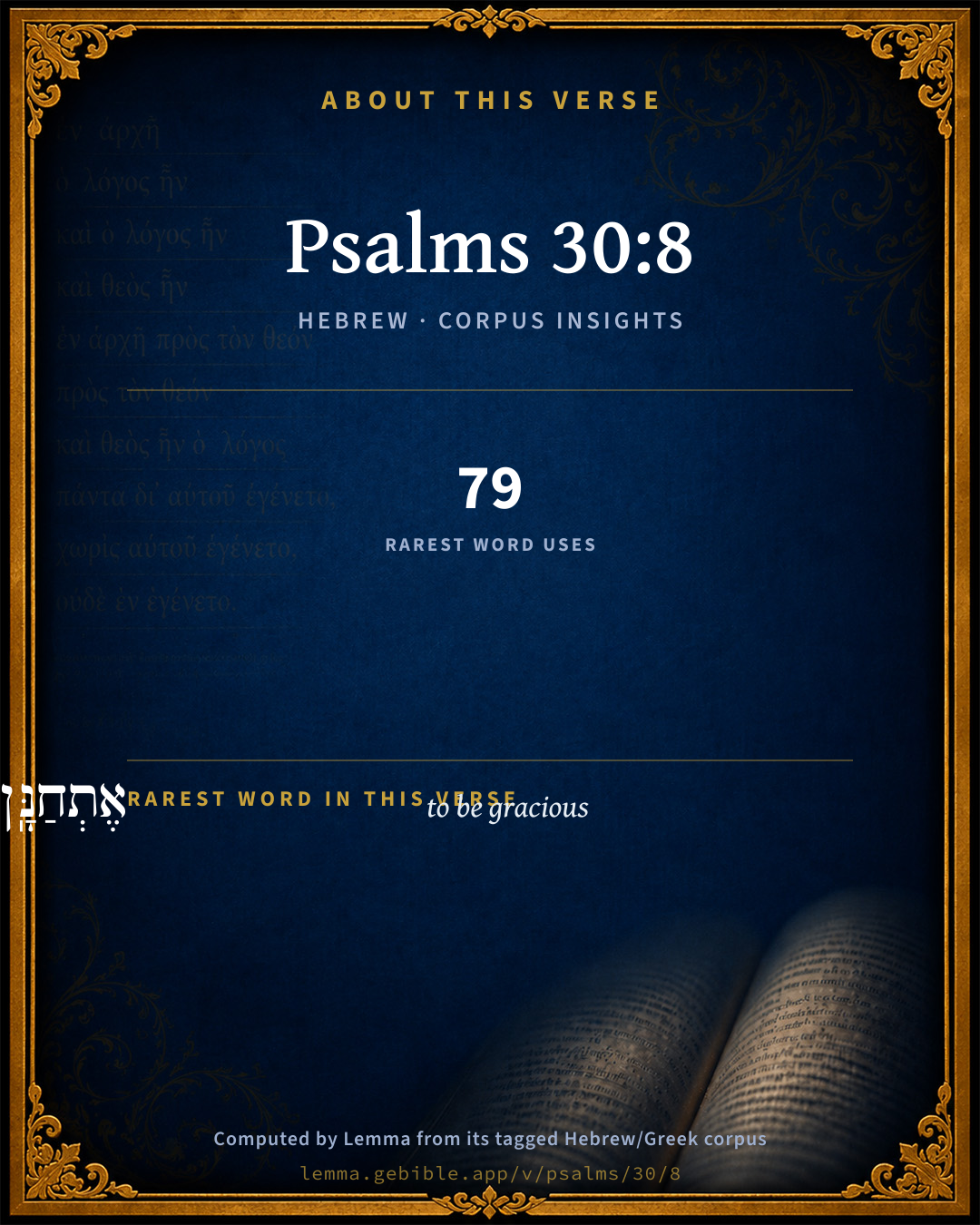
About this verse

These counts appear in no published source. They are computed here, from the morphology-tagged text and Lemma’s own curated glosses. What Lemma adds →

6
words
5
distinct lemmas
Wisdom
section

Grammatical profile

  • 2 verbs
  • 2 nouns
  • 2 prepositions

Verb forms

  • אֶקְרָ֑א Qal · Imperfect
  • אֶתְחַנָּֽן Hithpael · Imperfect

Repetition

A word recurs within this verse — often emphatic in Hebrew:

  • אֵלֶ֣יךָ to H413 ×2

Hebrew & Septuagint length

In English translation the verse runs 10 words from the Hebrew and 15 from the Septuagint (LXX English) — closely comparable.

A rough comparison of the two English renderings, which tokenize alike — not a word-level alignment.

Word counts can differ between the Hebrew and the Greek without any difference in meaning — e.g. the Hebrew direct-object marker אֵת has no separate Greek word, and Greek often adds the article ὁ.

Cross-references

5

Topical passages linked to Psalms 30:8 in the Treasury of Scripture Knowledge — connected by theme and wording, ordered by reader-vote popularity; previews shown in the World English Bible.

  • Philippians 4:6–7 In nothing be anxious, but in everything, by prayer and petition with thanksgiving, let your requests be made known to God.
  • Psalms 34:6 This poor man cried, and Yahweh heard him, And saved him out of all his troubles.
  • Psalms 130:1–2 Out of the depths I have cried to you, Yahweh.
  • Psalms 77:1–2 My cry goes to God! Indeed, I cry to God for help, And for him to listen to me.
  • 1 Corinthians 12:8–9 For to one is given through the Spirit the word of wisdom, and to another the word of knowledge, according to the same Spirit;

Cross-references courtesy of OpenBible.info (CC BY 4.0).

Hebrew and Greek witnesses Masoretic Hebrew ↔ Greek Septuagint

The same verse in the two great witnesses to the Old Testament, shown verse-for-verse.

You’re reading Greek Psalm 29 (Hebrew Psalm 30). The Septuagint counts the superscription, so verse numbers can differ from the Hebrew — chapter-level alignment, not verse-by-verse. Numbering follows Rahlfs.

These are two independent witnesses, not word-aligned to each other, and the Septuagint is shown in lemma (dictionary) form.

Hebrew Psalms 30:8 Masoretic · Westminster Leningrad Codex

אֵלֶ֣יךָ יְהוָ֣ה אֶקְרָ֑א וְאֶל אֲ֝דֹנָ֗י אֶתְחַנָּֽן

I cried to you, Yahweh. To Yahweh I made supplication:

World English Bible · Public Domain

Greek LXX Greek Psalm 29:8 Septuagint · lemma form

κύριος ἐν ὁ θέλημα σύ παραἔχω ὁ κάλλος ἐγώ δύναμις ἀποστρέφω δέ ὁ πρόσωπον σύ καί γίγνομαι ταράσσω

To you, O Lord, will I cry; and to my God will I make supplication.

LXX2012 (modern English Septuagint) · Public Domain

Hebrew: Westminster Leningrad Codex (CC BY 4.0). Greek: Septuagint (public domain); English from LXX2012 (modern English Septuagint) (Public Domain). How the Septuagint differs from the Hebrew →

Commentary

Notes on Psalms 30:8 from classic Christian and Jewish commentators (each source and its license shown beneath its notes). The classic Christian expositions comment on the surrounding passage and are grouped to its opening verse, so a note may address several verses; the Jewish commentaries on the Tanakh (Rashi and others) are per-verse, so they appear only where the commentator wrote on this verse.

Lemma curates 59 commentaries, every one of them public domain or Creative Commons licensed, each selected and text-cleaned for this edition rather than reprinted as found. About our sources →

Ellicott's Commentary for English Readers

(8) I cried to thee.—The very words of “this utter agony of prayer” are given. But it is better to keep the futures in Psa_30:8, instead of translating them as preterites, and make the quotation begin here. So Symmachus, “Then I said, I will cry to thee, O Lord,” &c

A Bible Commentary for English Readers, edited by Charles John Ellicott (1878–1897) — public domain. Text from a community e-Sword module.

Trapp's Complete Commentary

John Trapp

Psa 30:8 I cried to thee, O LORD; and unto the LORD I made supplication.

Ver. 8. I cried to thee, O Lord, &c.] For what reason? I felt myself, all that while that I was deserted, in a kind of hell above ground. Haec tentatio initium aliquod et gustus fuit illerum inenarrabilium dolorum quos impii sentiunt in omni aeternitate. David felt himself now in the suburbs of hell, as it were; and doth therefore set up as loud a cry after God as once Micah did after his idols, Jdg 18:24, and far greater cause he had.

And unto the Lord I made supplication] He knew that the same hand alone must cure him that had wounded him; neither was God’s favour recoverable, but by humble confession and hearty prayer. Some think to glide away their groans with games, and their cares with cards; to bury their terrors and themselves in wine and sleep. They run to their music, with Saul; to building of cities, with Cain, when cast out of God’s presence, &c., sed haeret lateri lethalis arundo; but as the wounded deer that hath the deadly arrow sticking in his side, well he may frisk up and down for a time, but still he bleedeth, and will ere long fall down dead; so it is with such as seek not comfort in God alone, as make not supplication to him for him; as return not to God, who hath smitten them, nor seek the Lord of hosts, Isa 9:13.

John Trapp, A Commentary or Exposition upon All the Books of the Old and New Testament (1647–1656) — public domain. Text from a community e-Sword module.

J. A. Alexander on Psalms

Joseph Addison Alexander

9. (Psa 30:8). Unto thee, Jehovah, will I call, and to Jehovah, I will cry for mercy. This was the resolution formed at the time when God concealed his face and he was troubled. The insertion of the words then said I, at the beginning of the verse, would render the connection clear, but is unnecessary. The translation of the futures as past tenses is a licence which could only be justified by extreme exegetical necessity, certainly not by the trivial circumstance, that the last clause speaks of Jehovah in the third, person, which is not more surprising in a prayer than the second person of the first clause would be in a narrative. The sudden change of person is, of course, the same in either case.

Joseph Addison Alexander, The Psalms Translated and Explained (1850) — public domain. Text from a community e-Sword module.

Tyndale Open Study Notes

Tyndale Open Resources

30:8-12 The psalmist faced death (also in 30:1-3)—perhaps literally, perhaps figuratively. But when he turned to the Lord, the Lord rescued him and turned his mourning into joyful dancing. Only God’s favor can permanently and powerfully overcome human failure and the depths of despair.

Tyndale Open Study Notes — © Tyndale Open Resources, licensed CC BY-SA 4.0. Text via the HelloAO Bible API.

Jamieson, Fausset & Brown

Robert Jamieson, A. R. Fausset & David Brown

As in Psa 6:5; Psa 88:10; Isa 38:18, the appeal for mercy is based on the destruction of his agency in praising God here, which death would produce. The terms expressing relief are poetical, and not to be pressed, though "dancing" is the translation of a word which means a lute, whose cheerful notes are contrasted with mourning, or (Amo 5:16) wailing.

Jamieson, Fausset & Brown — Commentary Critical and Explanatory on the Whole Bible (1871) — public domain (CC PDM 1.0). Text via the HelloAO Bible API.

Adam Clarke's Commentary

Verse 8. I cried to thee, O Lord] I found no help but in him against whom I had sinned. See his confession and prayer, 2Sa 24:17.

Made supplication.] Continued to urge my suit; was instant in prayer.

Adam Clarke's Commentary on the Bible (1810–1826) — public domain. Text from a community e-Sword/MySword module.

John Calvin's Commentaries

8. O Jehovah! I cried unto thee. Now follows the fruit of David’s chastisement. He had been previously sleeping profoundly, and fostering his indolence by forgetfulness; but being now awakened all on a sudden with fear and terror, he begins to cry to God. As the iron which has contracted rust cannot be put to any use until it be heated again in the fire, and beaten with the hammer, so in like manner, when carnal security has once got the mastery, no one can give himself cheerfully to prayer, until he has been softened by the cross, and thoroughly subdued. And this is the chief advantage of afflictions, that while they make us sensible of our wretchedness, they stimulate us again to supplicate the favor of God.

John Calvin's Commentaries (1540-1563) — public domain. Text from the Calvin Translation Society English edition (1840s-50s) via the Christian Classics Ethereal Library (ccel.org). Calvin's coverage is partial (roughly two-thirds of the Bible); uncommented books and verses are honest gaps, never fabricated. The 19th-century editor's footnotes and remarks are omitted so the notes are faithfully Calvin's own voice.

The Cambridge Bible for Schools and Colleges

gen. ed. J. J. S. Perowne

8. The tense in the original is inadequately represented by a simple perfect, though its precise force is not easy to define. It may express the frequent repetition of the prayer, or, like a historic present, it may set the action vividly before us as in actual progress (App., Note IV); or possibly throwing himself back into the past, the Psalmist gives the words of his resolution: [I said,] Unto thee, O Jehovah, will I call (= Psa_28:1); yea, unto the Lord (the best attested reading is Adonai) will I make supplication (Psa_142:1).

8–10. By trouble he learnt whence his strength came, and betook himself to prayer. Psa_30:9-10 are the words of his prayer.

The Cambridge Bible for Schools and Colleges (gen. ed. J. J. S. Perowne; Cambridge University Press, 1878–1918) — public domain. Text from a community e-Sword module.

John Gill's Exposition

I cried to thee, O Lord,.... In his trouble, when the Lord had hid his face from him, and he was sensible that he had departed from him: he was not stupid and unaffected with it; nor did he turn his back upon God, and seek to others; but he cried after a departing God, which showed love to him, and some degree of faith in him, by looking again towards his holy temple, and waiting upon him until he returned;

and unto the Lord I made supplication; in the most humble manner; entreating his grace and mercy, and that he would again show him his face and favour.

John Gill's Exposition of the Whole Bible (1746–1763) — public domain (CC PDM 1.0). Text via the HelloAO Bible API.

Albert Barnes' Notes on the Bible

I cried to thee, O Lord - That is, when those reverses came, and when that on which I had so confidently relied was taken away, I called upon the Lord; I uttered an earnest cry for aid. The prayer which he uttered on the occasion is specified in the following verses. The idea here is, that he was not driven from God by these reverses, but TO him. He felt that his reliance on those things in which he had put his trust was vain, and he now came to God, the true Source of strength, and sought His protection and favor. This was doubtless the design of the reverses which God had brought upon him; and this will always be the effect of the reverses that come upon good men. When they have placed undue reliance upon wealth, or health, or friends, and when these are taken away, the effect will be to lead them to God in earnest prayer. God designs to bring them back, and they do come back to him. Afflictions are always, sooner or later, effectual in bringing good men back to God. The sinner is often driven from God by trial; the good man is brought back to find his strength and comfort in God. The one complains, and murmurs, and is wretched; the other prays, and submits, and is made more happy than he was in the days of his prosperity.

Albert Barnes' Notes on the Bible (1834–1885) — public domain. Text from a community e-Sword/MySword module.

The Treasury of David

Charles H. Spurgeon

Ver. 8. I cried to thee, O Lord. Prayer is the unfailing resource of God's people. If they are driven to their wit's end, they may still go to the mercyseat. When an earthquake makes our mountain tremble, the throne of grace still stands firm, and we may come to it. Let us never forget to pray, and let us never doubt the success of prayer. The hand which wounds can heal: let us turn to him who smites us, and he will be entreated of us. Prayer is better solace than Cain's building a city, or Saul's seeking for music. Mirth and carnal amusements are a sorry prescription for a mind distracted and despairing: prayer will succeed where all else fails.

Ver. 8. I cried to thee, O Lord; and unto the Lord I made supplication. Bernard, under a fiction, proposes a fable well worthy of our beholding: therein the kings of Babylon and Jerusalem, signifying the state of the world and the church, always warring together; in which encounter, at length it fell out, that one of the soldiers of Jerusalem was fled to the castle of Justice. Siege laid to the castle, and a multitude of enemies entrenched round about it, Fear gave over all hope, but Prudence ministered her comfort. "Does thou not know, "saith she, "that our king is the King of glory; the Lord strong and mighty, even the Lord mighty in battle? Let us therefore despatch a messenger that may inform him of our necessities." Fear replies, "But who is able to break through? Darkness is upon the face of the earth, and our walls are begirt with a watchful troop of armed men, and we, utterly inexpert in the way into so far a country." Whereupon Justice is consulted. "Be of good cheer, "saith Justice, "I have a messenger of especial trust, well known to the king and his court, Prayer by name, who knoweth to address herself by ways unknown in the stillest silence of the night, till she cometh to the secrets and chamber of the King himself." Forthwith she goeth, and findeth the gates shut, knocketh again, "Open, ye gates of righteousness, and be ye opened, ye everlasting doors, that I may come in and tell the King of Jerusalem how our case standeth." Doubtless the trustiest and most effectual messenger we have to send is Prayer. If we send up merits, the stars in heaven will disdain it, that we which dwell at the footstool of God dare to presume so far, when the purest creatures in heaven are impure in his sight. If we send up fear and distrustfulness, the length of the way will tire them out. They are as heavy and lumpish as gads of iron; they will sink to the ground before they come half way to the throne of salvation. If we send up blasphemies and curses, all the creatures betwixt heaven and earth will band themselves against us. The sun and the moon will rain down blood; the fire, hot burning coals; the air, thunderbolts upon our heads. Prayer, I say again, is the surest ambassador; which neither the tediousness of the way, nor difficulties of the passage, can hinder from her purpose; quick of speed, faithful for trustiness, happy for success, able to mount above the eagles of the sky, into the heaven of heavens, and as a chariot of fire bearing us aloft into the presence of God to seek his assistance. John King.

Ver. 8., in connection with verse 3 prayer the universal remedy.

Psalms 30:9*

Charles H. Spurgeon's The Treasury of David (1869–1885) — public domain. Psalms only. Text from a community e-Sword/MySword module.

Whedon's Commentary on the Bible

Daniel D. Whedon

8. I cried to thee—See his prayer, 1Ch_21:17

Daniel D. Whedon (gen. ed.), Commentary on the Old and New Testaments (1874–1909) — public domain. Text from a community e-Sword module.

The Pulpit Commentary

1 cried to thee, O Lord; and unto thee I made supplication. (comp. 2Sa_24:17 1Ch_21:17) The part of his prayer most honourable to David is not recorded by himself, but by the historians. He tells us of his secret wrestlings with God, his complaints and expostulations his cries and pleadings as they remained in his memory; he passes over the desire to die for his people, which the historians put on record.

The Pulpit Commentary (1880–1919), ed. H.D.M. Spence-Jones & Joseph S. Exell — public domain. Text from a community e-Sword module.

Keil & Delitzsch

C. F. Keil & F. Delitzsch

(Heb.: 30:9-11) Nevertheless he who is thus chastened prayed fervently. The futures in Psa 30:9, standing as they do in the full flow of the narration, have the force of imperfects, of "the present in the past" as the Arabian grammarians call it. From the question "What profit is there (the usual expression for τίὄφελος, quid lucri) in my blood?", it is not to be inferred that David was in danger of death by the hand of a foe; for ותרפאני in Psa 30:3 teaches us very different, "what profit would there be in my blood?" is therefore equivalent to (cf. Job 16:18) what advantage would there be in Thy slaying me before my time? On the contrary God would rob Himself of the praise, which the living one would render to Him, and would so gladly render. His request that his life may be prolonged was not, therefore, for the sake of worldly possessions and enjoyment, but for the glory of God. He feared death as being the end of the praise of God. For beyond the grave there will be no more psalms sung, Psa 6:6. In the Old Testament, Hades was as yet unvanquished, Heaven was not yet opened. In Heaven are the בני אלים, but as yet no blessed בני אדם.

Keil & Delitzsch — Biblical Commentary on the Old Testament (1861–1891) — public domain (CC PDM 1.0). Text via the HelloAO Bible API. (Old Testament only.)

Lesson kit

Teaching starters — assembled from the data on this page, not authored interpretation. Every prompt links to the verse data it draws on. Edit before teaching.

Psalms, in the Wisdom, opens this verse with 6 words (5 distinct Hebrew lemmas). Its most distinctive word is chânan (“to be gracious”). A historical commentator’s framing appears above. Read the whole chapter for the surrounding context.

Discussion questions

  1. What does “to be gracious” (chânan) contribute to the verse as a whole?
  2. How does Philippians 4:6–7, which shares this passage’s theme, read alongside this verse?
  3. What does the repetition of “to” (2× in this one verse) do in this verse?
  4. These translations render this verse differently; the difference is in the English rendering, not the original. What questions does that raise?
  5. «אֶקְרָ֑א» is a Qal Imperfect verb. How does that grammatical form shape the action described?
  6. Compare how Ellicott's Commentary for English Readers and Trapp's Complete Commentary read this verse. Where do they agree or differ?

Things to notice

Reading settings

Reading text

Shown beneath each verse's original-language words.

Old Testament
Old Testament edition

Read the OT as the Masoretic Hebrew (MT) or the Greek Septuagint (LXX).

English shown for the Greek Septuagint (in the Hebrew ↔ Greek comparison).

Comparing translations? Open the Compare panel on any verse page to stack up to four side by side.