
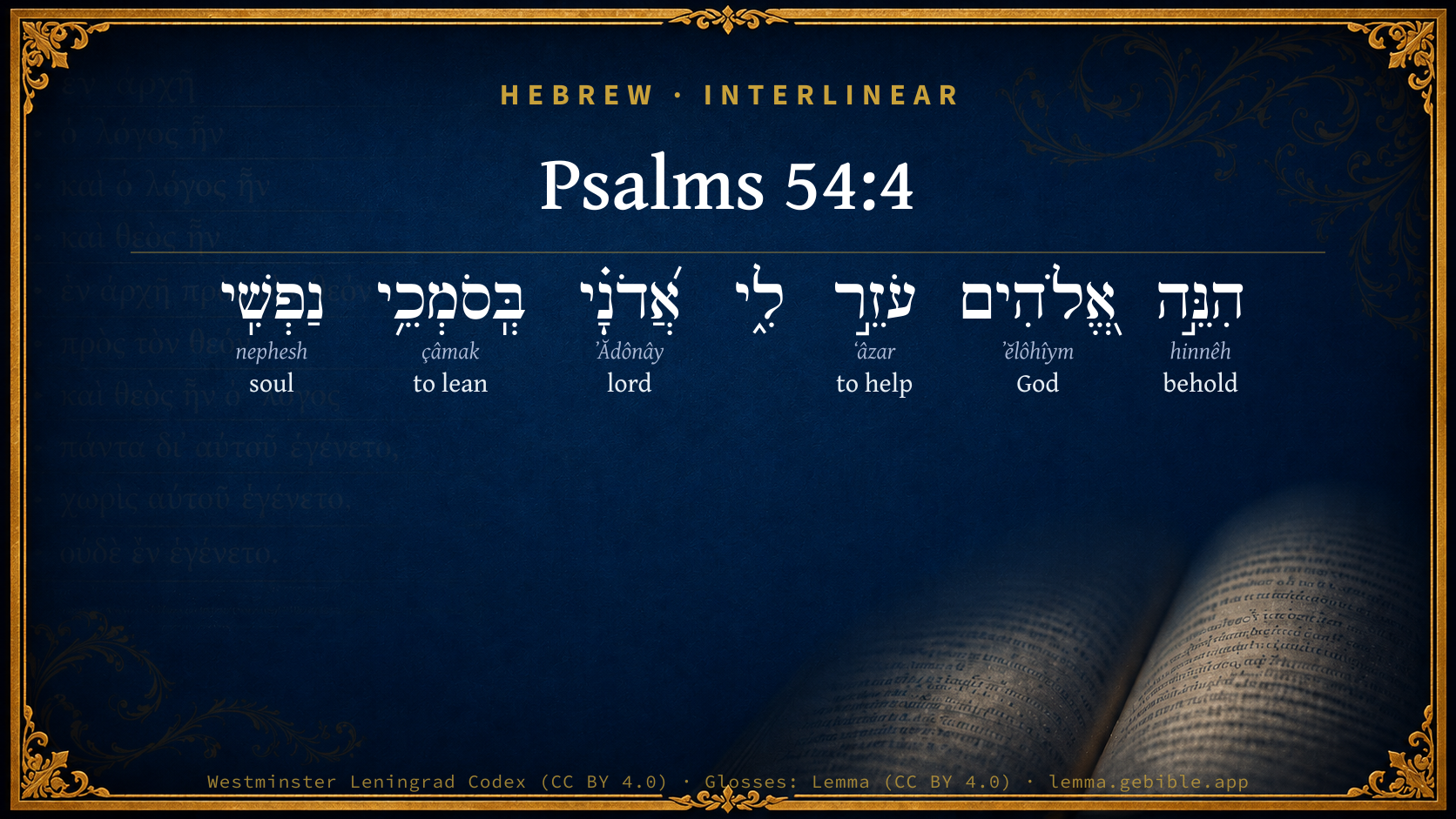
Psalms 54:4

Hebrew (Westminster Leningrad Codex) Psalms 54:4 appears in the Hebrew Old Testament. The text above is from the Westminster Leningrad Codex. Each word links to its Strong’s number, a concise gloss, and parsing drawn from the Open Scriptures Hebrew Bible morphology. Click any word for its full Brown-Driver-Briggs (BDB) entry.
Download image
Cite this verse

Psalms 54:4 (World English Bible). Public Domain. Lemma interlinear Bible study tool, https://lemma.gebible.app/v/psalms/54/4.

Show BibTeX & RIS
BibTeX
RIS
English Translation
Behold, God is my helper. The Lord is the one who sustains my soul.
World English Bible · Public Domain
Download a study sheet

One document with this verse’s original text, its word-by-word gloss line, the meaning frame, cross-references with their text, attributed commentary, and full source and license credits — printable, and it pastes into notes with its structure intact.

This verse Autodidact and up

Study sheet (.html) Plain text (.txt)

A passage Seminary Student

Up to 50 verses in one chapter. A passage sheet keeps up to 6 commentary sources and 12 cross-references per verse, in the order this page ranks them, and says so on the sheet whenever that leaves anything out. Ask for a single verse and you get the Autodidact verse sheet above.

Everything on this page stays free to read, with no account — the sheet is a download of what is already on screen, not access to it.

Want to remove ads? Support Godless Engineer
Compare translations 3

The same verse in 3 English versions, stacked beneath the original-language interlinear above. Click any original word for its lexicon entry.

Each is an independent rendering of the whole verse — the interlinear is not word-aligned to these translations.

Highlighted words mark where these versions differ — a whole-verse word diff, not a word-by-word alignment.

  • World English Bible Public Domain
    Behold, God is my helper. The Lord is the one who sustains my soul.
  • King James Version Public Domain
    Behold, God is mine helper: the Lord is with them that uphold my soul.
  • unfoldingWord Literal Text CC BY-SA 4.0
    Behold, God is a helper to me; the Lord with the sustainers of my life.

unfoldingWord Literal Text — © unfoldingWord, licensed CC BY-SA 4.0. Word-aligned USFM3 via Door43 (git.door43.org/unfoldingWord/en_ult).

Versions to compare (up to 4)

3 of 4 selected

Show all 18 translations

Every available English version of this verse, each an independent rendering of the whole verse.

  • World English Bible Public Domain
    Behold, God is my helper. The Lord is the one who sustains my soul.
  • Berean Standard Bible Public Domain
    Surely God is my helper; the Lord is the sustainer of my soul.
  • Majority Standard Bible Public Domain
    Surely God is my helper; the Lord is the sustainer of my soul.
  • King James Version Public Domain
    Behold, God is mine helper: the Lord is with them that uphold my soul.
  • American Standard Version (1901) Public Domain
    Behold, God is my helper: The Lord is of them that uphold my soul.
  • Revised Version (1885) Public Domain
    Behold, God is mine helper: the Lord is of them that uphold my soul.
  • Geneva Bible (1599) Public Domain
    Beholde, God is mine helper: the Lord is with them that vpholde my soule.
  • Douay-Rheims (1899) Public Domain
    O God, hear my prayer: give ear to the words of my mouth.
  • Young's Literal Translation Public Domain
    Lo, God `is' a helper to me, The Lord `is' with those supporting my soul,
  • Literal Standard Version CC BY-SA 4.0
    Behold, God [is] a helper to me, || The Lord [is] with those supporting my soul,
  • Unlocked Literal Bible CC BY-SA 4.0
    See, God is my helper; the Lord is the one who upholds me.
  • unfoldingWord Literal Text CC BY-SA 4.0
    Behold, God is a helper to me; the Lord with the sustainers of my life.
  • Darby Bible Public Domain
    Behold, God is my helper; the Lord is among them that uphold my soul.
  • World Messianic Bible Public Domain
    Behold, God is my helper. The Lord is the one who sustains my soul.
  • Webster's Bible Public Domain
    \\54:2\\Hear my prayer, O God; give ear to the words of my mouth.
  • Free Bible Version CC BY-SA 4.0
    But God helps me; the Lord saves my life!
  • Bible in Basic English Public Domain
    See, God is my helper: the Lord is the great supporter of my soul.
  • JPS Tanakh (1917) Public Domain
    (54-6) Behold, God is my helper; the Lord is for me as the upholder of my soul.

Literal Standard Version (2020), Covenant Press — licensed CC BY-SA 4.0. Text via the HelloAO Bible API (eBible.org). Unlocked Literal Bible (unfoldingWord) — licensed CC BY-SA 4.0. Text via the HelloAO Bible API (eBible.org). unfoldingWord Literal Text — © unfoldingWord, licensed CC BY-SA 4.0. Word-aligned USFM3 via Door43 (git.door43.org/unfoldingWord/en_ult). Free Bible Version, Dr. Jonathan Gallagher — licensed CC BY-SA 4.0. Text via the HelloAO Bible API (eBible.org).

Word by word

More ways to search: Search by grammar → Find every occurrence → Compare this word →

Practice this passage: Drill this verse → Learn its vocabulary →

בְּֽסֹמְכֵ֥י
çâmak
H5564
“in/at · leaning”
Preposition + Verb, Qal, Participle Active, Masculine, Plural, Construct
Part of Speech
Preposition + Verb
Stem
Qal
Form
Participle Active
Gender
Masculine
Number
Plural
State
Construct
Full BDB Definition

Origin: a primitive root

TWOT: 1514

to lean, lay, rest, support, put, uphold, lean upon - (Qal) - to lean or lay upon, rest upon, lean against - to support, uphold, sustain - (Niphal) to support or brace oneself - (Piel) to sustain, refresh, revive
  1. הִנֵּ֣ה hinnêh H2009 “behold” Particle, Demonstrative
  2. אֱ֭לֹהִים ʼĕlôhîym H430 “God(s)” Noun, Common, Masculine, Plural, Absolute
  3. עֹזֵ֣ר ʻâzar H5826 “helping” Verb, Qal, Participle Active, Masculine, Singular, Absolute
  4. אֲ֝דֹנָ֗י ʼĂdônây H136 “Lord · my” Noun, Common, Masculine, Plural, Construct + Suffix, Personal, 1st Person, Common, Singular
  5. נַפְשִֽׁי nephesh H5315 “soul · my” Noun, Common, Both, Singular, Construct + Suffix, Personal, 1st Person, Common, Singular

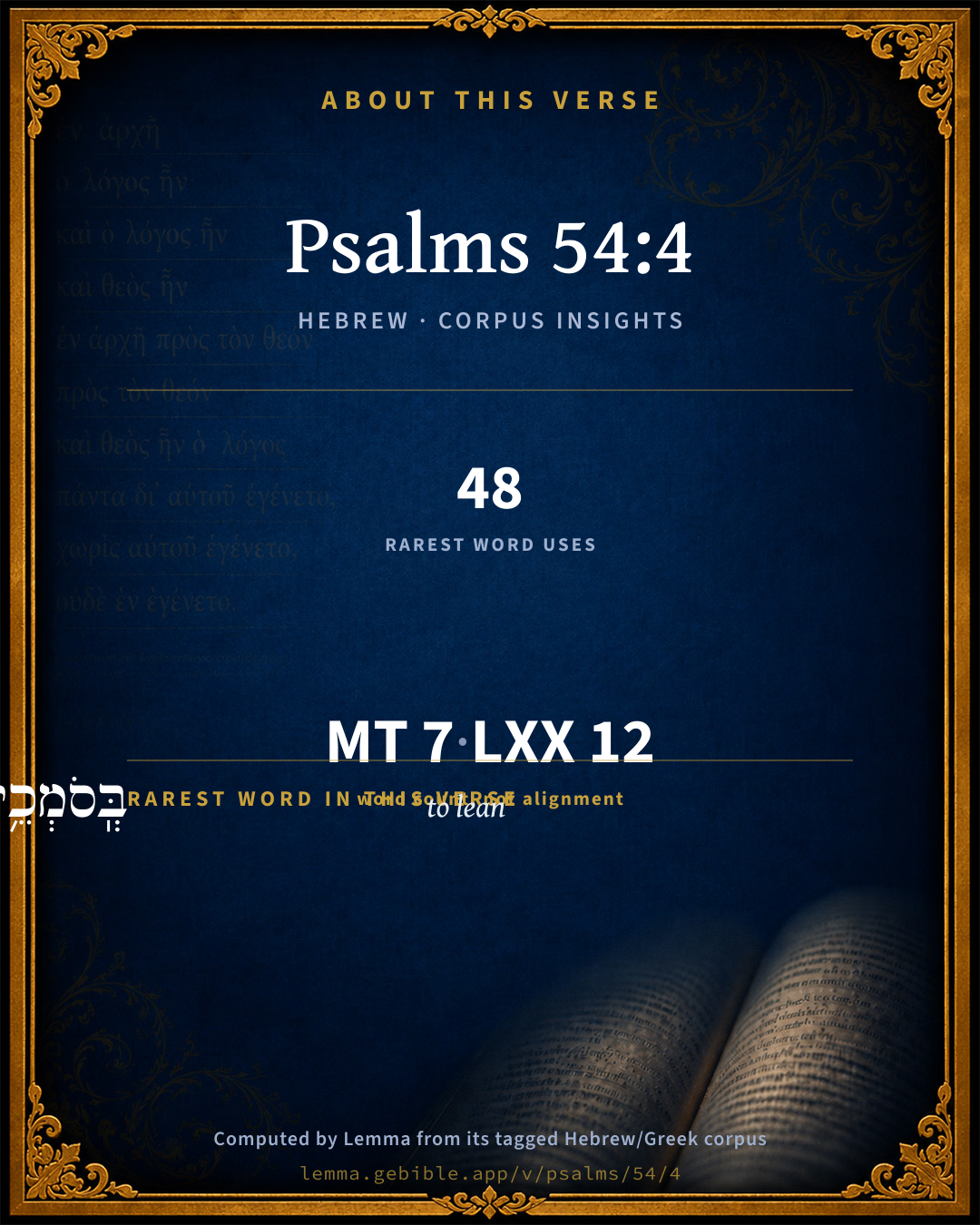
About this verse

These counts appear in no published source. They are computed here, from the morphology-tagged text and Lemma’s own curated glosses. What Lemma adds →

7
words
6
distinct lemmas
Wisdom
section

Shared distinctive vocabulary

בְּֽסֹמְכֵ֥י to lean H5564 occurs in 47 verses of the Hebrew Bible. Also found in:

Grammatical profile

  • 2 verbs
  • 3 nouns
  • 1 preposition
  • 1 particle

Verb forms

  • עֹזֵ֣ר Qal · Participle Active
  • בְּֽסֹמְכֵ֥י Qal · Participle Active

Hebrew & Septuagint length

In English translation the verse runs 14 words from the Hebrew and 14 from the Septuagint (LXX English) — the same length.

A rough comparison of the two English renderings, which tokenize alike — not a word-level alignment.

Word counts can differ between the Hebrew and the Greek without any difference in meaning — e.g. the Hebrew direct-object marker אֵת has no separate Greek word, and Greek often adds the article ὁ.

In the original languages it is 7 Hebrew tokens and 12 Greek tokens — but the two are counted differently (Hebrew bundles its prefixes and suffixes into one token; the Greek is in lemma form), so that isn’t a like-for-like length.

Cross-references

9

Topical passages linked to Psalms 54:4 in the Treasury of Scripture Knowledge — connected by theme and wording, ordered by reader-vote popularity; previews shown in the World English Bible.

  • Hebrews 13:6 So that with good courage we say, "The Lord is my helper. I will not fear. What can man do to me?"
  • Psalms 118:6–7 Yahweh is on my side. I will not be afraid. What can man do to me?
  • Isaiah 41:10 Don't you be afraid, for I am with you; don't be dismayed, for I am your God; I will strengthen you; yes, I will help you; yes, I will uphold you with the right hand of my righteousness.
  • Romans 8:31 What then shall we say about these things? If God is for us, who can be against us?
  • Psalms 118:13 You pushed me back hard, to make me fall, But Yahweh helped me.
  • Isaiah 50:7–9 For the Lord Yahweh will help me; therefore I have not been confounded: therefore have I set my face like a flint, and I know that I shall not be disappointed.
  • 1 Chronicles 12:18 Then the Spirit came on Amasai, who was chief of the thirty, [and he said], "We are yours, David, and on your side, you son of Jesse: peace, peace be to you, and peace be to your helpers; for your God helps you." Then David received them, and made them captains of the band.
  • Isaiah 42:1 Behold, my servant, whom I uphold; my chosen, in whom my soul delights: I have put my Spirit on him; he will bring forth justice to the Gentiles.
  • Psalms 41:12 As for me, you uphold me in my integrity, And set me in your presence forever.

Cross-references courtesy of OpenBible.info (CC BY 4.0).

Hebrew and Greek witnesses Masoretic Hebrew ↔ Greek Septuagint

The same verse in the two great witnesses to the Old Testament, shown verse-for-verse.

You’re reading Greek Psalm 53 (Hebrew Psalm 54). The Septuagint counts the superscription, so verse numbers can differ from the Hebrew — chapter-level alignment, not verse-by-verse. Numbering follows Rahlfs.

These are two independent witnesses, not word-aligned to each other, and the Septuagint is shown in lemma (dictionary) form.

Hebrew Psalms 54:4 Masoretic · Westminster Leningrad Codex

הִנֵּ֣ה אֱ֭לֹהִים עֹזֵ֣ר לִ֑י אֲ֝דֹנָ֗י בְּֽסֹמְכֵ֥י נַפְשִֽׁי

Behold, God is my helper. The Lord is the one who sustains my soul.

World English Bible · Public Domain

Greek LXX Greek Psalm 53:4 Septuagint · lemma form

ὁ θεός εἰςἀκούω ὁ προσευχή ἐγώ ἐνὠτίζομαι ὁ ῥῆμα ὁ στόμα ἐγώ

For behold! God assists me; and the Lord is the helper of my soul.

LXX2012 (modern English Septuagint) · Public Domain

On this verse, Ellicott's Commentary for English Readers discusses the Septuagint’s reading. Read the note in Commentary ↓

Hebrew: Westminster Leningrad Codex (CC BY 4.0). Greek: Septuagint (public domain); English from LXX2012 (modern English Septuagint) (Public Domain). How the Septuagint differs from the Hebrew →

Commentary

Notes on Psalms 54:4 from classic Christian and Jewish commentators (each source and its license shown beneath its notes). The classic Christian expositions comment on the surrounding passage and are grouped to its opening verse, so a note may address several verses; the Jewish commentaries on the Tanakh (Rashi and others) are per-verse, so they appear only where the commentator wrote on this verse.

Lemma curates 59 commentaries, every one of them public domain or Creative Commons licensed, each selected and text-cleaned for this edition rather than reprinted as found. About our sources →

Matthew Henry's Commentary

We have here the lively actings of David's faith in his prayer, by which he was assured that the issue would be comfortable, though the attempt upon him was formidable.

I. He was sure that he had God on his side, that God took his part (Psa 54:4); he speaks it with an air of triumph and exultation, Behold, God is my helper. If we be for him, he is for us; and, if he be for us, we shall have such help in him that we need not fear any power engaged against us. Though men and devils aim to be our destroyers, they shall not prevail while God is our helper: The Lord is with those that uphold my soul. Compare Psa 118:7, "The Lord taketh my part with those that help me. There are some that uphold me, and God is one of them; he is the principal one; none of them could help me if he did not help them." Every creature is that to us (and no more) that God makes it to be. He means, "The Lord is he that upholds my soul, and keeps me from tiring in my work and sinking under my burdens." He that by his providence upholds all things by his grace upholds the souls of his people. God, who will in due time save his people, does, in the mean time, sustain them and bear them up, so that the spirit he has made shall not fail before him.

II. God taking part with him, he doubted not but his enemies should both flee and fall before him (Psa 54:5): "He shall reward evil unto my enemies that observe me, seeking an opportunity to do me a mischief. The evil they designed against me the righteous God will return upon their own heads." David would not render evil to them, but he knew God would: I as a deaf man heard not, for thou wilt hear. The enemies we forgive, if they repent not, God will judge; and for this reason we must not avenge ourselves, because God has said, Vengeance is mine. But he prays, Cut them off in thy truth. This is not a prayer of malice, but a prayer of faith; for it has an eye to the word of God, and only desires the performance of that. There is truth in God's threatenings as well as in his promises, and sinners that repent not will find it so to their cost.

III. He promises to give thanks to God for all the experiences he had had of his goodness to him (Psa 54:6): I will sacrifice unto thee. Though sacrifices were expensive, yet, when God required that his worshippers should in that way praise him, David would not only offer them, but offer them freely and without grudging. All our spiritual sacrifices must, in this sense, be free-will-offerings; for God loves a cheerful giver. Yet he will not only bring his sacrifice, which was but the shadow, the ceremony; he will mind the substance: I will praise thy name. A thankful heart, and the calves of our lips giving thanks to his name, are the sacrifices God will accept: "I will praise thy name, for it is good. Thy name is not only great but good, and therefore to be praised. To praise thy name is not only what we are bound to, but it is good, it is pleasant, it is profitable; it is good for us (Psa 92:1); therefore I will praise thy name."

IV. He speaks of his deliverance as a thing done (Psa 54:7): I will praise thy name, and say, "He has delivered me; this shall be my song then." That which he rejoices in is a complete deliverance - He has delivered me from all trouble; and a deliverance to his heart's content - My eye has seen its desire upon my enemies, not seen them cut off and ruined, but forced to retreat, tidings being brought to Saul that the Philistines were upon him, Sa1 23:27, Sa1 23:28. All David desired was to be himself safe; when he saw Saul draw off his forces he saw his desire. He has delivered me from all trouble. Either, 1. With this thought David comforted himself when he was in distress: "He has delivered me from all trouble hitherto, and many a time I have gained my point, and seen my desire on my enemies; therefore he will deliver me out of this trouble." We should thus, in our greatest straits, encourage ourselves with our past experiences. Or, 2. With this thought he magnified his present deliverance when the fright was over, that it was an earnest of further deliverance. He speaks of the completing of his deliverance as a thing done, though he had as yet many troubles before him, because, having God's promise for it, he was as sure of it as if it had been done already. "He that has begun to deliver me from all troubles, and will at length give me to see my desire upon my enemies." This may perhaps point at Christ, of whom David was a type; God would deliver him out of all the troubles of his state of humiliation, and he was perfectly sure of it; and all things are said to be put under his feet; for, though we see not yet all things put under him, yet we are sure he shall reign till all his enemies be made his footstool, and he shall see his desire upon them. However, it is an encouragement to all believers to make that use of their particular deliverances which St. Paul does (like David here), Ti2 4:17, Ti2 4:18, He that delivered me from the mouth of the lion shall deliver me from every evil work, and will preserve me to his heavenly kingdom.

Matthew Henry's Commentary on the Whole Bible (1708–1710) — public domain (CC PDM 1.0). Text via the HelloAO Bible API.

Trapp's Complete Commentary

John Trapp

Psa 54:4 Behold, God [is] mine helper: the Lord [is] with them that uphold my soul.

Ver. 4. Behold, God is mine helper] And that mine enemies might have seen, had they set God before them. The Dutch have a proverb, Where God hath a mind to destroy a man, he first putteth out his eyes.

The Lord is with them that uphold my soul] That favour my righteous cause, and wish my welfare, as doth Jonathan, and the rest that fear God; who although they be but few and feeble in comparison, yet they have God with them and for them ( non interfuit modo, sed etiam praefuit), and how many do you reckon him for? as Antigonus once said. David was environed, and in great danger to be surprised; but God rescued him by an invasion of the Philistines, 1Sa 23:27-28. The Lord knoweth how to deliver his, 2Pe 2:9 R. Moses expounded it, God is loco omnium, et super omnes, instead of all, and above all.

John Trapp, A Commentary or Exposition upon All the Books of the Old and New Testament (1647–1656) — public domain. Text from a community e-Sword module.

The Biblical Illustrator

Joseph S. Exell

Psa_54:4-7

Behold, God is mine helper; the Lord is with them that uphold my soul

God our Helper

I.

When God is the helper of His people.

1. In the great crisis of their conversion. He raiseth from the pit, delivers, saves, etc.

2. In the troubles and afflictions of life. These are many, varied, sometimes severe, etc. Job, the apostles (2Co_1:8-10).

3. In the perils and conflicts of their warfare (Psa_37:14-15; Psa_60:11-12).

4. In their labours and toils in His kingdom (Psa_121:1-2).

5. In weakness, sickness and death (Psa_23:4; Psa_116:1-9).

II. What kind of a helper is God.

1. Always near at hand.

2. Always efficient and sufficient.

3. Perpetual and everlasting.

III. The conclusions to which the subject should lead us.

1. Personal knowledge and reliance on God.

2. Unwavering faith and hope.

3. Constant prayer and supplication. He will be sought and inquired of.

4. Acknowledgment and praise. Bless the Lord at all times, etc. (J. Burns, D. D.)

The Biblical Illustrator, edited by Joseph S. Exell (c. 1880s–1900s) — public domain. Text from a community e-Sword module.

The Treasury of David

Charles H. Spurgeon

Ver. 4. Behold, God is mine helper. He saw enemies everywhere, and now to his joy as he looks upon the band of his defenders he sees one whose aid is better than all the help of men; he is overwhelmed with joy at recognizing his divine champion, and cries,

Behold. And is not this a theme for pious exultation in all time, that the great God protects us, his own people: what matters the number or violence of our foes when HE uplifts the shield of his omnipotence to guard us, and the sword of his power to aid us? Little care we for the defiance of the foe while we have the defence of God.

The Lord is with them that uphold my soul. The reigning Lord, the great Adonai is in the camp of my defenders. Here was a greater champion than any of the three mighties, or than all the valiant men who chose David for their captain. The psalmist was very confident, he felt so thoroughly that his heart was on the Lord's side that he was sure God was on his side. He asked in the first verse for deliverance, and here he returns thanks for upholding: while we are seeking one mercy which we have not, we must not be unmindful of another which we have. It is a great mercy to have some friends left us, but a greater mercy still to see the Lord among them, for like so many cyphers our friends stand for nothing till the Lord sets himself as a great unit in the front of them.

Ver. 4. Behold, says he, I produce a certain fact, well known, demonstrated by a new proof, and worthy of all attention; for the particle behold, contains this breadth of meaning. Hermann Venema.

Ver. 4. Christ sees with the utmost clearness, that God will be his own helper, and of them--the disciples and believers-- that uphold his soul. In the same moment, does he foresee the destruction of his enemies. He views, in thought, the armies of Titus, the fall of the Jewish nation, and the dispersion of the remnant. He beholds the avenging hand of God, stretched in fury over the destroyers. William Hill Tucker.

Ver. 4. (second clause). Such as take part with the persecuted saints, God will take part with them! The Lord is with them that uphold my soul. David Dickson.

Ver. 4-5. He is assured of help to himself and to his friends, and of vengeance to his enemies. Whence learn,

1. Fervent prayer hath readily a swift answer, and sometimes wonderfully swift, even before a man have ended speech, as here David findeth in experience. Behold, saith he, God is my helper.

2. The sight of faith is very clear and piercing through all clouds when God holds forth the light of his Spirit unto it, it can demonstrate God present in an instant; ready to help in greatest straits: Behold, God is my helper.

3. There is more joy in God's felt presence than grief in felt trouble; for, Behold, God is mine helper, was more comfortable to David than his friends' unkindness, and strangers' malice was grievous. David Dickson.

Ver. 4. A theme for wonder.

1. At his unmerited grace, that he should side with me.

2. At his gracious power, for who can resist him?

3. At his practical help, for he has upheld my soul.

Psalms 54:5*

Ver. 4-5. See Psalms on "Ps 54:4" for further information.

Charles H. Spurgeon's The Treasury of David (1869–1885) — public domain. Psalms only. Text from a community e-Sword/MySword module.

Joseph Benson's Commentary

Psa 54:4-5. Behold, God is my helper — Consider it, and see the vanity of all your wicked practices against me. The Lord is with them that uphold my soul — He fights for them, and on my behalf, and therefore against all mine enemies. He shall reward evil to mine enemies — He shall bring upon themselves the mischief they intended for me. Cut them off in thy truth — For, or according to, thy truth; whereby thou art engaged to fulfil thy promises made to me, and thy threatenings denounced against thine and mine implacable enemies.

Joseph Benson's Commentary on the Old and New Testaments (1811–1818) — public domain. Text from a community e-Sword module.

J. A. Alexander on Psalms

Joseph Addison Alexander

6. (Psa 54:4). Behold, God (is) a helper for me; the Lord is among the upholders of my soul. From the party of his enemies he looks to that of his defenders, and joyfully recognises God, not merely with, but in (the midst of) them, among them. The behold is expressive of surprise, and at the same time of a perspicacious faith. With the form of expression in the first clause, compare Psa 30:10; with the second Psa 118:7, Jdg 11:35. The upholders of his soul are the defenders of his life against those who seek it. See above, Psa 54:5 (3). Adhonai, the divine name properly translated Lord, because expressive of God's sovereignty. It is peculiarly appropriate here, where he is claiming God as his protector.

Joseph Addison Alexander, The Psalms Translated and Explained (1850) — public domain. Text from a community e-Sword module.

Geneva Bible (1599)

Geneva Bible translators

Be they never so few, as he was with Jonathan.

Geneva Bible (1599) marginal notes — public domain. Text via Bolls.life.

Jamieson, Fausset & Brown

Robert Jamieson, A. R. Fausset & David Brown

(Compare Psa 30:10).

with them--on their side, and for me (compare Psa 46:11).

Jamieson, Fausset & Brown — Commentary Critical and Explanatory on the Whole Bible (1871) — public domain (CC PDM 1.0). Text via the HelloAO Bible API.

Adam Clarke's Commentary

Verse 4. Behold, God is mine helper] This would naturally occur to him when he saw that Saul was obliged to leave the pursuit, and go to defend his territories, when he was on the very point of seizing him. God, whose providence is ever watchful, had foreseen this danger, and stirred up the Philistines to make this inroad just at the time in which Saul and his army were about to lay hands on David. Well might he then say, "Behold, God is mine helper."

Is with them, that uphold my soul.] נפשי naphshi, my life. This may even refer to the Philistines, who had at this time made an inroad on Israel. God was even with his own enemies, by making them instruments to save the life of his servant.

Adam Clarke's Commentary on the Bible (1810–1826) — public domain. Text from a community e-Sword/MySword module.

John Calvin's Commentaries

4. Behold! God is my helper Such language as this may show us that David did not direct his prayers at random into the air, but offered them in the exercise of a lively faith. There is much force in the demonstrative adverb. He points, as it were, with the finger, to that God who stood at his side to defend him; and was not this an amazing illustration of the power with which faith can surmount all obstacles, and glance, in a moment, from the depths of despair to the very throne of God? He was a fugitive amongst the dens of the earth, and even there in hazard of his life — how, then, could he speak of God as being near to him? He was pressed down to the very mouth of the grave; and how could he recognize the gracious presence of God? He was trembling in the momentary expectation of being destroyed; and how is it possible that he can triumph in the certain hope that Divine help will presently be extended to him? In numbering God amongst his defenders, we must not suppose that he assigns him a mere common rank amongst the men who supported his cause, which would have been highly derogatory to his glory. He means that God took part with those, such as Jonathan and others, who were interested in his welfare. These might be few in number, possessed of little power, and cast down with fears; but he believed that, under the guidance and protection of the Almighty, they would prove superior to his enemies: or, perhaps, we may view him as referring, in the words, to his complete destitution of all human defenders, and asserting that the help of God would abundantly compensate for all.

John Calvin's Commentaries (1540-1563) — public domain. Text from the Calvin Translation Society English edition (1840s-50s) via the Christian Classics Ethereal Library (ccel.org). Calvin's coverage is partial (roughly two-thirds of the Bible); uncommented books and verses are honest gaps, never fabricated. The 19th-century editor's footnotes and remarks are omitted so the notes are faithfully Calvin's own voice.

Ellicott's Commentary for English Readers

(4) With them . . .—Better, is a supporter of my life. So LXX. and Vulgate.

A Bible Commentary for English Readers, edited by Charles John Ellicott (1878–1897) — public domain. Text from a community e-Sword module.

The Cambridge Bible for Schools and Colleges

gen. ed. J. J. S. Perowne

4. God is mine helper] Taught by his past experience he can say not merely that God will help him, but that God is on his side, so that the issue cannot be doubtful.

the Lord is with them that uphold my soul] R.V., is of them that uphold my soul: perhaps better, is the Upholder of my soul. The expression is an idiomatic one, and “the sense is not that God is the support of the Psalmist among many others, but that He is so in a supreme degree, that He sums up in Himself the qualities of a class, viz. the class of helpers (so Psa_118:7). Comp. Jdg_11:35, ‘Alas, my daughter, thou hast bowed me down; even thou art my greatest troubler.’ ” (Cheyne). For uphold cp. Psa_3:5 (sustaineth); Psa_51:12.

4–7. A confident expectation of deliverance and vow of thanksgiving.

The Cambridge Bible for Schools and Colleges (gen. ed. J. J. S. Perowne; Cambridge University Press, 1878–1918) — public domain. Text from a community e-Sword module.

John Gill's Exposition

Behold, God is mine helper,.... This being a matter of wonder to be helped in so extraordinary a manner, and a sure and certain case, and what was deserving the attention of others; for the encouragement of their faith and hope in like cases, a "behold" is prefixed unto it: and what is here said is true of David's son, the Messiah, and is expressed by him in much the same language, Isa 50:9; and of all the saints whom the Lord helps, as at first conversion, out of the pit wherein is no water, out of the horrible pit, the mire and clay of nature's darkness, ignorance, and unbelief; so out of all their afflictions and temptations, and out of the hands of all their enemies; he helps in the exercise of grace, and in the discharge of duty; and he helps to all mercies, temporal and spiritual, needful for them; which help is quick and present, seasonable and suitable, always sufficient; and is what they have reason to expect both from what he has said to them in promise, and from what he has done for them;

the Lord is with them that uphold my soul; that ministered to his sustenance, as Abigail did, and that gathered to him and joined him, and exposed their lives in the defence of him; these the Lord was with, blessed, protected, and afforded them his gracious presence. Such there were with Christ; who followed him in the regeneration; who ministered to him of their substance, whom God rewarded in a way of grace; and he blesses them that bless his, and do good to them; they being the excellent in the earth, in whom is his delight, the apple of his eye, and his jewels. Or the sense is, that the Lord is he that upheld his soul; not only the chief of his upholders, but the only one: so R. Moses (l) interprets it, that he is the alone upholder, and is instead of all upholders, and answers to them all; who upheld his soul in life, and followed him with his goodness: as when God is said to be the first, and "with the last", the meaning is, that he is the first and the last, Isa 41:4; see Psa 118:7; so he upheld the soul of Christ in the wilderness, and in the garden, and on the cross; see Isa 42:1. And he upholds all his people in a providential way in their beings, and supplies them with all the necessaries of life; and, in a spiritual way, maintaining their spiritual life, supplying them with all grace, bearing them up under all trials, holding up their goings in his ways, and preserving them to the end.

(l) Apud Aben Ezram in loc.

John Gill's Exposition of the Whole Bible (1746–1763) — public domain (CC PDM 1.0). Text via the HelloAO Bible API.

Albert Barnes' Notes on the Bible

Behold, God is mine helper - That is, God alone can aid me in these circumstances, and to him I confidently look.

The Lord is with them that uphold my soul - My friends; those who have rallied around me to defend me; those who comfort me by their presence; those who sustain me in my cause, and who keep me from sinking under the burden of my accumulated troubles.

Albert Barnes' Notes on the Bible (1834–1885) — public domain. Text from a community e-Sword/MySword module.

Matthew Poole's English Annotations

Behold; consider it, and see the vanity of all your wicked practices against me.

The Lord is with them that uphold my soul; he fights for them, and on my behalf, and therefore against all mine enemies.

Matthew Poole's English Annotations on the Holy Bible (1683–1685) — public domain. Text from a community e-Sword/MySword module.

Whedon's Commentary on the Bible

Daniel D. Whedon

4. Behold, God is mine helper—From the treachery and enmity of men the psalmist turns in confidence to God. Help, here, literally means to surround, as if to protect on all sides. The complementary word in the next hemistich is uphold, support, make strong. The participial form of the two words denotes a present helping and upholding, as if faith already felt the prayed-for relief. Calvin: “Then must it needs be that he excelled wonderfully in strength of faith, whereby, surmounting so many obstacles, he penetrated even from hell to heaven.” The form is very expressive, not only counting God in the class of his helpers, but placing him as his sole reliance.

Daniel D. Whedon (gen. ed.), Commentary on the Old and New Testaments (1874–1909) — public domain. Text from a community e-Sword module.

The Pulpit Commentary

Behold, God is mine Helper. There is a pause between vers. 3 and 4, indicated by the pause-mark, "Selah." Then, confident of his prayer having been heard, the psalmist breaks out into a joyous burst of thankfulness and self-gratulation (vers. 4-7). The Lord is with them that uphold my soul; rather, of them (Revised Version); i.e. "one of them.

But the intention is not to place God on a par with other helpers. Rather, as Professor Cheyne remarks, it is to make him the representative of" the class of helpers."

The Pulpit Commentary (1880–1919), ed. H.D.M. Spence-Jones & Joseph S. Exell — public domain. Text from a community e-Sword module.

Keil & Delitzsch

C. F. Keil & F. Delitzsch

(Heb.: 54:6-9) In this second half, the poet, in the certainty of being heard, rejoices in help, and makes a vow of thanksgiving. The בּ of בּסמכי is not meant to imply that God is one out of many who upheld his threatened life; but rather that He comes within the category of such, and fills it up in Himself alone, cf. Psa 118:7; and for the origin of this Beth essentiae, Psa 99:6, Jdg 11:35. In Psa 54:7 the Kerמ merits the preference over the Chethמb (evil shall "revert" to my spies), which would at least require על instead of ל (cf. Psa 7:17). Concerning שׁררי, vid., on Psa 27:11. In the rapid transition to invocation in Psa 54:7 the end of the Psalm announces itself. The truth of God is not described as an instrumental agent of the cutting off, but as an impelling cause. It is the same Beth as in the expression בּנדבה (Num 15:3): by or out of free impulse. These free-will sacrifices are not spiritual here in opposition to the ritual sacrifices (Psa 50:14), but ritual as an outward representation of the spiritual. The subject of הצּילני is the Name of God; the post-biblical language, following Lev 24:11, calls God straightway השּׁם, and passages like Isa 30:27 and the one before us come very near to this usage. The praeterites mention the ground of the thanksgiving. What David now still hopes for will then lie behind him in the past. The closing line, v. 9b, recalls Psa 35:21, cf. Psa 59:11; Psa 92:12; the invoking of the curse upon his enemies in v. 8 recalls Psa 17:13; Psa 56:8; Psa 59:12.; and the vow of thanksgiving in v. 8 recalls Psa 22:26; Psa 35:18; Psa 40:10.

Keil & Delitzsch — Biblical Commentary on the Old Testament (1861–1891) — public domain (CC PDM 1.0). Text via the HelloAO Bible API. (Old Testament only.)

unfoldingWord translationNotes

Door43 World Missions Community

who upholds me

Defending David and keeping him safe is spoken of as upholding or supporting him. AT: "who defends me" or "who keeps me safe" (See: Metaphor)

He will repay my enemies with evil

Punishment is spoken as if it were payment. AT: "He will do the evil to my enemies that they have done to me" or "He will cause the evil that my enemies have done to me to be done to them" (See: Metaphor)

in your faithfulness, destroy them

Here David changes from talking about God to talking to God. AT: "God, destroy them because you are faithful to me"

translationWords

lord

evil

faithful

unfoldingWord translationNotes — © Distant Shores Media and the Door43 World Missions Community, licensed CC BY-SA 4.0. Source: git.door43.org/Door43/en_tn.

Lesson kit

Teaching starters — assembled from the data on this page, not authored interpretation. Every prompt links to the verse data it draws on. Edit before teaching.

Psalms, in the Wisdom, opens this verse with 7 words (6 distinct Hebrew lemmas). Its most distinctive word is çâmak (“to lean”). A historical commentator’s framing appears above. Read the whole chapter for the surrounding context.

Discussion questions

  1. What does “to lean” (çâmak) contribute to the verse as a whole?
  2. How does Genesis 27:37, which shares the word «to lean», read alongside this verse?
  3. These translations render this verse differently. What is at stake in choosing one wording over another?
  4. «עֹזֵ֣ר» is a Qal Participle Active verb. How does that grammatical form shape the action described?
  5. Compare how Matthew Henry's Commentary and Trapp's Complete Commentary read this verse. Where do they agree or differ?

Things to notice

Reading settings

Reading text

Shown beneath each verse's original-language words.

Old Testament
Old Testament edition

Read the OT as the Masoretic Hebrew (MT) or the Greek Septuagint (LXX).

English shown for the Greek Septuagint (in the Hebrew ↔ Greek comparison).

Comparing translations? Open the Compare panel on any verse page to stack up to four side by side.