
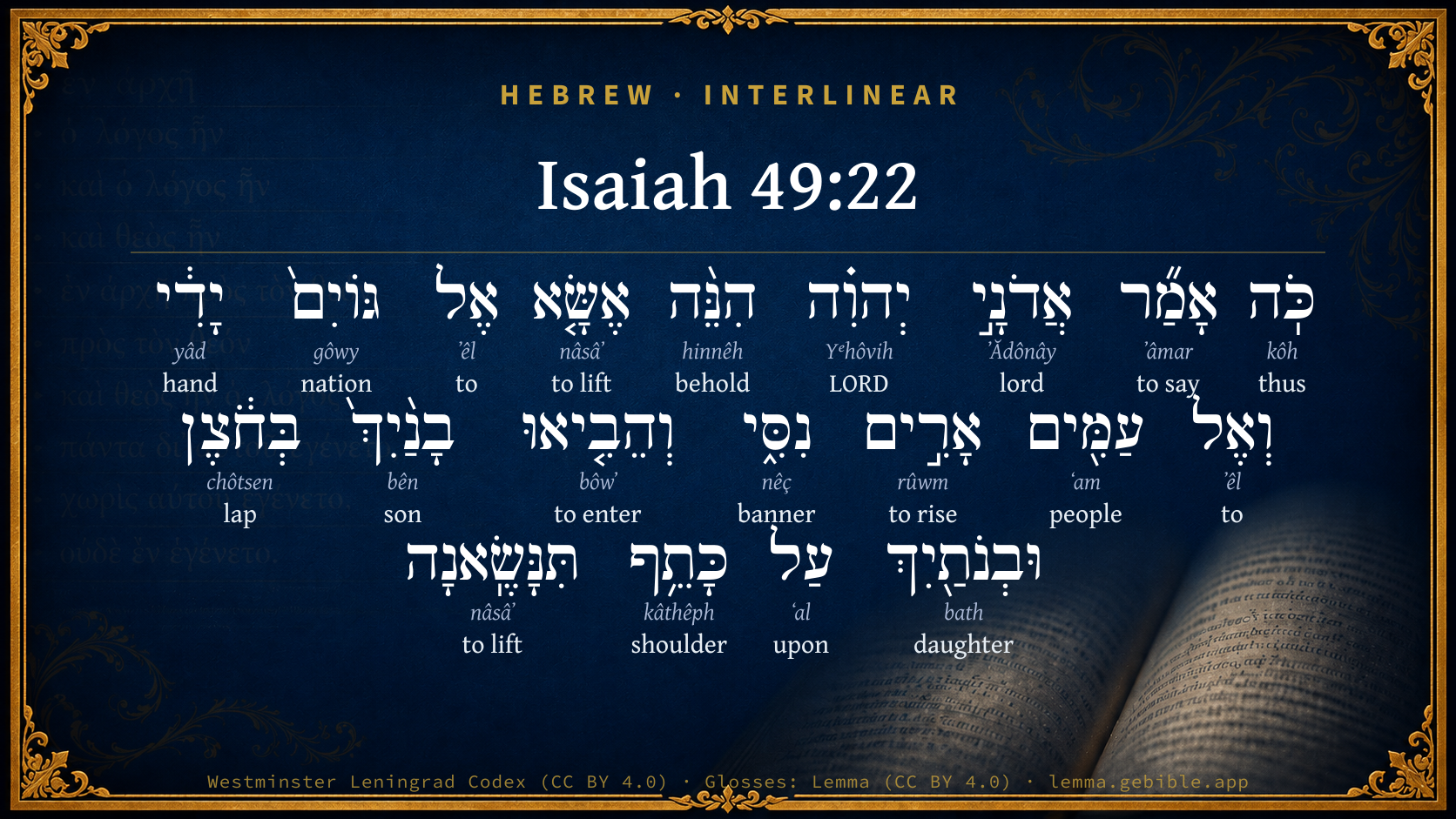
Isaiah 49:22

Hebrew (Westminster Leningrad Codex) Isaiah 49:22 appears in the Hebrew Old Testament. The text above is from the Westminster Leningrad Codex. Each word links to its Strong’s number, a concise gloss, and parsing drawn from the Open Scriptures Hebrew Bible morphology. Click any word for its full Brown-Driver-Briggs (BDB) entry.
Download image
Cite this verse

Isaiah 49:22 (World English Bible). Public Domain. Lemma interlinear Bible study tool, https://lemma.gebible.app/v/isaiah/49/22.

Show BibTeX & RIS
BibTeX
RIS
English Translation
Thus says the Lord Yahweh, Behold, I will lift up my hand to the nations, and set up my ensign to the peoples; and they shall bring your sons in their bosom, and your daughters shall be carried on their shoulders.
World English Bible · Public Domain
Download a study sheet

One document with this verse’s original text, its word-by-word gloss line, the meaning frame, cross-references with their text, attributed commentary, and full source and license credits — printable, and it pastes into notes with its structure intact.

This verse Autodidact and up

Study sheet (.html) Plain text (.txt)

A passage Seminary Student

Up to 50 verses in one chapter. A passage sheet keeps up to 6 commentary sources and 12 cross-references per verse, in the order this page ranks them, and says so on the sheet whenever that leaves anything out. Ask for a single verse and you get the Autodidact verse sheet above.

Everything on this page stays free to read, with no account — the sheet is a download of what is already on screen, not access to it.

Want to remove ads? Support Godless Engineer
Compare translations 3

The same verse in 3 English versions, stacked beneath the original-language interlinear above. Click any original word for its lexicon entry.

Each is an independent rendering of the whole verse — the interlinear is not word-aligned to these translations.

Highlighted words mark where these versions differ — a whole-verse word diff, not a word-by-word alignment.

  • World English Bible Public Domain
    Thus says the Lord Yahweh, Behold, I will lift up my hand to the nations, and set up my ensign to the peoples; and they shall bring your sons in their bosom, and your daughters shall be carried on their shoulders.
  • King James Version Public Domain
    Thus saith the Lord GOD, Behold, I will lift up mine hand to the Gentiles, and set up my standard to the people: and they shall bring thy sons in their arms, and thy daughters shall be carried upon their shoulders.
  • unfoldingWord Literal Text CC BY-SA 4.0
    Thus says the Lord Yahweh: “Behold, I will lift up my hand to the nations, and I will raise my banner to the peoples. And they will bring your sons in laps, and your daughters will be carried on shoulders.

unfoldingWord Literal Text — © unfoldingWord, licensed CC BY-SA 4.0. Word-aligned USFM3 via Door43 (git.door43.org/unfoldingWord/en_ult).

Versions to compare (up to 4)

3 of 4 selected

Show all 18 translations

Every available English version of this verse, each an independent rendering of the whole verse.

  • World English Bible Public Domain
    Thus says the Lord Yahweh, Behold, I will lift up my hand to the nations, and set up my ensign to the peoples; and they shall bring your sons in their bosom, and your daughters shall be carried on their shoulders.
  • Berean Standard Bible Public Domain
    This is what the Lord GOD says: “Behold, I will lift up My hand to the nations, and raise My banner to the peoples. They will bring your sons in their arms and carry your daughters on their shoulders.
  • Majority Standard Bible Public Domain
    This is what the Lord GOD says: “Behold, I will lift up My hand to the nations, and raise My banner to the peoples. They will bring your sons in their arms and carry your daughters on their shoulders.
  • King James Version Public Domain
    Thus saith the Lord GOD, Behold, I will lift up mine hand to the Gentiles, and set up my standard to the people: and they shall bring thy sons in their arms, and thy daughters shall be carried upon their shoulders.
  • American Standard Version (1901) Public Domain
    Thus saith the Lord Jehovah, Behold, I will lift up my hand to the nations, and set up my ensign to the peoples; and they shall bring thy sons in their bosom, and thy daughters shall be carried upon their shoulders.
  • Revised Version (1885) Public Domain
    Thus saith the Lord GOD, Behold, I will lift up mine hand to the nations, and set up my ensign to the peoples: and they shall bring thy sons in their bosom, and thy daughters shall he carried upon their shoulders.
  • Geneva Bible (1599) Public Domain
    Thus sayeth the Lord God, Beholde, I will lift vp mine hande to the Gentiles and set vp my stadart to the people, and they shall bring thy sonnes in their armes: and thy daughters shall be caried vpon their shoulders.
  • Douay-Rheims (1899) Public Domain
    Thus saith the Lord God: Behold I will lift up my hand to the Gentiles, and will set up my standard to the people. And they shall bring thy sons in their arms, and carry thy daughters upon their shoulders.
  • Young's Literal Translation Public Domain
    Thus said the Lord Jehovah: `Lo, I lift up unto nations My hand, And unto peoples I raise up Mine ensign, And they have brought thy sons in the bosom, And thy daughters on the shoulder are carried.
  • Literal Standard Version CC BY-SA 4.0
    Thus said Lord YHWH: “Behold, I lift up My hand to nations, || And I raise up My ensign to peoples, || And they have brought your sons in the bosom, || And your daughters are carried on the shoulder.
  • Unlocked Literal Bible CC BY-SA 4.0
    This is what the Lord Yahweh says, “Look, I will raise my hand to the nations; I will raise my signal flag to the peoples. They will bring your sons in their arms and carry your daughters on their shoulders.
  • unfoldingWord Literal Text CC BY-SA 4.0
    Thus says the Lord Yahweh: “Behold, I will lift up my hand to the nations, and I will raise my banner to the peoples. And they will bring your sons in laps, and your daughters will be carried on shoulders.
  • Darby Bible Public Domain
    Thus saith the Lord Jehovah: Behold, I will lift up my hand to the nations, and set up my banner to the peoples; and they shall bring thy sons in [their] bosom, and thy daughters shall be carried upon the shoulder.
  • World Messianic Bible Public Domain
    The Lord GOD says, “Behold, I will lift up my hand to the nations, and lift up my banner to the peoples. They shall bring your sons in their bosom, and your daughters shall be carried on their shoulders.
  • Webster's Bible Public Domain
    Thus saith the Lord GOD, Behold, I will lift up my hand to the Gentiles, and set up my standard to the people: and they shall bring thy sons in their arms, and thy daughters shall be carried upon their shoulders.
  • Free Bible Version CC BY-SA 4.0
    This is what the Lord God says, Watch as I give the signal to the nations, as I raise my flag to let everyone know. They will bring them back, carrying your sons in their arms, and lifting your daughters onto their shoulders.
  • Bible in Basic English Public Domain
    This is the word of the Lord God: See, I will make a sign with my hand to the nations, and put up my flag for the peoples; and they will take up your sons on their beasts, and your daughters on their backs.
  • JPS Tanakh (1917) Public Domain
    Thus saith the Lord GOD: Behold, I will lift up My hand to the nations, and set up Mine ensign to the peoples, and they shall bring thy sons in their bosom, and thy daughters shall be carried upon their shoulders.

Literal Standard Version (2020), Covenant Press — licensed CC BY-SA 4.0. Text via the HelloAO Bible API (eBible.org). Unlocked Literal Bible (unfoldingWord) — licensed CC BY-SA 4.0. Text via the HelloAO Bible API (eBible.org). unfoldingWord Literal Text — © unfoldingWord, licensed CC BY-SA 4.0. Word-aligned USFM3 via Door43 (git.door43.org/unfoldingWord/en_ult). Free Bible Version, Dr. Jonathan Gallagher — licensed CC BY-SA 4.0. Text via the HelloAO Bible API (eBible.org).

Word by word

More ways to search: Search by grammar → Find every occurrence → Compare this word →

Practice this passage: Drill this verse → Learn its vocabulary →

בְּחֹ֔צֶן
chôtsen
H2684
“in/at · lap”
Preposition + Noun, Common, Masculine, Singular, Absolute
Part of Speech
Preposition + Noun
Type
Common
Gender
Masculine
Number
Singular
State
Absolute
Full BDB Definition

Origin: a collateral form of H2683 , and meaning the same

TWOT: 720b

bosom, lap
  1. כֹּֽה kôh H3541 “thus” Adverb
  2. אָמַ֞ר ʼâmar H559 “to say” Verb, Qal, Perfect, 3rd Person, Masculine, Singular
  3. אֲדֹנָ֣י ʼĂdônây H136 “Lord · my” Noun, Common, Masculine, Plural, Construct + Suffix, Personal, 1st Person, Common, Singular
  4. יְהוִ֗ה Yᵉhôvih H3069 “LORD” Noun, Proper
  5. הִנֵּ֨ה hinnêh H2009 “behold” Particle, Demonstrative
  6. אֶשָּׂ֤א nâsâʼ H5375 “to lift” Verb, Qal, Imperfect, 1st Person, Common, Singular
  7. אֶל ʼêl H413 “to” Preposition
  8. גּוֹיִם֙ gôwy H1471 “nations” Noun, Common, Masculine, Plural, Absolute
  9. יָדִ֔י yâd H3027 “hand · my” Noun, Common, Both, Singular, Construct + Suffix, Personal, 1st Person, Common, Singular
  10. וְאֶל ʼêl H413 “and · to” Conjunction + Preposition
  11. עַמִּ֖ים ʻam H5971 “peoples” Noun, Common, Masculine, Plural, Absolute
  12. אָרִ֣ים rûwm H7311 “to rise” Verb, Hiphil, Imperfect, 1st Person, Common, Singular
  13. נִסִּ֑י nêç H5251 “banner · my” Noun, Common, Masculine, Singular, Construct + Suffix, Personal, 1st Person, Common, Singular
  14. וְהֵבִ֤יאוּ bôwʼ H935 “and · to enter” Conjunction + Verb, Hiphil, Sequential Perfect, 3rd Person, Common, Plural
  15. בָנַ֨יִךְ֙ bên H1121 “sons · your” Noun, Common, Masculine, Plural, Construct + Suffix, Personal, 2nd Person, Feminine, Singular
  16. וּבְנֹתַ֖יִךְ bath H1323 “and · daughters · your” Conjunction + Noun, Common, Feminine, Plural, Construct + Suffix, Personal, 2nd Person, Feminine, Singular
  17. עַל ʻal H5921 “upon” Preposition
  18. כָּתֵ֥ף kâthêph H3802 “shoulder” Noun, Common, Feminine, Singular, Absolute
  19. תִּנָּשֶֽׂאנָה nâsâʼ H5375 “to lift” Verb, Niphal, Imperfect, 3rd Person, Feminine, Plural

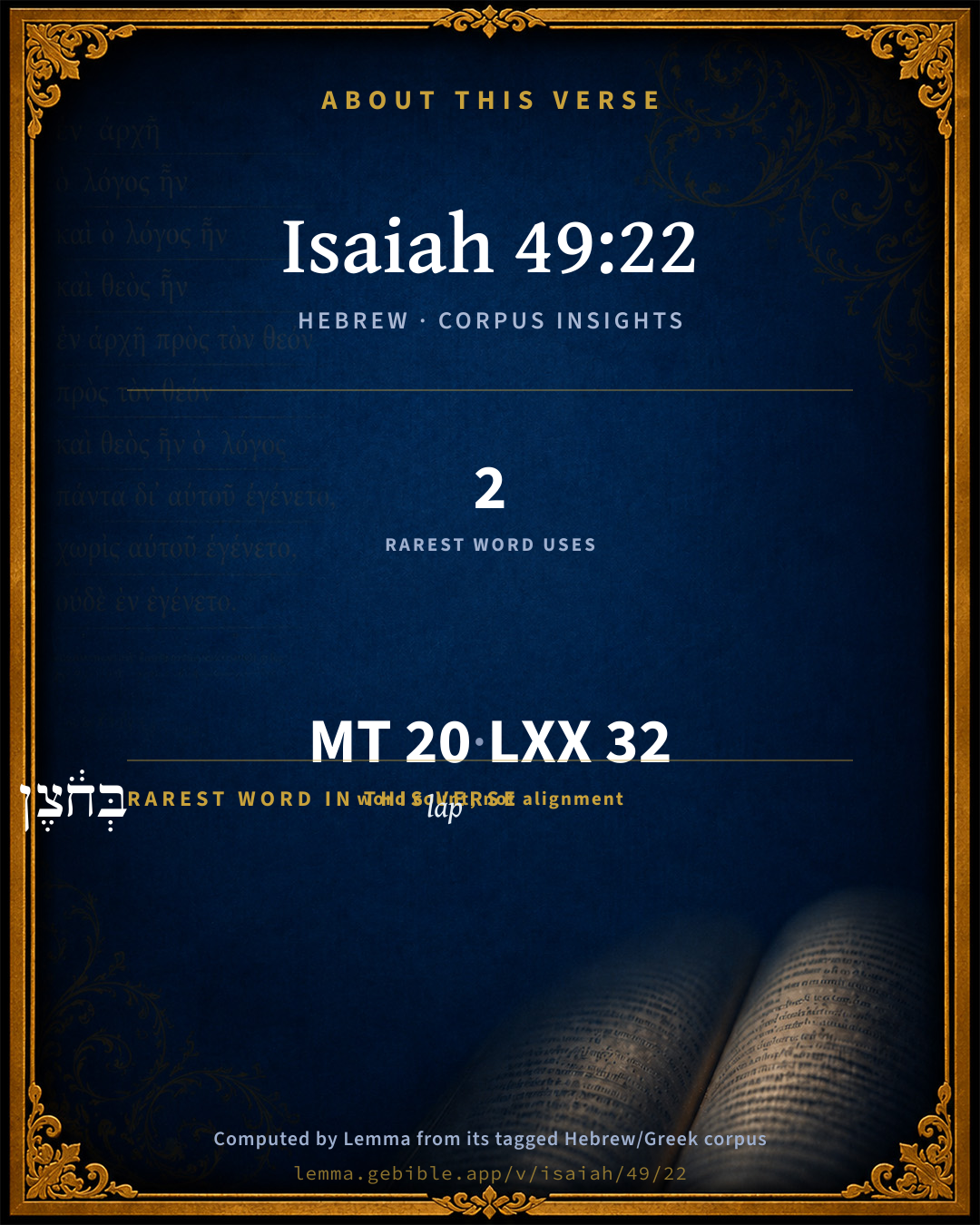
About this verse

These counts appear in no published source. They are computed here, from the morphology-tagged text and Lemma’s own curated glosses. What Lemma adds →

20
words
18
distinct lemmas
Prophets
section

Notable vocabulary

The rarest word here is בְּחֹ֔צֶן lap H2684 — appearing just 2 times in the whole Hebrew Bible.

Shared distinctive vocabulary

בְּחֹ֔צֶן lap H2684 occurs in 2 verses of the Hebrew Bible. Also found in:

Grammatical profile

  • 5 verbs
  • 10 nouns
  • 3 prepositions
  • 1 adverb
  • 1 particle

Verb forms

  • אָמַ֞ר Qal · Perfect
  • אֶשָּׂ֤א Qal · Imperfect
  • אָרִ֣ים Hiphil · Imperfect
  • וְהֵבִ֤יאוּ Hiphil · Sequential Perfect
  • תִּנָּשֶֽׂאנָה Niphal · Imperfect

Repetition

Words recur within this verse — often emphatic in Hebrew:

  • אֶשָּׂ֤א to lift H5375 ×2
  • אֶל to H413 ×2

Hebrew & Septuagint length

In English translation the verse runs 41 words from the Hebrew and 43 from the Septuagint (LXX English) — closely comparable.

A rough comparison of the two English renderings, which tokenize alike — not a word-level alignment.

Word counts can differ between the Hebrew and the Greek without any difference in meaning — e.g. the Hebrew direct-object marker אֵת has no separate Greek word, and Greek often adds the article ὁ.

In the original languages it is 20 Hebrew tokens and 32 Greek tokens — but the two are counted differently (Hebrew bundles its prefixes and suffixes into one token; the Greek is in lemma form), so that isn’t a like-for-like length.

Cross-references

14

Topical passages linked to Isaiah 49:22 in the Treasury of Scripture Knowledge — connected by theme and wording, ordered by reader-vote popularity; previews shown in the World English Bible.

  • Psalms 86:9 All nations you have made will come and worship before you, Lord. They shall glorify your name.
  • Isaiah 14:2 The peoples shall take them, and bring them to their place; and the house of Israel shall possess them in the land of Yahweh for servants and for handmaids: and they shall take them captive whose captives they were; and they shall rule over their oppressors.
  • Luke 13:29 They will come from the east, west, north, and south, and will sit down in the Kingdom of God.
  • Psalms 22:27 All the ends of the earth shall remember and turn to Yahweh. All the relatives of the nations shall worship before you.
  • Psalms 67:4–7 Oh let the nations be glad and sing for joy, For you will judge the peoples with equity, And govern the nations on earth. Selah.
  • Psalms 72:8 He shall have dominion also from sea to sea, From the River to the ends of the earth.
  • Psalms 72:17 His name endures forever. His name continues as long as the sun. Men shall be blessed by him. All nations will call him blessed.
  • Isaiah 2:2–3 It shall happen in the latter days, that the mountain of Yahweh's house shall be established on the top of the mountains, And shall be raised above the hills; And all nations shall flow to it.
  • Isaiah 11:10–12 It shall happen in that day, that the root of Jesse, who stands for an ensign of the peoples, to him shall the nations seek; and his resting-place shall be glorious.
  • Isaiah 42:1–4 Behold, my servant, whom I uphold; my chosen, in whom my soul delights: I have put my Spirit on him; he will bring forth justice to the Gentiles.
  • Isaiah 49:12 Behold, these shall come from far; and, behold, these from the north and from the west; and these from the land of Sinim.
  • Isaiah 60:3–11 Nations shall come to your light, and kings to the brightness of your rising.
  • Isaiah 66:20 They shall bring all your brothers out of all the nations for an offering to Yahweh, on horses, and in chariots, and in litters, and on mules, and on dromedaries, to my holy mountain Jerusalem, says Yahweh, as the children of Israel bring their offering in a clean vessel into the house of Yahweh.
  • Malachi 1:11 For from the rising of the sun even to the going down of the same, my name is great among the nations, and in every place incense will be offered to my name, and a pure offering: for my name is great among the nations," says Yahweh of Hosts.

Cross-references courtesy of OpenBible.info (CC BY 4.0).

Hebrew and Greek witnesses Masoretic Hebrew ↔ Greek Septuagint

The same verse in the two great witnesses to the Old Testament, shown verse-for-verse.

These are two independent witnesses, not word-aligned to each other, and the Septuagint is shown in lemma (dictionary) form.

Hebrew Isaiah 49:22 Masoretic · Westminster Leningrad Codex

כֹּֽה אָמַ֞ר אֲדֹנָ֣י יְהוִ֗ה הִנֵּ֨ה אֶשָּׂ֤א אֶל גּוֹיִם֙ יָדִ֔י וְאֶל עַמִּ֖ים אָרִ֣ים נִסִּ֑י וְהֵבִ֤יאוּ בָנַ֨יִךְ֙ בְּחֹ֔צֶן וּבְנֹתַ֖יִךְ עַל כָּתֵ֥ף תִּנָּשֶֽׂאנָה

Thus says the Lord Yahweh, Behold, I will lift up my hand to the nations, and set up my ensign to the peoples; and they shall bring your sons in their bosom, and your daughters shall be carried on their shoulders.

World English Bible · Public Domain

Greek LXX Isaiah 49:22 Septuagint · lemma form

οὕτως λέγω κύριος ἰδού αἴρω εἰς ὁ ἔθνος ὁ χείρ ἐγώ καί εἰς ὁ νήσος αἴρω σύσσημον ἐγώ καί ἄγω ὁ υἱός σύ ἐν κόλπος ὁ δέ θυγάτηρ σύ ἐπί ὦμος αἴρω

Thus says the Lord, even the Lord, Behold, I lift up my hand to the nations, and I will lift up my signal to the islands: and they shall bring your sons in their bosom, and shall bear your daughters on their shoulders.

LXX2012 (modern English Septuagint) · Public Domain

On this verse, Adam Clarke's Commentary discusses the Septuagint’s reading. Read the note in Commentary ↓

Hebrew: Westminster Leningrad Codex (CC BY 4.0). Greek: Septuagint (public domain); English from LXX2012 (modern English Septuagint) (Public Domain). How the Septuagint differs from the Hebrew →

Targum (Aramaic paraphrase)

1

The Targum is the ancient Jewish Aramaic paraphrase of the Hebrew Scriptures — an interpretive translation, not the Hebrew text itself. Onkelos (literal) and Pseudo-Jonathan (expansive) render the Torah, and Jonathan the Prophets. Coverage is partial: where no permissively-licensed English translation exists for a verse, only the Aramaic is shown. This is verse-level text, not a word-by-word alignment to the Hebrew.

  1. Targum Jonathan Prophets (Joshua–Malachi)
    כִּדְנַן אֲמַר יְיָ אֱלֹהִים הָא אֶגְלֵי בְּעַמְמַיָא גְבוּרְתִי וְעַל מַלְכְּוָתָא אֲרִים נִסִי וְיֵיתוּן בְנָךְ בְּצִיבִין וּבְנָתָךְ עַל פַּרְוָן יִתְנַטְלָן:

    Thus saith the Lord God, Behold, I will reveal my power among the Gentiles, and unto the kingdoms I will raise my standard, and thy children shall come in palanquins, and thy daughters shall be carried upon the shoulders.

    Targum Jonathan — Aramaic: “Mikraot Gedolot” (public domain). English: “Sefaria Community Translation” (CC0 1.0 (public-domain dedication)); “London "Chaldee Paraphrase," 1871” (public domain). Text via Sefaria.

Commentary

Notes on Isaiah 49:22 from classic Christian and Jewish commentators (each source and its license shown beneath its notes). The classic Christian expositions comment on the surrounding passage and are grouped to its opening verse, so a note may address several verses; the Jewish commentaries on the Tanakh (Rashi and others) are per-verse, so they appear only where the commentator wrote on this verse.

Lemma curates 59 commentaries, every one of them public domain or Creative Commons licensed, each selected and text-cleaned for this edition rather than reprinted as found. About our sources →

Trapp's Complete Commentary

John Trapp

Isa 49:22 Thus saith the Lord GOD, Behold, I will lift up mine hand to the Gentiles, and set up my standard to the people: and they shall bring thy sons in [their] arms, and thy daughters shall be carried upon [their] shoulders.

Ver. 22. Behold, I will lift up my hand, &c., ] i.e., I will call them by the gospel, which is the power of God to salvation to all believers. {Rom 1:16}

And they shall bring thy sons in their arms,] sc., When they bring them to be baptized. Respicit ad puerilem conditionem: yet some expound it metaphorically, as Deu 32:10 Hos 11:3.

John Trapp, A Commentary or Exposition upon All the Books of the Old and New Testament (1647–1656) — public domain. Text from a community e-Sword module.

Joseph Benson's Commentary

Isa 49:22-23. I will lift up my hand to the Gentiles — I will call them to me; and set up my standard to the people — As generals do, to gather their forces together. And they shall bring thy sons — Those who shall be thine by adoption, who shall own God for their Father, and Jerusalem for their mother; in their arms — With great care and tenderness, as nurses carry young infants: the sense is, Even the heathen shall contribute to the increase and preservation of those children which shall be begotten to thee. And thy daughters shall be carried, &c. — As sick or infirm persons used to be carried. And kings shall be thy nursing fathers — Kings and queens shall have a sincere affection and tender regard unto thee and thy children. Which was in some sort fulfilled by Cyrus, Ahasuerus, and some few others of the Persian kings or queens; but much more truly and fully by those many kings and emperors of the Gentile world who, after the time of Christ, did both themselves embrace the true religion, and also provide for the reception and establishment of it in their dominions. They shall bow down to thee, &c. — They shall highly reverence and honour thee, and shall most humbly and readily submit themselves unto thee. This was not verified in any of the Persian kings, but only in those kings or emperors who were converted to the Christian faith and church. And lick up the dust of thy feet — These expressions are borrowed from the manners of the eastern people in their prostrations and adorations, who bowed so low as to touch and kiss the ground. For they shall not be ashamed that wait for me — Their expectations shall not be disappointed, but abundantly satisfied.

Joseph Benson's Commentary on the Old and New Testaments (1811–1818) — public domain. Text from a community e-Sword module.

Tyndale Open Study Notes

Tyndale Open Resources

49:22 carry your little sons . . . your daughters: The mighty rulers of the nations, some of whom had previously killed children in Israel, would aid in their return to Zion (see also 60:3-9). Elsewhere Isaiah envisioned people of foreign nations streaming to Zion to worship the Lord (see 2:2-4).

Tyndale Open Study Notes — © Tyndale Open Resources, licensed CC BY-SA 4.0. Text via the HelloAO Bible API.

Geneva Bible (1599)

Geneva Bible translators

He showeth that Christ will not only gather this great number of the Jews, but also of the Gentiles.

Geneva Bible (1599) marginal notes — public domain. Text via Bolls.life.

Jamieson, Fausset & Brown

Robert Jamieson, A. R. Fausset & David Brown

lift . . . hand--that is, beckon to (see on Isa 13:2).

standard-- (Isa 11:12).

bring . . . sons in . . . arms--The Gentiles shall aid in restoring Israel to its own land (Isa 60:4; Isa 66:20). Children able to support themselves are carried on the shoulders in the East; but infants, in the arms, or astride on one haunch (Isa 60:12). "Thy sons" must be distinct from "the Gentiles," who carry them; and therefore cannot primarily refer to converts among the Gentiles.

Jamieson, Fausset & Brown — Commentary Critical and Explanatory on the Whole Bible (1871) — public domain (CC PDM 1.0). Text via the HelloAO Bible API.

Adam Clarke's Commentary

Verse 22. Thus saith the Lord God - אדני יהוה Adonai Yehovah. Adonai is wanting in one MS., in the Alexandrine copy of the Septuagint, and in the Arabic.

Adam Clarke's Commentary on the Bible (1810–1826) — public domain. Text from a community e-Sword/MySword module.

Ellicott's Commentary for English Readers

(22) The Gentiles . . . the people . . .—Both words are used of the heathen. They are summoned by the uplifted signal of Jehovah to do their work as nursing fathers, carrying the children in their bosom (Num_11:12).

A Bible Commentary for English Readers, edited by Charles John Ellicott (1878–1897) — public domain. Text from a community e-Sword module.

The Cambridge Bible for Schools and Colleges

gen. ed. J. J. S. Perowne

22, 23. The first of the three short oracles describes the restoration of the exiles as a spontaneous act of homage on the part of the Gentiles. The conception is intermediate between that of ch. Isa_45:14 ff., where the nations acknowledge the divinity of Jehovah and the religious supremacy of Israel, and that of ch. Isa_60:4; Isa_60:8, Isa_66:20; cf. ch. Isa_11:11-12. For Gentiles read nations, and for people, peoples, as R.V.

set up my standard] as a signal; see on ch. Isa_5:26.

they shall bring thy sons in the bosom] of the garment (sinus) where little children were carried (Num_11:12). The word belongs to late Hebrew (Neh_5:13 [E.V. lap]; Psa_129:7).

The Cambridge Bible for Schools and Colleges (gen. ed. J. J. S. Perowne; Cambridge University Press, 1878–1918) — public domain. Text from a community e-Sword module.

John Gill's Exposition

Thus saith the Lord God,.... In answer to the questions, where had these children been? and from whence did they come? who begot them, and brought them up? and by what means was all this done, or would be done?

I will lift up mine hand to the Gentiles; beckoning them to come unto him, directing and ordering them what to do; or rather exerting the power of his grace in the conversion of them. The Targum is,

"I will reveal my power among the Gentiles;''

his efficacious grace attending the ministry of the word, whereby it becomes "the power of God unto salvation"; for when that hand is lifted up or exerted, the "word" comes "not in word only", "but in power, and in the Holy Ghost", and is effectual to saving purposes:

and set up my standard to the people; meaning Christ, "the ensign of the people"; who, in the ministration of the Gospel, is set up as a standard, to gather persons to him, as an ensign or standard is set up by a general of an army to collect soldiers to him, to come and enlist, and fight under his banners; see Isa 11:10,

and they shall bring thy sons in their arms; or, "bosom" (s); such as are regenerated by the Spirit and grace of God, under the word, are to be tenderly dealt with by the ministers of the Gospel, as they are by Christ, Isa 40:11 and to be encouraged to come and join themselves to the church, and be directed and assisted by them in that service:

and thy daughters shall be carried on their shoulders; meaning the same as before, only perhaps weaker converts, dealing with them according to their infirmities; carrying them with as much ease, care, and tenderness, as young children are carried on the shoulders of their parents or others. It may be these expressions are designed to show how assisting and encouraging the Christian Gentiles will be to the Jews, when converted in their several countries, both to admit them into Gospel churches, and bring them into their own land; see Isa 66:19.

(s) , Sept. "in gremio", Tigurine version; "in sinu", Munster, Montanus. But Ben Melech interprets it "the arm".

John Gill's Exposition of the Whole Bible (1746–1763) — public domain (CC PDM 1.0). Text via the HelloAO Bible API.

Albert Barnes' Notes on the Bible

Behold, I will lift up mine hand to the Gentiles - To lift up the hand is a sign of beckoning to, or inviting; and the idea here is, that God would call the Gentiles to partake of the blessings of the true religion, and to embrace the Messiah (see the notes at Isa 11:11).

And set up my standard to the people - To the people of other lands; the word here being synonymous with the word Gentiles. A standard, or an ensign was erected in times of war to rally the forces of a nation around it; and the sense here is, that God would erect an ensign high in the sight of all the nations, and would call them to himself, as a military leader musters his forces for battle; that is, he would call the nations to embrace the true religion. See this phrase explained in the the note at Isa 11:12.

They shall bring thy sons in their arms - Margin, ‘Bosom.’ Jerome renders it, In ulnis - ‘In their arms.’ The Septuagint, Ἐν κόλπῳ En kolpō - ‘In the bosom.’ Aquila, Symmachus, and Theodotion, Ἀγκαλας Agkalas - ‘In their arms.’ If it means bosom, as Gesenius renders it, it refers to the bosom of a garment in which things are carried. But it more probably means in the arms, as children are borne; and the idea is, that the distant nations would come and bear with them those who were the children of Zion, that is, those who would become the true friends and worshippers of God.

And thy daughters shall be carried upon their shoulders - Referring, doubtless, to the manner in which children were carried. In Isa 66:12, the same idea is expressed by their being carried upon the sides, referring to the custom still prevalent in the East, of placing a child when it is nursed astride on the side of the mother. The following quotation will more fully explain the customs here alluded to. ‘It is a custom in many parts of the East, to carry their children astride upon the hip, with the arm around the body. In the kingdom of Algiers, where the slaves take the Children out, the boys ride upon their shoulders; and in a religious procession, which Symes had an opportunity of seeing at Ava, the capital of the Burman empire, the first personages of rank that passed by were three children borne astride, on people’s shoulders. It is evident, from these facts, that the Oriental children are carried sometimes the one way, sometimes the other.

Nor was the custom, in reality, different in Judea, though the prophet expresses himself in these terms: “They shall bring thy sons in their arms, and thy daughters shall be carried upon their shoulders;” for, according to Dr. Russel, the children able to support themselves are usually carried astride on the shoulders; but in infancy they are carried in the arms, or awkwardly on one haunch. Dandini tells us that, on horseback, the Asiatics “carry their children upon their shoulders with great dexterity. These children hold by the head of him who carries them, whether he be on horseback or on foot, and do not hinder him from walking or doing what he pleases.” This augments the import of the passage in Isaiah, who speaks of the Gentiles bringing children thus; so that distance is no objection to this mode of conveyance, since they may thus be brought on horseback from among the people, however remote.’ (Paxton) ‘Children of both sexes are carried on the shoulders.

Thus may be seen the father carrying his son, the little fellow being astride on the shoulder, having, with his hands, hold of his father’s head. Girls, however, sit on the shoulder, as if on a chair, their legs banging in front, while they also, with their hands, lay hold of the head. In going to, or returning from pagan festivals, thousands of parents and their children may be thus seen marching along with joy.’ (Roberts) The sense is, that converts should come from every land - that the nations should flock to the standard of the Messiah. And why may it not be regarded as a legitimate interpretation of this passage, that those who come should bring their children, their sons and their daughters, with them? That they were borne upon the arm, or upon the shoulder, is indicative of their being young children; and that is no forced interpretation of this passage which regards it as teaching, that the parents who should be converted among the Gentiles should bring their offspring to the Redeemer, and present them publicly to God.

Albert Barnes' Notes on the Bible (1834–1885) — public domain. Text from a community e-Sword/MySword module.

Haydock's Catholic Bible Commentary

CHAPTER XLIX.

Shoulders. Thus the Syrians commonly carried children astride. (Cotovic. xiv.)

George Leo Haydock (1774–1849), Haydock's Catholic Family Bible and Commentary, 1859 edition — public domain. Excludes Psalms (Douay-Rheims chapter numbering differs from Protestant) and Deuterocanonical books (Catholic canon only).

Matthew Poole's English Annotations

I will lift up mine hand; I will call them to me, and command them to do this work, as men commonly signify their calls and commands by this gesture.

Set up my standard, as generals do to gather their forces together. See Poole "Isa 11:12". To the people; unto thee, or to thy church and people. Shall bring thy sons; those which shall be thine, if not by natural generation, yet by adoption, that shall own God for their Father, and Jerusalem for their mother.

In their arms; with great care and tenderness, as nurses carry young infants. The sense is, Even the heathen shall contribute to the increase and preservation of those children which shall be begotten to thee.

Thy daughters shall be carried upon their shoulders; as sick or infirm persons used to be carried.. See Mar 2:3; Luk 15:5.

Matthew Poole's English Annotations on the Holy Bible (1683–1685) — public domain. Text from a community e-Sword/MySword module.

Whedon's Commentary on the Bible

Daniel D. Whedon

22. Thus saith the Lord God — In answer to the inquiry just put. Alexander renders the Lord’s reply as follows: “Behold, I will lift up to the nations my hand, and I will set up to the peoples my standard, (or, signal,) and they will bring thy sons in the bosom, (or, arms,) and thy daughters on the shoulders shall be carried.” The figures here are much the same as in chapter Isa_13:2, namely, raising and waving or shaking the hand to the nations far off and near, raising a pole as a signal, summoning to help in Zion’s cause. The gospel is inscribed upon said signal. The nations understand; they rush to it; they bring back Zion’s children, not merely backslidden Israel, but multitudes of wanderers besides.

In their arms… upon their shoulders — Such figures are well understood in oriental life, expressing the tender care lavished on children by parents or by nurses.

Daniel D. Whedon (gen. ed.), Commentary on the Old and New Testaments (1874–1909) — public domain. Text from a community e-Sword module.

The Pulpit Commentary

I will lift up mine hand to the Gentiles. The new children the new converts are to come from the Gentiles; the fresh "sons" and "daughters" will be carried by the nations in their arms, and by the peoples upon their shoulders. It is usual to expound this and parallel passages (Isa_60:4 Isa_66:20) of the return of the Jews to their own land by favour of the Gentiles, either when the decree of Cyrus went forth, or at some still future period. But perhaps the children intended are foster-children, actual Gentiles, whom their parents will bring to baptism. In the Assyrian sculptures, mothers are constantly represented as carrying their children upon their shoulders ("Ancient Monarchies," vol. 1 p. 480).

The Pulpit Commentary (1880–1919), ed. H.D.M. Spence-Jones & Joseph S. Exell — public domain. Text from a community e-Sword module.

John Wesley's Explanatory Notes

Behold - I will call them to me. Set my standard - As generals do to gather their forces together. Thy sons - Those who shall be thine by adoption, that shall own God for their father, and Jerusalem for their mother. Carried - With great care and tenderness, as nurses carry young infants. Carried - As sick or infirm persons used to be carried.

John Wesley, Explanatory Notes Upon the Whole Bible (1754–1765) — public domain. Text via the GEBible commentary corpus.

Keil & Delitzsch

C. F. Keil & F. Delitzsch

The prophecy now takes a step backward in the domain of the future, and describes the manner in which the children of Zion get back to their home. "Thus saith the Lord Jehovah, Behold, I lift up my hand to nations, and set up my standard to peoples: and they bring thy sons in their bosom; and thy daughters, upon shoulders are they carried." The setting up of a standard (Isa 5:26; Isa 11:12; Isa 18:3, cf., Isa 62:10) is a favourite figure with Isaiah, as well as swaying the hand. Jehovah gives a sign to the heathen nations with His hand, and points out to them the mark that they are to keep in view, with a signal pole which is set up. They understand it, and carry out His instructions, and bring Zion's sons and daughters thither, and that as a foster-father ('ōmēn) carries an infant in the bosom of his dress (chōtsen, as in Neh 5:13; Arabic as in Psa 129:7, hidn, from hadana, to embrace, to press tenderly to one's self; vid., Num 11:12), or upon his arms, so that it reclines upon his shoulder (‛al-kâthēph; cf., ‛al-tsad, Isa 60:4; Isa 66:12).

Keil & Delitzsch — Biblical Commentary on the Old Testament (1861–1891) — public domain (CC PDM 1.0). Text via the HelloAO Bible API. (Old Testament only.)

J. A. Alexander on Isaiah

Joseph Addison Alexander

“Thus saith the Lord Jehovah, Behold, I will lift up to the nations my hand, and I will set up to the peoples my standard (or signal); and they will bring thy sons in the bosom (or arms), and thy daughters on the shoulders shall be carried.” The idea expressed by the figures of the first clause is that of summoning the nations to perform their part in this great work. The figures themselves are the same as in Isa 13:2, viz. the shaking or waving of the hand and the erection of a banner, pole, or other signal, with distinct reference perhaps to persons at a distance and at hand. The figurative promise would be verified by any divine influence securing the co-operation of the heathen in accomplishing Jehovah’s purpose, whatever might be the external circumstances either of the call or their compliance with it. The effect of that compliance is described in the last clause, as the bringing home of Zion’s sons and daughters; with all the tender care which is wont to be lavished upon infants by their parents or their nurses. The same image is again presented in Isa 60:4; Isa 66:12. Peculiar to this case is the use of the word chotsen, which seems most probably to signify either the bosom or the arm, when spoken of in reference to carrying and especially the carrying of children. Strictly perhaps the word expresses an idea intermediate between arm and bosom, or including both, viz. the space enclosed by them in the act of grasping or embracing. Those who restrict the promise to the exiled Jews in Babylon are under the necessity of making this a restoration, which is not only perfectly gratuitous but inconsistent with the verse preceding, where these same children are described as appearing for the first time and thereby exciting the surprise of the forsaken mother.

Joseph Addison Alexander, The Prophecies of Isaiah (1846–1847; New York: Scribner, 1870–1878) — public domain. Text from a community e-Sword module.

unfoldingWord translationNotes

Door43 World Missions Community

General Information:

Yahweh continues speaking to Zion as if it were a woman. He explains how she is able to have so many children. (See: Personification)

I will raise my hand to the nations; I will raise my signal flag to the peoples

These two clauses mean basically the same thing. AT: "I will raise my hand and signal with a flag for the people of the nations to come" (See: Parallelism)

They will bring your sons in their arms and carry your daughters on their shoulders

Yahweh speaks of the people who will inhabit Jerusalem as if they were the city's children. He also speaks of the people of other nations helping the Israelites to return to Jerusalem as if they were carrying the Israelites. (See: Metaphor)

translationWords

Lord Yahweh

hand

nation

people group

son

unfoldingWord translationNotes — © Distant Shores Media and the Door43 World Missions Community, licensed CC BY-SA 4.0. Source: git.door43.org/Door43/en_tn.

Rashi

Rabbi Shlomo Yitzchaki (Rashi)

My hand...My standard A signal to bring the exiles.

a standard Perka in O.F., [perche in modern French,] a pole. Comp. (supra 30:17) “And like a flagpole (וְכַנֵּס) on a hill.” It is a signal for gathering, and they place a cloth [a flag] on the end of it.

in their armpits Ajjsela [aisela] in O.F., [aisselle in modern French]. Comp. Ezra (Neh. 5:13): “Also I shook out my armpit (חָצְנִי).”

Rashi on the Tanakh — English translations: “The Judaica Press complete Tanach with Rashi, translated by A. J. Rosenberg” (CC BY 4.0); “Pentateuch with Rashi's commentary by M. Rosenbaum and A.M. Silbermann, 1929-1934” (public domain); “The Metsudah Tanach series, Lakewood, N.J” (CC BY 4.0); and “The Book of Joshua, Metsudah Publications, 1997” (CC BY 4.0). Text via Sefaria.

Ibn Ezra

Rabbi Abraham ibn Ezra

Behold, I will lift up My hand, etc. As a man lifts up his hand, that he may be seen. This phrase as well as that which follows: And set up my standard, are the same as I shall make known this my salvation.

And they shall bring thy sons. By they the Non-Israelites are to be understood.

בחוצן In their lap. Comp. חצני my lap (Neh. 5:13)

Ibn Ezra on the Tanakh — English translations: “Sefaria Community Translation” (CC0 1.0 (public-domain dedication)); “Yalkut, Sifsei Chachomim Chumash, Metsudah Publications, 2009” (CC BY 4.0); and “Commentary of Ibn Ezra on Isaiah - trans. by M. Friedlander, 1873” (public domain). Text via Sefaria.

Lesson kit

Teaching starters — assembled from the data on this page, not authored interpretation. Every prompt links to the verse data it draws on. Edit before teaching.

Isaiah, in the Prophets, opens this verse with 20 words (18 distinct Hebrew lemmas). Its most distinctive word is chôtsen (“lap”). A historical commentator’s framing appears above. Read the whole chapter for the surrounding context.

Discussion questions

  1. What does “lap” (chôtsen) contribute to the verse as a whole?
  2. Nehemiah 5:13 shares the word «lap» with this verse. How do the two illuminate each other?
  3. “to lift” occurs 2× in this one verse. What is the effect of the repetition?
  4. The translations on this page render this verse differently — a whole-verse word diff, not a word-by-word alignment. What might account for the different wordings?
  5. The verb «אָמַ֞ר» is Qal Perfect. How does its form color the action?
  6. Reading how Trapp's Complete Commentary and Joseph Benson's Commentary read this verse, where do the two commentators agree and where do they part?

Things to notice

Reading settings

Reading text

Shown beneath each verse's original-language words.

Old Testament
Old Testament edition

Read the OT as the Masoretic Hebrew (MT) or the Greek Septuagint (LXX).

English shown for the Greek Septuagint (in the Hebrew ↔ Greek comparison).

Comparing translations? Open the Compare panel on any verse page to stack up to four side by side.