
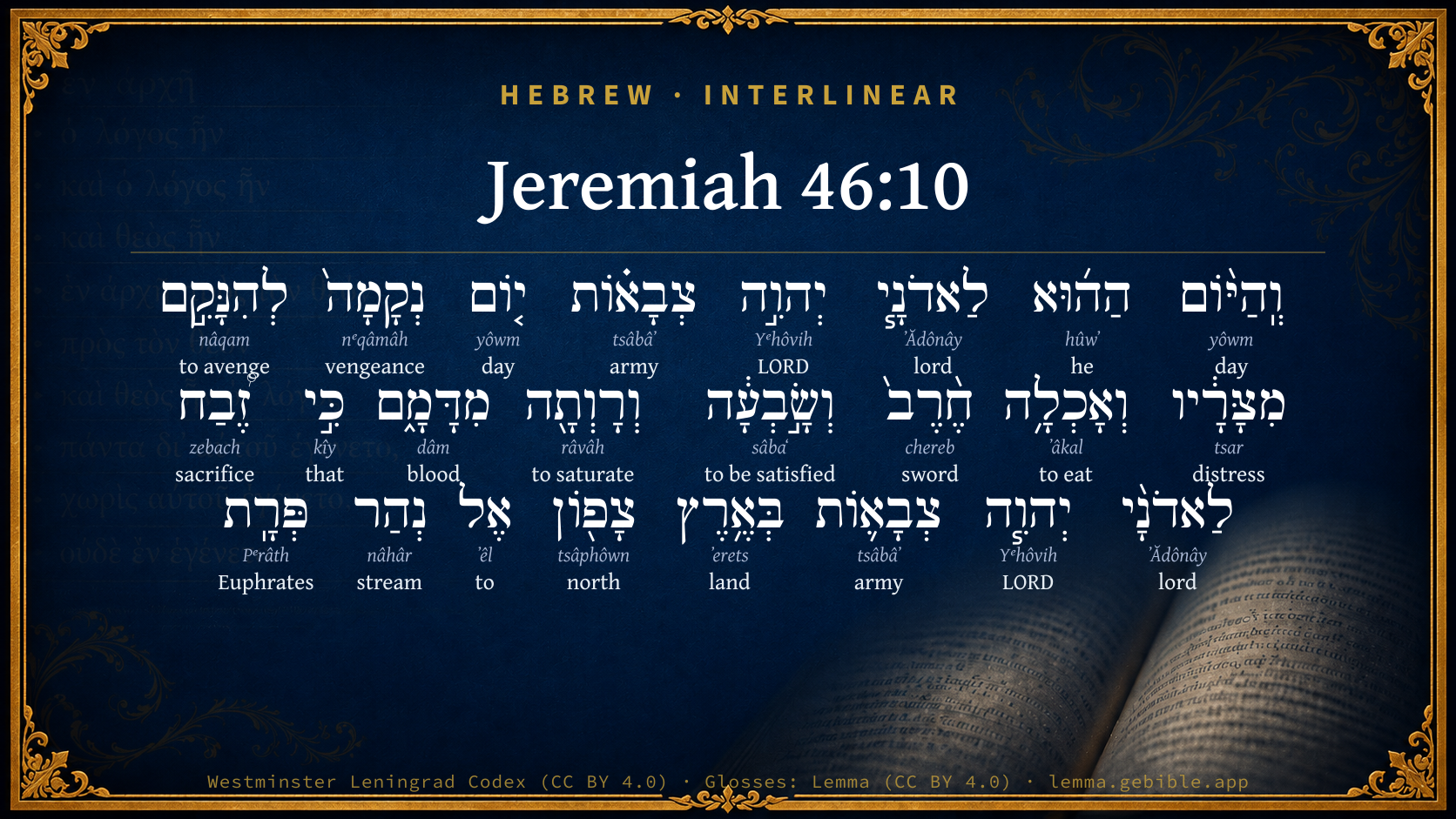
Jeremiah 46:10

Hebrew (Westminster Leningrad Codex) Jeremiah 46:10 appears in the Hebrew Old Testament. The text above is from the Westminster Leningrad Codex. Each word links to its Strong’s number, a concise gloss, and parsing drawn from the Open Scriptures Hebrew Bible morphology. Click any word for its full Brown-Driver-Briggs (BDB) entry.
Download image
Cite this verse

Jeremiah 46:10 (World English Bible). Public Domain. Lemma interlinear Bible study tool, https://lemma.gebible.app/v/jeremiah/46/10.

Show BibTeX & RIS
BibTeX
RIS
English Translation
For that day is [a day] of the Lord, Yahweh of Hosts, a day of vengeance, that he may avenge him of his adversaries: and the sword shall devour and be satiate, and shall drink its fill of their blood; for the Lord, Yahweh of hosts, has a sacrifice in the north country by the river Euphrates.
World English Bible · Public Domain
Download a study sheet

One document with this verse’s original text, its word-by-word gloss line, the meaning frame, cross-references with their text, attributed commentary, and full source and license credits — printable, and it pastes into notes with its structure intact.

This verse Autodidact and up

Study sheet (.html) Plain text (.txt)

A passage Seminary Student

Up to 50 verses in one chapter. A passage sheet keeps up to 6 commentary sources and 12 cross-references per verse, in the order this page ranks them, and says so on the sheet whenever that leaves anything out. Ask for a single verse and you get the Autodidact verse sheet above.

Everything on this page stays free to read, with no account — the sheet is a download of what is already on screen, not access to it.

Want to remove ads? Support Godless Engineer
Compare translations 3

The same verse in 3 English versions, stacked beneath the original-language interlinear above. Click any original word for its lexicon entry.

Each is an independent rendering of the whole verse — the interlinear is not word-aligned to these translations.

Highlighted words mark where these versions differ — a whole-verse word diff, not a word-by-word alignment.

  • World English Bible Public Domain
    For that day is [a day] of the Lord, Yahweh of Hosts, a day of vengeance, that he may avenge him of his adversaries: and the sword shall devour and be satiate, and shall drink its fill of their blood; for the Lord, Yahweh of hosts, has a sacrifice in the north country by the river Euphrates.
  • King James Version Public Domain
    For this is the day of the Lord GOD of hosts, a day of vengeance, that he may avenge him of his adversaries: and the sword shall devour, and it shall be satiate and made drunk with their blood: for the Lord GOD of hosts hath a sacrifice in the north country by the river Euphrates.
  • unfoldingWord Literal Text CC BY-SA 4.0
    That day will be the day of vengeance for the Lord Yahweh of hosts, and he will avenge himself on his foes. The sword will devour and be satisfied. It will drink its fill of their blood. For there will be a sacrifice to the Yahweh Lord of hosts in the northern land by the Euphrates River.

unfoldingWord Literal Text — © unfoldingWord, licensed CC BY-SA 4.0. Word-aligned USFM3 via Door43 (git.door43.org/unfoldingWord/en_ult).

Versions to compare (up to 4)

3 of 4 selected

Show all 18 translations

Every available English version of this verse, each an independent rendering of the whole verse.

  • World English Bible Public Domain
    For that day is [a day] of the Lord, Yahweh of Hosts, a day of vengeance, that he may avenge him of his adversaries: and the sword shall devour and be satiate, and shall drink its fill of their blood; for the Lord, Yahweh of hosts, has a sacrifice in the north country by the river Euphrates.
  • Berean Standard Bible Public Domain
    For that day belongs to the Lord GOD of Hosts, a day of vengeance against His foes. The sword will devour until it is satisfied, until it is quenched with their blood. For the Lord GOD of Hosts will hold a sacrifice in the land of the north by the River Euphrates.
  • Majority Standard Bible Public Domain
    For that day belongs to the Lord GOD of Hosts, a day of vengeance against His foes. The sword will devour until it is satisfied, until it is quenched with their blood. For the Lord GOD of Hosts will hold a sacrifice in the land of the north by the River Euphrates.
  • King James Version Public Domain
    For this is the day of the Lord GOD of hosts, a day of vengeance, that he may avenge him of his adversaries: and the sword shall devour, and it shall be satiate and made drunk with their blood: for the Lord GOD of hosts hath a sacrifice in the north country by the river Euphrates.
  • American Standard Version (1901) Public Domain
    For that day is `a day' of the Lord, Jehovah of hosts, a day of vengeance, that he may avenge him of his adversaries: and the sword shall devour and be satiate, and shall drink its fill of their blood; for the Lord, Jehovah of hosts, hath a sacrifice in the north country by the river Euphrates.
  • Revised Version (1885) Public Domain
    For that day is a day of the Lord, the LORD of hosts, a day of vengeance, that he may avenge him of his adversaries: and the sword shall devour and be satiate, and shall drink its fill of their blood: for the Lord, the LORD of hosts, hath a sacrifice in the north country by the river Euphrates.
  • Geneva Bible (1599) Public Domain
    For this is the day of ye Lord God of hostes, and a day of vengeance, that he may auenge him of his enemies: for the sworde shall deuoure, and it shall be saciate, and made drunke with their blood: for the Lord God of hosts hath a sacrifice in the North countrey by the Riuer Perath.
  • Douay-Rheims (1899) Public Domain
    For this is the day of the Lord the God of hosts, a day of vengeance, that he may revenge himself of his enemies: the sword shall devour, and shall be filled, and shall be drunk with their blood: for there is a sacrifice of the Lord God of hosts in the north country, by the river Euphrates.
  • Young's Literal Translation Public Domain
    And that day `is' to the Lord Jehovah of Hosts A day of vengeance, To be avenged of His adversaries, And the sword hath devoured, and been satisfied, And it hath been watered from their blood, For a sacrifice `is' to the Lord Jehovah of Hosts, In the land of the north, by the river Phrat.
  • Literal Standard Version CC BY-SA 4.0
    And that day [is] to Lord YHWH of Hosts || A day of vengeance, || To be avenged of His adversaries, || And the sword has devoured, and been satisfied, || And it has been watered from their blood, || For a sacrifice [is] to Lord YHWH of Hosts, || In the land of the north, by the Euphrates River.
  • Unlocked Literal Bible CC BY-SA 4.0
    That day will be the day of vengeance for the Lord Yahweh of hosts, and he will avenge himself on his foes. The sword will devour and be satisfied. It will drink its fill of their blood. For there will be a sacrifice to the Yahweh Lord of hosts in the northern land by the Euphrates River.
  • unfoldingWord Literal Text CC BY-SA 4.0
    That day will be the day of vengeance for the Lord Yahweh of hosts, and he will avenge himself on his foes. The sword will devour and be satisfied. It will drink its fill of their blood. For there will be a sacrifice to the Yahweh Lord of hosts in the northern land by the Euphrates River.
  • Darby Bible Public Domain
    For this is the day of the Lord Jehovah of hosts, a day of vengeance, that he may be avenged of his adversaries; and the sword shall devour, and it shall be sated and made drunk with their blood; for the Lord Jehovah of hosts hath a sacrifice in the north country, by the river Euphrates.
  • World Messianic Bible Public Domain
    For that day is of the Lord, GOD of Hosts, a day of vengeance, that he may avenge himself of his adversaries. The sword will devour and be satiated, and will drink its fill of their blood; for the Lord, GOD of Hosts, has a sacrifice in the north country by the river Euphrates.
  • Webster's Bible Public Domain
    For this is the day of the Lord GOD of hosts, a day of vengeance, that he may avenge him of his adversaries: and the sword shall devour, and it shall be satiated and made drunk with their blood: for the Lord GOD of hosts hath a sacrifice in the north country by the river Euphrates.
  • Free Bible Version CC BY-SA 4.0
    But this is the day of the Lord God Almighty, a day of retribution when he takes vengeance on his enemies. The sword will destroy until it is satisfied, until it's had enough of their blood. The Lord God Almighty is having a sacrifice in the north country beside the Euphrates.
  • Bible in Basic English Public Domain
    But that day is the day of the Lord, the Lord of armies, a day of punishment when he will take payment from his haters: and the sword will have all its desire, drinking their blood in full measure: for there is an offering to the Lord, the Lord of armies, in the north country by the river Euphrates.
  • JPS Tanakh (1917) Public Domain
    For the Lord GOD of hosts shall have on that day a day of vengeance, that He may avenge Him of His adversaries; and the sword shall devour and be satiate, and shall be made drunk with their blood; for the Lord GOD of hosts hath a sacrifice in the north country by the river Euphrates.

Literal Standard Version (2020), Covenant Press — licensed CC BY-SA 4.0. Text via the HelloAO Bible API (eBible.org). Unlocked Literal Bible (unfoldingWord) — licensed CC BY-SA 4.0. Text via the HelloAO Bible API (eBible.org). unfoldingWord Literal Text — © unfoldingWord, licensed CC BY-SA 4.0. Word-aligned USFM3 via Door43 (git.door43.org/unfoldingWord/en_ult). Free Bible Version, Dr. Jonathan Gallagher — licensed CC BY-SA 4.0. Text via the HelloAO Bible API (eBible.org).

Word by word

More ways to search: Search by grammar → Find every occurrence → Compare this word →

Practice this passage: Drill this verse → Learn its vocabulary →

וְרָוְתָ֖ה
râvâh
H7301
“and · to saturate”
Conjunction + Verb, Qal, Sequential Perfect, 3rd Person, Feminine, Singular
Part of Speech
Conjunction + Verb
Stem
Qal
Form
Sequential Perfect
Person
3rd Person
Gender
Feminine
Number
Singular
Full BDB Definition

Origin: a primitive root

TWOT: 2130

to be satiated or saturated, have or drink one's fill - (Qal) to take one's fill - (Piel) - to be drunk, be intoxicated - to drench, water abundantly, saturate - (Hiphil) to saturate, water, cause to drink
  1. וְֽהַיּ֨וֹם yôwm H3117 “and · the · day” Conjunction + Particle, Definite Article + Noun, Common, Masculine, Singular, Absolute
  2. הַה֜וּא hûwʼ H1931 “the · he” Particle, Definite Article + Pronoun, Personal, 3rd Person, Masculine, Singular
  3. לַאדֹנָ֧י ʼĂdônây H136 “to/for · Lord · my” Preposition + Noun, Common, Masculine, Plural, Construct + Suffix, Personal, 1st Person, Common, Singular
  4. יְהוִ֣ה Yᵉhôvih H3069 “LORD” Noun, Proper
  5. צְבָא֗וֹת tsâbâʼ H6635 “armies” Noun, Common, Both, Plural, Absolute
  6. י֤וֹם yôwm H3117 “day of” Noun, Common, Masculine, Singular, Construct
  7. נְקָמָה֙ nᵉqâmâh H5360 “vengeance” Noun, Common, Feminine, Singular, Absolute
  8. לְהִנָּקֵ֣ם nâqam H5358 “to avenge” Preposition + Verb, Niphal, Infinitive Construct
  9. מִצָּרָ֔יו tsar H6862 “from · distresses · his” Preposition + Noun, Common, Masculine, Plural, Construct + Suffix, Personal, 3rd Person, Masculine, Singular
  10. וְאָכְלָ֥ה ʼâkal H398 “and · to eat” Conjunction + Verb, Qal, Sequential Perfect, 3rd Person, Feminine, Singular
  11. חֶ֨רֶב֙ chereb H2719 “sword” Noun, Common, Feminine, Singular, Absolute
  12. וְשָׂ֣בְעָ֔ה sâbaʻ H7646 “and · to be satisfied” Conjunction + Verb, Qal, Sequential Perfect, 3rd Person, Feminine, Singular
  13. מִדָּמָ֑ם dâm H1818 “from · blood · their” Preposition + Noun, Common, Masculine, Singular, Construct + Suffix, Personal, 3rd Person, Masculine, Plural
  14. כִּ֣י kîy H3588 “that” Conjunction
  15. זֶ֠בַח zebach H2077 “sacrifice” Noun, Common, Masculine, Singular, Absolute
  16. לַאדֹנָ֨י ʼĂdônây H136 “to/for · Lord · my” Preposition + Noun, Common, Masculine, Plural, Construct + Suffix, Personal, 1st Person, Common, Singular
  17. יְהוִ֧ה Yᵉhôvih H3069 “LORD” Noun, Proper
  18. צְבָא֛וֹת tsâbâʼ H6635 “armies” Noun, Common, Both, Plural, Absolute
  19. בְּאֶ֥רֶץ ʼerets H776 “in/at · land of” Preposition + Noun, Common, Both, Singular, Construct
  20. צָפ֖וֹן tsâphôwn H6828 “north” Noun, Common, Feminine, Singular, Absolute
  21. אֶל ʼêl H413 “to” Preposition
  22. נְהַר nâhâr H5104 “stream of” Noun, Common, Masculine, Singular, Construct
  23. פְּרָֽת Pᵉrâth H6578 “Euphrates” Noun, Proper

About this verse

These counts appear in no published source. They are computed here, from the morphology-tagged text and Lemma’s own curated glosses. What Lemma adds →

24
words
20
distinct lemmas
Prophets
section

Notable vocabulary

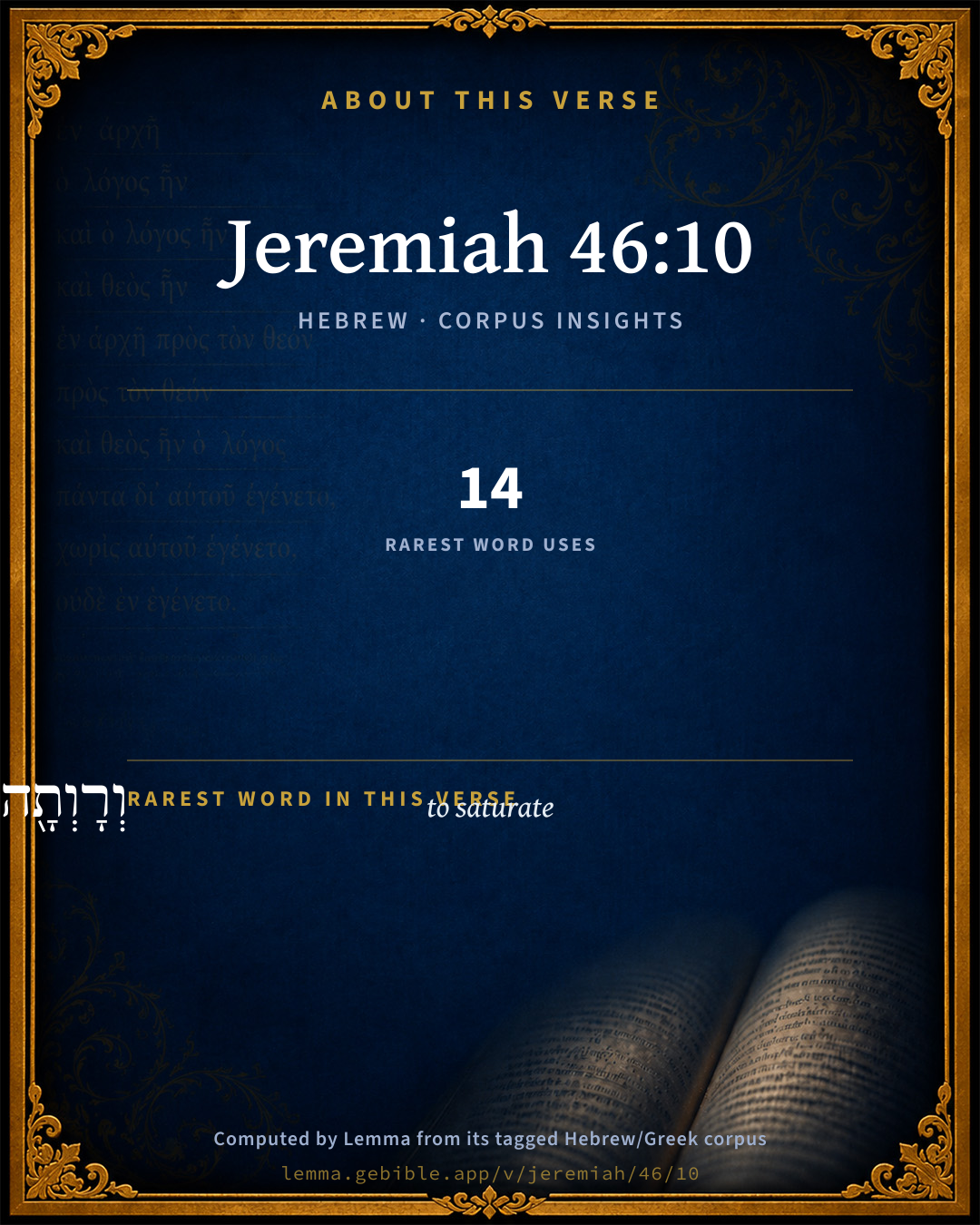
The rarest word here is וְרָוְתָ֖ה to saturate H7301 — appearing just 14 times in the whole Hebrew Bible.

Shared distinctive vocabulary

וְרָוְתָ֖ה to saturate H7301 occurs in 14 verses of the Hebrew Bible. Also found in:

Grammatical profile

  • 4 verbs
  • 17 nouns
  • 1 pronoun
  • 1 preposition
  • 1 conjunction

Verb forms

  • לְהִנָּקֵ֣ם Niphal · Infinitive Construct
  • וְאָכְלָ֥ה Qal · Sequential Perfect
  • וְשָׂ֣בְעָ֔ה Qal · Sequential Perfect
  • וְרָוְתָ֖ה Qal · Sequential Perfect

Repetition

Words recur within this verse — often emphatic in Hebrew:

  • וְֽהַיּ֨וֹם day H3117 ×2
  • לַאדֹנָ֧י lord H136 ×2
  • יְהוִ֣ה LORD H3069 ×2
  • צְבָא֗וֹת army H6635 ×2

Cross-references

17

Topical passages linked to Jeremiah 46:10 in the Treasury of Scripture Knowledge — connected by theme and wording, ordered by reader-vote popularity; previews shown in the World English Bible.

  • Deuteronomy 32:42 I will make my arrows drunk with blood, My sword shall devour flesh; With the blood of the slain and the captives, From the head of the leaders of the enemy.
  • Jeremiah 46:2 Of Egypt: concerning the army of Pharaoh Necoh king of Egypt, which was by the river Euphrates in Carchemish, which Nebuchadrezzar king of Babylon struck in the fourth year of Jehoiakim the son of Josiah, king of Judah.
  • Joel 1:15 Alas for the day! For the day of Yahweh is at hand, And it will come as destruction from the Almighty.
  • Jeremiah 46:6 Don't let the swift flee away, nor the mighty man escape; in the north by the river Euphrates have they stumbled and fallen.
  • Zephaniah 1:7–8 Be silent at the presence of the Lord Yahweh, for the day of Yahweh is at hand. For Yahweh has prepared a sacrifice. He has consecrated his guests.
  • 2 Kings 24:7 The king of Egypt didn't come again out of his land any more; for the king of Babylon had taken, from the brook of Egypt to the river Euphrates, all that pertained to the king of Egypt.
  • Isaiah 13:6 Wail; for the day of Yahweh is at hand; as destruction from the Almighty shall it come.
  • Isaiah 34:5–8 For my sword has drunk its fill in the sky: behold, it shall come down on Edom, and on the people of my curse, to judgment.
  • Isaiah 63:4 For the day of vengeance was in my heart, and the year of my redeemed is come.
  • Jeremiah 50:15 Shout against her round about: she has submitted herself; her bulwarks are fallen, her walls are thrown down; for it is the vengeance of Yahweh: take vengeance on her; as she has done, do to her.
  • Jeremiah 51:6 Flee out of the midst of Babylon, and save every man his life; don't be cut off in her iniquity: for it is the time of Yahweh's vengeance; he will render to her a recompense.
  • Ezekiel 39:17–21 You, son of man, thus says the Lord Yahweh: Speak to the birds of every sort, and to every animal of the field, Assemble yourselves, and come; gather yourselves on every side to my sacrifice that I do sacrifice for you, even a great sacrifice on the mountains of Israel, that you may eat flesh and drink blood.
  • Joel 2:1 Blow you the trumpet in Zion, And sound an alarm in my holy mountain! Let all the inhabitants of the land tremble, For the day of Yahweh comes, For it is close at hand:
  • Zephaniah 1:14–15 The great day of Yahweh is near. It is near, and hurries greatly, the voice of the day of Yahweh. The mighty man cries there bitterly.
  • Luke 21:22 For these are days of vengeance, that all things which are written may be fulfilled.
  • Revelation 19:17–21 I saw an angel standing in the sun. He cried with a loud voice, saying to all the birds that fly in the sky, "Come! Be gathered together to the great supper of God,
  • Isaiah 61:2 to proclaim the year of Yahweh's favor, and the day of vengeance of our God; to comfort all who mourn;

Cross-references courtesy of OpenBible.info (CC BY 4.0).

Hebrew and Greek witnesses Masoretic Hebrew ↔ Greek Septuagint

The same verse in the two great witnesses to the Old Testament, shown verse-for-verse.

These are two independent witnesses, not word-aligned to each other, and the Septuagint is shown in lemma (dictionary) form.

Hebrew Jeremiah 46:10 Masoretic · Westminster Leningrad Codex

וְֽהַיּ֨וֹם הַה֜וּא לַאדֹנָ֧י יְהוִ֣ה צְבָא֗וֹת י֤וֹם נְקָמָה֙ לְהִנָּקֵ֣ם מִצָּרָ֔יו וְאָכְלָ֥ה חֶ֨רֶב֙ וְשָׂ֣בְעָ֔ה וְרָוְתָ֖ה מִדָּמָ֑ם כִּ֣י זֶ֠בַח לַאדֹנָ֨י יְהוִ֧ה צְבָא֛וֹת בְּאֶ֥רֶץ צָפ֖וֹן אֶל נְהַר פְּרָֽת

For that day is [a day] of the Lord, Yahweh of Hosts, a day of vengeance, that he may avenge him of his adversaries: and the sword shall devour and be satiate, and shall drink its fill of their blood; for the Lord, Yahweh of hosts, has a sacrifice in the north country by the river Euphrates.

World English Bible · Public Domain

Greek LXX Structure differs

In the Septuagint, Jeremiah is about an eighth shorter than the Hebrew and arranges its material differently — the Oracles Against the Nations (Hebrew chapters 46–51) appear in the middle of the Greek book, after 25:13. Because the chapter and verse boundaries do not line up, a verse-for-verse comparison with the Hebrew is not shown.

A verse-for-verse comparison isn’t shown here because the chapters and verses don’t line up. Switch to the LXX edition with the MT / LXX toggle above to read the Greek directly.

Hebrew: Westminster Leningrad Codex (CC BY 4.0). Greek: Septuagint (public domain); English from a public-domain English Septuagint. How the Septuagint differs from the Hebrew →

Targum (Aramaic paraphrase)

1

The Targum is the ancient Jewish Aramaic paraphrase of the Hebrew Scriptures — an interpretive translation, not the Hebrew text itself. Onkelos (literal) and Pseudo-Jonathan (expansive) render the Torah, and Jonathan the Prophets. Coverage is partial: where no permissively-licensed English translation exists for a verse, only the Aramaic is shown. This is verse-level text, not a word-by-word alignment to the Hebrew.

  1. Targum Jonathan Prophets (Joshua–Malachi)
    וְיוֹמָא הַהוּא קֳדָם יְיָ צְבָאוֹת יוֹם פּוּרְעֲנוּתָא לְאִתְפְּרַע מִסַנְאֵי עַמֵיהּ וְתִקְטֵיל חַרְבָּא וְתִשְׂבַּע וּתְרַוֵי מִדִמְהוֹן אֲרֵי קְטָלָא קֳדָם יְיָ אֱלֹהִים צְבָאוֹת בְּאַרְעָא צִפּוּנָא עַל נְהַר פְּרָת:

    (no public-domain English translation for this verse)

    Targum Jonathan — Aramaic: “Mikraot Gedolot” (public domain). English: “Sefaria Community Translation” (CC0 1.0 (public-domain dedication)); “London "Chaldee Paraphrase," 1871” (public domain). Text via Sefaria.

Commentary

Notes on Jeremiah 46:10 from classic Christian and Jewish commentators (each source and its license shown beneath its notes). The classic Christian expositions comment on the surrounding passage and are grouped to its opening verse, so a note may address several verses; the Jewish commentaries on the Tanakh (Rashi and others) are per-verse, so they appear only where the commentator wrote on this verse.

Lemma curates 59 commentaries, every one of them public domain or Creative Commons licensed, each selected and text-cleaned for this edition rather than reprinted as found. About our sources →

Trapp's Complete Commentary

John Trapp

Jer 46:10 For this [is] the day of the Lord GOD of hosts, a day of vengeance, that he may avenge him of his adversaries: and the sword shall devour, and it shall be satiate and made drunk with their blood: for the Lord GOD of hosts hath a sacrifice in the north country by the river Euphrates.

Ver. 10. For this is the day of the Lord God of hosts.] See Isa 34:5-8.

John Trapp, A Commentary or Exposition upon All the Books of the Old and New Testament (1647–1656) — public domain. Text from a community e-Sword module.

Geneva Bible (1599)

Geneva Bible translators

He calleth the slaughter of God’s enemies a sacrifice, because it is a thing that doth please him, Isa. 34:6.

That is, at Carchemish.

Geneva Bible (1599) marginal notes — public domain. Text via Bolls.life.

Jamieson, Fausset & Brown

Robert Jamieson, A. R. Fausset & David Brown

vengeance--for the slaughter of Josiah (Kg2 23:29).

sword shall devour . . . be . . . drunk--poetical personification (Deu 32:42).

a sacrifice-- (Isa 34:6; Eze 39:17). The slaughter of the Egyptians is represented as a sacrifice to satiate His righteous vengeance.

Jamieson, Fausset & Brown — Commentary Critical and Explanatory on the Whole Bible (1871) — public domain (CC PDM 1.0). Text via the HelloAO Bible API.

Adam Clarke's Commentary

Verse 10. For this is the day of the Lord God of hosts] The prophet represents this as a mighty sacrifice, where innumerable victims were slain.

Adam Clarke's Commentary on the Bible (1810–1826) — public domain. Text from a community e-Sword/MySword module.

John Calvin's Commentaries

The Prophet having described the terrible forces of Pharaoh, in which he so trusted, that he dared to boast of a certain victory, now says that the event would be very different: But this day, he says, will be the day of Jehovah’s vengeance; as though he had said, that Pharaoh would look only on his chariots and horsemen, his hired soldiers, their arms and warlike preparations, and that he would not at the same time look to God, who is not without reason called the God of hosts. Though the Scripture in many places ascribes this title to God, yet here it has a special application. For the Prophet derides the folly of Pharaoh, because he thought the issue of the war was in his own hand, as though the over-ruling of all things was not in God’s hand. He then says, that victory depended on God only; and farther, he announces what was to be: This day, he says, will be the day of God’s vengeance.

By these words he intimates that God was incensed with the Egyptians, and the cause we referred to yesterday, even because Pharaoh-necho had in passing through slain the pious King Josiah. He then deserved that God should lay prostrate his arrogance, and also chastise his cruelty and check his tyranny. But when he calls the Egyptians God’s adversaries, this was said for the consolation of the chosen people, to shew that God would undertake their cause. For whence was it that he was an enemy to the Egyptians? even because he would not suffer the pious king to be killed with impunity. We now then understand what these words mean, that this day would be a day of vengeance to the God of hosts; as though he had said, that God would preside over and regulate that war, so that all the forces of Pharaoh would avail him nothing.

he afterwards expresses more clearly, for confirmation, what he had said: The sword, he says, shall devour, and shall be satiated and made drunk with their blood But at the end of the verse he says, that this would be the righteous judgment of God. For God so extols his own power, that he yet would have himself acknowledged to be just whenever he inflicts punishment on the ungodly; for as his severity often appears extreme, hence the Prophets, when they speak of acts of vengeance which God executes, at the same time adds some testimony as to his judgment being righteous, as in this place, when it is said, that the God of hosts had a sacrifice

By sacrifice the Prophet means, that the slaughter would be free from every stain; for it is the same thing as though he had said, “God will be glorified in that slaughter, when all the Egyptians shall be destroyed.” For why do we offer sacrifices to God except that his glory may be proclaimed, that he is just as well as merciful, and almighty, and the fountain of all wisdom and uprightness? We hence see the purpose for which the word sacrifice is used, even that none should dare to blame that slaughter, as though God were too rigid and exceeded the limits of justice in shedding that blood. He then says that all the slaughters would be as so many sacrifices, in which God’s justice as well as his power would shine forth, he again points out the place, the land of the north, nigh Euphrates, in order that more credit and certainty might be given to the prophecy. It now follows, —

John Calvin's Commentaries (1540-1563) — public domain. Text from the Calvin Translation Society English edition (1840s-50s) via the Christian Classics Ethereal Library (ccel.org). Calvin's coverage is partial (roughly two-thirds of the Bible); uncommented books and verses are honest gaps, never fabricated. The 19th-century editor's footnotes and remarks are omitted so the notes are faithfully Calvin's own voice.

Ellicott's Commentary for English Readers

(10) This is the day of the Lord God of hosts.—The prophet contemplates the issue of all these great preparations, and sees that they will end in a disastrous overthrow, the righteous retribution for long years of cruelty and outrage. In doing so he falls back upon the language of earlier prophets (Isa_34:8; Zep_1:7), in part also upon that of Deu_32:42. There is to be a “great sacrifice,” and the army of Egypt is the destined victim; and the banks of the Euphrates (i.e., Carchemish) are to be as the altar.

A Bible Commentary for English Readers, edited by Charles John Ellicott (1878–1897) — public domain. Text from a community e-Sword module.

The Cambridge Bible for Schools and Colleges

gen. ed. J. J. S. Perowne

10. For] rather, But. For the language here cp. Isa_34:5-6; Isa_34:8. The expression of fierce vengeance, adduced by Schwally and others (see introd. notes) as an argument for rejecting the passage, is not unnatural, when we consider that the death of Josiah and captivity of Jehoahaz (cp. Jer_22:10) were still fresh in memory.

The Cambridge Bible for Schools and Colleges (gen. ed. J. J. S. Perowne; Cambridge University Press, 1878–1918) — public domain. Text from a community e-Sword module.

John Gill's Exposition

For this is the day of the Lord God of hosts,.... Or, "but this is the day" (y), &c. notwithstanding this great apparatus for war, and those many auxiliaries the Egyptians would have, yet it would not be their day, in which they should get the better of their enemies; but the Lord's day; the day he had appointed; who is the Lord God of all armies, above and below; and who would bring his own armies together when he pleased, and give them victory:

a day of vengeance, that he may avenge him of his enemies: the enemies of his people, as the Targum; the Egyptians, who had been of old the implacable enemies of his people Israel; though now, contrary to his will, they too much trusted to them, and relied on them; according to Kimchi, this vengeance was taken on them for killing Josiah:

and the sword shall devour, and it shall be satiate and made drunk with their blood; that is, the sword of the Chaldeans shall destroy the Egyptians in such vast numbers, that there shall be no more to be slain; or there shall be no desire in the enemy to slay any more; they shall be glutted with their blood. All the phrases are designed to show the carnage that should be made; the vast destruction of the people; the large numbers that should be slain:

for the Lord God of hosts hath a sacrifice in the north country by the river Euphrates; near Carchemish, situated by the river Euphrates, which lay north of Egypt; see Jer 46:6. Here is an allusion to the sacrifices of great persons, which are many; the Lord of hosts had a sacrifice, or a great slaughter of men, his enemies; inflicted punishment on them, wherein his power, justice, and holiness, were displayed; see Isa 34:6.

(y) "dies autem", V. L. "atque dies", Junius & Tremellius; "sed dies ille", Schmidt.

John Gill's Exposition of the Whole Bible (1746–1763) — public domain (CC PDM 1.0). Text via the HelloAO Bible API.

Albert Barnes' Notes on the Bible

Rather, But that “day belongeth to the Lord Yahweh of hosts.” They march forth in haughty confidence, but that day, the day to which they are looking forward in proud hope of victory, is Yahweh’s day, a day on which they will be the victims sacrificed in His honor.

Albert Barnes' Notes on the Bible (1834–1885) — public domain. Text from a community e-Sword/MySword module.

Haydock's Catholic Bible Commentary

Devour. It seems animated, and eager to slay the victim, Ezechiel xxxix. 17.

George Leo Haydock (1774–1849), Haydock's Catholic Family Bible and Commentary, 1859 edition — public domain. Excludes Psalms (Douay-Rheims chapter numbering differs from Protestant) and Deuterocanonical books (Catholic canon only).

Matthew Poole's English Annotations

Or,

But this is the day of the Lord, & c. Pharaoh is mistaken in accounting this day his own, because of the multitude of his forces, this is

the day of the Lord, who as he is the Lord of all the hosts of his creatures, so hath a particular rule and government over hosts of men: this is further explained by the next words, a day of vengeance, which God hath set apart, in it to be avenged upon his enemies.

The sword shall devour, and it shall be satiate and made drunk with their blood: these phrases only metaphorically signify the great slaughter God would make that day amongst the Egyptians. This the prophet declares that God would do for his honour and glory, therefore he calls it a

sacrifice, by which also he declareth his justice in this punishment of the Egyptians; and for the further repute and credit of his prophecy, telleth them to whom he spake of the place it should be in, viz. near the river Euphrates, where Josiah was slain by him, 2Ki 23:29.

Matthew Poole's English Annotations on the Holy Bible (1683–1685) — public domain. Text from a community e-Sword/MySword module.

Whedon's Commentary on the Bible

Daniel D. Whedon

10. For this is the day, etc. — Rather, but that day belongs to the Lord of hosts.

The Lord… hath a sacrifice — The Lord is making ready to slay sacrifices. So the slaughter of the Egyptians is represented.

Daniel D. Whedon (gen. ed.), Commentary on the Old and New Testaments (1874–1909) — public domain. Text from a community e-Sword module.

The Pulpit Commentary

The contrast. And yet that day is (the day) of the Lord, Jehovah Sabdoth (the rendering of the Authorized Version, For this is the day, etc., is clearly a mistake). The "day of Jehovah" is an expression so familiar to us that we are in danger of losing a part of its sublime meaning. It is, in brief, "that crisis in the history of the world when Jehovah will interpose to rectify the evils of the present, bringing joy and glory to the humble believer, and misery and shame to the proud and disobedient .... This great crisis is called a day, in antithesis to the ages of the Divine long suffering: it is Jehovah"s day, because, without a special Divine interposition, there would be no issue out of the perplexities and miseries of human life." We may say, with equal truth, that there are many "days of the Lord," and that there is only one. Every great revolution is a fresh stage in the great judgment day; die Weltgesehichte ist das Weltgericht" (Schiller). The loci classici for the expression in the prophets are Amo_5:18, 20 Zep_1:7, 14 Joe_2:1, 11 Isa_2:12 Isa_13:6, 9 Isa_2:12, the phraseology closely resembles that of our passage there is a day unto Jehovah Sabaoth;" Jehovah, that is, hath it in readiness in the supersensible world, where there is no time, and where all God"s purposes have an ideal, but no less real existence. We might, in fact, render our passage, "but that day (is the day that belongeth) unto the Lord," etc.). The Lord here, as generally elsewhere, is that expressive form which intimates the universal lordship of the God who has revealed himself to Israel. The sword. A comparison with Isa_34:6 suggests that it is "the sword of the Lord" which is meant a symbolic phrase for the Divine vengeance, which meets us again in Jer_12:12 Jer_47:6 Deu_32:41, 42 Jud_1:7:20; (comp. Jos_5:13) Isa_27:1 Isa_31:8 Isa_34:5, 6 66:16 Zec_13:7. If Jehovah can be spoken of as having an Arm, a Hand, and a Bow, why not also as having a sword? Both expressions represent the self-revealing side of the Divine nature, and are not merely poetical ornaments, but correspond to awful objective realities. Divine vengeance exists, and must exercise itself on all who oppose the Divine will. Hath a sacrifice. The same figurative expression occurs in Isa_34:6, and, developed at considerable length, Eze_39:17-20, where the slaughtered foes are described as fatted beasts, rams, lambs, he-goats, bullocks animals employed in the Jewish sacrifices. This, then, is the purpose for which this immense host "rolls up from Africa it is that it may fall by the Euphrates, at once as a proof of God"s justice, and as a warning to transgressors.

The terror of sacrifice without its blessing.

The ancient sacrifices had much about them that was very repulsive. The slaughtering and dismemberment of the vast herds of animals that were year by year brought to the altar must have involved in it very much that was of a revolting nature. No doubt their sensitiveness to such scenes of blood was far less than ours; but at the best it must have been a most painful spectacle. Hence scoffers have called it the religion of the shambles. But the salvation and blessing that came through the sacrifices divested them of all that was painful or repulsive to the offerer. But there may be all that is terrible about sacrifice agony, blood, death, carnage without any corresponding blessing. Such is the meaning here. Slaughter, but no salvation. The same word for "sacrifice" is used as in those which were offered according to the Law on the altar in the temple. And so in the parallel passages in Isa_34:6 and Eze_39:17, which should be compared with this, and which are alluded to by St. John in the Revelation. In all these there is the terror of sacrifice, but none of its blessing. And there is that which corresponds to this now. Even Christ"s sacrifice may be a terror and not a salvation. It is so to:

1. Those who refuse it.

2. Those who apostatize from it, who count the blood of the covenant an unholy thing, trampling underfoot the Son of God. (Heb 10)

3. Those who make it the minister of sin. Who "turn the grace of God into lasciviousness." There is, then a twofold aspect, of the Lord"s sacrifice. Either it must be that by it we rise or fall. "This child is set for the fall and rising again." The gospel is "a savour of life unto life, or," etc. Christ is a Rock on which we may build, or which, falling on the impenitent, crushes him to powder. Which for ourselves? C.

The Pulpit Commentary (1880–1919), ed. H.D.M. Spence-Jones & Joseph S. Exell — public domain. Text from a community e-Sword module.

John Wesley's Explanatory Notes

Made drunk - These phrases only metaphorically signify, the great slaughter God would make that day amongst the Egyptians.

John Wesley, Explanatory Notes Upon the Whole Bible (1754–1765) — public domain. Text via the GEBible commentary corpus.

Keil & Delitzsch

C. F. Keil & F. Delitzsch

This formidable army shall perish; for the day of the battle is the day of the Lord of hosts, on which He will take vengeance upon His enemies. Among these enemies are the Egyptians, who have grievously sinned against Israel, the people of the Lord, not merely of late, by making war upon and killing King Josiah, by carrying away Jehoahaz, and making Jehoiakim his vassal, but also from the earliest times. For this, Egypt is now to be brought low. The sword shall devour and be refreshed by drinking the blood of the Egyptians. For the Lord is preparing for a slaying of sacrifices (זבח) in the north, at the Euphrates. Isa 34:6 forms the basis of these words.

Keil & Delitzsch — Biblical Commentary on the Old Testament (1861–1891) — public domain (CC PDM 1.0). Text via the HelloAO Bible API. (Old Testament only.)

Scofield Reference Notes

C. I. Scofield

day of the Lord

See Day (of Jehovah) note, (See Scofield "Isa 2:12").

The Scofield Reference Bible (1917 edition), notes by C. I. Scofield — public domain. Text from a community e-Sword module.

unfoldingWord translationNotes

Door43 World Missions Community

General Information:

Jeremiah's quotation of Yahweh's declaration to the nation of Egypt continues.

That day

This phrase refers to the day the Egyptians lose the battle to the Babylonians.

for the Lord Yahweh of hosts, and he will avenge himself on his foes

Yahweh speaks of himself in third person. This can be stated in first person. AT: "for me, Lord Yahweh of hosts, and I will avenge myself on my foes" (See: First, Second, or Third Person)

The sword will devour and be satisfied. It will drink its fill of their blood

This speaks of Yahweh's sword as if it were devouring people and drinking blood. Both these phrases are saying similar thing and are combined to emphasize that there will be complete destruction. AT: "I will completely destroy my enemy. It will be like my sword devours them and gets drunk on their blood" (See: Parallelism and Personification)

The sword will devour

Yahweh punishing and killing his enemies is spoken of as if he would use a sword to kill them. (See: Metaphor)

For there will be a sacrifice

Yahweh avenging himself by causing the Egyptians to lose in battle against the Babylonians is spoken of as if the Egyptian army would be a sacrifice to Yahweh. AT: "For the Egyptians will be like a sacrifice" (See: Metaphor)

translationWords

day

avenge

lord

Yahweh of hosts

sword

devour

blood

sacrifice

Euphrates River

unfoldingWord translationNotes — © Distant Shores Media and the Door43 World Missions Community, licensed CC BY-SA 4.0. Source: git.door43.org/Door43/en_tn.

Rashi

Rabbi Shlomo Yitzchaki (Rashi)

and its thirst shall be quenched Heb. ורותה, an expression of satiety. [Another interpretation: It] is an expression of drunkenness; cf. שֵּׁכַר, strong drink, which we translate מְרַוֵי.

in the north land For Pharaoh marched on Nebuchadnezzar in Carchemish, and there he fell and his mighty men were slain, and he fled from the battle.

Rashi on the Tanakh — English translations: “The Judaica Press complete Tanach with Rashi, translated by A. J. Rosenberg” (CC BY 4.0); “Pentateuch with Rashi's commentary by M. Rosenbaum and A.M. Silbermann, 1929-1934” (public domain); “The Metsudah Tanach series, Lakewood, N.J” (CC BY 4.0); and “The Book of Joshua, Metsudah Publications, 1997” (CC BY 4.0). Text via Sefaria.

Lesson kit

Teaching starters — assembled from the data on this page, not authored interpretation. Every prompt links to the verse data it draws on. Edit before teaching.

Jeremiah, in the Prophets, opens this verse with 24 words (20 distinct Hebrew lemmas). Its most distinctive word is râvâh (“to saturate”). A historical commentator’s framing appears above. Read the whole chapter for the surrounding context.

Discussion questions

  1. The word râvâh carries the sense “to saturate.” How does it shape the verse?
  2. Psalms 36:8 shares the word «to saturate» with this verse. How do the two illuminate each other?
  3. “day” occurs 2× in this one verse. What is the effect of the repetition?
  4. These translations render this verse differently; the difference is in the English rendering, not the original. What questions does that raise?
  5. The verb «לְהִנָּקֵ֣ם» is Niphal Infinitive Construct. How does its form color the action?
  6. Reading how Trapp's Complete Commentary and Geneva Bible (1599) read this verse, where do the two commentators agree and where do they part?

Things to notice

Reading settings

Reading text

Shown beneath each verse's original-language words.

Old Testament
Old Testament edition

Read the OT as the Masoretic Hebrew (MT) or the Greek Septuagint (LXX).

English shown for the Greek Septuagint (in the Hebrew ↔ Greek comparison).

Comparing translations? Open the Compare panel on any verse page to stack up to four side by side.