
Lamentations 2:20

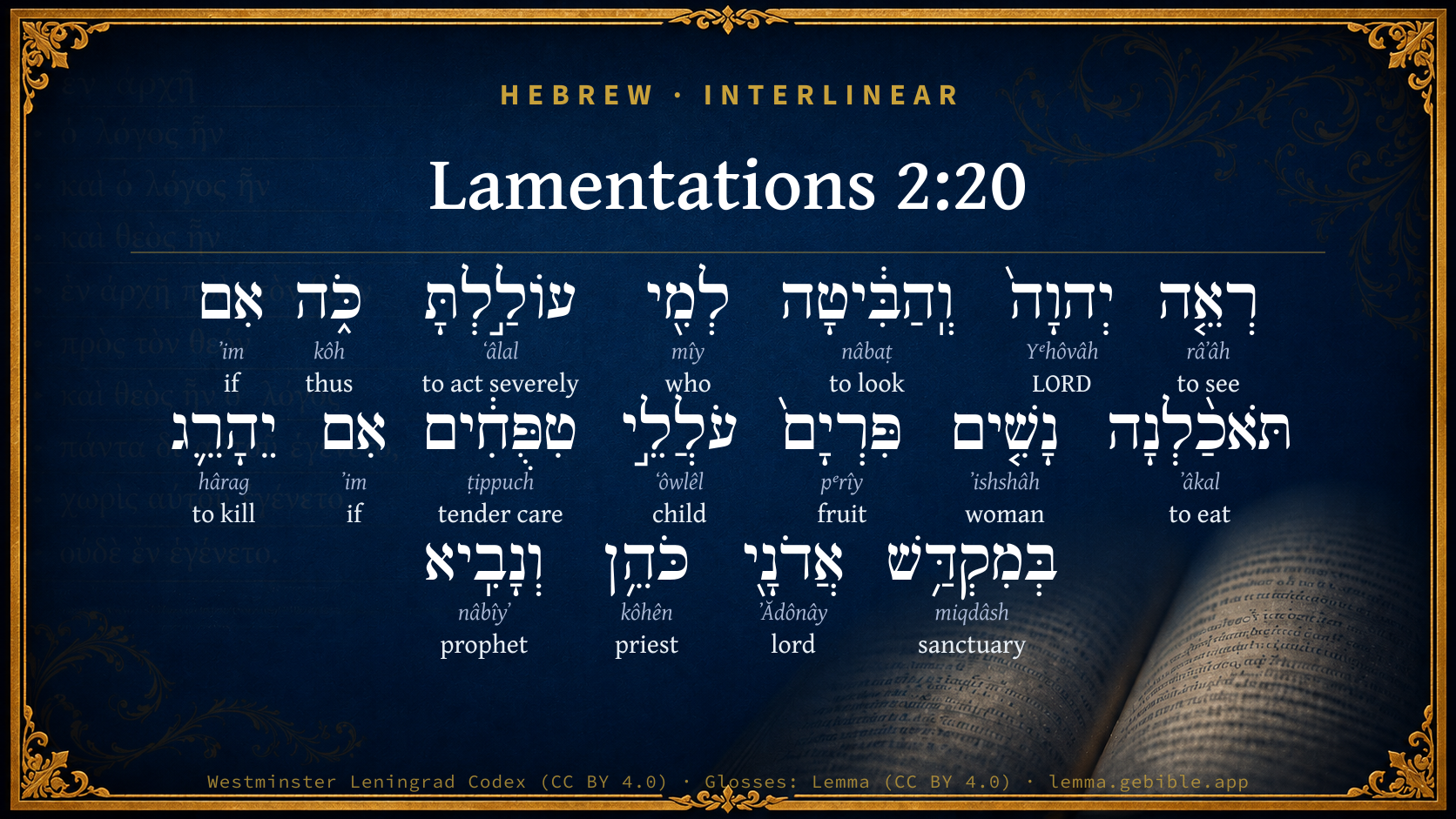
Hebrew (Westminster Leningrad Codex) Lamentations 2:20 appears in the Hebrew Old Testament. The text above is from the Westminster Leningrad Codex. Each word links to its Strong’s number, a concise gloss, and parsing drawn from the Open Scriptures Hebrew Bible morphology. Click any word for its full Brown-Driver-Briggs (BDB) entry.
Download image
Cite this verse

Lamentations 2:20 (World English Bible). Public Domain. Lemma interlinear Bible study tool, https://lemma.gebible.app/v/lamentations/2/20.

Show BibTeX & RIS
BibTeX
RIS
English Translation
Look, Yahweh, and see to whom you have done thus! Shall the women eat their fruit, the children that are dandled in the hands? Shall the priest and the prophet be killed in the sanctuary of the Lord?
World English Bible · Public Domain
Highlights
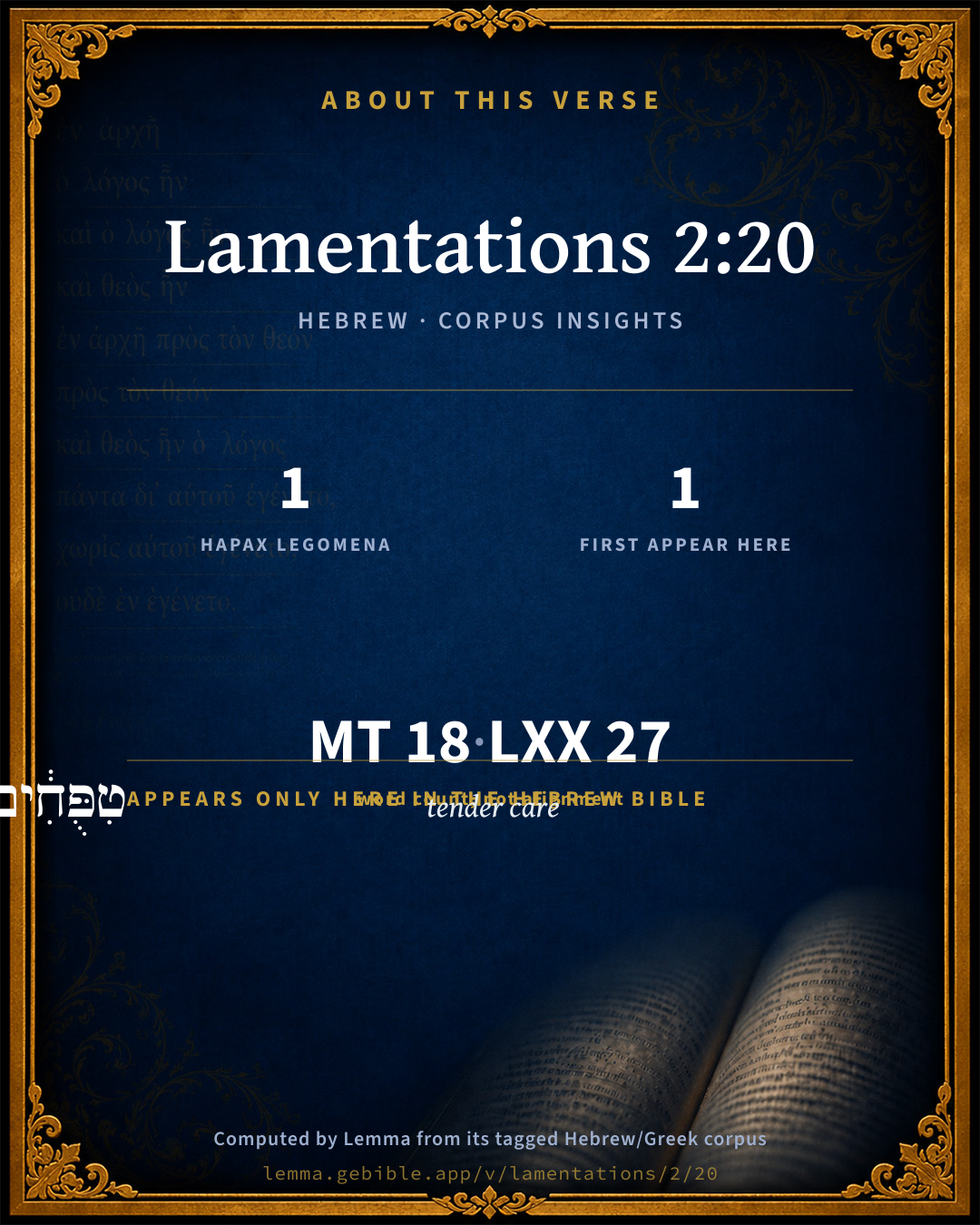
  • 1 hapax legomenon — only here in the Hebrew Bible
  • 1 first appearance in the Hebrew Bible
Full analysis ↓
Download a study sheet

One document with this verse’s original text, its word-by-word gloss line, the meaning frame, cross-references with their text, attributed commentary, and full source and license credits — printable, and it pastes into notes with its structure intact.

This verse Autodidact and up

Study sheet (.html) Plain text (.txt)

A passage Seminary Student

Up to 50 verses in one chapter. A passage sheet keeps up to 6 commentary sources and 12 cross-references per verse, in the order this page ranks them, and says so on the sheet whenever that leaves anything out. Ask for a single verse and you get the Autodidact verse sheet above.

Everything on this page stays free to read, with no account — the sheet is a download of what is already on screen, not access to it.

Want to remove ads? Support Godless Engineer
Compare translations 3

The same verse in 3 English versions, stacked beneath the original-language interlinear above. Click any original word for its lexicon entry.

Each is an independent rendering of the whole verse — the interlinear is not word-aligned to these translations.

Highlighted words mark where these versions differ — a whole-verse word diff, not a word-by-word alignment.

  • World English Bible Public Domain
    Look, Yahweh, and see to whom you have done thus! Shall the women eat their fruit, the children that are dandled in the hands? Shall the priest and the prophet be killed in the sanctuary of the Lord?
  • King James Version Public Domain
    Behold, O LORD, and consider to whom thou hast done this. Shall the women eat their fruit, and children of a span long? shall the priest and the prophet be slain in the sanctuary of the Lord?
  • unfoldingWord Literal Text CC BY-SA 4.0
    See, O Yahweh, and look! To whom have you dealt thus? Should women eat their fruit, children of nursing? Should priest and prophet be slain in the sanctuary of the Lord? SIN

unfoldingWord Literal Text — © unfoldingWord, licensed CC BY-SA 4.0. Word-aligned USFM3 via Door43 (git.door43.org/unfoldingWord/en_ult).

Versions to compare (up to 4)

3 of 4 selected

Show all 18 translations

Every available English version of this verse, each an independent rendering of the whole verse.

  • World English Bible Public Domain
    Look, Yahweh, and see to whom you have done thus! Shall the women eat their fruit, the children that are dandled in the hands? Shall the priest and the prophet be killed in the sanctuary of the Lord?
  • Berean Standard Bible Public Domain
    Look, O LORD, and consider: Whom have You ever treated like this? Should women eat their offspring, the infants they have nurtured? Should priests and prophets be killed in the sanctuary of the Lord?
  • Majority Standard Bible Public Domain
    Look, O LORD, and consider: Whom have You ever treated like this? Should women eat their offspring, the infants they have nurtured? Should priests and prophets be killed in the sanctuary of the Lord?
  • King James Version Public Domain
    Behold, O LORD, and consider to whom thou hast done this. Shall the women eat their fruit, and children of a span long? shall the priest and the prophet be slain in the sanctuary of the Lord?
  • American Standard Version (1901) Public Domain
    See, O Jehovah, and behold to whom thou hast done thus! Shall the women eat their fruit, the children that are dandled in the hands? Shall the priest and the prophet be slain in the sanctuary of the Lord?
  • Revised Version (1885) Public Domain
    See, O LORD, and behold, to whom thou hast done thus! shall the women eat their fruit, the children that are dandled in the hands? shall the priest and the prophet be slain in the sanctuary of the Lord?
  • Geneva Bible (1599) Public Domain
    Beholde, O Lord, and consider to whome thou hast done thus: shall the women eate their fruite, and children of a spanne long? shall the Priest and the Prophet be slaine in the Sanctuarie of the Lord?
  • Douay-Rheims (1899) Public Domain
    Res. Behold, O Lord, and consider whom thou hast thus dealt with: shall women then eat their own fruit, their children of a span long? shall the priest and the prophet be slain in the sanctuary of the Lord?
  • Young's Literal Translation Public Domain
    See, O Jehovah, and look attentively, To whom Thou hast acted thus, Do women eat their fruit, infants of a handbreadth? Slain in the sanctuary of the Lord are priest and prophet?
  • Literal Standard Version CC BY-SA 4.0
    See, O YHWH, and look attentively, || To whom You have acted thus, || Do women eat their fruit, infants of a handbreadth? Slain in the sanctuary of the Lord are priest and prophet?
  • Unlocked Literal Bible CC BY-SA 4.0
    See, Yahweh, and consider those you have dealt in this way. Should women eat the fruit of their wombs, the children whom they have cared for? Should priest and prophet be slaughtered in the sanctuary of the Lord?
  • unfoldingWord Literal Text CC BY-SA 4.0
    See, O Yahweh, and look! To whom have you dealt thus? Should women eat their fruit, children of nursing? Should priest and prophet be slain in the sanctuary of the Lord? SIN
  • Darby Bible Public Domain
    See, Jehovah, and consider to whom thou hast done this! Shall the women eat their fruit, the infants that they nursed? Shall priest and prophet be slain in the sanctuary of the Lord?
  • World Messianic Bible Public Domain
    “Look, LORD, and see to whom you have done thus! Should the women eat their offspring, the children that they held and bounced on their knees? Should the priest and the prophet be killed in the sanctuary of the Lord?
  • Webster's Bible Public Domain
    Behold, O LORD, and consider to whom thou hast done this. Shall the women eat their fruit, children of a span long? shall the priest and the prophet be slain in the sanctuary of the Lord?
  • Free Bible Version CC BY-SA 4.0
    Lord, please think about it! Who have you ever treated this way? Should women have to eat their children, the little ones they love? Should priests and prophets be killed in the Lord's Temple?
  • Bible in Basic English Public Domain
    Look! O Lord, see to whom you have done this! Are the women to take as their food the fruit of their bodies, the children who are folded in their arms? are the priest and the prophet to be put to death in the holy place of the Lord?
  • JPS Tanakh (1917) Public Domain
    'See, O LORD, and consider, to whom Thou hast done thus! Shall the women eat their fruit, the children that are dandled in the hands? Shall the priest and the prophet be slain in the sanctuary of the Lord?

Literal Standard Version (2020), Covenant Press — licensed CC BY-SA 4.0. Text via the HelloAO Bible API (eBible.org). Unlocked Literal Bible (unfoldingWord) — licensed CC BY-SA 4.0. Text via the HelloAO Bible API (eBible.org). unfoldingWord Literal Text — © unfoldingWord, licensed CC BY-SA 4.0. Word-aligned USFM3 via Door43 (git.door43.org/unfoldingWord/en_ult). Free Bible Version, Dr. Jonathan Gallagher — licensed CC BY-SA 4.0. Text via the HelloAO Bible API (eBible.org).

Word by word

More ways to search: Search by grammar → Find every occurrence → Compare this word →

Practice this passage: Drill this verse → Learn its vocabulary →

טִפֻּחִ֔ים
ṭippuch
H2949
“tender cares”
Noun, Common, Masculine, Plural, Absolute
Part of Speech
Noun
Type
Common
Gender
Masculine
Number
Plural
State
Absolute
Full BDB Definition

Origin: from H2946

TWOT: 818a

tender care, dandling
  1. רְאֵ֤ה râʼâh H7200 “see” Verb, Qal, Imperative, 2nd Person, Masculine, Singular
  2. יְהוָה֙ Yᵉhôvâh H3068 “LORD” Noun, Proper
  3. וְֽהַבִּ֔יטָה nâbaṭ H5027 “and · look” Conjunction + Verb, Hiphil, Imperative, 2nd Person, Masculine, Singular + Suffix, h
  4. לְמִ֖י mîy H4310 “to/for · who” Preposition + Particle, Interrogative
  5. עוֹלַ֣לְתָּ ʻâlal H5953 “to act severely” Verb, Poel, Perfect, 2nd Person, Masculine, Singular
  6. כֹּ֑ה kôh H3541 “thus” Adverb
  7. אִם ʼim H518 “if” Conjunction
  8. תֹּאכַ֨לְנָה ʼâkal H398 “to eat” Verb, Qal, Imperfect, 3rd Person, Feminine, Plural
  9. נָשִׁ֤ים ʼishshâh H802 “women” Noun, Common, Feminine, Plural, Absolute
  10. פִּרְיָם֙ pᵉrîy H6529 “fruit · their” Noun, Common, Masculine, Singular, Construct + Suffix, Personal, 3rd Person, Masculine, Plural
  11. עֹלֲלֵ֣י ʻôwlêl H5768 “children of” Noun, Common, Masculine, Plural, Construct
  12. אִם ʼim H518 “if” Conjunction
  13. יֵהָרֵ֛ג hârag H2026 “to kill” Verb, Niphal, Imperfect, 3rd Person, Masculine, Singular
  14. בְּמִקְדַּ֥שׁ miqdâsh H4720 “in/at · sanctuary of” Preposition + Noun, Common, Masculine, Singular, Construct
  15. אֲדֹנָ֖י ʼĂdônây H136 “Lord · my” Noun, Common, Masculine, Plural, Construct + Suffix, Personal, 1st Person, Common, Singular
  16. כֹּהֵ֥ן kôhên H3548 “priest” Noun, Common, Masculine, Singular, Absolute
  17. וְנָבִֽיא nâbîyʼ H5030 “and · prophet” Conjunction + Noun, Common, Masculine, Singular, Absolute

About this verse

These counts appear in no published source. They are computed here, from the morphology-tagged text and Lemma’s own curated glosses. What Lemma adds →

18
words
17
distinct lemmas
Prophets
section

Notable vocabulary

1 hapax legomenon — a word that appears only here in the entire Hebrew Bible:

  • טִפֻּחִ֔ים tender care H2949

First appearance in Scripture

This word makes its first canonical appearance in the Hebrew Bible here:

  • טִפֻּחִ֔ים tender care H2949

Shared distinctive vocabulary

עוֹלַ֣לְתָּ to act severely H5953 occurs in 18 verses of the Hebrew Bible. Also found in:

Grammatical profile

  • 5 verbs
  • 9 nouns
  • 2 conjunctions
  • 1 adverb
  • 1 particle

Verb forms

  • רְאֵ֤ה Qal · Imperative
  • וְֽהַבִּ֔יטָה Hiphil · Imperative
  • עוֹלַ֣לְתָּ Poel · Perfect
  • תֹּאכַ֨לְנָה Qal · Imperfect
  • יֵהָרֵ֛ג Niphal · Imperfect

Repetition

A word recurs within this verse — often emphatic in Hebrew:

  • אִם if H518 ×2

Hebrew & Septuagint length

In English translation the verse runs 38 words from the Hebrew and 49 from the Septuagint (LXX English) — closely comparable.

A rough comparison of the two English renderings, which tokenize alike — not a word-level alignment.

Word counts can differ between the Hebrew and the Greek without any difference in meaning — e.g. the Hebrew direct-object marker אֵת has no separate Greek word, and Greek often adds the article ὁ.

In the original languages it is 18 Hebrew tokens and 27 Greek tokens — but the two are counted differently (Hebrew bundles its prefixes and suffixes into one token; the Greek is in lemma form), so that isn’t a like-for-like length.

Cross-references

20

Topical passages linked to Lamentations 2:20 in the Treasury of Scripture Knowledge — connected by theme and wording, ordered by reader-vote popularity; previews shown in the World English Bible.

  • Jeremiah 19:9 I will cause them to eat the flesh of their sons and the flesh of their daughters; and they shall eat everyone the flesh of his friend, in the siege and in the distress, with which their enemies, and those who seek their life, shall distress them.
  • Lamentations 4:10 The hands of the pitiful women have boiled their own children; They were their food in the destruction of the daughter of my people.
  • Psalms 78:64 Their priests fell by the sword, And their widows couldn't weep.
  • Exodus 32:11 Moses begged Yahweh his God, and said, "Yahweh, why does your wrath burn hot against your people, that you have brought forth out of the land of Egypt with great power and with a mighty hand?
  • Deuteronomy 9:26 I prayed to Yahweh, and said, Lord Yahweh, don't destroy your people and your inheritance, that you have redeemed through your greatness, that you have brought forth out of Egypt with a mighty hand.
  • Lamentations 4:13 [It is] because of the sins of her prophets, [and] the iniquities of her priests, That have shed the blood of the just in the midst of her.
  • Leviticus 26:29 You will eat the flesh of your sons, and you will eat the flesh of your daughters.
  • Deuteronomy 28:53–57 You shall eat the fruit of your own body, the flesh of your sons and of your daughters, whom Yahweh your God has given you, in the siege and in the distress with which your enemies shall distress you.
  • 2 Kings 6:28–29 The king said to her, What ails you? She answered, This woman said to me, Give your son, that we may eat him today, and we will eat my son tomorrow.
  • Isaiah 9:14–17 Therefore Yahweh will cut off from Israel head and tail, palm-branch and rush, in one day.
  • Isaiah 63:16–19 For you are our Father, though Abraham doesn't know us, and Israel does not acknowledge us: you, Yahweh, are our Father; our Redeemer from everlasting is your name.
  • Isaiah 64:8–12 But now, Yahweh, you are our Father; we are the clay, and you our potter; and we all are the work of your hand.
  • Jeremiah 5:31 the prophets prophesy falsely, and the priests bear rule by their means; and my people love to have it so: and what will you do in the end of it?
  • Jeremiah 14:15–18 Therefore thus says Yahweh concerning the prophets who prophesy in my name, and I didn't send them, yet they say, Sword and famine shall not be in this land: By sword and famine shall those prophets be consumed.
  • Jeremiah 14:20–21 We acknowledge, Yahweh, our wickedness, and the iniquity of our fathers; for we have sinned against you.
  • Jeremiah 23:11–15 for both prophet and priest are profane; yes, in my house have I found their wickedness, says Yahweh.
  • Lamentations 1:19 I called for my lovers, [but] they deceived me: My priests and my elders gave up the spirit in the city, While they sought them food to refresh their souls.
  • Lamentations 4:16 The anger of Yahweh has scattered them; he will no more regard them: They didn't respect the persons of the priests, they didn't favor the elders.
  • Ezekiel 5:10 Therefore the fathers shall eat the sons in the midst of you, and the sons shall eat their fathers; and I will execute judgments on you; and the whole remnant of you will I scatter to all the winds.
  • Ezekiel 9:5–6 To the others he said in my hearing, Go you through the city after him, and strike: don't let your eye spare, neither have you pity;

Cross-references courtesy of OpenBible.info (CC BY 4.0).

Hebrew and Greek witnesses Masoretic Hebrew ↔ Greek Septuagint

The same verse in the two great witnesses to the Old Testament, shown verse-for-verse.

These are two independent witnesses, not word-aligned to each other, and the Septuagint is shown in lemma (dictionary) form.

Hebrew Lamentations 2:20 Masoretic · Westminster Leningrad Codex

רְאֵ֤ה יְהוָה֙ וְֽהַבִּ֔יטָה לְמִ֖י עוֹלַ֣לְתָּ כֹּ֑ה אִם תֹּאכַ֨לְנָה נָשִׁ֤ים פִּרְיָם֙ עֹלֲלֵ֣י טִפֻּחִ֔ים אִם יֵהָרֵ֛ג בְּמִקְדַּ֥שׁ אֲדֹנָ֖י כֹּהֵ֥ן וְנָבִֽיא

Look, Yahweh, and see to whom you have done thus! Shall the women eat their fruit, the children that are dandled in the hands? Shall the priest and the prophet be killed in the sanctuary of the Lord?

World English Bible · Public Domain

Greek LXX Lamentations 2:20 Septuagint · lemma form

ὁράω κύριος καί ἐπιβλέπω τίς ἐπιφυλλίζω οὕτως εἰ ἐσθίω γυνή καρπός κοιλία αὐτός ἐπιφυλλίς ποιέω μάγειρος φονεύω νήπιος θηλάζω μαστός ἀποκτείνω ἐν ἁγίασμα κύριος ἱερεύς καί προφήτης

RHECHS. Behold, O Lord, and see for whom you have gathered thus. Shall the women eat the fruit of their womb? the cook has made a gathering: shall the infants sucking at the breasts be slain? will you kill the priest and prophet in the sanctuary of the Lord?

LXX2012 (modern English Septuagint) · Public Domain

On this verse, Joseph Benson's Commentary discusses the Septuagint’s reading. Read the note in Commentary ↓

Hebrew: Westminster Leningrad Codex (CC BY 4.0). Greek: Septuagint (public domain); English from LXX2012 (modern English Septuagint) (Public Domain). How the Septuagint differs from the Hebrew →

Commentary

Notes on Lamentations 2:20 from classic Christian and Jewish commentators (each source and its license shown beneath its notes). The classic Christian expositions comment on the surrounding passage and are grouped to its opening verse, so a note may address several verses; the Jewish commentaries on the Tanakh (Rashi and others) are per-verse, so they appear only where the commentator wrote on this verse.

Lemma curates 59 commentaries, every one of them public domain or Creative Commons licensed, each selected and text-cleaned for this edition rather than reprinted as found. About our sources →

Trapp's Complete Commentary

John Trapp

Lam 2:20 Behold, O LORD, and consider to whom thou hast done this. Shall the women eat their fruit, [and] children of a span long? shall the priest and the prophet be slain in the sanctuary of the Lord?

Ver. 20. Behold, O Lord, and consider to whom thou hast done this.] Even to thine own inheritances, who suffer harder and heavier things commonly than any others. And why? Ingentia beneficia, ingentia flagitia, ingentia supplicia; their offences are increased, their punishments are aggravated by their obligations.

Shall the women eat their fruit, children of a span long?] That they did so in the siege of Jerusalem by the Chaldees, it appeareth by this question. In the famine of Samaria, under Joram, they did likewise; {2Ki 6:28-29} as also at the last destruction of Jerusalem by the Romans; {a} and at the siege of Sancerra, in France, A.D. 1572. See the sad effects of sin, and shun it, if but for the ill consequents of it.

Shall the priest and the prophet be slain in the sanctuary of the Lord?] It seems they were so - but who they were we read not - although God had cautioned, "Touch not mine anointed, and do my prophets no harm." Priests were slaughtered, where they used to slaughter beasts for sacrifices; but it may be they were nothing better than Thomas Becket, the devil’s martyr, here, and Adam Benton, that butcherly archbishop in Scotland, who, when himself was butchered, cried out, Kill me not, for I am a priest. {b}

{a} Joseph. de Bel., lib. vii. cap. 8.

{b} Acts and Mon.

John Trapp, A Commentary or Exposition upon All the Books of the Old and New Testament (1647–1656) — public domain. Text from a community e-Sword module.

The Biblical Illustrator

Joseph S. Exell

Lam_2:20

Behold, O Ford, and consider to whom Thou hast done this.

Fervent prayer

1. The only way of remedy in our greatest miseries is to call upon God in fervent prayer.

(1) It declareth that we are humbled and our pride broken, in confessing no power to be in ourselves, and seeking help elsewhere.

(2) He is of greatest power, and none else can help us.

(3) He will have all the glory of our deliverance (Psa_50:15).

2. By this vehement kind of speech we learn that in right prayer to God the frame of our words must be according to our affection.

3. The chief reason to move the Lord to pity us is the remembrance of His covenant of mercy in Christ.

4. Gods wrath overturneth the course of nature in those against whom it is bent.

5. There is sufficient cause and matter in all the infants of Gods people, why God should in His justice destroy them (Psa_51:5).

6. Cruelty exercised by the hands of the wicked upon children and ministers is a special means to move God to hear us when we pray for them.

7. There is no privilege of peace that can free us from punishment when we sin against the Lord. (J. Udall.)

The Biblical Illustrator, edited by Joseph S. Exell (c. 1880s–1900s) — public domain. Text from a community e-Sword module.

Joseph Benson's Commentary

Lam 2:20-22. Behold, O Lord, to whom thou hast done this — To thy people, for whom thou hast formerly expressed so much tenderness and affection. Jerusalem seems to be here introduced speaking. Shall the women eat their fruit — We find by comparing this verse with chap. Lam 4:10, that God brought upon them that terrible judgment which he had denounced against them, if they continued to provoke him, namely, that they should eat the flesh of their own sons and daughters. See the margin. And children of a span long — Hebrew, שׂפחים, rendered in the margin, swaddled with their hands, and by the LXX., νηπια θηλαζοντα μαστους, infants sucking the breasts. Shall the priest and the prophet be slain in the sanctuary of the Lord? — Shall thy ministers be slain, and that in thy sanctuary? We learn from this, 1st, That the Chaldeans spared no character, no, not the most distinguished; even the priest and the prophet, who, of all men, one would think, might have expected protection from heaven, and veneration on earth, yet they were slain; not abroad in the field of battle, where they would have been out of their place, as Hophni and Phinehas were, but in the sanctuary of the Lord, the place of their business, and which they hoped would have been a refuge to them. 2d, They spared no age, no, not those who, by reason of their tender or decrepit age, were exempted from taking up the sword; for the young and the old lay on the ground slain in the streets. 3d, They spared no sex, the virgins and the young men fell by the sword. In the most barbarous military executions that we read of, the virgins were spared and made part of the spoil, but here they were put to the sword as well as the young men. We learn, 4th, That this was the Lord’s doing; he suffered the sword of the Chaldeans to devour thus without distinction; he slew them in the day of his anger — Namely, his anger for their many and aggravated sins. Thou hast called, as in a solemn day — A day of awful retribution; my terrors round about — As my people were wont to be called together from all parts on solemn days, when they were to meet at Jerusalem for thy service; so now, by thy providence, my terrible enemies are by thee called together to slay thy people in that holy city in which they were wont to worship thee. So that none escaped nor remained — That is, few or none. Those that I have swaddled, and brought up, hath mine enemy consumed — As if they had been brought forth for the murderer, like lambs for the butcher, Hos 9:13. Zion, that was a mother to them all, laments to see those that were brought up in her courts, and under the tuition of her oracles, thus made a prey of and destroyed.

Joseph Benson's Commentary on the Old and New Testaments (1811–1818) — public domain. Text from a community e-Sword module.

Whedon's Commentary on the Bible

Daniel D. Whedon

THE PRAYER, Lam_2:20-22.

20. Behold, O Lord, etc. — The prayer of the prophet. The fearful picture has been seen, the cries of distress and agony have been heard, and the prophet weaves out of them an argument of prayer.

To whom thou hast done this — An appeal to that covenant upon which their very existence was based.

Their fruit — That is, the fruit of their body.

Children of a span long — Children of their tender care; the word being from a verb, שׂפח, which means to care for tenderly.

Daniel D. Whedon (gen. ed.), Commentary on the Old and New Testaments (1874–1909) — public domain. Text from a community e-Sword module.

The Preacher's Complete Homiletical Commentary

Joseph S. Exell (gen. ed.)

EXEGETICAL NOTES.—

(ר) Lam_2:20. The prayer is put into words correspondent with the circumstances. See, Jehovah, and behold to whom thou hast done this, to the city called thine, to the people whom thou hast chosen to be a name and praise to thee. How shocking are the consequences! See if women eat their fruit, the children whom they carried. The last word relates to that which is spread—as infants on the knees or arms. The Revised Version translates it dandled in the hands, which, if expressing the idea, is too special. The awful incident was a punishment threatened (Deu_28:56-57; Jer_19:9). See if there are slain in the sanctuary of the Lord priest and prophet. His own holy place defiled with blood. If such spectacles were common, as they were, will God not stay His hand?

(ש) Lam_2:21. From the massacre in the Temple to the general slaughter of all ages and both sexes is another step in the dismal recital. The youth and the old man … my virgins and choice young men, were killed. It was clear that they had to bear the anger of Jehovah—that He was not only full of compassion, but in righteousness he doth judge and make war upon evil.

(ח) Lam_2:22. Thou hast called as in a day of solemn assembly, summoning, as by trumpet, all kinds of terrifying agencies—men, famine, fire, sword—my terrors on every side, and there was none that escaped or remained in the day of Jehovah’s anger. Then, in motherly anguish, she laments again over the children she had carried and brought up, whom the enemy had cruelly consumed. So “the poem concludes, like the first, with deep sorrow, regarding which all attempts at comfort are quite unavailing.”

HOMILETICS

A PRAYER FOR DIVINE COMPASSION

(Lam_2:20-22)

I. Reminding Jehovah of His former favour to the sufferers. “Behold, O Lord, and consider to whom Thou hast done this” (Lam_2:20). The prophet seems to feel that if God would only look and recall to mind who they were who were suffering, He would surely have pity. They are not the heathen, but His own people, the seed of Abraham, whom He raised from obscurity and endowed with unexampled blessings. Their present misery was all the more painful to endure when contrasted with their former affluence and power, and would surely move the compassion of Him who had so often interposed on their behalf. It is a great help in prayer to remind God of His former loving-kindness. Every blessing we receive from God increases His interest in our welfare. Every act of disobedience is a sin against Infinite Love.

II. Uttered from the midst of appalling distress (Lam_2:20-21). In these verses we have a vivid description of the suffering and desolation occasioned by the siege. In the extreme exigencies of famine the most horrible cannibalism was practised: the pangs of hunger devoured maternal affection, and mothers devoured their newly-born infants. Even this had been predicted as the fruit of disobedience (Deu_28:53). How little do we appreciate the great goodness of God in providing daily food for ourselves and our children! Everywhere in the city were visible the most ghastly scenes of indiscriminate massacre—“priest and prophet, young and old, virgins and young men,” lay in promiscuous heaps of the slain. If prayer can reach heaven, it must surely be when ascending from the midst of anguish like this. The greater the distress we are in, the more urgent and importunate should be our prayers.

III. Wrung from a people terrified with startling proofs of the Divine anger. “Thou hast called as in a solemn day my terrors round about, so that in the day of the Lord’s anger none escaped or remained” (Lam_2:22). Jeremiah had often threatened the terrors of God’s wrath in the destruction of the nation, if the people persisted in idolatry; but they heeded not. They made jests of his warnings, and their earnest repetition only increased their ridicule. But when they saw Jerusalem hemmed round by the victorious Chaldeans and the utter ruin that followed, they then saw the portentous meaning of “the terrors” that had been so often threatened and so recklessly despised. The anger of the Lord became to them a solemn reality, and, overwhelmed with confusion and fear, they cry for help. Whatever impels the soul to pray is a blessing. The beginning of prayer may rise from our fears; but as we persevere, it will be actuated by nobler motives. All that prayer can do is to bring our case before God. We must then leave it there with Him, and say, “Thy will be done.”

LESSONS.—

1. The final appeal of the helpless is to God.

2. When distress induces prayer, deliverance is at hand.

3. Jehovah is graciously moved to help by human entreaty.

GERM NOTES ON THE VERSES

Lam_2:20. “Behold, O Lord, and consider to whom Thou hast done this.” The Divine pity:

1. Earnestly implored by a suffering people.

2. Invoked on the ground of former kindnesses, which, it is acknowledged, have been abused.

3. Is never appealed to in vain.

Lam_2:22. The tyranny of fear:

1. Realised when beset by a powerful enemy.

2. When the enemy is summoned and directed by One whom we have consciously offended.

3. When we are witnesses of cruelties we are powerless to prevent.

ILLUSTRATIONS.—Prayer. It is helplessness casting itself on power. It is infirmity leaning on strength, and misery wooing bliss. It is the flight of the soul to the bosom of God, and the spirit soaring upward and claiming nativity beyond the stars. It is the soaring eagle mounting upward in its flight, and with steady gaze pursuing the track till lost to all below. It is the roving wanderer looking towards his abiding-place, where are all his treasures and his gold. It is the prisoner pleading for release. It is the mariner of a dangerous sea, upon the reeling topmast, descrying the broad and quiet haven of repose. It is the soul, oppressed by earthly soarings, escaping to a broader and purer sphere, and bathing its plumes in the ethereal and eternal.—Wells.

Yearning for God.—When my blood flows like wine, when all is ease and prosperity, when the sky is blue and birds sing and flowers blossom, and my life is an anthem moving in time and tune, then this world’s joy and affection suffice. But when a change comes, when I am weary and disappointed, when the skies lower into a sombre night, when there is no song of bird, and the perfume of flowers is but their dying breath, when all is sun-setting and autumn, then I yearn for Him who sits with the summer of love in His soul, and feel that all earthly affection is but a glow-worm light compared to that which blazes with such effulgence in the heart of God.—Beecher.

Divine compassion. We often suffer more on account of other’s troubles than they themselves do in those troubles, for both love and sorrow take their measure as much from the capacity of the nature that experiences them as from the power of the externally exciting cause. How much one suffers with or for another does not depend altogether upon how much that other is suffering, but upon how much that nature which sympathises has with which to suffer. God feels with us, so that our experiences throw their waves upon the shore of His soul. He carries us so near to His heart that all our feelings which are of any moment produce their effects in some degree in His bosom. It seems very strange that the Maker of all the earth should permit Himself to be a participant in all the petty experiences that belong to any human life. No man would have dared to conceive such an idea of God, and to have believed any such thing as that, if it had not been revealed in unequivocal terms.

The compassion of Jesus. Luther said, “I would run into the arms of Christ if He stood with a drawn sword in His hands.” John Butterworth, reading this, resolved to do likewise, and found, as every venturing sinner does, no sword in the hands of Jesus, but open arms and a hearty welcome. Christ’s proclamation, for ever sounding forth to every burdened heart, is “Come unto Me, all ye that labour and are heavy laden, and I will give you rest.” He demonstrated His marvellous compassion by dying for us. He will not now repulse the approach or disregard the cry of the needy.

The influence of fear. There is a virtuous fear, which is the effect of faith; and there is a vicious fear, which is the product of doubt. The former leads to hope, as relying on God, in whom we believe; the latter inclines to despair, as not relying on God, in whom we do not believe. Persons of the one character fear to lose God; persons of the other character fear to find Him.—Pascal.

Slavish and filial fear. There are two kinds of fear—one full of suspicious watchfulness, of anxious apprehension, of trepidation, terror, and dismay; the other such as can dwell in the same heart with confidence and love, and is but another form of reverence. Filial fear of God is a duty; slavish and servile dread of Him is a sin. Filial fear shrinks from sin; servile fear only from the smart of punishment. Filial fear keeps men from departing from the living God, servile fear drives them from Him. By filial fear men are made like the man Christ Jesus; by servile fear they may be scared from iniquity, as the wolf from the sheepfold by the shepherd’s gun; but it does no more to make them holy than the fright does to destroy the wolf’s ferocity. Filial fear animates us to avoid whatever would be offensive to our Heavenly Father, and, if the expression may be allowed, to consult His feelings and desires; but servile fear, as it springs from selfishness, causes us only to care for ourselves, and at best makes us not better, but only a little more prudent than the devil.—Bertram.

The greatest fear. When a city is compassed round about with a wall that is impregnable, it will be opened still towards heaven, and therefore cannot be out of danger if God be an enemy. For all their walls and bars, God could rain fire and brimstone upon the Sodomites out of heaven. Alexander asked the Scythians what they were most afraid of, thinking they would say of himself, who was so victorious everywhere. But they answered scoffingly they were most afraid lest heaven should fall upon them. We, indeed, need not fear anything but this only, lest the heaven should fall upon us, lest God should be our enemy.—J. Stoughton.

The Preacher's Complete Homiletical Commentary (gen. ed. Joseph S. Exell; Funk & Wagnalls, c. 1892) — public domain (pre-1929). A full-Bible homiletical/sermon-outline anthology covering 65 of 66 books (2 John is absent from the source module). Text from a community e-Sword module.

Keil & Delitzsch

C. F. Keil & F. Delitzsch

In Lam 2:20 follows the prayer which the city has been commanded to make. The prayer sets before the mind of the Lord the terrible misery under which Jerusalem suffers. The question, "To whom hast Thou acted thus?" does not mean, "What innocent and godly ones are being sacrificed?" (Thenius), but "to what nation?" - not a heathen one, but the people of thy choice, to whom all Thy blessed promises have been given (Ngelsbach). This is clear from the reasons given in the question, in which the murder of the priests and prophets in the sanctuary of the Lord is brought forward. But first there is mentioned a case of inhuman conduct, prompted by necessity, viz., that women, in the extreme destitution of hunger, have been constrained to eat the fruit of their body, their beloved children. אם...אם does not, in this case, introduce a disjunctive question, but merely an indirect question in two parts. In view of such inhuman cruelties and such desecration of His sanctuary, God cannot remain inactive. The meaning of the question is not: estne hoc unquam fando auditum, quod apud nos factum est, or, quod matres fame eo adactae fuerint, ut suos faetus comederent (C. B. Michaelis, Rosenmller). For in this case, not the imperfect, but the perfect, would be used. It is merely asked whether something could happen in a certain way, while it is implied that it has actually occurred already. פּרים has the masc. instead of the fem. suffix, as pretty frequently happens. The fruit of their bodies is meant, as the lxx have rightly rendered; but there is no reason for making this the ground of alterations in the text. The expression "their fruit," indefinite in itself, is immediately rendered definite by עללי טפּחים. The last word is a verbal noun from טפּח (Lam 2:22), which again is a denominative from טפח, and means to bear on the hands, to care for tenderly. Both words occur only in this passage. The Israelites, moreover, had been threatened with this inhuman outrage as the most extreme form of divine chastisement, Lev 26:26; Deu 28:56; cf. Jer 19:9. While this abomination is opposed to the moral order of the world instituted by God, the other case (the murder of the priests and prophets in the sanctuary) is a violation of the covenant-order which the Lord had given His people. Neither of these arrangements can God consent to abolish. Therein is implicitly contained the request that He would put an end to the misery into which His people have fallen. This request, however, is not expressly stated; there is merely complaint made to God regarding the terrible misery. From the massacre in the temple, the lamentation passes to the bloodshed on the streets of the city, in which neither age nor sex was spared; cf. Jer 6:11. חוּצות is a local accus., "through the streets," along the streets.

Keil & Delitzsch — Biblical Commentary on the Old Testament (1861–1891) — public domain (CC PDM 1.0). Text via the HelloAO Bible API. (Old Testament only.)

Tyndale Open Study Notes

Tyndale Open Resources

2:20 Jeremiah had predicted that the same cannibalism that occurred during a siege of Samaria (2 Kgs 6:28-29) would happen in Jerusalem (Jer 19:9; see also Lam 4:10; Ezek 5:10; cp. Deut 28:53-57).

Tyndale Open Study Notes — © Tyndale Open Resources, licensed CC BY-SA 4.0. Text via the HelloAO Bible API.

Geneva Bible (1599)

Geneva Bible translators

Or, brought up in their own hands.

Geneva Bible (1599) marginal notes — public domain. Text via Bolls.life.

Jamieson, Fausset & Brown

Robert Jamieson, A. R. Fausset & David Brown

women eat . . . fruit--as threatened (Lev 26:29; Deu 28:53, Deu 28:56-57; Jer 19:9).

children . . . span long--or else, "children whom they carry in their arms" [MAURER].

Jamieson, Fausset & Brown — Commentary Critical and Explanatory on the Whole Bible (1871) — public domain (CC PDM 1.0). Text via the HelloAO Bible API.

Adam Clarke's Commentary

Verse 20. Consider to whom thou hast done this] Perhaps the best sense of this difficult verse is this: "Thou art our Father, we are thy children; wilt thou destroy thy own offspring? Was it ever heard that a mother devoured her own child, a helpless infant of a span long?" That it was foretold that there should be such distress in the siege, - that mothers should be obliged to eat their own children, is evident enough from Le 26:29; De 28:53; De 28:56-57; but the former view of the subject seems the most natural and is best supported by the context. The priest and the prophet are slain; the young and old lie on the ground in the streets; the virgins and young men are fallen by the sword. "THOU hast slain them in the day of thine anger; THOU hast killed, and not pitied." See La 4:10.

Adam Clarke's Commentary on the Bible (1810–1826) — public domain. Text from a community e-Sword/MySword module.

John Calvin's Commentaries

Here, also, Jeremiah dictates words, or a form of prayer to the Jews. And this complaint availed to excite pity, that God had thus afflicted, not strangers, but the people whom he had adopted. Interpreters do, indeed, give another explanation, “See, Jehovah, To whom hast thou done this?” that is, Has any people been ever so severely afflicted? But I do not think that the comparison is made here, which they seek to make, but that the people only set before God the covenant which he had made with their fathers, as though they said, “O Lord, hadst thou thus cruelly raged against strangers, there would have been nothing so wonderful; but since we are thine heritage, and the blessed seed of Abraham, since thou hast been pleased to choose us as thy peculiar people, what can this mean, that, thou treatest us with so much severity?”

We now, then, perceive the real meaning of the Prophet, when, in the person of the people, he speaks thus, See, and look on, Jehovah, to whom thou hast done this; for thou hast had to do with thy children: not that the Jews could allege any worthiness; but the gratuitous election of God must have been abundantly sufficient to draw forth mercy. Nor do the faithful here simply ask God to see, but they add another word, Look on. By the two words they more fully express the indignity of what had happened, as though they said, that it was like a prodigy that God’s people should be so severely afflicted, who had been chosen by him: see, then, to whom thou hast done this

And this mode of praying was very common, as we find it said in the Psalms,

“Pour forth thy wrath on the nations which know not thee, and on the kingdoms which call not on thy name.” (Psalm 79:6.)

And a similar passage we have before observed in our Prophet. (Jeremiah 10:25.) The sum of what is said is, that there was a just reason why God should turn to mercy, and be thus reconciled to his people, because he had not to do with aliens, but with his own family, whom he had been pleased to adopt. But the rest I shall defer until tomorrow.

John Calvin's Commentaries (1540-1563) — public domain. Text from the Calvin Translation Society English edition (1840s-50s) via the Christian Classics Ethereal Library (ccel.org). Calvin's coverage is partial (roughly two-thirds of the Bible); uncommented books and verses are honest gaps, never fabricated. The 19th-century editor's footnotes and remarks are omitted so the notes are faithfully Calvin's own voice.

Ellicott's Commentary for English Readers

(20) To whom thou hast done this—i.e., not to a heathen nation, but to the people whom Jehovah Himself had chosen.

Shall the women eat their fruit.—Atrocities of this nature had been predicted in Lev_26:26; Deu_28:57; Jer_19:9. They were, indeed, the natural incidents of a besieged city reduced to starvation, as in the case of Samaria (2Ki_6:28), and the siege of Jerusalem by the Romans (Jos., B. J. v. 12), and had been witnessed, as the words show, in that by the Chaldæans. (Comp., as to the famine, Eze_4:16-17; Eze_5:16.)

Shall the priest . . .—Stress is laid on this as being the next element of horror. The very Holy of Holies was profaned with the blood of the priests and prophets of Jehovah.

A Bible Commentary for English Readers, edited by Charles John Ellicott (1878–1897) — public domain. Text from a community e-Sword module.

The Cambridge Bible for Schools and Colleges

gen. ed. J. J. S. Perowne

20. Here begins the prayer made in response to the prophet’s exhortation. The questions are rhetorical and mean (although the verbs are in the future), Wilt thou look with unconcern at the things which have been done? For the state of things (foretold Jer_19:9; Deu_28:53) cp. 2Ki_6:25-30.

behold, to whom thou hast done thus] viz. Thy chosen ones of old.

that are dandled in the hands] The thought of maternal tenderness in the forms in which it would ordinarily be displayed towards children of that age heightens the effect of the picture.

The Cambridge Bible for Schools and Colleges (gen. ed. J. J. S. Perowne; Cambridge University Press, 1878–1918) — public domain. Text from a community e-Sword module.

John Gill's Exposition

Behold, O Lord, and consider to whom thou hast done this,.... On whom thou hast brought these calamities of famine and sword; not upon thine enemies, but upon thine own people, that are called by thy name, and upon theirs, their young ones, who had not sinned as their fathers had: here the church does not charge God with any injustice, or complain of hard usage; only humbly entreats he would look upon her, in her misery, with an eye of pity and compassion; and consider her sorrowful condition; and remember the relation she stood in to him; and so submits her case, and leaves it with him. These words seem to be suggested to the church by the prophet, as what might be proper for her to use, when praying for the life of her young children; and might be introduced by supplying the word "saying" before "behold, O Lord", &c.

shall the women eat their fruit; their children, the fruit of their womb, as the Targum; their newborn babes, that hung at their breasts, and were carried in their arms; it seems they did, as was threatened they should, Lev 26:29; and so they did at the siege of Samaria, and at the siege of Jerusalem, both by the Chaldeans and the Romans:

and children of a span long? or of a hand's breadth; the breadth of the palms of the hand, denoting very little ones: or "children handled", or "swaddled with the hands" (c); of their parents, who are used to stroke the limbs of their babes, to bring them to; and keep them in right form and shape, and swaddle them with swaddling bands in a proper manner; see Lam 2:22; and so the Targum,

"desirable children, who are wrapped in fine linen.''

Jarchi (d) interprets it of Doeg Ben Joseph, whom his mother slew, and ate:

shall the priest and the prophet be slain in the sanctuary of the Lord? as very probably some were, who fled thither for safety when the city was broken up; but were not spared by the merciless Chaldeans, who had no regard to their office and character; nor is it any wonder they should not, when the Jews themselves slew Zechariah, a priest and prophet, between the porch and the altar; of whom the Targum here makes mention; and to whom Jarchi applies these words.

(c) "parvulos qui educantur", Pagninus; "parvulos educationum", Montanus; "educationis", Calvin; "infantes palmationum, sive tractationis palmarum", Michaelis; "pueros palmis tractatos", Cocceius. (d) E Talmud Bab. Yoma, fol. 38. 2.

John Gill's Exposition of the Whole Bible (1746–1763) — public domain (CC PDM 1.0). Text via the HelloAO Bible API.

Albert Barnes' Notes on the Bible

The sense is: “See, Yahweh, and look! whom hast Thou treated thus? Shall women eat their fruit - children whom they must still carry?” the swaddled child being one still needing to be nursed and borne in their arms.

Albert Barnes' Notes on the Bible (1834–1885) — public domain. Text from a community e-Sword/MySword module.

Haydock's Catholic Bible Commentary

Dealt. Literally, "gathered grapes," chap. i. 12. (Haydock) --- Long; quite small, Psalm xxxviii. 9. This has been denounced, chap. xix. 9., and Deuteronomy xxviii. 53. (Calmet) It took place at Samaria, and in the last siege of Jerusalem, (Josephus, Jewish Wars vii., and viii.; Worthington) as well as at this time. (Haydock)

George Leo Haydock (1774–1849), Haydock's Catholic Family Bible and Commentary, 1859 edition — public domain. Excludes Psalms (Douay-Rheims chapter numbering differs from Protestant) and Deuterocanonical books (Catholic canon only).

Matthew Poole's English Annotations

Consider to whom thou hast done this; that is, not to heathen, who never owned thee, nor were called by thy name, but to thine own people, called thy portion and thine heritage; let thy former relation to us, and our former acknowledgments of thee, prevail with thee. Wilt thou suffer, or should such a thing be, as for women to satisfy their hunger with the fruit of their own bodies, and that when they are very young? And shall thy ministers be slain, and that in thy sanctuary? Any human blood polluted it; shall not the blood of those that were the ministers of God be judged a pollution and profanation of it?

Matthew Poole's English Annotations on the Holy Bible (1683–1685) — public domain. Text from a community e-Sword/MySword module.

The Pulpit Commentary

To whom thou hast done this; viz. to Israel, the chosen people. And children; rather, (even) children. The children are the "fruit" referred to. Comp. the warnings in Lev_26:26 Deu_28:56; and especially Jer_19:9; also the historical incident in 2Ki_6:28, 2Ki_6:29. Of a span long; rather, borne in the hands. The word is derived from the verb renders to swaddle" in ver. 22 (see note).

Consideration besought.

How truly human is this language! How real was the eternal Lord to him who could shape his entreaty thus! As if to urge a plea for pity, the prophet implores him who has been offended by the nation"s sins, who has suffered the nation"s misery and apparent ruin, to consider; to remember who Judah is, and to have mercy.

I THE CIRCUMSTANCES THAT CALL FOR CONSIDERATION.

1. Famine and the inhuman conduct to which famine sometimes leads.

2. Death by the sword,

3. The privation of those religious offices which are the centre and inspiration of the nation"s life.

4. The common suffering of all classes; prophet and priest, children and old men, virgins and youth, are alike overtaken by want, by wounds, by death.

II THE GROUNDS UPON WHICH CONSIDERATION IS BEGGED FOR.

1. The main appeal is to Divine pity and benevolence.

2. The former mercies shown to Judah seem to be brought implicitly forward in this language. Israel has been chosen by God himself, favoured with privileges, delivered, protected, and blessed in a thousand ways. Will God cast off those in whom he has taken an interest so deep, for whom he has done so great things?

III THE HOPE WITH WHICH CONSIDERATION IS ASKED. Hitherto the regard of God in recent events has been a regard of displeasure and of censure. But if the attitude of the stricken be no longer one of defiance, but of submission, it may be that the Lord will turn him again, will be favourable unto his afflicted people, will restore them to former prosperity, enriched with the precious lessons of their adverse experience. T.

The Pulpit Commentary (1880–1919), ed. H.D.M. Spence-Jones & Joseph S. Exell — public domain. Text from a community e-Sword module.

John Wesley's Explanatory Notes

Whom - Not the Heathen, but to thy own people. Women - Wilt thou suffer women to satisfy their hunger with the fruit of their own bodies?

John Wesley, Explanatory Notes Upon the Whole Bible (1754–1765) — public domain. Text via the GEBible commentary corpus.

unfoldingWord translationNotes

Door43 World Missions Community

Should women eat the fruit of their wombs ... for?

This rhetorical question is asked to emphasize that it is not right for women to eat their children. This question can be written as a statement. AT: "Woman should not eat their own children ... for!" (See: Rhetorical Question)

the fruit of their wombs

This speaks of children having come from their mother as if they were fruit that came from her womb. AT: "their children that they have given birth to" or "their own children" (See: Metaphor)

Should priest and prophet be slaughtered in the sanctuary of the Lord?

This rhetorical question is used to emphasize that the prophets and priests should not be killed. This question can be written as a statement. AT: "The prophets and priests should not be slaughtered in the sanctuary of the Lord!" (See: Rhetorical Question)

Should priest and prophet be slaughtered

This can be stated in active form. AT: "Should our enemies slaughter priests and prophets" (See: Active or Passive)

translationWords

fruit

priest

prophet

slaughter

sanctuary

unfoldingWord translationNotes — © Distant Shores Media and the Door43 World Missions Community, licensed CC BY-SA 4.0. Source: git.door43.org/Door43/en_tn.

Rashi

Rabbi Shlomo Yitzchaki (Rashi)

children that are petted tender children, who are still being raised with their mothers’ pampering. And our Sages expounded on Doeg the son of Joseph, whose mother would measure him with [her] fists every day, to give gold to the Temple according to how much he grew, and she ultimately devoured him.

Will priest and prophet be slain in the Sanctuary of the Lord The holy spirit answers them, “Now was it proper for you that you slew Zechariah the son of Jehoiada?” as is written in (II) Chronicles (24:22), that he reproved them when they came and prostrated themselves to Joash, and deified him. (ibid. verse 20): “And the spirit of God enveloped Zechariah the son of Jehoiada.” He was a priest and a prophet, and they slew him in the forecourt.

Rashi on the Tanakh — English translations: “The Judaica Press complete Tanach with Rashi, translated by A. J. Rosenberg” (CC BY 4.0); “Pentateuch with Rashi's commentary by M. Rosenbaum and A.M. Silbermann, 1929-1934” (public domain); “The Metsudah Tanach series, Lakewood, N.J” (CC BY 4.0); and “The Book of Joshua, Metsudah Publications, 1997” (CC BY 4.0). Text via Sefaria.

Lesson kit

Teaching starters — assembled from the data on this page, not authored interpretation. Every prompt links to the verse data it draws on. Edit before teaching.

Lamentations, in the Prophets, opens this verse with 18 words (17 distinct Hebrew lemmas). Its most distinctive word is ṭippuch (“tender care”). A historical commentator’s framing appears above. Read the whole chapter for the surrounding context.

Discussion questions

  1. The word ṭippuch carries the sense “tender care.” How does it shape the verse?
  2. 1 word here appears nowhere else in the Hebrew Bible. Why might the author reach for such rare wording?
  3. This is the first place “tender care” appears in Scripture (first appears here). What does its debut here establish?
  4. How does Exodus 10:2, which shares the word «to act severely», read alongside this verse?
  5. What does the repetition of “if” (2× in this one verse) do in this verse?
  6. The translations on this page render this verse differently — a whole-verse word diff, not a word-by-word alignment. What might account for the different wordings?
  7. «רְאֵ֤ה» is a Qal Imperative verb. How does that grammatical form shape the action described?
  8. Compare how Trapp's Complete Commentary and The Biblical Illustrator read this verse. Where do they agree or differ?

Things to notice

  • 1 word in this verse appears nowhere else in the Hebrew Bible.
  • 1 word makes its first canonical appearance in Scripture here.
  • This verse counts 18 Hebrew ↔ 27 Greek words.
  • These translations choose different wording for 21 words in this verse.
  • “if” occurs 2× in this single verse.

Reading settings

Reading text

Shown beneath each verse's original-language words.

Old Testament
Old Testament edition

Read the OT as the Masoretic Hebrew (MT) or the Greek Septuagint (LXX).

English shown for the Greek Septuagint (in the Hebrew ↔ Greek comparison).

Comparing translations? Open the Compare panel on any verse page to stack up to four side by side.