Ezekiel 13:3

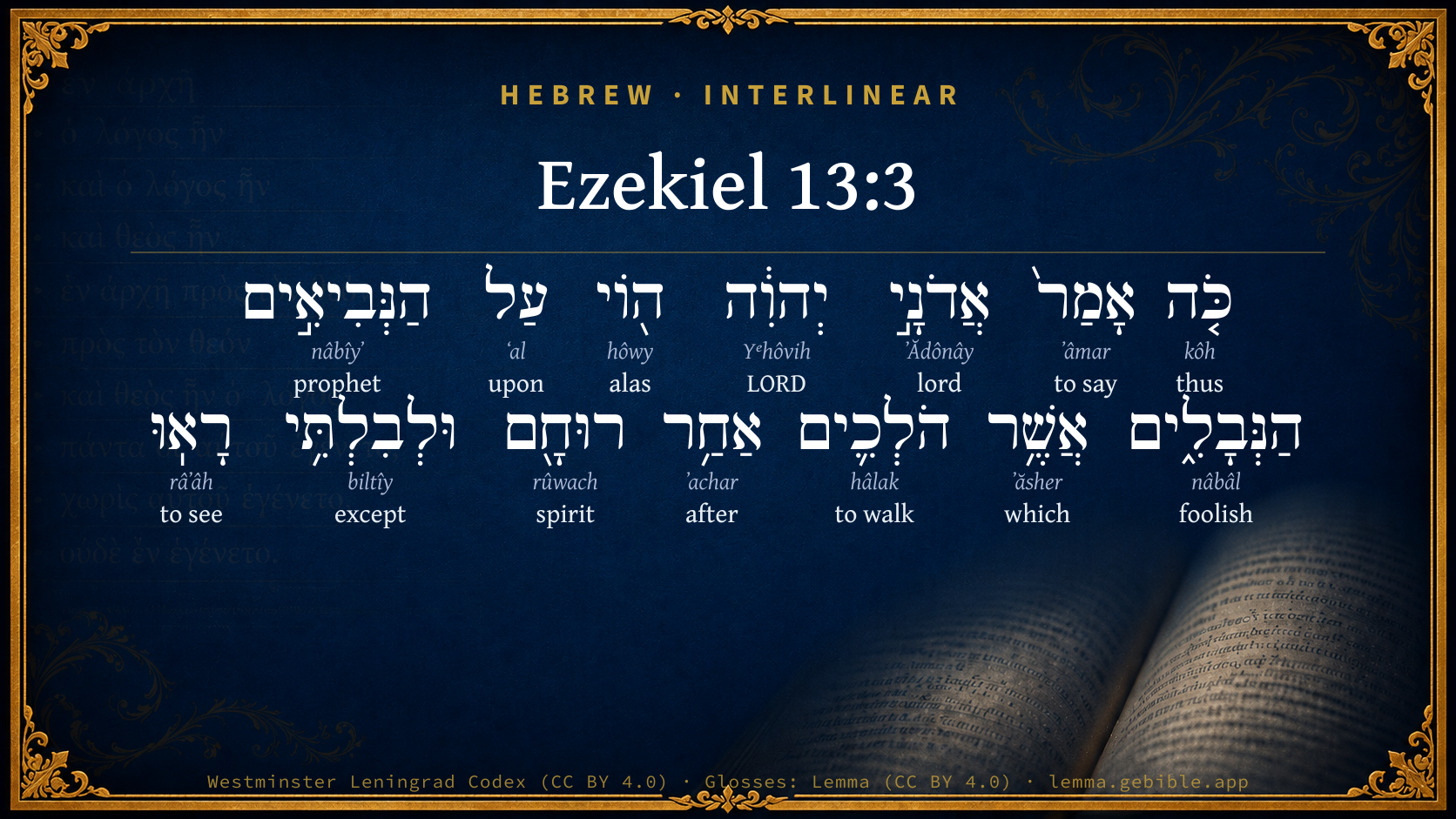
Hebrew (Westminster Leningrad Codex) Ezekiel 13:3 appears in the Hebrew Old Testament. The text above is from the Westminster Leningrad Codex. Each word links to its Strong’s number, a concise gloss, and parsing drawn from the Open Scriptures Hebrew Bible morphology. Click any word for its full Brown-Driver-Briggs (BDB) entry.
Download image
Cite this verse

Ezekiel 13:3 (World English Bible). Public Domain. Lemma interlinear Bible study tool, https://lemma.gebible.app/v/ezekiel/13/3.

Show BibTeX & RIS
BibTeX
RIS
English Translation
Thus says the Lord Yahweh, Woe to the foolish prophets, who follow their own spirit, and have seen nothing!
World English Bible · Public Domain
Download a study sheet

One document with this verse’s original text, its word-by-word gloss line, the meaning frame, cross-references with their text, attributed commentary, and full source and license credits — printable, and it pastes into notes with its structure intact.

This verse Autodidact and up

Study sheet (.html) Plain text (.txt)

A passage Seminary Student

Up to 50 verses in one chapter. A passage sheet keeps up to 6 commentary sources and 12 cross-references per verse, in the order this page ranks them, and says so on the sheet whenever that leaves anything out. Ask for a single verse and you get the Autodidact verse sheet above.

Everything on this page stays free to read, with no account — the sheet is a download of what is already on screen, not access to it.

Want to remove ads? Support Godless Engineer
Compare translations 3

The same verse in 3 English versions, stacked beneath the original-language interlinear above. Click any original word for its lexicon entry.

Each is an independent rendering of the whole verse — the interlinear is not word-aligned to these translations.

Highlighted words mark where these versions differ — a whole-verse word diff, not a word-by-word alignment.

  • World English Bible Public Domain
    Thus says the Lord Yahweh, Woe to the foolish prophets, who follow their own spirit, and have seen nothing!
  • King James Version Public Domain
    Thus saith the Lord GOD; Woe unto the foolish prophets, that follow their own spirit, and have seen nothing!
  • unfoldingWord Literal Text CC BY-SA 4.0
    The Lord Yahweh says this: Woe to the foolish prophets who follow their own spirit, but who have seen nothing!

unfoldingWord Literal Text — © unfoldingWord, licensed CC BY-SA 4.0. Word-aligned USFM3 via Door43 (git.door43.org/unfoldingWord/en_ult).

Versions to compare (up to 4)

3 of 4 selected

Show all 18 translations

Every available English version of this verse, each an independent rendering of the whole verse.

  • World English Bible Public Domain
    Thus says the Lord Yahweh, Woe to the foolish prophets, who follow their own spirit, and have seen nothing!
  • Berean Standard Bible Public Domain
    This is what the Lord GOD says: Woe to the foolish prophets who follow their own spirit, yet have seen nothing.
  • Majority Standard Bible Public Domain
    This is what the Lord GOD says: Woe to the foolish prophets who follow their own spirit yet have seen nothing.
  • King James Version Public Domain
    Thus saith the Lord GOD; Woe unto the foolish prophets, that follow their own spirit, and have seen nothing!
  • American Standard Version (1901) Public Domain
    Thus saith the Lord Jehovah, Woe unto the foolish prophets, that follow their own spirit, and have seen nothing!
  • Revised Version (1885) Public Domain
    Thus saith the Lord GOD: Woe unto the foolish prophets, that follow their own spirit, and have seen nothing!
  • Geneva Bible (1599) Public Domain
    Thus sayth the Lord God, Woe vnto the foolish Prophets that follow their owne spirit, and haue seene nothing.
  • Douay-Rheims (1899) Public Domain
    Thus saith the Lord God: Woe to the foolish prophets that follow their own spirit, and see nothing.
  • Young's Literal Translation Public Domain
    Thus said the Lord Jehovah: Wo unto the prophets who are foolish, Who are going after their own spirit, And they have seen nothing.
  • Literal Standard Version CC BY-SA 4.0
    Thus said Lord YHWH: Woe to the prophets who are foolish, || Who are going after their own spirit, || And they have seen nothing.
  • Unlocked Literal Bible CC BY-SA 4.0
    The Lord Yahweh says this: Woe to the foolish prophets who follow their own spirit, but who have seen nothing!
  • unfoldingWord Literal Text CC BY-SA 4.0
    The Lord Yahweh says this: Woe to the foolish prophets who follow their own spirit, but who have seen nothing!
  • Darby Bible Public Domain
    Thus saith the Lord Jehovah: Woe unto the foolish prophets, that follow their own spirit, and have seen nothing!
  • World Messianic Bible Public Domain
    The Lord GOD says, “Woe to the foolish prophets, who follow their own spirit, and have seen nothing!
  • Webster's Bible Public Domain
    Thus saith the Lord GOD; Woe to the foolish prophets, that follow their own spirit, and have seen nothing!
  • Free Bible Version CC BY-SA 4.0
    This is what the Lord God says: Disaster is coming to these foolish prophets who follow their own ideas. They haven't seen anything.
  • Bible in Basic English Public Domain
    This is what the Lord has said: A curse on the foolish prophets who go after the spirit which is in them and have seen nothing!
  • JPS Tanakh (1917) Public Domain
    Thus saith the Lord GOD: Woe unto the vile prophets, that follow their own spirit, and things which they have not seen!

Literal Standard Version (2020), Covenant Press — licensed CC BY-SA 4.0. Text via the HelloAO Bible API (eBible.org). Unlocked Literal Bible (unfoldingWord) — licensed CC BY-SA 4.0. Text via the HelloAO Bible API (eBible.org). unfoldingWord Literal Text — © unfoldingWord, licensed CC BY-SA 4.0. Word-aligned USFM3 via Door43 (git.door43.org/unfoldingWord/en_ult). Free Bible Version, Dr. Jonathan Gallagher — licensed CC BY-SA 4.0. Text via the HelloAO Bible API (eBible.org).

Word by word

More ways to search: Search by grammar → Find every occurrence → Compare this word →

Practice this passage: Drill this verse → Learn its vocabulary →

הַנְּבָלִ֑ים
nâbâl
H5036
“the · foolish”
Particle, Definite Article + Adjective, Adjective, Masculine, Plural, Absolute
Part of Speech
Particle + Adjective
Type
Adjective
Gender
Masculine
Number
Plural
State
Absolute
Full BDB Definition

Origin: from H5034

TWOT: 1285a

foolish, senseless, fool
  1. כֹּ֤ה kôh H3541 “thus” Adverb
  2. אָמַר֙ ʼâmar H559 “to say” Verb, Qal, Perfect, 3rd Person, Masculine, Singular
  3. אֲדֹנָ֣י ʼĂdônây H136 “Lord · my” Noun, Common, Masculine, Plural, Construct + Suffix, Personal, 1st Person, Common, Singular
  4. יְהוִ֔ה Yᵉhôvih H3069 “LORD” Noun, Proper
  5. ה֖וֹי hôwy H1945 “alas” Particle, Interjection
  6. עַל ʻal H5921 “upon” Preposition
  7. הַנְּבִיאִ֣ים nâbîyʼ H5030 “the · prophets” Particle, Definite Article + Noun, Common, Masculine, Plural, Absolute
  8. אֲשֶׁ֥ר ʼăsher H834 “which” Particle, Relative
  9. הֹלְכִ֛ים hâlak H1980 “walking” Verb, Qal, Participle Active, Masculine, Plural, Absolute
  10. אַחַ֥ר ʼachar H310 “after” Preposition
  11. רוּחָ֖ם rûwach H7307 “spirit · their” Noun, Common, Both, Singular, Construct + Suffix, Personal, 3rd Person, Masculine, Plural
  12. וּלְבִלְתִּ֥י biltîy H1115 “and · to/for · except” Conjunction + Preposition + Particle, Negative
  13. רָאֽוּ râʼâh H7200 “to see” Verb, Qal, Perfect, 3rd Person, Common, Plural

About this verse

These counts appear in no published source. They are computed here, from the morphology-tagged text and Lemma’s own curated glosses. What Lemma adds →

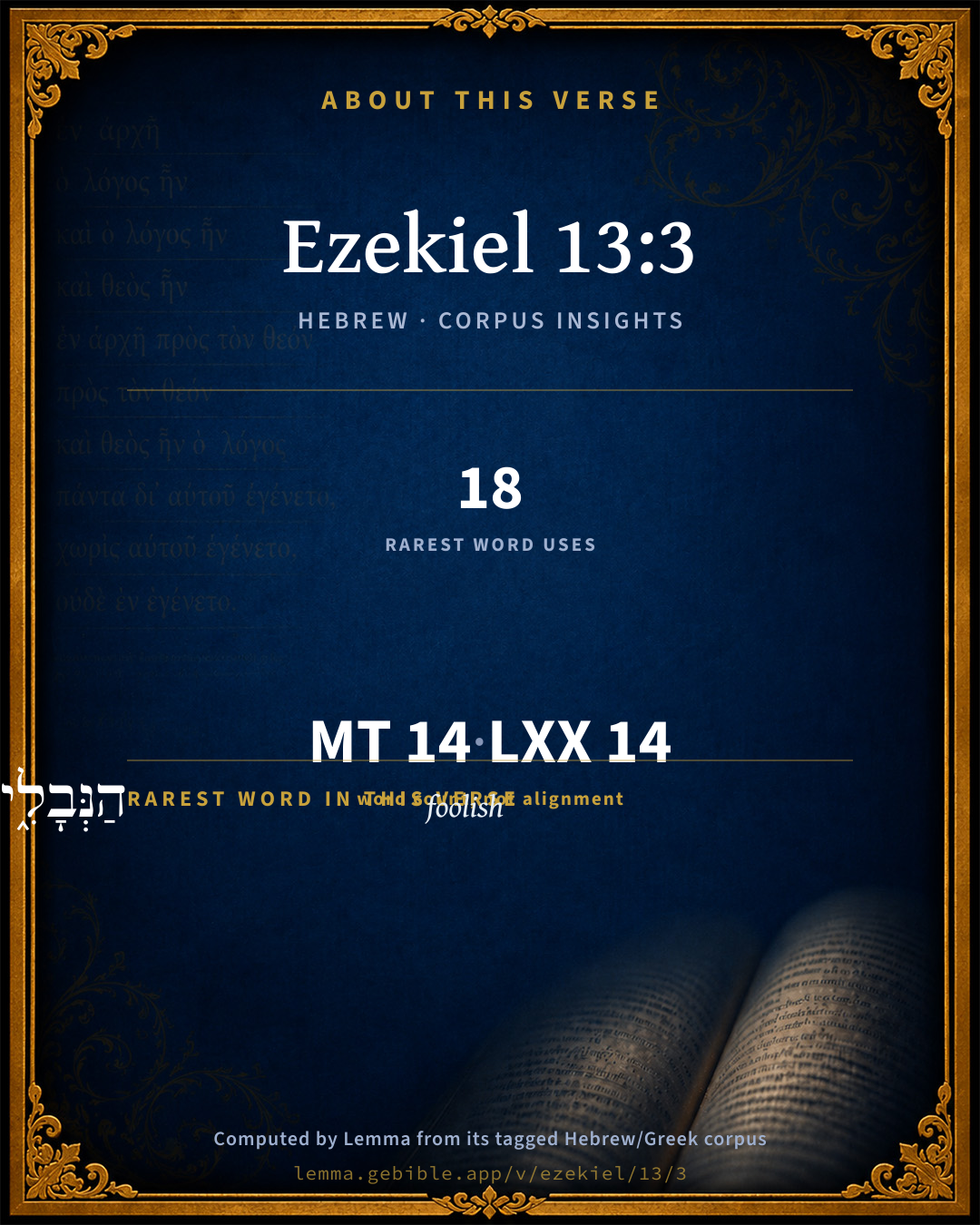
14
words
14
distinct lemmas
Prophets
section

Notable vocabulary

The rarest word here is הַנְּבָלִ֑ים foolish H5036 — appearing just 18 times in the whole Hebrew Bible.

Shared distinctive vocabulary

הַנְּבָלִ֑ים foolish H5036 occurs in 18 verses of the Hebrew Bible. Also found in:

Grammatical profile

  • 3 verbs
  • 4 nouns
  • 1 adjective
  • 2 prepositions
  • 1 adverb
  • 3 particles

Verb forms

  • אָמַר֙ Qal · Perfect
  • הֹלְכִ֛ים Qal · Participle Active
  • רָאֽוּ Qal · Perfect

Hebrew & Septuagint length

In English translation the verse runs 19 words from the Hebrew and 20 from the Septuagint (LXX English) — closely comparable.

A rough comparison of the two English renderings, which tokenize alike — not a word-level alignment.

Word counts can differ between the Hebrew and the Greek without any difference in meaning — e.g. the Hebrew direct-object marker אֵת has no separate Greek word, and Greek often adds the article ὁ.

In the original languages it is 14 Hebrew tokens and 14 Greek tokens — but the two are counted differently (Hebrew bundles its prefixes and suffixes into one token; the Greek is in lemma form), so that isn’t a like-for-like length.

Cross-references

17

Topical passages linked to Ezekiel 13:3 in the Treasury of Scripture Knowledge — connected by theme and wording, ordered by reader-vote popularity; previews shown in the World English Bible.

  • Lamentations 2:14 Your prophets have seen for you false and foolish visions; They have not uncovered your iniquity, to bring back your captivity, But have seen for you false oracles and causes of banishment.
  • Jeremiah 23:28–32 The prophet who has a dream, let him tell a dream; and he who has my word, let him speak my word faithfully. What is the straw to the wheat? says Yahweh.
  • Hosea 9:7 The days of visitation have come. The days of reckoning have come. Israel will consider the prophet to be a fool, And the man who is inspired to be insane, Because of the abundance of your sins, And because your hostility is great.
  • Proverbs 15:14 The heart of one who has understanding seeks knowledge, But the mouths of fools feed on folly.
  • Jeremiah 23:1 Woe to the shepherds who destroy and scatter the sheep of my pasture! says Yahweh.
  • Ezekiel 34:2 Son of man, prophesy against the shepherds of Israel, prophesy, and tell them, even to the shepherds, Thus says the Lord Yahweh: Woe to the shepherds of Israel who feed themselves! Shouldn't the shepherds feed the sheep?
  • Matthew 23:13–29 "Woe to you, scribes and Pharisees, hypocrites! For you devour widows' houses, and as a pretense you make long prayers. Therefore you will receive greater condemnation.
  • Proverbs 15:2 The tongue of the wise commends knowledge, But the mouth of fools gush out folly.
  • Ezekiel 13:6–7 They have seen falsehood and lying divination, who say, Yahweh says; but Yahweh has not sent them: and they have made men to hope that the word would be confirmed.
  • Ezekiel 13:18 and say, Thus says the Lord Yahweh: Woe to the women who sew pillows on all elbows, and make kerchiefs for the head of [persons of] every stature to hunt souls! Will you hunt the souls of my people, and save souls alive for yourselves?
  • Zechariah 11:15 Yahweh said to me, "Take for yourself yet again the equipment of a foolish shepherd.
  • Luke 11:40 You foolish ones, didn't he who made the outside make the inside also?
  • Luke 11:42–47 But woe to you Pharisees! For you tithe mint and rue and every herb, but you bypass justice and the love of God. You ought to have done these, and not to have left the other undone.
  • Luke 11:52 Woe to you lawyers! For you took away the key of knowledge. You didn't enter in yourselves, and those who were entering in, you hindered."
  • 1 Corinthians 9:16 For if I preach the Gospel, I have nothing to boast about; for necessity is laid on me; but woe is to me, if I don't preach the Gospel.
  • 1 Timothy 6:4 he is conceited, knowing nothing, but obsessed with arguments, disputes, and word battles, from which come envy, strife, reviling, evil suspicions,
  • 2 Timothy 3:9 But they will proceed no further. For their folly will be evident to all men, as theirs also came to be.

Cross-references courtesy of OpenBible.info (CC BY 4.0).

Hebrew and Greek witnesses Masoretic Hebrew ↔ Greek Septuagint

The same verse in the two great witnesses to the Old Testament, shown verse-for-verse.

These are two independent witnesses, not word-aligned to each other, and the Septuagint is shown in lemma (dictionary) form.

Hebrew Ezekiel 13:3 Masoretic · Westminster Leningrad Codex

כֹּ֤ה אָמַר֙ אֲדֹנָ֣י יְהוִ֔ה ה֖וֹי עַל הַנְּבִיאִ֣ים הַנְּבָלִ֑ים אֲשֶׁ֥ר הֹלְכִ֛ים אַחַ֥ר רוּחָ֖ם וּלְבִלְתִּ֥י רָאֽוּ

Thus says the Lord Yahweh, Woe to the foolish prophets, who follow their own spirit, and have seen nothing!

World English Bible · Public Domain

Greek LXX Ezekiel 13:3 Septuagint · lemma form

ὅδε λέγω κύριος οὐαί ὁ προφητεύω ἀπό καρδία αὐτός καί ὁ καθόλου μή βλέπω

Thus says the Lord, Woe to them that prophesy out of their own heart, and who see nothing at all.

LXX2012 (modern English Septuagint) · Public Domain

Hebrew: Westminster Leningrad Codex (CC BY 4.0). Greek: Septuagint (public domain); English from LXX2012 (modern English Septuagint) (Public Domain). How the Septuagint differs from the Hebrew →

Targum (Aramaic paraphrase)

1

The Targum is the ancient Jewish Aramaic paraphrase of the Hebrew Scriptures — an interpretive translation, not the Hebrew text itself. Onkelos (literal) and Pseudo-Jonathan (expansive) render the Torah, and Jonathan the Prophets. Coverage is partial: where no permissively-licensed English translation exists for a verse, only the Aramaic is shown. This is verse-level text, not a word-by-word alignment to the Hebrew.

  1. Targum Jonathan Prophets (Joshua–Malachi)
    כִּדְנַן אֲמַר יְיָ אֱלֹהִים וַי עַל נְבִיֵי שִׁקְרָא דְמִשְׁתַּטָן דְאָזְלִין בָּתַר הִרְהוּר לִבְּהוֹן וּמִדַעַם לָא חָזָן:

    (no public-domain English translation for this verse)

    Targum Jonathan — Aramaic: “Mikraot Gedolot” (public domain). English: “Sefaria Community Translation” (CC0 1.0 (public-domain dedication)); “London "Chaldee Paraphrase," 1871” (public domain). Text via Sefaria.

Commentary

Notes on Ezekiel 13:3 from classic Christian and Jewish commentators (each source and its license shown beneath its notes). The classic Christian expositions comment on the surrounding passage and are grouped to its opening verse, so a note may address several verses; the Jewish commentaries on the Tanakh (Rashi and others) are per-verse, so they appear only where the commentator wrote on this verse.

Lemma curates 59 commentaries, every one of them public domain or Creative Commons licensed, each selected and text-cleaned for this edition rather than reprinted as found. About our sources →

Trapp's Complete Commentary

John Trapp

Eze 13:3 Thus saith the Lord GOD; Woe unto the foolish prophets, that follow their own spirit, and have seen nothing!

Ver. 3. Woe unto the foolish prophets.] Wise enough they were in their generation - and so are the foxes, whereto they are compared {Eze 13:4} - but in the things of God, silly simples, blinder than moles.

That follow their own spirit.] Aud their own fancies, acted and abused by that great lying spirit.

And have seen nothing.] Nothing from God, though they thought and pretended they had seen something. All was but lies; {Jer 27:10} dreams; {Jer 23:32} things of naught. {Eze 22:28} As Antipheron Orietes in Aristotle thought that everywhere he saw his own shape and picture going before him; so here. Now a woe is denounced against these; vae woe, is a little word, but very comprehensive, as there is often much poison in little drops.

John Trapp, A Commentary or Exposition upon All the Books of the Old and New Testament (1647–1656) — public domain. Text from a community e-Sword module.

Jamieson, Fausset & Brown

Robert Jamieson, A. R. Fausset & David Brown

foolish--though vaunting as though exclusively possessing "wisdom" (Co1 1:19-21); the fear of God being the only beginning of wisdom (Psa 111:10).

their own spirit--instead of the Spirit of God. A threefold distinction lay between the false and the true prophets: (1) The source of their messages respectively; of the false, "their own hearts"; of the true, an object presented to the spiritual sense (named from the noblest of the senses, a seeing) by the Spirit of God as from without, not produced by their own natural powers of reflection. The word, the body of the thought, presented itself not audibly to the natural sense, but directly to the spirit of the prophet; and so the perception of it is properly called a seeing, he perceiving that which thereafter forms itself in his soul as the cover of the external word [DELITZSCH]; hence the peculiar expression, "seeing the word of God" (Isa 2:1; Isa 13:1; Amo 1:1; Mic 1:1). (2) The point aimed at; the false "walking after their own spirit"; the true, after the Spirit of God. (3) The result; the false saw nothing, but spake as if they had seen; the true had a vision, not subjective, but objectively real [FAIRBAIRN]. A refutation of those who set the inward word above the objective, and represent the Bible as flowing subjectively from the inner light of its writers, not from the revelation of the Holy Ghost from without. "They are impatient to get possession of the kernel without its fostering shell--they would have Christ without the Bible" [BENGEL].

Jamieson, Fausset & Brown — Commentary Critical and Explanatory on the Whole Bible (1871) — public domain (CC PDM 1.0). Text via the HelloAO Bible API.

John Calvin's Commentaries

Woe to, the foolish or disgraceful prophets נבל, nebel, signifies “a vile person,” “a castaway,” just as נבלה, nebeleh, means “foulness,” “crime,” “wickedness,” although נבל, nebel, is oftener taken for folly, and I willingly embrace this sense as it is generally received. He calls false prophets foolish, because they doubtless fiercely insulted the true servants of God — just like upstarts puffed up with wonderful self-conceit; for the devil, who reigns in them, is the father of pride: hence they carry themselves haughtily, arrogate all things to themselves, and wish to be thought angels come down from heaven. And when Paul speaks of human fictions, he grants them the form of wisdom. (Colossians 2:23.) Hence there is no doubt that these pretenders of whom Ezekiel speaks were held in great esteem, and so, when swollen with bombast, they puffed forth surprising wisdom; but meanwhile the Holy Spirit shortly pronounces them fools: for whatever pleases the world under the mask of wisdom, we know to be mere folly before God.

Now he adds, who walk after their own spirit, without seeing any thing: that is, when no vision has been given them. Ezekiel explains himself more clearly, or rather the Spirit who spoke through him. As, therefore, he has lately condemned all who prophesy out of their own mind or heart, — for the noun “heart” is here used for “intellect,” as in other places, — as, therefore, the Spirit has lately condemned all such, so he says that those who walk after their own spirit wickedly abuse the prophetic office. He here alludes to the prophetic gift when he speaks of “spirit.” For, because they might object that false prophets did not speak from their own heart, but had secret revelations, he concedes to them the use of the word “spirit” by a rhetorical figure, and thus refutes their boasting, as if Ezekiel had said that those fictitious revelations are mere fancies: they have indeed something in them more than common, but still they are fanatics. This then is the sense of the word “spirit.” Meanwhile there is no doubt that he repeats what he lately saw, and the contrast removes all doubt. Without seeing any thing, says he: thus vision is opposed to the human heart and spirit; but what is vision but a supernatural gift? When, therefore, God raises his servants above the capacity of human ability, and makes them discern what no mortal power can bestow, that is a vision; and if a vision is removed, nothing will remain but the spirit or heart of man. Hence those who cannot really show that their utterance is evidently inspired, shall be compelled to confess that they speak of their own minds. It follows —

John Calvin's Commentaries (1540-1563) — public domain. Text from the Calvin Translation Society English edition (1840s-50s) via the Christian Classics Ethereal Library (ccel.org). Calvin's coverage is partial (roughly two-thirds of the Bible); uncommented books and verses are honest gaps, never fabricated. The 19th-century editor's footnotes and remarks are omitted so the notes are faithfully Calvin's own voice.

Ellicott's Commentary for English Readers

(3) Foolish prophets.—They were certainly foolish who undertook to forge the name of the Omniscient, as it were, to utterances of their own devising. Folly according to the use of the word in the Old Testament, was not merely an intellectual failing, but was always associated with moral obliquity. (See Psa_14:1, and Proverbs throughout.) The last clause of the verse is better expressed in the margin: these prophets were. “seers of that which they have not seen.”

A Bible Commentary for English Readers, edited by Charles John Ellicott (1878–1897) — public domain. Text from a community e-Sword module.

The Cambridge Bible for Schools and Colleges

gen. ed. J. J. S. Perowne

3. foolish prophets] The word, not used again by Ezekiel, is rather a moral term, meaning destitute of that wisdom the beginning of which is the fear of the Lord (Psa_13:1). Jeremiah charges the prophets of his day with shameful vices, “They commit adultery with their neighbours’ wives” (Jer_29:23; cf. Jer_23:14, and pass.); but, without supposing that all the “false” prophets were so bad, it characterized them in general that they were superficial men in a moral sense. Their notions of religion and life were not high or strict, and hence they saw nothing in the condition of the people or the state calling for the judgment of God, and prophesied “peace.” This was what distinguished them from Jeremiah and other prophets whom we call “true.” Micah says in opposition to them: “I am full of power by the spirit of the Lord to declare unto Jacob his transgression and to Israel his sin” (ch. Eze_3:8); and Jeremiah goes so far as to declare it to be the mark of a true prophet that he threatens judgment upon the nation (Jer_28:8-9). A true prophet is one by whom the Lord speaks, and a “false” prophet (the expression is not used in the Old Testament, though the prophets are said to speak “falsely”) is one by whom he does not speak. This is true: but the converse has also its truth—the Lord did not speak by these prophets because they were “false” (1Ki_22:6 seq.). There is a spirit of false prophecy as well as a spirit of true prophecy. The spirit of true prophecy is the spirit of the theocracy and of the religion of Jehovah, the spirit that comprehends its principles, sympathises with its lofty morality, understands its aims, and therefore can perceive the true means to be used for fulfilling them. The spirit of false prophecy is the untheocratic spirit, which, even when speaking in the name of Jehovah, has not entered with any profoundness into the nature and aims of his kingdom, and consequently misapprehends the means needful to further it. In his encounters with the prophets of his day Jeremiah opposes them in three spheres: that of policy; that of morals; and that of personal experience. In policy the genuine prophets had some fixed principles, all arising out of the idea that the kingdom of the Lord was not a kingdom of this world. Hence they opposed military preparation (Psa_20:7), riding on horses and building of fenced cities (Hos_14:3; Mic_5:10-11; Isa_31:1), and counselled trust in Jehovah (Isa_7:9; Isa_10:20-21; Isa_17:7; Isa_30:15). These prophets were moving forward (often unconsciously) towards that conception of the kingdom of God which has been realized in the “Church;” and external providence was shaping the history of the nation on lines parallel to this conception, which eventually received form by the destruction of the state and the reduction of the people to be a mere religious community. The false prophets, on the other hand, desired their country to be a military power among the powers around, they advocated alliances with the Eastern empires and with Egypt, and relied on their national strength (Amo_6:13). Again, the true prophets had a stringent personal and state morality (see above). In their view the true cause of the destruction of the state was its immoralities. But the false prophets had no such deep moral convictions, and seeing nothing unwonted or alarming in the condition of things, prophesied of “peace.” They were not necessarily irreligious men, but their religion had no truer insight into the nature of the God of Israel than that of the common people (Amo_5:18); hence they pointed to the Temple as the house of the Lord, which he must protect; while Jeremiah told them that they had made it “a cave of robbers,” in which they thought themselves safe after committing their crimes, and threatened it with the fate of Shiloh (Jeremiah 7, 26). And finally Jeremiah expresses his conviction that the prophets whom he opposed did not stand in the same relation to the Lord as he did; they had not his experiences of the word of the Lord, into whose counsel (Amo_3:7) they had not been admitted, and they were without that fellowship of mind with the mind of Jehovah which was the true source of prophecy (Jeremiah 23 pass.). Hence he satirizes their pretended supernatural “dreams,” and charges them from conscious want of any true prophetic word with “stealing” words from one another. Cf. Eze_13:6-7 and ch. 14.

their own spirit] The term is used in opposition to the “spirit” of the Lord which inspired the true prophet, who is called “a man of the spirit” (Hos_9:7). As distinct from heart “spirit” is rather the force or power moving the prophet. In early times the prophets were the subjects of considerable excitation; and looking on them thus powerfully affected men recognised the influence of the spirit of God upon them.

and have seen nothing] Rather: and (go after) that which they have not seen. They did not see, though no doubt they thought they saw. They were self-deceived.

The Cambridge Bible for Schools and Colleges (gen. ed. J. J. S. Perowne; Cambridge University Press, 1878–1918) — public domain. Text from a community e-Sword module.

John Gill's Exposition

O Israel, thy prophets are like the foxes of the deserts. The false prophets, as the Targum; these are called Israel's prophets, because received, embraced, and encouraged by them; not the Lord's, for they were not sent by him, nor had any messages from him; and such are comparable to foxes, for their craftiness and cunning, and lying in wait to deceive, as these seduced the Lord's people, Eze 13:10; and such are false teachers, who walk in craftiness, and handle the word of God deceitfully, and are deceitful workers; and to foxes in the deserts, which are hungry and ravenous, and make a prey of whatsoever comes within their reach, as these prophets did of the people, Eze 13:19. Kimchi interprets "deserts" of breaches and ruinous places in the walls of a vineyard, where the foxes lie, or through which they enter into the vineyard and spoil it; as these false prophets entered in among the Israelites, like to a vineyard, and did them much hurt and damage, by insinuating themselves among the weak, and those of little faith, which the above writer compares to breaches in vineyards; see Sol 2:15. It may be the deserts may have respect to the land of Chaldea, where Israel was carried captive, and where these foxes, the false prophets, could play their part to advantage; not being under the notice and restraints of the sanhedrim at Jerusalem.

. It may be the deserts may have respect to the land of Chaldea, where Israel was carried captive, and where these foxes, the false prophets, could play their part to advantage; not being under the notice and restraints of the sanhedrim at Jerusalem.

Ezekiel 13:5

eze 13:5

eze 13:5

eze 13:5Ye have not gone up into the gaps,.... Or "breaches" (d); so the Targum. The allusion is to breaches made in the walls of a city when besieged; at which time those within gather together in great numbers to meet the enemy, and prevent his entrance by the breaches. These words are either spoken to the princes of Israel, the civil magistrates; or to the prophets, who seeing the sins of the people, like a mighty torrent, opening a breach for the wrath and judgments of God to pour in upon them, should have called them, and importunately pressed them to repentance and reformation, and to have put up their prayers, and made intercession to God for them; neither of which they did, and therefore are here blamed; see Eze 22:30;

neither made up the hedge for the house of Israel; or a "fence", a fortification. The Vulgate Latin renders it, "a wall"; a new wall, which is generally made by the besieged within, when a breach is made upon them: it signifies the same as before. Jarchi and Kimchi interpret it of repentance and good works; and so the Targum, which paraphrases the words thus,

"neither have ye done for yourselves good works, to deprecate for the house of Israel, to stand to pray for them:''

to stand in the battle in the day of the Lord: when he came forth in battle array against them, with great wrath and indignation, in the way of his righteous judgments. The Targum is,

"when warriors come up against them in the day of the wrath of the Lord;''

when the Chaldeans came against them by the will of God, he being angry with them.

(d) "in fracturas", Pagninus, Montanus, Tigurine version; "rupturas", Calvin, Piscator, Starckius.

John Gill's Exposition of the Whole Bible (1746–1763) — public domain (CC PDM 1.0). Text via the HelloAO Bible API.

Albert Barnes' Notes on the Bible

That follow ... nothing - Better in the margin. A true prophet (like Ezekiel) spoke “the word of the Lord,” and declared what he had seen “in the visions of God.” These pretenders are stigmatized in scorn “prophets out of their own hearts,” “seers of what they have not seen.”

Albert Barnes' Notes on the Bible (1834–1885) — public domain. Text from a community e-Sword/MySword module.

Haydock's Catholic Bible Commentary

Nothing. Yet would lead the blind, though they are not directed by God.

George Leo Haydock (1774–1849), Haydock's Catholic Family Bible and Commentary, 1859 edition — public domain. Excludes Psalms (Douay-Rheims chapter numbering differs from Protestant) and Deuterocanonical books (Catholic canon only).

Matthew Poole's English Annotations

They shall be doubly miserable, suffering with the deceived, and suffering by the enraged, when their lies are detected.

Foolish prophets; either in a moral sense, i. e. wicked; or in a literal sense, unwise. It is both foolishly wicked and imprudent to pretend revelations, and yet have none from God.

Their own spirit; in contradistinction to the Spirit of God, the true Spirit of prophecy, they strongly fancy what they would have, and then presumptuously prophesy that it shall come to pass.

Have seen nothing; God hath showed them no vision, nothing of all they pretend to is from God.

Matthew Poole's English Annotations on the Holy Bible (1683–1685) — public domain. Text from a community e-Sword/MySword module.

Whedon's Commentary on the Bible

Daniel D. Whedon

3. Foolish prophets — The “fool,” in Scripture language, is the impious man. Many of these false prophets were grossly immoral (Jer_23:14; Jer_29:23), and none of them had the appreciation of the heinousness of sin and the certainty of God’s wrath falling upon an unrepentant people, which is so characteristic of the writings of the true prophets. Lacking the fear of the Lord, which is the beginning of wisdom, the policy which they advocated was almost invariably wrong. They posed as patriots, and friends of Jerusalem and the temple, advocating war and such political alliances as they believed to be for the temporal interests of the nation; not having the foresight to perceive that the laxity of morals and impurity of worship were being increased by such affiliations and that the real danger to the nation lay not in its lack of military power, but in its lack of spirituality and faith in God.

Follow their own spirit — The true prophet is the “man of the spirit” (Hos_9:7), who receives his message from God (Jer_23:16); but the spirit which controls the false prophet is from within, and not from above.

And have seen nothing — Literally, that which they have not seen. They saw no vision of God, though they pretended to see and may even have imagined that they saw.

Daniel D. Whedon (gen. ed.), Commentary on the Old and New Testaments (1874–1909) — public domain. Text from a community e-Sword module.

John Wesley's Explanatory Notes

Foolish prophets - Foolish prophets are not of God's sending: for whom he sends, he either finds fit, or makes fit. Where he gives warrant, he gives wisdom. Their own spirit - Not the spirit of God. Seen nothing - God hath shewed them no vision.

John Wesley, Explanatory Notes Upon the Whole Bible (1754–1765) — public domain. Text via the GEBible commentary corpus.

Rashi

Rabbi Shlomo Yitzchaki (Rashi)

mad Heb. הַנְבָלִים, madmen.

their desire Heb. רוּחָם [lit. their spirit,] like רְצוֹנָם, their will.

Rashi on the Tanakh — English translations: “The Judaica Press complete Tanach with Rashi, translated by A. J. Rosenberg” (CC BY 4.0); “Pentateuch with Rashi's commentary by M. Rosenbaum and A.M. Silbermann, 1929-1934” (public domain); “The Metsudah Tanach series, Lakewood, N.J” (CC BY 4.0); and “The Book of Joshua, Metsudah Publications, 1997” (CC BY 4.0). Text via Sefaria.

Lesson kit

Teaching starters — assembled from the data on this page, not authored interpretation. Every prompt links to the verse data it draws on. Edit before teaching.

Ezekiel, in the Prophets, opens this verse with 14 words (14 distinct Hebrew lemmas). Its most distinctive word is nâbâl (“foolish”). A historical commentator’s framing appears above. Read the whole chapter for the surrounding context.

Discussion questions

  1. How does “foolish” (nâbâl) shape what this verse is saying?
  2. Deuteronomy 32:6 shares the word «foolish» with this verse. How do the two illuminate each other?
  3. The translations on this page render this verse differently — a whole-verse word diff, not a word-by-word alignment. What might account for the different wordings?
  4. The verb «אָמַר֙» is Qal Perfect. How does its form color the action?
  5. Reading how Trapp's Complete Commentary and Jamieson, Fausset & Brown read this verse, where do the two commentators agree and where do they part?

Things to notice

Reading settings

Reading text

Shown beneath each verse's original-language words.

Old Testament
Old Testament edition

Read the OT as the Masoretic Hebrew (MT) or the Greek Septuagint (LXX).

English shown for the Greek Septuagint (in the Hebrew ↔ Greek comparison).

Comparing translations? Open the Compare panel on any verse page to stack up to four side by side.