
Jeremiah 14:13

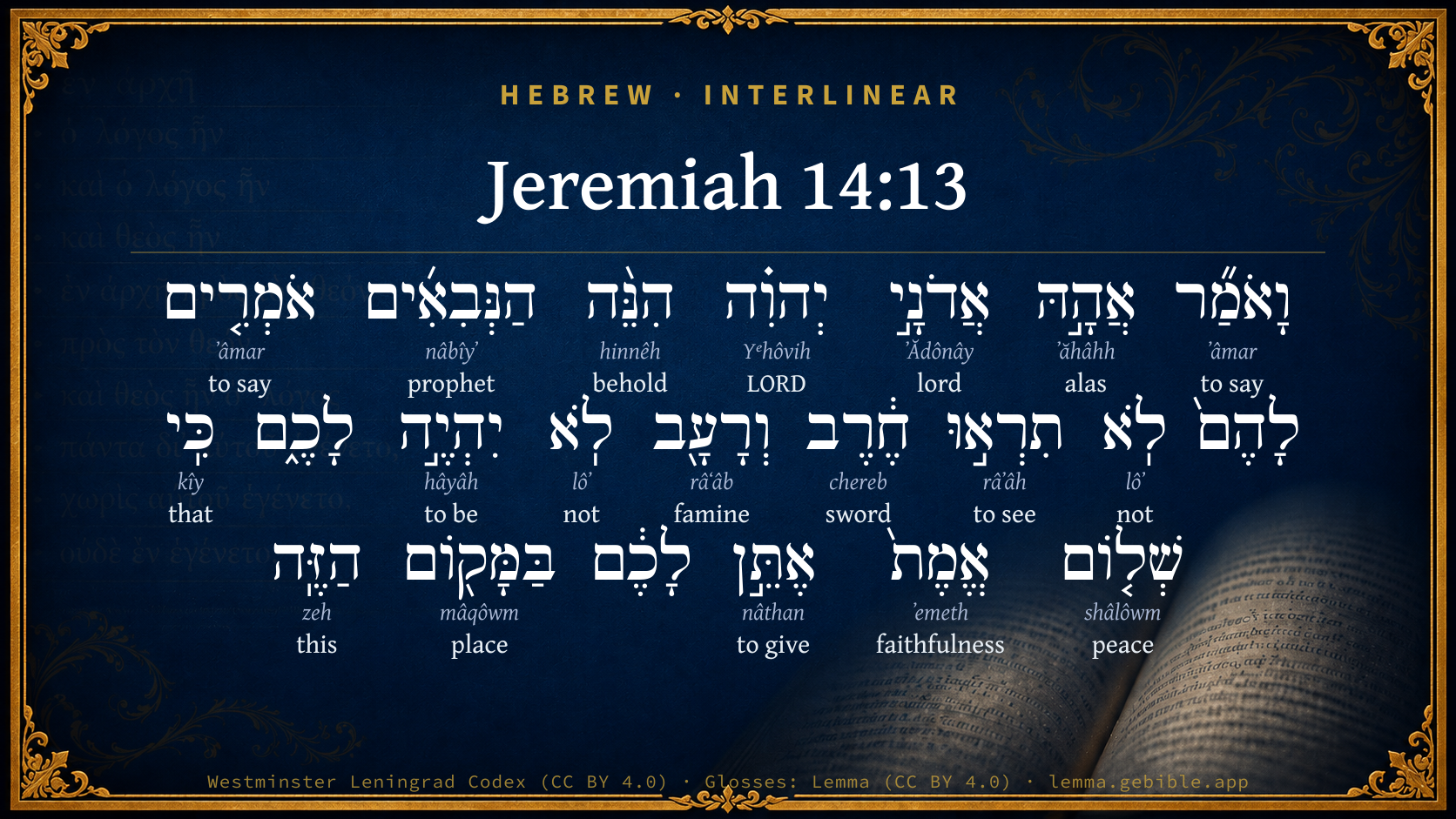
Hebrew (Westminster Leningrad Codex) Jeremiah 14:13 appears in the Hebrew Old Testament. The text above is from the Westminster Leningrad Codex. Each word links to its Strong’s number, a concise gloss, and parsing drawn from the Open Scriptures Hebrew Bible morphology. Click any word for its full Brown-Driver-Briggs (BDB) entry.
Download image
Cite this verse

Jeremiah 14:13 (World English Bible). Public Domain. Lemma interlinear Bible study tool, https://lemma.gebible.app/v/jeremiah/14/13.

Show BibTeX & RIS
BibTeX
RIS
English Translation
Then said I, Ah, Lord Yahweh! behold, the prophets tell them, You shall not see the sword, neither shall you have famine; but I will give you assured peace in this place.
World English Bible · Public Domain
Download a study sheet

One document with this verse’s original text, its word-by-word gloss line, the meaning frame, cross-references with their text, attributed commentary, and full source and license credits — printable, and it pastes into notes with its structure intact.

This verse Autodidact and up

Study sheet (.html) Plain text (.txt)

A passage Seminary Student

Up to 50 verses in one chapter. A passage sheet keeps up to 6 commentary sources and 12 cross-references per verse, in the order this page ranks them, and says so on the sheet whenever that leaves anything out. Ask for a single verse and you get the Autodidact verse sheet above.

Everything on this page stays free to read, with no account — the sheet is a download of what is already on screen, not access to it.

Want to remove ads? Support Godless Engineer
Compare translations 3

The same verse in 3 English versions, stacked beneath the original-language interlinear above. Click any original word for its lexicon entry.

Each is an independent rendering of the whole verse — the interlinear is not word-aligned to these translations.

Highlighted words mark where these versions differ — a whole-verse word diff, not a word-by-word alignment.

  • World English Bible Public Domain
    Then said I, Ah, Lord Yahweh! behold, the prophets tell them, You shall not see the sword, neither shall you have famine; but I will give you assured peace in this place.
  • King James Version Public Domain
    Then said I, Ah, Lord GOD! behold, the prophets say unto them, Ye shall not see the sword, neither shall ye have famine; but I will give you assured peace in this place.
  • unfoldingWord Literal Text CC BY-SA 4.0
    Then I said, “Ah, Lord Yahweh! Behold, the prophets are saying to them, ‘You shall not see sword and you shall not have famine, but peace of stability I will give to you in this place.’”

unfoldingWord Literal Text — © unfoldingWord, licensed CC BY-SA 4.0. Word-aligned USFM3 via Door43 (git.door43.org/unfoldingWord/en_ult).

Versions to compare (up to 4)

3 of 4 selected

Show all 18 translations

Every available English version of this verse, each an independent rendering of the whole verse.

  • World English Bible Public Domain
    Then said I, Ah, Lord Yahweh! behold, the prophets tell them, You shall not see the sword, neither shall you have famine; but I will give you assured peace in this place.
  • Berean Standard Bible Public Domain
    “Ah, Lord GOD!” I replied, “Look, the prophets are telling them, ‘You will not see the sword or suffer famine, but I will give you lasting peace in this place.’”
  • Majority Standard Bible Public Domain
    “Ah, Lord GOD!” I replied, “Look, the prophets are telling them, ‘You will not see the sword or suffer famine, but I will give you lasting peace in this place.’”
  • King James Version Public Domain
    Then said I, Ah, Lord GOD! behold, the prophets say unto them, Ye shall not see the sword, neither shall ye have famine; but I will give you assured peace in this place.
  • American Standard Version (1901) Public Domain
    Then said I, Ah, Lord Jehovah! behold, the prophets say unto them, Ye shall not see the sword, neither shall ye have famine; but I will give you assured peace in this place.
  • Revised Version (1885) Public Domain
    Then said I, Ah, Lord GOD! behold, the prophets say unto them, Ye shall not see the sword, neither shall ye have famine; but I will give you assured peace in this place.
  • Geneva Bible (1599) Public Domain
    Then answered I, Ah Lord God, beholde, the prophets say vnto them, Ye shall not see the sworde, neither shall famine come vpon you, but I wil giue you assured peace in this place.
  • Douay-Rheims (1899) Public Domain
    And I said: Ah, ah, ah, O Lord God, the prophets say to them: You shall not see the sword, and there shall be no famine among you, but he will give you true peace in this place.
  • Young's Literal Translation Public Domain
    And I say, `Ah, Lord Jehovah, Lo, the prophets are saying to them: Ye do not see a sword, yea, famine is not to you, For true peace I give to you in this place.'
  • Literal Standard Version CC BY-SA 4.0
    And I say, “Aah! Lord YHWH, behold, the prophets are saying to them: You do not see a sword, indeed, famine is not [on] you, for I give true peace to you in this place.”
  • Unlocked Literal Bible CC BY-SA 4.0
    Then I said, “Oh, Lord Yahweh! Behold! The prophets are saying to the people, 'You will not see the sword; there will be no famine for you, for I will give you true security in this place.'”
  • unfoldingWord Literal Text CC BY-SA 4.0
    Then I said, “Ah, Lord Yahweh! Behold, the prophets are saying to them, ‘You shall not see sword and you shall not have famine, but peace of stability I will give to you in this place.’”
  • Darby Bible Public Domain
    And I said, Alas, Lord Jehovah! Behold, the prophets say unto them, Ye shall not see the sword, neither shall ye have famine; for I will give you assured peace in this place.
  • World Messianic Bible Public Domain
    Then I said, “Ah, Lord GOD! Behold, the prophets tell them, ‘You will not see the sword, neither will you have famine; but I will give you assured peace in this place.’”
  • Webster's Bible Public Domain
    Then said I, Ah Lord GOD! behold, the prophets say to them, Ye shall not see the sword, neither shall ye have famine; but I will give you assured peace in this place.
  • Free Bible Version CC BY-SA 4.0
    “Oh Lord God!” I answered, “Look what prophets are telling them, claiming to be speaking for you: ‘You won't see war or suffer from famine, but I will give you peace that lasts here in this place.’”
  • Bible in Basic English Public Domain
    Then I said, Ah, Lord God! see, the prophets say to them, You will not see the sword or be short of food; but I will give you certain peace in this place.
  • JPS Tanakh (1917) Public Domain
    Then said I: 'Ah, Lord GOD! behold, the prophets say unto them: Ye shall not see the sword, neither shall ye have famine; but I will give you assured peace in this place.'

Literal Standard Version (2020), Covenant Press — licensed CC BY-SA 4.0. Text via the HelloAO Bible API (eBible.org). Unlocked Literal Bible (unfoldingWord) — licensed CC BY-SA 4.0. Text via the HelloAO Bible API (eBible.org). unfoldingWord Literal Text — © unfoldingWord, licensed CC BY-SA 4.0. Word-aligned USFM3 via Door43 (git.door43.org/unfoldingWord/en_ult). Free Bible Version, Dr. Jonathan Gallagher — licensed CC BY-SA 4.0. Text via the HelloAO Bible API (eBible.org).

Word by word

More ways to search: Search by grammar → Find every occurrence → Compare this word →

Practice this passage: Drill this verse → Learn its vocabulary →

אֲהָ֣הּ
ʼăhâhh
H162
“alas”
Particle, Interjection
Part of Speech
Particle
Type
Interjection
Full BDB Definition

Origin: apparently a primitive word expressing pain exclamatorily, Oh!

TWOT: 30

alas!, oh!, ah!
  1. וָאֹמַ֞ר ʼâmar H559 “and · to say” Conjunction + Verb, Qal, Sequential Imperfect, 1st Person, Common, Singular
  2. אֲדֹנָ֣י ʼĂdônây H136 “Lord · my” Noun, Common, Masculine, Plural, Construct + Suffix, Personal, 1st Person, Common, Singular
  3. יְהוִ֗ה Yᵉhôvih H3069 “LORD” Noun, Proper
  4. הִנֵּ֨ה hinnêh H2009 “behold” Particle, Demonstrative
  5. הַנְּבִאִ֜ים nâbîyʼ H5030 “the · prophets” Particle, Definite Article + Noun, Common, Masculine, Plural, Absolute
  6. אֹמְרִ֤ים ʼâmar H559 “saying” Verb, Qal, Participle Active, Masculine, Plural, Absolute
  7. לֹֽא lôʼ H3808 “not” Particle, Negative
  8. תִרְא֣וּ râʼâh H7200 “to see” Verb, Qal, Imperfect, 2nd Person, Masculine, Plural
  9. חֶ֔רֶב chereb H2719 “sword” Noun, Common, Feminine, Singular, Absolute
  10. וְרָעָ֖ב râʻâb H7458 “and · famine” Conjunction + Noun, Common, Masculine, Singular, Absolute
  11. לֹֽא lôʼ H3808 “not” Particle, Negative
  12. יִהְיֶ֣ה hâyâh H1961 “to be” Verb, Qal, Imperfect, 3rd Person, Masculine, Singular
  13. כִּֽי kîy H3588 “that” Conjunction
  14. שְׁל֤וֹם shâlôwm H7965 “peace of” Noun, Common, Masculine, Singular, Construct
  15. אֱמֶת֙ ʼemeth H571 “faithfulness” Noun, Common, Feminine, Singular, Absolute
  16. אֶתֵּ֣ן nâthan H5414 “to give” Verb, Qal, Imperfect, 1st Person, Common, Singular
  17. בַּמָּק֖וֹם mâqôwm H4725 “in/at the · place” Preposition, Determined + Noun, Common, Masculine, Singular, Absolute
  18. הַזֶּֽה zeh H2088 “the · this” Particle, Definite Article + Pronoun, Demonstrative, Masculine, Singular

About this verse

These counts appear in no published source. They are computed here, from the morphology-tagged text and Lemma’s own curated glosses. What Lemma adds →

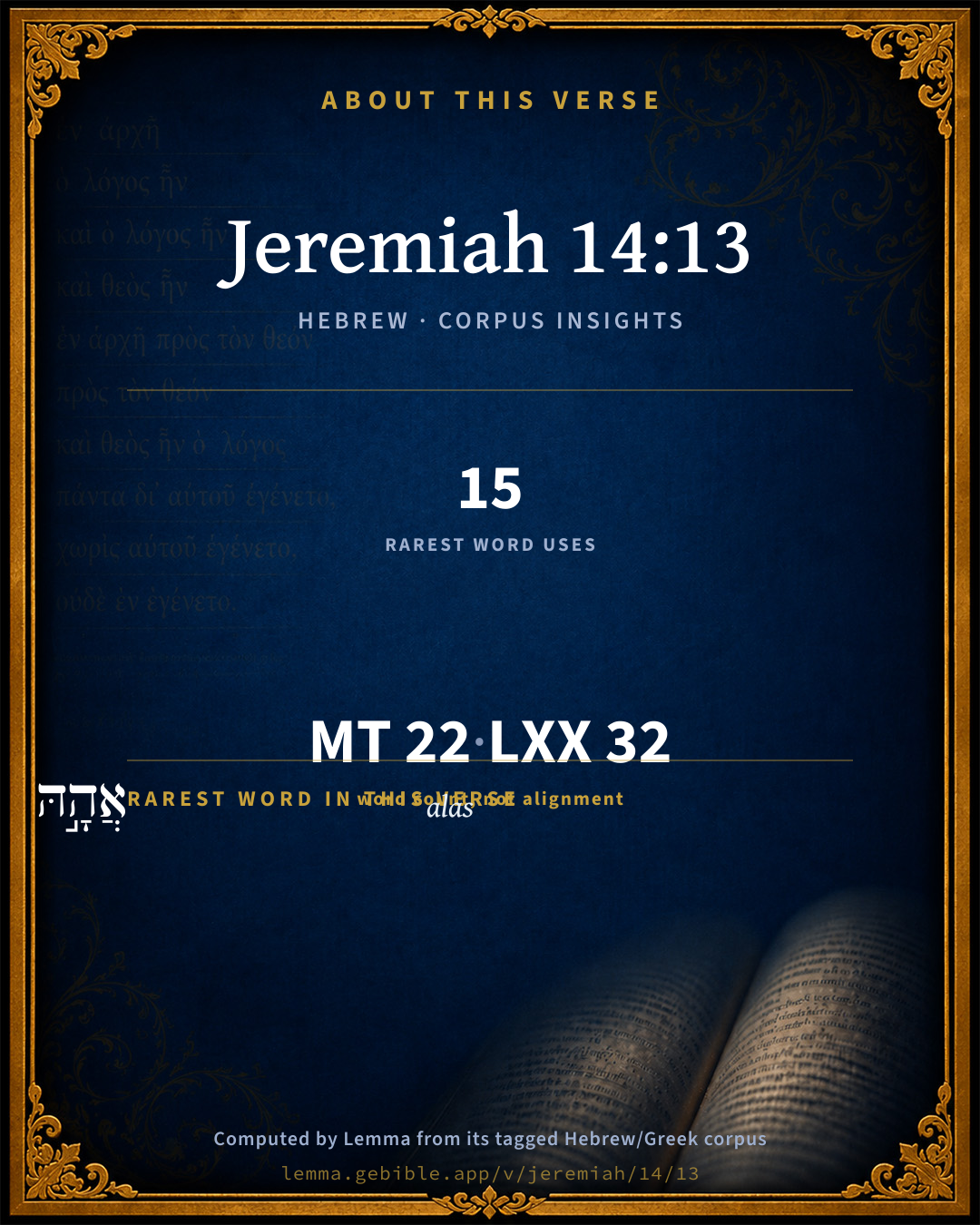
22
words
17
distinct lemmas
Prophets
section

Notable vocabulary

The rarest word here is אֲהָ֣הּ alas H162 — appearing just 15 times in the whole Hebrew Bible.

Shared distinctive vocabulary

אֲהָ֣הּ alas H162 occurs in 15 verses of the Hebrew Bible. Also found in:

Grammatical profile

  • 5 verbs
  • 8 nouns
  • 1 pronoun
  • 3 prepositions
  • 1 conjunction
  • 4 particles

Verb forms

  • וָאֹמַ֞ר Qal · Sequential Imperfect
  • אֹמְרִ֤ים Qal · Participle Active
  • תִרְא֣וּ Qal · Imperfect
  • יִהְיֶ֣ה Qal · Imperfect
  • אֶתֵּ֣ן Qal · Imperfect

Repetition

Words recur within this verse — often emphatic in Hebrew:

  • וָאֹמַ֞ר to say H559 ×2
  • לֹֽא not H3808 ×2

Hebrew & Septuagint length

In the original languages it is 22 Hebrew tokens and 32 Greek tokens — but the two are counted differently (Hebrew bundles its prefixes and suffixes into one token; the Greek is in lemma form), so that isn’t a like-for-like length.

Cross-references

12

Topical passages linked to Jeremiah 14:13 in the Treasury of Scripture Knowledge — connected by theme and wording, ordered by reader-vote popularity; previews shown in the World English Bible.

  • Jeremiah 6:14 They have healed also the hurt of my people slightly, saying, Peace, peace; when there is no peace.
  • Jeremiah 4:10 Then said I, Ah, Lord Yahweh! surely you have greatly deceived this people and Jerusalem, saying, You shall have peace; whereas the sword reaches to the life.
  • Jeremiah 23:17 They say continually to those who despise me, Yahweh has said, You shall have peace; and to everyone who walks in the stubbornness of his own heart they say, No evil shall come on you.
  • Micah 3:11 Her leaders judge for bribes, And her priests teach for a price, And her prophets of it tell forturnes for money: Yet they lean on Yahweh, and say, Isn't Yahweh in the midst of us? No disaster will come on us.
  • 2 Peter 2:1 But there also arose false prophets among the people, as among you also there will be false teachers, who will secretly bring in destructive heresies, denying even the Master who bought them, bringing on themselves swift destruction.
  • Jeremiah 5:12 They have denied Yahweh, and said, It is not he; neither shall evil come on us; neither shall we see sword nor famine:
  • Jeremiah 8:11 They have healed the hurt of the daughter of my people slightly, saying, Peace, peace; when there is no peace.
  • Jeremiah 1:6 Then said I, Ah, Lord Yahweh! behold, I don't know how to speak; for I am a child.
  • Jeremiah 5:31 the prophets prophesy falsely, and the priests bear rule by their means; and my people love to have it so: and what will you do in the end of it?
  • Jeremiah 28:2–5 Thus speaks Yahweh of Hosts, the God of Israel, saying, I have broken the yoke of the king of Babylon.
  • Ezekiel 13:10–16 Because, even because they have seduced my people, saying, Peace; and there is no peace; and when one builds up a wall, behold, they daub it with whitewash:
  • Ezekiel 13:22 Because with lies you have grieved the heart of the righteous, whom I have not made sad; and strengthened the hands of the wicked, that he should not return from his wicked way, and be saved alive:

Cross-references courtesy of OpenBible.info (CC BY 4.0).

Hebrew and Greek witnesses Masoretic Hebrew ↔ Greek Septuagint

The same verse in the two great witnesses to the Old Testament, shown verse-for-verse.

These are two independent witnesses, not word-aligned to each other, and the Septuagint is shown in lemma (dictionary) form.

Hebrew Jeremiah 14:13 Masoretic · Westminster Leningrad Codex

וָאֹמַ֞ר אֲהָ֣הּ אֲדֹנָ֣י יְהוִ֗ה הִנֵּ֨ה הַנְּבִאִ֜ים אֹמְרִ֤ים לָהֶם֙ לֹֽא תִרְא֣וּ חֶ֔רֶב וְרָעָ֖ב לֹֽא יִהְיֶ֣ה לָכֶ֑ם כִּֽי שְׁל֤וֹם אֱמֶת֙ אֶתֵּ֣ן לָכֶ֔ם בַּמָּק֖וֹם הַזֶּֽה

Then said I, Ah, Lord Yahweh! behold, the prophets tell them, You shall not see the sword, neither shall you have famine; but I will give you assured peace in this place.

World English Bible · Public Domain

Greek LXX Structure differs

In the Septuagint, Jeremiah is about an eighth shorter than the Hebrew and arranges its material differently — the Oracles Against the Nations (Hebrew chapters 46–51) appear in the middle of the Greek book, after 25:13. Because the chapter and verse boundaries do not line up, a verse-for-verse comparison with the Hebrew is not shown.

A verse-for-verse comparison isn’t shown here because the chapters and verses don’t line up. Switch to the LXX edition with the MT / LXX toggle above to read the Greek directly.

On this verse, John Gill's Exposition discusses the Septuagint’s reading. Read the note in Commentary ↓

Hebrew: Westminster Leningrad Codex (CC BY 4.0). Greek: Septuagint (public domain); English from a public-domain English Septuagint. How the Septuagint differs from the Hebrew →

Targum (Aramaic paraphrase)

1

The Targum is the ancient Jewish Aramaic paraphrase of the Hebrew Scriptures — an interpretive translation, not the Hebrew text itself. Onkelos (literal) and Pseudo-Jonathan (expansive) render the Torah, and Jonathan the Prophets. Coverage is partial: where no permissively-licensed English translation exists for a verse, only the Aramaic is shown. This is verse-level text, not a word-by-word alignment to the Hebrew.

  1. Targum Jonathan Prophets (Joshua–Malachi)
    וַאֲמָרֵית קַבֵּל בָּעוּתִי יְיָ אֱלֹהִים הָא נְבִיֵי שִׁקְרָא אָמְרִין לְהוֹן לָא תֶחְזוֹן דְקַטְלִין בְּחַרְבָּא וְכַפְנָא לָא יְהֵי לְכוֹן אֲרֵי שְׁלָם דִקְשׁוֹט אֶתֵּן לְכוֹן בְּאַתְרָא הָדֵין:

    (no public-domain English translation for this verse)

    Targum Jonathan — Aramaic: “Mikraot Gedolot” (public domain). English: “Sefaria Community Translation” (CC0 1.0 (public-domain dedication)); “London "Chaldee Paraphrase," 1871” (public domain). Text via Sefaria.

Commentary

Notes on Jeremiah 14:13 from classic Christian and Jewish commentators (each source and its license shown beneath its notes). The classic Christian expositions comment on the surrounding passage and are grouped to its opening verse, so a note may address several verses; the Jewish commentaries on the Tanakh (Rashi and others) are per-verse, so they appear only where the commentator wrote on this verse.

Lemma curates 59 commentaries, every one of them public domain or Creative Commons licensed, each selected and text-cleaned for this edition rather than reprinted as found. About our sources →

Trapp's Complete Commentary

John Trapp

Jer 14:13 Then said I, Ah, Lord GOD! behold, the prophets say unto them, Ye shall not see the sword, neither shall ye have famine; but I will give you assured peace in this place.

Ver. 13. Ah, Lord God!] The Vulgate Latin hath it, Ah, ah, ah. Vide diligentissimam intercessionem. He seeketh somewhat to excuse the people by laying the blame upon their false prophets. Like whereunto were those Popish priests in Gerson’s time, who preached publicly to the people, that whosoever would come to hear a mass, he should not be struck blind on that day, neither should he die a sudden death, nor want sufficient sustenance, &c.

But I will give you assured peace.] Heb., Peace of truth. Thus these deluders had learned to speak the language of God’s true prophets. Of the high soaring, pretended spiritual language of Familists and some other sectarians one saith well, That it is a great deal too high for this world, and a great deal too low for the world to come.

John Trapp, A Commentary or Exposition upon All the Books of the Old and New Testament (1647–1656) — public domain. Text from a community e-Sword module.

The Biblical Illustrator

Joseph S. Exell

Jer_14:13

I will give you assured peace.

Assured peace

I. Human life wants it.

1. Uncertainty troubles our life.

2. Delusions embitter our heart.

3. Misgivings weary our soul.

II. God alone can give it.

1. Peace is not a human commodity, but a Divine boon.

2. Peace comes only to Divinely-prepared hearts.

3. Peace is specifically the Saviours benefaction.

III. Lying voices offer it.

1. False prophets preach peace still.

(1) In our churches, promising ceremonies righteous works it through etc.

(2) In pleasures scenes, assuring the gay and frivolous of satisfaction, etc.

2. Beguiled dupes are ensnared still.

3. Yet assured peace is available still. May be found by all (Mat_11:28-30). (W. H. Jellie.)

Peace

Peace is various and versatile. Peace is not mere pleasure, yet there is a pleasure in peace. When there is no longer any offers to be happy, nor any dread of care, pleasure settles to its repose, as a frame that lolls and turns on a luxurious couch by and by folds itself to motionless and dreamy comfort; or as the mountain peak that shot and shafted to its height sublime falls softly off and folds away into the gentle slope, the nooks where lights and shadows play, the curve that modulates the majestic summit to the meek swell of the landscape lowlands, and invests the valley with the mountain grandeur, and mountain grandeur with the placid secret of the lowly vale; the breast that heaved with pleasure in its confirmed rapture comes to rest. Pleasure is not peace, but in Its realisation and fulfilment there is a peace of pleasure. See a little further. Joy is not peace, nevertheless there is a peace of joy in which the mind and heart take counsel with each other. This is delight arriving at repose. Thus, when a strain of music dies away upon the ear, the harmony thrills memory still--the noise ceases, the notes linger and serenade the silence, the silence returns the serenade. Again, pain might be reckoned as the foe of peace, and still there is a peace of pain. Some tranquilities are gendered by adversity alone. The peace found in pain cannot be otherwise discovered nor elsewhere known. When one has borne excruciating pang or undergone sore struggle, and can say, It is familiar now; I have been through the worst of it, and have survived; or where one can even set out about such an undertaking, and although outwardly the infliction or affliction has yet to be encountered, that moment takes on its own radiance, and the mind has upon effective grounds prepared itself for all, anticipated all, looked through all resolutely, braced now and nerved, knitted and compacted; the resolve is half the readiness, the readiness is all the conflict--the endurance is the victory, as of one whose valour makes his foes to tremble, as the Spartan band or the Royal Guard by their very presence put the enemy to flight. When the heart and soul are set in resolution, like a regiment kneeling with fixed bayonets, and so the onset is taken with a will, and the triumph is anticipated in advance, there ensues a serenity which is of itself a triumph, a fortitude which is in itself a conquest and a coronation. It is thus that there can come into the heart the peace of pain. It has distinct varieties. The peace of suffering in physical endurance must not be undervalued. There is such a thing as is indicated by the words, to suffer and be strong, whereby that which in another would enforce an outcry or insist upon a groan--that which even to the same sufferer, at another time, coming by stealth or startling, would utterly unman the nature, has become a manageable trial, to be confronted, to be endured, and to be looked through and through, it may be with bated breath and set teeth, but still at bay, until the paroxysm faints away into the peace, and the strong mastery of the resolve carries the torture of the flesh, and rules the throb of the nerves by its volition. There is a pain peace not to be despised--it may be the peace of peril. Presence of mind is power of help. The war horse stands motionless while the guns emit their bloody blasts and the carnage overflows. The young hero leaps upon the ramparts, the veteran holds the fort. The peace of peril is the opposite of peril panic. Panic huddled the fleeing, frightened throng, so that none could escape from the blazing building; peace would have found the fire escape; peace would have opened the back stairs. And thus it is in life at large: panic is perils peril, but peace is perils protection--perils safe control. And of pain peace another branch is peace of sorrow, peculiar to itself. It does not neutralise the grief, it softens and enchants it. When sorrow has undergone its first wild shock, when cries are stilled and tears are dried, a hush that sinks to softer sorrow, as a gale dies to a zephyr breeze, comes in upon the gloomy void, and sorrow in its silence, sorrow in its sanctity, can find sorrow peace--the very peace of pain. And so it is that in all these varieties, and under all vicissitudes like these, the grace within enkindles peace without. And when the Finite is in treaty with the Infinite, the creature in reconciliation with his Maker, the soul, possessed of peace with God through our Lord Jesus Christ, can prove that paradox of life and earth--the peace of God which passeth all understanding. (H. S. Carpenter.)

The Biblical Illustrator, edited by Joseph S. Exell (c. 1880s–1900s) — public domain. Text from a community e-Sword module.

Joseph Benson's Commentary

Jer 14:13-16. Ah, Lord God! Behold the prophets, &c. — See note on Jer 4:10. Thus saith the Lord — And what he saith he will assuredly make good; By the sword and famine shall those prophets be consumed — They shall fall first by those very judgments, with the hopes of an exemption from which they have flattered others. And the people shall be cast out in the streets, &c. — The people contributed to their own delusions, and readily hearkened to such false prophets as confirmed them in their evil ways: God therefore justly threatens to punish them, because they were unwilling to know the truth.

Joseph Benson's Commentary on the Old and New Testaments (1811–1818) — public domain. Text from a community e-Sword module.

Tyndale Open Study Notes

Tyndale Open Resources

14:13-16 their prophets: The government of Judah supported a corps of prophets who promoted the religious views of the king and his advisers. The Lord often condemned them, along with the officials and the priests. Here, the Lord exposed them as impostors and described what would happen to them and to the people to whom they prophesied.

Tyndale Open Study Notes — © Tyndale Open Resources, licensed CC BY-SA 4.0. Text via the HelloAO Bible API.

Geneva Bible (1599)

Geneva Bible translators

He pitieth the people, and accuseth the false prophets, which deceived them: but the Lord answered, that both the prophets, which deceived, and the people, which suffered themselves to be seduced, shall perish, Jer. 23:15 and 27:8, 9 and 29:8.

Geneva Bible (1599) marginal notes — public domain. Text via Bolls.life.

Jamieson, Fausset & Brown

Robert Jamieson, A. R. Fausset & David Brown

Jeremiah urges that much of the guilt of the people is due to the false prophets' influence.

assured peace--solid and lasting peace. Literally, "peace of truth" (Isa 39:8).

Jamieson, Fausset & Brown — Commentary Critical and Explanatory on the Whole Bible (1871) — public domain (CC PDM 1.0). Text via the HelloAO Bible API.

Adam Clarke's Commentary

Verse 13. Ah, Lord God! behold, the prophets say unto them] True, Lord, they are exceedingly wicked; but the false prophets have deceived them; this is some mitigation of their offense. This plea God does not admit; and why? the people believed them, without having any proof of their Divine mission.

Adam Clarke's Commentary on the Bible (1810–1826) — public domain. Text from a community e-Sword/MySword module.

John Calvin's Commentaries

The Prophet no doubt relates what he had expressed in prayer to God; but yet he has a reference to the people. He then prayed in the manner he now relates; but he renders public the prayers he offered by himself and without a witness, in order that he might restore the Jews from their impiety. Now Jeremiah’s colloquy with God availed not a little to touch the Jews; for as though they themselves had been present, he set before them what he had heard from God’s mouth. We now then understand why he made known his secret prayers; it was not for the sake of boasting, but for the sake of doing good to the Jews. It was then his object to consult their benefit, when he declared to them what he had previously poured forth without any witness into the bosom of his God.

And I said, Ah, Lord Jehovah! He uses an expression of grief, Ah! and thus he shews what concern he felt for his people, being not less anxious on account of their ruin than on account of his own. It may yet be an expression of astonishment, as though the Prophet was fined with surprise, “What can this be, O Lord?” And doubtless an expression of astonishment is not unsuitable, so that the Jews might feel horrified together with him, when they saw that they had been led astray by the false prophecies, by which they had been deceived. He then says, “How is this, O Lord? for the prophets say to them, etc.

Here the word, prophets, is emphatic, as though he had said, They are not thus mad wilfully in promising to themselves peace, contrary to thy will, but these prophets who profess and boast of thy name, these are the authors of this so gross a security; for they say, Ye shall not see the sword, famine shall not happen to you; nay, I will give you, etc. Here they assume the person of God; for it is not said, “God shall give you sure peace,” but “I will give you,” etc. We hence see that the Prophet here expresses his horror, while he compares false prophecies with the oracle which he had received from the mouth of God. The prophets, he declares, say, etc. They assumed an honorable title, and one connected with the power and authority of God himself. “Even the prophets then, who seem endued with the authority of heaven, and seem to have been sent by thee, as though they were angels, — even these promise men peace, not in a common manner, but in a way the most imposing, as though they had thine authority, and brought from thy mouth their fallacies, I will give you.”

We now then understand the design of the Prophet; for it was necessary to shake off from the Jews that false confidence, by which the false prophets, who pretended to have been sent from above, and boasted that they were God’s servants, the agents of the Holy Spirit, had inebriated them. As then it was necessary to take away from the Jews this confidence, the cause of their ruin, because they hardened themselves in contempt of God, and despised all his threatenings; he therefore says, “What! the false prophets speak thus, I will give you sure peace in this place.”

We hence learn that Jeremiah had almost a continual contest; for the fiercest antagonists immediately presented themselves, whenever he threatened the people either with exile or with famine, or with any other judgment of God. “What! be secure, for God has chosen this place where he is worshipped. It cannot be that he will banish his Church from its quiet rest. There is no reason then to fear that he will ever suffer this kingdom to perish or his Temple to be destroyed.” Hence the complaint of the Prophet, not that he himself was affected by such falsehoods, but he regarded the good of the people, and sought to recover those who were as yet healable from these deceptions. Hence it follows —

John Calvin's Commentaries (1540-1563) — public domain. Text from the Calvin Translation Society English edition (1840s-50s) via the Christian Classics Ethereal Library (ccel.org). Calvin's coverage is partial (roughly two-thirds of the Bible); uncommented books and verses are honest gaps, never fabricated. The 19th-century editor's footnotes and remarks are omitted so the notes are faithfully Calvin's own voice.

Ellicott's Commentary for English Readers

(13) Ah, Lord God!—Literally, as in Jer_1:6, Alas, my Lord (Adonaï) Jehovah! We have had in Jer_5:31 a glimpse of the evil influence of the great body of the prophetic order; and now the true prophet feels more bitterly than ever the misery of having to contend against it. The colleges or schools of the prophets had rapidly degenerated from their first ideal, and had become (as the Mendicant Orders did in the history of mediæval Christendom) corrupt, ambitious, seekers after popularity. So Micah (Mic_3:8-11), whose words were yet fresh in the memories of men (see Jer_26:18), had spoken sharp words of the growing evil. So Ezekiel through one whole chapter (Jeremiah 13) inveighs against the guilt of the prophets, male or female, who followed their own spirit, and had seen no true vision.

Ye shall not see . . .—To the eye of Jeremiah the future was clear. The sins of the people must lead to shame, defeat, and exile. Out of that discipline, but only through that, they might return with a better mind to better days. The false prophets took the easier and more popular line of predicting victory and “assured peace” (literally, peace of truth, i.e., true peace) for the people and their city.

A Bible Commentary for English Readers, edited by Charles John Ellicott (1878–1897) — public domain. Text from a community e-Sword module.

The Cambridge Bible for Schools and Colleges

gen. ed. J. J. S. Perowne

13. assured peace] mg. Heb. peace of truth (stability). They may have sought to support their reassuring assertions by reference to such utterances as those of Isa_37:33 ff.

13, 14. For the attitude of the false prophets and their relation to the true see Intr. pp. xxxii. f.; also xxiii. 9 ff.

The Cambridge Bible for Schools and Colleges (gen. ed. J. J. S. Perowne; Cambridge University Press, 1878–1918) — public domain. Text from a community e-Sword module.

John Gill's Exposition

Then said I, Ah, Lord God!.... Being grieved at heart for the people, because he was forbid to pray for them, and because the Lord had resolved on the ruin of them; and the rather he pitied them, because they were deceived by the false prophets, and therefore he tries to excuse them, and lay the blame upon them, as follows:

behold, the prophets say unto them; that is, the false prophets, as the Targum; Jeremiah does not call them so, being willing to make the best of it:

ye shall not see the sword; the sword of the enemy drawn in your country, or fall by it:

neither shall ye have famine; by which it appears, that it was not yet come, only foretold; the contrary to which is here affirmed:

but I will give you assured peace in this place; so they spoke as from the Lord, and in his name, with all the confidence imaginable; assuring the people that they should have peace and prosperity, and be in the utmost safety in Jerusalem; and that neither famine nor sword would come to them, nor in the least hurt them. In the Hebrew text it is, "peace of truth" (l); that is, true peace, firm and lasting. The Septuagint render it "peace and truth"; see Isa 39:8.

(l) "pacem veritatis", Montanus, Schmidt.

John Gill's Exposition of the Whole Bible (1746–1763) — public domain (CC PDM 1.0). Text via the HelloAO Bible API.

Albert Barnes' Notes on the Bible

The false prophets in Jeremiah’s days were so numerous and influential an to counteract and almost nullify the influence of the true prophet. We find in Isaiah the first indications of the internal decay of the prophetic order; and Micah, his contemporary, denounces the false prophets in the strongest terms Mic 3:5, Mic 3:11. For the secret of their power see Jer 5:31.

Albert Barnes' Notes on the Bible (1834–1885) — public domain. Text from a community e-Sword/MySword module.

Haydock's Catholic Bible Commentary

Ah. Hebrew has only one exclamation, or three letters, which Aquila renders, Ah, ah, ah., chap. i. 6., and Ezechiel iv. 14. (Haydock) --- Jeremias lays the blame on false prophets. (Calmet) --- Yet they afford no excuse to thy followers. Both fall into the ditch. (Worthington)

George Leo Haydock (1774–1849), Haydock's Catholic Family Bible and Commentary, 1859 edition — public domain. Excludes Psalms (Douay-Rheims chapter numbering differs from Protestant) and Deuterocanonical books (Catholic canon only).

Matthew Poole's English Annotations

We have many complaints of this prophet against false prophets that contradicted his prophecies, Jer 4:10; 23:9, and we shall hereafter meet with the names of some of them. Corrupt governments never want prophets to their humour, though a bolder transgression can hardly be imagined, than for men to entitle God to their own imaginations and fancies, and we shall, Jer 14:15, meet with the usual wages of such works.

Matthew Poole's English Annotations on the Holy Bible (1683–1685) — public domain. Text from a community e-Sword/MySword module.

Whedon's Commentary on the Bible

Daniel D. Whedon

13. Then said I — Another clamorous outburst of prayer. As if the prophet would leave nothing unsaid that might serve to put the case into a stronger light. The plea he now makes is important and relevant. The people are deceived and deluded. The false prophets at this time, even more than in that of Micah, (Mic_3:5; Mic_3:11,) promise peace. This would have been a more potent plea were it not true, as had been already charged, (Jer_5:31,) “My people love to have it so.”

Daniel D. Whedon (gen. ed.), Commentary on the Old and New Testaments (1874–1909) — public domain. Text from a community e-Sword module.

The Pulpit Commentary

"Pleading with Providence, the good prophet lays the blame on ill teaching, but the stern answer (Ver. 14), admitting the plea as true, rejects it as inadequate (Ver. 14), and denounces sorrows which (Vers. 17-22) the prophet passionately deprecates" (Rowland Williams). Ah, Lord God! rather, Alas! O Lord Jehovah. (see on Jer_1:6) The prophets say unto them. The greater part of the prophetic order had not kept pace with its more spiritual members (Isaiah, Jeremiah, etc.). They still traded on those natural gifts of divination (Mic_3:6) which were, no doubt, where genuine, of Divine origin, but which, even then, needed to be supple-merited and controlled by a special impulse from the Spirit of holiness. Jeremiah, however, declares, on the authority of a revelation, that these prophets did not divine by any God-given faculty, but "the deceit of their own heart" (Ver. 14). The Deuteronomic Torah, discovered after a period of concealment at the outset of Jeremiah"s ministry, energetically forbids the practice of the art of divination. (Deu_18:10)

Vers. 13-16. False prophets.

I OFFICIAL TEACHERS MAY BE FALSE TEACHERS. The false prophets belonged to the recognized order of prophets. No rank in the Church confers infallibility. Popes have been heretics. The authority of a teacher must be sought in his message, not in his office. It is our duty to try the spirits by their correspondence with known revelation, (1Jn_4:2) by the fruits of their lives and doctrines, (Mat_7:16) and by the standard of our own conscience. (2Co_4:2)

II PREACHING WHICH IS NOT INSPIRED BY THE DIVINE SPIRIT OF HOLINESS IS LIKELY BE FALSE. The prophet may have a piercing intellect and a towering imagination. Yet he will err if he be blinded by unholiness and excluded from the revelations of spiritual communion. He speaks only out of his own heart; but the heart is "deceitful above all things." Attempts are constantly made to evolve religious truth out of the inner consciousness of the thinker. No idle dreams are more delusive, since

(1) men have not the materials out of which to build a theology of their own;

(2) they have not the faculties capable of using those materials sin perverts the spiritual vision, prejudice and self-interest distort views of truth.

III CONSCIOUSLY TEACHING FALSE IDEAS OF RELIGION IS A HEINOUS CRIME. It is using the Name of God in vain (Ver. 14). It is abusing the trust of a high office for low purposes. It is likely to involve many in the toils of a fatal deception. It is easy to prophesy smooth things easy thus to gain a vulgar popularity. But if this is done at the expense of truth, it is an awful sin. All Christian teachers should beware of the temptation to degrade their mission by aiming at pleasing their hearers instead of faithfully proclaiming the will of God.

IV FALSE TEACHING IN RELIGION WILL BE PUNISHED BY FATAL RESULTS. It ought to be clear to everybody that the first question concerning any teaching is whether it is true. Yet this question is often ignored. The prophet is eloquent; the doctrine is pleasing; the prediction is inviting. But what of all that if it is false? The prophecy will be punished when truth is revealed by facts. Then the false prophet will suffer by the fulfillment in himself of the prophecy he denied, and the people by the coming of the evil day they were too ready to hear discredited.

Vers. 13-16. False teachers no adequate excuse for evil conduct.

No doubt the people to whom Jeremiah was sent had been encouraged in their ungodliness by the faithlessness and sin of their prophets. Blind guides were leading the blind, and with the inevitable result. And here Jeremiah pleads, as an excuse for his people"s sin, that they had been thus misled. But God refuses to admit the plea. Now, on this, note

I FALSE TEACHING IS SOME EXCUSE FOR EVIL CONDUCT. The deepest instincts of our hearts affirm this. Our Lord himself does so, when he says, "He that knew not his Lord"s will and did it not, shall be beaten with few stripes." But this word of his, whilst it allows that lack of teaching is some excuse, denies that it is sufficient. (cf. Joh_19:11) St. Paul also says, concerning the heathen nations, "The time of this ignorance God winked at.

II BUT IT IS NOT AN ADEQUATE EXCUSE. For:

1. The taught are the creators almost as much as the creatures of their teachers. The people who clamor for smooth things to be prophesied to them will find such prophets forthcoming. Ahab"s prophets all of them but Micaiah were such. It is true, "like priest, like people;" but it is also true, "like people, like priest." The demand creates the supply. The pastors of the Church are the product of the Church, almost as much as the Church is the product of the pastors. What a worldly Church wants it will have, for the woe both of itself and its pastors alike.

2. They have a sure test by which to try all their teachers. "To the Law and to the testimony," etc. Conscience also is ever on the side of God, and is prompt to condemn all teaching that leads to sin. The Holy Spirit likewise pleads in men"s hearts for God. And the faithful words of those in whom God"s Spirit dwells. None, therefore, are shut up to any human teachers.

3. And where evil teachers have been followed, it has been in spite of the protest which these other higher and surer guides have uttered, or would have uttered had they been suffered so to do.

III BUT IF IT BE ILL FOR THE TAUGHT, IT IS YET MORE ILL FOR THE TEACHERS. "His blood will I require at the watchman"s hands." The most awful of our Lord"s denunciations were addressed to such evil teachers (cf. the oft-repeated, "Woe unto you, scribes and Pharisees, hypocrites!" cf. Ver. 14, etc.).

CONCLUSION.

1. Let those who are taught by any human teachers test what they receive by the Word of God. Be as the Bereans. (Act_17:11)

2. Let those who teach watch anxiously and prayerfully against the temptation to conform their teachings to the likings of their hearers rather than to their needs. Let them remember that the causes of error and false teaching are much more moral than they are intellectual.

3. Let teachers and taught alike sit daily at his feet who said, "I am the Way, the Truth, and the Life. C.

Vers. 13-16. The peculiar doom of the false prophets.

I THE SIN OF THE PROPHETS. That they are found liars is, comparatively speaking, a small part of their offence. Their lie is productive of so much that adds to the peril of the position so much that is peculiarly insulting to Jehovah. Their sin and the punishment of it were not unlike the sin and punishment of Ananias and Sapphira. Ananias and Sapphira were smitten, not because they had lied, but because they had lied against the Holy Ghost. So with these false prophets here; they prophesied falsely; but that in itself might not have brought a peculiar doom upon them. The offence lay in this, that the false prophecy came at a time when it was peculiarly obnoxious to Jehovah. It was not a distant danger that these false prophets made light of, but one close to the door. The prophet"s difficulties, arising from the natural disposition of his auditors, were already great enough. No false prophet was needed to come in with his contradiction. It must also be remembered that there was a peculiarly insulting sin in that these men told their lies as prophets. What a dreadful thing for a man to go forth with "Thus saith Jehovah" in his mouth, when the words are the deceit of his own heart! This expression, "the deceit of their heart," seems to suggest the possibility that in some instances these false prophets were not deliberate liars, but were themselves deluded by a fanatical exaggeration of patriotism. Nevertheless, even so, the sin was none the less, for the spirits of the prophets were subject to the prophets. We had need be very sure that we are duly commissioned when we undertake to speak in the Name of God, else we may land ourselves in most humiliating exposures, and come to a most admonitory end. Thus we come to notice

II HOW THE SIN OF THESE PROPHETS WAS MADE CLEAR. Jeremiah said one thing, the false prophets said the direct contrary, and at the time there seemed no means of vindicating the true prophet beyond all chance of cavil. Doubtless those who were rightly disposed did listen and believe. Their very disposition was in itself a touchstone by which to discriminate between the false and the true; while those disposed to reject could make anything serve for an excuse. The important thing to notice is that the occasion of this great sin was seized upon to predict in due time a terrible, an indisputable, revelation of the sin. Thus an opportunity came for adding detail and emphasis to the prophecy already given. What could not be made plain at the moment would be made abundantly plain hereafter. Sword and famine were not only certain, they were near; coming within the lives of these living men, who would see these very false prophets die by the sword and famine which they had sneered at as impossible. Those who during life had told so many inexpressibly mischievous falsehoods with their lips, were made the instruments, their own will not being at all consulted, of uttering most impressive truth in their death. God and his truth and his true prophets and faithful witnesses can wait. Time is increasingly on the side of all truth, while false prophets are condemned out of their own mouths.

III THE DECEIVED AUDITORS SUFFER JUST AS MUCH AS THE DECEIVING SPEAKERS. The people were not at liberty to plead contradictions in the messages as a ground for continued inaction in the matter of repentance. Such a plea was certain to be seized on, but, while it might help to drug the conscience, it availed nothing to lighten the judgments which Jehovah was bringing on his unfaithful people. That God who is to be reckoned true, though such reckoning makes every man a liar, has assuredly not left himself without ample witness. False prophets can be tested at once by the heart of each individual to whom they appeal, although their exposure before the whole universe may not come for many ages. God gives us for our own sakes the present means of guarding against them. As to his Name and glory, we may be sure he will vindicate them in his own time and way. Y.

The Pulpit Commentary (1880–1919), ed. H.D.M. Spence-Jones & Joseph S. Exell — public domain. Text from a community e-Sword module.

unfoldingWord translationNotes

Door43 World Missions Community

General Information:

Yahweh has just told Jeremiah not to pray for the people of Judah.

You will not see the sword

Here "sword" represents war, and to "see" represents experiencing. AT: "You will not experience any war" (See: Metonymy)

I will give you true security

Here "security" is spoken of as if it were an object that someone could give to another person. AT: "I will allow you to live securely" or "I will allow you to live peacefully" (See: Metaphor)

prophesy deceit

The word "deceit" can be expressed as an adjective. AT: "prophesy deceitfully" (See: Abstract Nouns)

in my name

This phrase refers to speaking with Yahweh's power and authority or as his representative. (See: Metonymy)

I did not send them out

This means that Yahweh did not send them out with messages to give to the people. AT: "I did not send them to prophesy to other people" (See: Assumed Knowledge and Implicit Information)

coming from their own minds

Here "minds" are spoken of as if they were a place instead of the ability to think of ideas. AT: "that they think up themselves" (See: Metaphor)

translationWords

Lord Yahweh

false prophet

true

prophet

deceive

command

vision

divination

heart

unfoldingWord translationNotes — © Distant Shores Media and the Door43 World Missions Community, licensed CC BY-SA 4.0. Source: git.door43.org/Door43/en_tn.

Lesson kit

Teaching starters — assembled from the data on this page, not authored interpretation. Every prompt links to the verse data it draws on. Edit before teaching.

Jeremiah, in the Prophets, opens this verse with 22 words (17 distinct Hebrew lemmas). Its most distinctive word is ʼăhâhh (“alas”). A historical commentator’s framing appears above. Read the whole chapter for the surrounding context.

Discussion questions

  1. The word ʼăhâhh carries the sense “alas.” How does it shape the verse?
  2. Joshua 7:7 shares the word «alas» with this verse. How do the two illuminate each other?
  3. “to say” occurs 2× in this one verse. What is the effect of the repetition?
  4. These translations render this verse differently. What is at stake in choosing one wording over another?
  5. The verb «וָאֹמַ֞ר» is Qal Sequential Imperfect. How does its form color the action?
  6. Reading how Trapp's Complete Commentary and The Biblical Illustrator read this verse, where do the two commentators agree and where do they part?

Things to notice

Reading settings

Reading text

Shown beneath each verse's original-language words.

Old Testament
Old Testament edition

Read the OT as the Masoretic Hebrew (MT) or the Greek Septuagint (LXX).

English shown for the Greek Septuagint (in the Hebrew ↔ Greek comparison).

Comparing translations? Open the Compare panel on any verse page to stack up to four side by side.