
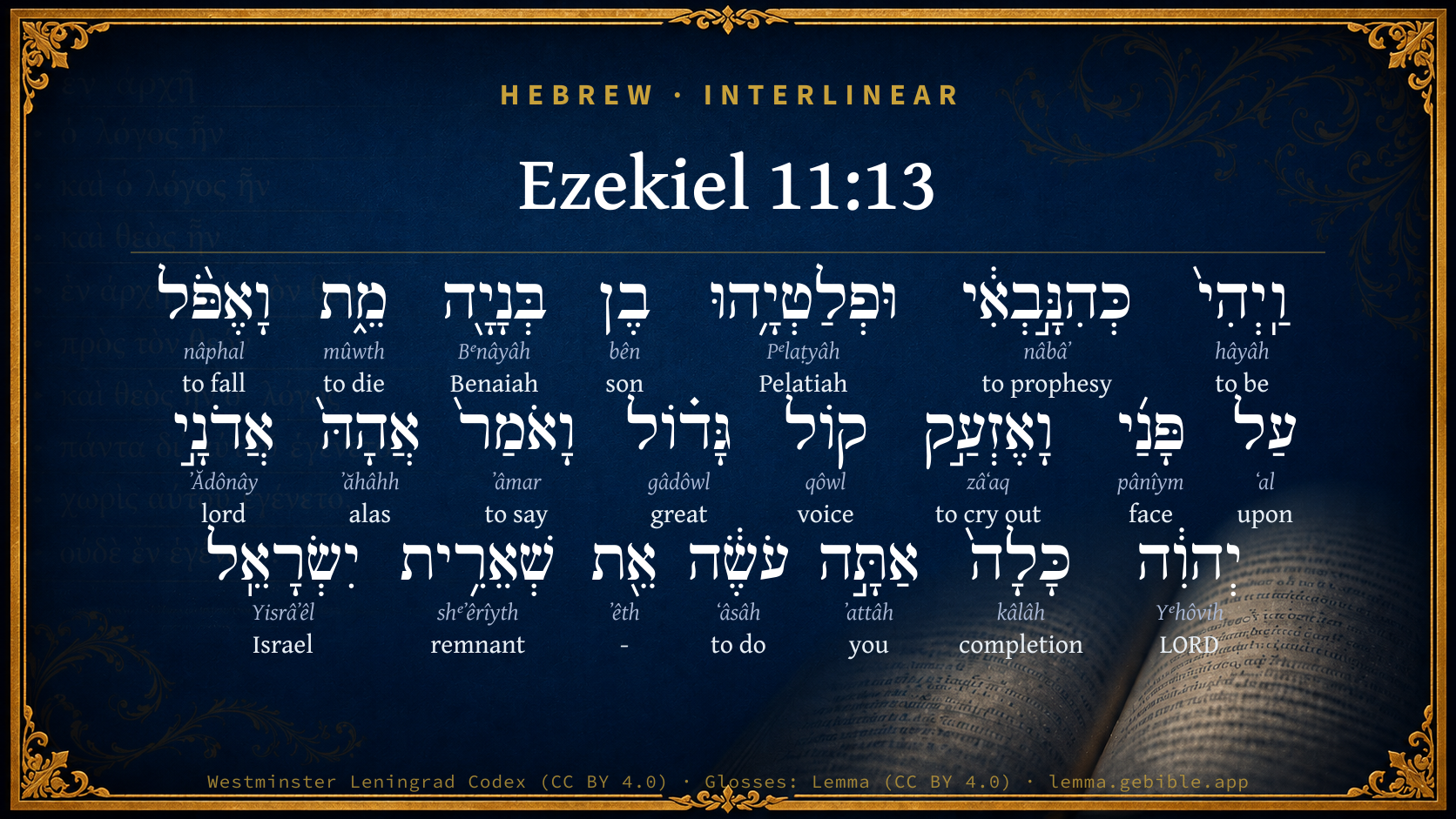
Ezekiel 11:13

Hebrew (Westminster Leningrad Codex) Ezekiel 11:13 appears in the Hebrew Old Testament. The text above is from the Westminster Leningrad Codex. Each word links to its Strong’s number, a concise gloss, and parsing drawn from the Open Scriptures Hebrew Bible morphology. Click any word for its full Brown-Driver-Briggs (BDB) entry.
Download image
Cite this verse

Ezekiel 11:13 (World English Bible). Public Domain. Lemma interlinear Bible study tool, https://lemma.gebible.app/v/ezekiel/11/13.

Show BibTeX & RIS
BibTeX
RIS
English Translation
It happened, when I prophesied, that Pelatiah the son of Benaiah died. Then fell I down on my face, and cried with a loud voice, and said, Ah Lord Yahweh! will you make a full end of the remnant of Israel?
World English Bible · Public Domain
Download a study sheet

One document with this verse’s original text, its word-by-word gloss line, the meaning frame, cross-references with their text, attributed commentary, and full source and license credits — printable, and it pastes into notes with its structure intact.

This verse Autodidact and up

Study sheet (.html) Plain text (.txt)

A passage Seminary Student

Up to 50 verses in one chapter. A passage sheet keeps up to 6 commentary sources and 12 cross-references per verse, in the order this page ranks them, and says so on the sheet whenever that leaves anything out. Ask for a single verse and you get the Autodidact verse sheet above.

Everything on this page stays free to read, with no account — the sheet is a download of what is already on screen, not access to it.

Want to remove ads? Support Godless Engineer
Compare translations 3

The same verse in 3 English versions, stacked beneath the original-language interlinear above. Click any original word for its lexicon entry.

Each is an independent rendering of the whole verse — the interlinear is not word-aligned to these translations.

Highlighted words mark where these versions differ — a whole-verse word diff, not a word-by-word alignment.

  • World English Bible Public Domain
    It happened, when I prophesied, that Pelatiah the son of Benaiah died. Then fell I down on my face, and cried with a loud voice, and said, Ah Lord Yahweh! will you make a full end of the remnant of Israel?
  • King James Version Public Domain
    And it came to pass, when I prophesied, that Pelatiah the son of Benaiah died. Then fell I down upon my face, and cried with a loud voice, and said, Ah Lord GOD! wilt thou make a full end of the remnant of Israel?
  • unfoldingWord Literal Text CC BY-SA 4.0
    It came about that as I was prophesying, Pelatiah son of Benaiah, died. So I fell on my face and cried out with a loud voice and said, “Alas, Lord Yahweh, will you completely destroy the remnant of Israel?”

unfoldingWord Literal Text — © unfoldingWord, licensed CC BY-SA 4.0. Word-aligned USFM3 via Door43 (git.door43.org/unfoldingWord/en_ult).

Versions to compare (up to 4)

3 of 4 selected

Show all 18 translations

Every available English version of this verse, each an independent rendering of the whole verse.

  • World English Bible Public Domain
    It happened, when I prophesied, that Pelatiah the son of Benaiah died. Then fell I down on my face, and cried with a loud voice, and said, Ah Lord Yahweh! will you make a full end of the remnant of Israel?
  • Berean Standard Bible Public Domain
    Now as I was prophesying, Pelatiah son of Benaiah died. Then I fell facedown and cried out in a loud voice, “Oh, Lord GOD, will You bring the remnant of Israel to a complete end?”
  • Majority Standard Bible Public Domain
    Now as I was prophesying, Pelatiah son of Benaiah died. Then I fell facedown and cried out in a loud voice, “Oh, Lord GOD, will You bring the remnant of Israel to a complete end?”
  • King James Version Public Domain
    And it came to pass, when I prophesied, that Pelatiah the son of Benaiah died. Then fell I down upon my face, and cried with a loud voice, and said, Ah Lord GOD! wilt thou make a full end of the remnant of Israel?
  • American Standard Version (1901) Public Domain
    And it came to pass, when I prophesied, that Pelatiah the son of Benaiah died. Then fell I down upon my face, and cried with a loud voice, and said, Ah Lord Jehovah! wilt thou make a full end of the remnant of Israel?
  • Revised Version (1885) Public Domain
    And it came to pass, when I prophesied, that Pelatiah the son of Benaiah died. Then fell I down upon my face, and cried with a loud voice, and said, Ah Lord GOD! wilt thou make a full end of the remnant of Israel?
  • Geneva Bible (1599) Public Domain
    And when I prophesied, Pelatiah the sonne of Benaiah dyed: then fell I downe vpon my face, and cryed with a loude voyce, and saide, Ah Lord God, wilt thou then vtterly destroy all the remnant of Israel?
  • Douay-Rheims (1899) Public Domain
    And it came to pass, when I prophesied, that Pheltias the son of Banaias died: and I fell down upon my face, and cried with a loud voice: and said: Alas, alas, alas, O Lord God: wilt thou make an end of all the remnant of Israel?
  • Young's Literal Translation Public Domain
    And it cometh to pass, at my prophesying, that Pelatiah son of Benaiah is dying, and I fall on my face, and cry -- a loud voice -- and say, `Ah, Lord Jehovah, an end Thou art making of the remnant of Israel.'
  • Literal Standard Version CC BY-SA 4.0
    And it comes to pass, at my prophesying, that Pelatiah son of Benaiah is dying, and I fall on my face, and cry—a loud voice—and say, “Aah! Lord YHWH, You are making an end of the remnant of Israel.”
  • Unlocked Literal Bible CC BY-SA 4.0
    It came about that as I was prophesying, Pelatiah son of Benaiah, died. So I fell on my face and cried out with a loud voice and said, “Alas, Lord Yahweh, will you completely destroy the remnant of Israel?”
  • unfoldingWord Literal Text CC BY-SA 4.0
    It came about that as I was prophesying, Pelatiah son of Benaiah, died. So I fell on my face and cried out with a loud voice and said, “Alas, Lord Yahweh, will you completely destroy the remnant of Israel?”
  • Darby Bible Public Domain
    And it came to pass, when I prophesied, that Pelatiah the son of Benaiah died. And I fell down on my face, and cried with a loud voice, and said, Ah, Lord Jehovah! wilt thou make a full end of the remnant of Israel?
  • World Messianic Bible Public Domain
    When I prophesied, Pelatiah the son of Benaiah died. Then I fell down on my face, and cried with a loud voice, and said, “Ah Lord GOD! Will you make a full end of the remnant of Israel?”
  • Webster's Bible Public Domain
    And it came to pass, when I prophesied, that Pelatiah the son of Benaiah died. Then I fell down upon my face, and cried with a loud voice, and said, Ah Lord GOD! wilt thou make a full end of the remnant of Israel?
  • Free Bible Version CC BY-SA 4.0
    While I was prophesying, Pelatiah son of Benaiah died. I fell facedown on the ground and shouted loudly, “Lord God, are you going to completely destroy what's left of the people of Israel?”
  • Bible in Basic English Public Domain
    Now while I was saying these things, death came to Pelatiah, the son of Benaiah. Then falling down on my face and crying out with a loud voice, I said, Ah, Lord! will you put an end to all the rest of Israel?
  • JPS Tanakh (1917) Public Domain
    And it came to pass, when I prophesied, that Pelatiah the son of Benaiah died. Then fell I down upon my face, and cried with a loud voice, and said: 'Ah Lord GOD! wilt Thou make a full end of the remnant of Israel?'

Literal Standard Version (2020), Covenant Press — licensed CC BY-SA 4.0. Text via the HelloAO Bible API (eBible.org). Unlocked Literal Bible (unfoldingWord) — licensed CC BY-SA 4.0. Text via the HelloAO Bible API (eBible.org). unfoldingWord Literal Text — © unfoldingWord, licensed CC BY-SA 4.0. Word-aligned USFM3 via Door43 (git.door43.org/unfoldingWord/en_ult). Free Bible Version, Dr. Jonathan Gallagher — licensed CC BY-SA 4.0. Text via the HelloAO Bible API (eBible.org).

Word by word

More ways to search: Search by grammar → Find every occurrence → Compare this word →

Practice this passage: Drill this verse → Learn its vocabulary →

וּפְלַטְיָ֥הוּ
Pᵉlaṭyâh
H6410
“and · Pelatiah”
Conjunction + Noun, Proper
Part of Speech
Conjunction + Noun
Type
Proper
Full BDB Definition

Origin: from H6403 and H3050

TWOT: None

Pelatiah = "Jehovah delivers" - son of Hananiah and grandson of Zerubbabel - a Simeonite in the days of king Hezekiah of Judah who was one of the captains of 500 men who defeated the Amalekites who had escaped - one of the heads of the people who sealed the covenant with Nehemiah - son of Benaiah and one of the princes of the people against whom Ezekiel was ordered to prophesy doom
  1. וַֽיְהִי֙ hâyâh H1961 “and · to be” Conjunction + Verb, Qal, Sequential Imperfect, 3rd Person, Masculine, Singular
  2. כְּהִנָּ֣בְאִ֔י nâbâʼ H5012 “like/as · to prophesy · me” Preposition + Verb, Niphal, Infinitive Construct + Suffix, Personal, 1st Person, Common, Singular
  3. בֶן bên H1121 “son of” Noun, Common, Masculine, Singular, Construct
  4. בְּנָיָ֖ה Bᵉnâyâh H1141 “Benaiah” Noun, Proper
  5. מֵ֑ת mûwth H4191 “to die” Verb, Qal, Perfect, 3rd Person, Masculine, Singular
  6. וָאֶפֹּ֨ל nâphal H5307 “and · to fall” Conjunction + Verb, Qal, Sequential Imperfect, 1st Person, Common, Singular
  7. עַל ʻal H5921 “upon” Preposition
  8. פָּנַ֜י pânîym H6440 “face(s) · my” Noun, Common, Both, Plural, Construct + Suffix, Personal, 1st Person, Common, Singular
  9. וָאֶזְעַ֣ק zâʻaq H2199 “and · to cry out” Conjunction + Verb, Qal, Sequential Imperfect, 1st Person, Common, Singular
  10. קוֹל qôwl H6963 “voice” Noun, Common, Masculine, Singular, Absolute
  11. גָּד֗וֹל gâdôwl H1419 “great” Adjective, Adjective, Masculine, Singular, Absolute
  12. וָאֹמַר֙ ʼâmar H559 “and · to say” Conjunction + Verb, Qal, Sequential Imperfect, 1st Person, Common, Singular
  13. אֲהָהּ֙ ʼăhâhh H162 “alas” Particle, Interjection
  14. אֲדֹנָ֣י ʼĂdônây H136 “Lord · my” Noun, Common, Masculine, Plural, Construct + Suffix, Personal, 1st Person, Common, Singular
  15. יְהוִ֔ה Yᵉhôvih H3069 “LORD” Noun, Proper
  16. כָּלָה֙ kâlâh H3617 “completion” Noun, Common, Feminine, Singular, Absolute
  17. אַתָּ֣ה ʼattâh H859 “you” Pronoun, Personal, 2nd Person, Masculine, Singular
  18. עֹשֶׂ֔ה ʻâsâh H6213 “doing” Verb, Qal, Participle Active, Masculine, Singular, Absolute
  19. אֵ֖ת ʼêth H853 “-” Particle, Direct Object
  20. שְׁאֵרִ֥ית shᵉʼêrîyth H7611 “remnant of” Noun, Common, Feminine, Singular, Construct
  21. יִשְׂרָאֵֽל Yisrâʼêl H3478 “Israel” Noun, Proper

About this verse

These counts appear in no published source. They are computed here, from the morphology-tagged text and Lemma’s own curated glosses. What Lemma adds →

22
words
22
distinct lemmas
Prophets
section

Notable vocabulary

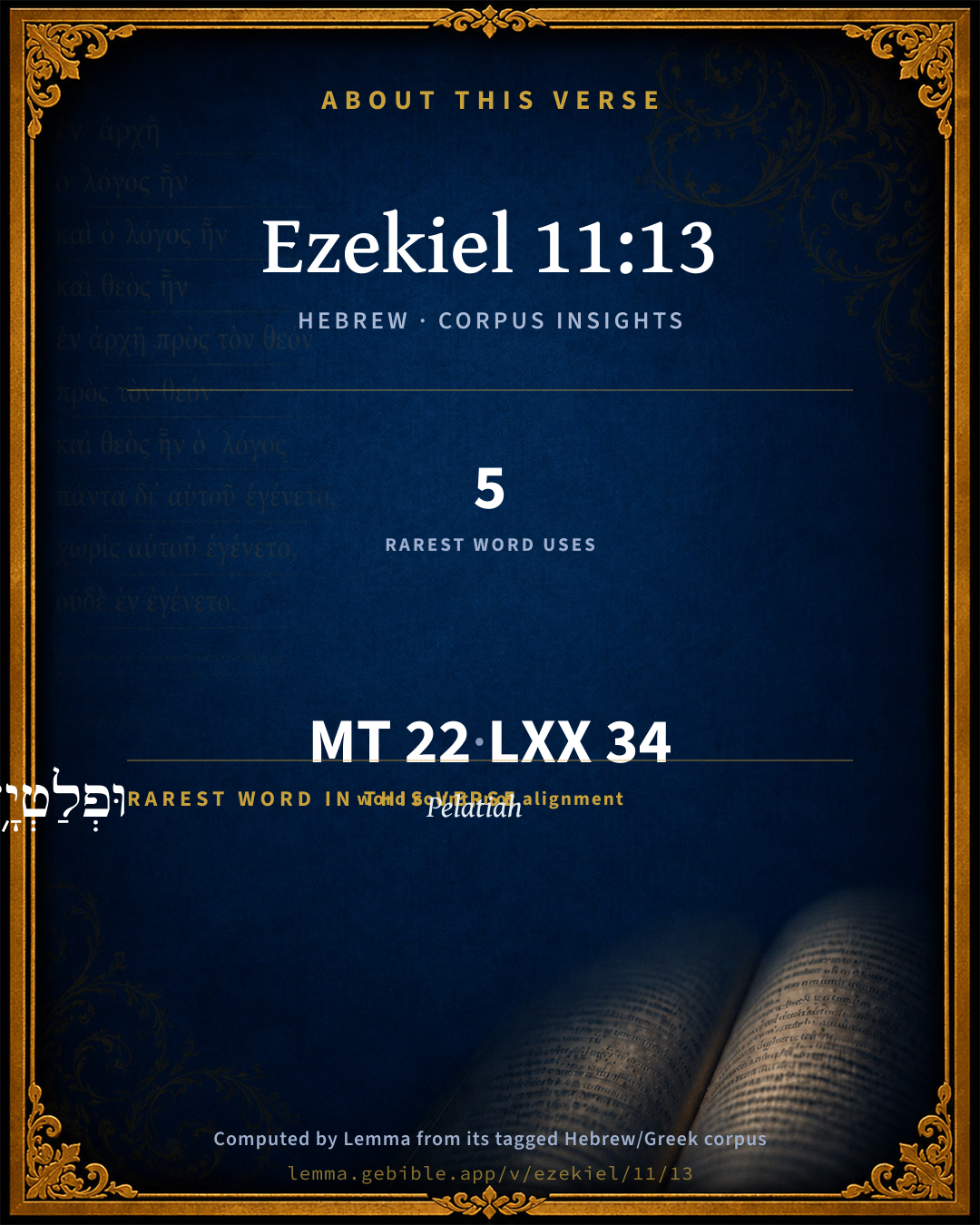
The rarest word here is וּפְלַטְיָ֥הוּ Pelatiah H6410 — appearing just 5 times in the whole Hebrew Bible.

Shared distinctive vocabulary

וּפְלַטְיָ֥הוּ Pelatiah H6410 occurs in 5 verses of the Hebrew Bible. Also found in:

Grammatical profile

  • 7 verbs
  • 10 nouns
  • 1 adjective
  • 1 pronoun
  • 1 preposition
  • 2 particles

Verb forms

  • וַֽיְהִי֙ Qal · Sequential Imperfect
  • כְּהִנָּ֣בְאִ֔י Niphal · Infinitive Construct
  • מֵ֑ת Qal · Perfect
  • וָאֶפֹּ֨ל Qal · Sequential Imperfect
  • וָאֶזְעַ֣ק Qal · Sequential Imperfect
  • וָאֹמַר֙ Qal · Sequential Imperfect
  • עֹשֶׂ֔ה Qal · Participle Active

Hebrew & Septuagint length

In the original languages it is 22 Hebrew tokens and 34 Greek tokens — but the two are counted differently (Hebrew bundles its prefixes and suffixes into one token; the Greek is in lemma form), so that isn’t a like-for-like length.

Cross-references

19

Topical passages linked to Ezekiel 11:13 in the Treasury of Scripture Knowledge — connected by theme and wording, ordered by reader-vote popularity; previews shown in the World English Bible.

  • Ezekiel 11:1 Moreover the Spirit lifted me up, and brought me to the east gate of Yahweh's house, which looks eastward: and see, at the door of the gate twenty-five men; and I saw in the midst of them Jaazaniah the son of Azzur, and Pelatiah the son of Benaiah, princes of the people.
  • Ezekiel 9:8 It happened, while they were smiting, and I was left, that I fell on my face, and cried, and said, Ah Lord Yahweh! will you destroy all the residue of Israel in your pouring out of your wrath on Jerusalem?
  • Acts 5:5 Ananias, hearing these words, fell down and died. Great fear came on all who heard these things.
  • Numbers 14:35–37 I, Yahweh, have spoken, surely this will I do to all this evil congregation, who are gathered together against me: in this wilderness they shall be consumed, and there they shall die.
  • Deuteronomy 7:4 For he will turn away your son from following me, that they may serve other gods: so will the anger of Yahweh be kindled against you, and he will destroy you quickly.
  • Deuteronomy 9:18–19 I fell down before Yahweh, as at the first, forty days and forty nights; I did neither eat bread nor drink water; because of all your sin which you sinned, in doing that which was evil in the sight of Yahweh, to provoke him to anger.
  • Joshua 7:6–9 Joshua tore his clothes, and fell to the earth on his face before the ark of Yahweh until the evening, he and the elders of Israel; and they put dust on their heads.
  • 1 Kings 13:4 It happened, when the king heard the saying of the man of God, which he cried against the altar in Bethel, that Jeroboam put forth his hand from the altar, saying, Lay hold on him. His hand, which he put forth against him, dried up, so that he could not draw it back again to him.
  • 1 Chronicles 21:16–17 David lifted up his eyes, and saw the angel of Yahweh standing between earth and the sky, having a drawn sword in his hand stretched out over Jerusalem. Then David and the elders, clothed in sackcloth, fell on their faces.
  • Psalms 106:23 Therefore he said that he would destroy them, Had Moses, his chosen, not stood before him in the breach, To turn away his wrath, so that he wouldn't destroy them.
  • Psalms 119:120 My flesh trembles for fear of you. I am afraid of your judgments.
  • Proverbs 6:15 Therefore his calamity will come suddenly. He will be broken suddenly, and that without remedy.
  • Jeremiah 28:15–17 Then said the prophet Jeremiah to Hananiah the prophet, Hear now, Hananiah: Yahweh has not sent you; but you make this people to trust in a lie.
  • Ezekiel 37:7 So I prophesied as I was commanded: and as I prophesied, there was a noise, and, behold, an earthquake; and the bones came together, bone to its bone.
  • Hosea 6:5 Therefore I have cut them to pieces with the prophets; I killed them with the words of my mouth. Your judgments are like a flash of lightning.
  • Amos 7:2 It happened that, when they made an end of eating the grass of the land, then I said, "Lord Yahweh, forgive, I beg you! How could Jacob stand? For he is small."
  • Amos 7:5 Then I said, "Lord Yahweh, stop, I beg you! How could Jacob stand? For he is small."
  • Acts 5:10 She fell down immediately at his feet, and died. The young men came in and found her dead, and they carried her out and buried her by her husband.
  • Acts 13:11 Now, behold, the hand of the Lord is on you, and you will be blind, not seeing the sun for a season!" Immediately there fell on him a mist and darkness. He went around seeking someone to lead him by the hand.

Cross-references courtesy of OpenBible.info (CC BY 4.0).

Hebrew and Greek witnesses Masoretic Hebrew ↔ Greek Septuagint

The same verse in the two great witnesses to the Old Testament, shown verse-for-verse.

These are two independent witnesses, not word-aligned to each other, and the Septuagint is shown in lemma (dictionary) form.

Hebrew Ezekiel 11:13 Masoretic · Westminster Leningrad Codex

וַֽיְהִי֙ כְּהִנָּ֣בְאִ֔י וּפְלַטְיָ֥הוּ בֶן בְּנָיָ֖ה מֵ֑ת וָאֶפֹּ֨ל עַל פָּנַ֜י וָאֶזְעַ֣ק קוֹל גָּד֗וֹל וָאֹמַר֙ אֲהָהּ֙ אֲדֹנָ֣י יְהוִ֔ה כָּלָה֙ אַתָּ֣ה עֹשֶׂ֔ה אֵ֖ת שְׁאֵרִ֥ית יִשְׂרָאֵֽל

It happened, when I prophesied, that Pelatiah the son of Benaiah died. Then fell I down on my face, and cried with a loud voice, and said, Ah Lord Yahweh! will you make a full end of the remnant of Israel?

World English Bible · Public Domain

Greek LXX Ezekiel 11:13 Septuagint · lemma form

καί γίγνομαι ἐν ὁ προφητεύω ἐγώ καί φαλτιας ὁ ὁ βαναιου ἀποθνήσκω καί πίπτω ἐπί πρόσωπον ἐγώ καί ἀναβοάω φωνή μέγας καί εἶπον οἴμμοι οἴμμοι κύριος εἰς συντέλεια σύ ποιέω ὁ κατάλοιπος ὁ ἰσραήλ

No English rendering of this Greek verse — the small residue in the structurally divergent books.

Hebrew: Westminster Leningrad Codex (CC BY 4.0). Greek: Septuagint (public domain); English from a public-domain English Septuagint. How the Septuagint differs from the Hebrew →

Targum (Aramaic paraphrase)

1

The Targum is the ancient Jewish Aramaic paraphrase of the Hebrew Scriptures — an interpretive translation, not the Hebrew text itself. Onkelos (literal) and Pseudo-Jonathan (expansive) render the Torah, and Jonathan the Prophets. Coverage is partial: where no permissively-licensed English translation exists for a verse, only the Aramaic is shown. This is verse-level text, not a word-by-word alignment to the Hebrew.

  1. Targum Jonathan Prophets (Joshua–Malachi)
    וַהֲוָה כְּאִתְנַבָּיוּתִי וּפְלַטְיָה בַר בְּנָיָה מִית וְאִשְׁתַּטְחֵית עַל אַפֵּי וּצְוָחֵית בְּקַל רַב וַאֲמָרֵית קַבֵּיל בָּעוּתִי יְיָ אֱלֹהִים גְמִירָא אַתְּ עֲבִיד עִם שְׁאָרָא דְיִשְׂרָאֵל:

    (no public-domain English translation for this verse)

    Targum Jonathan — Aramaic: “Mikraot Gedolot” (public domain). English: “Sefaria Community Translation” (CC0 1.0 (public-domain dedication)); “London "Chaldee Paraphrase," 1871” (public domain). Text via Sefaria.

Commentary

Notes on Ezekiel 11:13 from classic Christian and Jewish commentators (each source and its license shown beneath its notes). The classic Christian expositions comment on the surrounding passage and are grouped to its opening verse, so a note may address several verses; the Jewish commentaries on the Tanakh (Rashi and others) are per-verse, so they appear only where the commentator wrote on this verse.

Lemma curates 59 commentaries, every one of them public domain or Creative Commons licensed, each selected and text-cleaned for this edition rather than reprinted as found. About our sources →

Trapp's Complete Commentary

John Trapp

Eze 11:13 And it came to pass, when I prophesied, that Pelatiah the son of Benaiah died. Then fell I down upon my face, and cried with a loud voice, and said, Ah Lord GOD! wilt thou make a full end of the remnant of Israel?

Ver. 13. And it came to pass that when I prophesied.] God heweth men by his prophets, and slayeth them by the words of his mouth, and his judgments are as the light, or lightning, that goeth forth. {Hos 6:5} Elisha hath his sword as well as Jehu and Hazael. {1Ki 19:17} See Jer 1:10 2Co 10:6.

Pelatiah the son of Benaiah died.] Suddenly, {a} and before his time, in Solomon’s sense. {Ecc 7:17} Driven away he was in his iniquity Cerinthus, Arius so were Ananias and Sapphira, Cerinthus, Arius, Stephen Gardiner, Cardinal Pool, Dick of Dover, as they called the persecuting suffragan {b} there; Nightingale, parson of Becking, &c. See Pro 6:14-15.

Then fell I down upon my face.] Out of a holy solicitude about God’s elect, lest they also should have perished, as Petaliah had done, whose very name might seem somewhat ominous, for it signifieth "the escaped one of the Lord"; and therefore his sudden death might portend destruction to the remnant of Israel.

And cried with a loud voice.] Sudden or singular judgments put saints upon humble, earnest, and argumentative prayer.

{a} Magnum est subito opprimi.

{b} A bishop considered in regard to his relation to the archbishop or metropolitan, by whom he may be summoned to attend synods and give his suffrage. ŒD

John Trapp, A Commentary or Exposition upon All the Books of the Old and New Testament (1647–1656) — public domain. Text from a community e-Sword module.

Joseph Benson's Commentary

Eze 11:13. And when I prophesied, Pelatiah died — Mentioned Eze 11:1, a principal man among the twenty-five princes, who made all the mischief in Jerusalem: see note on Eze 11:2. It seems this was done only in vision now, (as the slaying of the ancient men, Eze 9:6,) but it was an assurance, that when this prophecy was published it would be done in fact. And the death of Pelatiah was a pledge of the complete accomplishment of the prophecy. Then fell I down upon my face, and cried — The prophet thought this an earnest of the common destruction which was coming upon all the inhabitants of the city, and thereupon he earnestly deprecated so severe a judgment. See chap. Eze 9:8.

Joseph Benson's Commentary on the Old and New Testaments (1811–1818) — public domain. Text from a community e-Sword module.

Tyndale Open Study Notes

Tyndale Open Resources

11:13 The judgment that the Lord pronounced occurred immediately. • O Sovereign Lord, are you going to kill everyone in Israel? If those who still remained in the land were destined for such comprehensive destruction, who would be God’s people?

Tyndale Open Study Notes — © Tyndale Open Resources, licensed CC BY-SA 4.0. Text via the HelloAO Bible API.

Geneva Bible (1599)

Geneva Bible translators

It seemeth that this noble man died of some terrible death, and therefore the Prophet feared some strange judgment of God toward the rest of the people.

Geneva Bible (1599) marginal notes — public domain. Text via Bolls.life.

Jamieson, Fausset & Brown

Robert Jamieson, A. R. Fausset & David Brown

Pelaliah--probably the ringleader of the scorners (Eze 11:1) was an earnest of the destruction of the rest of the twenty-five, as Ezekiel had foretold, as also of the general ruin.

fell . . . upon . . . face--(See on Eze 9:8).

wilt thou make a full end of the remnant--Is Pelatiah's destruction to be the token of the destruction of all, even of the remnant? The people regarded Pelatiah as a mainstay of the city. His name (derived from a Hebrew root, "a remnant," or else "God delivers") suggested hope. Is that hope, asks Ezekiel, to be disappointed?

Jamieson, Fausset & Brown — Commentary Critical and Explanatory on the Whole Bible (1871) — public domain (CC PDM 1.0). Text via the HelloAO Bible API.

Adam Clarke's Commentary

Verse 13. Pelatiah the son of Benaiah died.] Most probably he was struck dead the very hour in which Ezekiel prophesied against him. His death appears to have resembled that of Ananias and Sapphira, Ac 5:1, &c.

Adam Clarke's Commentary on the Bible (1810–1826) — public domain. Text from a community e-Sword/MySword module.

John Calvin's Commentaries

It is by no means doubtful that this Phalatias died at the same time at which the vision was offered to God’s servant. We shall see at the end of the chapter that the Prophet was always in exile; but then he seemed to himself caught up into the temple, and seemed also to himself to behold Phalatias dead. And yet it is possible that he died at his own home, and not in the entrance or threshold of the temple. But we know that the vision was not limited to places. As, therefore, Ezekiel was only by vision in the temple, so also he saw the death of Phalatias; and in this way God began by a kind of prelude to show that the slaughter of the city was at hand. For Phalatias was one of the chief rulers, as was said in the first verse of this chapter, and was doubtless a man of good reputation: hence his death was a presage of a general destruction. Hence this exclamation of the Prophet, Ah Lord God, wilt thou utterly consume the remnant of Israel? for now only a small number out of an immense multitude remained. Phalatias is seized, and in this way he shows that destruction hangs over the whole people. Hence it came to pass that the Prophet fell upon the earth astonished, and exclaimed that it was by no means agreeable to God’s promises to destroy the remnant of Israel. For some remnant ought to remain, as we often see in other places: even in the general slaughter of the whole people, God always gave some hope that he would not abolish his covenant. For this reason the Prophet now exclaims.

John Calvin's Commentaries (1540-1563) — public domain. Text from the Calvin Translation Society English edition (1840s-50s) via the Christian Classics Ethereal Library (ccel.org). Calvin's coverage is partial (roughly two-thirds of the Bible); uncommented books and verses are honest gaps, never fabricated. The 19th-century editor's footnotes and remarks are omitted so the notes are faithfully Calvin's own voice.

Ellicott's Commentary for English Readers

(13) Pelatiah . . . died.—This Pelatiah was one of the “princes of the people” mentioned in Eze_11:1-2 as “those that devise mischief and give wicked counsel.” The prophet’s mind is greatly affected by his sudden death, and he earnestly intercedes that in the judgments God will not “make a full end of the remnant.”

A Bible Commentary for English Readers, edited by Charles John Ellicott (1878–1897) — public domain. Text from a community e-Sword module.

The Cambridge Bible for Schools and Colleges

gen. ed. J. J. S. Perowne

13. While Ezekiel was uttering this prophecy Pelatiah fell down dead, and the prophet seemed to see in the event the coming destruction of all the remnant of Israel before the wrath of God, and fell on his face to intercede for them. This incident is exceedingly difficult to estimate. The prophet tells us that all the occurrences in ch. 8–11 were done in vision. Unfortunately this does not justify us in assuming that the death of Pelatiah was a mere symbolical death, and no reality. For the “vision” is in great measure a mere schema under which the prophet groups much that had reality, such as his own thoughts, his discourses to the people, and probably actual events happening in Jerusalem. But in grouping the events under the schema of the vision he idealises them, making them expressive of general conceptions and principles, and it is impossible to distinguish between things which were actual but are idealised, and things which are purely creations of the symbolizing imagination. It is possible that Ezekiel prophesied against these princes in Jerusalem (ch. Eze_11:4), as Jeremiah did against the false prophets in Babylon, whom a horrible fate overtook (Jer_29:21), and against Hananiah (Jer_28:15. seq.), and it is possible that soon afterwards Pelatiah suddenly died, and that these real occurrences have been drawn by the prophet under his schema of the vision. On the other hand the death of Pelatiah may be merely symbolical, to shew with what certainty the word of God takes effect, the symbol being modelled on Jeremiah’s prophecy against Hananiah.

a full end] See on ch. Eze_9:8.

14 seq. The answer of the Lord to the prophet’s intercession. The destruction of the inhabitants of Jerusalem is not the end of Israel. The Israel in exile is the Israel whom the Lord regards and will yet restore.

The Cambridge Bible for Schools and Colleges (gen. ed. J. J. S. Perowne; Cambridge University Press, 1878–1918) — public domain. Text from a community e-Sword module.

John Gill's Exposition

And it came to pass when I prophesied,.... Or, "as I prophesied" (i); that is, while he was prophesying, or declaring the above things from the mouth of the Lord, concerning the slaughter of the Jews by the sword, and the captivity of the rest:

that Pelatiah the son of Benaiah died; one of the princes of the people, and was among the five and twenty men the prophet saw at the door of the east gate of the temple, Eze 11:1; this man dropped down dead on a sudden, just as Ananias and Sapphira at the feet of Peter, Act 5:5. It was in a vision Ezekiel saw this, and in the temple; but no doubt at the same time this prince died at his own house, whose death was notified to the prophet in this way;

then fell I down upon my face; as greatly surprised at the event, and filled with concern at what would be the issue of this providence; looking upon it as a pledge and earnest, a token and forerunner, of the utter destruction of the people:

and cried with a loud voice; expressing the vehemency of his affection, and the earnestness of his supplication:

and said, ah, Lord God! wilt thou make a full end of the remnant of Israel? or, "art thou making?" (k) the ten tribes had been carried captive many years ago, and a large number of the other two tribes in Jeconiah's captivity, so that there were but a remnant left in the land; and, upon the sudden and awful death of this prince, the prophet feared the Lord was going to make an utter end of them at once; which he deprecates.

(i) "me prophetante", Junius & Tremellius, Polanus. (k) "tu faciem", Montanus, Starckius.

John Gill's Exposition of the Whole Bible (1746–1763) — public domain (CC PDM 1.0). Text via the HelloAO Bible API.

Albert Barnes' Notes on the Bible

The death of Pelatiah was communicated in this vision, which represented ideally the idolatry in which Pelatiah had actually been foremost.

Albert Barnes' Notes on the Bible (1834–1885) — public domain. Text from a community e-Sword/MySword module.

Haydock's Catholic Bible Commentary

Pheltias, the prince, (ver. 1.; Haydock) or false prophet, whose death Ezechiel does not bewail, but fears the great destruction of the people; (Worthington; Menochius) though, if Pheltias died impenitent, his death might justly call for tears. (Haydock) --- This happened in a vision. Yet (Calmet) he probably died suddenly about his time. (Lyranus)

George Leo Haydock (1774–1849), Haydock's Catholic Family Bible and Commentary, 1859 edition — public domain. Excludes Psalms (Douay-Rheims chapter numbering differs from Protestant) and Deuterocanonical books (Catholic canon only).

Matthew Poole's English Annotations

Either this refers to some’ particular prediction of the death of this man; as Jeremiah did of Hananiah’s death, Jer 28:17; though I do not remember that Ezekiel had spoken of it before, and therefore I take the words for a usual transition. If you suppose the first guess at the meaning of,

it came to pass, then this will be best interpreted by

according to, or

even as; if you adhere to the latter, then this when is

whilst, or

as, I was prophesying.

Died; and so was a pledge or presage of the following death of the other twenty-four.

Then; immediately, in the most humble manner, as that people were used to do, Jos 7:10; 2Ch 20:18. He fell down upon his face, in order to pray.

Cried; with intense and earnest mind he prayed, as well as with a loud voice: see Eze 9:8. Much like phrase is that in Est 4:1.

Ah Lord God! an expression of his tender compassions for them.

Wilt thou make, & c.? a very usual way of interceding, and so common in Scripture, that it is a wonder any should find fault with it who know the Scripture.

Make a full end, by slaying all as this man is cut off. This man’s name implieth one that escaped, or was delivered by God’s good hand; and perhaps the prophet alludes to it; however, he is very solicitous, as others were, for the remnant, which was ever least, 2Ki 19:30,31; Isa 10:21,22; Jer 23:3; 31:7; and in this manner does Eze 9:8, intercede for the Jews.

Matthew Poole's English Annotations on the Holy Bible (1683–1685) — public domain. Text from a community e-Sword/MySword module.

Whedon's Commentary on the Bible

Daniel D. Whedon

13. Pelatiah the son of Benaiah died — At the very time when the prophet in vision is crying out against these wicked counselors (Eze_11:7) he sees the chief conspirator fall dead. He thinks the end has at last come and God’s extremest punishment has begun, and once again he utters the wail which had before broken from his heart (Eze_9:8). He had all along, it seems, hoped that repentance would follow these plain warnings, and forgiveness would be granted; but he now fears that the total destruction has commenced of which he had so long prophesied.

Daniel D. Whedon (gen. ed.), Commentary on the Old and New Testaments (1874–1909) — public domain. Text from a community e-Sword module.

The Pulpit Commentary

Pelatiah the son of Benaiah. We must remember that this as part of the vision, but it may be assumed, in the nature of the case, that it represented what then or afterwards was a fact in history. Had Pelatiah died suddenly during a council meeting? Compare the death of Hananiah in Jer_28:17. As it was, even in the vision, the death so startled and horrified the prophet, that he burst out again into a prayer like that of Eze_9:8. Was the "residue," the "remnant" of Israel, represented by one of thechief counsellors of the city, to be thus cut off?

Remonstrance and intercession.

It is remarkable that whilst Ezekiel was commissioned to censure and to denounce the political action of the evil counsellors of Jerusalem, he took no pleasure in the awful practical expression which the righteous Judge saw fit to give to this censure and denunciation. It was the prophet"s business to expose the wicked policy of Pelatiah; but this man"s death was to Ezekiel a severe shock and sorrow, calling forth from his sympathetic and patriotic heart the words in which he deprecated with all reverence and submission the displeasure of the Lord.

I THE OCCASION OF REMONSTRANCE AND INTERCESSION. In this passage the occasion was twofold.

1. The pressure of present affliction, in the death of one of the leaders andrulers in the metropolis.

2. The apprehension of future calamity and disaster such as the presentaffliction foreboded. What had happened to one would, in all likelihood, happen to others. Similarly, every well wisher to his country and his Church is, in times of trial, driven to the throne of grace for merciful forbearance and interposition.

II THE PRESENTATION OF REMONSTRANCE AND INTERCESSION.

1. There is an identification on the part of the suppliant of himself with hispeople. After all, whatever might be the errors of any class of his countrymen, Ezekiel was a Hebrew, and he could not but suffer in the sufferings of his country; its misfortunes could not but afflict him; its ruin could not but humiliate and distress him.

2. There is an implicit admission of the justice of the Divine action; theprophet does not complain of what had been wrought by the hand of Divine and judicial authority. No affliction was undeserved.

3. There is supplication that ills apparently impending may be averted. AsAbraham pleaded for Sodom, so Ezekiel pleaded for Jerusalem. There is but a remnant: of that remnant shall a full end be made? As if he added, in the language of the patriarch, "That be far from thee, Lord!

APPLICATION. The Christian cannot fail to be reminded, by this passage, of the intercessory office of Christ. We have an Advocate with the Father, appointed and accepted by that Father"s love. Here is our refuge and our hope in the time of calamity and under the fear of judgment. Our High Priest is a powerful and successful Intercessor. Our sins have deserved that "a full end" should be made of humanity. But through Christ mercy is extended, clemency exercised, and salvation assured to those who place themselves under the patronage and protection of the great Mediator and Advocate. T.

The Pulpit Commentary (1880–1919), ed. H.D.M. Spence-Jones & Joseph S. Exell — public domain. Text from a community e-Sword module.

John Wesley's Explanatory Notes

Pelatiah - Mentioned ver. 1, a principal man among the twenty-five princes, who made all the mischief in Jerusalem. It should seem this was done in vision now, (as the slaying of the ancient men, chap. ix, 6,) but it was an assurance, that when this prophecy was published, it would be done in fact. And the death of Pelatiah was an earnest of the compleat accomplishment of the prophecy. A full end - By slaying all, as this man is cut off.

John Wesley, Explanatory Notes Upon the Whole Bible (1754–1765) — public domain. Text via the GEBible commentary corpus.

Keil & Delitzsch

C. F. Keil & F. Delitzsch

And it came to pass, as I was prophesying, that Pelatiah the son of Benaiah died: then I fell upon my face, and cried with a loud voice, and said: Alas! Lord Jehovah, dost Thou make an end of the remnant of Israel? - The sudden death of one of the princes of the nation, while Ezekiel was prophesying, was intended to assure the house of Israel of the certain fulfilment of this word of God. So far, however, as the fact itself is concerned, we must bear in mind, that as it was only in spirit that Ezekiel was at Jerusalem, and prophesied to the men whom he saw in spirit there, so the death of Pelatiah was simply a part of the vision, and in all probability was actually realized by the sudden death of this prince during or immediately after the publication of the vision. But the occurrence, even when the prophet saw it in spirit, made such an impression upon his mind, that with trembling and despair he once more made an importunate appeal to God, as in Eze 9:8, and inquired whether He meant to destroy the whole of the remnant of Israel. עשׂה כלה, to put an end to a thing, with את before the object, as in Zep 1:18 (see the comm. on Nah 1:8). The Lord then gives him the comforting assurance in Eze 11:14-21, that He will preserve a remnant among the exiles, and make them His people once more.

Keil & Delitzsch — Biblical Commentary on the Old Testament (1861–1891) — public domain (CC PDM 1.0). Text via the HelloAO Bible API. (Old Testament only.)

unfoldingWord translationNotes

Door43 World Missions Community

It came about

This phrase is used here to mark an important event in the story. If your language has a way for doing this, you could consider using it here.

Pelatiah son of Benaiah

This is the name of a man. See how you translated this in Ezekiel 11:1. (See: How to Translate Names)

I fell on my face

"I bowed down to the ground" or "I lay on the ground." Ezekiel did not fall by accident. He went down to the ground to show that he respected and feared Yahweh. (See: Idiom and Symbolic Action)

Alas, Lord Yahweh

The word "Alas" is an exclamation that expresses fear and sadness. AT: "Oh no, Lord Yahweh" or "Ah, Lord Yahweh" (See: Exclamations)

translationWords

prophet

Lord Yahweh

remnant

Israel

unfoldingWord translationNotes — © Distant Shores Media and the Door43 World Missions Community, licensed CC BY-SA 4.0. Source: git.door43.org/Door43/en_tn.

Lesson kit

Teaching starters — assembled from the data on this page, not authored interpretation. Every prompt links to the verse data it draws on. Edit before teaching.

Ezekiel, in the Prophets, opens this verse with 22 words (22 distinct Hebrew lemmas). Its most distinctive word is Pᵉlaṭyâh (“Pelatiah”). A historical commentator’s framing appears above. Read the whole chapter for the surrounding context.

Discussion questions

  1. How does “Pelatiah” (Pᵉlaṭyâh) shape what this verse is saying?
  2. How does 1 Chronicles 3:21, which shares the word «Pelatiah», read alongside this verse?
  3. These translations render this verse differently. What is at stake in choosing one wording over another?
  4. «וַֽיְהִי֙» is a Qal Sequential Imperfect verb. How does that grammatical form shape the action described?
  5. Compare how Trapp's Complete Commentary and Joseph Benson's Commentary read this verse. Where do they agree or differ?

Things to notice

Reading settings

Reading text

Shown beneath each verse's original-language words.

Old Testament
Old Testament edition

Read the OT as the Masoretic Hebrew (MT) or the Greek Septuagint (LXX).

English shown for the Greek Septuagint (in the Hebrew ↔ Greek comparison).

Comparing translations? Open the Compare panel on any verse page to stack up to four side by side.