
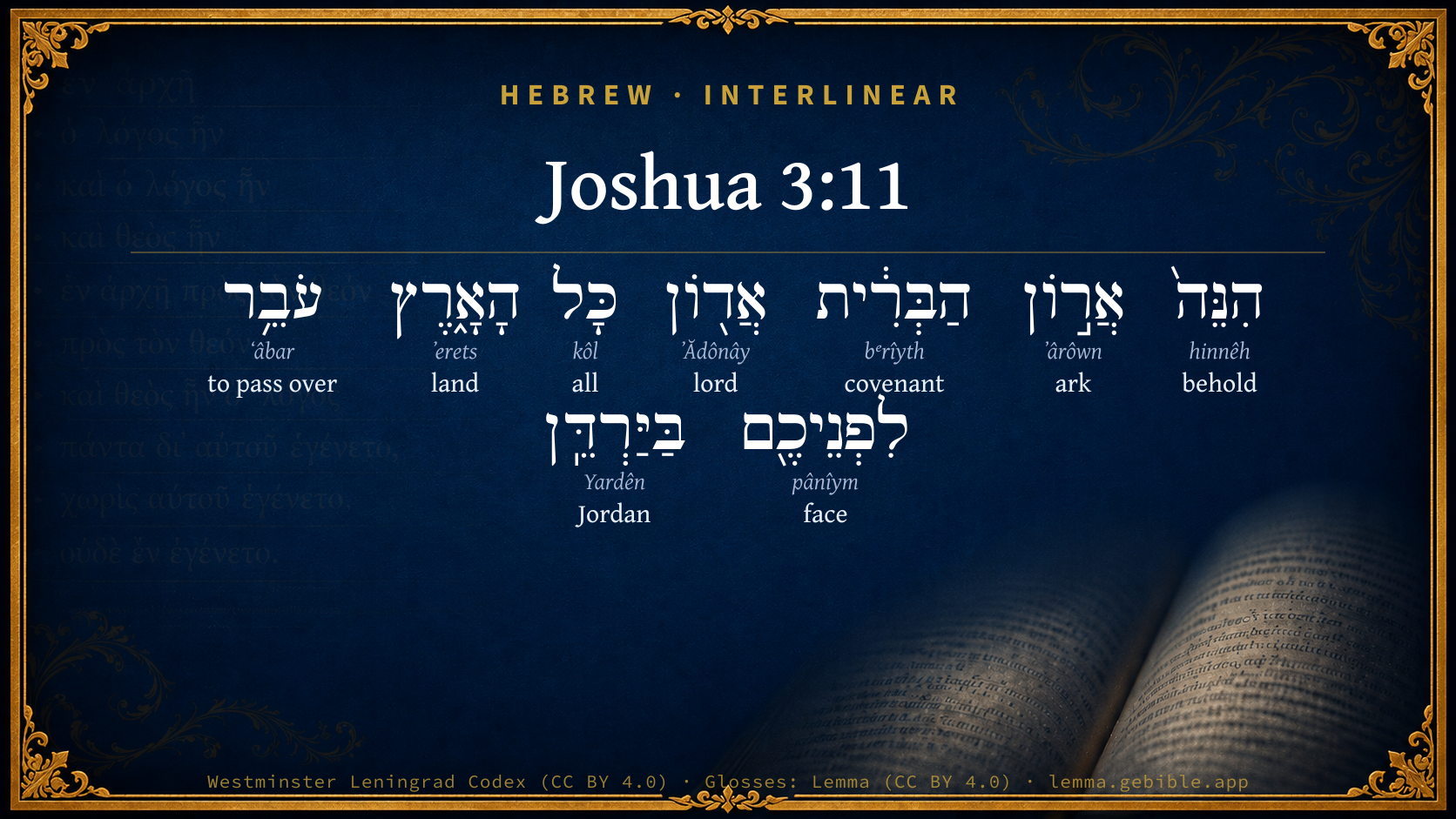
Joshua 3:11

Hebrew (Westminster Leningrad Codex) Joshua 3:11 appears in the Hebrew Old Testament. The text above is from the Westminster Leningrad Codex. Each word links to its Strong’s number, a concise gloss, and parsing drawn from the Open Scriptures Hebrew Bible morphology. Click any word for its full Brown-Driver-Briggs (BDB) entry.
Download image
Cite this verse

Joshua 3:11 (World English Bible). Public Domain. Lemma interlinear Bible study tool, https://lemma.gebible.app/v/joshua/3/11.

Show BibTeX & RIS
BibTeX
RIS
English Translation
Behold, the ark of the covenant of the Lord of all the earth passes over before you into the Jordan.
World English Bible · Public Domain
Download a study sheet

One document with this verse’s original text, its word-by-word gloss line, the meaning frame, cross-references with their text, attributed commentary, and full source and license credits — printable, and it pastes into notes with its structure intact.

This verse Autodidact and up

Study sheet (.html) Plain text (.txt)

A passage Seminary Student

Up to 50 verses in one chapter. A passage sheet keeps up to 6 commentary sources and 12 cross-references per verse, in the order this page ranks them, and says so on the sheet whenever that leaves anything out. Ask for a single verse and you get the Autodidact verse sheet above.

Everything on this page stays free to read, with no account — the sheet is a download of what is already on screen, not access to it.

Want to remove ads? Support Godless Engineer
Compare translations 3

The same verse in 3 English versions, stacked beneath the original-language interlinear above. Click any original word for its lexicon entry.

Each is an independent rendering of the whole verse — the interlinear is not word-aligned to these translations.

Highlighted words mark where these versions differ — a whole-verse word diff, not a word-by-word alignment.

  • World English Bible Public Domain
    Behold, the ark of the covenant of the Lord of all the earth passes over before you into the Jordan.
  • King James Version Public Domain
    Behold, the ark of the covenant of the LORD of all the earth passeth over before you into Jordan.
  • unfoldingWord Literal Text CC BY-SA 4.0
    Behold, the Box of the Covenant of the Lord of all of the earth crossing over to your faces in the Jordan.

unfoldingWord Literal Text — © unfoldingWord, licensed CC BY-SA 4.0. Word-aligned USFM3 via Door43 (git.door43.org/unfoldingWord/en_ult).

Versions to compare (up to 4)

3 of 4 selected

Show all 18 translations

Every available English version of this verse, each an independent rendering of the whole verse.

  • World English Bible Public Domain
    Behold, the ark of the covenant of the Lord of all the earth passes over before you into the Jordan.
  • Berean Standard Bible Public Domain
    Behold, the ark of the covenant of the Lord of all the earth will go ahead of you into the Jordan.
  • Majority Standard Bible Public Domain
    Behold, the ark of the covenant of the Lord of all the earth will go ahead of you into the Jordan.
  • King James Version Public Domain
    Behold, the ark of the covenant of the LORD of all the earth passeth over before you into Jordan.
  • American Standard Version (1901) Public Domain
    Behold, the ark of the covenant of the Lord of all the earth passeth over before you into the Jordan.
  • Revised Version (1885) Public Domain
    Behold, the ark of the covenant of the Lord of all the earth passeth over before you into Jordan.
  • Geneva Bible (1599) Public Domain
    Beholde, the Arke of the couenant of the Lord of all the worlde passeth before you into Iorden.
  • Douay-Rheims (1899) Public Domain
    Behold the ark of the covenant of the Lord of all the earth shall go before you into the Jordan.
  • Young's Literal Translation Public Domain
    lo, the ark of the covenant of the Lord of all the earth is passing over before you into Jordan;
  • Literal Standard Version CC BY-SA 4.0
    behold, the Ark of the Covenant of the Lord of all the earth is passing over before you into the Jordan;
  • Unlocked Literal Bible CC BY-SA 4.0
    Look! The ark of the covenant of the Lord of all the earth crosses over ahead of you into the Jordan.
  • unfoldingWord Literal Text CC BY-SA 4.0
    Behold, the Box of the Covenant of the Lord of all of the earth crossing over to your faces in the Jordan.
  • Darby Bible Public Domain
    Behold, the ark of the covenant of the Lord of all the earth is going over before you into the Jordan.
  • World Messianic Bible Public Domain
    Behold, the ark of the covenant of the Lord of all the earth passes over before you into the Jordan.
  • Webster's Bible Public Domain
    Behold, the ark of the covenant of the Lord of all the earth passeth over before you into Jordan.
  • Free Bible Version CC BY-SA 4.0
    Just watch—the Ark of the Agreement of the Lord of all the earth will cross in front of you through the Jordan.
  • Bible in Basic English Public Domain
    See, the ark of the agreement of the Lord of all the earth is going over before you into Jordan.
  • JPS Tanakh (1917) Public Domain
    Behold, the ark of the covenant of the Lord of all the earth passeth on before you over the Jordan.

Literal Standard Version (2020), Covenant Press — licensed CC BY-SA 4.0. Text via the HelloAO Bible API (eBible.org). Unlocked Literal Bible (unfoldingWord) — licensed CC BY-SA 4.0. Text via the HelloAO Bible API (eBible.org). unfoldingWord Literal Text — © unfoldingWord, licensed CC BY-SA 4.0. Word-aligned USFM3 via Door43 (git.door43.org/unfoldingWord/en_ult). Free Bible Version, Dr. Jonathan Gallagher — licensed CC BY-SA 4.0. Text via the HelloAO Bible API (eBible.org).

Word by word

More ways to search: Search by grammar → Find every occurrence → Compare this word →

Practice this passage: Drill this verse → Learn its vocabulary →

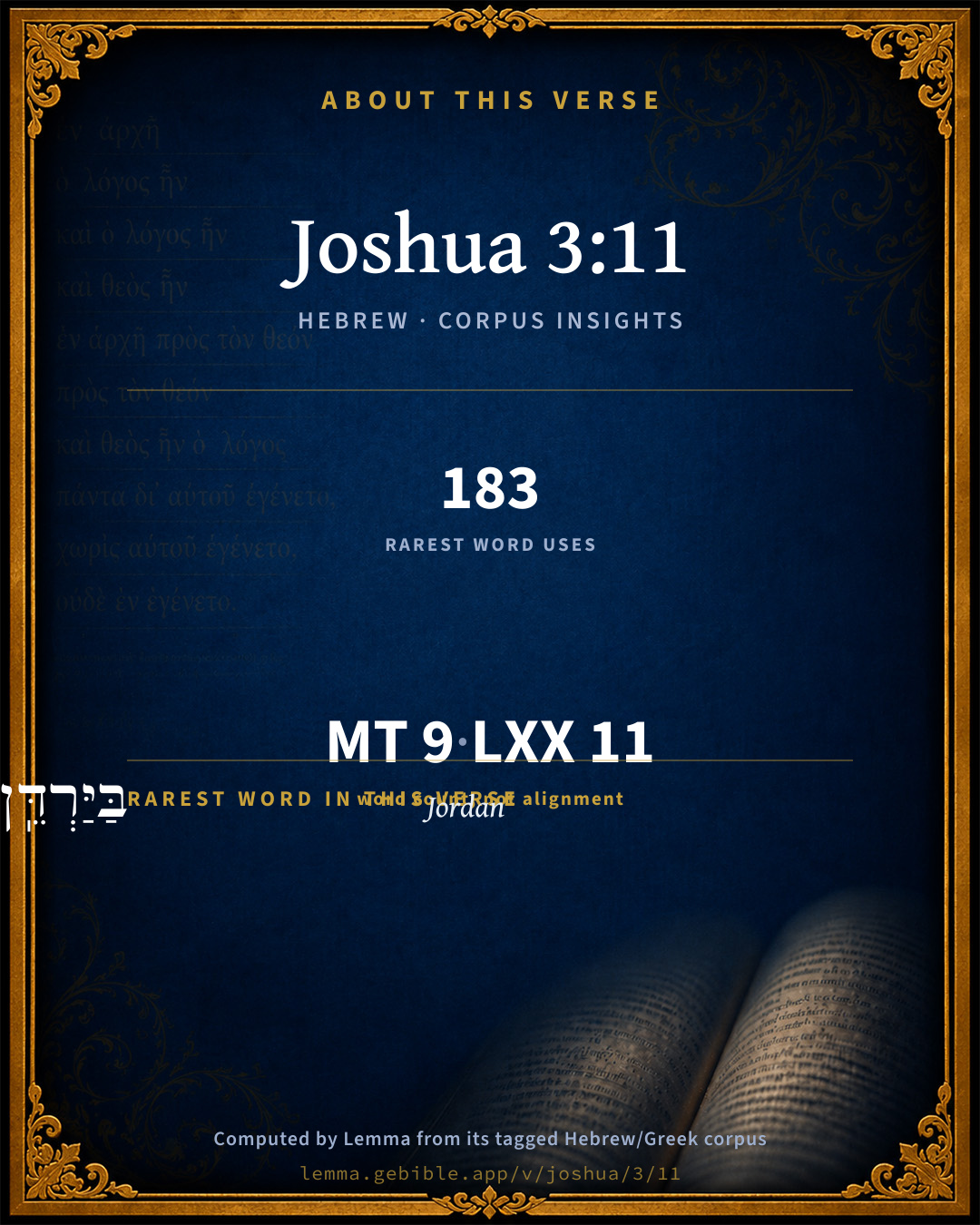
בַּיַּרְדֵּֽן
Yardên
H3383
“in/at the · Jordan”
Preposition, Determined + Noun, Proper
Part of Speech
Preposition + Noun
Type
Proper
Full BDB Definition

Origin: from H3381

TWOT: None

Jordan = "descender" - the river of Palestine running from the roots of Anti-Lebanon to the Dead Sea a distance of approx 200 miles (320 kilometers)
  1. הִנֵּה֙ hinnêh H2009 “behold” Particle, Demonstrative
  2. אֲר֣וֹן ʼârôwn H727 “ark of” Noun, Common, Both, Singular, Construct
  3. הַבְּרִ֔ית bᵉrîyth H1285 “the · covenant” Particle, Definite Article + Noun, Common, Feminine, Singular, Absolute
  4. אֲד֖וֹן ʼĂdônây H136 “lord of” Noun, Common, Masculine, Singular, Construct
  5. כָּל kôl H3605 “all of” Noun, Common, Masculine, Singular, Construct
  6. הָאָ֑רֶץ ʼerets H776 “the · land” Particle, Definite Article + Noun, Common, Both, Singular, Absolute
  7. עֹבֵ֥ר ʻâbar H5674 “passing over” Verb, Qal, Participle Active, Masculine, Singular, Absolute
  8. לִפְנֵיכֶ֖ם pânîym H6440 “to/for · face(s) · your” Preposition + Noun, Common, Both, Plural, Construct + Suffix, Personal, 2nd Person, Masculine, Plural

About this verse

These counts appear in no published source. They are computed here, from the morphology-tagged text and Lemma’s own curated glosses. What Lemma adds →

9
words
9
distinct lemmas
Historical
section

Grammatical profile

  • 1 verb
  • 7 nouns
  • 1 particle

Verb forms

  • עֹבֵ֥ר Qal · Participle Active

Hebrew & Septuagint length

In English translation the verse runs 20 words from the Hebrew and 16 from the Septuagint (LXX English) — closely comparable.

A rough comparison of the two English renderings, which tokenize alike — not a word-level alignment.

Word counts can differ between the Hebrew and the Greek without any difference in meaning — e.g. the Hebrew direct-object marker אֵת has no separate Greek word, and Greek often adds the article ὁ.

In the original languages it is 9 Hebrew tokens and 11 Greek tokens — but the two are counted differently (Hebrew bundles its prefixes and suffixes into one token; the Greek is in lemma form), so that isn’t a like-for-like length.

Cross-references

12

Topical passages linked to Joshua 3:11 in the Treasury of Scripture Knowledge — connected by theme and wording, ordered by reader-vote popularity; previews shown in the World English Bible.

  • Zechariah 6:5 The angel answered me, "These are the four winds of the sky, which go forth from standing before the Lord of all the earth.
  • Psalms 24:1 The earth is Yahweh's, with its fullness; The world, and those who dwell therein.
  • Zechariah 4:14 Then he said, "These are the two anointed ones who stand by the Lord of the whole earth."
  • Joshua 3:13 It shall come to pass, when the soles of the feet of the priests who bear the ark of Yahweh, the Lord of all the earth, shall rest in the waters of the Jordan, that the waters of the Jordan shall be cut off, even the waters that come down from above; and they shall stand in one heap.
  • Micah 4:13 Arise and thresh, daughter of Zion; For I will make your horn iron, And I will make your hoofs brass; And you will beat in pieces many peoples: And I will devote their gain to Yahweh, And their substance to the Lord of the whole earth.
  • Joshua 3:3–6 and they commanded the people, saying, When you see the ark of the covenant of Yahweh your God, and the priests the Levites bearing it, then you shall remove from your place, and go after it.
  • Job 41:11 Who has first given to me, that I should repay him? Everything under the heavens is mine.
  • Isaiah 3:12 As for my people, children are their oppressors, And women rule over them. My people, those who lead you cause you to err, And destroy the way of your paths.
  • Isaiah 54:5 For your Maker is your husband; Yahweh of Hosts is his name: and the Holy One of Israel is your Redeemer; the God of the whole earth shall he be called.
  • Jeremiah 10:7 Who should not fear you, King of the nations? for to you does it appertain; because among all the wise men of the nations, and in all their royal estate, there is none like you.
  • Zephaniah 2:11 Yahweh will be awesome to them, for he will famish all the gods of the land. Men will worship him, everyone from his place, even all the shores of the nations.
  • Zechariah 14:9 Yahweh will be King over all the earth. In that day Yahweh will be one, and his name one.

Cross-references courtesy of OpenBible.info (CC BY 4.0).

Hebrew and Greek witnesses Masoretic Hebrew ↔ Greek Septuagint

The same verse in the two great witnesses to the Old Testament, shown verse-for-verse.

These are two independent witnesses, not word-aligned to each other, and the Septuagint is shown in lemma (dictionary) form.

Hebrew Joshua 3:11 Masoretic · Westminster Leningrad Codex

הִנֵּה֙ אֲר֣וֹן הַבְּרִ֔ית אֲד֖וֹן כָּל הָאָ֑רֶץ עֹבֵ֥ר לִפְנֵיכֶ֖ם בַּיַּרְדֵּֽן

Behold, the ark of the covenant of the Lord of all the earth passes over before you into the Jordan.

World English Bible · Public Domain

Greek LXX Joshua 3:11 Septuagint · lemma form

ἰδού ὁ κιβωτός διαθήκη κύριος πᾶς ὁ γῆ διαβαίνω ὁ ἰορδάνης

Behold, the ark of the covenant of the Lord of all the earth passes over Jordan.

LXX2012 (modern English Septuagint) · Public Domain

On this verse, The Pulpit Commentary discusses the Septuagint’s reading. Read the note in Commentary ↓

Hebrew: Westminster Leningrad Codex (CC BY 4.0). Greek: Septuagint (public domain); English from LXX2012 (modern English Septuagint) (Public Domain). How the Septuagint differs from the Hebrew →

Targum (Aramaic paraphrase)

1

The Targum is the ancient Jewish Aramaic paraphrase of the Hebrew Scriptures — an interpretive translation, not the Hebrew text itself. Onkelos (literal) and Pseudo-Jonathan (expansive) render the Torah, and Jonathan the Prophets. Coverage is partial: where no permissively-licensed English translation exists for a verse, only the Aramaic is shown. This is verse-level text, not a word-by-word alignment to the Hebrew.

  1. Targum Jonathan Prophets (Joshua–Malachi)
    הָא אֲרוֹן קְיָמָא דְרִבּוֹן כָּל אַרְעָא עֲבַר קֳדָמֵיכוֹן בְּיַרְדְנָא:

    (no public-domain English translation for this verse)

    Targum Jonathan — Aramaic: “Mikraot Gedolot” (public domain). English: “Sefaria Community Translation” (CC0 1.0 (public-domain dedication)); “London "Chaldee Paraphrase," 1871” (public domain). Text via Sefaria.

Commentary

Notes on Joshua 3:11 from classic Christian and Jewish commentators (each source and its license shown beneath its notes). The classic Christian expositions comment on the surrounding passage and are grouped to its opening verse, so a note may address several verses; the Jewish commentaries on the Tanakh (Rashi and others) are per-verse, so they appear only where the commentator wrote on this verse.

Lemma curates 59 commentaries, every one of them public domain or Creative Commons licensed, each selected and text-cleaned for this edition rather than reprinted as found. About our sources →

Trapp's Complete Commentary

John Trapp

Jos 3:11 Behold, the ark of the covenant of the Lord of all the earth passeth over before you into Jordan.

Ver. 11. Behold the ark of the covenant, even the Lord of heaven and earth.] Where the ark is, and where the ordinances are, there God is: hence the ark is called God’s face, {Psa 105:4} yea, God’s self. {Psa 132:5}

John Trapp, A Commentary or Exposition upon All the Books of the Old and New Testament (1647–1656) — public domain. Text from a community e-Sword module.

Tyndale Open Study Notes

Tyndale Open Resources

3:11 Because the Ark of the Covenant went ahead of the Israelites, they knew that the Lord of the whole earth was leading them into Canaan. Their God was not a limited local deity.

Tyndale Open Study Notes — © Tyndale Open Resources, licensed CC BY-SA 4.0. Text via the HelloAO Bible API.

John Calvin's Commentaries

11. Behold the ark of the covenant, etc First he says that the ark of God will go before; and secondly, he explains for what purpose, namely, that Jordan may retire from its place, trembling, so to speak, at the presence of the Lord, as is said in the Psalms. (Psalm 114.) The narrative introduced concerning the twelve men is parenthetical, as it only briefly alludes to what it will afterwards deliver more fully and clearly. At present let us merely understand, that while the ark went before, God displayed his power in guiding the people. And in this way there was a confirmation of the sanctity of the worship appointed by the Law, when the Israelites perceived that it was no empty symbol of his presence that God had deposited with them. For Jordan was compelled to yield obedience to God just as if it had beheld his majesty.

Let us however remember, that the only reason which induced the Lord to display his grace in the ark was because he had placed the tables of his covenant within it. Moreover, as the thing could not be easily credited, Joshua directs the mind of the people to the contemplation of the divine power, which surmounts all difficulties. The title of Ruler of the whole earth here applied to God is not insignificant, but extols his power above all the elements of nature, in order that the Israelites, considering how seas and rivers are subject to his dominion, might have no doubt that the waters, though naturally liquid, would become stable in obedience to his word.

John Calvin's Commentaries (1540-1563) — public domain. Text from the Calvin Translation Society English edition (1840s-50s) via the Christian Classics Ethereal Library (ccel.org). Calvin's coverage is partial (roughly two-thirds of the Bible); uncommented books and verses are honest gaps, never fabricated. The 19th-century editor's footnotes and remarks are omitted so the notes are faithfully Calvin's own voice.

Ellicott's Commentary for English Readers

(11) The ark of the covenant.—The ten commandments are presented throughout this narrative as a covenant. So Exo_34:28, “the words of the covenant, the ten commandments.” It must be remembered that a promise precedes all the commandments. “I am Jehovah thy God.” The “ten words” that follow are the testimony to His character who commanded the covenant. (See Silver Sockets, p. 28.) The thing signified by the dividing of Jordan does indeed exhibit the law as a covenant in a way that those who followed Joshua can hardly have conceived. But history must come before prophecy, if prophecy is to be understood.

A Bible Commentary for English Readers, edited by Charles John Ellicott (1878–1897) — public domain. Text from a community e-Sword module.

The Cambridge Bible for Schools and Colleges

gen. ed. J. J. S. Perowne

11. the Lord of all the earth] A significant title of the Most High, at a time when the conquest of the Land was contemplated.

The Cambridge Bible for Schools and Colleges (gen. ed. J. J. S. Perowne; Cambridge University Press, 1878–1918) — public domain. Text from a community e-Sword module.

John Gill's Exposition

Behold, the ark of the covenant of the Lord of all the earth,.... Some both Jewish and Christian interpreters, because there is a distinguishing accent on the word "covenant", read the words "the ark of the covenant, even the Lord of all the earth"; so in some copies of our English Bible, as if the ark was called the Lord of all the earth, because of his presence and dwelling there; but, as Kimchi observes, either the word "ark" is wanting, or the word "covenant", and may be supplied either thus,"the ark of the covenant, the ark (I say) of the Lord of all the earth;''or thus,"the ark of the covenant, which is the covenant of the Lord of all the earth:''the true meaning is what Abarbinel gives,"the ark of the covenant of the Lord, who is the Lord of the whole earth;''the Maker and possessor of the whole earth, the whole terraqueous globe; and can do what he pleases in the earth, or in the water; and can control the powers of nature, and do what is beyond them, things miraculous and astonishing:

passeth before you into Jordan; not only unto it, but into it, into the river itself; and, by the power of him whose presence was with it, the waters of Jordan were to be divided, to give them a passage through it as on dry land, and so it came to pass.

John Gill's Exposition of the Whole Bible (1746–1763) — public domain (CC PDM 1.0). Text via the HelloAO Bible API.

Matthew Poole's English Annotations

Into part of the river.

Matthew Poole's English Annotations on the Holy Bible (1683–1685) — public domain. Text from a community e-Sword/MySword module.

Whedon's Commentary on the Bible

Daniel D. Whedon

11. The ark of the covenant of the Lord of all the earth — Here are four words grammatically dependent on one another, though slightly separated by the disjunctive accent. But this Hebrew accent by no means requires so strange a translation as that adopted by some scholars, which makes Lord of all the earth in apposition with ark of the covenant. {This would be to make the ark of Jehovah identical with Jehovah.} This claim of universal dominion for Jehovah, in contrast with the limited sway of the local gods of the pagans, not only enthrones Jehovah over all nations, but also over the forces of the material world. Perhaps no miracle of Jesus inspired such overwhelming awe in his disciples as his control of the winds and the waves.

Daniel D. Whedon (gen. ed.), Commentary on the Old and New Testaments (1874–1909) — public domain. Text from a community e-Sword module.

The Pulpit Commentary

The Lord of all the earth. As He was about to prove Himself to be by the mighty miracles He wrought to establish the Israelites in their land and thus fulfil His promise. The Israelites needed to be reminded of this to support them during the crossing of the Jordan. The translation of the LXX, though rejected by the Masorites, who separate the words "covenant" and "Lord," is admissible here, "the covenant of the Lord of all the earth." If we follow the Masoretic punctuation, we must supply the word "ark" again, and translate "the ark of the covenant, the ark of the Lord of the whole earth.

HOMILIES BY R. GLOVER Ver. 11. The passage of the Jordan.

The lessons of importance are not exhausted in those already suggested in this passage of the Jordan. A deed so great, so solemn, so vast in its results, has many sides, and many subordinate points of interest. I gather up in this second homily a few of those points of interest and instruction. And first observe

I THE SIGN OF GOD"S PRESENCE WITH ISRAEL IS TEMPORARY, BUT THE PRESENCE ITSELF IS PERMANENT. This lesson arises at once from the fact that the pillar of cloud which hitherto had led them does not precede them now. To its guidance hitherto they had marched, and under its shadow rested. And the sign of God"s presence had been a sweet assurance and a constant augury of success. Now it disappears altogether from the history of Israel. They will cross Jordan under the guidance of the ark, and of that alone. God"s presence remains with them, but the sign of it is withdrawn. There were doubtless many who regarded such a loss as an omen of sinister significance; and many who, mixing devotion and superstition, would deplore that when the great crisis of the enterprise was come, their usual assurance of God"s presence failed them. But there were some that had looked net to but through the sign, and built their hopes on the living God. And they, Joshua leading them, trusting in the love and faithfulness which they felt must be His character, were ready to venture without their sign. And venturing, they found God there, though the cloud of His presence had been withdrawn, and they got a notable lesson in walking by faith rather than by sight. We need few lessons more than this: That God"s presence or absence is not to be concluded from the presence or absence of the sign of it. We are all Jewish enough to "require a sign." We want some assurance of acceptance over and beyond what gospel words convey. We want some "leading of Providence" in addition to the sense of duty before we feel comfortable in starting on any course. Raptures, mystic whisperings of God"s consolation, special experiences not granted to others these are apt in the regard of all of us to assume too much importance. We are apt to make the same mistake concerning these which some in Israel doubtless made concerning the pillar of cloud and fire; namely, to imagine them a special crown, a testimony to our unusual sanctity, instead of a gracious condescension to our weaknesses and to the fears which mark our setting out on a pilgrimage. Just escaping from slavery, Israel needed signs; now, maturer in experience and stronger in faith, the signs are no longer needed. Probably. in all cases it will be found that signs belong to the earlier stages of the experience either of the community or the individual. When experience and faith are strong, they are withdrawn. Put not a dark construction on any mere want of signs, for while the sign of the presence is temporary, the presence itself is permanent with all God"s people. Growing out of this a second lesson suggests itself, viz.:

II THEY ARE WELL LED WHO ARE ARK LED. Israel no longer had the pillar of cloud and fire, but they had the ark of God, and, as the event proved, the ark led them just as wisely as the pillar; and in following it they found just the same help of miraculous power. What was this ark of the covenant? A wonderful piece of sacred symbolism. Over it in fact, forming the lid of it was what was named the mercy seat, God"s earthly throne. Within it were the ten commandments, written on two tables of stone. This combination of symbols of law and mercy belonged to no religion but that of Israel. The gods of other nations required but little duty, and were hardly expected to show mercy. But the symbolism of the ark and the whole Mosaic economy projected these thoughts before the minds of Israel: The true God is a God of mercy. But at the same time He insists on duty. The ark proclaimed Him the God of mercy and of law; of gracious promise, of ennobling precept; delivering men by the grace He gave, dignifying them by the duty He exacted. This was the God of Israel. And now, in lieu of signs, the symbol of mercy and of duty was to lead the way. Not eagles, symbols of victorious power, but tables of stone led them, and "marshalled them the way that they were going." And their successful following of this lead suggests that when any one marches to the lead of the ten commandments, or of the promises of God, he is as well led and as grandly succoured as when some cloudy pillar moves before him. There is importance in this. Often our signs are withdrawn; as with the community of Israel so with us, it is probably the case that signs grow fewer and that special experiences grow more rare as character matures. Then comes a time, more or less clearly definite, when, instead of mysterious movings felt to be Divine, the guidance of the Lord is given, through a testimony of mercy and of duty. Before you goes the symbol of heavenly love and of earthly duty. And you have to march, coldly as it may seem, to the lead of tables of stone and verbal assurances only of God"s care. Murmur not at this; a hope and a duty are guides sublime. The ark is just as good as the cloud. If you had the choice of an enlightened conscience or a special angel to be your guide, you would do wisely to choose the conscience in preference to the angel. You may mistake the reading of your signs you rarely will your duty. Next to His redeeming grace, the richest mercy He gives us is a "word behind us," or within us, "saying, this is the way, walk ye in it." And the grandest spirits of mankind in their pilgrimage from victory to victory have marched under the lead of nothing grander than some ark, something that whispered hope and demanded duty. Thus led, did Israel lose? Nay, as before the cloudy pillar the sea divided, so before the sacred ark did Jordan. If you have something like what the ark embodied a promise and a precept ask no more; where the tables of the covenant lead you, there follow. Few get more, and none get anything better, than these. God guides through enlightenment of conscience, or Bible precept, or the devout example which you instinctively perceive is a pattern to be followed. Seek not any sign; God"s presence will ever be with all those that keep His precepts. If the ark of God, as replacing the pillar of cloud, has such suggestions, observe thirdly

III GOD"S HYDRAULICS ARE NEVER FAULTY. In the West of England just now there is considerable discussion about" dockising" the river Avon, i.e. , so throwing a dam across the mouth that all the river up to Bristol would be converted into one huge dock. And in the discussion the strength of such a dam, its cost, its leakage, the right place for it, how to provide for the outlet of all water above a certain level, are canvassed by all. Here we have the "dockising" for a day or two of the river Jordan, a very much larger river than the Avon, one whose very name suggests the swiftness of its current. And the dam that effects this great collection of the waters is "the ark of God," set down in the midst of the Jordan bed, with the priests grouped on either side. How would the philosophers of that day criticise that dam, and express with assumed anxiety their fears that the law of gravitation and the law that governs the flow of liquids would prove too much for the legs of the priests, and even for the weight of the tables of stone. But whatever fear might be entertained by the people before the ark entered Jordan, and whatever misgivings by the priests when they were standing in its pebbly bed, there was a power which operated from that ark which dammed the fiver as no engineer could have done it. So that instead of reading of struggling with the water, of multitudes carried down the stream, of hairbreadth escapes, of multitudes left behind, all got safely across. And here, I think, we have a specimen of what is everywhere to be seen; the efficiency of spiritual barriers against all assailing forces. We see them on all hands; we dread lest they be overborne by some strong current bearing down against them. But lo! they stand against all force that threatens them. God"s truth is such a barrier. With error like a huge river rushing down upon it, it seems as slender and insufficient as was the barrier of the ark. Science is so arrogant and captious, chronology so sure, metaphysics so disputatious, error so agreeable to the natural man, that it seems as if there could be no standing. But the Jordan of all the philosophies and all the heresies threaten in vain, and God"s ark of truth is sufficient to withstand them. God"s grace in the heart is such a dam; nothing seemingly more feeble, nothing really more strong, against the swelling tides of inward corruption and outward temptation that assail the character. Sometimes prayer shields a distant boy, an erring friend, and protects them with a guard as really omnipotent as it appears feeble. Judge not by the outward appearance. The clock is not about to go backward, nor error usurp the place of truth. Don"t tremble for the ark of God, as did Eli. Whatever God wants guarded, it is omnipotent to guard. So that, amongst other lessons, this sweet one comes to us that we are guarded better than we think. And what seems God"s weakness is mightier than the strongest strength which can come against us. G.

The Pulpit Commentary (1880–1919), ed. H.D.M. Spence-Jones & Joseph S. Exell — public domain. Text from a community e-Sword module.

Keil & Delitzsch

C. F. Keil & F. Delitzsch

After this inspiriting promise, Joshua informed the people what the Lord intended to do first: "Behold, the ark of the covenant of the Lord of the whole earth will go before you into Jordan." כּל־הארץ 'adown is a genitive dependent upon הברית ארון, the strict subordination of the construct state being loosened in this case by the article before the nomen regens. The punctuators have therefore separated it from the latter by sakeph-katon, without thereby explaining it as in opposition or giving any support to the mistaken exposition of Buxtorff and Drusius, that "the ark of the covenant is called the ruler of the whole earth." The description of Jehovah as "Lord of the whole earth," which is repeated in Jos 3:13, is very appropriately chosen for the purpose of strengthening confidence in the omnipotence of the Lord. This epithet "exalted the government of God over all the elements of the world, that the Israelites might have no doubt that as seas and rivers are under His control, the waters, although liquid by nature, would become stable at His nod" (Calvin). The expression, "passeth over before you into Jordan," is more precisely explained in the course of the narrative: the ark of the covenant went (was carried) before the people into the river, and then stood still, as the bulwark of the people, till the passage was completed; so that the word "before" indicates the protection which it would afford.

Jos 3:12-13

"And take to you (i.e., appoint) twelve men out of the tribes of Israel, one for each tribe." For what purpose is not stated here, but is apparent from what follows (Jos 4:2.). The choice or appointment of these men was necessarily commanded before the crossing commenced, as they were to stand by the side of Joshua, or near the bearers of the ark of the covenant, so as to be at hand to perform the duty to be entrusted to them (Jos 4:3.). Joshua then concludes by foretelling the miracle itself: "It will come to pass, that when the soles of the feet of the priests who bear the ark of the Lord shall settle down in the water of the Jordan, the waters of the Jordan shall be cut off; namely, the waters flowing down from above, and shall stand still as one heap." "Shall be cut off," so as to disappear; namely, at the place where the priests stand with the ark of the covenant. This took place through the waters standing still as a heap, or being heaped up, at some distance above the standing-place. אחד נד is an accusative of more precise definition. The expression is taken from the song of Moses (Exo 15:8).

Keil & Delitzsch — Biblical Commentary on the Old Testament (1861–1891) — public domain (CC PDM 1.0). Text via the HelloAO Bible API. (Old Testament only.)

Rashi

Rabbi Shlomo Yitzchaki (Rashi)

The covenant of the Master of all the earth. The covenant of the Holy One, blessed is He, Who is the Master of all the earth. Do not wonder about the letter ה of the word הַבְּרִית for there are many Scriptual words that are so constructed, such as: ‘הַמִסְגְּרוֹת הַמְכוֹנוֹת, the borders of the foundation.’ הָעֵמֶק הַפְּגָרִים, the valley of the corpses.

Will cross over before You. It will go before you to enter into the Jordan.

Rashi on the Tanakh — English translations: “The Judaica Press complete Tanach with Rashi, translated by A. J. Rosenberg” (CC BY 4.0); “Pentateuch with Rashi's commentary by M. Rosenbaum and A.M. Silbermann, 1929-1934” (public domain); “The Metsudah Tanach series, Lakewood, N.J” (CC BY 4.0); and “The Book of Joshua, Metsudah Publications, 1997” (CC BY 4.0). Text via Sefaria.

Lesson kit

Teaching starters — assembled from the data on this page, not authored interpretation. Every prompt links to the verse data it draws on. Edit before teaching.

Joshua, in the Historical, opens this verse with 9 words (9 distinct Hebrew lemmas). Its most distinctive word is Yardên (“Jordan”). A historical commentator’s framing appears above. Read the whole chapter for the surrounding context.

Discussion questions

  1. What does “Jordan” (Yardên) contribute to the verse as a whole?
  2. How does Zechariah 6:5, which shares this passage’s theme, read alongside this verse?
  3. These translations render this verse differently; the difference is in the English rendering, not the original. What questions does that raise?
  4. «עֹבֵ֥ר» is a Qal Participle Active verb. How does that grammatical form shape the action described?
  5. Compare how Trapp's Complete Commentary and Tyndale Open Study Notes read this verse. Where do they agree or differ?

Things to notice

Reading settings

Reading text

Shown beneath each verse's original-language words.

Old Testament
Old Testament edition

Read the OT as the Masoretic Hebrew (MT) or the Greek Septuagint (LXX).

English shown for the Greek Septuagint (in the Hebrew ↔ Greek comparison).

Comparing translations? Open the Compare panel on any verse page to stack up to four side by side.