
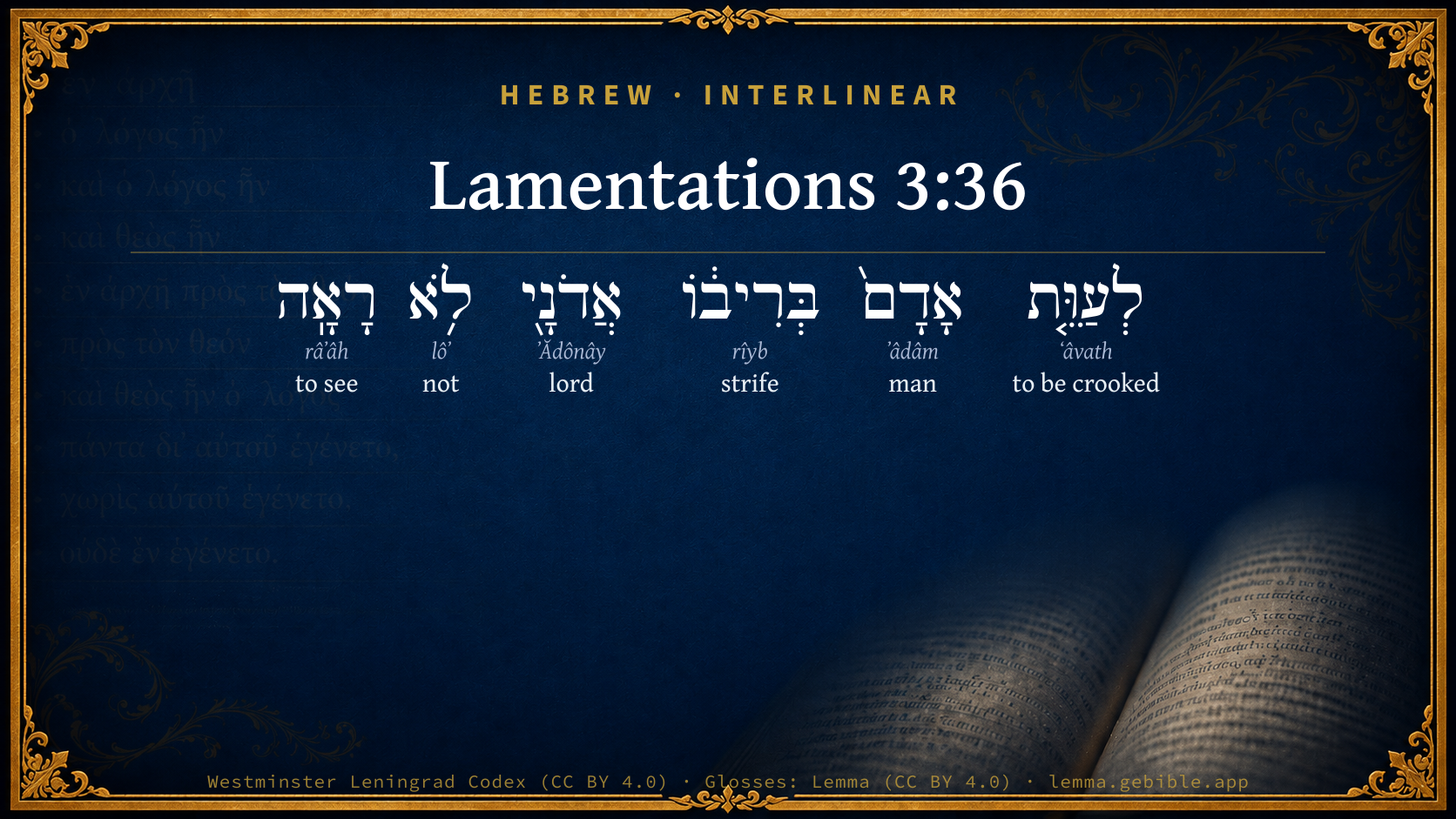
Lamentations 3:36

Hebrew (Westminster Leningrad Codex) Lamentations 3:36 appears in the Hebrew Old Testament. The text above is from the Westminster Leningrad Codex. Each word links to its Strong’s number, a concise gloss, and parsing drawn from the Open Scriptures Hebrew Bible morphology. Click any word for its full Brown-Driver-Briggs (BDB) entry.
Download image
Cite this verse

Lamentations 3:36 (World English Bible). Public Domain. Lemma interlinear Bible study tool, https://lemma.gebible.app/v/lamentations/3/36.

Show BibTeX & RIS
BibTeX
RIS
English Translation
To subvert a man in his cause, the Lord doesn't approve.
World English Bible · Public Domain
Download a study sheet

One document with this verse’s original text, its word-by-word gloss line, the meaning frame, cross-references with their text, attributed commentary, and full source and license credits — printable, and it pastes into notes with its structure intact.

This verse Autodidact and up

Study sheet (.html) Plain text (.txt)

A passage Seminary Student

Up to 50 verses in one chapter. A passage sheet keeps up to 6 commentary sources and 12 cross-references per verse, in the order this page ranks them, and says so on the sheet whenever that leaves anything out. Ask for a single verse and you get the Autodidact verse sheet above.

Everything on this page stays free to read, with no account — the sheet is a download of what is already on screen, not access to it.

Want to remove ads? Support Godless Engineer
Compare translations 3

The same verse in 3 English versions, stacked beneath the original-language interlinear above. Click any original word for its lexicon entry.

Each is an independent rendering of the whole verse — the interlinear is not word-aligned to these translations.

Highlighted words mark where these versions differ — a whole-verse word diff, not a word-by-word alignment.

  • World English Bible Public Domain
    To subvert a man in his cause, the Lord doesn't approve.
  • King James Version Public Domain
    To subvert a man in his cause, the LORD approveth not.
  • unfoldingWord Literal Text CC BY-SA 4.0
    to pervert a man in his dispute— the Lord does not see MEM

unfoldingWord Literal Text — © unfoldingWord, licensed CC BY-SA 4.0. Word-aligned USFM3 via Door43 (git.door43.org/unfoldingWord/en_ult).

Versions to compare (up to 4)

3 of 4 selected

Show all 18 translations

Every available English version of this verse, each an independent rendering of the whole verse.

  • World English Bible Public Domain
    To subvert a man in his cause, the Lord doesn't approve.
  • Berean Standard Bible Public Domain
    to subvert a man in his lawsuit—of these the Lord does not approve.
  • Majority Standard Bible Public Domain
    to subvert a man in his lawsuit—of these the Lord does not approve.
  • King James Version Public Domain
    To subvert a man in his cause, the LORD approveth not.
  • American Standard Version (1901) Public Domain
    To subvert a man in his cause, the Lord approveth not.
  • Revised Version (1885) Public Domain
    To subvert a man in his cause, the Lord approveth not.
  • Geneva Bible (1599) Public Domain
    In subuerting a man in his cause: the Lord seeth it not.
  • Douay-Rheims (1899) Public Domain
    Lamed. To destroy a man wrongfully in his judgment, the Lord hath not approved.
  • Young's Literal Translation Public Domain
    To subvert a man in his cause, the Lord hath not approved.
  • Literal Standard Version CC BY-SA 4.0
    To subvert a man in his cause, the Lord has not approved.
  • Unlocked Literal Bible CC BY-SA 4.0
    to deny justice to a person—the Lord would not approve such things!
  • unfoldingWord Literal Text CC BY-SA 4.0
    to pervert a man in his dispute— the Lord does not see MEM
  • Darby Bible Public Domain
    to wrong a man in his cause, -- will not the Lord see it?
  • World Messianic Bible Public Domain
    to subvert a man in his cause, the Lord doesn’t approve.
  • Webster's Bible Public Domain
    To subvert a man in his cause, the Lord approveth not.
  • Free Bible Version CC BY-SA 4.0
    Or cheating someone in their legal case—these things the Lord doesn't approve of.
  • Bible in Basic English Public Domain
    In his doing wrong to a man in his cause, the Lord has no pleasure.
  • JPS Tanakh (1917) Public Domain
    To subvert a man in his cause, the Lord approveth not.

Literal Standard Version (2020), Covenant Press — licensed CC BY-SA 4.0. Text via the HelloAO Bible API (eBible.org). Unlocked Literal Bible (unfoldingWord) — licensed CC BY-SA 4.0. Text via the HelloAO Bible API (eBible.org). unfoldingWord Literal Text — © unfoldingWord, licensed CC BY-SA 4.0. Word-aligned USFM3 via Door43 (git.door43.org/unfoldingWord/en_ult). Free Bible Version, Dr. Jonathan Gallagher — licensed CC BY-SA 4.0. Text via the HelloAO Bible API (eBible.org).

Word by word

More ways to search: Search by grammar → Find every occurrence → Compare this word →

Practice this passage: Drill this verse → Learn its vocabulary →

About this verse

These counts appear in no published source. They are computed here, from the morphology-tagged text and Lemma’s own curated glosses. What Lemma adds →

6
words
6
distinct lemmas
Prophets
section

Notable vocabulary

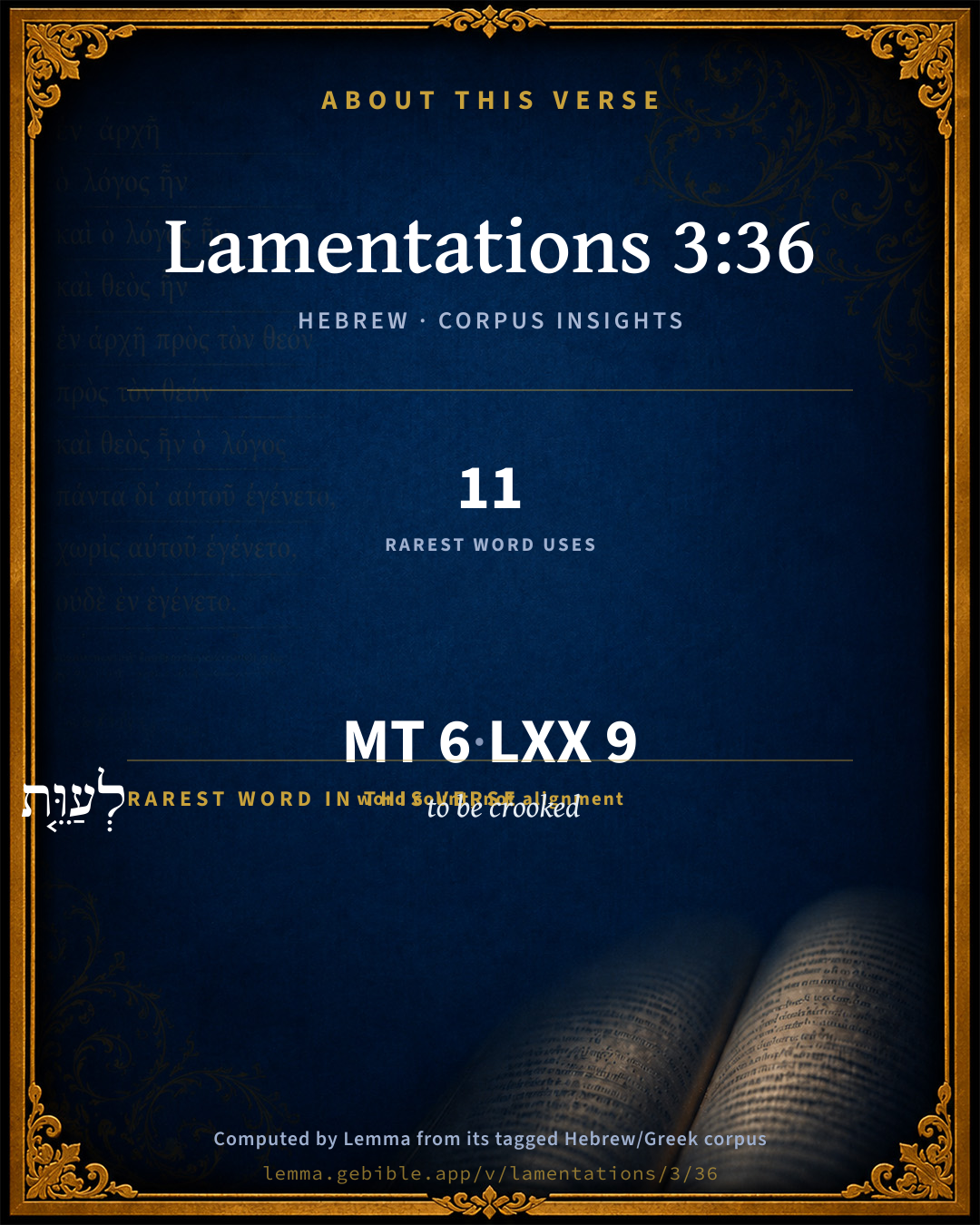
The rarest word here is לְעַוֵּ֤ת to be crooked H5791 — appearing just 11 times in the whole Hebrew Bible.

Shared distinctive vocabulary

לְעַוֵּ֤ת to be crooked H5791 occurs in 10 verses of the Hebrew Bible. Also found in:

Grammatical profile

  • 2 verbs
  • 3 nouns
  • 1 particle

Verb forms

  • לְעַוֵּ֤ת Piel · Infinitive Construct
  • רָאָֽה Qal · Perfect

Hebrew & Septuagint length

In English translation the verse runs 11 words from the Hebrew and 14 from the Septuagint (LXX English) — closely comparable.

A rough comparison of the two English renderings, which tokenize alike — not a word-level alignment.

Word counts can differ between the Hebrew and the Greek without any difference in meaning — e.g. the Hebrew direct-object marker אֵת has no separate Greek word, and Greek often adds the article ὁ.

In the original languages it is 6 Hebrew tokens and 9 Greek tokens — but the two are counted differently (Hebrew bundles its prefixes and suffixes into one token; the Greek is in lemma form), so that isn’t a like-for-like length.

Cross-references

4

Topical passages linked to Lamentations 3:36 in the Treasury of Scripture Knowledge — connected by theme and wording, ordered by reader-vote popularity; previews shown in the World English Bible.

  • Isaiah 59:15 Yes, truth is lacking; and he who departs from evil makes himself a prey. Yahweh saw it, and it displeased him who there was no justice.
  • Habakkuk 1:13 You who have purer eyes than to see evil, and who cannot look on perversity, why do you tolerate those who deal treacherously, and keep silent when the wicked swallows up the man who is more righteous than he,
  • 2 Samuel 11:27 When the mourning was past, David sent and took her home to his house, and she became his wife, and bore him a son. But the thing that David had done displeased Yahweh.
  • Jeremiah 22:3 Thus says Yahweh: Execute you justice and righteousness, and deliver him who is robbed out of the hand of the oppressor: and do no wrong, do no violence, to the foreigner, the fatherless, nor the widow; neither shed innocent blood in this place.

Cross-references courtesy of OpenBible.info (CC BY 4.0).

Hebrew and Greek witnesses Masoretic Hebrew ↔ Greek Septuagint

The same verse in the two great witnesses to the Old Testament, shown verse-for-verse.

These are two independent witnesses, not word-aligned to each other, and the Septuagint is shown in lemma (dictionary) form.

Hebrew Lamentations 3:36 Masoretic · Westminster Leningrad Codex

לְעַוֵּ֤ת אָדָם֙ בְּרִיב֔וֹ אֲדֹנָ֖י לֹ֥א רָאָֽה

To subvert a man in his cause, the Lord doesn't approve.

World English Bible · Public Domain

Greek LXX Lamentations 3:36 Septuagint · lemma form

καταδικάζω ἄνθρωπος ἐν ὁ κρίνω αὐτός κύριος οὐ εἶπον

to condemn a man unjustly in his judgment, the Lord has not given commandment.

LXX2012 (modern English Septuagint) · Public Domain

Hebrew: Westminster Leningrad Codex (CC BY 4.0). Greek: Septuagint (public domain); English from LXX2012 (modern English Septuagint) (Public Domain). How the Septuagint differs from the Hebrew →

Commentary

Notes on Lamentations 3:36 from classic Christian and Jewish commentators (each source and its license shown beneath its notes). The classic Christian expositions comment on the surrounding passage and are grouped to its opening verse, so a note may address several verses; the Jewish commentaries on the Tanakh (Rashi and others) are per-verse, so they appear only where the commentator wrote on this verse.

Lemma curates 59 commentaries, every one of them public domain or Creative Commons licensed, each selected and text-cleaned for this edition rather than reprinted as found. About our sources →

Trapp's Complete Commentary

John Trapp

Lam 3:36 To subvert a man in his cause, the Lord approveth not.

Ver. 36. To subvert a man in his cause.] By sleight of hand to tilt the balance of justice on one side.

The Lord approveth not.] Heb., Seeth not. Non videt - i.e., non ei visum est, it seemeth not good unto him; he liketh it not.

John Trapp, A Commentary or Exposition upon All the Books of the Old and New Testament (1647–1656) — public domain. Text from a community e-Sword module.

Geneva Bible (1599)

Geneva Bible translators

He doth not delight therein.

Geneva Bible (1599) marginal notes — public domain. Text via Bolls.life.

Jamieson, Fausset & Brown

Robert Jamieson, A. R. Fausset & David Brown

subvert--to wrong.

Jamieson, Fausset & Brown — Commentary Critical and Explanatory on the Whole Bible (1871) — public domain (CC PDM 1.0). Text via the HelloAO Bible API.

Adam Clarke's Commentary

Verse 36. To subvert a man in his cause] To prevent his having justice done him in a lawsuit, &c., by undue interference, as by suborning false witnesses, or exerting any kind of influence in opposition to truth and right.-Blayney.

The Lord approved not.] Instead of אדני Adonai, seventeen MSS., of Kennicott's, and one ancient of my own, have יהוה Yehovah. Approveth not, לא ראה lo raah, doth not see, turns away his face from it, abhors it.

Adam Clarke's Commentary on the Bible (1810–1826) — public domain. Text from a community e-Sword/MySword module.

John Gill's Exposition

Let us search and try our ways,.... stead of murmuring and complaining, let us search for something that may support and comfort, teach and instruct, under afflictive providences; let us search into the love of God, which, though it cannot be fully searched out, it will be found to be from everlasting to everlasting; and that all afflictions spring from it; and that it continues notwithstanding them: let us search into the covenant of grace, in which provision is made for afflictions in case of disobedience, and for supports under them: let us search the Scriptures, which are written for our comfort; and it is much if we do not find some in the instances, examples, and experiences of other saints therein recorded: let us search after a greater degree of the knowledge of Christ, and of his grace; so shall we be more conformable to his sufferings and death, and patient under our troubles: let us search into our own hearts, and examine ourselves, whether we have true repentance for sin, true faith in Christ; and whether he is in us, or not; and we have a part in him, which will make us easy in every state: let us search into the present dispensation, in order to find out the cause of it, which is sin; and the end of it, which God has in it for our good: let us search "our ways", and "try them", by the word of God, the standard of faith and practice; and see what agreement there is between them: let us try our thoughts, words, and actions, by the law of God, which is holy, spiritual, just, and good; and we shall see how abundantly short they come of it: and let us try "our ways", and compare them with the ways of God, which he has prescribed in his word; and we shall find that the one are holy, the other unholy; the one plain, the other crooked; the one dark, the other light; the one pleasant, and peace is in them, the other not; the one lead to life, the other to death; see Isa 55:7;

and turn again to the Lord; by repentance, as the Targum adds; let us turn out of our sinful ways, upon a search and examination of them; and turn to the Lord, his ways and worship, from whom we have departed, and against whom we have sinned; acknowledging our iniquities, who receives graciously, is ready to forgive, and does abundantly pardon.

John Gill's Exposition of the Whole Bible (1746–1763) — public domain (CC PDM 1.0). Text via the HelloAO Bible API.

Matthew Poole's English Annotations

Here are three things mentioned, of all which it is said that God

approveth them

not neither all, nor any of them. The first is, to crush the prisoners of the earth: he hath power to crush all men in the world, they are his prisoners, and cannot flee from him, but he delighteth not in it. Some think it spoken with special reference to the Jews, who now were all captives. A second thing which it is said God approveth not is, turning away the right of a man before the face of the Most High. Some by the Most High understand God, and make the sense to be, in the sight of God. Others think that a superior magistrate is understood, who, Ecc 5:8, is called the highest; and that seemeth the most probable sense. The turning away the right of a man before them, signifieth the use of any arts to deprive them of their just right by misrepresenting their cause, aspersing their persons, &c. The third thing mentioned is, the subverting a man in his cause, either by art and rhetoric, making it to appear bad when it is not so, or by mere will and power, overruling it contrary to right and justice.

Matthew Poole's English Annotations on the Holy Bible (1683–1685) — public domain. Text from a community e-Sword/MySword module.

The Pulpit Commentary

Approveth not. The sense is an excellent one, but it is very doubtful whether it can be obtained without altering one of the letters of the word in the text (reading racah for ra"ah). The text reading is, "the Lord seeth not." This may be explained either as "the Lord regardeth not (such thing)," or as a question, "Doth not the Lord regard (this)?"

The Pulpit Commentary (1880–1919), ed. H.D.M. Spence-Jones & Joseph S. Exell — public domain. Text from a community e-Sword module.

John Wesley's Explanatory Notes

To subvert - Here are three things mentioned, which God approveth not.

John Wesley, Explanatory Notes Upon the Whole Bible (1754–1765) — public domain. Text via the GEBible commentary corpus.

Rashi

Rabbi Shlomo Yitzchaki (Rashi)

does not approve He does not approve that the heavenly tribunal should distort a person’s dispute, like (Gen. 20:10): “What did you see that you did, etc.”

Rashi on the Tanakh — English translations: “The Judaica Press complete Tanach with Rashi, translated by A. J. Rosenberg” (CC BY 4.0); “Pentateuch with Rashi's commentary by M. Rosenbaum and A.M. Silbermann, 1929-1934” (public domain); “The Metsudah Tanach series, Lakewood, N.J” (CC BY 4.0); and “The Book of Joshua, Metsudah Publications, 1997” (CC BY 4.0). Text via Sefaria.

Lesson kit

Teaching starters — assembled from the data on this page, not authored interpretation. Every prompt links to the verse data it draws on. Edit before teaching.

Lamentations, in the Prophets, opens this verse with 6 words (6 distinct Hebrew lemmas). Its most distinctive word is ʻâvath (“to be crooked”). A historical commentator’s framing appears above. Read the whole chapter for the surrounding context.

Discussion questions

  1. The word ʻâvath carries the sense “to be crooked.” How does it shape the verse?
  2. How does Job 8:3, which shares the word «to be crooked», read alongside this verse?
  3. These translations render this verse differently; the difference is in the English rendering, not the original. What questions does that raise?
  4. «לְעַוֵּ֤ת» is a Piel Infinitive Construct verb. How does that grammatical form shape the action described?
  5. Compare how Trapp's Complete Commentary and Geneva Bible (1599) read this verse. Where do they agree or differ?

Things to notice

Reading settings

Reading text

Shown beneath each verse's original-language words.

Old Testament
Old Testament edition

Read the OT as the Masoretic Hebrew (MT) or the Greek Septuagint (LXX).

English shown for the Greek Septuagint (in the Hebrew ↔ Greek comparison).

Comparing translations? Open the Compare panel on any verse page to stack up to four side by side.