
Jeremiah 50:25

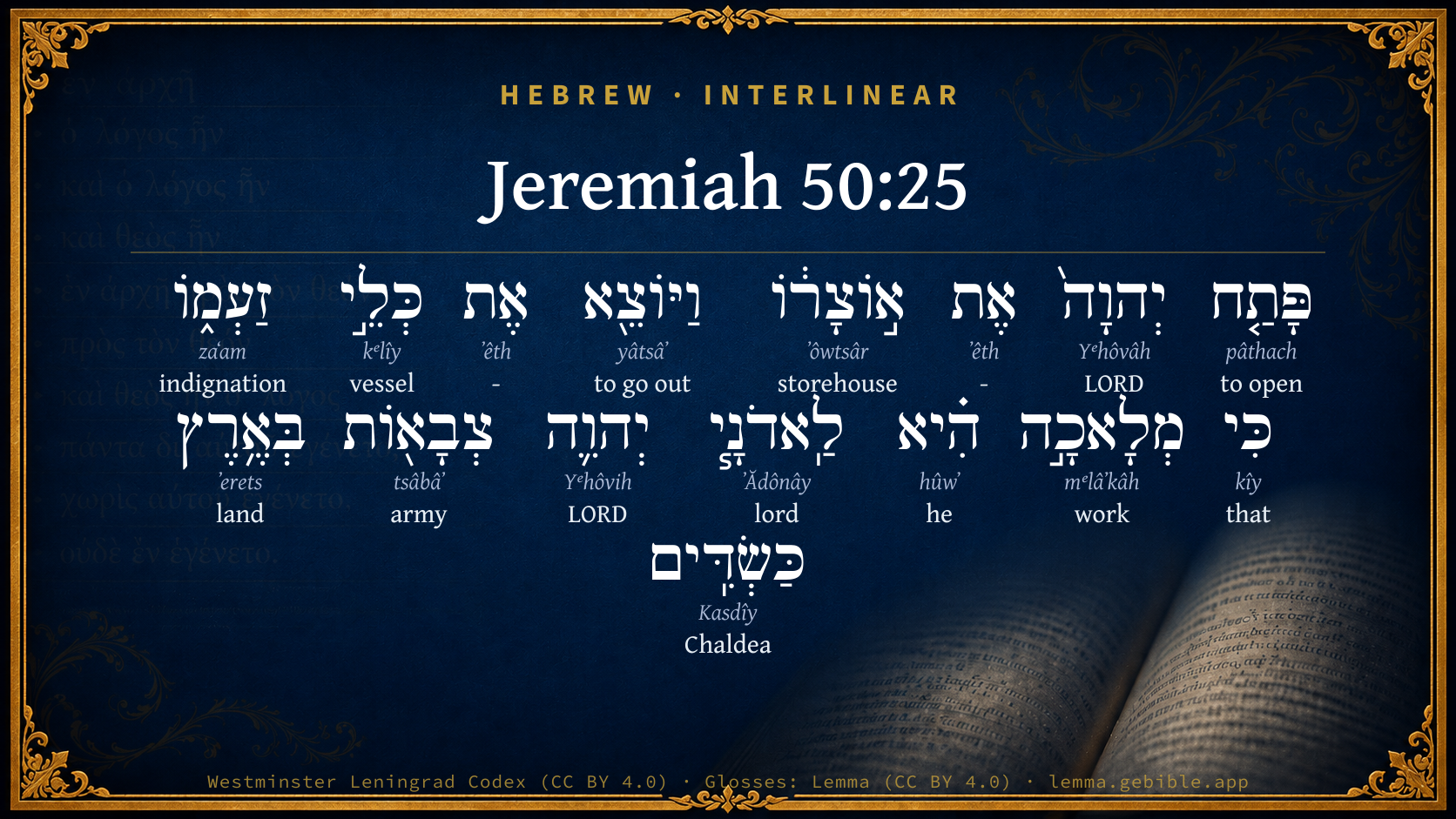
Hebrew (Westminster Leningrad Codex) Jeremiah 50:25 appears in the Hebrew Old Testament. The text above is from the Westminster Leningrad Codex. Each word links to its Strong’s number, a concise gloss, and parsing drawn from the Open Scriptures Hebrew Bible morphology. Click any word for its full Brown-Driver-Briggs (BDB) entry.
Download image
Cite this verse

Jeremiah 50:25 (World English Bible). Public Domain. Lemma interlinear Bible study tool, https://lemma.gebible.app/v/jeremiah/50/25.

Show BibTeX & RIS
BibTeX
RIS
English Translation
Yahweh has opened his armory, and has brought forth the weapons of his indignation; for the Lord, Yahweh of Hosts, has a work [to do] in the land of the Chaldeans.
World English Bible · Public Domain
Download a study sheet

One document with this verse’s original text, its word-by-word gloss line, the meaning frame, cross-references with their text, attributed commentary, and full source and license credits — printable, and it pastes into notes with its structure intact.

This verse Autodidact and up

Study sheet (.html) Plain text (.txt)

A passage Seminary Student

Up to 50 verses in one chapter. A passage sheet keeps up to 6 commentary sources and 12 cross-references per verse, in the order this page ranks them, and says so on the sheet whenever that leaves anything out. Ask for a single verse and you get the Autodidact verse sheet above.

Everything on this page stays free to read, with no account — the sheet is a download of what is already on screen, not access to it.

Want to remove ads? Support Godless Engineer
Compare translations 3

The same verse in 3 English versions, stacked beneath the original-language interlinear above. Click any original word for its lexicon entry.

Each is an independent rendering of the whole verse — the interlinear is not word-aligned to these translations.

Highlighted words mark where these versions differ — a whole-verse word diff, not a word-by-word alignment.

  • World English Bible Public Domain
    Yahweh has opened his armory, and has brought forth the weapons of his indignation; for the Lord, Yahweh of Hosts, has a work [to do] in the land of the Chaldeans.
  • King James Version Public Domain
    The LORD hath opened his armoury, and hath brought forth the weapons of his indignation: for this is the work of the Lord GOD of hosts in the land of the Chaldeans.
  • unfoldingWord Literal Text CC BY-SA 4.0
    Yahweh has opened his armory and is bringing out the weapons for carrying out his anger. There is work for the Lord Yahweh of hosts in the land of the Chaldeans.

unfoldingWord Literal Text — © unfoldingWord, licensed CC BY-SA 4.0. Word-aligned USFM3 via Door43 (git.door43.org/unfoldingWord/en_ult).

Versions to compare (up to 4)

3 of 4 selected

Show all 18 translations

Every available English version of this verse, each an independent rendering of the whole verse.

  • World English Bible Public Domain
    Yahweh has opened his armory, and has brought forth the weapons of his indignation; for the Lord, Yahweh of Hosts, has a work [to do] in the land of the Chaldeans.
  • Berean Standard Bible Public Domain
    The LORD has opened His armory and brought out His weapons of wrath, for this is the work of the Lord GOD of Hosts in the land of the Chaldeans.
  • Majority Standard Bible Public Domain
    The LORD has opened His armory and brought out His weapons of wrath, for this is the work of the Lord GOD of Hosts in the land of the Chaldeans.
  • King James Version Public Domain
    The LORD hath opened his armoury, and hath brought forth the weapons of his indignation: for this is the work of the Lord GOD of hosts in the land of the Chaldeans.
  • American Standard Version (1901) Public Domain
    Jehovah hath opened his armory, and hath brought forth the weapons of his indignation; for the Lord, Jehovah of hosts, hath a work `to do' in the land of the Chaldeans.
  • Revised Version (1885) Public Domain
    The LORD hath opened his armoury, and hath brought forth the weapons of his indignation: for the Lord, the LORD of hosts, hath a work to do in the land of the Chaldeans.
  • Geneva Bible (1599) Public Domain
    The Lord hath opened his treasure, and hath brought foorth the weapons of his wrath: for this is the woorke of the Lord God of hostes in the lande of the Caldeans.
  • Douay-Rheims (1899) Public Domain
    The Lord hath opened his armoury, and hath brought forth the weapons of his wrath: for the Lord the God of hosts hath a work to be done in the land of the Chaldeans.
  • Young's Literal Translation Public Domain
    Jehovah hath opened His treasury, And He bringeth out the weapons of His indignation, For a work `is' to the Lord Jehovah of Hosts, In the land of the Chaldeans.
  • Literal Standard Version CC BY-SA 4.0
    YHWH has opened His treasury, || And He brings out the weapons of His indignation, || For a work [is] to Lord YHWH of Hosts, || In the land of the Chaldeans.
  • Unlocked Literal Bible CC BY-SA 4.0
    Yahweh has opened his armory and is bringing out the weapons for carrying out his anger. There is work for the Lord Yahweh of hosts in the land of the Chaldeans.
  • unfoldingWord Literal Text CC BY-SA 4.0
    Yahweh has opened his armory and is bringing out the weapons for carrying out his anger. There is work for the Lord Yahweh of hosts in the land of the Chaldeans.
  • Darby Bible Public Domain
    Jehovah hath opened his armoury, and hath brought forth the weapons of his indignation; for this is a work for the Lord, Jehovah of hosts, in the land of the Chaldeans.
  • World Messianic Bible Public Domain
    The LORD has opened his armory, and has brought out the weapons of his indignation; for the Lord, GOD of Hosts, has a work to do in the land of the Kasdim.
  • Webster's Bible Public Domain
    The LORD hath opened his armory, and hath brought forth the weapons of his indignation: for this is the work of the Lord GOD of hosts in the land of the Chaldeans.
  • Free Bible Version CC BY-SA 4.0
    In his anger the Lord opened his armory to bring out his weapons, for this is what the Lord God Almighty is doing in the country of Babylonia.
  • Bible in Basic English Public Domain
    From his store-house the Lord has taken the instruments of his wrath: for the Lord, the Lord of armies, has a work to do in the land of the Chaldaeans.
  • JPS Tanakh (1917) Public Domain
    The LORD hath opened His armoury, and hath brought forth the weapons of His indignation; for it is a work that the Lord GOD of hosts hath to do in the land of the Chaldeans.

Literal Standard Version (2020), Covenant Press — licensed CC BY-SA 4.0. Text via the HelloAO Bible API (eBible.org). Unlocked Literal Bible (unfoldingWord) — licensed CC BY-SA 4.0. Text via the HelloAO Bible API (eBible.org). unfoldingWord Literal Text — © unfoldingWord, licensed CC BY-SA 4.0. Word-aligned USFM3 via Door43 (git.door43.org/unfoldingWord/en_ult). Free Bible Version, Dr. Jonathan Gallagher — licensed CC BY-SA 4.0. Text via the HelloAO Bible API (eBible.org).

Word by word

More ways to search: Search by grammar → Find every occurrence → Compare this word →

Practice this passage: Drill this verse → Learn its vocabulary →

זַעְמ֑וֹ
zaʻam
H2195
“indignation · his”
Noun, Common, Masculine, Singular, Construct + Suffix, Personal, 3rd Person, Masculine, Singular
Part of Speech
Noun
Type
Common
Gender
Masculine
Number
Singular
State
Construct
Full BDB Definition

Origin: from H2194

TWOT: 568a

anger, indignation
  1. פָּתַ֤ח pâthach H6605 “to open” Verb, Qal, Perfect, 3rd Person, Masculine, Singular
  2. יְהוָה֙ Yᵉhôvâh H3068 “LORD” Noun, Proper
  3. אֶת ʼêth H853 “-” Particle, Direct Object
  4. א֣וֹצָר֔וֹ ʼôwtsâr H214 “storehouse · his” Noun, Common, Masculine, Singular, Construct + Suffix, Personal, 3rd Person, Masculine, Singular
  5. וַיּוֹצֵ֖א yâtsâʼ H3318 “and · to go out” Conjunction + Verb, Hiphil, Sequential Imperfect, 3rd Person, Masculine, Singular
  6. אֶת ʼêth H853 “-” Particle, Direct Object
  7. כְּלֵ֣י kᵉlîy H3627 “vessels of” Noun, Common, Masculine, Plural, Construct
  8. כִּי kîy H3588 “that” Conjunction
  9. מְלָאכָ֣ה mᵉlâʼkâh H4399 “work” Noun, Common, Feminine, Singular, Absolute
  10. הִ֗יא hûwʼ H1931 “he” Pronoun, Personal, 3rd Person, Feminine, Singular
  11. לַֽאדֹנָ֧י ʼĂdônây H136 “to/for · Lord · my” Preposition + Noun, Common, Masculine, Plural, Construct + Suffix, Personal, 1st Person, Common, Singular
  12. יְהוִ֛ה Yᵉhôvih H3069 “LORD” Noun, Proper
  13. צְבָא֖וֹת tsâbâʼ H6635 “armies” Noun, Common, Both, Plural, Absolute
  14. בְּאֶ֥רֶץ ʼerets H776 “in/at · land of” Preposition + Noun, Common, Both, Singular, Construct
  15. כַּשְׂדִּֽים Kasdîy H3778 “Chaldea” Noun, Proper

About this verse

These counts appear in no published source. They are computed here, from the morphology-tagged text and Lemma’s own curated glosses. What Lemma adds →

16
words
15
distinct lemmas
Prophets
section

Notable vocabulary

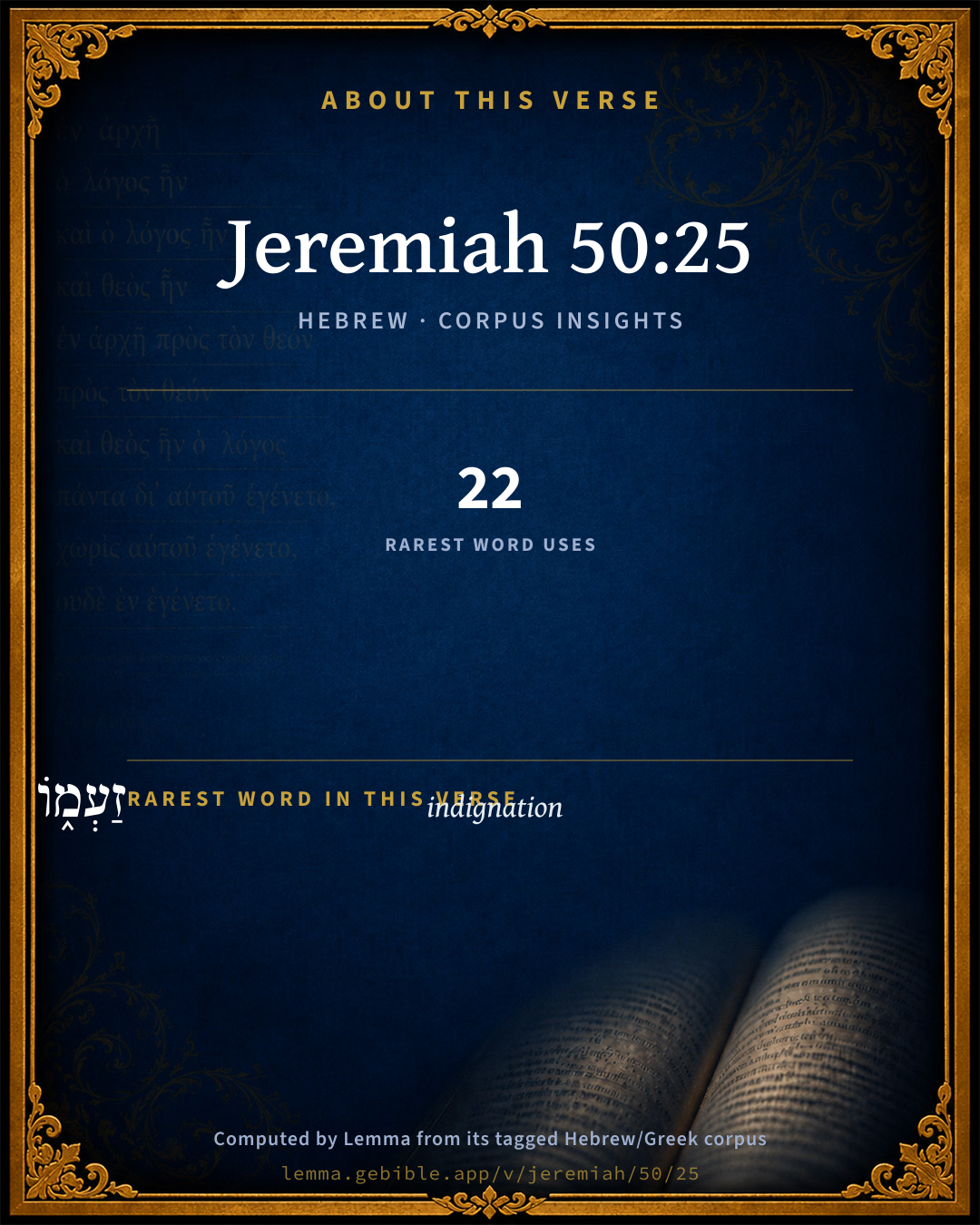
The rarest word here is זַעְמ֑וֹ indignation H2195 — appearing just 22 times in the whole Hebrew Bible.

Shared distinctive vocabulary

זַעְמ֑וֹ indignation H2195 occurs in 22 verses of the Hebrew Bible. Also found in:

Grammatical profile

  • 2 verbs
  • 10 nouns
  • 1 pronoun
  • 1 conjunction
  • 2 particles

Verb forms

  • פָּתַ֤ח Qal · Perfect
  • וַיּוֹצֵ֖א Hiphil · Sequential Imperfect

Cross-references

16

Topical passages linked to Jeremiah 50:25 in the Treasury of Scripture Knowledge — connected by theme and wording, ordered by reader-vote popularity; previews shown in the World English Bible.

  • Jeremiah 51:25 Behold, I am against you, destroying mountain, says Yahweh, which destroy all the earth; and I will stretch out my hand on you, and roll you down from the rocks, and will make you a burnt mountain.
  • Jeremiah 51:55 For Yahweh lays Babylon waste, and destroys out of her the great voice; and their waves roar like many waters; the noise of their voice is uttered:
  • Jeremiah 50:15 Shout against her round about: she has submitted herself; her bulwarks are fallen, her walls are thrown down; for it is the vengeance of Yahweh: take vengeance on her; as she has done, do to her.
  • Jeremiah 51:20 You are my battle-axe and weapons of war: and with you will I break in pieces the nations; and with you will I destroy kingdoms;
  • Amos 3:6 Does the trumpet alarm sound in a city, Without the people being afraid? Does evil happen to a city, And Yahweh hasn't done it?
  • Psalms 45:3 Gird your sword on your thigh, mighty one: Your splendor and your majesty.
  • Psalms 45:5 Your arrows are sharp. The nations fall under you, with arrows in the heart of the king's enemies.
  • Isaiah 13:2–5 Set up an ensign on the bare mountain, lift up the voice to them, wave the hand, that they may go into the gates of the nobles.
  • Isaiah 13:17–18 Behold, I will stir up the Medes against them, who shall not regard silver, and as for gold, they shall not delight in it.
  • Isaiah 14:22–24 I will rise up against them, says Yahweh of Hosts, and cut off from Babylon name and remnant, and son and son's son, says Yahweh.
  • Isaiah 21:7–9 and when he sees a troop, horsemen in pairs, a troop of donkeys, a troop of camels, he shall listen diligently with much heed.
  • Isaiah 46:10–11 declaring the end from the beginning, and from ancient times things that are not [yet] done; saying, My counsel shall stand, and I will do all my pleasure;
  • Isaiah 48:14–15 Assemble yourselves, all you, and hear; who among them has declared these things? He whom Yahweh loves shall perform his pleasure on Babylon, and his arm [shall be on] the Chaldeans.
  • Jeremiah 50:35–38 A sword is on the Chaldeans, says Yahweh, and on the inhabitants of Babylon, and on her princes, and on her wise men.
  • Jeremiah 51:11–12 Make sharp the arrows; hold firm the shields: Yahweh has stirred up the spirit of the kings of the Medes; because his purpose is against Babylon, to destroy it: for it is the vengeance of Yahweh, the vengeance of his temple.
  • Revelation 18:8 Therefore in one day her plagues will come: death, mourning, and famine; and she will be utterly burned with fire; for the Lord God who has judged her is strong.

Cross-references courtesy of OpenBible.info (CC BY 4.0).

Hebrew and Greek witnesses Masoretic Hebrew ↔ Greek Septuagint

The same verse in the two great witnesses to the Old Testament, shown verse-for-verse.

These are two independent witnesses, not word-aligned to each other, and the Septuagint is shown in lemma (dictionary) form.

Hebrew Jeremiah 50:25 Masoretic · Westminster Leningrad Codex

פָּתַ֤ח יְהוָה֙ אֶת א֣וֹצָר֔וֹ וַיּוֹצֵ֖א אֶת כְּלֵ֣י זַעְמ֑וֹ כִּי מְלָאכָ֣ה הִ֗יא לַֽאדֹנָ֧י יְהוִ֛ה צְבָא֖וֹת בְּאֶ֥רֶץ כַּשְׂדִּֽים

Yahweh has opened his armory, and has brought forth the weapons of his indignation; for the Lord, Yahweh of Hosts, has a work [to do] in the land of the Chaldeans.

World English Bible · Public Domain

Greek LXX Structure differs

In the Septuagint, Jeremiah is about an eighth shorter than the Hebrew and arranges its material differently — the Oracles Against the Nations (Hebrew chapters 46–51) appear in the middle of the Greek book, after 25:13. Because the chapter and verse boundaries do not line up, a verse-for-verse comparison with the Hebrew is not shown.

A verse-for-verse comparison isn’t shown here because the chapters and verses don’t line up. Switch to the LXX edition with the MT / LXX toggle above to read the Greek directly.

Hebrew: Westminster Leningrad Codex (CC BY 4.0). Greek: Septuagint (public domain); English from a public-domain English Septuagint. How the Septuagint differs from the Hebrew →

Targum (Aramaic paraphrase)

1

The Targum is the ancient Jewish Aramaic paraphrase of the Hebrew Scriptures — an interpretive translation, not the Hebrew text itself. Onkelos (literal) and Pseudo-Jonathan (expansive) render the Torah, and Jonathan the Prophets. Coverage is partial: where no permissively-licensed English translation exists for a verse, only the Aramaic is shown. This is verse-level text, not a word-by-word alignment to the Hebrew.

  1. Targum Jonathan Prophets (Joshua–Malachi)
    גְלָא יְיָ יַת בֵּית גְנָזֵיהּ וְאָפֵּיק יַת מָנֵי כָס דִלְוָט קֳדָמוֹהִי אֲרֵי עֲבִידָא הִיא קֳדָם יְיָ אֱלֹהִים צְבָאוֹת בְּאַרְעָא כַסְדָאֵי:

    (no public-domain English translation for this verse)

    Targum Jonathan — Aramaic: “Mikraot Gedolot” (public domain). English: “Sefaria Community Translation” (CC0 1.0 (public-domain dedication)); “London "Chaldee Paraphrase," 1871” (public domain). Text via Sefaria.

Commentary

Notes on Jeremiah 50:25 from classic Christian and Jewish commentators (each source and its license shown beneath its notes). The classic Christian expositions comment on the surrounding passage and are grouped to its opening verse, so a note may address several verses; the Jewish commentaries on the Tanakh (Rashi and others) are per-verse, so they appear only where the commentator wrote on this verse.

Lemma curates 59 commentaries, every one of them public domain or Creative Commons licensed, each selected and text-cleaned for this edition rather than reprinted as found. About our sources →

Trapp's Complete Commentary

John Trapp

Jer 50:25 The LORD hath opened his armoury, and hath brought forth the weapons of his indignation: for this [is] the work of the Lord GOD of hosts in the land of the Chaldeans.

Ver. 25. The Lord hath opened his armoury.] Heb., Treasury. Now God’s armoury is omne id sub coelo, usque ad diabolos; all things, both in heaven and under the cope of heaven, as far as the very devils, whereby he is able to subdue his enemies, and to bring them to nothing. Out of this treasury God took Darius and Cyrus, with their forces, and set them upon this expedition.

John Trapp, A Commentary or Exposition upon All the Books of the Old and New Testament (1647–1656) — public domain. Text from a community e-Sword module.

Joseph Benson's Commentary

Jer 50:25-32. The Lord hath opened his armory, &c. — God hath raised up enemies to subdue the Chaldeans, namely, Cyrus and his confederates, and hath furnished them with all the means necessary for such an undertaking. Come against her from the utmost border — From distant parts, namely, from the Caspian and Euxine seas. Cast her up as heaps — The marginal rendering seems preferable; Tread her, trample over her, as heaps of ruins; or tread her as the corn is trodden down when it is thrashed. Slay her bullocks — That is, Her strong men, as the Vulgate and the Chaldee interpret the expression. Wo unto them, for their day is come — The time in which they are to be punished. The voice of them that escape, to declare in Zion, &c. — This may either foretel that some of the Babylonians would flee as far as Judea for refuge, and there publish what had befallen Babylon, or, which seems more likely, that some of those Jews or proselytes to the Jewish religion in Chaldea, who were more than ordinarily zealous for the welfare of God’s church and people, would be ready, upon the first news of the taking of Babylon, to bring the glad tidings to Judea, that God had avenged his people, and executed his judgments on those who destroyed his temple, and profaned the holy vessels of it: see Jer 51:51; Dan 5:1-3; Dan 5:5; Dan 5:30. Call together the archers — See Jer 50:9; Jer 50:14. Recompense her according to her work — This is applied to mystical Babylon, Rev 18:6, which, when fulfilled, will be a manifest token of the righteous judgment of God, as St. Paul speaks, 2Th 1:5, at which all good men ought to rejoice, and give glory to God when they see it effected. For she hath been proud against the Lord — Hath exalted herself against God, saying, I am, and there is none besides me, Isa 47:7-8, where see the notes. Therefore shall her young men fall in the streets — Xenophon relates, lib. 7., that when Gobryas and Gadates, two of Cyrus’s generals, with their soldiers, had got into the city, they marched directly toward the palace, killing all they met, and, having surprised the guards, cut them in pieces, and slain the king himself, they, without difficulty, made themselves masters of the palace. I will kindle a fire in his cities — This may be meant of the destruction made in the Babylonian territories, in the several expeditions Cyrus undertook against that monarchy before the taking of Babylon.

Joseph Benson's Commentary on the Old and New Testaments (1811–1818) — public domain. Text from a community e-Sword module.

Jamieson, Fausset & Brown

Robert Jamieson, A. R. Fausset & David Brown

weapons of his indignation--the Medes and Persians (Isa 13:5).

Jamieson, Fausset & Brown — Commentary Critical and Explanatory on the Whole Bible (1871) — public domain (CC PDM 1.0). Text via the HelloAO Bible API.

John Calvin's Commentaries

The Prophet here expresses more clearly what he bad touched upon, even that this war would not be that of the Persians, but of God himself. He then says, that God had opened his treasure, even because he has various and manifold ways and means, which cannot be comprehended by men, when he resolves to destroy the ungodly. That monarchy was impregnable according to the judgment of men; but God here says that he had hidden means by which he would lay waste Babylon and reduce it to nothing. Then what is by a similitude called the treasure of God, means such a way as surpasses the comprehension of men, that is, when God executes his judgments in a way hidden and unexpected.

As, then, the faithful could hardly conceive what Jeremiah said, he raises up their thoughts to God’s providence, which ought not to be subjected to human judgment; for it is absurd in men to judge of God’s power according to the perceptions of the flesh; it is the same as though they attempted to include heaven and earth in the hollow of their hand. God himself says, that he takes heaven and earth in the hollow of his hand. When, therefore, men seek to comprehend the power of God, it is like a fly attempting to devour all the mountains. Hence the Prophet reproves this presumption to which we are all by nature inclined, even to determine according to the comprehension of our minds what God is about or ought to do, as though his power were not infinite.

This is the reason why the Prophet says, God hath opened his treasury; and then, he hath thence brought forth the instruments of his wrath, that is, from his treasury, even in a way and manner which was then incomprehensible. And subjoined is the reason, Because this is the work of God alone, the God of hosts, in the land of the Chaldeans Here the Prophet briefly concludes, intimating, that the faithful ought quietly to wait until what he taught came to pass, even because it was the work of God. And there is nothing more absurd than for men to seek to measure God’s power, as it has been said, by their own judgment. It follows, — but I cannot explain the verse now.

John Calvin's Commentaries (1540-1563) — public domain. Text from the Calvin Translation Society English edition (1840s-50s) via the Christian Classics Ethereal Library (ccel.org). Calvin's coverage is partial (roughly two-thirds of the Bible); uncommented books and verses are honest gaps, never fabricated. The 19th-century editor's footnotes and remarks are omitted so the notes are faithfully Calvin's own voice.

Ellicott's Commentary for English Readers

(25) The Lord hath opened his armoury.—The word is the same as that for “treasures” in Jer_10:13; Jer_51:16, the choice of the appropriate English word being determined, in each case, by the context. Here the figure is that of a mighty king going to his arsenal and equipping himself with the weapons which will insure his victory. An expansion of the same imagery is found in Wis_5:17-23; Wis_18:15-16.

This is the work of the Lord God of hosts.—Better, the Lord God of hosts hath a work . . .

A Bible Commentary for English Readers, edited by Charles John Ellicott (1878–1897) — public domain. Text from a community e-Sword module.

The Cambridge Bible for Schools and Colleges

gen. ed. J. J. S. Perowne

25. the weapons of his indignation] used also in Isa_13:5 of the nations who unconsciously discharge God’s bidding in war.

The Cambridge Bible for Schools and Colleges (gen. ed. J. J. S. Perowne; Cambridge University Press, 1878–1918) — public domain. Text from a community e-Sword module.

John Gill's Exposition

The Lord hath opened his armoury,.... Alluding to the manner of kings, who have some particular edifice built for an armoury; see Sol 4:4; wherein are provided and laid up all sorts of armour, small and great, which are fetched out from thence, in time of need. This armoury is to be understood of Media and Persia, and other parts, from whence a mighty army, well accoutred, was brought by the powerful providence of God; and indeed the whole world is his armoury, from whence he can raise up instruments to do his will at pleasure; or, "his treasury" (y); so the Targum; and some think this is said with reference to the treasure of the Lord's house the king of Babylon had seized upon, and now by way of retaliation the Lord would open his treasury to his ruin:

and hath brought forth the weapons of his indignation; as a king, when he goes to war, opens his armoury, and takes out armour of every kind, both offensive and defensive, swords, spears, shields, &c. so the Lord would now bring the Medes and Persians, well armed, to be the instruments of his wrath and vengeance on Babylon: or, "the vessels of his indignation" (z); having some view to the vessels of the sanctuary, as some think, the king of Babylon had taken away and profaned; these may well be applied to the vials of wrath poured out on the antichristian states by the angels, called forth out of the temple, Rev 15:1;

for this is the work of the Lord God of hosts in the land of the Chaldeans; which he decreed and ordered to be done; and which, without his power and providence, could never have been done: compare with this Rev 18:8.

(y) "thesaurum suum", Vulg. Lat. Vatablus, Pagninus, Montanus, Schmidt. (z) "vasa irae suae", Vulg. Lat. Pagninus; "vasa indignationis suae", Montanus.

John Gill's Exposition of the Whole Bible (1746–1763) — public domain (CC PDM 1.0). Text via the HelloAO Bible API.

Albert Barnes' Notes on the Bible

By a grand figure the prophet describes Yahweh arming Himself that in person He may execute justice upon the wicked city.

For this is the work - Rather, for my Lord Yahweh of hosts hath a work to do in the land of the Chaldaeans.

Albert Barnes' Notes on the Bible (1834–1885) — public domain. Text from a community e-Sword/MySword module.

Haydock's Catholic Bible Commentary

Armoury. Fire and war are the Lord’s weapons, Job xxxviii. 22. --- Work: punishment, chap. xlviii. 10.

George Leo Haydock (1774–1849), Haydock's Catholic Family Bible and Commentary, 1859 edition — public domain. Excludes Psalms (Douay-Rheims chapter numbering differs from Protestant) and Deuterocanonical books (Catholic canon only).

Matthew Poole's English Annotations

Babylon was so rich and potent a nation, and had been so great a conqueror, that people looking only with the eye of sense, and judging according to probabilities in the eyes of men, might well ask how these things could possibly be. To which the prophet here answereth, that the hand of God was to be eyed in the case, this was the Lord’s work upon the Chaldeans; God had

opened his armoury, and the Medes were to make use of the weapons of his indignation. He who threatened this destruction was able to carry it through, and it was no great matter what weapons either the Babylonians had to defend themselves, or the Medes to offend them, God’s power and strength as only to be regarded.

Matthew Poole's English Annotations on the Holy Bible (1683–1685) — public domain. Text from a community e-Sword/MySword module.

Whedon's Commentary on the Bible

Daniel D. Whedon

25. Weapons of his indignation — The Medes and Persians. For this is the work, etc. — Better, for the Lord Jehovah of hosts hath a work in the land of the Chaldeans.

Daniel D. Whedon (gen. ed.), Commentary on the Old and New Testaments (1874–1909) — public domain. Text from a community e-Sword module.

The Pulpit Commentary

Hath opened his armoury. A truly grand figure. The north country (the "hidden" part of the earth, as it was called in Hebrew) is regarded by the prophet as a storehouse of young and "inexhaustible" nations, from which Jehovah can at any time "bring forth weapons of his indignation." The latter phrase, occurs again in the parallel prophecy, (Isa_13:5) where it is evidently applied to the army of Medo-Persian invaders. For this is the work, etc.; rather, For the Lord, Jehovah of hosts, hath a work.

The Pulpit Commentary (1880–1919), ed. H.D.M. Spence-Jones & Joseph S. Exell — public domain. Text from a community e-Sword module.

unfoldingWord translationNotes

Door43 World Missions Community

Yahweh has opened his armory and is bringing out the weapons for carrying out his anger

Yahweh's anger that causes him to send enemies against Babylon is spoken of as if Yahweh had an armory and weapons. To open an armory is a metonym for preparing for battle. AT: "Yahweh has prepared for war and is sending the nations to attack Babylon in his anger" (See: Metonymy)

armory

this is a building or room where weapons of war are stored

Attack her from far away

Yahweh speaks to the enemies of Babylon. AT: "You enemies of Babylon, attack her from far away"

Open her granaries

Here "granaries" represent where Babylon stored its treasures. AT: "Raid the places where her treasures are stored" (See: Metaphor)

granaries

buildings where grain is stored

pile her up like heaps of grain

Possible meanings are 1) reduce the city to piles of rubble that look like stacks of grain or 2) stack up the plunder from the city like piles of grain. (See: Simile)

Set her apart for destruction

This idiom means to destroy something completely. See how you translated a similar phrase in Jeremiah 25:9. AT: "destroy her completely" (See: Idiom)

Leave no remnant of her

This is stated in a negative way to emphasize the completeness of the destruction. AT: "Kill every person in her"

translationWords

works

Lord Yahweh

Chaldea

grain

remnant

unfoldingWord translationNotes — © Distant Shores Media and the Door43 World Missions Community, licensed CC BY-SA 4.0. Source: git.door43.org/Door43/en_tn.

Lesson kit

Teaching starters — assembled from the data on this page, not authored interpretation. Every prompt links to the verse data it draws on. Edit before teaching.

Jeremiah, in the Prophets, opens this verse with 16 words (15 distinct Hebrew lemmas). Its most distinctive word is zaʻam (“indignation”). A historical commentator’s framing appears above. Read the whole chapter for the surrounding context.

Discussion questions

  1. The word zaʻam carries the sense “indignation.” How does it shape the verse?
  2. How does Psalms 38:3, which shares the word «indignation», read alongside this verse?
  3. These translations render this verse differently. What is at stake in choosing one wording over another?
  4. «פָּתַ֤ח» is a Qal Perfect verb. How does that grammatical form shape the action described?
  5. Compare how Trapp's Complete Commentary and Joseph Benson's Commentary read this verse. Where do they agree or differ?

Things to notice

Reading settings

Reading text

Shown beneath each verse's original-language words.

Old Testament
Old Testament edition

Read the OT as the Masoretic Hebrew (MT) or the Greek Septuagint (LXX).

English shown for the Greek Septuagint (in the Hebrew ↔ Greek comparison).

Comparing translations? Open the Compare panel on any verse page to stack up to four side by side.