
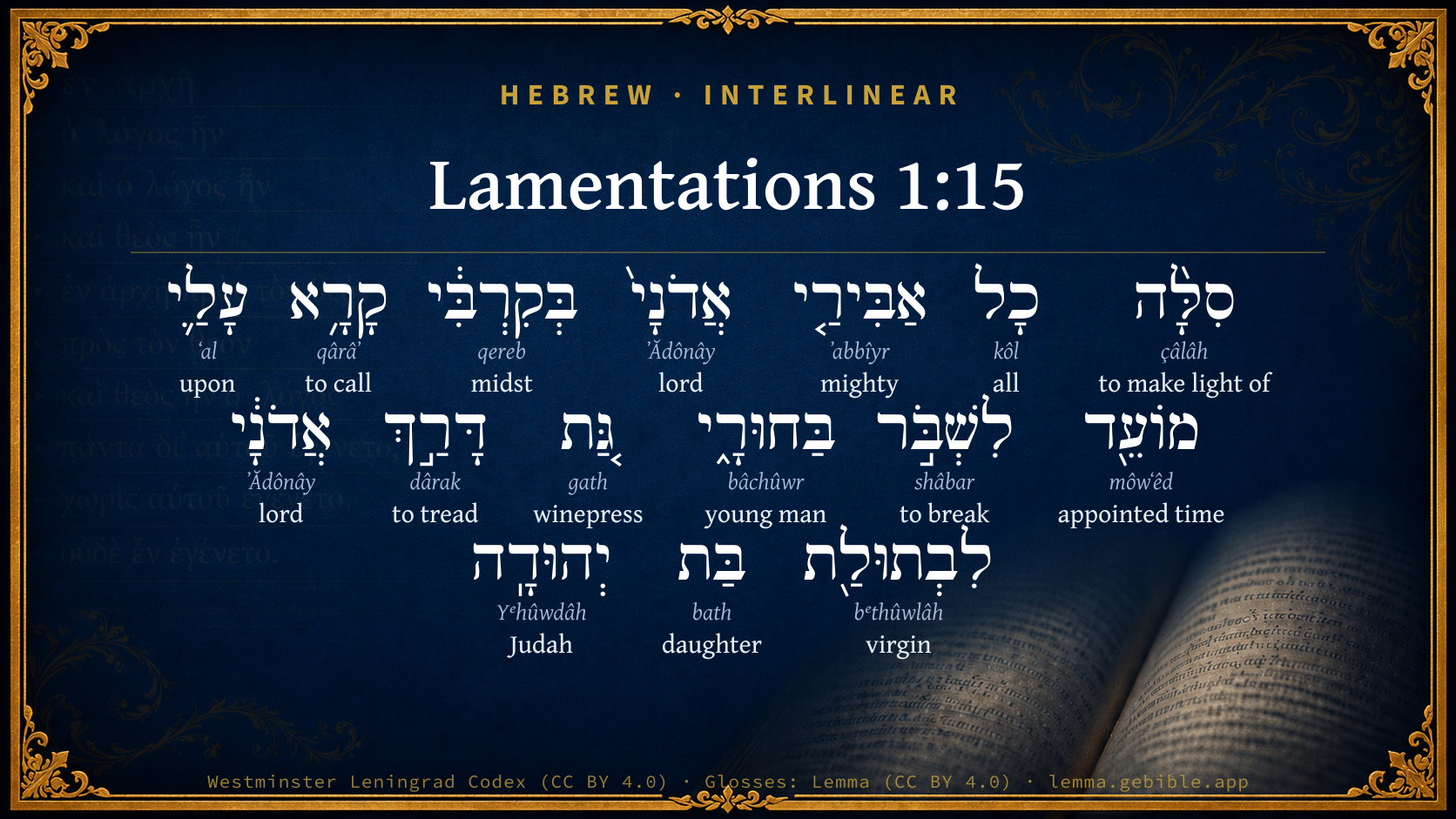
Lamentations 1:15

Hebrew (Westminster Leningrad Codex) Lamentations 1:15 appears in the Hebrew Old Testament. The text above is from the Westminster Leningrad Codex. Each word links to its Strong’s number, a concise gloss, and parsing drawn from the Open Scriptures Hebrew Bible morphology. Click any word for its full Brown-Driver-Briggs (BDB) entry.
Download image
Cite this verse

Lamentations 1:15 (World English Bible). Public Domain. Lemma interlinear Bible study tool, https://lemma.gebible.app/v/lamentations/1/15.

Show BibTeX & RIS
BibTeX
RIS
English Translation
The Lord has set at nothing all my mighty men in the midst of me; He has called a solemn assembly against me to crush my young men: The Lord has trodden as in a winepress the virgin daughter of Judah.
World English Bible · Public Domain
Download a study sheet

One document with this verse’s original text, its word-by-word gloss line, the meaning frame, cross-references with their text, attributed commentary, and full source and license credits — printable, and it pastes into notes with its structure intact.

This verse Autodidact and up

Study sheet (.html) Plain text (.txt)

A passage Seminary Student

Up to 50 verses in one chapter. A passage sheet keeps up to 6 commentary sources and 12 cross-references per verse, in the order this page ranks them, and says so on the sheet whenever that leaves anything out. Ask for a single verse and you get the Autodidact verse sheet above.

Everything on this page stays free to read, with no account — the sheet is a download of what is already on screen, not access to it.

Want to remove ads? Support Godless Engineer
Compare translations 3

The same verse in 3 English versions, stacked beneath the original-language interlinear above. Click any original word for its lexicon entry.

Each is an independent rendering of the whole verse — the interlinear is not word-aligned to these translations.

Highlighted words mark where these versions differ — a whole-verse word diff, not a word-by-word alignment.

  • World English Bible Public Domain
    The Lord has set at nothing all my mighty men in the midst of me; He has called a solemn assembly against me to crush my young men: The Lord has trodden as in a winepress the virgin daughter of Judah.
  • King James Version Public Domain
    The LORD hath trodden under foot all my mighty men in the midst of me: he hath called an assembly against me to crush my young men: the LORD hath trodden the virgin, the daughter of Judah, as in a winepress.
  • unfoldingWord Literal Text CC BY-SA 4.0
    The Lord has rejected all the mighty men in my midst. He has called an appointed time against me to crush my young men. The Lord has trodden the winepress for the virgin daughter of Judah. AYIN

unfoldingWord Literal Text — © unfoldingWord, licensed CC BY-SA 4.0. Word-aligned USFM3 via Door43 (git.door43.org/unfoldingWord/en_ult).

Versions to compare (up to 4)

3 of 4 selected

Show all 18 translations

Every available English version of this verse, each an independent rendering of the whole verse.

  • World English Bible Public Domain
    The Lord has set at nothing all my mighty men in the midst of me; He has called a solemn assembly against me to crush my young men: The Lord has trodden as in a winepress the virgin daughter of Judah.
  • Berean Standard Bible Public Domain
    The Lord has rejected all the mighty men in my midst; He has summoned an army against me to crush my young warriors. Like grapes in a winepress, the Lord has trampled the Virgin Daughter of Judah.
  • Majority Standard Bible Public Domain
    The Lord has rejected all the mighty men in my midst; He has summoned an army against me to crush my young warriors. Like grapes in a winepress, the Lord has trampled the Virgin Daughter of Judah.
  • King James Version Public Domain
    The LORD hath trodden under foot all my mighty men in the midst of me: he hath called an assembly against me to crush my young men: the LORD hath trodden the virgin, the daughter of Judah, as in a winepress.
  • American Standard Version (1901) Public Domain
    The Lord hath set at nought all my mighty men in the midst of me; He hath called a solemn assembly against me to crush my young men: The Lord hath trodden as in a winepress the virgin daughter of Judah.
  • Revised Version (1885) Public Domain
    The Lord hath set at nought all my mighty men in the midst of me; he hath called a solemn assembly against me to crush my young men: the Lord hath trodden as in a winepress the virgin daughter of Judah.
  • Geneva Bible (1599) Public Domain
    The Lord hath troden vnder foote all my valiant men in the middes of me: he hath called an assembly against me to destroy my yong men: the Lord hath troden the wine presse vpon the virgine the daughter of Iudah.
  • Douay-Rheims (1899) Public Domain
    Samech. The Lord hath taken away all my mighty men out of the midst of me: he hath called against me the time, to destroy my chosen men: the Lord hath trodden the winepress for the virgin daughter of Juda.
  • Young's Literal Translation Public Domain
    Trodden down all my mighty ones hath the Lord in my midst, He proclaimed against me an appointed time, To destroy my young men, A wine-press hath the Lord trodden, To the virgin daughter of Judah.
  • Literal Standard Version CC BY-SA 4.0
    The Lord has trodden down all my mighty ones in my midst, || He proclaimed an appointed time against me, || To destroy my young men, || The Lord has trodden a winepress, || To the virgin daughter of Judah.
  • Unlocked Literal Bible CC BY-SA 4.0
    The Lord has tossed aside all my mighty men who defended me. He has called an assembly against me to crush my vigorous men. The Lord has trampled the virgin daughter of Judah in the winepress.
  • unfoldingWord Literal Text CC BY-SA 4.0
    The Lord has rejected all the mighty men in my midst. He has called an appointed time against me to crush my young men. The Lord has trodden the winepress for the virgin daughter of Judah. AYIN
  • Darby Bible Public Domain
    The Lord hath cast down all my mighty men in the midst of me; he hath called an assembly against me to crush my young men; the Lord hath trodden as a winepress the virgin daughter of Judah.
  • World Messianic Bible Public Domain
    “The Lord has set at nothing all my mighty men within me. He has called a solemn assembly against me to crush my young men. The Lord has trodden the virgin daughter of Judah as in a wine press.
  • Webster's Bible Public Domain
    The Lord hath trodden under foot all my mighty men in the midst of me: he hath called an assembly against me to crush my young men: the Lord hath trodden the virgin, the daughter of Judah, as in a wine-press.
  • Free Bible Version CC BY-SA 4.0
    The Lord brushed aside all my strong soldiers defending me. He called up an army to attack me, to crush my young men. The Lord has trampled down the virgin Daughter of Judah like grapes in a winepress.
  • Bible in Basic English Public Domain
    The Lord has made sport of all my men of war in me, he has got men together against me to send destruction on my young men: the virgin daughter of Judah has been crushed like grapes under the feet of the Lord.
  • JPS Tanakh (1917) Public Domain
    The Lord hath set at nought all my mighty men in the midst of me; He hath called a solemn assembly against me to crush my young men; the Lord hath trodden as in a winepress the virgin the daughter of Judah.'

Literal Standard Version (2020), Covenant Press — licensed CC BY-SA 4.0. Text via the HelloAO Bible API (eBible.org). Unlocked Literal Bible (unfoldingWord) — licensed CC BY-SA 4.0. Text via the HelloAO Bible API (eBible.org). unfoldingWord Literal Text — © unfoldingWord, licensed CC BY-SA 4.0. Word-aligned USFM3 via Door43 (git.door43.org/unfoldingWord/en_ult). Free Bible Version, Dr. Jonathan Gallagher — licensed CC BY-SA 4.0. Text via the HelloAO Bible API (eBible.org).

Word by word

More ways to search: Search by grammar → Find every occurrence → Compare this word →

Practice this passage: Drill this verse → Learn its vocabulary →

סִלָּ֨ה
çâlâh
H5541
“to make light of”
Verb, Piel, Perfect, 3rd Person, Masculine, Singular
Part of Speech
Verb
Stem
Piel
Form
Perfect
Person
3rd Person
Gender
Masculine
Number
Singular
Full BDB Definition

Origin: a primitive root

TWOT: 1502 , 1503

to make light of, toss aside - (Qal) to make light of - (Piel) to flout, reject - to weigh, balance - (Pual) to be weighed
  1. כָל kôl H3605 “all of” Noun, Common, Masculine, Singular, Construct
  2. אַבִּירַ֤י ʼabbîyr H47 “mighty · my” Adjective, Adjective, Masculine, Plural, Construct + Suffix, Personal, 1st Person, Common, Singular
  3. אֲדֹנָי֙ ʼĂdônây H136 “Lord · my” Noun, Common, Masculine, Plural, Construct + Suffix, Personal, 1st Person, Common, Singular
  4. בְּקִרְבִּ֔י qereb H7130 “in/at · midst · my” Preposition + Noun, Common, Masculine, Singular, Construct + Suffix, Personal, 1st Person, Common, Singular
  5. קָרָ֥א qârâʼ H7121 “to call” Verb, Qal, Perfect, 3rd Person, Masculine, Singular
  6. עָלַ֛י ʻal H5921 “upon · me” Preposition + Suffix, Personal, 1st Person, Common, Singular
  7. מוֹעֵ֖ד môwʻêd H4150 “appointed time” Noun, Common, Masculine, Singular, Absolute
  8. לִשְׁבֹּ֣ר shâbar H7665 “to break” Preposition + Verb, Qal, Infinitive Construct
  9. בַּחוּרָ֑י bâchûwr H970 “young men · my” Noun, Common, Masculine, Plural, Construct + Suffix, Personal, 1st Person, Common, Singular
  10. גַּ֚ת gath H1660 “winepress” Noun, Common, Feminine, Singular, Absolute
  11. דָּרַ֣ךְ dârak H1869 “to tread” Verb, Qal, Perfect, 3rd Person, Masculine, Singular
  12. אֲדֹנָ֔י ʼĂdônây H136 “Lord · my” Noun, Common, Masculine, Plural, Construct + Suffix, Personal, 1st Person, Common, Singular
  13. לִבְתוּלַ֖ת bᵉthûwlâh H1330 “to/for · virgin of” Preposition + Noun, Common, Feminine, Singular, Construct
  14. בַּת bath H1323 “daughter of” Noun, Common, Feminine, Singular, Construct
  15. יְהוּדָֽה Yᵉhûwdâh H3063 “Judah” Noun, Proper

About this verse

These counts appear in no published source. They are computed here, from the morphology-tagged text and Lemma’s own curated glosses. What Lemma adds →

16
words
15
distinct lemmas
Prophets
section

Notable vocabulary

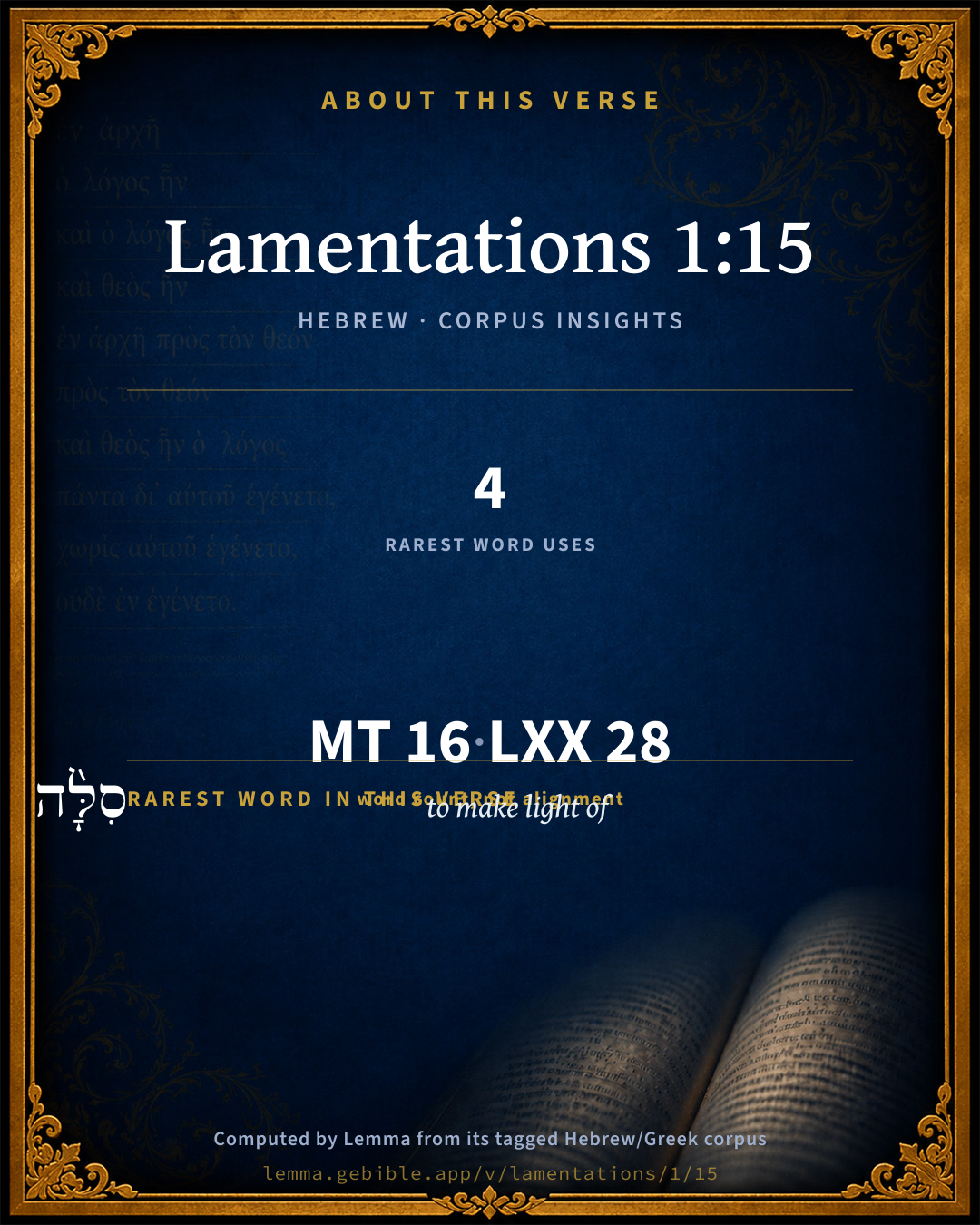
The rarest word here is סִלָּ֨ה to make light of H5541 — appearing just 4 times in the whole Hebrew Bible.

Shared distinctive vocabulary

סִלָּ֨ה to make light of H5541 occurs in 4 verses of the Hebrew Bible. Also found in:

Grammatical profile

  • 4 verbs
  • 10 nouns
  • 1 adjective
  • 1 preposition

Verb forms

  • סִלָּ֨ה Piel · Perfect
  • קָרָ֥א Qal · Perfect
  • לִשְׁבֹּ֣ר Qal · Infinitive Construct
  • דָּרַ֣ךְ Qal · Perfect

Repetition

A word recurs within this verse — often emphatic in Hebrew:

  • אֲדֹנָי֙ lord H136 ×2

Hebrew & Septuagint length

In English translation the verse runs 41 words from the Hebrew and 44 from the Septuagint (LXX English) — closely comparable.

A rough comparison of the two English renderings, which tokenize alike — not a word-level alignment.

Word counts can differ between the Hebrew and the Greek without any difference in meaning — e.g. the Hebrew direct-object marker אֵת has no separate Greek word, and Greek often adds the article ὁ.

In the original languages it is 16 Hebrew tokens and 28 Greek tokens — but the two are counted differently (Hebrew bundles its prefixes and suffixes into one token; the Greek is in lemma form), so that isn’t a like-for-like length.

Cross-references

23

Topical passages linked to Lamentations 1:15 in the Treasury of Scripture Knowledge — connected by theme and wording, ordered by reader-vote popularity; previews shown in the World English Bible.

  • Isaiah 63:3 I have trodden the winepress alone; and of the peoples there was no man with me: yes, I trod them in my anger, and trampled them in my wrath; and their lifeblood is sprinkled on my garments, and I have stained all my clothing.
  • Isaiah 28:18 Your covenant with death shall be annulled, and your agreement with Sheol shall not stand; when the overflowing scourge shall pass through, then you shall be trodden down by it.
  • Malachi 4:3 You shall tread down the wicked; for they will be ashes under the soles of your feet in the day that I make," says Yahweh of Hosts.
  • Luke 21:24 They will fall by the edge of the sword, and will be led captive into all the nations. Jerusalem will be trampled down by the Gentiles, until the times of the Gentiles are fulfilled.
  • Hebrews 10:29 How much worse punishment, do you think, will he be judged worthy of, who has trodden under foot the Son of God, and has counted the blood of the covenant with which he was sanctified an unholy thing, and has insulted the Spirit of grace?
  • Revelation 14:19–20 The angel thrust his sickle into the earth, and gathered the vintage of the earth, and threw it into the great winepress of the wrath of God.
  • Revelation 19:15 Out of his mouth proceeds a sharp, double-edged sword, that with it he should strike the nations. He will rule them with a rod of iron. He treads the winepress of the fierceness of the wrath of God, the Almighty.
  • Deuteronomy 28:33 The fruit of your ground, and all your labors, shall a nation which you don't know eat up; and you shall be only oppressed and crushed always;
  • Judges 10:8 They vexed and oppressed the children of Israel that year: eighteen years [oppressed they] all the children of Israel that were beyond the Jordan in the land of the Amorites, which is in Gilead.
  • 2 Kings 9:33 He said, Throw her down. So they threw her down; and some of her blood was sprinkled on the wall, and on the horses: and he trod her under foot.
  • 2 Kings 24:14–16 He carried away all Jerusalem, and all the princes, and all the mighty men of valor, even ten thousand captives, and all the craftsmen and the smiths; none remained, save the poorest sort of the people of the land.
  • 2 Kings 25:4–7 Then a breach was made in the city, and all the men of war [fled] by night by the way of the gate between the two walls, which was by the king's garden (now the Chaldeans were against the city round about); and [the king] went by the way of the Arabah.
  • Psalms 119:118 You reject all those who stray from your statutes, For their deceit is in vain.
  • Isaiah 5:5 Now I will tell you what I will do to my vineyard. I will take away its hedge, and it will be eaten up. I will break down its wall of it, and it will be trampled down.
  • Isaiah 41:2 Who has raised up one from the east, whom he calls in righteousness to his foot? he gives nations before him, and makes him rule over kings; he gives them as the dust to his sword, as the driven stubble to his bow.
  • Jeremiah 14:17 You shall say this word to them, Let my eyes run down with tears night and day, and let them not cease; for the virgin daughter of my people is broken with a great breach, with a very grievous wound.
  • Jeremiah 18:21 Therefore deliver up their children to the famine, and give them over to the power of the sword; and let their wives become childless, and widows; and let their men be slain of death, [and] their young men struck of the sword in battle.
  • Jeremiah 37:10 For though you had struck the whole army of the Chaldeans who fight against you, and there remained but wounded men among them, yes would they rise up every man in his tent, and burn this city with fire.
  • Jeremiah 50:26 Come against her from the utmost border; open her store-houses; cast her up as heaps, and destroy her utterly; let nothing of her be left.
  • Jeremiah 51:34 Nebuchadrezzar the king of Babylon has devoured me, he has crushed me, he has made me an empty vessel, he has, like a monster, swallowed me up, he has filled his maw with my delicacies; he has cast me out.
  • Lamentations 3:34 To crush under foot all the prisoners of the earth,
  • Daniel 3:13 Then Nebuchadnezzar in [his] rage and fury commanded to bring Shadrach, Meshach, and Abednego. Then they brought these men before the king.
  • Micah 7:10 Then my enemy will see it, And shame will cover her who said to me, Where is Yahweh your God? Then my enemy will see me and will cover her shame. Now she will be trodden down like the mire of the streets.

Cross-references courtesy of OpenBible.info (CC BY 4.0).

Hebrew and Greek witnesses Masoretic Hebrew ↔ Greek Septuagint

The same verse in the two great witnesses to the Old Testament, shown verse-for-verse.

These are two independent witnesses, not word-aligned to each other, and the Septuagint is shown in lemma (dictionary) form.

Hebrew Lamentations 1:15 Masoretic · Westminster Leningrad Codex

סִלָּ֨ה כָל אַבִּירַ֤י אֲדֹנָי֙ בְּקִרְבִּ֔י קָרָ֥א עָלַ֛י מוֹעֵ֖ד לִשְׁבֹּ֣ר בַּחוּרָ֑י גַּ֚ת דָּרַ֣ךְ אֲדֹנָ֔י לִבְתוּלַ֖ת בַּת יְהוּדָֽה

The Lord has set at nothing all my mighty men in the midst of me; He has called a solemn assembly against me to crush my young men: The Lord has trodden as in a winepress the virgin daughter of Judah.

World English Bible · Public Domain

Greek LXX Lamentations 1:15 Septuagint · lemma form

ἐκαἴρω πᾶς ὁ ἰσχυρός ἐγώ ὁ κύριος ἐκ μέσος ἐγώ καλέω ἐπί ἐγώ καιρός ὁ συντρίβω ἐκλεκτός ἐγώ ληνός πατέω κύριος παρθένος θυγάτηρ ιουδα ἐπί οὗτος ἐγώ κλαίω

SAMECH. The Lord has cut off all my strong men from the midst of me: he has summoned against me a time for crushing my choice men: the Lord has trodden a wine-press for the virgin daughter of Juda: for these things I weep.

LXX2012 (modern English Septuagint) · Public Domain

Hebrew: Westminster Leningrad Codex (CC BY 4.0). Greek: Septuagint (public domain); English from LXX2012 (modern English Septuagint) (Public Domain). How the Septuagint differs from the Hebrew →

Commentary

Notes on Lamentations 1:15 from classic Christian and Jewish commentators (each source and its license shown beneath its notes). The classic Christian expositions comment on the surrounding passage and are grouped to its opening verse, so a note may address several verses; the Jewish commentaries on the Tanakh (Rashi and others) are per-verse, so they appear only where the commentator wrote on this verse.

Lemma curates 59 commentaries, every one of them public domain or Creative Commons licensed, each selected and text-cleaned for this edition rather than reprinted as found. About our sources →

Trapp's Complete Commentary

John Trapp

Lam 1:15 The Lord hath trodden under foot all my mighty [men] in the midst of me: he hath called an assembly against me to crush my young men: the Lord hath trodden the virgin, the daughter of Judah, [as] in a winepress.

Ver. 15. The Lord hath trodden underfoot.] As unsavoury salt; that is, he hath covered with the greatest contempt.

All my mighty men.] Vulgate, My magnificos, or gallants, in whom I too much trusted.

In the midst of me.] In the very bosom of their mother; as Caracalla killed his brother Geta, consecrating the sword wherewith he so killed him.

He hath called an assembly against me.] Vocant adversum me tempus, so the Vulgate version hath it; and Calvin to the same purpose, He hath called the time against me - i.e., a set time wherein to destroy my strong ones. Howbeit one {a} maketh this inference from the words, for the very time which we have condemned, we shall be condemned; and for every day which we have spent idly, we shall be shent severely. This is true, but little to the present purpose; like as Hushai said, Ahithophel’s counsel was good, but not now.

The Lord hath trodden her as in a winepress.] By another like metaphor, God is said to have threshed Babylon as a threshingfloor. {Jer 51:33}

{a} Dr Playfair.

John Trapp, A Commentary or Exposition upon All the Books of the Old and New Testament (1647–1656) — public domain. Text from a community e-Sword module.

The Biblical Illustrator

Joseph S. Exell

Lam_1:15-17

The Lord hath trodden under foot all my mighty men.

Supreme penalties

1. When God meaneth to afflict us, He will spoil us of all our helps wherein we may have any confidence.

2. God can as easily destroy in a fenced city as in a battle.

3. It is God that ruleth even the wicked, and setteth them on work against His servants.

4. Men can no more escape Gods hand in punishing them, than the grapes can fly from the treader of the winepress.

5. The niceness of those that have lived daintily (the virgin) is no reason to free them, but rather a provocation to bring afflictions upon them.

(1) The pampering of ourselves is none of the ends for which God bestoweth His blessings upon us.

(2) Such coy niceness as many be of is seldom without special sins that are incident to that condition, which God will not let pass unpunished.

6. Except the children forsake their sins, they shall not be spared for the godliness of their parents. (J. Udall.)

For these things I weep.

Grief in view of punishment

1. It is not only lawful, but also necessary, for the godly to be so greatly grieved, when God punisheth them for their sins, as may draw them into extreme weeping.

2. No adversity hath warrant to grieve us so much as the punishment of God upon us for our sins (Luk_23:28).

3. There is none so stout, or hardhearted, but afflictions will bring him down.

4. It is a grievous plague to be deprived of comforters in affliction; the contrary whereof is an exceeding blessing.

5. It is the duty of everyone to comfort and relieve others that be in distress.

(1) God hath so commanded (Gal_6:2).

(2) We are members one of another (1Co_12:27).

(3) We may have the like need ourselves another time.

6. The Church, as also the commonwealth, is to declare herself a kind mother to everyone that is trained up therein, and to have compassion of their miseries, helping them to the uttermost.

7. It is the property of carnal friends to be friendly only whilst prosperity is upon us; but if our adversaries prevail against us, they are gone. (J. Udall.)

Zion spreadeth forth her hands.--

The appeal for help

1. It is a necessary duty in Gods people to seek out all good means of their release from troubles.

2. God often frustrateth the lawful endeavours of His children of that good issue which is expected, and yet liketh well that they should use means to bring the same to pass.

3. The wicked have no power against Gods people, but that which is given them from the Lord.

4. Gods people are more grievously afflicted and reproached in the world than any else, and the godliest most of all. (J. Udall.)

The Biblical Illustrator, edited by Joseph S. Exell (c. 1880s–1900s) — public domain. Text from a community e-Sword module.

Tyndale Open Study Notes

Tyndale Open Resources

1:15 his beloved city: God had given special care to Jerusalem, like a father protecting his daughter. But her sins had been persistent, and her punishment was horrible. • like grapes . . . trampled in a winepress: This common procedure for extracting juice from grapes is used vividly in Isa 63:3 to show the horrors of punishment. In Rev 14:18-20; 19:15, the image graphically represents universal judgment.

Tyndale Open Study Notes — © Tyndale Open Resources, licensed CC BY-SA 4.0. Text via the HelloAO Bible API.

Geneva Bible (1599)

Geneva Bible translators

He hath trodden them underfoot as they tread grapes in the winepress.

Geneva Bible (1599) marginal notes — public domain. Text via Bolls.life.

Jamieson, Fausset & Brown

Robert Jamieson, A. R. Fausset & David Brown

trodden, &c.--MAURER, from Syriac root, translates, "cast away"; so Kg2 23:27. But Psa 119:118, supports English Version.

in . . . midst of me--They fell not on the battlefield, but in the heart of the city; a sign of the divine wrath.

assembly--the collected forces of Babylon; a very different "assembly" from the solemn ones which once met at Jerusalem on the great feasts. The Hebrew means, literally, such a solemn "assembly" or feast (compare Lam 2:22).

trodden . . . virgin . . . in a wine-press--hath forced her blood to burst forth, as the red wine from the grapes trodden in the press (Isa 63:3; Rev 14:19-20; Rev 19:15).

Jamieson, Fausset & Brown — Commentary Critical and Explanatory on the Whole Bible (1871) — public domain (CC PDM 1.0). Text via the HelloAO Bible API.

Adam Clarke's Commentary

Verse 15. Called an assembly] The Chaldean army, composed of various nations, which God commissioned to destroy Jerusalem.

Adam Clarke's Commentary on the Bible (1810–1826) — public domain. Text from a community e-Sword/MySword module.

John Calvin's Commentaries

She first says, that all her valiant men had been trodden underfoot. Now we know how much the Jews trusted in their men even to the very time when they were wholly subdued. As then they had shewed so much insolence and pride towards the prophets, it hence became a cause of greater sorrow, when Jerusalem herself saw that she was destitute of every protection, and that her valiant men were trodden under foot. She says, in the midst of me. And this ought to be observed; for if they had fallen on the field of battle, if they had been taken in the fields by their enemies, such a thing would not have been so grievous: but that they had been thus laid prostrate, in the very bosom of the city, was indeed a token of vengeance from above. We now see that this circumstance was not superfluous, that all the valiant men of Jerusalem were laid prostrate in the midst of her.

It is then said that it was the fixed time, when God destroyed her chosen men, or her youth. Should it seem preferable to take מועד, muod, as meaning a congregation, I do not object; yet I do not approve of this meaning, for it seems forced. It agrees better with the context to regard it as the fixed time, the time before appointed by God to destroy all the strong men.

There is then another metaphor used, — that God had trodden the winepress as to the daughter of Zion. This figure occurs elsewhere, as in Isaiah 63:1,

“Who is this that cometh from Edom? and why are his garments red?”

For the Prophet wonders how God could come forth from Edom, sprinkled with blood. God answers, “The winepress have I trod alone;” that is, because he had avenged the wrongs done to his people. For we know that the Idumeans had always been incensed against the miserable Jews. Then God, in order to shew that lie was the defender of his Church, says that he came from Edom, and was sprinkled and even made wet with blood. As when any one is red with wine after having toiled in the winepress, so also is the representation in this place. We have also seen in Jeremiah 51:33, that Babylon was like a threshing-floor. The metaphor, indeed, is different, but bears a likeness to the present. As, then, God is said to tread, or to thresh, when he afflicts any land, so he is said to tread the winepress, as here. It follows, —

John Calvin's Commentaries (1540-1563) — public domain. Text from the Calvin Translation Society English edition (1840s-50s) via the Christian Classics Ethereal Library (ccel.org). Calvin's coverage is partial (roughly two-thirds of the Bible); uncommented books and verses are honest gaps, never fabricated. The 19th-century editor's footnotes and remarks are omitted so the notes are faithfully Calvin's own voice.

Ellicott's Commentary for English Readers

(15) Trodden under foot.—Better, hath made contemptible, as those who are weighed in the balance and found wanting.

All my mighty men . . .—The adjective is used elsewhere of bulls (Psa_22:12; Isa_34:7), but stands here for the heroes of Judah, who fell, not in open battle, but ignominiously “in the midst” of the captured city.

He hath called an assembly.—The point of the phrase lies in its being that commonly used for proclaiming a religious festival (Lev_23:4). Here the festival is proclaimed, not for Jerusalem, but against her, and is to be kept by those who exult in the slaughter of her youthful warriors.

The Lord hath trodden the virgin . . .—Better, hath trodden the winepress for the virgin . . . For the winepress as the symbol of judgment and slaughter, see Isa_63:2; Rev_14:19; Rev_19:15.

A Bible Commentary for English Readers, edited by Charles John Ellicott (1878–1897) — public domain. Text from a community e-Sword module.

The Cambridge Bible for Schools and Colleges

gen. ed. J. J. S. Perowne

15. hath called a solemn assembly] or, sacrificial banquet. Cp. Jer_46:10; Isa_34:6; Eze_39:17 ff.; Zep_1:7 f. The festival is not for Israel but for the enemy, and that which is to be celebrated, the overthrow of the flower of the Jewish army.

hath trodden, etc.] hath trodden the winepress of the virgin daughter of Judah. For treading the winepress, as a phrase to express the wrath of God, cp. Isa_63:3; Joe_3:13; Rev_14:19; Rev_19:15, and for the virgin (daughter), Jer_14:17; Jer_18:13 (where see note), Jer_31:4. The expression is used to indicate inviolate security, and Zion (the speaker) here identifies it with the people of Judah collectively.

The Cambridge Bible for Schools and Colleges (gen. ed. J. J. S. Perowne; Cambridge University Press, 1878–1918) — public domain. Text from a community e-Sword module.

John Gill's Exposition

The Lord hath trodden under foot all my mighty men in the midst of me,.... As a causeway is trodden; or as mire is trodden under foot in the streets; so were the mighty and valiant men, the soldiers and men of war, trodden under foot and destroyed by the Chaldeans in the streets of Jerusalem, and in the midst of Judea; the Lord so permitting it:

he hath called an assembly against me to crush my young men; the army of the Chaldeans, which were brought against Jerusalem by a divine appointment and call; against whom the choicest and stoutest of them, even their young men, could not stand; but were crushed and broken to pieces by them. The word for "assembly" sometimes signifies an appointed time; a time fixed for solemn festivals, and for calling the people to them; and so the Targum here,

"he hath called or appointed a time to break the strength of my young men;''

the time of Jerusalem's destruction by the Babylonians:

the Lord hath trodden the virgin, the daughter of Judah, as in a winepress; in the winepress of his wrath; or however in the winepress of the Babylonians, who are compared to one; into whose hands the Jews falling, were like grapes cast into a winepress, and there trodden by men, in order to squeeze and get out the wine; and in like manner were their blood squeezed out of them and shed. The Targum interprets it of the blood of virginity being poured out, as wine in a press; the virgins of Judah being ravished and defiled by the enemy.

John Gill's Exposition of the Whole Bible (1746–1763) — public domain (CC PDM 1.0). Text via the HelloAO Bible API.

Haydock's Catholic Bible Commentary

Mighty. Hebrew, "magnificent" princes, (Luke xxii. 25.) or warriors. --- Time of vengeance. All in animated. Hebrew also, "a troop" of Chaldeans, chap. ii. 22. --- Juda. God, as the first cause, punishes the Jews by war.

George Leo Haydock (1774–1849), Haydock's Catholic Family Bible and Commentary, 1859 edition — public domain. Excludes Psalms (Douay-Rheims chapter numbering differs from Protestant) and Deuterocanonical books (Catholic canon only).

Matthew Poole's English Annotations

In the midst of me, may be interpreted either as pleonastical, or as denoting the place in which they lost their valiant men, viz. in the midst of the city during the siege, not in the field.

He hath called an assembly against me to crush my young men; instead of those solemn assemblies that were wont to be called together within Jerusalem by sound of trumpet for the solemn worship of God, God had called an assembly of Chaldeans as adversaries against the city, to crush the inhabitants of it.

The Lord hath trodden the virgin, the daughter of Judah, as in a wine-press; God had trodden upon the Jews as men use to stamp grapes in a wine-press, where they use to crush them to pieces to get out the juice, and then they throw the husks, that are good for nothing, upon the dunghills. These are but various expressions to set out the misery into which God had brought this people for their sins.

Matthew Poole's English Annotations on the Holy Bible (1683–1685) — public domain. Text from a community e-Sword/MySword module.

Whedon's Commentary on the Bible

Daniel D. Whedon

15. The Lord — Here, and in thirteen other places, we have Adonai, while the name Jehovah is less prominent, “as if in their punishment the people felt the lordship of the Deity more, and his covenant love to them less.”

Hath trodden under foot — More literally, hath taken away, or, as yet others translate, hath made contemptible.

Called an assembly — More literally, with Gesenius, Keil, and most others, proclaim a festival. To this festival God invites the nations to crush the young men of Jerusalem. Hath trodden the virgin, etc. — Better, hath trodden the wine-press for the virgin.

Daniel D. Whedon (gen. ed.), Commentary on the Old and New Testaments (1874–1909) — public domain. Text from a community e-Sword module.

The Pulpit Commentary

Hath trodden under foot; rather, hath rejected; i.e. hath punished. Comp. Psa_119:118, Psa_119:119, where "thou rejectest same verb as here all them that wander from thy statutes" is followed by "thou puttest away all the ungodly of the earth like dross," Hath called an assembly; rather, hath proclaimed a festival. When Jehovah summons the instruments of his vengeance, the prophets describe it as the "proclaiming a festival." The Persians or Chaldeans, as the case may be, obey the summons with a holy glee, and destroy the enemies of the true God. (comp. Isa_13:3) Hath trodden, etc.; rather, hath trodden the winepress for (i.e. to the ruin of) the virgin daughter of Zion. The poet. carries on the figure of the festival. It is a vintage which is to be celebrated, such a vintage as is described in Isa_63:3. (comp. Joe_3:13) The choicest youth of Judah are to be cut off like grapes from the vine. "Virgin daughter" is a frequent figure to express inviolate security. (so Jer_14:17)

The Pulpit Commentary (1880–1919), ed. H.D.M. Spence-Jones & Joseph S. Exell — public domain. Text from a community e-Sword module.

John Wesley's Explanatory Notes

An assembly - God had called an assembly of Chaldeans against the city, to crush the inhabitants of it. Trodden - God had trodden upon the Jews as men use to stamp grapes in a wine- press.

John Wesley, Explanatory Notes Upon the Whole Bible (1754–1765) — public domain. Text via the GEBible commentary corpus.

unfoldingWord translationNotes

Door43 World Missions Community

General Information:

In this section Jerusalem is portrayed as a woman speaking about herself. (See: Personification)

mighty men

"strongest soldiers"

an assembly

Here the enemy army attacking Jerusalem is spoken of as if it were a meeting of people who have come together in order to accuse and condemn someone. AT: "a great army" (See: Metaphor)

to crush my vigorous men

This speaks of the enemy army defeating the soldiers of Jerusalem as if they crushed them. AT: "to defeat my vigorous men"

vigorous men

This refers to men at the strongest time of their lives.

The Lord has trampled ... in the winepress

Here the judgment of God is described as if Jerusalem were grapes on which he had trampled in order to squeeze out the juice. AT: "It is as though the Lord has trampled upon the virgin daughter of Judah in a winepress" (See: Metaphor)

the virgin daughter of Judah

This is a poetic name for Jerusalem, which is spoken of here as if it were a woman. The word "virgin" suggests that this woman is pure. (See: Metaphor)

translationWords

lord

might

assembly

virgin

kingdom of Judah

grape

winepress

unfoldingWord translationNotes — © Distant Shores Media and the Door43 World Missions Community, licensed CC BY-SA 4.0. Source: git.door43.org/Door43/en_tn.

Rashi

Rabbi Shlomo Yitzchaki (Rashi)

The Lord has trampled Heb. סִלָה. He trampled and trod, an expression of (Isa. 62:10): “pave, pave the highway (סֹלוּ סֹלוּ הַמְסִלָה),” [meaning to beat down the road].

He summoned an assembly against me Heb. מוֹעֵד, a gathering of troops to come against me. And our Sages expounded what they expounded (Pes. 77a, Ta’an. 29a, Sanh. 104b): Tammuz of that year was a full (thirty-day) month; [i. e., the Tammuz] of the second year from the Exodus from Egypt. Therefore, the return of the Spies occurred on the night of the ninth of Av, upon which their weeping was established for generations (Ta’an. ad loc., Sanh. ad loc., Sotah 35a).

the Lord has trodden as in a wine press An expression of massacre, like (Isa. 63:3): “A wine press I trod alone.” As one treads grapes to extract their wine, so did He trample the women to extract their blood.

Rashi on the Tanakh — English translations: “The Judaica Press complete Tanach with Rashi, translated by A. J. Rosenberg” (CC BY 4.0); “Pentateuch with Rashi's commentary by M. Rosenbaum and A.M. Silbermann, 1929-1934” (public domain); “The Metsudah Tanach series, Lakewood, N.J” (CC BY 4.0); and “The Book of Joshua, Metsudah Publications, 1997” (CC BY 4.0). Text via Sefaria.

Lesson kit

Teaching starters — assembled from the data on this page, not authored interpretation. Every prompt links to the verse data it draws on. Edit before teaching.

Lamentations, in the Prophets, opens this verse with 16 words (15 distinct Hebrew lemmas). Its most distinctive word is çâlâh (“to make light of”). A historical commentator’s framing appears above. Read the whole chapter for the surrounding context.

Discussion questions

  1. How does “to make light of” (çâlâh) shape what this verse is saying?
  2. Job 28:16 shares the word «to make light of» with this verse. How do the two illuminate each other?
  3. “lord” occurs 2× in this one verse. What is the effect of the repetition?
  4. These translations render this verse differently. What is at stake in choosing one wording over another?
  5. The verb «סִלָּ֨ה» is Piel Perfect. How does its form color the action?
  6. Reading how Trapp's Complete Commentary and The Biblical Illustrator read this verse, where do the two commentators agree and where do they part?

Things to notice

Reading settings

Reading text

Shown beneath each verse's original-language words.

Old Testament
Old Testament edition

Read the OT as the Masoretic Hebrew (MT) or the Greek Septuagint (LXX).

English shown for the Greek Septuagint (in the Hebrew ↔ Greek comparison).

Comparing translations? Open the Compare panel on any verse page to stack up to four side by side.