
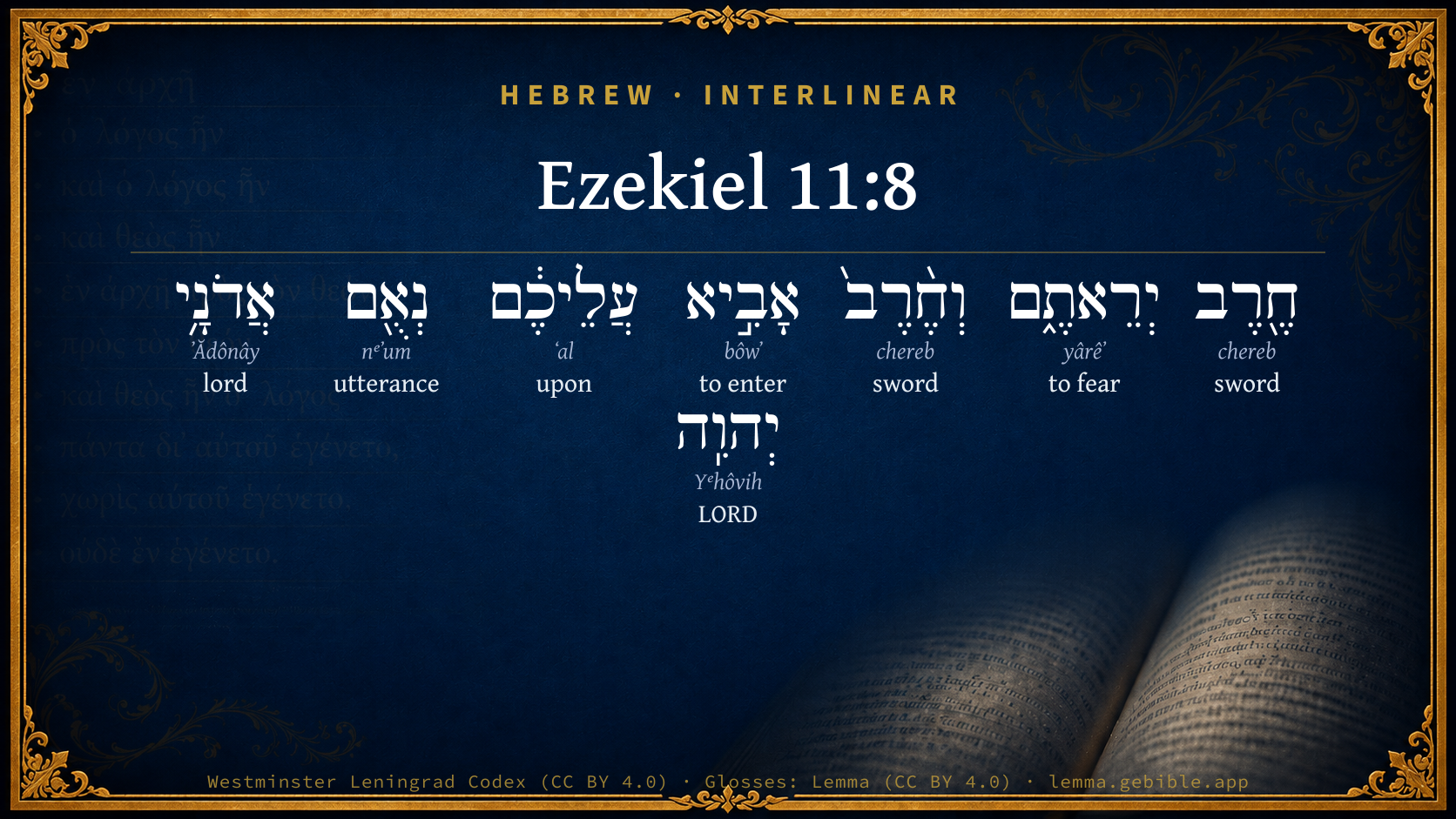
Ezekiel 11:8

Hebrew (Westminster Leningrad Codex) Ezekiel 11:8 appears in the Hebrew Old Testament. The text above is from the Westminster Leningrad Codex. Each word links to its Strong’s number, a concise gloss, and parsing drawn from the Open Scriptures Hebrew Bible morphology. Click any word for its full Brown-Driver-Briggs (BDB) entry.
Download image
Cite this verse

Ezekiel 11:8 (World English Bible). Public Domain. Lemma interlinear Bible study tool, https://lemma.gebible.app/v/ezekiel/11/8.

Show BibTeX & RIS
BibTeX
RIS
English Translation
You have feared the sword; and I will bring the sword on you, says the Lord Yahweh.
World English Bible · Public Domain
Download a study sheet

One document with this verse’s original text, its word-by-word gloss line, the meaning frame, cross-references with their text, attributed commentary, and full source and license credits — printable, and it pastes into notes with its structure intact.

This verse Autodidact and up

Study sheet (.html) Plain text (.txt)

A passage Seminary Student

Up to 50 verses in one chapter. A passage sheet keeps up to 6 commentary sources and 12 cross-references per verse, in the order this page ranks them, and says so on the sheet whenever that leaves anything out. Ask for a single verse and you get the Autodidact verse sheet above.

Everything on this page stays free to read, with no account — the sheet is a download of what is already on screen, not access to it.

Want to remove ads? Support Godless Engineer
Compare translations 3

The same verse in 3 English versions, stacked beneath the original-language interlinear above. Click any original word for its lexicon entry.

Each is an independent rendering of the whole verse — the interlinear is not word-aligned to these translations.

Highlighted words mark where these versions differ — a whole-verse word diff, not a word-by-word alignment.

  • World English Bible Public Domain
    You have feared the sword; and I will bring the sword on you, says the Lord Yahweh.
  • King James Version Public Domain
    Ye have feared the sword; and I will bring a sword upon you, saith the Lord GOD.
  • unfoldingWord Literal Text CC BY-SA 4.0
    You have feared the sword, so I am bringing the sword upon you—this is the declaration of the Lord Yahweh.

unfoldingWord Literal Text — © unfoldingWord, licensed CC BY-SA 4.0. Word-aligned USFM3 via Door43 (git.door43.org/unfoldingWord/en_ult).

Versions to compare (up to 4)

3 of 4 selected

Show all 18 translations

Every available English version of this verse, each an independent rendering of the whole verse.

  • World English Bible Public Domain
    You have feared the sword; and I will bring the sword on you, says the Lord Yahweh.
  • Berean Standard Bible Public Domain
    You fear the sword, so I will bring the sword against you, declares the Lord GOD.
  • Majority Standard Bible Public Domain
    You fear the sword, so I will bring the sword against you, declares the Lord GOD.
  • King James Version Public Domain
    Ye have feared the sword; and I will bring a sword upon you, saith the Lord GOD.
  • American Standard Version (1901) Public Domain
    Ye have feared the sword; and I will bring the sword upon you, saith the Lord Jehovah.
  • Revised Version (1885) Public Domain
    Ye have feared the sword; and I will bring the sword upon you, saith the Lord GOD.
  • Geneva Bible (1599) Public Domain
    Ye haue feared the sworde, and I wil bring a sworde vpon you, saith the Lord God.
  • Douay-Rheims (1899) Public Domain
    You have feared the sword, and I will bring the sword upon you, saith the Lord God.
  • Young's Literal Translation Public Domain
    A sword ye have feared, And a sword I bring in against you, An affirmation of the Lord Jehovah.
  • Literal Standard Version CC BY-SA 4.0
    You have feared a sword, || And I bring in a sword against you, || A declaration of Lord YHWH.
  • Unlocked Literal Bible CC BY-SA 4.0
    You have feared the sword, so I am bringing the sword upon you—this is the declaration of the Lord Yahweh.
  • unfoldingWord Literal Text CC BY-SA 4.0
    You have feared the sword, so I am bringing the sword upon you—this is the declaration of the Lord Yahweh.
  • Darby Bible Public Domain
    Ye have feared the sword, and I will bring a sword upon you, saith the Lord Jehovah.
  • World Messianic Bible Public Domain
    You have feared the sword; and I will bring the sword on you,” says the Lord GOD.
  • Webster's Bible Public Domain
    Ye have feared the sword; and I will bring a sword upon you, saith the Lord GOD.
  • Free Bible Version CC BY-SA 4.0
    You're afraid of being killed by the sword, so I will bring invaders with swords to attack you, declares the Lord God.
  • Bible in Basic English Public Domain
    You have been fearing the sword, and I will send the sword on you, says the Lord.
  • JPS Tanakh (1917) Public Domain
    Ye have feared the sword; and the sword will I bring upon you, saith the Lord GOD.

Literal Standard Version (2020), Covenant Press — licensed CC BY-SA 4.0. Text via the HelloAO Bible API (eBible.org). Unlocked Literal Bible (unfoldingWord) — licensed CC BY-SA 4.0. Text via the HelloAO Bible API (eBible.org). unfoldingWord Literal Text — © unfoldingWord, licensed CC BY-SA 4.0. Word-aligned USFM3 via Door43 (git.door43.org/unfoldingWord/en_ult). Free Bible Version, Dr. Jonathan Gallagher — licensed CC BY-SA 4.0. Text via the HelloAO Bible API (eBible.org).

Word by word

More ways to search: Search by grammar → Find every occurrence → Compare this word →

Practice this passage: Drill this verse → Learn its vocabulary →

About this verse

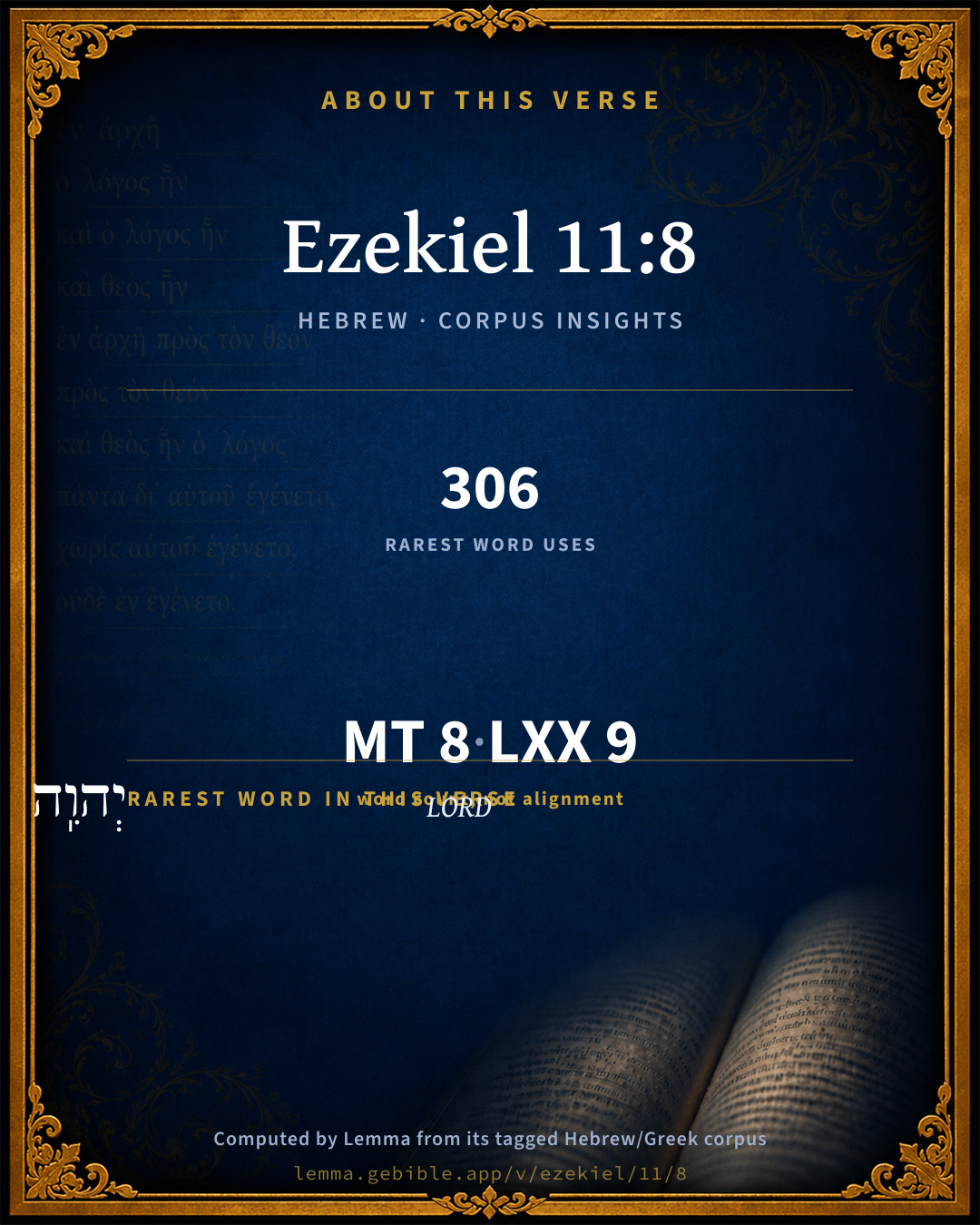
These counts appear in no published source. They are computed here, from the morphology-tagged text and Lemma’s own curated glosses. What Lemma adds →

8
words
7
distinct lemmas
Prophets
section

Grammatical profile

  • 2 verbs
  • 5 nouns
  • 1 preposition

Verb forms

  • יְרֵאתֶ֑ם Qal · Perfect
  • אָבִ֣יא Hiphil · Imperfect

Repetition

A word recurs within this verse — often emphatic in Hebrew:

  • חֶ֖רֶב sword H2719 ×2

Hebrew & Septuagint length

In English translation the verse runs 17 words from the Hebrew and 15 from the Septuagint (LXX English) — closely comparable.

A rough comparison of the two English renderings, which tokenize alike — not a word-level alignment.

Word counts can differ between the Hebrew and the Greek without any difference in meaning — e.g. the Hebrew direct-object marker אֵת has no separate Greek word, and Greek often adds the article ὁ.

In the original languages it is 8 Hebrew tokens and 9 Greek tokens — but the two are counted differently (Hebrew bundles its prefixes and suffixes into one token; the Greek is in lemma form), so that isn’t a like-for-like length.

Cross-references

12

Topical passages linked to Ezekiel 11:8 in the Treasury of Scripture Knowledge — connected by theme and wording, ordered by reader-vote popularity; previews shown in the World English Bible.

  • Proverbs 10:24 What the wicked fear, will overtake them, But the desire of the righteous will be granted.
  • Job 3:25 For the thing which I fear comes on me, That which I am afraid of comes to me.
  • Isaiah 24:17–18 Fear, and the pit, and the snare, are on you, O inhabitant of the earth.
  • Isaiah 66:4 I also will choose their delusions, and will bring their fears on them; because when I called, none did answer; when I spoke, they did not hear: but they did that which was evil in my eyes, and chose that in which I didn't delight.
  • Job 20:24 He shall flee from the iron weapon. The bronze arrow shall strike him through.
  • Isaiah 30:16–17 but you said, No, for we will flee on horses; therefore shall you flee: and, We will ride on the swift; therefore shall those who pursue you be swift.
  • Jeremiah 38:19–23 Zedekiah the king said to Jeremiah, I am afraid of the Jews who are fallen away to the Chaldeans, lest they deliver me into their hand, and they mock me.
  • Jeremiah 42:14–16 saying, No; but we will go into the land of Egypt, where we shall see no war, nor hear the sound of the trumpet, nor have hunger of bread; and there will we dwell:
  • Jeremiah 44:12–13 I will take the remnant of Judah, that have set their faces to go into the land of Egypt to sojourn there, and they shall all be consumed; in the land of Egypt shall they fall; they shall be consumed by the sword and by the famine; they shall die, from the least even to the greatest, by the sword and by the famine; and they shall be an object of horror, [and] an astonishment, and a curse, and a reproach.
  • Amos 9:1–4 I saw the Lord standing beside the altar, and he said, "Strike the tops of the pillars, that the thresholds may shake; and break them in pieces on the head of all of them; and I will kill the last of them with the sword: there shall not one of them flee away, and there shall not one of them escape.
  • John 11:48 If we leave him alone like this, everyone will believe in him, and the Romans will come and take away both our place and our nation."
  • 1 Thessalonians 2:15–16 who killed both the Lord Jesus and their own prophets, and drove us out, and didn't please God, and are contrary to all men;

Cross-references courtesy of OpenBible.info (CC BY 4.0).

Hebrew and Greek witnesses Masoretic Hebrew ↔ Greek Septuagint

The same verse in the two great witnesses to the Old Testament, shown verse-for-verse.

These are two independent witnesses, not word-aligned to each other, and the Septuagint is shown in lemma (dictionary) form.

Hebrew Ezekiel 11:8 Masoretic · Westminster Leningrad Codex

חֶ֖רֶב יְרֵאתֶ֑ם וְחֶ֨רֶב֙ אָבִ֣יא עֲלֵיכֶ֔ם נְאֻ֖ם אֲדֹנָ֥י יְהוִֽה

You have feared the sword; and I will bring the sword on you, says the Lord Yahweh.

World English Bible · Public Domain

Greek LXX Ezekiel 11:8 Septuagint · lemma form

ῥομφαία φοβέω καί ῥομφαία ἐπιἄγω ἐπί σύ λέγω κύριος

You⌃ fear the sword; and I will bring a sword upon you, says the Lord.

LXX2012 (modern English Septuagint) · Public Domain

Hebrew: Westminster Leningrad Codex (CC BY 4.0). Greek: Septuagint (public domain); English from LXX2012 (modern English Septuagint) (Public Domain). How the Septuagint differs from the Hebrew →

Targum (Aramaic paraphrase)

1

The Targum is the ancient Jewish Aramaic paraphrase of the Hebrew Scriptures — an interpretive translation, not the Hebrew text itself. Onkelos (literal) and Pseudo-Jonathan (expansive) render the Torah, and Jonathan the Prophets. Coverage is partial: where no permissively-licensed English translation exists for a verse, only the Aramaic is shown. This is verse-level text, not a word-by-word alignment to the Hebrew.

  1. Targum Jonathan Prophets (Joshua–Malachi)
    מִן קֳדָם דְקָטְלִין בְּחַרְבָּא דְחַלְתּוּן וּדְקָטְלִין בְּחַרְבָּא אַיְתִי עֲלֵיכוֹן אֲמַר יְיָ אֱלֹהִים:

    (no public-domain English translation for this verse)

    Targum Jonathan — Aramaic: “Mikraot Gedolot” (public domain). English: “Sefaria Community Translation” (CC0 1.0 (public-domain dedication)); “London "Chaldee Paraphrase," 1871” (public domain). Text via Sefaria.

Commentary

Notes on Ezekiel 11:8 from classic Christian and Jewish commentators (each source and its license shown beneath its notes). The classic Christian expositions comment on the surrounding passage and are grouped to its opening verse, so a note may address several verses; the Jewish commentaries on the Tanakh (Rashi and others) are per-verse, so they appear only where the commentator wrote on this verse.

Lemma curates 59 commentaries, every one of them public domain or Creative Commons licensed, each selected and text-cleaned for this edition rather than reprinted as found. About our sources →

Trapp's Complete Commentary

John Trapp

Eze 11:8 Ye have feared the sword; and I will bring a sword upon you, saith the Lord GOD.

Ver. 8. Ye have feared the sword.] And yet they made as if they feared nothing; they doubted not but to die in their nest; but all guilt hath fear, and all such fear hath torment.

And I will bring a sword upon you.] Such as all your craft can never keep off. Ineluctabilis vis fatorum, cuius fortunam mutare canstituit, consilia corrumpit. {a} See Pro 10:24. {See Trapp on "Pro 10:24"}

{a} Velleius, lib. ii.

John Trapp, A Commentary or Exposition upon All the Books of the Old and New Testament (1647–1656) — public domain. Text from a community e-Sword module.

Joseph Benson's Commentary

Eze 11:8-11. Ye have feared the sword — Of the Chaldeans; and have, to avoid it, courted them, and left my worship to follow their idolatrous rites: but this very sword will I bring upon you. And I will deliver you into the hands of strangers — Defeating all your projects for escape; and I will execute judgments among you — By the hands of the Chaldeans, whom I will make the instruments of my just vengeance. I will judge you in the border of Israel — Namely, in Riblah, just upon the borders of Judea. In this place the king of Babylon, who is here spoken of as God’s representative, sat in judgment on all the princes of Judah, and slew them: see the margin. This city shall not be your caldron — The place of your sufferings; greater are reserved for you elsewhere.

Joseph Benson's Commentary on the Old and New Testaments (1811–1818) — public domain. Text from a community e-Sword module.

Tyndale Open Study Notes

Tyndale Open Resources

11:8-10 God had once rescued his people from foreigners in Egypt, but now he would hand them over to foreigners for judgment.

Tyndale Open Study Notes — © Tyndale Open Resources, licensed CC BY-SA 4.0. Text via the HelloAO Bible API.

Jamieson, Fausset & Brown

Robert Jamieson, A. R. Fausset & David Brown

The Chaldean sword, to escape which ye abandoned your God, shall be brought on you by God because of that very abandonment of Him.

Jamieson, Fausset & Brown — Commentary Critical and Explanatory on the Whole Bible (1871) — public domain (CC PDM 1.0). Text via the HelloAO Bible API.

John Calvin's Commentaries

We ought to join these verses together, because the Prophet treats the same thing in many words. First he denounces that they should perish by the sword since they feared the sword By these words he admonishes them, that even if God should draw them out of the city, yet Jeremiah’s prophecy would prove true, since the Chaldeans would consume them as if the pot was boiling on the fire. Lastly, he shows how frivolous was their cavil when they said, “if we are flesh, we shall remain in the caldron.” But the Prophet shows that they must not cavil like children with God, because when he showed the caldron to his servant Jeremiah, he meant nothing else than that the Jews should perish, since the Chaldeans would come to consume them. But they had purposely perverted the Prophet’s sense, and thought themselves clever and shrewd when they corrupted the heavenly doctrine. First of all the Prophet says, ye have feared the sword, and ye shall fall by the sword: he afterwards adds the manner: I, says he, will bring the sword upon you, which ye feared: he says, I will draw you out from the midst of it. He declares the manner: namely, that he will bring them into an open plain, that he may more easily slay them there. If any should object, that this was not seething them in the city, the answer is easy: that God did not restrict his wroth to one kind of punishment, when he thus spoke by Jeremiah. For we know that the Prophets set before us God’s judgments in various ways, and thus use various figures. Since therefore the Prophets do not always teach in the same manner, it is not surprising if, when he shortly shows that God’s wrath was near the Jews, he used that simile: ye shall fall, says he, by the sword, and in the borders of Israel shall I judge you.

Here he clearly expresses what I lately touched upon. It was indeed God’s judgment, when the Jews were drawn from the city in which they thought they had a quiet nest: for when they were violently dragged into exile, God exercised his judgments upon them: and from the time when he deprived them of their country, then he already began to be their judge. But here he begins to treat of a severer judgment. Although God had begun to chastise the Jews when he expelled them from the city, yet he treated them more severely in the boundaries of Israel; because when they came in sight of the king of Babylon, then the king saw his slain: then he himself was rendered blind and dragged into Chaldea, and all the nobles slain. (2 Kings 25; Jeremiah 39.) Hence we may gather that the people’s blood was poured out without discrimination. Now therefore we understand what God means when he threatens to judge them in the borders of Israel, that is without their country. Lastly, he here denounces a double penalty, first because God would east them out of Jerusalem in which they delighted, and in which they said that they should dwell so long that exile would be their first punishment: then he adds, that he was not content with exile, but that a heavier punishment was at hand, when they should be cast out of their country, and the land should cast; them forth as a stench which it cannot bear. I will judge you therefore in the borders of Israel: that is, beyond the holy land: for since one curse has already occurred in exile, still a harder and more formidable revenge will await; you. Now he adds, ye shall know that I am Jehovah

Doubtless Ezekiel reproves the sloth which was the cause of such great contumacy: for they had never dared to contend so perseveringly with God, unless their minds had been stupified; for were we to reflect that we are striving with God, horror would immediately seize upon us; for who labors under such madness as to dare to contend with God his maker? This torpor, therefore, Ezekiel now obliquely reproves, when he says that the Jews would know too late that they were dealing with God. Although therefore they sinned through ignorance, it does not follow that they were without, excuse, for whence arose their ignorance except from being inattentive to God? It sprang first from carelessness: then that carelessness and security produced contempt, and contempt sprang from their depraved lust of sinning. Since therefore they determined to give themselves up to all manner of sinning, they put away as far as possible all teaching: nay they willingly endeavored to stupify their own consciences, and thus we see that depraved desire impelled them to contempt, and contempt begat in them security, in which at length this ignorance plunged them. Since therefore at the time it did not come into their mind to contend with God, this does not extenuate their fault, because, as I have said, they had stupified themselves with determined and spontaneous wickedness.

Meanwhile, it is by no means doubtful that God always pricked them that they might feel themselves sinners, but the Prophet here speaks of that knowledge which is called experimental. For the impious are said to know God when, being struck by his hand, they unwillingly acknowledge his power: because whether they will or not they feel him to be their judge. But this knowledge does not profit them; nay even increases their destruction. But we understand the Prophet’s meaning, that the Jews were rebellious and despised God’s servants: because they pretended that they had to do only with men, and covered themselves with darkness, lest they should behold the light which was offered to their eyes. God pronounces that they should know at length with whom they contended, as Zechariah says, they shall see whom they have pierced; (Zechariah 12:10;) that is, they shall know that it is I whom they have wounded, when they so proudly despised my servants, and abjured all confidence in my teaching. Hence also we gather that the minds of the impious were so confused, that seeing they did not see; for when they experience God to be their judge, they are compelled in reality to confess that they feel his hand: yet they remain stupid, because they do not profit, as the Prophet had just now said, — ye feared the sword. But they were careless, as we saw, and despised all threats. Of what kind, then, is this fear which is remarked upon by the Prophet? that of the impious forsooth, who while they make for themselves blandishments, and fancy that they have made a covenant with death, as is said in Isaiah, (Isaiah 28:15; Isaiah 48:22; and Isaiah 57:21,) and promise themselves freedom from punishment, even when a scourge is passing through the land, yet tremble and are always ill-at-ease, because they have no peace, as it is said elsewhere. In fine, we see the impious always remaining careless and stupid: though they are careless, yet they tremble and are tortured with secret impiety, since the severity of God urges them on. At length he concludes, Jerusalem should not be their caldron, but he would punish them in the border of Israel But I have sufficiently explained this clause. It follows —

John Calvin's Commentaries (1540-1563) — public domain. Text from the Calvin Translation Society English edition (1840s-50s) via the Christian Classics Ethereal Library (ccel.org). Calvin's coverage is partial (roughly two-thirds of the Bible); uncommented books and verses are honest gaps, never fabricated. The 19th-century editor's footnotes and remarks are omitted so the notes are faithfully Calvin's own voice.

The Cambridge Bible for Schools and Colleges

gen. ed. J. J. S. Perowne

8. have feared] Ye fear. The language of the ruling class, in spite of its recklessness (Eze_11:3), betrays the consciousness of the risks they incur; and their fears shall be more than verified.

The Cambridge Bible for Schools and Colleges (gen. ed. J. J. S. Perowne; Cambridge University Press, 1878–1918) — public domain. Text from a community e-Sword module.

John Gill's Exposition

Ye have feared the sword,.... Of the Chaldeans; and therefore they sent to the Egyptians for help. The Targum is,

"ye have been afraid of them that kill with the sword;''

and not afraid of the Lord; see Mat 10:28;

and I will bring a sword upon you, saith the Lord God; or those that kill with the sword, as the Targum; meaning the Chaldeans, who were sent by the Lord, and, when they took the city, put many to death by the sword, and carried captive others.

John Gill's Exposition of the Whole Bible (1746–1763) — public domain (CC PDM 1.0). Text via the HelloAO Bible API.

Matthew Poole's English Annotations

Sinfully, and forgetting God, you would have escaped the sword of the Babylonians, and attempted it by an idolatrous compliance: for this very cause will I send that sword upon you, and it shall slay your wives, children, and fellow citizens.

Matthew Poole's English Annotations on the Holy Bible (1683–1685) — public domain. Text from a community e-Sword/MySword module.

Whedon's Commentary on the Bible

Daniel D. Whedon

8. Ye have feared the sword;… I will bring a sword — With all their bravado there is a note of despair in Eze_11:3. The very fact that they felt the need of an Egyptian alliance shows that they feared the avenging sword of Babylon. But God says that it will not be Nebuchadnezzar’s sword, but his own, that will cut them down. It is not rebellion against the king of Babylon, but against the King of heaven which brings these calamities and delivers the people into Babylonian hands (Eze_11:9).

Daniel D. Whedon (gen. ed.), Commentary on the Old and New Testaments (1874–1909) — public domain. Text from a community e-Sword module.

unfoldingWord translationNotes

Door43 World Missions Community

General Information:

Yahweh continues giving Ezekiel his message to Israel.

You have feared the sword, so I am bringing the sword upon you

The word "sword" is a metonym for soldiers who kill people using swords. AT: "You have feared war, so I am bringing enemy armies to attack you" (See: Metonymy)

this is the declaration of the Lord Yahweh

Yahweh speaks of himself by name to express the certainty of what he is declaring. See how you translated this in Ezekiel 5:11. AT: "this is what the Lord Yahweh has declared" or "this is what I, the Lord Yahweh, have declared" (See: First, Second, or Third Person)

put you into the hands of foreigners

Here the metonym "hands" represents power or control. AT: "put you into the power of foreigners" or "enable foreigners to capture you" (See: Metonymy)

You will fall by the sword

The word "sword" is a metonym for soldiers who kill people using swords. AT: "They will kill you with their swords" or "You will die in battle" (See: Metonymy)

know that I am Yahweh

When Yahweh says that people will know that he is Yahweh, he is implying that they will know that he is the one true God who has supreme authority and power. See how you translated this in Ezekiel 6:7. AT: "understand that I am Yahweh, the one true God" or "realize that I, Yahweh, have supreme power and authority" (See: Assumed Knowledge and Implicit Information)

translationWords

sword

declare

Lord Yahweh

hand

alien

judge

Israel

Yahweh

unfoldingWord translationNotes — © Distant Shores Media and the Door43 World Missions Community, licensed CC BY-SA 4.0. Source: git.door43.org/Door43/en_tn.

Rashi

Rabbi Shlomo Yitzchaki (Rashi)

You feared the sword when you turned for aid to the king of Egypt, as it is said regarding Zedekiah (17:15): “And he rebelled against him (the king of Babylon) by sending his emissaries to Egypt.”

Rashi on the Tanakh — English translations: “The Judaica Press complete Tanach with Rashi, translated by A. J. Rosenberg” (CC BY 4.0); “Pentateuch with Rashi's commentary by M. Rosenbaum and A.M. Silbermann, 1929-1934” (public domain); “The Metsudah Tanach series, Lakewood, N.J” (CC BY 4.0); and “The Book of Joshua, Metsudah Publications, 1997” (CC BY 4.0). Text via Sefaria.

Lesson kit

Teaching starters — assembled from the data on this page, not authored interpretation. Every prompt links to the verse data it draws on. Edit before teaching.

Ezekiel, in the Prophets, opens this verse with 8 words (7 distinct Hebrew lemmas). Its most distinctive word is Yᵉhôvih (“LORD”). A historical commentator’s framing appears above. Read the whole chapter for the surrounding context.

Discussion questions

  1. What does “LORD” (Yᵉhôvih) contribute to the verse as a whole?
  2. How does Proverbs 10:24, which shares this passage’s theme, read alongside this verse?
  3. What does the repetition of “sword” (2× in this one verse) do in this verse?
  4. The translations on this page render this verse differently — a whole-verse word diff, not a word-by-word alignment. What might account for the different wordings?
  5. «יְרֵאתֶ֑ם» is a Qal Perfect verb. How does that grammatical form shape the action described?
  6. Compare how Trapp's Complete Commentary and Joseph Benson's Commentary read this verse. Where do they agree or differ?

Things to notice

Reading settings

Reading text

Shown beneath each verse's original-language words.

Old Testament
Old Testament edition

Read the OT as the Masoretic Hebrew (MT) or the Greek Septuagint (LXX).

English shown for the Greek Septuagint (in the Hebrew ↔ Greek comparison).

Comparing translations? Open the Compare panel on any verse page to stack up to four side by side.