
Lamentations 1:14

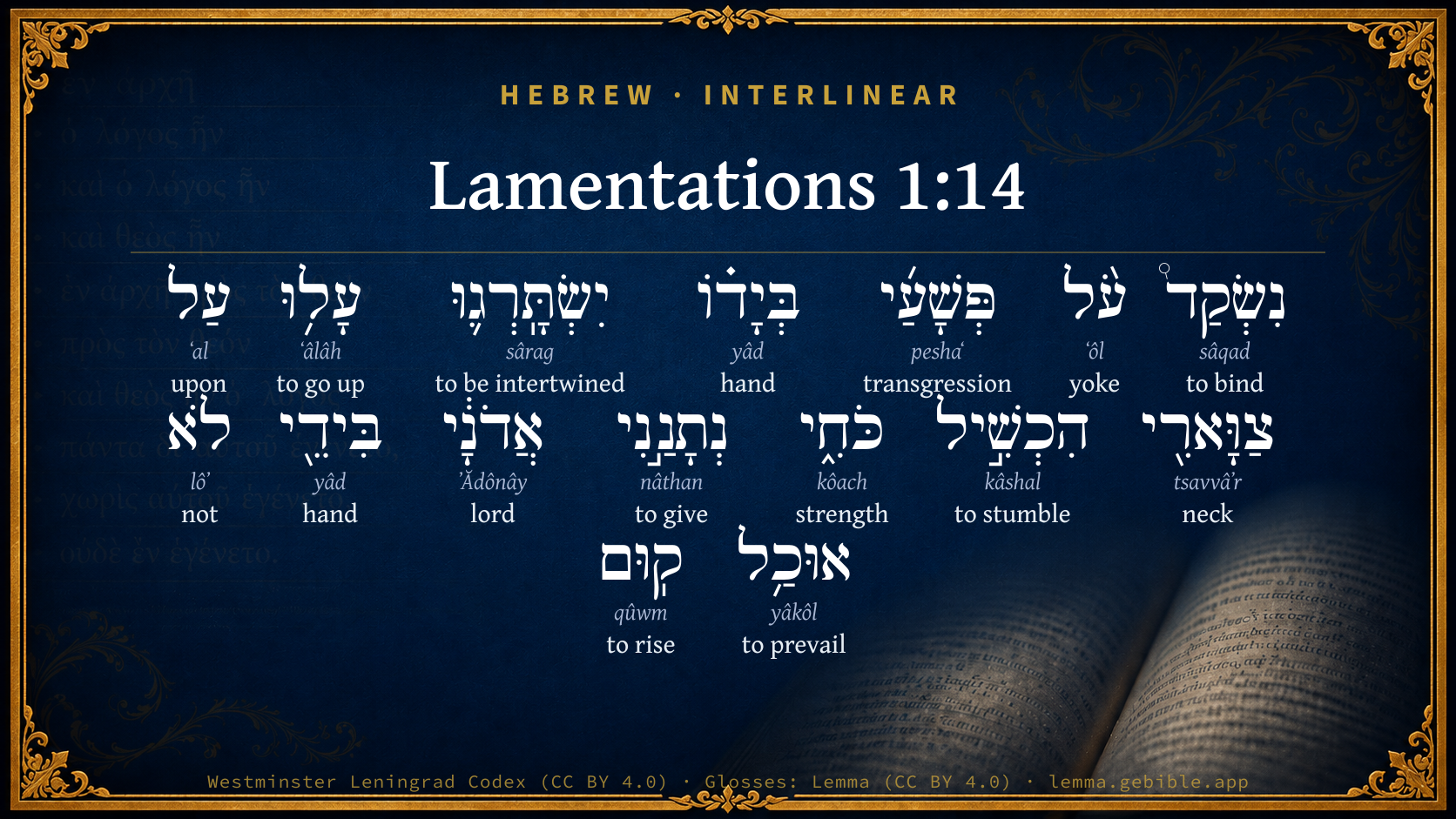
Hebrew (Westminster Leningrad Codex) Lamentations 1:14 appears in the Hebrew Old Testament. The text above is from the Westminster Leningrad Codex. Each word links to its Strong’s number, a concise gloss, and parsing drawn from the Open Scriptures Hebrew Bible morphology. Click any word for its full Brown-Driver-Briggs (BDB) entry.
Download image
Cite this verse

Lamentations 1:14 (World English Bible). Public Domain. Lemma interlinear Bible study tool, https://lemma.gebible.app/v/lamentations/1/14.

Show BibTeX & RIS
BibTeX
RIS
English Translation
The yoke of my transgressions is bound by his hand; They are knit together, they are come up on my neck; he has made my strength to fail: The Lord has delivered me into their hands, against whom I am not able to stand.
World English Bible · Public Domain
Highlights
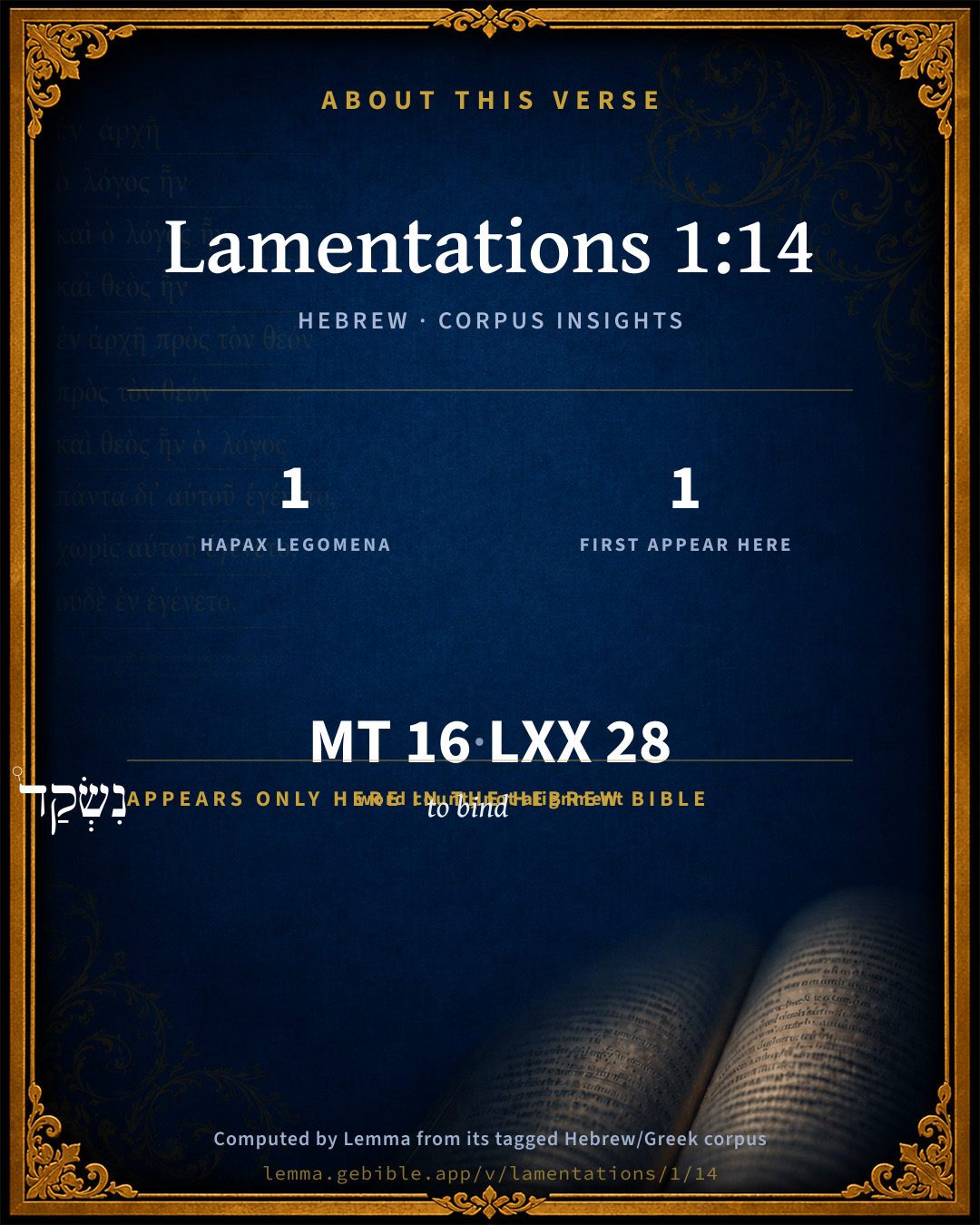
  • 1 hapax legomenon — only here in the Hebrew Bible
  • 1 first appearance in the Hebrew Bible
Full analysis ↓
Download a study sheet

One document with this verse’s original text, its word-by-word gloss line, the meaning frame, cross-references with their text, attributed commentary, and full source and license credits — printable, and it pastes into notes with its structure intact.

This verse Autodidact and up

Study sheet (.html) Plain text (.txt)

A passage Seminary Student

Up to 50 verses in one chapter. A passage sheet keeps up to 6 commentary sources and 12 cross-references per verse, in the order this page ranks them, and says so on the sheet whenever that leaves anything out. Ask for a single verse and you get the Autodidact verse sheet above.

Everything on this page stays free to read, with no account — the sheet is a download of what is already on screen, not access to it.

Want to remove ads? Support Godless Engineer
Compare translations 3

The same verse in 3 English versions, stacked beneath the original-language interlinear above. Click any original word for its lexicon entry.

Each is an independent rendering of the whole verse — the interlinear is not word-aligned to these translations.

Highlighted words mark where these versions differ — a whole-verse word diff, not a word-by-word alignment.

  • World English Bible Public Domain
    The yoke of my transgressions is bound by his hand; They are knit together, they are come up on my neck; he has made my strength to fail: The Lord has delivered me into their hands, against whom I am not able to stand.
  • King James Version Public Domain
    The yoke of my transgressions is bound by his hand: they are wreathed, and come up upon my neck: he hath made my strength to fall, the LORD hath delivered me into their hands, from whom I am not able to rise up.
  • unfoldingWord Literal Text CC BY-SA 4.0
    The yoke of my transgressions was bound fast, they are intertwined by his hand; they have come up onto my neck. He has caused my strength to stumble; the Lord has given me into the hands of those I am not able to rise against. SAMEKH

unfoldingWord Literal Text — © unfoldingWord, licensed CC BY-SA 4.0. Word-aligned USFM3 via Door43 (git.door43.org/unfoldingWord/en_ult).

Versions to compare (up to 4)

3 of 4 selected

Show all 18 translations

Every available English version of this verse, each an independent rendering of the whole verse.

  • World English Bible Public Domain
    The yoke of my transgressions is bound by his hand; They are knit together, they are come up on my neck; he has made my strength to fail: The Lord has delivered me into their hands, against whom I am not able to stand.
  • Berean Standard Bible Public Domain
    My transgressions are bound into a yoke, knit together by His hand; they are draped over my neck, and the Lord has broken my strength. He has delivered me into the hands of those I cannot withstand.
  • Majority Standard Bible Public Domain
    My transgressions are bound into a yoke, knit together by His hand; they are draped over my neck, and the Lord has broken my strength. He has delivered me into the hands of those I cannot withstand.
  • King James Version Public Domain
    The yoke of my transgressions is bound by his hand: they are wreathed, and come up upon my neck: he hath made my strength to fall, the LORD hath delivered me into their hands, from whom I am not able to rise up.
  • American Standard Version (1901) Public Domain
    The yoke of my transgressions is bound by his hand; They are knit together, they are come up upon my neck; he hath made my strength to fail: The Lord hath delivered me into their hands, against whom I am not able to stand.
  • Revised Version (1885) Public Domain
    The yoke of my transgressions is bound by his hand; they are knit together, they are come up upon my neck; he hath made my strength to fail: the Lord hath delivered me into their hands, against whom I am not able to stand.
  • Geneva Bible (1599) Public Domain
    The yoke of my transgressions is bounde vpon his hand: they are wrapped, and come vp vpon my necke: hee hath made my strength to fall: the Lord hath deliuered me into their hands, neither am I able to rise vp.
  • Douay-Rheims (1899) Public Domain
    Nun. The yoke of my iniquities hath watched: they are folded together in his hand, and put upon my neck: my strength is weakened: the Lord hath delivered me into a hand out of which I am not able to rise.
  • Young's Literal Translation Public Domain
    Bound hath been the yoke of my transgressions by His hand, They are wrapped together, They have gone up on my neck, He hath caused my power to stumble, The Lord hath given me into hands, I am not able to rise.
  • Literal Standard Version CC BY-SA 4.0
    Bound has been the yoke of my transgressions by His hand, || They are wrapped together, || They have gone up on my neck, || He has caused my power to stumble, || The Lord has given me into hands, I am not able to rise.
  • Unlocked Literal Bible CC BY-SA 4.0
    The yoke of my transgressions is bound together by his hand. They are knit together and placed upon my neck. He has made my strength fail. The Lord has given me over into their hands, and I am not able to stand.
  • unfoldingWord Literal Text CC BY-SA 4.0
    The yoke of my transgressions was bound fast, they are intertwined by his hand; they have come up onto my neck. He has caused my strength to stumble; the Lord has given me into the hands of those I am not able to rise against. SAMEKH
  • Darby Bible Public Domain
    The yoke of my transgressions is bound by his hand: they are wreathed, they are come up upon my neck; he hath made my strength to fail; the Lord hath delivered me into hands out of which I am not able to rise up.
  • World Messianic Bible Public Domain
    “The yoke of my transgressions is bound by his hand. They are knit together. They have come up on my neck. He made my strength fail. The Lord has delivered me into their hands, against whom I am not able to stand.
  • Webster's Bible Public Domain
    The yoke of my transgressions is bound by his hand: they are wreathed, and come up upon my neck: he hath made my strength to fall, the Lord hath delivered me into their hands, from whom I am not able to rise.
  • Free Bible Version CC BY-SA 4.0
    He took my rebellious sins and twisted them together into a yoke that he tied to my neck. He took away all my strength, and handed me over defenseless to my enemies.
  • Bible in Basic English Public Domain
    A watch is kept on my sins; they are joined together by his hand, they have come on to my neck; he has made my strength give way: the Lord has given me up into the hands of those against whom I have no power.
  • JPS Tanakh (1917) Public Domain
    The yoke of my transgressions is impressed by His hand; they are knit together, they are come up upon my neck; He hath made my strength to fail; the Lord hath delivered me into their hands, against whom I am not able to stand.

Literal Standard Version (2020), Covenant Press — licensed CC BY-SA 4.0. Text via the HelloAO Bible API (eBible.org). Unlocked Literal Bible (unfoldingWord) — licensed CC BY-SA 4.0. Text via the HelloAO Bible API (eBible.org). unfoldingWord Literal Text — © unfoldingWord, licensed CC BY-SA 4.0. Word-aligned USFM3 via Door43 (git.door43.org/unfoldingWord/en_ult). Free Bible Version, Dr. Jonathan Gallagher — licensed CC BY-SA 4.0. Text via the HelloAO Bible API (eBible.org).

Word by word

More ways to search: Search by grammar → Find every occurrence → Compare this word →

Practice this passage: Drill this verse → Learn its vocabulary →

נִשְׂקַד֩
sâqad
H8244
“to bind”
Verb, Niphal, Perfect, 3rd Person, Masculine, Singular
Part of Speech
Verb
Stem
Niphal
Form
Perfect
Person
3rd Person
Gender
Masculine
Number
Singular
Full BDB Definition

Origin: a primitive root

TWOT: 2281

to bind, bind on, be kept on (meaning doubtful) - (Niphal) to be kept on
  1. עֹ֨ל ʻôl H5923 “yoke of” Noun, Common, Masculine, Singular, Construct
  2. פְּשָׁעַ֜י peshaʻ H6588 “transgressions · my” Noun, Common, Masculine, Plural, Construct + Suffix, Personal, 1st Person, Common, Singular
  3. בְּיָד֗וֹ yâd H3027 “in/at · hand · his” Preposition + Noun, Common, Both, Singular, Construct + Suffix, Personal, 3rd Person, Masculine, Singular
  4. יִשְׂתָּֽרְג֛וּ sârag H8276 “to be intertwined” Verb, Hithpael, Imperfect, 3rd Person, Masculine, Plural
  5. עָל֥וּ ʻâlâh H5927 “to go up” Verb, Qal, Perfect, 3rd Person, Common, Plural
  6. עַל ʻal H5921 “upon” Preposition
  7. צַוָּארִ֖י tsavvâʼr H6677 “neck · my” Noun, Common, Masculine, Singular, Construct + Suffix, Personal, 1st Person, Common, Singular
  8. הִכְשִׁ֣יל kâshal H3782 “to stumble” Verb, Hiphil, Perfect, 3rd Person, Masculine, Singular
  9. כֹּחִ֑י kôach H3581 “strength · my” Noun, Common, Masculine, Singular, Construct + Suffix, Personal, 1st Person, Common, Singular
  10. נְתָנַ֣נִי nâthan H5414 “to give · me” Verb, Qal, Perfect, 3rd Person, Masculine, Singular + Suffix, Personal, 1st Person, Common, Singular
  11. אֲדֹנָ֔י ʼĂdônây H136 “Lord · my” Noun, Common, Masculine, Plural, Construct + Suffix, Personal, 1st Person, Common, Singular
  12. בִּידֵ֖י yâd H3027 “in/at · hands of” Preposition + Noun, Common, Both, Dual, Construct
  13. לֹא lôʼ H3808 “not” Particle, Negative
  14. אוּכַ֥ל yâkôl H3201 “to prevail” Verb, Qal, Imperfect, 1st Person, Common, Singular
  15. קֽוּם qûwm H6965 “to rise” Verb, Qal, Infinitive Construct

About this verse

These counts appear in no published source. They are computed here, from the morphology-tagged text and Lemma’s own curated glosses. What Lemma adds →

16
words
15
distinct lemmas
Prophets
section

Notable vocabulary

1 hapax legomenon — a word that appears only here in the entire Hebrew Bible:

  • נִשְׂקַד֩ to bind H8244

First appearance in Scripture

This word makes its first canonical appearance in the Hebrew Bible here:

  • נִשְׂקַד֩ to bind H8244

Shared distinctive vocabulary

יִשְׂתָּֽרְג֛וּ to be intertwined H8276 occurs in 2 verses of the Hebrew Bible. Also found in:

Grammatical profile

  • 7 verbs
  • 7 nouns
  • 1 preposition
  • 1 particle

Verb forms

  • נִשְׂקַד֩ Niphal · Perfect
  • יִשְׂתָּֽרְג֛וּ Hithpael · Imperfect
  • עָל֥וּ Qal · Perfect
  • הִכְשִׁ֣יל Hiphil · Perfect
  • נְתָנַ֣נִי Qal · Perfect
  • אוּכַ֥ל Qal · Imperfect
  • קֽוּם Qal · Infinitive Construct

Repetition

A word recurs within this verse — often emphatic in Hebrew:

  • בְּיָד֗וֹ hand H3027 ×2

Hebrew & Septuagint length

In English translation the verse runs 44 words from the Hebrew and 40 from the Septuagint (LXX English) — closely comparable.

A rough comparison of the two English renderings, which tokenize alike — not a word-level alignment.

Word counts can differ between the Hebrew and the Greek without any difference in meaning — e.g. the Hebrew direct-object marker אֵת has no separate Greek word, and Greek often adds the article ὁ.

In the original languages it is 16 Hebrew tokens and 28 Greek tokens — but the two are counted differently (Hebrew bundles its prefixes and suffixes into one token; the Greek is in lemma form), so that isn’t a like-for-like length.

Cross-references

18

Topical passages linked to Lamentations 1:14 in the Treasury of Scripture Knowledge — connected by theme and wording, ordered by reader-vote popularity; previews shown in the World English Bible.

  • Deuteronomy 28:48 therefore shall you serve your enemies whom Yahweh shall send against you, in hunger, and in thirst, and in nakedness, and in want of all things: and he shall put a yoke of iron on your neck, until he have destroyed you.
  • Isaiah 47:6 I was angry with my people, I profaned my inheritance, and gave them into your hand: you did show them no mercy; on the aged have you very heavily laid your yoke.
  • Proverbs 5:22 The evil deeds of the wicked ensnare him. The cords of his sin hold him firmly.
  • Jeremiah 28:14 For thus says Yahweh of Hosts, the God of Israel: I have put a yoke of iron on the neck of all these nations, that they may serve Nebuchadnezzar king of Babylon; and they shall serve him: and I have given him the animals of the field also.
  • Ezekiel 25:4 therefore, behold, I will deliver you to the children of the east for a possession, and they shall set their encampments in you, and make their dwellings in you; they shall eat your fruit, and they shall drink your milk.
  • Ezekiel 25:7 therefore, behold, I have stretched out my hand on you, and will deliver you for a spoil to the nations; and I will cut you off from the peoples, and I will cause you to perish out of the countries: I will destroy you; and you shall know that I am Yahweh.
  • Isaiah 14:25 that I will break the Assyrian in my land, and on my mountains tread him under foot: then shall his yoke depart from off them, and his burden depart from off their shoulder.
  • Jeremiah 25:9 behold, I will send and take all the families of the north, says Yahweh, and [I will send] to Nebuchadrezzar the king of Babylon, my servant, and will bring them against this land, and against the inhabitants of it, and against all these nations round about; and I will utterly destroy them, and make them an astonishment, and a hissing, and perpetual desolations.
  • Jeremiah 27:8 It shall happen, that the nation and the kingdom which will not serve the same Nebuchadnezzar king of Babylon, and that will not put their neck under the yoke of the king of Babylon, that nation will I punish, says Yahweh, with the sword, and with the famine, and with the pestilence, until I have consumed them by his hand.
  • Jeremiah 27:12 I spoke to Zedekiah king of Judah according to all these words, saying, Bring your necks under the yoke of the king of Babylon, and serve him and his people, and live.
  • Jeremiah 32:5 and he shall bring Zedekiah to Babylon, and there shall he be until I visit him, says Yahweh: though you fight with the Chaldeans, you shall not prosper?
  • Jeremiah 34:20–21 I will even give them into the hand of their enemies, and into the hand of those who seek their life; and their dead bodies shall be for food to the birds of the sky, and to the animals of the earth.
  • Jeremiah 37:17 Then Zedekiah the king sent, and fetched him: and the king asked him secretly in his house, and said, Is there any word from Yahweh? Jeremiah said, There is. He said also, You shall be delivered into the hand of the king of Babylon.
  • Jeremiah 39:1–9 It happened when Jerusalem was taken, (in the ninth year of Zedekiah king of Judah, in the tenth month, came Nebuchadrezzar king of Babylon and all his army against Jerusalem, and besieged it;
  • Ezekiel 11:9 I will bring you forth out of the midst of it, and deliver you into the hands of strangers, and will execute judgments among you.
  • Ezekiel 21:31 I will pour out my indignation on you; I will blow on you with the fire of my wrath; and I will deliver you into the hand of brutish men, skillful to destroy.
  • Ezekiel 23:28 For thus says the Lord Yahweh: Behold, I will deliver you into the hand of them whom you hate, into the hand of them from whom your soul is alienated;
  • Hosea 5:14 For I will be to Ephraim like a lion, And like a young lion to the house of Judah. I myself will tear in pieces and go away. I will carry off, and there will be no one to deliver.

Cross-references courtesy of OpenBible.info (CC BY 4.0).

Hebrew and Greek witnesses Masoretic Hebrew ↔ Greek Septuagint

The same verse in the two great witnesses to the Old Testament, shown verse-for-verse.

These are two independent witnesses, not word-aligned to each other, and the Septuagint is shown in lemma (dictionary) form.

Hebrew Lamentations 1:14 Masoretic · Westminster Leningrad Codex

נִשְׂקַד֩ עֹ֨ל פְּשָׁעַ֜י בְּיָד֗וֹ יִשְׂתָּֽרְג֛וּ עָל֥וּ עַל צַוָּארִ֖י הִכְשִׁ֣יל כֹּחִ֑י נְתָנַ֣נִי אֲדֹנָ֔י בִּידֵ֖י לֹא אוּכַ֥ל קֽוּם

The yoke of my transgressions is bound by his hand; They are knit together, they are come up on my neck; he has made my strength to fail: The Lord has delivered me into their hands, against whom I am not able to stand.

World English Bible · Public Domain

Greek LXX Lamentations 1:14 Septuagint · lemma form

γρηγορέω ἐπί ὁ ἀσέβημα ἐγώ ἐν χείρ ἐγώ συνπλέκω ἀναβαίνω ἐπί ὁ τράχηλος ἐγώ ἀσθενέω ὁ ἰσχύς ἐγώ ὅτι δίδωμι κύριος ἐν χείρ ἐγώ ὀδύνη οὐ δύναμαι ἵστημι

NUN. He has watched over my sins, they are twined about my hands, they have come up on my neck: my strength has failed; for the Lord has laid pains on my hands, I shall not be able to stand.

LXX2012 (modern English Septuagint) · Public Domain

On this verse, The Cambridge Bible for Schools and Colleges discusses the Septuagint’s reading. Read the note in Commentary ↓

Hebrew: Westminster Leningrad Codex (CC BY 4.0). Greek: Septuagint (public domain); English from LXX2012 (modern English Septuagint) (Public Domain). How the Septuagint differs from the Hebrew →

Commentary

Notes on Lamentations 1:14 from classic Christian and Jewish commentators (each source and its license shown beneath its notes). The classic Christian expositions comment on the surrounding passage and are grouped to its opening verse, so a note may address several verses; the Jewish commentaries on the Tanakh (Rashi and others) are per-verse, so they appear only where the commentator wrote on this verse.

Lemma curates 59 commentaries, every one of them public domain or Creative Commons licensed, each selected and text-cleaned for this edition rather than reprinted as found. About our sources →

Trapp's Complete Commentary

John Trapp

Lam 1:14 The yoke of my transgressions is bound by his hand: they are wreathed, [and] come up upon my neck: he hath made my strength to fall, the Lord hath delivered me into [their] hands, [from whom] I am not able to rise up.

Ver. 14. The yoke of my transgressions is bound by his hand.] Compactum est. Or, Is bound upon his hand; that is, the Lord carrieth them in his continual remembrance.

They are wreathed.] Wrapped and wreathed together as a strong cord. My sins are twisted together, saith one, and sadly accented; so are the punishments of my sins, saith the Church here, neither can I get free, but as the heifer, by wriggling against the yoke, galleth her neck, so do I

And come up upon my neck.] Praeclarum scilicet monile, et torques, mearum virtutum index, et insigne.

He hath made my strength to fall.] Heb., He hath caused my power to stumble i.e., so to stumble as to fall; for he who stumbleth and yet falleth not, getteth ground.

From whom I am not able to arise.] Only God can raise me; and it is a work worthy of God, who

“ Deiecit ut relevet: premit ut solaria praestet. ”

John Trapp, A Commentary or Exposition upon All the Books of the Old and New Testament (1647–1656) — public domain. Text from a community e-Sword module.

The Biblical Illustrator

Joseph S. Exell

Lam_1:14

The yoke of my transgressions is bound by His hand.

A guilty conscience

I. Its sense of oppression. It feels itself under a yoke. It is heavy iron a crushing yoke is sin It is on the neck, there is no breaking away from it.

II. Its sense of degradation. It feels itself held m a miserable vassalage, carnally sold under sin.

III. Its sense of retribution. It feels that the heavy, degrading yoke is bound by His hand, the hand of justice: that his transgression is like a chain wreathed by retributive law upon the neck. The guilty conscience awakened feels that God is in all its sufferings, that there is justice in all. (Homilist.)

The misery of sin

1. The sins of Gods people are the heaviest burden they can possibly bear in this life.

(1) They make a separation between God and them.

(2) They give Satan matter to tyrannise over them.

(3) They do, after a sort, possess the soul with the very torments of hell.

2. When God meaneth to punish us for our sins, He calleth them all to remembrance.

(1) That His justice may find just matter why to smite us.

(2) That He may lay His corrections upon us according as He shall see meet, by viewing the quality of our sins and obstinacy therein, or proudness to repentance.

3. When God meaneth to correct, He will so do it as it cannot be escaped.

4. God giveth strength and courage to men, and taketh it away at His pleasure (Deu_28:7; Deu_28:25).

5. The issue of battle is in the hand of God alone (Psa_44:3).

6. God often delivereth His servants into the hands of the ungodly.

(1) To exercise them, and bring them to repentance, or to perfect His power in their weakness.

(2) To give the wicked occasion to show forth their cruel disposition.

7. God sometimes afflicteth His people so grievously that their state seemeth desperate and irrecoverable in the judgment of flesh and blood.

(1) That He may show His mighty power in restoring them.

(2) That all means being taken away, they may learn to look up to heaven and rest upon Him only. (J. Udall.)

The Biblical Illustrator, edited by Joseph S. Exell (c. 1880s–1900s) — public domain. Text from a community e-Sword module.

Tyndale Open Study Notes

Tyndale Open Resources

1:14 For their sins, the people of Judah were tied to one another with ropes and taken as captives into exile.

Tyndale Open Study Notes — © Tyndale Open Resources, licensed CC BY-SA 4.0. Text via the HelloAO Bible API.

Geneva Bible (1599)

Geneva Bible translators

Mine heavy sins are continually before his eyes, as he that tieth a thing to his hand for a remembrance.

Geneva Bible (1599) marginal notes — public domain. Text via Bolls.life.

Jamieson, Fausset & Brown

Robert Jamieson, A. R. Fausset & David Brown

yoke . . . is bound by his hand-- (Deu 28:48). Metaphor from husbandmen, who, after they have bound the yoke to the neck of oxen, hold the rein firmly twisted round the hand. Thus the translation will be, "in His hand." Or else, "the yoke of my transgressions" (that is, of punishment for my transgressions) is held so fast fixed on me "by" God, that there is no loosening of it; thus English Version, "by His hand."

wreathed--My sins are like the withes entwined about the neck to fasten the yoke to.

into their hands, from whom--into the hands of those, from whom, &c. MAURER translates, "before whom I am not able o stand."

Jamieson, Fausset & Brown — Commentary Critical and Explanatory on the Whole Bible (1871) — public domain (CC PDM 1.0). Text via the HelloAO Bible API.

Adam Clarke's Commentary

Verse 14. The yoke of my transgressions] I am now tied and bound by the chain of my sins; and it is so wreathed, so doubled and twisted round me, that I cannot free myself. A fine representation of the miseries of a penitent soul, which feels that nothing but the pitifulness of God's mercy can loose it.

Adam Clarke's Commentary on the Bible (1810–1826) — public domain. Text from a community e-Sword/MySword module.

John Calvin's Commentaries

Here, again, Jerusalem confesses that God had been justly displeased. She had ascribed to God’s vengeance the evils which she suffered; but now she expresses the cause of that displeasure or wrath. Hence she says, that the yoke of her iniquities had been bound in God’s hand. Though interpreters explain the words, yet they touch not the meaning of the Prophet; for they consider not that there is a continued metaphor. We ought then to bear in mind the two clauses, — that God’s hand held the yoke tied, and also that the yoke was bound around the neck of Jerusalem. As when a husbandman, after having tied a yoke to oxen, holds a rein, and folds it rotund his hand, so that the oxen not only cannot throw off the yoke, but must also obey the hand which holds the reins; so also it is said, that the yoke of iniquities was fastened: “I bear the yoke,” she says, “but it is tied, and so fastened, that it cannot be shaken off; and then, however furious I may be, or kick, God holds the tied yoke by his own hand so as to constrain me to bear it.”

We now, then, see the design and import of the Prophet’s words, that God was justly incensed against Jerusalem, and had justly used so much severity. Expressed at the same time is the atrocity of the punishment, though wholly just; for, on the one hand, Jerusalem complains that a yoke was laid on her neck, tied and fastened, and also that it was tied by the hand of God, as though she had said, that she was under such a constraint, that there was no relaxation. On the one hand, then, she bewails the grievousness of her calamity; and on the other, she confesses that she fully deserved what she suffered; and thus she accused herself, lest any should think that he clamored against God, as is commonly the case in sorrow.

It is added, He hath made to fall, or weakened, etc. The verb כשל, cashel, in Hilphil, means, as it is well known, to stumble, or to cause to stumble or fall. He hath, then, weakened my strength; the Lord hath given me up into the hand of my enemies, from whom I shall not be able to rise; that is, he hath so subjugated me, and so laid me prostrate under the hands of my enemies, that there is no hope of rising again. Were any one to ask, “Why then does she pray, and again will pray often?” the answer is, that when she says here, that she will not be able to rise again, the reference is made to the outward state of things: in the meantime, the grace of God is not taken to the account. and this goes beyond all human means. She then says, that according, to the thoughts of the flesh, she had no hope, because there appeared to be no means of rising. But yet she did not despair, but that God would at length, by His almighty power, cause her to rise from fatal ruin. And this is a mode of speaking that ought to be borne in mind; for hope sees things which are hidden. But at the same time the faithful speak according to the common appearance of things, and when they seem to despair, they regard what falls under their own observation and judgment. So then Jerusalem now says that she could not rise, except God manifested his extraordinary power, which far exceeds all human means. It follows, —

John Calvin's Commentaries (1540-1563) — public domain. Text from the Calvin Translation Society English edition (1840s-50s) via the Christian Classics Ethereal Library (ccel.org). Calvin's coverage is partial (roughly two-thirds of the Bible); uncommented books and verses are honest gaps, never fabricated. The 19th-century editor's footnotes and remarks are omitted so the notes are faithfully Calvin's own voice.

Ellicott's Commentary for English Readers

(14) Is bound by his hand . . .—The verb is not found elsewhere, but was probably a technical term for the twisting of the thongs by which the yoke was fastened, the “yoke” in this case being the transgressions of Judah, which were as a sore burden too heavy to be borne.

He hath made.—Better, it hath made; i.e., the yoke which was above her strength to bear.

The Lord.—It is noticeable that here, and in thirteen other passages in this book, the word Adonai is used instead of the more usual Jehovah, as though the latter, the covenant Name of the God of Israel, was less appropriate in the lips of one who was under His condemnation.

A Bible Commentary for English Readers, edited by Charles John Ellicott (1878–1897) — public domain. Text from a community e-Sword module.

The Cambridge Bible for Schools and Colleges

gen. ed. J. J. S. Perowne

14. is bound] The manifold sins of the people are likened to a complication of cords, attaching a yoke to the neck of a beast of burden, and keeping it secure in its place. Cp. note on “bands and bars” of Jer_27:2. The Heb. verb, however, occurs here only, and the reading may be corrupt. The LXX (and so Vulg.), by the slightest possible change in reading the Heb. verb (involving only the transference of a diacritical mark), render “watch has been kept over mine iniquities,” obtaining the latter part of their rendering by taking the word pointed in MT. to mean yoke (‘ol) as though it were the preposition upon (‘al). We must then, for the sake of metrical division, take “by his hand” in connexion with “they are knit together,” and, as this leaves the next line (in the MT.) too short, Budde there inserts “a yoke” before “upon,” rendering, “They have come up as a yoke upon my neck; they have made my strength to fail.”

The Cambridge Bible for Schools and Colleges (gen. ed. J. J. S. Perowne; Cambridge University Press, 1878–1918) — public domain. Text from a community e-Sword module.

John Gill's Exposition

The yoke of my transgressions is bound by his hand,.... That is, the punishment of her sins was laid upon her by the Lord himself; his hand was in it; it came from him; the Chaldeans were only instruments; and a heavy yoke this was. So the Targum renders it,

"the yoke of my rebellions is made heavy by his hand:''

they are wreathed, and come upon my neck; or, "twisted together" (b); as lines to make a cord; or as several cords to make a rope; or as branches of trees or withes are implicated and entwined; and so the Targum,

"they are twisted together as the branches of a vine.''

It denotes the complication of judgments upon the Jewish nation for their sins, with which they were holden as with cords; and which were like ropes about their necks, very heavy and distressing to them, and from which they could not deliver themselves. Mr. Broughton thinks the apostle has reference to this passage; and explains it by the sin that easily besets, or cunningly wraps about, Heb 12:1;

he hath made my strength to fall; by the weight of punishment laid upon her, which she could not stand up under, but sunk and fell: this may be understood of her strong and mighty men; her men of valour and courage, who yet stumbled and fell:

the Lord hath delivered me into their hands, from whom I am not able to rise up; meaning the Chaldeans; nor were the Jews at last delivered from them by their own strength, but by the means of Cyrus the Persian conquering Babylon.

(b) "involutae", Vatablus; "perplexae", Pagninus, Montanus, Calvin; "contortae", Piscator, Grotius, Michaelis.

John Gill's Exposition of the Whole Bible (1746–1763) — public domain (CC PDM 1.0). Text via the HelloAO Bible API.

Haydock's Catholic Bible Commentary

Watched. This metaphor is not too harsh, chap. xxxi. 28. The Masorets prefer, (Calmet) "is bound by his hand." (Protestants) But miskad is explained (Haydock) by the Septuagint, &c., in the sense of the Vulgate. God lays the yoke on my neck suddenly. My iniquities are like bands, and Nabuchodonosor has power over me.

George Leo Haydock (1774–1849), Haydock's Catholic Family Bible and Commentary, 1859 edition — public domain. Excludes Psalms (Douay-Rheims chapter numbering differs from Protestant) and Deuterocanonical books (Catholic canon only).

Matthew Poole's English Annotations

Still the prophet eyeth God in all, and acknowledgeth his justice while he calls their afflictions the yoke of their transgressions, that is, which was put upon their neck, upon the same account that yokes are put about the necks of beasts that use to break hedges, &c. and bound to keep them fast. My punishments are twisted as cords, to make them more strong; I have a complication of judgments upon me, sword, famine, pestilence, captivity; they are not only prepared for my neck, but they are already put upon it. All my valiant men, the strength of my nation is broken; and I am so fallen, that I am not able to rise again.

Matthew Poole's English Annotations on the Holy Bible (1683–1685) — public domain. Text from a community e-Sword/MySword module.

Whedon's Commentary on the Bible

Daniel D. Whedon

14. Yoke of my transgressions — The “yoke” formed by my sins. This is described as bound by the hand of God, who causeth the sin of every man to find him out.

Wreathed — Interwoven, knotted together.

Daniel D. Whedon (gen. ed.), Commentary on the Old and New Testaments (1874–1909) — public domain. Text from a community e-Sword module.

The Pulpit Commentary

Is bound...are wreathed. The transgressions of Jerusalem are likened to a heavy yoke. So numerous are they that they are said to be "wreathed," or twisted together, like ropes. Into their hands. The Hebrew has simply "into hands;" following a suggestion of the Septuagint. Budde would read, "Into the hands of adversaries."

The Pulpit Commentary (1880–1919), ed. H.D.M. Spence-Jones & Joseph S. Exell — public domain. Text from a community e-Sword module.

John Wesley's Explanatory Notes

Is bound - Put upon my neck on account of my transgressions. Wreathed - My punishments are twisted as cords; I have a complication of judgments upon me, sword, famine, pestilence, captivity.

John Wesley, Explanatory Notes Upon the Whole Bible (1754–1765) — public domain. Text via the GEBible commentary corpus.

Rashi

Rabbi Shlomo Yitzchaki (Rashi)

The yoke of my transgressions was marked Heb. נִשְׂקַד. This word has no likeness in Scripture, and in the Aramaic language of the Pesikta (d’Rav Kahana p. 153), they call a goad מַסְקְדָא, an ox goad, and I say that it is equivalent to pointurez in Old French. My transgressions were dotted, spotted, and marked in the hand of the Holy One, blessed be He, for a remembrance. Their number and their recompense were not forgotten.

they have become interwoven Heb. יִשְּׂתָּרְגוּ. They became many plaits, and came up on my neck. This is the language of the Mishnah (See M.K. 1:8). We may not girth (מְסָרְגִין) the bedsteads.

Rashi on the Tanakh — English translations: “The Judaica Press complete Tanach with Rashi, translated by A. J. Rosenberg” (CC BY 4.0); “Pentateuch with Rashi's commentary by M. Rosenbaum and A.M. Silbermann, 1929-1934” (public domain); “The Metsudah Tanach series, Lakewood, N.J” (CC BY 4.0); and “The Book of Joshua, Metsudah Publications, 1997” (CC BY 4.0). Text via Sefaria.

Lesson kit

Teaching starters — assembled from the data on this page, not authored interpretation. Every prompt links to the verse data it draws on. Edit before teaching.

Lamentations, in the Prophets, opens this verse with 16 words (15 distinct Hebrew lemmas). Its most distinctive word is sâqad (“to bind”). A historical commentator’s framing appears above. Read the whole chapter for the surrounding context.

Discussion questions

  1. The word sâqad carries the sense “to bind.” How does it shape the verse?
  2. 1 word here appears nowhere else in the Hebrew Bible. Why might the author reach for such rare wording?
  3. This is the first place “to bind” appears in Scripture (first appears here). What does its debut here establish?
  4. How does Job 40:17, which shares the word «to be intertwined», read alongside this verse?
  5. What does the repetition of “hand” (2× in this one verse) do in this verse?
  6. The translations on this page render this verse differently — a whole-verse word diff, not a word-by-word alignment. What might account for the different wordings?
  7. «נִשְׂקַד֩» is a Niphal Perfect verb. How does that grammatical form shape the action described?
  8. Compare how Trapp's Complete Commentary and The Biblical Illustrator read this verse. Where do they agree or differ?

Things to notice

  • 1 word in this verse appears nowhere else in the Hebrew Bible.
  • 1 word makes its first canonical appearance in Scripture here.
  • This verse counts 16 Hebrew ↔ 28 Greek words.
  • These translations choose different wording for 21 words in this verse.
  • “hand” occurs 2× in this single verse.

Reading settings

Reading text

Shown beneath each verse's original-language words.

Old Testament
Old Testament edition

Read the OT as the Masoretic Hebrew (MT) or the Greek Septuagint (LXX).

English shown for the Greek Septuagint (in the Hebrew ↔ Greek comparison).

Comparing translations? Open the Compare panel on any verse page to stack up to four side by side.