
Judges 6:22

Hebrew (Westminster Leningrad Codex) Judges 6:22 appears in the Hebrew Old Testament. The text above is from the Westminster Leningrad Codex. Each word links to its Strong’s number, a concise gloss, and parsing drawn from the Open Scriptures Hebrew Bible morphology. Click any word for its full Brown-Driver-Briggs (BDB) entry.
Download image
Cite this verse

Judges 6:22 (World English Bible). Public Domain. Lemma interlinear Bible study tool, https://lemma.gebible.app/v/judges/6/22.

Show BibTeX & RIS
BibTeX
RIS
English Translation
Gideon saw that he was the angel of Yahweh; and Gideon said, Alas, Lord Yahweh! because I have seen the angel of Yahweh face to face.
World English Bible · Public Domain
Download a study sheet

One document with this verse’s original text, its word-by-word gloss line, the meaning frame, cross-references with their text, attributed commentary, and full source and license credits — printable, and it pastes into notes with its structure intact.

This verse Autodidact and up

Study sheet (.html) Plain text (.txt)

A passage Seminary Student

Up to 50 verses in one chapter. A passage sheet keeps up to 6 commentary sources and 12 cross-references per verse, in the order this page ranks them, and says so on the sheet whenever that leaves anything out. Ask for a single verse and you get the Autodidact verse sheet above.

Everything on this page stays free to read, with no account — the sheet is a download of what is already on screen, not access to it.

Want to remove ads? Support Godless Engineer
Compare translations 3

The same verse in 3 English versions, stacked beneath the original-language interlinear above. Click any original word for its lexicon entry.

Each is an independent rendering of the whole verse — the interlinear is not word-aligned to these translations.

Highlighted words mark where these versions differ — a whole-verse word diff, not a word-by-word alignment.

  • World English Bible Public Domain
    Gideon saw that he was the angel of Yahweh; and Gideon said, Alas, Lord Yahweh! because I have seen the angel of Yahweh face to face.
  • King James Version Public Domain
    And when Gideon perceived that he was an angel of the LORD, Gideon said, Alas, O LORD God! for because I have seen an angel of the LORD face to face.
  • unfoldingWord Literal Text CC BY-SA 4.0
    And Gideon saw that he the angel of Yahweh, and Gideon said, “Alas, my Lord Yahweh, for upon that I have seen the angel of Yahweh face to face!”

unfoldingWord Literal Text — © unfoldingWord, licensed CC BY-SA 4.0. Word-aligned USFM3 via Door43 (git.door43.org/unfoldingWord/en_ult).

Versions to compare (up to 4)

3 of 4 selected

Show all 18 translations

Every available English version of this verse, each an independent rendering of the whole verse.

  • World English Bible Public Domain
    Gideon saw that he was the angel of Yahweh; and Gideon said, Alas, Lord Yahweh! because I have seen the angel of Yahweh face to face.
  • Berean Standard Bible Public Domain
    When Gideon realized that it was the angel of the LORD, he said, “Oh no, Lord GOD! I have seen the angel of the LORD face to face!”
  • Majority Standard Bible Public Domain
    When Gideon realized that it was the angel of the LORD, he said, “Oh no, Lord GOD! I have seen the angel of the LORD face to face!”
  • King James Version Public Domain
    And when Gideon perceived that he was an angel of the LORD, Gideon said, Alas, O LORD God! for because I have seen an angel of the LORD face to face.
  • American Standard Version (1901) Public Domain
    And Gideon saw that he was the angel of Jehovah; and Gideon said, Alas, O Lord Jehovah! forasmuch as I have seen the angel of Jehovah face to face.
  • Revised Version (1885) Public Domain
    And Gideon saw that he was the angel of the LORD; and Gideon said, Alas, O Lord GOD! forasmuch as I have seen the angel of the LORD face to face.
  • Geneva Bible (1599) Public Domain
    And when Gideon perceiued that it was an Angel of the Lord, Gideon then sayde, Alas, my Lord God: for because I haue seene an Angell of the Lord face to face, I shall die.
  • Douay-Rheims (1899) Public Domain
    The angel of the Lord put forth the tip of the rod, which he held in his hand, and touched the flesh and the unleavened loaves: and there arose a fire from the rock, and consumed the flesh and the unleavened loaves: and the angel of the Lord vanished out of his sight.
  • Young's Literal Translation Public Domain
    And Gideon seeth that He `is' a messenger of Jehovah, and Gideon saith, `Alas, Lord Jehovah! because that I have seen a messenger of Jehovah face to face!'
  • Literal Standard Version CC BY-SA 4.0
    And Gideon sees that He [is] the Messenger of YHWH, and Gideon says, “Aah, Lord YHWH! For so I have looked on the Messenger of YHWH face to face!”
  • Unlocked Literal Bible CC BY-SA 4.0
    Gideon understood that this was the angel of Yahweh. Gideon said, “Ah, Lord Yahweh! For I have seen the angel of Yahweh face to face!”
  • unfoldingWord Literal Text CC BY-SA 4.0
    And Gideon saw that he the angel of Yahweh, and Gideon said, “Alas, my Lord Yahweh, for upon that I have seen the angel of Yahweh face to face!”
  • Darby Bible Public Domain
    Then Gideon perceived that he was the angel of the LORD; and Gideon said, "Alas, O Lord GOD! For now I have seen the angel of the LORD face to face."
  • World Messianic Bible Public Domain
    Gideon saw that he was the LORD’s angel; and Gideon said, “Alas, Lord GOD! Because I have seen the LORD’s angel face to face!”
  • Webster's Bible Public Domain
    And when Gideon perceived that he was an angel of the LORD, Gideon said, Alas, O Lord GOD! for because I have seen an angel of the LORD face to face.
  • Free Bible Version CC BY-SA 4.0
    When Gideon realized that it was the angel of the Lord, he cried out, “Oh no, Lord God! I've seen the angel of the Lord face to face!”
  • Bible in Basic English Public Domain
    Then Gideon was certain that he was the angel of the Lord; and Gideon said, I am in fear, O Lord God! for I have seen the angel of the Lord face to face.
  • JPS Tanakh (1917) Public Domain
    And Gideon saw that he was the angel of the LORD; and Gideon said: 'Alas, O Lord GOD! forasmuch as I have seen the angel of the LORD face to face.'

Literal Standard Version (2020), Covenant Press — licensed CC BY-SA 4.0. Text via the HelloAO Bible API (eBible.org). Unlocked Literal Bible (unfoldingWord) — licensed CC BY-SA 4.0. Text via the HelloAO Bible API (eBible.org). unfoldingWord Literal Text — © unfoldingWord, licensed CC BY-SA 4.0. Word-aligned USFM3 via Door43 (git.door43.org/unfoldingWord/en_ult). Free Bible Version, Dr. Jonathan Gallagher — licensed CC BY-SA 4.0. Text via the HelloAO Bible API (eBible.org).

Word by word

More ways to search: Search by grammar → Find every occurrence → Compare this word →

Practice this passage: Drill this verse → Learn its vocabulary →

אֲהָהּ֙
ʼăhâhh
H162
“alas”
Particle, Interjection
Part of Speech
Particle
Type
Interjection
Full BDB Definition

Origin: apparently a primitive word expressing pain exclamatorily, Oh!

TWOT: 30

alas!, oh!, ah!
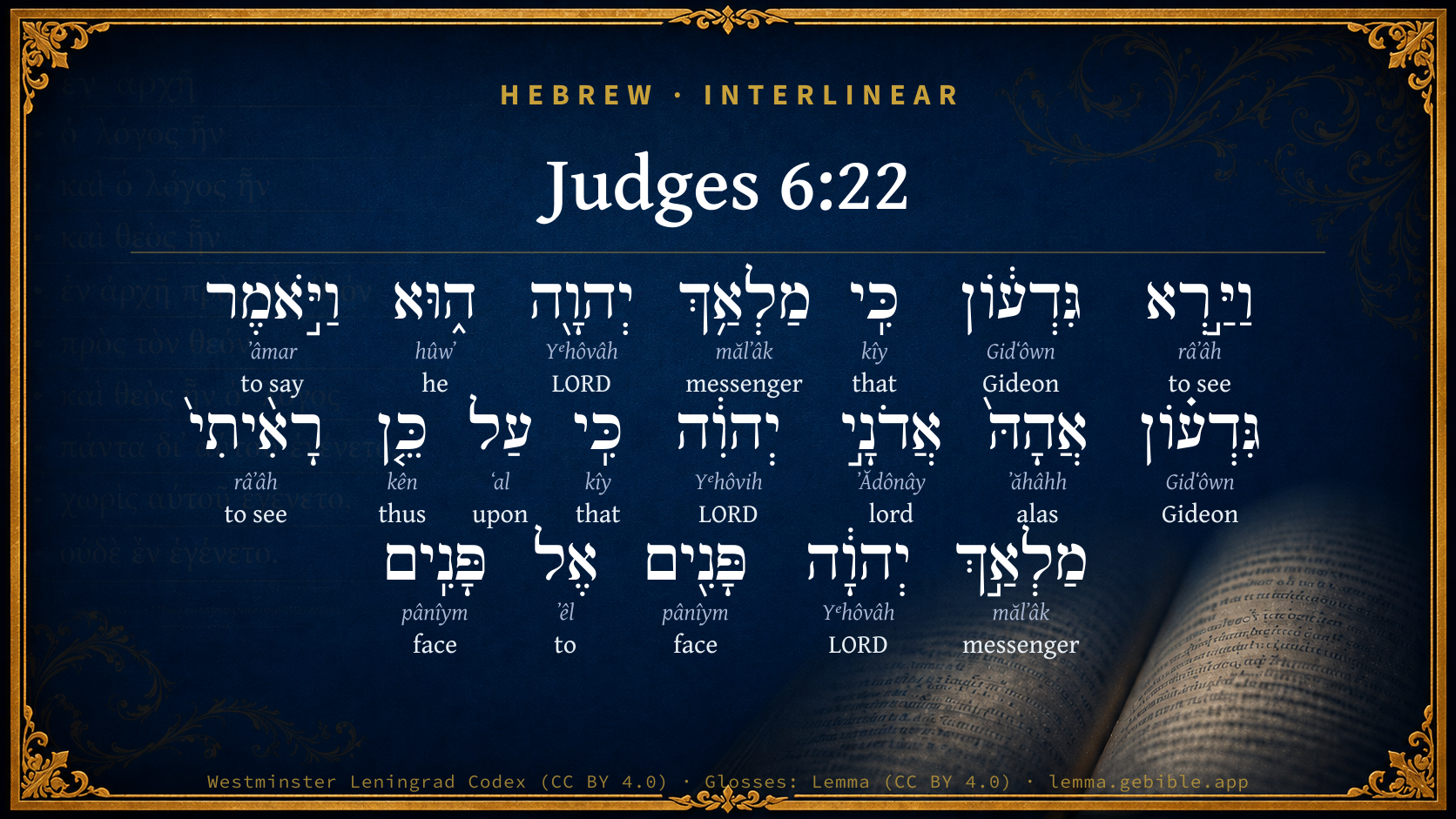
  1. וַיַּ֣רְא râʼâh H7200 “and · to see” Conjunction + Verb, Qal, Sequential Imperfect, 3rd Person, Masculine, Singular
  2. גִּדְע֔וֹן Gidʻôwn H1439 “Gideon” Noun, Proper
  3. כִּֽי kîy H3588 “that” Conjunction
  4. מַלְאַ֥ךְ mălʼâk H4397 “messenger of” Noun, Common, Masculine, Singular, Construct
  5. יְהוָ֖ה Yᵉhôvâh H3068 “LORD” Noun, Proper
  6. ה֑וּא hûwʼ H1931 “he” Pronoun, Personal, 3rd Person, Masculine, Singular
  7. וַיֹּ֣אמֶר ʼâmar H559 “and · to say” Conjunction + Verb, Qal, Sequential Imperfect, 3rd Person, Masculine, Singular
  8. גִּדְע֗וֹן Gidʻôwn H1439 “Gideon” Noun, Proper
  9. אֲדֹנָ֣י ʼĂdônây H136 “Lord · my” Noun, Common, Masculine, Plural, Construct + Suffix, Personal, 1st Person, Common, Singular
  10. יְהוִ֔ה Yᵉhôvih H3069 “LORD” Noun, Proper
  11. כִּֽי kîy H3588 “that” Conjunction
  12. עַל ʻal H5921 “upon” Preposition
  13. כֵּ֤ן kên H3651 “thus” Particle, Demonstrative
  14. רָאִ֨יתִי֙ râʼâh H7200 “to see” Verb, Qal, Perfect, 1st Person, Common, Singular
  15. מַלְאַ֣ךְ mălʼâk H4397 “messenger of” Noun, Common, Masculine, Singular, Construct
  16. יְהוָ֔ה Yᵉhôvâh H3068 “LORD” Noun, Proper
  17. פָּנִ֖ים pânîym H6440 “face(s)” Noun, Common, Both, Plural, Absolute
  18. אֶל ʼêl H413 “to” Preposition
  19. פָּנִֽים pânîym H6440 “face(s)” Noun, Common, Both, Plural, Absolute

About this verse

These counts appear in no published source. They are computed here, from the morphology-tagged text and Lemma’s own curated glosses. What Lemma adds →

20
words
14
distinct lemmas
Historical
section

Notable vocabulary

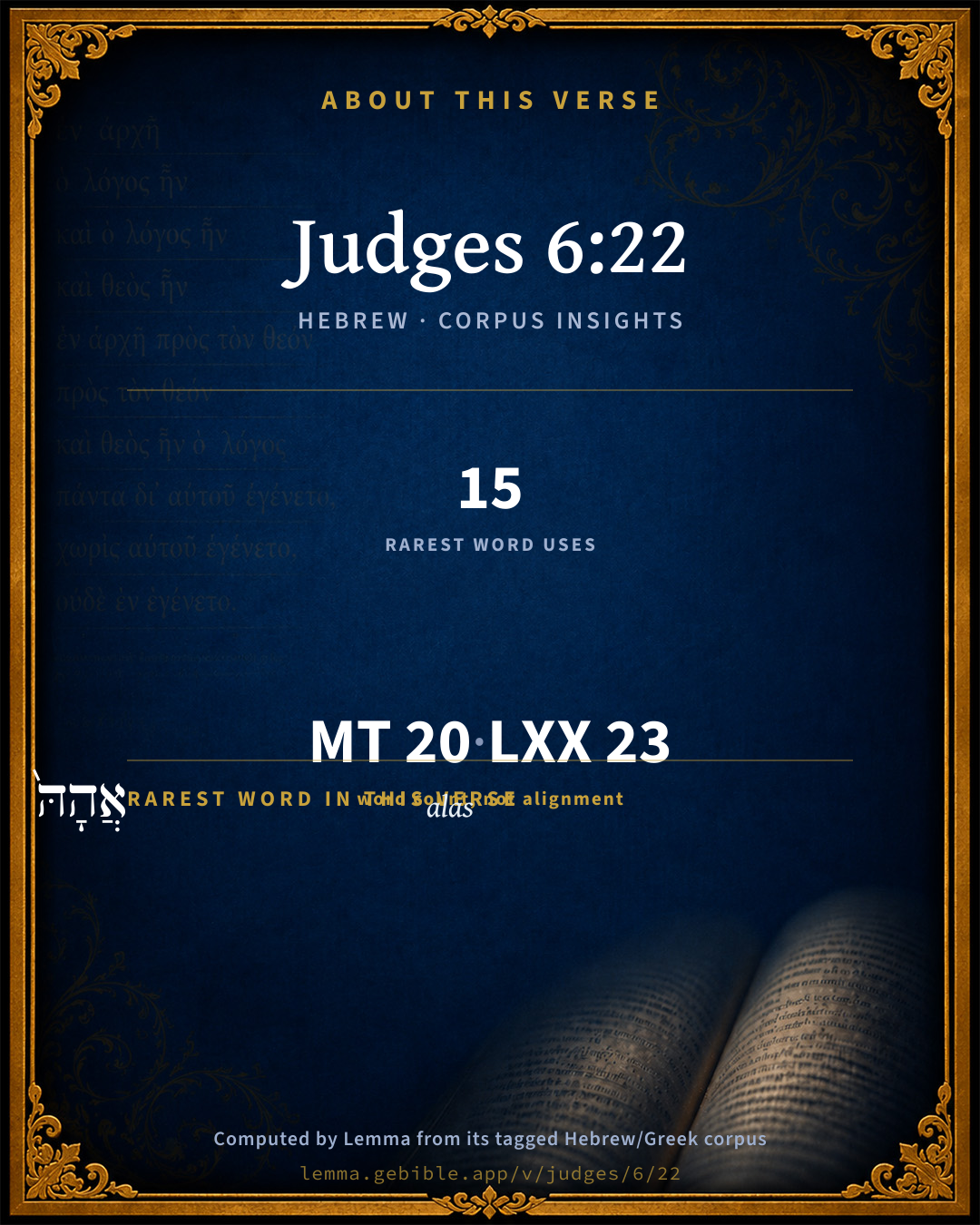
The rarest word here is אֲהָהּ֙ alas H162 — appearing just 15 times in the whole Hebrew Bible.

Shared distinctive vocabulary

אֲהָהּ֙ alas H162 occurs in 15 verses of the Hebrew Bible. Also found in:

Grammatical profile

  • 3 verbs
  • 10 nouns
  • 1 pronoun
  • 2 prepositions
  • 2 conjunctions
  • 2 particles

Verb forms

  • וַיַּ֣רְא Qal · Sequential Imperfect
  • וַיֹּ֣אמֶר Qal · Sequential Imperfect
  • רָאִ֨יתִי֙ Qal · Perfect

Repetition

Words recur within this verse — often emphatic in Hebrew:

  • וַיַּ֣רְא to see H7200 ×2
  • גִּדְע֔וֹן Gideon H1439 ×2
  • מַלְאַ֥ךְ messenger H4397 ×2
  • יְהוָ֖ה LORD H3068 ×2
  • פָּנִ֖ים face H6440 ×2
  • כִּֽי that H3588 ×2

Hebrew & Septuagint length

In English translation the verse runs 26 words from the Hebrew and 31 from the Septuagint (LXX English) — closely comparable.

A rough comparison of the two English renderings, which tokenize alike — not a word-level alignment.

Word counts can differ between the Hebrew and the Greek without any difference in meaning — e.g. the Hebrew direct-object marker אֵת has no separate Greek word, and Greek often adds the article ὁ.

In the original languages it is 20 Hebrew tokens and 23 Greek tokens — but the two are counted differently (Hebrew bundles its prefixes and suffixes into one token; the Greek is in lemma form), so that isn’t a like-for-like length.

Cross-references

10

Topical passages linked to Judges 6:22 in the Treasury of Scripture Knowledge — connected by theme and wording, ordered by reader-vote popularity; previews shown in the World English Bible.

  • Genesis 32:30 Jacob called the name of the place Peniel: for, he said, "I have seen God face to face, and my life is preserved."
  • Exodus 33:20 He said, "You cannot see my face, for man may not see me and live."
  • Deuteronomy 5:26 For who is there of all flesh, that has heard the voice of the living God speaking out of the midst of the fire, as we have, and lived?
  • John 1:18 No one has seen God at any time. The one and only Son, who is in the bosom of the Father, he has declared him.
  • Genesis 16:13 She called the name of Yahweh who spoke to her, "You are a God who sees," for she said, "Have I even stayed alive after seeing him?"
  • Deuteronomy 5:5 (I stood between Yahweh and you at that time, to show you the word of Yahweh: for you were afraid because of the fire, and didn't go up onto the mountain;) saying,
  • Deuteronomy 5:24 and you said, Behold, Yahweh our God has shown us his glory and his greatness, and we have heard his voice out of the midst of the fire: we have seen this day that God does speak with man, and he lives.
  • Judges 13:21–23 But the angel of Yahweh did no more appear to Manoah or to his wife. Then Manoah knew that he was the angel of Yahweh.
  • Isaiah 6:5–8 Then I said, "Woe is me! For I am undone, because I am a man of unclean lips, and I dwell in the midst of a people of unclean lips: for my eyes have seen the King, Yahweh of Hosts!"
  • John 12:41 Isaiah said these things when he saw his glory, and spoke of him.

Cross-references courtesy of OpenBible.info (CC BY 4.0).

Hebrew and Greek witnesses Masoretic Hebrew ↔ Greek Septuagint

The same verse in the two great witnesses to the Old Testament, shown verse-for-verse.

These are two independent witnesses, not word-aligned to each other, and the Septuagint is shown in lemma (dictionary) form.

Hebrew Judges 6:22 Masoretic · Westminster Leningrad Codex

וַיַּ֣רְא גִּדְע֔וֹן כִּֽי מַלְאַ֥ךְ יְהוָ֖ה ה֑וּא וַיֹּ֣אמֶר גִּדְע֗וֹן אֲהָהּ֙ אֲדֹנָ֣י יְהוִ֔ה כִּֽי עַל כֵּ֤ן רָאִ֨יתִי֙ מַלְאַ֣ךְ יְהוָ֔ה פָּנִ֖ים אֶל פָּנִֽים

Gideon saw that he was the angel of Yahweh; and Gideon said, Alas, Lord Yahweh! because I have seen the angel of Yahweh face to face.

World English Bible · Public Domain

Greek LXX Judges 6:22 Septuagint · lemma form

καί ὁράω γεδεων ὅτι ἄγγελος κύριος οὗτος εἰμί καί εἶπον γεδεων ἆ ἆ κύριος ἐγώ κύριος ὅτι ὁράω ἄγγελος κύριος πρόσωπον πρός πρόσωπον

And Gedeon saw that he was an angel of the Lord; and Gedeon said, Ah, ah, Lord my God! for I have seen the angel of the Lord face to face.

LXX2012 (modern English Septuagint) · Public Domain

Hebrew: Westminster Leningrad Codex (CC BY 4.0). Greek: Septuagint (public domain); English from LXX2012 (modern English Septuagint) (Public Domain). How the Septuagint differs from the Hebrew →

Targum (Aramaic paraphrase)

1

The Targum is the ancient Jewish Aramaic paraphrase of the Hebrew Scriptures — an interpretive translation, not the Hebrew text itself. Onkelos (literal) and Pseudo-Jonathan (expansive) render the Torah, and Jonathan the Prophets. Coverage is partial: where no permissively-licensed English translation exists for a verse, only the Aramaic is shown. This is verse-level text, not a word-by-word alignment to the Hebrew.

  1. Targum Jonathan Prophets (Joshua–Malachi)
    וַחֲזָא גִדְעוֹן אֲרֵי מַלְאָכָא דַייָ הוּא וַאֲמַר גִדְעוֹן בְּבָעוּ יְיָ אֱלֹהִים אֲרֵי עַל כֵּן חֲזֵיתִי מַלְאָכָא דַייָ אַפִּין בְּאַפִּין:

    (no public-domain English translation for this verse)

    Targum Jonathan — Aramaic: “Mikraot Gedolot” (public domain). English: “Sefaria Community Translation” (CC0 1.0 (public-domain dedication)); “London "Chaldee Paraphrase," 1871” (public domain). Text via Sefaria.

Commentary

Notes on Judges 6:22 from classic Christian and Jewish commentators (each source and its license shown beneath its notes). The classic Christian expositions comment on the surrounding passage and are grouped to its opening verse, so a note may address several verses; the Jewish commentaries on the Tanakh (Rashi and others) are per-verse, so they appear only where the commentator wrote on this verse.

Lemma curates 59 commentaries, every one of them public domain or Creative Commons licensed, each selected and text-cleaned for this edition rather than reprinted as found. About our sources →

Trapp's Complete Commentary

John Trapp

Jdg 6:22 And when Gideon perceived that he [was] an angel of the LORD, Gideon said, Alas, O Lord GOD! for because I have seen an angel of the LORD face to face.

Ver. 22. Alas, O Lord God!] Fasciculus temporum, A.D. 884, cries out in the words of this text, Heu, heu, Domine Deus! bittery bewailing the iniquities of those times.

For because I have seen an angel] And shall therefore doubtless die. But how then should he save Israel, as God had promised? Where was now his faith? Was this the "mighty man of valour?"

John Trapp, A Commentary or Exposition upon All the Books of the Old and New Testament (1647–1656) — public domain. Text from a community e-Sword module.

Adam Clarke's Commentary

Verse 22. Alas, O Lord God! for because I have seen] This is an elliptical sentence, a natural expression of the distressed state of Gideon's mind: as if he had said, Have mercy on me, O Lord God! else I shall die; because I have seen an angel of Jehovah face to face. We have frequently seen that it was a prevalent sentiment, as well before as under the law, that if any man saw God, or his representative angel he must surely die. On this account Gideon is alarmed, and prays for his life. This notion prevailed among the heathens, and we find an instance of it in the fable of Jupiter and Semele. She wished to see his glory; she saw it, and was struck dead by the effulgence. See the notes on Ex 33:20. We find that a similar opinion prevailed very anciently among the Greeks. In the hymn of Callimachus, Εις Λουτρα της Παλλαδος, ver. 100, are these words: -

Κρονιοι δ' ὡδε λεγοντι νομοι·

Ὁς κε τιν' αθανατων, ὁκα μη θεος αυτος ἑληται,

Αθρησῃ, μισθῳ τουτον ιδειν μεγαλῳ.

"The laws of Saturn enact, that if any man see any of the

immortal gods, unless that god himself shall choose it,

he shall pay dearly for that sight."

Adam Clarke's Commentary on the Bible (1810–1826) — public domain. Text from a community e-Sword/MySword module.

Ellicott's Commentary for English Readers

(22) When Gideon perceived.—The last sign gave him a deeper sense than before of the grandeur of the messenger who had come to him.

Alas !—There is no need to supply “I shall die” at the end of the clause, but that this was the apprehension in Gideon’s mind is shown by his cry of alarm.

For because.—Rather, for to this end. The belief that death or misfortune would be the result of looking on any Divine being was universal among the Jews. We find it in Jdg_13:22; Gen_16:13; Gen_32:30; Exo_20:19; Deu_5:24-25. He said, “Thou canst not see my face: for there shall no man see me, and live” (Exo_33:20; Isa_6:5; Luk_5:8). The existence of the same belief among the heathen is shown in the legends of Semele, Actæon, Psyche, &c.; and Callimachus sings, “Whosoever, save by God’s own choice, looks on any of the immortals, sees them only to his own great cost.”

A Bible Commentary for English Readers, edited by Charles John Ellicott (1878–1897) — public domain. Text from a community e-Sword module.

The Cambridge Bible for Schools and Colleges

gen. ed. J. J. S. Perowne

22. Now at last Gideon recognizes the nature of his Guest; he is overwhelmed with terror, for he has intruded upon the holiness of God, and death must be the penalty; cf. Jdg_13:22 and Gen_16:13; Gen_32:30, Exo_33:20 (all J), Deu_4:33; Deu_5:24; Deu_5:26, Isa_6:5.

The Cambridge Bible for Schools and Colleges (gen. ed. J. J. S. Perowne; Cambridge University Press, 1878–1918) — public domain. Text from a community e-Sword module.

John Gill's Exposition

And the Lord said unto him,.... Either by a secret impulse upon his spirit, or by a voice from heaven; and even, as Kimchi observes, the angel, after he ascended, might cause this voice to be heard, seeing him in great fear, because he knew he was an angel; and which is another proof of this angel being Jehovah himself, the eternal Word:

peace be unto thee, fear not, thou shall not die; let not thy mind be ruffled and disturbed, but serene and calm; fear not that any evil shall befall thee, and particularly death; thou shall be safe from any danger whatever, and especially from death, which he expected in his flight would immediately follow.

John Gill's Exposition of the Whole Bible (1746–1763) — public domain (CC PDM 1.0). Text via the HelloAO Bible API.

Albert Barnes' Notes on the Bible

Alas, O Lord GOD! - Compare Jos 7:7. “because I have seen an angel of the Lord” Compare the marginal references, in which the notion that it was death for mortal man to see God appears clearly. The same notion prevailed among the pagan.

Albert Barnes' Notes on the Bible (1834–1885) — public domain. Text from a community e-Sword/MySword module.

Haydock's Catholic Bible Commentary

Alas. He makes this exclamation, concluding that he should soon die, Exodus xxxiii. 20. Callimachus says that "it was a law of Saturn, that the man who saw an immortal, unless the god himself chose to shew him that favour, should pay dearly for it." (Grotius) --- This opinion was groundless; and it is wonderful that it should prevail among the Israelites, (Haydock) since so many had seen angels without receiving any harm. (Menochius)

George Leo Haydock (1774–1849), Haydock's Catholic Family Bible and Commentary, 1859 edition — public domain. Excludes Psalms (Douay-Rheims chapter numbering differs from Protestant) and Deuterocanonical books (Catholic canon only).

Matthew Poole's English Annotations

I am an undone man; I must die, and that speedily; for that he feared, Jdg 6:23, according to the common opinion in that case; of which see Gen 16:13; 32:30; Exo 33:20; Deu 5:25,26.

For because, or, for therefore, &c., i.e. therefore God hath showed me this sight as a presage of my death.

Matthew Poole's English Annotations on the Holy Bible (1683–1685) — public domain. Text from a community e-Sword/MySword module.

Whedon's Commentary on the Bible

Daniel D. Whedon

22. Because I have seen an angel — The wavering faith that asked for a sign now trembles and despairs because a sign is given. Gideon was awed and astonished at his divine commission to save Israel. To strengthen his faith he asked a sign, and so overwhelming in majesty and power was the sign granted that he trembled before it, and, forgetful of his divine commission, he began to fear that he must die. This whole narrative shows up Gideon as a man of sudden and strong emotions, yet unaspiring and simple, and honest in his modesty. Prevalent and strong was the conviction among the ancients that no man could behold the face of Jehovah and live. Compare Gen_32:30; Exo_33:20; Jdg_13:22.

Daniel D. Whedon (gen. ed.), Commentary on the Old and New Testaments (1874–1909) — public domain. Text from a community e-Sword module.

The Pulpit Commentary

Gideon perceived, etc. Gideon"s suspicious were now turned into a certainty. It was indeed God that had spoken to him by his angel (ver. 17). Alas, etc. Gideon speaks thus in terror of the death which he thought must be the penalty of seeing the angel of the Lord. (see Jud_1:13:22, and note) Because. Rather, therefore, or to this end, viz., that I should die.

Vers. 22-24. Jehovah Shalom, or spiritual forebodings stilled.

The religious experience of one is often of help to others. At all times has the commerce of man with the unseen taken place; it is a necessary element in his spiritual life. The test of true religion is the sentiment thus awakened.

I THE NATURAL FEAR OF GOD, AND ITS CAUSE. The sentiment expressed by Gideon a general one, but peculiar to Israelites. The Greek knew not this fear, because his conception of the nature of the gods was different. They were but as men, only more glorious and powerful. To the Israelite God was the Supreme in holiness and authority. Reverence for the character of God deepened into fear, because of the tradition that a visitation such as he now received meant death, either immediate or near at hand, and because of the sense of sin. No man could see God and live. We have the remnant and echoes of this belief still among us, in the fear of supernatural appearances and intimations. It is the dread of the simple, absolute holiness and goodness of God, deepened by our sense of sinfulness. The culprit trembles in presence of the judge. Had Israel rightly served God, this dread would have disappeared. Were men"s hearts right with him, they would welcome his presence and prize his visitations.

II THE WHISPER OF TRACE. It is a token of good-will. The terror which overcame the strong man is allayed. Christ gives a deeper tranquillity. He fills the breast with the sense of spiritual reconciliation peace of God which passeth all understanding." And this is felt in the trial hours of life, and in the agony of dying. It steadies and evens the spirit amidst the most afflicting circumstances. In conversion the fear of the sinner under conviction is often intense. But who shall tell the rapture when peace is found?

III THE MEMORIAL. HOW fitting that it should be commemorated, and by such a symbol! The altar is the meeting-place of man and God. The monument. The church. It told to others of an individual, secret transaction and experience. Here was won a victory over self, a triumph of duty more signal than Marathon, Bannock-burn, or Morgarten. It is well to tell men of God"s mercies to us; and this intimation was an eloquent appeal to men to draw near and receive a like blessing. M.

The Pulpit Commentary (1880–1919), ed. H.D.M. Spence-Jones & Joseph S. Exell — public domain. Text from a community e-Sword module.

John Wesley's Explanatory Notes

Alas - I am an undone man: I must die, and that speedily; for that he feared, ver. 23, according to the common opinion in that case.

John Wesley, Explanatory Notes Upon the Whole Bible (1754–1765) — public domain. Text via the GEBible commentary corpus.

Scofield Reference Notes

C. I. Scofield

angel

(See Scofield Heb 1:4).

The Scofield Reference Bible (1917 edition), notes by C. I. Scofield — public domain. Text from a community e-Sword module.

unfoldingWord translationNotes

Door43 World Missions Community

angel of Yahweh

In Jdg 6:11-24 Yahweh appears to Gideon in the form of an angel. See how you translated this in Judges 6:11.

Ah, Lord Yahweh!

The word "Ah" here shows that Gideon was very frightened. (See: Exclamations)

seen the angel of Yahweh face to face

This phrase refers to two people being close to each other. AT: "really seen the angel of Yahweh" (See: Idiom)

Yahweh said to him

Apparently Yahweh spoke to Gideon from heaven. (See: Assumed Knowledge and Implicit Information)

To this day

This means to the time when the book of Judges was written.

Ophrah

Translate the name of this town as you did in Judges 6:11.

the clan of Abiezer

Translate the name of this people group as you did in Judges 6:11.

translationWords

Gideon

angel

Yahweh

Lord Yahweh

face

peace

die

altar

unfoldingWord translationNotes — © Distant Shores Media and the Door43 World Missions Community, licensed CC BY-SA 4.0. Source: git.door43.org/Door43/en_tn.

Rashi

Rabbi Shlomo Yitzchaki (Rashi)

Aahha. This denotes apprehension, as if to say, "What will become of me?"

This, because I have seen. Because I have seen an angel of Adonoy—this is why I am apprehensive and exclaim "Aahha!"

Rashi on the Tanakh — English translations: “The Judaica Press complete Tanach with Rashi, translated by A. J. Rosenberg” (CC BY 4.0); “Pentateuch with Rashi's commentary by M. Rosenbaum and A.M. Silbermann, 1929-1934” (public domain); “The Metsudah Tanach series, Lakewood, N.J” (CC BY 4.0); and “The Book of Joshua, Metsudah Publications, 1997” (CC BY 4.0). Text via Sefaria.

Lesson kit

Teaching starters — assembled from the data on this page, not authored interpretation. Every prompt links to the verse data it draws on. Edit before teaching.

Judges, in the Historical, opens this verse with 20 words (14 distinct Hebrew lemmas). Its most distinctive word is ʼăhâhh (“alas”). A historical commentator’s framing appears above. Read the whole chapter for the surrounding context.

Discussion questions

  1. What does “alas” (ʼăhâhh) contribute to the verse as a whole?
  2. Joshua 7:7 shares the word «alas» with this verse. How do the two illuminate each other?
  3. “to see” occurs 2× in this one verse. What is the effect of the repetition?
  4. The translations on this page render this verse differently — a whole-verse word diff, not a word-by-word alignment. What might account for the different wordings?
  5. The verb «וַיַּ֣רְא» is Qal Sequential Imperfect. How does its form color the action?
  6. Reading how Trapp's Complete Commentary and Adam Clarke's Commentary read this verse, where do the two commentators agree and where do they part?

Things to notice

Reading settings

Reading text

Shown beneath each verse's original-language words.

Old Testament
Old Testament edition

Read the OT as the Masoretic Hebrew (MT) or the Greek Septuagint (LXX).

English shown for the Greek Septuagint (in the Hebrew ↔ Greek comparison).

Comparing translations? Open the Compare panel on any verse page to stack up to four side by side.