
Ezekiel 5:11

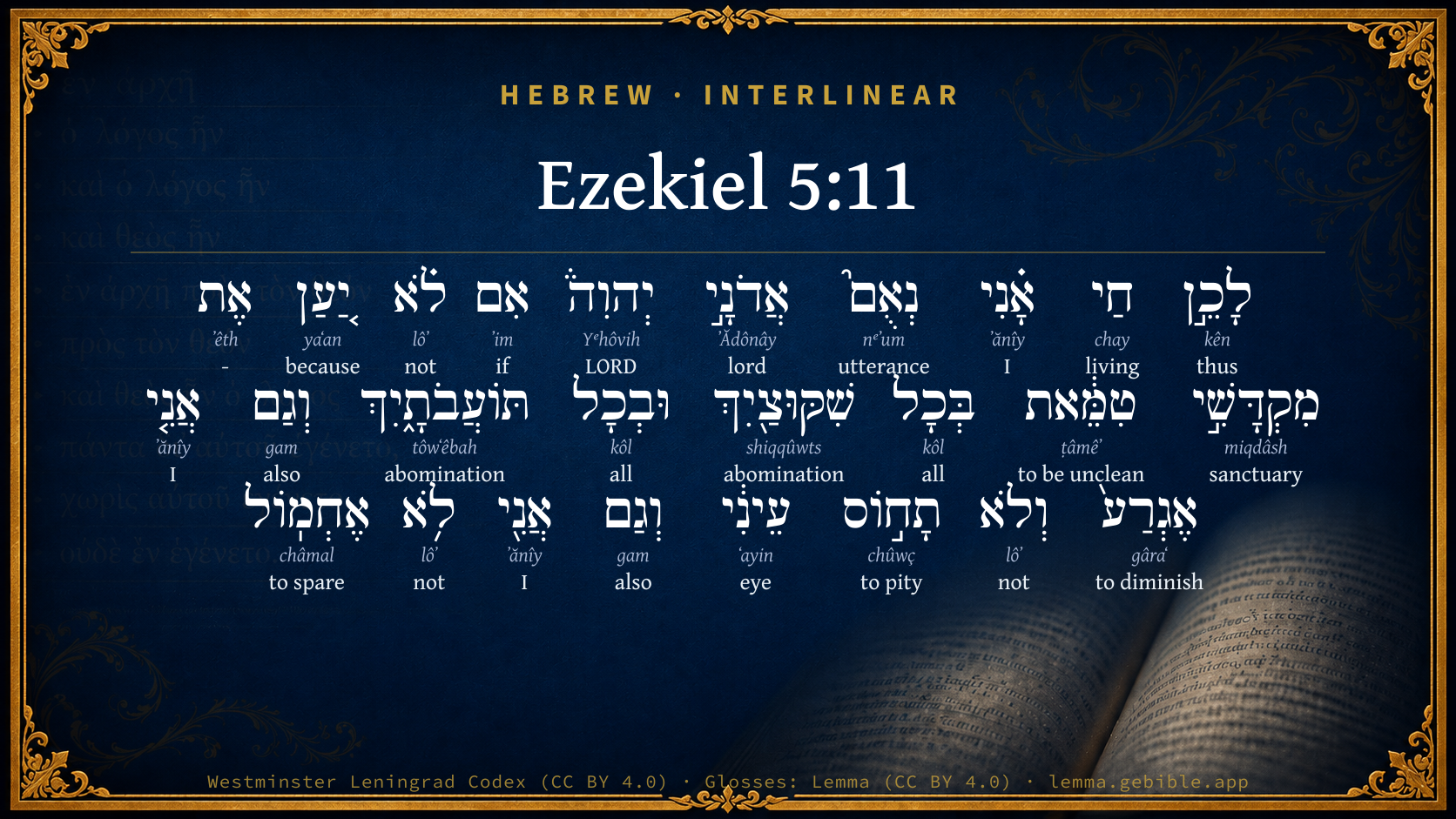
Hebrew (Westminster Leningrad Codex) Ezekiel 5:11 appears in the Hebrew Old Testament. The text above is from the Westminster Leningrad Codex. Each word links to its Strong’s number, a concise gloss, and parsing drawn from the Open Scriptures Hebrew Bible morphology. Click any word for its full Brown-Driver-Briggs (BDB) entry.
Download image
Cite this verse

Ezekiel 5:11 (World English Bible). Public Domain. Lemma interlinear Bible study tool, https://lemma.gebible.app/v/ezekiel/5/11.

Show BibTeX & RIS
BibTeX
RIS
English Translation
Therefore, as I live, says the Lord Yahweh, surely, because you have defiled my sanctuary with all your detestable things, and with all your abominations, therefore will I also diminish [you]; neither shall my eye spare, and I also will have no pity.
World English Bible · Public Domain
Download a study sheet

One document with this verse’s original text, its word-by-word gloss line, the meaning frame, cross-references with their text, attributed commentary, and full source and license credits — printable, and it pastes into notes with its structure intact.

This verse Autodidact and up

Study sheet (.html) Plain text (.txt)

A passage Seminary Student

Up to 50 verses in one chapter. A passage sheet keeps up to 6 commentary sources and 12 cross-references per verse, in the order this page ranks them, and says so on the sheet whenever that leaves anything out. Ask for a single verse and you get the Autodidact verse sheet above.

Everything on this page stays free to read, with no account — the sheet is a download of what is already on screen, not access to it.

Want to remove ads? Support Godless Engineer
Compare translations 3

The same verse in 3 English versions, stacked beneath the original-language interlinear above. Click any original word for its lexicon entry.

Each is an independent rendering of the whole verse — the interlinear is not word-aligned to these translations.

Highlighted words mark where these versions differ — a whole-verse word diff, not a word-by-word alignment.

  • World English Bible Public Domain
    Therefore, as I live, says the Lord Yahweh, surely, because you have defiled my sanctuary with all your detestable things, and with all your abominations, therefore will I also diminish [you]; neither shall my eye spare, and I also will have no pity.
  • King James Version Public Domain
    Wherefore, as I live, saith the Lord GOD; Surely, because thou hast defiled my sanctuary with all thy detestable things, and with all thine abominations, therefore will I also diminish thee; neither shall mine eye spare, neither will I have any pity.
  • unfoldingWord Literal Text CC BY-SA 4.0
    Therefore, as I live—this is the Lord Yahweh’s declaration—it is certainly because you have defiled my sanctuary with all your hateful things and with all your disgusting deeds, that I myself will reduce you in number; my eye will not have pity on you, and I will not spare you.

unfoldingWord Literal Text — © unfoldingWord, licensed CC BY-SA 4.0. Word-aligned USFM3 via Door43 (git.door43.org/unfoldingWord/en_ult).

Versions to compare (up to 4)

3 of 4 selected

Show all 18 translations

Every available English version of this verse, each an independent rendering of the whole verse.

  • World English Bible Public Domain
    Therefore, as I live, says the Lord Yahweh, surely, because you have defiled my sanctuary with all your detestable things, and with all your abominations, therefore will I also diminish [you]; neither shall my eye spare, and I also will have no pity.
  • Berean Standard Bible Public Domain
    Therefore as surely as I live, declares the Lord GOD, because you have defiled My sanctuary with all your detestable idols and abominations, I Myself will withdraw My favor; I will not look upon you with pity, nor will I spare you.
  • Majority Standard Bible Public Domain
    Therefore as surely as I live, declares the Lord GOD, because you have defiled My sanctuary with all your detestable idols and abominations, I Myself will withdraw My favor; I will not look upon you with pity, nor will I spare you.
  • King James Version Public Domain
    Wherefore, as I live, saith the Lord GOD; Surely, because thou hast defiled my sanctuary with all thy detestable things, and with all thine abominations, therefore will I also diminish thee; neither shall mine eye spare, neither will I have any pity.
  • American Standard Version (1901) Public Domain
    Wherefore, as I live, saith the Lord Jehovah, surely, because thou hast defiled my sanctuary with all thy detestable things, and with all thine abominations, therefore will I also diminish `thee'; neither shall mine eye spare, and I also will have no pity.
  • Revised Version (1885) Public Domain
    Wherefore, as I live, saith the Lord GOD, surely, because thou hast defiled my sanctuary with all thy detestable things, and with all thine abominations, therefore will I also diminish thee; neither shall mine eye spare, and I also will have no pity.
  • Geneva Bible (1599) Public Domain
    Wherefore, as I liue, saith the Lord God, Surely because thou hast defiled my Sanctuarie with all thy filthinesse, and with all thine abominations, therefore will I also destroy thee, neither shall mine eye spare thee, neither will I haue any pitie.
  • Douay-Rheims (1899) Public Domain
    Therefore as I live, saith the Lord God: Because thou hast violated my sanctuary with all thy offences, and with ail thy abominations: I will also break thee in pieces, and my eye shall not spare, and I will not have any pity.
  • Young's Literal Translation Public Domain
    Therefore, I live -- an affirmation of the Lord Jehovah: Because My sanctuary thou hast defiled, With all thy detestable things, And with all thine abominations, Mine eye pitieth not, and I also spare not. Do not even I also diminish?
  • Literal Standard Version CC BY-SA 4.0
    Therefore, [as] I live,” a declaration of Lord YHWH, || “Because you have defiled My sanctuary || With all your detestable things, || And with all your abominations, || Therefore I also diminish you, || And My eye does not pity, and I do not spare.
  • Unlocked Literal Bible CC BY-SA 4.0
    Therefore, as I live—this is the Lord Yahweh's declaration—it is certainly because you have defiled my sanctuary with all your hateful things and with all your disgusting deeds, that I myself will reduce you in number; my eye will not have pity on you, and I will not spare you.
  • unfoldingWord Literal Text CC BY-SA 4.0
    Therefore, as I live—this is the Lord Yahweh’s declaration—it is certainly because you have defiled my sanctuary with all your hateful things and with all your disgusting deeds, that I myself will reduce you in number; my eye will not have pity on you, and I will not spare you.
  • Darby Bible Public Domain
    Wherefore, [as] I live, saith the Lord Jehovah, verily because thou hast defiled my sanctuary with all thy detestable things, and with all thine abominations, therefore will I also withdraw mine eye, and it shall not spare, nor will I have any pity.
  • World Messianic Bible Public Domain
    Therefore as I live,’ says the Lord GOD, ‘surely, because you have defiled my sanctuary with all your detestable things, and with all your abominations, therefore I will also diminish you. My eye won’t spare, and I will have no pity.
  • Webster's Bible Public Domain
    Wherefore, as I live, saith the Lord GOD; Surely, because thou hast defiled my sanctuary with all thy detestable things, and with all thy abominations, therefore I will also diminish thee; neither shall my eye spare, neither will I have any pity.
  • Free Bible Version CC BY-SA 4.0
    As I live, declares the Lord God, because you have made my sanctuary unclean with all your offensive idols and disgusting practices, I will stop treating you well. I won't be kind to you—I won't show you any pity.
  • Bible in Basic English Public Domain
    For this cause, by my life, says the Lord, because you have made my holy place unclean with all your hated things and all your disgusting ways, you will become disgusting to me; my eye will have no mercy and I will have no pity.
  • JPS Tanakh (1917) Public Domain
    Wherefore, as I live, saith the Lord GOD, surely, because thou hast defiled My sanctuary with all thy detestable things, and with all thine abominations, therefore will I also diminish thee; neither shall Mine eye spare, and I also will have no pity.

Literal Standard Version (2020), Covenant Press — licensed CC BY-SA 4.0. Text via the HelloAO Bible API (eBible.org). Unlocked Literal Bible (unfoldingWord) — licensed CC BY-SA 4.0. Text via the HelloAO Bible API (eBible.org). unfoldingWord Literal Text — © unfoldingWord, licensed CC BY-SA 4.0. Word-aligned USFM3 via Door43 (git.door43.org/unfoldingWord/en_ult). Free Bible Version, Dr. Jonathan Gallagher — licensed CC BY-SA 4.0. Text via the HelloAO Bible API (eBible.org).

Word by word

More ways to search: Search by grammar → Find every occurrence → Compare this word →

Practice this passage: Drill this verse → Learn its vocabulary →

אֶגְרַע֙
gâraʻ
H1639
“to diminish”
Verb, Qal, Imperfect, 1st Person, Common, Singular
Part of Speech
Verb
Stem
Qal
Form
Imperfect
Person
1st Person
Gender
Common
Number
Singular
Full BDB Definition

Origin: a primitive root

TWOT: 384

to diminish, restrain, withdraw, abate, keep back, do away, take from, clip - (Qal) - to diminish - to restrain - to withdraw - (Niphal) - to be withdrawn - to be restrained - (Piel) to withdraw, draw up
  1. לָכֵ֣ן kên H3651 “to/for · thus” Preposition + Adverb
  2. חַי chay H2416 “living” Adjective, Adjective, Masculine, Singular, Absolute
  3. אָ֗נִי ʼănîy H589 “I” Pronoun, Personal, 1st Person, Common, Singular
  4. נְאֻם֮ nᵉʼum H5002 “utterance of” Noun, Common, Masculine, Singular, Construct
  5. אֲדֹנָ֣י ʼĂdônây H136 “Lord · my” Noun, Common, Masculine, Plural, Construct + Suffix, Personal, 1st Person, Common, Singular
  6. יְהוִה֒ Yᵉhôvih H3069 “LORD” Noun, Proper
  7. אִם ʼim H518 “if” Conjunction
  8. לֹ֗א lôʼ H3808 “not” Particle, Negative
  9. יַ֚עַן yaʻan H3282 “because” Conjunction
  10. אֶת ʼêth H853 “-” Particle, Direct Object
  11. מִקְדָּשִׁ֣י miqdâsh H4720 “sanctuary · my” Noun, Common, Masculine, Singular, Construct + Suffix, Personal, 1st Person, Common, Singular
  12. טִמֵּ֔את ṭâmêʼ H2930 “to be unclean” Verb, Piel, Perfect, 2nd Person, Feminine, Singular
  13. בְּכָל kôl H3605 “in/at · all of” Preposition + Noun, Common, Masculine, Singular, Construct
  14. שִׁקּוּצַ֖יִךְ shiqqûwts H8251 “abominations · your” Noun, Common, Masculine, Plural, Construct + Suffix, Personal, 2nd Person, Feminine, Singular
  15. וּבְכָל kôl H3605 “and · in/at · all of” Conjunction + Preposition + Noun, Common, Masculine, Singular, Construct
  16. תּוֹעֲבֹתָ֑יִךְ tôwʻêbah H8441 “abominations · your” Noun, Common, Feminine, Plural, Construct + Suffix, Personal, 2nd Person, Feminine, Singular
  17. וְגַם gam H1571 “and · also” Conjunction + Particle, Accusative
  18. אֲנִ֤י ʼănîy H589 “I” Pronoun, Personal, 1st Person, Common, Singular
  19. וְלֹא lôʼ H3808 “and · not” Conjunction + Particle, Negative
  20. תָח֣וֹס chûwç H2347 “to pity” Verb, Qal, Imperfect, 3rd Person, Feminine, Singular
  21. עֵינִ֔י ʻayin H5869 “eye · my” Noun, Common, Both, Singular, Construct + Suffix, Personal, 1st Person, Common, Singular
  22. וְגַם gam H1571 “and · also” Conjunction + Particle, Accusative
  23. אֲנִ֖י ʼănîy H589 “I” Pronoun, Personal, 1st Person, Common, Singular
  24. לֹ֥א lôʼ H3808 “not” Particle, Negative
  25. אֶחְמֽוֹל châmal H2550 “to spare” Verb, Qal, Imperfect, 1st Person, Common, Singular

About this verse

These counts appear in no published source. They are computed here, from the morphology-tagged text and Lemma’s own curated glosses. What Lemma adds →

26
words
20
distinct lemmas
Prophets
section

Notable vocabulary

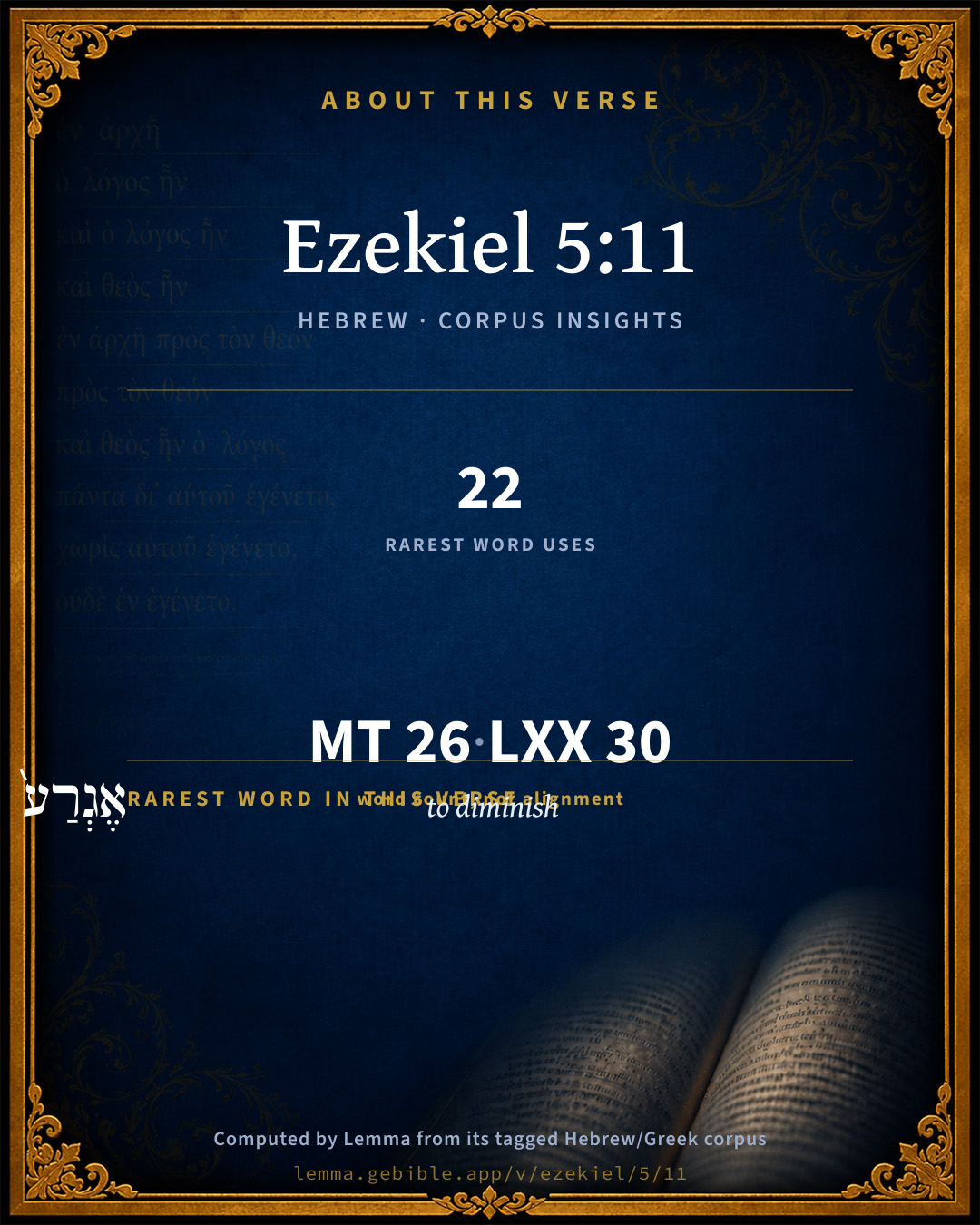
The rarest word here is אֶגְרַע֙ to diminish H1639 — appearing just 22 times in the whole Hebrew Bible.

Shared distinctive vocabulary

אֶגְרַע֙ to diminish H1639 occurs in 21 verses of the Hebrew Bible. Also found in:

Grammatical profile

  • 4 verbs
  • 9 nouns
  • 1 adjective
  • 3 pronouns
  • 2 conjunctions
  • 1 adverb
  • 6 particles

Verb forms

  • טִמֵּ֔את Piel · Perfect
  • אֶגְרַע֙ Qal · Imperfect
  • תָח֣וֹס Qal · Imperfect
  • אֶחְמֽוֹל Qal · Imperfect

Repetition

Words recur within this verse — often emphatic in Hebrew:

  • בְּכָל all H3605 ×2
  • וְגַם also H1571 ×2
  • אָ֗נִי I H589 ×3
  • לֹ֗א not H3808 ×3

Hebrew & Septuagint length

In English translation the verse runs 43 words from the Hebrew and 35 from the Septuagint (LXX English) — closely comparable.

A rough comparison of the two English renderings, which tokenize alike — not a word-level alignment.

Word counts can differ between the Hebrew and the Greek without any difference in meaning — e.g. the Hebrew direct-object marker אֵת has no separate Greek word, and Greek often adds the article ὁ.

In the original languages it is 26 Hebrew tokens and 30 Greek tokens — but the two are counted differently (Hebrew bundles its prefixes and suffixes into one token; the Greek is in lemma form), so that isn’t a like-for-like length.

Cross-references

39

Topical passages linked to Ezekiel 5:11 in the Treasury of Scripture Knowledge — connected by theme and wording, ordered by reader-vote popularity; previews shown in the World English Bible.

  • Ezekiel 7:20 As for the beauty of his ornament, he set it in majesty; but they made the images of their abominations [and] their detestable things therein: therefore have I made it to them as an unclean thing.
  • 2 Chronicles 36:14 Moreover all the chiefs of the priests, and the people, trespassed very greatly after all the abominations of the nations; and they polluted the house of Yahweh which he had made holy in Jerusalem.
  • Jeremiah 7:9–11 Will you steal, murder, and commit adultery, and swear falsely, and burn incense to Baal, and walk after other gods that you have not known,
  • Ezekiel 7:4 My eye shall not spare you, neither will I have pity; but I will bring your ways on you, and your abominations shall be in the midst of you: and you shall know that I am Yahweh.
  • Ezekiel 7:9 My eye shall not spare, neither will I have pity: I will bring on you according to your ways; and your abominations shall be in the midst of you; and you shall know that I, Yahweh, do strike.
  • Ezekiel 8:5–6 Then said he to me, Son of man, lift up your eyes now the way toward the north. So I lifted up my eyes the way toward the north, and see, northward of the gate of the altar this image of jealousy in the entry.
  • Ezekiel 11:18 They shall come there, and they shall take away all the detestable things of it and all the abominations of it from there.
  • Jeremiah 16:18 First I will recompense their iniquity and their sin double, because they have polluted my land with the carcasses of their detestable things, and have filled my inheritance with their abominations.
  • Lamentations 2:21 The youth and the old man lie on the ground in the streets; My virgins and my young men are fallen by the sword: You have killed them in the day of your anger; you have slaughtered, [and] not pitied.
  • Ezekiel 8:16 He brought me into the inner court of Yahweh's house; and see, at the door of the temple of Yahweh, between the porch and the altar, were about twenty-five men, with their backs toward the temple of Yahweh, and their faces toward the east; and they were worshipping the sun toward the east.
  • Ezekiel 8:18 Therefore will I also deal in wrath; my eye shall not spare, neither will I have pity; and though they cry in my ears with a loud voice, yet will I not hear them.
  • Ezekiel 9:5 To the others he said in my hearing, Go you through the city after him, and strike: don't let your eye spare, neither have you pity;
  • Ezekiel 9:10 As for me also, my eye shall not spare, neither will I have pity, but I will bring their way on their head.
  • Ezekiel 11:21 But as for them whose heart walks after the heart of their detestable things and their abominations, I will bring their way on their own heads, says the Lord Yahweh.
  • Ezekiel 24:14 I, Yahweh, have spoken it: it shall happen, and I will do it: I will not go back, neither will I spare, neither will I repent; according to your ways, and according to your doings, shall they judge you, says the Lord Yahweh.
  • Numbers 14:28–35 Tell them, As I live, says Yahweh, surely as you have spoken in my ears, so will I do to you:
  • Deuteronomy 7:25–26 The engraved images of their gods shall you burn with fire: you shall not covet the silver or the gold that is on them, nor take it to you, lest you be snared therein; for it is an abomination to Yahweh your God.
  • 2 Kings 21:4 He built altars in the house of Yahweh, of which Yahweh said, In Jerusalem will I put my name.
  • 2 Kings 21:7 He set the engraved image of Asherah, that he had made, in the house of which Yahweh said to David and to Solomon his son, In this house, and in Jerusalem, which I have chosen out of all the tribes of Israel, will I put my name forever;
  • 2 Kings 23:12 The altars that were on the roof of the upper chamber of Ahaz, which the kings of Judah had made, and the altars which Manasseh had made in the two courts of the house of Yahweh, did the king break down, and beat [them] down from there, and cast the dust of them into the brook Kidron.
  • 2 Chronicles 33:4 He built altars in the house of Yahweh, of which Yahweh said, In Jerusalem shall my name be forever.
  • 2 Chronicles 33:7 He set the engraved image of the idol, which he had made, in the house of God, of which God said to David and to Solomon his son, In this house, and in Jerusalem, which I have chosen out of all the tribes of Israel, will I put my name forever:
  • Psalms 95:11 Therefore I swore in my wrath, "They won't enter into my rest."
  • Psalms 107:39 Again, they are diminished and bowed down Through oppression, trouble, and sorrow.
  • Jeremiah 10:24 Yahweh, correct me, but in measure: not in your anger, lest you bring me to nothing.
  • Jeremiah 32:34 But they set their abominations in the house which is called by my name, to defile it.
  • Jeremiah 44:4 However I sent to you all my servants the prophets, rising up early and sending them, saying, Oh, don't do this abominable thing that I hate.
  • Ezekiel 23:28 For thus says the Lord Yahweh: Behold, I will deliver you into the hand of them whom you hate, into the hand of them from whom your soul is alienated;
  • Ezekiel 29:15 It shall be the base of the kingdoms; neither shall it any more lift itself up above the nations: and I will diminish them, that they shall no more rule over the nations.
  • Ezekiel 44:7 in that you have brought in foreigners, uncircumcised in heart and uncircumcised in flesh, to be in my sanctuary, to profane it, even my house, when you offer my bread, the fat and the blood, and they have broken my covenant, [to add] to all your abominations.
  • Amos 8:7 Yahweh has sworn by the pride of Jacob, "Surely I will never forget any of their works.
  • Zechariah 11:6 For I will no more pity the inhabitants of the land," says Yahweh; "but, behold, I will deliver the men everyone into his neighbor's hand, and into the hand of his king. They will strike the land, and out of their hand I will not deliver them."
  • Malachi 3:17 They shall be mine," says Yahweh of Hosts, "my own possession in the day that I make, and I will spare them, as a man spares his own son who serves him.
  • Romans 8:32 He who didn't spare his own Son, but delivered him up for us all, how would he not also with him freely give us all things?
  • Romans 11:12 Now if their fall is the riches of the world, and their loss the riches of the Gentiles; how much more their fullness?
  • Romans 11:21 for if God didn't spare the natural branches, neither will he spare you.
  • Hebrews 6:13 For when God made a promise to Abraham, since he could swear by none greater, he swore by himself,
  • 2 Peter 2:4–5 For if God didn't spare angels when they sinned, but cast them down to Tartarus, and committed them to pits of darkness, to be reserved to judgment;
  • Deuteronomy 29:20 Yahweh will not pardon him, but then the anger of Yahweh and his jealousy will smoke against that man, and all the curse that is written in this book shall lie on him, and Yahweh will blot out his name from under the sky.

Cross-references courtesy of OpenBible.info (CC BY 4.0).

Hebrew and Greek witnesses Masoretic Hebrew ↔ Greek Septuagint

The same verse in the two great witnesses to the Old Testament, shown verse-for-verse.

These are two independent witnesses, not word-aligned to each other, and the Septuagint is shown in lemma (dictionary) form.

Hebrew Ezekiel 5:11 Masoretic · Westminster Leningrad Codex

לָכֵ֣ן חַי אָ֗נִי נְאֻם֮ אֲדֹנָ֣י יְהוִה֒ אִם לֹ֗א יַ֚עַן אֶת מִקְדָּשִׁ֣י טִמֵּ֔את בְּכָל שִׁקּוּצַ֖יִךְ וּבְכָל תּוֹעֲבֹתָ֑יִךְ וְגַם אֲנִ֤י אֶגְרַע֙ וְלֹא תָח֣וֹס עֵינִ֔י וְגַם אֲנִ֖י לֹ֥א אֶחְמֽוֹל

Therefore, as I live, says the Lord Yahweh, surely, because you have defiled my sanctuary with all your detestable things, and with all your abominations, therefore will I also diminish [you]; neither shall my eye spare, and I also will have no pity.

World English Bible · Public Domain

Greek LXX Ezekiel 5:11 Septuagint · lemma form

διά οὗτος ζάω ἐγώ λέγω κύριος εἰ μή ἀντί ὅς ὁ ἅγιος ἐγώ μιαίνω ἐν πᾶς ὁ βδέλυγμα σύ καΐἐγώ ἀποὠθέω σύ οὐ φείδομαι ἐγώ ὁ ὀφθαλμός καΐἐγώ οὐ ἐλεέω

Therefore, as I live, says the Lord; surely, because you have defiled my holy things with all your abominations, I also will reject you; my eye shall not spare, and I will have no mercy.

LXX2012 (modern English Septuagint) · Public Domain

On this verse, The Pulpit Commentary discusses the Septuagint’s reading. Read the note in Commentary ↓

Hebrew: Westminster Leningrad Codex (CC BY 4.0). Greek: Septuagint (public domain); English from LXX2012 (modern English Septuagint) (Public Domain). How the Septuagint differs from the Hebrew →

Targum (Aramaic paraphrase)

1

The Targum is the ancient Jewish Aramaic paraphrase of the Hebrew Scriptures — an interpretive translation, not the Hebrew text itself. Onkelos (literal) and Pseudo-Jonathan (expansive) render the Torah, and Jonathan the Prophets. Coverage is partial: where no permissively-licensed English translation exists for a verse, only the Aramaic is shown. This is verse-level text, not a word-by-word alignment to the Hebrew.

  1. Targum Jonathan Prophets (Joshua–Malachi)
    בְּכֵן קַיָים אֲנָא אֲמַר יְיָ אֱלֹהִים אִם לָא חֲלַף דְמָקְדְשֵׁי סָאֵבְתְּ בְּכָל שִׁקוּצָיִךְ וּבְכָל תּוֹעֲבָתָיִךְ וְאַף אֲנָא אֶקְטוֹף תְּקוֹף דַרְעִיךְ וְלָא יָחוּס מֵימְרִי וְאַף אֲנָא לָא אֲרַחֵם:

    (no public-domain English translation for this verse)

    Targum Jonathan — Aramaic: “Mikraot Gedolot” (public domain). English: “Sefaria Community Translation” (CC0 1.0 (public-domain dedication)); “London "Chaldee Paraphrase," 1871” (public domain). Text via Sefaria.

Commentary

Notes on Ezekiel 5:11 from classic Christian and Jewish commentators (each source and its license shown beneath its notes). The classic Christian expositions comment on the surrounding passage and are grouped to its opening verse, so a note may address several verses; the Jewish commentaries on the Tanakh (Rashi and others) are per-verse, so they appear only where the commentator wrote on this verse.

Lemma curates 59 commentaries, every one of them public domain or Creative Commons licensed, each selected and text-cleaned for this edition rather than reprinted as found. About our sources →

Trapp's Complete Commentary

John Trapp

Eze 5:11 Wherefore, [as] I live, saith the Lord GOD; Surely, because thou hast defiled my sanctuary with all thy detestable things, and with all thine abominations, therefore will I also diminish [thee]; neither shall mine eye spare, neither will I have any pity.

Ver. 11. Wherefore, as I live, saith the Lord.] This is God’s usual oath (in this prophet especially), and therefore should not be used as an oath or asseveration by any other, since he only liveth (to speak properly).

Therefore will I also diminish thee.] Or, I will break thee down; or, I will shave thee. {as Eze 5:1 Jer 48:37}

John Trapp, A Commentary or Exposition upon All the Books of the Old and New Testament (1647–1656) — public domain. Text from a community e-Sword module.

The Biblical Illustrator

Joseph S. Exell

Eze_5:11

As I live, saith the Lord God.

The Divine oath

I. The form of the Divine oath. When men swear, they do it by the greater (Heb_6:16). God cannot do this. So He swears by Himself.

II. The use of the Divine oath. God utters His word clearly and plainly, calling on men to believe it. When they will not, He tries a new expedient, backing it up with an oath. Was ever grace more conspicuous, and forbearance more extraordinary?

III. Examples of the Divine oath.

1. The oath used in connection with the Priesthood of Christ (Psa_110:4, as interpreted in Heb_7:1-28).

2. The oath used in connection with the believers safety (Heb_7:17-18). Blessed safeguard!

3. The oath used in connection with the sincerity of the Gospel call (Eze_33:11). Must not God be terribly in earnest?

4. The oath used in connection with the ultimate triumph of the Christian cause (Isa_45:23). Can such a purpose be defeated? Encouraged by this, let the Church go forward.

5. The oath used in connection with the doom of the unbelieving (Psa_95:11). Then, Acquaint now thyself, etc. (Job_22:21). Believe on the Lord Jesus Christ, etc. (Act_16:31). (John Burnett, B. D.)

The Biblical Illustrator, edited by Joseph S. Exell (c. 1880s–1900s) — public domain. Text from a community e-Sword module.

Jamieson, Fausset & Brown

Robert Jamieson, A. R. Fausset & David Brown

as I five--the most solemn of oaths, pledging the self-existence of God for the certainty of the event.

defiled my sanctuary--the climax of Jewish guilt: their defiling Jehovah's temple by introducing idols.

diminish--literally "withdraw," namely, Mine "eye" (which presently follows), that is, My favors; Job 36:7 uses the Hebrew verb in the same way. As the Jews had withdrawn from God's sanctuary its sacredness by "defiling" it, so God withdraws His countenance from them. The significance of the expression lies in the allusion to Deu 4:2, "Ye shall not diminish aught from the word which I command you"; they had done so, therefore God diminishes them. The reading found in six manuscripts, "I will cut thee off," is not so good.

Jamieson, Fausset & Brown — Commentary Critical and Explanatory on the Whole Bible (1871) — public domain (CC PDM 1.0). Text via the HelloAO Bible API.

John Calvin's Commentaries

Here God again expresses more clearly why he was so eager to take vengeance namely, because the religion of the Jews was corrupt, and the Temple had been violated, as we shall see to-morrow.

John Calvin's Commentaries (1540-1563) — public domain. Text from the Calvin Translation Society English edition (1840s-50s) via the Christian Classics Ethereal Library (ccel.org). Calvin's coverage is partial (roughly two-thirds of the Bible); uncommented books and verses are honest gaps, never fabricated. The 19th-century editor's footnotes and remarks are omitted so the notes are faithfully Calvin's own voice.

Ellicott's Commentary for English Readers

(11) Because thou . . . therefore will I.—The parallel between Israel’s conduct and God’s judgments is here, as everywhere, brought into strong light. God would inflict no evil upon them which they had not themselves called down by their obdurate and infatuated persistence in rebellion against Him.

Also diminish thee.—The word diminish is hardly an adequate translation of the original, and the pronoun thee is not in the Hebrew. The word properly means to withdraw, and is to be taken either as reflective, “withdraw myself,” or as having for its object “mine eye” of the following clause, the sense being the same in either case: the Lord will withdraw from them His presence and His compassion.

Eze_5:12-17 follow in plain language the symbolical prophecies of Eze_5:1-4, and give the inspired interpretation of their meaning. They bring out very distinctly the fact that the judgments should not end with the destruction of Jerusalem.

A Bible Commentary for English Readers, edited by Charles John Ellicott (1878–1897) — public domain. Text from a community e-Sword module.

The Cambridge Bible for Schools and Colleges

gen. ed. J. J. S. Perowne

11. defiled my sanctuary] The commentary on this is supplied by ch. 8.

will I also diminish thee] The word is so rendered ch. Eze_16:27, where, however, an object follows the verb. The balance of clauses here: I also will—and mine eye shall not spare: I also will not pity, appears to shew that the word expresses one idea along with the words “mine eye shall not spare.” This can hardly be expressed otherwise than: I also will withdraw mine eye and it shall not spare; I also will have no pity. For the phrase “withdraw the eye” cf. Job_36:7. In ch. Eze_24:14 a similar word occurs, but there with the negative. Targ. Vulg. render “hew down,” but this kind of reading (d for r) is too familiar to be of any value. Perhaps the reading might be: I also am against thee and mine eye shall not spare, (form of “against thee” as Eze_21:8, cf. here Eze_5:8). Cf. ch. Eze_8:18.

The Cambridge Bible for Schools and Colleges (gen. ed. J. J. S. Perowne; Cambridge University Press, 1878–1918) — public domain. Text from a community e-Sword module.

John Gill's Exposition

Wherefore, as I live, saith the Lord God,.... This is a form of an oath, and shows that what is after said should certainly be done; God would not repent of it, nor revoke it:

surely, because thou hast defiled my sanctuary, with all thy detestable things, and with all thine abominations: that is, with their idols and idolatrous worship, which were detestable and abominable to the Lord; so Manasseh not only built altars for Baal in the house of the Lord, but set up in it a graven image of the grove, Kg2 21:3;

therefore will I also diminish thee; as they lessened his glory by such abominable actions, so he threatens that he would lessen their privileges and blessings; as they took away from him the worship and honour that were due to him, so he would take away from them their civil and church state, his sanctuary, word, and ordinances, and deprive them of everything that was valuable and excellent. The Targum paraphrases it,

"I will cut off the strength of thine arm;''

weaken her power:

neither shall mine eye spare, neither will I have any pity; when in the greatest misery and distress. The Targum is,

"my Word shall not spare, &c.''

John Gill's Exposition of the Whole Bible (1746–1763) — public domain (CC PDM 1.0). Text via the HelloAO Bible API.

Matthew Poole's English Annotations

As I live; a form of an oath becoming none but the living God, used often in Scripture and in this prophet.

Defiled; violated and profaned.

My sanctuary; my temple.

With all thy detestable things; not that all they did abominably was done in the temple; but either because they never heeded how they were polluted, but with legal pollutions on them came to the temple; or rather, brought in their idols, all their detestable counterfeit gods, as Jer 7:30, and, in 2Ki 16:10; 23:12,13, their own altars, as Ahaz and Manasseh. All their idolatry and wickednesses, expressed by two words of like emphasis.

Diminish; lessen, break to pieces, cut up by the roots such stinking weeds.

Neither shall mine eye spare; there shall not be the least sign of pity in my eye, though I see all their misery.

Neither will I have pity; nor yet will I retain any affection of kindness for them; my heart, as my eye, shall be far from all pity and commiseration towards them.

Matthew Poole's English Annotations on the Holy Bible (1683–1685) — public domain. Text from a community e-Sword/MySword module.

Whedon's Commentary on the Bible

Daniel D. Whedon

11. Detestable things,… abominations — These are the objects of their idolatrous worship (chap. 8). It is because of their willful and persistent insults, even in his own temple, that Jehovah declares, Therefore will I also withdraw (my glory, Eze_10:18); neither shall mine eye spare, etc. The constant reiteration of the threat shows how the heart of Jehovah longed to do differently, and how, according to the speech of men, he needed to constantly reiterate his determination to execute the full penalty of this great sin. The calls to repentance and quick offers of forgiveness show how lovingly a cry for mercy would have been heard, if the threatening had awakened the people to penitence and reformation (Jon_3:10; Eze_33:11).

Diminish — Literally, withdraw. Smend translates “withdraw (thy needs);” Davidson, “I will withdraw (mine eye);” Toy, “I will deal furiously.” By a slight change the word can mean “hew down.” Plumptre holds to the Authorized Version and explains by Eze_16:27.

Daniel D. Whedon (gen. ed.), Commentary on the Old and New Testaments (1874–1909) — public domain. Text from a community e-Sword module.

The Pulpit Commentary

Because thou hast defiled my sanctuary, etc. For the full account of the nature of the abominations which are thus spoken of, see notes on ch. 8. This was, after all, the root evil of all other evils. Pollution of worship, the degradation of the highest element in man"s nature, passed into pollution and degradation of his whole life. Even in our Lord"s acted teaching, in Joh_2:15, 16 and Mat_21:12, we have the same principle implied. Therefore will I also diminish thee, etc. The italics show that the last word is not in the Hebrew. The Revised Version margin suggests two other renderings.

(1) Therefore will I also withdraw mine eye that it shall not spare; and

(2) Therefore will I hew thee down. To these we may add the LXX I will reject, and the Vulgate I will break in pieces, which apparently, like (2), imply a different reading. Most recent critics suggest conjectural emendations of the text. I incline to rest satisfied with the Authorized Version, and to explain it by Eze_16:27. The word implies not only the decrease, but the entire withdrawal of Jehovah"s favour. Possibly there is an implied reference to the command of Deu_4:2 Deu_12:32. Jerusalem had "diminished" from the Law of God, had, as it were, erased the commandments which were of supreme obligation, and therefore, as by a lex talionis, God would diminish her. Neither will I have any pity. The words are, of course, anthropomorphic, and have therefore to be received with the necessary limitations. As the earthly minister of justice must not yield to a weak pity which would be incompatible with the assertion of the eternal law of righteousness, so neither will the Supreme Judge. There is a time for all things, and justice must do its work first, in order that there may be room for pity afterwards. For other assertions, which seems strange to us, of trials unpitying character of God, see Eze_7:4, 9 8:18 9:10, et al.; 2Ki_17:25) But even before the exile, war, famine, and plague reduced the population. Professor Seeley has shown that the chief cause of the overthrow of Rome by the Teutonic invaders was the great depopulating of Italy that took place under the empire. France is now threatened by decreasing population. The strength of a nation is in its people more than in its wealth.

II GLORY IS DIMINISHED. Instead of the growth of honour and fame among the nations which was seen under Solomon, the Hebrew nation is now to shrink in importance, and so to fall into a position of insignificance. This has happened to Greece, Rome, Spain, Holland. It may happen to England. We have no assurance that our proud British flag shall always float in glory. For our national sins God may permit it to be trampled in the mire.

III POWER IS DIMINISHED. In regard to national movements this runs parallel with the previous thought, but in individuals it has a wider scope. The final punishment of sin is death. The prior penalties of sin are dying, i.e. a reduction of spiritual life, activity, and power. The once fruitful tree is now barren. He who was most successful in spiritual work now feels himself failing in all he attempts. His influence shrinks into insignificance. Sin has paralyzed his soul.

IV THE VISION OF TRUTH IS DIMINISHED. Doubts succeed to the formerly growing knowledge of truth. The eyes of the soul become dim. God, who was once near, seems to withdraw himself into the darkness. The whole spiritual world, which had shone on the soul in full-orbed splendors, wanes and fades, and passes in gloom out of sight. The things unseen and eternal, which had been the very universe of existence, melt into vague shadows, and float out of consciousness like the summer clouds that disappear while we gaze at them.

V THE JOY OF SPIRITUAL EXPERIENCE IS DIMINISHED. That joy can only be bright when the soul"s life is fresh and strong. A dull apathy comes with the reduced spirituality. A very weariness succeeds to the old earnest gladness of service. The May time of the soul has gone, and a November gloom has taken its place.

CONCLUSION. There is hope still. Diminution is not extinction. The tree is hewn down, but the stump may sprout. (Isa_6:13) The Jews diminished by Nebuchadnezzar were restored under Cyrus. It is good in some way to feel diminution if pride is thereby also diminished. In the humility of shame the penitent may hope for his restoration to a new and more sound vigour by the merciful Saviour, who will not break the bruised reed nor quench the smoking flax. (Isa_42:3)

Vers. 11-17. The Divine Remonstrator.

It is clear as daylight that the root sin of the Jews was unbelief. Although the prophets of Jehovah brought incontestable evidence that they spake in God"s Name, and spake only words of truth, the people closed their ears, and treated the warning with contempt. They were in love with sin, and were resolved not to part from it. Proofs that God spake through the lips of these prophets were abundant.

I THERE WAS THE REPEATED ASSERTION OF HONEST MEN THAT GOD SPAKE BY THEM. Ezekiel was known to be a true man. It was known that he had no private interests to serve. It was acknowledged that in all the relations of human life he was honourable and faithful. He was known to be a devout man, a man of prayer. What other explanation, therefore, could men put upon his earnest, heart-stirring appeals than that God spoke by him? If his reproof of sin was true, then God spoke through him. If he made known the might and righteousness of Jehovah, Jehovah spoke through him. If his purpose was to deter from sin and induce repentance, it was evident to every honest mind that it was true, as Ezekiel said, "I the Lord have spoken it!

II THE PARTICULARIZATION OF COMING JUDGMENTS PROVED THAT THE MESSENGER SPAKE IN GOD"S NAME. The retribution was not announced in vague, general terms. There was revealed a wise discrimination in dealing out judgment to wrong doers. "A third part shall die with the pestilence;" "A third part shall fall by the sword;" "I will scatter a third part into all the winds." Severe as the threatening was, there was nothing improbable or unnatural in it. Pestilence was a common disaster, and if a hundred families, now and again, were carried off by its virulence, why may not a third of the nation? So with famine; so with the sword. In a time of severe drought, famine and pestilence often went hand in hand. The flower of the nation being destroyed, some martial neighbour would gladly seize the opportunity for invasion. Resistance would end in terrible defeat; and, for the residue, banishment was decreed. Both man and nature are the servants of God; often are they combined to execute his will. If we escape one minister of vengeance, it is only to be overtaken by another.

III THE REVEALED PURPOSE OF THE RETRIBUTION WAS TO SATISFY GOD"S RIGHTEOUSNESS. "Then shall mine anger be comforted." God accommodates himself, in his speech, to the manners of men. There can be no rest for him so long as guilt stalks abroad unpunished. There is disturbance in his moral universe. There is pain in every loyal angel"s breast. Fallen spirits are encouraged in their rebellion. The moral force of law is weakened. His own veracity is at stake while sin is unpunished. Therefore, to maintain the interests of universal justice, to maintain in tranquillity his own throne, to uphold order everywhere, sin must be stamped out. There is disease in the system, and no rest can be enjoyed until health be restored. The principles and attributes of God"s nature can only then settle into complete harmony when sin is chastised.

IV THE EVIDENT INTENTION OF THE REMONSTRANCE PROVED THAT IT WAS FROM GOD. "I the Lord have spoken it." No sane mind could doubt that the motive of such repeated remonstrance was love wise and far reaching love. The ancient Greeks had a proverb, "The gods have feet of wool." They were supposed to overtake men noiselessly and without warning. Not so Jehovah. In his most severe retributions kindness is yet manifest. Faithful expostulation and tearful warning precede final destruction. The good of his creatures is a superlative motive in his bosom a motive that reigns side by side with the maintenance of law. If the good of the sinner himself be hopeless, then the good of others is sought. These earnest pleadings with men declare most emphatically his condescension, his patience, his self-sacrificing love. This is not after the manner of men. If offenders against God would only reflect, they would confess that such remonstrance was a remonstrance of eternal Love the counsel of the living God. D.

The Pulpit Commentary (1880–1919), ed. H.D.M. Spence-Jones & Joseph S. Exell — public domain. Text from a community e-Sword module.

John Wesley's Explanatory Notes

Sanctuary - My temple. Detestable things - Thy idols.

John Wesley, Explanatory Notes Upon the Whole Bible (1754–1765) — public domain. Text via the GEBible commentary corpus.

unfoldingWord translationNotes

Door43 World Missions Community

General Information:

Yahweh continues to speak to the people of Israel and Judah.

as I live

"as surely as I am alive." Yahweh uses this expression to show that what he says next is certainly true. This is a way of making a solemn promise. AT: "I solemnly swear" (See: Idiom)

this is the Lord Yahweh's declaration

Yahweh speaks of himself by name to express the certainty of what he is declaring. AT: "this is what the Lord Yahweh has declared" or "this is what I, the Lord Yahweh, have declared" (See: First, Second, or Third Person)

Lord Yahweh

See how you translated this in Ezekiel 2:4.

defiled ... sanctuary

ruined the place that Yahweh had set aside to be only for his use

with all your hateful things

"with all of those things of yours that I hate." You may need to make explicit that this refers to idols: "with all your idols, which I hate" or "with all your disgusting idols." (See: Assumed Knowledge and Implicit Information)

with all your disgusting deeds

"with all the disgusting things that you do"

my eye will not have pity on you

The eye is a synecdoche for the person whose eye it is. AT: "I will not pity you" (See: and Synecdoche)

I will not spare you

"I will surely punish you"

they will be consumed by famine in your midst

"many of them will die because of famine"

translationWords

life

Lord Yahweh

declare

defile

sanctuary

die

plague

famine

sword

unfoldingWord translationNotes — © Distant Shores Media and the Door43 World Missions Community, licensed CC BY-SA 4.0. Source: git.door43.org/Door43/en_tn.

Lesson kit

Teaching starters — assembled from the data on this page, not authored interpretation. Every prompt links to the verse data it draws on. Edit before teaching.

Ezekiel, in the Prophets, opens this verse with 26 words (20 distinct Hebrew lemmas). Its most distinctive word is gâraʻ (“to diminish”). A historical commentator’s framing appears above. Read the whole chapter for the surrounding context.

Discussion questions

  1. The word gâraʻ carries the sense “to diminish.” How does it shape the verse?
  2. Exodus 5:8 shares the word «to diminish» with this verse. How do the two illuminate each other?
  3. “all” occurs 2× in this one verse. What is the effect of the repetition?
  4. The translations on this page render this verse differently — a whole-verse word diff, not a word-by-word alignment. What might account for the different wordings?
  5. The verb «טִמֵּ֔את» is Piel Perfect. How does its form color the action?
  6. Reading how Trapp's Complete Commentary and The Biblical Illustrator read this verse, where do the two commentators agree and where do they part?

Things to notice

Reading settings

Reading text

Shown beneath each verse's original-language words.

Old Testament
Old Testament edition

Read the OT as the Masoretic Hebrew (MT) or the Greek Septuagint (LXX).

English shown for the Greek Septuagint (in the Hebrew ↔ Greek comparison).

Comparing translations? Open the Compare panel on any verse page to stack up to four side by side.