Isaiah 22:14

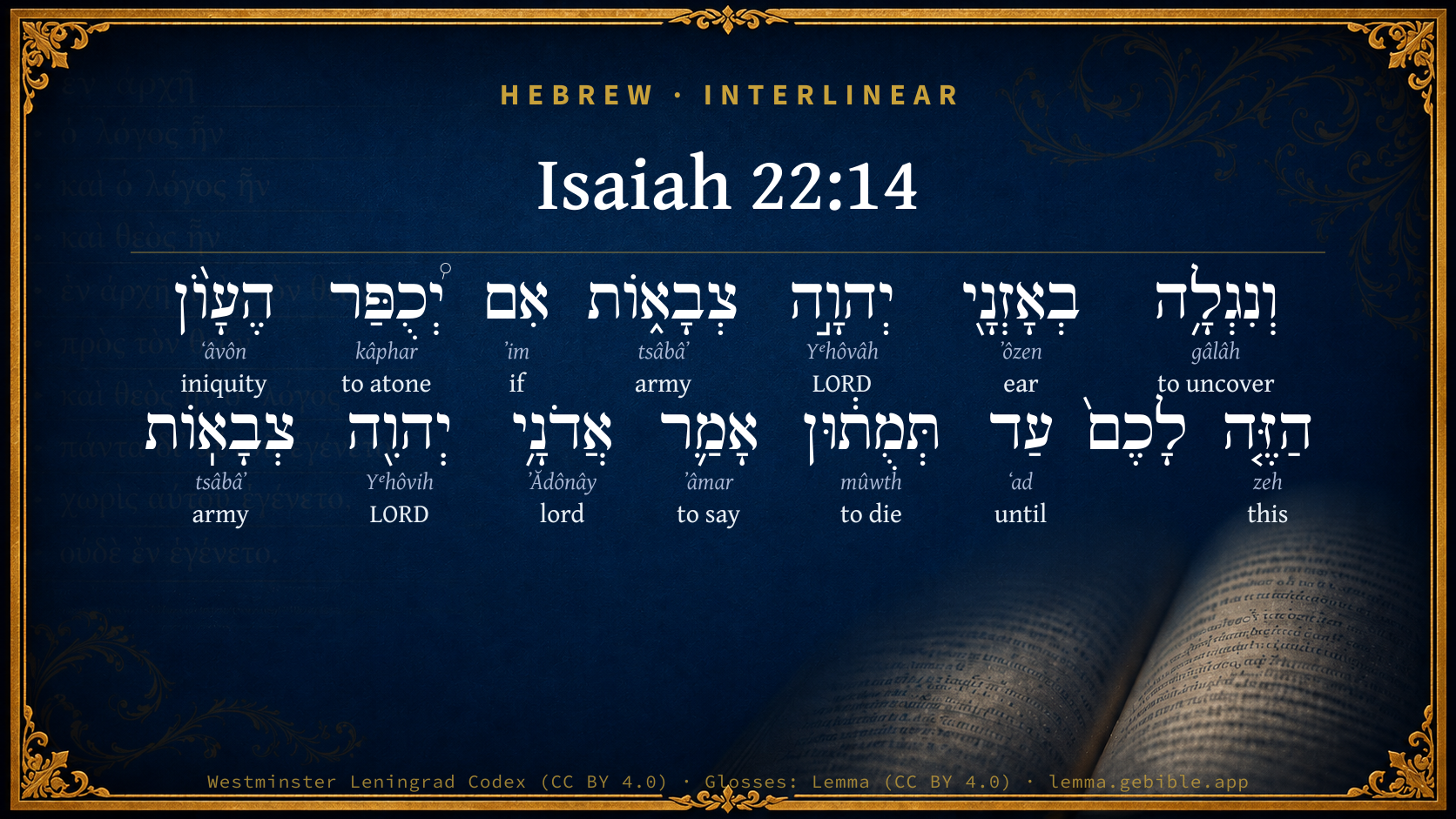
Hebrew (Westminster Leningrad Codex) Isaiah 22:14 appears in the Hebrew Old Testament. The text above is from the Westminster Leningrad Codex. Each word links to its Strong’s number, a concise gloss, and parsing drawn from the Open Scriptures Hebrew Bible morphology. Click any word for its full Brown-Driver-Briggs (BDB) entry.
Download image
Cite this verse

Isaiah 22:14 (World English Bible). Public Domain. Lemma interlinear Bible study tool, https://lemma.gebible.app/v/isaiah/22/14.

Show BibTeX & RIS
BibTeX
RIS
English Translation
Yahweh of Hosts revealed himself in my ears, Surely this iniquity shall not be forgiven you until you die, says the Lord, Yahweh of Hosts.
World English Bible · Public Domain
Download a study sheet

One document with this verse’s original text, its word-by-word gloss line, the meaning frame, cross-references with their text, attributed commentary, and full source and license credits — printable, and it pastes into notes with its structure intact.

This verse Autodidact and up

Study sheet (.html) Plain text (.txt)

A passage Seminary Student

Up to 50 verses in one chapter. A passage sheet keeps up to 6 commentary sources and 12 cross-references per verse, in the order this page ranks them, and says so on the sheet whenever that leaves anything out. Ask for a single verse and you get the Autodidact verse sheet above.

Everything on this page stays free to read, with no account — the sheet is a download of what is already on screen, not access to it.

Want to remove ads? Support Godless Engineer
Compare translations 3

The same verse in 3 English versions, stacked beneath the original-language interlinear above. Click any original word for its lexicon entry.

Each is an independent rendering of the whole verse — the interlinear is not word-aligned to these translations.

Highlighted words mark where these versions differ — a whole-verse word diff, not a word-by-word alignment.

  • World English Bible Public Domain
    Yahweh of Hosts revealed himself in my ears, Surely this iniquity shall not be forgiven you until you die, says the Lord, Yahweh of Hosts.
  • King James Version Public Domain
    And it was revealed in mine ears by the LORD of hosts, Surely this iniquity shall not be purged from you till ye die, saith the Lord GOD of hosts.
  • unfoldingWord Literal Text CC BY-SA 4.0
    And it was revealed in my ears Yahweh of Armies, “If this iniquity will be covered for you until you die!”—said the Lord, Yahweh of Armies.

unfoldingWord Literal Text — © unfoldingWord, licensed CC BY-SA 4.0. Word-aligned USFM3 via Door43 (git.door43.org/unfoldingWord/en_ult).

Versions to compare (up to 4)

3 of 4 selected

Show all 18 translations

Every available English version of this verse, each an independent rendering of the whole verse.

  • World English Bible Public Domain
    Yahweh of Hosts revealed himself in my ears, Surely this iniquity shall not be forgiven you until you die, says the Lord, Yahweh of Hosts.
  • Berean Standard Bible Public Domain
    The LORD of Hosts has revealed in my hearing: “Until your dying day, this sin of yours will never be atoned for,” says the Lord GOD of Hosts.
  • Majority Standard Bible Public Domain
    The LORD of Hosts has revealed in my hearing: “Until your dying day, this sin of yours will never be atoned for,” says the Lord GOD of Hosts.
  • King James Version Public Domain
    And it was revealed in mine ears by the LORD of hosts, Surely this iniquity shall not be purged from you till ye die, saith the Lord GOD of hosts.
  • American Standard Version (1901) Public Domain
    And Jehovah of hosts revealed himself in mine ears, Surely this iniquity shall not be forgiven you till ye die, saith the Lord, Jehovah of hosts.
  • Revised Version (1885) Public Domain
    And the LORD of hosts revealed himself in mine ears, Surely this iniquity shall not be purged from you till ye die, saith the Lord, the LORD of hosts.
  • Geneva Bible (1599) Public Domain
    And it was declared in ye eares of the Lord of hostes. Surely this iniquitie shall not be purged from you, til ye die, saith the Lord God of hostes.
  • Douay-Rheims (1899) Public Domain
    And the voice of the Lord of hosts was revealed in my ears: Surely this iniquity shall not be forgiven you till you die, saith the Lord God of hosts.
  • Young's Literal Translation Public Domain
    And revealed it hath been in mine ears, `By' Jehovah of Hosts: Not pardoned is this iniquity to you, Till ye die, said the Lord, Jehovah of Hosts.
  • Literal Standard Version CC BY-SA 4.0
    And it has been revealed in my ears, || [By] YHWH of Hosts: This iniquity is not pardoned to you, || Until you die, said the Lord, YHWH of Hosts.
  • Unlocked Literal Bible CC BY-SA 4.0
    This was revealed in my ears by Yahweh of hosts: “Surely this iniquity will not be forgiven you, even when you die,” says the Lord Yahweh of hosts.
  • unfoldingWord Literal Text CC BY-SA 4.0
    And it was revealed in my ears Yahweh of Armies, “If this iniquity will be covered for you until you die!”—said the Lord, Yahweh of Armies.
  • Darby Bible Public Domain
    And it was revealed in mine ears by Jehovah of hosts: Assuredly this iniquity shall not be purged from you till ye die, saith the Lord, Jehovah of hosts.
  • World Messianic Bible Public Domain
    The LORD of Hosts revealed himself in my ears, “Surely this iniquity will not be forgiven you until you die,” says the Lord, GOD of Hosts.
  • Webster's Bible Public Domain
    And it was revealed in my ears by the LORD of hosts, Surely this iniquity shall not be purged from you till ye die, saith the Lord GOD of hosts.
  • Free Bible Version CC BY-SA 4.0
    The Lord Almighty has made this clear to me: “I will not forgive this sin till your dying day, says the Lord, the Lord Almighty.”
  • Bible in Basic English Public Domain
    And the Lord of armies said to me secretly, Truly, this sin will not be taken from you till your death, says the Lord, the Lord of armies.
  • JPS Tanakh (1917) Public Domain
    And the LORD of hosts revealed Himself in mine ears: Surely this iniquity shall not be expiated by you till ye die, saith the Lord, the GOD of hosts.

Literal Standard Version (2020), Covenant Press — licensed CC BY-SA 4.0. Text via the HelloAO Bible API (eBible.org). Unlocked Literal Bible (unfoldingWord) — licensed CC BY-SA 4.0. Text via the HelloAO Bible API (eBible.org). unfoldingWord Literal Text — © unfoldingWord, licensed CC BY-SA 4.0. Word-aligned USFM3 via Door43 (git.door43.org/unfoldingWord/en_ult). Free Bible Version, Dr. Jonathan Gallagher — licensed CC BY-SA 4.0. Text via the HelloAO Bible API (eBible.org).

Word by word

More ways to search: Search by grammar → Find every occurrence → Compare this word →

Practice this passage: Drill this verse → Learn its vocabulary →

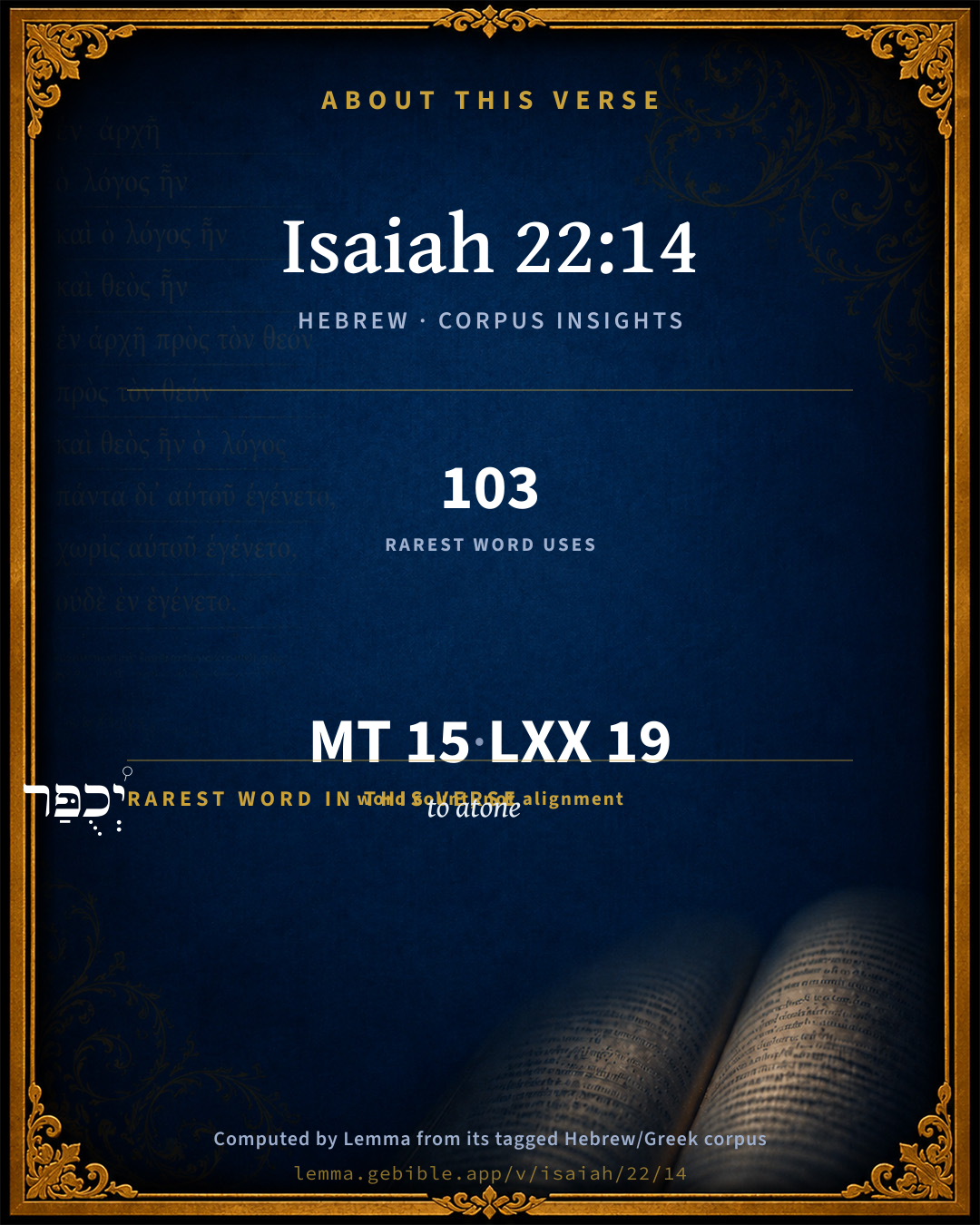
יְ֠כֻפַּר
kâphar
H3722
“to atone”
Verb, Pual, Imperfect, 3rd Person, Masculine, Singular
Part of Speech
Verb
Stem
Pual
Form
Imperfect
Person
3rd Person
Gender
Masculine
Number
Singular
Full BDB Definition

Origin: a primitive root

TWOT: 1023 , 1024 , 1025 , 1026

to cover, purge, make an atonement, make reconciliation, cover over with pitch - (Qal) to coat or cover with pitch - (Piel) - to cover over, pacify, propitiate - to cover over, atone for sin, make atonement for - to cover over, atone for sin and persons by legal rites - (Pual) - to be covered over - to make atonement for - (Hithpael) to be covered
  1. וְנִגְלָ֥ה gâlâh H1540 “and · to uncover” Conjunction + Verb, Niphal, Perfect, 3rd Person, Masculine, Singular
  2. בְאָזְנָ֖י ʼôzen H241 “in/at · ears · my” Preposition + Noun, Common, Feminine, Dual, Construct + Suffix, Personal, 1st Person, Common, Singular
  3. יְהוָ֣ה Yᵉhôvâh H3068 “LORD” Noun, Proper
  4. צְבָא֑וֹת tsâbâʼ H6635 “armies” Noun, Common, Both, Plural, Absolute
  5. אִם ʼim H518 “if” Conjunction
  6. הֶעָוֺ֨ן ʻâvôn H5771 “the · iniquity” Particle, Definite Article + Noun, Common, Both, Singular, Absolute
  7. הַזֶּ֤ה zeh H2088 “the · this” Particle, Definite Article + Pronoun, Demonstrative, Masculine, Singular
  8. עַד ʻad H5704 “until” Preposition
  9. תְּמֻת֔וּן mûwth H4191 “to die” Verb, Qal, Imperfect, 2nd Person, Masculine, Plural + Suffix, n
  10. אָמַ֛ר ʼâmar H559 “to say” Verb, Qal, Perfect, 3rd Person, Masculine, Singular
  11. אֲדֹנָ֥י ʼĂdônây H136 “Lord · my” Noun, Common, Masculine, Plural, Construct + Suffix, Personal, 1st Person, Common, Singular
  12. יְהוִ֖ה Yᵉhôvih H3069 “LORD” Noun, Proper
  13. צְבָאֽוֹת tsâbâʼ H6635 “armies” Noun, Common, Both, Plural, Absolute

About this verse

These counts appear in no published source. They are computed here, from the morphology-tagged text and Lemma’s own curated glosses. What Lemma adds →

15
words
13
distinct lemmas
Prophets
section

Grammatical profile

  • 4 verbs
  • 7 nouns
  • 1 pronoun
  • 2 prepositions
  • 1 conjunction

Verb forms

  • וְנִגְלָ֥ה Niphal · Perfect
  • יְ֠כֻפַּר Pual · Imperfect
  • תְּמֻת֔וּן Qal · Imperfect
  • אָמַ֛ר Qal · Perfect

Repetition

A word recurs within this verse — often emphatic in Hebrew:

  • צְבָא֑וֹת army H6635 ×2

Hebrew & Septuagint length

In English translation the verse runs 25 words from the Hebrew and 24 from the Septuagint (LXX English) — closely comparable.

A rough comparison of the two English renderings, which tokenize alike — not a word-level alignment.

Word counts can differ between the Hebrew and the Greek without any difference in meaning — e.g. the Hebrew direct-object marker אֵת has no separate Greek word, and Greek often adds the article ὁ.

In the original languages it is 15 Hebrew tokens and 19 Greek tokens — but the two are counted differently (Hebrew bundles its prefixes and suffixes into one token; the Greek is in lemma form), so that isn’t a like-for-like length.

Cross-references

12

Topical passages linked to Isaiah 22:14 in the Treasury of Scripture Knowledge — connected by theme and wording, ordered by reader-vote popularity; previews shown in the World English Bible.

  • Ezekiel 24:13 In your filthiness is lewdness: because I have cleansed you and you weren't cleansed, you shall not be cleansed from your filthiness any more, until I have caused my wrath toward you to rest.
  • 1 Samuel 3:14 Therefore I have sworn to the house of Eli, that the iniquity of Eli's house shall not be expiated with sacrifice nor offering forever.
  • Isaiah 5:9 In my ears, Yahweh of Hosts says: "Surely many houses will be desolate, Even great and beautiful, unoccupied.
  • Isaiah 13:11 I will punish the world for [their] evil, and the wicked for their iniquity: and I will cause the arrogance of the proud to cease, and will lay low the haughtiness of the terrible.
  • Isaiah 26:21 For, behold, Yahweh comes forth out of his place to punish the inhabitants of the earth for their iniquity: the earth also shall disclose her blood, and shall no more cover her slain.
  • Revelation 22:11–12 He who acts unjustly, let him act unjustly still. He who is filthy, let him be filthy still. He who is righteous, let him do righteousness still. He who is holy, let him be holy still."
  • Numbers 15:25–31 The priest shall make atonement for all the congregation of the children of Israel, and they shall be forgiven; for it was an error, and they have brought their offering, an offering made by fire to Yahweh, and their sin-offering before Yahweh, for their error:
  • 1 Samuel 9:15 Now Yahweh had revealed to Samuel a day before Saul came, saying,
  • Amos 3:7 Surely the Lord Yahweh will do nothing, Unless he reveals his secret to his servants the prophets.
  • John 8:21–24 Jesus said therefore again to them, "I am going away, and you will seek me, and you will die in your sins. Where I go, you can't come."
  • Hebrews 10:26–27 For if we sin willfully after we have received the knowledge of the truth, there remains no more a sacrifice for sins,
  • Isaiah 30:13 therefore this iniquity shall be to you as a breach ready to fall, swelling out in a high wall, whose breaking comes suddenly in an instant.

Cross-references courtesy of OpenBible.info (CC BY 4.0).

Hebrew and Greek witnesses Masoretic Hebrew ↔ Greek Septuagint

The same verse in the two great witnesses to the Old Testament, shown verse-for-verse.

These are two independent witnesses, not word-aligned to each other, and the Septuagint is shown in lemma (dictionary) form.

Hebrew Isaiah 22:14 Masoretic · Westminster Leningrad Codex

וְנִגְלָ֥ה בְאָזְנָ֖י יְהוָ֣ה צְבָא֑וֹת אִם יְ֠כֻפַּר הֶעָוֺ֨ן הַזֶּ֤ה לָכֶם֙ עַד תְּמֻת֔וּן אָמַ֛ר אֲדֹנָ֥י יְהוִ֖ה צְבָאֽוֹת

Yahweh of Hosts revealed himself in my ears, Surely this iniquity shall not be forgiven you until you die, says the Lord, Yahweh of Hosts.

World English Bible · Public Domain

Greek LXX Isaiah 22:14 Septuagint · lemma form

καί ἀνακαλύπτω οὗτος εἰμί ἐν ὁ οὖς κύριος σαβαωθ ὅτι οὐ ἀποἵημι σύ οὗτος ὁ ἁμαρτία ἕως ἄν ἀποθνήσκω

And these things are revealed in the ears of the Lord of hosts: for this sin shall not be forgiven you, until you⌃ die.

LXX2012 (modern English Septuagint) · Public Domain

On this verse, Adam Clarke's Commentary discusses the Septuagint’s reading. Read the note in Commentary ↓

Hebrew: Westminster Leningrad Codex (CC BY 4.0). Greek: Septuagint (public domain); English from LXX2012 (modern English Septuagint) (Public Domain). How the Septuagint differs from the Hebrew →

Targum (Aramaic paraphrase)

1

The Targum is the ancient Jewish Aramaic paraphrase of the Hebrew Scriptures — an interpretive translation, not the Hebrew text itself. Onkelos (literal) and Pseudo-Jonathan (expansive) render the Torah, and Jonathan the Prophets. Coverage is partial: where no permissively-licensed English translation exists for a verse, only the Aramaic is shown. This is verse-level text, not a word-by-word alignment to the Hebrew.

  1. Targum Jonathan Prophets (Joshua–Malachi)
    אֲמַר נְבִיָא בְאוּדְנִי הֱוֵיתִי שְׁמַע כַּד אִתְגְזַר דָא מִן קֳדָם יְיָ צְבָאוֹת אִם יִשְׁתְּבַק חוֹבָא הָדֵין לְכוֹן עַד דִי תְמוּתוּן מוֹתָא תִנְיָנָא אֲמַר יְיָ אֱלֹהִים צְבָאוֹת:

    The prophet said, with mine ears I was hearing when this was decreed from before the Lord of hosts, namely, that this your iniquity shall not be forgiven you till you die the second death, said the Lord, the God, the God of hosts.

    Targum Jonathan — Aramaic: “Mikraot Gedolot” (public domain). English: “Sefaria Community Translation” (CC0 1.0 (public-domain dedication)); “London "Chaldee Paraphrase," 1871” (public domain). Text via Sefaria.

Commentary

Notes on Isaiah 22:14 from classic Christian and Jewish commentators (each source and its license shown beneath its notes). The classic Christian expositions comment on the surrounding passage and are grouped to its opening verse, so a note may address several verses; the Jewish commentaries on the Tanakh (Rashi and others) are per-verse, so they appear only where the commentator wrote on this verse.

Lemma curates 59 commentaries, every one of them public domain or Creative Commons licensed, each selected and text-cleaned for this edition rather than reprinted as found. About our sources →

Trapp's Complete Commentary

John Trapp

Isa 22:14 And it was revealed in mine ears by the LORD of hosts, Surely this iniquity shall not be purged from you till ye die, saith the Lord GOD of hosts.

Ver. 14. And it was revealed in mine ears.] It was told me for certain. God is absolute in threatening, because resolute in punishing; such is his hatred against scuffing epicures.

Surely this iniquity shall not be purged.] Heb., If it be ever purged, let me be never trusted again.

Till ye die.] That is, never; for "ye shall die in your sin," die eternally. Oh fearful! Pavete, cavete.

John Trapp, A Commentary or Exposition upon All the Books of the Old and New Testament (1647–1656) — public domain. Text from a community e-Sword module.

Tyndale Open Study Notes

Tyndale Open Resources

22:14 you will never be forgiven for this sin: The people of Judah added sin upon sin to the point that God would justly condemn them. This foreshadowed the Exile; although it took place in 586 BC, Isaiah was already anticipating it in 701 BC.

Tyndale Open Study Notes — © Tyndale Open Resources, licensed CC BY-SA 4.0. Text via the HelloAO Bible API.

Adam Clarke's Commentary

Verse 14. It was revealed in mine ears - "The voice of Jehovah"] The Vulgate has vox Domini; as if in his copy he had read קול יהוה kol Yehovah; and in truth, without the word קול kol, voice, it is not easy to make out the sense of the passage; as appears from the strange versions which the rest of the ancients, (except the Chaldee,) and many of the moderns, have given of it; as if the matter were revealed in or to the ears of JEHOVAH: εν τοις ωσι Κυριου, in the ears of the Lord, Septuagint. Vitringa translates it, Revelatus est in auribus meis JEHOVAH, "JEHOVAH hath revealed it in mine ears," and refers to 1Sa 2:27; 1Sa 3:21: but the construction in those places is different, and there is no speech of God added; which here seems to want something more than the verb נגלה nigleh to introduce it. Compare Isa 5:9, where the text is still more imperfect.

The Lord God of hosts] אדני יהוה צבאות Adonai Yehovah tsebaoth. But אדני Adonai, Lord, is omitted by two of Kennicott's and De Rossi's MSS., and by two of my own; by three editions, and the Septuagint, Syriac and Arabic.

Adam Clarke's Commentary on the Bible (1810–1826) — public domain. Text from a community e-Sword/MySword module.

Ellicott's Commentary for English Readers

(14) It was revealed in mine ears . . .—The special form indicates that the warning was “borne in,” ringing, as it were, on the inward ears of the prophet, as an oracle of God. That sensual recklessness could have but one end in all countries and ages, and that end was death. No formal religion, no chastisement, even, would avail to purge an iniquity like that in the absence of a true repentance.

A Bible Commentary for English Readers, edited by Charles John Ellicott (1878–1897) — public domain. Text from a community e-Sword module.

The Cambridge Bible for Schools and Colleges

gen. ed. J. J. S. Perowne

14. And it was revealed … hosts] Render with R.V. And Jehovah of hosts revealed himself in mine ears. The message comes to the prophet like an external voice, which he knows to be that of the Lord (cf. ch. Isa_5:9).

Surely …] The form is that of adjuration (cf. Isa_14:24).

purged from you] Better; expiated for you. Cf. 1Sa_3:14. The threat neither implies that the sin could be expiated by the death of the sinner, nor means merely that guilt would lie on them as long as they lived; it is a definite intimation that the unexpiated sin will call down punishment, and the punishment will be death.

The Cambridge Bible for Schools and Colleges (gen. ed. J. J. S. Perowne; Cambridge University Press, 1878–1918) — public domain. Text from a community e-Sword module.

John Gill's Exposition

And it was revealed in my ears by the Lord of hosts,.... Both what they said in the preceding verse Isa 22:13, their profane, impious, and scoffing language; which perhaps was not expressed by words, but said in their hearts, and which God the searcher of hearts knew, and revealed it to the prophet; and also what he determined to do upon this, which is afterwards said, which being a purpose within himself, could not be known without a divine revelation; so the Targum,

"the prophet said, with mine ears I was hearing, when this was decreed from before the Lord of hosts;''

namely, that their iniquity should not be forgiven; the Vulgate Latin version is, "the voice of the Lord of hosts is revealed in mine ears"; saying what is expressed in the next clause: but the Septuagint, and Arabic versions, understand it of the ears of Lord of hosts himself: and Aben Ezra thinks the word "ani" or "I" is wanting, and so Kimchi; and that the words should be rendered thus, "it was revealed in mine ears, I am the Lord of hosts": and so it is by some others, "it was revealed in the ears of me, the Lord of hosts" (q), or, "of the Lord of hosts"; the wickedness, profaneness, and luxury of the people; the cry of their sins came up into the ears of the Lord of hosts, and therefore he determined to do what he next declares:

Surely this iniquity shall not be purged from you till ye die; it being of heinous nature, so daring, insolent, and affronting, such a contempt of God and his word, and discovering such impenitence and hardness of heart, it should not be expiated by any sacrifice whatever; not by the day of atonement, nor death itself, as the Jews from hence fancy; in short, it should not be forgiven, neither in this world, nor in that to come; for if not till they died, then not after, where there is no repentance, nor remission; see Mat 12:32 the words are in the form of an oath, "if this iniquity be purged, or expiated", &c. (r); the Lord swears to it, that it never should be pardoned, but they should die in it; as a corporeal, so an eternal death. The Targum interprets it of the second death; that is, as Kimchi explains it, the death of the soul in the world to come; see Rev 21:8,

saith the Lord God of hosts; and therefore this would certainly be the case; for his word and oath are his two immutable things, in which it is impossible for him to lie.

(q) "et revelabitur in auribus meis Domini exercituum", Montanus; "et revelatum in auribus Domini", &c. Musculus. (r) "si exibitur", Pagninus, Montanus, Piscator; "si expietur", Junius & Tremellius.

John Gill's Exposition of the Whole Bible (1746–1763) — public domain (CC PDM 1.0). Text via the HelloAO Bible API.

Albert Barnes' Notes on the Bible

It was revealed in mine ears, Surely this iniquity shall not be purged from you until ye die - That is, the sin is so aggravated that it shall never be expiated or pardoned. Few sins can be more aggravated than revelry and riot, thoughtlessness and mirth over the grave. Nothing can show a more decided disregard of God, and nothing a more grovelling and sensual disposition. And yet, it is the common sin of the world; and there can be nothing more melancholy than that a race hastening to the grave should give itself to riot and dissipation. One would think that the prospect of a speedy and certain death would deter people from sin. But the very reverse is true. The nearer they approach death, the more reckless and abandoned do they often become. The “strength and power” of depravity is thus shown in the fact that people can sin thus when near the grave, and with the most fearful warnings and assurances that they are soon to go down to eternal wo.

Albert Barnes' Notes on the Bible (1834–1885) — public domain. Text from a community e-Sword/MySword module.

Haydock's Catholic Bible Commentary

Die. The repentance of Manasses, and the piety of Josias, could not avert the storm. Discite justitiam moniti et non temnere divos.

George Leo Haydock (1774–1849), Haydock's Catholic Family Bible and Commentary, 1859 edition — public domain. Excludes Psalms (Douay-Rheims chapter numbering differs from Protestant) and Deuterocanonical books (Catholic canon only).

Matthew Poole's English Annotations

It was revealed in mine ears; what I am saying is not my own invention, nor uncertain reports, but what I heard with these ears of mine. The like phrase we have 1Sa 9:15, the Lord had told Samuel in his ear. This iniquity shall not be purged from you till ye die; you shall feel the sad effects of this wickedness, and my just displeasure for it, as long as you live. This is not spoken exclusively, as if it should be purged after their death, which is absurd and impious to imagine, at least concerning such as lived and died in this desperate and impenitent condition; but emphatically. to show that God will have no mercy upon them in that time of life, in which he useth and delighteth to give repentance and remission of sins to mankind.

Matthew Poole's English Annotations on the Holy Bible (1683–1685) — public domain. Text from a community e-Sword/MySword module.

The Pulpit Commentary

It was revealed in mine cars by the Lord of hosts; rather, the Lord of hosts revealed himself in mine ears, saying. This iniquity shall not be purged from you till ye die. The sin of turning a call to repentance into an excuse for rioting and drunkenness is one which God will not pardon. It implies a hardness of heart which cannot fail to issue in final impenitence.

Iniquity that cannot be purged in this life.

God is a God of infinite mercy to forgive sin, and yet he will "by no means clear the guilty." He will surely visit iniquity by fixing its consequences upon the sinner, and even also upon others who may be related to him.

I SIN-PENALTIES THAT CAN BE REMOVED NOW, WHILE WE ARE IN" THIS WORLD. They are such as rest on the soul. Sin has a twofold aspect it is both an act of transgression and a spirit of self-will. It is the soul that sinneth; the self-will, as opposing God"s will, is the fountain and source of all wrong-doing. But the soul finds expression and action through the body, and consequently there will be both spiritual and bodily penalties following upon all sin. The soul will undergo a hardening process: The body will come into disabilities and sufferings. Pharaoh is willful. Then the Lord, in his judgment, wilt harden Pharaoh"s heart; smite him in the tenderest part of his family feeling by the death of his firstborn; and bring down the pride of Egypt by an ignominious overthrow in the Red Sea. The soul-penalties attaching to sin are expressed in the sentence, "The soul that sinneth it shall die." Death, spiritual death, is the necessary result of soul-sin. Our first father, Adam, began to die when, in a spirit of self-will and self-pleasing, he ate the forbidden fruit. Every one of us, nowadays, begins to die the "eternal death" when we sin with our souls. The sphere of the atonement made by our Lord Jesus, in his life and in his cross, is precisely this sphere of soul-penalties. Christ removes the penalties of sin which come upon our souls. Christ renews the life of love, and trust, and submission, and joy in God, which effectually prevents any of the hardenings and debasings of sin becoming permanent in our cases.

II SIN-PENALTIES THAT CANNOT NOW BE REMOVED. The penalties and consequences of sin that come on our bodies, our circumstances, and others who are connected with us. God has appointed the order in which family and social life should be arranged and conducted. If we would carry out that Divine order perfectly, and obey those Divine laws faithfully, heaven, with its eternal purities, its peace passing understanding, and its joy unspeakable, would be begun below. Sin, in its outward aspect, is the infringement of this Divine order, the breaking of those gracious and holy laws. To every such infringement a natural penalty is attached. This is expressed in a figure by the familiar words, "Whatsoever a man soweth, that shall he also reap." The redemption provided by the Lord Jesus does not immediately and directly touch these natural penalties of sin. There is an important sense in which the forgiving God "by no means clears the guilty." The child of the drunkard or the sensualist will not have the spirit of drink or of passion taken out of him, nor will he be renewed from his physical deterioration, because his father becomes a Christian in his later years. Consequences of wrong reach on until they get altogether beyond hand-grasp. Do any wrong, and for the soul of the wrong there is forgiveness, and full restoration, in the Divine mercy, through the precious blood-shedding; but you may pursue all your life after the natural consequences, and you shall never overtake them, never master them, never remove them. On they go, carrying their burdens of woe to the third and fourth generation. And Isaiah reminds us that there are some special kinds of iniquity to which the rule must more especially apply, for whose consequences there can be no earthly purging. They are such as are:

1. Maintained in a spirit of willfulness.

2. Such as outlast all warnings and corrections.

3. Such as have become a cause of open reproach.

4. And such as have been the means of ruining others.

In all these cases the judgment must come, and the sinner"s fellow-men must see it hanging over him as long as he lives. If it were not so, adequate impressions of the evil and hatefulness of sin could not be kept before the eyes of men. Though we should also see that these sin-penalties, lying so heavy on the race, are part of the Divine remedial scheme for finally delivering humanity from its self-serving and its sin. R.T.

The Pulpit Commentary (1880–1919), ed. H.D.M. Spence-Jones & Joseph S. Exell — public domain. Text from a community e-Sword module.

John Wesley's Explanatory Notes

'Till ye die - You shall feel the sad effects of this, as long as you live.

John Wesley, Explanatory Notes Upon the Whole Bible (1754–1765) — public domain. Text via the GEBible commentary corpus.

J. A. Alexander on Isaiah

Joseph Addison Alexander

“And Jehovah of Hosts revealed Himself in my ears (i.e., made a revelation to me, saying) If this iniquity shall be forgiven you (i.e., it certainly shall not be forgiven you) until you die.” The conditional form of expression, so far from expressing doubt or contingency, adds to the following declaration the solemnity of an oath. What is said is also sworn, so that by two immutable things in which it is impossible for God to lie, the truth of the threatening may be confirmed. On the elliptical formula of swearing, see above Isa 5:9. This iniquity of course means the presumptuous contempt of God’s messages and providential warnings, with which the people had been charged in the preceding verse. This offence is here treated in the same way as the sin against the Holy Spirit is in the New Testament, and is indeed very much of the same nature. The word translated ‘shall be forgiven’ strictly means shall be atoned for or expiated. ‘Until you die’ is equivalent to ever, the impossibility of expiation afterwards being assumed. This use of until is common in all languages. ‘As long as you live you shall not be forgiven’ is equivalent to saying ‘you shall never be forgiven.’

Joseph Addison Alexander, The Prophecies of Isaiah (1846–1847; New York: Scribner, 1870–1878) — public domain. Text from a community e-Sword module.

Rashi

Rabbi Shlomo Yitzchaki (Rashi)

until you die Jonathan paraphrases a second death in the World to Come.

Rashi on the Tanakh — English translations: “The Judaica Press complete Tanach with Rashi, translated by A. J. Rosenberg” (CC BY 4.0); “Pentateuch with Rashi's commentary by M. Rosenbaum and A.M. Silbermann, 1929-1934” (public domain); “The Metsudah Tanach series, Lakewood, N.J” (CC BY 4.0); and “The Book of Joshua, Metsudah Publications, 1997” (CC BY 4.0). Text via Sefaria.

Ibn Ezra

Rabbi Abraham ibn Ezra

ונגלה And it was revealed. This thing was revealed. באזני In mine ears. Supply אָזְנֵי the ears of. Comp. נביאכם יי Your prophet, the prophet of the Lord (Num. 12:6). According to some the suffix in באזני refers to the prophet; but the first explanation is better.

Till ye die by the hand of the enemy who will besiege you.

Ibn Ezra on the Tanakh — English translations: “Sefaria Community Translation” (CC0 1.0 (public-domain dedication)); “Yalkut, Sifsei Chachomim Chumash, Metsudah Publications, 2009” (CC BY 4.0); and “Commentary of Ibn Ezra on Isaiah - trans. by M. Friedlander, 1873” (public domain). Text via Sefaria.

Lesson kit

Teaching starters — assembled from the data on this page, not authored interpretation. Every prompt links to the verse data it draws on. Edit before teaching.

Isaiah, in the Prophets, opens this verse with 15 words (13 distinct Hebrew lemmas). Its most distinctive word is kâphar (“to atone”). A historical commentator’s framing appears above. Read the whole chapter for the surrounding context.

Discussion questions

  1. The word kâphar carries the sense “to atone.” How does it shape the verse?
  2. Ezekiel 24:13 shares this passage’s theme. How do the two illuminate each other?
  3. “army” occurs 2× in this one verse. What is the effect of the repetition?
  4. These translations render this verse differently. What is at stake in choosing one wording over another?
  5. The verb «וְנִגְלָ֥ה» is Niphal Perfect. How does its form color the action?
  6. Reading how Trapp's Complete Commentary and Tyndale Open Study Notes read this verse, where do the two commentators agree and where do they part?

Things to notice

Reading settings

Reading text

Shown beneath each verse's original-language words.

Old Testament
Old Testament edition

Read the OT as the Masoretic Hebrew (MT) or the Greek Septuagint (LXX).

English shown for the Greek Septuagint (in the Hebrew ↔ Greek comparison).

Comparing translations? Open the Compare panel on any verse page to stack up to four side by side.