
Psalms 78:65

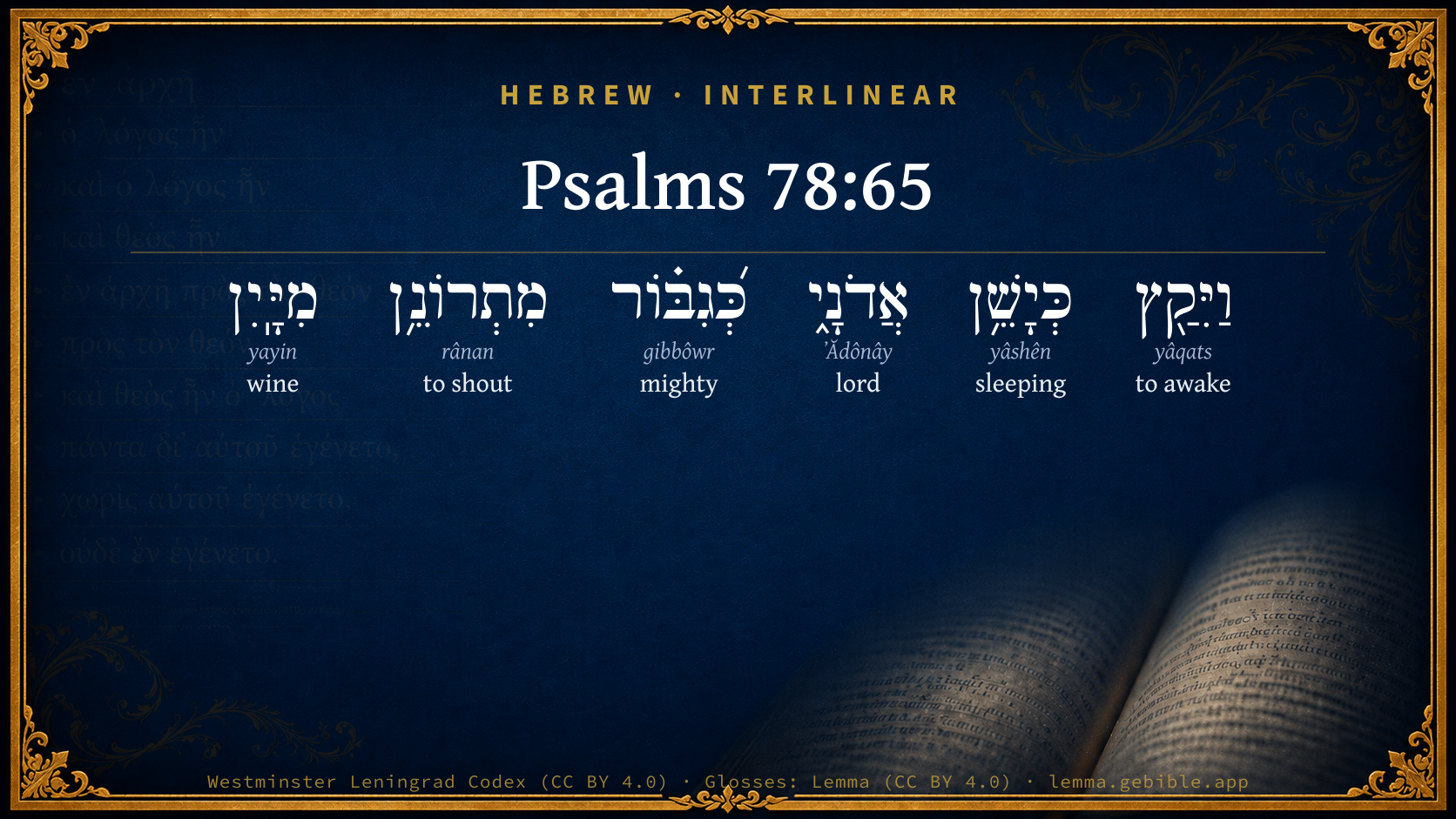
Hebrew (Westminster Leningrad Codex) Psalms 78:65 appears in the Hebrew Old Testament. The text above is from the Westminster Leningrad Codex. Each word links to its Strong’s number, a concise gloss, and parsing drawn from the Open Scriptures Hebrew Bible morphology. Click any word for its full Brown-Driver-Briggs (BDB) entry.
Download image
Cite this verse

Psalms 78:65 (World English Bible). Public Domain. Lemma interlinear Bible study tool, https://lemma.gebible.app/v/psalms/78/65.

Show BibTeX & RIS
BibTeX
RIS
English Translation
Then the Lord awakened as one out of sleep, Like a mighty man who shouts by reason of wine.
World English Bible · Public Domain
Download a study sheet

One document with this verse’s original text, its word-by-word gloss line, the meaning frame, cross-references with their text, attributed commentary, and full source and license credits — printable, and it pastes into notes with its structure intact.

This verse Autodidact and up

Study sheet (.html) Plain text (.txt)

A passage Seminary Student

Up to 50 verses in one chapter. A passage sheet keeps up to 6 commentary sources and 12 cross-references per verse, in the order this page ranks them, and says so on the sheet whenever that leaves anything out. Ask for a single verse and you get the Autodidact verse sheet above.

Everything on this page stays free to read, with no account — the sheet is a download of what is already on screen, not access to it.

Want to remove ads? Support Godless Engineer
Compare translations 3

The same verse in 3 English versions, stacked beneath the original-language interlinear above. Click any original word for its lexicon entry.

Each is an independent rendering of the whole verse — the interlinear is not word-aligned to these translations.

Highlighted words mark where these versions differ — a whole-verse word diff, not a word-by-word alignment.

  • World English Bible Public Domain
    Then the Lord awakened as one out of sleep, Like a mighty man who shouts by reason of wine.
  • King James Version Public Domain
    Then the LORD awaked as one out of sleep, and like a mighty man that shouteth by reason of wine.
  • unfoldingWord Literal Text CC BY-SA 4.0
    Then the Lord awoke as one sleeping, as a mighty man shouting from wine.

unfoldingWord Literal Text — © unfoldingWord, licensed CC BY-SA 4.0. Word-aligned USFM3 via Door43 (git.door43.org/unfoldingWord/en_ult).

Versions to compare (up to 4)

3 of 4 selected

Show all 18 translations

Every available English version of this verse, each an independent rendering of the whole verse.

  • World English Bible Public Domain
    Then the Lord awakened as one out of sleep, Like a mighty man who shouts by reason of wine.
  • Berean Standard Bible Public Domain
    Then the Lord awoke as from sleep, like a mighty warrior overcome by wine.
  • Majority Standard Bible Public Domain
    Then the Lord awoke as from sleep, like a mighty warrior overcome by wine.
  • King James Version Public Domain
    Then the LORD awaked as one out of sleep, and like a mighty man that shouteth by reason of wine.
  • American Standard Version (1901) Public Domain
    Then the Lord awaked as one out of sleep, Like a mighty man that shouteth by reason of wine.
  • Revised Version (1885) Public Domain
    Then the Lord awaked as one out of sleep, like a mighty man that shouteth by reason of wine.
  • Geneva Bible (1599) Public Domain
    But the Lord awaked as one out of sleepe, and as a strong man that after his wine crieth out,
  • Douay-Rheims (1899) Public Domain
    And the Lord was awaked as one out of sleep, and like a mighty man that hath been surfeited with wine.
  • Young's Literal Translation Public Domain
    And the Lord waketh as a sleeper, As a mighty one crying aloud from wine.
  • Literal Standard Version CC BY-SA 4.0
    And the Lord wakes as a sleeper, || As a mighty one crying aloud from wine.
  • Unlocked Literal Bible CC BY-SA 4.0
    Then the Lord awakened as one from sleep, like a warrior who shouts because of wine.
  • unfoldingWord Literal Text CC BY-SA 4.0
    Then the Lord awoke as one sleeping, as a mighty man shouting from wine.
  • Darby Bible Public Domain
    Then the Lord awoke as one out of sleep, like a mighty man that shouteth aloud by reason of wine;
  • World Messianic Bible Public Domain
    Then the Lord awakened as one out of sleep, like a mighty man who shouts by reason of wine.
  • Webster's Bible Public Domain
    Then the Lord awaked as one out of sleep, and like a mighty man that shouteth by reason of wine.
  • Free Bible Version CC BY-SA 4.0
    Then the Lord woke up as if from sleep, as a warrior sobering up from drinking wine.
  • Bible in Basic English Public Domain
    Then was the Lord like one awaking from sleep, and like a strong man crying out because of wine.
  • JPS Tanakh (1917) Public Domain
    Then the Lord awaked as one asleep, like a mighty man recovering from wine.

Literal Standard Version (2020), Covenant Press — licensed CC BY-SA 4.0. Text via the HelloAO Bible API (eBible.org). Unlocked Literal Bible (unfoldingWord) — licensed CC BY-SA 4.0. Text via the HelloAO Bible API (eBible.org). unfoldingWord Literal Text — © unfoldingWord, licensed CC BY-SA 4.0. Word-aligned USFM3 via Door43 (git.door43.org/unfoldingWord/en_ult). Free Bible Version, Dr. Jonathan Gallagher — licensed CC BY-SA 4.0. Text via the HelloAO Bible API (eBible.org).

Word by word

More ways to search: Search by grammar → Find every occurrence → Compare this word →

Practice this passage: Drill this verse → Learn its vocabulary →

About this verse

These counts appear in no published source. They are computed here, from the morphology-tagged text and Lemma’s own curated glosses. What Lemma adds →

6
words
6
distinct lemmas
Wisdom
section

Notable vocabulary

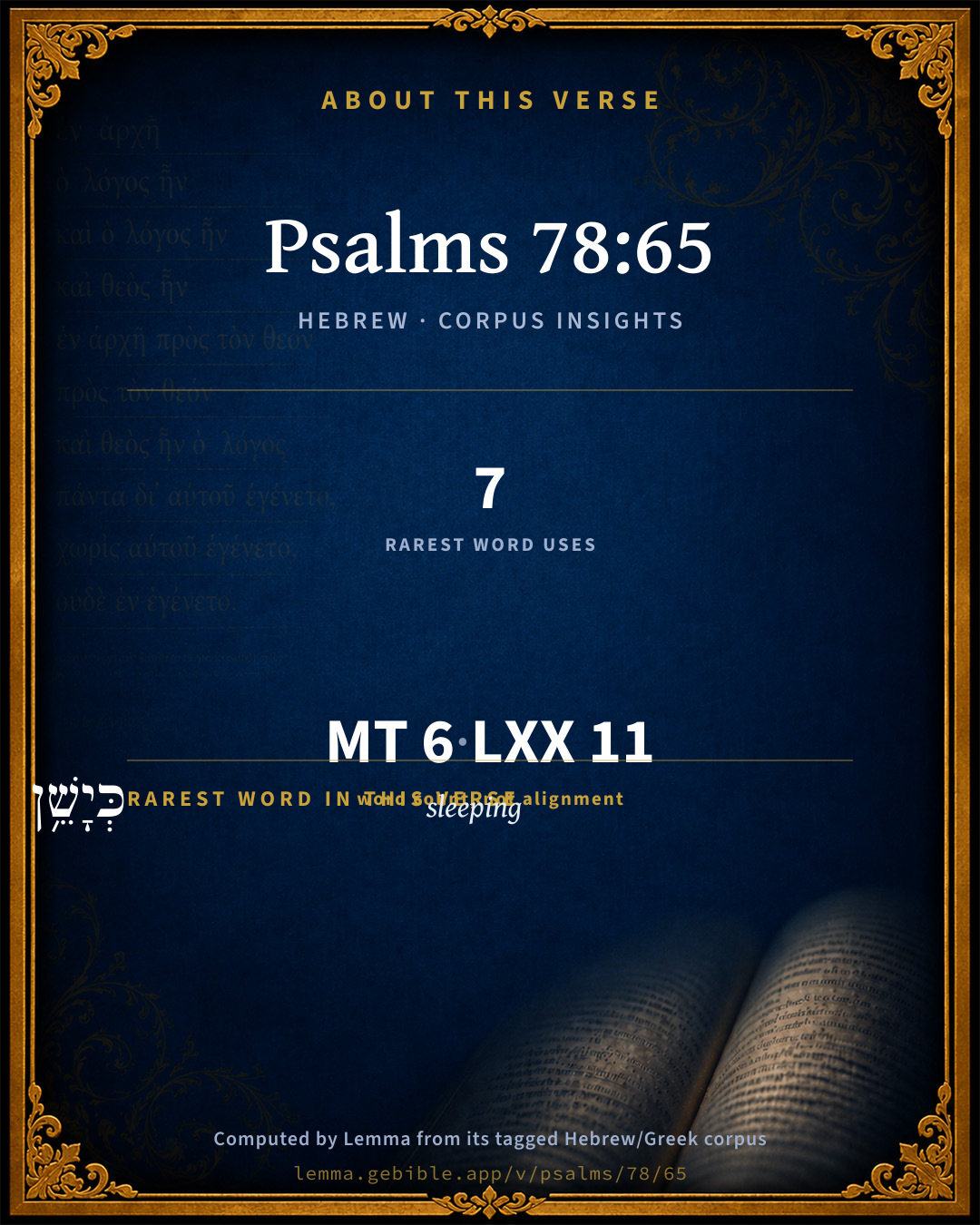
The rarest word here is כְּיָשֵׁ֥ן sleeping H3463 — appearing just 7 times in the whole Hebrew Bible.

Shared distinctive vocabulary

כְּיָשֵׁ֥ן sleeping H3463 occurs in 7 verses of the Hebrew Bible. Also found in:

Grammatical profile

  • 2 verbs
  • 2 nouns
  • 2 adjectives

Verb forms

  • וַיִּקַ֖ץ Qal · Sequential Imperfect
  • מִתְרוֹנֵ֥ן Hithpolel · Participle Active

Hebrew & Septuagint length

In English translation the verse runs 19 words from the Hebrew and 20 from the Septuagint (LXX English) — closely comparable.

A rough comparison of the two English renderings, which tokenize alike — not a word-level alignment.

Word counts can differ between the Hebrew and the Greek without any difference in meaning — e.g. the Hebrew direct-object marker אֵת has no separate Greek word, and Greek often adds the article ὁ.

In the original languages it is 6 Hebrew tokens and 11 Greek tokens — but the two are counted differently (Hebrew bundles its prefixes and suffixes into one token; the Greek is in lemma form), so that isn’t a like-for-like length.

Cross-references

5

Topical passages linked to Psalms 78:65 in the Treasury of Scripture Knowledge — connected by theme and wording, ordered by reader-vote popularity; previews shown in the World English Bible.

  • Psalms 44:23 Wake up! Why do you sleep, Lord? Arise! Don't reject us forever.
  • Psalms 7:6 Arise, Yahweh, in your anger. Lift up yourself against the rage of my adversaries. Awake for me. You have commanded judgment.
  • Isaiah 51:9 Awake, awake, put on strength, arm of Yahweh; awake, as in the days of old, the generations of ancient times. Isn't it you who did cut Rahab in pieces, who pierced the monster?
  • Psalms 73:20 As a dream when one wakes up, So, Lord, when you awake, you will despise their fantasies.
  • Isaiah 42:13–14 Yahweh will go forth as a mighty man; he will stir up [his] zeal like a man of war: he will cry, yes, he will shout aloud; he will do mightily against his enemies.

Cross-references courtesy of OpenBible.info (CC BY 4.0).

Hebrew and Greek witnesses Masoretic Hebrew ↔ Greek Septuagint

The same verse in the two great witnesses to the Old Testament, shown verse-for-verse.

You’re reading Greek Psalm 77 (Hebrew Psalm 78). The Septuagint counts the superscription, so verse numbers can differ from the Hebrew — chapter-level alignment, not verse-by-verse. Numbering follows Rahlfs.

These are two independent witnesses, not word-aligned to each other, and the Septuagint is shown in lemma (dictionary) form.

Hebrew Psalms 78:65 Masoretic · Westminster Leningrad Codex

וַיִּקַ֖ץ כְּיָשֵׁ֥ן אֲדֹנָ֑י כְּ֝גִבּ֗וֹר מִתְרוֹנֵ֥ן מִיָּֽיִן

Then the Lord awakened as one out of sleep, Like a mighty man who shouts by reason of wine.

World English Bible · Public Domain

Greek LXX Greek Psalm 77:65 Septuagint · lemma form

καί ἐκἐγείρω ὡς ὁ ὕπνος κύριος ὡς δυνατός κραιπαλάω ἐκ οἶνος

So the Lord awaked as one out of sleep, and as a mighty man who has been heated with wine.

LXX2012 (modern English Septuagint) · Public Domain

On this verse, The Cambridge Bible for Schools and Colleges discusses the Septuagint’s reading. Read the note in Commentary ↓

Hebrew: Westminster Leningrad Codex (CC BY 4.0). Greek: Septuagint (public domain); English from LXX2012 (modern English Septuagint) (Public Domain). How the Septuagint differs from the Hebrew →

Commentary

Notes on Psalms 78:65 from classic Christian and Jewish commentators (each source and its license shown beneath its notes). The classic Christian expositions comment on the surrounding passage and are grouped to its opening verse, so a note may address several verses; the Jewish commentaries on the Tanakh (Rashi and others) are per-verse, so they appear only where the commentator wrote on this verse.

Lemma curates 59 commentaries, every one of them public domain or Creative Commons licensed, each selected and text-cleaned for this edition rather than reprinted as found. About our sources →

Trapp's Complete Commentary

John Trapp

Psa 78:65 Then the Lord awaked as one out of sleep, [and] like a mighty man that shouteth by reason of wine.

Ver. 65. The Lord awaked as one out of sleep] Humanitus dictum; the Philistines haply had such bald conceits of him, that either he slept, or, if awake, that he was overcome with wine.

John Trapp, A Commentary or Exposition upon All the Books of the Old and New Testament (1647–1656) — public domain. Text from a community e-Sword module.

Joseph Benson's Commentary

Psa 78:65-66. Then the Lord awaked as one out of sleep, &c. — “While, by his permission, the Philistines were chastising his people for their sins, he held his peace, and seemed unconcerned as one asleep: but when due chastisement had brought the delinquents to themselves, the cries of penitent Israel awakened, as it were, and called forth the zeal of the Lord of hosts, to vindicate his honour, and deliver his servants; and then the vigour of his operations was such, as might be compared to the alacrity and courage of a mighty champion, when, refreshed and inspirited by wine, he attacks his adversaries, and bears all down before him. And he smote his enemies in the hinder parts — With the disease of the emerods, which was both painful and shameful. He put them to a perpetual reproach — He caused them to perpetuate their own reproach, by sending back the ark of God with their golden emerods, the lasting monuments of their shame.

Joseph Benson's Commentary on the Old and New Testaments (1811–1818) — public domain. Text from a community e-Sword module.

J. A. Alexander on Psalms

Joseph Addison Alexander

65. (Psa 78:65) Then awoke, as a sleeper, the Lord, as a hero rejoicing from wine. His apparent connivance or indifference to what was passing was abruptly exchanged for new and terrible activity. The Lord, the sole and rightful sovereign, both of men in general and of Israel in particular. A hero, mighty man, or warrior. See above on Psalms 14. From wine is not to be construed with awoke or awakes understood, but with rejoicing, exhilarated, cheered by wine.

Joseph Addison Alexander, The Psalms Translated and Explained (1850) — public domain. Text from a community e-Sword module.

Geneva Bible (1599)

Geneva Bible translators

Because they were drunken in their sins, they judged God’s patience to be a slumbering, as though he were drunken, therefore he answering their beastly judgment, saith, he will awake and take sudden vengeance.

Geneva Bible (1599) marginal notes — public domain. Text via Bolls.life.

Adam Clarke's Commentary

Verse 65. Then the Lord awaked] He seemed as if he had totally disregarded what was done to his people, and the reproach that seemed to fall on himself and his worship by the capture of the ark.

Like a mighty man] כגבור kegibbor, like a hero that shouteth by reason of wine. One who, going forth to meet his enemy, having taken a sufficiency of wine to refresh himself, and become a proper stimulus to his animal spirits, shouts-gives the war-signal for the onset; impatient to meet the foe, and sure of victory. The idea is not taken from the case of a drunken man. A person in such a state would be very unfit to meet his enemy, and could have little prospect of conquest.

Adam Clarke's Commentary on the Bible (1810–1826) — public domain. Text from a community e-Sword/MySword module.

John Calvin's Commentaries

65. But the Lord awoke as one asleep. Some understand this as spoken of the Israelites, implying that the Lord awoke against them; and others, as spoken of their enemies. If the first sense is adopted, it need not excite our surprise, that the Israelites are termed, in the 66th verse, the enemies of God, even as they are so designated in Isaiah 1:24,

“Therefore, saith the Lord, the Lord of hosts, the mighty One of Israel, Ah! I will ease me of mine adversaries, and avenge me of mine enemies.” (Isaiah 1:24)

And thus the meaning will be, that the Israelites paid dearly for abusing the patience of God, by taking encouragement from it to indulge to greater excess in the commission of sin; for awaking suddenly, he rushed upon them with so much the greater fury. But as we find the prophets drawing their doctrine from Moses, and also framing their language according to his as a standard, the opinion of those who understand this and the following verse, as referring to the Philistines, is no less probable. The prophet here appears to have borrowed this order, from the song of Moses, (Deuteronomy 32:27,) where God declares, that while he punished his own people, he, at the same time, did not forget to repress their enemies. Since it is a common proverb, that the issue of wars is uncertain, if, after the enemies of the chosen tribes had obtained the victory, no change had happened to them, it would not have been so manifest, that what befell his own people was a punishment inflicted upon them by God. But when God, after having afflicted and humbled the Israelites, made his judgments to fall on their conquerors, without the instrumentality of man, beyond all human expectation, and contrary to what happens in the ordinary course of events; — from this it is the more plainly manifest, that when the Israelites were laid in the dust, it was the work of God, who intended thus to punish them. The prophet, however, at the same time, gives us to understand, that God was constrained, as it were, by necessity, to punish them with greater severity; because, in afterwards inflicting his judgments upon the Philistines, he gave abundant evidence of his regard to his covenant, which the Israelites might be very apt to think he had quite forgotten. Although he had, so to speak, taken the side of the Philistines for a time, it was not his intention utterly to withdraw his love from the children of Abraham, lest the truth of his promise should become void.

The figure of a drunken man may seem somewhat harsh; but the propriety of using it will appear, when we consider that it is employed in accommodation to the stupidity of the people. Had they been of a pure and clear understanding, God would not have thus transformed himself, and assumed a character foreign to his own. When he, therefore, compares himself to a drunken man, it was the drunkenness of the people; that is to say, their insensibility that constrained him to speak thus: which was so much the greater shame to them. With respect to God, the metaphor derogates nothing from his glory. If he does not immediately remedy our calamities, we are ready to think that he is sunk into a profound sleep. But how can God, it may be said, be thus asleep, when he is superior in strength to all the giants, and yet they can easily watch for a long time, and are satisfied with little sleep? I answer, when he exercises forbearance, and does not promptly execute his judgments, the interpretation which ignorant people put upon his conduct is, that he loiters in this manner like a man who is stupified, and knows not how to proceed. The prophet, on the contrary, declares, that this sudden awaking of God will be more alarming and terrible than if he had at the first lifted up his hand to execute judgment; and that it will be as if a giant, drunken with wine, should start up suddenly out of his sleep, while as yet he had not slept off his surfeit. Many restrict the statement in the 66th verse, concerning God’s smiting his enemies behind, to the plague which he sent upon the Philistines, recorded in 1 Samuel 5:12. The phrase, everlasting disgrace, agrees very well with this interpretation; for it was a shameful disease to be afflicted with haemorrhoids in their hinder parts. But as the words, They were smitten behind, admit of a more simple sense, I leave the matter undecided.

John Calvin's Commentaries (1540-1563) — public domain. Text from the Calvin Translation Society English edition (1840s-50s) via the Christian Classics Ethereal Library (ccel.org). Calvin's coverage is partial (roughly two-thirds of the Bible); uncommented books and verses are honest gaps, never fabricated. The 19th-century editor's footnotes and remarks are omitted so the notes are faithfully Calvin's own voice.

Ellicott's Commentary for English Readers

(65) That shouteth . . .—For the boldness of the image which likens God to a giant warrior exhilarated with wine we may range this with the picture in Psalms 60 (See Notes.)

A Bible Commentary for English Readers, edited by Charles John Ellicott (1878–1897) — public domain. Text from a community e-Sword module.

The Cambridge Bible for Schools and Colleges

gen. ed. J. J. S. Perowne

65. While His people were at the mercy of their enemies He seemed to be asleep. Cp. Psa_44:23, note.

that shouteth &c.] Cp. Isa_42:13-14. “The daring figure of God’s awaking as from sleep, and dashing upon Israel’s foes, who are also His, with a shout like that of a hero stimulated by wine, is more accordant with Eastern fervour than with our colder imagination; but it wonderfully expresses the sudden transition from a period, during which God seemed passive and careless of His people’s wretchedness, to one in which His power flashed forth triumphant for their defence.” (Maclaren). Many modern commentators follow the LXX, Targ., and Jer., in rendering like a giant who has been overcome with wine. This gives a good parallelism to the preceding line, but the verb does not occur elsewhere in this sense, and bold as are the similes of the Psalmists, this would be scarcely seemly.

65–66. At length Jehovah took pity on His people, and delivered them from their adversaries.

The Cambridge Bible for Schools and Colleges (gen. ed. J. J. S. Perowne; Cambridge University Press, 1878–1918) — public domain. Text from a community e-Sword module.

John Gill's Exposition

And he smote his enemies in the hinder parts,.... Not the Israelites, as Kimchi interprets it, but the Philistines, who in another battle were put to flight, and turned their backs, and so were smitten in their hinder parts; or rather this has reference to the Philistines being smitten with haemorrhoids, or piles in their posteriors, while the ark was retained a captive by them, Sa1 5:6, and so the Targum paraphrases it,

"and he smote them that troubled them with haemorrhoids in their posteriors;''

the Greek version, as quoted by Suidas (c), is, "he smote his enemies on the back parts of the seat"; signifying, he says, a disease, modestly expressed:

he put them to a perpetual reproach; either by causing their idol Dagon to fall before his ark, and be broken upon the threshold of the house of the idol; in memory of which the priests ever after, nor any that came in thither, trod upon the threshold, Sa1 5:3, or rather through their sending golden images of their haemorrhoids, and golden mice along with the ark, which were reserved to their perpetual reproach: other instances of the Lord's regard to Israel follow, in providing a proper place for the ark, and appointing a suitable governor over the people.

(c) In voce

John Gill's Exposition of the Whole Bible (1746–1763) — public domain (CC PDM 1.0). Text via the HelloAO Bible API.

Albert Barnes' Notes on the Bible

Then the Lord awaked as one out of sleep - literally, as one sleeping; that is, as one who is asleep suddenly arouses himself. The Lord seemed to have slept, or to have been inattentive to what was occurring. Suddenly he aroused himself to inflict vengeance on the enemies of his people. Compare Psa 7:6, note; Psa 44:23, note.

And like a mighty man - The allusion is probably to a warrior.

That shouteth by reason of wine - The proper idea here is that of singing, or lifting up the voice in exultation and rejoicing; the idea of a man who sings and shouts as he is excited by wine, and as he presses onward to conflict and to victory. It is not uncommon in the Scriptures to compare God, as he goes forth to accomplish his purposes on his enemies, with a warrior. See Exo 15:3; Psa 24:8.

Albert Barnes' Notes on the Bible (1834–1885) — public domain. Text from a community e-Sword/MySword module.

Matthew Poole's English Annotations

Awaked as one out of sleep; for God, by giving up not only his people, but his ark, to the contempt and insolency of the Philistines, might seem to be asleep, and insensible of his own honour and interest, till by a sudden and unexpected blow he convinced his enemies of the contrary.

Shouteth by reason of wine; whose spirit and courage is revived and inflamed by a liberal draught of generous wine; which comparison is no more injurious to the Divine Majesty than that of a thief’s coming in the night, to which Christ’s second coming is compared, 1Th 5:2.

Matthew Poole's English Annotations on the Holy Bible (1683–1685) — public domain. Text from a community e-Sword/MySword module.

The Treasury of David

Charles H. Spurgeon

Ver. 65. The Lord awaked as one out of sleep. Justly inactive, he had suffered the enemy to triumph, his ark to be captured, and his people to be slain; but now he arouses himself, his heart is full of pity for his chosen, and anger against the insulting foe. Woe to thee, O Philistia, now thou shalt feel the weight of his right hand! Waking and putting forth strength like a man who has taken a refreshing draught, the Lord is said to be,

like a mighty man that shouteth by reason of wine. Strong and full of energy the Lord dashed upon his foes, and made them stagger beneath his blows. His ark from city to city went as an avenger rather than as a trophy, and in every place the false gods fell helplessly before it.

Ver. 65. Then the Lord awaked. Know how to understand this and similar passages in Scripture, as to the Lord's sleeping and forgetting his people, Ps 13:1 44:33 77:9. These are not to be understood as to an universal and absolute forgetting and sleep of providence; for God hath not his vacation time: he still holds the reins of government in his hand, all the world over. Neither do they infer an absolute cessation of providence in reference to that object matter which the Lord to our apprehension seems to forget, and lies dormant; for there is a promoting work of providence, which we see not, and are not so sensible of for the present, as hath been shewed. Besides, such forgetting and sleep of providence, as it is such, bespeaks the beauty of providence in the way of bringing things to pass. It is so far from inferring an interrgnum, or letting fall the sceptre of government, as that it is a glorious demonstration that God orders matters, and that wisely, whilst he seems to forget, and be as one asleep. As the night, as night, falls under the providence of God, as well as the day, for there are the ordinances of heaven for the night season, Jer 31:35: so the dark night, when as to matters the Lord seems to sleep, is part and parcel of his all wise model of government. The seventy years captivity was a long night for the church's distress; and yet thus it must be according to the ordinance of providence. Jer 29:10. Thomas Crane.

Ver. 65. Like a mighty man that shouteth by reason of wine: whose spirit and courage is revived and inflamed by a liberal draught of generous wine; which comparison is no more injurious to the Divine Majesty than that of a thief's coming in the night, to which Christ's second coming is compared. 1Th 5:2. Matthew Poole.

Charles H. Spurgeon's The Treasury of David (1869–1885) — public domain. Psalms only. Text from a community e-Sword/MySword module.

Whedon's Commentary on the Bible

Daniel D. Whedon

65. Then the Lord awaked—He had suffered their irreverent conduct to proceed without check to this extremity, that he might punish both Israel and Philistia by the consequences of their irreligion.

Daniel D. Whedon (gen. ed.), Commentary on the Old and New Testaments (1874–1909) — public domain. Text from a community e-Sword module.

The Pulpit Commentary

Then the Lord awaked as one out of sleep. (comp. Psa_7:6 Psa_35:23 Psa_73:20) God is said to "awake," when, after a time of inaction, he suddenly exerts his Almighty power, to the discomfiture of his enemies. That God never really slept was the profound conviction of the Israelites generally. (see 2Ki_18:27 Psa_121:3, Psa_121:4) And like a mighty man that shouteth by reason of wine. (comp. Zec_10:7 Isa_42:13)

The Pulpit Commentary (1880–1919), ed. H.D.M. Spence-Jones & Joseph S. Exell — public domain. Text from a community e-Sword module.

Rashi

Rabbi Shlomo Yitzchaki (Rashi)

shouting Heb. מתרונן, awaking and strengthening himself with speech to awaken from his wine. מתרונן is an expression of רנה, shouting.

Rashi on the Tanakh — English translations: “The Judaica Press complete Tanach with Rashi, translated by A. J. Rosenberg” (CC BY 4.0); “Pentateuch with Rashi's commentary by M. Rosenbaum and A.M. Silbermann, 1929-1934” (public domain); “The Metsudah Tanach series, Lakewood, N.J” (CC BY 4.0); and “The Book of Joshua, Metsudah Publications, 1997” (CC BY 4.0). Text via Sefaria.

Lesson kit

Teaching starters — assembled from the data on this page, not authored interpretation. Every prompt links to the verse data it draws on. Edit before teaching.

Psalms, in the Wisdom, opens this verse with 6 words (6 distinct Hebrew lemmas). Its most distinctive word is yâshên (“sleeping”). A historical commentator’s framing appears above. Read the whole chapter for the surrounding context.

Discussion questions

  1. What does “sleeping” (yâshên) contribute to the verse as a whole?
  2. 1 Samuel 26:7 shares the word «sleeping» with this verse. How do the two illuminate each other?
  3. These translations render this verse differently; the difference is in the English rendering, not the original. What questions does that raise?
  4. The verb «וַיִּקַ֖ץ» is Qal Sequential Imperfect. How does its form color the action?
  5. Reading how Trapp's Complete Commentary and Joseph Benson's Commentary read this verse, where do the two commentators agree and where do they part?

Things to notice

Reading settings

Reading text

Shown beneath each verse's original-language words.

Old Testament
Old Testament edition

Read the OT as the Masoretic Hebrew (MT) or the Greek Septuagint (LXX).

English shown for the Greek Septuagint (in the Hebrew ↔ Greek comparison).

Comparing translations? Open the Compare panel on any verse page to stack up to four side by side.