
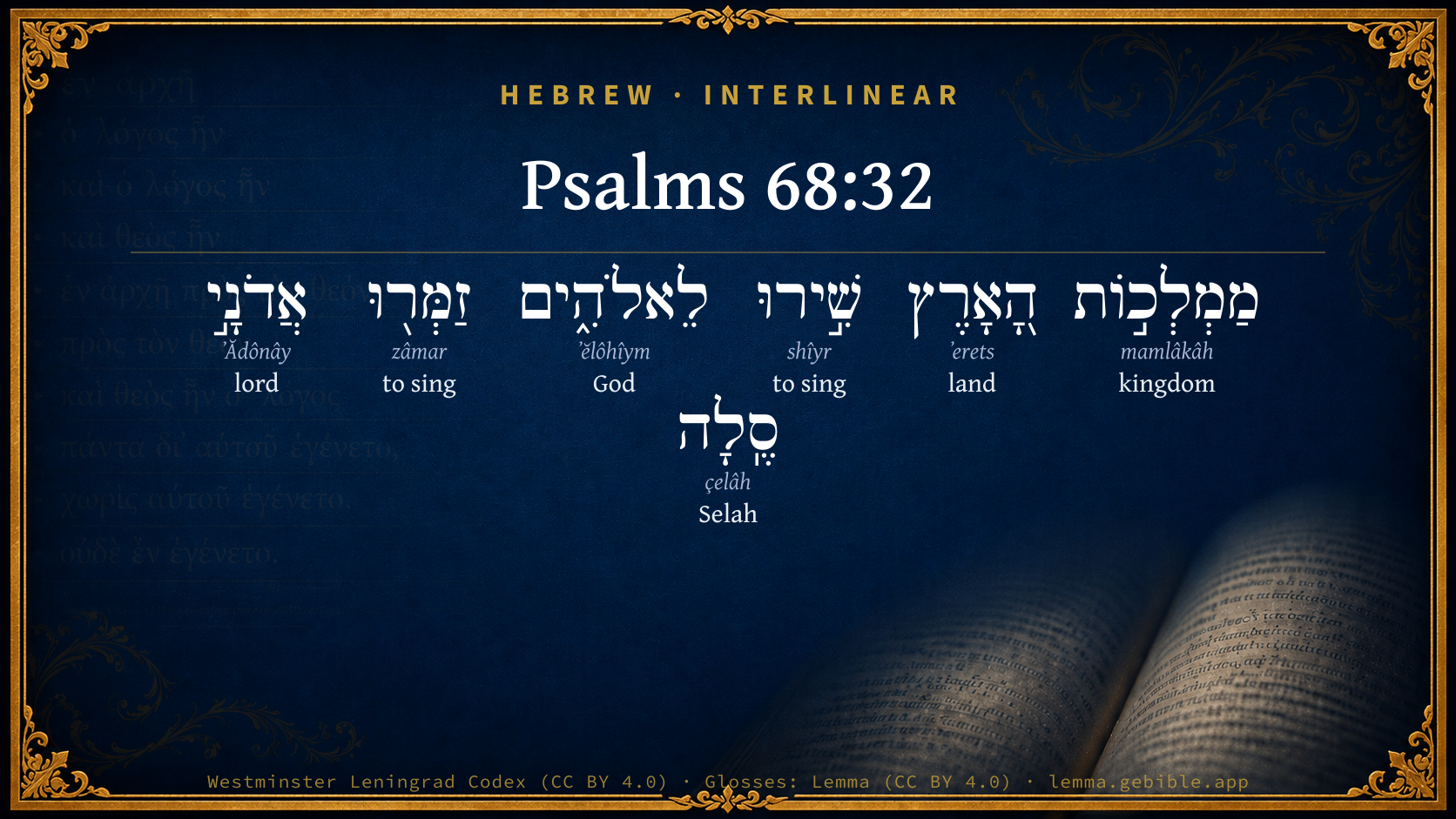
Psalms 68:32

Hebrew (Westminster Leningrad Codex) Psalms 68:32 appears in the Hebrew Old Testament. The text above is from the Westminster Leningrad Codex. Each word links to its Strong’s number, a concise gloss, and parsing drawn from the Open Scriptures Hebrew Bible morphology. Click any word for its full Brown-Driver-Briggs (BDB) entry.
Download image
Cite this verse

Psalms 68:32 (World English Bible). Public Domain. Lemma interlinear Bible study tool, https://lemma.gebible.app/v/psalms/68/32.

Show BibTeX & RIS
BibTeX
RIS
English Translation
Sing to God, you kingdoms of the earth! Sing praises to the Lord! Selah.
World English Bible · Public Domain
Download a study sheet

One document with this verse’s original text, its word-by-word gloss line, the meaning frame, cross-references with their text, attributed commentary, and full source and license credits — printable, and it pastes into notes with its structure intact.

This verse Autodidact and up

Study sheet (.html) Plain text (.txt)

A passage Seminary Student

Up to 50 verses in one chapter. A passage sheet keeps up to 6 commentary sources and 12 cross-references per verse, in the order this page ranks them, and says so on the sheet whenever that leaves anything out. Ask for a single verse and you get the Autodidact verse sheet above.

Everything on this page stays free to read, with no account — the sheet is a download of what is already on screen, not access to it.

Want to remove ads? Support Godless Engineer
Compare translations 3

The same verse in 3 English versions, stacked beneath the original-language interlinear above. Click any original word for its lexicon entry.

Each is an independent rendering of the whole verse — the interlinear is not word-aligned to these translations.

Highlighted words mark where these versions differ — a whole-verse word diff, not a word-by-word alignment.

  • World English Bible Public Domain
    Sing to God, you kingdoms of the earth! Sing praises to the Lord! Selah.
  • King James Version Public Domain
    Sing unto God, ye kingdoms of the earth; O sing praises unto the Lord; Selah:
  • unfoldingWord Literal Text CC BY-SA 4.0
    Kingdoms of the earth, sing to God! Make music the Lord, Selah

unfoldingWord Literal Text — © unfoldingWord, licensed CC BY-SA 4.0. Word-aligned USFM3 via Door43 (git.door43.org/unfoldingWord/en_ult).

Versions to compare (up to 4)

3 of 4 selected

Show all 18 translations

Every available English version of this verse, each an independent rendering of the whole verse.

  • World English Bible Public Domain
    Sing to God, you kingdoms of the earth! Sing praises to the Lord! Selah.
  • Berean Standard Bible Public Domain
    Sing to God, O kingdoms of the earth; sing praises to the Lord—Selah
  • Majority Standard Bible Public Domain
    Sing to God, O kingdoms of the earth; sing praises to the Lord—Selah
  • King James Version Public Domain
    Sing unto God, ye kingdoms of the earth; O sing praises unto the Lord; Selah:
  • American Standard Version (1901) Public Domain
    Sing unto God, ye kingdoms of the earth; Oh sing praises unto the Lord; Selah
  • Revised Version (1885) Public Domain
    Sing unto God, ye kingdoms of the earth; O sing praises unto the Lord; Selah
  • Geneva Bible (1599) Public Domain
    Sing vnto God, O yee kingdomes of the earth: sing praise vnto the Lord, (Selah)
  • Douay-Rheims (1899) Public Domain
    ambassadors shall come out of Egypt: Ethiopia shall soon stretch out her hands to God.
  • Young's Literal Translation Public Domain
    Kingdoms of the earth, sing ye to God, Praise ye the Lord. Selah.
  • Literal Standard Version CC BY-SA 4.0
    Kingdoms of the earth, sing to God, || Praise the Lord! Selah.
  • Unlocked Literal Bible CC BY-SA 4.0
    Sing to God, you kingdoms of the earth; Selah Sing praises to Yahweh.
  • unfoldingWord Literal Text CC BY-SA 4.0
    Kingdoms of the earth, sing to God! Make music the Lord, Selah
  • Darby Bible Public Domain
    Ye kingdoms of the earth, sing unto God; sing psalms of the Lord, (Selah,)
  • World Messianic Bible Public Domain
    Sing to God, you kingdoms of the earth! Sing praises to the Lord—Selah—
  • Webster's Bible Public Domain
    \\68:31\\Princes shall come out of Egypt; Cush shall soon stretch out her hands to God.
  • Free Bible Version CC BY-SA 4.0
    Sing to God, kingdoms of the earth, sing praises to the Lord. Selah.
  • Bible in Basic English Public Domain
    Make songs to God, you kingdoms of the earth; O make songs of praise to the Lord; (Selah.)
  • JPS Tanakh (1917) Public Domain
    (68-33) Sing unto God, ye kingdoms of the earth; O sing praises unto the Lord; Selah

Literal Standard Version (2020), Covenant Press — licensed CC BY-SA 4.0. Text via the HelloAO Bible API (eBible.org). Unlocked Literal Bible (unfoldingWord) — licensed CC BY-SA 4.0. Text via the HelloAO Bible API (eBible.org). unfoldingWord Literal Text — © unfoldingWord, licensed CC BY-SA 4.0. Word-aligned USFM3 via Door43 (git.door43.org/unfoldingWord/en_ult). Free Bible Version, Dr. Jonathan Gallagher — licensed CC BY-SA 4.0. Text via the HelloAO Bible API (eBible.org).

Word by word

More ways to search: Search by grammar → Find every occurrence → Compare this word →

Practice this passage: Drill this verse → Learn its vocabulary →

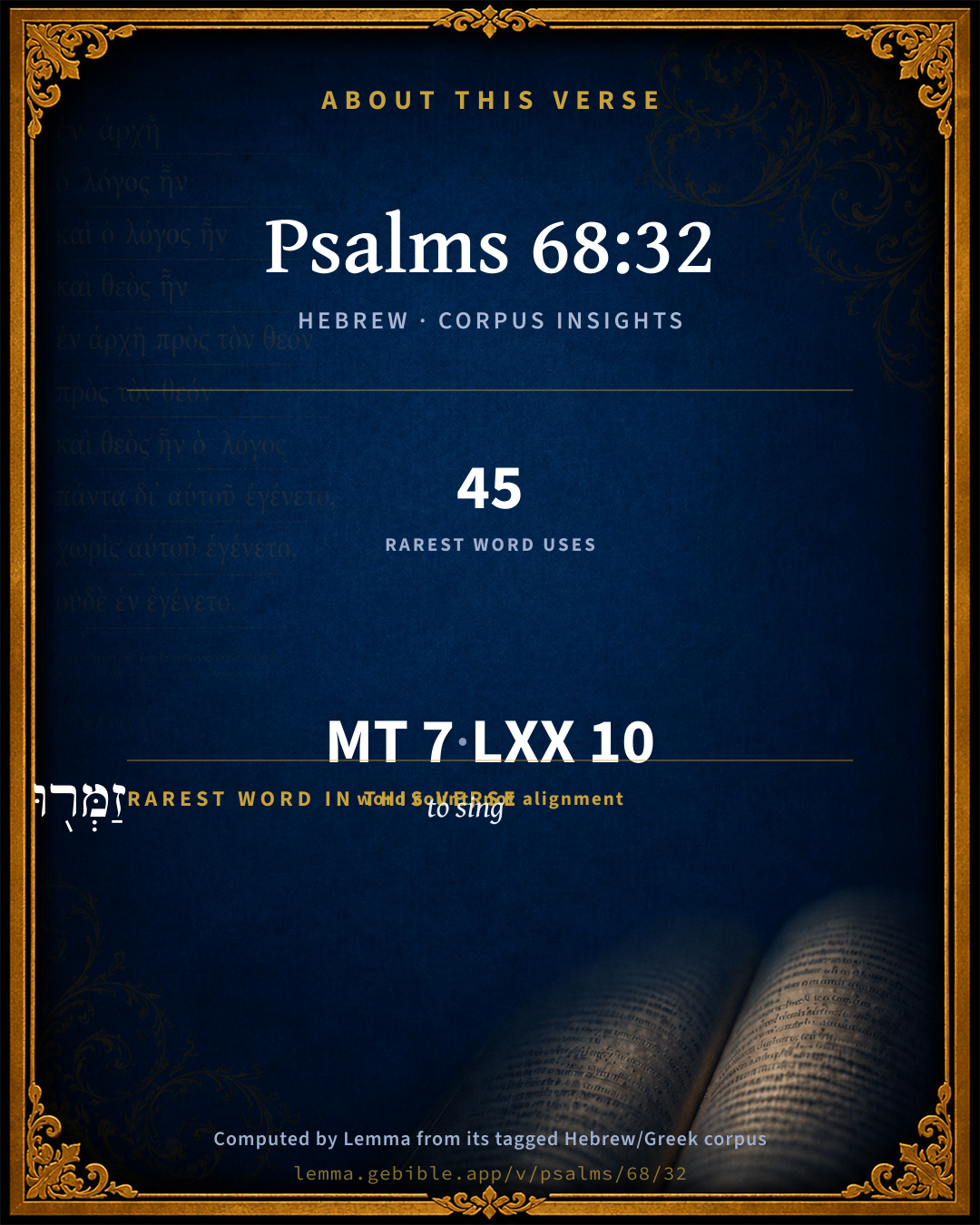
About this verse

These counts appear in no published source. They are computed here, from the morphology-tagged text and Lemma’s own curated glosses. What Lemma adds →

7
words
7
distinct lemmas
Wisdom
section

Shared distinctive vocabulary

זַמְּר֖וּ to sing H2167 occurs in 41 verses of the Hebrew Bible. Also found in:

Grammatical profile

  • 2 verbs
  • 4 nouns
  • 1 particle

Verb forms

  • שִׁ֣ירוּ Qal · Imperative
  • זַמְּר֖וּ Piel · Imperative

Hebrew & Septuagint length

In English translation the verse runs 14 words from the Hebrew and 14 from the Septuagint (LXX English) — the same length.

A rough comparison of the two English renderings, which tokenize alike — not a word-level alignment.

Word counts can differ between the Hebrew and the Greek without any difference in meaning — e.g. the Hebrew direct-object marker אֵת has no separate Greek word, and Greek often adds the article ὁ.

In the original languages it is 7 Hebrew tokens and 10 Greek tokens — but the two are counted differently (Hebrew bundles its prefixes and suffixes into one token; the Greek is in lemma form), so that isn’t a like-for-like length.

Cross-references

7

Topical passages linked to Psalms 68:32 in the Treasury of Scripture Knowledge — connected by theme and wording, ordered by reader-vote popularity; previews shown in the World English Bible.

  • Deuteronomy 32:43 Rejoice, you nations, [with] his people: For he will avenge the blood of his servants, Will render vengeance to his adversaries, Will make expiation for his land, for his people.
  • Psalms 67:2–5 That your way may be known on earth, And your salvation among all nations,
  • Psalms 117:1–2 Praise Yahweh, all you nations! Extol him, all you peoples!
  • Romans 15:10–11 Again he says, "Rejoice, you Gentiles, with his people."
  • Revelation 15:4 Who wouldn't fear you, Lord, And glorify your name? For you only are holy. For all the nations will come and worship before you. For your righteous acts have been revealed."
  • Psalms 100:1 Shout for joy to Yahweh, all you lands!
  • Psalms 102:22 When the peoples are gathered together, The kingdoms, to serve Yahweh.

Cross-references courtesy of OpenBible.info (CC BY 4.0).

Hebrew and Greek witnesses Masoretic Hebrew ↔ Greek Septuagint

The same verse in the two great witnesses to the Old Testament, shown verse-for-verse.

You’re reading Greek Psalm 67 (Hebrew Psalm 68). The Septuagint counts the superscription, so verse numbers can differ from the Hebrew — chapter-level alignment, not verse-by-verse. Numbering follows Rahlfs.

These are two independent witnesses, not word-aligned to each other, and the Septuagint is shown in lemma (dictionary) form.

Hebrew Psalms 68:32 Masoretic · Westminster Leningrad Codex

מַמְלְכ֣וֹת הָ֭אָרֶץ שִׁ֣ירוּ לֵאלֹהִ֑ים זַמְּר֖וּ אֲדֹנָ֣י סֶֽלָה

Sing to God, you kingdoms of the earth! Sing praises to the Lord! Selah.

World English Bible · Public Domain

Greek LXX Greek Psalm 67:32 Septuagint · lemma form

ἥκω πρέσβυς ἐκ αἴγυπτος αἰθιοπία προφθάνω χείρ αὐτός ὁ θεός

Sing to God, you⌃ kingdoms of the earth; sing psalms to the Lord. Pause.

LXX2012 (modern English Septuagint) · Public Domain

Hebrew: Westminster Leningrad Codex (CC BY 4.0). Greek: Septuagint (public domain); English from LXX2012 (modern English Septuagint) (Public Domain). How the Septuagint differs from the Hebrew →

Commentary

Notes on Psalms 68:32 from classic Christian and Jewish commentators (each source and its license shown beneath its notes). The classic Christian expositions comment on the surrounding passage and are grouped to its opening verse, so a note may address several verses; the Jewish commentaries on the Tanakh (Rashi and others) are per-verse, so they appear only where the commentator wrote on this verse.

Lemma curates 59 commentaries, every one of them public domain or Creative Commons licensed, each selected and text-cleaned for this edition rather than reprinted as found. About our sources →

Matthew Henry's Commentary

The psalmist, having prayed for and prophesied of the conversion of the Gentiles, here invites them to come in and join with the devout Israelites in praising God, intimating that their accession to the church would be the matter of their joy and praise (Psa 68:32): Let the kingdoms of the earth sing praises to the Lord; they all ought to do it, and, when they become the kingdoms of the Lord and of his Christ, they will do it. God is here proposed to them as the proper object of praise upon several accounts:

I. Because of his supreme and sovereign dominion: He rides upon the heavens of heavens which were of old (Psa 68:33); compare Psa 68:4. He has from the beginning, nay from before all time, prepared his throne; he sits on the circuit of heaven, guides all the motions of the heavenly bodies; and from the highest heavens, which are the residence of his glory, he dispenses the influences of his power and goodness to this lower world.

II. Because of his awful and terrible majesty: He sends out his voice, and that a mighty voice. This may refer either generally to the thunder, which is called the voice of the Lord and is said to be powerful and full of majesty (Psa 29:3, Psa 29:4), or in particular to that thunder in which God spoke to Israel at Mount Sinai.

III. Because of his mighty power: Ascribe you strength unto God (Psa 68:34); acknowledge him to be a God of such irresistible power that it is folly to contend with him and wisdom to submit to him; acknowledge that he has power sufficient both to protect his faithful subjects and to destroy his stubborn adversaries; and give him the glory of all the instances of his omnipotence. Thine is the kingdom and power, and therefore thine is the glory. We must acknowledge his power, 1. In the kingdom of grace: His excellency is over Israel; he shows his sovereign care in protecting and governing his church; that is the excellency of his power, which is employed for the good of his people. 2. In the kingdom of providence: His strength is in the clouds, whence comes the thunder of his power, the small rain, and the great rain of his strength. Though God has his strength in the clouds, yet he condescends to gather his Israel under the shadow of his wings, Deu 33:26.

IV. Because of the glory of his sanctuary and the wonders wrought there (Psa 68:35): O God! thou art terrible out of thy holy places. God is to be admired and adored with reverence and godly fear by all those that attend him in his holy places, that receive his oracles, that observe his operations according to them, and that pay their homage to him. He displays that out of his holy places which declares aloud that he will be sanctified in those that come nigh unto him. Out of heaven, his holy place above, he does, and will, show himself a terrible God. Nor is any attribute of God more dreadful to sinners than his holiness.

V. Because of the grace bestowed upon his people: The God of Israel is he that gives strength and power unto his people, which the gods of the nations, that were vanity and a lie, could not give to their worshippers; how should they help them, when they could not help themselves? All Israel's strength against their enemies came from God; they owned they had no might of their own, Ch2 20:12. And all our sufficiency for our spiritual work and warfare is from the grace of God. It is through Christ strengthening us that we can do all things, and not otherwise; and therefore he must have the glory of all we do (Psa 115:1) and our humble thanks for enabling us to do it and accepting the work of his own hands in us. If it be the God of Israel that vies strength and power unto his people, they ought to say, Blessed be God. If all be from him, let all be to him.

Matthew Henry's Commentary on the Whole Bible (1708–1710) — public domain (CC PDM 1.0). Text via the HelloAO Bible API.

Trapp's Complete Commentary

John Trapp

Psa 68:32 Sing unto God, ye kingdoms of the earth; O sing praises unto the Lord; Selah:

Ver. 32. Siny unto God, ye kingdoms] No such joy as that of the converted; Isa 35:10, "The ransomed of the Lord shall return, and come to Zion with songs, and everlasting joy upon their heads," &c. Bernard, for a certain time after his conversion, remained, as it were, deprived of his senses, by the excessive consolations he had from God. The like befell Cyprian, Austin, and others.

John Trapp, A Commentary or Exposition upon All the Books of the Old and New Testament (1647–1656) — public domain. Text from a community e-Sword module.

Joseph Benson's Commentary

Psa 68:32-33. Sing unto God, ye kingdoms of the earth — Not only Egypt and Ethiopia, but other kingdoms and nations also, who shall partake of the same grace with them. To him that rideth upon the heavens of heavens — Upon the highest heavens, his truest and best sanctuary; dwelling there in infinite glory and majesty, and from thence looking down upon all the inhabitants of the earth, and ruling them by his almighty power, and therefore most fit to be acknowledged and received by all kings and kingdoms as their Lord and Governor; which were of old — From the very beginning of the world; whereas the ark was only a few hundreds of years old. Lo, he doth send out his voice — Thunder is described in Scripture as the voice of God, (Psalms 29.,) and is peculiarly awful and terrible in the eastern and warmer parts of the earth. But the word of God seems to be here meant, namely, the gospel, published by Christ and his apostles, with the Holy Ghost sent down from heaven; which might well be called God’s voice, and that a mighty voice, because it produced such great and wonderful effects, as are here mentioned, in converting the kings and kingdoms of the earth.

Joseph Benson's Commentary on the Old and New Testaments (1811–1818) — public domain. Text from a community e-Sword module.

J. A. Alexander on Psalms

Joseph Addison Alexander

33. (Psa 68:32). Kingdoms of the earth, sing unto God; praise (or celebrate) the Lord! Selah. In view of the conquests here foreseen, the whole world is summoned to acknowledge the God of Israel as the universal sovereign. Compare Rev 11:15.

Joseph Addison Alexander, The Psalms Translated and Explained (1850) — public domain. Text from a community e-Sword module.

Tyndale Open Study Notes

Tyndale Open Resources

68:32-35 The psalmist calls for the people to praise God, who is victorious over his enemies.

68:32 The term kingdoms of the earth includes all nations and power structures.

Tyndale Open Study Notes — © Tyndale Open Resources, licensed CC BY-SA 4.0. Text via the HelloAO Bible API.

Jamieson, Fausset & Brown

Robert Jamieson, A. R. Fausset & David Brown

To Him who is presented as riding in triumph through His ancient heavens and proclaiming His presence--to Him who, in nature, and still more in the wonders of His spiritual government, out of His holy place (Psa 43:3), is terrible, who rules His Church, and, by His Church, rules the world in righteousness--let all nations and kingdoms give honor and power and dominion evermore.

Next: Psalms Chapter 69

Jamieson, Fausset & Brown — Commentary Critical and Explanatory on the Whole Bible (1871) — public domain (CC PDM 1.0). Text via the HelloAO Bible API.

Adam Clarke's Commentary

Verse 32. Sing unto God] All the inhabitants of the earth are invited to sing unto God, to acknowledge him as their God, and give him the praise due to his name.

Adam Clarke's Commentary on the Bible (1810–1826) — public domain. Text from a community e-Sword/MySword module.

John Calvin's Commentaries

In the next verse he goes farther than before, and calls upon the kingdoms of the earth to praise God, language which implies that those who had once been distinguished by their hostility to him would be ranked amongst his willing worshippers. There must be the knowledge of God, as I have remarked elsewhere, before men can celebrate the praises of his name; and we have a proof of the calling of the Gentiles, in the fact that Moses and the prophets invite them to offer sacrifices of praise. That it might not seem a strange and incredible thing to speak of the extension of the worship of God from one land, within which it had been hitherto confined, to the whole world, David insists upon God’s rightful dominion over all parts of the earth. He rideth upon the heaven of heavens; that is, as we have observed at the beginning of the psalm, he has supreme power over all creatures, and governs the universe at his will. This truth is one which, even in its general application, is well fitted to beget a reverential consideration of the majesty of God; but we must not overlook the more particular reason for which it is here introduced. Mention having been made of the Gentiles, who lay as yet without the pale of the Church, he proves them to be embraced in the government of God by virtue of his sovereignty as Creator, and intimates that there was nothing wonderful in the fact, that he who sits upon the heavens should comprehend the whole inhabitants of the earth under his sway. By the heavens of ancient times, it is meant to intimate that the whole human family were under his power from the very beginning. We have a signal proof of the glorious power of God in the fact, that, notwithstanding the immensity of the fabric of the heavens, the rapidity of their motion, and the conflicting revolutions which take place in them, the most perfect subordination and harmony are preserved; and that this fair and beautiful order has been uninterruptedly maintained for ages. It is apparent then how the ancientness of the heavens may commend to us the singular excellency of the handiwork of God. Having touched upon the work of creation, he particularises thunder, for this is what he intends by a mighty voice, as in Psalm 29:4. There are two constructions which we may put upon the words used, either that by his voice of command he calls forth the thunders which shake heaven and earth with the loudness of their sound, or that he sends forth his mighty voice in the thunder. I have already shown, at some length, in commenting upon the other passage just quoted, that there is a propriety in God’s being represented as thundering; for the phenomenon is one which, more than any other, impresses an awe upon the spirits of men. And the words are introduced with the exclamation lo! or behold! the better to arrest our wandering thoughts, or rather to reprehend our security.

John Calvin's Commentaries (1540-1563) — public domain. Text from the Calvin Translation Society English edition (1840s-50s) via the Christian Classics Ethereal Library (ccel.org). Calvin's coverage is partial (roughly two-thirds of the Bible); uncommented books and verses are honest gaps, never fabricated. The 19th-century editor's footnotes and remarks are omitted so the notes are faithfully Calvin's own voice.

Ellicott's Commentary for English Readers

(32) Sing praises . . .—Better, play and sing. The Selah, as in some other cases, is introduced where to our sense of rhythm it is quite out of place.

A Bible Commentary for English Readers, edited by Charles John Ellicott (1878–1897) — public domain. Text from a community e-Sword module.

The Cambridge Bible for Schools and Colleges

gen. ed. J. J. S. Perowne

32. The kingdoms of the earth are invited to reecho Israel’s chorus of praise, Psa_68:4. Cp. Rev_11:15 The musical interlude (Selah) may suggest the outbreak of the chorus of universal praise.

32–35. All nations are summoned to unite in praising Israel’s God.

The Cambridge Bible for Schools and Colleges (gen. ed. J. J. S. Perowne; Cambridge University Press, 1878–1918) — public domain. Text from a community e-Sword module.

John Gill's Exposition

Sing unto God, ye kingdoms of the earth,.... Not only the Egyptian and Ethiopian kingdoms, but all the kingdoms of the world; which will now be converted to Christ, and become his, even all the Papal, Pagan, and Mahometan kingdoms; see Rev 11:15. These are called upon to sing songs and hymns of praise to Christ, who is God, for redemption by him, and salvation in him; and for their deliverance from all the darkness and delusions under which they formerly were;

O sing praises unto the Lord; the Lord of all, the Lord of lords, the Head of the church, and Saviour of the body; and whom those converted nations will acknowledge to be their Lord and King; and make their homage, and bring their tribute of praise to him, for breaking the antichristian yokes that were upon them, and freeing them from the tyranny and bondage with which they were oppressed: this will be fulfilled in the latter day; see Rev 11:1.

Selah; on this word; see Gill on Psa 3:2.

John Gill's Exposition of the Whole Bible (1746–1763) — public domain (CC PDM 1.0). Text via the HelloAO Bible API.

Albert Barnes' Notes on the Bible

Sing unto God, ye kingdoms of the earth - That is - that acknowledge the true God - celebrate his praise. The psalmist sees the conversion of the world to God to be so certain an event that he calls on all nations to join in the song.

Albert Barnes' Notes on the Bible (1834–1885) — public domain. Text from a community e-Sword/MySword module.

Matthew Poole's English Annotations

Not only Egypt and Ethiopia, but other kingdoms and nations also, who shall partake of the same grace with them.

Matthew Poole's English Annotations on the Holy Bible (1683–1685) — public domain. Text from a community e-Sword/MySword module.

The Treasury of David

Charles H. Spurgeon

Ver. 32. Sing unto God, ye kingdoms of the earth. Glorious shall that song be in which whole empires join. Happy are men that God is one who is consistently the object of joyous worship, for not such are the demons of the heathen. So sweet a thing is song that it ought to be all the Lord's; a secular concert seems almost a sacrilege, a licentious song is treason.

O sing praises unto the Lord. Again and again is God to be magnified; we have too much sinning against God, but cannot have too much singing to God.

Selah. Well may we rest now that our contemplations have reached the millennial glory. What heart will refuse to be lifted up by such a prospect!

None.

None.

Psalms 68:33*

Charles H. Spurgeon's The Treasury of David (1869–1885) — public domain. Psalms only. Text from a community e-Sword/MySword module.

Whedon's Commentary on the Bible

Daniel D. Whedon

32. Sing unto God—The call is upon all the kingdoms of the earth. The reign of Messiah is cause of universal joy.

Daniel D. Whedon (gen. ed.), Commentary on the Old and New Testaments (1874–1909) — public domain. Text from a community e-Sword module.

The Pulpit Commentary

Sing unto God, ye kingdoms of the earth; O sing praises unto the Lord. All the world powers having submitted to the Church, all the kingdoms of the earth can be called upon to join in the praise of God.

The Pulpit Commentary (1880–1919), ed. H.D.M. Spence-Jones & Joseph S. Exell — public domain. Text from a community e-Sword module.

unfoldingWord translationNotes

Door43 World Missions Community

you kingdoms of the earth

Here "kingdoms" refers to the citizens of the kingdoms. AT: "you people who are citizens of kingdoms all over the world" (See: Synecdoche)

To him who rides on the heaven of heavens

The word "Sing" is implied as the beginning of this verse. Here God is described as if he rides in a chariot in the sky. AT: "Sing to God who rides across the sky in his chariot" (See: Ellipsis and Metaphor)

he lifts up his voice with power

This idiom means he speaks powerfully. AT: "he shouts powerfully" or "he speaks loudly" (See: Idiom)

translationWords

kingdom

earth

selah

Yahweh

heaven

voice

power

unfoldingWord translationNotes — © Distant Shores Media and the Door43 World Missions Community, licensed CC BY-SA 4.0. Source: git.door43.org/Door43/en_tn.

Rashi

Rabbi Shlomo Yitzchaki (Rashi)

Gifts will be brought (Then, when You destroy Esau and the King Messiah arises, they will bring you gifts from Egypt and from Cush.Parshandatha) Then, when You scatter the enemy, and the King Messiah arises in the future, they will bring you gifts from Egypt and from Cush. Menachem interpreted חשמנים as the name of a province, the dwellers of Hashmonah (p. 96), but the commentators interpret it as an expression of a gift.

Rashi on the Tanakh — English translations: “The Judaica Press complete Tanach with Rashi, translated by A. J. Rosenberg” (CC BY 4.0); “Pentateuch with Rashi's commentary by M. Rosenbaum and A.M. Silbermann, 1929-1934” (public domain); “The Metsudah Tanach series, Lakewood, N.J” (CC BY 4.0); and “The Book of Joshua, Metsudah Publications, 1997” (CC BY 4.0). Text via Sefaria.

Lesson kit

Teaching starters — assembled from the data on this page, not authored interpretation. Every prompt links to the verse data it draws on. Edit before teaching.

Psalms, in the Wisdom, opens this verse with 7 words (7 distinct Hebrew lemmas). Its most distinctive word is zâmar (“to sing”). A historical commentator’s framing appears above. Read the whole chapter for the surrounding context.

Discussion questions

  1. What does “to sing” (zâmar) contribute to the verse as a whole?
  2. How does Judges 5:3, which shares the word «to sing», read alongside this verse?
  3. These translations render this verse differently. What is at stake in choosing one wording over another?
  4. «שִׁ֣ירוּ» is a Qal Imperative verb. How does that grammatical form shape the action described?
  5. Compare how Matthew Henry's Commentary and Trapp's Complete Commentary read this verse. Where do they agree or differ?

Things to notice

Reading settings

Reading text

Shown beneath each verse's original-language words.

Old Testament
Old Testament edition

Read the OT as the Masoretic Hebrew (MT) or the Greek Septuagint (LXX).

English shown for the Greek Septuagint (in the Hebrew ↔ Greek comparison).

Comparing translations? Open the Compare panel on any verse page to stack up to four side by side.