
Exodus 15:17

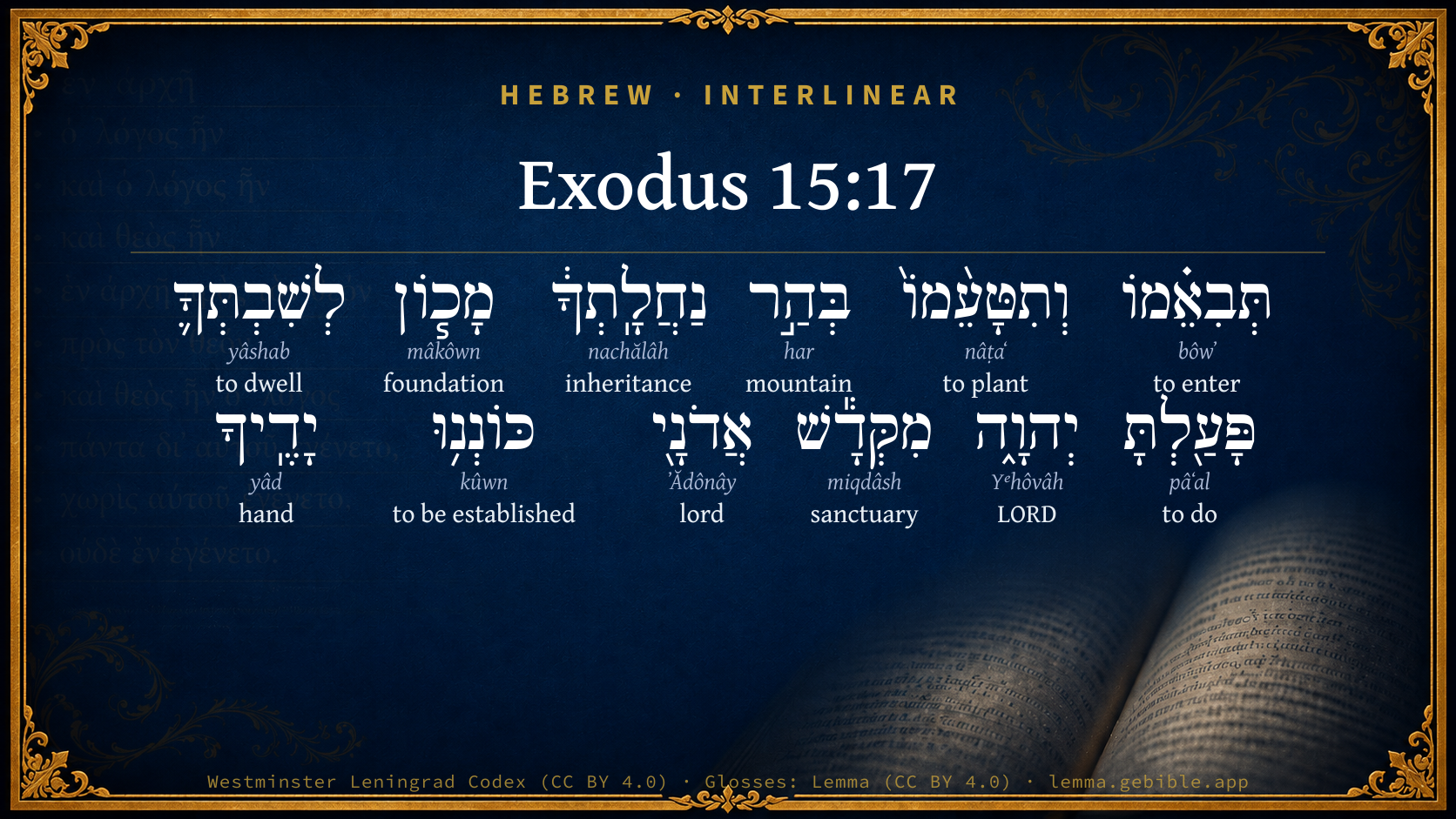
Hebrew (Westminster Leningrad Codex) Exodus 15:17 appears in the Hebrew Old Testament. The text above is from the Westminster Leningrad Codex. Each word links to its Strong’s number, a concise gloss, and parsing drawn from the Open Scriptures Hebrew Bible morphology. Click any word for its full Brown-Driver-Briggs (BDB) entry.
Download image
Cite this verse

Exodus 15:17 (World English Bible). Public Domain. Lemma interlinear Bible study tool, https://lemma.gebible.app/v/exodus/15/17.

Show BibTeX & RIS
BibTeX
RIS
English Translation
You shall bring them in, and plant them in the mountain of your inheritance, The place, Yahweh, which you have made for yourself to dwell in; The sanctuary, Lord, which your hands have established.
World English Bible · Public Domain
Highlights
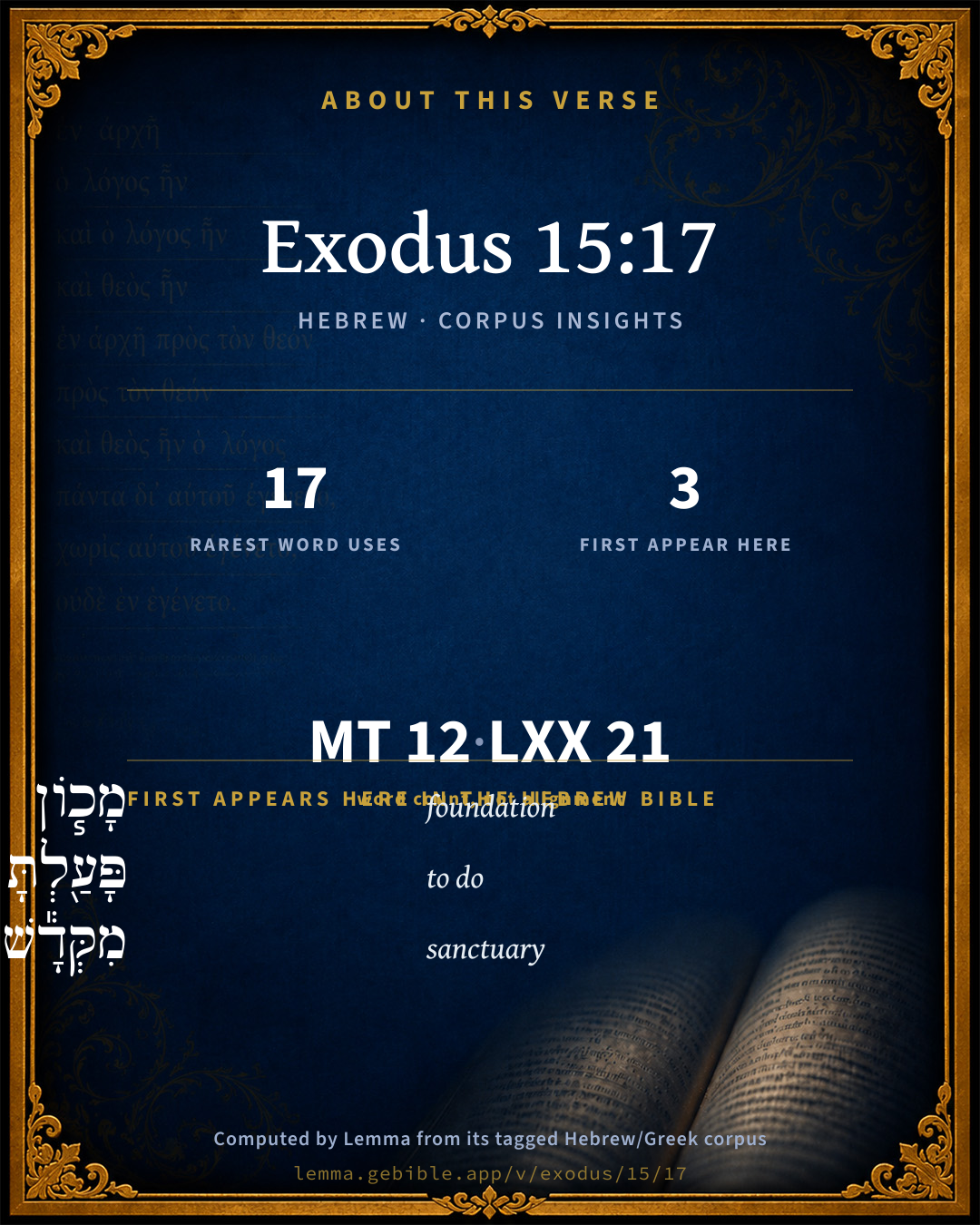
  • 3 first appearances in the Hebrew Bible
Full analysis ↓
Download a study sheet

One document with this verse’s original text, its word-by-word gloss line, the meaning frame, cross-references with their text, attributed commentary, and full source and license credits — printable, and it pastes into notes with its structure intact.

This verse Autodidact and up

Study sheet (.html) Plain text (.txt)

A passage Seminary Student

Up to 50 verses in one chapter. A passage sheet keeps up to 6 commentary sources and 12 cross-references per verse, in the order this page ranks them, and says so on the sheet whenever that leaves anything out. Ask for a single verse and you get the Autodidact verse sheet above.

Everything on this page stays free to read, with no account — the sheet is a download of what is already on screen, not access to it.

Want to remove ads? Support Godless Engineer
Compare translations 3

The same verse in 3 English versions, stacked beneath the original-language interlinear above. Click any original word for its lexicon entry.

Each is an independent rendering of the whole verse — the interlinear is not word-aligned to these translations.

Highlighted words mark where these versions differ — a whole-verse word diff, not a word-by-word alignment.

  • World English Bible Public Domain
    You shall bring them in, and plant them in the mountain of your inheritance, The place, Yahweh, which you have made for yourself to dwell in; The sanctuary, Lord, which your hands have established.
  • King James Version Public Domain
    Thou shalt bring them in, and plant them in the mountain of thine inheritance, in the place, O LORD, which thou hast made for thee to dwell in, in the Sanctuary, O LORD, which thy hands have established.
  • unfoldingWord Literal Text CC BY-SA 4.0
    You will bring them, and you will plant them on the mountain of your possession, the place, Yahweh, that you made for your dwelling, the holy place, my Lord, that your hands built.

unfoldingWord Literal Text — © unfoldingWord, licensed CC BY-SA 4.0. Word-aligned USFM3 via Door43 (git.door43.org/unfoldingWord/en_ult).

Versions to compare (up to 4)

3 of 4 selected

Show all 18 translations

Every available English version of this verse, each an independent rendering of the whole verse.

  • World English Bible Public Domain
    You shall bring them in, and plant them in the mountain of your inheritance, The place, Yahweh, which you have made for yourself to dwell in; The sanctuary, Lord, which your hands have established.
  • Berean Standard Bible Public Domain
    You will bring them in and plant them on the mountain of Your inheritance—the place, O LORD, You have prepared for Your dwelling, the sanctuary, O Lord, Your hands have established.
  • Majority Standard Bible Public Domain
    You will bring them in and plant them on the mountain of Your inheritance—the place, O LORD, You have prepared for Your dwelling, the sanctuary, O Lord, Your hands have established.
  • King James Version Public Domain
    Thou shalt bring them in, and plant them in the mountain of thine inheritance, in the place, O LORD, which thou hast made for thee to dwell in, in the Sanctuary, O LORD, which thy hands have established.
  • American Standard Version (1901) Public Domain
    Thou wilt bring them in, and plant them in the mountain of thine inheritance, The place, O Jehovah, which thou hast made for thee to dwell in, The sanctuary, O Lord, which thy hands have established.
  • Revised Version (1885) Public Domain
    Thou shalt bring them in, and plant them in the mountain of thine inheritance, The place, O LORD, which thou hast made for thee to dwell in, The sanctuary, O Lord, which thy hands have established.
  • Geneva Bible (1599) Public Domain
    Thou shalt bring them in, and plant them in the mountaine of thine inheritance, which is the place that thou hast prepared, O Lord, for to dwell in, euen the sanctuarie, O Lord, which thine hands shall establish.
  • Douay-Rheims (1899) Public Domain
    Thou shalt bring them in, and plant them in the mountain of thy inheritance, in thy most firm habitation which thou hast made, O Lord; thy sanctuary, O Lord, which thy hands have established.
  • Young's Literal Translation Public Domain
    Thou dost bring them in, And dost plant them In a mountain of Thine inheritance, A fixed place for Thy dwelling Thou hast made, O Jehovah; A sanctuary, O Lord, Thy hands have established;
  • Literal Standard Version CC BY-SA 4.0
    You bring them in, and plant them || In a mountain of Your inheritance, || A fixed place for Your dwelling You have made, O YHWH; A sanctuary, O Lord, Your hands have established;
  • Unlocked Literal Bible CC BY-SA 4.0
    You will bring them and plant them on the mountain of your inheritance, the place, Yahweh, that you have made to live in, the sanctuary, our Lord, that your hands have built.
  • unfoldingWord Literal Text CC BY-SA 4.0
    You will bring them, and you will plant them on the mountain of your possession, the place, Yahweh, that you made for your dwelling, the holy place, my Lord, that your hands built.
  • Darby Bible Public Domain
    Thou shalt bring them in, and plant them in the mountain of thine inheritance, The place that thou, Jehovah, hast made thy dwelling, The Sanctuary, Lord, that thy hands have prepared.
  • World Messianic Bible Public Domain
    You will bring them in, and plant them in the mountain of your inheritance, the place, LORD, which you have made for yourself to dwell in: the sanctuary, Lord, which your hands have established.
  • Webster's Bible Public Domain
    Thou shalt bring them in, and plant them in the mountain of thy inheritance, in the place, O LORD, which thou hast made for thee to dwell in; in the sanctuary, O Lord. which thy hands have established.
  • Free Bible Version CC BY-SA 4.0
    You will take your people and plant them on the mountain that you own, the place that you, Lord, have prepared as your home, the sanctuary that your hands have built, Lord.
  • Bible in Basic English Public Domain
    You will take them in, planting them in the mountain of your heritage, the place, O Lord, where you have made your house, the holy place, O Lord, the building of your hands.
  • JPS Tanakh (1917) Public Domain
    Thou bringest them in, and plantest them in the mountain of Thine inheritance, the place, O LORD, which Thou hast made for Thee to dwell in, the sanctuary, O Lord, which Thy hands have established.

Literal Standard Version (2020), Covenant Press — licensed CC BY-SA 4.0. Text via the HelloAO Bible API (eBible.org). Unlocked Literal Bible (unfoldingWord) — licensed CC BY-SA 4.0. Text via the HelloAO Bible API (eBible.org). unfoldingWord Literal Text — © unfoldingWord, licensed CC BY-SA 4.0. Word-aligned USFM3 via Door43 (git.door43.org/unfoldingWord/en_ult). Free Bible Version, Dr. Jonathan Gallagher — licensed CC BY-SA 4.0. Text via the HelloAO Bible API (eBible.org).

Word by word

More ways to search: Search by grammar → Find every occurrence → Compare this word →

Practice this passage: Drill this verse → Learn its vocabulary →

מָכ֧וֹן
mâkôwn
H4349
“foundation”
Noun, Common, Masculine, Singular, Absolute
Part of Speech
Noun
Type
Common
Gender
Masculine
Number
Singular
State
Absolute
Full BDB Definition

Origin: from H3559

TWOT: 964c

fixed or established place, foundation - fixed place - foundation
  1. תְּבִאֵ֗מוֹ bôwʼ H935 “to enter · them” Verb, Hiphil, Imperfect, 2nd Person, Masculine, Singular + Suffix, Personal, 3rd Person, Masculine, Plural
  2. וְתִטָּעֵ֨מוֹ֙ nâṭaʻ H5193 “and · to plant · them” Conjunction + Verb, Qal, Imperfect, 2nd Person, Masculine, Singular + Suffix, Personal, 3rd Person, Masculine, Plural
  3. בְּהַ֣ר har H2022 “in/at · mountain of” Preposition + Noun, Common, Masculine, Singular, Construct
  4. נַחֲלָֽתְךָ֔ nachălâh H5159 “inheritance · your” Noun, Common, Feminine, Singular, Construct + Suffix, Personal, 2nd Person, Masculine, Singular
  5. לְשִׁבְתְּךָ֛ yâshab H3427 “to dwell · you” Preposition + Verb, Qal, Infinitive Construct + Suffix, Personal, 2nd Person, Masculine, Singular
  6. פָּעַ֖לְתָּ pâʻal H6466 “to do” Verb, Qal, Perfect, 2nd Person, Masculine, Singular
  7. יְהוָ֑ה Yᵉhôvâh H3068 “LORD” Noun, Proper
  8. מִקְּדָ֕שׁ miqdâsh H4720 “sanctuary” Noun, Common, Masculine, Singular, Absolute
  9. אֲדֹנָ֖י ʼĂdônây H136 “Lord · my” Noun, Common, Masculine, Plural, Construct + Suffix, Personal, 1st Person, Common, Singular
  10. כּוֹנְנ֥וּ kûwn H3559 “to be established” Verb, Polel, Perfect, 3rd Person, Common, Plural
  11. יָדֶֽיךָ yâd H3027 “hands · your” Noun, Common, Both, Dual, Construct + Suffix, Personal, 2nd Person, Masculine, Singular

About this verse

These counts appear in no published source. They are computed here, from the morphology-tagged text and Lemma’s own curated glosses. What Lemma adds →

12
words
12
distinct lemmas
Pentateuch
section

Notable vocabulary

The rarest word here is מָכ֧וֹן foundation H4349 — appearing just 17 times in the whole Hebrew Bible.

First appearance in Scripture

These words make their first canonical appearance in the Hebrew Bible here:

  • מָכ֧וֹן foundation H4349
  • פָּעַ֖לְתָּ to do H6466
  • מִקְּדָ֕שׁ sanctuary H4720

Shared distinctive vocabulary

מָכ֧וֹן foundation H4349 occurs in 17 verses of the Hebrew Bible. Also found in:

Grammatical profile

  • 5 verbs
  • 7 nouns

Verb forms

  • תְּבִאֵ֗מוֹ Hiphil · Imperfect
  • וְתִטָּעֵ֨מוֹ֙ Qal · Imperfect
  • לְשִׁבְתְּךָ֛ Qal · Infinitive Construct
  • פָּעַ֖לְתָּ Qal · Perfect
  • כּוֹנְנ֥וּ Polel · Perfect

Hebrew & Septuagint length

In English translation the verse runs 34 words from the Hebrew and 32 from the Septuagint (LXX English) — closely comparable.

A rough comparison of the two English renderings, which tokenize alike — not a word-level alignment.

Word counts can differ between the Hebrew and the Greek without any difference in meaning — e.g. the Hebrew direct-object marker אֵת has no separate Greek word, and Greek often adds the article ὁ.

In the original languages it is 12 Hebrew tokens and 21 Greek tokens — but the two are counted differently (Hebrew bundles its prefixes and suffixes into one token; the Greek is in lemma form), so that isn’t a like-for-like length.

Cross-references

9

Topical passages linked to Exodus 15:17 in the Treasury of Scripture Knowledge — connected by theme and wording, ordered by reader-vote popularity; previews shown in the World English Bible.

  • Psalms 44:2 You drove out the nations with your hand, But you planted them. You afflicted the peoples, But you spread them abroad.
  • Psalms 80:8 You brought a vine out of Egypt. You drove out the nations, and planted it.
  • Psalms 78:54–55 He brought them to the border of his sanctuary, To this mountain, which his right hand had taken.
  • Jeremiah 32:41 Yes, I will rejoice over them to do them good, and I will plant them in this land assuredly with my whole heart and with my whole soul.
  • Psalms 78:68–69 But chose the tribe of Judah, Mount Zion which he loved.
  • Psalms 132:13–14 For Yahweh has chosen Zion. He has desired it for his habitation.
  • Isaiah 5:1–4 Let me sing for my well beloved a song of my beloved about his vineyard. My beloved had a vineyard on a very fruitful hill.
  • Jeremiah 2:21 Yet I had planted you a noble vine, wholly a right seed: how then are you turned into the degenerate branches of a foreign vine to me?
  • Jeremiah 31:23 Thus says Yahweh of Hosts, the God of Israel, Yet again shall they use this speech in the land of Judah and in the cities of it, when I shall bring again their captivity: Yahweh bless you, habitation of righteousness, mountain of holiness.

Cross-references courtesy of OpenBible.info (CC BY 4.0).

Hebrew and Greek witnesses Masoretic Hebrew ↔ Greek Septuagint

The same verse in the two great witnesses to the Old Testament, shown verse-for-verse.

These are two independent witnesses, not word-aligned to each other, and the Septuagint is shown in lemma (dictionary) form.

Hebrew Exodus 15:17 Masoretic · Westminster Leningrad Codex

תְּבִאֵ֗מוֹ וְתִטָּעֵ֨מוֹ֙ בְּהַ֣ר נַחֲלָֽתְךָ֔ מָכ֧וֹן לְשִׁבְתְּךָ֛ פָּעַ֖לְתָּ יְהוָ֑ה מִקְּדָ֕שׁ אֲדֹנָ֖י כּוֹנְנ֥וּ יָדֶֽיךָ

You shall bring them in, and plant them in the mountain of your inheritance, The place, Yahweh, which you have made for yourself to dwell in; The sanctuary, Lord, which your hands have established.

World English Bible · Public Domain

Greek LXX Exodus 15:17 Septuagint · lemma form

εἰςἄγω καταφυτεύω αὐτός εἰς ὄρος κληρονομία σύ εἰς ἕτοιμος κατοικητήριον σύ ὅς καταἐργάζομαι κύριος ἁγίασμα κύριος ὅς ἑτοιμάζω ὁ χείρ σύ

Bring them in and plant them in the mountain of their inheritance, in your prepared habitation, which you, O Lord, have prepared; the sanctuary, O Lord, which your hands have made ready.

LXX2012 (modern English Septuagint) · Public Domain

Hebrew: Westminster Leningrad Codex (CC BY 4.0). Greek: Septuagint (public domain); English from LXX2012 (modern English Septuagint) (Public Domain). How the Septuagint differs from the Hebrew →

Targum (Aramaic paraphrase)

2

The Targum is the ancient Jewish Aramaic paraphrase of the Hebrew Scriptures — an interpretive translation, not the Hebrew text itself. Onkelos (literal) and Pseudo-Jonathan (expansive) render the Torah, and Jonathan the Prophets. Coverage is partial: where no permissively-licensed English translation exists for a verse, only the Aramaic is shown. This is verse-level text, not a word-by-word alignment to the Hebrew.

  1. Targum Onkelos Torah (Genesis–Deuteronomy)
    תָּעֵלִנוּן וְתַשְׁרִינוּן בְּטוּרָא דְאַחְסַנְתָּךְ אֲתַר מְתַקֵן לְבֵית שְׁכִנְתָּךְ אַתְקֵנְתָּא יְיָ מַקְדְשָׁא יְיָ אַתְקְנוֹהִי יְדָיךְ:

    (no public-domain English translation for this verse)

    Targum Onkelos — Aramaic: “Onkelos Genesis” (public domain); “Onkelos Exodus” (public domain); “Onkelos Leviticus” (public domain); “Onkelos Numbers” (public domain); “Onkelos Deuteronomy” (public domain). English: “Sefaria Community Translation” (CC0 1.0 (public-domain dedication)); “J.W. Etheridge. The Targums of Onkelos and Jonathan Ben Uzziel on the Pentateuch. London: Longmans, Green, 1862” (public domain). Text via Sefaria.

  2. Targum Pseudo-Jonathan Torah (Genesis–Deuteronomy)
    תָּעוּל יַתְהוֹן וְתִנְצוֹב יַתְהוֹן בְּטוּר בֵּית מַקְדְּשָׁךְ אָתַר דִּמְכֻוַּון קְבֵיל כּוּרְסֵי יְקָרָךְ מוּזְמַן קְבֵיל בֵּית שְׁכִינַת קָדְשָׁךְ אַתְקִינְתָּא יְיָ בֵּית מַקְדָּשָׁךְ יְיָ תַּרְתֵּין אִידְיָיךְ שַׁכְלִילוּ יָתֵיהּ

    Thou wilt bring them in, and plant them on the mountain of Thy sanctuary, the place which Thou hast provided before the throne of Thy glory, the house of Thy holy Shekinah, which Thou, O Lord, hast prepared, Thy sanctuary that with both hands Thou hast established.

    Targum Pseudo-Jonathan — Aramaic: “Targum Jonathan on Genesis” (public domain); “Targum Jonathan on Exodus” (public domain); “Targum Jonathan on Leviticus” (public domain); “Targum Jonathan on Numbers” (public domain); “Targum Jonathan on Deuteronomy” (public domain). English: “The Targum of Jonathan ben Uzziel, trans. J. W. Etheridge, London, 1862” (public domain). Text via Sefaria.

Commentary

Notes on Exodus 15:17 from classic Christian and Jewish commentators (each source and its license shown beneath its notes). The classic Christian expositions comment on the surrounding passage and are grouped to its opening verse, so a note may address several verses; the Jewish commentaries on the Tanakh (Rashi and others) are per-verse, so they appear only where the commentator wrote on this verse.

Lemma curates 59 commentaries, every one of them public domain or Creative Commons licensed, each selected and text-cleaned for this edition rather than reprinted as found. About our sources →

Trapp's Complete Commentary

John Trapp

Exo 15:17 Thou shalt bring them in, and plant them in the mountain of thine inheritance, [in] the place, O LORD, [which] thou hast made for thee to dwell in, [in] the Sanctuary, O Lord, [which] thy hands have established.

Ver. 17. Of thine inheritance.] Provided and purchased by thee for thy firstborn, Israel.

John Trapp, A Commentary or Exposition upon All the Books of the Old and New Testament (1647–1656) — public domain. Text from a community e-Sword module.

The Biblical Illustrator

Joseph S. Exell

Exo_15:17-18

Thou shalt bring them in.

Anticipations of faith

We are, perhaps, hardly surprised at the tone of jubilant confidence which pervades this glorious psalm of thanksgiving. Very strong indeed is the language used; but perhaps not stronger than might naturally have been expected to spring from such circumstances; for what a wonderful event had just transpired! Here they were then, on the other side of the Red Sea, the vast wilderness stretching before them, their long weary march not yet commenced, and wholly destitute of any adequate supplies, and without either arms, or discipline, or any capacity for warfare. Surely the prospect might have seemed most discouraging. They must have known perfectly well--what they soon found out to be a fact--that the wilderness swarmed with wandering nomad hordes, Bedouins of the desert, men of war, who might at any moment come down upon them, cut off their stragglers, or even put the whole undisciplined rabble to rout and make a prey of them. And even supposing they should overcome these difficulties of the journey, what then? There lay Canaan before them, but how were they, who could hardly hold their own against the tribes of the desert, to undertake aggressive warfare against nations dwelling in cities with walls great and high, and equipped with all the appliances of ancient warfare? How chimerical their enterprise would seem on reflection! how improbable that they would ever succeed in taking possession of the land which God had promised to them! But faith looked on beyond all difficulties. Faith never stops for commissariat supplies! Faith does not ask, Where is my daily bread to come from? Faith does not wait to be clothed with armour, save such armour as the power of God supplies. Faith does not stop to weigh the adequacy of the means within our reach to induce the end. Children of God, it is time we endeavoured to apply the lessons suggested by all this to ourselves. We too have been the subjects of a great deliverance, a deliverance as supernatural in its character and as astonishing in its conditions as ever was the deliverance of Israel from Egypt. This deliverance is also the product of redemption. We are saved in order that we may rise to the prize of our high calling, and become inheritors of our true Land of Promise; and the first great deliverance is with us also surely an earnest and a pledge of all that is to follow. I suppose it is because we so imperfectly apprehend the miracle of our deliverance and its completeness, and the new relations which it establishes between ourselves and God, and between ourselves and sin, that our feelings at the outset of our new life are so often just the opposite of those depicted in this triumphant song. Instead of joyous anticipation, how common a thing it is to meet with gloomy forebodings on the part of the newborn children of God, fresh from the Cross of Christ, just rising, as we may say, spiritually out of the waters of the Red Sea. And many of us have scarcely been saved from our condition of condemnation and spiritual bondage before we begin to consider the difficulties that lie before us, the enemies that we shall have to encounter, the sacrifices that we may have to make, the trials that we may have to undergo. The wilderness seems so vast, the enemies so mighty, the supplies so inadequate or precarious; and while our eyes of unbelief are resting upon all these adverse considerations, our heart seems to sink within us until we are ready to turn back again into Egypt. How common a thing it is to meet with young Christians who seem indeed to be on the right side of the Red Sea, but who appear to be more inclined to wring their hands in terror than to sound the loud timbrel in exultation! (W. Hay Aitken, M. A.)

An encouraging deliverance

Two ways this great deliverance was encouraging.

1. It was such an instance of Gods power as would terrify their enemies and quite dishearten them (Exo_15:14-16). It had this effect (see Deu_2:4; Num_22:3; Jos_2:9-10).

2. It was such a beginning of Gods favour to them as gave them an earnest of the perfection of His kindness. This was but in order to something further (Exo_15:17). (M. Henry, D. D.)

Christ for ever

When Luther went to his trial at Augsburg from Wittemberg he walked all the distance. Clad in his monks brown frock, with all his wardrobe on his back, the citizens, high and low, attended him in enthusiastic admiration. As they went they cried, Luther for ever! Nay! nay! he answered, Christ for ever!

The Biblical Illustrator, edited by Joseph S. Exell (c. 1880s–1900s) — public domain. Text from a community e-Sword module.

Joseph Benson's Commentary

Exo 15:17. Thou shalt bring them in — If he thus bring them out of Egypt, he will bring them into Canaan; for he has begun, and will he not make an end? Thou wilt plant them in the place made for thee to dwell in — It is good dwelling where God dwells, in his church on earth, and in his church in heaven. In the mountains — The mountainous country of Canaan. The sanctuary which thy hands have established — Will as surely establish as if it were done already.

Joseph Benson's Commentary on the Old and New Testaments (1811–1818) — public domain. Text from a community e-Sword module.

MacLaren's Expositions of Holy Scripture

Alexander MacLaren

Exodus

THE ULTIMATE HOPE

Exo 15:17.

I. The lesson taught by each present deliverance and kindness is that we shall be brought to His rest at last.

{a} Daily mercies are a pledge and a pattern of His continuous acts. The confidence that we shall be kept is based upon no hard doctrine of final perseverance, but on the assurance that God is always the same, like the sunshine which has poured out for all these millenniums and still rushes on with the same force. Consider-

The inexhaustibleness of the divine resources.

The steadfastness of the divine purposes.

The long-suffering of the divine patience.

{b} Thus daily mercies should lead on our thoughts to heavenly things. They should not prison us in their own sweetness. We should see the great Future shining through them as a transparent, not an opaque medium.

{c} That ultimate future should be the great object of our hope. Surely it is chiefly in order that we may have the light of that great to-morrow brightening and magnifying our dusty to-days, that we are endowed with the faculty of looking forward and ‘calling things that are not as though they were.’ So we should engage and enlarge our minds with it.

II. The form which that ultimate future assumes.

The Israelites thought of Canaan, and in particular of ‘Zion,’ its centre-point.

{a} Perpetual rest. ‘Bring in and plant’-a contrast to the desert nomad life.

{b} Perpetual safety. ‘The sanctuary which Thy hands have established,’ i.e. made firm.

{c} Perpetual dwelling in God. ‘Thy dwelling,’ ‘Thy mountain,’ ‘Thy holy habitation’ {Exo 15:13}, rather than ‘our land.’ For Israel their communion with Jehovah was perfected on Zion by the Temple and the sacrifices, including the revelation of {priestly} national service.

{d} Perpetual purity. ‘Thy sanctuary.’ ‘Without’ holiness ‘no man shall see the Lord.’

Alexander MacLaren, Expositions of Holy Scripture (1904–1910) — public domain. Text from a community e-Sword module.

Tyndale Open Study Notes

Tyndale Open Resources

15:17 your own mountain: Deities were believed to have their residence on mountains. Thus Canaan is figuratively portrayed as God’s residence.

Tyndale Open Study Notes — © Tyndale Open Resources, licensed CC BY-SA 4.0. Text via the HelloAO Bible API.

Geneva Bible (1599)

Geneva Bible translators

Which was mount Zion, where afterward the Temple was built.

Geneva Bible (1599) marginal notes — public domain. Text via Bolls.life.

Adam Clarke's Commentary

Verse 17. Thou shalt bring them in] By thy strength and mercy alone shall they get the promised inheritance.

And plant them] Give them a fixed habitation in Canaan, after their unsettled wandering life in the wilderness.

In the mountain] Meaning Canaan, which was a very mountainous country, De 11:11; or probably Mount Zion, on which the temple was built. Where the pure worship of God was established, there the people might expect both rest and safety. Wherever the purity of religion is established and preserved, and the high and the low endeavour to regulate their lives according to its precepts, the government of that country is likely to be permanent.

Adam Clarke's Commentary on the Bible (1810–1826) — public domain. Text from a community e-Sword/MySword module.

Ellicott's Commentary for English Readers

(17) In the mountain of thine inheritance.—Some suppose Mount Moriah to be especially intended; but it is better to understand Canaan generally, which is a country consisting almost entirely of mountains, with only two plains of any extent—those of Sharon and Esdraelon.

The Sanctuary can only mean the place where God was “to put his name.” (See the comment on Exo_15:13.) This is spoken of as already “made” and “established,” because it was so in the Divine counsels, as Moses very well knew. (See Deu_12:5; Deu_12:11; Deu_12:14; Deu_14:23-24, &c.)

A Bible Commentary for English Readers, edited by Charles John Ellicott (1878–1897) — public domain. Text from a community e-Sword module.

The Cambridge Bible for Schools and Colleges

gen. ed. J. J. S. Perowne

17.Thou didst bring them in, and plant them in the mountain of thine inheritance,

The place which thou hadst made for thee to dwell in, O Yahweh,

The sanctuary, O Lord, which thy hands have established.

The final goal of Israel’s triumphant progress through the nations (vv. 14–16): viz. its settlement in Canaan, with Jehovah’s sanctuary established in its midst.

plant them] fix them in firmly: the figure, as 2Sa_7:10, Amo_9:15, Psa_44:2, and elsewhere.

the mountain of thine inheritance] i.e. Canaan, called a ‘mountain’ on account of the mountainous character of many of its most important parts (Judah, Benjamin, and Ephraim, for instance). Cf. Deu_3:25, Isa_11:9, Psa_78:54 b (with allusion to this passage).

of thine inheritance] in so far as it was His possession: cf. Jer_Exo_2:7, Psa_79:1; and (of the people) 1Sa_10:1; 1Sa_26:19, 2Sa_14:16; 2Sa_20:19; 2Sa_21:3.

a place … for thee to dwell in] These words, exactly as 1Ki_8:13 (‘I have surely built thee an house of habitation, a place for thee to dwell in for ever’), in the poetical fragment (vv. 12, 13), excerpted, it is almost certain (see Skinner’s note on the passage in the Century Bible, or Barnes’ in the Cambridge Bible), from the ancient ‘Book of Jashar’ (hence also the expression, ‘place of thy (or his) dwelling,’ in 1Ki_8:39; 1Ki_8:43; 1Ki_8:49, Psa_33:14). Di. thinks that the reference is to the sanctuary of Shiloh (which must have been a substantial building, 1Sa_1:3; 1Sa_1:9; 1Sa_3:3; 1Sa_3:15): others think that the terms used point rather to the Temple on Zion (with ‘established,’ in the next line, cf. Psa_48:8; Psa_87:5). Of course, the entire people was not ‘planted’ at either of these places: but the poet, as he goes on, narrows his outlook, and fixes his thoughts on Jehovah’s earthly dwelling, the religious centre of the nation.

The Cambridge Bible for Schools and Colleges (gen. ed. J. J. S. Perowne; Cambridge University Press, 1878–1918) — public domain. Text from a community e-Sword module.

John Gill's Exposition

Thou shalt bring them in,.... Into the land of Canaan, which is often ascribed to the Lord, as well as his bringing them out of the land of Egypt, see Deu 8:8,

and plant them in the mountain of thine inheritance; in the country which he chose for the inheritance of his people and himself; one part of which was very mountainous, called the hill country of Judea, and especially Jerusalem, round about which mountains were; and particular respect may be had to Mount Moriah and Zion, on which the temple afterwards stood, and which was called the mountain of the Lord's house, and seems to be pointed at in the following account: here Israel is compared to a vine as elsewhere, which the Lord took out of Egypt and planted in the land of Canaan, where it took root and was settled, see Psa 80:8.

in the place, O Lord, which thou hast made for thee to dwell in; that is, which he had appointed for his habitation; for as yet neither the tabernacle nor temple were built, in which he afterwards dwelt: in this sense the word "made" is used in Pro 16:4.

in the sanctuary, O Lord, which thy hands have established; that is, which he intended to establish, and would, and did establish; meaning, more especially, the temple, and the holy of holies in it, which he directed Solomon to build, and was a settled dwelling place for him, Kg1 8:13, now all this may be considered as typical of the church of Christ, and of his bringing and planting his people there, which is a "mountain", and often signified by Mount Zion; is visible and immovable, the true members of it being interested in the love of God, on the sure foundation of electing grace, secured in the everlasting covenant, and built on the rock Christ Jesus; and is the Lord's "inheritance", chosen by him to be so, given to Christ, and possessed by him as such, and as dear to him, and more so, than a man's inheritance is to him: this is a "place" he has appointed, prepared, and made for himself to dwell in, and is the habitation of Father, Son, and Spirit; and is a "sanctuary" or holy place, consisting of holy persons established in Christ, as particular believers are, and the church in general is; and though now sometimes in an unsettled state as to outward things, yet ere long will be established on the top of the mountains: and hither the Lord brings his purchased people, as sheep into his fold, as children to his house, fitted up for them, as guests to partake of his entertainments; and this is an act of his powerful grace upon them, and of his distinguished goodness to them: and here he also plants them, for the church is a plantation, a garden, an orchard of pomegranates, with pleasant fruits; and such as are planted here are transplanted out of the world, and are first planted in Christ, and receive the ingrafted word; and though ministers may be instruments in planting, the Lord is the efficient; and those that are planted by him are choice pleasant plants, fruitful ones, and shall never be plucked up: but as this follows the passage of the Lord's people over Jordan into Canaan land, it may rather be considered as an emblem of the heavenly state, and of the Lord's bringing and planting his people there; which, like a mountain, is an immovable and unalterable state, an inheritance incorruptible and eternal, the dwellingplace of Jehovah, a sanctuary or holy place, which his hand prepared from the foundation of the world; and which he has established as everlasting habitations for his people, where he brings their souls at death, and both souls and bodies in the resurrection morn to dwell with him for ever; and which is a paradise, an Eden of pleasure, where he plants them as trees of righteousness, next to Christ the tree of life, and where they are always green, fruitful, flourishing, and shall never be hurt by any scorching heat or blasting wind, or be trodden under foot or plucked up.

John Gill's Exposition of the Whole Bible (1746–1763) — public domain (CC PDM 1.0). Text via the HelloAO Bible API.

Haydock's Catholic Bible Commentary

Mountain. Chanaan was very mountainous, and different from Egypt. (Calmet) --- Sion was the peculiar mountain of God, consecrated to his worship. (Menochius)

George Leo Haydock (1774–1849), Haydock's Catholic Family Bible and Commentary, 1859 edition — public domain. Excludes Psalms (Douay-Rheims chapter numbering differs from Protestant) and Deuterocanonical books (Catholic canon only).

Matthew Poole's English Annotations

In the mountain of thine inheritance; either,

1. In the country of Canaan, which is a mountainous country, full of hills and valleys, Deu 11:11; not like Egypt, a plain and low country. Or,

2. In and about the mount of Moriah, where the temple was to be built, which is here put for the whole land, it being the most eminent part of it, round about which the people were planted, and to which they were frequently to resort.

Have established; will certainly build and establish, i.e. cause to be built and established. The past tense for the future, to note the certainty of it, according to the style of the prophets.

Matthew Poole's English Annotations on the Holy Bible (1683–1685) — public domain. Text from a community e-Sword/MySword module.

The Pulpit Commentary

Thou shalt bring them ini.e. , give them possession of the laud. And plant themi.e. , fix them firmly in it enable them to take root there. The mountain of thine inheritance. The land of Canaan, which is almost wholly mountainous, and which God had given as an inheritance to his people. (Gen_15:7; Heb_11:8) The sanctuary. See the comment on verse 13. Which thy hands have established. Moses sees in idea the sanctuary already set up, and God dwelling in it; and emphasises his conviction by using the past tense.

The Pulpit Commentary (1880–1919), ed. H.D.M. Spence-Jones & Joseph S. Exell — public domain. Text from a community e-Sword module.

John Wesley's Explanatory Notes

Thou shalt bring them in - If he thus bring them out of Egypt, he will bring them into Canaan; for has he begun, and will he not make an end? Thou wilt plant them in the place which thou hast made for thee to dwell in - It is good dwelling where God dwells, in his church on earth, and in his church in heaven. In the mountains - In the mountainous country of Canaan: The sanctuary which thy hands have established - Will as surely establish as if it was done already.

John Wesley, Explanatory Notes Upon the Whole Bible (1754–1765) — public domain. Text via the GEBible commentary corpus.

unfoldingWord translationNotes

Door43 World Missions Community

You will bring them

Where God would bring them can be stated clearly. Since Moses was not already in Canaan, some languages would use "take" rather than "bring." AT: "You will take your people to Canaan" (See: Assumed Knowledge and Implicit Information and Go and Come)

plant them on the mountain

Moses speaks about God giving his people the land to live in as if they were a tree that God was planting. AT: "settle them on the mountain" or "let them live on the mountain" (See: Metaphor)

the mountain of your inheritance

This refers to Mount Zion in the land of Canaan.

of your inheritance

Moses speaks about God promising to give his people the mountain forever as if he were giving it to them as an inheritance. AT: "that you have given them as an inheritance" (See: Metaphor)

that your hands have built

The phrase "your hands" refers to God's power. AT: "that you have built by your power" (See: Metonymy and Predictive Past)

translationWords

inherit

sanctuary

lord

hand

reign

eternity

unfoldingWord translationNotes — © Distant Shores Media and the Door43 World Missions Community, licensed CC BY-SA 4.0. Source: git.door43.org/Door43/en_tn.

Rashi

Rabbi Shlomo Yitzchaki (Rashi)

תבאמו THOU WILL BRING THEM IN — Moses foresaw by prophetic inspiration that he would not enter the Holy Land: on this account it is not stated here, “Thou wilt bring us in” (Mekhilta).

מכון לשבתך THE PLACE FOR THY RESIDENCE — the Sanctuary here below will be exactly opposite the Divine Throne above which פעלת THOU HAST MADE (Mekhilta).

מקדש ה׳ The accent on it (the word מקדש) is a Zakef Gadol (a disjunctive accent) which serves to separate it from the word expressing the Divine Name (ה׳) which follows it, so that the translation is: “The sanctuary which Thy hands have established, O Lord”. The Temple is an object of affection to God because the Universe was created by one hand — as it is stated, (Isaiah 48:13) “Yea, My hand hath laid the foundation of the earth” — whilst the Temple by two hands, as stated here. And when will it be rebuilt by God, with the two hands? At the time when “the Lord shall reign for ever and ever”: at that future period when all the kingdom will be His (Mekhilta).

Rashi on the Tanakh — English translations: “The Judaica Press complete Tanach with Rashi, translated by A. J. Rosenberg” (CC BY 4.0); “Pentateuch with Rashi's commentary by M. Rosenbaum and A.M. Silbermann, 1929-1934” (public domain); “The Metsudah Tanach series, Lakewood, N.J” (CC BY 4.0); and “The Book of Joshua, Metsudah Publications, 1997” (CC BY 4.0). Text via Sefaria.

Lesson kit

Teaching starters — assembled from the data on this page, not authored interpretation. Every prompt links to the verse data it draws on. Edit before teaching.

Exodus, in the Pentateuch, opens this verse with 12 words (12 distinct Hebrew lemmas). Its most distinctive word is mâkôwn (“foundation”). A historical commentator’s framing appears above. Read the whole chapter for the surrounding context.

Discussion questions

  1. How does “foundation” (mâkôwn) shape what this verse is saying?
  2. 3 words here appear for the first time in Scripture. What is being introduced at this debut?
  3. 1 Kings 8:13 shares the word «foundation» with this verse. How do the two illuminate each other?
  4. These translations render this verse differently; the difference is in the English rendering, not the original. What questions does that raise?
  5. The verb «תְּבִאֵ֗מוֹ» is Hiphil Imperfect. How does its form color the action?
  6. Reading how Trapp's Complete Commentary and The Biblical Illustrator read this verse, where do the two commentators agree and where do they part?

Things to notice

Reading settings

Reading text

Shown beneath each verse's original-language words.

Old Testament
Old Testament edition

Read the OT as the Masoretic Hebrew (MT) or the Greek Septuagint (LXX).

English shown for the Greek Septuagint (in the Hebrew ↔ Greek comparison).

Comparing translations? Open the Compare panel on any verse page to stack up to four side by side.