
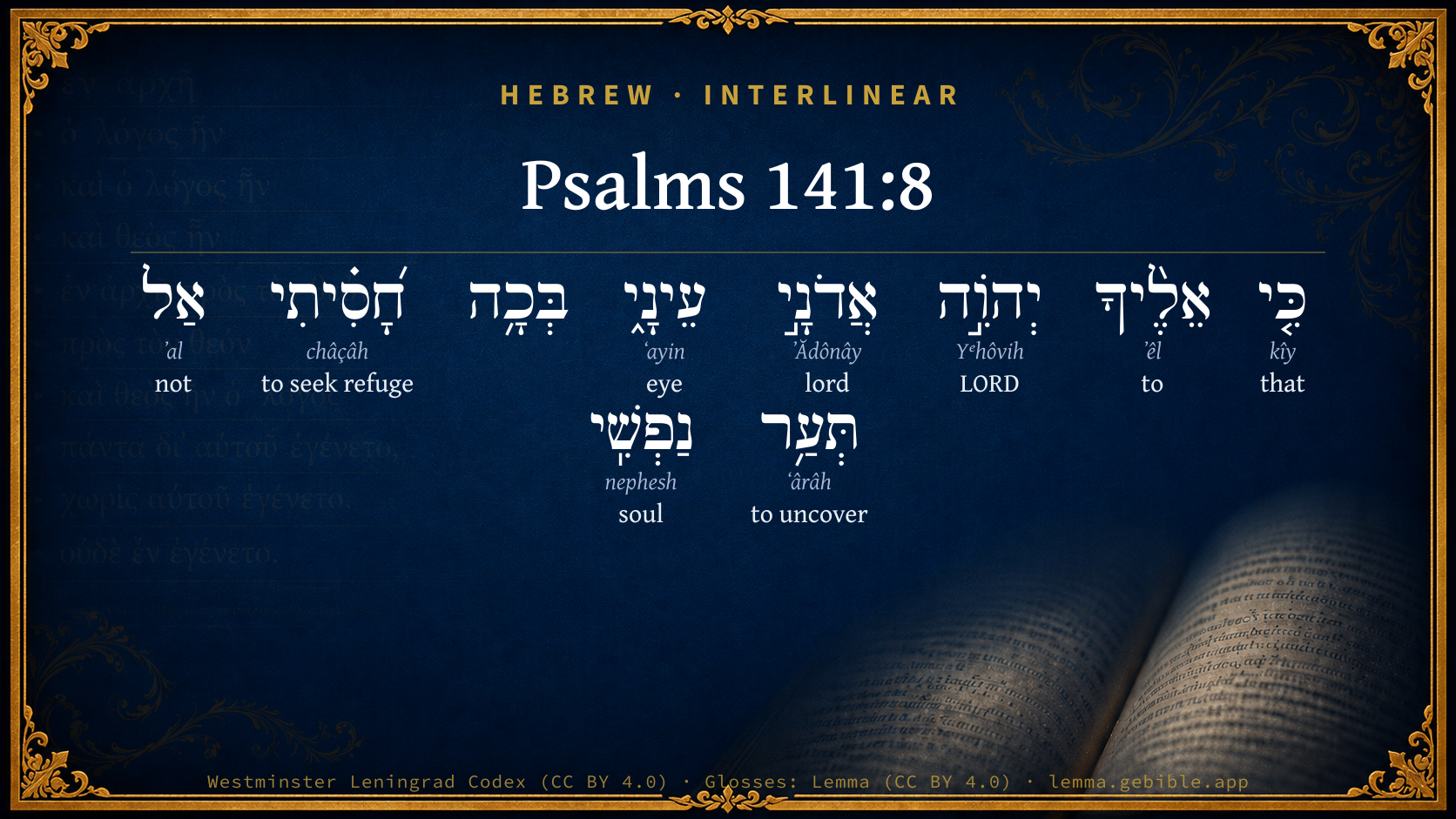
Psalms 141:8

Hebrew (Westminster Leningrad Codex) Psalms 141:8 appears in the Hebrew Old Testament. The text above is from the Westminster Leningrad Codex. Each word links to its Strong’s number, a concise gloss, and parsing drawn from the Open Scriptures Hebrew Bible morphology. Click any word for its full Brown-Driver-Briggs (BDB) entry.
Download image
Cite this verse

Psalms 141:8 (World English Bible). Public Domain. Lemma interlinear Bible study tool, https://lemma.gebible.app/v/psalms/141/8.

Show BibTeX & RIS
BibTeX
RIS
English Translation
For my eyes are on you, Yahweh, the Lord. In you, I take refuge. Don't leave my soul destitute.
World English Bible · Public Domain
Download a study sheet

One document with this verse’s original text, its word-by-word gloss line, the meaning frame, cross-references with their text, attributed commentary, and full source and license credits — printable, and it pastes into notes with its structure intact.

This verse Autodidact and up

Study sheet (.html) Plain text (.txt)

A passage Seminary Student

Up to 50 verses in one chapter. A passage sheet keeps up to 6 commentary sources and 12 cross-references per verse, in the order this page ranks them, and says so on the sheet whenever that leaves anything out. Ask for a single verse and you get the Autodidact verse sheet above.

Everything on this page stays free to read, with no account — the sheet is a download of what is already on screen, not access to it.

Want to remove ads? Support Godless Engineer
Compare translations 3

The same verse in 3 English versions, stacked beneath the original-language interlinear above. Click any original word for its lexicon entry.

Each is an independent rendering of the whole verse — the interlinear is not word-aligned to these translations.

Highlighted words mark where these versions differ — a whole-verse word diff, not a word-by-word alignment.

  • World English Bible Public Domain
    For my eyes are on you, Yahweh, the Lord. In you, I take refuge. Don't leave my soul destitute.
  • King James Version Public Domain
    But mine eyes are unto thee, O GOD the Lord: in thee is my trust; leave not my soul destitute.
  • unfoldingWord Literal Text CC BY-SA 4.0
    Yet my eyes are on you, Yahweh, Lord; in you I take refuge; do not uncover my soul.

unfoldingWord Literal Text — © unfoldingWord, licensed CC BY-SA 4.0. Word-aligned USFM3 via Door43 (git.door43.org/unfoldingWord/en_ult).

Versions to compare (up to 4)

3 of 4 selected

Show all 18 translations

Every available English version of this verse, each an independent rendering of the whole verse.

  • World English Bible Public Domain
    For my eyes are on you, Yahweh, the Lord. In you, I take refuge. Don't leave my soul destitute.
  • Berean Standard Bible Public Domain
    But my eyes are fixed on You, O GOD the Lord. In You I seek refuge; do not leave my soul defenseless.
  • Majority Standard Bible Public Domain
    But my eyes are fixed on You, O GOD the Lord. In You I seek refuge; do not leave my soul defenseless.
  • King James Version Public Domain
    But mine eyes are unto thee, O GOD the Lord: in thee is my trust; leave not my soul destitute.
  • American Standard Version (1901) Public Domain
    For mine eyes are unto thee, O Jehovah the Lord: In thee do I take refuge; leave not my soul destitute.
  • Revised Version (1885) Public Domain
    For mine eyes are unto thee, O GOD the Lord: in thee do I put my trust; leave not my soul destitute.
  • Geneva Bible (1599) Public Domain
    But mine eyes looke vnto thee, O Lord God: in thee is my trust: leaue not my soule destitute.
  • Douay-Rheims (1899) Public Domain
    O Lord, Lord, the strength of my salvation: thou hast overshadowed my head in the day of battle.
  • Young's Literal Translation Public Domain
    But to Thee, O Jehovah, my Lord, `are' mine eyes, In Thee I have trusted, Make not bare my soul.
  • Literal Standard Version CC BY-SA 4.0
    But to You, O YHWH, my Lord, [are] my eyes, || In You I have trusted, || Do not make my soul bare.
  • Unlocked Literal Bible CC BY-SA 4.0
    Surely my eyes are on you, Yahweh, Lord; in you I take refuge; do not leave my soul defenseless.
  • unfoldingWord Literal Text CC BY-SA 4.0
    Yet my eyes are on you, Yahweh, Lord; in you I take refuge; do not uncover my soul.
  • Darby Bible Public Domain
    For unto thee, Jehovah, Lord, are mine eyes; in thee do I trust: leave not my soul destitute.
  • World Messianic Bible Public Domain
    For my eyes are on you, LORD, the Lord. I take refuge in you. Don’t leave my soul destitute.
  • Webster's Bible Public Domain
    But my eyes are to thee, O GOD the Lord: in thee is my trust; leave not my soul destitute.
  • Free Bible Version CC BY-SA 4.0
    But I'm looking to you, Lord God, for I find protection in you. Don't let me die!
  • Bible in Basic English Public Domain
    But my eyes are turned to you, O Lord God: my hope is in you; let not my soul be given up to death.
  • JPS Tanakh (1917) Public Domain
    For mine eyes are unto Thee, O GOD the Lord; in Thee have I taken refuge, O pour not out my soul.

Literal Standard Version (2020), Covenant Press — licensed CC BY-SA 4.0. Text via the HelloAO Bible API (eBible.org). Unlocked Literal Bible (unfoldingWord) — licensed CC BY-SA 4.0. Text via the HelloAO Bible API (eBible.org). unfoldingWord Literal Text — © unfoldingWord, licensed CC BY-SA 4.0. Word-aligned USFM3 via Door43 (git.door43.org/unfoldingWord/en_ult). Free Bible Version, Dr. Jonathan Gallagher — licensed CC BY-SA 4.0. Text via the HelloAO Bible API (eBible.org).

Word by word

More ways to search: Search by grammar → Find every occurrence → Compare this word →

Practice this passage: Drill this verse → Learn its vocabulary →

תְּעַ֥ר
ʻârâh
H6168
“to uncover”
Verb, Piel, Jussive, 2nd Person, Masculine, Singular
Part of Speech
Verb
Stem
Piel
Form
Jussive
Person
2nd Person
Gender
Masculine
Number
Singular
Full BDB Definition

Origin: a primitive root

TWOT: 1692

to be bare, be nude, uncover, leave destitute, discover, empty, raze, pour out - (Piel) - to bare, lay bare - to lay bare by emptying, empty - to pour out - (Hiphil) - to make naked, strip bare (of sexual offences) - to pour out - (Niphal) to be poured out, be exposed - (Hithpael) - to expose oneself, make oneself naked - pouring oneself, spreading oneself (participle)
  1. כִּ֤י kîy H3588 “that” Conjunction
  2. אֵלֶ֨יךָ ʼêl H413 “to · you” Preposition + Suffix, Personal, 2nd Person, Masculine, Singular
  3. יְהֹוִ֣ה Yᵉhôvih H3069 “LORD” Noun, Proper
  4. אֲדֹנָ֣י ʼĂdônây H136 “Lord · my” Noun, Common, Masculine, Plural, Construct + Suffix, Personal, 1st Person, Common, Singular
  5. עֵינָ֑י ʻayin H5869 “eyes · my” Noun, Common, Both, Dual, Construct + Suffix, Personal, 1st Person, Common, Singular
  6. חָ֝סִ֗יתִי châçâh H2620 “to seek refuge” Verb, Qal, Perfect, 1st Person, Common, Singular
  7. אַל ʼal H408 “not” Particle, Negative
  8. נַפְשִֽׁי nephesh H5315 “soul · my” Noun, Common, Both, Singular, Construct + Suffix, Personal, 1st Person, Common, Singular

About this verse

These counts appear in no published source. They are computed here, from the morphology-tagged text and Lemma’s own curated glosses. What Lemma adds →

10
words
9
distinct lemmas
Wisdom
section

Notable vocabulary

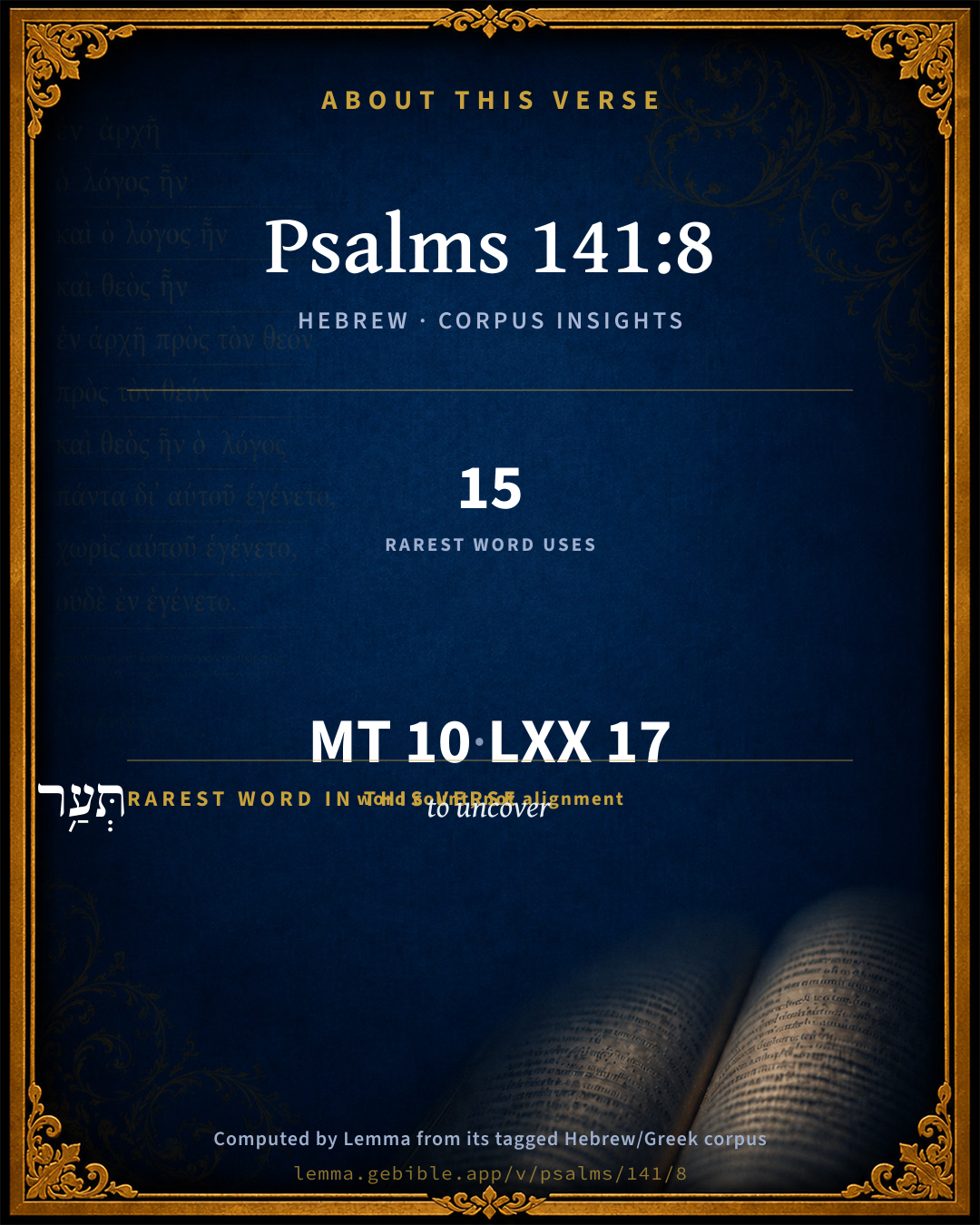
The rarest word here is תְּעַ֥ר to uncover H6168 — appearing just 15 times in the whole Hebrew Bible.

Shared distinctive vocabulary

תְּעַ֥ר to uncover H6168 occurs in 14 verses of the Hebrew Bible. Also found in:

Grammatical profile

  • 2 verbs
  • 4 nouns
  • 2 prepositions
  • 1 conjunction
  • 1 particle

Verb forms

  • חָ֝סִ֗יתִי Qal · Perfect
  • תְּעַ֥ר Piel · Jussive

Hebrew & Septuagint length

In English translation the verse runs 19 words from the Hebrew and 19 from the Septuagint (LXX English) — the same length.

A rough comparison of the two English renderings, which tokenize alike — not a word-level alignment.

Word counts can differ between the Hebrew and the Greek without any difference in meaning — e.g. the Hebrew direct-object marker אֵת has no separate Greek word, and Greek often adds the article ὁ.

In the original languages it is 10 Hebrew tokens and 17 Greek tokens — but the two are counted differently (Hebrew bundles its prefixes and suffixes into one token; the Greek is in lemma form), so that isn’t a like-for-like length.

Cross-references

9

Topical passages linked to Psalms 141:8 in the Treasury of Scripture Knowledge — connected by theme and wording, ordered by reader-vote popularity; previews shown in the World English Bible.

  • Psalms 123:1–2 To you I do lift up my eyes, You who sit in the heavens.
  • 2 Chronicles 20:12 Our God, will you not judge them? for we have no might against this great company that comes against us; neither know we what to do: but out eyes are on you.
  • Isaiah 41:17 The poor and needy seek water, and there is none, and their tongue fails for thirst; I, Yahweh, will answer them, I, the God of Israel, will not forsake them.
  • Psalms 102:17 He has responded to the prayer of the destitute, And has not despised their prayer.
  • Psalms 25:15–17 My eyes are ever on Yahweh, For he will pluck my feet out of the net.
  • Psalms 2:12 Kiss the son, lest he be angry, and you perish in the way, For his wrath will soon be kindled. Blessed are all those who take refuge in him.
  • John 14:18 I will not leave you orphans. I will come to you.
  • Psalms 143:3–4 For the enemy pursues my soul. He has struck my life down to the ground. He has made me live in dark places, as those who have been long dead.
  • Psalms 11:1 In Yahweh, I take refuge. How can you say to my soul, "Flee as a bird to your mountain!"

Cross-references courtesy of OpenBible.info (CC BY 4.0).

Hebrew and Greek witnesses Masoretic Hebrew ↔ Greek Septuagint

The same verse in the two great witnesses to the Old Testament, shown verse-for-verse.

You’re reading Greek Psalm 140 (Hebrew Psalm 141). The Septuagint counts the superscription, so verse numbers can differ from the Hebrew — chapter-level alignment, not verse-by-verse. Numbering follows Rahlfs.

These are two independent witnesses, not word-aligned to each other, and the Septuagint is shown in lemma (dictionary) form.

Hebrew Psalms 141:8 Masoretic · Westminster Leningrad Codex

כִּ֤י אֵלֶ֨יךָ יְהֹוִ֣ה אֲדֹנָ֣י עֵינָ֑י בְּכָ֥ה חָ֝סִ֗יתִי אַל תְּעַ֥ר נַפְשִֽׁי

For my eyes are on you, Yahweh, the Lord. In you, I take refuge. Don't leave my soul destitute.

World English Bible · Public Domain

Greek LXX Greek Psalm 140:8 Septuagint · lemma form

ὅτι πρός σύ κύριος κύριος ὁ ὀφθαλμός ἐγώ ἐπί σύ ἐλπίζω μή ἀντι ἀναἔρχομαι ὁ ψυχή ἐγώ

For my eyes are to you, O Lord God: I have hoped in you; take not away my life.

LXX2012 (modern English Septuagint) · Public Domain

On this verse, Keil & Delitzsch discusses the Septuagint’s reading. Read the note in Commentary ↓

Hebrew: Westminster Leningrad Codex (CC BY 4.0). Greek: Septuagint (public domain); English from LXX2012 (modern English Septuagint) (Public Domain). How the Septuagint differs from the Hebrew →

Commentary

Notes on Psalms 141:8 from classic Christian and Jewish commentators (each source and its license shown beneath its notes). The classic Christian expositions comment on the surrounding passage and are grouped to its opening verse, so a note may address several verses; the Jewish commentaries on the Tanakh (Rashi and others) are per-verse, so they appear only where the commentator wrote on this verse.

Lemma curates 59 commentaries, every one of them public domain or Creative Commons licensed, each selected and text-cleaned for this edition rather than reprinted as found. About our sources →

The Cambridge Bible for Schools and Colleges

gen. ed. J. J. S. Perowne

8. But mine eyes] The conjunction must be rendered For, which gives no sense in connexion with Psa_141:7. It must introduce the reason for the prayers of Psa_141:1-4, or for the resolution to continue in prayer with which Psa_141:5 ends. The impossibility of connecting Psa_141:8 with Psa_141:6-7 is an additional reason for thinking that these verses are misplaced.

mine eyes are unto thee] The attitude of expectant prayer. Cp. Psa_25:15, note.

O God the Lord] Jehovah, Lord. Cp. Psa_140:7, and see note on Psa_109:21.

in thee is my trust] In thee have I taken refuge. He has put himself under Jehovah’s protection, and appeals to Him on the ground of this relationship. Cp. Psa_2:12; Psa_7:1; Psa_57:1, and many other passages.

leave not my soul destitute] Rather, as R.V. marg., pour not thou out my life, suffer me not to perish. Cp. Isa_53:12. The figure is explained by the identification of life with the blood.

8–10. Concluding expression of confidence, with prayer for preservation and deliverance.

The Cambridge Bible for Schools and Colleges (gen. ed. J. J. S. Perowne; Cambridge University Press, 1878–1918) — public domain. Text from a community e-Sword module.

Trapp's Complete Commentary

John Trapp

Psa 141:8 But mine eyes [are] unto thee, O GOD the Lord: in thee is my trust; leave not my soul destitute.

Ver. 8. But mine eyes are unto thee] Afflictions to the saints are tanquam scalae et alae, to mount them to God.

Leave not my soul destitute] Ne exinanias, make not bare my soul, viz. of thy protection.

John Trapp, A Commentary or Exposition upon All the Books of the Old and New Testament (1647–1656) — public domain. Text from a community e-Sword module.

Joseph Benson's Commentary

Psa 141:8. But mine eyes are unto thee — But in this sore distress I fix my thoughts on thee, O God, the Lord, the only living and true God, and governor of all things; in thee is my trust, &c. — In thee I repose an assured confidence that thou wilt not leave me without support and protection, much less wilt thou abandon me to the malice of those that seek to take away my life. This verse, says Mr. Peters, shows us what was David’s support under his extraordinary trials: it was a firm trust in God, as the great Lord and Ruler of the world: and a steady resolution to obey him in all things. “Among the sayings of Pythagoras this was one, απλωσον σεαυτον, simplify thyself, that is, ‘reduce thy conduct, if possible, to one single aim, and pursue it without weariness, or distraction.’ If this single aim be, to approve ourselves to God by such a course of life as he prescribes; to adhere strictly to our duty, with an eye to him who has commanded it, and patiently submit the issue of things to his all-wise and gracious providence; we have then hit upon that principle which here appears to have animated David, and may, with confidence, address our prayers to the great Lord and Sovereign of the world in all our straits and difficulties, as he does in the following part of the Psalm.” Leave not my soul destitute — Hebrew, make not my soul naked: deprive it not of thy favour and protection: or, do not pour out my soul, namely, unto death, as the same word, ערה, is used, Isa 53:12. In the language of the Holy Scriptures, God is said to do what he only permits or suffers to be done. But whether David here prays to have his life preserved from danger, or his soul from sin, may admit of a question. The words will suit with either explanation, and probably he might intend both; but chiefly the latter. We have seen, from Psa 141:4, how earnestly he begs that God would protect him by his grace from complying with the idolatrous practices of the heathen, to whom he was about to flee for refuge; and it is remarkable that, in his last speech to Saul, he particularly dwells upon the danger to which his religion was exposed, 1Sa 26:19. They have driven me out this day from abiding in the inheritance of the Lord, saying, Go serve other gods. As if he had said, “They have done what lies in their power to drive me to idolatry, by forcing me into a country where I shall have the strongest temptations to it.” This was a thing he seems to have dreaded more than death; and therefore he prays against it in the next verse.

Joseph Benson's Commentary on the Old and New Testaments (1811–1818) — public domain. Text from a community e-Sword module.

Keil & Delitzsch

C. F. Keil & F. Delitzsch

The prayer now begins to be particularized, and that in the first instance as a petition fore the grace of silence, calling to mind old Davidic passages like Psa 39:2; Psa 34:14. The situation of David, the betrayed one, requires caution in speaking; and the consciousness of having sinned, not indeed against the rebels, but against God, who would not visit him thus without his deserving it, stood in the way of any outspoken self-vindication. In pone custodiam ori meo שׁמרה is ἅπ. λεγ., after the infinitive form דּבקה, עזבה, עצמה. In Psa 141:3 דּל is ἅπ. λεγ. for דּלת; cf. "doors of the mouth" in Mic 7:5, and πύλαι στόματος in Euripides. נצּרה might be imper. Kal: keep I pray, with Dag. dirimens as in Pro 4:13. But נצר על is not in use; and also as the parallel word to שׁמרה, which likewise has the appearance of being imperative, נצּרה is explicable as regards its pointing by a comparison of יקּהה in Gen 49:10, דּבּרה in Deu 33:3, and קרבה in Psa 73:28. The prayer for the grace of silence is followed in Psa 141:4 by a prayer for the breaking off of all fellowship with the existing rulers. By a flight of irony they are called אישׁים, lords, in the sense of בּני אישׁ, Psa 4:3 (cf. the Spanish hidalgos = hijos d'algo, sons of somebody). The evil thing (רע דּבר, with Pasek between the two ר, as in Num 7:13; Deu 7:1 between the two מ, and in Ch1 22:3 between the two )ל, to which Jahve may be pleased never to incline his heart (תּט, fut. apoc. Hiph. as in Psa 27:9), is forthwith more particularly designated: perpetrare facinora maligne cum dominis, etc. עללות of great achievements in the sense of infamous deeds, also occurs in Psa 14:1; Psa 99:8. Here, however, we have the Hithpo. התעלל, which, with the accusative of the object עללות, signifies: wilfully to make such actions the object of one's acting (cf. Arab. ta‛allala b-'l-š', to meddle with any matter, to amuse, entertain one's self with a thing). The expression is made to express disgust as strongly as possible; this poet is fond of glaring colouring in his language. In the dependent passage neve eorum vescar cupediis, לחם is used poetically for אכל, and בּ is the partitive Beth, as in Job 21:25. מנעמּים is another hapaxlegomenon, but as being a designation of dainties (from נעם, to be mild, tender, pleasant), it may not have been an unusual word. It is a well-known thing that usurpers revel in the cuisine and cellars of those whom they have driven away.

Psalms 141:5

psa 141:5

Thus far the Psalm is comparatively easy of exposition; but now it becomes difficult, yet not hopelessly so. David, thoroughly conscious of his sins against God and of his imperfection as a monarch, says, in opposition to the abuse which he is now suffering, that he would gladly accept any friendly reproof: "let a righteous man smite in kindness and reprove me - head-oil (i.e., oil upon the head, to which such reproof is likened) shall my head not refuse." So we render it, following the accents, and not as Hupfeld, Kurtz, and Hitzig do: "if a righteous man smites me, it is love; if he reproves me, an anointing of the head is it unto me;" in connection with which the designation of the subject with היא would be twice wanting, which is more than is admissible. צדּיק stands here as an abstract substantive: the righteous man, whoever he may be, in antithesis, namely, to the rebels and to the people who have joined them. Amyraldus, Maurer, and Hengstenberg understand it of God; but it only occurs of God as an attribute, and never as a direct appellation. חסד, as in Jer 31:3, is equivalent to בּחסד, cum benignitate = benigne. What is meant is, as in Job 6:14, what Paul (Gal 6:1) styles πνεῦμα πραΰ́τητος. and הלם, tundere, is used of the strokes of earnest but well-meant reproof, which is called "the blows of a friend" in Pro 27:6. Such reproof shall be to him as head-oil (Psa 23:5; Psa 133:2), which his head does not despise. יני, written defectively for יניא, like ישּׁי, in Psa 55:16, אבי, Kg1 21:29 and frequently; הניא (root נא, Arab. n', with the nasal n, which also expresses the negation in the Indo-Germanic languages) here signifies to deny, as in Psa 33:10 to bring to nought, to destroy. On the other hand, the lxx renders μὴ λιπανάτω τὴν κεφαλήν μου, which is also followed by the Syriac and Jerome, perhaps after the Arabic nawiya, to become or to be fat, which is, however, altogether foreign to the Aramaic, and is, moreover, only used of fatness of the body, and in fact of camels. The meaning of the figure is this: well-meant reproof shall be acceptable and spiritually useful to him. The confirmation כּי־עוד וגו follows, which is enigmatical both in meaning and expression. This עוד is the cipher of a whole clause, and the following ו is related to this עוד as the Waw that introduces the apodosis, not to כּי as in Ch2 24:20, since no progression and connection is discernible if כי is taken as a subordinating quia. We interpret thus: for it is still so (the matter still stands thus), that my prayer is against their wickednesses; i.e., that I use no weapon but that of prayer against these, therefore let me always be in that spiritual state of mind which is alive to well-meant reproof. Mendelssohn's rendering is similar: I still pray, whilst they practise infamy. On עוד ו cf. Zac 8:20 עוד אשׁר (vid., Khler), and Pro 24:27 אחר ו. He who has prayed God in Psa 141:3 to set a watch upon his mouth is dumb in the presence of those who now have dominion, and seeks to keep himself clear of their sinful doings, whereas he willingly allows himself to be chastened by the righteous; and the more silent he is towards the world (see Amo 5:13), the more constant is he in his intercourse with God. But there will come a time when those who now behave as lords shall fall a prey to the revenge of the people who have been misled by them; and on the other hand, the confession of the salvation, and of the order of the salvation, of God, that has hitherto been put to silence, will again be able to make itself freely heard, and find a ready hearing.

As Psa 141:6 says, the new rulers fall a prey to the indignation of the people and are thrown down the precipices, whilst the people, having again come to their right mind, obey the words of David and find them pleasant and beneficial (vid., Pro 15:26; Pro 16:24). נשׁמטוּ is to be explained according to Kg2 9:33. The casting of persons down from the rock was not an unusual mode of execution (Ch2 25:12). ידי־סלע are the sides (Psa 140:6; Jdg 11:26) of the rock, after which the expression ἐχόμενα πέτρας of the lxx, which has been misunderstood by Jerome, is intended to be understood;

(Note: Beda Pieringer in his Psalterium Romana Lyra Radditum (Ratisbonae 1859) interprets κατεπόθησαν ἐχόμενα πέτρας οἱ κραταιοὶ τὐτῶν, absorpti, i.e., operti sunt loco ad petram pertinente signiferi turpis consilii eorum.)

they are therefore the sides of the rock conceived of as it were as the hands of the body of rock, if we are not rather with Bttcher to compare the expressions בּידי and על־ידי construed with verbs of abandoning and casting down, Lam 1:14; Job 16:11, and frequently. In Psa 141:7 there follows a further statement of the issue on the side of David and his followers: instar findentis et secantis terram (בּקע with Beth, elsewhere in the hostile signification of irrumpere) dispersa sunt ossa nostra ad ostium (לפי as in Pro 8:3) orci; Symmachus: ὥσπερ γεωργὸς ὅταν ῥήσσῃ τὴν τὴν, οὕτως ἐσκορπίσθη τὰ ὀστᾶ ἡμῶν εἰς στόμα ᾅδου; Quinta: ὡς καλλιεργῶν καὶ σκάπτων ἐν τῇ γῇ κ. τ. λ. Assuming the very extreme, it is a look of hope into the future: should his bones and the bones of his followers be even scattered about the mouth of Shel (cf. the Syrian picture of Shel: "the dust upon its threshold ‛al-escûfteh," Deutsche Morgenlnd. Zeitschrift, xx. 513), their soul below, their bones above - it would nevertheless be only as when on in ploughing cleaves the earth; i.e., they do not lie there in order that they may continue lying, but that they may rise up anew, as the seed that is sown sprouts up out of the upturned earth. lxx Codd. Vat. et Sinait. τὰ ὀστᾶ ἡμῶν, beside which, however, is found the reading αὐτῶν (Cod. Alex. by a second hand, and the Syriac, Arabic, and Aethiopic versions), as Bttcher also, pro ineptissimo utcunque, thinks עצמינו must be read, understanding this, according to Ch2 25:12 extrem., of the mangled bodies of those cast down from the rock. We here discern the hope of a resurrection, if not directly, at least (cf. Oehler in Herzog's Real-Encyclopdie, concluding volume, S. 422) as am emblem of victory in spite of having succumbed. That which authorizes this interpretation lies in the figure of the husbandman, and in the conditional clause (Psa 141:8), which leads to the true point of the comparison; for as a complaint concerning a defeat that had been suffered: "so are our bones scattered for the mouth of the grave (in order to be swallowed up by it)," Psa 141:7, would be alien and isolated with respect to what precedes and what follows.

Psalms 141:8

psa 141:8

If Psa 141:7 is not merely an expression of the complaint, but at the same time of hope, we now have no need to give the כּי the adversative sense of imo, but we may leave it its most natural confirmatory signification namque. From this point the Psalm gradually dies away in strains comparatively easy to be understood and in perfect keeping with the situation. In connection with Psa 141:8 one is reminded of Psa 25:15; Psa 31:2; with Psa 141:9., of Psa 7:16; Psa 69:23, and other passages. In "pour not out (תּער with sharpened vowel instead of תּער, Ges. ֗75, rem. 8) my soul," ערה, Piel, is equivalent to the Hiph. הערה in Isa 53:12. ידי פח are as it were the hands of the seizing and capturing snare; and יקשׂוּ לּי is virtually a genitive: qui insidias tendunt mihi, since one cannot say יקשׁ פח, ponere laqueum. מכמרים, nets, in Psa 141:10 is another hapaxlegomenon; the enallage numeri is as in Psa 62:5; Isa 2:8; Isa 5:23, - the singular that slips in refers what is said of the many to each individual in particular. The plural מקשׁות for מקשׁים, Psa 18:6; Psa 64:6, also occurs only here. יחד is to be explained as in 4:9: it is intended to express the coincidence of the overthrow of the enemies and the going forth free of the persecuted one. With יחד אנכי the poet gives prominence to his simultaneous, distinct destiny: simul ego dum (עד as in Job 8:21, cf. Job 1:18) praetereo h.e. evado. The inverted position of the כּי in Psa 18:10-12 may be compared; with Psa 120:7 and Kg2 2:14, however (where instead of אף־הוּא it is with Thenius to be read אפוא), the case is different.

Next: Psalms Chapter 142

Keil & Delitzsch — Biblical Commentary on the Old Testament (1861–1891) — public domain (CC PDM 1.0). Text via the HelloAO Bible API. (Old Testament only.)

J. A. Alexander on Psalms

Joseph Addison Alexander

8. (Psa 141:8) For unto thee, Jehovah, Lord, (are) my eyes—in thee have I confided—pour not out my soul. The for refers to the consolatory import of the verse preceding. The one before us contains several favourite Davidic phrases. My eyes are unto thee, Psa 25:15. In thee have I confided (or sought refuge), Psa 2:12; Psa 31:1. In the last clause the soul or life is confounded with its vehicle. See Gen 9:4, Lev 17:11; Lev 17:14. The same remarkable expression is applied by Isaiah (Isa 53:12) to the voluntary death of the Messiah. That the verb literally means to pour out, is clear from Gen 24:20, Isa 32:15. This verse resembles Psa 140:7, in two points, the combination Jehovah Adhonai, and the supernumerary.

Joseph Addison Alexander, The Psalms Translated and Explained (1850) — public domain. Text from a community e-Sword module.

Adam Clarke's Commentary

Verse 8. But mine eyes are unto thee] In all times, in all places, on all occasions, I will cleave unto the Lord, and put my whole confidence in him.

Adam Clarke's Commentary on the Bible (1810–1826) — public domain. Text from a community e-Sword/MySword module.

John Calvin's Commentaries

8. Because to thee, O Jehovah! etc. If we reflect upon what was comprehended under the previous figure of their bones being broken, his praying in such circumstances is just as if the torn fragments of a mangled corpse should cry unto God. This may give us some idea of the heroical courage of David, who could continue to direct his eyes to God even under such overwhelming difficulties; this being the very part faith ought to discharge, in making us collected and composed when our senses would otherwise be confounded. “C’est le propre de la foy de rassembler lessens de la personne dispersez, lequels autrement s’esvanouiroyent a chacun coup.” —Fr.

John Calvin's Commentaries (1540-1563) — public domain. Text from the Calvin Translation Society English edition (1840s-50s) via the Christian Classics Ethereal Library (ccel.org). Calvin's coverage is partial (roughly two-thirds of the Bible); uncommented books and verses are honest gaps, never fabricated. The 19th-century editor's footnotes and remarks are omitted so the notes are faithfully Calvin's own voice.

Ellicott's Commentary for English Readers

(8, 9) Comp. Psa_25:15.

A Bible Commentary for English Readers, edited by Charles John Ellicott (1878–1897) — public domain. Text from a community e-Sword module.

John Gill's Exposition

But mine eyes are unto thee, O God the Lord,.... Not only the eyes of his body, lifted up to God in prayer, this being a prayer gesture, Joh 11:41; but the eyes of his mind, or understanding, especially the eyes of faith and love; for it is expressive of his affection to God, his holy confidence in him, and humble hope and expectation of good things from him, in this his time of distress: his eyes were to him and him only, both for temporal food for himself and his men; and for spiritual food, for all supplies of grace, for wisdom and direction, for strength and assistance, for protection and deliverance;

in thee is my trust; not in himself, nor in his friends, nor in any creature, prince or potentate, but in the Lord, as the God of nature, providence, and grace; to which he was encouraged by his lovingkindness to him; by the everlasting strength in him; by what he had done for others and for him in times past; by the provisions he has made in his covenant and promises for those that trust in him, who are of all men most happy;

leave not my soul destitute; of daily food, of help and assistance, of the presence, spirit, and grace of God; or "naked" (g), and defenceless, but let it be surrounded or protected by almighty power and grace; or "pour not out my soul" (h), that is, unto death; suffer me not to be taken by enemies and slain; see Isa 53:12. The Targum is,

"in the Word (of the Lord) I trust, do not empty my soul,''

or "evacuate" (i) it, as Aben Ezra; that is, out of his body; for he observes, that the soul fills the body.

(g) "ne nudes", Junius & Tremellius; so Piscator. (h) "Ne effandas", Pagninus, Montanus, Vatablus, Musculus. (i) "Ne evacues", Cocceius, Gejerus, Michaelis.

John Gill's Exposition of the Whole Bible (1746–1763) — public domain (CC PDM 1.0). Text via the HelloAO Bible API.

Albert Barnes' Notes on the Bible

But mine eyes are unto thee, O God the Lord - My hope is in thee. I do not rely on my own power. I do not trust in my armed forces. I know that they are weak, dispirited, scattered - like strewed bones - like the chips and splinters lying around the place where wood is chopped. I look, therefore, solely to God. I believe that he “will” interpose; and now that my enemy has placed himself in this position, I do not need to resort to stealthful arts - to dishonorable acts - to assassination - as my friends advise, but the object will be accomplished, and I shall be placed on the throne by the act of God, and in a manner that will not subject my name and memory to reproach by a base and treacherous deed.

In thee is my trust - I rely on thee alone.

Leave not my soul destitute - My life; my all. Do not now leave me without thy gracious interposition; do not suffer this juncture to pass by without such an interposition as will end the war, and restore peace to me and to a distracted land.

Albert Barnes' Notes on the Bible (1834–1885) — public domain. Text from a community e-Sword/MySword module.

Matthew Poole's English Annotations

Or, naked, as this word signifies, Psa 137:7, and Aaron is said to have made the people naked, Exo 32:25, i.e. deprived of thy favour and protection. Or, do not pour out my soul, to wit, unto death, as this word is used, Isa 53:12.

Matthew Poole's English Annotations on the Holy Bible (1683–1685) — public domain. Text from a community e-Sword/MySword module.

The Treasury of David

Charles H. Spurgeon

Ver. 8. But mine eyes are unto thee, O GOD the Lord. He looked upward and kept his eyes fixed there. He regarded duty more than circumstances; he considered the promise rather than the external providence; and he expected from God rather than from men. He did not shut his eyes in indifference or despair, neither did he turn them to the creature in vain confidence, but he gave his eyes to his God, and saw nothing to fear. Jehovah his Lord is also his hope. Thomas called Jesus Lord and God, and David here speaks of his God and Lord. Saints delight to dwell upon the divine names when they are adoring or appealing. In thee is my trust. Not alone in thine attributes or in thy promises, but in thyself. Others might confide where they chose, but David kept to his God: in him he trusted always, only, confidently, and unreservedly. Leave not my soul destitute; as it would be if the Lord did not remember and fulfil his promise. To be destitute in circumstances is bad, but to be destitute in soul is far worse; to be left of friends is a calamity, but to be left of God would be destruction. Destitute of God is destitution with a vengeance. The comfort is that God hath said, "I will never leave thee nor forsake thee."

Ver. 8. Mine eyes are unto thee, O GOD the Lord. If you would keep your mind fixed in prayer, keep your eye fixed. Much vanity comes in at the eye. When the eyes wander in prayer, the heart wanders. To think to keep the heart fixed in prayer, and yet let the eyes gaze abroad, is as if one should think to keep his house sate, yet let the windows be open. Thomas Watson.

Ver. 8. Leave not my soul destitute. The literal Hebrew is, Pour not out my soul, but keep it in thy cup of salvation. Agellius. Compare Isa 53:12: "He hath poured out his soul unto death."]

Ver. 8. Leave not my soul destitute, or, "Cast not out my soul." That is, cast not my life away, as water, which is of no account, is cast out of a vessel containing it. Daniel Cresswell.

Ver. 8. Leave not my soul destitute. His soul knew what it was to be "destitute"; he had known the misery of spiritual beggary and soul poverty. It was not with him as natural poverty is with the rich, a matter of speculation, a mere matter of theory; but a matter of personal and painful experience...It is in the margin "Make not my soul bare", Strip me not of every hope; leave me not completely naked; abandon me not to nature's beggary and misery; let me not go down into the pit with all my sins upon my head; leave not my soul destitute of pardon and peace. Joseph C. Philpot.

Ver. 8-10.

O pour not out my soul, I pray,

From the dark snare preserve my way, The chambers of the blind entangling net, Which by my path the powers of evil set.

Behold them hid, the godless crew, Low in the toils they darkly drew:

The while, with gathering heart and watchful eye I wait mine hour to pass victorious by.

John Keble.

Psalms 141:9*

Charles H. Spurgeon's The Treasury of David (1869–1885) — public domain. Psalms only. Text from a community e-Sword/MySword module.

Whedon's Commentary on the Bible

Daniel D. Whedon

8, 9. In these verses David declares his sole trust in God. He admits that human resources had utterly failed. His prayer is plaintive.

Leave not my soul destitute—Do not make my soul empty, or naked.

Daniel D. Whedon (gen. ed.), Commentary on the Old and New Testaments (1874–1909) — public domain. Text from a community e-Sword module.

The Pulpit Commentary

But mine eyes are unto thee, O God the Lord. I, however, the psalmist says, do not despair I look to thee, O Jehovah the Lord (comp. Psa_40:7) in thee is my trust; leave not my soul destitute. The last clause is, literally, pour not out my soul; i.e. destroy me not do not spill my life on the ground. (comp. Isa_53:12)

Soul-destitution.

"We have born so harrowed and torn that we are brought to the brink of the grave." "To be destitute in circumstances is bad, but to be destitute in soul is far worse; to be left of friends is a calamity, but to be left of God would be destruction. Destitute of God is destitution with a vengeance. The comfort is that God hath said, "I will never leave thee, nor forsake thee. The margin is, "Make not my soul bare;" strip me not of every hope; leave me not completely naked; abandon me not to nature"s beggary and misery; let me not go down to the pit with all my sins upon my head; leave not my soul destitute of pardon and peace. The mood is well indicated in David"s sense of being left alone of God for long months after his sin in the matter of Uriah. A comparison may be made between this prayer, "Leave not my soul destitute," and the confident assurance, "None of them that trust in him shall be desolate.

I THE SOUL IN RIGHTEOUSNESS FEELS BEFRIENDED. That is, the soul that is in right relations, and has right desires inspiring right endeavors. That man can always say, "The Lord of hosts is with us, the God of Jacob is our Refuge." And that befriending makes him superior to all surroundings of distress, and all consciousness of frailty. Keep me from the snares which they have laid for me, and the gins of the workers of iniquity. (comp. Psa_40:4, Psa_40:5)

II THE SOUL IN SIN FEELS DESTITUTE. He is conscious that he has put himself out of the atmosphere in which alone the God of love and righteousness can reveal himself. The prodigal son felt destitute as soon as "he came to himself," and realized that no love wrapped him round. When a man sins, and persists in his sins, it is his soul that feels destitute. His surroundings may not immediately change, but his soul does. That loses what is its supreme treasure, the sense of God. "Man was made for God, and can find no rest till it gets rest in him." When man sins, and keeps his sin, he must lose his treasure. But soul-destitution may set man seeking after God"s return with a passionate intensity. R.T.

The Pulpit Commentary (1880–1919), ed. H.D.M. Spence-Jones & Joseph S. Exell — public domain. Text from a community e-Sword module.

Scofield Reference Notes

C. I. Scofield

trust

(See Scofield "Psa 2:12").

The Scofield Reference Bible (1917 edition), notes by C. I. Scofield — public domain. Text from a community e-Sword module.

unfoldingWord translationNotes

Door43 World Missions Community

my eyes are on you

The eyes are a synecdoche for the whole person. AT: "I am looking to see what you will do" or "I expect you to help me" (See: Synecdoche)

in you I take refuge

"I am asking you to protect me" See how "take refuge" is translated in Psalms 118:9. (See: Metaphor)

my soul

The soul is a metonym for the whole person. AT: "me" (See: Synecdoche)

the snares that they have laid for me

The psalmist speaks of deceiving a good man so the good man will sin or so that the evil people can defeat him as if it were laying a trap for an animal. The word "snares" is a metonym for the people themselves. AT: "people who are looking for ways to harm me" (See: Metaphor and Metonymy)

snares ... traps

Bible experts disagree on the exact meanings of these words. It would be best either to translate one of them with the word for a net or cage that contains the prey and the other as a rope or vine that catches the prey by the leg or neck or to translate both with the general word for "traps." See how these words are translated in Psalms 140:5.

from the traps of evildoers

The verb may be supplied from the previous phrase. AT: "and protect me from the traps that those who do evil have set" (See: Ellipsis)

Let the wicked fall into their own nets

The psalmist speaks of evil people deceiving good people as if hunters were trapping animals. AT: "Let the wicked fall into the net traps they have made to trap other people" or "Let the bad things the wicked planned for the righteous happen to the wicked instead"

translationWords

lord

refuge

soul

evil

unfoldingWord translationNotes — © Distant Shores Media and the Door43 World Missions Community, licensed CC BY-SA 4.0. Source: git.door43.org/Door43/en_tn.

Rashi

Rabbi Shlomo Yitzchaki (Rashi)

For to You, etc., are my eyes This goes back to the above verses (3f.): Place a guard for my mouth...Do not incline...for to You...are my eyes, etc.

do not cast out my soul Heb. אל תער. Do not cast me from before You, like (Gen. 24:20): “and emptied (ותער) her pitcher into the watering trough.”

Rashi on the Tanakh — English translations: “The Judaica Press complete Tanach with Rashi, translated by A. J. Rosenberg” (CC BY 4.0); “Pentateuch with Rashi's commentary by M. Rosenbaum and A.M. Silbermann, 1929-1934” (public domain); “The Metsudah Tanach series, Lakewood, N.J” (CC BY 4.0); and “The Book of Joshua, Metsudah Publications, 1997” (CC BY 4.0). Text via Sefaria.

Lesson kit

Teaching starters — assembled from the data on this page, not authored interpretation. Every prompt links to the verse data it draws on. Edit before teaching.

Psalms, in the Wisdom, opens this verse with 10 words (9 distinct Hebrew lemmas). Its most distinctive word is ʻârâh (“to uncover”). A historical commentator’s framing appears above. Read the whole chapter for the surrounding context.

Discussion questions

  1. The word ʻârâh carries the sense “to uncover.” How does it shape the verse?
  2. Genesis 24:20 shares the word «to uncover» with this verse. How do the two illuminate each other?
  3. The translations on this page render this verse differently — a whole-verse word diff, not a word-by-word alignment. What might account for the different wordings?
  4. The verb «חָ֝סִ֗יתִי» is Qal Perfect. How does its form color the action?
  5. Reading how The Cambridge Bible for Schools and Colleges and Trapp's Complete Commentary read this verse, where do the two commentators agree and where do they part?

Things to notice

Reading settings

Reading text

Shown beneath each verse's original-language words.

Old Testament
Old Testament edition

Read the OT as the Masoretic Hebrew (MT) or the Greek Septuagint (LXX).

English shown for the Greek Septuagint (in the Hebrew ↔ Greek comparison).

Comparing translations? Open the Compare panel on any verse page to stack up to four side by side.