Amos 3:11

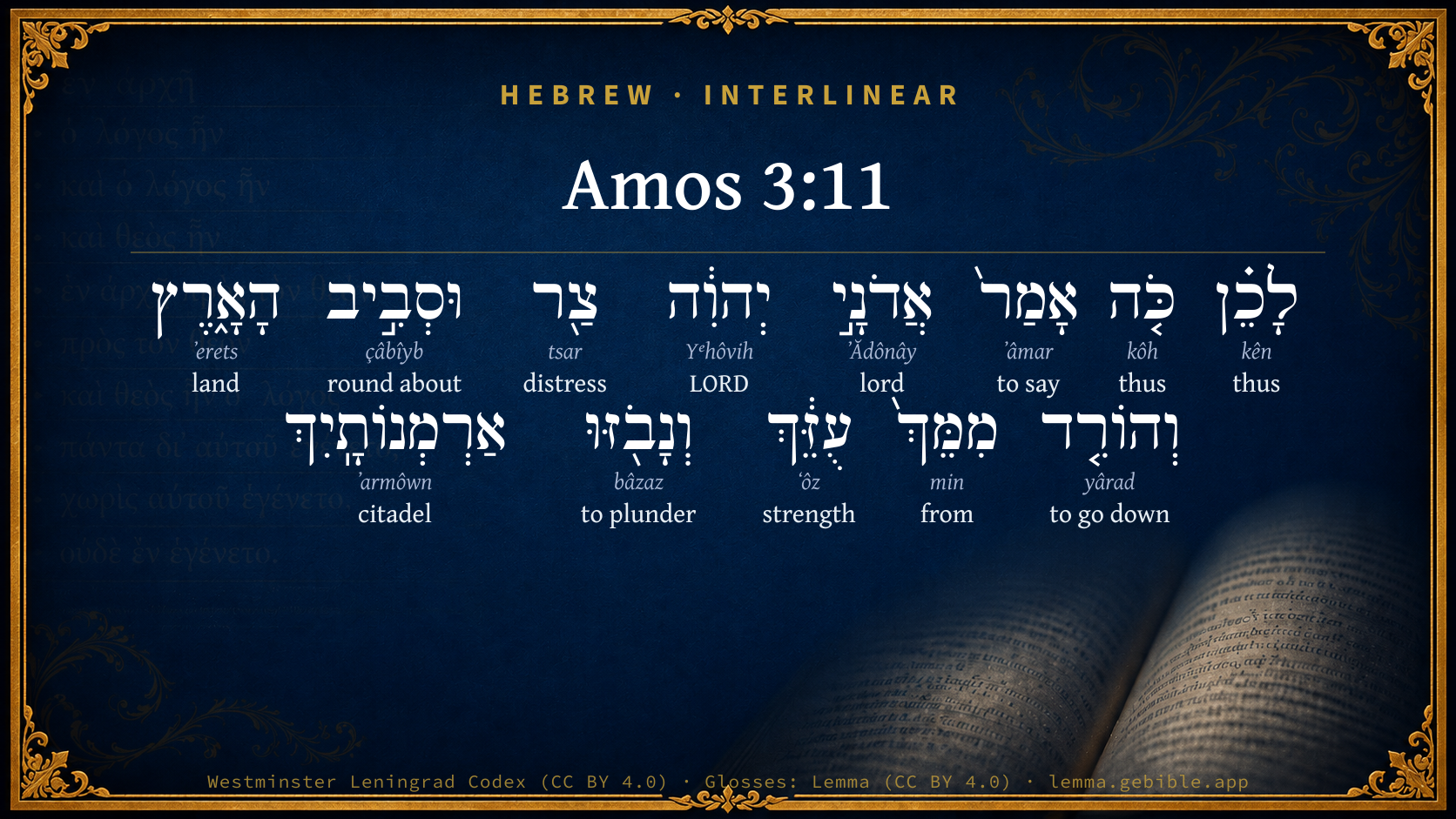
Hebrew (Westminster Leningrad Codex) Amos 3:11 appears in the Hebrew Old Testament. The text above is from the Westminster Leningrad Codex. Each word links to its Strong’s number, a concise gloss, and parsing drawn from the Open Scriptures Hebrew Bible morphology. Click any word for its full Brown-Driver-Briggs (BDB) entry.
Download image
Cite this verse

Amos 3:11 (World English Bible). Public Domain. Lemma interlinear Bible study tool, https://lemma.gebible.app/v/amos/3/11.

Show BibTeX & RIS
BibTeX
RIS
English Translation
Therefore thus says the Lord Yahweh: "An adversary will overrun the land; And he will pull down your strongholds, And your fortresses will be plundered."
World English Bible · Public Domain
Download a study sheet

One document with this verse’s original text, its word-by-word gloss line, the meaning frame, cross-references with their text, attributed commentary, and full source and license credits — printable, and it pastes into notes with its structure intact.

This verse Autodidact and up

Study sheet (.html) Plain text (.txt)

A passage Seminary Student

Up to 50 verses in one chapter. A passage sheet keeps up to 6 commentary sources and 12 cross-references per verse, in the order this page ranks them, and says so on the sheet whenever that leaves anything out. Ask for a single verse and you get the Autodidact verse sheet above.

Everything on this page stays free to read, with no account — the sheet is a download of what is already on screen, not access to it.

Want to remove ads? Support Godless Engineer
Compare translations 3

The same verse in 3 English versions, stacked beneath the original-language interlinear above. Click any original word for its lexicon entry.

Each is an independent rendering of the whole verse — the interlinear is not word-aligned to these translations.

Highlighted words mark where these versions differ — a whole-verse word diff, not a word-by-word alignment.

  • World English Bible Public Domain
    Therefore thus says the Lord Yahweh: "An adversary will overrun the land; And he will pull down your strongholds, And your fortresses will be plundered."
  • King James Version Public Domain
    Therefore thus saith the Lord GOD; An adversary there shall be even round about the land; and he shall bring down thy strength from thee, and thy palaces shall be spoiled.
  • unfoldingWord Literal Text CC BY-SA 4.0
    Therefore, this is what the Lord Yahweh says: “An enemy will surround the land, and pull down your strongholds and plunder your fortresses.”

unfoldingWord Literal Text — © unfoldingWord, licensed CC BY-SA 4.0. Word-aligned USFM3 via Door43 (git.door43.org/unfoldingWord/en_ult).

Versions to compare (up to 4)

3 of 4 selected

Show all 18 translations

Every available English version of this verse, each an independent rendering of the whole verse.

  • World English Bible Public Domain
    Therefore thus says the Lord Yahweh: "An adversary will overrun the land; And he will pull down your strongholds, And your fortresses will be plundered."
  • Berean Standard Bible Public Domain
    Therefore this is what the Lord GOD says: “An enemy will surround the land; he will pull down your strongholds and plunder your citadels.”
  • Majority Standard Bible Public Domain
    Therefore this is what the Lord GOD says: “An enemy will surround the land; he will pull down your strongholds and plunder your citadels.”
  • King James Version Public Domain
    Therefore thus saith the Lord GOD; An adversary there shall be even round about the land; and he shall bring down thy strength from thee, and thy palaces shall be spoiled.
  • American Standard Version (1901) Public Domain
    Therefore thus saith the Lord Jehovah: An adversary `there shall be', even round about the land; and he shall bring down thy strength from thee, and thy palaces shall be plundered.
  • Revised Version (1885) Public Domain
    Therefore thus saith the Lord GOD: An adversary there shall be, even round about the land: and he shall bring down thy strength from thee, and thy palaces shall be spoiled.
  • Geneva Bible (1599) Public Domain
    Therefore thus saith the Lord God, An aduersary shall come euen rounde about the countrey, and shall bring downe thy strength from thee, and thy palaces shalbe spoyled.
  • Douay-Rheims (1899) Public Domain
    Therefore thus saith the Lord God: The land shall be in tribulation, and shall be compassed about: and thy strength shall be taken away from thee, and thy houses shall be spoiled.
  • Young's Literal Translation Public Domain
    Therefore, thus said the Lord Jehovah: An adversary -- and surrounding the land, And he hath brought down from thee thy strength, And spoiled have been thy palaces.
  • Literal Standard Version CC BY-SA 4.0
    Therefore, thus said Lord YHWH: “An adversary—and surrounding the land, || And he has brought down your strength from you, || And your palaces have been spoiled.”
  • Unlocked Literal Bible CC BY-SA 4.0
    Therefore, this is what the Lord Yahweh says: “An enemy will surround the land, and pull down your strongholds and plunder your fortresses.”
  • unfoldingWord Literal Text CC BY-SA 4.0
    Therefore, this is what the Lord Yahweh says: “An enemy will surround the land, and pull down your strongholds and plunder your fortresses.”
  • Darby Bible Public Domain
    Therefore thus saith the Lord Jehovah: An adversary! -- even round about the land! And he shall bring down thy strength from thee, and thy palaces shall be pillaged.
  • World Messianic Bible Public Domain
    Therefore the Lord GOD says: “An adversary will overrun the land; and he will pull down your strongholds, and your fortresses will be plundered.”
  • Webster's Bible Public Domain
    Therefore thus saith the Lord GOD; An adversary there shall be even around the land; and he shall bring down thy strength from thee, and thy palaces shall be plundered.
  • Free Bible Version CC BY-SA 4.0
    As a result, says the Lord, an enemy will surround you, break down your strongholds, and plunder your fortresses.
  • Bible in Basic English Public Domain
    For this reason, says the Lord, an attacker will come, shutting in the land on every side; and your strength will come down and your great houses will be made waste.
  • JPS Tanakh (1917) Public Domain
    Therefore thus saith the Lord GOD: An adversary, even round about the land! And he shall bring down thy strength from thee, and thy palaces shall be spoiled.

Literal Standard Version (2020), Covenant Press — licensed CC BY-SA 4.0. Text via the HelloAO Bible API (eBible.org). Unlocked Literal Bible (unfoldingWord) — licensed CC BY-SA 4.0. Text via the HelloAO Bible API (eBible.org). unfoldingWord Literal Text — © unfoldingWord, licensed CC BY-SA 4.0. Word-aligned USFM3 via Door43 (git.door43.org/unfoldingWord/en_ult). Free Bible Version, Dr. Jonathan Gallagher — licensed CC BY-SA 4.0. Text via the HelloAO Bible API (eBible.org).

Word by word

More ways to search: Search by grammar → Find every occurrence → Compare this word →

Practice this passage: Drill this verse → Learn its vocabulary →

אַרְמְנוֹתָֽיִךְ
ʼarmôwn
H759
“citadels · your”
Noun, Common, Masculine, Plural, Construct + Suffix, Personal, 2nd Person, Feminine, Singular
Part of Speech
Noun
Type
Common
Gender
Masculine
Number
Plural
State
Construct
Full BDB Definition

Origin: from an unused root (meaning to be elevated)

TWOT: 164a

citadel, palace, fortress
  1. לָכֵ֗ן kên H3651 “to/for · thus” Preposition + Adverb
  2. כֹּ֤ה kôh H3541 “thus” Adverb
  3. אָמַר֙ ʼâmar H559 “to say” Verb, Qal, Perfect, 3rd Person, Masculine, Singular
  4. אֲדֹנָ֣י ʼĂdônây H136 “Lord · my” Noun, Common, Masculine, Plural, Construct + Suffix, Personal, 1st Person, Common, Singular
  5. יְהוִ֔ה Yᵉhôvih H3069 “LORD” Noun, Proper
  6. צַ֖ר tsar H6862 “distress” Noun, Common, Masculine, Singular, Absolute
  7. וּסְבִ֣יב çâbîyb H5439 “and · round about of” Conjunction + Noun, Common, Both, Singular, Construct
  8. הָאָ֑רֶץ ʼerets H776 “the · land” Particle, Definite Article + Noun, Common, Both, Singular, Absolute
  9. וְהוֹרִ֤ד yârad H3381 “and · to go down” Conjunction + Verb, Hiphil, Sequential Perfect, 3rd Person, Masculine, Singular
  10. מִמֵּךְ֙ min H4480 “from · you” Preposition + Suffix, Personal, 2nd Person, Feminine, Singular
  11. עֻזֵּ֔ךְ ʻôz H5797 “strength · your” Noun, Common, Masculine, Singular, Construct + Suffix, Personal, 2nd Person, Feminine, Singular
  12. וְנָבֹ֖זּוּ bâzaz H962 “and · to plunder” Conjunction + Verb, Niphal, Sequential Perfect, 3rd Person, Common, Plural

About this verse

These counts appear in no published source. They are computed here, from the morphology-tagged text and Lemma’s own curated glosses. What Lemma adds →

13
words
13
distinct lemmas
Prophets
section

Shared distinctive vocabulary

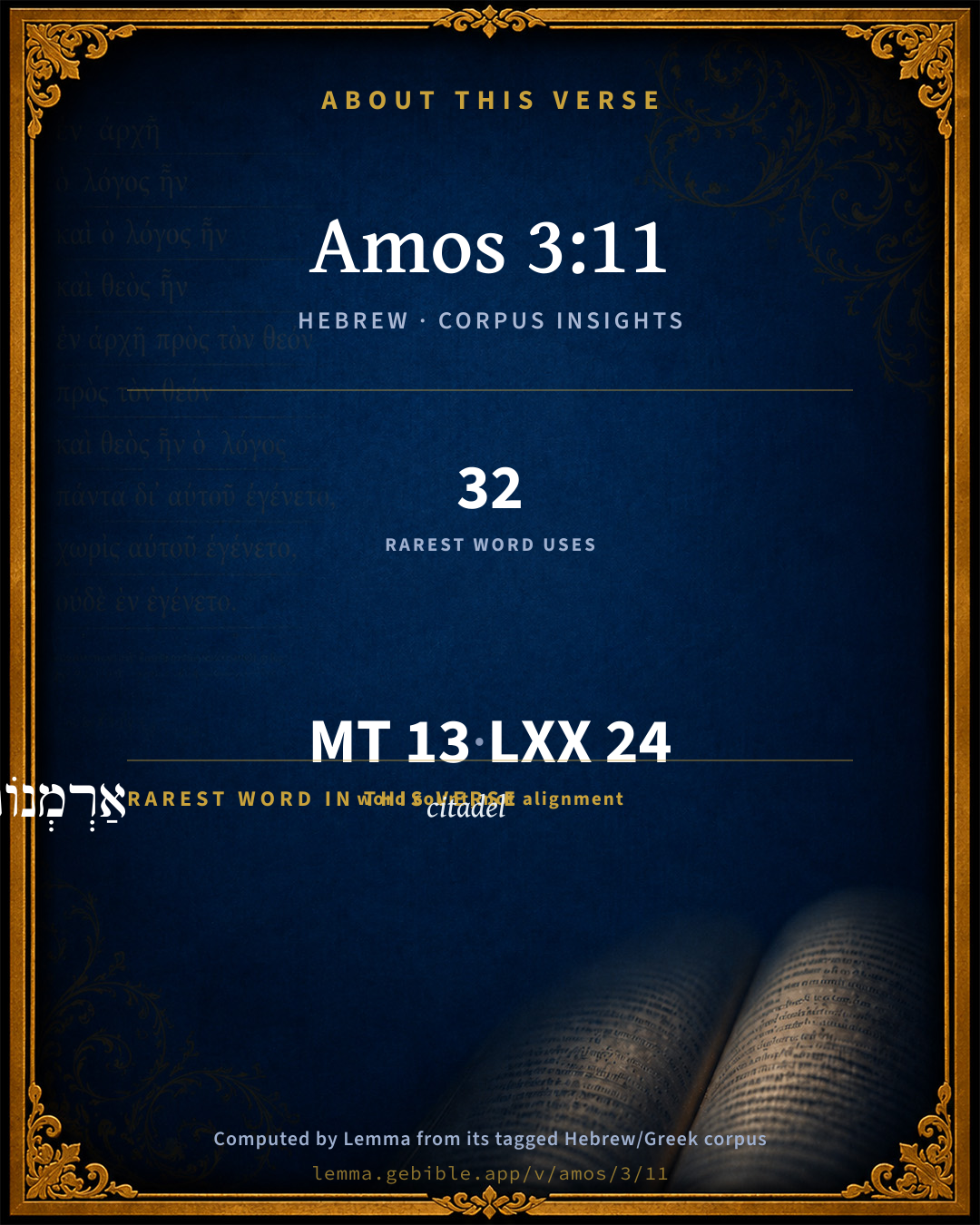
אַרְמְנוֹתָֽיִךְ citadel H759 occurs in 31 verses of the Hebrew Bible. Also found in:

Grammatical profile

  • 3 verbs
  • 7 nouns
  • 1 preposition
  • 2 adverbs

Verb forms

  • אָמַר֙ Qal · Perfect
  • וְהוֹרִ֤ד Hiphil · Sequential Perfect
  • וְנָבֹ֖זּוּ Niphal · Sequential Perfect

Hebrew & Septuagint length

In English translation the verse runs 25 words from the Hebrew and 33 from the Septuagint (LXX English) — closely comparable.

A rough comparison of the two English renderings, which tokenize alike — not a word-level alignment.

Word counts can differ between the Hebrew and the Greek without any difference in meaning — e.g. the Hebrew direct-object marker אֵת has no separate Greek word, and Greek often adds the article ὁ.

In the original languages it is 13 Hebrew tokens and 24 Greek tokens — but the two are counted differently (Hebrew bundles its prefixes and suffixes into one token; the Greek is in lemma form), so that isn’t a like-for-like length.

Cross-references

15

Topical passages linked to Amos 3:11 in the Treasury of Scripture Knowledge — connected by theme and wording, ordered by reader-vote popularity; previews shown in the World English Bible.

  • 2 Kings 18:9–11 It happened in the fourth year of king Hezekiah, which was the seventh year of Hoshea son of Elah king of Israel, that Shalmaneser king of Assyria came up against Samaria, and besieged it.
  • 2 Kings 15:19 There came against the land Pul the king of Assyria; and Menahem gave Pul one thousand talents of silver, that his hand might be with him to confirm the kingdom in his hand.
  • 2 Kings 17:3–6 Against him came up Shalmaneser king of Assyria; and Hoshea became his servant, and brought him tribute.
  • Amos 2:5 But I will send a fire on Judah, And it will devour the palaces of Jerusalem."
  • Amos 6:14 For, behold, I will raise up against you a nation, house of Israel," Says Yahweh, the God of hosts; "And they will afflict you from the entrance of Hamath to the brook of the Arabah."
  • 2 Kings 15:29 In the days of Pekah king of Israel came Tiglath Pileser king of Assyria, and took Ijon, and Abel Beth Maacah, and Janoah, and Kedesh, and Hazor, and Gilead, and Galilee, all the land of Naphtali; and he carried them captive to Assyria.
  • 2 Chronicles 36:19 They burnt the house of God, and broke down the wall of Jerusalem, and burnt all the palaces of it with fire, and destroyed all the goodly vessels of it.
  • Isaiah 7:17–25 Yahweh will bring on you, on your people, and on your father's house, days that have not come, from the day that Ephraim departed from Judah; even the king of Assyria.
  • Isaiah 8:7–8 now therefore, behold, the Lord brings up on them the waters of the River, strong and many, [even] the king of Assyria and all his glory: and it shall come up over all its channels, and go over all its banks;
  • Isaiah 10:5–6 Ho Assyrian, the rod of my anger, the staff in whose hand is my indignation!
  • Isaiah 10:9–11 Isn't Calno as Carchemish? Isn't Hamath as Arpad? Isn't Samaria as Damascus?
  • Hosea 11:5–6 "They won't return into the land of Egypt; But the Assyrian will be their king, Because they refused to repent.
  • Amos 3:10 "Indeed they don't know to do right," says Yahweh, "Who hoard plunder and loot in their palaces."
  • Amos 3:15 I will strike the winter house with the summer house; And the houses of ivory will perish, And the great houses will have an end," says Yahweh.
  • Amos 6:8 "The Lord Yahweh has sworn by himself," says Yahweh, the God of hosts: "I abhor the pride of Jacob, And detest his fortresses. Therefore I will deliver up the city with all that is in it.

Cross-references courtesy of OpenBible.info (CC BY 4.0).

Hebrew and Greek witnesses Masoretic Hebrew ↔ Greek Septuagint

The same verse in the two great witnesses to the Old Testament, shown verse-for-verse.

These are two independent witnesses, not word-aligned to each other, and the Septuagint is shown in lemma (dictionary) form.

Hebrew Amos 3:11 Masoretic · Westminster Leningrad Codex

לָכֵ֗ן כֹּ֤ה אָמַר֙ אֲדֹנָ֣י יְהוִ֔ה צַ֖ר וּסְבִ֣יב הָאָ֑רֶץ וְהוֹרִ֤ד מִמֵּךְ֙ עֻזֵּ֔ךְ וְנָבֹ֖זּוּ אַרְמְנוֹתָֽיִךְ

Therefore thus says the Lord Yahweh: "An adversary will overrun the land; And he will pull down your strongholds, And your fortresses will be plundered."

World English Bible · Public Domain

Greek LXX Amos 3:11 Septuagint · lemma form

διά οὗτος ὅδε λέγω κύριος ὁ θεός τύρος κυκλόθεν ὁ γῆ σύ ἐρημόω καί καταἄγω ἐκ σύ ἰσχύς σύ καί διαἁρπάζω ὁ χώρα σύ

Therefore thus says the Lord God; O Tyre, your land shall be made desolate round about you; and he shall bring down your strength out of you, and your countries shall be spoiled.

LXX2012 (modern English Septuagint) · Public Domain

On this verse, Whedon's Commentary on the Bible discusses the Septuagint’s reading. Read the note in Commentary ↓

Hebrew: Westminster Leningrad Codex (CC BY 4.0). Greek: Septuagint (public domain); English from LXX2012 (modern English Septuagint) (Public Domain). How the Septuagint differs from the Hebrew →

Targum (Aramaic paraphrase)

1

The Targum is the ancient Jewish Aramaic paraphrase of the Hebrew Scriptures — an interpretive translation, not the Hebrew text itself. Onkelos (literal) and Pseudo-Jonathan (expansive) render the Torah, and Jonathan the Prophets. Coverage is partial: where no permissively-licensed English translation exists for a verse, only the Aramaic is shown. This is verse-level text, not a word-by-word alignment to the Hebrew.

  1. Targum Jonathan Prophets (Joshua–Malachi)
    בְּכֵן כִּדְנַן אֲמַר יְיָ אֱלֹהִים עָקָא תַּקִיפָא לְאַרְעָא וְיִבָּטֵיל מִנִיךְ תּוֹקְפֵיךְ וְיִתְבַּזוּן בִּרְנְיָתָיִךְ:

    (no public-domain English translation for this verse)

    Targum Jonathan — Aramaic: “Mikraot Gedolot” (public domain). English: “Sefaria Community Translation” (CC0 1.0 (public-domain dedication)); “London "Chaldee Paraphrase," 1871” (public domain). Text via Sefaria.

Commentary

Notes on Amos 3:11 from classic Christian and Jewish commentators (each source and its license shown beneath its notes). The classic Christian expositions comment on the surrounding passage and are grouped to its opening verse, so a note may address several verses; the Jewish commentaries on the Tanakh (Rashi and others) are per-verse, so they appear only where the commentator wrote on this verse.

Lemma curates 59 commentaries, every one of them public domain or Creative Commons licensed, each selected and text-cleaned for this edition rather than reprinted as found. About our sources →

Trapp's Complete Commentary

John Trapp

Amo 3:11 Therefore thus saith the Lord GOD; An adversary [there shall be] even round about the land; and he shall bring down thy strength from thee, and thy palaces shall be spoiled.

Ver. 11. Therefore thus saith the Lord] And he saith it in great haste and heat; as appeareth by that concise kind of expression that he here useth, after the manner of those that are thorough angry, and therefore say not much, but mean to do the more, Aposiopesis, ut Quos ego (Virg. Aen. i. 135).

An adversary round about the land] A distresser at every corner; that as all the borderers have beheld thy wickedness, so shall they thy wretchedness, by reason of the enemy and the avenger, who shall meet thee at every turn, and leave thee neither hope of better nor place of worse.

And he shall brinq down thy strength from thee] Thee in the feminine gender; haply because they should be so enfeebled and impoverished: or else, to express the heat of God’s anger against them, as Num 11:15, where meek Moses, being in a great passion of anger and grief together, saith to God, "If thou" (in the feminine) "deal thus with me, kill me, I pray thee, out of hand," &c.; he was so out of measure moved that he could not fill up his speech, nor utter the last syllable, At for Atta, ex magna perturbatione.

Thy strength] Thy strongholds, or thy riches, those treasures of wickedness wherein thou trustest, Pro 10:2 Amo 3:15, "The rich man’s wealth is his strong city." It is called his strength because he confideth in it, 1Ti 6:17, and because he is enabled, by it, to bring about his designs.

And thy palaces shall be spoiled] They shall be blown up, because their foundation was laid upon fireworks, their mortar mixed with blood, their materials raked together by rapine and robbery; their furniture, and those ill gotten goods therein hid and hoarded, shall be given, hosti non haeredi, not to thine heir, but to thine enemy for a booty. "An inheritance may be hastily gotten at the beginning; but the end thereof shall not be blessed," Pro 20:21. "As the partridge sitteth on eggs, and hatcheth them not; so he that getteth riches, and not by right, shall leave them in the midst of his days, and at his end be a fool," Jer 17:11. A poor fool God will make of him ere he hath done with him, as he did for Balaam, Achan, Ahab, Gehazi, the rich man, Luk 12:16-21; Luk 16:19-31.

John Trapp, A Commentary or Exposition upon All the Books of the Old and New Testament (1647–1656) — public domain. Text from a community e-Sword module.

The Biblical Illustrator

Joseph S. Exell

Amo_3:11-15

Therefore thus saith the Lord God; An adversary there shall be even round about the land.

The spoiler spoiled

In the previous verse Amos has pronounced Gods verdict on the proud citizens of Samaria; here he proclaims the punishment which is about to come upon them.

I. The first word of the passage, therefore, shows us that this spoiling is the direct result of their own sin. They had chosen their path--that of remorseless greed, and of luxury won by oppression and tyranny--and it was the path on which the avenging angels walked with the vials of Gods wrath. Their sin was to be punished by the loss of everything which it seemed to have secured. The history of Assyria is another illustration of this connection between sin and punishment (Isa_33:1; Nahum, etc.). God will surely spoil every spoiler.

II. The fruits of this course of oppression. The treasures gained by sin pass away by plunder. An adversary (verse 11). Sixty years later the king of Assyria besieged Samaria as Amos foretold, and rifled their glorious palaces. They had filled them with stores of wealth, and had revelled there in luxury; but these things only served to whet the appetite for plunder which brought Assyria to their gates. They built their winter houses and their summer houses, their great houses and their houses of ivory, regardless of the despair of the poor, and of the curses of the oppressed. Even Gods threatenings had not been able to check them for a moment. What end had it served? They had a few years of revelry, but at last that for which they had sacrificed a good conscience and the favour of God was snatched from them in a moment. What an ignominious end verse 12 describes. Melanchthons mother said, Ill-gotten wealth but loss secures. How true it is! If never before, yet when death comes that for which a man has sacrificed character and conscience is taken from him, and, robbed of all he prized, he must stand in the presence of his Judge.

III. The failure of every stay on which such men might rest in the time of trouble, In the day that I shall visit the trangressions of Israel upon him I will also visit the altars of Bethel; and the horns of the altar shall be cut off and fall to the ground. The idols should perish in the same hour as their worshippers, involved in a common destruction. It was from Bethel that they looked for deliverance. There they had presented their offerings and paid their tithes, but the idols failed them in their hour of trouble, and fell by the same visitation. Every arm of flesh must fail when Gods judgments come. (J. Telford, B. A.)

The Biblical Illustrator, edited by Joseph S. Exell (c. 1880s–1900s) — public domain. Text from a community e-Sword module.

Whedon's Commentary on the Bible

Daniel D. Whedon

11-15. The sentence. Jehovah will speedily send an enemy to avenge the wrongdoing; he will lay waste the corrupt city; even the altars of Beth-el will be overthrown. The sentence is introduced by the solemn “Thus saith the Lord Jehovah.”

Therefore — Because of the utter corruption.

An adversary — A word rendered more often “trouble” or “distress,” but “adversary” is most suitable here.

There shall be even round about the land — This is undoubtedly the sense of the passage, but the Hebrew is awkward. A very slight change, supported by Peshitto, gives “shall surround the land.” With the land completely surrounded, every avenue of escape will be cut off.

He shall bring down thy strength — May be rendered also, “thy strength shall be brought down” (G.-K., 144d.)

Strength — Defenses, that is, the walls and the citadel; they will be torn down.

Thy palaces — In which the plunder is stored.

Shall be spoiled — The retribution is according to the lex talionis.

Following Amo_3:11 Harper reads Amo_3:15, then Amo_3:12-14, but there is no necessity for the transposition.

12. The people will be swept away, only a small fraction will escape.

Taketh — R.V., “rescueth.” The Davids who could kill the wild beasts and save the lambs unharmed (1Sa_17:34-35) were the exception; ordinarily the lion devoured the prey.

Two legs — Literally, shin bones.

Piece of an ear — That is, small fragments which were overlooked by accident. As a shepherd Amos would be familiar with such happenings.

Children of Israel — Perhaps not the whole nation, but the nobles of Samaria who are described in the following words.

Corner of a bed — Better, R.V., “couch,” or divan. The divan in an Oriental home runs around three sides, the seat of honor being in the corner opposite the door, “where upon the usual cushions is set a smaller one, against which he may rest his head and take a nap” (Van Lennep, Bible Lands, 460, 461). The prophet evidently has in mind the extravagant, luxury-loving nobles of Samaria.

In Damascus in a couch — R.V., “on the silken cushions of a bed.” Some Hebrew manuscripts and LXX. read “Damascus” (so A.V.), but the common Hebrew text has a word with a slightly different vocalization, the meaning of which is uncertain. Damascus is out of the question, since Amos is not concerned in this connection with inhabitants of a foreign Country. Most commentators read damask — similarly R.V, “silken cushions” — the fine material which derives its name from Damascus. However, it is very doubtful that in Amos’s day Damascus had already given its name to this material. Nevertheless, we expect a word of some such meaning, or possibly one parallel with corner.

In Amo_3:13-15 the judgment is announced once more, in the form of a proclamation.

Hear — As in Amo_3:9, no one in particular is addressed.

This mode of expression is chosen for rhetorical purposes, to introduce in a more vivid and forceful manner the announcement of judgment.

Testify — Announce solemnly (Gen_43:3; Deu_4:26).

The house of Jacob — Israel; here in the narrower sense, the northern kingdom.

The Lord Jehovah, the God of hosts — The accumulation of divine titles indicates the solemnity of the announcement. On the first two see on Amo_1:8; on the whole title, which is used again in Amo_4:13; Amo_5:16; Amo_5:27; Amo_6:14, see on Hos_12:5.

Amo_3:14-15 emphasize the completeness of the destruction. Not even the sanctuaries will escape.

Beth-el — The chief sanctuary of the northern kingdom. Dan also enjoyed royal patronage (1Ki_12:29), but the former was supreme. It was situated about ten miles north of Jerusalem, on the road to Nablus. Its name — house of God — testifies to its sanctity, and very early in Hebrew history it appears as a sacred place (Gen_12:8; Gen_35:7; 1Sa_10:3). It was at Beth-el that Amos delivered his message (Amo_7:13). The ruins of the old town, now called Beitin, lie on the summit of a hill sloping to the southeast, and cover three or four acres. It appears from this verse (compare Amo_2:8) that numerous altars were at Beth-el; whether they were all, nominally at least, consecrated to Jehovah, or whether some were sacred to other deities, is not certain — probably the former.

Horns of the altar — Important fixtures of the altar (Lev_4:7; Lev_4:18; Lev_4:30), which offered a place of refuge and safety (1Ki_1:50-51; 1Ki_2:28). When they are gone the last ray of hope must vanish. The horns of the altar are mentioned frequently in the Old Testament, but their origin is not yet satisfactorily explained. They were found also on altars outside of Israel. On a monument found in Teima, southeast of Edom, an altar is represented with horns curved like those of an ox, rising from the corner. With the sanctuaries the magnificent palaces of king and nobles will be destroyed.

Winter house… summer house — To be understood as collectives; the summer residences and winter residences of king and nobles. For the latter compare Jer_36:22; for the former Jdg_3:20. Ordinarily the summer and winter houses do not appear to have been separate buildings, they were rather different parts of the same house. The upper rooms, if there are two stories, or the outside rooms, if there is but one story, are still the rooms occupied preferably in summer, while the lower story or inside rooms are preferred for winter (Thomson, The Land and the Book, 1:478). In exceptional cases people have separate dwellings for summer and winter respectively (Van Lennep, Bible Lands, 115). The language here would seem to indicate separate dwellings. An Aramaic inscription found in Zinjirli, near Aleppo, furnishes an interesting parallel to these expressions. In it Bar-rekub, king of Sham’al, a vassal of Tiglath-pileser III, and therefore a younger contemporary of Amos, relates that he beautified his father’s house in honor of his ancestors; then he continues, “and it is for them a summer house and a winter house.”

Houses of ivory — Houses whose walls are paneled or inlaid with ivory (1Ki_22:39; compare Amo_6:4). Since ivory was very costly, only the wealthy could afford this luxury.

Great houses — Or, magnificent (Amo_5:11; Amo_6:11); R.V. margin, “many houses.” The word is so rendered in Isa_5:9; if so here, it points to the wide extent of the threatened ruin.

Daniel D. Whedon (gen. ed.), Commentary on the Old and New Testaments (1874–1909) — public domain. Text from a community e-Sword module.

Keil & Delitzsch

C. F. Keil & F. Delitzsch

Thus do they bring about the ruin of the kingdom. Amo 3:11. "Therefore thus saith the Lord Jehovah, An enemy, and that round about the land; and he will hurl down thy glory from thee, and thy palaces are plundered. Amo 3:12. Thus saith Jehovah, As the shepherd delivers out of the mouth of the lion two shin-bones or an ear-lappet, so will the sons of Israel deliver themselves; they who sit on the corner of the couch and on the damask of the bed." The threat is introduced in the form of an aposiopesis. צר, enemy, וּסביב הארץ, and indeed round about the land ( ו explic. as in Amo 4:10, etc.; and סביב in the construct state construed as a preposition), i.e., will come, attack the land on all sides, and take possession of it. Others regard צר as an abstract: oppression (from the Chaldee); but in this case we should have to supply Jehovah as the subject to והוריד; and although this is probable, it is by no means natural, as Jehovah is speaking. There is no foundation, on the other hand, for the remark, that if tsar signified the enemy, we should either find the plural צרים, or הצּר with the article (Baumgarten). The very indefiniteness of tsar suits the sententious brevity of the clause. This enemy will hurl down the splendour of Samaria, "which ornaments the top of the mountain like a crown, Isa 28:1-3" (Hitzig: עז, might, with the subordinate idea of glory), and plunder the palaces in which violence, i.e., property unrighteously acquired, is heaped up (Amo 3:10). The words are addressed to the city of Samaria, to which the feminine suffixes refer. On the fall of Samaria, and the plundering thereof, the luxurious grandees, who rest upon costly pillows, will only be able to save their life to the very smallest extent, and that with great difficulty. In the simile used in Amo 3:12 there is a slight want of proportion in the two halves, the object of the deliverance being thrown into the background in the second clause by the passive construction, and only indicated in the verb, to deliver themselves, i.e., to save their life. "A pair of shin-bones and a piece (בּדל ἁταξ λεγ.), i.e., a lappet, of the earth," are most insignificant remnants. The grandees of Samaria, of whom only a few were to escape with their life, are depicted by Amos as those who sit on costly divans, without the least anxiety. פּאת מטּה, the corner of the divan, the most convenient for repose. According to Amo 6:4, these divans were ornamented with ivory, and according to the verse before us, they were ornamented with costly stuffs. דּמשׂק comes from דמּשׂק, Damascus, and signifies damask, an artistically woven material (see Ges. Thes. p. 346). This brings the visitation of God to an end. Even the altars and palaces are to be laid in ruins, and consequently Samaria will be destroyed.

Keil & Delitzsch — Biblical Commentary on the Old Testament (1861–1891) — public domain (CC PDM 1.0). Text via the HelloAO Bible API. (Old Testament only.)

Tyndale Open Study Notes

Tyndale Open Resources

3:11 The real enemy was not Egypt or Philistia, but Assyria, the only superpower in the region.

Tyndale Open Study Notes — © Tyndale Open Resources, licensed CC BY-SA 4.0. Text via the HelloAO Bible API.

Jamieson, Fausset & Brown

Robert Jamieson, A. R. Fausset & David Brown

Translate, "An adversary (the abruptness produces a startling effect)! and that too, from every side of the land." So in the fulfilment, Kg2 17:5 : "The king of Assyria (Shalmaneser) came up throughout all the land, and went up to Samaria, and besieged it three years."

bring down thy strength from thee--that is, bring thee down from thy strength (the strength on which thou didst boast thyself): all thy resources (Pro 10:15).

palaces shall be spoiled--a just retribution in kind (Amo 3:10). The palaces in which spoils of robbery were stored up, "shall be spoiled."

Jamieson, Fausset & Brown — Commentary Critical and Explanatory on the Whole Bible (1871) — public domain (CC PDM 1.0). Text via the HelloAO Bible API.

Adam Clarke's Commentary

Verse 11. An adversary, round about the land] Ye shall not be able to escape, wherever ye turn, ye shall meet a foe.

Adam Clarke's Commentary on the Bible (1810–1826) — public domain. Text from a community e-Sword/MySword module.

John Calvin's Commentaries

The Prophet here announces the punishment God would inflict on the Israelites. An enemy, he says, and indeed one around you, etc. Some think צר, tsar, to be a verb in the imperative mood; but this cannot be maintained. But Amos, here declares that an enemy was near the Israelites, who would besiege them on every side. The ungodly are ever wont to seek escapes, and if they see the smallest hole, they think that they can escape. Strange is the presumption of men with regard to God: when they see themselves hemmed in, they are really frightened, yea, they become wholly disheartened; but yet they seek subterfuges on the right hand and on the left, and never submit to God except when constrained. This is the reason why the Prophet now says, that an enemy was near, and indeed around them; as though he said, “You have no reason to think that there is any way of escape open to you; for God has hemmed you in on every side; there is therefore a siege which so confines you, that you in vain hope to escape.” An enemy, he says, is indeed around — around the whole land, who will take away from thee thy strength. Here the Prophet removes from the Israelites their vain confidence; for they could not think of God’s vengeance, while looking on their own power. They indeed thought that they had sufficient protection in their own large number, riches, and arms, as men are wont to set up against God what proceeds from himself, as though creatures could do anything against him, and as though God could not take away, when he pleases, what he has given: and yet such is the blindness of men. Hence the Prophet says, that all the wealth and all the strength in which the Israelites excelled would be useless, inasmuch as an enemy, he says, armed by God, shall take from thee thy strength; and thy palaces shall be plundered.

John Calvin's Commentaries (1540-1563) — public domain. Text from the Calvin Translation Society English edition (1840s-50s) via the Christian Classics Ethereal Library (ccel.org). Calvin's coverage is partial (roughly two-thirds of the Bible); uncommented books and verses are honest gaps, never fabricated. The 19th-century editor's footnotes and remarks are omitted so the notes are faithfully Calvin's own voice.

Ellicott's Commentary for English Readers

(11) An adversary.—This rendering is to be preferred to “affliction” (Chald., Syr.). It is the subject of the following verb “bring down,” Assyria being referred to, though not in express terms. The reading of LXX., “O Tyre, thy land round about thee is desolate,” is incoherent, and confounds Tzãr with tzôr.

Thy strength points mainly to the stronghold of Samaria, which the enemy was to bring down or reduce to ruins, but it may likewise include the chief warriors who were to be led away captive.

A Bible Commentary for English Readers, edited by Charles John Ellicott (1878–1897) — public domain. Text from a community e-Sword module.

The Cambridge Bible for Schools and Colleges

gen. ed. J. J. S. Perowne

11–15. The sentence.

An adversary] or Distress, a rendering which most moderns prefer.

there shall be even round about] The Hebrew is harsh: a very slight change, supported by Pesh. (יְסֹבֵב for וּסְבִב), yields shall surround (or encircle), which is to be preferred.

he shall bring down thy strength] or, thy strength shall be brought down, as the same Hebrew may be rendered (Ges.-Kautzsch, § 144. 3a), though Wellh. would read hûrad for hôrîd. The foe will encircle the land; the strong ‘crown’ of Samaria will be ‘brought down’ to the ground (cf. Deu_28:52; Eze_30:6; Isa_28:2 b); and its palaces (Amo_3:10) will be plundered.

The Cambridge Bible for Schools and Colleges (gen. ed. J. J. S. Perowne; Cambridge University Press, 1878–1918) — public domain. Text from a community e-Sword module.

John Gill's Exposition

Thus saith the Lord, as the shepherd taketh out of the mouth of the lion,.... Or what the lion has left, to show to his master that it had been seized and torn by a beast of prey; for otherwise it is a most daring thing, and not usual, for a shepherd to take anything out of a lion's mouth, though David did: and here it is said to be not a whole sheep, or a lamb, but

two legs, or a piece of an ear; the body of the creature being devoured by the lion, only some offal left he cared not for; two shanks of the legs that had no flesh upon them, and the gristle of the ear, as the Targum; having satisfied his hunger with the best of it: signifying hereby that only a few of the Israelites should escape the enemy, and those poor and insignificant, he made no account of; and this in a miraculous manner, it being like taking anything out of the mouth of a lion, to which a powerful enemy is compared, and particularly the king of Assyria, Jer 50:17;

so shall the children of Israel be taken out that dwell in Samaria; only a few of them, and those the poorest; and their escape will be next to a miracle, when the city will be taken; even such as are weak and sickly, or faint hearted: being

in a corner of a bed; who either through sickness lie there, or slothfulness, danger being near; or through poverty, having only a corner or a piece of a bed to lie on; or through cowardice they hid themselves in one part of it:

and in Damascus in a couch; or "in a bed of Damascus" (h); the chief city in Syria, taken much about the same time as Samaria was; and where some of the Israelites might betake themselves, and think themselves secure as persons laid on a couch: or at the bed's feet (i), as some render it; or "in a corner of a couch" (k), as before. The Targum paraphrases it,

"that dwell in Samaria, in the strength of power, trusting in Damascus.''

(h) "in sponda Damasci", Tigurine version; "in grabbato Damasci", so some in Drusius; "in lectis Damascenis", Castalio; so Abendana. (i) "In crure spondae", Junius & Tremellius, Piscator, Tarnovius. (k) "Angulo grabati", Pagninus; "in angulo strati", Montanus. So R. Sol. Urbin. Ohel Moed, fol. 75. 1.

John Gill's Exposition of the Whole Bible (1746–1763) — public domain (CC PDM 1.0). Text via the HelloAO Bible API.

Albert Barnes' Notes on the Bible

Therefore thus saith the Lord God - There was no human redress. The oppressor was mighty, but mightier the Avenger of the poor. Man would not help; therefore God would. “An adversary” there shall be, “even round about the land;” literally, “An enemy, and around the land!” The prophets speaks, as seeing him. The abruptness tells how suddenly that enemy should come, and hem in the whole land on all sides. What an unity in their destruction! He sees one “enemy, and” him everywhere, all “around,” encircling, encompassing, as with a net, their whole land, narrowing in, as he advanced, until it closed around and upon them. The corruption was universal, so should be the requital.

And he shall bring down thy strength from - (that is, away from) thee The word “bring down” implies a loftiness of pride which was to be brought low, as in Obadiah, “thence will I bring thee down” Oba 1:4; and in Isaiah, “I will bring down their strength to the earth” Isa 63:6. But further, their strength was not only, as in former oppressions, to be “brought down,” but “forth from thee. Thy palaces shall be spoiled;” those palaces, in which they had heaped up the spoils of the oppressed. Man’s sins are, in God’s Providence, the means of their punishment. “Woe to thee that spoilest and” Isa 33:1 (that is, whereas) thou wert “not spoiled, and dealest treacherously, and they dealt not treacherowsly with thee! when thou perfectest, spoiling, thou shalt be spoiled; when thou accomplihest dealing treacherously, they shall deal treacherously with thee.” Their spoiling should invite the spoiler, their oppressions should attract the oppressor and they, with all which they held to be their strength, should go “forth” into captivity.

Rib.: “The Lord will be justified in His sayings, and in His works, when He executeth judgment on ‘us and shall be cleared,’ even by the most unjust judges, ‘when He is judged.’ Psa 51:4. He cites the Ashdodites and Egyptians as judges, who were witnesses of His benefits to this people, that they might see how justly He punished them. And now the hardened Jews themselves, Turks and all Hagarenes, might be called to behold at once our iniquities, and ‘the mercies of the Lord, that we are not consumed’ Lam 3:22. If these were gathered on the mountains of Samaria, and surveyed from aloft our sins, who worship Mammon and Vain-glory and Venus for God, doubtless the Name of God would through us be blasphemed among the pagan. ‘Imagine yourselves withdrawn for a while to the summit of some lofty mountain,’ says the blessed martyr Cyprian , ‘view thence the face of things, as they lie beneath you, yourself free from contact of earth, cast your eyes hither and thither, and mark the turmoils of this billowy world.

You too, recalled to self-remembrance, will pity the world; and, made more thankful to God, will congratulate yourself with deeper joy that you have escaped it. See thou the ways obstructed by bandits, the seas infested by pirates, war diffused everywhere by the camp’s bloodstained fierceness: a world reeking with mutual slaughter; and homicide, a crime in individuals, called virtue when worked by nations. Not innocence but the scale of its ferocity gains impunity for guilt. Turn thy eyes to the cities, thou wilt see a populated concourse more melancholy than any solitude.’ This and much more which he says of the life of the Gentiles, how it fits in with our’s, any can judge. What greater madness than that people, called to heavenly thrones, should cling to trifles of earth? immortal man glued to passing, perishable things people, redeemed by the Blood of Jesus Christ, for lucre wrong their brethren, redeemed by the same Price, the same Blood! No marvel then, that the Church is afflicted, and encompassed by unseen enemies, and her strength drawn down from her spoiled houses.”

“Samaria is also every soul, which willeth to please man by whom it thinketh it may be holpen, rather than God, and, boasting itself to be Israel, yet worshipeth the golden calves, that is, gold, silver, honors, and pleasures. Let people alien from the light of the Gospel survey ‘its tumults,’ with what ardor of mind riches, pleasures are sought, how ambition is served, how restless and disturbed the soul is in catching at nothings, how forgetful of God the Creator and of heavenly things and of itself, how minded, as if it were to perish with the body! What tumults, when ambition bids one thing, lust another, avarice another, wrath another, and, like strong winds on the sea, strong, unbridled passions strive together! They ‘know not to do right,’ bad ends spoiling acts in themselves good. They ‘treasure up violence,’ whereas they ought to treasure up grace and charity against that Day when God shall judge the secrets of people. And when they ascribe to themselves any benefits of the divine mercy, and any works pleasing to God, which they may have done or do, what else do they than ‘store up robbery?’ So then the powers of the soul are “spoiled,” when truths as to right action, once known and understood by the soul, fade and are obscure, when the memory retaineth nothing usefill, when the will is spoiled of virtues and yields to vicious affections.”

Albert Barnes' Notes on the Bible (1834–1885) — public domain. Text from a community e-Sword/MySword module.

Haydock's Catholic Bible Commentary

About, As oxen tread out corn, going round a tree. (Calmet) --- Septuagint, "Tyre even all round, thy land shall be a desert." Tsar means "Tyre and tribulation," according to St. Jerome’s master. (Haydock)

George Leo Haydock (1774–1849), Haydock's Catholic Family Bible and Commentary, 1859 edition — public domain. Excludes Psalms (Douay-Rheims chapter numbering differs from Protestant) and Deuterocanonical books (Catholic canon only).

Matthew Poole's English Annotations

Therefore; because of all the violence and rapine, with other crying sins, multiplied against God in the midst of them.

An adversary, the Assyrian with united forces, shall be even round about the land, on all sides shall beset thee; the whole land shall be but as one besieged city, out of which none, or so few as next to none, shall escape.

He shall bring down thy strength from thee; lay low all thy fortresses, break all thy power, kill thy valiant men, destroy thy armies, and by force take thy strong holds.

Thy palaces shall be spoiled; where thou laidst up thy spoils gotten by violence and oppression, there thy enemy shall find them, and take them away as lawful plunder; and when thy riches are carried out, they shall burn the palaces themselves too.

Matthew Poole's English Annotations on the Holy Bible (1683–1685) — public domain. Text from a community e-Sword/MySword module.

The Pulpit Commentary

An adversary. The Hebrew is forcible, the Lord speaking as though he saw the fee present: "an enemy and around the land." Ewald and Hitzig take tsar as an abstract noun, "distress;" the LXX and Aquila, pointing it differently, read, Turov, but the continuation of the sentence is scarcely to be deemed a translation, kukloqen hJ gh sou ejrhmwqhsetai "Thy land shall be made desolate round about thee" The adversary meant is Shalmaneser, who attacked Israel more than once and besieged Samaria; or his successor, Sargon, who claims to have reduced the city and removed the inhabitants (2Ki 17 and 18:9, etc.; see Introduction to Micah). Thy strength. All wherein thou trustedst shall be brought down to the ground (Oba_1:3) Palaces, in which were stored the fruits of injustice and rapine (ver. 10).

The Pulpit Commentary (1880–1919), ed. H.D.M. Spence-Jones & Joseph S. Exell — public domain. Text from a community e-Sword module.

John Wesley's Explanatory Notes

Therefore - Because of all the violence and rapine with other crying sins. An adversary - The Assyrian. Round about - Shall beset the whole land as one besieged city.

John Wesley, Explanatory Notes Upon the Whole Bible (1754–1765) — public domain. Text via the GEBible commentary corpus.

unfoldingWord translationNotes

Door43 World Missions Community

Therefore, this is what the Lord Yahweh says

It can be stated clearly who God was saying this to. AT: "Therefore, this is what the Lord Yahweh says to the people of Israel living in Samaria" (See: Assumed Knowledge and Implicit Information)

An enemy will surround the land

"An enemy army will surround the land"

plunder your fortresses

"steal all the things in your fortresses"

As the shepherd rescues ... so will the people of Israel ... be rescued

The Lord compares the people of Israel being rescued with an unsuccessful attempt to rescue an animal from a lion. They will not be completely rescued. (See: Simile)

As the shepherd rescues out of the mouth of the lion two legs only, or a piece of an ear

It can be stated clearly that the shepherd tries to rescue the whole animal. AT: "As the shepherd tries to rescue an animal from the lion's mouth, but is able to save only two legs or a piece of an ear" (See: Assumed Knowledge and Implicit Information)

As the shepherd ... the lion

Here the phrases "the shepherd" and "the lion" refer to any shepherd or lion. AT: "As a shepherd ... a lion" (See: Generic Noun Phrases)

they will be left with only the corner of a couch or a piece of a bed

This phrase shows that they will not be completely rescued. Almost all of their possessions will be stolen. This passage in Hebrew is difficult to understand, and some modern versions interpret it differently.

couch

This is a soft chair big enough to lie down on.

translationWords

Lord Yahweh

adversary

stronghold

shepherd

lions

Israel

Samaria

unfoldingWord translationNotes — © Distant Shores Media and the Door43 World Missions Community, licensed CC BY-SA 4.0. Source: git.door43.org/Door43/en_tn.

Rashi

Rabbi Shlomo Yitzchaki (Rashi)

An adversary, even round about the land—The adversary is prepared to come, and he will come around this land.

Rashi on the Tanakh — English translations: “The Judaica Press complete Tanach with Rashi, translated by A. J. Rosenberg” (CC BY 4.0); “Pentateuch with Rashi's commentary by M. Rosenbaum and A.M. Silbermann, 1929-1934” (public domain); “The Metsudah Tanach series, Lakewood, N.J” (CC BY 4.0); and “The Book of Joshua, Metsudah Publications, 1997” (CC BY 4.0). Text via Sefaria.

Lesson kit

Teaching starters — assembled from the data on this page, not authored interpretation. Every prompt links to the verse data it draws on. Edit before teaching.

Amos, in the Prophets, opens this verse with 13 words (13 distinct Hebrew lemmas). Its most distinctive word is ʼarmôwn (“citadel”). A historical commentator’s framing appears above. Read the whole chapter for the surrounding context.

Discussion questions

  1. How does “citadel” (ʼarmôwn) shape what this verse is saying?
  2. How does 1 Kings 16:18, which shares the word «citadel», read alongside this verse?
  3. These translations render this verse differently; the difference is in the English rendering, not the original. What questions does that raise?
  4. «אָמַר֙» is a Qal Perfect verb. How does that grammatical form shape the action described?
  5. Compare how Trapp's Complete Commentary and The Biblical Illustrator read this verse. Where do they agree or differ?

Things to notice

Reading settings

Reading text

Shown beneath each verse's original-language words.

Old Testament
Old Testament edition

Read the OT as the Masoretic Hebrew (MT) or the Greek Septuagint (LXX).

English shown for the Greek Septuagint (in the Hebrew ↔ Greek comparison).

Comparing translations? Open the Compare panel on any verse page to stack up to four side by side.