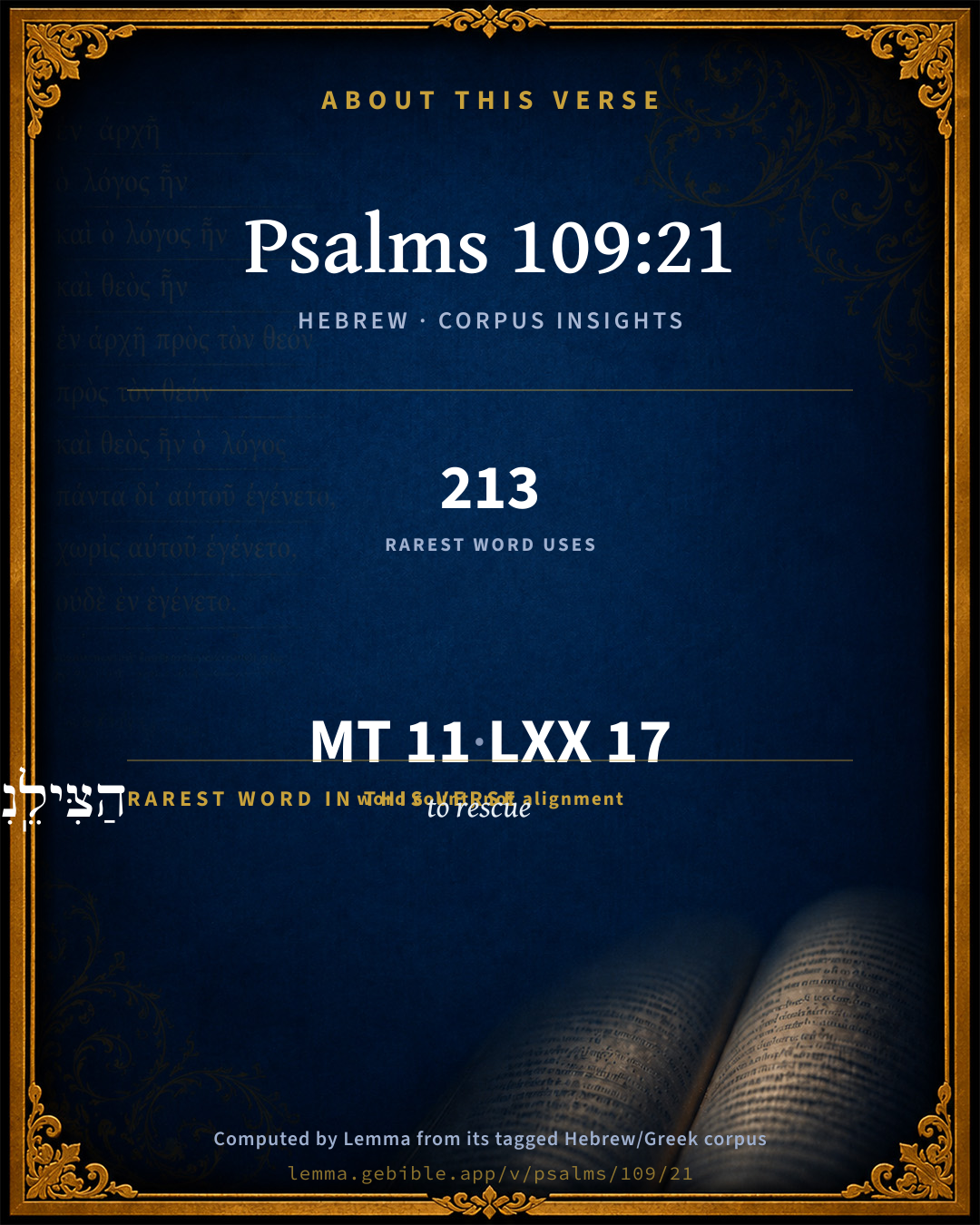
Psalms 109:21

Hebrew (Westminster Leningrad Codex) Psalms 109:21 appears in the Hebrew Old Testament. The text above is from the Westminster Leningrad Codex. Each word links to its Strong’s number, a concise gloss, and parsing drawn from the Open Scriptures Hebrew Bible morphology. Click any word for its full Brown-Driver-Briggs (BDB) entry.
Download image
Cite this verse

Psalms 109:21 (World English Bible). Public Domain. Lemma interlinear Bible study tool, https://lemma.gebible.app/v/psalms/109/21.

Show BibTeX & RIS
BibTeX
RIS
English Translation
But deal with me, Yahweh the Lord, for your name's sake, Because your loving kindness is good, deliver me;
World English Bible · Public Domain
Download a study sheet

One document with this verse’s original text, its word-by-word gloss line, the meaning frame, cross-references with their text, attributed commentary, and full source and license credits — printable, and it pastes into notes with its structure intact.

This verse Autodidact and up

Study sheet (.html) Plain text (.txt)

A passage Seminary Student

Up to 50 verses in one chapter. A passage sheet keeps up to 6 commentary sources and 12 cross-references per verse, in the order this page ranks them, and says so on the sheet whenever that leaves anything out. Ask for a single verse and you get the Autodidact verse sheet above.

Everything on this page stays free to read, with no account — the sheet is a download of what is already on screen, not access to it.

Want to remove ads? Support Godless Engineer
Compare translations 3

The same verse in 3 English versions, stacked beneath the original-language interlinear above. Click any original word for its lexicon entry.

Each is an independent rendering of the whole verse — the interlinear is not word-aligned to these translations.

Highlighted words mark where these versions differ — a whole-verse word diff, not a word-by-word alignment.

  • World English Bible Public Domain
    But deal with me, Yahweh the Lord, for your name's sake, Because your loving kindness is good, deliver me;
  • King James Version Public Domain
    But do thou for me, O GOD the Lord, for thy name's sake: because thy mercy is good, deliver thou me.
  • unfoldingWord Literal Text CC BY-SA 4.0
    But you, Yahweh, my Lord, do with me on account of your name. Because your covenant faithfulness good, rescue me!

unfoldingWord Literal Text — © unfoldingWord, licensed CC BY-SA 4.0. Word-aligned USFM3 via Door43 (git.door43.org/unfoldingWord/en_ult).

Versions to compare (up to 4)

3 of 4 selected

Show all 18 translations

Every available English version of this verse, each an independent rendering of the whole verse.

  • World English Bible Public Domain
    But deal with me, Yahweh the Lord, for your name's sake, Because your loving kindness is good, deliver me;
  • Berean Standard Bible Public Domain
    But You, O GOD, the Lord, deal kindly with me for the sake of Your name; deliver me by the goodness of Your loving devotion.
  • Majority Standard Bible Public Domain
    But You, O GOD, the Lord, deal kindly with me for the sake of Your name; deliver me by the goodness of Your loving devotion.
  • King James Version Public Domain
    But do thou for me, O GOD the Lord, for thy name's sake: because thy mercy is good, deliver thou me.
  • American Standard Version (1901) Public Domain
    But deal thou with me, O Jehovah the Lord, for thy name's sake: Because thy lovingkindness is good, deliver thou me;
  • Revised Version (1885) Public Domain
    But deal thou with me, O GOD the Lord, for thy name’s sake: because thy mercy is good, deliver thou me,
  • Geneva Bible (1599) Public Domain
    But thou, O Lord my God, deale with me according vnto thy Name: deliuer me, (for thy mercie is good)
  • Douay-Rheims (1899) Public Domain
    But thou, O Lord, do with for thy names sake: because thy mercy is sweet. Do thou deliver me.
  • Young's Literal Translation Public Domain
    And Thou, O Jehovah Lord, Deal with me for Thy name's sake, Because Thy kindness `is' good, deliver me.
  • Literal Standard Version CC BY-SA 4.0
    And You, O Lord YHWH, || Deal with me for Your Name’s sake, || Because Your kindness [is] good, deliver me.
  • Unlocked Literal Bible CC BY-SA 4.0
    Yahweh my Lord, deal kindly with me for your name's sake. Because your covenant faithfulness is good, save me.
  • unfoldingWord Literal Text CC BY-SA 4.0
    But you, Yahweh, my Lord, do with me on account of your name. Because your covenant faithfulness good, rescue me!
  • Darby Bible Public Domain
    But do *thou* for me, Jehovah, Lord, for thy name's sake; because thy loving-kindness is good, deliver me:
  • World Messianic Bible Public Domain
    But deal with me, GOD the Lord, for your name’s sake, because your loving kindness is good, deliver me;
  • Webster's Bible Public Domain
    But do thou for me, O GOD the Lord, for thy name's sake: because thy mercy is good, deliver thou me.
  • Free Bible Version CC BY-SA 4.0
    But treat me well, Lord God, because of your own reputation. Save me because you are faithful and good.
  • Bible in Basic English Public Domain
    But, O Lord God, give me your help, because of your name; take me out of danger, because your mercy is good.
  • JPS Tanakh (1917) Public Domain
    But Thou, O GOD the Lord, deal with me for Thy name's sake; because Thy mercy is good, deliver Thou me.

Literal Standard Version (2020), Covenant Press — licensed CC BY-SA 4.0. Text via the HelloAO Bible API (eBible.org). Unlocked Literal Bible (unfoldingWord) — licensed CC BY-SA 4.0. Text via the HelloAO Bible API (eBible.org). unfoldingWord Literal Text — © unfoldingWord, licensed CC BY-SA 4.0. Word-aligned USFM3 via Door43 (git.door43.org/unfoldingWord/en_ult). Free Bible Version, Dr. Jonathan Gallagher — licensed CC BY-SA 4.0. Text via the HelloAO Bible API (eBible.org).

Word by word

More ways to search: Search by grammar → Find every occurrence → Compare this word →

Practice this passage: Drill this verse → Learn its vocabulary →

הַצִּילֵֽנִי
nâtsal
H5337
“rescue · me”
Verb, Hiphil, Imperative, 2nd Person, Masculine, Singular + Suffix, Personal, 1st Person, Common, Singular
Part of Speech
Verb
Stem
Hiphil
Form
Imperative
Person
2nd Person
Gender
Masculine
Number
Singular
Full BDB Definition

Origin: a primitive root

TWOT: 1404

to snatch away, deliver, rescue, save, strip, plunder - (Niphal) - to tear oneself away, deliver oneself - to be torn out or away, be delivered - (Piel) - to strip off, spoil - to deliver - (Hiphil) - to take away, snatch away - to rescue, recover - to deliver (from enemies or troubles or death) - to deliver from sin and guilt - (Hophal) to be plucked out - (Hithpael) to strip oneself
  1. וְאַתָּ֤ה ʼattâh H859 “and · you” Conjunction + Pronoun, Personal, 2nd Person, Masculine, Singular
  2. יְה֘וִ֤ה Yᵉhôvih H3069 “LORD” Noun, Proper
  3. אֲדֹנָ֗י ʼĂdônây H136 “Lord · my” Noun, Common, Masculine, Plural, Construct + Suffix, Personal, 1st Person, Common, Singular
  4. עֲֽשֵׂה ʻâsâh H6213 “do” Verb, Qal, Imperative, 2nd Person, Masculine, Singular
  5. אִ֭תִּי ʼêth H854 “with · me” Preposition + Suffix, Personal, 1st Person, Common, Singular
  6. לְמַ֣עַן maʻan H4616 “for the sake of” Preposition
  7. שְׁמֶ֑ךָ shêm H8034 “name · your” Noun, Common, Masculine, Singular, Construct + Suffix, Personal, 2nd Person, Masculine, Singular
  8. כִּי kîy H3588 “that” Conjunction
  9. ט֥וֹב ṭôwb H2896 “good” Adjective, Adjective, Masculine, Singular, Absolute
  10. חַ֝סְדְּךָ֗ chêçêd H2617 “kindness · your” Noun, Common, Masculine, Singular, Construct + Suffix, Personal, 2nd Person, Masculine, Singular

About this verse

These counts appear in no published source. They are computed here, from the morphology-tagged text and Lemma’s own curated glosses. What Lemma adds →

11
words
11
distinct lemmas
Wisdom
section

Grammatical profile

  • 2 verbs
  • 4 nouns
  • 1 adjective
  • 1 pronoun
  • 2 prepositions
  • 1 conjunction

Verb forms

  • עֲֽשֵׂה Qal · Imperative
  • הַצִּילֵֽנִי Hiphil · Imperative

Hebrew & Septuagint length

In English translation the verse runs 19 words from the Hebrew and 18 from the Septuagint (LXX English) — closely comparable.

A rough comparison of the two English renderings, which tokenize alike — not a word-level alignment.

Word counts can differ between the Hebrew and the Greek without any difference in meaning — e.g. the Hebrew direct-object marker אֵת has no separate Greek word, and Greek often adds the article ὁ.

In the original languages it is 11 Hebrew tokens and 17 Greek tokens — but the two are counted differently (Hebrew bundles its prefixes and suffixes into one token; the Greek is in lemma form), so that isn’t a like-for-like length.

Cross-references

13

Topical passages linked to Psalms 109:21 in the Treasury of Scripture Knowledge — connected by theme and wording, ordered by reader-vote popularity; previews shown in the World English Bible.

  • Psalms 31:3 For you are my rock and my fortress, Therefore for your name's sake lead me and guide me.
  • Psalms 69:16 Answer me, Yahweh, for your loving kindness is good. According to the multitude of your tender mercies, turn to me.
  • Psalms 63:3 Because your loving kindness is better than life, My lips shall praise you.
  • Psalms 79:9–10 Help us, God of our salvation, for the glory of your name. Deliver us, and forgive our sins, for your name's sake.
  • Psalms 25:11 For your name's sake, Yahweh, Pardon my iniquity, for it is great.
  • Philippians 2:8–11 And being found in human form, he humbled himself, becoming obedient to death, yes, the death of the cross.
  • Psalms 36:7–9 How precious is your loving kindness, God! The children of men take refuge under the shadow of your wings.
  • Psalms 86:5 For you, Lord, are good, and ready to forgive; Abundant in loving kindness to all those who call on you.
  • Psalms 86:15 But you, Lord, are a merciful and gracious God, Slow to anger, and abundant in loving kindness and truth.
  • Psalms 143:11–12 Revive me, Yahweh, for your name's sake. In your righteousness, bring my soul out of trouble.
  • John 17:1 Jesus said these things, and lifting up his eyes to heaven, he said, "Father, the time has come. Glorify your Son, that your Son may also glorify you;
  • Psalms 69:29 But I am in pain and distress. Let your salvation, God, protect me.
  • Psalms 23:3 He restores my soul. He guides me in the paths of righteousness for his name's sake.

Cross-references courtesy of OpenBible.info (CC BY 4.0).

Hebrew and Greek witnesses Masoretic Hebrew ↔ Greek Septuagint

The same verse in the two great witnesses to the Old Testament, shown verse-for-verse.

You’re reading Greek Psalm 108 (Hebrew Psalm 109). The Septuagint counts the superscription, so verse numbers can differ from the Hebrew — chapter-level alignment, not verse-by-verse. Numbering follows Rahlfs.

These are two independent witnesses, not word-aligned to each other, and the Septuagint is shown in lemma (dictionary) form.

Hebrew Psalms 109:21 Masoretic · Westminster Leningrad Codex

וְאַתָּ֤ה יְה֘וִ֤ה אֲדֹנָ֗י עֲֽשֵׂה אִ֭תִּי לְמַ֣עַן שְׁמֶ֑ךָ כִּי ט֥וֹב חַ֝סְדְּךָ֗ הַצִּילֵֽנִי

But deal with me, Yahweh the Lord, for your name's sake, Because your loving kindness is good, deliver me;

World English Bible · Public Domain

Greek LXX Greek Psalm 108:21 Septuagint · lemma form

καί σύ κύριος κύριος ποιέω μετά ἐγώ ἔλεος ἕνεκεν ὁ ὄνομα σύ ὅτι χρηστός ὁ ἔλεος σύ

But you, O Lord, Lord, deal mercifully with me, for your name's sake: for your mercy is good.

LXX2012 (modern English Septuagint) · Public Domain

Hebrew: Westminster Leningrad Codex (CC BY 4.0). Greek: Septuagint (public domain); English from LXX2012 (modern English Septuagint) (Public Domain). How the Septuagint differs from the Hebrew →

Commentary

Notes on Psalms 109:21 from classic Christian and Jewish commentators (each source and its license shown beneath its notes). The classic Christian expositions comment on the surrounding passage and are grouped to its opening verse, so a note may address several verses; the Jewish commentaries on the Tanakh (Rashi and others) are per-verse, so they appear only where the commentator wrote on this verse.

Lemma curates 59 commentaries, every one of them public domain or Creative Commons licensed, each selected and text-cleaned for this edition rather than reprinted as found. About our sources →

Matthew Henry's Commentary

David, having denounced God's wrath against his enemies, here takes God's comforts to himself, but in a very humble manner, and without boasting.

I. He pours out his complaint before God concerning the low condition he was in, which, probably, gave advantage to his enemies to insult over him: "I am poor and needy, and therefore a proper object of pity, and one that needs and craves thy help." 1. He was troubled in mind (Psa 109:22): My heart is wounded within me, not only broken with outward troubles, which sometimes prostrate and sink the spirits, but wounded with a sense of guilt; and a wounded spirit who can bear? who can heal? 2. He apprehended himself drawing near to his end: I am gone like the shadow when it declines, as good as gone already. Man's life, at best, is like a shadow; sometimes it is like the evening shadow, the presage of night approaching, like the shadow when it declines. 3. He was unsettled, tossed up and down like the locust, his mind fluctuating and unsteady, still putting him upon new counsels, his outward condition far from any fixation, but still upon the remove, hunted like a partridge on the mountains. 4. His body was wasted, and almost worn away (Psa 109:24): My knees are weak through fasting, either forced fasting (for want of food when he was persecuted, or for want of appetite when he was sick) or voluntary fasting, when he chastened his soul either for sin or affliction, his own or other's, Psa 35:13; Psa 69:10. "My flesh fails of fatness; that is, it has lost the fatness it had, so that I have become a skeleton, nothing but skin and bones." But it is better to have this leanness in the body, while the soul prospers and is in health, than, like Israel, to have leanness sent into the soul, while the body is feasted. 5. He was ridiculed and reproached by his enemies (Psa 109:25); his devotions and his afflictions they made the matter of their laughter, and, upon both those accounts, God's people have been exceedingly filled with the scorning of those that were at ease. In all this David was a type of Christ, who in his humiliation was thus wounded, thus weakened, thus reproached; he was also a type of the church, which is often afflicted, tossed with tempests, and not comforted.

II. He prays for mercy for himself. In general (Psa 109:21): "Do thou for me, O God the Lord! appear for me, act for me." If God be for us, he will do for us, will do more abundantly for us than we are able either to ask or think. He does not prescribe to God what he should do for him, but refers himself to his wisdom: "Lord, do for me what seems good in thy eyes. Do that which thou knowest will be for me, really for me, in the issue for me, though for the present it may seem to make against me." More particularly, he prays (Psa 109:26): "Help me, O Lord my God! O save me! Help me under my trouble, save me out of my trouble; save me from sin, help me to do my duty." He prays (Psa 109:28), Though they curse, bless thou. Here (1.) He despises the causeless curses of his enemies: Let them curse. He said of Shimei, So let him curse. They can but show their malice; they can do him no more mischief than the bird by wandering or the swallow by flying, Pro 26:2. He values the blessing of God as sufficient to counterbalance their curses: Bless thou, and then it is no matter though they curse. If God bless us, we need not care who curses us; for how can they curse those whom God has not cursed, nay, whom he has blessed? Num 23:8. Men's curses are impotent; God's blessings are omnipotent; and those whom we unjustly curse may in faith expect and pray for God's blessing, his special blessing. When the Pharisees cast out the poor man for his confessing Christ, Christ found him, Joh 9:35. When men without cause say all the ill they can of us, and wish all the ills they can to us, we may with comfort lift up our heart to God in this petition: Let them curse, but bless thou. He prays (Psa 109:28), Let thy servant rejoice. Those that know how to value God's blessing, let them but be sure of it, and they will be glad of it.

III. He prays that his enemies might be ashamed (Psa 109:28), clothed with shame (Psa 109:29), that they might cover themselves with their own confusion, that they might be left to themselves, to do that which would expose them and manifest their folly before all men, or rather that they might be disappointed in their designs and enterprises against David, and thereby might be filled with shame, as the adversaries of the Jews were, Neh 6:16. Nay, in this he prays that they might be brought to repentance, which is the chief thing we should beg of God for our enemies. Sinners indeed bring shame upon themselves, but they are true penitents that take shame to themselves and cover themselves with their own confusion.

IV. He pleads God's glory, the honour of his name: - Do for me, for thy name's sake (Psa 109:21), especially the honour of his goodness, by which he has proclaimed his name: "Deliver me, because thy mercy is good; it is what thou thyself dost delight in, and it is what I do depend upon. Save me, not according to my merit, for I have none to pretend to, but according to thy mercy; let that be the fountain, the reason, the measure, of my salvation."

Lastly, He concludes the psalm with joy, the joy of faith, joy in assurance that his present conflicts would end in triumphs. 1. He promises God that he will praise him (Psa 109:30): "I will greatly praise the Lord, not only with my heart, but with my mouth; I will praise him, not in secret only, but among the multitude." 2. He promises himself that he shall have cause to praise God (Psa 109:31): He shall stand at the right hand of the poor, night to him, a present help; he shall stand at his right hand as his patron and advocate to plead his cause against his accusers and to bring him off, to save him from those that condemn his soul and would execute their sentence if they could. God was David's protector in his sufferings, and was present also with the Lord Jesus in his, stood at his right hand, so that he was not moved (Psa 16:8), saved his soul from those that pretended to be the judges of it, and received it into his own hands. Let all those that suffer according to the will of God commit the keeping of their souls to him.

Matthew Henry's Commentary on the Whole Bible (1708–1710) — public domain (CC PDM 1.0). Text via the HelloAO Bible API.

Trapp's Complete Commentary

John Trapp

Psa 109:21 But do thou for me, O GOD the Lord, for thy name’s sake: because thy mercy [is] good, deliver thou me.

Ver. 21. But do thou for me] Fac mecum, sis mihi a latere, stick to me, act on my behalf, and for my benefit.

John Trapp, A Commentary or Exposition upon All the Books of the Old and New Testament (1647–1656) — public domain. Text from a community e-Sword module.

The Biblical Illustrator

Joseph S. Exell

Psa_109:21

But do Thou for me, O God the Lord, for Thy names sake.

An exemplary prayer

I. It is true in its direction. It is addressed to God the Lord. There is but One all-suffering Being to whom we can address our prayers. Think what is requisite to be able to answer prayer at all times--infinite intelligence, unlimited goodness, universal sovereignty, etc. The petition of the psalmist indicates his belief that he was approaching such a Being. If he could but secure the help of God he would leave everything else to Him.

II. It is personal in its aim. Do Thou for me. Mans first business is to secure the blessing of God for himself. We should not keep the vineyard of another and neglect our own. We should not attempt to lead ethers unto Jesus Christ until we know Him as our own Saviour. This is not selfish, but benevolent.

III. It is submissive in its spirit. The wise and good man leaves the means and the manner of blessing to God. He leaves the time also to God. This submission is both wise and pious.

IV. It is powerful in its plea. For Thy names sake. The name represents the character of God. The honour of the Divine name is bound up with His treatment of His people. If any one trusting in God were to perish, the glory of His name would be sullied. Such a plea--

1. Implies great faith in God on the part of Him who urges it.

2. Honours God by the exalted conception of His character which it implies.

3. Prevails with God. The man who honours God by believing greatly in Him is mighty with God in prayer. (W. Jones.)

The Christians prayer

I. General remarks.

1. The petition may be considered as addressed with equal propriety to each of the Persons in the Godhead, who are the joint objects of religious worship, possessed of the same adorable perfections, and equally concerned in carrying on the work, and conveying the blessings of salvation.

2. Though the good man may and should pray for others, yet he is and ought to be principally concerned for himself. Do Thou for me; for my body, for my soul, especially the latter. Begin Thy work there in conviction and conversion, carry it on in progressive sanctification, and perfect it in eternal glory. Say unto my soul, I am thy salvation.

3. The good man desires that what God does may be for him, and not against him; that He would deal by him as a friend, and not as an enemy.

4. When we desire that God should do for us, it is proper that we should leave the way and manner entirely to Him.

II. What is implied.

1. Do that for me which I cannot do for myself. Reduce my wandering heart, direct my feeble steps, teach me both the way in which Thou walkest towards me, and the way in which I ought to walk toward Thee, the way of duty and of peace.

2. Do that for me which no one else either can or will do. They cannot restore case to a distempered body, nor comfort to a discontented mind; cannot reprieve one moment from the demands of death, nor disarm it of its terrors.

3. Do that for me which Thou knowest to be necessary, and without which I must be undone for ever.

4. Do all that for me which Thou hast appointed and promised, and whereby Thou mayest be glorified. In all our prayers it becomes us to have an eye to

(1) The Divine appointments: for if our petitions do not refer to them, and are not regulated by them, they are not likely to meet with acceptance, nor to procure a blessing.

(2) The Divine promises.

(3) The Divine glory.

III. Improvement.

1. The prayer of the psalmist will apply not only to a state of prosperity, but adversity; not only to Gods merciful dispensations, but also to those which are afflictive. Do Thou for me, in wounding as well as healing, in casting down as well as lifting up.

2. The petition is suitable for those who have most to do for God, or their fellow-creatures; such as magistrates, ministers, masters of families and others. There are also peculiar seasons to which it is especially suited; when our path is intricate, and our work difficult, either in the morning of the Sabbath, or in the near approach of death.

3. It is likewise necessary at all seasons, and for all sorts of persons. (B. Beddome, M.A.)

All of grace

Sir James Simpson, the doctor-saint, was waiting for a train at a station, and when it drew up he saw a poor lad, looking very ill, being conveyed by his mother home. He went in beside them into the carriage, and asked all about the boy. By and by he said to the mother, Your boy might be made quite well; why dont you take him to Dr. So-and-So? Because, said the mother, I havent money enough to pay the fees. Well, said the stranger, I am a doctor; and then he told his name, to the poor womans great surprise. Will you put him in my hands, and I will do what I can for him, and it shall cost you nothing? The mother thankfully consented; her boy was carefully treated, and in a few weeks time returned home quite cured. The great Physician does all His cures, bestows all His blessings, and gives all His salvation, for loves sake. And His healing is perfect. (H. O. Mackey.)

.

Psa_110:1-7

The Biblical Illustrator, edited by Joseph S. Exell (c. 1880s–1900s) — public domain. Text from a community e-Sword module.

Joseph Benson's Commentary

Psa 109:21-22. But do thou for me, O God — Namely, what I desire, which he expresses in the next clause, saying, Deliver thou me — Or, he means, Do thou act for me; be not silent or still, but stir up thyself to work on my behalf; for thy name’s sake — For the glory of thy faithfulness, which is highly concerned in giving me the deliverance which thou hast promised me; because thy mercy is good — That is, gracious, and ready to do good to all, but especially to those that love and fear thee. For I am poor and needy — And therefore a very proper object for thy pity and help. And my heart is wounded within me — I am wounded not slightly, but even to the very heart, with soul-piercing sorrows.

Joseph Benson's Commentary on the Old and New Testaments (1811–1818) — public domain. Text from a community e-Sword module.

Keil & Delitzsch

C. F. Keil & F. Delitzsch

The thunder and lightning are now as it were followed by a shower of tears of deep sorrowful complaint. Ps 109 here just as strikingly accords with Ps 69, as Ps 69 does with Ps 22 in the last strophe but one. The twofold name Jahve Adonaj (vid., Symbolae, p. 16) corresponds to the deep-breathed complaint. עשׂה אתּי, deal with me, i.e., succouring me, does not greatly differ from לי in Sa1 14:6. The confirmation, Psa 109:21, runs like Psa 69:17 : Thy loving-kindness is טּוב, absolutely good, the ground of everything that is good and the end of all evil. Hitzig conjectures, as in Psa 69:17, חסדך כּטוב, "according to the goodness of Thy loving-kindness;" but this formula is without example: "for Thy loving-kindness is good" is a statement of the motive placed first and corresponding to the "for thy Name's sake." In Psa 109:22 (a variation of Psa 55:5) חלל, not חלל, is traditional; this חלל, as being verb. denom. from חלל, signifies to be pierced, and is therefore equivalent to חולל (cf. Luk 2:35). The metaphor of the shadow in Psa 109:23 is as in Psa 102:12. When the day declines, the shadow lengthens, it becomes longer and longer (Virgil, majoresque cadunt altis de montibus umbrae), till it vanishes in the universal darkness. Thus does the life of the sufferer pass away. The poet intentionally uses the Niph. נהלכתּי (another reading is נהלכתּי); it is a power rushing upon him from without that drives him away thus after the manner of a shadow into the night. The locust or grasshopper (apart from the plague of the locusts) is proverbial as being a defenceless, inoffensive little creature that is soon driven away, Job 39:20. ננער, to be shaken out or off (cf. Arabic na‛ûra, a water-wheel that fills its clay-vessels in the river and empties them out above, and הנּער, Zac 11:16, where Hitzig wishes to read הנּער, dispulsio = dispulsi). The fasting in Psa 109:24 is the result of the loathing of all food which sets in with deep grief. כּחשׁ משּׁמן signifies to waste away so that there is no more fat left.

(Note: The verbal group כחשׁ, כחד, Arab. ḥajda, kaḥuṭa, etc. has the primary signification of withdrawal and taking away or decrease; to deny is the same as to withdraw from agreement, and he becomes thin from whom the fat withdraws, goes away. Saadia compares on this passage (פרה) בהמה כחושׁה, a lean cow, Berachoth 32a. In like manner Targum II renders Gen 41:27 תּורתא כהישׁתא, the lean kine.)

In Psa 109:25 אני is designedly rendered prominent: in this the form of his affliction he is the butt of their reproaching, and they shake their heads doubtfully, looking upon him as one who is punished of God beyond all hope, and giving him up for lost. It is to be interpreted thus after Psa 69:11.

Keil & Delitzsch — Biblical Commentary on the Old Testament (1861–1891) — public domain (CC PDM 1.0). Text via the HelloAO Bible API. (Old Testament only.)

J. A. Alexander on Psalms

Joseph Addison Alexander

21. (Psa 109:21) And thou, Jehovah, Lord, do with me for thy name's sake, because good is thy mercy set me free. The emphatic thou at the beginning indi- cates a contrast between God and his oppressors. Do with me is a common English phrase meaning deal with me, dispose of me; but no such diom exists in Hebrew, and the best authorities regard the construction as elliptical, and make it mean, do kindness (or skew mercy) to me. With the last clause compare Psa 63:3), 69:16.

Joseph Addison Alexander, The Psalms Translated and Explained (1850) — public domain. Text from a community e-Sword module.

Tyndale Open Study Notes

Tyndale Open Resources

109:21-25 Vulnerable and miserable, the psalmist appeals to his Lord for help. The accusations have killed his inner spirit and even his physical stamina.

109:21 The Lord’s reputation is at stake. If the wicked triumph, others could think that the Lord is also wicked and be drawn to that wickedness (1:1).

Tyndale Open Study Notes — © Tyndale Open Resources, licensed CC BY-SA 4.0. Text via the HelloAO Bible API.

Geneva Bible (1599)

Geneva Bible translators

As thou art named merciful, gracious and long suffering, so show thyself in effect.

Geneva Bible (1599) marginal notes — public domain. Text via Bolls.life.

Adam Clarke's Commentary

Verse 21. But do thou for me] While they use horrible imprecations against me, and load me with their curses, act thou for me, and deliver me from their maledictions. While they curse, do thou bless. This verse is a farther proof of the correctness of the interpretation given above.

Adam Clarke's Commentary on the Bible (1810–1826) — public domain. Text from a community e-Sword/MySword module.

John Calvin's Commentaries

21 And thou, O Jehovah my Lord! From the pouring out of complaints and imprecations against his enemies, the Psalmist passes to prayers; or rather, after having betaken himself to God as his guardian and deliverer, he appears to take occasion, from this circumstance, to encourage himself in prayer; even as all the pious reflections by which the faithful exercise and strengthen their faith, stimulate them to call upon the name of God. At the same time, he does not pique himself upon any service which he has rendered to God, as deserving of his help, nor does he rely upon his own worthiness, but he places all his confidence in the free grace and mercy of God. That integrity of which he was conscious, he placed in opposition to his enemies, for the purpose of making their iniquity more manifest; but he does not aspire after any recompense from God, because he adopts the nobler principle, that of owing every thing to God’s voluntary choice, upon which also he acknowledges his safety depends. Were it lawful for any one to boast of his virtues and merits, certainly David was not the man who was least entitled to do so; and, moreover, he was the representative of Christ, and of the whole Church. Hence it follows, that all our prayers will vanish in smoke, unless they are grounded upon the mercy of God. The case of Christ was indeed a peculiar one, inasmuch as it was by his own righteousness that he appeased the wrath of his Father towards us. As, however, his human nature was entirely dependant on the good pleasure of God, so it was his will, by his own example, to direct us to the same source. What can we do, seeing that the most upright among us is constrained to acknowledge that he is chargeable with the commission of much sin; surely we never can make God our debtor? It follows, therefore, that God, on account of the benignity of his nature, takes us under his protection; and that, because of the goodness of his mercy, he desires his grace may shine forth in us. In coming to God, we must always remember that we must possess the testimony of a good conscience, and must beware of harbouring the thought that we have any inherent righteousness which would render God our debtor, or that we deserve any recompense at his hands. For if, in the preservation of this short and frail life, God manifests the glory of his name and of his goodness, how much more ought all confidence in good works to be laid aside, when the subject-matter referred to is life heavenly and eternal? If, in the prolonging of my life for a short time on earth, his name is thereby glorified, by manifesting of his own accord towards me his benignity and liberality; when, therefore, having delivered me from the tyranny of Satan, he adopts me into his family, washes away my impurity in the blood of Christ, regenerates me by his Holy Spirit, unites me to his Son, and conducts me to the life of heaven, — then, assuredly, the more bountifully he treats me, the less should I be disposed to arrogate to myself any portion of the praise. How different a part does David act, who, in order to procure favor for himself, publishes his own poverty and misery? And as outward affliction is of no avail, unless a man, at the same time, be humbled, and his proud and rebellious spirit be subdued, the Psalmist here repeats, that his heart was wounded within him. From which we may learn, that God will be a physician to none, except to such as in the spirit of genuine humility send up their sighs and groans to him, and do not become hardened under their afflictions.

John Calvin's Commentaries (1540-1563) — public domain. Text from the Calvin Translation Society English edition (1840s-50s) via the Christian Classics Ethereal Library (ccel.org). Calvin's coverage is partial (roughly two-thirds of the Bible); uncommented books and verses are honest gaps, never fabricated. The 19th-century editor's footnotes and remarks are omitted so the notes are faithfully Calvin's own voice.

Ellicott's Commentary for English Readers

(21) Do thou for me.—It is almost impossible in English to retain the emphasis of this appeal, made still more emphatic by the sudden change from imprecation on an enemy to prayer for mercy towards self.

A Bible Commentary for English Readers, edited by Charles John Ellicott (1878–1897) — public domain. Text from a community e-Sword module.

The Cambridge Bible for Schools and Colleges

gen. ed. J. J. S. Perowne

21. But thou, Jehovah the Lord (or, my Lord), work thou for me] Lit. with me; put forth Thy power so as to shew that Thou art on my side, and prove Thyself all that Thou hast declared Thyself to be. Cp. Psa_119:126; Jer_16:7. God is printed in capitals in A.V., because it represents the sacred Name Jehovah, for which Elôhîm, ‘God,’ was substituted by the Jews in reading when Adônai, ‘Lord,’ the regular substitute, is joined with it. This combination of names Jehovah Adonai occurs in the Psalter only in Psa_68:20; Psa_140:7; Psa_141:8; and elsewhere only in Hab_3:19.

because &c.] Cp. Psa_69:16.

21–25. From the pitilessness of man the Psalmist turns to implore the mercy of God.

The Cambridge Bible for Schools and Colleges (gen. ed. J. J. S. Perowne; Cambridge University Press, 1878–1918) — public domain. Text from a community e-Sword module.

John Gill's Exposition

For I am poor and needy,.... As he was in human nature, being born of poor parents, brought up in a mean manner, had not where to lay his head, and was ministered to by others; though he was Lord of all, and immensely rich in the perfections of his nature, and in his vast empire and dominion, and the revenues arising from thence; see Co2 8:9. It may here chiefly respect his helpless and forlorn estate as man, at the time of his sufferings and death; see Psa 40:17.

And my heart is wounded within me; with the sins of his people on him, with a sense of divine wrath, and when under divine desertions, especially when his soul was exceeding sorrowful, even unto death, Mat 26:38.

John Gill's Exposition of the Whole Bible (1746–1763) — public domain (CC PDM 1.0). Text via the HelloAO Bible API.

Albert Barnes' Notes on the Bible

But do thou for me, O God the Lord, for thy name’s sake - That is, Interpose for me; exert thy power in my behalf. The phrase “for thy name’s sake” implies that the motive which prompted him was a desire that God might be honored. It was not primarily or mainly for his own happiness; it was that God might be glorified, that his character might be illustrated, that his plans might be accomplished. Compare the notes at Dan 9:18-19.

Because thy mercy is good - That is, It is the characteristic of mercy to do good; to show kindness.

Deliver thou me - He prays that God would “manifest” himself as he really was, as a God of mercy.

Albert Barnes' Notes on the Bible (1834–1885) — public domain. Text from a community e-Sword/MySword module.

Matthew Poole's English Annotations

Do thou for me, to wit, what I desire, which he expressing the next clause. Or, do thou act for me; be not or still, but stir up thyself to work on my behalf.

For my name’s sake; for the glory of thy faithfulness, which highly concerned in giving me the deliverance which thou hast promised to me.

Thy mercy is good, i.e. gracious, ready to do good to all, but especially to those that and fear thee. As sin is said to be sinful, Ro 7, so God’s mercy may be said to be merciful, to wit, in degree, and above the mercy of all the creatures

Matthew Poole's English Annotations on the Holy Bible (1683–1685) — public domain. Text from a community e-Sword/MySword module.

The Treasury of David

Charles H. Spurgeon

Ver. 21. But do thou for me, O God the Lord, for thy name's sake. How eagerly he turns from his enemies to his God! He sets the great THOU in opposition to all his adversaries, and you see at once that his heart is at rest. The words are very indistinct and though our version may not precisely translate them, yet it in a remarkable manner hits upon the sense and upon the obscurity which hangs over it. "Do thou for me" what shall he do? Why, do whatever he thinks fit. He leaves himself in the Lord's hands, dictating nothing, but quite content so long as his God will but undertake for him. His plea is not his own merit, but the name. The saints have always felt this to be their most mighty plea. God himself has performed his grandest deeds of grace for the honour of his name, and his people know that this is the most potent argument with him. What the Lord himself has guarded with sacred jealousy we should reverence with our whole hearts and rely upon without distrust. "Because thy mercy is good, deliver thou me." Not because I am good, but because thy mercy is good: see how the saints fetch their pleadings in prayer from the Lord himself. God's mercy is the star to which the Lord's people turn their eye when they are tossed with tempest and not comforted, for the peculiar bounty and goodness of that mercy have a charm for weary hearts. When man has no mercy we shall still find it in God. When man would devour we may look to God to deliver. His name and his mercy are two firm grounds for hope, and happy are those who know how to rest upon them.

Ver. 21. For thy name's sake. My enemies would soon become my friends and my protectors, if I would but renounce my allegiance to thee; my refusal to disobey thee constitutes all my crime in their eyes. My cause, therefore, becomes thine, it will be to thy glory to declare thyself on my side, lest the impious should take occasion from my sufferings to blaspheme thy holy name, as if thou hadst not the power to deliver, or wert utterly indifferent to those who, renouncing all human help, have put their confidence in thee. Jean Baptiste Massillion.

Ver. 21. For thy name's sake. It does not say, For my name, that it may be vindicated from, reproach and shame: but for Thy name; as if he would say, whatever I may be, O Lord, and whatever may befall me, have respect to Thy name, have regard to it only. I am not worthy, that I should seek Thy help, but Thy name is worthy which thou mayest vindicate from contempt. We learn here with what passion for the glory of the divine name they ought to be animated, who are peculiarly consecrated to the name of God.

He does not say, "Because my case is good", but because thy mercy is good. Note this also, he does not simply say, Because thou art good, or because thou art merciful; but because thy mercy is good. He had experienced a certain special goodness in the Divine mercy; i.e., such timeliness, kind readiness in all afflictions, and help for every kind of affliction prepared and provided. On this he rests hope and confidence, in this takes refuge. All those are truly happy who have had experience of this mercy, and can depend on it with firm hope and confidence. Wolfgang Musculus.

Ver. 21. Unto a truly broken, humbled sinner, the mercies that are in God, out of which he pardons, should have infinitely more of goodness and sweetness in them than the pardon itself, or all things else that are in the promises. This a soul that hath tasted how good the Lord is will instantly acknowledge. A promise of life to a condemned man is sweet, for life is sweet, as we say; but "thy lovingkindness", said David, who had tasted how good the Lord is, "is better than life", and infinitely sweeter, Ps 63:3. And again says David, Because thy mercy is good, deliver thou me. Deliverance was good; yea, but the mercy of God apprehended therewith was infinitely more good to him, which was the greatest inducement to him to seek deliverance. And indeed God's mercy doth eminently bear the style of goodness. Thomas Goodwin.

Ver. 21-25. The thunder and lightning are now as it were followed by a shower of tears of deep sorrowful complaint. Franz Delitzsch.

Ver. 21. The plea of a believer must be drawn from his God, his "name" and "mercy." The opposite habit of searching for arguments in self very common and very disappointing.

Ver. 21. The peculiar goodness of divine mercy.

Psalms 109:22*

Charles H. Spurgeon's The Treasury of David (1869–1885) — public domain. Psalms only. Text from a community e-Sword/MySword module.

Whedon's Commentary on the Bible

Daniel D. Whedon

21. But do thou for me, O God—The phrase is peculiar. The object of the verb is not expressed. The psalmist does not specify what he would have done, but leaves all to God, with the reverent and qualifying words “for thy name’s sake.” Similar forms elsewhere occur, as Psa_119:124; Jer_14:7

Daniel D. Whedon (gen. ed.), Commentary on the Old and New Testaments (1874–1909) — public domain. Text from a community e-Sword module.

The Pulpit Commentary

Vers. 21-29. The psalmist now turns to God in prolonged prayer, setting forth his needs (vers. 22-25), and entreating for help (ver. 26), deliverance (ver. 21), blessing (ver. 28), and triumph over his enemies (ver. 29).

But do thou for me; or, "deal thou with me" (see the Revised Version). O God the Lord; literally, Jehovah the Lord, as in Psa_68:20 Psa_140:7 Psa_141:8 Hab_3:19. For thy Name"s sake; i.e. suitably to thy Name according to thy historically manifested attributes. Because thy mercy is good, deliver thou me. A variant echo of the preceding clause. (comp. Psa_69:16)

The Pulpit Commentary (1880–1919), ed. H.D.M. Spence-Jones & Joseph S. Exell — public domain. Text from a community e-Sword module.

John Wesley's Explanatory Notes

Is good - Above the mercy of all the creatures.

John Wesley, Explanatory Notes Upon the Whole Bible (1754–1765) — public domain. Text via the GEBible commentary corpus.

unfoldingWord translationNotes

Door43 World Missions Community

deal kindly with me

This is a request for Yahweh to treat him kindly. AT: "treat me kindly" (See: Idiom)

your name's sake

"the sake of your reputation"

Because your covenant faithfulness is good

The abstract noun "faithfulness" can be translated with an adjective. AT: "Because you are good and are faithful to your covenant" (See: Abstract Nouns)

oppressed and needy

These two words have similar meanings and emphasize that he is unable to help himself. (See: Doublet)

my heart is wounded within me

Here David speaks of being in great despair as his heart being wounded. AT: "I am full of grief and despair" (See: Metaphor)

I am fading away like the shadow ... like a locust

David feels like he is going to die soon and describes this feeling by comparing himself to a fading shadow and to how the wind blows away locust. AT: "I feel like I am about to die, like an evening shadow that will soon disappear, like a locust is easily blown away by the wind" (See: Metaphor)

translationWords

lord

name

covenant faithfulness

good

save

oppress

heart

like

shadow

locust

unfoldingWord translationNotes — © Distant Shores Media and the Door43 World Missions Community, licensed CC BY-SA 4.0. Source: git.door43.org/Door43/en_tn.

Lesson kit

Teaching starters — assembled from the data on this page, not authored interpretation. Every prompt links to the verse data it draws on. Edit before teaching.

Psalms, in the Wisdom, opens this verse with 11 words (11 distinct Hebrew lemmas). Its most distinctive word is nâtsal (“to rescue”). A historical commentator’s framing appears above. Read the whole chapter for the surrounding context.

Discussion questions

  1. What does “to rescue” (nâtsal) contribute to the verse as a whole?
  2. How does Psalms 31:3, which shares this passage’s theme, read alongside this verse?
  3. The translations on this page render this verse differently — a whole-verse word diff, not a word-by-word alignment. What might account for the different wordings?
  4. «עֲֽשֵׂה» is a Qal Imperative verb. How does that grammatical form shape the action described?
  5. Compare how Matthew Henry's Commentary and Trapp's Complete Commentary read this verse. Where do they agree or differ?

Things to notice

Reading settings

Reading text

Shown beneath each verse's original-language words.

Old Testament
Old Testament edition

Read the OT as the Masoretic Hebrew (MT) or the Greek Septuagint (LXX).

English shown for the Greek Septuagint (in the Hebrew ↔ Greek comparison).

Comparing translations? Open the Compare panel on any verse page to stack up to four side by side.